


The purpose of this paper is to examine the role that Facebook Fan Pages (FFPs) play in the generation of visit intention. The study has three objectives: first, to examine the effects of museum-generated content (MGC) on perceived information quality and perceived customer service and perceived information quality and perceived customer service on visit intention and, second, to test the model with two samples to make comparisons that provide useful insights.
Data were collected through an online survey that achieved 308 valid responses. A multi-group analysis was conducted to compare the results from two groups: users of the Frida Kahlo museum and Anahuacalli museum FFPs.
The results reveal that there are significant differences between the two samples regarding the direct effects of perceived information quality on visit intention and perceived customer service on visit intention. The authors also noted a slight difference between the two museums’ FFPs in the relationship between MGC and perceived information quality.
Further research is needed to examine other FFP factors that influence visit intention to clarify the results obtained from the two samples and to analyse the proposed model in other settings. This research contributes to the literature concerning the impact of online platforms on visit intention.
The findings provide useful insights for managers as to how to increase their FFP followers’ intention to visit their establishments.
El propósito de esta investigación es examinar el papel que desempeñan las páginas de fans de Facebook (PFFs) en la generación de intenciones de visita. El objetivo de este estudio es doble: primero, examinar los efectos del contenido generado por el museo sobre la calidad de la información percibida y el atención al cliente percibido, y la calidad de la información percibida y el atención al cliente percibido sobre las intenciones de la visita y el segundo, probar el modelo en dos muestras para establecer una comparación que proporcione ideas útiles.
Los datos fueron recogidos a través de una encuesta online de 308 respuestas válidas. Se realiza un análisis multigrupo para comparar los resultados entre dos grupos: PFF del museo de Frida Kahlo y la PFF del museo Anahuacalli.
Los resultados revelan que existen diferencias significativas entre las dos muestras con respecto a los efectos directos de la calidad de la información percibida en las intenciones de visita y el servicio al cliente percibido en las intenciones de visita. También se ha observado una ligera diferencia entre las PFF de los dos museos en la relación entre el contenido generado por el museo y la calidad de la información percibida.
Se necesita más investigación para examinar otros factores en las PFF que influyen en las intenciones de visitar, aclarar los diferentes resultados obtenidos en las dos muestras y analizar el modelo propuesto en otros entornos. Esta investigación contribuye a la literatura sobre el impacto de las plataformas online en las intenciones de visitar.
Los resultados proporcionan información útil para los gerentes sobre cómo aumentar las intenciones de sus seguidores de visitar sus establecimientos.
Intención de visitar, Contenido generado por el museo, Calidad de la información percibida, Atención al cliente percibido, Facebook
Trabajo de investigación
1. Introduction
User-generated content (UGC) and marketer-generated content are growing rapidly and is having a significant impact on electronic commerce (Choi and Lee, 2016); this content can influence users’ perceptions of tourism products (Cox et al., 2009; Lim et al., 2012). In the case of museums, some professionals have anticipated that adopting digital innovations might help them strengthen their relationships with visitors and increase visitor numbers, whereas others have feared that this development would inevitably mean the loss of physical visits (Evrard and Krebs, 2017). The tourism industry is one of the most affected by digital innovations, as potential visitors increasingly use the internet as an information source and, consequently, are becoming more information-literate, and their needs and expectations are becoming more sophisticated (Cristobal-Fransi et al., 2017; Marty, 2008). Therefore, marketer-generated content (i.e. museum-generated content – MGC) has become an indispensable marketing tool through which to interact with potential tourists, and hence, with possible museum visitors.
Tourism companies consider social network sites, because of the advertising value of marketer-generated content, as essential elements in marketing decision-making (Hofacker and Belanche, 2016; Martïnez-Navarro and Bignë, 2017). These sites facilitate direct connections with potential consumers, establish awareness, build relationships with the target market and raise consumers’ knowledge (Kang et al., 2014; Misopoulos et al., 2014; Pagani et al., 2013). Thus, social network advertising, whether implicit or explicit, has become a compulsory marketing activity (Kwon et al., 2014), as social network sites have transformed consumer behaviour (Mutinga et al., 2011).
Facebook is considered to be a channel for addressing customer service issues and a tool for viral marketing, as it stimulates word of mouth (WOM) among followers (Hausmann, 2012; Jin, 2017; Padilla-Melendez and Del Aguila-Obra, 2013). Facebook is the third top website in terms of traffic (Helmond, 2018). Facebook Fan Pages (FFPs) are considered to be key free forms of social network advertising because of their wide reach (Martínez-Navarro and Bigné, 2017; Taylor et al., 2011), which is a consequence of the comprehensive information available on those platforms; these data assist users to make objective judgments regarding an organization and its products and services (Flavian and Guinaliu, 2006; Kang et al., 2014). They are very valuable edutainment tools for achieving a museum’s objectives (Camarero et al., 2018; Lazzeretti et al., 2015).
Some prior studies have found that social network sites boost behavioural intentions (Casalo et al., 2017a; 2018; Chung and Buhalis, 2008; Cristobal-Fransi et al., 2017). Most of the tourism research conducted into this topic looks at the influence of UGC on visiting intention, focusing on blogs (Chen et al., 2014; Hsiao et al., 2013), electronic word of mouth (eWOM) (Jalilvand and Samiei, 2012; Wang 2015a, 2015b), virtual communities (Duhan and Singh, 2014) and travel experience sharing on social network sites (Liu et al., 2018). In addition, we have found no tourism-related research focusing on the impact of marketer-generated content on visiting intention. In addition, we have found study dealing neither with the relationship between perceived information quality and visit intention nor with the linkage between perceived customer service and visit intention. Thus, there is a lack of understanding as to how to take advantage of the business opportunities offered by social network sites (Chung et al., 2017; Öz, 2015), particularly in the museum context (Padilla-Melendez and Del Aguila-Obra, 2013).
As noted by Camarero et al. (2018), there is a need for museum-related studies that focus on the effectiveness of social network sites. Furthermore, debate has continued for over 20 years, in the context of digital innovations, on whether these platforms increase or decrease visitor numbers to physical museums (Cunliffe et al., 2001; López et al., 2010). Museum-related research has analysed the effect of their websites on visitor intention to visit the museum (Marty, 2007, 2008; Padilla-Melendez and Del Aguila-Obra, 2013; Pallud and Straub, 2014), but the effect of social network sites on visit intention remains little studied.
This research aims to examine the direct effects of MGC on perceived information quality and perceived customer service and perceived information quality on visit intention and perceived customer service on visit intention. The study settings are the Frida Kahlo and Diego Rivera Anahuacalli (also known as Anahuacalli) museum FFPs. No recent research has been found that analyses the aforementioned relationships in a FFP context, examines the impact of marketer-generated content on visit intention and, moreover, that uses partial least squares multi-group analysis (MGA). There are no comparative studies into the influence of marketer-generated content on visit intention regarding two museum FFPs.
This paper compares, by using a partial least squares MGA, the Frida Kahlo museum and Diego Rivera Anahuacalli museum FFPs. To the best of our knowledge, this is one the first tourism studies to compare visit intention to two museums known for their relationships to two iconic artists; this is, thus, a unique theoretical contribution of this paper. Moreover, not only are these museums representative of iconic Mexican artists, the two museums share the same management team and are based in Mexico City, but not in the same specific locations. Despite these similarities, the museums’ Facebook strategies are different. The Frida Kahlo museum FFP focuses on creating an online community, whereas the Diego Rivera Anahuacalli museum FFP seeks to provide information to attract visitors. Hence, this research investigates the effects of MGC regarding these two museum FFPs. This is significant because research into museumgoers’ behavioural outcomes is limited, and there is a need for empirically verified conclusions.
2. Theoretical background and hypotheses
2.1 The influence of museum-generated content on perceived information quality
The development of information and communication technologies and the internet has dramatically revolutionized the way in which visitors plan, buy and consume tourism products and services (Buhalis and Law, 2008; Yoo and Gretzel, 2017). In such scenarios, information quality, as it can satisfy consumer expectations, is considered a crucial determinant of purchasing decision-making in the digital sphere (Kim et al., 2017). It is also considered a key element in the generation of a positive organizational image and for building long-term customer relationships (Jeong and Lambert, 2001). In the social media context, followers look not only for specific information but also for amusement (Chen et al., 2014; Kim et al., 2017). The users of social network sites assess perceived information quality in terms of the relevance of the information, comments regarding the product or service offer, the uniqueness of the information and its up-to-date quality (Kim and Johnson, 2016).
Very frequently, research on information quality considers information usefulness as one of its intrinsic dimensions (Delone and McLean, 1992). Usefulness is frequently considered part of contextual information quality, that is, the requirement that information quality must be considered within the context of the task at hand (Lee et al., 2002) . When applied to a digital environment, information usefulness also is considered a key component of information quality (Rieh, 2002) altogether with usability, adequacy, accessibility and interaction (Yang et al., 2005). Accordingly, if MGC focuses on providing information about museum values, benefits, positive atmosphere, positive emotions and feelings, as it is usually measured (Kim and Johnson, 2016), this kind of content focused on providing useful insights on the museum should increase perceived information quality. Kim and Johnson (2016) postulate the significant influence of UGC on the perceived information quality in the framework of the stimulus (S) – organism (O) – Response (R) under the rationale that brand-related UGC, shared via Facebook, contains informational messages that have a positive influence on consumers’ emotions (e.g. pleasure) but also on cognitions such as perceived information quality as other authors have also found in the website design framework (Eroglu et al., 2003; Ha and Im, 2012). Consequently, the following hypothesis is proposed:
The greater is the MGC on Facebook, the better is perceived information quality.
2.2 The influence of museum-generated content on perceived customer service
It has been proved that potential consumers increasingly use information from social network sites to make tourism decisions (Ayeh et al., 2013; Cox et al., 2009; Plank, 2016). Postings significantly influence consumers’ expectations, as these can have an effect at each stage of the customer journey and are considered reliable (Mauri and Minazzi, 2013; Xiang et al., 2015). Almost all organizations use social network sites as customer service tools to address consumers’ needs and desires; this is changing the customer service landscape by adding pressure to improve service quality (He et al., 2013).
Customer service is understood to be all the organization’s activities to increase the value received by customers, which can be tangible or intangible and can directly or indirectly address their expectations that will finally have an impact on their satisfaction and behavioural intention (Kursunluoglu, 2014). Postings should be complemented with accurate information that answers customer needs and inquiries (Ye et al., 2011). Studies concerning blogs highlight that the content of these platforms can trigger customer purchase intention (Chen et al., 2014; Escalas, 2004; Hsiao et al., 2013; Woodside et al., 2008). Accordingly, as this content has an impact on purchase intention, it is critical to discover the effect of MGC on customer service. In this respect, it has been found that direct communications are frequently representative of good customer service (Goh et al., 2013). Wolfinbarger and Gilly (2003) defined customer service in the electronic context as the willingness and readiness to respond to customer needs, the sincere interest of the site to solve customers’ problems and the prompt answer to inquiries. Daugherty et al. (2008) postulate that the most important motivations for generating UGC are utilitarian (gaining rewards and avoid punishment), knowledge (need to gain information), value-expression (express or relate their self-concept and values) and ego-defence (protect people from internal insecurities or external threats). The easiest way of fulfilling the ego-defence function is providing others with accurate information regarding how well the museum was able to provide a good service quality. Accordingly, we expect that the UGC based on relevant information about museum’s objectives, values and benefits as defined by Kim and Johnson (2016) should be correlated with the perception of good service quality, as it helps users as an indicator that the same museum which publish this useful UGC will probably be a museum committed to service quality. Thus, it is proposed:
The greater is MGC on Facebook, the better is the perceived customer service.
2.3 The influence of perceived information quality on visit intention
Information quality is also seen as a motivating factor, as it facilitates the differentiation between organizations in terms of the accuracy, consistency, timeliness and completeness needed to influence customers’ purchasing decisions (Heinrichs et al., 2011; McKnight et al., 2017; Pearson et al., 2012). Furthermore, it is argued that social network sites work like huge WOM mechanisms that catalyse and accelerate information distribution (Dellarocas, 2003; He et al., 2013). Owing to the complexity of social network sites, it is noted that it is important to help followers easily to understand and learn how to use them to ensure their willingness to continue to use the platforms as information sources; this can increase consumers’ intentions to share postings with their friends (Heinrichs et al., 2011).
In an online context, it is a very complicated for museum professionals to influence users’ behavioural intentions, such as their visit intention. Nonetheless, museum professionals hope that their online resources will encourage positive behavioural outcomes, mainly, of course, willingness to visit the physical museum (Lazarinis, 2011; Lepkowska-White and Imboden, 2013; Lin and Cassidy, 2008; Marty, 2007, 2008; 2011; Pallud and Straub, 2014). Although these scholars discuss the effect of museum online resources on consumers’ intentions to visit the actual museums, we have found no studies that measure the relationship between the perceived information quality of FFP postings and visit intention in the museum sector.
Nevertheless, it has been found that website information quality influences users’ behavioural intentions (such as intention to use, recommend and select over other websites) (Chiu et al., 2005; Kim and Niehm, 2009). In this sense, quality has become more critical, as it has been proved that the quality of online reviews has a positive impact on consumers’ behavioural intentions (Lee and Shin, 2014; Park et al., 2007). Specifically, some scholars have shown that eWOM has a significant impact on tourists’ attitudes towards visiting destinations (Doosti et al., 2016; Jalilvand and Samiei, 2012; Jalilvand et al., 2012; Jalilvand et al., 2013).
Another approach to the rationale of why information quality should positively influence visit intentions is provided by Kim and Park (2013) who consider that online buyers depend on the information provided by websites, as they have limited sources of information about products or services. Accordingly, consumers will tend to trust those websites that provide accurate and timely information.
Hence, it is reasonable to assume that a follower’s intention to visit a physical museum will be influenced by the perceived information quality of the FFP postings. Therefore, it is hypothesized:
The perceived information quality of FFP postings has a positive and significant influence on visit intention.
2.4 The influence of perceived customer service on visit intention
Customers use social network sites to interact with friends, view and share videos and photos and to search for organizations and brands. Social media allow followers, and even other users, to monitor and track how organizations operate (including complaint handling; Gallaugher and Ransbotham, 2010). Despite this, it is been considered by organizations as a new channel to strengthen customer relationships (Rapp et al., 2013). As a result, it is crucial for organizations actively to use these social networking sites as customer service tools (He et al., 2013; Kietzman et al., 2011).
Prior research concludes that online customer service has a positive impact on consumer satisfaction (Wolfinbarger and Gilly, 2003) and, consequently, on their behavioural intentions (Zeng et al., 2009). In this regard, it has been argued that customer service is a critical factor in an organization’s management, as a service failure will influence the customer’s service evaluation (Hsu et al., 2017; Wan et al., 2011). The modern consumer views online comments as a guide when purchasing products online (Jiménez and Mendoza, 2013).
At the very end, one of the main reasons to re-visit a museum or re-purchase any product or service is past experience (Kuo et al., 2009). However, when this previous experience has not taken place, potential visitors have to refer to a reliable indicator that can help consumers to anticipate how can they be treated during the visit. If the information in the posting contains answers to visitor needs, shows that inquiries are answered promptly or that the museum shows interest to solve visitor’s problems, these customer service activities should boost intention to visit the museum, as they can be the best proxy of past experiences and take its role to increase visit probability.
Thus, followers that perceive FFPs’ customer service positively will be likely to want to visit the physical museum. It is, therefore, postulated:
Perceived customer service activities in FFPs’ postings have a positive and significant influence on visit intention.
3. Methodology
3.1 Measurement model
All items were adapted from published studies and were measured on seven-point Likert scales. The items in Kim and Johnson (2016) study into brand-related UGC content served as the foundations for the MGC scale. The original scale used three items to assess informational brand-related UGC and three to examine emotional brand-related content. The items were slightly adapted to the museum context by substituting the terms “featured brand and product” and “functions of the featured brand and product” with “museum”, “visiting the museum” and “museum’s objectives”. Perceived information quality was measured through the cumulative word count methodology of Hsu et al. (2012) and Kim and Johnson (2016). The scale developed by Wolfinbarger and Gilly (2003) was used to measure perceived customer service. Visit intention were captured using the scales of Kim and Johnson (2016) and Pallud and Straub (2014).
3.2 Data collection procedure and sample profile
The model at Figure 1 was tested using the Frida Kahlo and Diego Rivera Anahuacalli museums FFPs. The Frida Kahlo museum FFP has more than 1 million followers and the Diego Rivera Anahuacalli museum FFP some 190,000 followers. The followers of both FFPs were invited to participate in this study. These FFPs were chosen for the study because both museums are very popular Mexico City attractions and are managed by the same staff team. The Frida Kahlo museum, in particular, can be considered a “superstar” museum, because it is a Mexican cultural icon and a reference for overcoming discrimination and gender inequality, whereas Anahuacalli is a popular museum for locals, as Diego de Rivera is not so well known internationally.
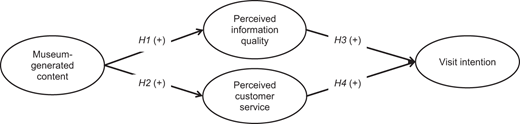
From May 2016 to February 2017, followers of both of the museums’ FFPs were invited to fill in an online survey in Spanish, as both museum FFPs are in this language. Participants were recruited through a non-probabilistic, convenience sampling method (Malhotra and Birks, 2007). Both online questionnaires, one for each museum FFP, were developed using the Google forms tool. Links to the online surveys were published on public posts on both of the museums’ FFPs. Both surveys included an introductory section explaining the project and, to ensure the quality of the study, participants were assured that:
their answers would be anonymous;
the data would be used only for research purposes; and
there were no right or wrong answers; so honest responses were expected (Podsakoff et al., 2003).
A total of 325 questionnaires were received, 172 from the Frida Kahlo and 153 from the Anahuacalli. However, the total number of usable questionnaires received was 308, 163 from the Frida Kahlo and 145 from the Anahuacalli. The 94 per cent response rate for both samples indicates that bias is not a concern (Fowler, 1984; Yuksel et al., 2010). G*Power 3 was used to perform the power analysis (Faul et al., 2007). Both sample sizes guaranteed power for the R2 deviation from zero test because the results in both cases were above 95 per cent for the proposed model (Figure 1) (Cohen, 1988). The statistical power of 163 and 145 for the two groups is acceptable sample sizes. Table I presents details of the socio-demographic profiles of both samples.
Profile of respondents
| Frequency | Percentage | |||
|---|---|---|---|---|
| Characteristics | Frida Kahlo museum FFP followers | Anahuacalli museum FFP followers | Frida Kahlo museum FFP followers | Anahuacalli museum FFP followers |
| Gender | ||||
| Female | 113 | 87 | 69.3 | 60.0 |
| Male | 50 | 58 | 30.7 | 40.0 |
| Age | ||||
| ≤17 | 3 | 3 | 1.8 | 2.1 |
| 18-25 | 22 | 17 | 13.5 | 11.7 |
| 26-35 | 49 | 46 | 30.1 | 31.7 |
| 36-45 | 35 | 45 | 21.5 | 31.0 |
| 46-55 | 37 | 24 | 22.7 | 16.6 |
| 56-65 | 13 | 9 | 8.0 | 6.2 |
| ≥66 | 4 | 1 | 2.5 | 0.7 |
| Education | ||||
| Primary | 2 | 1 | 1.2 | 0.7 |
| Secondary | 7 | 6 | 4.3 | 4.1 |
| Undergraduate/graduate | 105 | 90 | 64.4 | 62.1 |
| Postgraduate | 49 | 48 | 30.1 | 33.1 |
| Nationality | ||||
| National | 100 | 116 | 61.3 | 80.0 |
| Other | 63 | 29 | 38.7 | 20.0 |
| Country of residence | ||||
| Mexico | 101 | 118 | 62.0 | 81.4 |
| Other | 62 | 27 | 38.0 | 18.6 |
| Nª of times visited the museum | ||||
| 1-5 this year | 57 | 52 | 35.0 | 35.9 |
| >5 this year | 11 | 13 | 6.7 | 9.0 |
| I have not visited this year | 45 | 35 | 27.6 | 24.1 |
| Never | 50 | 45 | 30.7 | 31.0 |
| Time spent today on museum FFP | ||||
| 0-5 min | 29 | 37 | 17.8 | 25.5 |
| 6-10 min | 55 | 50 | 33.7 | 34.5 |
| 11-15 min | 30 | 31 | 18.4 | 21.4 |
| >16 min | 49 | 27 | 30.1 | 18.6 |
Table II details the measurement model and the descriptive analysis. In brief, the mean values indicate that the Frida Kahlo Museum and Anahuacalli Museum FFP followers value similarly all the dimensions of the proposed model. Perceived customer service seems to be the least valued factor in the Anahuacalli Museum FFP followers’ sample.
Descriptive analysis
| Frida Kahlo museum FFP followers | Anahuacalli museum FFP followers | ||||
|---|---|---|---|---|---|
| Construct/associated items | Mean | SD | Mean | SD | |
| Museum-generated content (MGC) | |||||
| 1. | The postings that appear on the FFP describe the museum’s objectives | 5,276 | 1,655 | 5,359 | 1,475 |
| 2. | The postings describe values of the museum | 5,129 | 1,706 | 5,276 | 1,497 |
| 3. | The postings describe benefits of visiting the museum | 5,485 | 1,583 | 5,400 | 1,431 |
| 4. | The postings create a positive atmosphere about the museum | 5,933 | 1,339 | 5,731 | 1,406 |
| 5. | The postings create positive emotions about the museum | 5,816 | 1,483 | 5,579 | 1,484 |
| 6. | The postings create positive feelings about the museum | 5,748 | 1,528 | 5,559 | 1,490 |
| Perceived information quality (PIQ) | |||||
| 1. | The information contained in the postings is up-to-date | 5,724 | 1,441 | 5,676 | 1,490 |
| 2 | The information contained in the postings provides me with all the information I need | 5,301 | 1,662 | 5,062 | 1,662 |
| 3. | The information contained in the posting is accurate | 5,638 | 1,477 | 5,462 | 1,438 |
| 4. | The information contained in the posting is high quality | 5,552 | 1,495 | 5,283 | 1,561 |
| Perceived customer service (PCS) | |||||
| 1. | The information contained in the postings contains answers to visitor needs | 5,515 | 1,467 | 4,938 | 1,523 |
| 2. | The information contained in the postings shows that inquiries are answered promptly | 5,055 | 1,724 | 4,786 | 1,731 |
| 3. | The information contained in the postings demonstrates that when a visitor has a problem, the museum shows a sincere interest in solving it | 5,006 | 1,781 | 4,910 | 1,685 |
| Visit intention (VIN) | |||||
| 1. | I would consider visiting the museum because of this FFP | 5,411 | 1,733 | 5,359 | 1,721 |
| 2. | The probability that I would consider visiting the museum is high | 5,644 | 1,553 | 5,538 | 1,549 |
| 3. | My willingness to visit the museum is high | 6,074 | 1,368 | 5,779 | 1,488 |
4. Results
4.1 Model assessment using partial least squares structural equation modelling
SmartPLS (version 3.2.7; Ringle et al., 2015) was used to perform the partial least squares structural equation modelling (PLS-SEM) and MGA analyses, as this nonparametric method is highly appropriate for MGAs (Hair et al., 2014; Henseler et al., 2016; Sarstedt et al., 2011). Moreover, PLS-SEM has a minimum condition regarding sample size, as it is based on ordinary least squares regressions and is less strict when analsying with non-normal data (Hair et al., 2014).
Table III shows the results of the measurement model reliability and convergent validity tests for both samples. Hair et al.’s (2011) benchmarks were followed (Table III): standardized indicator loadings were higher than 0.70, a composite reliability higher than 0.70 assured internal consistency, convergent validity was corroborated by an average variance extracted (AVE) higher than 0.50 and discriminant validity was confirmed, as each construct’s AVE is higher than its squared correlation with any other construct.
Reliability and convergent validity of the measurement model
| Frida Kahlo museum FFP followers | Anahuacalli museum FFP followers | ||||||||||||
|---|---|---|---|---|---|---|---|---|---|---|---|---|---|
| Factor | Indicator | Standardized loading | t-value (bootstrap) | CA | rho_A | CR | AVE | Standardized loading | t-value (bootstrap) | CA | rho_A | CR | AVE |
| MGC | MGC1 | 0.881 | 41,586 | 0.948 | 0.949 | 0.958 | 0.793 | 0.877 | 38,776 | 0.942 | 0.942 | 0.954 | 0.776 |
| MGC2 | 0.829 | 24,467 | 0.862 | 32,273 | |||||||||
| MGC3 | 0.898 | 45,837 | 0.852 | 31,087 | |||||||||
| MGC4 | 0.914 | 49,061 | 0.885 | 31,532 | |||||||||
| MGC5 | 0.914 | 58,346 | 0.906 | 44,583 | |||||||||
| MGC6 | 0.905 | 47,493 | 0.901 | 45,315 | |||||||||
| Perceived information quality | PIQ1 | 0.875 | 35,127 | 0.935 | 0.945 | 0.954 | 0.837 | 0.791 | 12,937 | 0.900 | 0.911 | 0.931 | 0.772 |
| PIQ2 | 0.916 | 58,065 | 0.876 | 25,760 | |||||||||
| PIQ3 | 0.946 | 100,163 | 0.940 | 80,910 | |||||||||
| PIQ4 | 0.922 | 65,086 | 0.900 | 45,426 | |||||||||
| Perceived customer service | PCS1 | 0.850 | 36,678 | 0.854 | 0.872 | 0.910 | 0.771 | 0.852 | 30,217 | 0.854 | 0.861 | 0.911 | 0.774 |
| PCS2 | 0.900 | 29,891 | 0.924 | 60,709 | |||||||||
| PCS3 | 0.884 | 29,686 | 0.861 | 29,325 | |||||||||
| Visit intention | VIN1 | 0.888 | 50,760 | 0.850 | 0.868 | 0.908 | 0.768 | 0.878 | 31,793 | 0.867 | 0.883 | 0.918 | 0.789 |
| VIN2 | 0.886 | 27,416 | 0.924 | 46,586 | |||||||||
| VIN3 | 0.855 | 25,026 | 0.861 | 20,298 | |||||||||
Notes: All loadings are significant at p < 0.01 level. CA = Cronbach’s alpha; CR = composite reliability
4.2 Assessment of the structural model
R2 was assessed to determine the model’s explanatory power (Hair et al., 2014); the dependent constructs of both samples were above 0.10 (Falk and Miller, 1992), presenting substantial values (Cohen, 1988). Also, positive Stone–Geisser’s Q2 were calculated using blindfolding (Henseler et al., 2009), showing good predictive power as the values are above zero (Table V).
4.3 Multi-group analysis
As Henseler et al. (2016) posit, measurement invariance must be tested before performing the MGA. The measurement invariance of composites (MICOM) evaluates the measurement invariance to compare and determine the MGA group-specific differences of PLS-SEM results (Henseler et al., 2016). The assessment of MICOM involves three steps:
a configural invariance assessment;
the establishment of a compositional invariance assessment; and
the assessment of equal means and variances (Rasoolimanesh et al., 2017).
To compare and interpret MGA group-specific differences, at least partial measurement invariance (Steps 1 and 2) should be verified (Henseler, Ringle and Sarstedt, 2016), and we do so in this research (Table VI).
Results of invariance measurement testing using permutation
| Compositionalinvariance(correlation = 1) | Equalmeanassessment | Equalvarianceassessment | |||||||||||
|---|---|---|---|---|---|---|---|---|---|---|---|---|---|
| Constructs | Configuralinvariance(same algorithmsfor both groups) | C = 1 | 5%quantile | Partialmeasurementinvarianceestablished | Differences | Confidenceinterval | Equal | Differences | Confidenceinterval | Equal | Fullmeasurementinvarianceestablished | ||
| Perceivedcustomerservice | Yes | 0.999 | 0.997 | Yes | −0.242 | −0.216 | 0.221 | No | 0.001 | −0.325 | 0.314 | Yes | No |
| Perceivedinformationquality | Yes | 1.000 | 0.999 | Yes | −0.136 | −0.232 | 0.213 | Yes | −0.056 | −0.366 | 0.388 | Yes | Yes |
| MGC | Yes | 1.000 | 1.000 | Yes | −0.066 | −0.223 | 0.201 | Yes | −0.217 | −0.374 | 0.389 | Yes | Yes |
| Visitintention | Yes | 0.999 | 0.998 | Yes | −0.106 | −0.206 | 0.200 | Yes | 0.062 | −0.386 | 0.367 | Yes | Yes |
Table VII shows that the MGA results were determined using two different nonparametric tests: Henseler’s MGA (Henseler et al., 2009) and the permutation test (Chin and Dibbern, 2010). Henseler’s MGA compares group bootstrap estimates from each bootstrap sample, where a p-value lower than 0.05 or higher than 0.95 indicates, at a 5 per cent level, significant differences between specific path coefficients across two groups (Henseler et al., 2009; Sarstedt et al., 2011). The permutation test recognizes differences at the 5 per cent level of significance if the p-value is lower than 0.05.
Hypotheses testing
| Hypothesis | Relationship | Path coefficients | Confidence interval (95%) | Path coefficient difference | p-value difference | ||||||
|---|---|---|---|---|---|---|---|---|---|---|---|
| Frida Kahlo museum FFP followers | Anahuacalli museum FFP followers | Frida Kahlo museum FFP followers | Anahuacalli museum FFP followers | Henseler’s MGA (one-tailed) | Permutation test (two-tailed) | ||||||
| H1 | MGC perceived → information quality | 0.876*** | 0.803*** | 0.821 | 0.914 | 0.704 | 0.863 | 0.073 | 0.950* | 0.110 | |
| H2 | MGC Perceived → customer service | 0.744*** | 0.774*** | 0.625 | 0.829 | 0.689 | 0.833 | 0.029 | 0.338 | 0.772 | |
| H3 | Perceived information quality → visit intention | 0.600*** | 0.164* | 0.373 | 0.803 | −0.040 | 0.334 | 0.436 | 0.997*** | 0.005*** | |
| H4 | Perceived customer → service visit intention | 0.156 | 0.568*** | −0.078 | 0.372 | 0.385 | 0.705 | 0.413 | 0.002*** | 0.012** | |
Notes: In Henseler’s MGA method, the p-value lower than 0.05 or higher than 0.95 indicates at the 5 per cent level significant differences between specific path coefficients across groups.
p < 0.01; **p < 0.05; *p < 0.10
The findings show that MGC has a positive and significant influence on perceived information quality (H1; Frida Kahlo museum FFP followers β = 0.876 p < 0.01; Anahuacalli museum FFP followers β = 0.803 p < 0.01) and on perceived customer service (H2; Frida Kahlo museum FFP followers β = 0.744 p < 0.01; Anahuacalli museum FFP followers β = 0.774 p < 0.01). The results show that perceived information quality has a positive and significant influence on visit intention for both samples (H3; Frida Kahlo museum FFP followers β = 0.600 p < 0.01; Anahuacalli museum FFP followers β = 0.164 p < 0.1). Finally, the results show that perceived customer service has a positive and significant influence on visit intention for Anahuacalli museum FFP followers (H4; β = 0.568 p < 0.01), whereas its influence on Frida Kahlo museum FFP followers is not significant (H4; β = 0.156; p > 0.10).
The permutation method shows that perceived information quality has a higher and significant effect on visit intention to the Frida Kahlo museum than to the Anahuacalli museum (H3; p-value = 0.005 p < 0.01) and perceived customer service on visit intention (H4; p-value = 0.012 p < 0.05), this time being higher for the Anahuacalli museum. In addition, Henseler’s MGA shows differences in the two aforementioned linkages (H3; p-value = 0.997 p < 0.01; H4; p-value = 0.002 p < 0.01) and a small difference between the two museum FFP followers in the relationship between MGC and perceived information quality (H1; p-value = 0.95 p < 0.10), the coefficient being higher for the Frida Kahlo museum. Henseler’s MGA and the permutation method similarly validate the significance and non-significance of the differences, establishing a multi-method confirmation of the results.
5. Discussion and implications
This study adds value to earlier MGC studies by analysing the direct effects of:
MGC on perceived information quality;
MGC on perceived customer service;
perceived information quality on visit intention; and
perceived customer service on visit intention, for two samples, the Frida Kahlo and Anahuacalli museums’ FFP followers.
This research assesses these different relationships of the two museum FFP followers’ samples to identify noteworthy and useful conclusions.
As expected, the results show that MGC has a meaningful and positive influence on perceived information quality (H1) and perceived customer service (H2) in both samples. As some scholars indicate, potential consumers consult social media to gain confidence about their purchase decisions (Goh et al., 2013). The organization should create postings that address customers’ needs (Ye et al., 2011). Although both relationships were found to be significant (with the same size effects) in both samples, Henseler’s MGA showed a slight difference in the linkage between MGC and perceived information quality in the two samples. In the Frida Kahlo case, the path coefficient was found to be slightly higher than for the Anahuacalli sample. This difference could exist because the Frida Kahlo museum is more focussed on controlling the quality and the timeliness of the postings on its FFP (because of its objective of creating an online community) than is the Anahuacalli museum, which is more concerned about providing information about the artist to attract visitors.
The empirical results show that perceived information quality has a significant and positive effect on visit intention (H3), as we anticipated. This finding corroborates prior research regarding the effect of perceived information quality on behavioural intentions (Chiu et al., 2005; Lee and Shin, 2014; Kim and Niehm, 2009; Park et al., 2007) and proves, for the first time, this positive effect in FFPs and in relation to visit intention. In addition, this linkage was compared between the two samples. Interestingly, Henseler’s MGA and the permutation method results show differences between the two museum FFP followers. The effect size of this relationship is higher in the Frida Kahlo case than for the Anahuacalli sample. This difference could be explained by the fact that its followers might consider that the information offered in Frida Kahlo museum FFPs is more oriented towards up-to-date and accurate postings aiming at creating an online community, whereas Anahuacalli FFP followers may perceive the data as more focused on Diego de Rivera, and his donations of pre-Columbian art pieces to the museum, to attract visitors.
Although the linkage between perceived customer service and visit intention has not been widely examined (H4) (Zeng et al., 2009), the results for the Anahuacalli museum FFP followers show a positive and significant effect. However, this relationship was found to be insignificant for the Frida Kahlo sample. Accordingly, Henseler’s MGA and permutation method results show a difference between the two samples. In accordance with the previous discussion, it seems that the Anahuacalli museum aims to attract visitors, which explains why the museum FFP is devoted to promptly addressing visitors’ needs, inquiries and problems. The insignificant effect found in the Frida Kahlo sample could be because the museum’s FFP objective is to create an online community. However, the updated and accurate postings (i.e. perceived information quality) of the Frida Kahlo museum FFP have a positive effect on visit intention, as the information fosters users’ interest in visiting the museum.
This research provides many theoretical contributions related to MGC, perceived information quality, perceived customer service and visit intention. First, no study has been found that examines the impact of the perceived information quality and perceived customer service of FFPs’ postings on visit intention. This study proposes a model to examine these linkages and the effects of MGC on perceived information quality and perceived customer service, which are also analysed for a first time in the FFP context. Second, Henseler’s MGA and the permutation method evidence that there are significant differences between the two samples in the direct impacts of perceived information quality on visit intention and perceived customer service on visit intention. These findings can add value to future research into this topic. Third, this study contributes to social network site literature and to tourism research, as it tests these effects with two samples using PLS-MGA.
The present research also provides useful information for museum managers and staff responsible for boosting visitor numbers. First, we found that MGC has a positive impact on perceived information quality and perceived customer service. Owing to this finding, in relation to the effects of marketer-generated content, it is recommended that both museums encourage followers’ postings (e.g. sharing photographs of ambient marketing actions or photo calls). Where there are frequent postings from followers, organizations can facilitate dialogue and offer information and service that meets their customers’ needs. The internet has changed the customer journey, and there is a need to give information to the customer at the different stages of the process (Lemon and Verhoef, 2016). Therefore, museums should foster MGC (Buhalis and Law, 2008; Hofacker and Belanche, 2016; Yoo and Gretzel, 2017). Social media enable museums to engage with a worldwide network of potential visitors. These potential visitors can take part in the design and production of the museum’s cultural services through their postings; this might also maximize their museum experience (Camarero et al., 2018; Padilla-Melendez and Del Aguila-Obra, 2013; Vassilakis et al., 2017).
Second, we find that perceived information quality positively and significantly influences visit intention. As information quality is considered a determinant of behavioural intentions in the online context (Kim et al., 2017), it would be interesting to link the news and information related to the two artists appearing in other media sources and post this on the FFPs, so that their followers perceive the FFP as a source of updated information. For instance, Mattel Inc has recently launched a Frida Kahlo Barbie doll, and Emoji has launched a FridaMoji. News or information about these two developments might be of interest to FFP followers and could be posted on the FFPs. Specifically, as suggested by Camarero et al. (2018), content – informative and entertaining – and relational – interactive – Facebook communications should be encouraged to prompt followers to comment (UGC), share and like (virality).
The Frida Kahlo museum posts photos when celebrities or famous persons visit the museum. Both museums could make use of ambient marketing strategies to increase the number of photos shared by visitors in social media, following the example of the Museum of Art of Sao Paolo and the Museum of Ice Cream. Moreover, Pallud (2016) points out that mobile applications allow professionals to interact with potential visitors in real time. In this way, the museums could identify influential followers who have visited the museum and who might facilitate interactions with other followers. The influential followers might answer questions and enrich the FFPs with their opinions of the museum experience (Casalo et al., 2017a; 2018; Hofacker and Belanche, 2016).
Third, we found that perceived customer service has a positive and significant effect on visit intention in the Anahuacalli case. Although this was not proved for the Frida Kahlo museum, many researchers note that social network sites are being used as tools to improve perceived customer service tools (Gallaugher and Ransbotham, 2010; He et al., 2016; Kietzman et al., 2011). As organizations must respond quickly to customers’ needs and desires, we suggest that both museums periodically carry out benchmarking exercises to ensure they are following best practices, not only against museums but also other edutainment contexts (Recuero et al., 2017).
5.1 Limitations and future research lines
There are limitations to this study. First, the samples are followers of two Mexican museums; this can lead to bias, as they may not be reflective of the general context for all museums. Also, the samples are mainly made up of women. In consequence, we encourage researchers to test samples in museums in other parts of the world and to use the same proportion of female and male respondents. Second, the samples are mainly Mexican nationals, and hence, it would be very useful for scholars to analyse the proposed model with samples including a higher percentage of international followers. Third, the multi-group comparison shows differences between the two museum FFPs’ followers and, therefore, scholars are encouraged to analyse the proposed model in other contexts. Moreover, as Instagram is growing in user numbers, it would be interesting for scholars to study that platform (Casalo et al., 2017b); for instance, by analysing the symbolic consumption of these experiences and the use of Instagram (Luna-Cortes, 2017), considering Casalo et al.’s (2017a) model that posits a perception–evaluation–intention chain that could also include visit intention. Also, the role of opinion leadership on visitor behavioural intentions might be examined (Casalo et al., 2018). Fourth, scholars are encouraged to include a control variable that takes into account the phase of the customer journey the respondents are in when they answer the questionnaire, to gain knowledge regarding the drivers of visit intention at each stage. Other aspects could be considered to analyse their impact on behavioural intentions, such as factors that improve website design (i.e. appearance, navigation, content and shopping process) (Flavian et al., 2009a, 2009b). Fifth, our research focus was to analyse these relationships between the Frida Kahlo museum and Anahuacalli museum FFPs, but we suggest scholars conduct a multi-group comparison that examines the differences between marketer-generated content and UGC to discover how to boost visit intention among FFP users.
Measurement model discriminant validity
| Factor | 1 | 2 | 3 | 4 | |
|---|---|---|---|---|---|
| Frida Kahlo museum FFP followers | |||||
| 1 | Perceived customer service | 0.878 | |||
| 2 | Perceived information quality | 0.724 | 0.915 | ||
| 3 | Museum-generated content | 0.744 | 0.876 | 0.891 | |
| 4 | Visit intention | 0.591 | 0.713 | 0.750 | 0.876 |
| Anahuacalli museum FFP followers | |||||
| 1 | Perceived customer service | 0.880 | |||
| 2 | Perceived information quality | 0.716 | 0.878 | ||
| 3 | Museum-generated content | 0.774 | 0.803 | 0.881 | |
| 4 | Visit intention | 0.686 | 0.571 | 0.729 | 0.888 |
Note: Fornell – Lacker criterion
The authors would like to thank the Frida Kahlo and Diego Rivera Anahuacalli museum teams for their support, especially the Director of both museums, Hilda Trujillo and Ximena Jordán.

