


This study aims to analyze consumer motivations to share information about corporate social responsibility (CSR) activities through electronic word of mouth. It examines the roles of self-enhancement, identity signaling and social bonding as antecedents of consumers’ CSR engagement on social media.
A quantitative approach is used with a single-factor between-subjects experimental design in which the presence vs absence of CSR information on a company website is manipulated. The hypotheses are tested through structural equation modeling.
Results show that after viewing the company’s CSR message on its website, consumers who generated more CSR associations were more motivated to engage with the CSR information to satisfy fundamental personality traits (need for self-enhancement) and social relationship motivations (social bonding), which increased their intention to share the information.
This study is restricted to CSR information on websites. Further research should consider what happens if such information is shared on social media, as consumers are more likely to spread CSR messages when they are shared by other public social network sites.
The study highlights the relevance of including CSR information on websites and offers insights into the importance of considering consumers in disseminating CSR information. Consumers share information when they have personal motivation for doing so.
This study put the focus on the role of consumers in the diffusion of corporate information.
The results show the importance of personal motivations such as self-enhancement and social bonding in sharing CSR information on social media.
El estudio analiza las motivaciones que tiene el consumidor para compartir información sobre acciones de responsabilidad social corporativa (RSC) a través de boca oído electrónico (eWOM). En particular, las motivaciones de mejora del auto-concepto, necesidad de mostrar una identidad deseada y la vinculación social.
Se utiliza un diseño experimental entre sujetos donde se manipuló la presencia vs ausencia de información sobre la RSC de la empresa. Las hipótesis se contrastaron mediante un modelo de ecuaciones estructurales.
Los resultados muestran que los consumidores con más asociaciones de RSC comparten más la información de RSC motivados por satisfacer la mejora del auto-concepto y vinculación social.
El estudio destaca la importancia de generar contenido de RSC en el sitio web de la empresa, y la importancia de los consumidores en la difusión de información de dicha información.
El estudio está restringido a la presencia de información de RSC en el sitio web de la empresa. Sería interesante evaluar lo que sucede si dicha información se comparte en redes sociales, en la medida en que los consumidores tienen mayor tendencia a compartir la información procedente de redes sociales.
Los resultados muestran la importancia de las motivaciones personales como la mejora del auto-concepto y la vinculación social a la hora compartir información de RSC en las redes sociales.
本研究分析了消费者通过电子口碑分享企业社会责任(CSR)活动信息的动机。它研究了自我提升、身份信号和社会联系作为消费者在社交媒体上参与企业社会责任的前因的作用。
采用单因素主体间实验设计的定量方法, 对公司网站上企业社会责任信息的存在与否进行操纵。假设通过使用R软件包lavaan的结构方程模型进行检验。
结果显示, 在观看公司网站上的企业社会责任信息后, 产生更多企业社会责任联想的消费者更有动力参与到企业社会责任信息中, 以满足基本的人格特征(自我提升的需要)和社会关系动机(社会纽带), 这增加了他们分享信息的意向。
该研究强调了将企业社会责任信息纳入网站的相关性, 并对在传播企业社会责任信息时考虑消费者的重要性提出了见解。消费者在有个人动机的情况下会分享信息。
本研究仅限于网站上的企业社会责任信息。进一步的研究应该考虑到社交媒体, 因为当消费者在其他公共社交网站上分享企业社会责任信息时, 他们更有可能进行传播。
研究结果表明, 在社交媒体上分享企业社会责任信息时, 自我提升和社会联系等个人动机的重要性。
1. Introduction
Today, people expect organizations to be socially engaged (de Jong and van der Meer, 2017), being corporate social responsibility (CSR) activities of great interest to consumers. CSR activities refer to voluntary actions aimed at furthering a social good, countering a social ill or addressing the externalities of a company’s operations in the world (Brown and Dacin, 1997). Nowadays, customers demand information about the company’s CSR activities (Pérez et al., 2020). In this context, the generation of messages related to CSR activities is a key element in CSR communication (Liu et al., 2020; Chu et al., 2020). CSR communication has been defined as “communication that is designed and distributed by the company itself about its CSR efforts” (Kim, 2019). Yet while the communication of CSR activities is an essential part of a company’s CSR impacts (Pérez et al., 2020), relatively little attention has been paid to the CSR communication aspect (Kim and Ferguson, 2018).
Most communication activities in this domain have focused on the creation of CSR reports or their distribution among shareholders in annual meetings. However, new media such as websites and social network sites (SNSs) are crucial for such communication as they are based on collective intelligence, collaboration, voluntariness, transparency and commitment (Castelló-Martínez and Ros-Diego, 2012). Since consumers in online environments are increasingly able to participate, share and collaborate (Chu et al., 2020), companies may benefit from more interactions with them (Liu et al., 2019). In addition to communicating brand-related messages, companies can communicate their CSR efforts to develop stronger bonds with consumers.
Recent research in CSR communication has examined the presence of CSR information on company websites with a focus on message design, information specificity and social topic awareness as antecedents of attitude toward the communication (Pérez et al., 2020). However, few research studies have focused on the motivations to share CSR information online. Previous research has identified fundamental personality traits and social relationship motivations as antecedents of electronic word of mouth (eWOM) behavior (Mishra et al., 2018; Taylor et al., 2012; Ho and Dempsey, 2010; Hennig-Thurau et al., 2004). The goal of this paper is, therefore, to provide a comprehensive understanding of the role of social and identity motivations in the development of CSR engagement with a company on SNSs. We propose that sharing CSR information may help individuals to improve how they perceive themselves or how others see them. More specifically, consumers’ needs for self-enhancement, identity signaling and social bonding are studied as antecedents of CSR engagement on SNSs.
Self-enhancement refers to an improvement in the sender’s image of themselves. People will talk more comfortably about things that help them to improve their self-concept (Ho and Dempsey, 2010; Packard and Wooten, 2013). Identity signaling refers to a specific identity that the sender wishes to communicate. People are more likely to provide information about things that help them to express a desired personality (Berger, 2014). Finally, social bonding refers to the sender’s need to belong (Schutz, 1958). People will share more information on topics that help them to connect with others (Rimé, 2009).
Through an experimental design, we demonstrate that the presence of CSR messages on the company website increases CSR associations, leading to higher motivations to share CSR information based on consumers’ needs for self-enhancement, identity signaling and social bonding. This study makes important contributions to the CSR communication literature. First, it highlights the role of consumers in disseminating CSR information and their involvement with CSR communication. In addition, it approaches the study of eWOM in the CSR domain, identifying important motivations based on fundamental personality traits and social factors as antecedents of engagement behavior on social media.
The following sections review the key concepts, formally propose the hypotheses and present the methodology in detail. The main results are then reported, and both the theoretical and managerial implications are discussed.
2. Theoretical development and hypotheses
2.1 Consumers’ engagement in corporate social responsibility communication
As CSR has become commonplace for companies, CSR professionals have realized that the activities require more than simply informing consumers about them; they also need to engage consumers in CSR initiatives, as they are the ultimate target audience whose behavior the program seeks to impact (Lee et al., 2019). Consumer engagement describes a customer’s resource investment in his/her brand interactions (Kumar et al., 2019, p. 141). For example, active engagement involves consumers following the website of a particular brand (Le, 2021). In this sense, their engagement in CSR may not be restricted to the activities per se but also apply to their interaction with the information about those activities.
Companies use different channels to convey their CSR messages and engage with consumers. The most used are mass media, corporate offline and online channels, interpersonal communication and CSR reports (Lee et al., 2019). However, the use of social media to communicate CSR messages may enhance their effectiveness due to the ease with which messages can be shared with general stakeholders (Chu et al., 2020). Consumers, therefore, develop an active role in the dissemination of CSR information that leads them to engage with the company by spreading its CSR messages.
According to Lee et al. (2019), consumers are more aware of companies’ CSR actions when the information is communicated through social media (such as websites and SNSs), compared to when companies use traditional media (such as television or CSR reports). On SNSs, consumers are free to express their opinions about the CSR activities and the company without the latter’s consent (Chu et al., 2020). Thus, social media, and especially SNSs, enables organizations to deliver CSR messages and stories to different stakeholders and engage them in dialogue (Lee et al., 2019). In this context, consumers’ engagement with CSR communication on social media is a form of eWOM behavior as users receive, create or share information about a brand’s CSR activities (Chu et al., 2020). Based on this definition, previous studies (Sicilia et al., 2020; Luarn et al., 2015) have measured consumers’ engagement on SNSs through the intention to interact with a message by clicking the “Like” button, commenting on and/or sharing it. In this sense, if the company targets a segment of engaged consumers with its CSR communication (Chu et al., 2020), they will be willing to talk to others about the company’s socially responsible activities.
2.2 The generation of corporate social responsibility associations
CSR communication is a significant antecedent of consumers’ CSR associations (Brown and Dacin, 1997). These associations refer to consumers’ perceptions of the company’s commitment to CSR (Lee et al., 2019). They include consumers’ knowledge about the company’s “status and activities with respect to its perceived social obligations” (Brown and Dacin, 1997, p. 68). In sum, consumers’ CSR associations with a company could be considered their socially responsible image of that company (Lee and Kim, 2017).
The company will be interested in generating CSR associations to the extent that previous literature has shown that they positively influence consumers’ responses to the company’s products and its brands, such as a more positive view of the company (Pérez et al., 2020), higher brand involvement and higher consumer–company identification (Liu et al., 2014; Pérez et al., 2020).
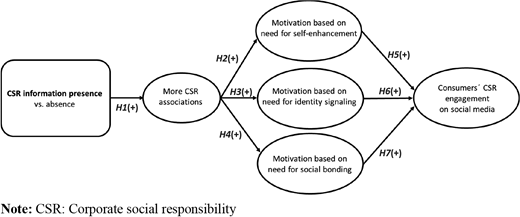
Moreover, consumers exposed to communication about the company’s CSR activities increase their CSR awareness (Öberseder et al., 2011). It is expected that subjects who are aware of a company’s CSR initiatives will have stronger associations regarding the CSR domains in which the company is developing its activities (Badenes-Rocha et al., 2019). In this context, social media offers consumers additional opportunities to be aware of the company’s CSR initiatives (Lee et al., 2019). Therefore, the communication of CSR messages through different social media, such as social networks and company websites, will favor the generation of CSR associations. As such, we propose that the presence of information about the company’s CSR activities on the company website will favor more CSR associations. More specifically:
The presence (vs. absence) of corporate social responsibility information on the company website will positively influence the generation of CSR associations by consumers.
2.3 Motivations to share corporate social responsibility information online
The process of sharing any positive or negative comment about a product or company, which is then available to many people and institutions online, is called eWOM (Hennig-Thurau et al., 2004, p. 39). The eWOM literature has explored the motivations involved when consumers share information about their consumption experiences (Berger, 2014; Hennig-Thurau et al., 2004; Chu et al., 2019). However, there is scant research regarding consumers’ intention to share other types of information, such as information related to the company’s CSR efforts (Chu et al., 2020).
eWOM literature has suggested that social factors (e.g. sociality and desire for social interaction) and fundamental personality traits (e.g. need for self-enhancement) are key drivers that impact consumers’ decisions to engage in eWOM behavior (Chu et al., 2019). These are especially relevant to SNSs, as they represent an emerging form of socialization agent that expedites the eWOM process because peers can connect and share information quickly and easily (Chu et al., 2020). Thus, in social media, consumers create content, and read and comment on public posts to enhance their self-presentation (Mishra et al., 2018). According to Taylor et al. (2012), by sharing a brand-related message, consumers may transfer some meanings inherent in the brand to their self-concepts. Taylor et al. (2012) considered self-enhancement as the key issue to explain the sharing of online advertising. Similarly, and based on Social Identity Theory (Tajfel et al., 1971), Chu et al. (2019) identified the need for self-enhancement and a sense of belonging as key factors explaining eWOM on the Chinese social network WeChat. More recently, Ismagilova et al. (2020) also recognized personal and social status as antecedents of eWOM-providing behavior.
Individuals may share CSR messages to use the positive perceptions of CSR to satisfy their psychological needs, to manage the image others have of them or even to establish relationships with others on social media. In this sense, a recent study by Chu et al. (2020) indicated that, due to the increasing interplay between CSR and social media, consumers’ eWOM-providing behaviors related to CSR are influenced by peers. This may be explained by the Meaning Transfer Theory (McCracken, 1989), wherein the meaning of one object (i.e. CSR information) may be transferred to another (i.e. the individual) and a positive shared association is created from a well-developed relationship between the two (i.e. sharing this information on SNSs). That is, when an individual shares CSR information, they are trying to associate themselves with CSR meanings by a transfer of meanings. In sum, these meanings will help individuals to manage their image for themselves and others and to establish relationships with others. Therefore, based on previous research (Chu et al., 2020; Chu et al., 2019; Taylor et al., 2012), we propose that consumers share CSR information to undertake impression management (self-enhancement and identity signaling) and based on their desire for social interaction (social bonding).
Impression management refers to “the process in which people try to manage and control other people’s impressions of themselves” (Zhou et al., 2020, p. 4). In essence, individuals would be interested in sharing CSR messages principally because of how this information contributes to the consumer needs for self-enhancement and identity signaling. Self-enhancement refers to improving self-concept, which is, improving an individual’s image of themselves (Ho and Dempsey, 2010). Thus, sharing meanings of themselves with others can contribute to an individual’s positive self-image (Taylor et al., 2012). In this sense, people share information that makes them look good instead of portraying them in a negative way (Berger, 2014), and CSR information falls into this category. Therefore, consumers’ perceptions about a company’s CSR engagement may influence their intention to provide positive eWOM (Fatma et al., 2020).
In online environments, previous studies have shown that people talk more comfortably about things that help their self-concept and improve their self-perception (Ho and Dempsey, 2010; Packard and Wooten, 2013). It has been widely demonstrated in the context of e-tourist platform use (e.g. Booking.com) that telling others about a satisfactory experience reinforces the consumer’s self-concept of “smart shopper” (Chu et al., 2019; Yang, 2017). However, they are also more likely to identify with highly socially responsible activities to express ethical or moral values that enhance their self-esteem (Fatma et al., 2020). Based on this reasoning, we propose that individuals with a higher number of CSR associations are more motivated to share CSR messages on SNSs to enhance themselves. Therefore, we propose:
As corporate social responsibility associations increase, consumers will be more motivated to share corporate social responsibility messages based on self-enhancement.
Sharing information with others allows individuals to communicate specific identities, both to themselves and others. According to Berger (2014), this enables individuals to have a better image of themselves, which, when sharing it, they can also project to others. Therefore, identity signaling explains why people are more likely to provide eWOM about some products or topics. In this sense, talking about particular topics provides information about people’s preferences as others may infer that they have certain knowledge or concerns in a particular domain (Kim and Ko, 2012).
For CSR information, individuals may be motivated to share CSR messages because they can project a desired identity to others. If someone talks about a CSR activity, others may infer that they are socially responsible, ethical and concerned with others’ well-being. Self-identity motivation is, therefore, a relevant behavioral driver in the context of both CSR and social media (Hartmann et al., 2021). As such, individuals with higher CSR associations with a particular brand will be more motivated to share that brand’s CSR messages to associate themselves with social issues such as social welfare or ethical responsibility. Therefore, we propose:
As corporate social responsibility associations increase, consumers will be more motivated to share corporate social responsibility messages based on identity signaling.
In addition, sharing information may help people to connect with others (Rimé, 2009). According to the Need to Belong Theory (Schutz, 1958), social inclusion is a personal need (Ho and Dempsey, 2010). Nowadays, SNSs offer a very easy way to integrate with others who have something in common and share information and thus become permanently connected with them (Liu et al., 2021; Gvili and Levy, 2018). “Likes” and “shares” associated with a post can serve as positive social cues that signal the post’s validity and others’ collective endorsement (Chu et al., 2020; Kim and Xu, 2019). As a result, individuals are motivated to share a specific message or associate themselves with that message (giving likes) if those behaviors increase their sense of belonging to a community.
The positive associations of CSR messages will foster individuals’ motivation to share them for social bonding reasons, that is, to be part of a community, as there is a high probability of other individuals also showing a positive evaluation of this type of information. In addition, CSR messages are related to emotional content (Lee and Chung, 2018). In this sense, sharing an emotional story or narrative increases the likelihood of others feeling similarly (Berger, 2014). Thus, individuals may enhance their connections with others by talking about CSR activities (Hall et al., 2021). We, therefore, contend that when CSR associations increase, individuals will be more motivated to share the CSR message for social bonding reasons. Thus, we propose the following hypothesis:
As corporate social responsibility associations increase, consumers will be more motivated to share corporate social responsibility messages based on social bonding.
2.4 The influence of motivations to share corporate social responsibility messages on consumers’ engagement
Companies are interested in increasing consumers’ likelihood of spreading positive comments about their CSR communication campaigns. In other words, they are interested in improving the marketing performance of the CSR messages. In this sense, the literature has shown that specific behaviors such as likes, shares and comments are easy measurements of brand engagement on social networks (Sicilia et al., 2020).
While consumers’ eWOM intention about CSR messages on social media is determined by the company’s CSR efforts (Fatma et al., 2020), research and companies will benefit from a greater understanding of the process by which consumer knowledge about the company’s CSR commitment is converted into eWOM. Based on the rationale of the Meaning Transfer Model (McCracken, 1989), the actions of consumers on SNSs are associated with their endorsement of some particular content. For information related to the CSR activity of a company, clicking like, sharing the information or making a comment are behaviors that help consumers to communicate who they are and to establish relationships with similar peers (Nelson-Field et al., 2012). Therefore, this study proposes that when consumers are motivated to share CSR messages for self-enhancement, identity signaling and social bonding, their engagement with CSR communication in social media will be higher. Thus, the following hypotheses are proposed:
As self-enhancement motivation to share corporate social responsibility messages increases, consumers’ engagement in corporate social responsibility communication will be higher.
As identity signaling motivation to share corporate social responsibility messages increases, consumers’ engagement in corporate social responsibility communication will be higher.
As social bonding motivation to share corporate social responsibility messages increases, consumers’ engagement in corporate social responsibility communication will be higher.
The proposed conceptual model is presented in Figure 1.
3. Methodology
3.1 Study design and data collection
We used a one-factor between-subjects experimental design, with the presence of CSR information on the company website manipulated (presence vs absence). The sampling procedure consisted of a nonprobabilistic, convenience sampling method (Malhotra et al., 2017; Mo et al., 2018). A total of 181 undergraduate students enrolled at a university in southeastern Spain participated for extra course credit. The data were collected in December 2017. Students from several undergraduate marketing courses were contacted and instructed to go to a computer lab to participate in the study.
Several key decisions were made when generating appropriate stimuli for the experiment. First, we had to select a company that conducted CSR activity. eWOM has a strong impact in hospitality-related industries (Hernández-Maestro, 2020), as they market intangible services that cannot be evaluated before the consumption experience, such as restaurant services (Jeong and Jang, 2011). Eighty percent of consumers in Spain search online reviews before choosing a restaurant (Esteve, 2018), and 50% visit its website first (Fundación Cruzcampo, 2018). In addition, bars and restaurants are usually frequented by young university students (in Spain, 64.3% of visits are made by individuals aged between 18 and 34) (Esteve, 2018). This is congruent with the age range of social network users in Spain, who are mainly young people aged between 16 and 24 (IAB Spain, 2020). Therefore, we selected a restaurant as the research context.
Second, to select a specific restaurant, a pretest was conducted with 40 students from the same university. We asked them to list the restaurants they had visited with their friends and their opinions about them. Among them, we selected a regional chain of restaurants. We also checked that the restaurant had its own online media: website and a profile on the main social networks: Facebook, Instagram and Twitter.
The third decision is related to the CSR action to be associated with the company. CSR activities are usually connected with the core business of the company (de Jong and van der Meer, 2017). In this sense, Jochim et al. (2015) supported the need for quick-service restaurants to closely fit with the makeup of the community in which they are located, attending to the social factors. Therefore, the CSR activity designed was the donation of 10 daily meals to a well-known charity foundation in the city.
We introduced the CSR information in an ad hoc and offline replica version of the company’s website. We created two stimuli based on the corporate website (Badenes-Rocha et al., 2019). In one of the ad hoc websites, the subjects were exposed to a message describing the restaurant’s CSR initiative: “The restaurant is collaborating with ‘XXXX Foundation’ by donating 10 daily meals.” For the other website stimulus, there was no CSR information. All other aspects remained constant.
3.2 Procedure
First, the participants were informed of the purpose of the study. They were then asked about their attitude toward quick-service restaurants and whether they knew “XXXX restaurant.” Once the individuals had confirmed that they knew it, the following instruction was given: “Imagine that you are planning to go out with your friends for dinner and you visit ‘XXXX restaurant’ website to see the menus it offers. This is the image that you find on the first screen.” After this, they were randomly assigned to one of the two stimuli. Subsequently, the participants completed the questionnaire.
3.3 Measures
Seven-point Likert scales were adapted from the literature to measure the constructs used in this study. Consumers’ CSR engagement on social media was measured with four items adapted from Eelen et al. (2017). Motivation based on the need for self-enhancement was measured using seven items adapted from Packard and Wooten (2013) and Hennig-Thurau et al. (2004). Motivation based on the need for identity signaling was measured using three items adapted from Berger and Heath (2007). Motivation based on the need for social bonding was measured with seven items adapted from Hennig-Thurau et al. (2004) and Wetzer et al. (2007). Finally, following Brown and Dacin (1997), CSR associations were measured using four items.
Regarding the control variables, attitude toward the restaurant was measured with five items in a seven-point differential semantic scale based on Gardner (1985). A manipulation check was also carried out asking individuals to recall the scenario assigned to them and then indicate whether or not information about CSR activities appeared on the restaurant website. A dummy variable in the database for each participant indicated whether they saw the website stimuli with (1) or without (0) CSR information.
4. Results
4.1 Sample characteristics and manipulation check
The age of the participants ranged from 18 to 45 years. The mean age was 22.77 years, and 57.46% of the participants were male (see Table 1). No significant differences were found among the experimental conditions for these variables (p > 0.10). In addition, the participants showed a good attitude toward restaurants (M = 5.46, standard deviation [SD] = 1.26, α = 0.96), and the majority (89.5%) had visited the specific restaurant and showed a good attitude toward it (M = 5.63, SD = 1.22, α = 0.95). The subjects spent more than three hours a day on social media (M = 4.76) and also had a very positive attitude toward CSR-related issues (M = 6.21, SD = 1.09, α = 0.93).
Demographics of the participants
| Variable | Frequency | % |
|---|---|---|
| Gender | ||
| Male | 104 | 57.46 |
| Female | 77 | 42.54 |
| Total | 181 | 100 |
| Age | ||
| 19–25 | 161 | 88.95 |
| 36–45 | 20 | 11.05 |
| Attitude toward the category restaurants α = 0.96 | ||
| 1–3 | 20 | 11.05 |
| 4–7 | 161 | 88.95 |
| Visit the specific restaurant | ||
| Yes | 162 | 89.50 |
| No | 19 | 10.50 |
| Attitude toward the restaurant α = 0.95 | ||
| 1–3 | 14 | 7.73 |
| 4–7 | 167 | 92.24 |
| Total | 181 | 100 |
To control for the manipulation, we evaluated the extent to which the participants recalled the scenario to which they were assigned; most of them did recall it (86%). The majority of the participants (75%) also responded that they “agreed” that “XXXX restaurant” donated or collaborated with the “XXXX Foundation.” Finally, 88% of the participants correctly pointed out that the CSR action developed by “XXXX restaurant” was “food donation.”
4.2 Common method variance
Common method bias was assessed to ensure the validity of the study results. It can be avoided using appropriate procedural and statistical techniques (Malhotra et al., 2017; Mo et al., 2018). Regarding the procedural techniques, several remedies were implemented:
The questionnaire was pretested.
The participants were informed that their answers would be treated anonymously.
The participants were told that there were no right or wrong answers.
They were encouraged to answer questions as honestly as possible (Malhotra et al., 2017).
Second, regarding the statistical techniques, we modeled all items as indicators of a single factor representing the common method effect. Confirmatory factor analysis (CFA) showed very poor fitness [χ2(252) = 1706.018, p = 0.000, NNFI = 0.576, IFI = 0.611, CFI = 0.556, TLI = 0.576, RMSEA = 0.196, SRMR = 0.128] compared with the original measurement model. These results suggested that common method bias was not a concern in this study.
4.3 Scale validation
The unidimensionality of each construct was assessed via CFA using the R package lavaan (Rosseel, 2012) and semTools (Jorgensen et al., 2020). The fit of the measurement model was acceptable [χ2(242gl) = 555.087, p = 0.000, χ2/df = 2.293, RMSEA = 0.085, SRMR = 0.075, CFI = 0.917, NNFI = 0.905, GFI = 0.766, NFI = 0.862] (Iacobucci, 2010). Despite this, one item (“I feel like a more knowledgeable person”) from the scale of motivation based on the need for self-enhancement showed a factor loading of 0.419. Following Bagozzi and Heatherton’s (1994) suggestions, the item was eliminated, and a second CFA was run. In this analysis, we found two items with factor loadings below 0.7 but did not remove these items as the composite reliability (CR) and average variance extracted (AVE) coefficients of the corresponding scales were acceptable, and both factor loadings were significant (p < 0.001) (Bagozzi and Heatherton, 1994). All of the Cronbach’s α and CR coefficients were greater than 0.70 (Hair et al., 1994). In addition, we found a large error covariance between items motsb1 and motsb2. Following Höllig et al. (2020), we added one error covariance. The new CFA model fit the data better [χ2 (219gl) = 428.026, p = 0.000, χ2/gl = 1.95, RMSEA = 0.073, SMRS = 0.076, CFI = 0.944, NNFI = 0.935, GFI = 0.802, NFI = 0.892] (see Table 2).
Measurement model evaluation
| Construct/Items | Loadings | SD |
|---|---|---|
| Consumers’ CSR engagement on social media adapted from Eelen et al. (2017) CA: 0.834; CR: 0.840; AVE: 0.570 | ||
| I will share the publication on social networks | 0.836 | 0.037 |
| I will send a message to my contacts with a comment on this publication | 0.759 | 0.043 |
| I will like this publication | 0.688 | 0.040 |
| I will comment on this publication | 0.727 | 0.058 |
| CSR associations adapted from Brown and Dacin (1997) CA: 0.957; CR: 0.959; AVE: 0.853 | ||
| The restaurant directs part of its budget to social causes | 0.924 | 0.015 |
| The restaurant shows its commitment towards society | 0.947 | 0.014 |
| The restaurant is socially responsible | 0.886 | 0.025 |
| The restaurant supports a good cause | 0.936 | 0.018 |
| Motivation based on the need for self-enhancement adapted from Packard and Wooten (2013) and Hennig-Thurau et al. (2004) CA: 0.922; CR: 0.926; AVE: 0.678 | ||
| Sharing the information boosts my self-esteem | 0.928 | 0.014 |
| Sharing the information leaves me feeling good about myself | 0.934 | 0.012 |
| By sharing the information, I can express my joy about a good restaurant | 0.822 | 0.036 |
| I feel good when I can tell others I visited the restaurant | 0.765 | 0.036 |
| By sharing the information, I can tell others about a great initiative | 0.682 | 0.044 |
| Sharing the information makes me feel like a clever person | 0.781 | 0.038 |
| Motivation based on the need for identity signaling adapted from Berger and Heath (2007) CA: 0.912; CR: 0.914; AVE: 0.781 | ||
| By sharing the information, I can tell others about my likes | 0.850 | 0.024 |
| By sharing the information, I can express my identity | 0.914 | 0.022 |
| By sharing the information, I allow others to know about me | 0.886 | 0.026 |
| Motivation based on the need for social bonding adapted from Hennig-Thurau et al. (2004) and Wetzer et al. (2007) CA: 0.929; CR: 0.921; AVE: 0.666 | ||
| Sharing the information allows me to interact with people who have the same interests as me | 0.664 | 0.050 |
| By sharing the information, I can chat with people like me | 0.754 | 0.037 |
| Sharing the information allows me to start a conversation | 0.727 | 0.039 |
| By sharing the information, I wanted to strengthen the bond with my conversation partner | 0.948 | 0.013 |
| By sharing the information, I hoped to get closer to my conversation partner | 0.965 | 0.008 |
| By sharing the information, I wanted to let my conversation partner know that he/she is important to me | 0.795 | 0.057 |
Notes:
CA: Cronbach’s alpha; CR: composite reliability; AVE: average variance extracted, SD: standard deviation
Regarding discriminant validity, two approaches were used. First, the AVE for each construct was compared with the squared correlation between construct pairs (Hair et al., 1994). Table 3 shows that, for all measures, the AVE exceeded the squared correlations. Second, the confidence interval was calculated at plus or minus two standard errors around the correlation between the factors (Hair et al., 1994). None of the confidence intervals in the analysis included 1. These two tests provided evidence for the discriminant validity of the measures.
Discriminant validity measures
| Construct | Mean | 1 | 2 | 3 | 4 | 5 |
|---|---|---|---|---|---|---|
| 1. Consumers’ CSR engagement on social media | 3.03 | 0.570 | 0.117; 0.433 | 0.624; 0.808 | 0.446; 0.694 | 0.40; 0.676 |
| 2. CSR associations | 4.59 | 0.076 | 0.853 | 0.316; 0552 | 0.134; 0.438 | 0.152; 0.452 |
| 3. Motivation based on the need for self-enhancement | 2.81 | 0.513 | 0.191 | 0.678 | 0.678; 0.838 | 0.487; 0.727 |
| 4. Motivation based on the need for identity signaling | 3.22 | 0.325 | 0.082 | 0.572 | 0.781 | 0.546; 0.762 |
| 5. Motivation based on the need for social bonding | 3.15 | 0.289 | 0.096 | 0.379 | 0.445 | 0.666 |
Notes:
AVE along the diagonal. Squared correlation coefficients below the diagonal. Confidence intervals above the diagonal
4.4 Multivariate analysis
To test H1–H7, a structural equation modeling approach was applied using the R package lavaan. The structural model’s fit to the data was acceptable [χ2 (220gl) = 380.647, χ2/gl = 1.730, p = 0.000, RMSEA = 0.064, SRMR = 0.081, CFI = 0.954, TLI = 0.948, NNFI = 0.948, GFI = 0.828, NFI = 0.899. RMR = 2.11].
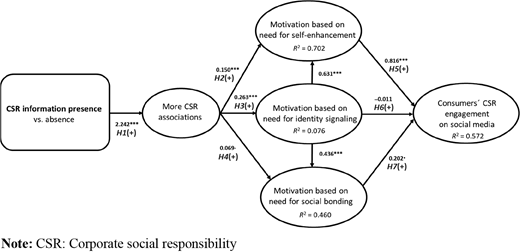
As is shown in Table 4, we first checked whether the company website that contained CSR information generated more CSR associations than the company website with no CSR information (with the dummy variable CSR information). The results indicate a positive and significant effect (β = 2.242; z = 10.448; p = 0.000), which supports H1. We also found a positive and significant effect of CSR associations on the motivations based on the need for self-enhancement (H2: β = 0.150; z = 3.709; p = 0.000), identity signaling (H3: β = 0.263; z = 3.753; p = 0.000) and social bonding (H4: β = 0.069; z = 1.661; p = 0.097), which supports H2, H3 and H4 (partially). Furthermore, consistent with H5 and H7, we found a positive relationship between the motivations based on the need for self-enhancement and the need for social bonding on consumers’ CSR engagement on social media (H5: β = 0.816; z = 6.052; p = 0.000) (H7: β = 0.202; z = 1.831; p = 0.067), respectively. Therefore, H5 is fully supported and H7 partially supported.
Summary of results
| Hypotheses | β | SD | z | Result |
|---|---|---|---|---|
| H1 The presence of corporate social responsibility information → More corporate social responsibility associations | 2.242*** | 0.215 | 10.448 | Supported |
| H2 More corporate social responsibility associations → Motivation based on the need for self-enhancement | 0.150*** | 0.041 | 3.709 | Supported |
| H3 More corporate social responsibility associations → Motivation based on the need for identity signaling | 0.246*** | 0.066 | 3.752 | Supported |
| H4 More corporate social responsibility associations → Motivation based on the need for social bonding | 0.069· | 0.042 | 1.661 | Supported |
| H5 Motivation based on the need for self-enhancement → Consumers’ corporate social responsibility engagement on social media | 0.819*** | 0.135 | 6.052 | Supported |
| H6 Motivation based on the need for identity signaling → Consumers’ corporate social responsibility engagement on social media | −0.145 | 0.125 | −1.166 | Not supported |
| H7 Motivation based on the need for social bonding → Consumers’ corporate social responsibility engagement on social media | 0.202· | 0.110 | 1.831 | Supported |
Notes:
SD: standard deviation. ***p < 0.001; ·p < 0.1,
Study design availability upon (reasonable) request
However, the results indicate no influence of the motivation based on the need for identity signaling on consumers’ CSR engagement on social media (H6: β = −0.145; z = −1.166; p = 0.244). In addition, to improve the adjustment of the model, we found a positive influence of the motivation based on the need for identity signaling on the need for self-enhancement (β = 0.631; z = 10.793; p = 0.000) and the need for social bonding (β = 0.436; z = 6.978; p = 0.000).
Logically, there is a positive and significant relationship between self-enhancement and identity signaling as both are ways to facilitate impression management (Berger, 2014). In addition, the motivation to share CSR messages to portray a desired identity to others is intimately related to the establishment of social bonding. The hypothesized relationship results are shown in Figure 2.
5. General discussion
Drawing on the literature on the antecedents of eWOM and CSR, this study proposes that communicating CSR information on a company website increases consumers’ CSR associations and their engagement with the CSR messages on SNSs. Our results provide insights into the fundamental personality traits and social relationship motivations that explain consumers’ engagement with CSR on social media. In particular, we demonstrated the key role of self-enhancement and social bonding in explaining the intention to share CSR information on social media.
First, our results show the potential contribution of social media, in particular, a company website, to the generation of CSR associations. Thus, according to Badenes-Rocha et al. (2019) and the seminal work of Brown and Dacin (1997), individuals who are aware of a company’s CSR initiatives through its website will have stronger associations regarding that company’s CSR activities. In this sense, the website emerges as a suitable tool for communicating CSR activities and, therefore, generating CSR associations.
Second, and aligned with previous studies on eWOM motives but specifically applied to CSR for the first time in literature, we have found that motivations based on the need for self-enhancement and the need for social bonding are antecedents of consumers’ engagement in CSR communication. Thus, our results extend previous findings about the role of self-enhancement and social bonding (Chu et al., 2019; Mishra et al., 2018; Taylor et al., 2012) in explaining eWOM intention. In this sense, CSR information helps individuals to achieve certain personal gratification such as self-enhancement and to establish relationships with peers.
5.1 Theoretical implications
Unlike many other studies on CSR communication, this research focuses on analyzing consumer involvement in such communication and not solely on assessing the determinants of consumers’ attitudes toward CSR communication (Pérez et al., 2020; Chu et al., 2020; Liu et al., 2014). Thus, while other studies concentrated on the message appeal, message content or information source as antecedents of consumers’ perception of CSR actions (Pérez et al., 2020), this study analyzes the role of consumers in the dissemination of CSR information. To the extent that CSR communication has become an important field of study in corporate communication (Yang et al., 2020), this study contributes to the existing body of knowledge.
eWOM is an important but understudied construct in the CSR literature (Chu et al., 2020). In line with Chu and Chen (2019) and Chu et al. (2020), eWOM is a key consequence of consumers’ engagement with companies’ CSR activities on social media. While previous studies have cited brand credibility, brand attitude and consumer brand identification as antecedents of eWOM behavior (Chu and Chen, 2019), this study has focused on self-serving motives to explain the phenomenon. The nature of SNSs certainly tends to favor individuals’ behavior in this online environment (i.e. likes, comments and shares) as being guided more by their own motivations.
In this regard, the study contributes to the previous literature on eWOM participation motives. We have extended previous knowledge that identified self-enhancement as an important motive for eWOM-providing behavior (Taylor et al., 2012; Mishra et al., 2018; Berger, 2014). Self-enhancement is also an important motive for CSR information sharing to the extent that consumers can endorse CSR information as a means of transferring the positive associations of CSR to themselves. Thus, the Meaning Transfer Theory (McCracken, 1989), which has traditionally been used to explain consumer endorsement of products, brands or celebrities, is also useful in the CSR domain. In addition, social bonding has traditionally been identified as an important antecedent of eWOM behavior (Chu et al., 2019; Berger, 2014), insofar as connection with others is inherent in SNSs. This study has shown that CSR information will be shared to establish relationships with others on social media. The Need to Belong Theory (Schutz, 1958), which has been used to explain the presence of individuals in brand communities and eWOM behavior (Sicilia et al., 2016), helps us to explain the use of CSR information to create social bonding with others.
5.2 Managerial implications
These findings have significant implications for corporate communications professionals and managers working for companies that conduct social responsibility initiatives. First, they highlight the importance of communicating the company’s CSR outcomes but also the relevance of including CSR information in the company’s social media tools to improve the visibility of its CSR efforts (Ballester et al., 2021; Pérez et al., 2020).
In addition, managers need to consider the key role of consumers in disseminating information about CSR activities. Individuals will be interested in sharing this type of information because it can improve the image they have of themselves, as well as the image they project to others, which is an essential element in establishing and maintaining social relationships with them. As Chu et al. (2020) suggested, it is critical to create CSR campaigns that individuals find likable and shareable. This will happen if the campaigns help individuals to establish relationships with others and express themselves.
5.3 Limitations and future research directions
The study has several limitations. First, it was based on a short, single data collection conducted in Spain. Therefore, the results may not be generalizable to other countries in which CSR awareness might be different. Future research may thus expand the boundaries of these findings to improve their generalizability. A second limitation relates to the experimentation methodology and stimuli design (Kim, 2019). A fictitious scenario was created in which the participants imagined that they were going to dinner with friends. A field study in a natural setting could optimize the effects of the manipulation. Third, the study considered only one economic sector, restaurant chains and one CSR action. Therefore, another economic sector could generate comparable results. Fourth, it is worth mentioning that while we used an experiment, the manipulated factor was hypothesized to influence only one variable in our model. Fifth, we limited the study to analysis of whether the presence of CSR information would motivate consumers to engage with it; however, we did not consider the specific form or type of information that would be critical in motivating consumers or the best way of presenting the information. Finally, we found marginally support for the hypotheses related with the motivation based on need for social bonding. Further research should explore the role of social bonding in the intention to share CSR information.
The authors thank the editor and the two reviewers for their helpful comments. This research was supported by the grant PID2020-116247GB-I00 from the Spanish Agencia Estatal de Investigación (AEI/10.13039/501100011033). Authors also thank the assistance provided by Fundación Cajamurcia.

