Skip to Main Content
Purpose

Workplace coaching practice (i.e. expertise and frequency) has been identified as a leadership tool for enhancing work-related outcomes. Drawing on social exchange theory (SET) and leader-member exchange (LMX), this study explores whether the expertise of the coaching supervisor or the frequency of formal coaching sessions is more important when predicting outcomes (i.e. job satisfaction, in-role behaviours (IRB) and turnover intentions). We also explore whether the relationship between coaching practices towards such outcomes is mediated by the quality of the coaching relationship (as perceived by the employee). Finally, we assess whether individual feedback orientation (IFO) has a moderating effect.

Design/methodology/approach

We selected a cross-sectional design, collecting data from a sample of formally coached New Zealand employees (n = 395). To assess model fit and test hypotheses, we took a structural equation modelling approach.

Findings

Findings revealed that (1) coaching expertise dominated over frequency. (2) the employee’s perceived quality of the coaching relationship (PQECR) fully mediated the effect of coaching expertise towards job satisfaction and turnover intentions and (3) these relationships were moderated by IFO.

Originality/value

Whilst there has been debate over the relative importance of coaching expertise versus coaching frequency, the dominance of one over the other has yet to be settled.

Workplace coaching has intensified (Ali et al., 2018; Schermuly et al., 2022) with many suggesting that in response to global pressures, organisations that coach their employees can gain a competitive advantage (Pousa and Mathieu, 2015; Wang, 2013). The practice has several pseudonyms yet each describes one-on-one meetings between an employee and their immediate supervisor (coach) aimed at development (Ellinger et al., 2003) and improving on-the-job performance (Gregory and Levy, 2010). McCarthy and Milner (2020, p. 149) state that workplace coaching is a “powerful approach to leadership” and note that roughly three-quarters of UK-based managers are expected to coach their direct reports.

Theoretically, social exchange theory (SET) (Blau, 1964) and the related leader–member exchange (LMX) theory (Dansereau et al., 1975) help explain the relationship between coaching practice and work-related outcomes. When an employee perceives an offer of coaching from their supervisor to be valuable, they experience a “felt obligation” (Haar and Spell, 2004, p. 1041) and reciprocate with increased effort on-the-job (Batson and Yoder, 2012). Several scholars suggest a positive relationship between the frequency of coaching events and work-related outcomes, including performance (Ali et al., 2018; London and Smither, 2002). Park et al. (2021, p. 816) note workplace coaching involves “everyday interactions” and is more than a “one-time event”. However, others note it is important not to confound frequency for quality (Dahling et al., 2016), and thus there is a body of literature that emphasises the quality of coaching (how it is done) over frequency (Ellinger et al., 2003; Pousa and Mathieu, 2015).

This study focuses on the relative importance of coaching expertise (quality) versus the frequency of events (how often coaching occurs). It is an important question because low-quality coaching done more frequently can be damaging for organisations (see Weer et al., 2016), yet best-practice coaching training can be expensive (David and Matu, 2013). When searching the literature, we found just one study where coaching expertise and frequency were included as predictors (see Dahling et al., 2016), where the authors found coaching expertise had a positive effect on sales goal attainment but frequency did not. In support, de Haan and Nilsson (2023) suggest the coaching frequency has little impact. Considering the paucity of studies, we decided to further explore the relative importance of coaching expertise versus frequency.

Workplace coaching is complex (Milner et al., 2023), and its influence on work-related outcomes is dynamic (Al Nahyan et al., 2024). Given this, some scholars have identified the supervisor–employee coaching relationship as a potential mediating mechanism. Ellinger et al. (2003) argue that desirable work-related outcomes are dependent on employees perceiving they share a relationship with their supervisor that is focused on enabled learning and development. Similarly, Bommelje (2015) argues that positive outcomes are more likely when the coaching relationship is perceived as a committed partnership based on mutual trust. Therefore, we also aim to determine whether the quality of the supervisor–employee coaching relationship is a mediating factor.

Workplace coaching necessarily involves feedback (Park et al., 2021; Rafferty and Fairbrother, 2015), so we include individual feedback orientation (IFO) as a moderating variable. IFO describes an individual’s attitude towards accepting feedback and is a personality trait that varies among adults (London and Smither, 2002). We anticipate participants with high IFO will view workplace coaching more favourably compared to those with low IFO.

This study makes several HRM contributions. We present evidence of the relative importance of coaching expertise versus frequency, and critique Gregory and Levy’s (2012) position that perceived quality of the coaching relationship (PQECR) antecedes coaching practices by modelling it as a mediator. Also, we offer insight into the effectiveness of workplace coaching when individuals are more or less willing to accept feedback.

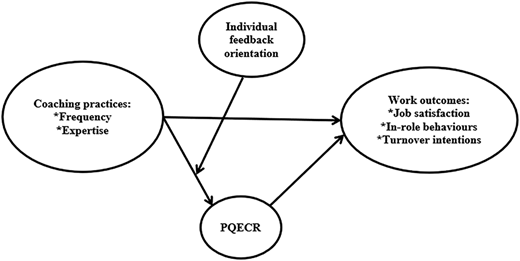
Our study model is shown in Figure 1.

Coaching for improved work-related outcomes can be understood as a social exchange between a supervisor and each direct report (Ali et al., 2018). Therefore, we drew on SET and LMX to guide us because both explain social exchange. SET is distinct from economic exchange where work is done for payment, and instead reflects giving back voluntarily (Blau, 1964). Like tangible goods traded in a marketplace, social goods including loyalty, support and information are traded during social interactions, with reciprocity being key (Weer et al., 2016). Consequently, parties tend to continue trading when power relations are balanced and there is mutual satisfaction (Blau, 1964). Haar and Spell (2004) argue SET reflects a felt obligation, whereby employees reciprocate for a valued practice from their organisation or supervisor. We consider workplace coaching to be a valued leadership practice that should encourage reciprocation from employees.

LMX (a sub-theory of SET) explains the exchange relationship between a supervisor and each direct report. Dansereau et al. (1975) theorise that leadership in organisations takes place at the level of the “vertical dyad” (p. 47). In exchange for an employee’s support and loyalty, the supervisor may offer valuable job resources (Dansereau et al., 1975) such as inside information, interesting work, or workplace coaching (Ali et al., 2018). Hagen and Peterson (2014) suggest interpersonal exchange relationships underpin workplace coaching, and Wang (2013) note when coaching is done well it enhances LMX because employees gain a sense that their supervisor cares about them and their vocational development. We suggest that when a supervisor offers workplace coaching (i.e. frequency and expertise), and the employee perceives it to be valuable, the employee’s perception of the coaching relationship will strengthen. Consequently, the employee will feel obligated to balance the exchange (Haar and Spell, 2004) by being more open to being coached, and reciprocating with improved work-related attitudes and behaviours.

Our hypotheses relate to positive and negative work-related outcomes. The positive set includes job satisfaction which is broadly defined as how happy an individual is with their job (Judge and Klinger, 2008). Prior research has positively linked job satisfaction with workplace coaching (Ellinger et al., 2003), and individual performance (Ali et al., 2018). We likewise include in-role behaviours (IRB) which comprise the actions that are expected from an employee to accomplish the formal requirements of their job (Hsu et al., 2017). IRBs indicate broader job performance (Williams and Anderson, 1991) which is an aim of workplace coaching (Kim and Kuo, 2015). The remaining outcome variable is turnover intentions, an antecedent to actual turnover (Böckerman and Ilmakunnas, 2009), defined as intention to search for a new job, searching for a new job, and intention to quit one’s current job (Mobley et al., 1979). Turnover is costly to organisations (Haar et al., 2016), can create instability in the labour market (Böckerman and Ilmakunnas, 2009) and prior research has negatively linked it with workplace coaching (Ali et al., 2018).

We agree that a strong coaching relationship is critical for successful workplace coaching, but are less convinced that it antecedes coaching practice (as theorised by Gregory and Levy (2012)). Our position is that coaching relationships can only be formed once there has been an attempt to coach. Whilst Gregory and Levy (2012) concede the relationship between coaching practices and relationship relationships may be reciprocal, we model the coaching relationship as a mediator, predicted by coaching practice.

Coaching events vary, so Grant (2017, p. 46) developed a “Quality Conversation Framework”, identifying different kinds of coaching events, spanning from the short and informal (one to five minutes) to the long and formal (up to one hour or more) and ranging from “corridor” conversations (p. 45) to formal coaching sessions. Similarly, Dixey (2015) differentiates between informal day-to-day coaching conversations and formal sessions. We operationalised coaching frequency as how often a supervisor meets one-on-one with a direct report for the purpose of having a performance focused coaching conversation. We captured formal coaching events only because they are distinct, structured and go for longer (Grant, 2017) making them easy to recall. By comparison, informal coaching conversations tend to be short and less structured (Grant, 2017) and because they are weaved into everyday conversations, some participants may not realise they have been coached (Dixey, 2015).

Some suggest more frequent coaching strengthens supervisor–employee interpersonal relationships (Gregory and Levy, 2011), describing coaching practice as on-going and more than a one-time interaction (Batson and Yoder, 2012). Ladyshewsky and Taplin (2017) recommend supervisors seize everyday opportunities to develop employees, whilst London and Smither (2002) emphasise regular interaction. Naturally, increasing frequency increases opportunities for social exchange (Hsieh and Huang, 2018) and the development of a high-quality coaching relationship (Gregory and Levy, 2011). Aligned with SET and LMX, we propose that when coaching frequency increases, it amplifies employee sense of felt obligation (Haar and Spell, 2004). Consequently, employees will reciprocate by being more open to formal coaching, form stronger coaching relationships and demonstrate improved work-related attitudes and behaviours. This leads to our first set of hypotheses.

H1.

Coaching frequency is positively related to (a) PQECR, (b) job satisfaction and (c) IRB.

H2.

Coaching frequency is negatively related to turnover intentions.

We define coaching expertise as the quality of the supervisor’s skills and behaviours aimed at enhancing employee development and performance (Hagen and Peterson, 2014). Almost certainly, coaching expertise can strengthen employee perception of the quality of the coaching relationship (Batson and Yoder, 2012; Pousa et al., 2020), resulting in improved learning and performance (Ellinger et al., 2003). The assumption that coaching expertise is positively related with coaching relationships and desirable workplace attitudes and behaviours is consistent with SET and LMX. Employees who are offered a valued practice such as expert workplace coaching ought to experience a sense of felt obligation (Haar and Spell, 2004) and reciprocate by being more open to being coached, cultivating the coaching relationship and delivering improved work-related attitudes and behaviours. Therefore, we posit the following hypotheses.

H3.

Coaching expertise is positively related to (a) PQECR, (b) job satisfaction and (c) IRB.

H4.

Coaching expertise is negatively related to turnover intentions.

We include employee PQECR as a mediator, linking coaching practice with work-related outcomes. The supervisor–employee coaching relationship has been defined by Gregory and Levy (2010, p. 111) as “a working partnership between an employee and his/her supervisor that is focused on addressing the performance and developments needs of that employee.” The importance of such high-quality supervisor–employee interpersonal relations is reinforced across the literature (Hsieh and Huang, 2018; Tanskanen et al., 2019). Theoretically, SET and LMX explain how coaching relationships impact on work related attitudes and behaviours. Employees who are afforded a valued practice (i.e. a high-quality supervisor–employee coaching relationship) will experience a sense of felt obligation (Haar and Spell, 2004) and will reciprocate by being more open to formal coaching and performing to a higher standard. Therefore, we posit the following hypotheses.

H5.

PQECR is positively related to (a) job satisfaction, (b) IRB, and negatively related to (c) turnover intentions.

H6.

PQECR mediates the influence of (a) coaching frequency, and (b) coaching expertise towards work-related outcomes.

It is difficult to envision workplace coaching for improved performance without an exchange of feedback. Linderbaum and Levy (2010) highlight numerous benefits of feedback including role clarification, increasing confidence, improved learning, lower turnover and improved performance. In support, others suggest feedback is a crucial component of workplace coaching (Ellinger et al., 2003; Park et al., 2021), and a valuable job resource (Park et al., 2021) that can positively influence coaching outcomes (London and Smither, 2002). However, whilst most supervisors intend feedback to be helpful, some employees view it as unwanted criticism (Kunst et al., 2018). McCarthy and Milner (2020) note that negative reactions from employees are one reason why supervisors avoid offering feedback. The point here is that individuals respond to feedback, and by association workplace coaching, differently.

Linderbaum and Levy (2010, p. 1372) define IFO as “an individual’s overall receptivity to feedback”. We included IFO as a moderator because we believe it attenuates the influence of coaching practice on employee perception of the coaching relationship they share with their supervisor. Ellinger et al. (2003, p. 453) indirectly support this position, suggesting that employee “readiness and receptivity to receive coaching” can influence coaching outcomes. Additionally, Gregory and Levy (2012) found IFO and the employee perception of the coaching relationship to be positively correlated. Under SET and LMX theory, being more open to feedback ought to enhance the beneficial effects of coaching practice because individuals with strong feedback orientation are more likely to perceive coaching (incorporating constructive feedback) as a valued practice, triggering a reciprocal obligation to act positively on the feedback they receive. This brings us to our final set of hypotheses.

H7.

IFO will moderate the effects of (a) coaching frequency, and (b) coaching expertise towards PQECR, with a stronger relationship occurring when IFO is high.

H8.

IFO will moderate the influence of (a) coaching frequency, and (b) coaching expertise, towards work-related outcomes with PQECR as a mediator, with a stronger relationship occurring when IFO is high (moderated mediation).

QualtricsXM panel data were collected from n = 395 New Zealand-based employees. Panellists were aged 18+, in paid employment (at least 20 h per week), and had experienced at least one formal coaching session in the previous six-months. Panellists are confidential, paid and have produced quality samples (e.g. Haar et al., 2022). Demographics revealed an average age of 42.06 years (SD = 12.35), a female orientated sample (67%), an average tenure of 7.15 years (SD = 5.71), highly educated with 60% having a bachelor’s degree or higher, and mainly working in the private sector (62%), or public sector (33%).

Except where noted, items were coded 1 = strongly disagree to 5 = strongly agree. We report construct reliability (CR) as an indicator of internal reliability for first-order latent variables, and omega hierarchical (ωh) for second-order latent variables (rationale discussed below).

Formal coaching frequency was measured with a single item: “In the past six months, how many one-on-one meetings (coaching conversations) has your direct supervisor had with you to discuss/improve your performance on the job?” Coded 1 = once in the past six months; 2 = roughly twice in the past six months; 3 = roughly 3–4 times in the past six months; 4 = roughly monthly; 5 = roughly every fortnight and 6 = roughly every week (or more).

Coaching expertise was measured with seven items from the eight-item coaching behaviour scale by Ellinger et al. (2003). A sample item is “My supervisor provides me with resources so I can perform my job more effectively.” Item eight was removed because the standardised factor loading was small compared with other items (0.52), affecting model fit (CR = 0.90).

IFO was measured with five items comprising the utility dimension of the four-dimensional scale by Linderbaum and Levy (2010). The utility dimension emphasises the perceived usefulness of feedback. It was chosen to determine the value of feedback as a valuable job resource. A sample item is “To develop my skills at work, I rely on feedback.” (CR = 0.86).

PQECR was measured with all twelve-items from the four-dimension scale by Gregory and Levy (2010). A sample item from the genuineness of the relationship dimension is “My supervisor and I have mutual respect for one another.” A sample item from the effective communication dimension is “My supervisor is a good listener.” A sample item from the comfort with the relationship dimension is “I feel safe being open and honest with my supervisor.” A sample item from the facilitating development dimension is “My supervisor helps me to identify and build upon my strengths.” (ωh = 0.94).

Job satisfaction was measured with three items by Judge et al. (2005) as validated by Haar et al. (2014). A sample item is “Most days I am enthusiastic about my work.” (CR = 0.87).

IRB was measured with five items from the six-item scale by Williams and Anderson (1991) coded 1 = never to 5 = almost always. A sample item is “I successfully perform the essential duties of my job.” Item four was removed because the standardised factor loading was small compared with the other items (0.58), affecting model fit (CR = 0.92).

Turnover intentions were measured with four items by Kelloway et al. (1999). A sample item is “I am thinking about leaving my organisation.” (CR = 0.95).

We controlled for age, gender (0 = Male, 1 = Female), tenure and level of education (1 = High School, 2 = Technical Collage, 3 = Bachelors, 4 = Post Graduate) because of their potential to influence the outcomes explored here (see de Haan and Nilsson, 2023; Ng and Feldman, 2009, 2010a, 2010b). Controls were modelled as ordinal variables.

Our hypotheses were tested using R statistical software (version 4.4), developed by the R Core Team (2025), using the lavaan package for structural equation modelling (version 0.6.19) developed by Rosseel (2012). We estimated p-values and 95% bootstrap confidence intervals (1,000 samples) for direct path coefficients, and 95% bootstrap confidence intervals for the mediated paths.

To assess measurement quality, we conducted a confirmatory factor analysis (CFA) using measure Q, an R package developed by Cheung et al. (2023). Fit indices for our measurement model were assessed against commonly accepted thresholds: comparative fit index (CFI) ≥0.95, root mean squared error of approximation (RMSEA) ≤0.08, and the standardised root mean square residual (SRMR) ≤0.10 (Williams et al., 2009). Overall, our measurement model was a good fit to the data: χ2(df) = 1427.1(725), CFI = 0.95, RMSEA = 0.04, and SRMR = 0.05.

When assessing the internal reliability of measures, we followed Cheung et al. (2023). Traditionally, researchers report Cronbach’s alpha (α), but Cronbach’s alpha assumes factor loadings are equal across indicators (tau-equivalence). Given this is atypical for structural equation models, construct reliability (CR) is preferred because it does not assume tau-equivalence (Cheung et al., 2023). Next, to assess internal reliability of the multidimensional latent variable (PQECR), we estimated omega hierarchical (ωh) because unlike construct reliability, omega hierarchical does not assume unidimensionality (Cheung et al., 2023). In sum, the internal reliability for our variable items exceeded the recommended threshold of ≥ 0.70 (Fornell and Larcker, 1981; Hair et al., 2014), confirming our measures to be sufficiently reliable.

To assess the convergent validity, we examined the standardised factor loadings and average variance extracted (AVE). Ideally, standardised factor loadings are ≥0.70 because it means the factor explains 50% or more of each indicator’s variance (Cheung et al., 2023; Fornell and Larcker, 1981). More importantly, the AVE for each factor will be > 0.50 because it means that at least 50% of the variance across indicators can be explained by the factor to which they are loaded (Fornell and Larcker, 1981; Hair et al., 2014). The standardised factor loadings for our model ranged from 0.68 to 0.96, and AVE ranged from 0.56 to 0.81, enabling us to confirm our measures to be convergently valid.

To assess discriminant validity we followed Cheung et al. (2023), constraining our model to prohibit cross-loading. Next, we applied the Fornell–Larker criterion under which discriminate validity is achieved when the AVE for each i-j pair of variables in a measurement model is greater than their squared correlation (Fornell and Larcker, 1981). For our model, the criterion was achieved for all i-j pairs except for coaching expertise and PQECR. Considering the expertise – PQECR correlation, to account for sampling variance, we estimated a 90% bootstrap confidence intervals (1,000 samples) for the latent correlation coefficient. The lower 90% bootstrap CI was 0.88, indicating discriminate validity was an issue (Cheung et al., 2023). Assessing further, we compared the fit of our eleven-factor model with an alternative ten-factor model, where we combined coaching expertise and PQECR into a single factor. Compared with the alternative model, χ2(df) = 1451.5 (734), our research model had a superior fit, χ2(df) = 1427.1 (725) and the difference was statistically significant, ∆χ2 = 24.4, p < 0.001. Additionally, the lower and upper 95% bootstrap confidence intervals for the coaching expertise – PQECR latent correlation coefficient did not include unity [0.87, 0.95]. Therefore, we concluded that whilst expertise and PQECR are highly correlated, they are distinct constructs.

To assess the risk of CMV, we conducted a Harman’s One Factor Test and confirmed that none of the variables in our model accounted for more than 50% of the total variance (<40%), signalling that CMV may not be a concern (Podsakoff et al., 2003).

Table 1 presents descriptive statistics and correlations for our model variables.

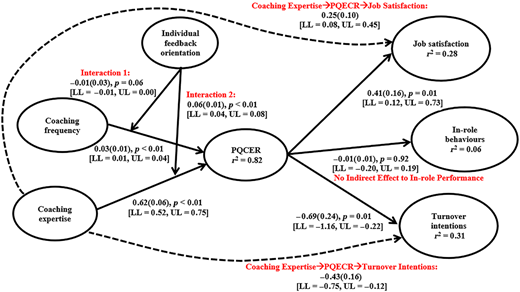
Figure 2 presents the path analysis results.

We hypothesised positive effects from coaching frequency and expertise towards PQECR, job satisfaction and IRB, and negative effects from coaching frequency and expertise towards turnover intentions. In the case of coaching frequency, there was a positive direct effect towards PQECR β = 0.03, p < 0.01), but no direct effect towards job satisfaction (β = 0.01, p = 0.65), IRB (β = 0.02, p = 0.24), or turnover intentions (β −0.01, p = 0.93). Considering coaching expertise, there was a positive direct effect towards PQECR (β = 0.62, p < 0.01) but no direct effect towards job satisfaction (β = 0.13, p = 0.25), IRB (β = 0.10, p = 0.22), or turnover intentions (β −0.19, p = 0.31). These results support Hypotheses 1(a) and 2(a), but do not support Hypotheses 1(b-d), or 2(b-d).

Post-hoc, we conducted a dominance analysis (Budescu, 1993) to statistically determine the relative importance of coaching frequency versus expertise. We estimated the R-square values for both variables towards PQECR independently and together and estimated that coaching expertise explained 92% of the variance in PQECR whereas coaching frequency accounted for just 8%. In sum, for our sample at least, coaching expertise was the dominant predictor.

As hypothesised, results confirm a positive direct effect from PQECR towards job satisfaction (β = 0.41, p = 0.01), and a negative direct effect towards turnover intentions (β = −0.69, p = 0.01). However, there was no direct effect towards IRB (β = −0.10, p = 0.92). These results support Hypotheses 5(a) and 5(c) but not 5(b).

We hypothesised that PQECR would mediate the effect from coaching frequency and expertise towards all outcome variables. PQECR did not mediate the effect of coaching frequency towards job satisfaction (β = 0.01, 95% BCI[0.00, 0.02], IRB (β < 0.01, 95% BCI[−0.01, 0.01]), or turnover intentions (β = −0.02, 95% BCI[−0.04, 0.00]). Nor did it mediate the effect of coaching expertise towards IRB (β = 0.01, 95% BCI[−0.13, 0.12]). However, it did mediate the effect from coaching expertise towards job satisfaction (β = 0.25, 95% BCI[0.08, 0.45]), and turnover intentions (β = −0.43, 95% BCI[−0.75, −0.12]). These results do not support Hypothesis 6(a) and partially support 6(b).

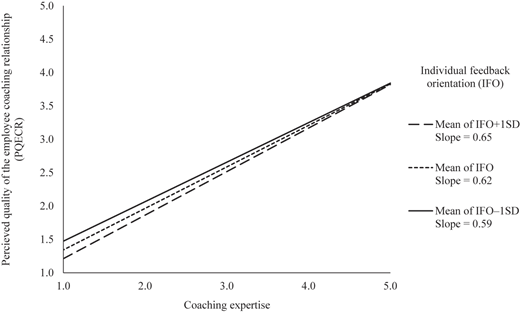
We hypothesised that IFO would moderate the direct effects of coaching frequency and expertise towards PQECR with the relationships strengthening as IFO increased (moderation). The regression coefficient for the frequency*IFO interaction was not statistically significant (β = −0.01, p = 0.06) meaning Hypothesis 7(a) was not supported. Conversely, the expertise*IFO interaction was statistically significant and in the expected direction (β = 0.06, p < 0.01), supporting Hypothesis 7(b). Figure 3 illustrates the relationship between coaching expertise towards PQECR at different values of IFO. When participants perceive the supervisor to be a coaching novice, those with high IFO tend to experience a weaker coaching relationship with their supervisor compared with those with low IFO. However, as perception of the supervisor’s coaching expertise strengthens, the difference in PQECR between participants with high IFO compared to those with low IFO becomes negligible.

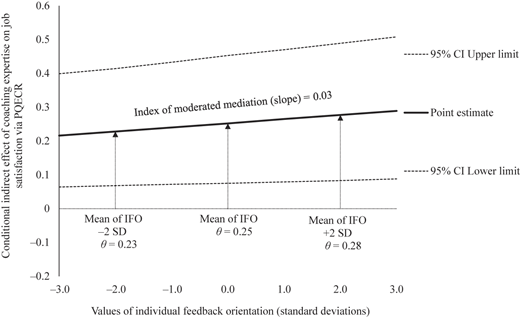
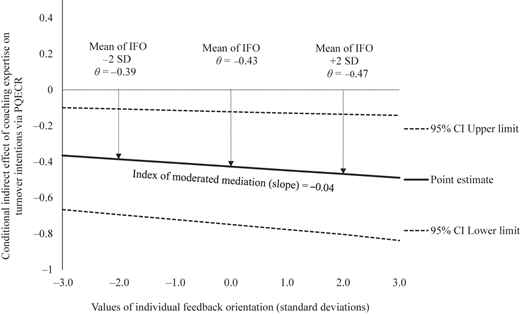
We hypothesised that via PQECR, the indirect paths from coaching frequency and expertise towards all outcome variables would be moderated by IFO, strengthening as IFO increased (moderated mediation). A useful inferential test for moderated mediation is the index of moderated mediation (∆) (Hayes, 2017). Focussing on frequency first, ∆ was non-significant for all three indirect paths (95% bootstrap CIs included zero), meaning Hypothesis 8(a) was not supported. Turning to expertise, whilst ∆ was non-significant for the indirect path towards IRB, the indirect paths towards job satisfaction (∆ = 0.03, 95% BCI[0.01, 0.04]) and turnover intentions (∆ = 0.04, 95% BCI[−0.06, −0.02]) were significant and in the expected direction. Therefore, Hypothesis 8(b) was partially supported. Having found evidence of moderated mediation for two of the hypothesised indirect paths, we probed these interactions at different values of IFO. Illustrated in Figures 4 and 5, as IFO strengthens, it amplifies the indirect relationships between coaching expertise→PQECR→job satisfaction, and coaching expertise→PQECR→turnover intentions.

We controlled for age, gender, tenure and level of education by including them as independent variables. The majority of the regression coefficients were non-significant, and none had a meaningful impact on the study results. Table 2 presents a summary of the statistically significant pathways only.

The aim of this study was to determine the relative importance of coaching frequency versus expertise when predicting work-related outcomes (i.e. job satisfaction, in-role behaviours and turnover intentions). Surprisingly, there has been little published research addressing this knowledge gap, but considering the costs associated with training (and maintaining) supervisors to be expert coaches, it is an important question to address. Dahling et al. (2016), found that coaching frequency had no impact on sales-goal attainment, commenting that previous literature had somehow “confounded frequency with quality of coaching” (p.884). Our results align with this sentiment. We found that effective workplace coaching draws considerably more on the supervisor’s coaching expertise than the frequency of coaching.

Previously, Gregory and Levy (2012) theorised that the quality of the supervisor–employee coaching relationship antecedes coaching practices, but conceded that the relationship might be reciprocal and encouraged further exploration. Based on SET and LMX, and the logic that coaching relationships can only be formed once there has been an attempt to coach, we modelled PQECR as a mediator to see how it shaped the relationships between coaching practices and work-related outcomes. Not only did we find that coaching expertise and frequency positively predicted PQECR, but we also found that PQECR fully mediated the indirect relationship between coaching expertise towards job satisfaction and turnover intentions. This builds on the work of Gregory and Levy (2012), demonstrating that when supervisors exercise expert coaching behaviours and coach employees regularly, it can strengthen the supervisor–employee coaching relationship. Prior research supports this, arguing that the supervisor–employee coaching relationship is critical for effective workplace coaching (Milner et al., 2023; Park et al., 2021).

Finally, we tested whether our hypothesised relationships were conditioned by IFO, something we believe has not been done previously. We found that participants with stronger IFO responded more positively to coaching expertise than those with low IFO. This is consistent with SET and LMX that propose people feel obliged to reciprocate in kind for a valued courtesy offered to them (Blau, 1964), and because feedback is a fundamental component of workplace coaching (Pousa et al., 2018), those with high IFO tend to view coaching as more valuable. In support, Gregory and Levy (2012) found IFO and PQECR were positively related, and Katz et al. (2023) found a similar relationship between IFO and job satisfaction.

Unexpectedly, we found neither coaching frequency nor expertise were related to IRB. This is inconsistent with SET and LMX which predict that employees offered a valuable job resource (i.e. workplace coaching) ought to experience a felt obligation (Haar and Spell, 2004) and reciprocate with improved IRB. Prior research is mixed. Some have found a positive relationship between workplace coaching towards IRB (Huang and Hsieh, 2015) whilst others have found the relationship to be non-significant (see Kim and Kuo, 2015; Pousa et al., 2018). This signals the situation with IRB is complex. Given feedback is a core ingredient of workplace coaching, it is possible that employees exit a coaching session with a more realistic appreciation of their performance, including areas where improvements could be made. Such a reality-check may result in deflated in-role behaviour scores as employees realise their performance could be improved. Moreover, employees with a low feedback orientation may perceive coaching from their supervisor as unwelcome criticism and respond negatively (i.e. self-rate as a poor performer).

In this study, coaching expertise, coaching relationships and IFO emerged as critical factors shaping work-related outcomes. Increasing the frequency of coaching had negligible impact. We recommend HRM practitioners train supervisors to be coaching experts, with a focus on developing and maintain high-quality coaching relationships. Prior research supports this approach (e.g. Ellinger et al., 2003; Pousa and Mathieu, 2015).

When selecting variables to include in our model, we were guided by SET and LMX. However, like all statistical models, ours is an imperfect representation of reality, meaning it is possible that additional variables may be responsible for relationships between our study variables (e.g. organisational culture and team dynamics). Data were collected from participants at the employee level only, at a single time point, using a self-completion survey. Whilst common in the field of workplace coaching (e.g. Al Nahyan et al., 2024; Pousa et al., 2020), the risk of common method variance (CMV) increases. However, results from the Harman’s One Factor Test suggest that CMV may not be a critical issue (Podsakoff et al., 2003).

We selected a cross-sectional design over an experimental design because of the practical challenges of reproducing genuine coaching relationships in a laboratory setting (Pousa et al., 2020). Also, there was no time separation between our measures, no random assignment to control and treatment groups and no manipulation of the independent variables. Consequently, we present evidence of correlation between variables, but we do not prove causal direction (Hayes, 2017). As such, caution must be used when considering the causal nature of the relationships tested here.

Our participants were not randomly selected, which is the gold standard for generalisation (Bell et al., 2019). None-the-less, we drew participants from multiple organisations across a range of industries and sectors, and statistically controlled for age, gender, tenure and level of education. This increases confidence that our study findings are generalisable beyond the sample. As noted by Pousa and Mathieu (2015), the use of non-random samples is common in the social sciences and does not prohibit generalisation.

Replication across other contexts to validate our findings would be useful. Also, future research should focus on supporting supervisors by identifying and refining best practice coaching training (Rafferty and Fairbrother, 2015). Ideally, this would include how to develop and maintain high-quality coaching relationships, a fundamental component for effective workplace coaching (Gregory and Levy, 2012).

Further investigation into the apparent non-significant relationship between coaching practices and IRB might be useful. We suspect that participants in our study may have come away from coaching sessions with a more realistic appraisal of their performance on-the-job, which may have negatively biased their self-rated IRB scores. Collecting performance data from an alternative source (e.g. the supervisor or company records) may eliminate such bias. Whilst this has been done previously (see Kim and Kuo, 2015) with a similar non-significant result, we recommend further testing to confirm.

Workplace coaching has become a multi-billion-dollar-business (Schermuly et al., 2022), making it crucial to understand how and when the practice is effective. Our study contributes to HRM by demonstrating that coaching expertise dominates over coaching frequency when predicting work-related outcomes (i.e. improved job satisfaction and weaker turnover intentions). We further demonstrate that the quality of the supervisor–employee coaching relationship mediates the effect of coaching practices towards desirable work-related outcomes, where those with higher IFO experienced stronger job satisfaction and weaker turnover intentions compared to those with lower IFO.

Ethics review board clearance: This research meets the ethical standards prescribed by Massey University, Auckland, New Zealand. A low-risk notification was acknowledged by the Human Ethics Committee on 30 April 2024. Application ID: 4000028883.
Al Nahyan
,
M.
,
Al Suwaidi
,
M.
,
Al Zaabi
,
N.
,
Al Qubaisi
,
F.
and
Jabeen
,
F.
(
2024
), “
Managerial coaching and innovative work behavior: mediating role of psychological empowerment and moderating role of task interdependence
”,
Evidence-based HRM
, Vol. 
13
No. 
1
, pp. 
49
-
67
, doi: .
Ali
,
M.
,
Lodhi
,
S.
,
Orangzab
,
Raza
,
B.
and
Ali
,
W.
(
2018
), “
Examining the impact of managerial coaching on employee job performance: mediating role of work engagement, leader-member-exchange quality, job satisfaction, and turnover intentions
”,
Pakistan Journal of Commerce and Social Sciences
, Vol. 
12
No. 
1
, pp. 
253
-
282
.
Batson
,
V.
and
Yoder
,
L.
(
2012
), “
Managerial coaching: a concept analysis
”,
Journal of Advanced Nursing
, Vol. 
68
No. 
7
, pp. 
1658
-
1669
, doi: .
Bell
,
E.
,
Bryman
,
A.
and
Harley
,
B.
(
2019
),
Business Research Methods
, (5th ed.) ,
Oxford University Press
,
Oxford
.
Blau
,
P.
(
1964
),
Exchange and Power in Social Life
,
Wiley
,
New York
.
Böckerman
,
P.
and
Ilmakunnas
,
P.
(
2009
), “
Job disamenities, job satisfaction, quit intentions, and actual separations: putting the pieces together
”,
Industrial Relations: A Journal of Economy and Society
, Vol. 
48
No. 
1
, pp. 
73
-
96
, doi: .
Bommelje
,
R.
(
2015
), “
Managerial coaching
”,
New Directions for Adult and Continuing Education
, Vol. 
148
, pp. 
69
-
77
, doi: .
Budescu
,
D.
(
1993
), “
Dominance analysis: a new approach to the problem of relative importance of predictors in multiple regression
”,
Pyschological Bulletin
, Vol. 
114
No. 
4
, pp. 
542
-
551
, doi: .
Cheung
,
G.
,
Cooper-Thomas
,
H.
,
Lau
,
R.
and
Wang
,
L.
(
2023
), “
Reporting reliability, convergent and discriminant validity with structural equation modelling: a review and best-practice recommendations
”,
Asia Pacific Journal of Management
, Vol. 
41
No. 
2
, pp. 
745
-
783
, doi: .
Dahling
,
J.
,
Taylor
,
S.
,
Chau
,
S.
and
Dwight
,
S.
(
2016
), “
Does coaching matter? A multilevel model linking managerial coaching skill and frequency to sales goal attainment
”,
Personnel Psychology
, Vol. 
69
No. 
4
, pp. 
863
-
894
, doi: .
Dansereau
,
F.
,
Graen
,
G.
and
Haga
,
W.
(
1975
), “
A vertical dyad linkage approach to leadership within formal organizations: a longitudinal investigation of the role making process
”,
Organizational Behavior and Human Performance
, Vol. 
13
No. 
1
, pp. 
46
-
78
, doi: .
David
,
O.
and
Matu
,
S.
(
2013
), “
How to tell if managers are good coaches and how to help them improve during adversity? The managerial coaching assessment system and the rational managerial coaching
”,
Journal of Cognitive and Behavioral Psychotherapies
, Vol. 
13
No. 
2a
, pp. 
497
-
522
.
de Haan
,
E.
and
Nilsson
,
V.
(
2023
), “
What can we know about the effectiveness of coaching? A meta-analysis based only on randomized controlled trials
”,
Academy of Management Learning and Education
, Vol. 
22
No. 
4
, pp. 
641
-
661
, doi: .
Dixey
,
A.
(
2015
), “
Managerial coaching: a formal process or a daily conversation?
”,
International Journal of Evidence Based Coaching and Mentoring
, No. 
9
, pp. 
77
-
89
.
Ellinger
,
A.D.
,
Ellinger
,
A.E.
and
Keller
,
S.
(
2003
), “
Supervisory coaching behavior, employee satisfaction, and warehouse employee performance: a dyadic perspective in the distribution industry
”,
Human Resource Development Quarterly
, Vol. 
14
No. 
4
, pp. 
435
-
458
, doi: .
Fornell
,
C.
and
Larcker
,
D.
(
1981
), “
Evaluating structural equation models with unobservable variables and measurement error
”,
Journal of Marketing Research
, Vol. 
18
No. 
1
, pp. 
39
-
50
, doi: .
Grant
,
A.
(
2017
), “
The third ‘generation’ of workplace coaching: creating a culture of quality conversations
”,
Coaching: An International Journal of Theory, Research and Practice
, Vol. 
10
No. 
1
, pp. 
37
-
53
, doi: .
Gregory
,
J.
and
Levy
,
P.
(
2010
), “
Employee coaching relationships: enhancing construct clarity and measurement
”,
Coaching: An International Journal of Theory, Research and Practice
, Vol. 
3
No. 
2
, pp. 
109
-
123
, doi: .
Gregory
,
J.
and
Levy
,
P.
(
2011
), “
It’s not me, it’s you: a multilevel examination of variables that impact employee coaching relationships
”,
Consulting Psychology Journal: Practice and Research
, Vol. 
63
No. 
2
, pp. 
67
-
88
, doi: .
Gregory
,
J.
and
Levy
,
P.
(
2012
), “
Employee feedback orientation: implications for effective coaching relationships
”,
Coaching: An International Journal of Theory, Research and Practice
, Vol. 
5
No. 
2
, pp. 
86
-
99
, doi: .
Haar
,
J.
and
Spell
,
C.
(
2004
), “
Programme knowledge and value of work-family practices and organizational commitment
”,
The International Journal of Human Resource Management
, Vol. 
15
No. 
6
, pp. 
1040
-
1055
, doi: .
Haar
,
J.
,
Russo
,
M.
,
Suñe
,
A.
and
Ollier-Malaterre
,
A.
(
2014
), “
Outcomes of work–life balance on job satisfaction, life satisfaction and mental health: a study across seven cultures
”,
Journal of Vocational Behavior
, Vol. 
85
No. 
3
, pp. 
361
-
373
, doi: .
Haar
,
J.
,
de Fluiter
,
A.
and
Brougham
,
D.
(
2016
), “
Abusive supervision and turnover intentions: the mediating role of perceived organisational support
”,
Journal of Management and Organization
, Vol. 
22
No. 
2
, pp. 
139
-
153
, doi: .
Haar
,
J.
,
O'Kane
,
C.
and
Daellenbach
,
U.
(
2022
), “
High performance work systems and innovation in New Zealand SMEs: testing firm size and competitive environment effects
”,
The International Journal of Human Resource Management
, Vol. 
33
No. 
16
, pp. 
3324
-
3352
, doi: .
Hagen
,
M.
and
Peterson
,
S.
(
2014
), “
Coaching scales: a review of the literature and comparative analysis
”,
Advances in Developing Human Resources
, Vol. 
16
No. 
2
, pp. 
222
-
241
, doi: .
Hair
,
J.
,
Black
,
W.
,
Babin
,
B.
and
Anderson
,
R.
(
2014
),
Multivariate Data Analysis
, (7th ed.) ,
Prentice Hall
,
New Jersey
.
Hayes
,
A.
(
2017
),
Introduction to Mediation, Moderation, and Conditional Process Analysis: A Regression-Based Approach
,
Guilford Publications
,
New York and London
.
Hsieh
,
H.
and
Huang
,
J.
(
2018
), “
Exploring factors influencing employees’ impression management feedback-seeking behavior: the role of managerial coaching skills and affective trust
”,
Human Resource Development Quarterly
, Vol. 
29
No. 
2
, pp. 
163
-
180
, doi: .
Hsu
,
J.
,
Shih
,
S.
and
Li
,
Y.
(
2017
), “
The mediating effects of in-role and extra-role behaviors on the relationship between control and software-project performance
”,
International Journal of Project Management
, Vol. 
35
No. 
8
, pp. 
1524
-
1536
, doi: .
Huang
,
J.
and
Hsieh
,
H.
(
2015
), “
Supervisors as good coaches: influences of coaching on employees’ in-role behaviors and proactive career behaviors
”,
The International Journal of Human Resource Management
, Vol. 
26
No. 
1
, pp. 
42
-
58
, doi: .
Judge
,
T.
and
Klinger
,
R.
(
2008
), “Job satisfaction: subjective well-being at work”, in
Eid
,
M.
and
Larsen
,
R.
(Eds),
The Science of Subjective Well-Being
,
Guilford Press
, pp. 
393
-
413
.
Judge
,
T.
,
Bono
,
J.
,
Erez
,
A.
and
Locke
,
E.
(
2005
), “
Core self-evaluations and job and life satisfaction: the role of self-concordance and goal attainment
”,
Journal of Applied Psychology
, Vol. 
90
No. 
2
, pp. 
257
-
268
, doi: .
Katz
,
I.
,
Moughan
,
C.
and
Rudolph
,
C.
(
2023
), “
Feedback orientation: a meta-analysis
”,
Human Resource Management Review
, Vol. 
33
No. 
4
, 100986, doi: .
Kelloway
,
E.
,
Gottlieb
,
B.
and
Barham
,
L.
(
1999
), “
The source, nature, and direction of work and family conflict: a longitudinal investigation
”,
Journal of Occupational Health Psychology
, Vol. 
4
No. 
4
, pp. 
337
-
346
, doi: .
Kim
,
S.
and
Kuo
,
M.
(
2015
), “
Examining the relationships among coaching, trustworthiness, and role behaviors: a social exchange perspective
”,
The Journal of Applied Behavioral Science
, Vol. 
51
No. 
2
, pp. 
152
-
176
, doi: .
Kunst
,
E.
,
van Woerkom
,
M.
,
Poell
,
R.
and
van Kollenburg
,
G.
(
2018
), “
Stability and change in teachers’ goal orientation profiles over time: managerial coaching behavior as a predictor of profile change
”,
Journal of Vocational Behavior
, Vol. 
104
, pp. 
115
-
127
, doi: .
Ladyshewsky
,
R.
and
Taplin
,
R.
(
2017
), “
Employee perceptions of managerial coaching and work engagement using the measurement model of coaching skills and the utrecht work engagement scale
”,
International Journal of Evidence Based Coaching and Mentoring
, Vol. 
15
No. 
2
, pp. 
25
-
42
.
Linderbaum
,
B.
and
Levy
,
P.
(
2010
), “
The development and validation of the feedback orientation scale (FOS)
”,
Journal of Management
, Vol. 
36
No. 
6
, pp. 
1372
-
1405
, doi: .
London
,
M.
and
Smither
,
J.
(
2002
), “
Feedback orientation, feedback culture, and the longitudinal performance management process
”,
Human Resource Management Review
, Vol. 
12
No. 
1
, pp. 
81
-
100
, doi: .
McCarthy
,
G.
and
Milner
,
J.
(
2020
), “
Ability, motivation and opportunity: managerial coaching in practice
”,
Asia Pacific Journal of Human Resources
, Vol. 
58
No. 
1
, pp. 
149
-
170
, doi: .
Milner
,
J.
,
Milner
,
T.
,
McCarthy
,
G.
and
da Motta Veiga
,
S.
(
2023
), “
Leaders as coaches: towards a code of ethics
”,
The Journal of Applied Behavioral Science
, Vol. 
59
No. 
3
, pp. 
448
-
472
, doi: .
Mobley
,
W.
,
Griffeth
,
R.
,
Hand
,
H.
and
Meglino
,
B.
(
1979
), “
Review and conceptual analysis of the employee turnover process
”,
Psychological Bulletin
, Vol. 
86
No. 
3
, pp. 
493
-
522
, doi: .
Ng
,
T.
and
Feldman
,
D.
(
2009
), “
How broadly does education contribute to job performance?
”,
Personnel Psychology
, Vol. 
62
No. 
1
, pp. 
89
-
134
, doi: .
Ng
,
T.
and
Feldman
,
D.
(
2010a
), “
Organizational tenure and job performance
”,
Journal of Management
, Vol. 
36
No. 
5
, pp. 
1220
-
1250
, doi: .
Ng
,
T.
and
Feldman
,
D.
(
2010b
), “
The relationships of age with job attitudes: a meta-analysis
”,
Personnel Psychology
, Vol. 
63
No. 
3
, pp. 
677
-
718
, doi: .
Park
,
S.
,
McLean
,
G.
and
Yang
,
B.
(
2021
), “
Impact of managerial coaching skills on employee commitment: the role of personal learning
”,
European Journal of Training and Development
, Vol. 
45
Nos
8/9
, pp. 
814
-
831
, doi: .
Podsakoff
,
P.
,
Mackenzie
,
S.
,
Lee
,
J.
and
Podsakoff
,
N.
(
2003
), “
Common method biases in behavioral research: a critical review of the literature and recommended remedies
”,
Journal of Applied Psychology
, Vol. 
88
No. 
5
, pp. 
879
-
903
, doi: .
Pousa
,
C.
and
Mathieu
,
A.
(
2015
), “
Is managerial coaching a source of competitive advantage? Promoting employee self-regulation through coaching
”,
Coaching: An International Journal of Theory, Research and Practice
, Vol. 
8
No. 
1
, pp. 
20
-
35
, doi: .
Pousa
,
C.
,
Richards
,
D.
and
Trépanier
,
C.
(
2018
), “
Managerial coaching of frontline employees: the moderating role of gender
”,
Human Resource Development Quarterly
, Vol. 
29
No. 
3
, pp. 
219
-
241
, doi: .
Pousa
,
C.
,
Liu
,
Y.
and
Aman
,
A.
(
2020
), “
The effect of managerial coaching on salesperson’s relationship behaviors: new evidence from frontline bank employees in China
”,
International Journal of Bank Marketing
, Vol. 
38
No. 
6
, pp. 
1259
-
1277
, doi: .
R Core Team
(
2025
), “
R: a language and environment for statistical computing
”,
available at:
 https://www.R-project.org/
Rafferty
,
R.
and
Fairbrother
,
G.
(
2015
), “
Factors influencing how senior nurses and midwives acquire and integrate coaching skills into routine practice: a grounded theory study
”,
Journal of Advanced Nursing
, Vol. 
71
No. 
6
, pp. 
1249
-
1259
, doi: .
Rosseel
,
Y.
(
2012
), “
Lavaan: an R package for structural equation modeling
”,
Journal of Statistical Software
, Vol. 
48
No. 
2
, pp. 
1
-
36
, doi: .
Schermuly
,
C.
,
Graßmann
,
C.
,
Ackermann
,
S.
and
Wegener
,
R.
(
2022
), “
The future of workplace coaching – an explorative Delphi study
”,
Coaching: An International Journal of Theory, Research and Practice
, Vol. 
15
No. 
2
, pp. 
244
-
263
.
Tanskanen
,
J.
,
Mäkelä
,
L.
and
Viitala
,
R.
(
2019
), “
Linking managerial coaching and leader–member exchange on work engagement and performance
”,
Journal of Happiness Studies
, Vol. 
20
No. 
4
, pp. 
1217
-
1240
, doi: .
Wang
,
Y.
(
2013
), “
R&D employees’ innovative behaviors in Taiwan: HRM and managerial coaching as moderators
”,
Asia Pacific Journal of Human Resources
, Vol. 
51
No. 
4
, pp. 
491
-
515
.
Weer
,
C.
,
DiRenzo
,
M.
and
Shipper
,
F.
(
2016
), “
A holistic view of employee coaching
”,
The Journal of Applied Behavioral Science
, Vol. 
52
No. 
2
, pp. 
187
-
214
, doi: .
Williams
,
L.
and
Anderson
,
S.
(
1991
), “
Job satisfaction and organizational commitment as predictors of organizational citizenship and in-role behaviors
”,
Journal of Management
, Vol. 
17
No. 
3
, pp. 
601
-
617
, doi: .
Williams
,
L.
,
Vandenberg
,
R.
and
Edwards
,
J.
(
2009
), “
12 structural equation modeling in management research: a guide for improved analysis
”,
The Academy of Management Annals
, Vol. 
3
No. 
1
, pp. 
543
-
604
, doi: .
Published by Emerald Publishing Limited. This article is published under the Creative Commons Attribution (CC BY 4.0) licence. Anyone may reproduce, distribute, translate and create derivative works of this article (for both commercial and non-commercial purposes), subject to full attribution to the original publication and authors. The full terms of this licence may be seen at http://creativecommons.org/licences/by/4.0/legalcode

Data & Figures

Figure 1
A diagram illustrating the relationship between coaching practices, individual feedback orientation, and work outcomes.The diagram features four main components: Coaching practices, Individual feedback orientation, PQECR, and Work outcomes. Coaching practices include frequency and expertise. Individual feedback orientation is connected to both coaching practices and PQECR. Work outcomes, which include job satisfaction, in-role behaviors, and turnover intentions, are influenced by both individual feedback orientation and PQECR. Arrows indicate the directional relationships among these components.

Study model. Source: Authors’ own work

Figure 1
A diagram illustrating the relationship between coaching practices, individual feedback orientation, and work outcomes.The diagram features four main components: Coaching practices, Individual feedback orientation, PQECR, and Work outcomes. Coaching practices include frequency and expertise. Individual feedback orientation is connected to both coaching practices and PQECR. Work outcomes, which include job satisfaction, in-role behaviors, and turnover intentions, are influenced by both individual feedback orientation and PQECR. Arrows indicate the directional relationships among these components.

Study model. Source: Authors’ own work

Close modal
Figure 2
A diagram showing study results on coaching expertise and job satisfaction.A diagram illustrating the relationships between coaching expertise, individual feedback orientation, coaching frequency, perceived quality of coaching received, job satisfaction, in-role behaviors, and turnover intentions. Coaching expertise positively influences perceived quality of coaching received and job satisfaction. Individual feedback orientation interacts with coaching frequency and coaching expertise to affect perceived quality of coaching received. Perceived quality of coaching received impacts job satisfaction and turnover intentions but does not affect in-role behaviors.

Study results. Source: Authors’ own work

Figure 2
A diagram showing study results on coaching expertise and job satisfaction.A diagram illustrating the relationships between coaching expertise, individual feedback orientation, coaching frequency, perceived quality of coaching received, job satisfaction, in-role behaviors, and turnover intentions. Coaching expertise positively influences perceived quality of coaching received and job satisfaction. Individual feedback orientation interacts with coaching frequency and coaching expertise to affect perceived quality of coaching received. Perceived quality of coaching received impacts job satisfaction and turnover intentions but does not affect in-role behaviors.

Study results. Source: Authors’ own work

Close modal
Figure 3
A line graph showing the interaction effect of individual feedback orientation on the relationship between coaching expertise and perceived quality of the employee coaching relationship.A line graph showing the interaction effect of individual feedback orientation on the relationship between coaching expertise and perceived quality of the employee coaching relationship. The x-axis represents coaching expertise ranging from 1 to 5, and the y-axis represents perceived quality of the employee coaching relationship ranging from 1 to 5. The graph includes three lines: a dashed line representing the mean of individual feedback orientation plus one standard deviation with a slope of 0.65, a dotted line representing the mean of individual feedback orientation with a slope of 0.62, and a solid line representing the mean of individual feedback orientation minus one standard deviation with a slope of 0.59. All values are approximated.

The interaction effect of IFO on the relationship between coaching expertise and PQECR. Source: Authors’ own work

Figure 3
A line graph showing the interaction effect of individual feedback orientation on the relationship between coaching expertise and perceived quality of the employee coaching relationship.A line graph showing the interaction effect of individual feedback orientation on the relationship between coaching expertise and perceived quality of the employee coaching relationship. The x-axis represents coaching expertise ranging from 1 to 5, and the y-axis represents perceived quality of the employee coaching relationship ranging from 1 to 5. The graph includes three lines: a dashed line representing the mean of individual feedback orientation plus one standard deviation with a slope of 0.65, a dotted line representing the mean of individual feedback orientation with a slope of 0.62, and a solid line representing the mean of individual feedback orientation minus one standard deviation with a slope of 0.59. All values are approximated.

The interaction effect of IFO on the relationship between coaching expertise and PQECR. Source: Authors’ own work

Close modal
Figure 4
A line graph showing the conditional indirect effect of coaching expertise on job satisfaction via PQECR, conditional on IFO.A line graph showing the conditional indirect effect of coaching expertise on job satisfaction via PQECR, conditional on IFO. The x-axis represents values of individual feedback orientation in standard deviations, ranging from negative three point zero to positive three point zero. The y-axis represents the conditional indirect effect of coaching expertise on job satisfaction via PQECR, ranging from negative zero point two to positive zero point six. The graph includes a point estimate line with a slope of zero point zero three, indicating a slight positive trend. The graph also includes upper and lower confidence interval limits, represented by dashed lines. Key points on the x-axis are marked at negative two standard deviations, the mean of IFO, and positive two standard deviations, with corresponding theta values of zero point two three, zero point two five, and zero point two eight, respectively. All values are approximated.

The indirect effect of coaching expertise towards job satisfaction via PQECR, conditional on IFO. Source: Authors’ own work

Figure 4
A line graph showing the conditional indirect effect of coaching expertise on job satisfaction via PQECR, conditional on IFO.A line graph showing the conditional indirect effect of coaching expertise on job satisfaction via PQECR, conditional on IFO. The x-axis represents values of individual feedback orientation in standard deviations, ranging from negative three point zero to positive three point zero. The y-axis represents the conditional indirect effect of coaching expertise on job satisfaction via PQECR, ranging from negative zero point two to positive zero point six. The graph includes a point estimate line with a slope of zero point zero three, indicating a slight positive trend. The graph also includes upper and lower confidence interval limits, represented by dashed lines. Key points on the x-axis are marked at negative two standard deviations, the mean of IFO, and positive two standard deviations, with corresponding theta values of zero point two three, zero point two five, and zero point two eight, respectively. All values are approximated.

The indirect effect of coaching expertise towards job satisfaction via PQECR, conditional on IFO. Source: Authors’ own work

Close modal
Figure 5
A line graph showing the conditional indirect effect of coaching expertise on turnover intentions via PQECR, conditional on IFO.A line graph showing the conditional indirect effect of coaching expertise on turnover intentions via PQECR, conditional on IFO. The x-axis represents values of individual feedback orientation in standard deviations, ranging from -3.0 to 3.0. The y-axis represents the conditional indirect effect of coaching expertise on turnover intentions via PQECR, ranging from -1 to 0.4. The graph includes a point estimate line with a slope of -0.04, indicating a negative relationship. Three specific points are highlighted: at -2 standard deviations with a value of -0.39, at the mean with a value of -0.43, and at +2 standard deviations with a value of -0.47. The graph also includes 95% confidence interval upper and lower limits, represented by dashed lines. All values are approximated.

The indirect effects of coaching expertise towards turnover intentions via PQECR, conditional on IFO. Source: Authors’ own work

Figure 5
A line graph showing the conditional indirect effect of coaching expertise on turnover intentions via PQECR, conditional on IFO.A line graph showing the conditional indirect effect of coaching expertise on turnover intentions via PQECR, conditional on IFO. The x-axis represents values of individual feedback orientation in standard deviations, ranging from -3.0 to 3.0. The y-axis represents the conditional indirect effect of coaching expertise on turnover intentions via PQECR, ranging from -1 to 0.4. The graph includes a point estimate line with a slope of -0.04, indicating a negative relationship. Three specific points are highlighted: at -2 standard deviations with a value of -0.39, at the mean with a value of -0.43, and at +2 standard deviations with a value of -0.47. The graph also includes 95% confidence interval upper and lower limits, represented by dashed lines. All values are approximated.

The indirect effects of coaching expertise towards turnover intentions via PQECR, conditional on IFO. Source: Authors’ own work

Close modal
Table 1

Descriptive statistics

VariablesMSDAVECR12345678910
1. Coaching frequency2.391.56         
2. Coaching expertise3.590.690.560.900.21Ф        
3. IFO3.850.490.560.860.15*0.40Ф        
4. PQECR3.810.670.660.94ϯ0.19Ф0.91Ф0.35Ф      
5. Job satisfaction3.730.700.690.870.090.46Ф0.23ϟ0.52Ф     
6. In-role behaviours4.470.590.710.920.030.080.070.12*0.25Ф    
7. Turnover intentions2.441.200.810.95−0.12*−0.45Ф−0.08−0.50Ф−0.60Ф−0.20Ф   
8. Age42.0612.35−0.070.02−0.24Ф−0.000.11*0.14ϟ−0.25Ф  
9. Tenure7.155.71−0.040.04−0.090.050.10*0.00−0.14ϟ0.37Ф 
10. Level of education2.640.990.09−0.090.08−0.03−0.02−0.010.13*−0.22Ф−0.18Ф

Note(s): *p < 0.05, ϟp<0.01, Фp<0.001, ϯ = omega hierarchical (ωh)

Source(s): Authors’ own work

Table 2

Direct effects from control variables

Regression pathβ(SE)Confidence intervalsp-value
Gender → PQECR0.11 (0.04)LL > 0.02, UL = 0.200.01
Level of education → PQECR0.04 (0.02)LL > 0.01, UL = 0.080.03
Age → In-role behaviours0.01 (<0.01)LL = 0.01, UL = 0.02<0.01
Gender → In-role behaviours0.20 (0.07)LL = 0.06, UL = 0.34<0.01
Age → Turnover intensions−0.02 (0.01)LL = −0.03, UL = −0.01<0.01

Note(s): β = unstandardised regression coefficients. Estimates were derived from a full structural equation model that included coaching frequency, coaching expertise, age, gender, level of education, tenure PQECR, individual feedback orientation, job satisfaction, in-role behaviour and turnover intentions

Source(s): Authors’ own work

Supplements

References

Al Nahyan
,
M.
,
Al Suwaidi
,
M.
,
Al Zaabi
,
N.
,
Al Qubaisi
,
F.
and
Jabeen
,
F.
(
2024
), “
Managerial coaching and innovative work behavior: mediating role of psychological empowerment and moderating role of task interdependence
”,
Evidence-based HRM
, Vol. 
13
No. 
1
, pp. 
49
-
67
, doi: .
Ali
,
M.
,
Lodhi
,
S.
,
Orangzab
,
Raza
,
B.
and
Ali
,
W.
(
2018
), “
Examining the impact of managerial coaching on employee job performance: mediating role of work engagement, leader-member-exchange quality, job satisfaction, and turnover intentions
”,
Pakistan Journal of Commerce and Social Sciences
, Vol. 
12
No. 
1
, pp. 
253
-
282
.
Batson
,
V.
and
Yoder
,
L.
(
2012
), “
Managerial coaching: a concept analysis
”,
Journal of Advanced Nursing
, Vol. 
68
No. 
7
, pp. 
1658
-
1669
, doi: .
Bell
,
E.
,
Bryman
,
A.
and
Harley
,
B.
(
2019
),
Business Research Methods
, (5th ed.) ,
Oxford University Press
,
Oxford
.
Blau
,
P.
(
1964
),
Exchange and Power in Social Life
,
Wiley
,
New York
.
Böckerman
,
P.
and
Ilmakunnas
,
P.
(
2009
), “
Job disamenities, job satisfaction, quit intentions, and actual separations: putting the pieces together
”,
Industrial Relations: A Journal of Economy and Society
, Vol. 
48
No. 
1
, pp. 
73
-
96
, doi: .
Bommelje
,
R.
(
2015
), “
Managerial coaching
”,
New Directions for Adult and Continuing Education
, Vol. 
148
, pp. 
69
-
77
, doi: .
Budescu
,
D.
(
1993
), “
Dominance analysis: a new approach to the problem of relative importance of predictors in multiple regression
”,
Pyschological Bulletin
, Vol. 
114
No. 
4
, pp. 
542
-
551
, doi: .
Cheung
,
G.
,
Cooper-Thomas
,
H.
,
Lau
,
R.
and
Wang
,
L.
(
2023
), “
Reporting reliability, convergent and discriminant validity with structural equation modelling: a review and best-practice recommendations
”,
Asia Pacific Journal of Management
, Vol. 
41
No. 
2
, pp. 
745
-
783
, doi: .
Dahling
,
J.
,
Taylor
,
S.
,
Chau
,
S.
and
Dwight
,
S.
(
2016
), “
Does coaching matter? A multilevel model linking managerial coaching skill and frequency to sales goal attainment
”,
Personnel Psychology
, Vol. 
69
No. 
4
, pp. 
863
-
894
, doi: .
Dansereau
,
F.
,
Graen
,
G.
and
Haga
,
W.
(
1975
), “
A vertical dyad linkage approach to leadership within formal organizations: a longitudinal investigation of the role making process
”,
Organizational Behavior and Human Performance
, Vol. 
13
No. 
1
, pp. 
46
-
78
, doi: .
David
,
O.
and
Matu
,
S.
(
2013
), “
How to tell if managers are good coaches and how to help them improve during adversity? The managerial coaching assessment system and the rational managerial coaching
”,
Journal of Cognitive and Behavioral Psychotherapies
, Vol. 
13
No. 
2a
, pp. 
497
-
522
.
de Haan
,
E.
and
Nilsson
,
V.
(
2023
), “
What can we know about the effectiveness of coaching? A meta-analysis based only on randomized controlled trials
”,
Academy of Management Learning and Education
, Vol. 
22
No. 
4
, pp. 
641
-
661
, doi: .
Dixey
,
A.
(
2015
), “
Managerial coaching: a formal process or a daily conversation?
”,
International Journal of Evidence Based Coaching and Mentoring
, No. 
9
, pp. 
77
-
89
.
Ellinger
,
A.D.
,
Ellinger
,
A.E.
and
Keller
,
S.
(
2003
), “
Supervisory coaching behavior, employee satisfaction, and warehouse employee performance: a dyadic perspective in the distribution industry
”,
Human Resource Development Quarterly
, Vol. 
14
No. 
4
, pp. 
435
-
458
, doi: .
Fornell
,
C.
and
Larcker
,
D.
(
1981
), “
Evaluating structural equation models with unobservable variables and measurement error
”,
Journal of Marketing Research
, Vol. 
18
No. 
1
, pp. 
39
-
50
, doi: .
Grant
,
A.
(
2017
), “
The third ‘generation’ of workplace coaching: creating a culture of quality conversations
”,
Coaching: An International Journal of Theory, Research and Practice
, Vol. 
10
No. 
1
, pp. 
37
-
53
, doi: .
Gregory
,
J.
and
Levy
,
P.
(
2010
), “
Employee coaching relationships: enhancing construct clarity and measurement
”,
Coaching: An International Journal of Theory, Research and Practice
, Vol. 
3
No. 
2
, pp. 
109
-
123
, doi: .
Gregory
,
J.
and
Levy
,
P.
(
2011
), “
It’s not me, it’s you: a multilevel examination of variables that impact employee coaching relationships
”,
Consulting Psychology Journal: Practice and Research
, Vol. 
63
No. 
2
, pp. 
67
-
88
, doi: .
Gregory
,
J.
and
Levy
,
P.
(
2012
), “
Employee feedback orientation: implications for effective coaching relationships
”,
Coaching: An International Journal of Theory, Research and Practice
, Vol. 
5
No. 
2
, pp. 
86
-
99
, doi: .
Haar
,
J.
and
Spell
,
C.
(
2004
), “
Programme knowledge and value of work-family practices and organizational commitment
”,
The International Journal of Human Resource Management
, Vol. 
15
No. 
6
, pp. 
1040
-
1055
, doi: .
Haar
,
J.
,
Russo
,
M.
,
Suñe
,
A.
and
Ollier-Malaterre
,
A.
(
2014
), “
Outcomes of work–life balance on job satisfaction, life satisfaction and mental health: a study across seven cultures
”,
Journal of Vocational Behavior
, Vol. 
85
No. 
3
, pp. 
361
-
373
, doi: .
Haar
,
J.
,
de Fluiter
,
A.
and
Brougham
,
D.
(
2016
), “
Abusive supervision and turnover intentions: the mediating role of perceived organisational support
”,
Journal of Management and Organization
, Vol. 
22
No. 
2
, pp. 
139
-
153
, doi: .
Haar
,
J.
,
O'Kane
,
C.
and
Daellenbach
,
U.
(
2022
), “
High performance work systems and innovation in New Zealand SMEs: testing firm size and competitive environment effects
”,
The International Journal of Human Resource Management
, Vol. 
33
No. 
16
, pp. 
3324
-
3352
, doi: .
Hagen
,
M.
and
Peterson
,
S.
(
2014
), “
Coaching scales: a review of the literature and comparative analysis
”,
Advances in Developing Human Resources
, Vol. 
16
No. 
2
, pp. 
222
-
241
, doi: .
Hair
,
J.
,
Black
,
W.
,
Babin
,
B.
and
Anderson
,
R.
(
2014
),
Multivariate Data Analysis
, (7th ed.) ,
Prentice Hall
,
New Jersey
.
Hayes
,
A.
(
2017
),
Introduction to Mediation, Moderation, and Conditional Process Analysis: A Regression-Based Approach
,
Guilford Publications
,
New York and London
.
Hsieh
,
H.
and
Huang
,
J.
(
2018
), “
Exploring factors influencing employees’ impression management feedback-seeking behavior: the role of managerial coaching skills and affective trust
”,
Human Resource Development Quarterly
, Vol. 
29
No. 
2
, pp. 
163
-
180
, doi: .
Hsu
,
J.
,
Shih
,
S.
and
Li
,
Y.
(
2017
), “
The mediating effects of in-role and extra-role behaviors on the relationship between control and software-project performance
”,
International Journal of Project Management
, Vol. 
35
No. 
8
, pp. 
1524
-
1536
, doi: .
Huang
,
J.
and
Hsieh
,
H.
(
2015
), “
Supervisors as good coaches: influences of coaching on employees’ in-role behaviors and proactive career behaviors
”,
The International Journal of Human Resource Management
, Vol. 
26
No. 
1
, pp. 
42
-
58
, doi: .
Judge
,
T.
and
Klinger
,
R.
(
2008
), “Job satisfaction: subjective well-being at work”, in
Eid
,
M.
and
Larsen
,
R.
(Eds),
The Science of Subjective Well-Being
,
Guilford Press
, pp. 
393
-
413
.
Judge
,
T.
,
Bono
,
J.
,
Erez
,
A.
and
Locke
,
E.
(
2005
), “
Core self-evaluations and job and life satisfaction: the role of self-concordance and goal attainment
”,
Journal of Applied Psychology
, Vol. 
90
No. 
2
, pp. 
257
-
268
, doi: .
Katz
,
I.
,
Moughan
,
C.
and
Rudolph
,
C.
(
2023
), “
Feedback orientation: a meta-analysis
”,
Human Resource Management Review
, Vol. 
33
No. 
4
, 100986, doi: .
Kelloway
,
E.
,
Gottlieb
,
B.
and
Barham
,
L.
(
1999
), “
The source, nature, and direction of work and family conflict: a longitudinal investigation
”,
Journal of Occupational Health Psychology
, Vol. 
4
No. 
4
, pp. 
337
-
346
, doi: .
Kim
,
S.
and
Kuo
,
M.
(
2015
), “
Examining the relationships among coaching, trustworthiness, and role behaviors: a social exchange perspective
”,
The Journal of Applied Behavioral Science
, Vol. 
51
No. 
2
, pp. 
152
-
176
, doi: .
Kunst
,
E.
,
van Woerkom
,
M.
,
Poell
,
R.
and
van Kollenburg
,
G.
(
2018
), “
Stability and change in teachers’ goal orientation profiles over time: managerial coaching behavior as a predictor of profile change
”,
Journal of Vocational Behavior
, Vol. 
104
, pp. 
115
-
127
, doi: .
Ladyshewsky
,
R.
and
Taplin
,
R.
(
2017
), “
Employee perceptions of managerial coaching and work engagement using the measurement model of coaching skills and the utrecht work engagement scale
”,
International Journal of Evidence Based Coaching and Mentoring
, Vol. 
15
No. 
2
, pp. 
25
-
42
.
Linderbaum
,
B.
and
Levy
,
P.
(
2010
), “
The development and validation of the feedback orientation scale (FOS)
”,
Journal of Management
, Vol. 
36
No. 
6
, pp. 
1372
-
1405
, doi: .
London
,
M.
and
Smither
,
J.
(
2002
), “
Feedback orientation, feedback culture, and the longitudinal performance management process
”,
Human Resource Management Review
, Vol. 
12
No. 
1
, pp. 
81
-
100
, doi: .
McCarthy
,
G.
and
Milner
,
J.
(
2020
), “
Ability, motivation and opportunity: managerial coaching in practice
”,
Asia Pacific Journal of Human Resources
, Vol. 
58
No. 
1
, pp. 
149
-
170
, doi: .
Milner
,
J.
,
Milner
,
T.
,
McCarthy
,
G.
and
da Motta Veiga
,
S.
(
2023
), “
Leaders as coaches: towards a code of ethics
”,
The Journal of Applied Behavioral Science
, Vol. 
59
No. 
3
, pp. 
448
-
472
, doi: .
Mobley
,
W.
,
Griffeth
,
R.
,
Hand
,
H.
and
Meglino
,
B.
(
1979
), “
Review and conceptual analysis of the employee turnover process
”,
Psychological Bulletin
, Vol. 
86
No. 
3
, pp. 
493
-
522
, doi: .
Ng
,
T.
and
Feldman
,
D.
(
2009
), “
How broadly does education contribute to job performance?
”,
Personnel Psychology
, Vol. 
62
No. 
1
, pp. 
89
-
134
, doi: .
Ng
,
T.
and
Feldman
,
D.
(
2010a
), “
Organizational tenure and job performance
”,
Journal of Management
, Vol. 
36
No. 
5
, pp. 
1220
-
1250
, doi: .
Ng
,
T.
and
Feldman
,
D.
(
2010b
), “
The relationships of age with job attitudes: a meta-analysis
”,
Personnel Psychology
, Vol. 
63
No. 
3
, pp. 
677
-
718
, doi: .
Park
,
S.
,
McLean
,
G.
and
Yang
,
B.
(
2021
), “
Impact of managerial coaching skills on employee commitment: the role of personal learning
”,
European Journal of Training and Development
, Vol. 
45
Nos
8/9
, pp. 
814
-
831
, doi: .
Podsakoff
,
P.
,
Mackenzie
,
S.
,
Lee
,
J.
and
Podsakoff
,
N.
(
2003
), “
Common method biases in behavioral research: a critical review of the literature and recommended remedies
”,
Journal of Applied Psychology
, Vol. 
88
No. 
5
, pp. 
879
-
903
, doi: .
Pousa
,
C.
and
Mathieu
,
A.
(
2015
), “
Is managerial coaching a source of competitive advantage? Promoting employee self-regulation through coaching
”,
Coaching: An International Journal of Theory, Research and Practice
, Vol. 
8
No. 
1
, pp. 
20
-
35
, doi: .
Pousa
,
C.
,
Richards
,
D.
and
Trépanier
,
C.
(
2018
), “
Managerial coaching of frontline employees: the moderating role of gender
”,
Human Resource Development Quarterly
, Vol. 
29
No. 
3
, pp. 
219
-
241
, doi: .
Pousa
,
C.
,
Liu
,
Y.
and
Aman
,
A.
(
2020
), “
The effect of managerial coaching on salesperson’s relationship behaviors: new evidence from frontline bank employees in China
”,
International Journal of Bank Marketing
, Vol. 
38
No. 
6
, pp. 
1259
-
1277
, doi: .
R Core Team
(
2025
), “
R: a language and environment for statistical computing
”,
available at:
 https://www.R-project.org/
Rafferty
,
R.
and
Fairbrother
,
G.
(
2015
), “
Factors influencing how senior nurses and midwives acquire and integrate coaching skills into routine practice: a grounded theory study
”,
Journal of Advanced Nursing
, Vol. 
71
No. 
6
, pp. 
1249
-
1259
, doi: .
Rosseel
,
Y.
(
2012
), “
Lavaan: an R package for structural equation modeling
”,
Journal of Statistical Software
, Vol. 
48
No. 
2
, pp. 
1
-
36
, doi: .
Schermuly
,
C.
,
Graßmann
,
C.
,
Ackermann
,
S.
and
Wegener
,
R.
(
2022
), “
The future of workplace coaching – an explorative Delphi study
”,
Coaching: An International Journal of Theory, Research and Practice
, Vol. 
15
No. 
2
, pp. 
244
-
263
.
Tanskanen
,
J.
,
Mäkelä
,
L.
and
Viitala
,
R.
(
2019
), “
Linking managerial coaching and leader–member exchange on work engagement and performance
”,
Journal of Happiness Studies
, Vol. 
20
No. 
4
, pp. 
1217
-
1240
, doi: .
Wang
,
Y.
(
2013
), “
R&D employees’ innovative behaviors in Taiwan: HRM and managerial coaching as moderators
”,
Asia Pacific Journal of Human Resources
, Vol. 
51
No. 
4
, pp. 
491
-
515
.
Weer
,
C.
,
DiRenzo
,
M.
and
Shipper
,
F.
(
2016
), “
A holistic view of employee coaching
”,
The Journal of Applied Behavioral Science
, Vol. 
52
No. 
2
, pp. 
187
-
214
, doi: .
Williams
,
L.
and
Anderson
,
S.
(
1991
), “
Job satisfaction and organizational commitment as predictors of organizational citizenship and in-role behaviors
”,
Journal of Management
, Vol. 
17
No. 
3
, pp. 
601
-
617
, doi: .
Williams
,
L.
,
Vandenberg
,
R.
and
Edwards
,
J.
(
2009
), “
12 structural equation modeling in management research: a guide for improved analysis
”,
The Academy of Management Annals
, Vol. 
3
No. 
1
, pp. 
543
-
604
, doi: .

Languages

or Create an Account

Close Modal
Close Modal