This study explores how lean and digital technologies can be synergistically integrated to enhance prefabricated construction (PC), particularly under dynamic and complex conditions. It aims to address the research gap concerning the lack of configurational pathways that enable lean-digital synergy across different PC developmental stages.
This study adopts a stage-based analytical framework to examine the evolution of lean-digital integration through three stages: primary, intermediate and advanced. A combination of Best-Worst Method (BWM) and fuzzy set Qualitative Comparative Analysis (fsQCA) is employed to identify and evaluate the multiple concurrent causal conditions that influence lean-digital transformation in the PC context. The robustness test is also conducted to validate the results.
The analysis reveals that no single factor is sufficient to drive lean-digital transformation. Instead, success depends on specific configurations of multiple interrelated factors. At the primary stage, standardized management and digital information systems lay the groundwork. The intermediate stage emphasizes resource coordination and dynamic decision-making through intelligent operations. The advanced stage, however, focuses on delivering customer value and achieving industry–chain collaboration and continuous improvement.
This study contributes to the theoretical development of lean–digital integration by identifying the dynamic and stage-specific causal pathways critical to transformation in PC. It offers actionable insights for industry stakeholders to strategically implement lean-digital transformation in the real-world, dynamic construction environments, promoting high-performance outcomes aligned with Construction 4.0.
1. Introduction
Digitalization has become a major driver for the advancements of intelligent construction, particularly within the prefabricated construction (PC) context (Hadi et al., 2023). It emphasized the use of digital data and digital technologies, like Building Information Modelling (BIM), Internet of Things (IoT), cloud platforms and Digital Twins, allowing for better process management, real-time monitoring and reduced labor requirements (Asif et al., 2024; Varouqa and Alnsour, 2024; Zhang and Zhang, 2024). This is being branded as the key enabler of PC performance improvement. For example, New South Wales Productivity and Equality Commission (NSWPEC) in Australia has seen digital technologies as key drivers in addressing housing shortages through prefabricated homes (Hannam, 2024). Moreover, the disruption caused by pandemics and climate change, has forced the PC industry to speed up the process of digitalization (Wang et al., 2025a).
However, implementing digitalization in PC still faces challenges. The major barrier lies in the lack of optimized workflow and processes, standardization, stakeholders' collaboration and resource allocation, which restricts data management and project value creation (Kordestani et al., 2025). Practically, the clients' customization demands create more complexity for digitalization in PC, as they require precise control, information share and supply chain collaboration (Schoenwitz et al., 2017). Accordingly, lean has been recognized as a way to address these challenges for increasing client satisfaction by reducing non-value-added activities, optimizing resource allocation and boosting value mobility (Du et al., 2023), providing a foundation for digital transformation (Li et al., 2024).
Conversely, digitalization facilitates lean implementation. It is recognized that the integration of lean and digitalization creates a mutually reinforcing relationship, ensuring the value and success of PC projects (Koskela et al., 2019). Previous studies have explored the interaction between BIM and lean. For example, Maraqa et al. (2021) revealed that their combination improves workflow efficiency. However, few have examined lean in conjunction with a broader range of digital technologies, such as IoT and digital twins, particularly within PC context. This study contributes to the current body of knowledge by extending BIM-lean to comprehensive lean-digital integration.
Notably, it is important to understand the key factors and pathways of implementing lean-digital transformation, which helps decision-making processes. In practice, lean-digital implementation progresses via the multiple maturity stages. This complexity also highlights the need to understand how different factor combinations affect outcomes at different evolutionary stages (Asif et al., 2024; Bataglin et al., 2020). However, existing studies tend to view lean-digital integration as a static adoption, overlooking its evolutionary nature. To address the gap, this study develops a three-stage dynamic model, comprising the primary, intermediate and advanced stages, to reveal how lean and digital practices co-evolve to drive PC improvement.
The interconnected factors determining the pathways of lean-digital transformation are complex and uncertain. How to accurately figure out the pathways at dynamic stages to drive lean-digital transformation is a problem worthy of attention. As highlighted by Bataglin et al. (2020), different combinations of factors give rise to distinct transformation pathways, with optimal combinations more likely to enhance PC performance, which remains unexplored in existing empirical research. Current studies predominantly focus on either lean or digitalization in isolation, with limited attention given to the pathways of lean–digital transformation. Moreover, existing research has primarily employed qualitative approaches, with a notable lack of quantitative analysis (Maraqa et al., 2021), failing to reveal the complex connection effects among factors to construct configuration (Barkokebas et al., 2021a). Thus, this study reveals the complex mechanism of conditions existing prior to lean-digital transformation in a dynamic environment.
To bridge these gaps, this study aims to explore multiple configuration pathways for lean-digital transformation in PC through a three-stage model, by addressing the following questions:
Which factors and variables influence lean-digital transformation across primary, intermediate and advanced stages?
In what ways are these factors configured within each stage of lean-digital transformation?
What pathways enable stakeholders to optimize decision-making throughout the lean-digital transformation process?
An empirical investigation through fuzzy-set Qualitative Comparative Analysis (fsQCA) method is conducted. To the best of our knowledge, it is among the first kind of studies to investigate lean-digital transformation, particularly in the context of PC. These findings yield threefold contributions. On the theoretical front, first, it advances understanding of how lean and digitalization interact across the different evolutionary stages, that is primary, intermediate and advanced, thereby enriching knowledge on lean-digital integration in the PC industry. Second, this study focuses on the dynamic nature of pathways of lean-digital transformation to enhance PC performance. Finally, this study offers evidence-based recommendations for policymakers and industry leaders to optimize resource allocation and enhance the synergistic effectiveness of lean and digitalization.
2. Literature review
This study draws on two key research streams. It first examines the current state of digitalization in PC to identify key technologies, practices and research gaps. Then it reviews lean construction to clarify its essential role in supporting digital transformation. Finally, the study investigates how the synergy between digitalization and lean principles can collectively improve PC performance.
2.1 Digitalization in PC
Digitalization facilitates the real-time data integration, collaboration and resource utilization across PC, achieving sustainable and efficient outcomes (Asif et al., 2024). In PC, the significance of digitalization is amplified due to the inherent characteristics of off-site production, modular assembly and multi-stakeholder coordination, which require precise information flow and synchronization across stages of design, manufacturing, logistics and on-site assembly (Kwok and Chang, 2025). It is recognized that PC development has been revolutionized by digital advancements (Wang et al., 2025a).
Existing studies on digitalization in PC could be categorized based on the various project stages; however, most focus primarily on technological adoption rather than the transformational mechanisms. For example, at the design and planning stage, digitalization efforts center on data integration and coordination through BIM (Luo et al., 2025), supported by Design for Manufacture and Assembly (DfMA) and parametric design approaches (Tan et al., 2023). At the production stage, technologies like digital twins, additive manufacturing and IoT are employed to enable smart factory automation (Alsakka et al., 2024; Wang et al., 2024a). At the on-site assembly stage, IoT sensors and drones, along with the digital twins and AR are applied for monitoring on-site progress and safety compliance (Anwar et al., 2018; Lawani et al., 2022). At the operation and maintenance stage, a digital-enabled smart system supports real-time response to end-user's demand (Wang et al., 2025b).
Despite these technological efforts, digitalization in PC is often treated as a tool-based process, overlooking the underlying factors that facilitate the digital transformation. Though Luan et al. (2022) adopted the technology-organization-environment framework to identify the factors affecting this digital transformation in PC, their study did not account for the role of lean as a complementary driver of digitalization. This study distinguishes itself by integrating lean into the digital transformation, recognizing that lean provides the foundation required for the effective digitalization (Barkokebas et al., 2021a). While some pioneering studies (Barkokebas et al., 2021b) provide valuable initial insights; however, they remain largely limited to BIM-focused investigations. In contrast, this study enriches the existing body of knowledge by conducting a comprehensive analysis of the synergies between lean principles and diverse digital technologies, revealing how their interaction drives sustainable performance improvement in PC.
2.2 Lean in PC
Since the late 2000s, lean has been increasingly applied into PC to achieve lean manufacturing, lean supply chain and lean on-site assembly (Albalkhy and Sweis, 2021). Lean is broadly defined as a philosophy and management approach focused on maximizing value and minimizing waste through continuous improvement, standardization and customer-centered value (Zhang and Tsai, 2021). As a result, integrating lean into PC aims to reduce waste and constraints while maximizing value to meet customer demands (Koskela et al., 2019).
A large body of research has explored the implementation of lean in PC, addressing key aspects covering influencing factors, lean tools and implementation frameworks (Dang et al., 2024). For example, Gaoa and Lowa (2015) proposed a four-tier framework based on the 14 Lean principles of “Toyota-way” model. Similarly, Aslam et al. (2022) developed a framework for selecting lean tools, including Just in Time (JIT) and Last Planner systems (LPS). Although these studies contribute valuable insights into lean adoption within the PC context, they remain largely isolated from recent digital advancements such as BIM, IoT and Digital Twins. In the digital era, effective lean implementation depends on its integration with modern digital tools, bringing real-time visualization and stakeholders' collaboration (Rashidian et al., 2024). Moreover, digital technologies are able to facilitate waste reduction and improve efficiency by streamlining drawings and enhancing lean outcomes (Aburumman et al., 2024). For example, Altan and Işık (2024) explored the interactions between digital twins and lean to analyze their benefits. Liu et al. (2024) proposed the framework for accelerating the transition from lean construction to smart lean in PC industry. However, these studies adopt a static research perspective, rather than their dynamic and evolutionary integration.
In fact, lean is not implemented as a fixed system, but an evolving system that goes through different maturity stages (Stålberg and Fundin, 2018). This is due to the fact that lean implementation is constrained by limited resources, cost and time, preventing simultaneous adoption of all lean components (Chauhan and Chauhan, 2019). Several studies have examined this evolutionary process, identifying distinct maturity levels. For example, Maasouman and Demirli (2016) suggested stages of understanding, implementation, improvement and sustainability for lean adoption. Bento and Tontini (2019) provided a five-staged lean implementation from “not implemented or implemented informally” to “implemented, controlled, and continuously improving”. Likewise, Gatell and Avella (2024a) defined five levels of lean maturity, named reactive, formal, deployed, autonomous and culture in lean leadership. These models demonstrate that lean implementation evolves from a reactive, or even infancy level at the beginning stage to a culturally embedded system, proficient or autonomous systems at the maximum maturity. Nevertheless, these maturity studies remain focused solely on lean evolution and fail to incorporate the digital transformation process. This leaves an important research gap in understanding how lean and digitalization co-evolve to drive PC. To address this gap, this study develops a dynamic three-stage lean-digital transformation framework, conceptualizing the integration process across three progressive stages, that is processes control (primary stage), flexible and valuable operation (intermediate stage) and cultural and collaborated system (advanced stage).
2.3 Synergy of lean and digitalization
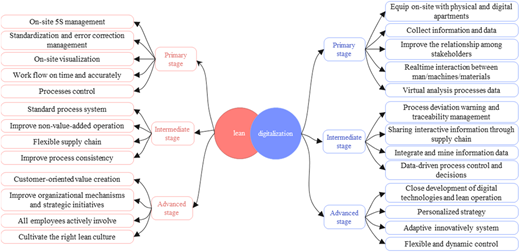
To sum up, the integration of lean and digital technologies is recognized as a strategic mode for achieving sustainable transformation in PC. Specifically, lean focuses on process rationalization, while digitalization prioritizes data value. By sorting out the aforementioned research, the characteristics of lean and digitalization in stages of “primary, intermediate and advanced”, are shown in Figure 1, respectively. Lean acts as an effective method to promote digitalization, in turn, digital technologies promote lean implementation (Dang et al., 2024).
Most previous studies explored the interaction between BIM and lean. For example, Sacks et al. (2010) developed a matrix illustrating the synergy between BIM functionalities with the lean principles. Few examined lean in conjunction with a broader range of digital technologies, particularly within PC context. This study contributes to the current body of knowledge by extending BIM-lean focus to a comprehensive digital-lean integration. Moreover, existing studies tend to view lean-digital integration as a static relationship, overlooking dynamic and evolutionary nature. In practice, lean-digital implementation progresses through multiple maturity stages. This complexity highlights the need to understand how different factor combinations affect outcomes at different evolutionary stages. To address the gap, this study develops a three-stage dynamic model, comprising primary, intermediate and advanced stages, to reveal how lean and digital practices co-evolve to drive performance improvement.
3. Research design
As highlighted by Bataglin et al. (2020), varying combinations of factors lead to distinct transformation pathways. Thus, this study conducts an empirical analysis via fsQCA for exploring the multiple pathways for lean-digital implementation in PC. Though various methods have been used for path analysis, such as the evolutionary game analysis, Bayesian networks and Interpretive Structural Modeling-Analytic Hierarchy Process approach (Al Hazaimeh and Alnsour, 2022; Alnsour and Alnsour, 2025), they are criticized to be less effective in constructing multiple paths from a dynamic perspective. In contrast, fsQCA has been increasingly favored for its ability to identify diverse configurations leading to specific outcomes. For example, Jiang et al. (2021) used fsQCA to analyze relationships among BIM, project complexity and user satisfaction, proposing three configuration paths to achieve high user satisfaction. Jing et al. (2021) explored path selection for achieving lean manufacturing and digitalization transformation across various stages of “point, line, plane, cube”. These studies provide valuable references for investigating paths in multi-stage contexts through fsQCA.
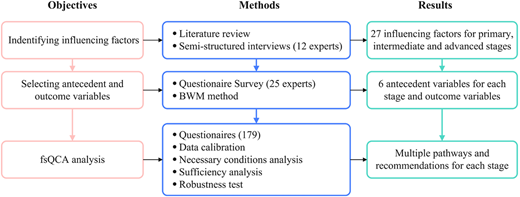
The research design is illustrated in Figure 2. The first step involved identifying factors driving lean-digital transformation within PC through literature review and expert semi-structured interviews (De Lombaert et al., 2023). The second step begins with a questionnaire to determine the antecedent variables, followed by a Best–Worst Method (BWM) analysis. Compared with other weighting approaches, BWM has the advantage of requiring fewer pairwise comparisons (Moslem et al., 2020; Rezaei, 2015). In the last step, fsQCA was used to quantitatively analyze complex interactions under multiple causal conditions, examining the necessity, sufficiency and impact of core variables on lean-digital transformation outcomes.
3.1 Identifying influencing factors
Lean-digital transformation is a dynamic process that will be affected by multifaceted factors across various stages. Firstly, a systematic literature review was undertaken to identify preliminary factors. The literature databases include Google Scholar and Web of Science. This is because Google Scholar emerged as the most comprehensive source of publications, and Web of Science citation contribution shows the strongest upward trend (Gerasimov et al., 2024). The integration of both database achieves 88% coverage of research, which supports the effectiveness of the results (Gerasimov et al., 2024). For example, Hacohen et al. (2022) using Google Scholar and Web of Science to review the landscape of autonomous driving. The searching criteria was set as T/A/K=(“lean/JIT” OR “digital/ BIM/ blockchain/cloud/IoT”) AND (“prefabricated construction” OR “prefabrication” OR “precast” OR “off-site construction” OR “industrial building” OR “industrialized construction”), with the YEAR from 2021. As peer-reviewed papers follow a rigorous review process, document type was set to article and language was set to English. After excluding duplicates, this search brought forth nearly 600 papers. Then, the papers underwent visual screening based on the following criteria: (1) abstracts were reviewed to exclude irrelevant studies, and (2) only papers published in SCI/SSCI journals ranked JCR Q3 or above were retained. Finally, a total of 50 publications remained for a full-text review, detailing key factors, pathways and strategies for implementing lean and digitalization. Based on a minimum occurrence frequency of three, 30 factors are identified across primary, intermediate and advanced stages.
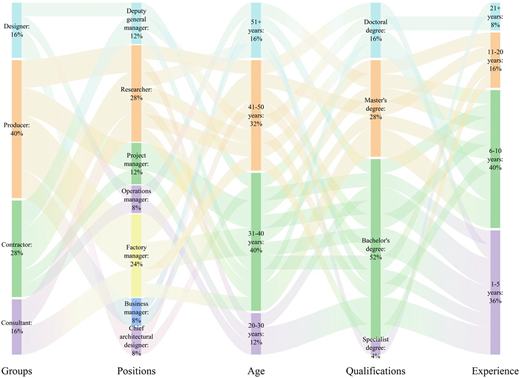
Subsequently, semi-structured interviews were conducted to verify the logic and completeness of the initially identified factors. 12 experts were recruited based on following stakeholder-oriented sampling principles: (1) at least five years of experience in lean or digital implementation (Nguyen et al., 2023); (2) having undertaken practical tasks of implementing lean or digitalization in PC projects (Solarino and Aguinis, 2021); (3) holding senior positions in the project teams (Silverio et al., 2022). These principles can ensure that the selected experts are qualified to answer the questions of lean and digital implementation (Marozzi et al., 2024). The sample size of 12 also aligns with methodological criteria that an effective decision-making panel should comprise 5–12 members (Brito et al., 2019). The experts represented key stakeholders in PC, including two business managers from developer, two factory managers from producer, three project managers from contractor, three project managers and two professors from consultant.
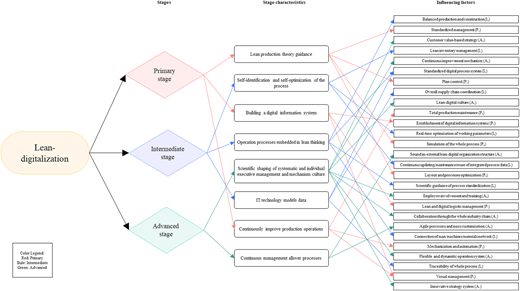
Prior to the semi-structured interview, each expert was provided with a brief summary of the research background and objectives to obtain informed consent. Upon consent, interviews were then conducted either face to face or by telephone to examine whether the factors identified from the literature were observable in real PC projects. Specifically, in Round 1, 8 experts reviewed the initial factor list based on their working experience, suggesting factor adjustments, additions or deletions where appropriate. In Round 2, another 4 experts were asked to cross-check the rationality of the updated factors. Each expert was interviewed lasting between 1–2 hours. Through this two-round semi-structured interview process, 27 factors across three stages and eight characteristics were finalized, as shown in Figure 3.
3.2 Selecting antecedent and outcome variables
3.2.1 (1) selecting antecedent variables based on BWM
A questionnaire survey was administered to an expanded expert panel to determine the weights using BWM method, supporting the selection of the antecedent variables at each stage. Recent applications suggest that expert panels comprising approximately 25 participants can provide a reliable basis for factor weighting and evaluation (Calle Müller and ElZomor, 2026; Gomroki et al., 2023). To meet this, the expert panel in the first step was expanded to 25 using the same selection criteria. Moreover, this sample size exceeds that used in most previous BWM studies (Gul and Yucesan, 2022; Nyimbili and Erden, 2021), indicating the suitability. The experts' profiles are shown in Figure 4.
First, the 25 experts assessed the importance of each factor using a 5-point Likert scale, where “1” means the least important, that is the worst factor, and “5” represents the most important, that is the best factor. Average scores were calculated and ranked to identify the best and worst factors. In the primary stage, standardized management () was identified as the best factor, while visual management () was considered the worst. In the intermediate stage, lean inventory management () was identified as the best factor, whereas balanced production and construction () was considered the worst. In the advanced stage, collaboration through the whole industry chain () was identified as the best factor, while establishment of a flexible and dynamic operation system () was considered the worst.
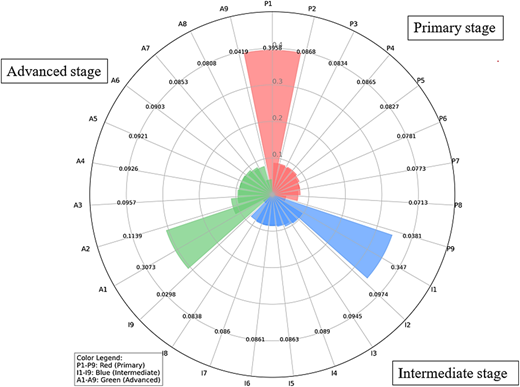
Next, the 25 experts performed the BWM pairwise comparisons by rating (1) the preference of the best factor over each remaining factor and (2) the preference of each factor over the worst factor using a 1–9 scale. Weights for each factor were further calculated through optimized procedure listed in Khan et al. (2023), shown as Figure 5. The distributions of factors' weights in primary, intermediate and advanced stage are respectively indicated with red, blue and green areas.
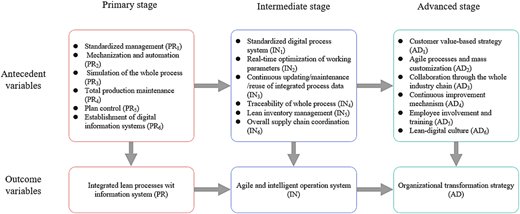
The top six factors were further selected as the antecedent variables for each stage based on the weights. This selection aligns with fsQCA requirements regarding the number of antecedent conditions and helps reduce the computational complexity (Rezaei, 2015).
3.2.2 (2) selecting outcome variables
In terms of outcome variables, the three stages of “primary, intermediate, advanced” target different elements, which in turn determines the differences in the goals of each stage. The goals of each stage are based on their characteristics and influencing factors in Figure 3. All outcome variables in each stage are illustrated in Figure 6.
3.3 fsQCA analysis
3.3.1 Data collection
Data were collected via a questionnaire using a Likert 5-point scale. For each stage, variables are determined by two questions, and the total score evaluated by respondents was used as the variable score. The questionnaire was revised based on the feedback from 25 experts, then distributed to PC stakeholders engaged in lean and digitalization. With 10 years of lean-digital consulting experience and strong ties to the Lean Digitalization Research Center at Tianjin University, the authors have access to credible respondents. Based on this, a total of 179 valid questionnaires were collected. The questionnaire data have been strictly screened, and reliability and validity tests have passed as both Cronbach's α index and KMO>0.7. All respondents had a minimum of five years of lean-digital experience, serving as specialists like designers (24.58%), producers (27.93%), contractors (29.05%) and consultants (18.44%). In terms of enterprise size, participants were from small (35.20%), medium (46.93%) and large (17.88%) firms. Regionally, responses were distributed across East China (27.93%), South China (19.55%), North China (13.41%), Southwest China (21.23%) and Northwest China (17.88%). This diversity in roles, organizational scale and geographic coverage ensures a representative sample, enabling a more comprehensive analysis of lean-digital transformation across different contexts and stages.
3.3.2 Data calibration
This study uses fsQCA 3.0 to calibrate antecedent and outcome variable, converting them into the corresponding fuzzy set membership degree. Three thresholds are used: full membership (1), cross-over point (0.5) and full non-membership (0). Specifying the raw values for these three thresholds allows software to calibrate all remaining scores. In general, the distribution of questionnaire data may have deviations, such as being distributed above 3, and the validity anchor points can be set to 3, 4 and 5 (Shamout, 2020). “3” represents full non-membership, “4” represents cross membership and “5” represents the full membership.
3.3.3 Analysis of necessary conditions
It is vital to test whether a single factor (including its non-set) or not is the necessary condition before configuration analysis (Rihoux, 2008). Based on set theory, the necessary analysis of a single factor is to test whether the result set is a subset of a certain factor set. If a condition consistently appears in all instances of the outcome, it can be considered necessary. A consistency threshold of 0.90 was applied. As shown in Table 1, none of the single antecedent variables affect outcome with the consistency exceeding 0.9, indicating that no single factor is a necessary condition for lean-digital transformation.
3.3.4 Sufficiency analysis
In fsQCA, configurations with PRI scores below 0.5 indicate significant inconsistency and should be excluded (Greckhamer et al., 2018). Following Greckhamer's suggestion, this study set the consistency threshold to 0.65 and the case threshold of 1 (Greckhamer, 2016). When using fsQCA to analyze configurations for lean digitalization, there are typically three solutions: complex, intermediate and simple solution. These intermediate solutions use only a subset of the simplifying assumptions (Nikou et al., 2024). Therefore, this study selected the intermediate solution for the analysis to ensure the scientific validity and practical guidance value of the results.
4. Results
The fsQCA highlights that the conditions for lean-digital transformation in PC vary across the primary, intermediate and advanced stages, indicating diverse transformation pathways. Each pathway requires specific resource allocations. By following the appropriate pathway, stakeholders can achieve better implementation outcomes and progress to higher stages of transformation. In the configurational conditions, consistency and coverage reflect the effectiveness of each configuration. Raw coverage and unique coverage measure how much of an outcome is covered (i.e. explained) by each solution term and by the whole solution.
4.1 Pathways of lean-digital transformation at the primary stage
This study identified three pathways (, and ) that can effectively explain the primary stage of lean-digital transformation in PC, providing decision-making strategies for stakeholders. As described in Table 2, the solution consistency is 0.854, and the solution coverage is 0.469, indicating that the three pathways collectively have strong explanatory power for the outcome.
Pathway (*∼PR2*PR3*∼ PR4* PR6) highlights the establishment of lean workflow standards, process simulation and the deployment of information systems for basic data collection and transparency (Barkokebas et al., 2021a). It is suited to contexts with low automation and limited equipment reliance, where transformation is primarily driven by process optimization and digital technologies. Pathway (*PR6) extends beyond by emphasizing lean planning and cross-process synergy (Alnaser et al., 2024). Through planning control with information systems, it enables process optimization, schedule coordination and efficient resource allocation, making it appropriate for projects with high requirements in production planning and information management. Pathway (* PR2* PR3* PR4 *∼ * PR6) advances transformation further by enhancing industrial-level capabilities and aligning lean maintenance with PC processes (Anang and Chukwunweike, 2024). This pathway is particularly relevant for stakeholders with advanced technical conditions and high degree of automation, where production efficiency relies heavily on equipment management, production simulation and sophisticated information systems. Together, these pathways provide differentiated routes for lean-digital transformation, corresponding to varying technical conditions and organizational needs.
4.2 Pathways of lean-digital transformation at the intermediate stage
At the intermediate stage, three pathways (, and ) are identified to effectively promote successful transformation. As described in Table 3, the overall solution's consistency is 0.885, with coverage of 0.467, showing that the three pathways collectively provide a strong explanatory power for the target results.
Pathway (∼* *∼ * * ) emphasizes establishment of standardized workflows, the integration of JIT and pull principles into inventory management and enhanced supply chain collaboration (Panigrahi et al., 2024). It is particularly suitable for stakeholders requiring standardization, rigorous quality control and improved coordination efficiency through digital traceability and information systems. Pathway (*∼ * * * ) extends beyond by highlighting data mining, adaptive tracking and data-driven lean operation management (Chen et al., 2020; Wang et al., 2017). This pathway is well suited to stable production environments, where transparency, parameter monitoring and supply chain responsiveness are prioritized over process adjustments. Pathway (*∼ * * * *∼ ) advances transformation further by embedding real-time data feedback and automated optimization to support customer-oriented and flexible production systems (Srewil and Scherer, 2013). It relies on dynamic adjustment and rapid response, making it especially relevant for projects requiring high customization and adaptability, such as urban regeneration and complex assemblies. Together, these pathways illustrate differentiated routes for lean-digital transformation at the intermediate stage, ranging from standardized management (), to data-driven operational improvement () and ultimately to adaptive and customer-centered production systems ().
4.3 Pathways of lean-digital transformation at the advanced stage
Three pathways (, and ), which can effectively explain the advanced stage of lean-digital transformation in PC, are shown in Table 4. Similarly, the solution consistency is 0.879, and solution coverage is 0.375, indicating that the three pathways collectively have strong explanatory power for the target results in the advanced stages.
Pathway (* * * *∼ ) emphasizes customer orientation, information sharing, employee training and the cultivation of innovation-driven culture (Schulze and Dallasega, 2023). This pathway is particularly suitable for stakeholders where customer satisfaction and value creation are core competencies, enabling improved collaboration in complex environments. Pathway (* * * *∼ ) highlights continuous improvement, with a focus on cross-process and multi-participant synergy (Eaidgah et al., 2016). It is well suited for stakeholders characterized by dynamic production processes, especially environments where technological capabilities and flexible manufacturing are critical. Pathway (* * *∼ *∼ * ) extends beyond the prior two pathways by integrating customer-centric innovation with flexible production, enabling rapid response to diverse market demands (Barlow and Ozaki, 2005). This stresses customized manufacturing and process reconfiguration to deliver individualized solutions, making it effective for highly customized PC projects.
5. Robustness test
To verify fsQCA results, this study conducts validation at both practical and theoretical levels (Jing et al., 2021).
Theoretical validation. Following Greckhamer and Gur (2021), the consistency threshold is adjusted from 0.65 to 0.7. Theoretically, the new configuration should be a subset of the previous configuration. These more stringent thresholds provide a more rigorous test of the proposed pathways in primary, immediate and advanced stages. The analysis results are shown in Appendix Table A1, which indicate a subset relationship among pre-adjustment configurations. Specifically, although increasing consistency threshold reduces partial coverage and diminishes the influence of certain non-core conditions, the core condition combinations and their explanatory power for the outcome remain stable. This suggests that the proposed pathways exhibit consistency across varying threshold settings, thereby confirming the robustness of the findings.
Practical verification. To enhance the reliability of results, an expert consultation with previous 25 experts was conducted. Over a week-long online feedback process, these experts provided their insights into the pathways of various stages. There was a consensus that the pathways align well with the real-world PC scenario and serve as a reference for future lean-digital implementation. Furthermore, we validate our findings through examining a PC company in Tianjin, China, which has embarked lean-digital transformation for years. Through workshops with managers, frontline employees and consultants, we found that their transformation process aligns with the three-stage model proposed in this study. In the primary stage, the focus was on standardizing materials and processes, automating production and implementing SinoBIM for simulation and data sharing, in line with L3 pathway. In the intermediate stage, the stakeholder integrated data and lean operations across factories, focusing on JIT inventory management and tracking processes for quality control. An integrated SinoBIM platform was used to enhance collaboration, aligning with L2 pathway. In the advanced stage, the stakeholder shifted focus to the end customers, launching their in-house digital platform known as (“Zhuangpei Hulian”) for industry collaboration and enabling mass customization through flexible production. Lean and digital technologies were fully integrated, supporting a culture of innovation, in line with L3 pathway. This case study validates the findings, showing a strong alignment between identified pathways within lean-digital transformation.
6. Discussion
The fsQCA configuration analysis was utilized to explore key pathways of lean-digital implementation in PC at primary, intermediate, to advanced stage. Compared with previous studies (Evans et al., 2021; Polat and Demirkesen, 2025), this analysis emphasized lean-digital transformation in PC considering the dynamic evolutionary stage. Furthermore, fsQCA was suitable than other methods such as ISM, dynamic Bayesian networks and SEM with the ability to diverse pathway configurations leading to lean-digital transformation (Alnsour, 2024; Yao et al., 2024).
At the primary stage, lean-digital transformation in PC follows the three complementary pathways tailored to different contexts, yet all converge on standardized workflows, process simulation and digital information systems as foundational practices. These essential elements consistently exhibit high robustness across scenarios, highlighting their centrality for early transformation. While previous studies have emphasized standardization (Bayhan et al., 2023), simulation for identifying inefficiencies (Chen et al., 2023) and digital platforms (Jiang et al., 2023), this study advances the literature by demonstrating how these lean and digital practices interact configurationally to generate multiple viable pathways rather than a single route. Such findings indicate that lean-digital transformation can be achieved under diverse technical conditions, whether by leveraging process optimization and digital tools in low-automation settings or by combining automation and lean in advanced projects. This extends prior arguments that industrialization should precede digitalization, suggesting that transformation may evolve along parallel or alternative routes (Ketchoua et al., 2025). In practice, PC stakeholders should progressively refine standardization, simulate processes to solve bottlenecks and deploy BIM-, or IoT-enabled systems to support real-time information sharing.
At the intermediate stage, lean-digital transformation in PC advances via three pathways that reflect diverse stakeholders' operational priorities and technical capacities. Across all configurations, lean inventory management emerges as the most critical practice, highlighting its key role in cost control, waste reduction and supply chain coordination. This offers new insights by highlighting inventory-centered integration as a pivotal driver of lean-digital implementation at this stage. While earlier studies have focused on inventory efficiency (Fang et al., 2025; Wang et al., 2024b), coordination (Kim et al., 2023) and data-driven traceability (Van Nguyen et al., 2023) respectively, this study extends the literature by demonstrating that transformation can be consistently realized under differentiated conditions, whether through inventory-focused integration in contexts of the limited standardization, or flexible coordination in dynamic environments with constrained real-time optimization. This perspective challenges the prevailing view that standardized processes (Barkokebas et al., 2021a) and parameter optimization (Russo et al., 2025) are the dominant enablers, showing instead that inventory-centered integration provides a scalable trajectory for intermediate stage. Compared with the primary stage, where standardized workflows and digital information systems are the foundation, the intermediate stage shifts attention toward inventory management, data utilization and supply chain responsiveness, aligning with emerging evidence on the role of BIM, digital twins and blockchain-enabled traceability in PC (Chatterjee et al., 2024; Van Nguyen et al., 2023). In practice, stakeholders should prioritize strengthening lean inventory management supported by digital technologies.
At the advanced stage, lean-digital transformation in PC progresses through three distinct pathways, ranging from customer-oriented value creation to continuous improvement and flexible customization. Despite these variations, they highlight two critical practices, that is customer value-based strategy and collaboration across the whole industry chain. These elements ensure that PC projects are not only technologically optimized but strategically aligned with customer needs (Turi et al., 2025). This extends previous research by demonstrating that the advanced lean-digital transformation requires not only industry-chain integration but also sustained attention to customer value and cultural development. While earlier studies emphasized customer orientation (Essiz and Senyuz, 2024), industry chain collaboration (Zelbst et al., 2024), culture for motivation (Gatell and Avella, 2024b) and employee engagement for ability and innovation (Müller and Leyer, 2025), this study advances these insights by revealing multiple viable pathways that extend beyond linear models of lean-digital implementation. The findings further indicate that, at the advanced stage, the focus of lean-digital transformation lies not in achieving large-scale customization (Barata et al., 2023) or institutional mechanisms (Guo and Mantravadi, 2025), rather in customer-oriented strategies, industry-chain integration and cultural development. Compared with earlier stages, where standardization (at the primary stage) and inventory management (at the intermediate stage) dominated, the advanced stage shifts the focus toward people-oriented innovation, cultural embedding and customer-centered value (Ordieres-Meré et al., 2023). Practically, this indicates that stakeholders should place customer value creation at the center of their long-term strategies and invest in employee training to cultivate a lean-digital culture.
7. Conclusion and future work
7.1 Conclusion
This study systematically analyzed configuration pathways for lean-digital transformation within the PC context in three stages: primary, intermediate and advanced. Methodologically, by adopting the BWM method, the top six factors at each stage were analyzed as antecedent variables, then the outcome variables are analyzed. Meanwhile, the multiple causal relationships among antecedent variables and implementation pathway were explored using the fsQCA method, exploring their configurations in lean-digital transformation. Key results are:
No single factor is necessary for lean-digital implementation. Instead, there are complex, multiple concurrent causal relationships between these factors.
Within PC, lean-digital implementation exhibits distinct pathways at each stage. These pathways are shaped by variations in management, resource and other contextual factors.
Certain core factors recur across multiple pathways within a stage, suggesting they should be prioritized during implementation.
7.2 Research implications
By proposing the three-stage pathway model for lean-digital transformation, this study provides theoretical, practical and managerial guidance.
From a theoretical view, first, this study contributes to the current knowledge body by extending BIM-lean focus to a comprehensive digital-lean integration; second, this study extends previous studies by exploring the dynamics of lean-digital transformation; third, this study advances the methodological part by providing an empirical analysis of pathways that drives lean-digital transformation. From a practical point of view, this study provides decision-making references for lean-digital implementation. For example, the pathway focuses on standardization and informatization system at the primary stage, inventory-centered integration at the intermediate stage and customer-oriented value at the advanced stage. This gives a comprehensive overview of lean-digital transformation pathways for PC, which should be prioritized according to stakeholders' resources, capability and goals. The managerial implication for policymakers is as follows:
Policymakers should prioritize integrating lean principles with digital technologies, to enhance their synergistic value.
A staged evaluation system with quantitative metrics should be developed to assess lean-digital stages in PC dynamically.
Policies should offer specific guidance for PC at lean-digital stages of primary, intermediate and advanced, with promoting for BIM training, information systems and data platforms, respectively.
7.3 Research limitations and future works
Although this study has addressed several gaps in the PC industry, some limitations are remaining. First, the data were collected in China, which may limit the generalizability of the findings to international contexts. Future research could include cross-country comparisons to broaden the applicability. Second, the researchers collected data from expert interview and questionnaire survey, which are subjective to a certain extent. Further research should collect objective data such as panel data to increase the persuasive power of results. Thirdly, the relative influence of each causal pathway on the outcome variables was not examined. Future research could incorporate quantitative techniques, such as regression analysis, to measure the impact of each pathway, thereby enhancing the explanatory power of the conclusions.