The article aims to analyse the barriers to Industry 5.0 adoption in the Indian manufacturing sector for improvement in organisational sustainability. Further, the study also provides different mitigation actions for barriers.
The analysis indicates that “Lack of connection between physical and virtual systems”, “Digitisation and automation of the process” and “Financial constraints” are the most critical barriers to the adoption of I5.0 in the Indian manufacturing sector.
The study is of the first kind that analyses the barriers to the adoption of I5.0 to enhance sustainability in India's manufacturing sector. Further, the study's uniqueness also lies in providing different mitigation actions and associated benefits for stakeholders.
1. Introduction
Industry 5.0 (I5.0) is a new industrial paradigm that enables humans to interact with machines through the use of digital technologies and cyber-physical systems (Sharma et al., 2022, 2025). Digital technologies of I5.0 provide real-time data collection and analysis, leading to improved operational performance within industrial settings (Kaswan et al., 2025a, b). Continuous pursuits towards the attainment of sustainable development goals (SDGs) and I5.0 foster industrial organisational capability towards the mass customisation of quality products (Özdemir and Hekim, 2018). In this volatile-uncertain-complex-ambiguous (VUCA) world, I5.0 execution is one of the key issues as it involves different sets of interacting technologies, complex machine tools and complex relationships of manufacturing systems (Nahavandi, 2019; Raj et al., 2020; Kaswan et al., 2025a, b). These new service paradigms, methods and practices are left to the domain of information and communication technologies (ICT) experts, smart entrepreneurs and industrial managers. This prophesies that the concept of this set of interactive technologies needs further detailed investigation. The need for the current scenario is to ensure the successful adoption of I5.0 to make sustainable factories (Fraga-Lamas et al., 2021).
The manufacturing sector of developing nations is currently facing challenges related to shorter product life cycles, increased intergovernmental pressures to reduce carbon footprint and waste reduction to ensure the timely delivery of products at the lowest possible cost (Satyro et al., 2022; Holopainen et al., 2024). Thus, the manufacturing sector must develop and adopt technologies that induce mass customisation, empower organisations towards social and environmental sustainability and induce quick decision-making, together with the reduction of different non-value-added activities. This current scenario associated with manufacturing entities of developing nations can be improved through the incorporation of digital technologies associated with the human touch of I5.0. ICTs like machine learning (ML), IoT and big data analysis (BDA) provide an integrated set of technologies that interact cohesively and improve the operational dynamics of the manufacturing industry (Singh et al., 2025).
Industry 5.0 has the potential to transform the manufacturing sector by enabling mass customisation to meet evolving consumer demands, while simultaneously promoting environmental sustainability, workplace safety and the well-being of industrial personnel. For this, I5.0 has gotten huge attention among policymakers, practitioners and researchers in the last few years. As a new model for industries, it is resisted by different levels of organisation personnel, due to industrial and technological boundaries. In the literature, most of the studies of I5.0 are related to concepts, applications and tools (Maddikunta et al., 2022). Despite the great potential of I5.0, its adoption has not been explored to fully tap into the manufacturing industries of India (Mukherjee et al., 2023). India is now the fifth-largest economy in the world, but it is not among the top five manufacturing hubs (Sindhwani et al., 2023). Further, according to recent reports, despite the Indian government's huge efforts under Make in India, investment in the manufacturing sector has slumped due to innovation measures and the availability of skilled professionals. For this, Indian manufacturing industries must comprehend the reasons that obstruct the adoption of I5.0 in Indian manufacturing. The existing studies of Industry 5.0 elaborated on know-how, basic concepts and technology, but didn't elaborate on why there is less adoption from the perspective of operational management and business viewpoint (Aslam et al., 2020; Doyle-Kent and Kopacek, 2021; Javaid et al., 2020). The extensive study on the barriers is related to descriptive analysis of the barriers in a generalised manner and not specific to the manufacturing sector and a particular segment or nation (Mukherjee et al., 2023). Previous studies have largely not focused on prioritising barriers in a manner that offers a structured and sequential approach for their mitigation, particularly given the interdependence among these barriers, which makes addressing all of them simultaneously impractical. For the said gaps, the present study makes a meticulous method to explore and analyse different barriers of the I5.0 in the Indian manufacturing sector for enhancement in the sustainability. Unlike literature that has primarily focused on conceptual and technological perspectives of I5.0, the present study contributes by exploring the I5.0 implementation barriers, ranking them and validating the same in India's manufacturing sector using a hybrid multi-criteria decision-making approach.
Thus, the present research study addresses the following research questions:
What are the barriers that hinder the successful implementation of Industry 5.0 in the Indian manufacturing sector?
What solutions can be deployed to overcome the barriers to the adoption of I5.0?
The paper contributes to existing literature by providing a comprehensive knowledge of I5.0 barriers and prioritising the same so that the most critical barriers can be addressed at the initial stage of I5.0 adoption. Further, the study also maps different barriers to the associated mitigation actions, which will assist in a ready-made plan for the removal of barriers. The findings of the present study can benefit industrialists by identifying real adoption gaps to the I5.0 implementation in the Indian manufacturing sector. The identification of barriers will facilitate industry leaders in formulating a more robust investment plan, and the key areas of industry which need the execution of digital transformation.
The rest of the article is organised as follows. Section 2 depicts the theoretical background of I5.0, the connection of I5.0 with sustainability and the exploration of gaps in the literature. Section 3 illustrates the adopted research method, whereas Section 4 presents the analysis and results. Section 5 focuses on the discussion and implications of the study. Finally, inferences and future aspects of the study are presented in the last section of the manuscript.
2. Theoretical background
The literature review section consists of three sub-sections. The first sub-section presents the background of I5.0, the second sub-section enumerates the synergy between I5.0 and sustainability, and the final sub-section illustrates gaps identified from the literature.
2.1 Industry 5.0
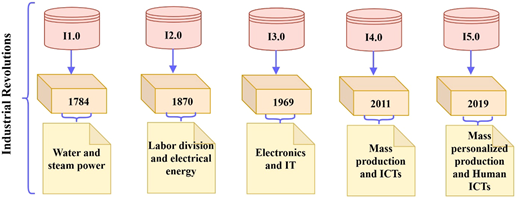
Industrial organisations are in a continuous pursuit of improving sustainability dynamics through the adoption of eco-friendly methods and practices (Sabale et al., 2024; Sharma et al., 2026). Further, increased consciousness about mass customisation, responsive actions and shorter product life cycles has forced industries to integrate their sustainable methods with ICTs like I5.0 (Carayannis and Morawska-Jancelewicz, 2022). The I5.0 revolution is centred on humanoids that encapsulate the 6′R (recognise, reconsider, realise, reduce, reuse and recycle) to reduce waste and harmful environmental impact, and are capable of delivering high-quality personalised products (Nahavandi, 2019). The history of I5.0 can be traced back to the development of different industrial revolutions. Industry 5.0 goes beyond Industry 4.0 (I4.0) and uses human expertise in conjunction with smart, efficient and intelligent machines to avoid delay and dissonance, making the workplace safer and environmentally friendly while leading to improved organisational productivity (Xu et al., 2021). Figure 1 illustrates the different industrial revolutions.
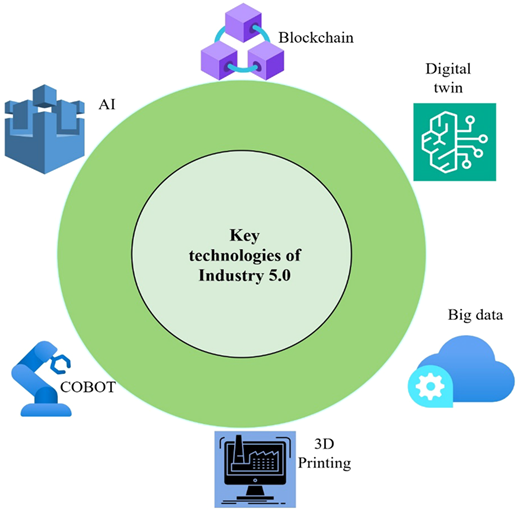
The main theme of I4.0 is to make the industry smart through the interconnection of devices and machines that collaborate throughout the lifespan of the product (Wagire et al., 2020; Ghobakhloo and Iranmanesh, 2021; Sreenivasan and Suresh, 2022). The primary focus of I4.0 is to promote process automation so there is less human intervention in the product or service delivery (Cimini et al., 2020; Bag et al., 2021; Quiroz et al., 2024). I5.0 has been intellectualised to influence the exclusive creativity of humanoid beings to interrelate with a smart set of technologies (Figure 2). Table 1 illustrates key differences between I4.0 and I5.0.
2.2 Industry 5.0 and sustainability
I5.0 makes the industry more resilient and sustainable by interlinking different sets of digital technologies with human aspects and thus promotes sustainable development goals (Kaswan et al., 2025a, b). It overcomes the limitations of I4.0 by introducing the human touch that leads to making the system more flexible and thus reduces the tendency for accidents (Kaswan et al., 2025a, b). It has been found that I5.0 promotes worker engagement, innovation and increased well-being (Kumar et al., 2024). I5.0 fosters the linear model of economy to the circular model of economy by introducing the different systems of circular economy coupled with digital technologies (Aslam et al., 2020). I5.0 makes the production line more flexible through systems of human-assisted robots and digital twins and thus leads to the production of highly customised (Kumar et al., 2025). In a nutshell, I5.0 maps the lens of all aspects of sustainability by using an integrated set of digital technologies and human aspects.
2.3 Research gaps
Despite a large set of advantages associated with I5.0, its potential has not been explored to the full tap due to prominent controversies. Firstly, the know-how, frameworks and scope of I5.0 are not much explored in academic literature. Secondly, how I5.0 can contribute to the sustainability of the organisation has also not been explored in full throttle. This led to the low adoption level of this new industrial paradigm within developing nations like India. Although studies related to the barriers of I5.0 exist in literature, previous studies are not specific to the manufacturing sector. Sharma et al. (2022) identified barriers to the I5.0 related to the pharmaceutical sector of Germany, so the same findings cannot be generalised for the manufacturing sector. Further, Mukherjee et al. (2023) explored barriers to I5.0 in developing nations, but the study findings were for all sectors of the industry, and the study did not concentrate on the manufacturing sector. Further, previous studies on the barriers of I5.0 do not provide avenues for how the removal of the barriers contributes to organisational sustainability improvement. Further for being a developing nation, most of the industrial sectors in India may not be able to mitigate or eradicate all these barriers at the same time due to funding and other constraints. Therefore, it is also imperative to prioritise the potential barriers to the adoption of I5.0 to determine and prioritise their removal. For this, the present research work advances the research of I5.0 through the identification, investigation and removal of the barriers of I5.0 from the viewpoint of improvement in organisation sustainability.
3. Research methodology
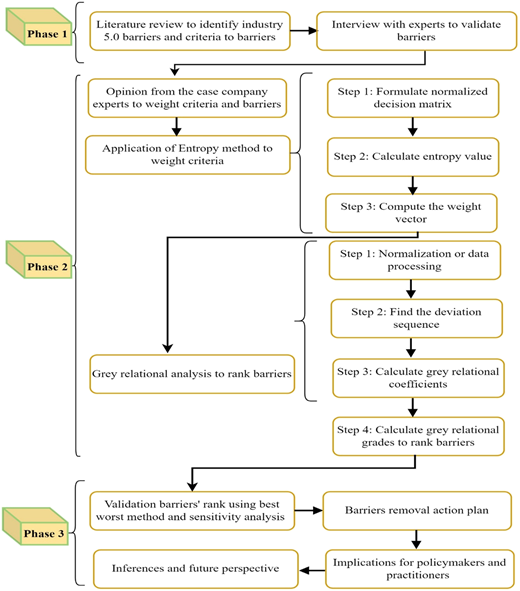
The research methodology adopted in the present research work consists of three distinct phases (Figure 3). The first phase broadly explains the identification of the barriers to I5.0 in Indian manufacturing industries. The second phase elaborates prioritisation of the barriers. The final phase illustrates the validation of the ranks and inferences drawn from the study. The various phases of the methodology are as follows:
Phase 1: A systematic study of the literature has been done initially to identify the barriers to I5.0. This resulted in the identification of the ten prominent barriers (Table 2). Further to validate the barriers, the experts were selected through a purposive sampling technique from diverse industrial domains and had vast experience in digital technology and operations. The major criteria used for expert selection were having a minimum of 14 years' experience and being involved in a decision-making approach related to digital technologies. A total of 11 experts comprised of three senior managers, two deputy managers, three chief engineers, two engineers and one senior engineer (Table 3). LinkedIn profiles and authors' networks were used to interact with the experts. To validate the findings of the barriers, the authors conducted semi-structured interviews with the experts, where different sets of questions (appended as a supplementary file 1) were asked. The qualitative data from semi-structured interviews were analysed following the Huberman and Miles (1994) coding protocol. Table 4 depicts the method for deciphering the transcripts. In this context, “code” presents certain conceptually framed codes derived from the transcripts, after identifying the pioneer concept area and imperative dimensions of the concept domain. Further, to provide more validation to the identified barriers, different sets of questions were asked from the manufacturing industry experts (questionnaire appended as supplementary file 2). The experts agree that the identified barriers are critical for the Indian manufacturing industry to adopt I5.0 practices.
The authors used their own experience to identify the code that matches the barriers identified from the literature (Table 4). This results in the authentication of the barriers unearthed from literature. The criteria considered for the barriers were related to productivity, social aspects, environmental impact, human-centeredness and working facilities.
Phase 2: In the second phase, opinions from the experts from the case company were taken into consideration, firstly to weigh the criteria and then rank barriers. Five senior managers, seven managers and three chief engineers from the case company participated in this study to weigh the criteria and then subsequently rank the barriers. The personnel have considerable experience, more than 14 years, in dealing with digital sets of technologies and system integration for improvement in organisational efficacy. A well-designed questionnaire was circulated to them using personal visits and asked to fill out the independent responses. The entropy method has been used in this study to rank criteria.
The entropy method is based on the information theory developed by Shanin in 1948 (Mukhametzyanov, 2021). It is used to find weights objectively from data sets where judgments are partial (Vu et al., 2019). The main benefit of the entropy method is its objectivity, where the evaluation of a certain criterion relative to others determines the relative importance without the direct involvement of the DMs. The different steps associated with the Entropy method are:
Step 1: Formulating a normalised decision matrix for the calculation of the weights of the criteria
The first step of the entropy method is the formulation of the normalised decision matrix. Equation (1) has been used to formulate the matrix.
Here, xuv depicts the sum of responses of a criterion to a project.
p = number of projects or alternatives
q = number of criteria
Step 2: Computing the entropy value
In the second step, the Entropy value was calculated using equation (2).
, where p is the number of projects or alternatives
Step 3: Computing the weight vector
The final step of the entropy method consisted of the calculation of the weight vector for the weight criterion. Equation (3) has been used to formulate the weight vector for the criteria.
here, dv is called a degree of diversification.
To rank barriers in this research, GRA has been used. GRA is one of the most effective MCDMs under complex decision-making environments, as calculations are easy and more convenient to comprehend (Senthilkumar et al., 2021). GRA can process inaccurate and vague information associated with a parameter, and it can work in uncertain and ambiguous environments (Kuo et al., 2006). Further, as compared to other MCDMs, GRA does not demand the distribution of samples (Kaswan and Rathi, 2021). Moreover, GRA does not result in inferences that are contradictory to the qualitative analysis. GRA analysis offers a transfer function model that is suitable and effective for dealing with the effective data set. Due to the distinct advantages of GRA over other MCDMs, the present study includes a concrete application of the same to find the barriers that are critical to ensure the successful application of I5.0. The various steps associated with GRA are:
Step 1: Normalisation or data processing
The collected responses from experts for each barrier against the criteria were summed up in the first step of GRA. , denotes the sum of the response of barriers “p” to criterion “q”. Here, represents the normalised value of the project “p” to the criterion “q”. To get normalised, equation (4) was used.
Step 2: Formulate the deviation sequence
The deviation sequence () was calculated using equation (5) in the next step of GRA.
Step 3: Calculate grey relational coefficients
The grey relational coefficients () is calculated using equation (6).
Step 4: Calculate grey relational grades and ranks
In this step, the grey relational grade () was estimated using Equation (7)
here, n = number of criteria and stands for the weight of a particular criterion
Once the ranks of the I5.0 barriers have been established, the same has been validated using the best-worst method (BWM).
Phase 3: In the third phase of the methodology, to validate the barriers rank, BWM has been used. Finally, based on the authors' experience and their feedback, solution measures to mitigate the barriers were suggested. BWM is a multi-criterion decision-making method developed by Razei to make decisions in complex decision-making environments (Everest et al., 2022). This method uses less data as it encompasses two vectors instead of the complete pairwise matrix (Yucesan et al., 2021). BWM is easy to comprehend as it uses an integer scale instead of a fractional one, hence facilitating analyses and decision-making. Furthermore, to validate the ranks of the barriers, the present study uses sensitivity analysis. It is an important tool to check the variation in outputs by changing the input parameters. This method provides robustness and validity to the results given by MCDMs and hence justifies the adopted approach for prioritisation of selected variables (Pianosi et al., 2016). Further, different barriers removal action plans and associated stakeholders' benefits were suggested.
4. Analysis and results
Once the barriers for I5.0 have been identified, the weights for different criteria against the barriers were calculated. In this study, the authors used the entropy method to weight criteria. To weigh the criteria, responses were collected from the case industry manufacturing personnel. The company considered in this research work is an automobile company located in the national capital region of India. Its annual turnover is around USD 139 million, and it was established in 1940. The case organisation had already incorporated I4.0 technologies like cloud computing and ML, and it is in a continuous pursuit to incorporate AR, COBOT and AM technologies of I4.0. The company primarily faced issues with incorporating IoT and blockchain. The exploration of different barriers played a prominent role in the case company's managers as they were taking proactive actions to strategise the smooth adoption and execution of I5.0 solutions. Firstly, the weights of the criterion were found using the entropy method. The steps associated with Entropy are:
In the first step, the responses were collected using a structured questionnaire from the case industry experts. Table 5 illustrates the summed responses of the experts for each barrier against each criterion. Once the responses have been collected, the normalised decision matrix has been formulated using equation (1).
Furthermore, the entropy value was calculated using Equation (2). In this study, a comparison has been made between I5.0 barriers and criteria to barriers. The final step of the entropy method consists of the calculation of the weight vector for the weight criterion. Equation (3) was used for the calculation of the weight vector for different criteria. Table 6 depicts the weights of the criterion.
The entropy analysis depicts that social aspects and environmental aspects are the most prominent criteria for barriers assessment, with entropy weights of 0.2691226 and 0.1973693, respectively. This exhibits the increased proclivity of industrial organisations towards the inclusion of social and environmental aspects within their existing system. The implementation of GRA demands responses against each barrier to each criterion. The responses were collected from the case industry experts (Table 7).
The various steps associated with GRA to rank barriers are:
The very first step associated with GRA is normalisation or data processing. The collected responses from experts for each barrier against the criteria were summed up. Equation (4) has been used to make the normalised matrix. Subsequently, in the 2nd step of GRA, the deviation sequence () was calculated using Equation (5). Further, in the final step of GRA, the were calculated using equation (6). The value of for different barriers is presented in Table 8. Subsequently, grey relational grades were calculated that depict the ranks of the barriers of I5.0. Table 9 depicts the ranks of the I5.0 barriers.
To validate the results of the study, the authors validated the ranks of I5.0 found through GRA through a novel decision-making approach BWM. Table 10 presents the final BWM weights and corresponding ranks for the barriers. The rank for the top six barriers was found to be similar and exhibits consistency in the results found and authenticates the results of the study.
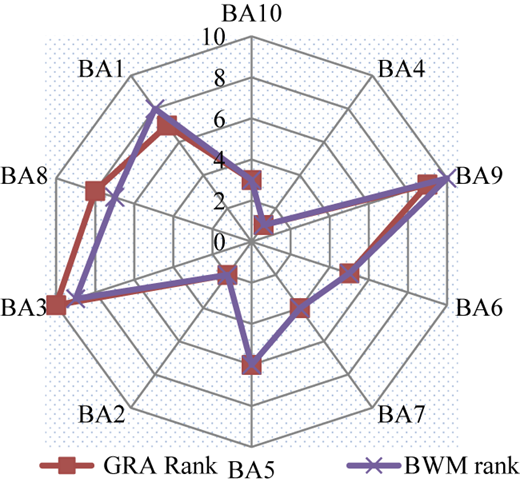
The results of the GRA state that “lack of connection between physical and virtual systems” and “making system automated and digital” are the most critical barriers to adopting I5.0 for the Indian manufacturing industry, with grey relational grades (GRGs) 0.903 and 0.861, respectively. Moreover, for the authentication of the results, the authors used a sensitivity analysis (Table 11), see Figure 4. It is an important tool to validate the results of the study through varying inputs by a certain degree and noting the corresponding changes in the output. The input responses of the experts were changed by 10 and −10% and the corresponding behaviour was observed for changes in GRG and ranks. It was found that the ranks of the barriers only changed slightly when the variation was −10, for only the case of ranks 9 and 10, they were interchanged; the rest of the ranks remained the same for the variation in the responses for the inputs. Thus, the results of the GRA were in agreement with the sensitivity analyses and BWM.
In developing nations like India, there is less knowledge base, adoption frameworks and real-time execution examples of I5.0 within industrial settings. So, there is a lack of integration between physical and virtual systems that form the core of I5.0 adoption. Moreover, industry peers fear that the adoption of new technologies and increased automation could lead to layoffs. This leads to resistance in the adoption of the I5.0 technologies within the industrial operations. Further, it has also been found that “lack of finances” and “regularisation standards” are the next critical barriers to the adoption of I5.0. As new technologies set and the non-availability of practical execution with result-oriented systems of I5.0, there is a risk among the investors to invest in new technological paradigms within the Indian nation. The same can be adjusted by presenting case study results and providing more confidence in capacity-building programs among investors. As the concept of I5.0 has not been explored to its full potential in developing nations, there is a need for a real-time execution framework that provides an approach and potential pragmatic results in terms of improvements related to sustainability. The development of a service-oriented framework of I5.0 will provide a boost to industrial managers to implement the I5.0 approach.
5. Discussion
Over the last few years, social and environmental sustainability has received a sublime interest from scholars and practitioners. A resilient and sustainable industry requires organisations to adopt technologies and approaches that protect the planet and stakeholders while meeting rising demand for customised products. I5.0 can be a foreseen vision for future industries that induce human-centred technologies and are adept at improving social and environmental sustainability. However, I5.0 has not been fully explored, and its adoption and execution are impeded by different barriers. Thus, it is imperative to comprehend, analyse and mitigate these barriers to ensure the successful execution of this human-focused paradigm. The GRA results revealed that the top 5 critical barriers to I5.0 adoption are “Lack of connection between physical and virtual systems”, “Making system automated and digital”, “Lack of finance”, “Regularisation standards' and “Infrastructure changes”.
Concerning “Lack of connection between physical and virtual systems”, it is evident from the results that Indian manufacturing companies are facing the main issue of integrating a data-backed mechanism of virtual manufacturing with the physical system of production. The reason for this can be attributed to traditional-based methods of production adopted by a large set of manufacturing companies and the resistance of the employees to adopt a new set of manufacturing technologies, like additive manufacturing. Most Indian manufacturers are still in early stages of automation, with fragmented digital infrastructures and low interoperability between machines and information systems (Kaswan et al., 2023). The absence of cyber-physical synchronisation reflects a legacy of stand-alone production setups and limited integration of IoT-enabled assets. Consequently, technological advancement remains foundational yet underdeveloped, making it the most influential barrier to Industry 5.0 adoption. To enhance the integration of virtual and physical systems, cyber-physical cognitive systems (CPCS) can be introduced with the existing ones (Maddikunta et al., 2022). Moreover, the integrated application of IoT and edge computing with physical systems promotes real-time data collection from the shop floor and processing of the same near real manufacturing systems, enhancing improved monitoring and control of the system. Further, the next critical barrier to the adoption of I5.0 in the Indian manufacturing industry is “Making system automated and digital”. Digitisation and automation of the processes can lead to considerable improvement in operational efficiency, saving on costs and improvement in organisation effectiveness. This can be achieved through a systematic assessment of the existing processes of the industry and the introduction of digital technologies for improved organisational sustainability. For instance, the incorporation of digital twins within the manufacturing system of India's Maruti-Suzuki industry for the creation of a digital replica of the manufacturing process led to a reduction of material waste by 12% and an increase in operational efficacy by 15% (Patil and Prakash, 2023). This was achieved as a digital twin that provided a clear picture of how the process will perform before actual process realisation, and that leads to considerable savings in time, energy, material and other allied resources that have been otherwise invested in the rework of the rejected parts earlier.
The next pressing issue for India's manufacturing sector to adopt I5.0 is a lack of finance. I5.0 will introduce new methods of work, enhanced human–machine collaboration, advanced communication technologies such as 6G, and logistics systems integrated with drone technologies (Mukherjee et al., 2023). Further, to cope with modern challenges related to environmental footprint reduction from the industry, it is also imperative to induce a smart set of devices for assessing and reducing pollutant matters (Kaswan et al., 2023). So, combined demand for green technology methods and I5.0 would require investment in new technologies that lead to smart factories (capable of producing customised products with less harm to Mother Nature), keeping humans at the centre of technologies. To address this barrier related to finance, government and monitoring bodies would need to provide long-term loans and incentive schemes, tax reimbursements and other allied benefits for the industries that are adopting clean and advanced technologies for improved productivity, coupled with less environmental emissions. Keeping in line with these initiatives, the Indian government made a considerable leap by covering finance, regulatory changes and technology for Indian Micro Small and Medium enterprises (MSMEs). The Indian government announced a credit guarantee scheme that will cover the pooling of risk without collateral or a third party. This will make the loan process easier and less stressful for Indian industries. Further initiatives like self-guaranteeing funds up to 100 Indian rupees will boost the Indian manufacturing industry for the adoption of advanced technologies for improvement in organisational sustainability.
The next pressing issue in this line is “Regularisation standards”. This barrier refers to the interaction between the virtual and real world using established standards and a set of rules. To ensure full throttle safety of the employee, there is a demand for a collaborative framework or a well-established approach. As the concept of I5.0 has not been explored to its full potential in developing nations, there is a need for a real-time execution framework that provides an approach and potential pragmatic results in terms of improvements related to sustainability. The development of a service-oriented framework of I5.0 will provide a boost for industrial managers to implement I5.0. Further need to mitigate the barriers is the development of the open standards and platform for cyber-physical systems, together with the 6G platform for communication, to ensure that data transmitted within the supply chain is secured and authenticated.
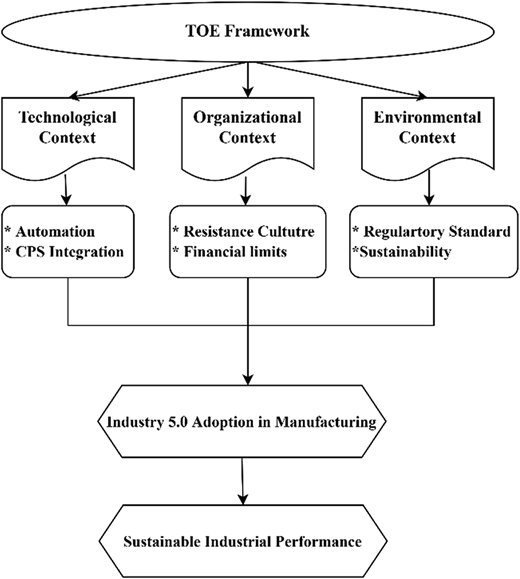
Further, based on the results obtained, the conceptual framework has been drawn to explore the integration of barriers of I5.0 adoption under the theoretical organisational and environmental (TOE) lens and exhibited in Figure 5.
This conceptual framework reveals that the early-stage adoption of I5.0 in the Indian manufacturing setting is strongly influenced by technological and organisational contexts. Under the technological context, availability, compatibility and complexity of technologies are covered, whereas resources, culture and managerial readiness are enclosed in the organisational context. On the other hand, environmental factors act as challenges for long-term sustainability in I5.0 adoption in manufacturing. So, it can be summarised that barriers to the adoption of I5.0 can be fixed under the umbrella of the TOE framework, and then the organisation can set its priorities to mitigate which set of barriers during the earlier set of adoption of I5.0.
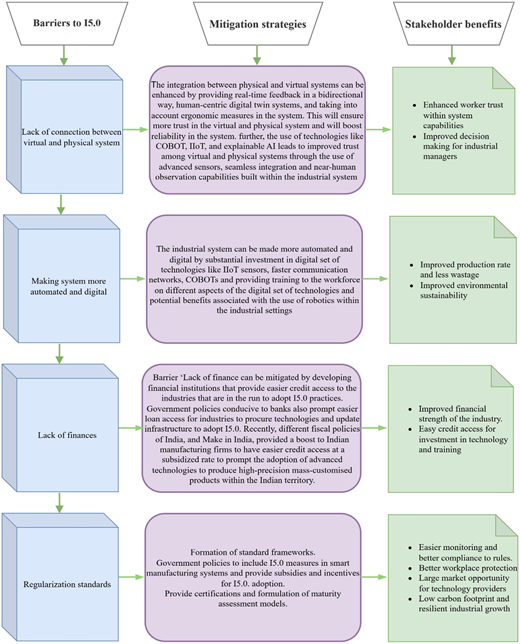
Developing nations like India have not harnessed the full-throttle opportunities of I4.0 technologies, and many industries are in their infancy. A few prominent industries are adopting practices of I5.0, but they will demand an overhaul in the infrastructure for a considerable proportion of time; the vision of the management, finance and a go-forward March is demanded. Industries must invest capital for the purchase of COBOTs, systems for analysis of Big data, advanced storage devices for data and cybersecurity measures to ensure the successful execution of I5.0. I5.0 is a new paradigm for developing economies like India, and its inception is also hindered by other associated factors like resistance from departments, job security, fund constraints, government policies and work related to effective standards. Figure 6 depicts the I5.0 critical barriers to Indian manufacturing industries associated with mitigation actions, and potential benefits to stakeholders. Thus, it is imperative to formulate better policies by local and central governments to create an upright ambience for the adoption and execution of new technological paradigms. India is one of the emerging economies in the world, and it is achieving excellence in terms of productivity, with the execution of new initiatives to make credit transfers easier, reduce taxes and initiatives like “Make in India”. Therefore, companies are already on the path to adopting new technological paradigms like I5.0, but this will only be possible if the identified barriers are addressed.
5.1 Implications
5.1.1 Theoretical implications
The findings of the present research have valuable theoretical implications. Firstly, since I5.0 is still in its early stages, especially in developing nations like India, this study provides an initial knowledge base for the researchers to comprehend the fundamental concepts of I5.0. Secondly, by reviewing literature and consulting experts, we have identified a comprehensive set of barriers to I5.0. The authors believe this will serve as a starting point for understanding these barriers, like approaches used in past studies of emerging fields (Kaswan and Rathi, 2021; Mukherjee et al., 2023).
Third, it improves the knowledge base of researchers and theories by linking the findings with SDGs. By controlling the critical technological and organisational barriers, manufacturing organisations can make transitions towards SDG 9 (Industry, Innovation and Infrastructure) by incorporating digital technologies in production systems. The evolution to digital, low-waste manufacturing also advances SDG 12 (Responsible Consumption and Production) and SDG 13 (Climate Action) by dropping resource use and emissions through automation, data analytics and cyber–physical integration. Moreover, I5.0 technology contributes directly to quality-of-life outcomes by reducing physical strain, workplace accidents and repetitive tasks, leading to safer and more inclusive work environments.
5.2 Practical implications
The study provides useful insights for practitioners and industrial managers to make their industry more resilient and vibrant. First, as it is impractical to address all barriers simultaneously, this study prioritises the most critical barriers to adopting I5.0. This prioritisation will assist practitioners and managers in tackling the most pressing barriers first when implementing mitigation strategies. Second, the study offers various actions to mitigate these barriers, facilitating the easy implementation of I5.0 practices within industrial settings. I5.0 supports SDGs such as human-centricity and socio-environmental sustainability through its functions, including timely communication, system integration and interoperability, intelligent automation and business process monitoring (Ghobakhloo et al., 2022). The insights gained from this study regarding barriers and their mitigation plans will enhance the productivity of manufacturing systems and improve the socio-economic sustainability of the industry. Third, as the present study advocates implementation of I5.0, the insights provide a boost to industrial personnel and policymakers to enlarge the prospect of I5.0, and this will make its practical implementation within their industries easier. So, in a nutshell, the study offers a boost to the adoption of I5.0 that will lead to real-time monitoring, improved decision-making and reduced rework and waste in production systems.
6. Conclusion, limitations and future research agenda
In a nutshell, the present study explores barriers to I5.0 and provides solution methods to decrease the probability of failure for I5.0 execution within the manufacturing sector of India. The systematic investigation of the literature on I5.0 and experts' opinions on barriers further facilitates understanding the mitigation of I5.0 barriers. Interlinking virtual reality and physical aspects, regulations/standards and easier credit are the major forces that can propel the adoption of I5.0 within the Indian context. The study designates human participation as highly demanded to enhance the value of tasks. Further, standardisation and legalisation will help to curb serious issues between society and technological matters. Moreover, there is a need to formulate policies to check and validate the behaviour of automatic systems. Once the different sets of regulations, standards and principles related to advanced sets of technologies become operational, then it will make the manufacturing system more transparent, efficient and easy to function. Further, as the study provides mitigation actions to barriers, the systematic removal of the same will facilitate easier adoption of I5.0, and this will enhance the environmental and social sustainability of the industry. The adoption of I5.0 will make the industry more resilient through the adoption of new technological sets. So, the study contributes to the prestigious SDGs 9, SDGs 11 and SDGs 12. The study's unique theoretical, methodological and practical contribution lies in:
Theoretical Contribution: This study covers the literature of I5.0 by systematically mapping and classifying the barriers to its adoption in developing nations, highlighting their implications for sustainability and human-centric manufacturing.
Methodological Contribution: The finalised barriers of I5.0 were ranked via a hybrid multi-criteria decision-making framework combining Entropy, GRA and BWM, followed by validation through a case study to enhance the robustness and reliability of prioritisation.
Practical Contribution: The outcome assists industrial managers and policymakers with a clear roadmap to mitigate the high-priority barriers such as the lack of integration between physical and virtual systems, financial constraints and the absence of standardisation, for facilitating a smoother I5.0 transition in manufacturing settings.
Despite several contributions, this study has certain limitations. First, the literature on I5.0 is expanding, and there may be barriers that have not been addressed in this study. Second, since the study focuses on I5.0 barriers in Indian manufacturing firms, the findings may not be generalisable to other countries. However, this limitation also offers opportunities to explore I5.0 in different national and continental contexts. Future researchers could identify barriers to I5.0 specific to other countries and assess the relationships between different barriers to better understand their causes and effects. A longitudinal study could also be conducted to determine whether these barriers change as I5.0 progresses. Furthermore, as I5.0 is still in its early stages, researchers can work on developing comprehensive frameworks for its adoption in various industrial sectors, including manufacturing. Additionally, studies can be undertaken to understand the contextual and precedent relationships among different barriers and enablers, thereby enhancing theoretical knowledge of I5.0. Researchers may also explore other under-researched areas of I5.0, such as human resource-related barriers and the development of I5.0 conceptual frameworks for different industrial domains (automotive, pharmaceuticals, logistics, or energy systems). Similarly, this methodology can be scaled to different national or regional contexts to compare the readiness and adoption dynamics of I5.0 across the globe. Such adaptability ensures the methodological framework's relevance of I5.0 for policymakers and researchers seeking to benchmark technological transformation performance across sectors and countries.
The supplementary material for this article can be found online.