This study presents a systematic literature review (SLR) of the interdisciplinary literature on drones in last-mile delivery (LMD) to extrapolate pertinent insights from and into the logistics management field.
Rooting their analytical categories in the LMD literature, the authors performed a deductive, theory refinement SLR on 307 interdisciplinary journal articles published during 2015–2022 to integrate this emergent phenomenon into the field.
The authors derived the potentials, challenges and solutions of drone deliveries in relation to 12 LMD criteria dispersed across four stakeholder groups: senders, receivers, regulators and societies. Relationships between these criteria were also identified.
This review contributes to logistics management by offering a current, nuanced and multifaceted discussion of drones' potential to improve the LMD process together with the challenges and solutions involved.
The authors provide logistics managers with a holistic roadmap to help them make informed decisions about adopting drones in their delivery systems. Regulators and society members also gain insights into the prospects, requirements and repercussions of drone deliveries.
This is one of the first SLRs on drone applications in LMD from a logistics management perspective.
1. Introduction
As the trend of online shopping is surging, the need of faster, more reliable and greener parcel delivery process has preoccupied almost every e-retailer. One of the most challenging transport legs along the parcel delivery process is the last-mile delivery (LMD) (Lim et al., 2018), referred to as the delivery from a terminal to end receivers. Using conventional vehicles (e.g. trucks, vans), e-retailers and their carriers are struggling to provide the needed capacities to deliver vast amounts of goods to end receivers immaculately and within the specified time windows while remaining profitable (Allen et al., 2018). Continuing to fulfill mounting LMD volumes through conventional vehicles is expected to create more road congestions, air pollution, safety hazards and other social and environmental concerns (Ignat and Chankov, 2020) – urging the industry to find an alternative.
Drones – or unmanned aerial vehicles (UAV) – represent one of the most promising technologies to enhance the LMD process, with some predicting them to change the future of supply chains (Merkert and Bushell, 2020). The global drone market is expected to reach $61.95bn USD by 2027, growing at a compound annual growth rate of 26.73% (Research and Markets, 2022). Industry giants, such as Amazon and UPS, have already begun experimenting with drones to improve their LMD process. Amazon's “Prime Air” made successful trials to deliver packages up to five pounds in 30 min or less right at the doorstep, or lawn, of the customer using drones (Amazon, 2016). Each of Amazon, UPS and Wing received their Part 135 Air Carrier Certificate from the US Federal Aviation Administration (Dallas News, 2021), indicating their determination to turn drone deliveries into a widespread reality.
Unlike conventional vehicles, drones ignore traffic congestion due to their flying capability (Liu et al., 2022a), which in turn shortens delivery time and fosters customer satisfaction (Lin et al., 2022). Drones can also minimize transport-related emissions through their reliance on electric batteries (Figliozzi, 2020) and substitution to conventional vehicles on the road (Kellermann et al., 2020). Moreover, drones can reduce transport costs due to their low investment and operating costs (Murray and Chu, 2015) and tendency to relieve accumulating inventory volumes (McKinnon, 2016). To no surprise, these benefits have attracted supply chains in sectors beyond e-commerce, including healthcare and humanitarian relief (Rejeb et al., 2023). Indeed, drones make it possible to deliver medicine and other time-critical items from hospitals, pharmacies and disaster-relief hubs to those in need under short time intervals while avoiding physical obstacles (Banik et al., 2022; Holzmann et al., 2021). However, despite the technology's positive prospects, some drone delivery projects led by industry leaders are still struggling to take off due to legislative, infrastructural, technical, safety and social acceptance barriers (Rathore et al., 2022). DHL cancelled its “Parcelcopter” program – which was eight years in the making – in 2021, whilst Amazon shut down its “Prime Air” operations in the UK (Tech.co, 2021).
Given drones' promising (yet uncertain) potential, research on their applications has grown significantly over the past years, with several literature reviews published parallel with this growth. Some of these reviews address drones amidst other emergent technologies (e.g. Dong et al., 2021), not devoting ample depth to this rapidly evolving field, whilst others focus on drones without systematic sampling of the literature (e.g. Mohamed et al., 2020), not depicting the state-of-the-art on the topic. The remaining reviews, compiled in Table 1, utilize systematic sampling to examine drone use across various topics, noting that only three of them are dedicated to the LMD segment.
These three LMD-focused reviews primarily examine the modeling aspects of drone deliveries and the technical intricacies of different routing problems. Consequently, a gap is formed in the logistics management field for addressing non-modeling issues surrounding drone deliveries to inform logistics scholars, practitioners and policymakers about the potentials and challenges associated with the technology. Rejeb et al. (2023) shed light upon this matter in their review. However, their sample of 55 articles was “limited to the field of business and management” (p. 710), overlooking extensive drone-related literature from non-managerial fields such as engineering and computer science – which, in fact, dominate drone research (Jouhet et al., 2020). What seems necessary at this point is another systematic review that derives knowledge from such interdisciplinary fields to inform the logistics management field, based on criteria established within that field. Moreover, Rejeb et al.'s review surpassed the LMD segment to include topics such as land surveying and energy monitoring, inviting further reviews to focus exclusively on drones in LMD due to their challenging nature, substantial growth and the myriad of factors involved for their facilitation. Hence, this research aims to present a systematic literature review (SLR) of the interdisciplinary literature on drones in LMD to extrapolate pertinent insights from and into the logistics management field. We posit four research questions for this inquiry:
From a logistics management viewpoint, what are the key criteria for adopting drones in LMD?
What are the potentials, challenges and solutions associated with each criterion for adopting drones in LMD?
What relationships can be identified among the criteria for adopting drones in LMD?
What further research directions for the logistics management field can be identified for adopting drones in LMD?
To answer these RQs, we applied a deductive, theory refinement SLR of 307 interdisciplinary, peer-reviewed journal articles on drone applications in LMD during 2015–2022. This SLR contributes to logistics management by offering a current, nuanced and multifaceted discussion of drones' potentials to improve the LMD process, the challenges involved and the solutions proposed. It also offers a holistic roadmap for logistics managers to support them make informed decisions about adopting drones in their delivery systems.
The remainder of this article is structured as follows: Section 2 derives the key criteria for LMD from the logistics management literature, concluding with an analytical framework to guide the SLR process. Section 3 covers the methodological steps; Section 4 presents descriptive analysis of the sample; Section 5 provides a thematic analysis of the LMD criteria for drone applications; Section 6 presents a cross-thematic analysis; Section 7 identifies further research directions; while Section 8 covers the conclusions.
2. Identifying LMD criteria
2.1 Defining LMD
Rooted in the telecommunication industry, “last-mile” is a term used to describe the last leg of a delivery process. Contingent on the context and scope of the process, terms such as last-mile “logistics”, “delivery”, “distribution” and “transport” have emerged in the literature – used distinctively in some cases and interchangeably in others. Distinguishing between these terms, Olsson et al. (2019) argued that LMD is the step that lies at the front-end of the delivery process, encompassing “the activities necessary for physical delivery to the final destination chosen by the receiver” (p. 13). The LMD literature generally agrees that the receiver is the one who chooses the final destination, which can be a home, office, parcel locker, or others (Wang et al., 2021). In turn, the sender is often the one who decides on the means of transport, which includes light goods vehicles, electric vans, bicycles, drones, or others (Olsson et al., 2019). The starting point of a delivery is referred to as the “order penetration point” (Sharman, 1984), defined by Lim et al. (2018, p. 310) as “an inventory location (e.g. fulfillment center, manufacturer site, or retail store) where a fulfillment process is activated by a consumer order”. As for who receives the order, the terms “consumer” and “customer” are commonly used among scholars, possibly due to the predominance of business-to-consumer sectors (e.g. retail) within logistics management. However, the field has expanded to encompass non-business sectors, bringing along other terms to describe the receiver. Kovács and Spens (2007) used “affected persons” to describe receivers within humanitarian relief, whereas Pohjosenperä et al. (2018) used “nursing staff” and “doctors” for receivers within healthcare. Since we don't wish to limit LMD to a specific sector, we apply the term “receiver”, given its simplicity and inclusiveness. As for the object being delivered, “parcel”, “package”, “spare parts”, and “samples” are terms used across the LMD literature, with the choice of term often varying by sector as well (Olsson et al., 2019). We apply “item” in this research, also for its simplicity and inclusiveness. Building on the above, we define LMD as:
The last stretch of an item delivery process that takes place from the order penetration point to the receiver's preferred destination point.
2.2 Key LMD criteria
Different delivery configurations have evolved to adapt receivers' time and location preferences while considering the available resources and infrastructure for senders (Wang et al., 2021). Lim et al. (2018) identify three of these configurations: push-centric (the item is sent to the receiver), pull-centric (the item is fetched by the receiver) and hybrid (the item is sent to an intermediate site, from which it is fetched by the receiver). Assessing last-mile logistics varies with the configuration at hand. For instance, timely delivery is crucial in push-centric and hybrid configurations, but less so in pull-centric setups where receivers determine the pickup time. Given our focus on LMD, we consider criteria related to push-centric configurations only.
One way to look at LMD criteria is through separating criteria related to the transport mode from those related to LMD overall. For example, “transport cost” and “delivery time” depend on whether a van or a bicycle is chosen for delivery, whereas “product availability” (Esper et al., 2003) and “order-picking time” (Kämäräinen et al., 2001) remain independent of the transport mode. Given the emphasis on transport modes in this research, we exclusively consider LMD criteria pertinent to them.
Another way to look at LMD criteria – in relation to transport modes – is through separating the sender's viewpoint from the receiver's (Kämäräinen et al., 2001). This is grounded in the idea that each stakeholder prioritizes certain criteria to be met in a given delivery event (Kiba-Janiak et al., 2021). Cost of transport, for instance, is a major concern for senders (Mangiaracina et al., 2019), accounting for almost half of total logistics costs for some firms (Vanelslander et al., 2013). Senders are also very attentive to the applicability of the transport mode (Dong et al., 2021) and its capacity (Castillo et al., 2018), while receivers are usually not concerned about – or willing to pay for – such operative criteria (Ignat and Chankov, 2020). Instead, receivers can be very demanding of LMD's service levels (Mangiaracina et al., 2019), which mainly relate to time, reach and item condition (Castillo et al., 2018; Nogueira et al., 2021).
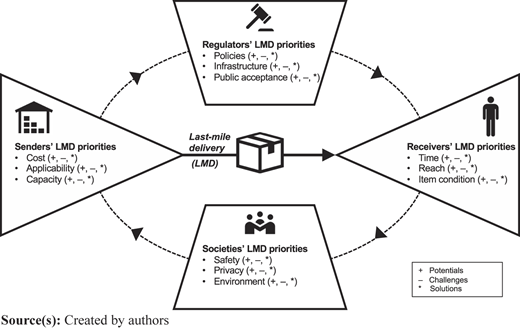
Regulators and societies represent other stakeholder groups who influence – and are influenced by – the LMD process (Kiba-Janiak et al., 2021), though both are not directly involved in it. Regulators are often responsible for providing the needed policies and infrastructures to enable operative and sustainable LMD operations (Ewedairo et al., 2018) – while keeping an eye on public's acceptance (Peppel et al., 2022). Societies, in turn, signify the broadest stakeholder group, concerned about the overall LMD's impact on safety, privacy and the environment (Ignat and Chankov, 2020). Table 2 [1] unpacks each LMD criterion based on the priorities of senders, receivers, regulators and societies. Note that these priorities are not mutually exclusive; e.g. delivering items within receives' preferred time window is also critical for senders to maintain customer satisfaction and avoid failed delivery cost. Safety, privacy and environmental criteria are important to all stakeholders, yet they have been placed under societies since they represent the most inclusive group.
2.3 Analytical framework
3. Methods
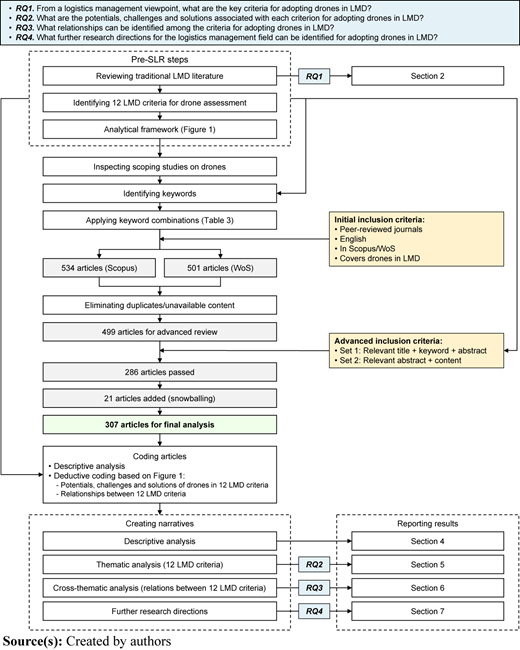
An SLR enables managing diversified knowledge for a specific inquiry (Tranfield et al., 2003), suiting our attempt to synthesize the interdisciplinary literature on drones in LMD for the logistics management field. Among different types of SLRs, we applied a deductive, theory refinement SLR (Seuring et al., 2021), because these are useful when the SLR's analytical constructs are derived from the field (i.e. the 12 LMD criteria), allowing the inclusion of a pertinent phenomenon emerging outside the field (i.e. drones in LMD, dominated by engineering and computer science). To obtain and synthesize the SLR's sample, we followed the six-step guidelines by Durach et al. (2017), discussed below and summarized in Figure 2.
Step (1) Defining research questions – The four RQs of this study were guided by its purpose. These were, at first, not overly specified to avoid restricting subsequent steps.
Step (2) Determining required characteristics of primary studies – One initial inclusion criterion for all articles was publication in English-speaking, peer-reviewed journals – ensuring quality standards (Durach et al., 2017). Two databases were selected for searching the literature: Scopus (by Elsevier) and Web of Science (WoS; by Clarivate) – chosen due to their wide-ranging repositories that span across diverse fields and their trustworthiness among scholars (Archambault et al., 2009). As for the content, the articles must cover drone deliveries to align with our scope, but not necessarily in dedication. That is, several drone-related articles compared drones with other emergent freight technologies, while others focused on drone deliveries alongside other applications (e.g. monitoring, sensing). We included both types of articles to ensure capturing the state-of-the-art on drones in LMD. Also, to that end, we did not limit our search to certain research fields or methods.
Step (3) Retrieving a sample of potential relevance – Following Tranfield et al. (2003), three researchers identified the search keywords after examining scoping studies with high citation counts from different disciplines. Table 3 lists the derived keywords after considering cognates for “drone”, “delivery” and “logistics”. To obtain results that are neither too broad (with unrelated content) nor too narrow (with missed related content), different keyword combinations were iteratively tested and verified through discussions between the authors. Table 3 shows the final keyword combination, yielding 534 articles in Scopus and 501 articles in WoS. The similar hit count across both databases indicates the consistency of our search strings, though differences might have surfaced due to the unique handling of duplicates within each database. Merging the sample was achieved through (1) eliminating within and cross-database duplicates/unavailable content and (2) omitting articles with irrelevant abstract and/or keywords – yielding an initial sample of 499 articles. This search was conducted in January 2023.
Step (4) Selecting pertinent literature – An advanced set of inclusion criteria was applied to the remaining 499 articles. This entailed closely inspecting the abstract of each article and matching it against our analytical framework (Figure 1). To exemplify, Eun et al.'s (2019) abstract stressed comparing the environmental impact of drone deliveries with traditional ground vehicles while considering the drone's capacity and applicability. Thus, the article was included as it met our initial criteria by addressing drones in LMD and advanced criteria through its focus on environment, capacity and applicability. Some articles needed closer examination to assess their relevance, as their abstracts offered unclear purposes despite relevant titles and keywords. To reduce bias in this step, three authors examined the articles independently. After applying initial and advanced inclusion criteria, the sample was reduced from 499 to 286 articles. This reduction was loomed with utmost caution; although most excluded articles discussed drones, their content did not mention the last-mile (or parcel) delivery segment, despite passing initial inclusion criteria. The excluded articles, instead, handled drone applications in topics entirely surpassing our scope, such as spraying fertilizers and land surveying.
Bearing in mind the need to include as many articles as possible (Pawson, 2006), criteria such as pertaining to certain journals or passing citation thresholds were not considered. This decision was backed by (1) the interdisciplinarity of the drone literature, thus not favoring journal selection and (2) the emergence of drone technologies, thus not favoring citation counting. We employed a snowballing technique by reviewing the reference lists of included articles, adding 21 more articles to the sample – each screened by two authors. Consequently, our final sample comprises 307 articles.
Step (5) Synthesizing literature – Following Braun and Clarke (2006), we applied a deductive (i.e. theory-driven) thematic analysis to synthesize the articles and code their content. The themes represent the 12 LMD criteria already established in Figure 1, whilst the articles' content was coded through extracting the potentials, challenges and solutions associated with drone use under each criterion. This was followed by a cross-thematic analysis to identify relationships between the 12 LMD criteria.
Step (6) Reporting results – Reporting was done by providing a descriptive analysis of the bibliometrics, a thematic and cross-thematic analysis of the content and derived directions for further research.
4. Descriptive analysis
4.1 Publications over time
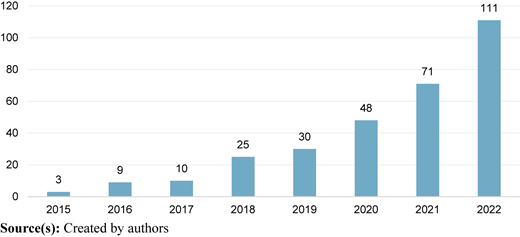
Figure 3 presents the distribution of the 307 articles through time, indicating a rapidly growing academic interest in the topic of drone deliveries. This trend is in line with the technology's projected market growth to reach $61.95bn USD by 2027 (Research and Markets, 2022). Consequently, we expect the number of publications on this topic to grow further in 2023 and beyond [2].
4.2 Publications by countries
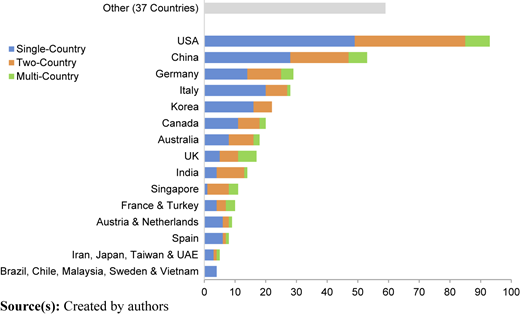
Figure 4 shows the authors' affiliations by country. The US dominated the list by contributing 30% of the sample, followed by China with 17%. European nations dominated regionally with 42% of contributions. The figure signals a need for more research to represent African countries, Latin America, the Middle East and Asian countries beyond China.
4.3 Publications by methods
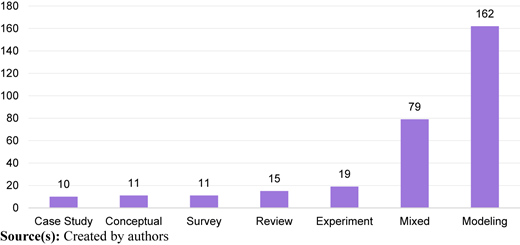
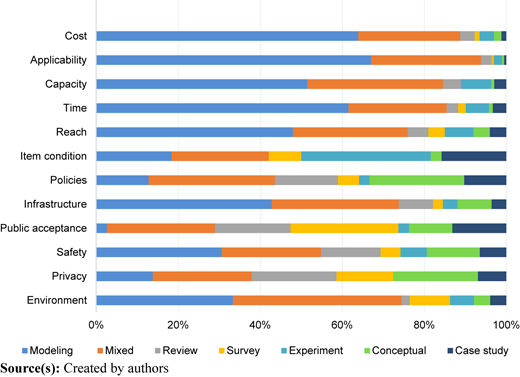
Figure 5 displays the distribution of articles by methods. Notably, 53% of the sample utilized a modeling approach, primarily applying multi-objective functions or routing validation methods such as the Vehicle Routing Problem or the Traveling Salesman Problem. Mixed-method articles (26%) often combined modeling with numerical cases or experiments, while pure experiments (6%) focused on drone applications using real-world data. Review articles (5%) synthesized the academic contributions on topics comprising drones' routing, social impact and integration in healthcare. Surveys (6%) explored behavioral preferences for drone use, whilst conceptual studies (6%) delved into drone implications across different disciplines. As for case studies (3%), seven quantitatively analyzed real drone applications in healthcare and three qualitatively assessed public/expert views on drone deliveries across general and medical contexts.
4.4 Publications across journals
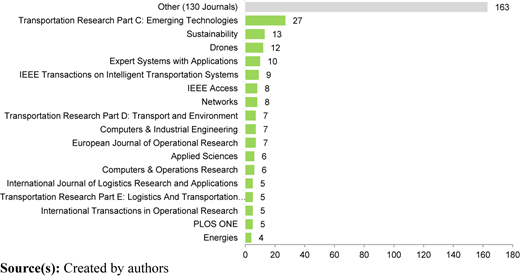
Figure 6 depicts the sample distribution across journals, revealing that 47% of articles were published in just 17 journals. The remaining 53% spread across 130 journals, with three or fewer articles in each. Notably, the journal “Drones” has emerged in dedication to this topic. One can also observe the dominance of journals within transport science, engineering and computer science – which may explain the prevalence of the modeling approach and the limited coverage of drones in prominent logistics management journals. This presents an opportunity for logistics management scholars to investigate the managerial aspects of this promising field.
4.5 Sectors adopting drone in LMD
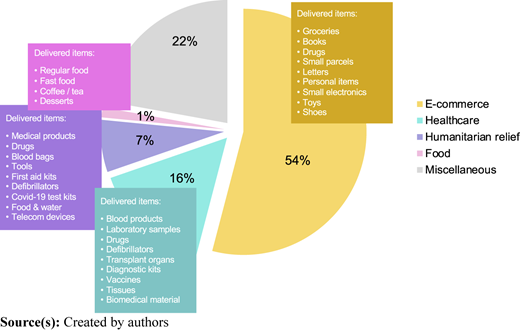
Figure 7 shows the primary sectors adopting drones in LMD as found in the sample, noting that 22% of articles addressed drones miscellaneously without specifying a sector.
5. Thematic analysis
5.1 Senders' priorities
5.1.1 Cost
Reducing cost is seen as a key motive for senders to adopt drones in LMD, with trials revealing their potentials to save 28% (Karak and Abdelghany, 2019), 30% (Dukkanci et al., 2021), 39% (Li et al., 2022b), 80% (Lemardalé et al., 2021), to even 93% (Kostrzewski et al., 2022) of total LMD costs compared to conventional delivery methods. Such cost savings can be attained through drones' low investment and operating costs (Murray and Chu, 2015) alongside their ability to improve transport efficiency (McKinnon, 2016) – emphasized by drones' capacity to shorten travel time and distance (Dukkanci et al., 2021) and lower reliance on fueled vehicles like trucks and vans (She and Ouyang, 2021). Drone-based deliveries may also reduce driver cost by shortening their working shifts (Dorling et al., 2017) and storage cost by relieving amassed inventory volumes (McKinnon, 2016). Drones' ability to deliver quickly and on-time can also lower cost of delayed/failed deliveries (Kim and Hwang, 2020), which may, in turn, increase profitability due to improved customer satisfaction (Lin et al., 2022). To achieve cost savings via drones, attention should be paid to the different cost elements involved across their utility cycle, compiled in Table 4.
Instead of treating each cost element in isolation, the literature strongly advocates applying a “system-thinking” approach to assess the overall cost savings from drone-based deliveries. Factors such as drones' scale economies (Baloch and Gzara, 2020), maintenance and deprecation rates (Shavarani et al., 2019b), payload-to-energy-consumption ratio (Dorling et al., 2017), drone-truck configuration (Aurambout et al., 2019), allocated delivery windows/penalties (Li et al., 2022b), geographical distribution of served customers (Shavarani et al., 2019a) and population density of served areas (Lemardelé et al., 2021) are viewed as key determinants of the overall economic viability of drone delivery systems. Highlighting the need for considering multiple cost elements, Lemardelé et al.'s (2021) comparison of drones with autonomous ground vehicles indicate that truck-launched drone deliveries are more viable in less dense and larger service areas (e.g. suburbs), while autonomous ground vehicles are more viable in denser neighborhoods (e.g. city centers). In another example, Aurambout et al. (2022) find that under current conditions drone deliveries are financially viable for serving 32–60% of the US population compared to only 16–43% in Europe.
Despite the low investment and operating costs of single drones compared to conventional vehicles (Murray and Chu, 2015), the aggregate investments in drone fleets, depots and recharging stations are likely to be large, especially since drones can only deliver modest loads to a small number of receivers per trip (McKinnon, 2016). This makes achieving scale economies for adopting drone in LMD a challenging task. Solutions to address this include adopting a “sharing economy” model for drones across multiple warehouses (Bruni and Khodaparasti, 2022), pairing drones with ground autonomous vehicles (Lemardelé et al., 2021) and coordinating drones with trucks along delivery routes (Canca et al., 2022).
5.1.2 Applicability
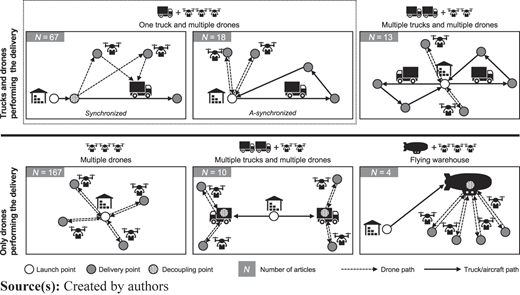
The reviewed literature specifies two primary approaches regarding how drones can be applied in LMD: (1) trucks and drones performing the delivery and (2) only drones performing the delivery (Figure 8). We unpack each approach below while referring the reader to Macrina et al. (2020) to learn about them from a modeling viewpoint.
Trucks and drones performing the delivery: can be divided into two segments. First, one truck and multiple drones, which can be further split into: (1) synchronized truck and drones, where drones are launched from a truck at one or more locations along the truck's delivery route to perform their assigned deliveries and then return to meet the truck (Bruni et al., 2022; Zang et al., 2022) and (2) a-synchronized truck and drones, where drones are launched from a depot to deliver to receivers close by, while a truck carries out deliveries far from the depot and beyond the drones' range (Murray and Chu, 2015; Nguyen et al., 2022). Second, multiple trucks and multiple drones, by which a fleet of trucks and drones perform deliveries simultaneously – each based on their carrying capacity and travel range (Dorling et al., 2017; Liu et al., 2021). The key aim of both approaches is to achieve faster deliveries and assign only the heavy cargo to trucks (Eun et al., 2019), which may, in turn, lower traffic congestion, transport cost and emissions (Raj and Sah, 2019; Wang et al., 2022b).
Only drones performing the delivery: can be divided into three segments. First, multiple drones (also called “drone-beehives”), by which a fleet of drones are launched from strategically located depots (e.g. city centers) to perform deliveries to several receivers (Aurambout et al., 2019; Thida San and Chang, 2022). Factors such as drones' energy consumption, flying range, number of receivers and battery capacity are critical in determining the applicability of this approach (Bruni and Khodaparasti, 2022; Macrina et al., 2020). Second, multiple trucks and multiple drones, by which drones are carried on trucks to perform deliveries within a radius pertinent to drones' range (Boysen et al., 2018; Dukkanci et al., 2021). Trucks do not perform deliveries in this approach; they only carry drones to optimal launch locations, where they park and await drones to complete their deliveries (Kang and Lee, 2021). Drones, on their part, may deliver to one receiver at a time (Huang et al., 2022a), or serve multiple receivers per trip (Gu et al., 2022). This approach is especially suited for humanitarian relief missions since drones can avoid physical barriers to reach those affected (Jeong et al., 2020). Third, a flying warehouse, which has been patented by Amazon under the label “airborne fulfillment center”. Here, a large aircraft floats over service areas to dispatch loaded drones from midair (Jeong et al., 2022; Wang et al., 2022a). An alternative to this approach is proposed by Wen and Wu (2022), where multiple drones are carried inside a larger drone.
In certain instances, a reversed setup is proposed: only trucks performing the delivery, resupplied by drones from the depot due to trucks' finite capacities (Dienstknecht et al., 2022). Another mentioned application involves a combination of a drone with an unmanned ground vehicle (in one unit), capable of both flying and traveling on the ground (Kumar et al., 2022). In any case, senders must select the right truck-drone combination based on their investment capability, drones' capacity, urgency of intended deliveries, geographical orientation of served areas and available infrastructure (Karak and Abdelghany, 2019; Macrina et al., 2020; Huang et al., 2022a). Here, deep learning methods (e.g. Q-learning) were suggested to aid choosing between trucks and drones (Chen et al., 2022). The literature also recommends selecting several truck-drone combinations to optimize the LMD process and enhance its flexibility (Kirschstein, 2020; Rave et al., 2022).
5.1.3 Capacity
Drones' limited capacity – in terms of travel range, speed, battery, payload and extreme weather resistance – is viewed as one of the main challenges to their adoption in LMD (Cheng et al., 2020; Tamke and Buscher, 2021). Tezza and Andujar (2019) stress that current drone models can fly up to only ∼5 miles (8 km) away from their pilots, while Choi and Schonfeld (2021) note that drones' flight time can rarely exceed 30 min due to the limited capacity of their lithium-ion batteries (which most drones rely on today). Drones trialed by companies like Amazon and UPS can carry payloads up to 5 pounds (2.27 kg) and fly at speeds up to 50 mph (80.47 kph) (Cheng et al., 2020). One of the highest payloads reported in the literature was when drones carried 6.4 kg of blood samples at 10 m/s velocity (Homier et al., 2021).
Drone capacities vary based on their model and type, resulting in trade-offs. For instance, multirotor drones excel in maneuverability but have a limited payload capacity, while hybrid drones, which combine propellers and wings, offer a longer range but compromise on maneuverability (Buldeo Rai et al., 2022; Pasha et al., 2022). Further trade-offs are cited amid drones' speed vs travel range (Murray and Chu, 2015), speed vs energy efficiency (Liu and Sun, 2022), travel range vs battery capacity (Glick et al., 2022), battery capacity vs payload (Jeon et al., 2021) and payload vs battery weight (Cheng et al., 2020).
Undeniably, drones' limited capacities make them inferior to conventional trucks on several fronts, which explains their frequent integration with trucks in LMD setups. Besides working with trucks, the literature suggests several solutions to boost the capacity of drones themselves, such as recharging drones – fully or optimally (Huang et al., 2022b) – along delivery routes (Glick et al., 2022), deploying battery swapping/maintenance points across distribution networks (Shao et al., 2020), or a combination of both (Huang and Savkin, 2022). Yet careful planning is advised before implementing such solutions; charging consumes time and blocks other drones from using the station (Huang et al., 2022b), whilst replacing batteries demands human access for assistance (Boysen et al., 2021). Hence, it is advised to find optimal locations of drones' charging/swapping stations while limiting their quantity to lower cost (Dhote and Limbourg, 2020). This can be achieved through several joint routing-charging strategies, compiled in Table 5.
Other approaches to overcome drone capacity limitations include optimizing the number of launch points in relation to receivers' density and drone speed (Liu and Sun, 2022), scheduling deliveries based on drones' battery capacity (Conte et al., 2022), having multiple drones carry the payload (Mohammadi et al., 2022) and equipping drones with multiple propellers (Schiano et al., 2022) or multiple mini-jet engines (Altuğ and Türkmen, 2022).
5.2 Receivers' priorities
5.2.1 Time
One key advantage of using drones in LMD is the possibility to deliver to receivers faster. Thanks to their flying capability, drones can reduce delivery time through avoiding buildings, traffic congestions, rivers, or other geographical/physical barriers (Hernández et al., 2020). Using real-time simulations, drones' ability to reduce delivery time were proven in scenarios where they delivered in tandem with trucks (Masone et al., 2022; Murray and Chu, 2015; Tong et al., 2022) and when trucks were utilized as landing/take-off hubs for drones (Boysen et al., 2018; Carlsson and Song, 2018). Pilot trials of drones have seen success on 30 min delivery intervals (Harn et al., 2021), to as low as 5 min in medical emergencies (Baumgarten et al., 2022; Mateen et al., 2020).
However, realizing such short delivery times may require operating dedicated drones for individual orders (Perera et al., 2020). This can create a shift towards decentralized distribution systems (Kunovjanek and Wankmüller, 2021), bringing along further cost constraints since additional delivery centers must be erected in close proximities to receivers (Pinto and Lagorio, 2022). To save both cost and time here, it is advised to share workloads between drones based on the unique capacities of the used models (Thida San and Chang, 2022), or having drones simultaneously pick-up and deliver items (Shi et al., 2022), which is most relevant in medical contexts. The literature also recommends assigning deliveries to trucks, drones, or a combination of both, based on either relaxed (Luo et al., 2022b) or strict time slots (Xing et al., 2023) – met by penalties if exceeded (Li et al., 2022b). Such time slots can be linked to the perishability of carried items to ensure their preservation while delivering them on time (Gentili et al., 2022).
A question that often arises is to what extent receivers care about significant reductions in delivery times. The literature hangs this debate on the time sensitivity of the deliveries (Gentili et al., 2022) and the socio-demographic characteristics of receivers such as age, gender and income (Kim, 2020) – where younger populations tend to opt for drone deliveries (Kim, 2020). Although e-commerce receivers prioritize delivery speed over other parameters such as cost and environmental impact (Nogueira et al., 2021), the situation is more critical in medical or disaster relief missions where a speedy delivery can save a life. In light of this, Table 6 demonstrates highly promising time savings enabled by drones for medical deliveries, as tested in several studies. Nonetheless, factors like travel distance, weather conditions, wind speed, geographic location, item weight and drone capacity can significantly impact the time savings achieved by drone deliveries (Johannessen et al., 2021; Kunovjanek and Wankmüller, 2021; Oakey et al., 2022).
5.2.2 Reach
A functional LMD system should enable reaching receivers no matter where they are located. Drones, in fact, have both strengths and weaknesses in this regard. Their strength lies in overcoming physical constraints (as discussed earlier). This is especially relevant in rescue and medical emergency missions, where drones can deliver time-critical items to people in hard-to-access zones such as mountains (Holzmann et al., 2021), hurricanes (Chowdhury et al., 2017), earthquakes (Kamat et al., 2022), or areas with poor transportation infrastructure (Hernández et al., 2020). In many instances – especially humanitarian-relief missions – the demand point of the delivery can be unknown (Ghelichi et al., 2022) or disrupted by weak/interrupted signals (Zhu et al., 2022). Equipping drones with Artificial Intelligence, thermographic cameras and strong zooming functionality may significantly expand their reach capacity and reduce arrival times in such conditions (Amicone, 2021; Holzmann et al., 2021).
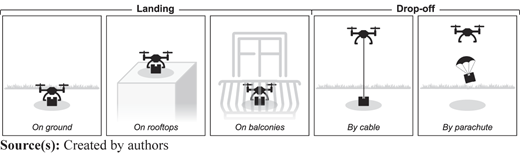
Figure 9 shows the most discussed drone landing and item drop-off methods in the literature. To enhance the precision of landing/drop-off events, it has been suggested to supply drones with fiducial markers (Innocenti et al., 2022), satellite and street imaging capability (Li et al., 2022c), or precision airdrop algorithms (Zhang et al., 2022).
As for reach weaknesses, drone deliveries are constrained in urban environments due to inadequate landing space for receivers situated in high-rise buildings or without access to open yards (Boysen et al., 2021). Additionally, most countries limit drone operations to rural areas to avoid interfering with other aircrafts or posing safety risks to residents (Boccia et al., 2021; García et al., 2021). Such constraints could eventually turn drone deliveries into a privilege enjoyed by populations within certain zip codes only. In response, the literature proposed a few solutions to foster drone deliveries in urban areas, such as installing “common delivery zones” (Pachayappana and Sundarakani, 2022) or accessing receivers amid no-fly-zones (Jia et al., 2022).
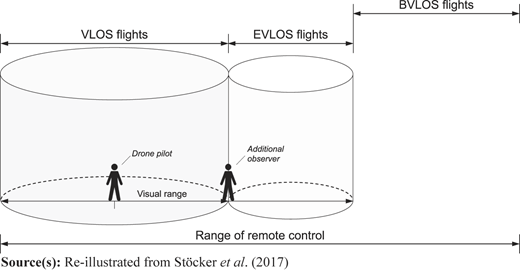
Most countries also limit drone flights to Visual-Line-Of-Sight (VLOS) zones, where pilots should keep the flown drones within their field of vision (Harn et al., 2021; Mohamed et al., 2020). In the EU, efforts have been made to ease sighting restrictions to reap the full benefits of drone deliveries, considering flights in Extended-Visual-Line-Of-Sight (EVLOS) and Beyond-Visual-Line-Of-Sight (BVLOS) zones (García et al., 2021). The former refers to the zone beyond the pilot's visual sight but within other observers' view, while the latter denotes the zone beyond any visual contact with the drone (Alamouri et al., 2021) – Figure 10. Flying in BVLOS zones is often carried out by fully autonomous drones, backed by Detect-and-Avoid systems to prevent collisions and warrant safe maneuvers (García et al., 2021). However, even if drone flights were fully autonomous, human intervention is still needed to reduce collision risks through pre-programming flights and supervising them in real time (Buldeo Rai et al., 2022).
5.2.3 Item condition
Delivering items free from all forms of damage – such as physical dents, surpassing expiration times or temperature ranges – is one of LMD's necessities. This is especially relevant in medical deliveries, where the way blood products, laboratory samples, or organs are transported impacts their quality (Scalea et al., 2021). Organs and blood products, which cannot be manufactured but only donated, benefit significantly from drone deliveries due to possible time savings that help preserve the products' integrity (Amicone et al., 2021). Here, blood products have a limited quality period before rapid deterioration sets in (Gentili et al., 2022), while organs require immediate deliveries to prevent damage to their tissues after cutting blood circulation (Amicone et al., 2021). Temperature ranges should also be calibrated based on the idiosyncrasies of transported items (Amukele et al., 2017). Red cells, for instance, should be maintained within 2–6 °C, whilst plasma should be kept frozen at below −25 °C (Niglio et al., 2022).
To warrant such meticulous preservation conditions, wet ice, dry ice, expanded polystyrene foams and pre-calibrated thermal packs can be added to the boxes containing the items delivered by drones (Ong et al., 2022; Zailani et al., 2022), with a possibility of live monitoring via smart capsules (Niglio et al., 2022). Live monitoring can also reduce time spent at the delivery destination. For instance, measuring product features (e.g. pH levels of blood samples) during drone flights can save up to 30 min upon arrival (Liu et al., 2022b), with package quick-release systems suggested to attain further time savings (Saponi et al., 2022). Drone deliveries may also reduce waste from carried items (e.g. blood), since their high success rates can lower resupply requests (Nisingizwe et al., 2022). Yet given drones' airborne maneuvers, using them for deliveries may damage the carried items – let alone damaging the drones themselves (De Silvestri et al., 2022). Indeed, some of Kornatowski et al.'s (2018) experiments resulted in damaged items after drones fell to the ground due to accidental battery detachments – prompting the authors to recommend using reliable drone components and reinforcing the boxes preserving the carried items.
5.3 Regulators' priorities
5.3.1 Policies
Drone deliveries may overcrowd the airspace that is also shared by other aircrafts with different functions (Ribiero et al., 2021). This calls for crafting new policies to govern the airspace and reconcile potentially competing interests (Ben Dor and Hoffman, 2022). Today, governmental policies are seen by many scholars as a large, if not the largest, challenge to drone adoption in LMD (Dhote and Limbourg, 2020; Raj and Sah, 2019; Rathore et al., 2022). Such policies encompass routing, elevation, sighting, proximity to people/buildings, permissible flight times, classification/weight of transported items, pilot certification/training, insurance and allocation of liability (Cracknell, 2017; Innocenti et al., 2022; Sah et al., 2021). A challenge here is that drones' policies are steered independently in each country, resulting in dissimilar or even conflicting rules (García et al., 2021). Countries like the US and Canada are known for their strict aviation policies, such as mandating a special UAV controller license (i.e. “pilot license”) to fly drones in BVLOS zones and demanding human supervision of flights at all times (Mateen et al., 2020). In Australia, it is not compulsory to hold a UAV controller license to operate certain drone models (e.g. radio-controlled drones), yet rules to govern responsible operations apply (Cracknell, 2017). In India, the process of registering drones via government portals can get tedious, with numerous restrictions concerning fly zones and trespassing, accompanied by a lack of UAV-dedicated frequencies to support flights (Kamat et al., 2022). Some low-income countries, in turn, have limited-to-no legislations for commercially operated drones, which may give them a “leapfrog” advantage but also backfire due to the lack of support from legislative bodies (Mateen et al., 2020) [3].
Despite the presence of policies of a strict nature in most parts of the world, many countries started relaxing their aviation policies to accommodate drone deliveries over their territories. The EU has passed a uniform set of rules to standardize drone guidelines across its 27 states, addressing various operational, technical, risk and safety matters (Dhote and Limbourg, 2020; García et al., 2021). In the US, the Federal Aviation Administration (FAA) has been granting companies like Amazon and Wing exemptions to operate drones weighing less than 25 kg for commercial purposes since 2016 (Ghelichi et al., 2021; Jeon et al., 2021). China exempted drones weighing below 1.5 kg (including fuel) from registration to lower barriers to entry (Cracknell, 2017). Australia has gone far in legalizing drone deliveries for commercial use (Rao et al., 2016), whilst Rwanda has incubated drone medical deliveries since 2016 (Lockhart et al., 2021). These remarks indicate that the world's nations started recognizing the value of drone deliveries and are taking progressive – yet careful – steps to facilitate their adoption.
5.3.2 Infrastructure
For drone deliveries to succeed, having a robust air-mobility infrastructure is vital. Regulators may enable funding, establishing and operating such infrastructures thanks to their frequent involvements with stakeholders from public and private domains (Comtet and Johannessen, 2022). According to the literature, infrastructural assets for drone deliveries may fall into two categories: tangible and intangible – outlined in Table 7.
Cokyasar (2021) finds that an infrastructure of drone-truck deliveries yields higher cost savings than a truck-only or drone-only infrastructure. Notwithstanding either, Kellermann et al. (2020) argue that many local planning authorities are not yet prepared for integrating drone deliveries into their current infrastructures or resolving conflicting interests that may arise parallel to implementation. In agreement, Aurambout et al. (2019) note that only a few major cities in Europe have the necessary resources to accommodate drone deliveries – though the situation may soon improve after the EU's introduction of a framework that fosters drones' innovation, investment and business development opportunities across its states.
One of the most cited initiatives in the infrastructural domain is the Unmanned Traffic Management (UTM), defined as a highly digitized automated control system that enables safe and efficient access to lower airspace for a large number of drones (Kellerman et al., 2020). UTM integrates numerous parameters into flight planning, such as drone/local airborne traffic, population density, number of people and objects on ground, geofences, physical obstacles and weather forecasts (Lundberg et al., 2018; Oosedo et al., 2021; Shao, 2020). UTM also utilizes data from drones' sensors and cameras to ensure safe maneuverability and landing (Lundberg et al., 2018), especially in BVLOS zones (Oosedo et al., 2021). Having a functional cellphone/GPS network is essential for UTM's success, as it allows drones to communicate with each other as well as with their operators (Miranda et al., 2022). Such networks should warrant speedy, reliable and uninterrupted service to enable the massive information exchange needed for operation (Ali and Ali, 2022). However, weak signals are sometimes inevitable in complex environments with high interferences, calling for innovative solutions such as having drones act as a means to deliver packages and transmit data simultaneously (Qin et al., 2022), or utilizing deep learning to aid drones in autonomously finding delivery spots via visual information (Luo et al., 2022a). Pre-flight conflict detection and resolution methods are also proposed to enable collision-free flights in the UTM's shared airspace and institute fairness to all parties involved (Li et al., 2022a; Ho et al., 2022).
Extensive testing of UTM has been carried out globally. In the US, the National Aeronautics and Space Administration (NASA), in partnership with the FAA, has already run successful UTM trials in both rural and urban areas (Kitjacharoenchai et al., 2019). UTM trials have stretched out to the UK and Europe under the “U-Space” program and to China under the “UAV Operations Management” initiative (Grote et al., 2021).
5.3.3 Public acceptance
Regulators need to consider public acceptance before legalizing a certain act at large. That is, even if drone deliveries proved success from operational and technical standpoints, careful measures should still be followed to avoid wreaking chaos in societies upon their launch (Moshref-Javadi and Winkenbach, 2021). Indeed, drone deliveries may deviate from their originally intended objectives and fall into ethical misconduct at individual, organizational and societal echelons (Luppicini and So, 2016). Examples contain spying on residents or organizations via drones' cameras and sensors, or using the collected data to influence the decisions of certain individuals or organizations (Mohamed et al., 2020). In fact, drones are already stigmatized in the public eye after some military applications led to unintended deaths of civilians, which affected their acceptance in non-military applications too (Luppicini and So, 2016). Table 8 provides a synopsis of the articles investigating public acceptance of drone deliveries across three levels: general public, potential receivers and potential senders and receivers.
Public acceptance is more critical now than ever, given rising public awareness on safety, privacy and ethical questions alongside growing governmental mistrust in some nations (Leon et al., 2021). Fear of losing one's job – especially truck drivers – is also mentioned as a factor harming public acceptance of drone deliveries (Cherif et al., 2021). To protect the public and garner their acceptance on drone use, it is advised to define clear guidelines and codes of ethics (Mohamed et al., 2020), enforce strict safety measures (Luppicini and So, 2016), educate pilots (Scalea et al., 2018) and apply stringent violation penalties (Rao et al., 2016). To expedite acceptance rates of drone applications (especially urgent ones like medical deliveries), the literature mentions familiarizing receivers and communities with drones' benefits by disseminating educational information across various channels, such as community leaders, radio/TV announcements, marketing campaigns and social media outlets (Jasim et al., 2022; Troug et al., 2020).
5.4 Societies' priorities
5.4.1 Safety
Drone deliveries may bring several safety benefits to societies. First, their potential to substituting traditional vehicles can alleviate traffic congestions and time spent by drivers on the road, minimizing road accidents (Jasim et al., 2022). This may also lower air- and noise pollution from traditional delivery vehicles, protecting the public from respiratory complications and stress-related illness (Buko et al., 2022; Kellermann et al., 2020). Second, drone deliveries eliminate drivers' physical contact with receivers and consequently limit the spread of contagious diseases such as Covid-19 (Du et al., 2022). Third, drones' speedy deliveries of medical items (e.g. blood, organs) can be life-saving for the patients in need (Boutilier and Chan, 2022). This also holds in humanitarian relief missions where drones enable delivering critical items to displaced/endangered persons (Hachiya et al., 2022). Fourth, drones' ability to lively monitor the status of carried items (via, e.g. sensors, smart capsules) may preserve their characteristics and lower risks of theft, loss, or damage (Amicone et al., 2021).
On the flipside, if drones were to replace other modes of delivery, a massive increase in traffic in the airspace would result (Ribeiro et al., 2021), bringing both mental- and physical distress to societies. Risk assessment studies reveal that drones pose safety threats during both (1) flying, with chances of crashes or falling packages (Ren and Cheng, 2020) and (2) take-off/landing, with potential harm to nearby pedestrians, children, pets, or property from exposed propellers or crashes (Oosedo et al., 2021). Han et al. (2022) identified four root causes of drone accident risks: ground control computer failures, communication interferences, human operational errors and drone component failures. Such risks intensify under emergency landing situations and extreme weather conditions (Glick et al., 2022), especially in urban environments (Shao, 2020). This urged regulators and operators alike to carefully specify maximum payloads and flight altitudes to warrant safe drone operations (Macrina et al., 2020). In light of this, Ren and Cheng (2020) find that flying at higher altitudes lowers drone delivery risk in urban areas, whilst flying at lower altitudes reduces the risk over open spaces such as lakes, woods and roads.
The literature suggests several measures to improve the safety of drone deliveries, including equipping drones with redundant systems (e.g. extra motors, sensors) to avoid crashing (Murray and Chu, 2015), using collision-free paths that lively consider space congestion and battery charge (Lee et al., 2022), employing deep learning for allocating safe landing spots based on current battery level (Conte et al., 2022), implementing event-based emergency detection systems (Kim et al., 2022) and forming dedicated aerial highways and standardized routing protocols (Moshref-Javadi and Winkenbach, 2021).
5.4.2 Privacy
Drones require sensing and surveillance technologies (e.g. cameras, radars) to avoid collisions and facilitate take-off, landing and item drop-off events (Nentwich and Horváth, 2018). Such technologies may also entail capturing/storing videos, images and other sorts of data (Mohamed et al., 2020), posing sociological concerns as they may invade people's privacy (Dhote and Limbourg, 2020), especially if the captured data landed in the wrong hands (Rao et al., 2016). In fact, people have already voiced their discomfort about feeling observed after the military began using drones for surveillance (Luppicini and So, 2016). The rise of cyberattacks has also reduced the approval rates of drone deliveries in fear of losing the captured data to malicious actors (Cherif et al., 2021; da Silva et al., 2022). This urged several scholars to promote data-encryption methods, such as blockchains, as a medium for secure and fast drone-related transactions (Kwon et al., 2022; Verma et al., 2022). Nonetheless, Kellermann and Fischer (2020) find that the public did not explicitly mention the privacy concern while expressing their views of drone deliveries in particular, which they attributed to the limited public awareness of the technical aspects of such deliveries. As McKinnon (2016) puts it, privacy concerns may intensify once drone deliveries become a norm and people start seeing them hovering over their homes and gardens. Looking at the matter from a legal perspective, Rao et al. (2016) stress that while present laws allow recording public spaces such as streets and parks, these laws prohibit recording the interior of homes or privately-owned buildings. This makes one wonder if flying drones over private spaces violates such laws – pointing towards possible loopholes in privacy laws. Ben Dor and Hoffman (2022) propose giving landowners the rights to commercialize and sell access to – or prohibit drones from entering – their private airspace, especially for low-latitude flights. In turn, Mohamed et al. (2020) recommend incorporating the case of drone deliveries under national privacy laws, such as the Data Protection Act in the UK.
5.4.3 Environment
Drones may relieve traffic congestion thanks to their flying ability (Serrano-Hernandez et al., 2021) and emit low emissions per package-km thanks to their electric batteries (Figliozzi, 2020). Nonetheless, the literature appears inconclusive on their environmental friendliness. ElSayed and Mohamed (2020) find that drone deliveries – in rural areas with relaxed aviation policies – may lower CO2 emissions at 1000-fold compared to diesel vehicles and by 35% compared to electric vans. Yet in urban areas, they find that drones' emissions may increase up to 400% due to stricter policies, extra travel to circumvent buildings and the need for additional service points. Worth noting in their model is that electricity for charging drones mostly came from low-emission sources such as nuclear and hydroelectric. If drone chargers were powered by carbon-intensive sources like coal, emissions can vary depending on drone's range, speed and weight (Goodchild and Toy, 2018). Distinctions were made between drones' power sources too; Stolaroff et al. (2018) note that hydrogen fuel-cells outpace lithium-ion batteries in energy density and range, though the technology is not mature yet with many unresolved safety concerns.
Several studies concur on the challenging nature of operating drones in urban areas. Kirschstein (2020) finds that using only drones for delivery is generally less energy-efficient compared to both diesel and electric ground vehicles – attributing this to the high receiver density and relatively short truck tours in urban settings. Similarly, Figliozzi (2020) compares drones with other transport modes (e.g. autonomous robots, electric/diesel vans), finding that drones are the most efficient alternative only under time-constrained and low-receiver-density scenarios. Goodchild and Toy (2018), however, note that using drones could lead to greener results in urban areas when receivers are close to depots and delivery routes comprise a few stops. In turn, Choi et al. (2022) propose operating drones through underground subways to circumvent urban delivery hurdles altogether.
Using Life Cycle Assessment (LCA), some scholars examined the environmental impact of drone deliveries beyond their operational phase. Koiwanit (2018) applied LCA to reveal that producing drones' parts has a higher environmental impact compared to drones’ operation. Park et al. (2018), also using LCA, compared the environmental impact of drones against motorcycles (both petrol-powered and electric), finding that drones were by far the most sustainable, especially in rural areas. The authors also suggest utilizing clean energy sources (e.g. solar, wind) to further tip the balance in drones' favor. Combining electric trucks with drones has also been proposed to maximize emission savings (Baldisseri et al., 2022), which may reach up to 87% in some cases (Bányai, 2022).
On the flipside, drone deliveries can cause unintended environmental externalities such as wildlife interference (especially with birds), noise and collision debris (Nentwich and Horváth, 2018). Moreover, tradeoffs between drones' CO2 reduction and costs seem to exist; Oakey et al.'s (2022) experiments reported a 20% emission reduction by drones but a 56% increase in equipment, charging and insurance costs.
6. Cross-thematic analysis
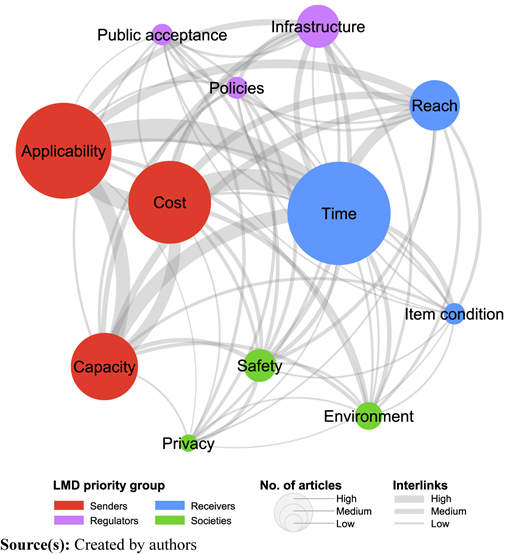
Figure 11 illustrates a network analysis of the 12 LMD criteria, delineating the degrees of emphasis of each criterion in the reviewed sample and their interconnectedness. At a glance, time, applicability and cost surge to the forefront as the most addressed – and most interlinked – criteria in the literature. This prevalence is not coincidental; modeling studies – which dominate the sample – lean heavily into evaluating the practical uses of drone-based deliveries and their potential to outperform traditional delivery methods such as trucks and vans. By doing so, researchers discern how drones can be best utilized to achieve both time and cost efficiencies – with time being an essential metric for receivers and cost being an essential metric for senders. Adjacent to these core criteria, capacity, reach and infrastructure emerge as vital, albeit less explored, areas of inquiry. Their presence in the literature, although not as dominant, is intrinsically linked to the primary criteria mentioned above. That is, when discussing potential time and cost savings by drone deliveries, one invariably touches upon the limitations posed by drones' payload/battery capacity and existent infrastructures to reach potential receivers, including the physical and technological frameworks available to warrant success of drone deliveries.
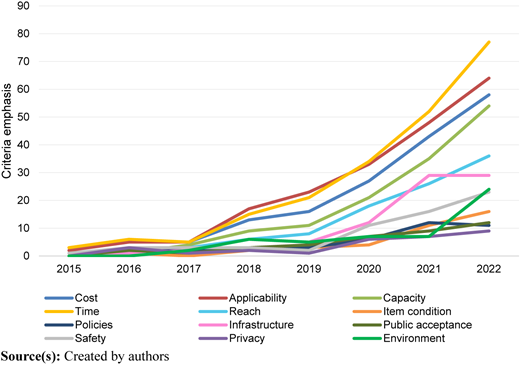
A careful observation of Figure 11 also reveals an area of opportunity. Crucial criteria such as environmental impact, safety considerations, governing policies, privacy and public acceptance have remained relatively less explored. This oversight perhaps stems from the nascent nature of drone technology and the initial industry inclination towards proving its operational efficacy. In other words, scholars in this realm seem to have wanted to prove that drone deliveries actually work as intended before exploring the adjacent ramifications for their facilitation. That being said, the landscape appears to be shifting, with more recent scholarly endeavors delving into these overlooked criteria (see Figure A1 in Appendix). This shift underscores the realization that for drone delivery systems to be holistically effective and accepted, they must address not only operational challenges but also legal, societal and environmental concerns.
Our further dissection of the relationships between the 12 LMD criteria resulted in forming a comprehensive 12 × 12 matrix (Table 9), from which we derived one positive and one negative relationship for each set of LMD criteria to elucidate their inherent inter-dependencies and the trade-offs involved for pursuing them. These associations highlight the highly challenging and intricate task of enabling drone deliveries in a manner that satisfies all stakeholder groups while fulfilling all LMD criteria simultaneously.
7. Further research directions
Grounded in the literature on drone applications in LMD, we identify nine research directions (RDs) for further investigation in the logistics management field.
Elucidating drone applications in LMD from a managerial perspective.
The reviewed literature is predominated by studies from transportation science, engineering and computer science, viewing the topic mainly from optimization and simulation standpoints. While these studies aid logistics managers' decision-making on drone deliveries based on key logistics criteria (e.g. cost, time, facility location), a comprehensive managerial perspective on the topic is rather scarce. This is a crucial gap to bridge, given the myriad of managerial factors affecting the applicability of drone deliveries coupled with the fact that they still lack scale economies, public acceptance, ready infrastructures and governing laws. As such, logistics managers are still left to wonder about the strategic considerations for investing in drone deliveries and the optimal timing and location for implementation. A large opportunity presents itself here to logistics management scholars to examine drone deliveries from strategic, marketing, financial, operational and supply chain outlooks. Theories such as transaction-cost economics, resource-based view, stakeholder theory and network theory may be applied to elucidate whether firms should internalize their drone applications or outsource them to third-party vendors. The relational view may also be relevant to explore whether supply chain partners can enact relation-specific assets or knowledge-sharing routines to leverage drone applications for desired win-wins.
Creating generalizable and contextualized knowledge on behavioral issues surrounding drone deliveries, using empirical research methods.
As discussed in Section 4.3, the literature on drone deliveries is dominated by modeling studies, utilizing approaches like the Vehicle Routing Problem and Facility Location Problem. While such non-empirical methods are invaluable for decision-making, they are limited in capturing the behavioral nuances surrounding drone use. Although our review identified 11 surveys and 10 case studies (of which three are qualitative), none of them focused on the behaviors of logistics firms, while only a few examined the behaviors of other stakeholders such as consumers and residents. This signals a need for more research to understand the perspectives of logistics managers, delivery experts, regulators, among others, to empirically assess their acquaintance with the technology.
Resolving conflicting cost, technical, social, and environmental trade-offs arising from drone deliveries.
Our review revealed study-worthy trade-offs among the 12 LMD criteria, emerged after matching the potentials and challenges of drone deliveries for each set of criteria (Table 9). Examples include when drones enhance the quality of life for receivers through rapid and far-reaching deliveries yet raise safety and privacy concerns for societies due to surveillance applications and airborne maneuvers. This trade-off is especially relevant in humanitarian and healthcare contexts, where drone deliveries are not a mere luxury but a life-saving necessity. Another trade-off was found when drones minimize the socio-environmental externalities of urban transport (e.g. emissions, congestion, accidents) by substituting ground vehicles, yet the need to operate a large number of drones to serve such areas due to drones' limited payload/range capacity. Here, drones may overcrowd the lower airspace and lead to a new stream of externalities related to safety, privacy and noise. We also found a trade-off when drones reduce transport costs with their low investment and operating cost yet incur high total investment costs to secure full drone delivery systems with fleets, depots and refueling stations. As such, future research can investigate the circumstances under which the benefits of drone deliveries outweigh their drawbacks across different LMD criteria.
Unraveling the roles and responsibilities for infrastructural updates to accomodate drone deliveries.
As this review showed, most transport infrastructures are not yet prepared to handle drone deliveries. We also discussed the requirements for enabling these infrastructures and divided them into tangible and intangible assets (Table 7). What can be noted is that these assets differ in their application and associated roles and responsibilities. For example, providing new warehouses to offset drones' limited capacities may fall under the responsibility of logistics managers, yet building such warehouses is often handled by contractors, pending the permission of local authorities, especially in areas near the city center. Warehouse operators, drone pilots, technicians and possibly truck/van drivers (for drone-truck setups) may also be recruited to fulfill delivery orders. If the LMD system is intended for medical deliveries, the intervention of doctors and nurses may be needed – let alone approvals of legal bodies such as the Food and Drug Authority. This is a glimpse of the numerous requirements for a functional infrastructure for drone deliveries. Charging hubs, take-off/landing stations, revised road structures, 5G/6G networks, legal frameworks, insurance policies and air-traffic management systems (e.g. UTM) are all essential toward that end. Considering the latter alone, feeding the UTM system with live data on all airborne traffic, geometry of buildings/objects, pedestrian movement and weather conditions is vital to warrant smooth and safe drone operations. Such complex infrastructures with diverse (and possibly, overlapping) responsibilities necessitate detailed planning efforts akin to those made a century ago for road infrastructures. Scholars can aid here by defining the roles for facilitating these infrastructures and exploring the dynamics of responsibility allocation among various actors.
Examining the needs of end consumers for drone deliveries in e-commerce.
While the desire for swift and far-reaching drone deliveries is evident in humanitarian relief and healthcare contexts, the situation in e-commerce may differ. Perhaps consumers do not “need” one-hour (or five-minute) deliveries for their regular, day-to-day merchandise like toothpastes or garments. In contrast, a hungry person would obviously prefer their meal delivered as quickly – and as warm – as possible. Moreover, while some may argue that receivers don't care about how their deliveries are carried out, a counterargument suggests that some may find it “cooler” to see a drone delivering their orders instead of a traditional (“boring”) van. As such, how will consumer preferences shape the marketing strategies of e-retailers with respect to promoting the technology? Will the situation normalize once drone deliveries become an established routine? Although the reviewed literature touched upon this topic, further research is still required to understand consumers' actual needs for drone deliveries and their impact on e-retailers' strategies, operations and revenues.
Elucidating human-drone interactions in LMD.
Human-drone interactions can be defined as “the study field focused on understanding, designing, and evaluating drone systems for use by or with human users” (Tezza and Andujar, 2019, p. 167439). Applying this concept on LMD allows specifying each of drone pilots, receivers and surrounding people as humans interacting with drones. Through informative screens at the pilot's end and cameras/sensors at the drone's end, a drone can virtually take its pilot to any point in the 3D airspace. This makes drones a medium for both input and output, where a pilot does not only interact with the drone but also with its physical surroundings. However, the reviewed literature revealed limited insights on how human-drone interactions take shape in LMD settings. This uncovers an opportunity for scholars to explore how pilot-drone interactions can utilize innovative control interfaces (e.g. speech, gesture, mental models) to enhance LMD performance, while discussing the required training/licensing to that end. Light can also be shed on how receivers and surrounding people interact with drones (or pilots) during drone flights and drop-off/landing events, considering factors such as interaction distance, drone feedback, remote communication and emotion encoding.
Understanding the actual societal repercussions of drone deliveries.
Since drone deliveries are not operational at large yet, their actual impact on societies remains barely known. Although our review uncovered societal opinions of drone deliveries from safety, privacy, ethical and environmental prospects, most of these opinions are speculative or experimentally controlled at best (i.e. they are not based on natural, day-to-day experiences with drone deliveries). Although controlled experiments enable studying a phenomenon before its widespread adoption, their external validity is limited due to researcher-imposed controls. Such experiments are also subject to bias, as participants often know they are being studied and may want to act positively. This is especially relevant in drone contexts, where there might be a desire to appear “tech-savvy” or “up-to-date”. Given the growing drone applications in real life, scholars can now explore the societal repercussions of this technology using less biased methods such as field experiments, econometrics, data analytics, or triangulation of multiple methods.
Guiding the formation of – and compliance with – airspace policies for drone deliveries.
This reviewed literature revealed the extreme complexities involved in crafting all-inclusive policies to govern drone deliveries – and to no surprise such deliveries are not yet active in most parts of the world. Different aviation policies between countries, alongside their varying degrees of strictness, pose a challenge to drone manufacturers and adopters vis-à-vis compliance. This also raises a question on whether drone manufacturing and operating procedures should be customized for certain regions or standardized on a global scale. We also saw how drone deliveries may create conflicting interests between senders, receivers, societies and other operators in the airspace and how current legal frameworks suffer from loopholes in lodging the technology. All these issues invite scholars to guide the formation of, and compliance with, airspace policies to leverage drone deliveries across various contexts and regions.
Understanding – and minimizing – the environmental impact of drone deliveries
Against our hopes, the reviewed literature showed that drone deliveries may not always be an environmentally preferable alternative – especially in urban areas. Factors such as travel distance, payload restrictions, receivers' density, energy source for charging and service hubs were found to be substantially determinantal of the overall greenness of drone deliveries. Using LCA, some studies went beyond the drone's operational phase to reveal a higher environmental harm during production, though drones outpace other transport modes when seen from a “cradle-to-grave” standpoint. As such, more research is needed to understand whether drone manufacturers may capitalize on scale economies to lower energy demands per single unit, or if innovative solutions may be utilized to enhance the environmental friendliness of drone deliveries in urban areas.
8. Conclusions
We presented a deductive, theory refinement SLR of 307 interdisciplinary, peer-reviewed journal articles on drone applications in LMD during 2015–2022, extrapolating pertinent insights from and into the logistics management field. Our thematic analysis revealed the potentials, challenges and solutions of drone deliveries in relation to twelve key LMD criteria dispersed across four stakeholder groups: senders, receivers, regulators and societies – along with identifying relationships between these criteria. This review contributes to logistics management by offering a timely, inclusive, inter-connected and well-balanced discussion of this emergent technology. Nine directions for further research were identified and thoroughly discussed, setting the stage for a new stream of research to expand our understanding of drone deliveries across various sectors and regions in parallel with growing real-world applications.
This review offers several practical implications. First, it provides logistics managers with an inclusive roadmap to guide their decisions on drone adoption in LMD. Specifically, it covers both operational LMD criteria (e.g. cost, capacity, time) and non-operational ones (e.g. privacy, policies, public acceptance) to holistically support the decision-making intricacies for adopting the technology. Second, it helps logistics managers understand how drone deliveries resonate with the priorities of other stakeholders who are directly involved in the LMD process (e.g. receivers) or indirectly involved but play key roles in shaping its outcomes (e.g. regulators, societies). This may support them adjust their strategies to accommodate each stakeholder group based on the criterion at hand. Third, it breaks down the complex, highly technical and conjectural topic of drones in LMD into easy-to-understand elements for business executives, practitioners, regulators and society at large. Last, it offers a realistic overview of drones' abilities in enhancing the LMD process and the challenges hindering them from reaching their full potential.
Notes
Refer to Figures A1 and A2 in Appendix for descriptive analysis across the 12 LMD criteria.
Refer to Stöcker et al. (2017) for a thorough cross-country comparison of UAV regulations.
References
Appendix
Articles included in the review but not referenced in the text*
*Agatz, N., Bouman, P. and Schmidt, M. (2018), “Optimization Approaches for the Traveling Salesman Problem with Drone”, Transportation Science, 52(4), 965–981.
*Amukele, T., Sokoll, L.J., Pepper, D., Howard, D.P. and Street, J. (2015), “Can unmanned aerial systems (drones) be used for the routine transport of chemistry, hematology, and coagulation laboratory specimens?”, PLoS One, 10(7), e0134020.
*Arafat, M.Y. and Moh, S. (2022), “JRCS: Joint Routing and Charging Strategy for Logistics Drones”, IEEE Internet of Things Journal, 9(21), 21751–21764.
*Aurambout, J.P., Gkoumas, K. and Ciuffo, B. (2019), “Last mile delivery by drones: an estimation of viable market potential and access to citizens across European cities”, European Transport Research Review, 11(1), 1–21.
*Bai, X., Cao, M., Yan, W. and Ge, S.S. (2019), “Efficient routing for precedence-constrained package delivery for heterogeneous vehicles”, IEEE Transactions on Automation Science and Engineering, 17(1), 248–260.
*Baniasadi, P., Foumani, M., Smith-Miles, K. and Ejov, V. (2020), “A transformation technique for the clustered generalized traveling salesman problem with applications to logistics”, European Journal of Operational Research, 285(2), 444–457.
*Benayad, A., Malasse, O., Belhadaoui, H. and Benayad, N. (2022), “Unmanned Aerial Vehicle in the Logistics of Pandemic Vaccination: An Exact Analytical Approach for Any Number of Vaccination Centres”, Healthcare (Basel), 10(10), 2102.
*Betti Sorbelli, F., Corò, F., Das, S.K., Palazzetti, L. and Pinotti, C.M. (2022), “On the Scheduling of Conflictual Deliveries in a last-mile delivery scenario with truck-carried drones”, Pervasive and Mobile Computing, 87, 101700.
*Betti Sorbelli, F., Pinotti, C.M. and Rigoni, G. (2023), “On the Evaluation of a Drone-Based Delivery System on a Mixed Euclidean-Manhattan Grid”, IEEE Transactions on Intelligent Transportation Systems, 24(1), 1276–1287.
*Chauhan, D., Unnikrishnan, A. and Figliozzi, M. (2019), “Maximum coverage capacitated facility location problem with range constrained drones”, Transportation Research Part C: Emerging Technologies, 99, 1–18.
*Chen, H., Liu, Z., Luo, Y. and Wang, H. (2019), “The Optimization Scheme of Drones in Rescue”, International Journal of Applied Mathematics and Soft Computing, 5(1), 47–54.
*Chen, M.F., Liu, Y.Q., Song, Y. and Sun, Q. (2019), “A contract coordination model of dual-channel delivery between UAVs and couriers considering the uncertainty of delivery for last mile”, Discrete Dynamics in Nature and Society, 1–11.
*Chiang, W.C., Li, Y., Shang, J. and Urban, T.L. (2019), “Impact of drone delivery on sustainability and cost: Realizing the UAV potential through vehicle routing optimization”, Applied Energy, 242, 1164–1175.
*Choi, Y. and Schonfeld, M. (2021), “A comparison of optimized deliveries by drone and truck”, Transportation Planning and Technology, 44(3), 319–336.
*Choudhury, S., Solovey, K., Kochenderfer, M.J. and Pavone, M. (2021), “Efficient large-scale multi-drone delivery using transit networks”, Journal of Artificial Intelligence Research, 70, 757–788.
*Chuang Liu, Chen, H., Li, X. and Liu, Z. (2021), “A scheduling decision support model for minimizing the number of drones with dynamic package arrivals and personalized deadlines”, Expert Systems with Applications, 167, 114157.
*Chung, J. (2018), “Heuristic method for collaborative parcel delivery with drone”, Journal of Distribution Science, 16(2), 19–24.
*Coindreau, M.A., Gallay, O. and Zufferey, N. (2021), “Parcel delivery cost minimization with time window constraints using trucks and drones”, Networks, 78(4), 400–420.
*de Freitas, J.C. and Penna, H.V. (2020), “A variable neighborhood search for flying sidekick traveling salesman problem”, International Transactions in Operational Research, 27(1): 267–290.
*Dell’Amico, M., Montemanni, R. and Novellani, S. (2021), “Algorithms based on branch and bound for the flying sidekick traveling salesman problem”, Omega, 104, 102493.
*Di Puglia Pugliese, L., Macrina, G. and Guerriero, F. (2021), “Trucks and drones cooperation in the last-mile delivery process”, Networks, 78(4), 371–399.
*Di Puglia Pugliese, L., Guerriero, F. and Scutellá, M.G. (2021), “The last-mile delivery process with trucks and drones under uncertain energy consumption”, Journal of Optimization Theory and Applications, 191(1), 31–67.
*do C. Martins, L., Hirsch, P. and Juan, A.A. (2021), “Agile optimization of a two-echelon vehicle routing problem with pickup and delivery”, International Transactions in Operational Research, 28(1), 201–221.
*Doole, M., Ellerbroek, J., Knoop, V.L. and Hoekstra, J.M. (2021), “Constrained urban airspace design for large-scale drone-based delivery traffic”, Aerospace, 8(2), 38.
*Dukkanci, O., Kara, B.Y. and Bektaş, T. (2021), “Minimizing energy and cost in range-limited drone deliveries with speed optimization”, Transportation Research Part C: Emerging Technologies, 125, 102985.
*ElSayed, M. and Mohamed, M. (2022), “The Impact of Airspace Discretization on the Energy Consumption of Autonomous Unmanned Aerial Vehicles (Drones)”, Energies, 15(14), 5074.
*Feng, X., Murray, A.T. and Church, R.L. (2021), “Drone service response: Spatiotemporal heterogeneity implications”, Journal of Transport Geography, 93, 103074.
*Ferrandez, S.M., Harbison, T., Weber, T., Sturges, R. and Rich, R. (2016), “Optimization of a truck-drone in tandem delivery network using k-means and genetic algorithm”, Journal of Industrial Engineering and Management, 9(2), 374–388.
*Figliozzi, M.A. (2017), “Lifecycle modeling and assessment of unmanned aerial vehicles (Drones) CO2e emissions”, Transportation Research Part D: Transport and Environment, 57, 251–261.
*Fikar, C., Gronalt, M. and Hirsch, P. (2016), “A decision support system for coordinated disaster relief distribution”, Expert Systems with Applications, 57, 104–116.
*Flemons, K., Baylis, B., Khan, A.Z., Kirkpatrick, A.W., Whitehead, K., Moeini, S., Schreiber, A., Lapointe, S., Ashoori, S., Arif, M., Berenger, B., Conly, J. and Hawkins, W. (2022), “The use of drones for the delivery of diagnostic test kits and medical supplies to remote First Nations communities during Covid-19”, American Journal of Infection Control, 50(8), 849–856.
*Gómez-Lagos, J., Candia-Véjar, A. and Encina, F. (2021), “A new truck-drone routing problem for parcel delivery services aided by parking lots”, IEEE Access, 9, 11091–11108.
*Gonzalez-R, L., Canca, D., Andrade-Pineda, J.L., Calle, M. and Leon–Blanco, J.M. (2020), “Truck-drone team logistics: A heuristic approach to multi-drop route planning”, Transportation Research Part C: Emerging Technologies, 114, 657–680.
*Ha, Q.M., Deville, Y., Pham, Q.D. and Hà, M.H. (2018), “On the min-cost traveling salesman problem with drone”, Transportation Research Part C: Emerging Technologies, 86, 597–621.
*Ha, Q.M., Deville, Y., Pham, Q.D. and Hà, M.H. (2020), “A hybrid genetic algorithm for the traveling salesman problem with drone”, Journal of Heuristics, 26(2), 219–247.
*Ham, A.M. (2018), “Integrated scheduling of m-truck, m-drone, and m-depot constrained by time-window, drop-pickup, and m-visit using constraint programming”, Transportation Research Part C: Emerging Technologies, 91, 1–14.
*Han, S., Özer, B., Alioglu, B., Polat, Ö. and Aktin, A.T. (2019), “A mathematical model for the delivery routing problem via drones”, Pamukkale University Journal of Engineering Science, 25(1), 89–97.
*Hii, M.S.Y., Courtney, P. and Royall, G. (2019), “An evaluation of the delivery of medicines using drones”, Drones, 3(3), 52.
*Hong, I., Kuby, M. and Murray, A.T. (2018), “A range-restricted recharging station coverage model for drone delivery service planning”, Transportation Research Part C: Emerging Technologies, 90, 198–212.
*Hossain, N.U.I., Sakib, N. and Govindan, K. (2022), “Assessing the performance of unmanned aerial vehicle for logistics and transportation leveraging the Bayesian network approach”, Expert Systems with Applications, 209, 118301.
*Huang, H. and Savkin, A.V. (2020), “A method of optimized deployment of charging stations for drone delivery”, IEEE Transactions on Transportation Electrification, 6(2), 510–518.
*Huang, H., Savkin, A.V. and Huang, C. (2020), “A new parcel delivery system with drones and a public train”, Journal of Intelligent and Robotic Systems, 100(3), 1341–1354.
*Huang, H., Savkin, A.V. and Huang, C. (2020), “Reliable path planning for drone delivery using a stochastic time-dependent public transportation network”, IEEE Transactions on Intelligent Transportation Systems, 22(8), 4941–4950.
*Huang, H., Savkin, A.V. and Huang, C. (2020), “Round trip routing for energy-efficient drone delivery based on a public transportation network”, IEEE Transactions on Transportation Electrification, 6(3), 1368–1376.
*Huang, H., Savkin, A.V. and Huang, C. (2020), “Scheduling of a parcel delivery system consisting of an aerial drone interacting with public transportation vehicles”, Sensors, 20(7), 2045.
*Huang, H., Savkin, A.V. and Huang, C. (2021), “Drone routing in a time-dependent network: Toward low-cost and large-range parcel delivery”, IEEE Transactions on Industrial Informatics, 17(2), 1526–1534.
*Ito, S., Nishikawa, H., Kong, X., Funabashi, Y., Shibata, A., Negoro, S., Taniguchi, I. and Tomiyama, H. (2021), “Energy-aware Routing of Delivery Drones under WIndy Conditions”, IPSJ Transactions on System LSI Design Methodology, 14, 30–39.
*Jasim, N.I., Kasim, H. and Mahmoud, M.A. (2022), “Towards the Development of Smart and Sustainable Transportation System for Foodservice Industry: Modelling Factors Influencing Customer's Intention to Adopt Drone Food Delivery (DFD) Services”. Sustainability, 14(5), 2852.
*Jeon, S., Lee, H., Kaliappan, V.K., Nguyen, T.A., Jo, H., Cho, H. and Min, D. (2022), “Multiagent Reinforcement Learning Based on Fusion-Multiactor-Attention-Critic for Multiple-Unmanned-Aerial-Vehicle Navigation Control”, Energies, 15(19), 7426.
*Jie Zhang and Li, Y. (2023), “Collaborative vehicle-drone distribution network optimization for perishable products in the epidemic situation”, Computers and Operations Research, 149, 106039.
*Juan Zhang, Campbell, J.F., Sweeney II, D.C. and Hupman, A.C. (2021), “Energy consumption models for delivery drones: A comparison and assessment”, Transportation Research Part D: Transport and Environment, 90, 102668.
*Jung, H. and Kim, J. (2022), “Drone scheduling model for delivering small parcels to remote islands considering wind direction and speed”, Computers and Industrial Engineering, 163, 107784.
*Kai Wang, Pesch, E., Kress, D., Fridman, I. and Boysen, N. (2022), “The Piggyback Transportation Problem: Transporting drones launched from a flying warehouse”, European Journal of Operational Research, 296(2), 504–519.
*Kamat, A., Shanker, S., Barve, A., Muduli, K., Mangla, S.K. and Luthra, S. (2022), “Uncovering interrelationships between barriers to unmanned aerial vehicles in humanitarian logistics”, Operations Management Research, 15(3–4), 1134–1160.
*Khan, S.I., Qadir, Z., Munawar, H.S., Nayak, S.R., Budati, A.K., Verma, K.D. and Prakash, D. (2021), “UAVs path planning architecture for effective medical emergency response in future networks”, Physical Communication, 47, 101337.
*Khosravi, M., Enayati, S., Saeedi, H. and Pishro-Nik, H. (2021), “Multi-purpose drones for coverage and transport applications”, IEEE Transactions on Wireless Communications, 20(6), 3974–3987.
*Kim, J., Moon, H. and Jung, H. (2020), “Drone-based parcel delivery using the rooftops of city buildings: Model and solution”, Applied Sciences, 10(12), 4362.
*Kim, S. and Moon, I. (2019), “Traveling salesman problem with a drone station”, IEEE Transactions on Systems, Man and Cybernetics: Systems, 49(1), 42–52.
*Kloster, K., Moeini, M., Vigo, D. and Wendt, O. (2023), “The multiple traveling salesman problem in presence of drone- and robot-supported packet stations”, European Journal of Operational Research, 305(2), 630–643.
*Kong, F., Li, J., Jiang, B., Wang, H. and Song, H. (2022), “Trajectory Optimization for Drone Logistics Delivery via Attention-Based Pointer Network”, IEEE Transactions on Intelligent Transportation Systems, 24(4), 4519–4531.
*Koshta, N., Devi, Y. and Chauhan, C. (2022), “Evaluating Barriers to the Adoption of Delivery Drones in Rural Healthcare Supply Chains: Preparing the Healthcare System for the Future”, IEEE Transactions on Engineering Management, 1–13.
*Kundu, A., Escobar, R.G. and Matis, T.I. (2022), “An efficient routing heuristic for a drone-assisted delivery problem”, IMA Journal of Management Mathematics, 33(4), 583–601.
*Kuo, R.J., Lu, S.-H., Lai:-Y. and Mara, S.T.W. (2022), “Vehicle routing problem with drones considering time windows”, Expert Systems with Applications, 191, 116264.
*Kuru, K., Ansell, D., Khan, W. and Yetgin, H. (2019), “Analysis and optimization of unmanned aerial vehicle swarms in logistics: An intelligent delivery platform”, IEEE Access, 7, 15804–15831.
*Kwon, H., Kim, J. and Park, Y. (2017), “Applying LSA text mining technique in envisioning social impacts of emerging technologies: The case of drone technology”, Technovation, 60, 15–28.
*Larson, J., Isihara, P. Flores, G., Townsend, E., Diedrichs, D.R., Baars, C., Kwon, S., McKinnon, W., Nussbaum, J., Steggerda, C. and Yan, J. (2020), “A priori assessment of a smart-navigated unmanned aerial vehicle disaster cargo fleet”, Simulation, 96(8), 641–653.
*Lee, C.-W. and Wong, W.-P. (2022), “Last-mile drone delivery combinatorial double auction model using multi-objective evolutionary algorithms”, Soft Computing, 26(22), 12355–12384.
*Lee, M.T., Lai, Y.C., Chuang, M.L. and Chen, B.Y. (2021), “Design and validation of a route planner for logistic UAV swarm”, Intelligent Automation and Soft Computing, 28(1), 227–240.
*Leon–Blanco, J.M., Gonzalez-R: L., Andrade-Pineda, J.L., Canca, D. and Calle, M. (2022), “A multi-agent approach to the truck multi-drone routing problem”, Expert Systems with Applications, 195, 116604.
*Li, H., Wang, H., Chen, J. and Bai, M. (2020), “Two-echelon vehicle routing problem with time windows and mobile satellites”, Transportation Research Part B: Methodological, 138, 179–201.
*Li, X., Gong, L., Liu, X., Jiang, F., Shi, W., Fan, L., Gao, H., Li, R. and Xu, J. (2022), “Solving the last mile problem in logistics: A mobile edge computing and blockchain-based unmanned aerial vehicle delivery system”, Concurrency and Computation: Practice and Experience, 34(7), e6068.
*Li, Y., Zhang, G., Pang, Z. and Li, L. (2020), “Continuum approximation models for joint delivery systems using trucks and drones”, Enterprise Information Systems, 14(4), 406–435.
*Liang, X., Yu, H., Zhang, Z., Liu, H., Fang, Y. and Han, J. (2023), “Unmanned Aerial Transportation System With Flexible Connection Between the Quadrotor and the Payload: Modeling, Controller Design, and Experimental Validation”, IEEE Transactions on Industrial Electronics, 70(2), 1870–1882.
*Lin, M., Chen, Y., Han, R., Chen, Y. and Anderson, D.R. (2022), “Discrete Optimization on Truck-Drone Collaborative Transportation System for Delivering Medical Resources”. Discrete Dynamics in Nature and Society, 1–13.
*Liu, C., Huang, L. and Dong, Z. (2022), “A Two-Stage Approach of Joint Route Planning and Resource Allocation for Multiple UAVs in Unmanned Logistics Distribution”, IEEE Access, 10, 113888–113901.
*Liu, R., Pitruzzello, G., Rosa, M., Battisti, A., Cerri, C. and Tortora, G. (2022), “Towards an Innovative Sensor in Smart Capsule for Aerial Drones for Blood and Blood Component Delivery”, Micromachines (Basel), 13(10), 1664.
*Lu, Y., Yang, C. and Yang, J. (2022), “A multi-objective humanitarian pickup and delivery vehicle routing problem with drones”, Annals of Operations Research, 319(1), 291–353.
*Luo, Z., Poon, M., Zhang, Z., Liu, Z. and Lim, A. (2021), “The multi-visit traveling salesman problem with multi-drones”, Transportation Research Part C: Emerging Technologies, 128, 103172.
*Macias, J.E., Angeloudis, P. and Ochieng, W. (2020), “Optimal hub selection for rapid medical deliveries using unmanned aerial vehicles”, Transportation Research Part C: Emerging Technologies, 110, 56–80.
*Mahmoudi, B. and Eshghi, K. (2022), “Energy-constrained multi-visit TSP with multiple drones considering non-customer rendezvous locations”, Expert Systems with Applications, 210, 118479.
*Malamule, D., Moreira, S., Madeira, C., Lutucuta, C., Ailstock, G., Maxim, L., Bechtel, R., Defawe, O. and Viegas, S. (2022), “Quality Analysis of Tuberculosis Specimens Transported by Drones versus Ground Transportation”, Drones, 6(7), 155.
*Markelova, A.Y., Allahverdyan, A.L., Martemyanov, A.A., Sokolova, I.S., Petrosian, O.L. and Svirkin, M.V. (2022), “Applied routing problem for a fleet of delivery drones using a modified parallel genetic algorithm”, Vestnik of Saint Petersburg University. Applied Mathematics. Computer Science. Control Processes, 18(1), 135–148.
*Markvica, K., Hu, B., Prandtstetter, M., Ritzinger, U., Zajicek, J., Berkowitsch, C., Hauger, G., Pfoser, S., Berger, T., Eitler, S. and Schodl, R. (2018), “On the development of a sustainable and fit-for-the-future transportation network”, Infrastructures, 3(3), 23.
*Mathew, N., Smith, S.L. and Waslander, S.L. (2015), “Planning paths for package delivery in heterogeneous multirobot teams”, IEEE Transactions on Automation Science and Engineering, 12(4), 1298–1308.
*Mbiadou Saleu, R.G., Deroussi, L., Feillet, D., Grangeon, N. and Quilliot, A. (2018), “An iterative two-step heuristic for the parallel drone scheduling traveling salesman problem”, Networks, 72(4), 459–474.
*Mbiadou Saleu, R.G., Deroussi, L., Feillet, D., Grangeon, N. and Quilliot, A. (2022), “The parallel drone scheduling problem with multiple drones and vehicles”, European Journal of Operational Research, 300(2), 571–589.
*Mora, P. and Araujo, C.A.S. (2021), “Delivering blood components through drones: a lean approach to the blood supply chain”, Supply Chain Forum: An International Journal, 23(2), 113–123.
*Moshref-Javadi, M., Lee, S. and Winkenbach, M. (2020), “Design and evaluation of a multi-trip delivery model with truck and drones”, Transportation Research Part E: Logistics and Transportation Review, 136, 101887.
*Murray, C.C. and Raj, R. (2020), “The multiple flying sidekicks traveling salesman problem: Parcel delivery with multiple drones”, Transportation Research Part C: Emerging Technologies, 110, 368–398.
*Najy, W., Archetti, C. and Diabat, A. (2023), “Collaborative truck-and-drone delivery for inventory-routing problems”, Transportation Research Part C: Emerging Technologies, 146, 103791.
*Ozkan, O. (2022), “Multi-objective optimization of transporting blood products by routing UAVs: the case of Istanbul”, International Transactions in Operational Research, 30(1), 302–327.
*Pan, Y., Chen, Q., Zhang, N., Li, Z., Zhu, T. and Han, Q. (2022), “Extending Delivery Range and Decelerating Battery Aging of Logistics UAVs using Public Buses”, IEEE Transactions on Mobile Computing, 22(9), 5280–5295.
*Pei, Z., Dai, X., Yuan, Y., Du, R. and Liu, C. (2021), “Managing price and fleet size for courier service with shared drones”, Omega, 104, 102482.
*Peng, K., Du, J., Lu, F., Sun, Q., Dong, Y., Zhou, P. and Hu, M. (2019), “A hybrid genetic algorithm on routing and scheduling for vehicle-assisted multi-drone parcel delivery”, IEEE Access, 7, 49191–49200.
*Perlee, D., van der Steege, K.H. and den Besten, G. (2021), “The effect of drone transport on the stability of biochemical, coagulation and hematological parameters in healthy individuals”, Clinical Chemistry and Laboratory Medicine, 59(11), 1772–1776.
*Pina-Pardo, J.C., Silva, D.F. and Smith, A.E. (2021), “The traveling salesman problem with release dates and drone resupply”, Computers and Operations Research, 129, 105170.
*Pinto, R., Zambetti, M., Lagorio, A. and Pirola, F. (2020), “A network design model for a meal delivery service using drones”, International Journal of Logistics Research and Applications, 23(4), 354–374.
*Poikonen, S., Golden, B. and Wasil, E.A. (2019), “A branch-and-bound approach to the traveling salesman problem with a drone”, INFORMS Journal on Computing, 31(2), 335–346.
*Poikonen, S., Wang, X. and Golden, B. (2017), “The vehicle routing problem with drones: Extended models and connections”, Networks, 70(1), 34–43.
*Rabta, B., Wankmüller, C. and Reiner, G. (2018), “A drone fleet model for last-mile distribution in disaster relief operations”, International Journal of Disaster Risk Reduction, 28, 107–112.
*Radzki, G., Nielsen, I., Golińska-Dawson, P. Bocewicz, G. and Banaszak, Z. (2021), “Reactive UAV fleet's mission planning in highly dynamic and unpredictable environments”, Sustainability, 13(9), 5228.
*Raj, R. and Murray, C. (2020), “The multiple flying sidekicks traveling salesman problem with variable drone speeds”, Transportation Research Part C: Emerging Technologies, 120, 102813.
*Rashidzadeh, E., Molana, S.M.H., Soltani, R. and Hafezalkotob, A. (2021), “Assessing the sustainability of using drone technology for last-mile delivery in a blood supply chain”, Journal of Modelling in Management, 16(4), 1376–1402.
*Resat, H.G. (2020), “Design and analysis of novel hybrid multi-objective optimization approach for data-driven sustainable delivery systems”, IEEE Access, 8, 90280–90293.
*Rezaei Kallaj, M., Hasannia Kolaee, M. and Mirzapour Al-e-hashem, S.M.J. (2022), “Integrating bloodmobiles and drones in a post-disaster blood collection problem considering blood groups”, Annals of Operations Research, 321(1–2), 783–811.
*Sacramento, D., Pisinger, D. and Ropke, S. (2019), “An adaptive large neighborhood search metaheuristic for the vehicle routing problem with drones”, Transportation Research Part C: Emerging Technologies, 102, 289–315.
*Sajid, M., Mittal, H., Pare, S. and Prasad, M. (2022), “Routing and scheduling optimization for UAV assisted delivery system: A hybrid approach”, Applied Soft Computing, 126, 109225.
*Salama, M. and Srinivas, S. (2020), “Joint optimization of customer location clustering and drone-based routing for last-mile deliveries”, Transportation Research Part C: Emerging Technologies, 114, 620–642.
*Sawadsitang, S., Niyato, D., Tan, S., Wang, P. and Nutanong, S. (2021), “Shipper Cooperation in Stochastic Drone Delivery: A Dynamic Bayesian Game Approach”, IEEE Transactions on Vehicular Technology, 70(8), 7437–7452.
*Schermer, D., Moeini, M. and Wendt, O. (2019), “A matheuristic for the vehicle routing problem with drones and its variants”, Transportation Research Part C: Emerging Technologies, 106, 166–204.
*Schermer, D., Moeini, M. and Wendt, O. (2020), “A b ranch-and-cut approach and alternative formulations for the traveling salesman problem with drone”, Networks, 76(2), 164–186.
*Scott, J.E. and Scott, C.H. (2019), “Models for drone delivery of medications and other healthcare items”, International Journal of Healthcare Information Systems and Informatics, 13(3), 20–34.
*Shavarani, S.M., Nejad, M.G., Rismanchian, F. and İzbirak, G. (2018), “Application of hierarchical facility location problem for optimization of a drone delivery system: a case study of Amazon prime air in the city of San Francisco”, The International Journal of Advanced Manufacturing Technology, 95(9), 3141–3153.
*Shen, Y., Xu, X., Zou, B. and Wang, H. (2021), “Operating policies in multi-warehouse drone delivery systems”, International Journal of Production Research, 59(7), 2140–2156.
*Sigari, C. and Biberthaler: (2021), “Medical drones: Disruptive technology makes the future happen”, Der Unfallchirurg, 124(12), 974–976.
*Simić, V., Lazarević, D. and Dobrodolac, M. (2021), “Picture fuzzy WASPAS method for selecting last-mile delivery mode: a case study of Belgrade”, European Transport Research Review, 13(1), 1–22.
*Song, B.D., Park, K. and Kim, J. (2018), “Persistent UAV delivery logistics: MILP formulation and efficient heuristic”, Computers and Industrial Engineering, 120, 418–428.
*Stalnov, O., Faran, M., Koral, Y. and Furst, M. (2022), “Auditory detection probability of propeller noise in hover flight in presence of ambient soundscape”, The Journal of the Acoustical Society of America, 151(6), 3719-3728.
*Tavana, M., Khalili-Damghani, K., Santos-Arteaga, F.J. and Zandi, M.H. (2017), “Drone shipping versus truck delivery in a cross-docking system with multiple fleets and products”, Expert Systems With Applications, 72, 93–107.
*Torabbeigi, M., Lim, G.J., Ahmadian, N. and Kim, S.J. (2021), “An optimization approach to minimize the expected loss of demand considering drone failures in drone delivery scheduling”, Journal of Intelligent and Robotic Systems, 102(1), 22.
*Troudi, A., Addouche, S.A., Dellagi, S. and Mhamedi, A.E. (2018), “Sizing of the drone delivery fleet considering energy autonomy”, Sustainability, 10(9), 3344.
*Ulmer, M.W. and Thomas, B.W. (2018), “Same-day delivery with heterogeneous fleets of drones and vehicles”, Networks, 72(4), 475–505.
*Vu, L., Vu, D.M., Hà, M.H. and Nguyen, V.P. (2022), “The two-echelon routing problem with truck and drones”, International Transactions in Operational Research, 29(5), 2968–2994.
*Wang, K., Yuan, B., Zhao, M. and Lu, Y. (2020), “Cooperative route planning for the drone and truck in delivery services: A bi-objective optimisation approach”, Journal of the Operational Research Society, 71(10), 1657–1674.
*Wang, X., Poikonen, S. and Golden, B. (2017), “The vehicle routing problem with drones: several worst-case results”, Optimization Letters, 11(4), 679–697.
*Wangsa, I.D., Wee, H.M., Hsiao, Y.L. and Rizky, N. (2021), “Identifying an effective last-mile customer delivery option with an integrated eco-friendly inventory model”, INFOR: Information Systems and Operational Research, 60(2), 165–200.
*Wankmüller, C., Kunovjanek, M. and Mayrgündter, S. (2021), “Drones in emergency response–evidence from cross-border, multi-disciplinary usability tests”, International Journal of Disaster Risk Reduction, 65, 102567.
*Windras Mara, S.T., Rifai, A.P. and Sopha, B.M. (2022), “An adaptive large neighborhood search heuristic for the flying sidekick traveling salesman problem with multiple drops”, Expert Systems with Applications, 205, 117647.
*Wright, D. and Moore, E. (2021), “DARC Matters: Repurposing Nineteenth-Century Property Law for the Twenty-First Century”, Iowa L. Rev., 107, 2247.
*Yanchao Liu, (2019), “An optimization-driven dynamic vehicle routing algorithm for on-demand meal delivery using drones”, Computers and Operations Research, 111, 1–20.
*Yixuan Li, Yuan, X., Zhu, J., Huang, H. and Wu, M. (2020), “Multiobjective scheduling of logistics UAVs based on variable neighborhood search”, Applied Sciences, 10(10), 3575.
*Yurek, E.E. and Ozmutlu, H.C. (2018), “A decomposition-based iterative optimization algorithm for traveling salesman problem with drone”, Transportation Research Part C: Emerging Technologies, 91, 249–262.
*Yuyu Li, Yang, W. and Huang, B. (2020), “Impact of UAV delivery on sustainability and costs under traffic restrictions”, Mathematical Problems in Engineering, 2020, 1–15.
*Zenezini, G., Mangano, G. and De Marco, A. (2022), “Experts' opinions about lasting innovative technologies in City Logistics”, Research in Transportation Business and Management, 45, 100865.
*Zhang, S., Liu, S., Xu, W. and Wang, W. (2022), “A novel multi-objective optimization model for the vehicle routing problem with drone delivery and dynamic flight endurance”, Computers and Industrial Engineering, 173, 108679.
*Zhang, Y. and Kamargianni, M. (2022), “A review on the factors influencing the adoption of new mobility technologies and services: autonomous vehicle, drone, micromobility and mobility as a service”, Transport Reviews, 43(3), 407–429.
*Zhao, L., Bi, X., Li, G., Dong, Z., Xiao, N. and Zhao, A. (2022), “Robust traveling salesman problem with multiple drones: Parcel delivery under uncertain navigation environments”, Transportation Research Part E: Logistics and Transportation Review, 168, 102967.