Skip to article sections
Purpose

This study aims to understand the effects of lean tools on the different sustainability dimensions and to identify possible gaps and directions for future research.

Design/methodology/approach

A Systematic Literature Review (SLR) was conducted. Considering the period from 2013 to 2024, a total of 106 articles were covered. The review identified 49 lean tools that can contribute to the achievement of sustainable goals.

Findings

The application of lean techniques can increase economic performance, especially in terms of cost reduction, time efficiency, inventory management, productivity, quality, and profitability. On the environmental side, the main contributions concern optimising the use of resources, reducing waste and pollution. Lean tools also have a positive impact on the social dimension, improving the well-being and satisfaction of employees, their skills and health and safety in the workplace. The 10 lean tools most investigated for their effects on sustainability were also identified. While all these techniques significantly increase economic performance, the positive effects on social and environmental sustainability differ across tools. Further studies are therefore needed to holistically evaluate the influence of lean techniques on sustainability and define models that can measure this interrelationship, with greater efforts to include the social pillar.

Originality/value

The paper offers a new systematic perspective on the interrelation between Lean tools and sustainability, highlighting how most studies focus on economic and environmental aspects, while the social impact of Lean tools is less explored. It therefore suggests the need for further research to better assess this dimension.

In recent years, the concept of sustainability has become increasingly central to business strategies, prompting organisations to seek methods to include sustainable practices in their production processes (Goni et al., 2021; Lopez-Torres et al., 2022; Urbancová and Vrabcová, 2023). According to the definition of the World Commission on Environment and Development (WCED, 1987, p. 43), sustainability requires acting to “meet the needs of the present without compromising the ability of future generations to meet their own needs”. Indeed, integrating sustainability into corporate strategies means adopting a three-dimensional approach to business management (Hourneaux et al., 2018; Loviscek, 2020), defined by Elkington (1997) as the Triple Bottom Line (TBL). It involves embedding three dimensions of sustainability, namely the economic, environmental and social ones (Lozano, 2020; Spallini et al., 2021).

From this perspective, the use of lean tools has gained increasing attention due to their potential to improve operational efficiency by reducing waste (Choudhary et al., 2019; Ikatrinasari et al., 2018; Palange and Dhatrak, 2021). Lean Manufacturing, or Lean Production, originated within the Japanese automotive industry Toyota and has spread globally, given its effectiveness in enhancing productivity and reducing costs (Resta et al., 2016; Khodeir and Othman, 2018; Gil-Vilda et al., 2021). Lean techniques aim to eliminate all waste within business processes (Santos et al., 2019; Rahardjo et al., 2023), while improving quality and business performance. Specifically, eight types of waste have been identified (Tasdemir and Gazo, 2018), overproduction, inventory, transportation, waiting, defects, overprocessing, motion and non-exploited human potential. As Lean Manufacturing aims to eliminate activities that do not add value (Ikatrinasari et al., 2018; Dieste et al., 2020), its impact on economic sustainability becomes evident. By reducing waste, companies can optimise resource use, lower operating costs, and improve product quality, leading to higher customer satisfaction and market competitiveness (Tasdemir and Gazo, 2018; Dieste et al., 2019; Dey et al., 2020). Cutting material waste and improving energy efficiency are among the positive environmental effects of implementing lean tools (Cherrafi et al., 2019; Udokporo et al., 2020; Elemure et al., 2023). For instance, Just-in-Time (JIT) can reduce material waste by optimising inventory levels, while Value Stream Mapping (VSM) can identify inefficiencies in the production process (Seth et al., 2017; Kong et al., 2018; Kholik et al., 2023). Furthermore, continuous improvement and employee engagement–key elements of the lean philosophy – can contribute to a safer and more satisfying work environment, increasing worker motivation and well-being (Souza and Alves, 2018; Cordeiro et al., 2020).

Indeed, while the economic and environmental benefits of lean methods have been widely documented, the contribution of lean practices to social sustainability still remains under-explored (Tasdemir and Gazo, 2018; Caiado et al., 2019; Dey et al., 2020; Chavez et al., 2022). This imbalance is evident in both empirical studies and reviews exploring the interactions of lean with sustainability (Chavez et al., 2022; Díaz-Reza et al., 2022; Ferrazzi et al., 2025). As a result, a holistic understanding of the overall benefits of lean techniques on all three aspects of sustainability is lacking (Dey et al., 2020; Naeemah and Wong, 2022; Wadood et al., 2023). Additionally, most studies have examined single lean tools or limited combinations of these, without providing a comprehensive assessment of the effects of lean techniques on sustainability dimensions (Naeemah and Wong, 2022). As an example, Garza-Reyes et al. (2018) explored the impacts of five specific lean methods (i.e., Just in Time, Autonomation, Kaizen/Continuous improvement, Total Productive Maintenance and Value Stream Mapping) on the environmental performance of manufacturing companies. Similarly, García-Alcaraz et al. (2021) addressed economic sustainability with a narrow focus on 5S, Single Minute Exchange of Die, and Continuous Flow. Sony et al. (2020) concentrated their review on Lean Six Sigma, restricting the analysis to the effects of this single technique on the social outcomes of organisations. This fragmented approach fails to fully exploit the potential of diverse lean practices in advancing all three dimensions of sustainability. A more comprehensive perspective is required to examine a broader range of lean tools and their positive impacts across the economic, environmental, and social dimensions. Therefore, there is a pressing need for systematic and transparent investigations that quantify the potential benefits of lean tools while critically examining their multifaceted contributions to sustainability. In light of the above framework, this study conducts a Systematic Literature Review (SLR) to assess how lean tools positively influence sustainability across the three pillars, namely economic, environmental and social. This method is recognised for its rigorousness and accuracy in analysing and synthesising previous research. It provides a thorough understanding of the existing body of knowledge and helps to identify key trends, gaps, and areas for further investigations. Following a well-established selection process, 106 articles were included in the final review. This research work contributes to expanding the existing literature and provides useful suggestions for practitioners by answering the following research questions:

RQ1.

What are the current publication trends related to the application of lean tools from a sustainability perspective?

RQ2.

What is the positive impact of lean tools on each dimension of sustainability?

RQ3.

What are the main lean tools investigated so far in the literature for their positive influence on sustainability? And how do they positively impact on the three pillars of sustainability?

The paper is structured as follows. Section 2 describes the research methodology, explaining the selection and analysis process of the studies included in the review. Section 3 presents the results of the analysis, outlining the key trends that emerged from the literature surveyed. Section 4 discusses the results obtained, draws the main conclusions and contributions, identifies limitations, and suggests future directions for research.

The present study is based on a Systematic Literature Review (SLR) of lean tools and their positive influence on sustainability dimensions. SLR is a methodological approach that provides a clear view of current and future research directions while ensuring replicability, reliability, accuracy, and transparency (Fink, 2019; Watson and Webster, 2020; Batwara et al., 2023). It is particularly valuable for aggregating evidence from different research work, offering a comprehensive and unbiased overview of the topic under investigation (Snyder, 2019). The SLR facilitates the uncovering of research gaps and trends by adopting a rigorous protocol for the selection and analysis of studies, thus advancing theory and practice in the field (Van Dinter et al., 2021).

The review was conducted in three main phases, namely planning, conducting, and reporting the review (Van Dinter et al., 2021; García-Peñalvo, 2022).

Planning involves the definition of the search protocol, which includes database selection and search strategy to identify relevant studies (Torres-Carrión et al., 2018). Scopus is the database selected for this review, as it offers wide coverage of high-quality scientific articles in the field and has many advanced features for data filtering and analysis (Harzing and Alakangas, 2016; Herrera-Franco et al., 2020). Furthermore, a careful analysis of other databases, such as Web of Science, showed a substantial overlap of studies and fewer results. Therefore, Scopus was considered the most suitable to include as many relevant studies as possible. Other important key recent studies have exclusively relied on Scopus for conducting SLRs on topics like those investigated in this work, including Parmar and Desai (2020), Kumar et al. (2024) and Ferrazzi et al. (2025).

To include the most recent studies in the field of lean tools and sustainability, the period between 2013 and 2024 was chosen. Specifically, the year 2013 was chosen as the starting point for the systematic literature review since it marks the beginning of a growing academic interest in the topic (Tasdemir and Gazo, 2018; Naeemah and Wong, 2022). It should also be noted that the information included for 2024 corresponds to the first five months of the year, as the search process was conducted in May 2024. Keywords were defined to cover a wide range of related topics, ensuring that all aspects pertinent to the research questions were included (Xiao and Watson, 2019). Therefore, the query string used was “lean tool” OR “lean technique” OR “lean method” OR “lean practice” AND (“sustain* manufacturing” OR “sustain* production” OR “sustainability”). It was applied in the title, abstract and keywords of the articles. To refine and delimit the analysis to the most relevant publications for the scope of the study (Antony et al., 2021), inclusion/exclusion criteria were also set. Articles, conference papers, book chapters, and books that had reached the final stage of publication were included, while those in press were excluded. Furthermore, only documents in English were considered, as this is the most common language in scientific publications (García-Lillo et al., 2017; Rao, 2019).

Table 1 outlines the search protocol and the selection criteria.

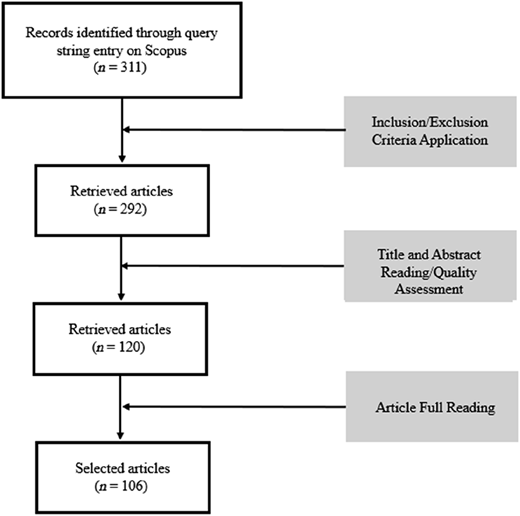
During the conducting phase, several key activities are carried out, ranging from the selection of relevant studies to their extraction, evaluation, and synthesis (Naeemah and Wong, 2022), Figure 1 illustrates the selection process of the reviewed articles. By applying the keywords in the Scopus database for the period between 2013 and 2024, 311 results were obtained. The use of inclusion/exclusion criteria indicated in Table 1 reduced the sample to 292 documents.

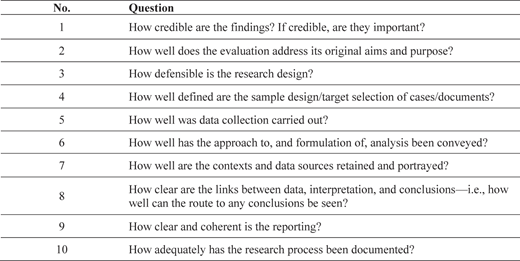
In order to identify the most relevant publications, titles and abstracts were examined. To ensure methodological rigour and mitigate subjectivity, the selection process was conducted independently by multiple researchers who worked on this study. Researchers used the checklist for quality assessment developed by De Carvalho et al. (2017, p. 12) to assess the quality of the selected studies (see Figure 2), to ensure that only studies relevant to the research objectives were selected for the analysis. This method is based on a well-established checklist of 10 evaluation questions (see Figure 2), which has been widely used in the literature to assess the methodological robustness of systematic reviews. Each question was rated on a scale of 0–2 points, with a maximum possible score of 20 per article. Papers that scored less than 14 points or received a score of 0 in three or more of the ten questions were excluded from the review. The scoring system is based on established literature review methodologies, with similar thresholds used in previous studies (Kitchenham and Charters, 2007; De Carvalho et al., 2017). The 14-point cutoff was chosen to ensure that only studies with sufficient methodological rigour were included, thus enhancing the reliability of the findings.

Any discrepancies in the inclusion or exclusion of studies were discussed and resolved through consensus. Particular attention was given to ensuring that the selected studies explicitly addressed the contribution of lean tools to sustainability, so as to align the final dataset with the intended scope of the review.

The selection was thus narrowed down to 120 papers. Additionally, the full articles were read to refine the selection and ensure consistency with the topic investigated. This multi-step screening process further reinforced the transparency and reliability of our methodology, ensuring that the final dataset was both comprehensive and representative of the research landscape.

As a result, 106 papers were included in the final review (see Figure 1).

Finally, the reporting phase concerns the draughting of the analysis outcomes (García-Peñalvo, 2022). The selected papers were examined through an in-depth content analysis using Excel spreadsheets. The elements explored included year of publication, country of authors, journal, citations, document type, keywords, research method, sector, and geographical application. In line with the research objectives, lean tools and their positive impacts on environmental, social, and economic sustainability were also identified.

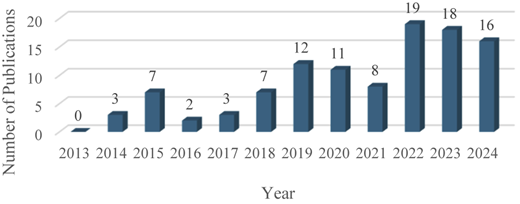
Figure 3 shows the evolution of the studies on lean tools and sustainability over the years. From 2013 to 2018, the number of research works was still low, with values never exceeding seven publications per year. In the last six years (2019–2024), articles published in this area have increased significantly up to 84, representing 79.24% of the total publications in the period under review. Specifically, 2022 is the year with the highest number of papers (19). 2024 also shows a positive trend, with 16 articles in just five months. The results suggest that this field of research is still recent, and this trend will continue to grow over time as more publications are added to the literature on the topic. The explanation for this increase could be the greater insistence with which practitioners and scholars are asked to find business solutions that are both efficient and sustainable. This trend also reflects a gradual shift from traditional lean applications towards more holistic interpretations that explicitly incorporate sustainability objectives. By focussing on waste reduction and continuous improvement, lean techniques enable operational efficiency, also generating positive impacts on the environment and society (Souza and Alves, 2018; Romeira et al., 2020; Naeemah and Wong, 2022).

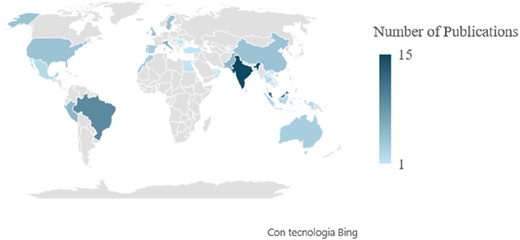
The geographical distribution of articles by author affiliation indicates that interest in lean tools and sustainability is widespread globally, as can be seen in Figure 4. India is the country with the highest number of publications, counting 15 research papers on this topic. This is followed by Malaysia and Brazil with 11 and 9 articles respectively. Italy (6), Pakistan (5), Peru (5) and Portugal (5) also make significant contributions to the research in this area.

Most of the reviewed articles are published in Sustainability (7), Journal of Cleaner Production (4) and TQM Journal (4) (Table 2). However, many studies are distributed among a wide range of academic sources. The majority of Journals present only one publication (62.26% in total), covering academic fields ranging from engineering and technology (e.g. IEEE International Conference on Engineering, Technology and Innovation, Advances in Intelligent Systems and Computing) to management and business (e.g. International Journal of Productivity and Performance Management, Total Quality Management and Business Excellence); from environmental sciences (e.g. Environmental Science and Pollution Research, Frontiers in Environmental Science) to social sciences (e.g. Sustainable Production and Consumption, Cleaner and Responsible Consumption). This heterogeneity points out a widespread, multidisciplinary interest in the integration of lean tools and sustainability. It may also indicate that the debate remains fragmented, suggesting opportunities for stronger integration across research streams. Such efforts could foster greater innovation and collaboration between different scientific communities and practitioners, further promoting the development of lean and sustainable practices within different industry contexts.

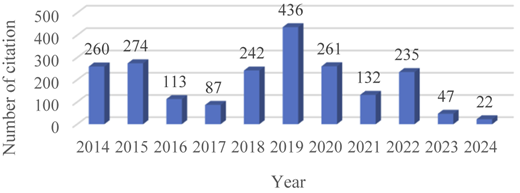
Looking at the impact of the selected contributions, the general trend confirms the growing attention to the impact of lean techniques on sustainable performance. As displayed in Figure 5, 2019 is the year with the most citations, consisting of 436. A preliminary analysis of the most cited articles from 2019 reveals that many of these studies focused on combining lean practices with green strategies to enhance sustainable performance. This integrated approach has demonstrated complementary benefits, as lean tools optimise operational efficiency while green practices help address environmental challenges. The synergy between lean and green has gained increasing relevance in response to stricter regulations, informed consumers, and competitive pressure to adopt sustainable production models. The growing interest of academics and practitioners in integrating lean and green has contributed to a significant increase in citations observed during this period. The peak in 2019 can therefore be interpreted not only as a quantitative increase, but as a qualitative turning point where lean started to be explicitly connected with broader sustainability agendas.

Despite the decrease in the following years, the high number of publications in 2022, 2023, and 2024, as shown in Figure 3, denotes that academic interest in this area is well established.

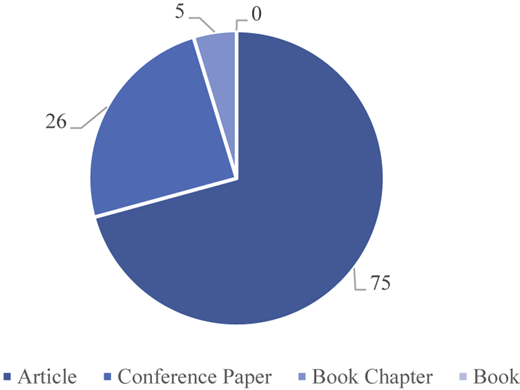
As displayed in Figure 6, the reviewed contributions are mainly articles, accounting for 75 papers; this is followed by conference papers (n. 26), which play an important role in sharing and discussing new research within the scientific community. Finally, book chapters are the least common type, with only 5 elements identified.

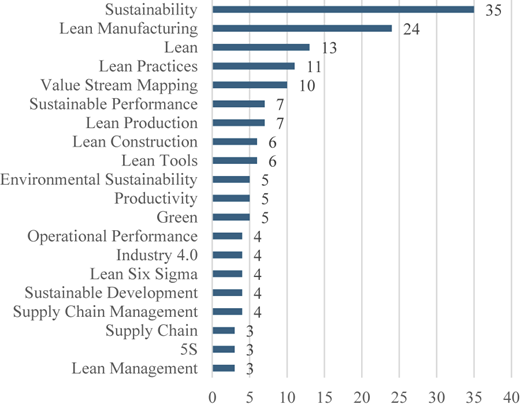
The keyword analysis shows that “Sustainability” (35) and “Lean manufacturing” (24) are among the most frequent words, underlining the relevance of these concepts in the current context. The lean tools primarily associated with the keyword “Sustainability” are Kaizen, Total Productive Maintenance (TPM), 5S, Value Stream Mapping (VSM) and Just-in-Time (JIT), which emphasises an integrated approach involving both continuous process optimisation, resource management and waste reduction. Furthermore, the occurrence of the terms “Lean Practices” (11) and “Value Stream Mapping” (10) suggests an interest in the implementation of lean techniques as tools to achieve efficiency and reach sustainable goals. Keywords such as “Environmental Sustainability” (5) and “Green” (5) also reflect the importance of integrating environmental issues into business management. These concepts are closely linked to techniques such as Value Stream Mapping (VSM), Kaizen, Just-in-Time (JIT), and Total Productive Maintenance (TPM), which are widely applied to enhance efficiency, reduce waste, and optimise resource management, addressing the growing demand for sustainable production. On the other hand, the relatively lower frequency of social-oriented keywords suggests that this dimension remains underrepresented in the current scientific debate, reinforcing a recurring imbalance between the pillars of sustainability.

Figure 7 shows the 20 most common keywords in the selected articles.

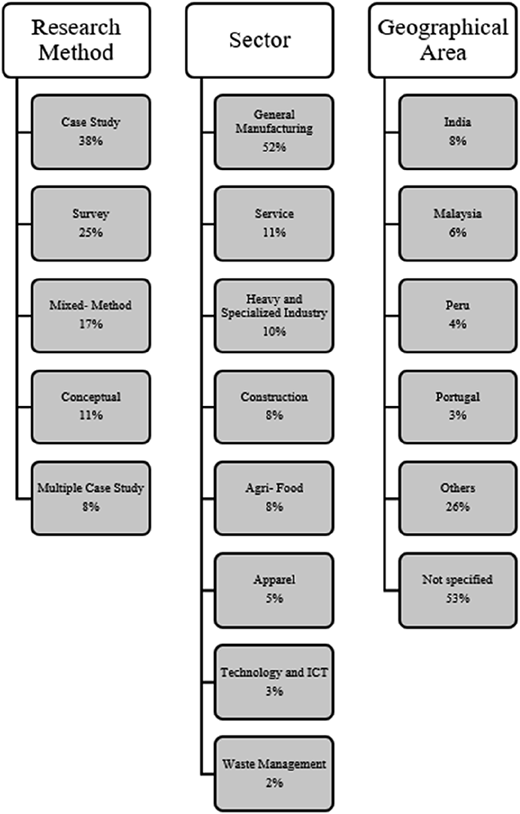
Figure 8 provides a detailed overview of the research methods used, the industry sectors involved, and the geographical applications of the studies under review. Regarding research methods, five main categories emerged: (1) single case study; (2) survey; (3) mixed-method; (4) multiple case study; (5) conceptual. Most of the articles used the single case study (38%). As the application of lean methodologies varies significantly by sector (Hartini et al., 2020; Verma and Sharma, 2021; Silva et al., 2024), this method has proven to be suitable for in-depth understanding of real-world context-specific dynamics. Surveys are also widely used (25%), as they allow data to be collected from a large sample of respondents and thus generalise the results. Data are often analysed using Structural Equation Modelling (SEM), which enables the examination of relationships between multiple variables and the validation of complex theoretical models. Moreover, 17% of the studies adopt mixed-methods, which allows combining the potential of qualitative and quantitative approaches to obtain a more comprehensive overview of the phenomenon. Less common are multiple case studies and the conceptual method, accounting for 8% and 11%, respectively. Overall, the prevalence of case studies highlights the exploratory stage of this research area, where context-specific insights are prioritised over generalisable theory-building. The selected studies mainly focused on the general manufacturing sector (52%), which could be determined by the link of this sector with the origins of Lean Production (Resta et al., 2016; Khodeir and Othman, 2018; Henao et al., 2019). However, it is interesting to note that services also received fair attention (11%), showing the multi-applicability of lean practices. Similarly, several studies have been conducted within heavy and specialised industry (10%), agri-food (8%) and construction (8%). The presence of multiple sectors demonstrates the versatility of lean tools, while raising questions about the influence of sector-specific dynamics on sustainability outcomes. Although the geographical application is mostly unspecified (53%), a significant portion of the studies focus on countries such as India (9%), Malaysia (6%) and Peru (4%), reflecting a growing interest in this area by emerging economies.

Lean Production includes a wide range of tools to simplify and optimise processes, while also improving the environmental and social impact of business operations. By using lean practices correctly, companies can create added value for customers, reduce operational inefficiencies and increase competitiveness in the global market (Tasdemir and Gazo, 2018; Palange and Dhatrak, 2021). Lean techniques also enable efficient use of natural resources, thus contributing to the preservation of the planet (Garza-Reyes et al., 2018; Bouazza et al., 2021). The successful implementation of lean methods requires the active involvement of employees and collaboration with suppliers (Iranmanesh et al., 2019; Cordeiro et al., 2020), fostering the creation of long-term, solid relationships. Therefore, a clear understanding about the role of lean tools is crucial to identify their contribution in achieving sustainable goals (Ikatrinasari et al., 2018; Taucean et al., 2021; Naeemah and Wong, 2022).

Table 3 provides an overview of the 49 lean tools identified by the analysis of the selected research papers. They were grouped into eight main categories, that is Problem Analysis and Resolution, Production Management, Planning and Control, Measurement and Control, Quality, Maintenance, Design and Ergonomics, Engagement and Relationship.

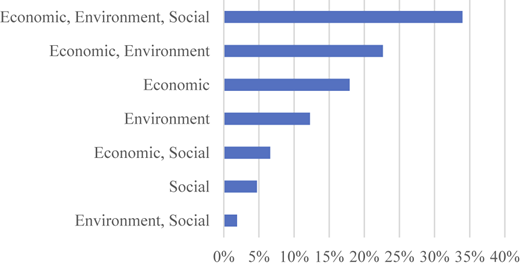
Focussing on the influence of the 49 lean tools on the pillars of sustainability, it emerges that almost 35% contribute equally to economic, environmental, and social aspects (Figure 9). This result confirms that the adoption of lean practices leads to integrated improvements in terms of operational efficiency, reduced ecological footprint and people well-being (Chavez et al., 2022; Wadood et al., 2023). In comparative terms, however, it is observed that most studies focused on the effects of lean practices in relation to only one (34.91%) or two (31.13%) dimensions of sustainability. The component most investigated individually is the economic one (17.92%), while together economic and environmental prevail (22.64%). Value Stream Mapping (VSM) and Kaizen emerge as the most analysed tools for their effects on both the economic and environmental pillars due to their ability to optimise production processes and reduce waste. For example, Saied et al. (2019) applied VSM to a company in the iron and steel sector, demonstrating how this tool can help increase productivity and identify energy waste. However, their study also reveals that the successful implementation of VSM requires considerable data collection and the capacity for continuous monitoring, which can be challenging for organisations with limited resources or less advanced operating systems. This suggests that the effectiveness of lean practices is contingent on organisational maturity and resource availability, pointing to important boundary conditions in their application. In energy-intensive industries or those with complex production processes, achieving substantial reductions in energy consumption also requires systemic changes beyond just identifying inefficiencies. While VSM and Kaizen were the lean methods most investigated for their joint impacts on economic and environmental aspects, 5S and Total Productive Maintenance (TPM) were mainly studied for their influence on a single pillar. 5S was most explored regarding the economic dimension, as it allows a better organisation of workspaces, reducing time wastage and increasing operational efficiency. Nevertheless, implementing 5S can be challenging in organisations with limited resources or a lack of a change-oriented culture. In small and medium-sized enterprises, the resource constraints may affect the effectiveness of 5S, hindering the achievement of long-term benefits (Tanasic et al., 2022). In contrast, TPM was examined for its environmental benefits through improved equipment reliability and reduced downtime. This leads to more efficient machinery management, which helps mitigate waste and reduce emissions. However, the full impact of TPM on environmental sustainability can be difficult to quantify, especially in terms of energy consumption (Chiarini, 2014). Furthermore, its potential in driving environmental improvements depends on the company’s commitment to external pressures and sustainability practices, such as environmental certifications. Without a broader, integrated environmental strategy, TPM alone may not achieve significant environmental outcomes (Chen et al., 2019).

On the contrary, less considered is the social pillar, both individually (4.72%) and jointly (8.49%). While the relationship of lean practices with environmental and economic benefits is easier to measure, assessing the effects on the social pillar is more complex due to their less tangible nature (Kühnen and Hahn, 2017; Tasdemir and Gazo, 2018). Among lean tools, Visual Management and 5S have received considerable attention for their impact on the social dimension, as both significantly improve workplace organisation, communication, and health and safety awareness. However, their success in advancing social sustainability is related to the top management commitment, proper training, and the implementation of monitoring systems (Ciannella and Santos, 2022). According to Kovács (2020), the positive impact of Visual Management can be compromised without sufficient employee training or clarity in the signalling system.

The relative scarcity of evidence on the social pillar thus contrasts with the greater emphasis placed on economic and environmental outcomes, suggesting that the three dimensions of sustainability are not yet equally addressed within the lean-lean-sustainability debate. The papers reviewed emphasise the need for a more integrated framework to comprehensively understand the overall effectiveness of lean techniques and address the challenges of measuring social outcomes, which remain particularly difficult to quantify.

For each aspect of sustainability, the specific role of the lean tools collected from the reviewed studies was also investigated and categorised in Table 4 to understand how they can support companies in achieving sustainable goals.

Concerning the economic pillar, the reviewed literature demonstrates a broad consensus on the role of lean tools in enhancing cost reduction, time efficiency, inventory management, productivity, quality, and profitability. However, the studies also suggest that such outcomes are not uniform, but rather depend on contextual conditions. For instance, while Just-in-Time (JIT) is widely recognised for reducing inventory and related costs (Rajagopalan, 2020), its effectiveness is closely linked to the resilience of supply chains, as excessive reliance on on-time deliveries can expose companies to disruptions (Abidin et al., 2022). Similarly, the implementation of Single Minute Exchange of Die (SMED) drastically reduces setup times, proving particularly valuable in high-volume and standardised settings, whereas its economic advantages appear less significant in industries characterised by product variability (Carrillo-Corzo et al., 2020). Tools such as Six Sigma can generate substantial gains by diminishing process variability and defects, although their implementation often requires high levels of technical expertise and commitment from leadership (Singh and Rathi, 2024). Kaizen also leads to better quality products through a continuous improvement approach and employee involvement, but its long-term effectiveness depends on establishing a participatory organisational culture (Dinis-Carvalho et al., 2023). Finally, 5S contributes to the economic dimension by enhancing workplace organisation and reducing inefficiencies, despite its impact being more moderate compared to techniques that directly target production flows (Tanasic et al., 2022).

The environmental dimension can benefit from the application of lean techniques, especially in terms of waste reduction, less pollution and optimisation in the resource use. Among other tools, Poka-Yoke contributes to less material waste by preventing production errors and reducing the need for rework and waste (Tanasic et al., 2022). Furthermore, the Pull Production System decreases overproduction, contributing to more sustainable resource management (Kovács, 2020). Value Stream Mapping enables the identification of areas of energy waste and the implementation of measures to improve energy consumption and minimise emissions (Saied et al., 2019; Estrada-Gonzalez et al., 2020). However, evidence shows that merely mapping energy and material flows is not sufficient, as more in-depth analyses of root causes are needed to achieve substantial environmental improvements (Saied et al., 2019). Likewise, studies combining life cycle assessment with lean tools highlight that efficiency savings at the process level may obscure broader environmental burdens unless a life cycle perspective is adopted (Estrada-Gonzalez et al., 2020). More generally, techniques such as Just in Time and SMED can support cleaner production practices (Cherrafi et al., 2018), but their contribution to reducing waste and resource use appears stronger when integrated into a wider green-lean strategy.

Lean tools also have a significant impact on social sustainability by improving employee well-being and satisfaction, health and safety conditions, training, and skills development. The adoption of lean practices such as the Gemba Walk and Employee Empowerment promotes a more engaging and collaborative workplace (Klein et al., 2022; Tanasic et al., 2022). At the same time, reducing work stress and increasing employee motivation are achieved through engagement techniques such as Kaizen, which encourages active employee participation (Ciannella and Santos, 2022). By promoting organisation and cleanliness in the workplace (Hoque et al., 2020; Dube and Gupta, 2023), the 5S method makes the work environment more ergonomic and safer. Investment in training and capability development is also a crucial aspect of lean methods (Zehra et al., 2024), as it improves workers' practical skills and enables them to understand the importance of change. Nevertheless, the evidence remains more fragmented and difficult to measure compared to the economic and environmental dimensions. The literature emphasises that the social benefits are strongly influenced by contextual factors, including leadership commitment, organisational culture, and the availability of resources to support continuous improvement initiatives.

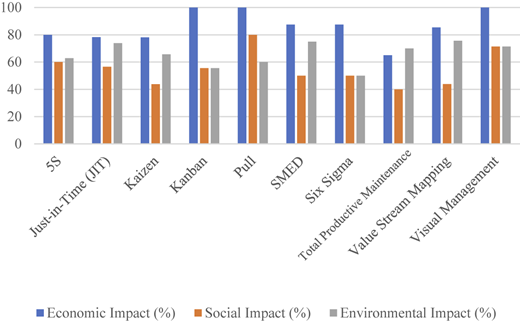
Based on the mentions within the 106 reviewed studies, the 10 lean tools most investigated for their impact on sustainable performance were finally identified. For each of these tools, a content analysis was conducted to determine how often they were explored in terms of their economic, environmental, and/or social effects. As shown in Figure 10, they are 5S, Just-in-Time (JIT), Kaizen, Kanban, Pull production system, SMED, Six Sigma, Total Productive Maintenance, Value Stream Mapping and Visual Management. All techniques show a strong propensity to improve economic performance, reflecting their main objective of optimising operational efficiency (Ikatrinasari et al., 2018; Palange and Dhatrak, 2021). However, social, and environmental impacts vary across tools, suggesting that some practices may be more effective than others in promoting sustainability as a whole. As an example, VSM (75.61%), SMED (75.0%), and JIT (73.91%) seem to be the methods that most positively influence the environmental dimension. SMED contributes to environmental sustainability by reducing machine setup times, lowering energy consumption and minimising material waste during transitions (Carrillo-Corzo et al., 2020). VSM enhances resource efficiency by mapping material and energy flows, identifying waste sources, and optimising processes to reduce emissions and excessive resource consumption (Estrada-Gonzalez et al., 2020) and JIT minimises overproduction and excessive inventory, which in turn reduces material waste, storage requirements, and the environmental footprint associated with unnecessary production (Abidin et al., 2022).

On the other hand, Pull Production System, Visual Management and 5S emerge as the techniques with the greatest social impact, with values of 80%, 71.43% and 60% respectively. The Pull Production System enhances job stability and reduces work-related stress by creating a smoother workflow, minimising production fluctuations, and preventing overburdening of employees (Naeemah and Wong, 2022). Visual Management improves communication and transparency in the workplace, providing clear visual cues that facilitate task coordination, reduce errors, and enhance worker autonomy (Kovács, 2020). Likewise, 5S contributes to a safer and more organised work environment by promoting cleanliness, ergonomic workplace arrangements, and structured processes, ultimately leading to improved employee well-being, motivation, and productivity (Ciannella and Santos, 2022; Dube and Gupta, 2023).

These findings suggest that the combination of several lean tools may be necessary to maximise the overall sustainable benefits, since no single practice can fully address the three pillars of sustainability in isolation. The predominance of economic impacts in almost all techniques reflects the historical roots of lean in efficiency-oriented paradigms (Palange and Dhatrak, 2021). This imbalance points to the need for more integrative approaches that combine complementary tools and explicitly address environmental and social concerns (Cherrafi et al., 2018). Otherwise, efficiency-oriented practices, while providing economic or environmental benefits, can also generate social pressures (Kovács, 2020).

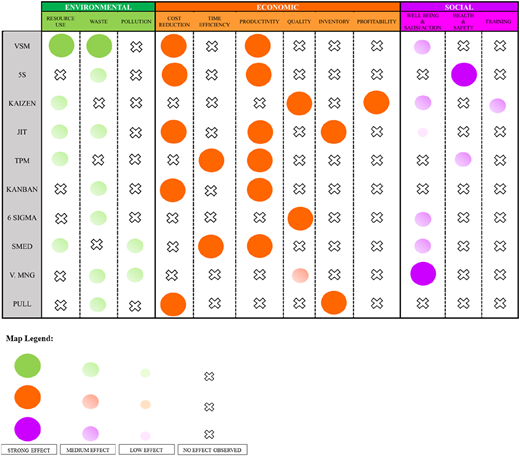
After having thoroughly quantitatively examined the papers for the 10 most used lean tools, a qualitative assessment of their impact on the three pillars of sustainability (economic, social and environmental) was performed. Figure 11 shows the graphical representation of the analysis performed. The criterion used is “Impact by pillar”, evaluating whether each tool has a:

  1. Strong impact: if the paper describes a significant impact, such as significant improvements in productivity, waste reduction, or well-documented social effects (e.g. improved working conditions).

  2. Medium impact: if the impact is positive but partial (e.g. moderate improvements in a specific process).

  3. Low impact: if the impact is mentioned but not explored or reported as limited.

The picture that emerges from the qualitative assessment of the impacts of lean tools on the three pillars of sustainability shows interesting trends: among the top 10 lean tools detected by importance, 9 (except for Visual Management) have a strong impact on the economic pillar (see Figure 11). This is consistent with the nature of lean tools, which were originally designed to improve operational efficiency, reduce costs, and increase productivity.

The environmental impact of the various tools is generally medium, except for the VSM tool, which shows strong impacts on the environmental pillar due to its ability to reduce waste and improve energy efficiency. Tools such as JIT, Kanban, and Six Sigma contribute to waste reduction through better control of inventory and processes, but the environmental impact tends to be more indirect and less pronounced. SMED and TPM, which are strongly linked to production optimisation and reduction of setup times, show a moderate environmental impact, especially in energy-intensive contexts.

The social impact is more variable among the various tools: 5S emerges as the tool with the strongest social impact for the improvement of working conditions, health, and safety, together with the V. MNG tool, which strongly impacts employee motivation and satisfaction. Tools such as Kanban and Pull have almost no social impact instead, as they have limited direct interaction with the workforce (Figure 11).

Lean Manufacturing principles not only allow organisations to eliminate waste and enhance operational efficiency but also offer significant sustainability benefits (Tasdemir and Gazo, 2018; Iranmanesh et al., 2019; Jum'a et al., 2022). Nonetheless, lean tools are still predominantly assessed in terms of economic outcomes, with environmental and especially social dimensions often treated in isolation. Therefore, there is a clear need for more rigorous and transparent investigations that are not limited to the potential benefits of lean tools but also critically assess their contributions to sustainability in an integrated manner (Ben Ruben et al., 2019; Naeemah and Wong, 2022). To address this gap, the present study systematically reviews the literature focussing on how lean tools influence the three sustainability pillars, while mapping current research trends and highlighting major knowledge gaps. By adopting a systematic and transparent methodology, this study aims to provide replicable insights and critically analyse the existing body of knowledge, finally developing an interpretative framework which links lean tools, sustainability pillars, and theoretical foundations.

The findings from this study underscore the growing interest in using lean tools from a sustainability perspective, particularly in recent years. This is reflected in the upward trend of publications, with notable peaks in 2019 and 2022. Although the body of literature on the intersection between lean methods and sustainability has expanded globally, it remains somewhat fragmented, especially when examining the three dimensions of sustainability simultaneously.

One notable aspect is the geographical distribution of studies, which highlights a strong focus on emerging economies. Countries like India (14%), Malaysia (10%), and Brazil (9%) are particularly active in this research field, reflecting the growing relevance of lean principles in contexts characterised by rapid industrial growth and economic transformation. This suggests lean is often seen as a strategic response to resource constraints in industrialising nations. However, the relative lack of contributions from developed countries raises questions about the transferability and contextual adaptation of lean practices in more mature industrial settings.

The preference for single case studies (38%) and surveys (25%) as research methods indicates a methodological inclination towards context-specific insights rather than generalisable evidence. While case studies offer valuable in-depth perspectives, the limited use of broader empirical methods underline the need for more robust, cross-sectional analyses. This highlights a key limitation: the lack of generalisable insights across industries and geographies. In particular, the strong focus on the manufacturing sector (52%) limits understanding how lean techniques could be effectively adapted to non-manufacturing contexts, such as healthcare, logistics, or public administration.

The identification of 49 lean tools confirms the broad applicability of lean across sustainability dimensions. However, most of the research reviewed tends to focus on economic (18%) and environmental and economic (23%) aspects, with the social component remaining underexplored (addressed individually or jointly in only 5% and 9% of articles, respectively). This disproportionate emphasis aligns with previous findings in the literature, which often prioritise tangible economic benefits over less measurable social impacts.

For example, JIT improves energy efficiency and reduces inventory costs, whereas TPM enhances equipment reliability through reduced downtime. On the environmental side, tools like VSM drive sustainability by minimising waste and optimising resources, however, their contribution to social outcomes remains less evident. This finding suggests that the effectiveness of lean tools is highly context-dependent and that leveraging their full potential requires tailored strategies that account for sectoral and regional differences.

The analysis also shows that while some tools (e.g., VSM, SMED, JIT) align well with environmental goals, others (like 5S or Visual Management) are better suited to support social sustainability. This disparity highlights a critical challenge in lean research: integrating multiple sustainability dimensions through a single approach. Relying on a single lean tool may lead to improvements in one dimension while neglecting others, reinforcing the need for combining complementary techniques.

The Triple Bottom Line framework (Elkington, 1997) provides a conceptual foundation for this integration, while Natural Resource-Based View (Hart, 1995) offers a valuable perspective on the intersection between economic and environmental performance. It highlights how lean tools that reduce waste, optimise resources, and enhance energy efficiency simultaneously generate cost advantages and ecological benefits. In line with this perspective, our findings confirm that the social dimension remains the least operationalised. To better frame this gap, additional theoretical perspectives such as the Stakeholder Theory (Freeman, 1984) and the Sustainable Work Systems approach (Docherty et al., 2002) offer useful interpretive lenses. They emphasise that organisational efficiency must be balanced with workers' well-being and long-term resilience. Similarly, Social Life Cycle Assessment (S-LCA) frameworks (Kühnen and Hahn, 2017) can help operationalise and measure social impacts more systematically, offering concrete methodological pathways that are currently missing in the lean–sustainability literature.

From a theoretical standpoint, when lean practices such as 5S, Visual Management or Kaizen are combined with participatory decision-making, continuous training, and employee involvement, they move beyond process optimisation and actively contribute to enhancing job satisfaction, safety, and organisational well-being. In this way, these models complement lean by translating operational improvements into tangible social outcomes, thereby addressing the current gap in the integration of the social pillar.

Overall, the results indicate that a holistic sustainability strategy cannot be achieved through isolated applications of lean tools. Instead, it requires an integrated approach combining various lean techniques with established theoretical frameworks, offering actionable pathways to operationalise the social dimension more rigorously.

This study contributes to the ongoing discussion on the integration of lean tools and sustainability by offering a more nuanced perspective on their interaction. Firstly, it highlights that integrating multiple lean tools, rather than focussing on a single technique, is crucial for achieving balanced sustainability impacts. Economic performance is the most commonly addressed dimension, while environmental and social impacts vary significantly across tools.

Unlike previous reviews that predominantly focus on economic and environmental aspects, this work highlights the critical gap related to the social pillar of sustainability. Although lean tools have been widely acknowledged for their economic and environmental benefits, their potential positive impact on social sustainability remains underexplored.

One of the most original aspects of this study lies in its systematic approach to identifying and analysing the social impacts of lean practices, attempting to reconnect lean tools with theoretical perspectives explicitly designed to capture social value creation.

By synthesising existing knowledge and pinpointing gaps, this review confirms the limited attention given to social sustainability in the current literature and offers a conceptual foundation for addressing this deficiency. Specifically, the study recognises that while economic efficiency and environmental benefits are more easily quantifiable, social improvements, such as enhanced employee well-being, job satisfaction, and workplace safety, are more nuanced and context-dependent.

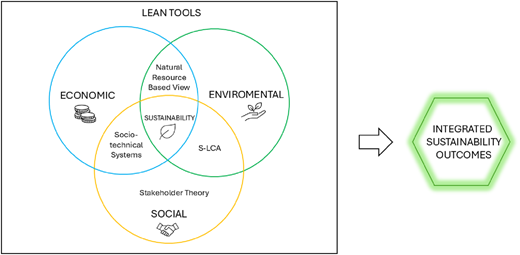
Building on these insights, we propose an interpretative framework in which lean tools are embedded within the Triple Bottom Line approach and conceptually grounded in Natural Resource-Based View (NRBV) model, Stakeholder Theory, Socio-technical Systems, and S-LCA. By linking operational practices with these theoretical foundations, the model encourages researchers to move beyond gap identification and towards the development of integrated measurement systems capable of capturing the multidimensional impacts of lean.

As illustrated in Figure 12, the framework is not merely descriptive but interpretative. Lean Tools are positioned as enablers that activate the Triple Bottom Line, represented as an integrated structure encompassing the economic, environmental, and social pillars. At the base of the model lie the theoretical foundations, which sustain and give meaning to these pillars. Each framework reinforces a different intersection: the Social Life Cycle Assessment (S-LCA) provides methodological grounding for both the social and the environmental dimensions; Stakeholder Theory offers a conceptual lens focused primarily on the social pillar; Socio-technical Systems theory bridges economic efficiency with human and organisational aspects of the social dimension; and the Natural Resource-Based View (NRBV) explains how environmental strategies can also serve as sources of competitive advantage, thereby connecting the environmental and economic pillars. Together, these perspectives “close the circle” by ensuring that all three dimensions of sustainability are theoretically anchored and interrelated. Finally, the upward trajectory of the framework points towards Integrated Sustainability Outcomes, emphasising that only through this combined approach can lean practices advance both academic understanding and managerial practice.

In practical terms, this implies that companies should not only adopt lean for efficiency purposes but should also embed it in human resource management strategies that prioritise empowerment, training, and safety. This holistic perspective can provide a new understanding of the potential synergies between lean practices and social well-being.

By integrating empirical studies and theoretical advancements, researchers can establish frameworks that better articulate the relationship between lean practices and social sustainability, ultimately guiding both academic inquiry and practical implementation.

Overall, this study contributes to the ongoing discussion on lean and sustainability by consolidating existing knowledge and providing actionable insights for researchers, practitioners and policy makers. Specifically, it enhances the theoretical understanding of the relationship between lean techniques and all three pillars of sustainability by providing an overview of their interaction, thereby addressing the fragmentation in the current literature.

From a practical perspective, this study highlights the need for companies to strategically integrate multiple lean tools to achieve a balanced sustainability impact. Practitioners should focus on economic efficiency while prioritising tools that foster social well-being and environmental improvements. For example, combining Value Stream Mapping (VSM) with Kaizen and 5S can simultaneously improve workflow efficiency, reduce waste, and enhance workplace safety. The effectiveness of lean tools can vary significantly depending on contextual and organisational factors such as industry type, company size, corporate culture, leadership, and resource availability. To maximise the impacts, practitioners should conduct a thorough assessment of their operational context before selecting and integrating lean practices. This could include evaluating existing workflows, resource allocation, and stakeholder engagement to tailor lean tool combinations effectively.

Concrete examples can be observed in manufacturing companies adopting lean to reduce both operational costs and energy consumption, hospitals using lean healthcare pathways to shorten patient waiting times while improving staff well-being, and universities integrating lean principles into administrative processes to optimise resources and enhance student services. These cases illustrate that lean practices, when adapted to context, can yield measurable benefits across multiple domains.

From a policy-making perspective, policymakers should consider promoting lean training programs and incentives for businesses adopting sustainability-oriented lean strategies. Governments can incentivise lean practices that integrate sustainability goals, particularly in industries where economic and environmental gains are evident, such as manufacturing and logistics.

In addition, clear policy guidelines could be developed to support the measurement and monitoring of the social dimension of lean adoption. For example, governments and institutions could fund the development of standardised indicators for workplace well-being, employee participation, safety, and equity, to be integrated into sustainability reporting frameworks. Certification schemes could also explicitly include social sustainability benchmarks, ensuring that organisations demonstrate not only efficiency and ecological improvements but also tangible progress in employee-related outcomes.

To practically support the adoption of lean practices in industrial sectors, it would be useful to develop sector-specific guidelines that outline best practices for integrating lean and sustainability. For example, this could include standardised metrics for waste reduction, energy efficiency, and worker safety improvements in manufacturing. Additionally, creating certification schemes or industry benchmarks could encourage companies to implement lean practices systematically and transparently.

Such schemes should explicitly link lean implementation with measurable social outcomes, such as reduced turnover, improved job satisfaction, and enhanced skills development, ensuring that the social pillar is not marginalised.

Future research should develop and test conceptual models that integrate lean tools with recognised frameworks such as the one proposed in this paper, to produce validated instruments for measuring social sustainability. This would not only advance academic knowledge but also provide practitioners and policymakers with concrete tools to assess the real impact of lean beyond cost savings.

On a broader societal level, the adoption of lean tools has the potential to improve job quality and employee engagement, addressing concerns related to worker well-being. However, the literature suggests that the social dimension remains underexplored. Further empirical research is needed to assess the long-term impact of lean tools on employee health, satisfaction, and work-life balance. Specifically, longitudinal studies in diverse sectors (e.g., manufacturing, healthcare, education, and public administration) would be particularly valuable in demonstrating how lean practices evolve into sustainable organisational routines with measurable social benefits.

While this review was developed with rigour and accuracy, it has some limitations. Firstly, the exclusive use of Scopus may have limited the inclusion of relevant studies found in other databases such as Web of Science or Google Scholar. Preliminary comparisons with other databases using the same search string showed that Scopus provided not only a larger volume of results, but also encompassed nearly all the contributions retrieved elsewhere. The few additional records outside Scopus were mostly duplicates or slight variations of already-indexed studies. Therefore, Scopus was chosen as the main database, as it guarantees broad coverage and consistency while minimising the risk of bias. While some marginal studies may have been excluded, no major or foundational works appear to have been omitted, and the overall validity of the analysis remains unaffected. Secondly, the use of a specific query may have led to the exclusion of additional scientific contributions in the field. Different formulations or synonyms not captured by the search string could have surfaced relevant but currently unindexed research. Third, the process of refining the studies, the inclusion and exclusion criteria and the categorisation of the identified scientific contributions are not completely immune to subjectivity. Fourth, only papers in English were selected, potentially excluding important contributions in other languages.

Another limitation is linked to the methodology adopted in this study, which may have inherently limited the identification of conflicts or challenges related to the interaction between lean tools and sustainability dimensions. Specifically, the criteria used for study selection primarily focused on identifying positive impacts and sustainable applications of lean practices. As a result, the review may not adequately capture critical perspectives or contradictions associated with lean practices, especially in relation to the three pillars of sustainability. However, addressing these conflicts would open a parallel line of inquiry, which, while equally important, falls outside the specific focus of this study. Finally, the impacts of lean tools on the three dimensions of sustainability were declined generically for all techniques identified in the reviewed articles. Future studies could involve multiple databases, use different keyword combinations, and include documents written in other languages. Similarly, it would be interesting to investigate the contribution of the single lean tool to each area of sustainability.

Considering the limitations identified, it becomes crucial to outline a research agenda addressing the existing gaps. This agenda aims to guide future studies towards a more comprehensive and nuanced understanding of the relationship between lean tools and sustainability, particularly in areas where current knowledge is limited. Therefore, the following research questions are proposed:

  1. What specific combinations of lean tools are most effective for simultaneously achieving economic, environmental, and social sustainability?

  2. How can lean practices be designed to better address the social pillar, particularly concerning employee well-being and health?

  3. How can lean tools be adapted to non-manufacturing contexts to enhance sustainability, particularly in service-oriented sectors?

  4. What theoretical tensions, conflicts, trade-offs, and adverse effects can emerge between lean practices and sustainability outcomes, and how can they be systematically identified and addressed in different industrial contexts?

  5. How can advanced integrative frameworks be designed to align lean practices with the three dimensions of sustainability, and through which measurement models can their impacts be jointly assessed?

While this SLR provides a comprehensive synthesis of existing knowledge, the inclusion of empirical validation methods, such as expert interviews or case studies, could further enhance the robustness of the findings. Triangulation with qualitative or quantitative approaches may help corroborate the relationships identified in the literature and provide additional practical insights. However, as SLRs primarily aim to structure and analyse existing research rather than generate new empirical data, such approaches extend beyond the scope of the present study.

Future studies could adopt a mixed-method approach to address the questions that emerged, combining case studies in diverse sectors with quantitative analysis to generalise findings. Longitudinal studies could also assess the long-term impact of lean tools on sustainability. Additionally, comparative studies between manufacturing and service sectors would help identify sector-specific challenges and solutions. Exploring the social dimension through participatory action research or ethnographic studies could yield insights into the real-world implications of lean practices on workers' well-being.
Abidin
,
M.H.Z.
,
Leman
,
Z.
,
Yusof
,
Z.A.M.
and
Ismail
,
M.Y.
(
2022
), “
Scrutinizing the impact of essential lean methods on sustainable performance in Malaysian manufacturing firms
”,
Jurnal Teknologi
, Vol. 
84
No. 
5
, pp. 
11
-
25
, doi: .
Akanmu
,
M.D.
and
Nordin
,
N.
(
2022
), “
Hybrid lean practices integrated with IR 4.0 and sustainability in Malaysia food and beverages companies: conceptual framework and hypothesis development
”,
Pertanika Journal of Science and Technology
, Vol. 
30
No. 
3
, pp. 
2271
-
2293
, doi: .
Al Adawi
,
H.K.
,
Al Alawi
,
A.
,
Johnston
,
P.
,
Al Kindi
,
A.
,
Al Husaini
,
N.
,
Al Balushi
,
F.
and
Al Mamari
,
Z.
(
2023
), “
Adoption of practical problem solving (PPS) methodology to drive business performance improvement in PDO, Sultanate of Oman
”,
Abu Dhabi International Petroleum Exhibition and Conference
,
SPE
,
D021S076R006
.
Antony
,
J.
,
Psomas
,
E.
,
Garza-Reyes
,
J.A.
and
Hines
,
P.
(
2021
), “
Practical implications and future research agenda of lean manufacturing: a systematic literature review
”,
Production Planning and Control
, Vol. 
32
No. 
11
, pp. 
889
-
925
, doi: .
Batwara
,
A.
,
Sharma
,
V.
,
Makkar
,
M.
and
Giallanza
,
A.
(
2023
), “
Towards smart sustainable development through value stream mapping–a systematic literature review
”,
Heliyon
, Vol. 
9
No. 
5
, e15852, doi: .
Ben Ruben
,
R.
,
Vinodh
,
S.
and
P
,
A.
(
2019
), “
State of art perspectives of lean and sustainable manufacturing
”,
International Journal of Lean Six Sigma
, Vol. 
10
No. 
1
, pp. 
234
-
256
, doi: .
Bouazza
,
Y.
,
Lajjam
,
A.
and
Dkhissi
,
B.
(
2021
), “
The impact of lean manufacturing on environmental performance in Moroccan automotive industry
”,
Management Systems in Production Engineering
, Vol. 
29
No. 
3
, pp. 
184
-
192
, doi: .
Büyüközkan
,
G.
,
Kayakutlu
,
G.
and
Karakadılar
,
İ.S.
(
2015
), “
Assessment of lean manufacturing effect on business performance using Bayesian belief networks
”,
Expert Systems with Applications
, Vol. 
42
No. 
19
, pp. 
6539
-
6551
, doi: .
Caiado
,
R.G.G.
,
Quelhas
,
O.L.G.
,
Nascimento
,
D.L.D.M.
,
Anholon
,
R.
and
Leal Filho
,
W.
(
2019
), “
Towards sustainability by aligning operational programmes and sustainable performance measures
”,
Production Planning and Control
, Vol. 
30
Nos
5-6
, pp. 
413
-
425
, doi: .
Carrillo-Corzo
,
A.
,
Tarazona-Gonzales
,
E.
,
Quiroz-Flores
,
J.
and
Viacava-Campos
,
G.
(
2020
), “
Lean process optimization model for improving processing times and increasing service levels using a deming approach in a fishing net textile company
”,
Proceedings of the 6th Brazilian Technology Symposium. BTSym 2020
,
Smart Innovation, Systems and Technologies
,
Cham
, Vol. 
233
,
Springer
, pp. 
443
-
451
, doi: .
Chavez
,
R.
,
Yu
,
W.
,
Jajja
,
M.S.S.
,
Song
,
Y.
and
Nakara
,
W.
(
2022
), “
The relationship between internal lean practices and sustainable performance: exploring the mediating role of social performance
”,
Production Planning and Control
, Vol. 
33
No. 
11
, pp. 
1025
-
1042
, doi: .
Chen
,
P.K.
,
Fortuny-Santos
,
J.
,
Lujan
,
I.
and
Ruiz-de-Arbulo-Lopez
,
P.
(
2019
), “
Sustainable manufacturing: exploring antecedents and influence of total productive maintenance and lean manufacturing
”,
Advances in Mechanical Engineering
, Vol. 
11
No. 
11
, pp. 
1
-
16
, doi: .
Cherrafi
,
A.
,
Garza-Reyes
,
J.A.
,
Kumar
,
V.
,
Mishra
,
N.
,
Ghobadian
,
A.
and
Elfezazi
,
S.
(
2018
), “
Lean, green practices and process innovation: a model for green supply chain performance
”,
International Journal of Production Economics
, Vol. 
206
, pp. 
79
-
92
, doi: .
Cherrafi
,
A.
,
Elfezazi
,
S.
,
Hurley
,
B.
,
Garza-Reyes
,
J.A.
,
Kumar
,
V.
,
Anosike
,
A.
and
Batista
,
L.
(
2019
), “
Green and lean: a Gemba–Kaizen model for sustainability enhancement
”,
Production Planning and Control
, Vol. 
30
Nos
5-6
, pp. 
385
-
399
, doi: .
Chiarini
,
A.
(
2014
), “
Sustainable manufacturing-greening processes using specific lean production tools: an empirical observation from European motorcycle component manufacturers
”,
Journal of Cleaner Production
, Vol. 
85
, pp. 
226
-
233
, doi: .
Choudhary
,
S.
,
Nayak
,
R.
,
Dora
,
M.
,
Mishra
,
N.
and
Ghadge
,
A.
(
2019
), “
An integrated lean and green approach for improving sustainability performance: a case study of a packaging manufacturing SME in the UK
”,
Production Planning and Control
, Vol. 
30
Nos
5-6
, pp. 
353
-
368
, doi: .
Ciannella
,
S.
and
Santos
,
L.C.
(
2022
), “
Exploring the influence of lean manufacturing practices on employee social sustainability
”,
Social Responsibility Journal
, Vol. 
18
No. 
8
, pp. 
1677
-
1691
, doi: .
Cordeiro
,
P.
,
,
J.C.
,
Pata
,
A.
,
Gonçalves
,
M.
,
Santos
,
G.
and
Silva
,
F.J.G.
(
2020
), “The impact of lean tools on safety–case study”, in
Occupational and Environmental Safety and Health II
,
Springer International Publishing
, pp. 
151
-
159
.
De Carvalho
,
A.C.V.
,
Granja
,
A.D.
and
Da Silva
,
V.G.
(
2017
), “
A systematic literature review on integrative lean and sustainability synergies over a building’s lifecycle
”,
Sustainability
, Vol. 
9
No. 
7
, 1156, doi: .
Dey
,
P.K.
,
Malesios
,
C.
,
De
,
D.
,
Chowdhury
,
S.
and
Abdelaziz
,
F.B.
(
2020
), “
The impact of lean management practices and sustainably-oriented innovation on sustainability performance of small and medium-sized enterprises: empirical evidence from the UK
”,
British Journal of Management
, Vol. 
31
No. 
1
, pp. 
141
-
161
, doi: .
Díaz-Reza
,
J.R.
,
García-Alcaraz
,
J.L.
,
Figueroa
,
L.J.M.
,
Vidal
,
R.P.I.
and
Muro
,
J.C.S.D.
(
2022
), “
Relationship between lean manufacturing tools and their sustainable economic benefits
”,
The International Journal of Advanced Manufacturing Technology
, Vol. 
123
No. 
3
, pp. 
1269
-
1284
, doi: .
Dieste
,
M.
,
Panizzolo
,
R.
,
Garza-Reyes
,
J.A.
and
Anosike
,
A.
(
2019
), “
The relationship between lean and environmental performance: practices and measures
”,
Journal of Cleaner Production
, Vol. 
224
, pp. 
120
-
131
, doi: .
Dieste
,
M.
,
Panizzolo
,
R.
and
Garza-Reyes
,
J.A.
(
2020
), “
Evaluating the impact of lean practices on environmental performance: evidences from five manufacturing companies
”,
Production Planning and Control
, Vol. 
31
No. 
9
, pp. 
739
-
756
, doi: .
Dinis-Carvalho
,
J.
,
Sousa
,
R.M.
,
Moniz
,
I.
,
Macedo
,
H.
and
Lima
,
R.M.
(
2023
), “
Improving the performance of a SME in the cutlery sector using lean thinking and digital transformation
”,
Sustainability
, Vol. 
15
No. 
10
, 8302, doi: .
Docherty
,
P.
,
Kira
,
M.
and
Shani
,
A.B.
(
2002
),
Creating Sustainable Work Systems: Emerging Perspectives and Practice
,
Routledge
,
London
.
Dube
,
L.
and
Gupta
,
K.
(
2023
), “
Lean manufacturing based space utilization and motion waste reduction for efficiency enhancement in a machining shop: a case study
”,
Applied Engineering Letters
, Vol. 
8
No. 
3
, pp. 
121
-
130
, doi: .
Elemure
,
I.
,
Dhakal
,
H.N.
,
Leseure
,
M.
and
Radulovic
,
J.
(
2023
), “
Integration of lean green and sustainability in manufacturing: a review on current state and future perspectives
”,
Sustainability
, Vol. 
15
No. 
13
, 10261, doi: .
Elkington
,
J.
(
1997
), “
The triple bottom line
”,
Environmental Management: Readings and Cases
, Vol. 
2
, pp. 
49
-
66
.
Estrada-Gonzalez
,
I.E.
,
Taboada-González
,
P.A.
,
Guerrero-Garcia-Rojas
,
H.
and
Marquez-Benavides
,
L.
(
2020
), “
Decreasing the environmental impact in an egg-producing farm through the application of LCA and lean tools
”,
Applied Sciences
, Vol. 
10
No. 
4
, 1352, doi: .
Ferrazzi
,
M.
,
Frecassetti
,
S.
,
Bilancia
,
A.
and
Portioli-Staudacher
,
A.
(
2025
), “
Investigating the influence of lean manufacturing approach on environmental performance: a systematic literature review
”,
The International Journal of Advanced Manufacturing Technology
, Vol. 
136
No. 
9
, pp. 
4025
-
4044
, doi: .
Fink
,
A.
(
2019
),
Conducting Research Literature Reviews: From the Internet to Paper
,
Sage Publications
,
Thousand Oaks, CA
.
Freeman
,
R.E.
(
1984
),
Strategic Management: A Stakeholder Approach
,
Pitman
,
Boston
.
García-Alcaraz
,
J.L.
,
Díaz Reza
,
J.R.
,
Sánchez Ramírez
,
C.
,
Limon Romero
,
J.
,
Jimenez Macias
,
E.
,
Lardies
,
C.J.
and
Rodríguez Medina
,
M.A.
(
2021
), “
Lean manufacturing tools applied to material flow and their impact on economic sustainability
”,
Sustainability
, Vol. 
13
No. 
19
, 10599, doi: .
García-Lillo
,
F.
,
Úbeda-García
,
M.
and
Marco-Lajara
,
B.
(
2017
), “
Intellectual structure of human resources management research: a bibliometric analysis of the journal human resource management
”,
International Journal of Human Resource Management
, Vol. 
28
No. 
13
, pp. 
1786
-
1815
, doi: .
García-Peñalvo
,
F.J.
(
2022
), “
Developing robust state-of-the-art reports: systematic literature reviews
”,
Education in the Knowledge Society
, Vol.
23
.
Garza-Reyes
,
J.A.
,
Kumar
,
V.
,
Chaikittisilp
,
S.
and
Tan
,
K.H.
(
2018
), “
The effect of lean methods and tools on the environmental performance of manufacturing organisations
”,
International Journal of Production Economics
, Vol. 
200
, pp. 
170
-
180
, doi: .
Gil-Vilda
,
F.
,
Yaguee-Fabra
,
J.A.
and
Sunyer
,
A.
(
2021
), “
From lean production to Lean 4.0: a systematic literature review with a historical perspective
”,
Applied Sciences
, Vol. 
11
No. 
21
, 10318, doi: .
Goni
,
F.A.
,
Gholamzadeh Chofreh
,
A.
,
Estaki Orakani
,
Z.
,
Klemeš
,
J.J.
,
Davoudi
,
M.
and
Mardani
,
A.
(
2021
), “
Sustainable business model: a review and framework development
”,
Clean Technologies and Environmental Policy
, Vol. 
23
No. 
3
, pp. 
889
-
897
, doi: .
Hart
,
S.L.
(
1995
), “
A natural-resource-based view of the firm
”,
Academy of Management Review
, Vol. 
20
No. 
4
, pp. 
986
-
1014
, doi: .
Hartini
,
S.
,
Ciptomulyono
,
U.
,
Anityasari
,
M.
and
Sriyanto
,
(
2020
), “
Manufacturing sustainability assessment using a lean manufacturing tool: a case study in the Indonesian wooden furniture industry
”,
International Journal of Lean Six Sigma
, Vol. 
11
No. 
5
, pp. 
943
-
971
, doi: .
Harzing
,
A.W.
and
Alakangas
,
S.
(
2016
), “
Google Scholar, Scopus and the Web of Science: a longitudinal and cross-disciplinary comparison
”,
Scientometrics
, Vol. 
106
No. 
2
, pp. 
787
-
804
, doi: .
Hegedić
,
M.
,
Gudlin
,
M.
,
Golec
,
M.
and
Tošanović
,
N.
(
2024
), “
Lean and green decision model for lean tools selection
”,
Sustainability
, Vol. 
16
No. 
3
, 1173, doi: .
Henao
,
R.
,
Sarache
,
W.
and
Gómez
,
I.
(
2019
), “
Lean manufacturing and sustainable performance: trends and future challenges
”,
Journal of Cleaner Production
, Vol. 
208
, pp. 
99
-
116
, doi: .
Herrera-Franco
,
G.
,
Montalván-Burbano
,
N.
,
Carrión-Mero
,
P.
,
Apolo-Masache
,
B.
and
Jaya-Montalvo
,
M.
(
2020
), “
Research trends in geotourism: a bibliometric analysis using the scopus database
”,
Geosciences
, Vol. 
10
No. 
10
, p.
379
, doi: .
Hoque
,
I.
,
Hasle
,
P.
and
Maalouf
,
M.M.
(
2020
), “
Lean meeting buyer’s expectations, enhanced supplier productivity and compliance capabilities in garment industry
”,
International Journal of Productivity and Performance Management
, Vol. 
69
No. 
7
, pp. 
1475
-
1494
, doi: .
Hourneaux
,
F.
 Jr
,
Gabriel
,
M.L.D.S.
and
Gallardo-Vázquez
,
D.A.
(
2018
), “
Triple bottom line and sustainable performance measurement in industrial companies
”,
Revista de Gestão
, Vol. 
25
No. 
4
, pp. 
413
-
429
, doi: .
Ikatrinasari
,
Z.F.
,
Hasibuan
,
S.
and
Kosasih
,
K.
(
2018
), “
The implementation lean and green manufacturing through sustainable value stream mapping
”,
IOP Conference Series: Materials Science and Engineering
, Vol. 
453
No. 
1
, 012004, doi: .
Iranmanesh
,
M.
,
Zailani
,
S.
,
Hyun
,
S.S.
,
Ali
,
M.H.
and
Kim
,
K.
(
2019
), “
Impact of lean manufacturing practices on firms’ sustainable performance: lean culture as a moderator
”,
Sustainability
, Vol. 
11
No. 
4
, 1112, doi: .
Jain
,
M.S.
,
Sudarsan
,
J.S.
and
Parija
,
P.P.
(
2023
), “
Managing construction and demolition waste using lean tools to achieve environmental sustainability: an Indian perspective
”,
Environmental Science and Pollution Research
, Vol. 
30
No. 
19
, pp. 
57188
-
57200
, doi: .
Japa
,
R.D.P.C.
,
Sequeiros
,
L.J.
and
Ramos
,
E.
(
2023
), “
Sustainable lean manufacturing model to reduce waste in a dairy company in Peru
”,
3rd LACCEI International Multiconference on Entrepreneurship, Innovation and Regional Development - LEIRD 2023 Virtual Edition
,
December 4-6
, pp. 
1
-
6
.
Jum'a
,
L.
,
Zimon
,
D.
,
Ikram
,
M.
and
Madzík
,
P.
(
2022
), “
Towards a sustainability paradigm; the nexus between lean green practices, sustainability-oriented innovation and triple bottom line
”,
International Journal of Production Economics
, Vol. 
245
, 108393, doi: .
Khodeir
,
L.M.
and
Othman
,
R.
(
2018
), “
Examining the interaction between lean and sustainability principles in the management process of AEC industry
”,
Ain Shams Engineering Journal
, Vol. 
9
No. 
4
, pp. 
1627
-
1634
, doi: .
Kholik
,
N.H.
,
Rahmawati
,
E.
and
Sudarmaningtyas
,
P.
(
2023
), “
Reduce inventory cost by implementation of just in time method in raw materials inventory control website application
”,
Jurnal Media Informatika Budidarma
, Vol. 
7
No. 
1
, pp. 
454
-
463
, doi: .
Kitchenham
,
B.
and
Charters
,
S.
(
2007
), “Guidelines for performing systematic literature reviews in software engineering”, in
Technical Report EBSE 2007-001
,
Keele University and Durham University Joint Report, Keele University and University of Durham
,
Staffordshire; Durham
.
Klein
,
L.L.
,
Alves
,
A.C.
,
Abreu
,
M.F.
and
Feltrin
,
T.S.
(
2022
), “
Lean management and sustainable practices in higher education institutions of Brazil and Portugal: a cross country perspective
”,
Journal of Cleaner Production
, Vol. 
342
, 130868, doi: .
Kong
,
L.
,
Li
,
H.
,
Luo
,
H.
,
Ding
,
L.
and
Zhang
,
X.
(
2018
), “
Sustainable performance of just-in-time (JIT) management in time-dependent batch delivery scheduling of precast construction
”,
Journal of Cleaner Production
, Vol. 
193
, pp. 
684
-
701
, doi: .
Kovács
,
G.
(
2020
), “
Combination of lean value-oriented conception and facility layout design for even more significant efficiency improvement and cost reduction
”,
International Journal of Production Research
, Vol. 
58
No. 
10
, pp. 
2916
-
2936
, doi: .
Kovilage
,
M.P.
(
2021
), “
Influence of lean–green practices on organizational sustainable performance
”,
Journal of Asian Business and Economic Studies
, Vol. 
28
No. 
2
, pp. 
121
-
142
, doi: .
Kühnen
,
M.
and
Hahn
,
R.
(
2017
), “
Indicators in social life cycle assessment: a review of frameworks, theories, and empirical experience
”,
Journal of Industrial Ecology
, Vol. 
21
No. 
6
, pp. 
1547
-
1565
, doi: .
Kumar
,
N.
,
Singh
,
A.
,
Gupta
,
S.
,
Kaswan
,
M.S.
and
Singh
,
M.
(
2024
), “
Integration of lean manufacturing and Industry 4.0: a bibliometric analysis
”,
The TQM Journal
, Vol. 
36
No. 
1
, pp. 
244
-
264
, doi: .
Lopez-Torres
,
G.C.
,
Montejano-García
,
S.
,
Alvarez-Torres
,
F.J.
and
Perez-Ramos
,
M.D.J.
(
2022
), “
Sustainability for competitiveness in firms–a systematic literature review
”,
Measuring Business Excellence
, Vol. 
26
No. 
4
, pp. 
433
-
450
, doi: .
Loviscek
,
V.
(
2020
), “
Triple bottom line toward a holistic framework for sustainability: a systematic review
”,
Revista de Administração Contemporânea
, Vol. 
25
No. 
3
, e200017, doi: .
Lozano
,
R.
(
2020
), “
Analysing the use of tools, initiatives, and approaches to promote sustainability in corporations
”,
Corporate Social Responsibility and Environmental Management
, Vol. 
27
No. 
2
, pp. 
982
-
998
, doi: .
Mittal
,
A.
,
Zugg
,
M.
and
Krejci
,
C.
(
2016
), “
Improving regional food hub operational efficiency with lean practices
”,
Industrial and Manufacturing Systems Engineering Conference Proceedings and Posters
, p.
108
.
Naeemah
,
A.J.
and
Wong
,
K.Y.
(
2022
), “
Positive impacts of lean manufacturing tools on sustainability aspects: a systematic review
”,
Journal of Industrial and Production Engineering
, Vol. 
39
No. 
7
, pp. 
552
-
571
, doi: .
Palange
,
A.
and
Dhatrak
,
P.
(
2021
), “
Lean manufacturing a vital tool to enhance productivity in manufacturing
”,
Materials Today: Proceedings
, Vol. 
46
, pp. 
729
-
736
, doi: .
Parmar
,
P.S.
and
Desai
,
T.N.
(
2020
), “
A systematic literature review on sustainable lean six sigma: current status and future research directions
”,
International Journal of Lean Six Sigma
, Vol. 
11
No. 
3
, pp. 
429
-
461
, doi: .
Rahardjo
,
B.
,
Wang
,
F.K.
,
Yeh
,
R.H.
and
Chen
,
Y.P.
(
2023
), “
Lean manufacturing in Industry 4.0: a smart and sustainable manufacturing system
”,
Machines
, Vol. 
11
No. 
1
, p.
72
, doi: .
Rajagopalan
,
J.
(
2020
), “
An empirical longitudinal study of adoption of lean management in India
”,
The TQM Journal
, Vol. 
32
No. 
6
, pp. 
1285
-
1306
, doi: .
Rao
,
P.S.
(
2019
), “
The role of English as a global language
”,
Research Journal of English
, Vol. 
4
No. 
1
, pp. 
65
-
79
.
Rasheed
,
K.
,
Saad
,
S.
,
Ammad
,
S.
and
Bilal
,
M.
(
2023
), “
Integrating sustainability management and lean practices for enhanced supply chain performance: exploring the role of process optimization in SMEs
”,
Engineering Proceedings
, Vol. 
56
No. 
1
, p.
154
, doi: .
Resta
,
B.
,
Dotti
,
S.
,
Gaiardelli
,
P.
and
Boffelli
,
A.
(
2016
), “
Lean manufacturing and sustainability: an integrated view
”, in
Advances in Production Management Systems. Initiatives for a Sustainable World: IFIP WG 5.7 International Conference, APMS 2016
,
Iguassu Falls, Brazil
,
September 3-7, 2016
,
Revised Selected Papers
,
Springer International Publishing
, pp. 
659
-
666
.
Romeira
,
B.
,
Moura
,
A.
and
Robaina
,
M.
(
2020
), “
The Kanban system’s environmental impacts: a comparative study
”,
Proceedings of the 5th NA International Conference on Industrial Engineering and Operations Management
,
Detroit, Michigan
, pp. 
1396
-
1407
.
Saha
,
C.
,
Lam
,
S.S.
,
Beckman
,
D.
and
Davis
,
N.
(
2014
), “
Lean transformation for server manufacturing environment
”,
IIE Annual Conference, Proceedings. Institute of Industrial and Systems Engineers (IISE)
, p.
2902
.
Sahoo
,
S.
(
2022
), “
Lean practices and operational performance: the role of organizational culture
”,
International Journal of Quality and Reliability Management
, Vol. 
39
No. 
2
, pp. 
428
-
467
, doi: .
Saied
,
E.
,
Galal
,
N.M.
and
El-Sayed
,
A.E.
(
2019
), “
Material and energy wastes reduction in steel production through the application of lean manufacturing tools
”,
Proceedings of the International Conference on Industrial Engineering and Operations Management Pilsen
,
Czech Republic
,
July 23-26, 2019
, pp. 
2346
-
2353
.
Santos
,
G.
,
Gomes
,
S.
,
Braga
,
V.
,
Braga
,
A.
,
Lima
,
V.
,
Teixeira
,
P.
and
,
J.C.
(
2019
), “
Value creation through quality and innovation - a case study on Portugal
”,
TQM Journal
, Vol. 
31
No. 
6
, pp. 
928
-
947
, doi: .
Seth
,
D.
,
Seth
,
N.
and
Dhariwal
,
P.
(
2017
), “
Application of value stream mapping (VSM) for lean and cycle time reduction in complex production environments: a case study
”,
Production Planning and Control
, Vol. 
28
No. 
5
, pp. 
398
-
419
, doi: .
Silva
,
E.S.
,
Agostinho
,
F.
,
Almeida
,
C.M.
,
Liu
,
G.
and
Giannetti
,
B.F.
(
2024
), “
Value stream mapping for sustainability: a management tool proposal for more sustainable companies
”,
Sustainable Production and Consumption
, Vol. 
47
, pp. 
329
-
342
, doi: .
Singh
,
M.
and
Rathi
,
R.
(
2024
), “
Implementation of environmental lean six sigma framework in an Indian medical equipment manufacturing unit: a case study
”,
The TQM Journal
, Vol. 
36
No. 
1
, pp. 
310
-
339
, doi: .
Snyder
,
H.
(
2019
), “
Literature review as a research methodology: an overview and guidelines
”,
Journal of Business Research
, Vol. 
104
, pp. 
333
-
339
, doi: .
Sony
,
M.
,
Naik
,
S.
and
Antony
,
J.
(
2020
), “
Lean six sigma and social performance: a review and synthesis of current evidence
”,
Quality Management Journal
, Vol. 
27
No. 
1
, pp. 
21
-
36
, doi: .
Souza
,
J.P.E.
and
Alves
,
J.M.
(
2018
), “
Lean-integrated management system: a model for sustainability improvement
”,
Journal of Cleaner Production
, Vol. 
172
, pp. 
2667
-
2682
, doi: .
Spallini
,
S.
,
Milone
,
V.
,
Nisio
,
A.
and
Romanazzi
,
P.
(
2021
), “
The dimension of sustainability: a comparative analysis of broadness of information in Italian companies
”,
Sustainability
, Vol. 
13
No. 
3
, 1457, doi: .
Tanasic
,
Z.
,
Janjic
,
G.
,
Sokovic
,
M.
and
Kusar
,
J.
(
2022
), “
Implementation of the lean concept and simulations in SMEs–a case study
”,
International Journal of Simulation Modelling
, Vol. 
21
No. 
1
, pp. 
77
-
88
, doi: .
Tasdemir
,
C.
and
Gazo
,
R.
(
2018
), “
A systematic literature review for better understanding of lean driven sustainability
”,
Sustainability
, Vol. 
10
No. 
7
, 2544, doi: .
Taucean
,
I.M.
,
Miclea
,
S.
,
Ivascu
,
L.
and
Negrut
,
M.L.
(
2021
), “
Analysis of interrelationship for lean and sustainability principles and implications
”,
Soft Computing Applications: Proceedings of the 8th International Workshop Soft Computing Applications (SOFA 2018)
, Vol. 
I 8
,
Springer International Publishing
, pp. 
217
-
227
, doi: .
Torres-Carrión
,
P.V.
,
González-González
,
C.S.
,
Aciar
,
S.
and
Rodríguez-Morales
,
G.
(
2018
), “
Methodology for systematic literature review applied to engineering and education
”,
2018 IEEE Global Engineering Education Conference (EDUCON)
,
IEEE
, pp. 
1364
-
1373
.
Udokporo
,
C.K.
,
Anosike
,
A.
,
Lim
,
M.
,
Nadeem
,
S.P.
,
Garza-Reyes
,
J.A.
and
Ogbuka
,
C.P.
(
2020
), “
Impact of lean, agile and green (LAG) on business competitiveness: an empirical study of fast-moving consumer goods businesses
”,
Resources, Conservation and Recycling
, Vol. 
156
, 104714, doi: .
Urbancová
,
H.
and
Vrabcová
,
P.
(
2023
), “
Sustainability-oriented innovation: crucial sources to achieve competitiveness
”,
Ekonomický Časopis (Journal of Economics)
, Vol. 
71
No. 
1
, pp. 
46
-
64
, doi: .
Van Dinter
,
R.
,
Tekinerdogan
,
B.
and
Catal
,
C.
(
2021
), “
Automation of systematic literature reviews: a systematic literature review
”,
Information and Software Technology
, Vol. 
136
, 106589, doi: .
Verma
,
N.
and
Sharma
,
V.
(
2021
), “
Implementation sustainable value stream mapping (Sus-VSM) in manufacturing industry
”,
Ilkogretim Online
, Vol. 
20
No. 
6
, pp.
644
-
656
.
Wadood
,
S.A.
,
Sadiq Jajja
,
M.S.
,
Chatha
,
K.A.
and
Farooq
,
S.
(
2023
), “
Lean, sustainability and the triple bottom line performance: a systems perspective-based empirical examination
”,
International Journal of Productivity and Performance Management
, Vol. 
72
No. 
6
, pp. 
1719
-
1739
, doi: .
Watson
,
R.T.
and
Webster
,
J.
(
2020
), “
Analysing the past to prepare for the future: writing a literature review a roadmap for release 2.0
”,
Journal of Decision Systems
, Vol. 
29
No. 
3
, pp. 
129
-
147
, doi: .
World Commission on Environment and Development (WCED)
(
1987
),
Our Common Future
,
Oxford University Press
,
Oxford
.
Xiao
,
Y.
and
Watson
,
M.
(
2019
), “
Guidance on conducting a systematic literature review
”,
Journal of Planning Education and Research
, Vol. 
39
No. 
1
, pp. 
93
-
112
, doi: .
Zehra
,
K.
,
Mirjat
,
N.H.
,
Shakih
,
S.A.
,
Harijan
,
K.
,
Kumar
,
L.
and
El Haj Assad
,
M.
(
2024
), “
Optimizing auto manufacturing: a holistic approach integrating overall equipment effectiveness for enhanced efficiency and sustainability
”,
Sustainability
, Vol. 
16
No. 
7
, 2973, doi: .
Published by Emerald Publishing Limited. This article is published under the Creative Commons Attribution (CC BY 4.0) licence. Anyone may reproduce, distribute, translate and create derivative works of this article (for both commercial and non-commercial purposes), subject to full attribution to the original publication and authors. The full terms of this licence may be seen at Link to the terms of the CC BY 4.0 licence.

Data & Figures

Figure 1
A flowchart shows the process of selecting articles for review, from query string identification to full reading.The flowchart begins with the top box labeled “Records identified through query string entry on Scopus (n equals 311).” A downward arrow leads to the second box, labeled “Retrieved articles (n equals 292).” A leftward arrow from the box labeled “Inclusion or Exclusion Criteria Application” points to the first downward arrow. Below the second box, a downward arrow leads to the third box, labeled “Retrieved articles (n equals 120).” A leftward arrow from a box labeled “Title and Abstract Reading or Quality Assessment” points to the second downward arrow. Below the third box, a downward arrow leads to the fourth box, labeled “Selected articles (n equals 106).” A leftward arrow from a box labeled “Article Full Reading” points to the third downward arrow.

Systematic literature review (SLR) phases. Source: Authors’ own work

Figure 1
A flowchart shows the process of selecting articles for review, from query string identification to full reading.The flowchart begins with the top box labeled “Records identified through query string entry on Scopus (n equals 311).” A downward arrow leads to the second box, labeled “Retrieved articles (n equals 292).” A leftward arrow from the box labeled “Inclusion or Exclusion Criteria Application” points to the first downward arrow. Below the second box, a downward arrow leads to the third box, labeled “Retrieved articles (n equals 120).” A leftward arrow from a box labeled “Title and Abstract Reading or Quality Assessment” points to the second downward arrow. Below the third box, a downward arrow leads to the fourth box, labeled “Selected articles (n equals 106).” A leftward arrow from a box labeled “Article Full Reading” points to the third downward arrow.

Systematic literature review (SLR) phases. Source: Authors’ own work

Close Figure 1
Figure 2
A checklist for quality assessment, presented as a two-column table with 10 numbered questions.The questions are as follows: 1. How credible are the findings? If credible, are they important? 2. How well does the evaluation address its original aims and purpose? 3. How defensible is the research design? 4. How well defined are the sample design or target selection of cases or documents? 5. How well was data collection carried out? 6. How well has the approach to, and formulation of, analysis been conveyed? 7. How well are the contexts and data sources retained and portrayed? 8. How clear are the links between data, interpretation, and conclusions, i.e., how well can the route to any conclusions be seen? 9. How clear and coherent is the reporting? 10. How adequately has the research process been documented?

Checklist for quality assessment. Source: De Carvalho et al. (2017, p. 12)

Figure 2
A checklist for quality assessment, presented as a two-column table with 10 numbered questions.The questions are as follows: 1. How credible are the findings? If credible, are they important? 2. How well does the evaluation address its original aims and purpose? 3. How defensible is the research design? 4. How well defined are the sample design or target selection of cases or documents? 5. How well was data collection carried out? 6. How well has the approach to, and formulation of, analysis been conveyed? 7. How well are the contexts and data sources retained and portrayed? 8. How clear are the links between data, interpretation, and conclusions, i.e., how well can the route to any conclusions be seen? 9. How clear and coherent is the reporting? 10. How adequately has the research process been documented?

Checklist for quality assessment. Source: De Carvalho et al. (2017, p. 12)

Close Figure 2
Figure 3
A bar chart showing the number of publications from 2013 to 2024.The horizontal axis shows the years from 2013 to 2024 in increments of 1 year. The vertical axis is labeled “Number of Publications” and ranges from 0 to 20 in increments of 2 units. The data is as follows: 2013: 0, 2014: 3, 2015: 7, 2016: 2, 2017: 3, 2018: 7, 2019: 12, 2020: 11, 2021: 8, 2022: 19, 2023: 18, and 2024: 16.

Publication distribution by year. Source: Authors’ own work

Figure 3
A bar chart showing the number of publications from 2013 to 2024.The horizontal axis shows the years from 2013 to 2024 in increments of 1 year. The vertical axis is labeled “Number of Publications” and ranges from 0 to 20 in increments of 2 units. The data is as follows: 2013: 0, 2014: 3, 2015: 7, 2016: 2, 2017: 3, 2018: 7, 2019: 12, 2020: 11, 2021: 8, 2022: 19, 2023: 18, and 2024: 16.

Publication distribution by year. Source: Authors’ own work

Close Figure 3
Figure 4
A choropleth world map showing the geographic density of publications.A color legend indicates that darker blue shading corresponds to a higher “Number of Publications,” ranging from 1 (lightest blue) to 15 (darkest blue). Countries with publications are highlighted in shades of blue. The darkest shading shows the highest number of publications (around 15), which appears to be over India. Other countries with noticeable publication activity (lighter shades of blue) include the United States, Brazil, parts of Europe, and China or East Asia.“

Publication distribution by author country. Source: Authors’ own work

Figure 4
A choropleth world map showing the geographic density of publications.A color legend indicates that darker blue shading corresponds to a higher “Number of Publications,” ranging from 1 (lightest blue) to 15 (darkest blue). Countries with publications are highlighted in shades of blue. The darkest shading shows the highest number of publications (around 15), which appears to be over India. Other countries with noticeable publication activity (lighter shades of blue) include the United States, Brazil, parts of Europe, and China or East Asia.“

Publication distribution by author country. Source: Authors’ own work

Close Figure 4
Figure 5
A bar chart showing the number of citations from 2014 to 2024.The horizontal axis shows the years from 2014 to 2024 in increments of 1 year. The vertical axis is labeled “Number of citation” and ranges from 0 to 500 in increments of 100 units. The data is as follows: 2014: 260, 2015: 274, 2016: 113, 2017: 87, 2018: 242, 2019: 436, 2020: 261, 2021: 132, 2022: 235, 2023: 47, and 2024: 22.

Citations per year. Source: Authors’ own work

Figure 5
A bar chart showing the number of citations from 2014 to 2024.The horizontal axis shows the years from 2014 to 2024 in increments of 1 year. The vertical axis is labeled “Number of citation” and ranges from 0 to 500 in increments of 100 units. The data is as follows: 2014: 260, 2015: 274, 2016: 113, 2017: 87, 2018: 242, 2019: 436, 2020: 261, 2021: 132, 2022: 235, 2023: 47, and 2024: 22.

Citations per year. Source: Authors’ own work

Close Figure 5
Figure 6
A pie chart shows the distribution of publications by document type.The majority is represented by a large, dark blue section labeled “75,” corresponding to “Article.” A medium blue section labeled “26” represents “Conference Paper.” The remaining smaller portions are a light blue section labeled “5” for “Book Chapter” and a very light blue, small section with no visible number, representing “Book.”

Document type. Source: Authors’ own work

Figure 6
A pie chart shows the distribution of publications by document type.The majority is represented by a large, dark blue section labeled “75,” corresponding to “Article.” A medium blue section labeled “26” represents “Conference Paper.” The remaining smaller portions are a light blue section labeled “5” for “Book Chapter” and a very light blue, small section with no visible number, representing “Book.”

Document type. Source: Authors’ own work

Close Figure 6
Figure 7
A horizontal bar chart showing the frequency of keywords.The vertical axis lists the keywords. The horizontal axis ranges from 0 to 40 in increments of 5 units. The data is as follows: The two most frequent keywords are “Sustainability” with 35 occurrences and “Lean Manufacturing” with 24 occurrences. Following these are “Lean” (13), “Lean Practices” (11), and “Value Stream Mapping” (10). The remaining keywords, with 7 or fewer occurrences, include “Sustainable Performance” (7), “Lean Production” (7), “Lean Construction” (6), “Lean Tools” (6), “Environmental Sustainability” (5), “Productivity” (5), “Green” (5), “Operational Performance” (4), “Industry 4.0” (4), “Lean Six Sigma” (4), “Sustainable Development” (4), “Supply Chain Management” (4), “Supply Chain” (3), “5 S” (3), and “Lean Management” (3).

Top 20 most used keywords. Source: Authors’ own work

Figure 7
A horizontal bar chart showing the frequency of keywords.The vertical axis lists the keywords. The horizontal axis ranges from 0 to 40 in increments of 5 units. The data is as follows: The two most frequent keywords are “Sustainability” with 35 occurrences and “Lean Manufacturing” with 24 occurrences. Following these are “Lean” (13), “Lean Practices” (11), and “Value Stream Mapping” (10). The remaining keywords, with 7 or fewer occurrences, include “Sustainable Performance” (7), “Lean Production” (7), “Lean Construction” (6), “Lean Tools” (6), “Environmental Sustainability” (5), “Productivity” (5), “Green” (5), “Operational Performance” (4), “Industry 4.0” (4), “Lean Six Sigma” (4), “Sustainable Development” (4), “Supply Chain Management” (4), “Supply Chain” (3), “5 S” (3), and “Lean Management” (3).

Top 20 most used keywords. Source: Authors’ own work

Close Figure 7
Figure 8
A diagram shows distribution by research method, sector, and geographical area with respective percentages.The columns are as follows: “Research Method,” “Sector,” and “Geographical Area,” each showing a breakdown by percentage. Research Method breakdown: Case Study: 38%. Survey: 25%. Mixed-Method: 17%. Conceptual: 11%. Multiple Case Study: 8%. Sector breakdown: General Manufacturing: 52%. Service: 11%. Heavy and Specialized Industry: 10%. Construction: 8%. Agri-Food: 8%. Apparel: 5%. Technology and I C T: 3%. Waste Management: 2%. Geographical Area breakdown: India: 8%. Malaysia: 6%. Peru: 4%. Portugal: 3%. Not specified: 53%. Others: 26%.

Research methods, sectors, and geographic applications in reviewed studies. Source: Authors’ own work

Figure 8
A diagram shows distribution by research method, sector, and geographical area with respective percentages.The columns are as follows: “Research Method,” “Sector,” and “Geographical Area,” each showing a breakdown by percentage. Research Method breakdown: Case Study: 38%. Survey: 25%. Mixed-Method: 17%. Conceptual: 11%. Multiple Case Study: 8%. Sector breakdown: General Manufacturing: 52%. Service: 11%. Heavy and Specialized Industry: 10%. Construction: 8%. Agri-Food: 8%. Apparel: 5%. Technology and I C T: 3%. Waste Management: 2%. Geographical Area breakdown: India: 8%. Malaysia: 6%. Peru: 4%. Portugal: 3%. Not specified: 53%. Others: 26%.

Research methods, sectors, and geographic applications in reviewed studies. Source: Authors’ own work

Close Figure 8
Figure 9
A horizontal bar chart shows the percentage of studies reporting positive impacts.The horizontal axis ranges from 0 percent to 40 percent in increments of 5 percent. The data is as follows: Economic, Environment, Social: 34 percent. Economic, Environment: 22.5 percent. Economic: 17.5 percent. Environment: 12 percent. Economic, Social: 6 percent. Social: 5 percent. Environment, Social: 2 percent. Note: All numerical values are approximated.

Positive impacts of the 49 lean tools on sustainability dimensions based on the reviewed studies. Source: Authors’ own work

Figure 9
A horizontal bar chart shows the percentage of studies reporting positive impacts.The horizontal axis ranges from 0 percent to 40 percent in increments of 5 percent. The data is as follows: Economic, Environment, Social: 34 percent. Economic, Environment: 22.5 percent. Economic: 17.5 percent. Environment: 12 percent. Economic, Social: 6 percent. Social: 5 percent. Environment, Social: 2 percent. Note: All numerical values are approximated.

Positive impacts of the 49 lean tools on sustainability dimensions based on the reviewed studies. Source: Authors’ own work

Close Figure 9
Figure 10
A grouped vertical bar chart shows the percentage of reviewed studies.The 10 lean tools on the horizontal axis are as follows: 5 S, Just-in-Time (J I T), Kaizen, Kanban, Pull, S M E D, Six Sigma, Total Productive Maintenance, Value Stream Mapping, and Visual Management. For each tool, there are three bars representing: Economic Impact (dark blue bar), Social Impact (orange bar), and Environmental Impact (gray bar). Economic Impact is consistently the highest reported impact for almost all tools, frequently reaching 80 percent to 100 percent. Kanban, Pull, and Virtual Management show a 100 percent Economic Impact. Social Impact is generally the lowest impact across the tools, ranging mostly from 40 percent to 60 percent. Environmental Impact is moderate, typically ranging from 60 percent to 80 percent. Note: All numerical values are approximated.

Impact of the top 10 lean tools on each sustainability dimension based on the reviewed studies. Source: Authors’ own work

Figure 10
A grouped vertical bar chart shows the percentage of reviewed studies.The 10 lean tools on the horizontal axis are as follows: 5 S, Just-in-Time (J I T), Kaizen, Kanban, Pull, S M E D, Six Sigma, Total Productive Maintenance, Value Stream Mapping, and Visual Management. For each tool, there are three bars representing: Economic Impact (dark blue bar), Social Impact (orange bar), and Environmental Impact (gray bar). Economic Impact is consistently the highest reported impact for almost all tools, frequently reaching 80 percent to 100 percent. Kanban, Pull, and Virtual Management show a 100 percent Economic Impact. Social Impact is generally the lowest impact across the tools, ranging mostly from 40 percent to 60 percent. Environmental Impact is moderate, typically ranging from 60 percent to 80 percent. Note: All numerical values are approximated.

Impact of the top 10 lean tools on each sustainability dimension based on the reviewed studies. Source: Authors’ own work

Close Figure 10
Figure 11
A table shows the level of effect (Strong, Medium, Low, or No Effect) of ten different lean tools.The table consists of 10 rows and 3 columns. The column headers are as follows: Environmental, Economic, and Social. The row headers are as follows: V S M, 5 S, KAIZEN, J I T, T P M, KANBAN, 6 SIGMA, S M E D, V. M N G, and PULL. The Performance Indicators (columns) are grouped as: ENVIRONMENTAL: Resource Use, Waste, Pollution. ECONOMIC: Cost Reduction, Time Efficiency, Productivity, Quality, Inventory, Profitability. SOCIAL: Well Being, Health, Satisfaction, Safety, Training. The Legend indicates the level of effect using colored circles: Strong Effect: Dark Green (Environmental), Dark Orange (Economic), Dark Violet (Social). Medium Effect: Light Green, Light Orange, Medium Pink. Low Effect: Very Light Green, Very Light Orange, Very Light Pink. No Effect Observed: Black “X” symbol. The table entries are as follows: Row 1: V S M: Resource use: Strong effect. Waste: Strong effect. Pollution: No effect. Cost Reduction: Strong effect. Time efficiency: No effect. Productivity: Strong effect. Quality: No effect. Inventory: No effect. Profitability: No effect. Well-being and Satisfaction: Medium effect. Health and Safety: No effect. Training: No effect. Row 2: 5 S: Resource use: No effect. Waste: Medium effect. Pollution: No effect. Cost Reduction: Strong effect. Time efficiency: No effect. Productivity: Strong effect. Quality: No effect. Inventory: No effect. Profitability: No effect. Well-being and Satisfaction: No effect. Health and Safety: Strong effect. Training: No effect. Row 3: KAIZEN: Resource use: Medium effect. Waste: No effect. Pollution: No effect. Cost Reduction: No effect. Time efficiency: No effect. Productivity: No effect. Quality: Strong. Inventory: No effect. Profitability: Strong effect. Well-being and Satisfaction: Medium effect. Health and Safety: No effect. Training: Medium effect. Row 4: JIT: Resource use: Medium effect. Waste: Medium effect. Pollution: No effect. Cost Reduction: Strong effect. Time efficiency: No effect. Productivity: Strong effect. Quality: No effect. Inventory: Strong effect. Profitability: No effect. Well-being and Satisfaction: Low effect. Health and Safety: No effect. Training: No effect. Row 5: T P M: Resource use: Medium effect. Waste: No effect. Pollution: No effect. Cost Reduction: No effect. Time efficiency: Strong effect. Productivity: Strong effect. Quality: No effect. Inventory: No effect. Profitability: No effect. Well-being and Satisfaction: No effect. Health and Safety: Medium effect. Training: No effect. Row 6: KANBAN: Resource use: No effect. Waste: Medium effect. Pollution: No effect. Cost Reduction: Strong effect. Time efficiency: No effect. Productivity: Strong effect. Quality: No effect. Inventory: No effect. Profitability: No effect. Well-being and Satisfaction: No effect. Health and Safety: No effect. Training: No effect. Row 7: 6 SIGMA: Resource use: No effect. Waste: Medium effect. Pollution: No effect. Cost Reduction: No effect. Time efficiency: No effect. Productivity: No effect. Quality: Strong effect. Inventory: No effect. Profitability: No effect. Well-being and Satisfaction: Medium effect. Health and Safety: No effect. Training: No effect. Row 8: S M E D: Resource use: Medium effect. Waste: No effect. Pollution: Medium effect. Cost Reduction: No effect. Time efficiency: Strong effect. Productivity: Strong effect. Quality: No effect. Inventory: No effect. Profitability: No effect. Well-being and Satisfaction: Medium effect. Health and Safety: No effect. Training: No effect. Row 9: V. M N G: Resource use: No effect. Waste: Medium effect. Pollution: Medium effect. Cost Reduction: No effect. Time efficiency: No effect. Productivity: No effect. Quality: Medium effect. Inventory: No effect. Profitability: No effect. Well-being and Satisfaction: Strong effect. Health and Safety: No effect. Training: No effect. Row 10: PULL: Resource use: No effect. Waste: Medium effect. Pollution: No effect. Cost Reduction: Strong effect. Time efficiency: No effect. Productivity: No effect. Quality: No effect. Inventory: Strong effect. Profitability: No effect. Well-being and Satisfaction: No effect. Health and Safety: No effect. Training: No effect.

Qualitative evaluation of the 10 most relevant lean tools’ impacts on environmental, economic, and social pillars of sustainability. Source: Authors’ own work

Figure 11
A table shows the level of effect (Strong, Medium, Low, or No Effect) of ten different lean tools.The table consists of 10 rows and 3 columns. The column headers are as follows: Environmental, Economic, and Social. The row headers are as follows: V S M, 5 S, KAIZEN, J I T, T P M, KANBAN, 6 SIGMA, S M E D, V. M N G, and PULL. The Performance Indicators (columns) are grouped as: ENVIRONMENTAL: Resource Use, Waste, Pollution. ECONOMIC: Cost Reduction, Time Efficiency, Productivity, Quality, Inventory, Profitability. SOCIAL: Well Being, Health, Satisfaction, Safety, Training. The Legend indicates the level of effect using colored circles: Strong Effect: Dark Green (Environmental), Dark Orange (Economic), Dark Violet (Social). Medium Effect: Light Green, Light Orange, Medium Pink. Low Effect: Very Light Green, Very Light Orange, Very Light Pink. No Effect Observed: Black “X” symbol. The table entries are as follows: Row 1: V S M: Resource use: Strong effect. Waste: Strong effect. Pollution: No effect. Cost Reduction: Strong effect. Time efficiency: No effect. Productivity: Strong effect. Quality: No effect. Inventory: No effect. Profitability: No effect. Well-being and Satisfaction: Medium effect. Health and Safety: No effect. Training: No effect. Row 2: 5 S: Resource use: No effect. Waste: Medium effect. Pollution: No effect. Cost Reduction: Strong effect. Time efficiency: No effect. Productivity: Strong effect. Quality: No effect. Inventory: No effect. Profitability: No effect. Well-being and Satisfaction: No effect. Health and Safety: Strong effect. Training: No effect. Row 3: KAIZEN: Resource use: Medium effect. Waste: No effect. Pollution: No effect. Cost Reduction: No effect. Time efficiency: No effect. Productivity: No effect. Quality: Strong. Inventory: No effect. Profitability: Strong effect. Well-being and Satisfaction: Medium effect. Health and Safety: No effect. Training: Medium effect. Row 4: JIT: Resource use: Medium effect. Waste: Medium effect. Pollution: No effect. Cost Reduction: Strong effect. Time efficiency: No effect. Productivity: Strong effect. Quality: No effect. Inventory: Strong effect. Profitability: No effect. Well-being and Satisfaction: Low effect. Health and Safety: No effect. Training: No effect. Row 5: T P M: Resource use: Medium effect. Waste: No effect. Pollution: No effect. Cost Reduction: No effect. Time efficiency: Strong effect. Productivity: Strong effect. Quality: No effect. Inventory: No effect. Profitability: No effect. Well-being and Satisfaction: No effect. Health and Safety: Medium effect. Training: No effect. Row 6: KANBAN: Resource use: No effect. Waste: Medium effect. Pollution: No effect. Cost Reduction: Strong effect. Time efficiency: No effect. Productivity: Strong effect. Quality: No effect. Inventory: No effect. Profitability: No effect. Well-being and Satisfaction: No effect. Health and Safety: No effect. Training: No effect. Row 7: 6 SIGMA: Resource use: No effect. Waste: Medium effect. Pollution: No effect. Cost Reduction: No effect. Time efficiency: No effect. Productivity: No effect. Quality: Strong effect. Inventory: No effect. Profitability: No effect. Well-being and Satisfaction: Medium effect. Health and Safety: No effect. Training: No effect. Row 8: S M E D: Resource use: Medium effect. Waste: No effect. Pollution: Medium effect. Cost Reduction: No effect. Time efficiency: Strong effect. Productivity: Strong effect. Quality: No effect. Inventory: No effect. Profitability: No effect. Well-being and Satisfaction: Medium effect. Health and Safety: No effect. Training: No effect. Row 9: V. M N G: Resource use: No effect. Waste: Medium effect. Pollution: Medium effect. Cost Reduction: No effect. Time efficiency: No effect. Productivity: No effect. Quality: Medium effect. Inventory: No effect. Profitability: No effect. Well-being and Satisfaction: Strong effect. Health and Safety: No effect. Training: No effect. Row 10: PULL: Resource use: No effect. Waste: Medium effect. Pollution: No effect. Cost Reduction: Strong effect. Time efficiency: No effect. Productivity: No effect. Quality: No effect. Inventory: Strong effect. Profitability: No effect. Well-being and Satisfaction: No effect. Health and Safety: No effect. Training: No effect.

Qualitative evaluation of the 10 most relevant lean tools’ impacts on environmental, economic, and social pillars of sustainability. Source: Authors’ own work

Close Figure 11
Figure 12
A diagram illustrates the relationship between the three pillars of sustainability and various concepts.The diagram shows a rectangle “LEAN TOOLS” on the left consisting of three overlapping circles: Blue Circle: It is labeled “ECONOMIC” (with an icon of stacked coins). Green Circle: It is labeled “ENVIRONMENTAL” (with an icon of a hand holding a leaf). Orange Circle: It is labeled “SOCIAL” (with an icon of two shaking hands). The overlapping areas are as follows: Center Overlap (Economic, Environmental, Social): It is labeled “SUSTAINABILITY” (with a leaf icon). This area represents the core balance of all three pillars. Economic and Environmental Overlap: It is labeled “Natural Resource Based View.” Economic and Social Overlap: It is labeled “Socio-technical Systems.” Environmental and Social Overlap: It is labeled “S-L C A.” Social Only Area: It is labeled “Stakeholder Theory.” An arrow points from the rectangle to a green, glowing hexagon on the right, which is labeled “INTEGRATED SUSTAINABILITY OUTCOMES.”

Interpretative framework linking lean tools, sustainability pillars, and theoretical foundations. Source: Authors’ own work

Figure 12
A diagram illustrates the relationship between the three pillars of sustainability and various concepts.The diagram shows a rectangle “LEAN TOOLS” on the left consisting of three overlapping circles: Blue Circle: It is labeled “ECONOMIC” (with an icon of stacked coins). Green Circle: It is labeled “ENVIRONMENTAL” (with an icon of a hand holding a leaf). Orange Circle: It is labeled “SOCIAL” (with an icon of two shaking hands). The overlapping areas are as follows: Center Overlap (Economic, Environmental, Social): It is labeled “SUSTAINABILITY” (with a leaf icon). This area represents the core balance of all three pillars. Economic and Environmental Overlap: It is labeled “Natural Resource Based View.” Economic and Social Overlap: It is labeled “Socio-technical Systems.” Environmental and Social Overlap: It is labeled “S-L C A.” Social Only Area: It is labeled “Stakeholder Theory.” An arrow points from the rectangle to a green, glowing hexagon on the right, which is labeled “INTEGRATED SUSTAINABILITY OUTCOMES.”

Interpretative framework linking lean tools, sustainability pillars, and theoretical foundations. Source: Authors’ own work

Close Figure 12
Table 1

Search protocol overview

CriteriaDetails
Review topicEffects of lean tools on sustainability dimensions
DatabaseScopus
Time period2013–2024
Search query stringTITLE-ABS-KEY ((“lean tool” OR “lean technique” OR “lean method” OR “lean practice” AND (“sustain* manufacturing” OR “sustain* production” OR “sustainability”))
Inclusion criteriaPublications from 2013 to 2024
 Articles, conference papers, book chapters, and books in the final stage of publication
 English language
Exclusion criteriaPublications before 2013 and after 2024
 Articles, conference papers, book chapters, and books in press
 Other languages
Source(s): Authors’ own work
Table 2

Publication distribution per journal

JournalPublication
n%
Sustainability (Switzerland)76.60%
Journal of Cleaner Production43.77%
TQM Journal43.77%
IEEE Access32.83%
International Journal of Production Economics32.83%
Proceedings of the International Conference on Industrial Engineering and Operations Management32.83%
Business Strategy and the Environment21.89%
International Journal of Civil Engineering and Technology21.89%
International Journal of Lean Six Sigma21.89%
International Journal of Quality and Reliability Management21.89%
Lecture Notes in Mechanical Engineering21.89%
Procedia CIRP21.89%
Proceedings of IGLC 23 – 23rd Annual Conference of the International Group for Lean Construction: Global Knowledge  Global Solutions21.89%
Production Planning and Control21.89%
2018 IEEE International Conference on Engineering, Technology and Innovation, ICE/ITMC 2018 - Proceedings10.94%
Advances in Intelligent Systems and Computing10.94%
Advances in Mechanical Engineering10.94%
Advances in Science and Technology10.94%
Applied Engineering Letters10.94%
Applied Mechanics and Materials10.94%
Applied Sciences (Switzerland)10.94%
ARPN Journal of Engineering and Applied Sciences10.94%
Asia-Pacific Journal of Business Administration10.94%
British Food Journal10.94%
Cleaner and Responsible Consumption10.94%
E3S Web of Conferences10.94%
Economic Research-Ekonomska Istrazivanja10.94%
EMJ  Engineering Management Journal10.94%
Engineering Proceedings10.94%
Engineering, Construction and Architectural Management10.94%
Environment and Social Psychology10.94%
Environmental Science and Pollution Research10.94%
European Modelling and Simulation Symposium, EMSS10.94%
Expert Systems with Applications10.94%
Frontiers in Environmental Science10.94%
Frontiers in Psychology10.94%
Gestao e Producao10.94%
Human Factors and Ergonomics in Manufacturing10.94%
IEEE International Conference on Industrial Engineering and Engineering Management10.94%
IFIP Advances in Information and Communication Technology10.94%
IIE Annual Conference and Expo 201410.94%
IIE Annual Conference and Expo 201510.94%
Indian Journal of Public Health Research and Development10.94%
International Journal for Quality Research10.94%
International Journal of Agile Systems and Management10.94%
International Journal of Contemporary Hospitality Management10.94%
International Journal of Physical Distribution and Logistics Management10.94%
International Journal of Production Management and Engineering10.94%
International Journal of Production Research10.94%
International Journal of Productivity and Performance Management10.94%
International Journal of Simulation Modelling10.94%
International Journal of Sustainability in Higher Education10.94%
International Journal of Sustainable Engineering10.94%
IOP Conference Series: Materials Science and Engineering10.94%
Journal of Advanced Manufacturing Technology10.94%
Journal of Asian Business and Economic Studies10.94%
Journal of Decision Systems10.94%
Journal of Purchasing and Supply Management10.94%
Journal of the Textile Association10.94%
Jurnal Teknologi10.94%
Lean Engineering for Global Development10.94%
Lecture Notes in Networks and Systems10.94%
Logforum10.94%
Machines10.94%
Management of Environmental Quality: An International Journal10.94%
Pertanika Journal of Science and Technology10.94%
Proceedings of the 2016 Industrial and Systems Engineering Research Conference, ISERC 201610.94%
Proceedings of the LACCEI International Multi-Conference for Engineering, Education and Technology10.94%
Production Engineering10.94%
Smart and Sustainable Food Technologies10.94%
Smart Innovation, Systems and Technologies10.94%
Social Responsibility Journal10.94%
Society of Petroleum Engineers  ADIPEC, ADIP 202310.94%
Springer Proceedings in Mathematics and Statistics10.94%
Studies in Systems, Decision and Control10.94%
Sustainable Advanced Manufacturing and Materials Processing: Methods and Technologies10.94%
Sustainable Production and Consumption10.94%
Systems10.94%
Total Quality Management and Business Excellence10.94%
World Sustainability Series10.94%
Total106100.00%
Source(s): Authors’ own work
Table 3

Lean tool description based on the reviewed studies

CategoryToolDescriptionReferences
Problem Analysis and Resolution   
 5 WhysTechnique used to identify the root cause of a problem by asking “why” five times in succession. Helps explore cause-and-effect relationshipsBüyüközkan et al. (2015), Saied et al. (2019) 
 Affinity DiagramTool used to organise ideas and data collected into groups based on natural affinities. Often used during brainstorming sessionsSaha et al. (2014) 
 Fishbone DiagramAlso known as Ishikawa or cause-and-effect diagram, used to identify possible causes of a specific problem and organise them visuallySaha et al. (2014) 
 Root Cause AnalysisSystematic process used to identify the main cause of a problem. Involves data analysis and application of various problem-solving techniquesBüyüközkan et al. (2015) 
 A3A lean-style report format used to document problem-solving thinking, proposed solutions, and action plans on a single A3-sized sheet of paperJapa et al. (2023) 
 Practical Problem SolvingStructured method for solving practical problems in the workplace using a combination of lean tools and analysis techniquesAl Adawi et al. (2023) 
Production Management   
 Just-in-Time (JIT)Production philosophy aimed at reducing waste by producing only what is needed, when it is needed, and in the amount neededAbidin et al. (2022), Akanmu and Nordin (2022), Cherrafi et al. (2018), Hegedić et al. (2024), Jum'a et al. (2022), Kovács (2020), Rajagopalan (2020), Rasheed et al. (2023), Sahoo (2022), Tanasic (2022) 
 KanbanProduction management system that uses visual signals (Kanban cards) to control the flow of materials and ensure Just-in-Time productionBüyüközkan et al. (2015), Carrillo-Corzo et al. (2020), Hegedić et al. (2024), Kovács (2020), Kovilage (2021) 
 Cellular ManufacturingOrganisation of production layout into autonomous work cells containing all the resources needed to complete a part or productCherrafi et al. (2018), Hegedić et al. (2024), Kovács (2020) 
 Continuous FlowProduction technique aimed at reducing downtime and waiting time by ensuring products move continuously through the production processAkanmu and Nordin (2022), Büyüközkan et al. (2015), Kovilage (2021) 
 One-piece FlowProduction of a single piece at a time through the production process, reducing waste and improving qualityKovács (2020) 
 Line BalancingTechnique used to evenly distribute work among workstations in a production line to improve efficiencyKovács (2020) 
 HeijunkaProduction levelling technique used to smooth out demand variations and improve production stabilityTanasic et al. (2022) 
 Pull Production System (PULL)Production system where materials are pulled through the production process based on actual demand, rather than pushed based on forecastsAkanmu and Nordin (2022), Büyüközkan et al. (2015), Kovács (2020), Kovilage (2021) 
 Inventory ManagementPractices and processes used to control inventory levels, reduce storage costs, and ensure the availability of necessary materialsHegedić et al. (2024) 
Planning and Control   
 Value Stream Mapping (VSM)Visual analysis technique used to map and analyse the flow of materials and information needed to bring a product from concept to customerBüyüközkan et al. (2015), Chiarini (2014), Choudhary et al. (2019), Japa et al. (2023), Dinis-Carvalho et al. (2023), Estrada-González et al. (2020), Hegedić et al. (2024), Hoque et al. (2020), Kovács (2020), Rasheed et al. (2023), Saied et al. (2019), Silva et al. (2024), Tanasic et al. (2022) 
 Suppliers, Inputs, Process, Outputs, Customers (SIPOC)Process mapping tool that identifies Suppliers, Inputs, Process, Outputs, and Customers of a processSaha et al. (2014) 
 Manufacturing Planning and ControlProduction planning and control practices including scheduling, inventory control, and capacity managementIranmanesh et al. (2019) 
 Last Planner SystemWork management system used in construction to improve planning and project reliability by involving “last planners” in decision makingJain et al. (2023) 
 Process and Equipment DesignProcess and equipment design to improve efficiency, quality, and production safetyIranmanesh et al. (2019) 
 Time Study AnalysisTechnique used to measure and analyse the time taken to complete a specific activity or process, to identify improvement opportunitiesSaha et al. (2014) 
 Visual Control/Management (V.MNG)Use of visual signals, such as signs, labels, and indicators, to improve communication and control of production processesGarcía-Alcaraz et al. (2021), Klein et al. (2022), Kovács (2020), Saha et al. (2014) 
 Takt-Time AnalysisCalculation of the production pace required to meet customer demand, used to synchronize production processesKovács (2020) 
 Standardized WorkDefinition and documentation of best practices for completing a job efficiently and with high qualityCiannella and Santos (2022), Japa et al. (2023), Mittal et al. (2016) 
 AndonVisual signalling system used to indicate production status and alert staff to any problems or interruptionsGarcía-Alcaraz et al. (2021) 
Measurement and Control   
 Key Performance Indicators (KPI)Key performance indicators used to measure and monitor the effectiveness of business operations and strategiesHegedić et al. (2024) 
 Data Capturing TechniqueMethods and tools used to collect and analyse relevant data for process improvementMittal et al. (2016) 
Quality   
 6 SigmaContinuous improvement methodology that uses statistical techniques to reduce variability and improve process qualitySingh and Rathi (2024) 
 Kaizen/Plan-Do-Check-Act (PDCA)Plan-Do-Check-Act continuous improvement cycle used to implement and evaluate changes in production processesBüyüközkan et al. (2015), Carrillo-Corzo et al. (2020), Ciannella and Santos (2022), Hegedić et al. (2024), Jum'a et al. (2022), Klein et al. (2022), Kovilage (2021), Mittal et al. (2016), Sahoo (2022), Silva et al. (2024), Tanasic et al. (2022) 
 Statistical Process ControlUse of statistical techniques to monitor and control production processes, to improve quality and reduce variabilityAkanmu and Nordin (2022) 
 Poka-YokeMistake-proofing devices or procedures designed to prevent or detect errors before they cause product defectsBüyüközkan et al. (2015), García-Alcaraz et al. (2021), Japa et al. (2023), Tanasic et al. (2022) 
 Total Quality Management (TQM)Management approach aimed at continuously improving product and process quality by involving all levels of the organisationJain et al. (2023), Sahoo (2022) 
 Overall Equipment Effectiveness (OEE)Measure of the overall performance of a plant or machine, considering availability, performance, and qualityZehra et al. (2024) 
 JidokaLean principle that enables machines and operators to detect quality problems and immediately stop production to prevent defectsTanasic et al. (2022) 
 Defect per Hundred Unit (DHU)Quality measure indicating the number of defects per hundred units produced, used to monitor and improve product qualityHoque et al. (2020) 
 Process OptimisationContinuous improvement activities aimed at optimising the efficiency, quality, and productivity of production processesRasheed et al. (2023) 
 Technical EmphasisFocus on technical and engineering aspects of process improvement, including process analysis and designSahoo (2022) 
Maintenance   
 Total Productive Maintenance (TPM)Maintenance strategy aimed at improving equipment productivity by involving all staff in preventive and corrective maintenanceAbidin et al. (2022), Akanmu and Nordin (2022), Chen et al. (2019), Chiarini (2014), Ciannella and Santos (2022), Hegedić et al. (2024), Sahoo (2022), Silva et al. (2024) 
 Preventive MaintenanceRegularly scheduled maintenance to prevent failures and extend equipment lifeKovilage (2021) 
 Set-up Time ReductionTechniques used to reduce the time needed to change or set up equipment, improving production efficiencyAkanmu and Nordin (2022), Cherrafi et al. (2018) 
 Single Minute Exchange of Die (SMED)Methodology to drastically reduce setup times in production operationsBüyüközkan et al. (2015), Carrillo-Corzo et al. (2020), Chiarini (2014), Japa et al. (2023), Hegedić et al. (2024), Hoque et al. (2020), Saha et al. (2014) 
Design and Ergonomics   
 Product DesignProcess of designing new products or improving existing ones to meet customer needs and improve manufacturabilityIranmanesh et al. (2019) 
 Workplace Ergonomics (5S)Study and application of ergonomic principles to design workplaces that improve worker safety, comfort, and productivityBüyüközkan et al. (2015), Carrillo-Corzo et al. (2020), Chiarini (2014), Ciannella and Santos (2022), Dube and Gupta (2023), Hegedić et al. (2024), Hoque et al. (2020), Jain et al. (2023), Kovács (2020), Rajagopalan (2020), Rasheed et al. (2023), Tanasic et al. (2022) 
Engagement and Relationship   
 Management and Leadership SupportActive involvement of business leaders in supporting and promoting continuous improvement initiatives and lean cultureKlein et al. (2022) 
 Employee InvolvementActive involvement of employees at all levels in identifying and implementing process improvementsAkanmu and Nordin (2022), Kovilage (2021) 
 Empowerment and CollaborationStrategy that encourages employee empowerment and collaboration to improve processes and solve problemsKlein et al. (2022) 
 GembaJapanese term meaning “the real place”, used to describe the importance of observing and understanding production processes directly on the shop floorTanasic et al. (2022) 
 Customer Relationship ManagementSystems and strategies used to manage customer interactions and relationships, improving customer satisfaction and loyaltyIranmanesh et al. (2019) 
 Supplier Relationship ManagementManagement of relationships with suppliers to optimise supply chain performance and improve quality and efficiencyIranmanesh et al. (2019) 
Source(s): Authors’ own work
Table 4

Positive impacts of the 49 lean tools on sustainability pillars

EconomicEnvironmentSocial
Cost Reduction
  • Inventory Costs

  • Production Costs

  • Operational Costs

  • Energy Costs

  • Supply Chain Costs

  • Quality Costs

  • Waste Disposal Costs

Waste
  • Material Waste Reduction

  • Hazardous Material Waste Reduction

  • Resource Use Optimisation

  • Reuse and Recycle

Well-being and Satisfaction
  • Improved Workplace Safety

  • Reduced Job Stress

  • Empowerment and Involvement

  • Encouraging Teamwork and Collaboration

  • Worker Motivation

Time efficiency
  • Reduced Lead Time

  • Reduced Cycle Time

  • Decreased Setup Time

  • Shorter Wait Times

  • Improved On-Time Delivery

  • Reduced Downtime

  • Quicker Decision-Making

Pollution
  • Lower Emissions

  • Reduced Waste Production

  • Energy Efficiency

  • Cleaner Production

Health and Safety
  • Ergonomic Workstations

  • Safety Training

  • Accident Reduction

Productivity
  • Increased Output

  • Enhanced Utilization of Resources

  • Minimised Waste

  • Improved Process Flow

  • Optimised Workflows

  • Better Space Utilization

  • Increased Flexibility

Resource Use
  • Energy Use Optimisation

  • Equipment Upgrades

  • Water Use Optimisation

  • Water Recycling and Reuse

Training
  • Skill Enhancement

  • Career Development and Empowerment

Quality
  • Reduction of Defects

  • Continuous Improvement

  • Process Reliability

  • Improved Process Control

  • Customer Focus

  
Inventory
  • Reduced Inventory Levels

  • Minimised Obsolescence

  • Space Optimisation

  • Pull Systems

  • Supplier Collaboration

  
Profitability
  • Revenue Growth

  • Increased Productivity

  • Improved Customer Satisfaction

  • Enhanced Quality

  • Faster Time-to-Market

  
Source(s): Authors’ own work

Supplements

References

Abidin
,
M.H.Z.
,
Leman
,
Z.
,
Yusof
,
Z.A.M.
and
Ismail
,
M.Y.
(
2022
), “
Scrutinizing the impact of essential lean methods on sustainable performance in Malaysian manufacturing firms
”,
Jurnal Teknologi
, Vol. 
84
No. 
5
, pp. 
11
-
25
, doi: .
Akanmu
,
M.D.
and
Nordin
,
N.
(
2022
), “
Hybrid lean practices integrated with IR 4.0 and sustainability in Malaysia food and beverages companies: conceptual framework and hypothesis development
”,
Pertanika Journal of Science and Technology
, Vol. 
30
No. 
3
, pp. 
2271
-
2293
, doi: .
Al Adawi
,
H.K.
,
Al Alawi
,
A.
,
Johnston
,
P.
,
Al Kindi
,
A.
,
Al Husaini
,
N.
,
Al Balushi
,
F.
and
Al Mamari
,
Z.
(
2023
), “
Adoption of practical problem solving (PPS) methodology to drive business performance improvement in PDO, Sultanate of Oman
”,
Abu Dhabi International Petroleum Exhibition and Conference
,
SPE
,
D021S076R006
.
Antony
,
J.
,
Psomas
,
E.
,
Garza-Reyes
,
J.A.
and
Hines
,
P.
(
2021
), “
Practical implications and future research agenda of lean manufacturing: a systematic literature review
”,
Production Planning and Control
, Vol. 
32
No. 
11
, pp. 
889
-
925
, doi: .
Batwara
,
A.
,
Sharma
,
V.
,
Makkar
,
M.
and
Giallanza
,
A.
(
2023
), “
Towards smart sustainable development through value stream mapping–a systematic literature review
”,
Heliyon
, Vol. 
9
No. 
5
, e15852, doi: .
Ben Ruben
,
R.
,
Vinodh
,
S.
and
P
,
A.
(
2019
), “
State of art perspectives of lean and sustainable manufacturing
”,
International Journal of Lean Six Sigma
, Vol. 
10
No. 
1
, pp. 
234
-
256
, doi: .
Bouazza
,
Y.
,
Lajjam
,
A.
and
Dkhissi
,
B.
(
2021
), “
The impact of lean manufacturing on environmental performance in Moroccan automotive industry
”,
Management Systems in Production Engineering
, Vol. 
29
No. 
3
, pp. 
184
-
192
, doi: .
Büyüközkan
,
G.
,
Kayakutlu
,
G.
and
Karakadılar
,
İ.S.
(
2015
), “
Assessment of lean manufacturing effect on business performance using Bayesian belief networks
”,
Expert Systems with Applications
, Vol. 
42
No. 
19
, pp. 
6539
-
6551
, doi: .
Caiado
,
R.G.G.
,
Quelhas
,
O.L.G.
,
Nascimento
,
D.L.D.M.
,
Anholon
,
R.
and
Leal Filho
,
W.
(
2019
), “
Towards sustainability by aligning operational programmes and sustainable performance measures
”,
Production Planning and Control
, Vol. 
30
Nos
5-6
, pp. 
413
-
425
, doi: .
Carrillo-Corzo
,
A.
,
Tarazona-Gonzales
,
E.
,
Quiroz-Flores
,
J.
and
Viacava-Campos
,
G.
(
2020
), “
Lean process optimization model for improving processing times and increasing service levels using a deming approach in a fishing net textile company
”,
Proceedings of the 6th Brazilian Technology Symposium. BTSym 2020
,
Smart Innovation, Systems and Technologies
,
Cham
, Vol. 
233
,
Springer
, pp. 
443
-
451
, doi: .
Chavez
,
R.
,
Yu
,
W.
,
Jajja
,
M.S.S.
,
Song
,
Y.
and
Nakara
,
W.
(
2022
), “
The relationship between internal lean practices and sustainable performance: exploring the mediating role of social performance
”,
Production Planning and Control
, Vol. 
33
No. 
11
, pp. 
1025
-
1042
, doi: .
Chen
,
P.K.
,
Fortuny-Santos
,
J.
,
Lujan
,
I.
and
Ruiz-de-Arbulo-Lopez
,
P.
(
2019
), “
Sustainable manufacturing: exploring antecedents and influence of total productive maintenance and lean manufacturing
”,
Advances in Mechanical Engineering
, Vol. 
11
No. 
11
, pp. 
1
-
16
, doi: .
Cherrafi
,
A.
,
Garza-Reyes
,
J.A.
,
Kumar
,
V.
,
Mishra
,
N.
,
Ghobadian
,
A.
and
Elfezazi
,
S.
(
2018
), “
Lean, green practices and process innovation: a model for green supply chain performance
”,
International Journal of Production Economics
, Vol. 
206
, pp. 
79
-
92
, doi: .
Cherrafi
,
A.
,
Elfezazi
,
S.
,
Hurley
,
B.
,
Garza-Reyes
,
J.A.
,
Kumar
,
V.
,
Anosike
,
A.
and
Batista
,
L.
(
2019
), “
Green and lean: a Gemba–Kaizen model for sustainability enhancement
”,
Production Planning and Control
, Vol. 
30
Nos
5-6
, pp. 
385
-
399
, doi: .
Chiarini
,
A.
(
2014
), “
Sustainable manufacturing-greening processes using specific lean production tools: an empirical observation from European motorcycle component manufacturers
”,
Journal of Cleaner Production
, Vol. 
85
, pp. 
226
-
233
, doi: .
Choudhary
,
S.
,
Nayak
,
R.
,
Dora
,
M.
,
Mishra
,
N.
and
Ghadge
,
A.
(
2019
), “
An integrated lean and green approach for improving sustainability performance: a case study of a packaging manufacturing SME in the UK
”,
Production Planning and Control
, Vol. 
30
Nos
5-6
, pp. 
353
-
368
, doi: .
Ciannella
,
S.
and
Santos
,
L.C.
(
2022
), “
Exploring the influence of lean manufacturing practices on employee social sustainability
”,
Social Responsibility Journal
, Vol. 
18
No. 
8
, pp. 
1677
-
1691
, doi: .
Cordeiro
,
P.
,
,
J.C.
,
Pata
,
A.
,
Gonçalves
,
M.
,
Santos
,
G.
and
Silva
,
F.J.G.
(
2020
), “The impact of lean tools on safety–case study”, in
Occupational and Environmental Safety and Health II
,
Springer International Publishing
, pp. 
151
-
159
.
De Carvalho
,
A.C.V.
,
Granja
,
A.D.
and
Da Silva
,
V.G.
(
2017
), “
A systematic literature review on integrative lean and sustainability synergies over a building’s lifecycle
”,
Sustainability
, Vol. 
9
No. 
7
, 1156, doi: .
Dey
,
P.K.
,
Malesios
,
C.
,
De
,
D.
,
Chowdhury
,
S.
and
Abdelaziz
,
F.B.
(
2020
), “
The impact of lean management practices and sustainably-oriented innovation on sustainability performance of small and medium-sized enterprises: empirical evidence from the UK
”,
British Journal of Management
, Vol. 
31
No. 
1
, pp. 
141
-
161
, doi: .
Díaz-Reza
,
J.R.
,
García-Alcaraz
,
J.L.
,
Figueroa
,
L.J.M.
,
Vidal
,
R.P.I.
and
Muro
,
J.C.S.D.
(
2022
), “
Relationship between lean manufacturing tools and their sustainable economic benefits
”,
The International Journal of Advanced Manufacturing Technology
, Vol. 
123
No. 
3
, pp. 
1269
-
1284
, doi: .
Dieste
,
M.
,
Panizzolo
,
R.
,
Garza-Reyes
,
J.A.
and
Anosike
,
A.
(
2019
), “
The relationship between lean and environmental performance: practices and measures
”,
Journal of Cleaner Production
, Vol. 
224
, pp. 
120
-
131
, doi: .
Dieste
,
M.
,
Panizzolo
,
R.
and
Garza-Reyes
,
J.A.
(
2020
), “
Evaluating the impact of lean practices on environmental performance: evidences from five manufacturing companies
”,
Production Planning and Control
, Vol. 
31
No. 
9
, pp. 
739
-
756
, doi: .
Dinis-Carvalho
,
J.
,
Sousa
,
R.M.
,
Moniz
,
I.
,
Macedo
,
H.
and
Lima
,
R.M.
(
2023
), “
Improving the performance of a SME in the cutlery sector using lean thinking and digital transformation
”,
Sustainability
, Vol. 
15
No. 
10
, 8302, doi: .
Docherty
,
P.
,
Kira
,
M.
and
Shani
,
A.B.
(
2002
),
Creating Sustainable Work Systems: Emerging Perspectives and Practice
,
Routledge
,
London
.
Dube
,
L.
and
Gupta
,
K.
(
2023
), “
Lean manufacturing based space utilization and motion waste reduction for efficiency enhancement in a machining shop: a case study
”,
Applied Engineering Letters
, Vol. 
8
No. 
3
, pp. 
121
-
130
, doi: .
Elemure
,
I.
,
Dhakal
,
H.N.
,
Leseure
,
M.
and
Radulovic
,
J.
(
2023
), “
Integration of lean green and sustainability in manufacturing: a review on current state and future perspectives
”,
Sustainability
, Vol. 
15
No. 
13
, 10261, doi: .
Elkington
,
J.
(
1997
), “
The triple bottom line
”,
Environmental Management: Readings and Cases
, Vol. 
2
, pp. 
49
-
66
.
Estrada-Gonzalez
,
I.E.
,
Taboada-González
,
P.A.
,
Guerrero-Garcia-Rojas
,
H.
and
Marquez-Benavides
,
L.
(
2020
), “
Decreasing the environmental impact in an egg-producing farm through the application of LCA and lean tools
”,
Applied Sciences
, Vol. 
10
No. 
4
, 1352, doi: .
Ferrazzi
,
M.
,
Frecassetti
,
S.
,
Bilancia
,
A.
and
Portioli-Staudacher
,
A.
(
2025
), “
Investigating the influence of lean manufacturing approach on environmental performance: a systematic literature review
”,
The International Journal of Advanced Manufacturing Technology
, Vol. 
136
No. 
9
, pp. 
4025
-
4044
, doi: .
Fink
,
A.
(
2019
),
Conducting Research Literature Reviews: From the Internet to Paper
,
Sage Publications
,
Thousand Oaks, CA
.
Freeman
,
R.E.
(
1984
),
Strategic Management: A Stakeholder Approach
,
Pitman
,
Boston
.
García-Alcaraz
,
J.L.
,
Díaz Reza
,
J.R.
,
Sánchez Ramírez
,
C.
,
Limon Romero
,
J.
,
Jimenez Macias
,
E.
,
Lardies
,
C.J.
and
Rodríguez Medina
,
M.A.
(
2021
), “
Lean manufacturing tools applied to material flow and their impact on economic sustainability
”,
Sustainability
, Vol. 
13
No. 
19
, 10599, doi: .
García-Lillo
,
F.
,
Úbeda-García
,
M.
and
Marco-Lajara
,
B.
(
2017
), “
Intellectual structure of human resources management research: a bibliometric analysis of the journal human resource management
”,
International Journal of Human Resource Management
, Vol. 
28
No. 
13
, pp. 
1786
-
1815
, doi: .
García-Peñalvo
,
F.J.
(
2022
), “
Developing robust state-of-the-art reports: systematic literature reviews
”,
Education in the Knowledge Society
, Vol.
23
.
Garza-Reyes
,
J.A.
,
Kumar
,
V.
,
Chaikittisilp
,
S.
and
Tan
,
K.H.
(
2018
), “
The effect of lean methods and tools on the environmental performance of manufacturing organisations
”,
International Journal of Production Economics
, Vol. 
200
, pp. 
170
-
180
, doi: .
Gil-Vilda
,
F.
,
Yaguee-Fabra
,
J.A.
and
Sunyer
,
A.
(
2021
), “
From lean production to Lean 4.0: a systematic literature review with a historical perspective
”,
Applied Sciences
, Vol. 
11
No. 
21
, 10318, doi: .
Goni
,
F.A.
,
Gholamzadeh Chofreh
,
A.
,
Estaki Orakani
,
Z.
,
Klemeš
,
J.J.
,
Davoudi
,
M.
and
Mardani
,
A.
(
2021
), “
Sustainable business model: a review and framework development
”,
Clean Technologies and Environmental Policy
, Vol. 
23
No. 
3
, pp. 
889
-
897
, doi: .
Hart
,
S.L.
(
1995
), “
A natural-resource-based view of the firm
”,
Academy of Management Review
, Vol. 
20
No. 
4
, pp. 
986
-
1014
, doi: .
Hartini
,
S.
,
Ciptomulyono
,
U.
,
Anityasari
,
M.
and
Sriyanto
,
(
2020
), “
Manufacturing sustainability assessment using a lean manufacturing tool: a case study in the Indonesian wooden furniture industry
”,
International Journal of Lean Six Sigma
, Vol. 
11
No. 
5
, pp. 
943
-
971
, doi: .
Harzing
,
A.W.
and
Alakangas
,
S.
(
2016
), “
Google Scholar, Scopus and the Web of Science: a longitudinal and cross-disciplinary comparison
”,
Scientometrics
, Vol. 
106
No. 
2
, pp. 
787
-
804
, doi: .
Hegedić
,
M.
,
Gudlin
,
M.
,
Golec
,
M.
and
Tošanović
,
N.
(
2024
), “
Lean and green decision model for lean tools selection
”,
Sustainability
, Vol. 
16
No. 
3
, 1173, doi: .
Henao
,
R.
,
Sarache
,
W.
and
Gómez
,
I.
(
2019
), “
Lean manufacturing and sustainable performance: trends and future challenges
”,
Journal of Cleaner Production
, Vol. 
208
, pp. 
99
-
116
, doi: .
Herrera-Franco
,
G.
,
Montalván-Burbano
,
N.
,
Carrión-Mero
,
P.
,
Apolo-Masache
,
B.
and
Jaya-Montalvo
,
M.
(
2020
), “
Research trends in geotourism: a bibliometric analysis using the scopus database
”,
Geosciences
, Vol. 
10
No. 
10
, p.
379
, doi: .
Hoque
,
I.
,
Hasle
,
P.
and
Maalouf
,
M.M.
(
2020
), “
Lean meeting buyer’s expectations, enhanced supplier productivity and compliance capabilities in garment industry
”,
International Journal of Productivity and Performance Management
, Vol. 
69
No. 
7
, pp. 
1475
-
1494
, doi: .
Hourneaux
,
F.
 Jr
,
Gabriel
,
M.L.D.S.
and
Gallardo-Vázquez
,
D.A.
(
2018
), “
Triple bottom line and sustainable performance measurement in industrial companies
”,
Revista de Gestão
, Vol. 
25
No. 
4
, pp. 
413
-
429
, doi: .
Ikatrinasari
,
Z.F.
,
Hasibuan
,
S.
and
Kosasih
,
K.
(
2018
), “
The implementation lean and green manufacturing through sustainable value stream mapping
”,
IOP Conference Series: Materials Science and Engineering
, Vol. 
453
No. 
1
, 012004, doi: .
Iranmanesh
,
M.
,
Zailani
,
S.
,
Hyun
,
S.S.
,
Ali
,
M.H.
and
Kim
,
K.
(
2019
), “
Impact of lean manufacturing practices on firms’ sustainable performance: lean culture as a moderator
”,
Sustainability
, Vol. 
11
No. 
4
, 1112, doi: .
Jain
,
M.S.
,
Sudarsan
,
J.S.
and
Parija
,
P.P.
(
2023
), “
Managing construction and demolition waste using lean tools to achieve environmental sustainability: an Indian perspective
”,
Environmental Science and Pollution Research
, Vol. 
30
No. 
19
, pp. 
57188
-
57200
, doi: .
Japa
,
R.D.P.C.
,
Sequeiros
,
L.J.
and
Ramos
,
E.
(
2023
), “
Sustainable lean manufacturing model to reduce waste in a dairy company in Peru
”,
3rd LACCEI International Multiconference on Entrepreneurship, Innovation and Regional Development - LEIRD 2023 Virtual Edition
,
December 4-6
, pp. 
1
-
6
.
Jum'a
,
L.
,
Zimon
,
D.
,
Ikram
,
M.
and
Madzík
,
P.
(
2022
), “
Towards a sustainability paradigm; the nexus between lean green practices, sustainability-oriented innovation and triple bottom line
”,
International Journal of Production Economics
, Vol. 
245
, 108393, doi: .
Khodeir
,
L.M.
and
Othman
,
R.
(
2018
), “
Examining the interaction between lean and sustainability principles in the management process of AEC industry
”,
Ain Shams Engineering Journal
, Vol. 
9
No. 
4
, pp. 
1627
-
1634
, doi: .
Kholik
,
N.H.
,
Rahmawati
,
E.
and
Sudarmaningtyas
,
P.
(
2023
), “
Reduce inventory cost by implementation of just in time method in raw materials inventory control website application
”,
Jurnal Media Informatika Budidarma
, Vol. 
7
No. 
1
, pp. 
454
-
463
, doi: .
Kitchenham
,
B.
and
Charters
,
S.
(
2007
), “Guidelines for performing systematic literature reviews in software engineering”, in
Technical Report EBSE 2007-001
,
Keele University and Durham University Joint Report, Keele University and University of Durham
,
Staffordshire; Durham
.
Klein
,
L.L.
,
Alves
,
A.C.
,
Abreu
,
M.F.
and
Feltrin
,
T.S.
(
2022
), “
Lean management and sustainable practices in higher education institutions of Brazil and Portugal: a cross country perspective
”,
Journal of Cleaner Production
, Vol. 
342
, 130868, doi: .
Kong
,
L.
,
Li
,
H.
,
Luo
,
H.
,
Ding
,
L.
and
Zhang
,
X.
(
2018
), “
Sustainable performance of just-in-time (JIT) management in time-dependent batch delivery scheduling of precast construction
”,
Journal of Cleaner Production
, Vol. 
193
, pp. 
684
-
701
, doi: .
Kovács
,
G.
(
2020
), “
Combination of lean value-oriented conception and facility layout design for even more significant efficiency improvement and cost reduction
”,
International Journal of Production Research
, Vol. 
58
No. 
10
, pp. 
2916
-
2936
, doi: .
Kovilage
,
M.P.
(
2021
), “
Influence of lean–green practices on organizational sustainable performance
”,
Journal of Asian Business and Economic Studies
, Vol. 
28
No. 
2
, pp. 
121
-
142
, doi: .
Kühnen
,
M.
and
Hahn
,
R.
(
2017
), “
Indicators in social life cycle assessment: a review of frameworks, theories, and empirical experience
”,
Journal of Industrial Ecology
, Vol. 
21
No. 
6
, pp. 
1547
-
1565
, doi: .
Kumar
,
N.
,
Singh
,
A.
,
Gupta
,
S.
,
Kaswan
,
M.S.
and
Singh
,
M.
(
2024
), “
Integration of lean manufacturing and Industry 4.0: a bibliometric analysis
”,
The TQM Journal
, Vol. 
36
No. 
1
, pp. 
244
-
264
, doi: .
Lopez-Torres
,
G.C.
,
Montejano-García
,
S.
,
Alvarez-Torres
,
F.J.
and
Perez-Ramos
,
M.D.J.
(
2022
), “
Sustainability for competitiveness in firms–a systematic literature review
”,
Measuring Business Excellence
, Vol. 
26
No. 
4
, pp. 
433
-
450
, doi: .
Loviscek
,
V.
(
2020
), “
Triple bottom line toward a holistic framework for sustainability: a systematic review
”,
Revista de Administração Contemporânea
, Vol. 
25
No. 
3
, e200017, doi: .
Lozano
,
R.
(
2020
), “
Analysing the use of tools, initiatives, and approaches to promote sustainability in corporations
”,
Corporate Social Responsibility and Environmental Management
, Vol. 
27
No. 
2
, pp. 
982
-
998
, doi: .
Mittal
,
A.
,
Zugg
,
M.
and
Krejci
,
C.
(
2016
), “
Improving regional food hub operational efficiency with lean practices
”,
Industrial and Manufacturing Systems Engineering Conference Proceedings and Posters
, p.
108
.
Naeemah
,
A.J.
and
Wong
,
K.Y.
(
2022
), “
Positive impacts of lean manufacturing tools on sustainability aspects: a systematic review
”,
Journal of Industrial and Production Engineering
, Vol. 
39
No. 
7
, pp. 
552
-
571
, doi: .
Palange
,
A.
and
Dhatrak
,
P.
(
2021
), “
Lean manufacturing a vital tool to enhance productivity in manufacturing
”,
Materials Today: Proceedings
, Vol. 
46
, pp. 
729
-
736
, doi: .
Parmar
,
P.S.
and
Desai
,
T.N.
(
2020
), “
A systematic literature review on sustainable lean six sigma: current status and future research directions
”,
International Journal of Lean Six Sigma
, Vol. 
11
No. 
3
, pp. 
429
-
461
, doi: .
Rahardjo
,
B.
,
Wang
,
F.K.
,
Yeh
,
R.H.
and
Chen
,
Y.P.
(
2023
), “
Lean manufacturing in Industry 4.0: a smart and sustainable manufacturing system
”,
Machines
, Vol. 
11
No. 
1
, p.
72
, doi: .
Rajagopalan
,
J.
(
2020
), “
An empirical longitudinal study of adoption of lean management in India
”,
The TQM Journal
, Vol. 
32
No. 
6
, pp. 
1285
-
1306
, doi: .
Rao
,
P.S.
(
2019
), “
The role of English as a global language
”,
Research Journal of English
, Vol. 
4
No. 
1
, pp. 
65
-
79
.
Rasheed
,
K.
,
Saad
,
S.
,
Ammad
,
S.
and
Bilal
,
M.
(
2023
), “
Integrating sustainability management and lean practices for enhanced supply chain performance: exploring the role of process optimization in SMEs
”,
Engineering Proceedings
, Vol. 
56
No. 
1
, p.
154
, doi: .
Resta
,
B.
,
Dotti
,
S.
,
Gaiardelli
,
P.
and
Boffelli
,
A.
(
2016
), “
Lean manufacturing and sustainability: an integrated view
”, in
Advances in Production Management Systems. Initiatives for a Sustainable World: IFIP WG 5.7 International Conference, APMS 2016
,
Iguassu Falls, Brazil
,
September 3-7, 2016
,
Revised Selected Papers
,
Springer International Publishing
, pp. 
659
-
666
.
Romeira
,
B.
,
Moura
,
A.
and
Robaina
,
M.
(
2020
), “
The Kanban system’s environmental impacts: a comparative study
”,
Proceedings of the 5th NA International Conference on Industrial Engineering and Operations Management
,
Detroit, Michigan
, pp. 
1396
-
1407
.
Saha
,
C.
,
Lam
,
S.S.
,
Beckman
,
D.
and
Davis
,
N.
(
2014
), “
Lean transformation for server manufacturing environment
”,
IIE Annual Conference, Proceedings. Institute of Industrial and Systems Engineers (IISE)
, p.
2902
.
Sahoo
,
S.
(
2022
), “
Lean practices and operational performance: the role of organizational culture
”,
International Journal of Quality and Reliability Management
, Vol. 
39
No. 
2
, pp. 
428
-
467
, doi: .
Saied
,
E.
,
Galal
,
N.M.
and
El-Sayed
,
A.E.
(
2019
), “
Material and energy wastes reduction in steel production through the application of lean manufacturing tools
”,
Proceedings of the International Conference on Industrial Engineering and Operations Management Pilsen
,
Czech Republic
,
July 23-26, 2019
, pp. 
2346
-
2353
.
Santos
,
G.
,
Gomes
,
S.
,
Braga
,
V.
,
Braga
,
A.
,
Lima
,
V.
,
Teixeira
,
P.
and
,
J.C.
(
2019
), “
Value creation through quality and innovation - a case study on Portugal
”,
TQM Journal
, Vol. 
31
No. 
6
, pp. 
928
-
947
, doi: .
Seth
,
D.
,
Seth
,
N.
and
Dhariwal
,
P.
(
2017
), “
Application of value stream mapping (VSM) for lean and cycle time reduction in complex production environments: a case study
”,
Production Planning and Control
, Vol. 
28
No. 
5
, pp. 
398
-
419
, doi: .
Silva
,
E.S.
,
Agostinho
,
F.
,
Almeida
,
C.M.
,
Liu
,
G.
and
Giannetti
,
B.F.
(
2024
), “
Value stream mapping for sustainability: a management tool proposal for more sustainable companies
”,
Sustainable Production and Consumption
, Vol. 
47
, pp. 
329
-
342
, doi: .
Singh
,
M.
and
Rathi
,
R.
(
2024
), “
Implementation of environmental lean six sigma framework in an Indian medical equipment manufacturing unit: a case study
”,
The TQM Journal
, Vol. 
36
No. 
1
, pp. 
310
-
339
, doi: .
Snyder
,
H.
(
2019
), “
Literature review as a research methodology: an overview and guidelines
”,
Journal of Business Research
, Vol. 
104
, pp. 
333
-
339
, doi: .
Sony
,
M.
,
Naik
,
S.
and
Antony
,
J.
(
2020
), “
Lean six sigma and social performance: a review and synthesis of current evidence
”,
Quality Management Journal
, Vol. 
27
No. 
1
, pp. 
21
-
36
, doi: .
Souza
,
J.P.E.
and
Alves
,
J.M.
(
2018
), “
Lean-integrated management system: a model for sustainability improvement
”,
Journal of Cleaner Production
, Vol. 
172
, pp. 
2667
-
2682
, doi: .
Spallini
,
S.
,
Milone
,
V.
,
Nisio
,
A.
and
Romanazzi
,
P.
(
2021
), “
The dimension of sustainability: a comparative analysis of broadness of information in Italian companies
”,
Sustainability
, Vol. 
13
No. 
3
, 1457, doi: .
Tanasic
,
Z.
,
Janjic
,
G.
,
Sokovic
,
M.
and
Kusar
,
J.
(
2022
), “
Implementation of the lean concept and simulations in SMEs–a case study
”,
International Journal of Simulation Modelling
, Vol. 
21
No. 
1
, pp. 
77
-
88
, doi: .
Tasdemir
,
C.
and
Gazo
,
R.
(
2018
), “
A systematic literature review for better understanding of lean driven sustainability
”,
Sustainability
, Vol. 
10
No. 
7
, 2544, doi: .
Taucean
,
I.M.
,
Miclea
,
S.
,
Ivascu
,
L.
and
Negrut
,
M.L.
(
2021
), “
Analysis of interrelationship for lean and sustainability principles and implications
”,
Soft Computing Applications: Proceedings of the 8th International Workshop Soft Computing Applications (SOFA 2018)
, Vol. 
I 8
,
Springer International Publishing
, pp. 
217
-
227
, doi: .
Torres-Carrión
,
P.V.
,
González-González
,
C.S.
,
Aciar
,
S.
and
Rodríguez-Morales
,
G.
(
2018
), “
Methodology for systematic literature review applied to engineering and education
”,
2018 IEEE Global Engineering Education Conference (EDUCON)
,
IEEE
, pp. 
1364
-
1373
.
Udokporo
,
C.K.
,
Anosike
,
A.
,
Lim
,
M.
,
Nadeem
,
S.P.
,
Garza-Reyes
,
J.A.
and
Ogbuka
,
C.P.
(
2020
), “
Impact of lean, agile and green (LAG) on business competitiveness: an empirical study of fast-moving consumer goods businesses
”,
Resources, Conservation and Recycling
, Vol. 
156
, 104714, doi: .
Urbancová
,
H.
and
Vrabcová
,
P.
(
2023
), “
Sustainability-oriented innovation: crucial sources to achieve competitiveness
”,
Ekonomický Časopis (Journal of Economics)
, Vol. 
71
No. 
1
, pp. 
46
-
64
, doi: .
Van Dinter
,
R.
,
Tekinerdogan
,
B.
and
Catal
,
C.
(
2021
), “
Automation of systematic literature reviews: a systematic literature review
”,
Information and Software Technology
, Vol. 
136
, 106589, doi: .
Verma
,
N.
and
Sharma
,
V.
(
2021
), “
Implementation sustainable value stream mapping (Sus-VSM) in manufacturing industry
”,
Ilkogretim Online
, Vol. 
20
No. 
6
, pp.
644
-
656
.
Wadood
,
S.A.
,
Sadiq Jajja
,
M.S.
,
Chatha
,
K.A.
and
Farooq
,
S.
(
2023
), “
Lean, sustainability and the triple bottom line performance: a systems perspective-based empirical examination
”,
International Journal of Productivity and Performance Management
, Vol. 
72
No. 
6
, pp. 
1719
-
1739
, doi: .
Watson
,
R.T.
and
Webster
,
J.
(
2020
), “
Analysing the past to prepare for the future: writing a literature review a roadmap for release 2.0
”,
Journal of Decision Systems
, Vol. 
29
No. 
3
, pp. 
129
-
147
, doi: .
World Commission on Environment and Development (WCED)
(
1987
),
Our Common Future
,
Oxford University Press
,
Oxford
.
Xiao
,
Y.
and
Watson
,
M.
(
2019
), “
Guidance on conducting a systematic literature review
”,
Journal of Planning Education and Research
, Vol. 
39
No. 
1
, pp. 
93
-
112
, doi: .
Zehra
,
K.
,
Mirjat
,
N.H.
,
Shakih
,
S.A.
,
Harijan
,
K.
,
Kumar
,
L.
and
El Haj Assad
,
M.
(
2024
), “
Optimizing auto manufacturing: a holistic approach integrating overall equipment effectiveness for enhanced efficiency and sustainability
”,
Sustainability
, Vol. 
16
No. 
7
, 2973, doi: .

Languages

or Create an Account

Close subscription notice
Close access options