The purpose of this paper is to examine the determinants of users’ simulated experience in a virtual store and to show the subsequent impact of that experience on engagement. The outcome of that engagement is examined in relation to enjoyment, satisfaction and purchase intentions.
The method comprised an experiment comparing users’ perceptions of a standard 2D online clothing store with an enhanced, immersive one that aimed to provide shopping value approaching that of a traditional store by using a 3D experience where participants wore special glasses and a data glove.
Results demonstrate the major role of telepresence components in simulated experience and the critical role of that experience, along with hedonic and utilitarian values, in engagement. Purchase intention is influenced by satisfaction, which is in turn influenced by enjoyment and engagement. Engagement in turn is influenced by utilitarian and hedonic value and the experience of product simulation or telepresence, which is composed of control, colour and graphics vividness, and 3D authenticity. In the immersive, 3D environment, experience is more associated with engagement and enjoyment, leading to greater purchase intention. The immersive, 3D environment, thus, has the potential to rival traditional shopping in terms of experience, resulting in higher sales for retailers and satisfaction for consumers.
This work has evaluated a robust model of purchase intention and demonstrated it to hold not only in a 3D environment on a conventional computer platform, but also in an immersive one, where participants wear special glasses and a data glove.
1. Introduction
Traditional store retailers have long used retail “atmosphere” or environment stimulus cues, such as colour, music and aroma, to influence consumers’ shopping behaviour (Mehrabian and Russell, 1974). In recent years, several disruptive patterns have dramatically changed the retail industry, while pushing traditional retailing to evolve in terms of structure (Pantano, 2014). e-Retailers are using atmospherics to compensate for the lack of a physical environment, including graphics, visuals, audio, colour, video (Dennis et al., 2009; Eroglu et al., 2003) and, centrally to this study, three-dimensional (3D) virtual reality, which we term the “immersive retail environment” (Laria and Pantano, 2012). In this scenario, Bourlakis et al. (2009) identified metaverse retailing as an evolution of electronic retailing, representing a shift from a product orientation to a consumer experience orientation. User experience in retail settings emerges from the interactions consumers have with a product, environment and retailer, and it has a holistic nature involving cognitive, affective, emotional, social and physical responses to the retail environment (Verhoef et al., 2009). This experience might be influenced by both elements under retailer control (e.g. assortment, price, layout, etc.) and other factors that cannot be managed by retailers (e.g. shopping motivations, etc.). The adoption of technologies might influence these factors and encourage consumers to shop online.
Advances in information technology empower consumers with efficient new tools for evaluating the products online, while providing realistic, engaging online shopping experiences where consumers directly interact with products without direct employee assistance (Blazquez, 2014). Hence, even the e-commerce environment is able to provide new virtual and exciting experiences for consumers with consequences for brick-and-mortar stores. A new challenge arises in this new competitive scenario, which is the need to rethink the in-store shopping experience through the support of technologies, by providing innovative advances in touch-points including the integration of online tools and automatic systems (i.e. self-service and recommendation technologies). Moreover, recent advances in technology also provide new tools for enhancing consumers’ shopping experiences by integrating virtual worlds within traditional brick-and-mortar stores. Nonetheless, there is still scope for further research into retailing in virtual worlds (Lee and Domina, 2013) which has so far been primarily concerned with shopping of virtual rather than real-world products (Guo and Barnes, 2011).
In this research, we build upon recently published work by Papagiannidis et al. (2013) that examines a number of ways of modelling the determinants of users’ simulated experience in a virtual store and the impact of engagement, enjoyment and satisfaction as well as purchase intentions. We expand this work by adopting the suggested optimum model (Papagiannidis et al., 2013) and extending the context to an immersive 3D retail store environment enabled by virtual reality technology, where participants wear special glasses and a data glove. The impact of technology factors, and the subsequent simulated retail experiences on user engagement and enjoyment are compared and contrasted for the two different resolutions for each of the environments. Given that the locus of customer value is shifting from product and service to experience and interaction (Prahalad and Ramaswamy, 2004), such a comparison is important as it cannot be assumed that access via different technologies to the same virtual space will produce the same result. Overall, we aim to test current theory by cross-analysing and extending the application of a specific model within two virtual retail environments (2D vs 3D desktop environments). Our work fills a gap in the contemporary literature by testing a theoretical, integrative model which takes into account a range of attributes (e.g. hedonic value, utilitarian value, etc.) leading to simulated experience and, in turn, it examines their impact on various outcomes including purchase intention. Hence, our key contribution is the provision of a theoretical path which maps consumer behaviour in relation to various attributes and examines the process leading to purchase intention. By cross-analysing this integrative model/theoretical path within two virtual retail environments (the second – immersive 3D-being a recent and novel one), we aim to provide new theoretical and practical insights into immersive environments and make a key contribution to this field of study.
The paper continues by presenting the relevant literature review and the model adopted. It will then discuss the methodology followed, especially when it came to using stereoscopic tools for 3D visualisation. Following this, we present the results of the experiments and discuss the implications for theory and practice.
2. Literature review
Although 3D-based retail environments can potentially operate as stand-alone systems, it is only through virtual worlds that they have become more prominent as the latter extended their reach and importance. Social virtual worlds are immersive, persistent, shared, computer-mediated 3D environments, designed for real-time social interaction (in the context of varying applications such as education or business) and entertainment, where the users are represented by individual avatars (Bartle, 2004; Zhou et al., 2011). These worlds extend our physical universe by adding new dimensions and domains for economic, social and leisure activities (Papagiannidis et al., 2008). Not surprisingly, among these activities shopping, in various forms and shapes depending on the world’s theme, features high in user preferences. Virtual commodities can act in essentially the same social roles as material goods, with users consuming virtual goods in order to express themselves and their identities, establish a social status, mark group membership, etc. (Lehdonvirta et al., 2009). Virtual retailing often resembles the traditional approaches, but is not bound by them and can go beyond them. When conduits between the real and the virtual exist, retailers are encouraged to consider such worlds as potential interfaces for their online arms. For instance in Second Life, one of the well-known social virtual worlds, it is possible to exchange real money for Linden dollars and purchase virtual good with them and vice versa. Many real organisations have entered such worlds, which first raised questions about the similarities and differences of the delivery of retailing in virtual worlds, in the bricks-and-mortar world, and on the internet and second whether retailing in virtual worlds would ever scale to become a future 3D platform for electronic commerce (Messinger et al., 2009). A few have even attempted to integrate their offline operations with the virtual world ones (Papagiannidis and Bourlakis, 2010).
Accessing such 3D worlds was achieved through a flat interface, i.e. a computer monitor, which did not offer a 3D perspective and interaction. With technology rapidly advancing one could envisage that it is only a matter of time until virtual worlds can be experienced in a truly 3D manner. This could in turn enhance user engagement and immersion. For example, televisions that support 3D viewing using appropriate glasses can now be found in consumers’ living rooms. This transition can significantly alter user behaviour, which has typically been studied in the context of the established virtual worlds (see e.g. Barnes et al., 2015; Domina et al., 2012; Gadalla et al., 2013; Krasonikolakis et al., 2014). Studying the differences between these two approaches is important in appreciating the potential changes technological advances and retail innovations can result in. This has significant implications as novel, exciting and engaging shopping experiences can positively affect consumer buying behaviour (Pantano and Naccarato, 2010). In fact, the retail industry is witnessing constant changes prompted by the continuous progress in information and communication technologies. For instance, augmented reality and haptic technologies, social networks, mobile technologies and multichannel environments highlight the heterogeneity of the innovative systems to be introduced for enhancing the retail process, and in turn, they deliver new stimuli while providing innovative sensorial experiences able to communicate and promote products, services, and firms (Demirkan and Spohrer, 2014; Kaplan, 2012; Kushwaha and Shankar, 2013; Pantano and Viassone, 2015). Hence, these innovations can be viewed as enablers of change that have dramatically modified the retail landscape (Hopping, 2000; Pantano, 2014); they are able to provide new entertaining experiences for consumers, while integrating leisure, technologies and retail establishments (Demirkan and Spohrer, 2014; Jones, 1999; Pantano and Viassone, 2015; Poncin and Mimoun, 2014). Consumers show an increasing desire to have a more engaging experience while shopping. This implies that the consumers have high level of expectations towards technology-based innovations able to support them (utilitarian value) while entertaining them (hedonic value). Hassouneh and Brengman (2011) found that users had an overall positive perception when it came to use a virtual world such as Second Life for shopping, concluding that this was not though just attributed to the virtual worlds’ characteristics but also to the fictitious possibilities offered by such worlds. Consequently such positive perception may not apply if the user is looking to purchase products for real use.
In the next section, we present our conceptual model for studying user expectations and overall experience and how they affect shopping intentions. We also undertake a comparison between a 2D and a 3D retail environment in order to examine the relative importance of space and interactivity.
Conceptual model and hypotheses
The term “telepresence” was introduced by Minsky (1980), indicating the degree to which a user feels “transported” via a virtual “tele-porting system”. More recently, the term telepresence has been used to describe the sense of being “transported” by a new technology. Hence, this construct describes the sense of presence within an interactive environment, and it is often used as an antecedent of user experience (Sukoco and Wu, 2011). Fiore, Kim and Lee (2005) propose three key determinants of telepresence: “the ability to control the relationship of one’s senses to the stimulus” (control), “the ability to modify the stimulus” in order increase the realism and excitement of the experience (colour and graphics vividness) and finally “the extent to which online sensory information approximates the real world stimulus” (3D authenticity), which refers to the degree to which the virtual environment may imitate the real one for products and services. Similarly, Sheridan (1992) suggests that virtual model technology will involve all three determinants, while Sukoco and Wu (2011) based the telepresence concept on control and interactivity. Previous research found evidence that behavioural control (or controllability), in other words users’ confidence, is their ability to use a certain technology, serves as the basis for the individual’s intention to use a certain system (Hernandez et al., 2009; Kim et al., 2011). Vividness might affect users’ emotional states, by providing hedonic pleasure to users, reducing their anxiety in using the technology, perhaps leading to increased time spent online and repeat visits (Shih, 1998; Koufaris, 2002). Finally, there is authenticity. As frequently demonstrated in the tourism industry, virtual reality has the potential to provide virtual experiences that consumers may accept as substitutes for real products (Guttentag, 2010; Dennis and Jayawardhena, 2010). Past studies on consumer behaviour have further emphasised the trade-off between utilitarian value and hedonic value emerging in shopping experience, with the balance potentially influencing the purchase intention (Olsen and Skallerud, 2011; Fiore and Kim, 2007). Utilitarian values characterize consumers who tend to employ cognitive processing for achieving the shopping purpose; thus, these values help consumers to save time, reduce effort while shopping (e.g. when comparing or choosing a certain product) (Fiore, Kim and Lee, 2005; Dennis et al., 2010). On the other hand, hedonic values concern the emotional state emerging from the experience, and may include all elements that cause a state of pleasure, such as colour, graphics, animation and other design elements (Coursaris et al., 2008; Al-Qeisi et al., 2014; Vila and Kuster, 2011). In other words, hedonic values emerge from fun, enjoyment, entertainment and excitement while interacting with the virtual environment, whereas the overall virtual experiences engage consumers and influence their purchasing behaviour (Fiore, Jin and Kim, 2005). In the specific context of this current study, prior research reports the influence of hedonic aspects while consumers interact with products in virtual environments developed for apparel shopping (Kim and Forsythe, 2007). Findings reveal that consumers’ positive attitudes are elicited by both utilitarian and hedonic value emerging from the use of the technology, emphasising that when consumers use a technology designed to provide hedonic benefits, they tend to have hedonic motivations rather than utilitarian ones. The idea of “engagement” has been reported in several contexts including psychology, computer science and sociology over the last decade. In particular, engagement consists of a psychological state including involvement and effective usage of cognitive capabilities, as well as creativity (Mollen and Wilson, 2010). Engagement can be classified into two different levels: low and high (Vorderer, 1992). For instance, a user interacting with a product in a real environment involves a high level of engagement, while someone just watching the user interacting with the products has a low level of engagement. Verhagen et al. (2015) have found that cognitive, social integrative and hedonic benefits appear to be significant in their influence on customer engagement intentions when it comes to virtual customer environments.
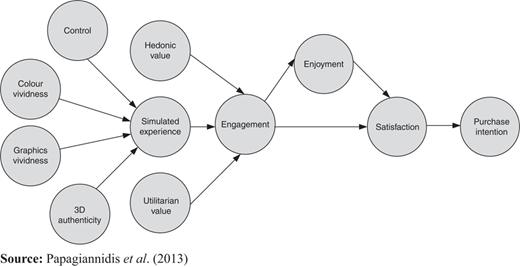
Although some technology-oriented perspectives consider shopping media simply as cold information systems, rather than as immersive, hedonic environments, the current trend is to develop new technologies that are able to provide immersive and engaging experiences. Consumers may live through these highly interactive, realistic interfaces, which can make such interfaces key elements for influencing consumers in the direction of buying products with strong hedonic attributes (Childers et al., 2001). Of course, hedonic and utilitarian experiences do not necessarily exclude one another; thus, the new retail environment might elicit both types of experience in different ways. The model developed for this paper (Figure 1) proposes that the dimensions of telepresence, such as control, 3D authenticity, colour and graphics vividness positively impact on a user’s experience and, in turn, along with utilitarian and hedonic values, positively affect engagement.
Previous studies have investigated to what extent a simulated experience supports the learning process, enriches shopping activity and improves overall experience, consumers’ satisfaction and loyalty (Algharabat and Dennis, 2010b; Pantano and Servidio, 2012). A high level of telepresence encourages consumers to believe that they are more informed about a certain product, by eliciting more positive behaviours towards it (Mollen and Wilson, 2010). To achieve this goal, it is important to provide highly interactive virtual environments (Steuer, 1992), by substituting the actual experience of the products with the opportunity to interact with the product virtually. Thus, the virtual route can frequently offer more options than can be provided in the real context. For example, the virtual context can allow users to directly interrogate the product about the manufacturing process or visualise the raw materials, etc. (Fiore, Kim and Lee, 2005). Prior research demonstrates that interactive marketing supports consumer’s decision-making processes, improves consumer relationships and facilitates the development of more efficient customised marketing strategies (Yoo et al., 2010). On the other hand, the rich environment and audio-visual stimuli that 3D worlds offer can be a distraction for users when attempting to complete tasks (Nah et al., 2011).
In the current model, simulated experience serves as an intermediate variable between telepresence factors and user engagement. Thus, as technology develops, the performance of telepresence elements such as control and graphics improves. As a consequence, the importance of those elements decreases, despite their important role in the effectiveness of simulation. Recent studies demonstrate greater effects of 3D product visualisation on consumers’ attitudes as compared to the effects of traditional 2D internet advertising (Lee, 2012). Current advances in 3D graphics provide new tools for enhancing the realism of virtual experience and make it more similar to the real one. This is achieved by reducing the perceptual distance between the real and the virtual scenarios, developing an efficient match between physical and the digital stores (Laria and Pantano, 2012; Houliez, 2010), by enhancing the sense of being in the environment while interacting with it (Parke, 2005). Amongst other advantages, 3D retail stores add emotional expressiveness (Gadalla et al., 2013) and can enhance social experience (Mäntymäki and Salo, 2011; Verhagen et al., 2012). 3D virtual experiences allow consumers to view products from different perspectives, angles and distances, as well as explore the different functions and feature of available products (Jiang and Benbasat, 2004) with benefits for positive evaluations of the product. Similarly, the vividness of graphics positively stimulates the user’s sensory perceptions through an increased level of interactivity (Cheng et al., 2014), by supporting mental imagery formation (Choi and Taylor, 2014), with benefits for consumers’ potential to remember products and gain confidence in the online shopping process (Lee, 2012). Hence, the quality of graphics enhances the realism of the experience and the feeling of interaction within the real environment, while the high level of controllability provides users with a customised and comfortable experience, which may be able to reduce the constraints associated with the lack of physical contact with the product. The quality of the virtual experience, prompted by the quality of visual effects and functionalities (i.e. high level of interactivity), pushes users to a psychological state where they perceive the environment as authentic (Malliet, 2006). Authenticity is a subjective concept, which users may perceive differently accordingly to the context and their personal attitudes towards the technology. Thus, authenticity is linked to user acceptance of the virtual experience (Guttentag, 2010). Accordingly, it is based on a psychological state in which the virtual environment and objects are perceived by users as actual (Algharabat and Dennis, 2011). To achieve this perception, the technology needs to be able to mimic or simulate the experience in the bricks-and-mortar environment, in other words to provide an authentic (virtual) reproduction of the offline experience. Hence, the concept of 3D authenticity relates directly to the users’ daily lives, depending on the ability of virtual environment to describe something real (Malliet, 2006). Summarizing these arguments, we propose the following hypotheses:
Higher levels of (a) control, (b) colour vividness, (c) graphics vividness and (d) 3D authenticity will be directly associated with increased levels of simulation experience.
Higher levels of simulation experience will be directly associated with increased engagement with the simulated retail environment.
Utilitarian experience will be directly associated with increased engagement with the simulated retail environment.
Hedonic experience will be directly associated with increased engagement with the simulated retail environment.
Flow theory suggests that user experience, engagement and enjoyment might be antecedents of satisfaction, with the main goal of modern retail environments is to create superior consumer experiences (Verhoef et al., 2009). Flow is defined as “the state in which people are so intensely involved in an activity that nothing else seems to matter; the experience itself is so enjoyable that people will do it even at great cost, for the sheer sake of doing it” (Csikszentmihalyi, 1990, p. 4). This differs from the concept of telepresence, used in the preliminary stage of our model, as telepresence refers to the feeling of being there (a feeling of immersion within the environment) (Weibel and Wissmath, 2011), whereas flow refers to the feeling of being involved in an action, engagement and enjoyment (Ghani and Deshpande, 1994). Past studies exploited these constructs in several fields (Bakker et al., 2011; Handelsman et al., 2005; Hu and Hui, 2012). Engagement and enjoyment can be produced by the characteristics of the website, such as telepresence and simulated experience. In the context of social virtual worlds, flow has been found to significantly affect intentions to purchase, but telepresence did not do so (Animesh et al., 2011).
In turn, engagement is a driver for enjoyment and consumer satisfaction. Prior studies have empirically highlighted engagement as an antecedent of user satisfaction (Hu and Hui, 2012; Kim et al., 2013). The effectiveness of virtual environments is associated with enjoyment and entertainment, which are in turn positively correlated with user satisfaction (Pantano and Servidio, 2012; Kim and Forsythe, 2007). Also, past research found that social virtual worlds’ continuance intentions depended on user satisfaction, which is in turn a function of utilitarian, hedonic and social benefits (Zhou et al., 2012, 2014; Verhagen et al., 2011). Starting from the key role of consumer satisfaction in building and maintaining loyalty (Yoo et al., 2010), end-user satisfaction emerges as the basic element of every user-system interaction, acting as a performance measure of the system (Van Vugt et al., 2009). Much prior research focusses on hedonic and utilitarian shopping values as shopping motivations and the value of shopping experience, yet little attention to date has been paid to the outcomes of shopping value in terms of consumers’ behaviour (Jones et al., 2006). To fill this gap, our research provides an integrated framework of analysis of the entire process, mapping consumer behaviour from a new experience in the virtual environment to the final purchase intention. Given the experimental setup of our study, purchase intention refers to the overall intention of participants to buy the products on offer (in our case apparel) after they have experienced the virtual environment. Several studies investigating both online and offline retail settings reveal the strong causal relationship between consumer satisfaction (and experience) and the subsequent purchase intention (e.g. Cronin et al., 2000; Yang and Wu, 2009; Hausman and Siekpe, 2009). The proposed relationships are illustrated schematically in Figure 1. Based on the above, we hypothesise that:
Engagement will be directly associated with increased enjoyment derived from the simulated retail environment.
Enjoyment will be directly associated with increased satisfaction with the simulated retail environment.
Engagement will be directly associated with satisfaction with the simulated retail environment.
Satisfaction with the simulated retail environment will be directly associated with intention to purchase.
It has long been known that shopping is not just about obtaining tangible products but also enjoyment and pleasure (Martineau, 1958), and that an enjoyable shopping experience is often reflected in higher shopper satisfaction and spending (e.g. Donovan et al., 1994; Jones, 1999). This is the basis of the “retail theatre” concept, where “[…] the experience revolves around the customer as if he or she were a critical component of a grand theatrical fantasy” (Healy et al., 2007, p. 756). Healy et al. (2007) also note that retail theatre concerns the dynamic element of an experiential environment (as with the immersive 3D environment in our virtual retail store), where a human interacts with aspects of the environment. Therefore, we expect that an immersive 3D environment will create higher levels of engagement, enjoyment and satisfaction, leading to greater purchase intention:
For consumers experiencing an immersive 3D environment, there will be a greater influence of (a) simulated experience on engagement, (b) engagement on enjoyment, (c) enjoyment on satisfaction and (d) satisfaction on purchase intention than for those exposed to the 2D desktop.
3. Method
A new virtual retail environment was developed for this study, offering more of a high level of presence prompted by the realistic interface and 3D graphics, enhancing the feeling of immersion in the system. The first phase of the study was to create a 3D virtual desktop application, which has been further compared with an immersive 3D application.
The 3D model of the building containing the store, which was created by an architectural CAD software programme, with the objects being imported and modified through 3D modelling software in order to develop the basic features for the 3D real-time simulation and the effective store. The 3D modelling software made it possible to identify and set the basic objects’ material and related features, which were better defined in the subsequent step through the simulation software for the recognition of the optical characteristics of the objects, such as shadows, reflections, α blending for transparency or bump mapping. Therefore, a more realistic environment was developed through the render-mapping technique, which consisted of the generation of ray-traced images used as textures. Afterwards, the illumination was defined, thus, it was possible to set up the rendering engine parameters and apply the render-map property to the objects. In this way, the ray-tracing engine created the images on which all the optical effects were mapped. The images have a 4,096×4,096 pixels resolution in PNG format and contain each single face shading property of the object. In addition to the shadows, most of ray-traced effects were pre-computed, such as ambient occlusion and global illumination. These images were applied to the 3D objects within the real-time environment in order to achieve a good final rendering. The environment could be accessed and browsed through a joystick.
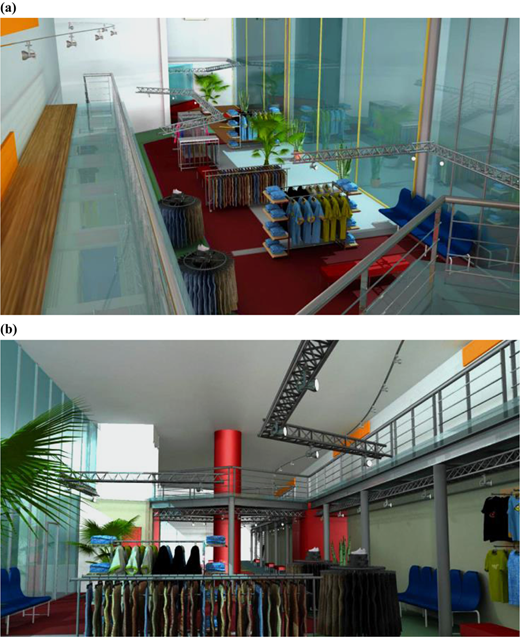
To show the effect of immersion on consumer behaviour, we also created an immersive environment that would overcome the traditional boundaries of desktop applications (such as the limited input devices, the unrealistic interaction through joysticks, etc.). The immersive store was modelled starting from a basic planimetric map of the virtual store including two floors (Plate 1). Objects were created on the basis of standard primitives, and then refined through additional tools. This procedure makes it possible to achieve a better outcome, in terms of the limited number of required polygons while keeping the maximum control of the 3D object topology. The added emphasis on the characteristics of objects in terms of materials and surfaces improves the realism of the final models, with emphasis on lighting and colour. The visual effects of such objects were further defined including transparency, reflections or bump mapping for the multi textured layered materials. The store featured transparent stairs, a lift (with transparent walls and door), and a few booths laid out as partitions, shelves and corridors that users can explore, as in a physical store. The final outcome is a realistic model loaded into the stereoscopic system. Quest3D software allows the effective development of the real-time application, as well as the programming of the whole virtual environment through a building-blocks paradigm.
The simulation was made available at the psychology laboratory of a university in southern Italy, where a convenience sample of engineering undergraduate students and staff were invited to attend the experiment. Participants were asked to attend both experiments, one for the immersive retail store environment, and another with the complete simulation presented on a traditional desktop screen. The same participants, thus, attended both the desktop and the immersive environment experiments. The two experiments were conducted on two separate days. On one day, 150 participants tested the desktop technology, while on another day (which they had previously chosen on the basis that they would do so on a different day between 3 and 30 days from the desktop technology testing) the same 150 people attended the experiment based on the test of immersive technology. Although a factorial design may have been more effective, this arrangement was adopted given that we only had a single immersive experimental setup and participants’ availability was constrained by inelastic commitments. Similarly, the order and time between the two runs was driven by the pragmatic scope imposed by the availability of the 3D setup.
The sample consisted of 59 females and 91 males. The greater number of males arises from the composition of the engineering department, but also reflects the likely composition of innovator consumers with a new online shopping technology (Dennis et al., 2009). In all, 85 per cent were aged between 21 and 30 and all had at least high school education. In all, 96 per cent were students, appropriate as they are more representative of online shopping customers than are the general population (Alsajjan and Dennis, 2010).
Participants were asked to explore the immersive store by wearing special glasses equipped with polarised lenses (for correct 3D visualisation) and a data glove (for browsing the environment) and fill in a questionnaire about their experience. They were not represented in the virtual world by avatars in order to guarantee a more realistic experience, given that the avatar’s personality may not necessarily mirror that of the user (Lin and Wang, 2013). Participants were further invited to undertake the tasks assigned. They were first introduced into a virtual bookstore in order to familiarise themselves with the 3D environment, functions and interaction modality, under the guidance of an experienced researcher. Next, participants autonomously explored a fashion retail store under two different graphic resolution modes (low and high), in order to elicit whether different graphic resolutions might influence consumers’ perception of the simulation experience. The high resolution version featured 2,048×768 dpi horizontal split resolution, while the low one 1,280×720. Thus, the experiment was set in two different environments providing differing qualities of graphics. Each participant could complete the following tasks in about ten minutes: go to the upper floor (choosing lift or stairs according to personal preference), find a particular T-shirt among those in the available collection and pick one that they would like to buy, choose a pair of jeans, reach the fitting room (without trying them on), approach the relaxing area for a quick rest. Participants were then asked to complete the same questionnaire after the virtual exploration of the environment under the two different graphic resolutions.
Similarly, the desktop-based and immersion-based presentations used identical resolutions and functionalities. The desktop simulation allows consumers to visualise the environment through a traditional display (rather than the large screen used for the immersive system), and to browse the environment through a joystick. In contrast to the immersion-based presentation, the desktop version does not require the user to wear any data glove or special glasses with polarised lenses.
So both environments are 3D, but the modalities of interaction and the quality of graphics and realism change totally. The processes of the experiments are presented in Table I.
4. Results
The following results have been generated using the partial least square (PLS) approach. Since the model in this study is a synthesis of earlier work, the literature suggests that PLS is a better approach compared with other SEM tools (Chin et al., 2003; Gefen et al., 2000; Reinartz et al., 2009). In this study, we used SmartPLS Version 2.0 (Ringle et al., 2005) to conduct the analyses including validity measures (Henseler et al., 2008). Tables II and III present the descriptive statistics of indicators, composite reliability, Cronbach’s α, and standardised factor loadings. All our constructs were measured using a seven-point Likert scale. All standardised factor loadings are significant, most of the factor loadings are higher than 0.6, which is considered high (Hair et al., 1998), and the other three factor loadings are higher than 0.4, which is acceptable (Raubenheimer, 2004), indicating convergent validity. The composite reliabilities, and Cronbach’s α of the constructs are all larger than the 0.7 threshold, indicating acceptable reliability (Boudreau et al., 2001).
Tables IV and V report the descriptive statistics of constructs and the correlations between them. The average variances extracted (AVEs) and correlations were used to assess discriminant validity. All the AVEs were found to be above 0.5, indicating that more than half of the variance observed in the items used was accounted for by their hypothesised constructs (Hair et al., 1998). All squared correlations are lower than the corresponding AVEs, implying acceptable discriminant validity. Nevertheless, Kock (2015) demonstrates that even when discriminant validity is satisfactory, common methods bias (CMB) can still be an issue and recommends a full collinearity assessment. Kock and Lynn (2012) recommend an upper variance inflation factor (VIF) threshold of five for SEM models of this type. The highest VIF is 4.20 and we accordingly conclude that CMB is not an issue in our model.
Empirical results for both immersive and desktop groups
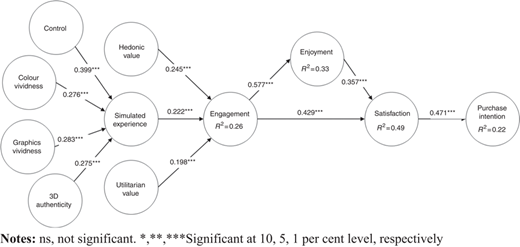
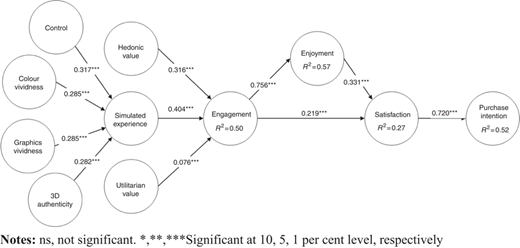
We adopted the PLS SEM for hypothesis testing. PLS does not generate as many goodness-of fit indices as covariance-based SEM does (Hu and Bentler, 1999). The percentage of variance explained is indicated by the R2 as a measure of the overall model fit (Henseler et al., 2008). One-tailed t-tests were used to test the significance of each of the path coefficients. The sample consists of two conditions. The first is the “immersive” environment, where 150 people interacted with the 3D setup. The other is the “desktop” environment, in which 150 people used the desktop screen. Figure 2 shows the path coefficients generated from the desktop environment and Figure 3 shows the path coefficients generated from the immersive environment. All path coefficients are presented on the respective arrows, and the figures in the circle are the R2. All path coefficients are significant at the 1 per cent level. H1-H6 are supported.
For the desktop environment, the three constructs (simulated experience, hedonic value and utilitarian value) explain 26 per cent of engagement. Engagement further explains 33 per cent of the enjoyment and 50 per cent of satisfaction. Finally, the satisfaction level accounts for 22 per cent of purchase intention. For the immersive environment, the simulated experience, hedonic value and utilitarian value explain half of the variance in engagement. Engagement explains 57 per cent of enjoyment and 27 per cent of satisfaction. More than half of the purchase intention (52 per cent) is explained by satisfaction.
Multi-group comparison
We analysed the resolution difference and immersion environment difference by conducting multi-group comparisons. The data are first divided into four groups: the “immersive” group with high resolution (immerse high), the “immersive” group with low resolution (immerse low), the “desktop” group with high resolution (desk high) and the “desktop” group with low resolution (desk low). Each of the four groups has 150 data points. The resolution differences are compared between desktop high and desktop low (Tables IV and V), and between immerse high and immerse low (Table VI). Then, the full data set is divided into “immersive” and “desktop” group, with each group containing 300 data points, and the path coefficients are compared between these two larger groups (Table VII).
Tables VI-VIII present the evaluation results of the structural model. The bootstrap analysis is used to assess the differences between groups. In each iteration, the number of cases is set equal to the specific sample size (Sarstedt et al., 2011). The bootstrap iteration was set equal to 1,000 (Chin, 1998; Chin and Dibbern, 2010) and 5,000 (Sarstedt et al., 2011) (also tested with the bootstrap iteration equal to 2,000 to assess whether they are in agreement).
As reported in Tables VII-VIII, the comparisons between desk low and desk high, and between immerse low and immerse high, do not show any significant difference (all the p-values are larger than 0.1). This demonstrates that the resolution will not be a confounding factor in our experiments, or in other words, the resolution we have chosen is sufficiently good. The comparison between the combined groups “immersive” and “desktop” shows significant differences with respect to several paths. Control has a significantly higher loading on simulated experience for the desktop environment (0.399) than for the immersive environment (0.315) at the 1 per cent significance level. In contrast, simulated experience has a higher impact on engagement for the immersive environment (0.402) than the desktop environment (0.222) (but only at the 10 per cent level). The immersive environment also has a higher loading on the path between “engagement” and “enjoyment” at the 5 per cent significance level. Finally, satisfaction has a larger effect on purchase intention in the immersive environment (0.716) than the desktop environment (0.474) at the 1 per cent significance level. The average value of constructs in each comparative group for different scenarios is shown in Table IX.
5. Discussion
Our work has filled a key gap in the literature by testing a theoretical, integrative model and developing a theoretical path which maps consumer behaviour leading to purchase intention. A cross-analysis of this integrative model/theoretical path within two virtual retail environments provided numerous theoretical and managerial insights for immersive environments, making a major contribution to this field of study.
Specifically, the findings support the conceptual model, extending Papagiannidis et al.’s (2013) work to the context of an immersive 3D retail store environment enabled by virtual reality technology, where participants wear special glasses and a data glove. Our model predicts that telepresence (control, colour vividness, graphic vividness and 3D authenticity) has positive effects on simulated experience (H1a-d, respectively), which in turn positively affects engagement (H1e). The results support past work (Fiore, Kim and Lee, 2005; Fiore and Kim, 2007; Song and Zinkhan, 2008) indicating that control plays a role in building user engagement. The findings also confirm prior studies by Shih (1998), Fiore, Jin and Kim (2005), Fiore, Kim and Lee (2005) and Steuer (1992) that colourful, vivid graphics create higher levels of user engagement. The results are in line with studies by Algharabat and Dennis (2010b) supporting the role of 3D authenticity in user engagement. Through engagement, the telepresence components, along with utilitarian value (H1f) and hedonic value (H1g), indirectly positively influence the enjoyment a user derives from experiencing the simulated retail environment (H2). This finding confirms previous studies, for example, by Ghani (1995), as well as past work in relation to flow theory (Turkay and Adinolf, 2010; D’alba et al., 2011; Mollen and Wilson, 2010; Oulasvirta et al., 2005; Ghani and Deshpande, 1994). Similarly, both enjoyment (H3) and engagement (H4) positively influence user satisfaction with the simulated retail environment, a finding that corresponds with previous work by Van Vugt et al. (2006; 2009) and Sylaiou et al. (2010) on virtual environments. In turn, satisfaction from experiencing the simulated retail environment influences the intention to purchase the clothing item involved (H5). This finding is consistent with many past marketing studies that have examined the link between satisfaction and purchase intention for various contexts (e.g. Hausman and Siekpe, 2009; Fiore, Jin and Kim, 2005; Fiore, Kim and Lee, 2005 in online environments). Overall, the findings confirm the role of simulation in encouraging users to engage more with products and services in virtual environments and to improve their experience (e.g. Algharabat and Dennis, 2010b). Resolution, when sufficiently high, has little impact on this psychological process, confirming previous findings by Papagiannidis et al. (2013). The results can be interpreted as meaning that, provided a minimum standard is reached, authenticity is less dependent on the quality of the graphics or other ICT factors but more perhaps on the degree to which the users can relate to the experience, as operationalised in this study by the degree of immersion.
Offering multiple ways that are customisable in order to communicate product and service information can help not only engage customers more, but even create additional revenues streams (Lowe et al., 2013). Consequently, understanding the impact change to an interface can have becomes very important. The results of the comparison between the immersive and desktop environments indicate significant differences on several paths. Higher control has less impact on simulated experience for the immersive environment than for the desktop. This difference may be because when an immersive environment is available, people pay much more attention to the visual aspects and the authenticity (i.e. colour vividness, graphic vividness and 3D authenticity), while control becomes less important. Similarly, simulated experience has significantly higher impact on engagement in the immersive environment. Notably, in the immersive environment, half of the variance of engagement is explained by simulated experience, hedonic value, utilitarian value; the impact of simulated experience is significantly higher than for the desktop environment (H6a). This is unsurprising, since the simulated experience in front of an immersive screen better resembles reality, reducing the negative impact of using an artificial system. There is also a difference between the two environments in terms of the effects of attentional involvement on enjoyment: engagement in the immersive environment explains perceived enjoyment better (H6b). This may be because the participants in the immersive environment experience something novel and the enjoyment mainly comes from the involvement that they had seldom experienced previously. In comparison, participants in the desktop environment sought enjoyment from other dimensions since they were more familiar with virtual stores on computer screens. Contrary to the expectation, the influence of enjoyment on satisfaction is greater for participants in the desktop environment than for participants in the immersive environment, although the difference is not significant (H6c not supported). Participants may have been expecting an enjoyable experience from the immersive environment; and therefore, may have adjusted expected standards of satisfaction upwards accordingly. They may still perceive the 3D environment as being at the developmental stage and further technical and operational improvements are required. Finally, the purchase intention of participants in the immersive environment is more related to the satisfaction from the virtual store (H6d). The reason may be that participants can connect the experience in the virtual store to the experience in a real store more easily in the immersive environment.
6. Conclusions, managerial implications and future research
This work has evaluated a robust model of purchase intention and demonstrated it to hold (for clothing purchases) not only in a 3D environment on a conventional computer platform but also in an immersive one, where participants wear special glasses and a data glove. Purchase intention is influenced by satisfaction, which is in turn influenced by enjoyment and engagement. Engagement in turn is influenced by utilitarian and hedonic value and the experience of product simulation or telepresence, which is composed of control, 3D authenticity, colour and graphics vividness.
Traditional in-store shopping can stimulate pleasure, enjoyment and excitement (Hart et al., 2014) whilst online shopping has been said to offer little experience value (Mathwick et al., 2001). However, more recent research suggests that shoppers also seek out recreational, enjoyable aspects of online shopping (Fiore, Jin and Kim, 2005; Konus et al., 2008). This study draws attention to the important differences between the two online environments, in that in the immersive environment, experience is more associated with engagement and enjoyment, leading to a greater purchase intention. The immersive, 3D environment, thus, has the potential to rival traditional shopping in terms of experience, resulting in higher sales for the retailers and satisfaction for the consumers. More importantly, these new environments (including the immersive one) differ radically from other, traditional shopping channels. Based on work by Alba et al. (1997), Childers et al. (2001, p. 515) argue that this is due to “the absence of the actual experience of visiting the store and physically examining a product prior to purchase”. It is evident, then, that we are experiencing fundamental and revolutionary changes in relation to shopping channels and consumer behaviour.
Overall, this work has generated many implications for marketing theory. The first relates to the retail theatre concept (see Healy et al., 2007), which our study extends to the virtual world by active and continuous engagement via 3D and an immersive environment, where participants wear special glasses and a data glove, which creates an unforgettable retail experience. The retail experience could be further developed by, for example, facilitating the shopper’s co-creation value (Kohler et al., 2011), e.g. by customising the product in terms of colour and size or even the retail space itself. Further, users could get involved with testing new clothing products and concepts within the virtual store and could provide their experience and views back to the retailer. For example, users could provide their views about a new virtual store layout and whether its design corresponds well with the merchandising (and products) on sale. The importance of experience has been noted in the past in both the marketing (experiential marketing, see Schmitt, 1999) and retailing (experiential retailing, see Kim, 2001) domains but limited work has been done in relation to virtual worlds from the retail marketing perspective. In our experiment we have only examined one aspect of the user experience, relating to the interaction between the user and the virtual retail environment. Retail theatre and co-creation of value would be even more effective if users interacted with either other human actors, such as shop assistants and other customers, or computer-generated ones, such as avatars. Retailers need to be strategic when assigning virtual identities to consumers or assistants as they can influence consumer behaviour in different ways (Yoo et al., 2015).
Building on the principle of the immersive environment, live interactions with store employees and other customers could provide a more lively and realistic retail experience that could be compared with electronic versions of the same roles, for example, using avatars. In addition, future research could potentially compare conventional web-based applications vs virtual world-based applications for the same retailer and product types, examining the relative importance of purchase decision-making factors. Future studies could examine whether virtual retailing is significantly affected by differences in consumers’ cultures and whether there are any differences between demographic groupings (e.g. age, income, socioeconomic status, etc.). The latter research will be very useful considering that our research focussed on a specific consumer segment, the student market. Future research could also examine consumer behaviour in these 3D environments as consumers operate nowadays as “inexperienced” shoppers here due to the new, original and innovative retail atmosphere presented to them (Jin, 2009). This also calls for a future longitudinal study which will revisit this work and test whether new results are generated and whether the immersive environment has become more “accepted” and, therefore, participants feel more “experienced” with it. The above indicates possible future research areas where we could test our conceptual framework further. It also presents an excellent opportunity to shed further light on the application of the retail theatre concept in relation to non-traditional environments such as virtual ones.
This work has generated numerous managerial implications. First, it has become clear that immersive environments present an innovative tool facilitating a new retail store model based on relevant technologies. These environments can provide excellent platforms for retail managers to test various marketing strategies including new product development, promotions, store atmospherics, etc. In this vein, immersive environments can become a major link in a multichannel strategy where various shopping channels will operate in an integrated fashion. Immersive environments are a market niche nowadays but they have a promising future and companies need to incorporate the above within their strategies. Managers could make use of models like the one proposed when employing these immersive environments with the ultimate aim of influencing consumers’ future product purchases. However, managers need to be aware that the consumers may nowadays have high expectations from these immersive environments and, therefore, they will need to adjust and factor this in when setting up relevant strategies.
To conclude, this paper has highlighted the role of immersive environments for retailers’ current and future marketing strategies and we hope that attention will be paid to our recommendations.
The work described in this paper was partially supported by a grant from the Department of Industrial and Systems Engineering, Hong Kong Polytechnic University, Hong Kong, China (Project No. G-YBE4).