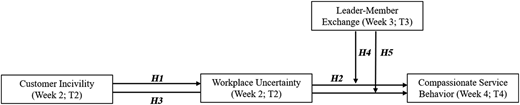
Grounded in uncertainty reduction theory and conservation of resources theory, this study investigates the relationship between customer incivility and compassionate service behavior among frontline employees. In particular, it examines whether workplace uncertainty mediates this relationship and whether, and to what extent, leader–member exchange (LMX) amplifies the negative effect of workplace uncertainty on compassionate service behavior, thereby moderating the indirect effect of customer incivility on compassionate service behavior through workplace uncertainty.
This study employed a four-wave, time-lagged survey design using a sample of 316 customer-facing service employees in the United States, recruited through Prolific. The hypothesized moderated mediation model was tested using the PROCESS macro in IBM SPSS.
Results indicated a significant negative indirect effect of customer incivility on compassionate service behavior through workplace uncertainty. Furthermore, both the relationship between workplace uncertainty and compassionate service behavior as well as the indirect relationship between customer incivility and compassionate service behavior through workplace uncertainty were stronger for employees who reported higher LMX compared to those with weaker LMX.
This study contributes to the growing literature on the consequences of customer incivility by uncovering workplace uncertainty as a key mediating mechanism. It also challenges the conventional view of LMX as uniformly beneficial, showing that, under conditions of heightened uncertainty, employees in high-quality LMX relationships may experience stronger constraints on compassionate service behavior because uncertainty represents a greater disruption to their typical experience of relational clarity and predictability.
Introduction
Customer incivility refers to instances in which employees perceive customers’ behavior as disrespectful, discourteous, or violating norms of appropriate interaction during service encounters (Koopmann et al., 2015; Chan et al., 2022). Such behaviors may involve unreasonable demands or complaints, use of rude language, and inappropriate gestures or expressions (Ugwu et al., 2022; Wilson and Holmvall, 2013). Customer incivility has become increasingly relevant to the service literature (Auh et al., 2024). Frontline employees in high-contact service industries demand more than just technical skills to meet customer sociopsychological needs (Li et al., 2019; Wang and Lang, 2019). While it is expected that employees remain friendly, civil, patient, empathetic, and professional when serving customers (Yue et al., 2021; Sommovigo et al., 2019), customer incivility can seriously threaten or disrupt service encounters (Al-Hawari et al., 2020; Frey-Cordes et al., 2020). Indeed, recent research demonstrates a link between customer incivility and a variety of outcomes for employees’ including increased stress, emotional exhaustion, and declined psychological well-being (Kim and Qu, 2019; Li et al., 2021; Shin et al., 2022; Alola et al., 2019; Pu et al., 2024; Baker and Kim, 2020; Wu et al., 2023). However, despite extensive evidence of its emotional consequences, less is known about the underlying cognitive mechanisms (Lages et al., 2023), that may shape the relationship between customer incivility and employee behaviors, such as compassionate service behaviors. This limitation is particularly important in the context of compassionate service behavior, which requires employees to remain attentive and responsive to customer suffering despite experiencing interpersonal stressors themselves (Ji et al., 2025; Ramadan et al., 2025).
Compassionate service behaviors are enacted specifically when customers experience difficulty, vulnerability, or suffering and employees respond with the intention of alleviating that suffering (Dutton et al., 2014; Lilius et al., 2008). In hospitality settings, such experiences may include travel disruptions, fatigue, illness, emotional distress, or uncertainty in unfamiliar environments. These situations create opportunities for employees to recognize and respond to customer needs that extend beyond routine service delivery. Compassionate service behavior, therefore, is also distinct from empathy, the latter of which reflects the capacity to understand and feel another’s emotions. By contrast, compassionate service involves taking action grounded in that empathetic awareness. In short, empathy is a felt state, whereas compassion is an enacted response aimed at reducing another person’s distress (Kanov et al., 2004; Reich, 1989). These actions may include voluntary emotional support, flexibility, or material assistance that extends beyond basic empathetic communication (Dutton et al., 2006). Although compassionate service may overlap with related constructs such as social support (House, 1983), organizational citizenship behavior (Smith et al., 1983), and prosocial behaviors (Brief and Motowidlo, 1986), it remains distinct in that it is explicitly oriented toward alleviating another’s suffering.
Because of this direct focus on addressing suffering, much of the empirical research on compassionate service has taken place in healthcare settings. Prior research has shown that compassionate care enhances patients’ perceived quality of care and satisfaction (Watts et al., 2023). Importantly, compassion in service delivery benefits not only the recipients of care but also the providers. For example, healthcare practitioners who engage in empathetic, reciprocal communication help patients feel heard and supported, particularly during complex or emotionally challenging decision-making processes (Derksen et al., 2013), while also reducing practitioners' anxiety and burnout (Choi et al., 2016). These findings underscore that compassionate interactions are meaningful for both parties and play a critical role in shaping service quality, highlighting the broader value of compassionate service across all sectors in the service industry.
Although prior research has begun to link compassion to coping processes and employee strain (e.g. Ropes and de Boer, 2021), existing scholarship provides limited insight into the cognitive pathways through which customer incivility may undermine compassionate service behaviors. Research on workplace mistreatment suggests interpersonal experiences can shape compassion-related responses among hospitality employees (Zoghbi-Manrique-de-Lara et al., 2021). Within the customer incivility literature, scholarly attention has largely centered on affective reactions, with comparatively less focus on the cognitive functioning that occurs during service interactions (Zhao et al., 2025). Building on prior calls to examine the cognitive processes underlying the effects of customer incivility (Lages et al., 2023), we advance workplace uncertainty as an important yet overlooked cognitively grounded mechanism through which uncivil customer encounters may constrain compassionate service behavior. In doing so, we extend research on customer incivility beyond its predominant focus on affective outcomes and emotional responses. Specifically, customer incivility may interfere with employees’ cognitive functioning by impairing attention, memory, and information processing capabilities during service interactions (Sommovigo et al., 2019). Such disruptions may make it more difficult for employees to accurately interpret customer needs, understand how interactions will unfold, and determine appropriate responses. As a result, employees may experience heightened workplace uncertainty, reducing the cognitive capacity available for responding with compassionate service behavior toward customers.
When employees encounter increasing levels of customer incivility, they may experience heightened uncertainty about how to respond appropriately and whether their organization will support them. According to Uncertainty Reduction Theory (URT; Berger and Calabrese, 1975), employees are motivated to restore predictability and stability when confronted with ambiguous or threatening interpersonal situations. At the same time, Conservation of Resources theory (COR; Hobfoll, 1989, 2001) indicates that doing so is especially difficult for frontline employees, who often operate with limited resources, discretion, and power within the service hierarchy (Kammeyer-Mueller et al., 2013). This uncertainty can divert employees’ cognitive and emotional resources toward self-protection and risk monitoring, thereby reducing their capacity to engage in other-directed, effortful behaviors such as providing compassionate service to customers. Consequently, the joint influence of customer incivility and workplace uncertainty on service-related behaviors remains insufficiently understood. Accordingly, this study conceptualizes workplace uncertainty as a key cognitive outcome of customer incivility and examines its role in shaping employees’ ability and motivation to enact compassionate service behavior.
This tension raises an important question: under what conditions are employees able to respond constructively to customer incivility despite limited resources and uncertainty? One critical factor is the quality of the employee’s relationship with their supervisor. Leader–member exchange (LMX), which reflects the quality of the relationship between an employee and their immediate leader, can significantly influence employee psychological states and behaviors as well as firm-level performance (Chang et al., 2020). Leaders in high-quality LMX relationships often provide guidance and support that help reduce ambiguity and mitigate the impact of work stressors on employees (Thomas and Lankau, 2009). However, emerging research suggests that the effects of LMX are more complex than traditionally portrayed and may not always be uniformly beneficial (Xu et al., 2024). Employees who develop high-quality relationships with their supervisors may come to rely on these relationships as a source of stability and predictability. As a result, they may be less prepared to navigate uncertain situations independently. Under conditions of heightened uncertainty, such as customer incivility, this reliance may introduce unintended challenges, suggesting that the effects of LMX may be more complex than traditionally assumed. Although higher LMX is typically associated with greater support and positive outcomes for employees, we consider LMX as a key moderator that may strengthen the negative indirect relationship between customer incivility and compassionate service behavior through workplace uncertainty.
Guided by URT and COR, this study examines how customer incivility influences frontline employees’ compassionate service behavior through workplace uncertainty and whether LMX shapes these relationships. Specifically, we address three questions: (1) how customer incivility affects compassionate service behavior, (2) the extent to which workplace uncertainty explains this relationship, and (3) how LMX functions as a boundary condition of the indirect effect. Using time-lagged survey data from frontline service employees, we test a moderated mediation model in which customer incivility predicts workplace uncertainty, workplace uncertainty predicts compassionate service behavior, and LMX moderates the relationship between workplace uncertainty and compassionate service behavior.
Despite growing interest in compassion in organizational settings, existing research has primarily examined compassion as a predictor of employee and organizational outcomes, with limited attention to the conditions under which employees are able to enact compassionate service behavior. In addition, prior work has focused largely on emotional outcomes of workplace stressors, offering less insight into the cognitive mechanisms that shape employee behavior in service interactions. Furthermore, the role of relational context in shaping these processes remains underexplored. This study addresses these gaps in three ways. First, it conceptualizes compassionate service behavior as a customer-directed outcome shaped by workplace conditions, rather than solely as an antecedent to employee outcomes. Second, it identifies workplace uncertainty as a key cognitive mechanism through which customer incivility influences employees’ capacity to engage in compassionate service behavior. Third, it examines leader–member exchange (LMX) as a boundary condition that shapes how strongly workplace uncertainty constrains compassionate service behavior. To further clarify how this study extends prior research, Table 1 summarizes existing work on compassion and highlights the key gaps addressed.
Building on these gaps, the following section develops a theoretical model linking customer incivility to compassionate service behavior through workplace uncertainty and examines the moderating role of leader–member exchange (see Figure 1).
Hypothesis development
Customer incivility and workplace uncertainty
Customer incivility refers to low-intensity, deviant behaviors enacted by customers during service encounters (Chan et al., 2022; Sliter et al., 2010). Unlike other forms of workplace incivility which typically occur among coworkers, customer incivility involves discourteous or disrespectful actions perpetrated by external organizational stakeholders and directed at frontline service workers (Sliter et al., 2010). Because coworker interactions are more sustained, while service encounters are typically brief and transactional, customer incivility unfolds under different relational and temporal conditions than workplace incivility (Wilson and Holmvall, 2013). Whereas workplace incivility occurs among peers with ongoing relationships, customer incivility may be more severe due to customer anonymity and the lack of future accountability (Grandey et al., 2007). As a result, customer incivility has substantial negative effects on employees and organizations, including increased counterproductive work behavior, heightened emotional labor demands, reduced well-being, greater exhaustion and burnout, and lower job satisfaction (Baker and Kim, 2020; Kim et al., 2014; Kim and Baker, 2019; Kim and Qu, 2019; Meier and Spector, 2013; Yang and Lau, 2019). Moreover, extant research strongly supports the notion that customer mistreatment depletes emotional resources and reduces employees’ ability or willingness to deliver high-quality service (Schilpzand et al., 2016; Sliter et al., 2012). Although prior research has primarily emphasized the resource-depleting effects of customer incivility, such experiences may also create uncertainty for employees regarding how workplace interactions and expectations should be interpreted and managed.
Workplace uncertainty refers to employees’ perceptions of unpredictability in important aspects of their work environment (Bordia et al., 2004; Grupe and Nitschke, 2013). Importantly, workplace uncertainty is conceptually distinct from several related constructs. Role ambiguity reflects uncertainty about task expectations and performance evaluation (Singh, 1993), whereas job insecurity refers to uncertainty about the future of one’s job, including concerns about the loss of desirable job features or the continued existence of the job itself (Shoss, 2017). In contrast, workplace uncertainty captures a broader inability to anticipate how interactions and expectations will unfold when organizational cues are inconsistent or unclear (Bordia et al., 2004; Grupe and Nitschke, 2013). In service contexts, this unpredictability may arise as employees struggle to anticipate how customer interactions will evolve or whether their responses will be supported by the organization. Accordingly, workplace uncertainty represents a cognitive mechanism reflecting employees’ perceptions that workplace interactions and outcomes are difficult to anticipate and predict in the face of disruptive customer encounters.
Because workplace uncertainty reflects a subjective psychological interpretation, employees’ experiences of workplace uncertainty vary across contexts and situations (Milliken, 1987; Sund, 2013). In organizational settings, employees typically strive for predictability and role clarity to manage expectations, understand responsibilities, and evaluate opportunities (Saks and Ashforth, 1997). Drawing on URT (Berger and Calabrese, 1975), individuals are motivated to reduce uncertainty in social and professional settings. Thus, when employees encounter inconsistent or negative treatment from customers or coworkers, they are likely to experience heightened psychological uncertainty (Morriss et al., 2022). Customer incivility creates unpredictability for service employees at multiple levels. At the work level, uncivil behaviors such as harsh tones, dismissive remarks, or outbursts violate expected norms of respectful service interactions (Lewis, 2023). These violations create uncertainty about how employees should respond in the moment, including whether to comply with policies, offer flexibility, or disengage to avoid escalation (Patterson et al., 2017). Repeated exposure to incivility generates uncertainty about interpersonal expectations and support within the workplace. Employees may question whether coworkers or supervisors will validate their responses or expect them to tolerate inappropriate behavior. At the organizational level, customer incivility raises doubts about the consistency of managerial and organizational support, leaving employees unsure whether their employers will back their decisions or prioritize customer appeasement at their employees’ expense (Morriss et al., 2022). Over time, these experiences can accumulate, increasing employees’ overall sense of workplace uncertainty.
There is a positive relationship between customer incivility and workplace uncertainty.
Workplace uncertainty and compassionate service behavior
Drawing from the broader social compassion literature (Lilius et al., 2008), compassionate service behavior involves recognizing customers’ suffering, interpreting its meaning, and responding with empathy and supportive action. In this study, compassionate service behavior is defined as employees noticing customers’ suffering, feeling empathic concern, interpreting the situation, and taking action to alleviate that suffering (Dutton et al., 2014). However, employees may not always have the capacity to enact compassionate service behavior, particularly under conditions of workplace uncertainty. When employees face such unpredictability, cognitive attention and emotional resources may be directed toward managing the situation rather than responding to others’ needs (Grupe and Nitschke, 2013). Consequently, workplace uncertainty may constrain employees’ capacity to engage in compassionate service behaviors.
COR theory provides a complementary explanation for this effect. COR posits that individuals strive to obtain and conserve valued resources, including psychological stability and emotional energy (Hobfoll, 1989, 2001). Workplace uncertainty signals potential resource loss and can initiate loss spirals that deplete these resources (Halbesleben et al., 2014). As resources diminish, employees have fewer resources available to invest in other-oriented behaviors such as compassionate service. URT suggests that individuals are motivated to restore predictability in social situations. When uncertainty is high, employees experience cognitive strain and emotional disequilibrium (Drapeau et al., 2012), which redirects attention toward managing uncertainty and away from attending to others psychosocial needs (Senbeto and Hon, 2020).
Consistent with this reasoning, perceived uncertainty is associated with increased stress, anxiety, and reduced performance (Li et al., 2021; Wisse and Sleebos, 2016). Because compassionate service behavior requires discretionary investment of psychological resources, heightened uncertainty makes such behavior less likely. Under these conditions, employees may withdraw from effortful interactions or limit their engagement to protect remaining resources, which is consistent with COR theory’s desperation principle (Hobfoll et al., 2018). As uncertainty intensifies, employees become less emotionally available and less inclined to engage in compassionate service behaviors. Importantly, we conceptualize compassionate service behavior as a generalized, other-oriented response toward customers in need, rather than a direct response to the same customer who engages in incivility. Thus, customer incivility is expected to undermine employees’ capacity to provide compassionate service more broadly.
There is a negative relationship between workplace uncertainty and compassionate service behavior.
Workplace uncertainty provides a key mechanism linking customer incivility to employees’ compassionate service behavior. When employees are uncertain about how interactions will unfold or how their responses will be evaluated, cognitive attention and emotional resources become oriented toward monitoring and managing the situation (Grupe and Nitschke, 2013). This heightened vigilance may divert resources from attending to customers' needs, constraining their ability to enact compassionate service behaviors. When employees experience customer incivility, they encounter greater unpredictability in their work interactions (Koopmann et al., 2015; Wilson and Holmvall, 2013), which can increase perceived workplace uncertainty. As described previously, such uncertainty induces psychological strain (Phillips-Wren and Adya, 2020; Katsaros and Tsirikas, 2022) and requires additional cognitive and emotional effort to manage, thereby depleting the resources available for other-oriented behaviors (Li et al., 2021; Charoensukmongkol and Phungsoonthorn, 2021). Consequently, workplace uncertainty serves as a key mechanism through which customer incivility undermines employees’ ability to respond to customer suffering with compassionate service.
There is a negative indirect relationship between customer incivility and compassionate service behavior through workplace uncertainty.
Moderating role of leader-member exchange
To understand when workplace uncertainty more strongly constrains compassionate service behavior, it is important to consider relational context. Leader–member exchange (LMX) reflects the quality of the social exchange relationship between employees and their supervisors (Graen and Uhl-Bien, 1995). High-quality LMX relationships are characterized by mutual trust, open communication, and greater information sharing. Meta-analytic evidence indicates that high LMX is associated with greater role clarity and reduced ambiguity (Dulebohn et al., 2012). As a result, employees in high-LMX relationships often operated in relatively stable and predictable relational environments.
As workplace uncertainty increases, employees must allocate cognitive attention toward interpreting unclear cues and managing potential risks. This shift in attention reduces the cognitive and emotional resources available for discretionary behaviors (Baumeister et al., 1998), such as compassionate service behaviors. LMX may shape how strongly uncertainty translates into reduced compassionate service. For employees who typically experience relational clarity through high-quality LMX relationships, elevated workplace uncertainty represents a more pronounced disruption of their usual work context. Because their baseline experience involves clearer expectations and greater predictability (Dulebohn et al., 2012; Liao and Hui, 2021; Thomas and Lankau, 2009), heightened ambiguity may require greater attentional reallocation toward managing uncertainty. This diversion of attention may more strongly constrain discretionary behaviors, such as compassionate service behaviors. By contrast, employees in lower-quality LMX relationships may receive less clear explanations (Dulebohn et al., 2012). As a result, workplace uncertainty represents a smaller deviation from their baseline expectations, leading to a comparatively weaker reduction in compassionate service behavior as uncertainty increases. Thus, LMX is expected to moderate the relationship between workplace uncertainty and compassionate service behavior, such that the negative relationship becomes stronger as LMX increases.
Leader-member exchange moderates the relationship between workplace uncertainty and compassionate service behavior, such that this negative relationship grows stronger as leader-member exchange increases.
Because LMX conditions the strength of the relationship between workplace uncertainty and compassionate service behavior, it also shapes the indirect effect of customer incivility on compassionate service behavior through workplace uncertainty. Specifically, this negative indirect effect is expected to be stronger at higher levels of LMX.
Leader-member exchange moderates the indirect effect of customer incivility on compassionate service behavior through workplace uncertainty, such that this negative indirect relationship grows stronger as leader-member exchange increases.
Method
Participants and procedure
Data were collected between March and April 2024 across four surveys that were spaced roughly one week apart. Each survey took participants, on average, between 15 and 22 min to complete. A total of 606 users of the Prolific online research platform completed the Week 1 survey, which largely served as a screening survey to confirm whether individuals met the eligibility requirements to continue participation in the study. Eligible participants must have been at least 18 years of age, able to read and write in English, reside in the US, work at least an average of 20 h each week for paid employment, and report interacting with an average of 10 or more clients or customers during a typical shift/day at work. Of these 606 respondents, 531 met each of the eligibility criteria, successfully passed two attention check items (e.g. “Please select ‘strongly agree’ as your response to this statement”), and, therefore, were invited to participate in the Week 2 survey. In the end, 316 participants successfully completed each of the four surveys, including satisfactorily responding to two attention check items for each of the four surveys (59.5% retention). Participants who completed each of the four surveys were compensated a total of $13.68.
The final sample of participants who completed all four surveys of the study were a majority female (51.9%), reported an average age of 41.4 years (SD = 10.8), an average organizational tenure of 9.6 years (SD = 9.0), an average industry tenure of 14.2 years (SD = 9.7), and most worked full-time (90.8%) at an average of 40.2 h each week (SD = 6.8). Our sample was diverse with regard to the industries in which participants were employed, with 22.5% in retail, 17.7% in business and professional services, 15.2% in healthcare, 9.5% in education, 9.2% in hospitality, and 25.9% in a variety of other industries. Most participants identified as White or Caucasian American (68.0%), followed by Black or African American (21.8%), Asian or Asian American (8.9%), and Hispanic American or of Latin origin (5.1%). To more accurately capture those with mixed or multiple ethnicities, participants were encouraged to select as many ethnicities as they felt represented their own racial/ethnic identities. As a result, the sum of these percentages exceeds 100.
Measures
The complete wording of all measurement items for all study variables is provided in the Appendix.
Customer incivility
We measured customer incivility on the week 2 survey using an adapted version of the seven-item measure of workplace incivility by Cortina et al. (2001). Participants were instructed to reflect on the previous week at work and then respond to each item on a scale from 1 (Almost never) to 5 (Almost always). A sample item read: “How frequently did guests or customers put you down or were condescending to you?” (α = 0.92).
Workplace uncertainty
Workplace uncertainty was measured on the week 2 survey using a four-item measure by Colquitt et al. (2012). Participants were instructed to reflect on the previous week at work and then respond to each item on a scale from 1 (Strongly disagree) to 5 (Strongly agree). A sample item read: “There was a lot of uncertainty at work.” (α = 0.94).
Leader-member exchange
LMX was measured on the week 3 survey using the seven-item measure by Wayne et al. (1997). Participants were instructed to reflect on the previous week at work and then respond to each item on a scale from 1 (Strongly disagree) to 5 (Strongly agree). A sample item read: “My working relationship with my supervisor was effective.” (α = 0.94).
Compassionate service behavior
We captured compassionate service behavior directed toward customers on the week 4 survey using a seven-item measure by Shaver et al. (1987). Participants were instructed to reflect on the previous week at work and then respond to each item on a scale from 1 (Almost never) to 7 (Almost all the time). A sample item read: “How frequently did you express care to customers.” (α = 0.88).
Control
Prior research indicates that individuals may differ in their capacity to express empathy (Eisenberg and Lennon, 1983; Toussaint and Webb, 2005) and demonstrate emotional intelligence (Schutte et al., 1998), and these differences can influence performance in high-contact service settings (Koc, 2020). Because previous studies have identified gender-related patterns in these traits, we included gender as a control variable. Beyond gender, employees’ chronological age and length of organizational tenure merit attention. Older workers, and those who have spent more years within the same organization, generally possess a broader reservoir of job-related experiences. This experiential depth is likely to underpin richer, more stable cognitive schemas that help them recognize, interpret, and cope with uncertainty at work. Accordingly, we treated both age and organizational tenure as control variables in the present study to isolate their potential influence on employees’ responses to ambiguous workplace situations.
Results
Descriptive statistics and intercorrelations
The means, standard deviations, and intercorrelations among study variables and demographic variables are reported in Table 2. As expected, results indicated that women reported engaging in compassionate service behavior to a greater degree than did men (r = 0.14, p < 0.05). Additionally, results found a positive and statistically significant relationship between organizational tenure and compassionate service behavior (r = 0.11, p < 0.05). Accordingly, both gender and organizational tenure were included as covariates when testing each of the hypothesized relationships.
Convergent and discriminant validity
We conducted confirmatory factor analysis using Mplus version 8.4 to test the convergent and discriminant validity of the hypothesized measurement model (see Table 3). We began by testing a four-factor model where items capturing customer incivility, workplace uncertainty, LMX, and compassionate service behavior were loaded to reflect their respective latent constructs. This hypothesized measurement model fit the data reasonably well (χ2 (269) = 661.57, p < 0.001; CFI = 0.92; TLI = 0.91; RMSEA = 0.07; SRMR = 0.07) as these values are all within acceptable ranges as outlined by Hu and Bentler (1999) and fit the data significantly better than two alternative, more parsimonious models (see Table 3).
Hypothesis testing
Hypothesis testing was performed using the PROCESS macro for IBM SPSS and results are presented in Table 4. Hypotheses 1 through 3 were tested using Model 4 of the PROCESS macro, Hypothesis 4 was tested using Model 1, and Hypothesis 5 was tested using Model 14. To address concerns regarding the timing of the LMX assessment, we conducted a robustness check using LMX measured at Time 2, alongside the independent variable and mediator. The pattern of results remained substantively unchanged, suggesting that our findings are not sensitive to the timing of the moderator. Because our model specifies LMX as a moderator of the relationship between workplace uncertainty and compassionate service behavior, and to ensure temporal separation between the mediator, moderator, and dependent variable, we retained the model with LMX measured at Time 3.
As hypothesized, results found a positive relationship between customer incivility and workplace uncertainty (b = 0.61, se = 0.07, p < 0.001), a negative relationship between workplace uncertainty and compassionate service behavior (b = −0.16, se = 0.06, p < 0.01), and a negative indirect effect of customer incivility on compassionate service behavior as mediated by workplace uncertainty (b = -0.10, se = 0.04, 95% bootstrap CI [−0.17, −0.03]). Hence, Hypotheses 1, 2, and 3 were all supported.
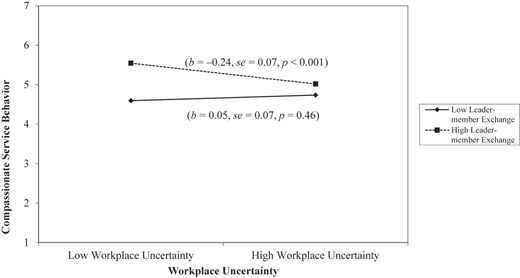
Moreover, results indicated that LMX moderated the effect of workplace uncertainty on compassionate service behavior (b = −0.17, se = 0.05, p < 0.001). As illustrated in Figure 2, no statistically significant relationship was found between workplace uncertainty and compassionate service behavior at low levels (-1SD) of LMX (b = 0.05, se = 0.07, p = 0.46). However, at high levels of LMX (+1SD) there was a negative and statistically significant relationship between workplace uncertainty and compassionate service behavior (b = −0.24, se = 0.07, p < 0.001). These findings provide support for Hypothesis 4.
Lastly, results yielded a statistically significant index of moderated mediation (b = −0.10, se = 0.03, 95% bootstrap CI [−0.17, −0.04]). In particular, when LMX was low (-1SD), there was no statistically significant indirect effect of customer incivility on compassionate service behavior through workplace uncertainty (b = -0.03, se = 0.05, 95% bootstrap CI [−0.14, 0.02]). At high levels of LMX (+1SD), however, there was a negative and statistically significant indirect effect of customer incivility on compassionate service behavior through workplace uncertainty (b = −0.15, se = 0.05, 95% bootstrap CI [−0.26, −0.05]). Hence, Hypothesis 5 was fully supported as well.
Discussion
This study examined how customer incivility relates to employees’ compassionate service behavior, focusing on workplace uncertainty as a key explanatory mechanism and LMX as a boundary condition of this relationship. The findings from data collected during a four-week, time-lagged survey supported each of the hypothesized relationships. Customer incivility was negatively associated with compassionate service behavior, and this relationship was explained by greater feelings of workplace uncertainty among employees. Moreover, LMX strengthened this negative association, suggesting that employees with higher-quality relationships with their leaders may experience a greater degree of uncertainty when encountering customer incivility at work. The nonsignificant relationship at low LMX is consistent with the idea that employees with weaker leader–member relationships may already hold lower expectations for support or clarity. When expectations are already modest, additional uncertainty may carry fewer incremental consequences for their willingness to engage in compassionate service, resulting in a flatter slope for this group. These findings underscore the role of customer incivility as a significant contributor to workplace uncertainty and reveal its capacity to undermine employees’ emotional and prosocial functioning. They also extend URT by highlighting how, why, and under which conditions uncivil customer behavior relates to employees’ willingness to engage in discretionary, compassionate service behaviors.
Theoretical implications
This study contributes to the theoretical advancement of URT by demonstrating that customer incivility acts as a stressor that heightens uncertainty and disrupts employees’ cognitive capacity to engage in compassionate service behavior. By identifying workplace uncertainty as a mediating mechanism, we extend URT to the service context, showing that unpredictable and disrespectful customer behavior impairs employees’ ability to interpret and manage their work environment. Prior research has emphasized emotional exhaustion as a key outcome of incivility (Shin et al., 2022; Alola et al., 2019; Pu et al., 2024). In contrast, our findings highlight workplace uncertainty as a distinct, yet related cognitive pathway through which customer incivility undermines compassionate service behavior.
Additionally, this research advances LMX theory by illustrating that high-quality LMX can have counterintuitive implications in the context of customer incivility. High-quality LMX relationships do not uniformly function as protective resources. Rather, because such relationships are associated with greater stability and predictability, heightened workplace uncertainty may represent a more pronounced disruption for these employees. As a result, employees in high-LMX relationships may be more sensitive to uncertainty and experience stronger constraints on their ability to engage in compassionate service behavior. This challenges dominant perspectives that portray high LMX as universally beneficial and suggests that its effects depend on the broader context in which employees operate. In doing so, we join a growing body of research emphasizing the conditional effects of workplace relationships (Lawrence and Kacmar, 2012; Hesselgreaves and Scholarios, 2014), offering a more nuanced view of how LMX functions within demanding service environments.
Finally, this study expands COR theory and the emerging literature on compassionate service behavior by positioning compassion as a discretionary behavior that is vulnerable to external stressors and uncertainty. While prior research has focused primarily on organizational compassion or service recovery (Ko et al., 2021; Rhee et al., 2017; Moon et al., 2016; Xu et al., 2025), our findings emphasize the fragile and effortful nature of compassion in customer service interactions. Theoretically, this suggests that compassionate service behavior is shaped not only by positive affect or organizational contexts, but also by workplace uncertainty and cognitive strain. This perspective opens new avenues for understanding how compassionate service can be sustained under challenging service conditions.
Practical implications
The findings of this study offer several important implications for organizations, managers, and employees working in high-contact service environments. Because customer incivility is associated with increased workplace uncertainty, organizations should implement strategies that clarify expectations and reduce uncertainty during challenging customer encounters. Establishing clear service protocols, structured escalations procedures, and transparent communication about behavioral expectations can help employees interpret and manage uncivil interactions more confidently (Solnet and Golubovskaya, 2023; Edmondson, 1999).
The moderating role of LMX highlights the nuanced role of supervisor support in uncertain service environments. Importantly, our findings do not suggest that high-quality LMX relationships are detrimental. Rather, they underscore the importance of actively managing uncertainty. Because employees in strong leader–member relationships often rely on consistent guidance and predictable expectations, leaders should be especially proactive in clarifying service standards during periods of customer mistreatment or uncertainty. For example, supervisors can provide explicit scripts (e.g. “I want to make sure this issue is handled correctly. I will follow our guidelines and, if needed, check with my manager so we can come up with the best solution for you”), define when employees are permitted to disengage or escalate situations, and communicate consistent criteria for acceptable responses. By reducing uncertainty in these moments, leaders can preserve the benefits of high LMX while preventing it from constraining compassionate service behavior.
In addition, leader development programs should emphasize how to offer guidance and structure without fostering overreliance. Scenario-based training can help supervisors offer support while maintaining clear boundaries and promoting employee autonomy (Riedel et al., 2023). Leader responsiveness during and after customer mistreatment is also critical. When supervisors acknowledge these incidents, provide guidance, and reinforce fair practices, employees are more likely to sense clarity and support, reducing the uncertainty that undermines compassionate service behavior.
Finally, given that organizational tenure was positively associated with compassionate service behavior, organizations should continue investing in the development and retention of frontline employees. Providing clear career paths, mentorship opportunities, and recognition can strengthen commitment (Al-Hawari et al., 2020; Frey-Cordes et al., 2020) and support sustained engagement in compassionate service behaviors. Together, these practices may enhance employees’ sense of stability and help them maintain compassion when responding to customers in need, even when they are exposed to customer incivility.
Limitations and future research directions
Several limitations of this study should be acknowledged. Although the time-lagged design established temporal separation among study variables, all measures were self-reported, which may have introduced perceptual bias or inflated associations among constructs (Podsakoff et al., 2003). Although LMX was measured prior to the outcome variable, it was not assessed at baseline; future research could examine potential changes in LMX over time. Future examinations could also incorporate multi-source or behavioral measures of both customer incivility and compassionate service behavior to strengthen the validity of these relationships.
While the four-wave design created temporal separation among variables, LMX was not assessed at the beginning of the timeline. While the robustness check indicated that LMX remained stable across the short intervals in our design and supported our use of the Week 3 measure, future research that collects repeated measures of LMX from the outset would allow for examining whether changes in leader–member relationships shape employees’ reactions to customer incivility. Additionally, this study included frontline service employees from a range of industries and occupations, which enhances the breadth of our findings but may obscure service sector-specific dynamics. The nature and consequences of customer incivility likely differ across service domains due to variations in emotional display rules, service intensity, and customer expectations. For example, hospitality and healthcare employees typically engage in sustained, relational customer interactions, while employees in retail or call center settings often experience shorter, transactional encounters. Such variation in interaction patterns may shape the degree to which customer incivility generates uncertainty and constrains compassionate service behaviors.
A promising direction for future research is the examination of leader and organizational responses to customer mistreatment. These responses may shape whether employees interpret customer incivility as a violation of expectations or as an experience that is acknowledged and addressed. This may be especially important for employees with strong leader–member relationships who hold higher expectations for support. Furthermore, future research could adopt a more industry- or occupation-specific approach to determine whether the mechanisms identified here operate differently across service contexts, offering a more fine-grained understanding of compassion service behaviors and workplace uncertainty in diverse service environments. Future research could also examine contextual and individual factors that influence how employees manage uncertainty arising from customer incivility. For example, a supportive team climate or a strong sense of organizational justice may provide informational and emotional cues that help employees interpret ambiguous customer behavior, thereby reducing uncertainty. Conversely, employees with limited emotion regulation skills may experience greater difficulty restoring predictability and control following uncivil interactions. Investigating such conditions would deepen understanding of how uncertainty reduction processes operate within different organizational and interpersonal environments.
Appendix Complete survey items
Customer incivility (Cortina et al., 2001)
Instructions: How frequently did guests or customers engage in each of the following behaviors toward you during the past 7 days at work? (1 = Almost never; 5 = Almost always)
Put you down or were condescending to you.
Paid little attention to your statements or showed little interest in your opinion.
Made demeaning or derogatory remarks about you.
Addressed you in unprofessional terms, either publicly or privately.
Ignored or excluded you from professional camaraderie.
Doubted your judgment on a matter over which you had responsibility.
Made unwanted attempts to draw you into a discussion of personal matters?
Workplace uncertainty (Colquitt et al., 2012)
Instructions: Reflecting on the past 7 days, use the scale below to indicate your level of agreement with each of the following beliefs about your overall job situation.…has your supervisor treated you in a polite manner? (1 = Strongly disagree; 5 = Strongly agree)
There was a lot of uncertainty at work.
Many things unsettled me at work.
If I recall my last week at work, I felt a lot of uncertainty.
I could not predict how things would go at work last week.
Leader-member exchange (Wayne et al., 1997)
Instructions: Reflecting on the past 7 days at work, rate the extent to which you agree with each of the following statements about your relationship with your supervisor. (1 = Strongly disagree; 5 = Strongly agree)
My working relationship with my supervisor was effective.
My supervisor understood my problems and needs.
My supervisor recognized my potential.
I could count on my supervisor to “bail me out,” even at his/her/their own expense, when I really needed it.
I usually knew where I stood with my supervisor.
My supervisor had enough confidence in me that he/she/they would defend and justify my decisions if I was not present to do so.
My supervisor would be personally inclined to use his/her/their power to help me solve problems in my work.
Compassionate service behavior (Shaver et al., 1987)
Instructions: How frequently did you express each of the following to customers during the past 7 days? (1 = Almost never; 7 = Almost all the time)
Care
Tenderness
Affection
Generosity
Empathy
Dignity
Respect