


This research examines empirically the concept of master–servant relationships in human–robot collaboration (HRC). Drawing on leader–member exchange and intergroup threat theories, this paper develops and tests a novel research model that links the working relationships between human frontline staff and humanoid social robots (HSRs) to customers’ perceptions of realistic threat and trust, and, consequently, their intention to use service robots in retail stores. In addition, the paper tests the moderating role of speciesism.
This paper consists of four online experiments studying the effects of master–servant roles in HRC in frontline retail. Data for the studies was collected from US participants and members of Prolific. Multiple moderated mediation models using SPSS v29 PROCESS 4.0 were used in the analyses to test the proposed hypotheses.
The role of master–servant relationships between human retail staff and HSRs influences customer perceptions of realistic threat and trust toward HSRs. Speciesism increases the negative mediating effects of realistic threat and reduces the positive mediating effects of trust, ultimately affecting consumers’ intention to use retail robots when they perform a master (vs. servant) role during HRC in frontline retail encounters.
The present research examines the likely working relationships between human frontline staff as subordinates (i.e. servants) and HSRs as their immediate supervisors (i.e. masters), as well as the spillover effects on customers’ perceptions in hybrid service encounters. The results contribute to recent research in which job titles of AI agents can influence customers’ perceptions of those agents (e.g. Jeon, 2022). In addition, this research showcases how speciesism moderates these effects.
1. Introduction
The retail industry is undergoing a drastic transformation. Fueled by the COVID-19 pandemic, the role of robot technologies in retailing has taken a dramatic leap (Shankar et al., 2021). Some scholars predict that the retailing industry is expected to increasingly deploy advanced humanoid service robots (HSRs) that can work seamlessly alongside human employees (Noble et al., 2022). Service robots are defined as “system-based autonomous and adaptable interfaces that interact, communicate and deliver service to an organization’s customers” (Wirtz et al., 2018, p. 909). According to industry estimates, the market for service robots is expected to grow in double digits, from USD 16.95 billion in 2021 to more than USD 57 billion by 2029 (Fortune Business Insights, 2022).
The robotization of the human workforce is also redefining the nature of service encounters and the dyadic relationship between customers and frontline employees (e.g. Li et al., 2021; Robinson et al., 2020) and creating new challenges for human–robot collaboration (HRC) between frontline employees and service robots (e.g. Noble et al., 2022; Paluch et al., 2022). In this context, scholars have begun to emphasize a triad relationship (e.g. Odekerken-Schröder et al., 2022).
While the topic of HRC has gained traction in service literature (e.g. Noble et al., 2022; Paluch et al., 2022; Tuzovic and Paluch, 2023), less is known about (1) human–robot working relationships and (2) how assigning new job roles (e.g. supervisor versus subordinate) between employees and HSRs may affect customer perceptions and their behavioral intentions. The current debate primarily assumes that HRC consists of the human playing the role of the leader or supervisor and the robot playing the role of worker or assistant (Khavas et al., 2020). Our research takes a step further, focusing on a research gap that has not been addressed so far: How do customers perceive the potential working relationships between a highly advanced HSR as supervisor of human frontline employees? Does the job role of HSR as master versus servant matter during a hybrid service encounter?
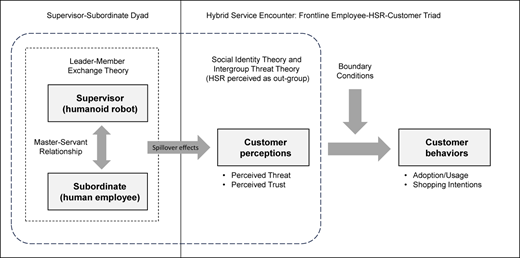
The aim of this research is to explore the concept of master–servant relationships in HRC. Drawing on the leader–member exchange theory (Graen, 1976; Graen and Uhl-Bien, 1995) and intergroup threat theory (Stephan et al., 2009), we develop and test a novel research model that links the working relationships between human frontline staff and humanoid service robots (HSRs) to customers’ perceptions of realistic threat and trust, and, consequently, their intention to use service robots in retail stores. While the scenario is yet to become a common practice in frontline service encounters, our assumptions are not far-fetched given the emerging debate about AI agents as bosses, which can include managerial roles and supervisor roles in frontline service environments (Burton et al., 2024). Furthermore, there is recent evidence of robots in a business leadership role. Mika, an AI-powered humanoid robot designed by Hanson Robotics was appointed as new CEO of a Polish drinks company (Evans, 2023; Sukheja, 2023). Tang Yu, a virtual AI, has been appointed as CEO of China-based NetDragon Websoft to support decision-making for the company’s daily operations (Cuthbertson, 2023; Odilov, 2024). A new report by Gartner predicts that robots may replace human bosses by the end of the decade (Cox, 2021).
Following the rationale of prior research (e.g. Kim et al., 2016), we propose that different human–robot master–servant relationships will have spillover effects on customer perceptions and behaviors. Finally, the paper tests the moderating role of speciesism. As HSRs become indistinguishable from human beings, the notion of speciesism may lead to a bias against robots as distinct social species and outgroup members (Huo et al., 2023a).
Our study makes several important contributions. First, we develop and test a novel and innovative research model that links the working relationships between human frontline staff and HSRs to customer perceptions. Recent research has studied the impact of manager-level job titles assigned to AI-based agents on marketing outcomes (e.g. Jeon, 2022). The author has found favorable downstream effects on customer attitudes and intentions. Our research goes a step further and assumes that HSRs will take on immediate supervisor roles in hybrid service encounters. The results provide important insights for an integrated human–robot frontline workforce in which both human and robot staff can inhibit a number of different roles (Tuzovic, 2024). We thus fill in an important research gap and provide new research directions for the domain of HRC and the robotization of the workforce.
Second, we link organizational behavior literature, such as leader–member exchange (Stringer, 2006) and supervisor–subordinate dyads (Ismail et al., 2012), to the growing field of human–robot interaction and service robot implementation. Based on a study by Kim et al. (2016), we argue that different master–servant relationships between human and robotic staff will have spillover effects on customer perceptions. Our results indicate that the conditions of master–servant relationships between human retail staff and HSRs influence customers’ realistic threat and trust towards HSRs. This research thus expands the field of supervisor–subordinate dyads to the context of service encounter triads.
Third, we add to the novel research on speciesism in human–AI relationships. In recent years, scholars have called for studies to explore the role of speciesism on adoption intensions and behaviors toward new technologies (Schmitt, 2020) and to investigate more boundary conditions (Huo et al., 2023a). Overall, our findings enhance our understanding of the effects of speciesism on human–robot interactions.
The remainder of this article is organized as follows. The next section reviews the theoretical background and describes the hypotheses’ development. Next, we describe the method and experimental design, followed by the data analysis and results. We conclude with a discussion of theoretical and practical contributions, limitations and directions for future research.
2. Theoretical background
The integration of robots and artificial intelligence in customer service roles has gained substantial attention across various sectors, from healthcare (e.g. Longoni et al., 2019; Shanks et al., 2024) and hospitality (e.g. Van Doorn et al., 2023) to retail (e.g. Huang and Dootson, 2022). Previous research has shown that customers’ perceptions and interaction with robots and AI are influenced by factors like anthropomorphism, power dynamics and the timing of human intervention (e.g. Huang and Dootson, 2022; Novak and Hoffman, 2019; Ötting et al., 2022; Schweitzer et al., 2019).
While these papers have examined a range of factors that influence the acceptance of robots in service settings, little research has studied hybrid situations where both robots and human service providers collaborate in a service setting, especially master–servant relationships in HRC. To better understand the emerging working relationships between human frontline staff and HSRs as their supervisors, we draw on the literature on leader–member exchange (LMX). LMX theory has been considered one of the most useful approaches for studying the dyadic relationship between supervisors and subordinates (Kim et al., 2016; Stringer, 2006). The main premise is that there are two central roles in organizations: leaders and followers. Table 1 summarizes some of the relevant studies that guide our research.
Literature review of relevant studies
| Author(s)/Year | Context | Nature of research | Key findings |
|---|---|---|---|
| Burton et al. (2024) | AI robot bosses | Conceptual | The authors propose four types of AI robot bosses: manager, producer, maestro and leader. The human only traditional organization chart becomes an incomplete and misleading representation of the organization and how it works. Furthermore, trust is a central issue for the acceptance of AI robots as a boss |
| Huang and Dootson (2022) | Customers’ response to chatbot service failures in retail settings | Empirical (experiment) | Studies tension between human and non-human employees (chatbots). Disclosing the availability of a human employee late in the service interaction results in higher customer aggression, as they feel deprived of the opportunity to interact with a human |
| Jeon (2022) | AI agents and the impact of manager-level job titles | Empirical (experimental studies) | The job titles given to the AI agents are found to have favorable downstream effects on customer satisfaction, brand attitude and the customers’ intentions to buy the products recommended during the chat by the AI manager |
| Kim et al. (2016) | Leader-member exchanges and spillover effect on marketing outcomes | Empirical (survey among employees and customers) | Leader behavior does not directly impact customers’ perceptions of service. However, leader-member exchanges have an indirect influence via job satisfaction. The authors link leader-member exchange theory to the services marketing field |
| Novak and Hoffman (2019) | Relationship with smart objects | Conceptual | Consumer relationships with smart objects can be classified as two types of master–servant relationships, partner relationships and unstable relationships. Complementary master–servant relationships that are high in communality reflect trusting master–servant relationship styles |
| Longoni et al. (2019) | Studies consumer resistance to medical AI, when AI and human providers coexist | Empirical (series of experiments) testing consumer preferences between AI and human healthcare providers | Customers resistance to use AI healthcare providers is stronger compared to human ones because their inability to account for customers’ unique characteristics. Specifically, consumer resistance to AI is due to “uniqueness neglect” where patients fear that AI lacks the ability to consider their individual circumstances. Furthermore, consumers are more willing to accept AI when there is clear human oversight. This suggests the importance of human supervision for customer trust in AI-based services |
| Schweitzer et al. (2019) | Relationship with voice-controlled smart assistants (VCSA) | Exploratory (user journey and interviews) | Users who perceived the VCSA as a master tended to have more negative experiences with the VCSA interaction than those who considered the devices as servant or partner. Furthermore, participants who regarded the VCSA a master considered themselves as slaves who had to obey to the VCSA’s rules and regarded the human-object relationship as perverted or reversed |
| Shanks et al. (2024) | Collaborative robotic teams in service environments | Empirical (6 studies in different healthcare settings) | Consumers respond less favorable when robots are in subordinate or leadership roles (lower behavioral intentions). This negative effect can be reduced by providing customers with a sense of control over the robot |
| Van Doorn et al. (2023) | Relationship consumer-facing and worker-facing automation technologies | Empirical (interviews with workers and customers in hospitality settings) | Workers see robots as tools to free them to focus on more relational and emotionally driven interactions with customers. When robots are perceived to take a leadership role, it undermines the relationship between workers and consumers The authors conclude that while robots handle routine tasks efficiently, consumers prefer human workers for emotionally driven interactions. Thus, having human employees alongside robots increases customer satisfaction by combining efficiency with personal attention |
Source(s): Authors’ own work
We propose that reversing the traditional roles, with HSRs as masters and humans as assistants, will have a negative effect on customer perceptions due to an increase in perceived threats and a reduction in trust (e.g. Fiestas et al., 2024). These shifts in preferences are because robots in master roles are likely to be seen as part of an outgroup compared to robots in assistant (servant) roles. These relationships are outlined in our theoretical model shown in Figure 1. In the next sections we will discuss relevant literature related to our model.
2.1 Master–servant relationships in human–robot collaboration
In recent years, the notion of human–robot working relationships has gained traction in the services literature (e.g. Le et al., 2023; Lu et al., 2020; Paluch et al., 2022; Shanks et al., 2024). While the discussion regarding the deployment of joint human–robot service teams is still in its infancy (Le et al., 2023), scholars have recently advanced the debate by addressing emerging issues as a result of the robotization of the workforce, such as AI robot bosses or job titles for AI agents (e.g. Burton et al., 2024; Jeon, 2022). In this context, we adopt the term master–servant relationship in HRC based on earlier research on how consumers build relationships with smart devices (e.g. Novak and Hoffman, 2019; Schweitzer et al., 2019; see Table 2). Master–servant relationships imply a social order where masters hold a higher position in the social hierarchy, and servants not only follow orders but have fewer rights and lower social status than their masters (Srinivas, 1995). For example, a robot boss may give orders to employees (e.g. Mika, CEO of Dictator; Evans, 2023; Sukheja, 2023). The power context of AI robot agents can influence individuals’ attitudes toward robots (Merdin-Uygur and Ozturkcan, 2023). Table 2 summarizes key studies and demonstrates how our research will combine different research streams to address the impact of master-servant relationships.
Overview of empirical research
| Author(s)/Year | SSR/MSR | HRC | RT | Trust | Speci | Context | Findings |
|---|---|---|---|---|---|---|---|
| Ismail et al. (2012) | Y | Supervisor–subordinate dyads; Survey (n = 200) | The authors identify antecedents and consequences of relationship conflict in supervisor–subordinate dyads | ||||
| Kim et al. (2016) | Y | Leader-member exchanges; Survey: 14 restaurants with customer-contact employees (n = 426) and their customers (n = 1,212) | Based on LMX Theory, the authors find positive spillover effects of the dyadic relationship between supervisors and subordinates on marketing outcomes | ||||
| Stringer (2006) | Y | Fire department; Survey (n = 57) | Based on the LMX Theory, the author demonstrates that high quality supervisor–employee relationships are positively related to the level of employees’ job satisfaction | ||||
| Schweitzer et al. (2019) | Y | Voice-controlled smart assistants (VCSA); Qualitative (N = 39) | Participants who regarded the voice-controlled smart assistants as masters considered themselves slaves who had to obey the device’s rules | ||||
| Shanks et al. (2024) | Y | Y | The authors examine customer reactions to power dynamics in human–robot collaboration in healthcare. Their experiments reveal that customers react more negatively when robots take on leadership roles, preferring human-led teams with robots in supporting roles. This effect is attributed to increased anxiety, which can be alleviated by giving customers a sense of control over the robot | ||||
| Huang et al. (2021) | Y | Hotels; low versus high anthropomorphic robot appearance; Experiment | Realistic threats significantly increase negative attitudes toward robots | ||||
| Złotowski et al. (2017) | Y | Various tasks; Visuals of wide range of robots; Experiment | The exposure to autonomous robots evoked stronger negative attitude towards robots in general and more opposition to robotics research than exposure to non-autonomous robots. Both realistic and identity threats mediated the increase in negative attitudes toward robots and opposition to robotics research, although realistic threats were often the stronger mediator of the two | ||||
| Song et al. (2022) | Y | Retailing; Robot Pepper; QCA) | Human-robot trust is a prerequisite of consumers’ behavioral intention to visit a footwear store | ||||
| Van Pinxteren et al. (2019) | Y | Campus visitors; Robot Pepper; Survey (n = 114) | Consumers’ trust in humanoid robots enhanced their emotional interaction and intention to use the robot | ||||
| Fiestas et al. (2024) | Y | Retailing; Robot Sophia; Experiments | The level of speciesism moderates the relationship between HSR intellectual intelligence and perceived competence such that an effect is found for low but not for high HSR intelligence | ||||
| Huo et al. (2023a) | Y | Healthcare; Medical AI; Survey (n = 266) | Patients with higher speciesism tend to have lower acceptance of medical AI in an independent role but higher acceptance in an assistive role | ||||
| Huo et al. (2023b) | Y | Healthcare; Medical AI; Survey (n = 266) | Speciesism moderates the relationship between staff participation and AI anxiety, such that those with high-level speciesism were more sensitive to perceived intergroup threat when they participated in the AI development process than those with lower levels of speciesism | ||||
| This Study | Y | Y | Y | Y | Y | Retailing; Robot Sophia; Experiments |
Note(s): SSR = supervisor-subordinate relationships; MSR = master-servant relationships; HRC = human–robot collaboration; RT = realistic threat; Speci = speciesism; QCA = qualitative comparative analysis
Source(s): Authors’ own work
2.2 Realistic threat
In recent years, scholars have argued that autonomous robots can be perceived as threatening when people perceive themselves as losing power and control (Złotowski et al., 2017). According to Haggadone et al. (2021), the negative bias of human intergroup interactions and relations is transferred to human-robot interactions and relations because individuals react similarly to robots as they do to human outgroup members. In this context, intergroup interactions and relations can be affected when members of a group (i.e. human staff = “us humans”) perceive that they are threatened by the members of an outgroup (i.e. retail robots = “they non-humans”) (Złotowski et al., 2017). Past research has studied the impact of realistic threat of HSRs in dyadic robot–customer interactions (e.g. Huang et al., 2021; Złotowski et al., 2017; see Table 2). The present study extends the context to HRC and hybrid service encounters.
2.3 Trust
In a service context, trust refers to a psychological expectation that others will keep their promises and will not behave opportunistically in expectation of a promised service (Blut et al., 2021). Literature has demonstrated that trust substantially affects business relationships in general and marketing outcomes (Gefen, 2000). Trust is also an important factor in the context of human–robot interactions and relationships. Literature shows that trust in a service robot mediates the effects of robot attributes on customers’ intentions to use it (see Table 2 for an overview of relevant studies).
For this research, we assume that intergroup bias may impact trust formation within a hybrid service team that consists of human and robot actors. Human actors such as employees and customers are considered ingroup members, whereas HSRs are considered outgroup members. However, we further assume that assigning different roles, from an assistant to a supervisor, may affect the social biases of ingroup members. The present study does not focus on the immediate relationship between HSRs and frontline staff but on spillover effects on customers.
2.4 Speciesism
The concept of speciesism explains how humans behave when interacting with other species. Initially, the term was used in the context of human–animal relationships, explaining human behaviors of treating non-human animals differently (Amiot et al., 2020). Normatively, speciesism is considered a form of prejudice analogous to racism and sexism (Caviola et al., 2019; Everett et al., 2019). Research in psychology suggests that speciesism relies on motivations and psychological processes similar to those underlying other prejudices (e.g. Dhont et al., 2016). Studies show that individuals with high speciesism (so-called “speciesists”) tend to hold a belief that humans are superior to other species and have a higher moral status than other species (Figdor, 2020; Huo et al., 2023b). Individuals’ speciesism may trigger prejudice towards members of other species, influencing the relationship between members of different species. In addition, Caviola and colleagues (2019) demonstrate that speciesism can predict real-world decision-making and behavior.
More recently, research in human–computer interaction has proposed to expand the scope of speciesism from human–animal relationships to human–AI relationships. As HSRs are moving toward an “advanced created artificial species” (Søraa, 2017), scholars have called for more research to examine how speciesism could affect the acceptance and use of HSRs (Schmitt, 2019, 2020). Table 2 summarizes the key findings of the few existing studies. Overall, there is limited empirical evidence of how humans may prejudicially respond to HSRs. While speciesism may be widespread, the causes of the phenomenon are not well understood.
2.4.1 Hypotheses development
Based on the review of the literature, we propose four main hypotheses. First, we adopt the lens of the LMX theory (Graen, 1976) to study the outcome of different master-servant relationships in HRC. According to the LMX literature, relationships are formed with each subordinate, ranging from high to low quality. Furthermore, these high and low-quality exchanges have been referred to as “ingroup” and “outgroup,” respectively (Kim et al., 2016; Stringer, 2006). In our study, instead of manipulating high versus low quality of supervisor–employee relationships (i.e. in a human–human dyad), we propose that HSRs in a supervisor (i.e. leader) role will be perceived more as outgroup than if they are taking on the role as an assistant (i.e. subordinate). In addition, in line with Kim et al. (2016), we expect a spillover effect on customer perceptions of the HRC, which ultimately influences their behavioral intentions.
Second, we consider the psychology of intergroup relations and Intergroup Threat Theory (Giger et al., 2019; Rios et al., 2018; Stephan et al., 2015) to explain customer perceptions of HSRs in a master (vs. servant) role. Research shows that interactions between intergroup agents are perceived as not beneficial and threatening as intergroup members distrust each other for not sharing common characteristics or goals (Çakal et al., 2021; Kappmeier et al., 2021). We argue that customers’ perceptions of realistic threat mediate the effect of master-servant relationships on customers’ intention to use HSRs. Specifically, when customers witness HSRs performing a master (vs. servant) role in HRC, they are likely to experience higher levels of perceived threat. These factors, in turn, are expected to diminish their intentions to use HSRs.
Customers will perceive higher levels of threat when HSRs have a supervisor (vs. assistant) role, which in turn reduces customers’ intention to use HSRs.
Based on the previous discussion, we further predict that speciesism will moderate the effect of realistic threat on consumers’ intentions to use HSRs, such that an effect is found for HSRs in a master role but not for HSRs in a servant role. Individuals with high levels of speciesism assign a lower moral status to any non-human agent, including HSRs, and perceive themselves as superior to be replaced in human-specific roles, such as a master (supervisor) in HRCs. Their beliefs about the moral worth of non-human species may create a bias, preferring humans to be the master in HRCs.
The negative indirect effect of realistic threat on consumers’ intentions to use HSR (H1) is negatively moderated by speciesism, such that this effect becomes stronger with higher levels of speciesism.
While many studies have demonstrated the important role of trust in human–robot interactions (e.g. Song et al., 2022; van Pinxteren et al., 2019), the question arises of whether individuals (i.e. employees or customers) differentiate ingroup versus outgroup as a factor of human-robot trust. We postulate that trust mediates the effect of master–servant relationships on customers’ intention to use HSRs.
The effect of master–servant relationships on customers’ intention to use HSRs is mediated by trust (H3a) such that customers’ perceived trust is higher when the HSR has a servant (vs. master) role, which leads to higher intentions to use HSRs. However, this effect is positively moderated by speciesism (H3b), such that this effect becomes stronger with higher levels of speciesism.
According to Vanman and Kappas (2019), HSRs that replicate human appearance and behave as sentient agents, performing human-specific tasks, can trigger individuals’ perceptions of threat. This is due to the argument that individuals perceive these robots as an outgroup social category trying to be part of an ingroup social group (humans). In this context, by categorizing HSRs as outgroups, ingroups (i.e. humans) can feel threatened by them and consequently have less trust towards HSRs during intergroup relations, ultimately favoring interactions among ingroup members, that is humans (Fraune, 2020; Voci, 2006).
In addition, when speciesists interact with HSRs performing dominant human-specific tasks, they can experience higher levels of realistic threats than non-speciesists. The rational is that speciesists believe that humans (i.e. ingroups) are superior in comparison to any other non-human agents (i.e. outgroups) (Caviola et al., 2019; Frank and Otterbring, 2023). The effects of high levels of speciesism may serve as a protective mechanism to maintain ingroup members (i.e. human staff) safe in their human-specific roles and prefer to interact with them, as they believe they are superior to outgroup members (i.e. HSRs), only choosing to interact with servant types of HSRs. Consequently, speciesists might prefer to interact with human staff as they would be able to trust their equals, especially when they witness HSRs performing human-specific tasks, like being a leader (master), regardless of the benefits that HSRs could bring to their in-store shopping experience. Therefore, based on the notion that consumers with high-level speciesism are more sensitive to perceived intergroup threat, we predict that robots in a master (vs. servant) role in HRC will lead to higher perceived realistic threat for those consumers high in speciesism but not for those with lower levels of speciesism.
The effect of master–servant HSR roles on intentions to use HSRs is sequentially mediated by realistic threat and trust, such that supervisor (vs. assistant) HSRs increase perceived threat and reduce perceived trust, which subsequently reduces customers’ intention to use HSRs. However, the sequential mediation effect becomes stronger with higher levels of speciesism.
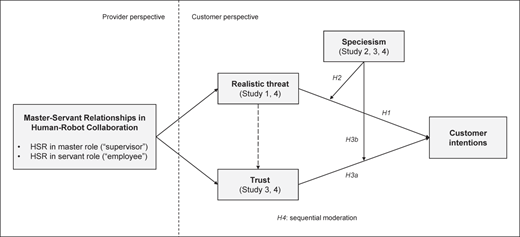
Figure 2 depicts our research model.
2.4.2 Overview of studies
The present research includes four online experiments. The first study tests hypothesis 1 by examining how individuals’ realistic threat reduces HSR usage intentions when robots perform master roles in HRCs in the context of an electronics store. The second study tests the moderating effect of speciesism (H2) in our proposed model, using the same manipulation and procedures as the first study. Specifically, it examines how the effects of speciesism influence individuals’ realistic threat derived from interacting with HSRs, affecting their intentions to use HSRs when robots perform master roles in HRCs.
The third study introduces trust as a facilitator of HSR usage. Using a different shopping scenario (i.e. camping equipment), this study examines how speciesism attenuates individuals’ trust when robots perform a master role (H3). Finally, the fourth study examines how a robot’s master role triggers individuals’ realistic threat, leading to lower trust, which in turn reduces HSR usage when robot threats are low and their speciesism is high. Using a similar scenario where participants were asked to consider the purchase of a laptop in an electronic store, this study tests H4. It demonstrates a boundary condition to the proposed model by priming participants’ perceived threat.
All studies used a similar design and procedure. Based on previous research procedures and stimuli (Fiestas et al., 2024), participants in all experiments read a hypothetical scenario where they imagined going either to a local electronics store or a camping store to buy a laptop or camping equipment where they read about an HRC where the retail robot acts as the master (vs. servant) of that collaboration. By using different retailing contexts, our experiments provide evidence for the robustness and generalizability of our proposed effects. The data for all studies was collected via Prolific. The data was analyzed using PROCESS 4.0 (Hayes, 2020).
2.4.3 Study 1
This experiment tests an innovative scenario where a retail robot performs a master (vs. servant) role during an HRC and its effect on perceived realistic threat and, subsequently, intentions to use HSRs. As a shopping context, we decided to select a utilitarian product category (i.e. laptop computers; Chitturi et al., 2008). We chose an electronic store as the focal scenario because this context represents an ideal realistic scenario where consumers often interact with a salesperson to seek assistance when deciding which products to buy, given the number of options and technical specifications involved in the purchase of such products. They first read a scenario about an HRC where the retail robot acts as the master or the servant of that collaboration. Afterward, they are approached by the retail robot to help them with their in-store shopping. In this scenario, we chose Sophia as the robot with the most human-like characteristics in existence.
2.4.3.1 Sample, design and procedure
The sample consists of 188 US participants aged between 18 and 75 years old (M = 38.68, SD = 13.38). Participants for this online study were recruited from Prolific Academic US, where they were paid a nominal fee of GBP£ 1, equivalent to US$ 1.35, for their participation. Appendix 4 shows the sample’s demographics. After expressing their consent, participants were randomly assigned to only one of two conditions (master vs. servant), where the role of an HSR in a master-servant HRC was manipulated. Appendix 1 shows the scenarios used in each condition for Study 1. After reading the scenario, participants attended to the dependent variables on the next page. Intention to use was measured using a five-item scale adapted from Park et al. (2021), and realistic threat was measured using a three-item scale adapted from Złotowski et al. (2017). Both variables used 7-point Likert-type scales (1 = strongly disagree, 7 = strongly agree) in which higher values indicate higher levels of the respective variable. Finally, participants answered questions regarding their demographics.
2.4.3.2 Results
Manipulation Check. A single question was adapted from Kim and Kramer (2015) to ask participants their perceptions of Sophia’s role in the HRC (“Which one describes Sophia and the salesperson correctly? 0 = Sophia is acting like a boss …; 1 = The salesperson is acting like a boss …”) to assess the independent variable’s (HSR roles: Master vs. Servant) manipulation check (Hauser et al., 2018). In both conditions, participants identified the HSR role correctly (HSRMaster 95.9% vs. HSRServant 97.8%). The Phi correlation coefficient was −0.94 (p < 0.0001), indicating the effectiveness of the manipulation.
Mediation effect. Results from the mediation analysis using SPSS v29 PROCESS 4.0 Model 4 with 5,000 bootstrap samples (Hayes, 2020) show that participants in the master condition increased realistic threat (β = 0.84, t = 6.27, p < 0.001). That is, participants who read about Sophia performing as a master perceived a higher realistic threat than those who witnessed the HSR performing as a servant [HSRMaster = 4.25 vs. HSRServant = 3.40, F(1,186) = 39.26, p < 0.001]. In turn, the realistic threat had a negative effect on intentions to use HSRs (β = −0.23, t = -2.73, p = 0.01). The indirect effect of HSR’s role on intentions to use HSRs through realistic threat was statistically significant (Index = −0.19; 95% CI: 0.35 to −0.05). In other words, when the retail robot plays a master role, it increases levels of realistic threat, which in turn decreases the intentions to use them. Finally, the direct effect of HSR roles on intentions to use HSRs was not statistically significant (β = 0.24, t = 1.38, p = 0.17).
2.4.3.3 Discussion
The findings in Study 1 support H1, demonstrating that individuals’ realistic threats are triggered when they are exposed to the HSRs performing master roles. Since our study is based on different research streams, such as leader-member exchange and intergroup threats, the results should be interpreted twofold. First, this study can be seen as an extension of the traditional supervisor-subordinate relationship literature (e.g. Ismail et al., 2012). Prior studies argued that the quality of the supervisor-subordinate relationship influences the employee’s job satisfaction (Stringer, 2006). Moreover, Kim et al. (2016) found that the quality of the working relationships has an indirect, via job satisfaction, on marketing outcomes. Our study suggests HSRs as leaders can be considered an outgroup, which has a negative impact compared to an ingroup leader. We also contribute to a question recently posed by Burton et al. (2024): “Can an AI robot be a boss or leader? And if so, can the AI robot be a good one?” While the authors refer to routine managerial jobs, our study offers new research avenues for the potential leadership role of HSRs in HRC.
Second, our results add to the debate about whether robots trigger individuals’ perceived threat (e.g. Huang et al., 2021; Vanman and Kappas, 2019). Research is still inconclusive about the positive or negative impact of highly anthropomorphized robots. Our results add to the literature by demonstrating that individuals may feel less threatened by human-like robots if they are assigned to an assistant role but not to a master role. While HSRs may be considered as outgroup members, there is still a difference based on their role. Our study suggests that the negative impact of being an outgroup member is greater in a master role than in an assistant role.
2.4.4 Study 2
The present study focuses on analyzing the moderating effects of speciesism on the relationship between realistic threat and customers’ intentions to use HSRs. The aim of Study 2 is to demonstrate that speciesism will moderate the influence of individuals’ realistic threat on their intentions to use HSRs in the condition when they perform a master role in HRC.
2.4.4.1 Sample, design and procedure
Data was collected from Prolific Academic US, and participants were paid a nominal fee of GBP£ 1, equivalent to US$ 1.35, for their participation. The sample for this study consists of 195 participants aged between 19 and 74 years old (M = 38.68, SD = 13.38). Appendix 4 describes the sample’s demographics. The scenario and manipulations used in the present study are the same as in Study 1. After expressing their consent, participants were randomly assigned to only one of two conditions (master vs. servant HSR). Next, participants answered the same questions about dependent variables as in the first study. The moderator, speciesism, was measured using an adapted scale from Caviola et al. (2019). Table 3 presents all scale items used in this study, including constructs’ reliability and convergent validity. Results suggested good internal consistency for all the scales.
Study 2 construct reliability and convergent validity
| Constructs and their items | Study 1 | |||
|---|---|---|---|---|
| Loads | α | CR | AVE | |
| Intention to Use | 0.955 | 0.965 | 0.846 | |
| 1. I will use the humanoid social robot to search for information on products | 0.899 | |||
| 2. I will use the humanoid social robot to select my products at the store | 0.896 | |||
| 3. I intend to use the humanoid social robot to proceed with my purchase at the store | 0.946 | |||
| 4. I plan to use the humanoid social robot in the future | 0.926 | |||
| 5. I will use the humanoid social robot at this store to make a purchase | 0.933 | |||
| Realistic Threat | 0.648 | 0.932 | 0.587 | |
| 1. The increased use of humanoid social robots in our everyday life is causing more job losses for humans | 0.721 | |||
| 2. In the long run, humanoid social robots pose a direct threat to human safety and wellbeing | 0.766 | |||
| 3. I would feel very nervous just standing in front of a humanoid social robot | 0.810 | |||
| Speciesism | 0.854 | 0.894 | 0.584 | |
| 1. Morally, animals always count for less than humans | 0.770 | |||
| 2. Humans have the right to use animals however they want to | 0.778 | |||
| 3. It is morally acceptable to keep animals in circuses for human entertainment | 0.666 | |||
| 4. It is morally acceptable to trade animals like possessions | 0.812 | |||
| 5. Chimpanzees should not have basic legal rights such as a right to life or a prohibition of torture | 0.727 | |||
| 6. It is morally acceptable to perform medical experiments on animals that we would not perform on any human | 0.824 | |||
Note(s): All items have high loadings. Criteria: Cronbach’s α > 0.70 (Nunnally and Bernstein, 1994), Composite Reliability (CR) > 0.70 and Average Variance Extracted (AVE) > 0.50 (Hair et al., 2010)
Source(s): Authors’ own work
2.4.4.2 Results
Manipulation Check. Participants identified the HSR role correctly in both conditions (HSRMaster 96.1% vs HSRServant 97.8%). A high Phi correlation coefficient supported this association (Phi = −0.94, p < 0.001), suggesting that manipulations were successful.
Moderation effect. Following the predictions of hypothesis 2, we conducted a mediated moderation test using SPSS v29 PROCESS 4.0 Model 14, with 5,000 bootstrap samples (Hayes, 2020). A dummy variable was used to code the independent variable experimental treatments in the model estimation, 0 = Servant HSR role condition and 1 = Master HSR role condition. The independent variable (i.e. HSRs’ master vs. servant roles) had a positive effect on realistic threat (β = 0.90, p < 0.01). Subsequently, the interaction between realistic threat and speciesism was significant and had a negative effect on intentions to use HSRs (β = −0.19, p < 0.05), suggesting an indirect effect of master–servant HSR roles on intentions to use HSRs via realistic threat was conditioned by speciesism. As predicted, the negative effect of realistic threat on intentions became stronger with higher levels of speciesism. Results show that for low levels of speciesism, the indirect effect of HSR roles on intentions via realistic threat was not statistically significant (-1SD: 0.04, 95% CI: 0.29–0.20). However, this indirect effect was statistically significant for medium (M: 0.22, 95% CI: 0.42 to −0.03) and high levels (+1SD: 0.40, 95% CI: 0.64 to −0.17) of speciesism. The index of mediated moderation was negative and significant (index: 0.17, 95% CI: 0.30 to −0.04). A Johnson–Neyman analysis reveals that the indirect effect is only statistically significant for values of speciesism higher than M – 0.1 times the SD. The regression scores are shown in Table 4.
Study 2 regression results for the mediated-moderation model
| Regression paths | β | t | Estimates | LLCI | ULCI |
|---|---|---|---|---|---|
| MS-HSR > Realistic Threat | 0.90*** | 6.72 | 0.63 | 1.16 | |
| MS-HSR > Intentions to Use | 0.12 | 0.64 | −0.24 | 0.48 | |
| Realistic Threat > Intentions to Use | −0.24* | −2.21 | −0.45 | −0.03 | |
| Speciesism > Intentions to Use | −0.009 | −0.088 | −0.20 | 0.18 | |
| Speciesism × Realistic Threat > Intentions to Use | −0.19* | −2.29 | −0.35 | −0.003 | |
| Mediated Moderated path | Speciesism | ||||
| MS-HSR > Realistic Threat > Intentions to Use | −1.06 | M – SD | −0.04 | −0.29 | 0.21 |
| MS-HSR > Realistic Threat > Intentions to Use | 0 | M | −0.22* | −0.42 | −0.03 |
| MS-HSR > Realistic Threat > Intentions to Use | 1.06 | M + SD | −0.40** | −0.64 | −0.17 |
| Index of Mediated-Moderation | −0.16* | −0.30 | −0.03 |
Note(s): ***p < 0.001
Source(s): Authors’ own work
2.4.4.3 Discussion
As predicted in H2, retail robots as masters trigger individuals’ perceived realistic threat, which ultimately reduces their intentions to use HSRs, but only for customers with moderate to higher speciesism levels, not those with low speciesism levels. As the individuals’ levels of speciesism increase (medium to high), their perceptions of realistic threat also increase, reinforcing the negative sentiment towards outgroup members (i.e. retail robots as non-human staff) performing tasks that ingroup members (human staff) traditionally perform, regardless of the benefits that shoppers could obtain from these interactions. Speciesism reinforces the negative effects of realistic threat as individuals consider HSRs to be outgroup members.
2.4.5 Study 3
Building on the previous studies and contradictory results in the literature (e.g. Jetten et al., 1996; van Pinxteren et al., 2019), Study 3 investigates whether trust mediates the relationship between HSR roles and consumers’ intention to use HSRs in a new retail scenario. In addition, the moderation effect of speciesism and the relationship between trust and intentions to use HSR is examined.
2.4.5.1 Sample
Data was collected from Prolific Academic US from a sample of 479 participants aged between 18 and 65 years old (M = 39.67, SD = 11.97). They were paid a nominal fee of GBP£ 1, equivalent to US$ 1.35, for their participation. Appendix 4 presents the sample’s demographics.
2.4.5.2 Design, procedure and measures
The present study used the same design and procedures as in the previous two studies except for the context. In Study 3, we chose to modify the shopping context. Participants were asked to purchase camping equipment instead of a laptop. Next, they were again randomly assigned to HSRs’ master versus servant roles. Appendix 2 shows the complete scenario for Study 3.
We used the same scales as in previous studies. Trust was measured using a three-item scale adapted from Park (2020) and Gefen (2002). Speciesism was measured using a three-item scale from Huo et al. (2023b). All constructs were measured using a 7-point Likert scale ranging from 1 = strongly disagree to 7 = strongly agree. Appendix 5 provides an overview of construct reliability and convergent validity. Similar to the previous study, the scales demonstrate good internal consistency.
2.4.5.3 Results
Manipulation Check. Study 3’s manipulation check was effective (HSRMaster 96.6% vs. HSRServant 94.3%). The Phi correlation coefficient was 0.91 (p < 0.0001), indicating high concordance between master–servant HSR roles conditions and the manipulation check.
Mediation and moderation effect. Following the predictions in hypothesis 3, the level of speciesism negatively moderates the relationship between trust and intentions to use HSRs. The mediated moderation data analysis supporting H3 was tested using SPSS v29 PROCESS 4.0 Model 14 (Hayes, 2020). In line with the previous studies, a dummy variable was used to code the experimental treatments (independent variable) in the model estimation, 0 = servant HSR role condition and 1 = master HSR role condition.
Results from the mediated moderation analysis reveal that the HSR role has a negative effect on trust (β = −0.24, p < 0.05). That is, trust was higher when assigned to the servant than the master condition [HSRMaster = 4.44 vs. HSRServant = 4.68, F(1,477) = 4.21, p = 0.04]. In this context, results demonstrate that higher levels of trust predict higher intentions to use HSRs (β = 0.57, p < 0.001), moderated by the interaction between speciesism and trust (β = 0.15, p < 0.001). In other words, the indirect effect of HSR roles on intentions to use HSRs via trust increases with higher levels of speciesism. The direct effect of HSR roles on intentions to use HSRs was not statistically significant (β = −0.04, p = 0.73). The index of mediated moderation was negative and significant (Index: 0.04, 95% CI: 0.08 to −0.001). Table 5 presents the correlation matrix. Correlations showed positive and strong associations between trust and intention to use HSRs (r = 0.681, p < 0.01), speciesism and intentions to use HSRs (r = 0.623, p < 0.01), as well as between speciesism and trust (r = 0.594, p < 0.01). Results from a Johnson–Neyman analysis reveal that the indirect effect is only statistically significant for values of speciesism higher than M - 2.7 times the SD. Table 6 shows the mediated moderation regression results.
Descriptive statistics and intercorrelations
| M(SD) | 1 | 2 | 3 | |
|---|---|---|---|---|
| Study 2 | ||||
| (1) Intentions to use | 5.27 (1.02) | – | – | – |
| (2) Speciesism | 4.33 (1.06) | 0.139 | – | – |
| (3) Realistic threat | 3.87 (1.03) | −0.176* | −0.597** | – |
| Study 3 | ||||
| (1) Intentions to use | 4.74 (1.69) | – | – | – |
| (2) Trust | 4.56 (1.30) | 0.681** | – | – |
| (3) Speciesism | 4.15 (1.35) | 0.623** | 0.594** | – |
| Study 4 | ||||
| (1) Intentions to use | 4.52(1.75) | – | ||
| (2) Realistic threat | 4.27(1.37) | −0.485** | – | |
| (3) Trust | 4.31(1.36) | 0.734** | −0.574** | – |
| (4) Speciesism | 4.37(1.34) | −0.598** | 0.645** | −0.572** |
Note(s): **p < 0.01, *p < 0.05
Source(s): Authors’ own work
Study 3 regression results for mediated-moderation model
| Regression paths | β | t | Estimates | LLCI | ULCI |
|---|---|---|---|---|---|
| MS-HSR > Trust | −0.24* | −2.05 | −0.48 | −0.01 | |
| MS-HSR > Intentions to Use | −0.04 | −0.34 | −0.24 | 0.17 | |
| Trust > Intentions to Use | 0.57*** | 11.63 | 0.48 | 0.67 | |
| Speciesism > Intentions to Use | −0.43*** | −9.14 | −0.52 | −0.34 | |
| Speciesism x Trust > Intentions to Use | 0.15*** | 5.99 | 0.10 | 0.20 | |
| Mediated Moderated path | Speciesism | ||||
| MS-HSR > Trust > Intentions to Use | −1.35 | −1 SD | 0.37*** | 0.24 | 0.50 |
| MS-HSR > Trust > Intentions to Use | 0 | M | 0.57*** | 0.48 | 0.67 |
| MS-HSR > Trust > Intentions to Use | 1.35 | +1 SD | 0.78*** | 0.67 | 0.89 |
| Index of moderated mediation | −0.04* | −0.08 | −0.01 |
Note(s): ***p < 0.001, *p < 0.05
Source(s): Authors’ own work
2.4.5.4 Discussion
As predicted in H3, findings indicate when speciesists read that retail robots are performing a master role, interacting with a salesperson, their trust levels towards HSRs are reduced, ultimately lowering their intentions to use them. Furthermore, individuals with medium to high levels of speciesism perceive HSRs as agents with lower moral worth than humans and reduce their trust towards them when performing human-specific dominant roles, thus negatively affecting their HSR usage. These results are aligned with individuals’ common perceptions of robots being subordinates (i.e. servants to humans) and having a lower social status compared to them (Babel et al., 2024). Our research further supports a recent study by Gall and Staton (2024). The authors argue that AI agents with human-like characteristics performing servant-like tasks are more trustworthy than those acting in boss-related roles (Gall and Staton, 2024).
2.4.6 Study 4
The current study tests the full proposed model. Specifically, it tests the effect of HSR roles on realistic threat, trust and intentions to use HSRs, moderated by speciesism, using a similar online scenario to Studies 1 and 2, where participants read a scenario about a laptop purchase in an electronics store. So far, findings from our previous studies show that when consumers are exposed to the master role of a retail robot, higher feelings of realistic threat are evoked, diminishing customers’ intentions to use HSRs. Further, this effect increases with higher levels of speciesism. In the current study, the aim is to demonstrate a boundary condition to this effect. Previous research has shown that many individuals hold negative thoughts and emotions (e.g. fear) when interacting with new technology. In this sense, it is argued that consumers with high fear of robots will perceive HSRs as a threat regardless of their role (master or servant) in HRC, showing lower trust levels and reduced intentions to use the HSR. To test this hypothesis, half of the participants were primed (vs. not primed) with a general fear of potential threats of robots.
2.4.6.1 Sample
A sample of 497 US participants was collected from Prolific Academic US, with GBP£ 1, equivalent to US$1.35, as a monetary incentive for their participation. Participants were aged between 18 and 65 years of age (M = 40.94, SD = 12.60), where 281 (56.5%) identified themselves as females and 209 (42.1%) as males. Appendix 4 shows the sample’s demographics.
2.4.6.2 Design, procedure and measures
After providing consent to participate in this online study, participants were first randomly assigned to one of two conditions priming participants’ perceived general threat towards robots. In the prime condition, participants read a short news article that discussed how jobs are being lost in the service industry due to innovation in robotics. In the control condition, the article participants read that robots are helping to increase job productivity. The prime conditions are shown in Appendix 3. After the priming, participants were randomly assigned to an HSR’s master versus servant role scenario, similar to Studies 1 and 2, where participants read a scenario about a laptop purchase in an electronics store (see Appendix 1 for the complete scenarios). After reading the assigned scenario, they were asked to answer the same questions as in our previous studies.
Realistic threat was measured using a three-item scale adapted from Złotowski et al. (2017). Trust was measured using a three-item scale adapted from Park (2020) and Gefen (2002). We used three items from Huo et al. (2023b) to measure speciesism. The scale to measure intentions to use HSRs was the same as in previous studies. Finally, participants answered questions regarding their demographics and were asked to rate how believable they thought the scenario to be by stating their level of agreement (1 = strongly disagree to 7 = strongly agree) to the following statement: “I think that the scenario in this survey is highly believable.” The results suggest that participants perceived the scenario to be believable, and there were no differences across conditions [Mservant = 5.03 versus Mmaster = 4.98, F(1, 495) = 0.21, p = 0.650]. Appendix 5 provides an overview of the complete scales, including the constructs’ reliability and convergent validity. Results suggest good internal consistency for all scales.
Pearson’s correlations were computed to measure associations between study variables. Results show significant associations between variables. Intentions to use HSRs had negative correlations with realistic threat (r = −0.485, p < 0.01), prime (r = −0.39, p < 0.01) and speciesism (r = −0.598, p < 0.01), and a positive correlation with trust (r = 0.734, p < 0.01). Moreover, realistic threat showed strong and positive interactions in the prime condition (r = 0.732, p < 0.01) and speciesism (r = 0.645, p < 0.01) and a negative association with trust (r = −0.574, p < 0.01). Furthermore, trust had negative and strong correlations in the prime condition (r = −0.468, p < 0.01) and speciesism (r = −0.572, p < 0.01), whereas these two last variables showed a positive interaction (r = 0.481, p < 0.01). Table 5 shows the descriptive statistics and correlations of these variables for all studies.
2.4.6.3 Results
Manipulation checks. Following the previous studies, a dummy variable was used to code the experimental treatments (independent variable) in the model estimation, 0 = Servant HSR Role condition and 1 = Master HSR role condition. The manipulation was effective (HSRMaster 89.9% vs HSRServant 93.3%). A high Phi correlation coefficient supported this association (Phi = −0.83, p < 0.001). Further, the prime worked as planned. Participants in the prime condition perceived a higher threat than in the control condition [Mprime = 4.08 vs. Mcontrol = 3.28, F(1, 495) = 29.74, p = 0.001].
Results from a two-way ANOVA show that the main effects of HSRs’ master vs. servant roles [F(1, 493) = 6.68, p = 0.01] and prime on realistic threat [F(1, 493) = 6.13, p = 0.01] were statistically significant. As predicted, there was also a significant interaction effect of HSR roles and the prime on realistic threat [F(1, 493) = 6.21, p = 0.01]. Post hoc pairwise comparisons show that participants’ realistic threat was higher when they were exposed to the master versus servant condition after being exposed to the control condition [MMaster = 4.44 vs. MServant = 3.82, p = 0.001], but these differences were not statistically significant when they were exposed to the prime scenario [MMaster = 4.44 vs. MServant = 4.42, p > 0.947]. This interaction is shown in Figure 3.
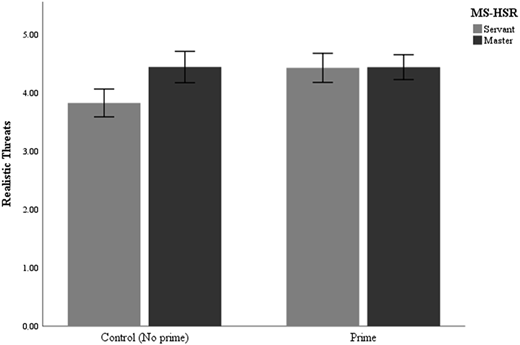
Interaction effects for prime vs. no prime conditions (Source: Authors own work)
Interaction effects for prime vs. no prime conditions (Source: Authors own work)
Finally, the interaction effect of HSR roles by the prime on trust [F(1, 493) = 0.77, p = 0.38] and intentions to use HSRs [F(1, 493) = 0.31, p = 0.58] were not statistically significant. Table 7 shows the means and the standard deviations (SDs) for Study 4.
Study 4 means and standard deviations (SD)
| Control (no prime) | Prime | |||
|---|---|---|---|---|
| Servant | Master | Servant | Master | |
| Intentions to use | 4.81(1.55) | 4.43 (1.77) | 4.51 (1.77) | 4.30 (1.79) |
| Realistic threat | 3.82 (1.37) | ***4.44 (1.46) | 4.42 (1.35) | 4.44 (1.21) |
| Trust | 4.53 (1.25) | 4.21 (1.44) | 4.29 (1.32) | 4.19 (1.43) |
| Cell Size | 132 | 118 | 117 | 130 |
Note(s): *p < 0.05, **p < 0.01. ***p < 0.001. Mean differences are calculated between servant and master conditions. Standard errors are in parentheses
Source(s): Authors’ own work
Moderated sequential mediation. To test the moderated sequential mediation hypothesis, three models were estimated. The first model tests the interaction effect of the prime and HSR roles on realistic threat. Model 2 tests a moderated mediation, accounting for the interaction effect of the prime and HSR roles on realistic threat, and its subsequent effect on trust. The final model (Model 3) estimates the moderating role of speciesism on the effect of trust on intentions to use HSRs. Table 8 shows the regression results divided into three models. The conditional indirect effects were estimated by means of 95% bias-corrected CIs based on 10,000 bootstrap samples.
Model 1. Regression results indicate a statistically significant simple effect of HSR roles and of the prime on realistic threat (β = 0.61, p < 0.001). Furthermore, consistent with the findings of the two-way ANOVA, the interaction of HSR roles by prime was negative and statistically significant (β = −0.60, p < 0.05). That is, realistic threat was perceived to be higher in the master versus the servant condition when participants were not primed compared to the control condition (no prime).
Model 2. Findings for the second stage (path B) of the sequential mediation showed a significant direct effect of realistic threat on trust. As the levels of realistic threat increase, trust levels decrease (β = −0.572, p < 0.001). The effect of master versus servant HSR roles on trust, however, was not statistically significant (β = −0.03, p = 0.747).
Model 3. Finally, the interaction effect of trust and speciesism on intention to use HSRs was positive (β = 0.07, p < 0.01), such that the sequential mediation effect of HSR roles on intention to use HSR via realistic threat and trust increases with higher levels of speciesism when participants were not primed but not when participants were primed. That is, when participants engaged with an HRC in a “high alert mode” (i.e. individuals are exposed to a scenario showing robot threats toward humans), they rate the HSR as a high realistic threat, displaying lower levels of trust and intentions to use HSRs, regardless of the role the HSR plays in the HRC.
Study 4 regression results for mediated-moderation model
| Regression paths | β | t | Estimates | LLCI | ULCI |
|---|---|---|---|---|---|
| Model 1: Prime * Realistic threat | |||||
| MS-HSR > Realistic threat | 0.61*** | 3.6 | 0.23 | 0.95 | |
| Prime > Realistic threat | 0.60*** | 3.51 | 0.27 | 0.94 | |
| MS-HSR × Prime > Realistic threat | −0.60* | −2.49 | −1.08 | −0.13 | |
| Model 2: Realistic threat > Trust | |||||
| MS-HSR > Trust | −0.03 | −0.32 | −0.23 | 0.17 | |
| Realistic threat > Trust | −0.57*** | −15.42 | −0.64 | −0.50 | |
| Model 3: Trust > Speciesism* Intentions to use | |||||
| MS-HSR > Intentions to use | −0.03 | −0.27 | −0.23 | 0.17 | |
| Realistic threat > Intentions to use | 0.06 | 1.09 | −0.05 | 0.16 | |
| Trust > Intentions to use | 0.78*** | 12.10 | 0.65 | 0.91 | |
| Prime > Intentions to use | 0.38 | 1.13 | −0.28 | 1.04 | |
| Speciesism > Intentions to use | −0.69*** | −5.19 | −0.96 | −0.43 | |
| MS-HSR x Speciesism > Intentions to use | 0.005 | 0.06 | −0.15 | 0.16 | |
| Trust x Speciesism > Intentions to use | 0.07** | 2.79 | 0.02 | 0.12 | |
| Indirect effects | Prime | Speciesism | Estimates | LLCI | ULCI |
|---|---|---|---|---|---|
| MS-HSR > Realistic Threat > Trust > Intentions to Use | 0 | −1.37 | −0.24 | −0.40 | −0.10 |
| MS-HSR > Realistic Threat > Trust > Intentions to Use | 0 | −0.04 | −0.27 | −0.44 | −0.11 |
| MS-HSR > Realistic Threat > Trust > Intentions to Use | 0 | 1.37 | −0.30 | −0.49 | −0.13 |
| MS-HSR > Realistic Threat > Trust > Intentions to Use | 1 | −1.37 | −0.004 | −0.12 | 0.10 |
| MS-HSR > Realistic Threat > Trust > Intentions to Use | 1 | −0.04 | −0.004 | −0.13 | 0.12 |
| MS-HSR > Realistic Threat > Trust > Intentions to Use | 1 | 1.37 | −0.005 | −0.15 | 0.13 |
Note(s): ***p < 0.001, **p < 0.01, *p < 0.05
Source(s): Authors’ own work
2.4.6.4 Discussion
As predicted in H4, findings indicate that when speciesists were exposed to retail robots in a master role interacting with a human frontline employee, their levels of realistic threat increased while their levels of trust were also reduced, ultimately lowering their intentions to use HSRs. The results of Study 4 replicate findings from Studies 2 and 3, where individuals with medium to high levels of speciesism experience higher levels of realistic threat and lower levels of trust than the ones experienced by individuals with lower levels of speciesism. However, the current study adds a boundary condition to this effect to demonstrate that this only occurs when individuals have lower levels of perceived threat at the time of judgment. In contrast, when individuals engage with the HRC scenario with higher levels of perceived threat, with a high-alert mindset, neutralizing the moderating effect of speciesism on consumer intentions, resulting in a classic ceiling effect.
2.4.7 General discussion
New research in organizational design has theorized the emergence of different types of AI robot bosses (Burton et al., 2024). Drawing on the synthesis of LMX literature and intergroup threat theory, this study proposed a novel research model that links the working relationships between human frontline staff and HSRs to customers’ perceptions of realistic threat and trust and, consequently, their intention to use service robots in retail stores. Existing literature has assumed the context of service robots in a dyad relationship, that is customer–robot or employee–robot interaction. Furthermore, service robots usually take on the role of an assistant. For example, Guha and Grewal (2022) developed a framework suggesting that retailers deploy robots to augment human capabilities. However, recent news in the popular press point to the possibility of robot leadership. For example, two companies have begun to appoint robots as CEOs (Evans, 2023; Odilov, 2024), demonstrating that AI bosses can supervise worker productivity and make workplace decisions.
Based on four online experiments, we demonstrate the effects of master–servant roles in a frontline retail setting, where customers witness the working relationships between human staff and the HSR. Table 9 summarizes the findings of our research. The first study demonstrated how individuals’ realistic threat reduces HSR usage when robots perform supervisory (i.e. master) roles in HRC. The second study then added a moderator. Specifically, we tested how the effects of speciesism influence individuals’ realistic threat derived from interacting with HSRs, affecting their intentions to use HSRs when robots perform master roles in HRCs. In our third study, we introduced trust as a facilitator. Specifically, we tested how speciesism attenuates individuals’ trust when robots perform a master role. Finally, the fourth study demonstrated how speciesism increases the negative mediating effects of realistic threat and reduces the positive mediating effects of trust, ultimately affecting the intention to use retail robots when they perform a master (vs. servant) role during HRC in frontline retail encounters.
Summary of hypotheses and findings
| Studies | Hypotheses | Findings |
|---|---|---|
| Study 1 | H1: Customers will perceive higher levels of threat when HSRs have a supervisor (vs. assistant) role, which in turn reduces customers’ intention to use HSRs | H1 supported |
| Study 2 | H2: The negative indirect effect of realistic threat on consumers’ intentions to use HSR (H1) is negatively moderated by speciesism, such that this effect becomes stronger with higher levels of speciesism | H1 supported H2 supported |
| Study 3 | H3: The effect of master-servant relationships on customers’ intention to use HSRs is mediated by trust (H3a) such that customers’ perceived trust is higher when the HSR has a servant (vs. master) role, which leads to higher intentions to use HSRs. However, this effect is positively moderated by speciesism (H3b), such that this effect becomes stronger with higher levels of speciesism | H3 supported H3a supported H3b supported |
| Study 4 | H4: The effect of master-servant HSR roles on intentions to use HSRs is sequentially mediated by realistic threat and trust, such that supervisor (vs. assistant) HSRs increase perceived threat and reduce perceived trust, which subsequently reduces customers’ intention to use HSRs. However, the sequential mediation effect becomes stronger with higher levels of speciesism | H4 supported |
Source(s): Authors’ own work
Our findings support and expand current literature (e.g. Vanman and Kappas, 2019; Złotowski et al., 2017), demonstrating that an HSR that performs human-specific tasks (e.g. leader or supervisor roles) triggers individuals’ perceptions of threat realistic threat, reducing their trust towards this type of robot. Individuals perceive these HSRs as an outgroup social category trying to be part of an ingroup social group (humans) (Vanman and Kappas, 2019), limiting intergroup relations, ultimately favoring interactions among ingroup members, humans (Fraune, 2020).
Additionally, our studies demonstrate that speciesists interacting with HSRs performing dominant human-specific tasks experience higher levels of realistic threats than non-speciesists, ultimately limiting their trust towards HSRs. The effects of high levels of speciesism may serve as a protective mechanism to maintain ingroup members (i.e. human staff) safe in their human-specific roles and prefer to interact with them, as they believe they are superior to outgroup members (i.e. HSRs), only choosing to interact with servant types of HSRs. Based on this, our findings also expand the role of speciesism in human–robot interactions (e.g. Huo et al., 2023a, b). Traditionally, speciesism has been perceived negatively in human–animal (Caviola et al., 2019), human–human (Oberg, 2016) and human–machine (Huo et al., 2023a, b) interactions. Our research demonstrates that speciesists prefer interacting with humans performing dominant roles in HRCs rather than HSRs. Customers with high levels of speciesism have the perception of superiority and uniqueness that serve as a psychological barrier that limits the reduction of their fears (realistic threat) and distrust from outgroup members, in this case, HSRs performing supervisory roles in HRCs. This can be explained by speciesists assigning a greater moral value to other humans, not believing that HSRs could perform as humans do, regardless of their role as master or servant. On the other hand, customers with medium to low levels of speciesism who read a scenario about the supervisory roles of HSRs react differently. The perceived threat from outgroup members (i.e. robots as supervisors) will increase while trust decreases. This will negatively influence their intention to use HSRs. Consequently, our results show empirical evidence supporting our theorizing, which has important implications for academic and industry professionals.
2.4.7.1 Theoretical contributions
The present research makes several important contributions to literature. First, we develop and test a novel and innovative research model that links the working relationships between human frontline staff and HSRs to customer perceptions. Recent research has conceptualized different types of AI robot bosses (Burton et al., 2024). Other studies have started to understand the impact of manager-level job titles assigned to AI-based agents on marketing outcomes (e.g. Jeon, 2022). The author found favorable downstream effects on customer attitudes and intentions. In addition, the popular press recently sensationalized the story of an AI-powered humanoid robot designed by Hanson Robotics that was appointed as the new CEO of the Polish drinks company Dictador (Haughey, 2023). Research by Gartner suggests that “robo-bosses” could replace human managers in middle management by 2030 (Tech Wire Asia, 2020). Our research goes a step further and assumes the fact that HSRs will take on immediate supervisor roles in hybrid service encounters. The results provide important insights for an integrated human-robot frontline workforce in which both human and robot staff can inhibit a number of different roles (Tuzovic, 2024). Our findings add to the new debate on robot bosses in organizations (Burton et al., 2024) and manager-level job titles assigned to AI-based agents (Jeon, 2022) and extend it to the field of frontline service encounters. We thus fill in an important research gap and provide new research directions for the domain of HRCs and the robotization of the workforce.
Second, we link organizational behavior literature, such as leader–member exchange (Stringer, 2006) and supervisor–subordinate dyads (Ismail et al., 2012), to the growing field of human–robot interaction and service robot implementation. Based on a study by Kim et al. (2016), we argue that different master–servant relationships between human and robotic staff will have spillover effects on customer perceptions. Our results indicate that the conditions of master–servant relationships between human retail staff and HSRs influence customers’ realistic threat and trust towards HSRs. This research thus expands the field of supervisor–subordinate dyads to the context of service encounter triads.
Third, we add to the novel research on speciesism in human–AI relationships (Huo et al., 2023b). Based on Intergroup Threat Theory (Giger et al., 2019; Stephan et al., 2015), the argument is that humans may subconsciously treat HSRs as a new distinct social species and outgroup members, leading to lower acceptance toward them (Fiestas et al., 2024). So far, only a few studies have investigated the boundary role of speciesism (e.g. Huo et al., 2023b). We demonstrate that speciesists would perceive higher levels of realistic threat when they perceive retail robots in a master role over human sales staff. In addition, the results indicate that speciesism also affects individuals’ trust, ultimately reducing their intention to use HSRs for in-store shopping. Overall, these findings enhance our understanding of the effects of speciesism on human-robot interactions. While our study focused on customer perceptions, the results are relevant for the transformation of workplaces and the reluctance of employees to use AI technology (Fiestas et al., 2024). They provide critical insights to design successful hybrid human-robot teams where customers do not feel threatened and trust HSRs.
2.4.7.2 Managerial implications
The study offers important managerial implications for retail professionals. As AI robotics and natural language processing continue to advance, the retailing industry is expected to increasingly deploy advanced HSRs that can work seamlessly alongside human employees (Noble et al., 2022). Yet, retailers face several critical questions regarding the robotization of their workforce. On the one hand, they need to consider the impact of assigning HSRs new job titles, such as “AI manager” (Jeon, 2022). Our findings offer retailers evidence that the traditional supervisor–subordinate dyad should be widened to a triad that also includes customers. As frontline environments transition to hybrid service teams, retailers should understand how the changes in organizational design will have downstream effects on customers’ perceptions and behaviors. Our scenarios used highly human-like robots. At this stage, customers may not feel comfortable with witnessing advanced HSRs in a master role. Thus, our study supports Jeon (2022), who states that retailers should begin the transition slowly. First, they should assign new job roles or titles for humans before replacing them with robots. This may require developing educational marketing campaigns and communication strategies to promote HRCs in retail environments.
Second, the research findings suggest that paying more attention to customers with a higher perception of human uniqueness is critical. Prior research shows that it is not easy to reduce people’s speciesist attitudes (Banach and Stel, 2024). One option for retailers is to identify speciesists through segmentation. For example, Huo et al. (2023b, p. 6) suggest to “select employees with high-level speciesism as much as possible to actively make their employees involved in the development process of medical AI.” While our study was conducted in a different context, the segmentation of customers with high-level speciesism offers retailers better strategies for designing hybrid service teams with advanced HSRs. Third, managers should consider hiring HSR supervisors as they may be considered less socially biased (Maddison, 2023). Retailers can employ HSRs as leaders to improve the in-store experience by resolving customer service issues objectively, consistently and fairly. This will be possible to implement across different shifts and stores, creating a coherent shopping experience based on the company’s values and policies, avoiding social biases that store managers might have towards customers in certain situations (Linzmajer et al., 2020).
2.4.8 Limitations and future research directions
The present research addresses a novel and innovative topic of human–robot relationships in the retail industry. While robots are increasingly transforming work environments as well as the in-store customer experience, the role of robots as supervisors and their spillover effects within a service encounter triad has not yet been investigated. Taking a futuristic outlook, this study has several important limitations. First, data was collected in the United States. Future research should replicate this work in other cultural contexts. As Yam et al. (2022) note, “the exposure to robots as a result of geographical locations might exert interesting effects on how robots are perceived” (p. 8). Participants in the United States might have a pre-existing negative perception of HSRs because of their exposure to the negative effects of robots on humanity in media and entertainment. For example, Hollywood movies such as “The Terminator” or the HBO Series “Westworld” often portray robots as a threat. In Asian countries, however, robots are presented as Allies to defeat enemies of humanity, such as Briareos (Appleseed, a Japanese manga franchise) or Mazinger Z (manga and anime created by Go Nagai). Furthermore, Asian citizens are more accustomed to interacting with different types of AI-technology and robots (Lufkin, 2020).
Second, the context of the research was limited to the retail industry. Even though the research field of robots in retail is still a relatively new and underexplored study area (De Gauquier et al. (2020), future research may extend the study to other service sectors. For example, HSRs are increasingly adopted in hospitality and healthcare services. Whether or not customer reactions to master–servant relationships between human and non-human staff will differ in those industries is unknown.
Third, the research design may limit the generalizability of the results. We selected two specific shopping scenarios of popular products with utilitarian benefits: laptops and camping equipment. Future research should expand the analysis and compare different utilitarian and hedonic product categories. In addition, we used online-based scenarios. Future studies may conduct a field experiment with a real HSR working alongside human frontline staff. Thus, it is possible that the effects of realistic threat and speciesism might differ. However, the use of online experiments allows scholars to easily replicate and manipulate master-servant roles in HRC while access to human-like robots like Sophia is limited or even impossible.
Fourth, we selected Sophia in our scenarios, as it is one of the world’s most advanced human-like and well-known HSRs. While Sophia has attracted much popular press, many humanoid robots are still in the prototype phase or other early stages of development (Built In, 2024). Real-world use cases of humanoid robots are limited. The deployment of robotic retail assistants currently includes service robots that are equipped only with some human-like features, such as Pepper. But, even though retailers may face a number of challenges of adopting humanoid robots (Gratton, 2024), the field of human-shaped robotics with dexterous hands is rapidly evolving (Melissa, 2024). For example, Agibot, a Chinese robotics start-up launched in February 2023, has stirred significant excitement in the industry with its announcement of having begun mass production of general-purpose robots (Caiyu, 2024). In the U.S., Agility Robotics has opened a humanoid robotics factory in Salem, Oregon, for the mass production of its humanoid robot Digit (Curryer, 2023).
And finally, we recognize that there is an ongoing relevant debate about the effects of the Uncanny Valley on human-robot interactions (Belanche et al., 2021; Mende et al., 2019). On one side of the debate, Mende et al. (2019) affirm that service robots with high levels of human-likeness can trigger individuals’ threat perception, and on the other hand, Belanche et al. (2021) demonstrate that individuals valuing innovation and social recognition prefer to interact with human-like service/social robots. In the present research, the authors decided to avoid focusing on this debate, as we consider that HSRs performing as masters (i.e. in supervisory roles) will replicate human-like characteristics (Damholdt et al., 2023; Tojib et al., 2023). However, they recommend that future research on HSRs acting in master–servant roles should examine the effects of the Uncanny Valley to contribute to the ongoing debate on its effects.
Despite the abovementioned limitations, this research offers novel and thought-provoking evidence as well as new opportunities to guide future research. First, the current debate has largely centered on drivers of human-robot interactions and, more recently, the area of HRC. Yet, the limitation of these studies is based on a dyadic perspective. As some scholars have begun to emphasize a triad relationship (e.g. Odekerken-Schröder et al., 2022), future research should study the new roles of HSRs in work environments. For example, Hou et al. (2023) point out to investigate specific power mechanisms such as coalition forming and relational demography in groups of more than two members. More research is also needed in understanding the impact of more empowered HSRs on employees’ autonomy and self-esteem. Thus, interdisciplinary studies are needed that combine different views of robotics, frontline services and human resources. Some scholars have already begun to consider the role of AI job titles on customers’ perceptions of AI agents (Jeon, 2022). In addition, research is needed to understand the role of upskilling and reskilling to cultivate employees’ transversal skills (Morandini et al., 2023). Finally, while the leader–member exchange theory has been applied to study the working relationships between subordinates and their immediate supervisor, future research should develop new theories to better understand frontline working relationships between human and non-human staff and their spillover effects on other employees or customers.
References
The supplementary material for this article can be found online.

