To ensure employee well-being and productivity, understanding and managing job demands and resources is crucial. Job demand-resources (JD-R) theory offers insights into this interplay in public healthcare organization. This paper aims to explore the balance between staffing needs, job demands, job resources and job satisfaction.
This is a cross-sectional study, using both employees’ self-reported and administrative data on working hours. Through a comprehensive survey, the perceptions of 26,577 employees were assessed. Staffing needs were then also objectively assessed through the application of a national methodology, adding the organizational perspective to the field of analysis.
Results indicate that adequate staffing, as perceived by employees and calculated objectively, correlates with improved reasonable workload. The impact of staffing needs on job satisfaction is more nuanced, with excess staffing possibly diminishing satisfaction. Furthermore, a positive perception of equipment adequacy reduces discrepancies between perceived and objective staffing needs.
Accurately assessing staffing needs with objective data is vital to prevent burnout and boost job satisfaction. Healthcare organizations must address gaps between perceived and actual staffing, offer support and invest in resources like leadership and technical equipment to maintain a resilient, motivated workforce.
The originality and value of this study lie in the complementarity of self-reported and administrative data, which add empirical evidence on the effect of human resource management (HRM) policies on the micro-individual level. This study contributes to the growing body of literature on JD-R theory, highlighting the impact of job demands on job satisfaction and adding the value of staffing needs in shaping this relationship.
Introduction
Public organizations play a crucial role in providing essential services to society, facing unique challenges that stem from their diverse responsibilities, complex structures, and dynamic environments. To ensure the well-being and productivity of their employees in the face of these challenges, understanding and managing work-related demands and resources becomes paramount (Bakker et al., 2023).
The Job Demands-Resources (JD-R) Theory, a prominent theoretical framework in Human Resources Management (HRM), offers valuable insights into this complex interplay (Bakker et al., 2023; Demerouti and Bakker, 2023). In public organizations, job demands can take a toll on the mental and physical health of workers and may result in reduced job satisfaction, increased absenteeism, and turnover intentions (Bakker et al., 2004, 2023). These demands can manifest in various ways. Due to the nature of their tasks, employees may experience high workloads, time pressure, emotional labor, and exposure to potentially traumatic events, depending on their roles (Schaufeli and Taris, 2014). Furthermore, bureaucracy and strict regulations may increase administrative burdens and reduce employees’ autonomy (Halbesleben et al., 2008; SCOTT, 2003). Identifying and managing these job demands is crucial to ensure a healthy and resilient workforce within public organizations (Maslach and Leiter, 2008).
On the other hand, there’s a unique range of job resources that can buffer the negative effects of job demands and foster employee well-being. Supportive leadership, opportunities for skill development, and a positive organizational culture are vital resources that can enhance job satisfaction, performance, and commitment (Bakker and van Woerkom, 2018; Wang et al., 2023). Public organizations need to recognize and optimize these resources, since they’re essential to create a positive work environment and promote the overall functioning of their workforce (Demerouti and Bakker, 2011).
Once we recognize the importance of job resources in mitigating job demands, and the relevance of the balance between them, (Bakker et al., 2023), an interesting question arises: What happens to employees’ behavior when the demand to be addressed is high, but the available resources, here intended as the required number of professionals to guarantee the service, are scarce?
Theoretical background and research questions
Organizational Behavior (OB) emerged during the 20th century as a research field that examines how individuals and groups engage within an organization and how these engagements impact an organization’s effectiveness (Gibson et al., 2012). Nevertheless, human behavior presents an intricate and diverse field of inquiry that is continuously developing and evolving in response to societal shifts (Bakker and Demerouti, 2018; Cantarelli et al., 2020).
The JD-R Theory aims to explain the impact of work characteristics on employee well-being and performance (Bakker et al., 2004). The theory posits that the work environment consists of two distinct components: job demands and job resources.
Job demands refer to aspects of the job that require physical, psychological, or social efforts and can lead to stress and burnout if they exceed workers’ capabilities.
In contrast, job resources are the elements that facilitate goal achievement, reduce job demands, and promote well-being and motivation among employees (Bakker and Demerouti, 2017). According to the JD-R Theory, strain could emerge when there is an imbalance between the demands posed by a job and the resources available (Bakker et al., 2023). While scholars have traditionally employed this conceptual framework to examine the causes of employee burnout and disengagement (Bakker et al., 2004), recent applications underscore the significance of particular demands and resources in the work environment in shaping favorable as well as adverse employee consequences (Andrews and Mostafa, 2019; Bakker and Demerouti, 2018; Tummers and Bakker, 2021).
Contextualizing JD-R theory applications in public healthcare organizations
As public organizations continue to face evolving challenges, it is crucial to adapt the JD-R Theory to the specific public sector context. The JD-R Theory provides a valuable framework for understanding the complexities of work environments in healthcare organizations (Ancarani et al., 2019; Donelli et al., 2022; Salas-Vallina et al., 2023; Tomo and De Simone, 2019).
Healthcare organizations play a vital role in providing essential medical services, supporting communities, and promoting public health. However, these organizations often face unique challenges that require a delicate balance between meeting staffing needs, managing job demands, and providing resources that facilitate employee’s satisfaction (Ceschel et al., 2024; Metcalf et al., 2018). Staffing needs are of utmost importance in healthcare as patient care directly relies on having the right number of qualified and motivated professionals available. Inadequate staffing levels can intensify the workload and heighten job demands, negatively impacting both employees (Aiken, 2002) and patient outcomes (van der Mark et al., 2021). Healthcare professionals work in dynamic and demanding environments characterized by long working hours, emotional intensity, and the responsibility for patient care. These inherent job demands can lead to burnout and reduced job satisfaction if not addressed (Chen and Chen, 2018).
Recognizing the high job demands that healthcare professionals face, particularly in terms of staffing needs, is crucial for preventing burnout and maintaining a resilient workforce (Salas-Vallina et al., 2023). Simultaneously, providing job resources, such as self-actualization opportunities, can empower healthcare professionals to thrive in their roles, leading to increased job satisfaction and enhanced organizational performance (Chen and Chen, 2018; Holmgreen et al., 2017). By addressing staffing needs adequately and providing sufficient job resources, healthcare organizations can create a positive work environment that enables their employees to cope effectively with job demands (Dall’Ora et al., 2020) and enhance their overall wellbeing and satisfaction (Bakker et al., 2023; Giauque, 2016).
One critical aspect of the JD-R Theory is the interaction between job demands and job resources (Demerouti and Bakker, 2011). It is suggested that high job demands may lead to strain and burnout (Bakker et al., 2004), while ample job resources can alleviate the negative impact of high job demands, creating a “motivational process” that stimulates employee engagement and job satisfaction (Breevaart and Bakker, 2018; Tummers and Bakker, 2021). In public healthcare organizations, understanding this dynamic relationship is essential for crafting effective HRM strategies.
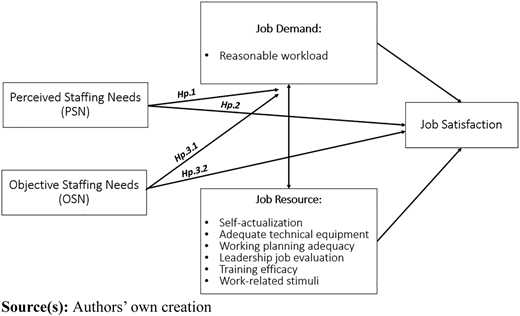
Given those premises, this article aims to explore the balance between staffing needs, job demands, here defined as reasonable workload, job resources, and job satisfaction (Figure 1). Reasonable workload refers to employees’ perceptions with respect to the item “My workload is reasonable”, for which we were inspired by the Federal Employees’ Viewpoint Survey, one of the largest and most structured questionnaires devoted to public employees (Office of Personnel Management, 2023). By adding the organizational level, with staffing needs as objectively calculated, we want to contribute to the literature on Organizational Behavior (OB), generally focused on the micro-level (Gibson et al., 2012), aligning with research perspectives that tend to include the organizational level into the field of analysis (Bakker and Demerouti, 2018; Lin-Schilstra et al., 2024; Wright et al., 2018).
Unveiling workload complexities: the role of staffing needs
The first component of the JD-R Theory, job demands, is particularly evident in healthcare organizations. The most recurrent variable associated with job demand is workload, which includes factors such as task complexity, time pressure, and administrative responsibilities (Maslach et al., 2001). Numerous studies have explored the detrimental effects of excessive workload on employee satisfaction, and productivity (Bakker and Demerouti, 2017; Cantarelli et al., 2016; Holland et al., 2019), as is equally vast the literature on its main determinants (Bi and Salvendy, 1994; Wickens, 2008). However, one essential aspect that remains relatively under-covered in the existing literature is the influence of staffing needs on job demand. Staffing needs refer to the adequacy of the workforce in meeting the demands of a particular job or task (Pirrotta et al., 2024). A well-staffed workforce can help distribute the workload more evenly among employees, reducing the burden on individual workers. Consequently, employees who perceive higher staffing needs might also be more likely to experience unsustainable workloads. When staffing levels align with job demands, employees are less likely to be overwhelmed by excessive workload, leading to improved well-being and job satisfaction (van den Oetelaar et al., 2021).
Despite its potential significance, the literature has not extensively investigated the link between staffing needs and job demand. While recent studies have delved into the effects of understaffing on employee stress and burnout (Kaufman et al., 2022; van der Mark et al., 2021), the relationship between perceived staffing needs and reasonable workload remains an area ripe for exploration. Assessing the effects of Perceived Staffing Needs (PSN), then, is paramount to understanding how the work experience is sustainable for employees.
Healthcare professionals who report perceiving understaffed are more likely to perceive unsustainable workloads than health care professionals reporting adequate staffing levels.
On the other hand, staffing needs play a critical role in shaping the relationship between job resources and employee well-being (Diehl et al., 2021). While job satisfaction has been widely studied in human resource management (HRM) literature (Cantarelli et al., 2016, 2023), to the authors’ knowledge, the specific link between staffing needs and job satisfaction has not received sufficient attention.
A well-staffed healthcare organization is better equipped to provide the necessary job resources that contribute to employee satisfaction. Adequate staffing levels ensure that employees have the time and capacity to engage in professional development and training opportunities, which are essential for personal growth and achieving their potential (Scheffler et al., 2016). Moreover, supportive leadership and a positive organizational culture, which are crucial job resources, are more achievable when staffing needs are met. When organizations have enough staff to handle responsibilities, leaders can dedicate more time to supporting and recognizing their employees (Breevaart and Bakker, 2018; Tummers and Bakker, 2021). A positive work environment that values contributions and promotes work-life balance becomes feasible with appropriate staffing levels. This, in turn, enhances employees’ satisfaction with their jobs and boosts their commitment to the organization (Nuti et al., 2019; Zeijen et al., 2020).
In contrast, when healthcare organizations face understaffing, job resources may become scarce, negatively impacting job satisfaction. In such circumstances, supportive leadership and a positive organizational culture might be difficult to maintain, leading to decreased job satisfaction and a higher likelihood of burnout.
Therefore, we hypothesized that although job resources have a positive impact on job satisfaction (Bakker et al., 2023; Cantarelli et al., 2016; Tummers and Bakker, 2021), these alone cannot overcome the lack of the main resources, namely human resources.
Healthcare professionals who report perceiving understaffed are more likely to be unsatisfied than healthcare professionals reporting adequate staffing levels.
Dealing with organizational dynamics: objective staffing needs
As stated by Bakker and Demerouti “organizations may influence employee work engagement and performance through human resources (HR) practices.” (2018, p. 5). In the same work, the authors call for more evidence regarding weather HRM practices can act as buffer or exacerbator of the effects on individuals (Bakker and Demerouti, 2018).
In this study, we refer to Objective Staffing Needs (OSN) as calculated through the application of structured scientific methodology (Decreto Ministeriale 24.01.2023, 2023). This methodology considers various organizational factors such as patient volume, acuity levels, task complexity, and required skills to determine the appropriate staffing levels (Pirrotta et al., 2022). It allows, through the collection of administrative data, to calculate the specific staffing needs for each professional family and care setting. The specificity of these results ensures a useful tool for HR managers and policy makers, enabling them to better plan staff deployment or design task shifting and skill mix practices.
By employing data-driven approaches to assess OSN, we also wanted to try avoiding the potential pitfalls of relying solely on employees’ subjective perceptions. The phenomenon of the common source bias arises from the potential for data collected from a single source to be influenced by the individual’s perceptions, leading to potential distortions in the findings (Jakobsen and Jensen, 2015). Common source bias can manifest when individuals’ subjective perceptions, such as perceived staffing needs (PSN), become the sole basis for understanding critical organizational dynamics (Kim and Daniel, 2020). These subjective perceptions may be influenced by various factors, consequently introducing biases and inaccuracies into the analysis (Favero and Bullock, 2015), and potentially clouding the true picture of workforce dynamics within healthcare organizations.
To mitigate the impact of common source bias and provide a more comprehensive understanding, this study adopts a two-pronged approach, considering both PSN and OSN. By comparing PSN with OSN, we want to gain a comprehensive understanding of the HRM dynamics and the organizational climate in healthcare organizations. Discrepancies between perception and actual situation may highlight areas where employees’ needs are not adequately addressed due to understaffing or misallocation of resources. Additionally, such comparisons can identify instances where employees’ perceptions align with the OSN, providing affirmation that the organization is effectively managing its workforce.
To conclude, OSN provides a solid foundation for evidence-based decision-making in healthcare workforce management (Crettenden et al., 2014; Laquintana et al., 2017) and we expect the same effects on workload sustainability and job satisfaction, as for PSN.
Healthcare professionals being understaffed, as objectively calculated, are more likely to perceive a lower reasonable workload than healthcare professionals with adequate staffing levels.
Healthcare professionals being understaffed, as objectively calculated, are more likely to be unsatisfied than healthcare professionals with adequate staffing levels.
Methodology
Participants and study setting
This is a cross-sectional study investigating the relationship between Perceived and Objective Staffing Needs and reasonable workload and job satisfaction, in the light of JD-R theory. To measure employees’ perceptions of job demands and resources, we used data from an organizational climate survey.
The survey, conducted in 2023, involved a total of 26,577 employees in an Italian Regional Healthcare System (RHS), with a response rate of 49.15%. The Italian National Health System (NHS) is a universal system that follows the Beveridge model and operates in a decentralized manner. It consists of nineteen regions and two autonomous provinces (Pirrotta et al., 2022). The system is organized into three levels: national, regional, and local, each with its own responsibilities and administration. Our study population consists of 9 different Local Health Authorities (LHAs) that forms a RHS. The survey targeted all RHS employees, thus allowing comparisons between different professional families or working areas.
About OSN, the methodology calculates staffing needs expressed in full-time equivalents (FTE), a measurement unit typically used in HRM to identify the exact staffing requirements needed to fulfill the workload (Shipp and WHO, 1998). When the score is negative, it means that there is a shortage of staff; conversely, a positive score highlights a surplus of staff. Considering that the method at this early stage allowed us to effectively calculate the needs for medical personnel only, for the third set of hypotheses we drop the responses of the other professional families, excluding nursing personnel. The choice to keep the responses of nursing staff is due to the desire to measure how medical OSNs impact their workload perceptions. The number of responses available in this third part is then reduced to 3,798.
The socio-demographic and work-related futures of our study population are shown in Table 1.
Measures and data analysis
The questionnaire consists of about one hundred questions, most of which have a 5-point Likert response scale, ranging from 1, expressing total disagreement with the item in question, to 5, expressing strong agreement. To investigate the multiple constructs underlying JD-R theory, once considered the reliability of the approach, as outcome variables, we used individual items representative of the object of analysis (Dolbier et al., 2005; Fakunmoju, 2020). Concerning Perceived Staffing Needs (PSN), again we used a single item in which we asked employees to express their opinion about the adequacy of staff, of their professional family, in their work unit. In detail, the scale for measuring the perception of staffing needs ranges from 1 to 5. A score of 1 represents employees’ perception of a 20% shortage of staff. Conversely, 5 indicates a perceived surplus of 20%. A score of 3 indicates adequacy of staffing, while 2 and 4 respectively report shortage and surplus situations of 10%.
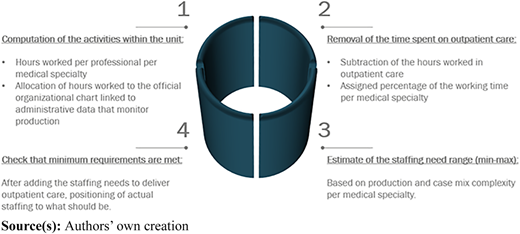
About Objective Staffing Needs (OSN), we used administrative data extracted from an ad hoc collection with the same organizations as the survey and applied a methodology for calculating hospital staffing needs (DM 24.01.2023). This methodology leverages objective administrative data to measure the productivity and efficiency of healthcare organizations and returns a result expressed as a deficit or surplus of personnel at the operational unit level. In order to compare the results with the soft part derived from the questionnaire, the results of this methodology were aggregated at the Homogeneous Area level (e.g. Medicine, Surgery, Emergency-Urgency, etc.).
The methodology involves four key steps: calculating the activities within the unit using hours worked by professionals per medical specialty, excluding time allocated to outpatient care, estimating the staffing needs based on production and case mix complexity, and verifying compliance with minimum staffing requirements. A brief description of the calculation procedures is illustrated in Figure 2.
For the statistical analysis, we began by assessing the distribution of all outcome variables using the Shapiro-Wilk test, which confirmed their nonnormal distribution. Consequently, we opted for Ordinary Least Squares (OLS) regression analyses to test our hypotheses grounded in the Job Demands-Resources (JD-R) theory. This approach enabled us to investigate both the direct associations between the variables under study, which are central to our hypotheses.
We incorporated a robust set of control variables to account for potential confounding effects. These included organizational-level factors, such as the working area, and individual-level factors, such as gender and professional family, ensuring that the analyses accounted for both macro- and micro-level influences.
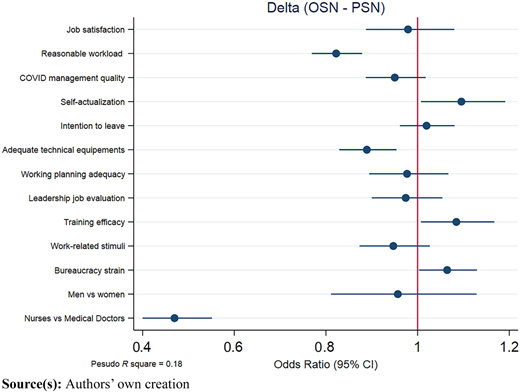
To further explore the relationship between Perceived Staffing Needs (PSN) and Objective Staffing Needs (OSN), we conducted an additional set of analyses. After standardizing both PSN and OSN scores, we computed a Delta variable to capture the difference between the two. The Delta variable was then dichotomized: a value of “0” indicated PSN equal to or exceeding OSN, while “1” denoted cases where OSN was greater than PSN. This dichotomous variable served as an outcome in subsequent analyses, providing insights into the discrepancies between perceived and objectively calculated staffing needs.
All data management and statistical analyses were conducted using Stata software version 17.1 (StataCorp LLC, College Station, Texas, USA). The use of this platform ensured rigorous statistical processing and facilitated comprehensive data handling, including the management of large datasets derived from the organizational survey and administrative records.
This multifaceted approach allowed us to address our research questions from various perspectives, offering robust evidence for the hypotheses tested.
Results
The results fully support the first hypotheses while fail to support second hypothesis. The perception that own work unit is understaffed appears to affect the perceived workload sustainability, while on the contrary perceiving being overstaffed seems to negatively affect job satisfaction (see Table 2).
More in detail, the assessment of reasonable workload is worse both where employees reported being understaffed by 20% or more (OR = 0.422, p < 0.001) and where they reported a shortage of about 10% (OR = 0.619, p < 0.001), concerning the ones who report having adequate staff. Other organizational climate aspects were also found to have an impact on the perceptions of reasonable workload, both positively, such as a good perception of work planning (OR = 1.442, p < 0.001), and negatively, such as stress caused by bureaucratic-administrative tasks (OR = 0.779, p < 0.001). Full model results are presented in Table A1 (See Appendix).
Regarding the second hypothesis, findings are reported synthetically in Table 2, (for full model see Table A2 Appendix). The results fail to support that individuals’ perception of being understaffed in their work unit has an impact on job satisfaction. On the contrary, it emerges that employees who stated that they had 20% more staff reported lower job satisfaction scores (OR = 0.737, p < 0.05). The most impactful variables on job satisfaction appear to be related to aspects of the organizational climate. Positive perception of one’s leadership job (OR = 2.456, p < 0.001) and a high sense of self-actualization (OR = 2.053, p < 0.001) appear to be the major determinants of high job satisfaction.
Coming to the third and final set of hypotheses, the results support the frame that as staffing requirements decrease, both as perceived by employees (OR = 1.458, p < 0.001) and as objectively estimated (OR = 1.007, p < 0.05) correspond to higher levels of reasonable workload. These results, reported in Table 3 (see also Table A4 for full model Appendix), suggest also that Perceived Staffing Needs (PSN) has a greater impact than Objective Staffing Needs (OSN) on the sustainability of workloads.
No significant relationship emerged between job satisfaction and both PSN and OSN. Full results are shown in Table A5 (see Appendix).
Analysis of the difference between PSN and OSN produced interesting results (see Figure 3 or Table A3 Appendix). Employees who perceived work rhythms as more sustainable tended to be less likely to perceive discrepancies between OSN and PSN (OR = 0 0.822, p < 0.001). A better perception of the adequacy of technical equipment is also associated with a lower inclination to perceive discrepancies (OR = 0.889, p < 0.001). In addition to this, employees who perceive a greater burden of bureaucratic procedures are more likely to perceive discrepancies between OSN and PSN (OR = 1.064, p < 0.05).
Discussions
The present study aimed to shed light on the role of staffing needs in affecting reasonable workload and consequently job satisfaction, under the light of the JD-R theory. The results provide valuable insights into the complex interplay between job demands, job resources, and employee well-being in the context of a public healthcare organization.
The findings support the first hypothesis, indicating that healthcare professionals who perceive their work units as understaffed are more likely to experience unsustainable work rhythms. This aligns with previous research indicating that staffing requirements significantly influence employee workload and job demands (Madsen et al., 2023; van der Mark et al., 2021). The results emphasize the importance of addressing staffing needs effectively to prevent burnout and promote a sustainable work environment in healthcare organizations. Additionally, the results confirm that perceptions of reasonable workload vary among different professional families within the healthcare organization (Elder et al., 2020; McCormick et al., 2023; Torrens et al., 2020). Health staff employees reported the highest perception of reasonable workload, followed by administrative staff and nursing staff. This highlights the need to consider the unique job demands experienced by various professional groups within the organization and tailor interventions accordingly. By understanding these differences, healthcare organizations can develop targeted strategies to optimize workloads and enhance employee well-being across all departments.
Contrary to the second hypothesis, the study did not find a significant direct relationship between PSN and overall job satisfaction. However, it did reveal that employees who reported having 20% more staff than perceived necessary exhibited lower job satisfaction scores. This suggests that an excess of staff may not necessarily correlate with higher job satisfaction and that other factors, such as leadership support and self-actualization opportunities, play a more critical role in promoting job satisfaction among healthcare professionals, as already demonstrated by previous studies (Breevaart and Bakker, 2018; Cantarelli et al., 2016; Glaser et al., 2018). Therefore, healthcare organizations should focus on providing adequate job resources that contribute to job satisfaction, rather than merely increasing staff numbers.
The third set of hypotheses explored Objective Staffing Needs (OSN) and their impact on reasonable workload and job satisfaction. Regressions’ results confirmed that as staffing requirements decrease, both perceived and actual, there is a corresponding increase in reasonable workload perception by employees. This highlights, as already stated (Geys et al., 2023; Pirrotta et al., 2022), the significance of accurately assessing and meeting staffing needs to ensure a sustainable work environment for healthcare professionals. It also suggests that PSN plays a more substantial role in influencing reasonable workload compared to OSN.
Employees’ perceptions of their work environment are crucial factors that impact their well-being and job satisfaction. Therefore, healthcare organizations should pay close attention to employees’ perceptions and take steps to address any discrepancies between perceived and objective staffing needs. Furthermore, the analysis of the difference between PSN and OSN revealed that employees who perceived their work rhythms as more sustainable were less likely to perceive discrepancies. This suggests that employees who are content with their current workload are less likely to perceive any discrepancies in staffing levels, indicating a level of satisfaction and alignment between perceived and actual staffing needs. Moreover, a positive perception of the adequacy of technical equipment was associated with a lower inclination to perceive discrepancies in staffing needs. This suggests that providing the necessary resources, such as modern and efficient equipment, can positively influence employees’ perceptions of staffing adequacy and reduce the likelihood of experiencing discrepancies in their perceptions. On the other hand, employees who perceived a greater burden of bureaucratic procedures were more likely to perceive discrepancies in staffing needs, indicating that administrative burdens might contribute to employees’ perception that their staffing needs were not being adequately met.
Academic and practical implications
The present study contributes to the growing body of literature on the JD-R Theory, providing insights into the role of staffing needs as job demands in public healthcare organizations and responding to the call for more evidence about the impact of HRM policies (Bakker and Demerouti, 2018). The results underscore the importance of effectively managing staffing needs to mitigate job demands and promote employee well-being and job satisfaction. The findings have several practical implications for healthcare organizations. First, it is crucial to accurately assess staffing needs through data-driven methodologies to ensure that the right number of qualified professionals is available to handle the workload. This can help prevent burnout, increase job satisfaction, and enhance patient care quality. Second, healthcare organizations should pay attention to employees’ perceptions of their work environment, particularly regarding reasonable workload and staffing adequacy. Addressing any discrepancies between perceived and real staffing needs can improve employee morale and contribute to a positive work environment. Third, providing adequate job resources, such as supportive leadership and opportunities for self-actualization, is essential for promoting job satisfaction and employee well-being. Findings confirm that investing in job resources can act as a buffer against job demands and contribute to a resilient and motivated workforce.
Limitations and future research avenues
This study presents some limitations that should be acknowledged. First, the cross-sectional design prevents establishing causal relationships between variables, restricting the interpretation of the observed associations. Additionally, the use of single-item measures for certain constructs, such as Perceived Staffing Needs, may not fully capture the complexity and nuances of these concepts. The scope of the objective staffing data further narrows the analysis, as it focuses exclusively on medical personnel, leaving out other essential roles like administrative and support staff. Moreover, the study was conducted within a single Italian Regional Healthcare System, which might limit the generalizability of findings to other healthcare systems with different organizational structures or cultural contexts. Despite these limitations, the study provides valuable insights into the dynamics of job demands, resources, and staffing needs in healthcare settings. Future research could further explore the dynamic relationship between staffing needs and job demands in healthcare organizations, considering other variables such as skill mix strategy, task shifting to deal with complexity, and the impact of different job resources on employee outcomes. Additionally, comparative, and longitudinal studies across different healthcare systems could provide valuable insights into the generalizability of the findings and potential cultural differences in perceptions of staffing needs and job demands.
Conclusion
This study highlights the significance of staffing needs in public healthcare organizations, emphasizing their role within the framework of the JD-R Theory. The results highlight the importance of effectively managing staffing needs to promote a sustainable work environment, mitigate job demands, and enhance employee well-being and job satisfaction. Healthcare organizations should recognize the significance of employees’ perceptions of their work environment and invest in job resources that support their staff, but they also should consider structured methodologies to assess staffing needs objectively. By combining these approaches, public healthcare organizations can create a work environment that fosters employee growth, and satisfaction, and ultimately, delivers high-quality patient care.
Luca Pirrotta acknowledge the support provided by the Italian Minstry of University and Research (MUR) through the project “HEALTH TECH: Technologies for More Resilient and Sustainable Social-Health Systems” under the Fund for the Promotion and Development of Policies within the National Research Program (PNR), in accordance with EU Regulation No. 241/2021 and the PNRR 2021–2026. Nicola Bellè and Paola Cantarelli also acknowledge funding from the European Union - Next Generation EU (No: PNRR MUR M4 C2 Inv. 1.5 CUPJ13C22000420001 – Tuscany Health Ecosystem, Spoke 10). The views and opinions expressed are those of the authors only and do not necessarily reflect those of the European Union or the European Commission. Neither the European Union nor the European Commission can be held responsible for them. This study is part of a series of collaborative initiatives carried out in partnership with Regione Toscana. We would like to express our heartfelt thanks to them, as well as to the Management and Healthcare Laboratory of the Sant’Anna School of Advanced Studies, for their invaluable support and cooperation.