This paper seeks to conceptualise an integrated, dynamic, everyday low-price (EDLP) retail business model (EDLP-RBM) and understand how retailers revitalise their EDLP business model in today’s hypercompetitive environment.
The study is based on an in-depth, longitudinal case study of EDLP retailers, employing a multi-case study methodology. The qualitative approach adopts an exploratory grounded theory perspective to build an interpretive theory for EDLP-RBM and BMI.
The paper proposes an extended representation of the EDLP-RBM, highlighting the interlocking elements that collectively renew the BM to create, capture and deliver value in a competitive context characterised by significant discontinuities for the retailers.
The main limitation is related to the qualitative nature of the research, which reduces the opportunity for generalising the results.
The case studies reveal that the BMI can serve as a redefinition of the value proposition currently offered within the industry (i.e. conventional EDLP, HILO and discount retailing) and how the operating model delivers it.
The study puts in evidence how leading Italian EDLP retailers innovatively and dynamically (re)combine different conceptual frameworks of BMs, such as their strategic variables, by experimenting with new ways to renew their competitive advantage to create and capture value.
1. Introduction
The everyday low price (EDLP) approach has traditionally been considered a pricing strategy that promises consumers a consistently low price, without requiring them to wait for sales or engage in time-consuming comparison shopping. The EDLP model, introduced by the Walmart retail chain in the United States in 1994 (Bergdahl, 2004), has been adopted by several national and international grocery retailers. This paper contributes to the retail business model (RBM) literature by presenting a conceptual framework for an EDLP retailer’s business model (EDLP-RBM), leveraging the specificities of the Italian EDLP-RBM implemented by prominent firms. It also contributes to the consolidated body of knowledge on BMI by providing new ways through which companies could experiment with BMI innovatively (re)combining different conceptual frameworks of BMs adopted within the industry. The BMI has been prevalently analysed as a disruptive innovation of the incumbents’ BM (i.e. Casadesus-Masanell and Ricart, 2010; Lanzolla and Markides, 2021; Bruni and Comacchio, 2023). Following Kim and Mauborgne’s research (2017, pp. 37–40), the approach to BMI is based on proposing breakthrough value propositions and creating new uncontested markets. However, it lacks an operating model and a clear methodological validation. Indeed, our study’s findings highlight that the BMI balances disruptive and nondisruptive creation, combining strategic levers of different BMs within the same industry (i.e. retailing) and by different ones. They also presented evidence of the cognitive schema of the companies’ managers, as emerging from their BMIs’ narratives during the interviews, and the “forms” of thinking (metaphors, tropes, and other analogies) used by them to explain their company’s BMs. This schema sheds light on how the managers “think with and think about” the BMI. Ultimately, the cognitive perspective on BM/BMI is not independent from the rational and evolutionary-learning one. Still, they can combine and feed on each other, forming a seamless strategic innovation process.
We address the lack of empirical studies aimed at conceptualising and operationalising the EDLP-RBM in retailing and BMI literature, bridging the approach to BM, BMI and the RBM. Our research approaches the research questions through a longitudinal case study of three Italian EDLP retailers: Unes-U2, Sole365 and DoDeCà. Unes-U2 and Sole365 (see Table II in the Supplementary materials for corporate information and available KPIs) are fast movers and fast growers in the grocery retailing sector, employing a new EDLP-RBM strategy to achieve high performance and sustainable growth. DoDeCà, owned by the Italian Multicedi Group, entered the market later as a follower of the two previous companies. Applying empirical research to the grocery retailing industry, we pose the following research question: “How do EDLP retailers recombine strategic levers across competing business-model logics to innovate value creation and capture?” To develop our research question, we employ an interpretive, abductive multi-case study methodology with EDLP retailers. Qualitative in-depth interviews with key informants, including key managers and customers, were conducted in 2016, 2018, 2021 and 2025. The study highlights, as a core finding, a hybrid EDLP-RBM that balances disruptive and nondisruptive creation and its mapping onto specific BM components. Ultimately, valuable theoretical and managerial insights emerge from this, shedding light on the key dimensions of the EDLP-RBM, interpreted within a holistic and dynamic framework, for understanding and designing value innovation. A holistic design, unlike a modular one, considers all the constituent components as a system of interconnected parts, rather than as independent and separate.
From a broader perspective, our study aims to achieve several objectives. First, our research aims to advance theorising on BMI by providing empirical evidence on how the (re)combining of different BMI frameworks, each understood as a system of interdependent components, can help elaborate an emergent BMI. Specifically, the new business logic stems from the combination of HILO, EDLP and Discount BMs in the retailing industry. As we will say in the following, this combination is represented through the component architecture of Johnson et al.’s, BM model (2008). Second, by considering the debate in the retailing literature, our empirical study and interpretive approach aim to overcome a lack in the literature regarding a holistic approach to analysing the BM/BMI in grocery retailing. Third, from interviews with managers of the involved EDLP retailers, it emerged that cognitive or mental schemas are helpful in thinking and linguistic structure for giving “form” to strategic innovation, its representation, interpretation and communication to others. Fourth, the theoretical framework and the findings of our study could provide a valuable starting point for analysis in other industries to validate their generalisability. Finally, we shed light on a different way of analysing the hybridity of business models, not just that resulting from the more contrasting company’s goals (i.e. Boni et al., 2025), digital transformation (i.e. Enders and Jelassi, 2000), and platforms (i.e. Zhao et al., 2020). In these studies, hybridisation and platformisation reflect the tension between stability and innovation.
Following this conceptual path, the rest of the paper is structured in six sections. The first reviews the theoretical background underpinning the research questions. The second discusses the research approach and method based on analysing leading Italian case studies. The third section presents the main findings of the empirical investigation, explaining why Italian companies could represent valuable case studies for effectively innovating the EDLP-RBM in the current challenging competitive scenario. The fourth section discusses the theoretical advancement emerging from the case studies and resulting in the research questions. The fifth section analyses the theoretical and managerial implications. The article concludes by addressing research limitations and offering some conclusions in the final sections.
2. Theoretical background
2.1 BM and BMI
The BM is conceived as a system of interdependent components (i.e. Casadesus-Masanell and Ricart, 2010; Zott and Amit, 2010; Desyllas et al., 2022), the locus of innovation and the source of value creation (Amit and Zott, 2001). Analysing several sectors, Baden-Fuller and Haefliger (2013) explored the relationships between BM/BMI, technology innovation and performance (Leppänen et al., 2023). This literature on BM/BMI highlights some limitations. First, they focus more on how and why the components of the BM create disruptive innovation than on the nature of the reconfiguration of its constituent components. Second, they emphasise the rational and experimental approach, based on trial-and-error learning in managerial decision-making. Third, they do not valorise the relationships of mutual influence between rational and experimental components with the managerial cognitive schemas.
Furthermore, BM and BMI have been investigated in several industries, traditional (i.e. Remane et al., 2017) and innovative too (Veile et al., 2022). Some authors have advanced the debate by examining the dynamics of BMI in the context of new ventures (Peprah et al., 2022), where external contexts are characterised by high uncertainty and risk. New entrepreneurs face the interrelated challenges of finding the internal fit of an ambiguous system of interdependent components and of gaining the external legitimation of the new BM while pursuing its distinctiveness from the competitors’ ones (McDonald and Eisenhardt, 2020).
2.2 BM and BMI as managerial cognition and sensemaking
Bruni and Comacchio (2023, p. 2) analyse the BM and BMI as “a cognitive representation or a schema which helps entrepreneurs to simplify the complexity and ambiguity of the environment and to make sense of the difficult process for configuring a new business logic”. However, the BMI does not always derive from adapting to environmental and industry changes but rather from a deep-rooted visionary orientation towards the strategic innovation of entrepreneurs or managers. They interpret organisational reality through cognitive processes linked to rational and heuristic dynamics (McKenzie et al., 2009), but also emotional and social ones (Weick et al., 2005), highlighting the evolution from static and rationalistic approaches towards dynamic, metacognitive and contextual models that incorporate contemporary perspectives from data science and artificial intelligence (Berret and Munzner, 2024). Therefore, framing and reframing are no longer seen as isolated acts but as iterative and reactive practices, closely intertwined with sensemaking (Yeoman, 2023), considering the dangers of cognitive biases and the use of organisational de-biasing tools (Midtgård and Selart, 2025).
2.3 BMI and dynamic capabilities
Teece (2018) has deepened the role of dynamic capabilities (DCs) and open innovation in the BMI to foster and renew the value creation (for the customers) and value capture (for the company and partners) mechanism. DCs are an enabling mechanism that interacts with, but does not replace, the recombination logic in BMI. DC’s theory generally falls within the broader field of the rational approach of the BM/BMI driven by the exogenous changes. It does not consider how dynamic capabilities foster strategic innovation (re)combining different BM frameworks, each understood as a system of interdependent components, helpful in elaborating an emergent BMI. Recently, some scholars have addressed the topic of DCs’ microfoundations (Chen et al., 2023), while others have integrated DCs and sensemaking to explain how managers reduce information asymmetry in dynamic contexts (Cristofaro and Lovallo, 2022).
2.4 BMI in the retail industry
The literature review (detailed in Tables IV and V of the Supplementary materials) on BMI in the retail industry (Sorescu et al., 2011) highlights that scholars have predominantly focused on a single (or just a few) components of the revenue/profit model, mainly pricing strategies and costs (i.e. Septianto et al., 2021). Several authors (e.g. Brea-Solís et al., 2015) emphasise the operational process efficiency of the value chain to pursue a cost-price-based strategy. In conclusion, the existing literature does not propose a holistic and integrated approach to show how retailers revitalise their EDLP-RBMs amid the current competitive pressures and design strategic levers as a cohesive system. Also, it does not relate to the managerial cognitive dimensions underlying the value innovation. No study has provided guidelines about how the integration of multiple BMs – working on different logic and mechanisms of value creation and capture – can be used for BMI. This central tenet is underexplored by BMI research.
With this study, we aim to contribute to the literature on the dynamics of the BM’s configuration in different ways.
3. Method
3.1 Research design and case selection
This article is based on an in-depth longitudinal case study (Belk, 2007) of EDLP retailers and employs a multi-case study methodology (Yin, 2014). The qualitative study adopts an interpretive, abductive and narrative approach to develop an interpretive theory for EDLP-RBM and BMI. We analysed and interpreted the textual data as narratives (Stern, 1995) to uncover the linkages between BMI and internal and external contexts. Through abductive reasoning, researchers seek to be “led away from old to new theoretical insights” (Timmermans and Tavory, 2012, p. 170). Following Haas (2019, p. 1044), we adopted a vice-versa approach to creating an RBM specific to the EDLP format.
The qualitative investigative technique adopted for the U2, Sole365, and DoDeCà labels involved conducting in-depth interviews with key informants. We selected managers with corporate responsibilities as our key informants, including the CEO and key functional managers such as the commercial manager, marketing manager and/or buying manager.
The interviews were conducted using a mixed approach (face-to-face and online) to explore the strategic levers by which the company innovated its EDLP-RBM. The questions were open-ended, broad and general, focusing on the key issues investigated. Three key factors guided the selection of the case studies.
The first was company size and age. We opted for an older, large company (Unes-U2), a younger, small company (Sole365) and a very young one (DoDeCà) to examine businesses at different stages in their growth life cycle.
Secondly, we focused on the geographical location of stores in northern and southern Italy, the two largest regional Italian markets. Unes-U2 for northern Italy and Sole365 and DoDeCà for southern Italy.
Thirdly, we sought to prioritise companies that have successfully introduced BMIs, transforming the established and conventional BMs, such as conventional EDLP, HILO and discount retailing (Table I in the Supplementary materials summarises the differences between them). They are exemplary and revelatory cases (Eisenhardt and Graebner, 2007), illustrating how to renew a BM in a market dominated by national and multinational incumbents with established BMs. They represent a continuum of the Italian EDLP-RBM. Each EDLP retailer has introduced an innovation in the value proposition and/or operating model (summarised in Figure I in the Supplementary materials).
3.2 Data collection and elaboration
The first research phase consisted of interviews conducted in July 2016 with the former CEO and President at Unes. The second phase took place in September 2018 when we interviewed the former CEO and the former Chief Procurement Officer at Unes supermarkets. Later, in June 2021, as the company replaced its CEOs during the research project, a further interview was conducted with the new CEO at Unes (appointed in July 2019). Managers with Microsoft Dynamics 365 were interviewed in January 2021. The key informants were the commercial director, one of the owners of the family business (AP Commerciale Ltd) and the sales manager.
To minimise any interpretive bias, in June 2021, we presented the qualitative data to senior managers at both Unes-U2 and Sole365 to validate the interview results. Further open-ended audio and video interviews were conducted in May 2025, involving the Commercial Director and the Multicedi Sales Director for DoDeCà as key informants. The interviews, recorded and then transcribed verbatim as textual data, involved all the managers and resulted in a total of 820 min (14 h) and 252 single-spaced pages (summarised in Table III in the Supplementary materials). Additionally, in May 2025, we interviewed five retailing experts as key informants (summarised in Table VI of the Supplementary materials). The interviews lasted an average of 60 min each, were recorded and transcribed for Word, resulting in a total of 212 single-spaced pages.
Finally, in May 2025, ten qualitative interviews were conducted with Sole365’s and DoDeCà’s high-spending customers at the stores of the two companies (summarised in Table VII in the Supplementary materials). We also used qualitative data from published materials, including interviews in Italian business magazines, video and audio interviews and presentations by the presidents and/or CEOs of the companies (summarised in Tables VIII and IX in the Supplementary materials).
We employed a purely interpretative approach, developed within the social sciences literature (Mottier, 2005), which has been recognised and adopted in managerial research (Prasad and Prasad, 2002). The process leading to the emergence of the EDLP RBM has been a gradual one, requiring reflection on how the format was spreading in Italy. This process resembles the organisational identity formation process proposed by Gioia et al. (2013). The Johnson et al. (2008) model was identified as the best explanation and shaping of the EDLP RBM, adapted to the peculiarities of EDLP retailers, to propose a final theorisation.
3.3 The rigour in method
To enhance the interpretative rigour and the consequential overall trustworthiness of the research, the narratives of three types of informants were triangulated (Farquhar et al., 2020), referring to the EDLP format (managers, consumers and experts), to avoid that the perception arising from the field could be conditioned from the perspective of analysis more than from the nature of the investigated phenomenon. Moreover, informants (managers, experts, and consumers) were asked to verify the content of their responses through a member check (Lloyd et al., 2024) to enhance content validity. Finally, the EDLP-RBM emerging from the field was discussed internally with the research team, among the researchers, and externally with the experts and managers interviewed, to reduce the risk of over-interpretive bias (Towers et al., 2020).
4. Findings
According to the role and use of the literature review in qualitative research (Suddaby, 2006), we adapted the conceptual model of Johnson et al. (2008) for our interpretive considerations on the EDLP-RBM and BMI of the companies, due to its completeness and simplicity. The linguistic narrative used by the respondents allowed us to recognise the five typical skills and activities of the innovators and the cognitive schema (Dyer et al., 2009) embedded in the companies’ entrepreneurial origin and ownership: (1) observing (competitors, ecosystem, customers, etc.); (2) questioning (being counterintuitive and asking the right questions); (3) associating (combining or integrating different concepts, structures and components); (4) experimenting and (5) networking (within the ecosystem).
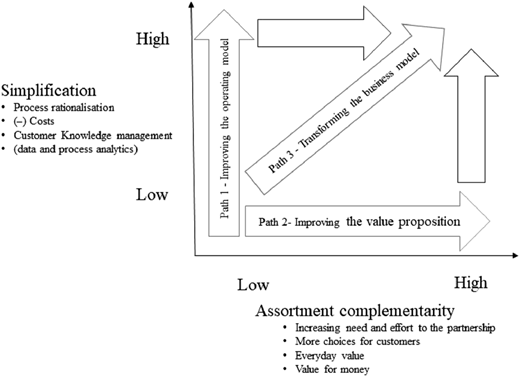
The findings of the study highlight that the BMI of the EDLP retailers originated from a conceptual fusion: (1) (re)combining the strength points of three consolidated BMs in the retail industry (HILO, conventional EDLP and discount) and (2) arranging a system of independent components to create value innovation for both the company and the customer, deviating from the industry’s competitive norms. Therefore, the EDLP-RBM strategy followed by the three Italian case studies falls into trajectory 3 (Figure 1), whose main drivers are the “simplification” of the processes and “assortment complementarity”, which work together to create and capture value. In short, this trajectory has significant implications for the innovation of all the building blocks presented by Johnson et al. BM (2008). These two constructs can be conceptualised from some interviews (interviews 1, 2 and 3).
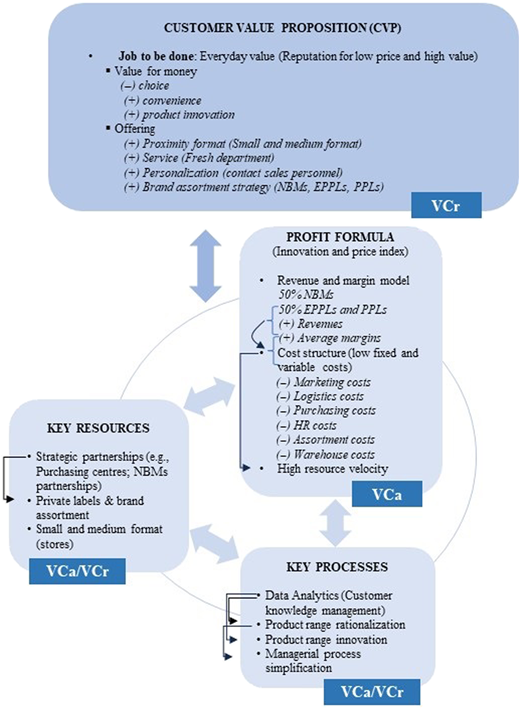
Adapting the conceptual framework proposed by Johnson et al. (2008), Figure 2 shows an extended representation of the EDLP-RBM, highlighting four interlocking elements that collectively renew the BM to create, capture and deliver value in a competitive context characterised by significant discontinuities for the retailers. Based on our interpretive research approach, it is, among others, a satisfactory conceptual model to interpret the empirical findings in a holistic perspective of the BM/BMI. In fact, the model considers four interrelated macro-components, which are in turn detailed in more micro-components: customer value proposition, key resources, key processes and profit formula. They can be recombined in an innovative configuration for the BMI. Therefore, let us begin by discussing the most important strategic levers that drive innovation in the customer value proposition (CVP). The underlined words represent the “forms” of thinking (metaphors, analogies, tropes, euphemisms and associations) characterising the cognitive schema of the informants as innovators.
In Table 1, the main findings that emerged from the interviews are reported (more detailed findings are summarised in Table III in the Supplementary materials).
To conclude, the EDLP-RBM strategy adopted by the Italian retailers can be represented and defined in two ways. The first (Figure 1) offers a simplified overview only of the BM’s main strategic paths. The second (Figure 2) shows the distinction between “value-creation” and “value-capture” mechanisms. For each of the four EDLP-RBM building blocks, we demonstrate the value generated for the customer (VCr) and the value captured by the business partners’ resources (VCa). The CVP building block comprises system variables designed to create value for the customers. Instead, the key resources and processes are available inside or outside the company to co-create customer value. Ultimately, the profit formula block encompasses all the factors that comprise the mechanism through which they capture or create economic value, leveraging the value proposition alongside key resources and processes. According to Unes’ former CEO and President (interview 36), the capability of experimenting with a new combination of components is the key to innovation, integrating (associating) them in a cohesive framework, capturing value for the company and partners and investing a necessary flow of resources by the times and needs of the business, like “a sand passing through an hourglass” (associative metaphor related to the key resources of the BM).
5. Discussion
The interviews with the five retailing experts highlighted the central role in the EDLP business model of the Job to Be Done (JTBD), a component of the CVP. The customer’s purchase in the EDLP is not speculative, unlike the HILO. The customer is aware that prices are always competitive. This prevents you from having to buy in stock and, above all, from spending time monitoring offers. Therefore, the cognitive costs for the customer are strongly reduced. The customer who regularly shops in the EDLP saves on the overall basket, which includes private-label products and fresh products. In these last departments, the overall convenience of the EDLP is achieved to the point of permitting the EDLP to reach, on average, a price scale of 0.85–0.90 compared to that of a HILO operator. Added to this is the higher quality of the offers in the fresh and very fresh product departments as well as the simplification of the products’ display. The smaller number of references on the shelf and the various ways of displaying them make the display of products in EDLP clear and more visible. These aspects of the JTBD have clear impacts on the management of operational processes, which are regularised and which allow the EDLP label to eliminate all the inefficiencies that characterise the HILO model (less stress on the organisation, logistics and in-store communication and no need for promotional sale of non-performing items). Sales spaces are also optimised in EDLP by eliminating a few non-essential references (4,000 references in Italy on average on EDLP compared to 8,500 on HILO for packaged consumer goods). The EDLP retailer also uses advanced planogramming, automatic ordering processes and limited outsourcing to the cooperative for shelf replenishment activities. However, the critical processes of the EDLP are five: private label management, dynamic pricing, strategic supplier selection, staff management in high-service departments and location choice.
Regarding brand architecture, it aims to build an offer with industrial leading brands and distributor brands (PL and PPL as well as one of local or ethical characterisation), at least in the defined target categories, which are always compared face-to-face. This is to allow the customer to identify the price of indifference in the choice between the (industrial) leading brands and the distributor’s ones. The service categories, instead, are only covered by own-branded products (PL or PPL). Dynamic pricing means that the EDLP retailer in its isochron is forced to study the prices of its primary (3/5) competitors through e-commerce engines and, based on these and its cost structure and margins on the products, it can choose the price positioning for industrial and distributor brands. This process is dynamic and data-driven. In the future, according to the experts interviewed, the EDLP will undergo hybridisation in the direction of greater use of loyalty cards, as it is a limitation nowadays not to have the customer’s records to set up outbound actions, the introduction of promotions on fresh departments and private labels, the use of e-commerce through the creation of a social community apps and the leverage on CRM and CSM. DoDeCà and Pam are working on this EDLP format innovation.
Furthermore, the real challenge will be to nationalise the business model. This could occur either through a federal model, with operators like Sole365 developing partnerships or concentrating processes with other regional operators or with an attempt to develop an EDLP national operator by a generalist retailing group (i.e. PAM and CRAI). According to the experts interviewed, the relationship with leading industrial brands will only be critical if the retailer is unable to reach the private brand threshold of 70% on consumer-packaged goods in the future. A logic of direct negotiation of the EDLP format with industrial brands and their purchasing centres cannot be ruled out in the future.
Taken together, all these aspects not only offer a set of actionable levers for management but also provide new insights for the theory.
5.1 Theoretical insights: the specificities of the Italian EDLP-RBM
While we acknowledge that the CVP of EDLP retailers’ centres on offerings (brand assortment), shopping experience and value for money, just like other types of retailers (Haas, 2019; Septianto et al., 2021), what sets the EDLP-RBM apart is that it targets an entire community rather than a specific market segment. This finding contradicts previous retailing research (Rintamäki and Kirves, 2017), which emphasises the decisive and positive impact of selecting “target clients” and cultivating “client relations” through loyalty cards or a CRM strategy. This article enhances our understanding of the factors influencing the shopping experience – service, proximity and personalisation – in grocery retailing. These factors remain relevant in predominantly offline contexts rather than online ones (Lian, 2021). Additionally, the Unes-U2’s, Sole365’s and DoDeCà’s business formulas are hybrid, occupying a middle ground between retailer and manufacturer models. Our research also confirms the findings of Albors-Garrigos (2020) regarding Mercadona, demonstrating that, in terms of the operational side of the BM, strategic partnerships and quasi-vertical integration are a hallmark within the context of EDLP-RBM. They contribute to optimising brand and product assortments (PLs), as well as improving back-office processes efficiency, simplifying operations and reducing costs. Drawing broader conclusions from the study’s findings, BMI can be pursued through the simplification and rationalisation of processes as well as examining the complementarity of product-service systems. These results can be operationalised by (1) (re)combining existing BMs, leveraging their characterising strong points, (2) (re)combining the relevant and interdependent strategic variables and (3) Synergistically exploiting the managers’ cognitive schemas able to create value innovation.
5.2 The role of a brand’s portfolio in contributing to an EDLP-RBM’s competitive advantage
The retailer brand architecture is multilevel (Pérez-Santamaría and Martos-Partal, 2021). The first level involves the corporate brand (i.e. Microsoft 365, U2 and DoDeCà), which conveys the identity and essence of the EDLP retailer. At the second level are the distributor’s brands or distinctive (premium) retailers’ brands. At the third level, we encounter the actual PL products designed, produced and managed directly by vendors and subsequently adopted by the EDLP retailer. An example of this is Selex, a PL owned by the distributor European Marketing Distribution (EMD) and sold across more than 3,000 points of sale associated with 30 labels in Italy. Lastly, at the fourth level are the NMBs, which are designed, produced, and managed externally by a leading national consumer goods brand. Discount use leading brands now and then as catalysts on the shelf. In this case, the leading brand plays a tactical and marginal role, with a minimal number of references, and is not used to build the assortment. In the EDLP, instead, the brands in the assortment tell the identity of the retailer. Retailers need this story to describe the positioning. The Unes-U2, Sole365 and DoDeCà case studies show how, on the one hand, selected NMB references guarantee the ability to attract customers into the stores, which generates high turnover and, on the other, contribute to the positioning of a lower price along the entire chain and assure strong visibility and the opportunity to sell PPLs (Loy et al., 2020). However, EPPL brand products also enable EDLPs to defend themselves against discount retailers in terms of market entry. The PPLs should be able to contribute to the differentiation of the offer system and the overall marginality of the BM. Despite arguments from several scholars (Swaminathan et al., 2020) regarding the expanded role of leading brands transcending traditional societal boundaries in today’s hyperconnected world, our study has found that the management of PLs within the context of the EDLP-RBM remains entrenched in traditional practices, with the primary strategies predominantly controlled within the label’s organisation and positioning (EPPL, PPL and NMB) (Cuneo et al., 2019). Enlarging on the findings of our study, assortment portfolio innovation can be pursued by looking across different BMs within the same industry or across different industries, exploring how products or services may be tailored to serve different buyer segments and create new market spaces also leveraging the competencies of external regional supply partners.
6. Theoretical and managerial implications
This article sheds light on the key dimensions of the EDLP-RBM, interpreted within a holistic and dynamic framework. The findings of the Italian case studies provide valuable insights for understanding and designing an EDLP-RBM value innovation. The managerial implications can be summarised as follows. (1) The emerging EDLP-RBM highlights a clear distinction between discount and non-discount RBMs. The former pursues discounted prices by mainly leveraging “fantasy” or “generic” PLs (low price-based). Instead, the EDLP-RBM creates value for the customer through an assortment comprising both “generic” and “flagship” products, such as national brand manufacturers as well as fresh and ultra-fresh products. A significant point of differentiation is that even when the comparison is with the HILO RBM. The EDLP-RBM is also pursued through the efficiency of the value chain’s key processes. (2) Considering the gradual shift from HILO to EDLP strategies in the retail sector, this article offers valuable insights into the managerial dynamics at play. However, this transition needs careful consideration of the high switching costs (Gauri et al., 2021). (3) In both the EDLP-RBM and the RBM scenarios, PLs (Wu et al., 2021) are increasingly seen as a portfolio brand management strategy offering both EPPs and PPLs to shape EDLP retailers’ customer value propositions. (4) Compared to the conventional EDLP retailers, other aspects of the value proposition are becoming strategically more significant in delivering value for money, e.g. the shopping experience, service and product innovation as well as good matching between NMBs and PLs. (5) Cultivating close relationships with business partners (Albors-Garrigos, 2020; Haas, 2019) is crucial to strengthening the value proposition and selecting a profitable product range. (6) Leveraging customer insights and data analytics is essential for rationalising product-brand ranges and simplifying managerial processes. The interviews conducted in 2025, involving the five retailing experts, confirm this conclusion. Indeed, the findings of our study also provide general insights into the theory and practice of BMI. The case studies enable us to highlight that the BMI can redefine the value proposition currently offered within the industry (i.e. conventional EDLP, HILO and discount retailing) and how the operating model delivers it. This approach to BMI balances disruptive and nondisruptive creation, combining strategic levers of different BMs within the same industry (i.e. retailing) and by different ones. Finally, the study’s findings also highlight the role of managers’ cognitive schemas in decision-making and the strategic execution of BMI. It emerges as a mental representation of the complex system of real-life activities, able to enact reality, interpret the strategic change and use their interpretations and symbolic “forms” of thinking to frame meaning for other members of the organisation. Both U2-Unes and Sole365 as well as DoDeCà, have demonstrated that the novel EDLP-RBM hybrid model emerging from the study has generated successful outcomes. The decision of U2-Unes to exit the EDLP format in 2023 is related to a general reorganisation process within the company, aimed at concentrating efforts on a single retailing business. That has been the opinion of the interviewed experts as well. All the case studies – larger and smaller, older and younger companies – point to evidence of the real difficulties in managing the EDLP format. The efficiency in every component of the BM–value proposition and operating activities is strategic for the value creation and capture.
7. Conclusions, limitations and directions for future research
While this research provides novel insights into the dynamics of EDLP-RBM innovation, it is subject to several limitations. First, the interpretive and abductive approach inherently reflects the researchers’ theoretical positioning. We acknowledge the potential for researcher bias in both data collection and interpretation (Gioia et al., 2013). Although we applied triangulation through multiple informant types and iterative coding validation, qualitative inquiry is, by nature, shaped by the interpretive frames of the researchers themselves. Second, the generalisability of the findings is limited due to the qualitative, case-based design (Yin, 2014). The empirical scope is restricted to three Italian retailers within a specific regulatory and cultural environment. While theoretical generalisation is possible (Stake, 1995), statistical generalisation cannot be claimed. Third, this study adopts an interpretivist epistemology wherein meaning is constructed through the interaction between researchers and informants. This standpoint emphasises understanding the subjective experiences and cognitive schemas of managers, but it also implies that findings are contextually bound and shaped by linguistic, symbolic and cultural nuances. Fourth, the study spans interviews collected over a longitudinal period (2016–2025). While this enhances our ability to observe business model evolution, it also introduces temporal inconsistency due to changes in market dynamics, leadership and organisational identity. Early interviews may reflect outdated strategic orientations.
Additionally, we acknowledge the necessity of researcher reflexivity (Johnson and Duberley, 2003). Our background and conceptual preferences influenced how narratives were interpreted and framed. We attempted to mitigate it by iterative peer debriefing, cross-validation with secondary sources and member checking with informants. Future research could address these limitations by adopting a multi-country comparative design or a mixed-methods approach to triangulate data sources and enhance the robustness of the findings. Quantitative validation of the EDLP-RBM framework or further qualitative inquiry into other retailing formats (e.g. omnichannel EDLP or hybrid discounters), could extend the theoretical reach. Ethnographic or real-time longitudinal designs may also deepen understanding of the micro-processes underlying business model innovation in retail settings (Langley, 1999).
We acknowledge all the managers involved in the field research.
The supplementary material for this article can be found online.