The Pakistan 2030 vision seeks sustainable growth through AI, partnerships, workforce development and Protection Motivation Theory (PMT). This research supports Pakistan and offers guidance for similar efforts worldwide, highlighting best practices and stakeholder views. It compares AI implementation in Pakistan and other countries’ government and private sectors, noting how AI frameworks support sustainability. Understanding global AI adoption, especially in developed nations, can help Pakistan’s Ministry of Information Technology and Telecommunication revise its National AI Policy for responsible, sector-wide AI integration. This paper aims to advance environmental sustainability and AI framework effectiveness.
Data regarding stakeholders’ attitudes, willingness and perceptions were collected through a quantitative research design using a self-administered survey questionnaire. A sample of 343 participants was obtained through snowball sampling and analyzed using Partial Least Squares Structural Equation Modeling (PLS-SEM).
The study employed variables such as stakeholder relations, engagement, AI integration, sustainability, incentives and motivation to explore potential public–private cooperation in AI development. Most hypothesized associations showed significant results, except for the moderating effect of cultural context. Employees’ attitudes toward AI were assessed using Protection Motivation Theory, which also incorporated organizational initiatives that helped reshape employees’ perceptions regarding advanced technologies, such as AI.
This research makes a significant contribution to the fields of AI and sustainability studies. It offers insights into the Pakistan 2030 agenda, illustrating how organizations can utilize AI to enhance sustainable development through employee engagement and protection behavior.
Introduction
Technological advancements worldwide have underscored the importance of one of the most transformative forces of the twenty-first century: artificial intelligence (AI). In the realm of new technologies, artificial intelligence has experienced rapid adoption by countries seeking to navigate the complexities of a rapidly digital and data-centric environment. The capacity to leverage extensive data, facilitate robotic process automation and foster innovation establishes AI as a vital tool in promoting sustainable development (Didcov, 2020). Sustainable development involves utilizing resources in a way that ensures future generations can fulfill their own needs without compromise. This definition is derived from the renowned report produced by the (Brundtland, 1987). Initiatives focused on enhancing social equity, ensuring environmental sustainability, fostering economic resilience and advancing technology have gained significant importance for countries looking to incorporate AI into their socio-economic frameworks (Kumar et al., 2024).
Consequently, AI has the potential to significantly contribute to the progress of sustainable development objectives, especially when incorporated into the Pakistan 2030 Vision. The Pakistan 2030 Vision delineates the nation’s strategy for executing the Sustainable Development Goals (SDGs). Within this framework, Pakistan needs to tackle three critical aspects of development: environmental, economic and social. The incorporation of AI into this framework provides a structured method to enhance the advantages of AI while ensuring fair access (Sumra et al., 2021). The strategy highlights the importance of collaboration and partnership, as effective AI integration requires a cooperative approach that involves intersectoral coordination, public–private partnerships and community engagement (Mikhaylov et al., 2018). This suggests that Pakistan has the potential to make significant progress by leveraging AI-driven technologies in conjunction with shared skills and resources.
A crucial strategic element of the Pakistan 2030 Vision is the empowerment of the workforce, facilitating the efficient use of human capital in the wake of AI implementation (Tenakwah and Watson, 2025). Achieving this involves ensuring that employees recognize the significance of cultivating an innovative culture, which necessitates ongoing training and development (Wei et al., 2013). These initiatives are instrumental in preparing the workforce with the essential skills required to operate and manage AI technologies effectively. This highlights the importance of protective actions that personnel must implement in response to threats such as cyberattacks and data breaches (Jimmy, 2021). The implementation of these protective mechanisms underscores the essential importance of stakeholder trust. The maintenance of this trust relies on the accountable application of AI, protected by strong cybersecurity measures, ethical guidelines and compliance with global agreements (Díaz-Rodríguez et al., 2023).
Consequently, the Pakistan 2030 Vision is dedicated to creating a harmonious strategy that integrates technological progress with broader societal goals. This study examines the strategic framework of the Pakistan 2030 Vision. This document examines the primary initiatives of the plan, including collaborative partnerships, workforce empowerment and the application of Protection Motivation Theory to facilitate forward-thinking growth (Gasperoni et al., 2024).
Additionally, this study seeks to support countries with aligned goals and make a significant contribution to the broader conversation surrounding sustainable development. This aims to emphasize optimal methods and integrate the viewpoints of involved parties to guarantee significance and practicality (Cummings et al., 2018).
AI-generated products and services, coupled with a culture of innovation, present substantial opportunities; however, they also introduce considerable risks, including copyright infringement, cyber-attacks and concerns regarding data security. Consequently, it is crucial to encourage protective behaviors to successfully address these challenges (Arif et al., 2024).
To attain sustainable development, it is essential to incorporate advanced yet affordable innovations that improve the production of efficient goods, technologies, and services. As a result, companies need to minimize waste and enhance the use of resources and energy – goals that can be facilitated by initiatives utilizing artificial intelligence (ATTA and KHAN, 2021). This study holds great importance for its contributions to the field of artificial intelligence, as it emphasizes the significance of the Pakistan 2030 agenda and demonstrates how organizations can utilize AI to foster sustainable development through employee engagement and protective behaviors.
Problem statement
The use of artificial intelligence (AI) in sustainability initiatives is gaining importance; however, the broader organizational and societal effects – especially in developing countries like Pakistan – are still not fully understood (Ali et al., 2024). Although earlier studies have examined AI’s role in automation, operational efficiency and predictive analytics, a clear gap remains in understanding its integration into national sustainability strategies and its impact on stakeholder collaboration, employee engagement and risk management strategies (Kassa and Worku, 2025). Additionally, the understanding of how AI integration could reshape socioeconomic institutions, legal systems, and workplace interactions related to sustainable development remains limited (Chirita and Sarpe, 2024). Furthermore, challenges associated with the sustainable implementation of AI in companies underscore the importance of addressing workforce skill gaps. Resistance from employees might arise due to a lack of knowledge and technical skills across various industries in Pakistan (Babashahi et al., 2024).
Pakistan’s economic progress heavily depends on this workforce, which often relies on traditional, manual methods. This dependence might hinder the adoption and effective use of advanced AI models in real-world settings (Batool et al., 2025). Most manufacturing firms in Pakistan employ labor-intensive processes, which may divert their focus from integrating AI solutions. Therefore, it is crucial to investigate how the implementation of AI could impact the workforce in these industries (Jamil et al., 2025). Opposition from the manufacturing sector may significantly slow the widespread adoption of AI technologies. Implementing AI frameworks is seen as a key step toward achieving Pakistan’s Vision 2030; however, its success largely depends on employee readiness and stakeholder support. The influence of these human factors is essential for the sustainable and effective deployment of AI models across different sectors (Latif, 2023).
Moreover, there is a significant knowledge gap regarding the effects of AI on employment and sustainable development, particularly regarding concerns about widespread job displacement. Data shows that around 14% of workers have experienced significant job losses due to AI integration (Batool et al., 2025). This points to growing job insecurity, particularly in tech-driven companies. This study aims to explore employees’ responses to the ongoing integration of AI technologies in the workplace. It is crucial to examine how strategic decisions by regulators, policymakers, and organizational leaders can collaborate to promote sustainable development across Pakistan’s sectors (Kim and Kim, 2024).
Analyzing AI’s role in helping achieve sustainable development goals requires a comprehensive look at skills development needs and vocational training initiatives. This reveals a significant gap in current research – especially concerning Pakistan – that needs attention. For a better understanding of technology among employees, policymakers must create supportive educational policies that foster skill development in low-tech areas. By 2030, an estimated 23% of jobs are expected to change due to the impact of AI, underscoring the urgent need for upskilling and enhancing technological literacy in Pakistan’s workforce (Kim and Kim, 2024). This study aims to address these issues by advocating for robust government support to enhance skills and empower workers in the face of rapid technological change. Moreover, when evaluating AI’s impact on emerging economies like Pakistan, it is crucial to focus on employee empowerment through skill development, especially regarding women’s involvement in the digital economy. Understanding how workers interact with AI in various sectors is crucial for promoting inclusive and sustainable AI integration in Pakistan (Siddiqui, 2024).
This research examines how AI can support sustainable development in Pakistan by assessing its impact on empowering and advancing gender equality. It also provides a detailed, policy-oriented analysis of AI’s role in sustainable development, extending beyond its technological potential. The study examines AI’s capacity to foster stakeholder collaboration, empower workers, and boost motivation to promote responsible growth. It provides a strategic framework for applying AI in sustainability efforts, grounded in empirical insights into employee perspectives, stakeholder engagement, and AI risk management. The findings aim to provide valuable guidance for leaders, industry experts, and sustainability advocates, viewing AI not only as a technological tool but also as a crucial driver of ethical, inclusive, and sustainable progress in Pakistan and beyond.
Literature review
Artificial intelligence (AI) is swiftly emerging as a crucial factor in promoting sustainable development across various sectors. The extensive applications – spanning automation, data analytics, and advanced machine learning – present remarkable opportunities for innovation and efficiency (Muchenje et al., 2024). The Pakistan 2030 strategy addresses the challenges associated with AI adoption and encourages its integration to further sustainability objectives. The transformation brought about by AI across various sectors is evident in its enhancement of accuracy, productivity and predictive capabilities (Lal and Umer, 2024). For instance, in the field of agriculture, advancements such as precision farming and automated irrigation systems enhance yield and optimize resource utilization (Adewusi et al., 2024).
The initiatives undertaken by Pakistan to achieve food security and promote sustainable agricultural practices are significantly dependent on these advancements (Siddiqui, 2024). The triple bottom line framework plays a crucial role in comprehending sustainable development, highlighting a business’s impact on social, economic and environmental well-being (Schulz and Flanigan, 2016). The influence of AI on sectors such as healthcare and education is profound, facilitating innovative business models, transforming traditional processes and providing tailored experiences (Yadav and Shrawankar, 2025). Nonetheless, the incorporation of AI into current frameworks presents obstacles, such as workforce displacement and ethical dilemmas (Bayan, 2024). A seamless transition to AI-driven environments requires thorough approaches that emphasize ethical principles, employee empowerment and adherence to regulations. Governments and organizations must address these challenges to maintain public confidence and create an environment that supports the advancement of AI (Díaz-Rodríguez et al., 2023).
In the public sector, organizations are progressively utilizing AI and data science to create and implement policies in the face of uncertainty. Effective incorporation of AI into public service delivery necessitates strong frameworks and ongoing governmental backing. The generation of extensive data by AI has a profound impact on the daily lives of individuals. The increasing impact of AI on the economy and society introduces a range of theoretical and practical challenges for legal frameworks (Artha et al., 2024). The challenges at hand include an examination of existing laws, regulations, and corporate governance practices to guarantee the responsible implementation of AI (Scherer, 2015). In 2017, Saudi Arabia awarded citizenship to a humanoid robot named Sophia, and Japan provided a residency permit to a chatbot known as Shibuya Mirai. Nonetheless, these advancements sparked a debate, with academics arguing that bestowing legal recognition on robots is at odds with current national legal systems (Atabekov and Yastrebov, 2018).
Across the globe, nations are implementing AI-based frameworks to address economic, legal, and environmental challenges, while also advancing their sustainability efforts. Technological advancements in artificial intelligence contribute significantly to the enhancement of environmental conservation, the optimization of energy usage, and the improvement of industrial efficiency. These initiatives illustrate the transformative potential of AI beyond regulatory concerns, establishing it as a means to attain global sustainability objectives (Santos and Carvalho, 2025). Examining these international AI-driven sustainability frameworks provides important insights for Pakistan’s Vision 2030. Examining Pakistan’s strategy toward nations such as China, the USA, and European Union members is crucial for assessing advancements and identifying opportunities for improvement (Kaur, 2025). In China, artificial intelligence plays a pivotal role in addressing social and environmental challenges, such as climate change, pollution management, and urban development, by leveraging data analytics and machine learning techniques.
China has gained international recognition as a leading producer of renewable energy, demonstrating its commitment to sustainable development through AI-enhanced energy strategies (Wang, 2023). The aim of implementing AI technologies in their energy production sectors has been to reduce carbon emission rates while providing AI-enhanced energy solutions for consumers. China’s initiatives to address climate change and its shift toward sustainable energy solutions underscore its recognition of the importance of AI technology in harnessing clean energy sources (Wang, 2023). Analyzing Pakistan’s initiative for sustainability to achieve its 2030 vision necessitates a comparison with other economies that have implemented AI technological frameworks to enhance their industries and sectors for greener production.
Understanding the narrative surrounding China’s complex approaches to achieving environmental sustainability through AI technologies could help the Pakistani Ministry of Information Technology and Telecommunication refine its national AI-related policies to enhance their applicability across various sectors (Khan et al., 2025). Studies have examined how China’s AI-driven integration highlights its focus on achieving energy-related objectives. The findings revealed the methods by which China can transform its energy sectors to enhance the effectiveness of AI implementation. China’s position as a global leader in the renewable energy sector underscores its strategic application of various AI frameworks (Ukoba et al., 2024). Furthermore, it highlights the Chinese government’s dedication to sustainability and the implementation of AI-driven energy solutions, which is a national priority.
Investigating China’s shift toward artificial intelligence could provide valuable insights for contrasting with Pakistan’s initiatives in adopting AI technologies to promote sustainable development (Liu et al., 2022). The application of AI-powered predictive analytics facilitates the tracking of carbon emissions, improves the distribution of renewable energy, and boosts agricultural productivity. These initiatives align with Pakistan’s sustainability objectives; however, they differ in scale and the level of technological investment driven by the government (Danish and Senjyu, 2023). The European Union’s Green Deal incorporates artificial intelligence into approaches for a circular economy, energy-efficient smart grids, and AI-driven regulatory frameworks (Fetting, 2020). Scholars and economists have highlighted the importance of the European Green Deal, a significant strategic initiative proposed by the European Commission, which outlines key elements aimed at achieving the climate and energy transition by 2030 (Almeida et al., 2023; Gailhofer et al., 2021).
Studies conducted within the EU have explored the application of AI in Earth Observation initiatives, such as New Space and Copernicus, focusing on assessing environmental impacts and enhancing digital infrastructure (Causevic et al., 2024). It is essential to note that the EU is developing the “Digital Twin of Planet Earth,” which aims to simulate the interactions between humans and the environment, thereby informing environmental policy decisions. The EU demonstrates its dedication through structured initiatives focused on data preparation, algorithm design, and data set development. Nonetheless, obstacles persist, especially regarding training data sets for deep learning applications (Bauer et al., 2024). Although AI has found extensive application in the analysis of optical imagery and sensor data, further investigation into sophisticated analytics is essential. Nevertheless, the EU’s Green Deal showcases a robust incorporation of AI in promoting sustainability, utilizing technologies such as intelligent automation, IoT, and machine-to-machine communication to enhance operational efficiency (Marques and Oliveira, 2024).
Analyzing this within the framework of Pakistan underscores a pressing need for a more comprehensive assessment of AI’s capabilities. Pakistan’s Ministry of IT and Telecommunication needs to promote strategic initiatives that enhance decision-making based on data (Latif, 2023). The EU’s focus on the ethical governance of artificial intelligence, transparency in data handling, and incentives for innovation presents a framework that Pakistan might consider adapting to enhance its regulatory structure. In the USA, AI is significantly applied in corporate sustainability strategies, particularly in areas such as supply chain optimization and AI-driven environmental management (Costa and Mendonça, 2024; Lamarre et al., 2023). Leading companies are pioneering the integration of AI, embedding it into their strategies for environmental, social, and governance initiatives. In the USA, private enterprises are leading the way in embracing technology, which may play a significant role in advancing environmental, social, and governance objectives. Private enterprises in the USA are at the forefront of adopting artificial intelligence, particularly in their pursuit of enhancing Environmental, Social, and Governance (ESG) objectives.
For instance, KPMG has adopted AI for sustainability auditing and impact reporting, showcasing an increasing trend among U.S. companies to incorporate AI into their ESG efforts (Wang, 2023). Enhancing the sustainability reporting framework through the utilization of AI solutions has been highlighted as a means to reduce environmental impact. KPMG has demonstrated its dedication to informing regulatory bodies by providing sustainability data while developing services centered on sustainability (Agarwal, 2024). Recent advancements demonstrate how the private sector in the U.S. is utilizing AI to enhance sustainability practices. Conversely, Pakistan’s strategy requires enhanced cooperation between the public and private sectors to fully leverage the capabilities of AI for sustainable development (Krasodomska et al., 2025).
Challenges and opportunities for Pakistan in AI adoption
When examining global AI interventions, Pakistan faces several significant obstacles, including insufficient infrastructure, a shortage of skilled professionals capable of handling AI systems, and an overreliance on traditional data management techniques. The identified limitations have resulted in challenges regarding data quality and heightened susceptibility to data protection risks, consequently giving rise to important ethical considerations (Noorani, 2025). Furthermore, the insufficient availability of funding and financial grants to facilitate the integration of AI in workplace settings has been identified as an obstacle to advancement. In light of these challenges, the Government of Pakistan has implemented measures to promote AI, including the establishment of the National Center for Artificial Intelligence (NCAI) and the “AI for All” initiative, which focuses on encouraging the adoption of AI technologies (Caswell and Jang, 2024). The emphasis of these programs lies in cultivating a technically proficient AI workforce while enhancing employees’ understanding of AI applications.
The NCAI has a significant influence on the transformation of multiple sectors through the facilitation of AI-driven solutions aimed at disaster management and climate control (Hossain et al., 2024). Furthermore, the Ministry of Information Technology and Telecommunication has introduced a National Artificial Intelligence Policy Framework, demonstrating the nation’s commitment to embracing the Fourth Industrial Revolution (Abid et al., 2019). This policy aims to ensure that technological progress benefits various sectors and functions in Pakistan, thereby facilitating the alignment of AI with the Sustainable Development Goals (SDGs). This outlines a strategic framework that enables Pakistan to adopt AI technologies, thereby transforming its local environment, encompassing employment sectors and industrial efficiency.
The analysis of these global initiatives suggests that Pakistan’s Vision 2030 should prioritize the importance of AI in driving digital transformation, promoting sustainable governance, upholding ethical practices, and fostering innovation across various sectors (Astuti et al., 2025). Through an analysis of international initiatives – including China’s AI-enhanced environmental oversight, the EU’s regulatory and ethical guidelines, and the proactive AI integration by the U.S. private sector – Pakistan can enhance its strategy to tackle local issues with greater efficacy. Adhering to global standards will aid the nation in progressing digital transformation, enhancing sustainable governance, encouraging innovation, and guaranteeing the ethical application of AI technologies (Astuti et al., 2025; Sajduk and Dziwisz, 2024).
Theoretical underpinning of the study
This study predominantly utilizes Protection Motivation Theory and organizational literature on employee empowerment and collaboration, while also integrating theoretical ideas from broader institutional, cultural, and stakeholder viewpoints. Stakeholder TheoryFreeman (1984) emphasizes the importance of including various entities – such as governmental agencies, corporations, and civil society – in achieving sustainable and inclusive AI implementation(Freeman et al., 2010). Hofstede’s Cultural Dimensions Theory(Hofstede and Bond, 1984) provides a framework for understanding how cultural values and social norms influence the acceptance and application of AI technology, particularly in developing nations. Institutional Theory (Scott, 2005) highlights the impact of regulatory, normative, and cognitive frameworks on organizational conduct and technology adoption. These complementary perspectives aid in contextualizing the conceptual model presented later in this study.
Hypotheses development
This study formulates numerous hypotheses that elucidate the links among AI adoption, sustainable development, and the specified mediating and moderating variables, based on the examined literature and theoretical frameworks previously discussed. These hypotheses correspond with the conceptual framework and underpin model creation and analysis:
AI adoption significantly impacts the effectiveness of collaborative partnerships in organizations
The integration of AI is reshaping the workplace, driven by the demand for enhanced productivity, increased process efficiency, and a lasting competitive edge. Employee engagement plays a crucial role in improving performance and sustaining a competitive advantage (Sajduk and Dziwisz, 2024). The adoption of AI profoundly influences the efficacy of collaborative partnerships inside enterprises, as evidenced by Stakeholder Theory (Freeman et al., 2010), which underscores the need of multi-actor collaboration in attaining common technological and sustainability objectives. Consequently, it is crucial to emphasize the importance of professional empowerment, particularly through ongoing training and educational opportunities. Adopting AI and prioritizing education can create new avenues for innovation, helping companies achieve lasting competitive advantages (Okunola et al., 2025):
The adoption of AI significantly enhances employee empowerment in organizations.
Focusing specifically on cybersecurity challenges, investigators are exploring the sustained implementation of AI chatbots, thereby reinforcing their contribution to advancing social sustainability. Employee empowerment plays a crucial role in the “Pakistan 2030” initiative, designed to equip workers with the autonomy and skills necessary to succeed in an AI-driven landscape (Jamro, 2023). With the ongoing evolution of AI technologies, the necessity for continuous learning and reskilling has emerged as a critical factor in equipping employees for new roles and responsibilities. This initiative centers around training programs and educational opportunities designed to provide staff with the essential skills for effective collaboration with AI technologies (Kamatala and Naayini, 2025). The implementation of AI markedly improves employee empowerment inside firms, as supported by the Employee Empowerment Theory (Wilkinson, 1998), emphasizing the importance of autonomy and skill development in fostering organizational creativity and flexibility.
Understanding the significance of ongoing education is crucial, as it cultivates a culture of innovation that motivates employees to pursue additional learning and development, thereby enhancing the adaptability and resilience of the workforce (Sarder, 2016). Encouraging a culture of creativity and enabling employees to engage in critical thinking, develop innovative ideas, and take proactive steps in their roles are essential components of employee empowerment (Naranjo-Valencia et al., 2016). A progressive environment fosters ongoing employee involvement and boosts creativity, leading to greater job fulfillment and a feeling of ownership. Consequently, organizational leadership needs to acknowledge the significance of adopting change to inspire employees, enhance engagement with AI technologies, and reinforce their understanding through a favorable connection with these efforts (Arpaci, 2023):
AI adoption significantly increases motivation for protection among employees.
The progress achieved by activists, global development leaders, and innovators in AI-driven technologies has played a crucial role in the effectiveness of sustainable development initiatives. Their ground-breaking actions have enhanced operational efficiency and supported resource preservation. Furthermore, these developments have facilitated the spread of knowledge and expertise, closed global resource and technology divides, and enhanced collaborations across various sectors to bolster broader global sustainability efforts (Goralski and Tan, 2020). The prevailing view is that artificial intelligence and associated technologies – like machine learning and extensive data analytics – have significantly altered both the current state and the future trajectory of human existence. Consequently, earlier studies have connected artificial intelligence to various fields, such as healthcare, education, employment, utilities, and environmental protection (Amabile and Khaire, 2008; Bag et al., 2021; Füller et al., 2022; Nahar, 2024):
There is a positive relationship between AI adoption and sustainable development, as AI adoption significantly contributes to sustainable development within organizations.
Collaboration requires that the parties involved share their perspectives to foster a mutual understanding of the underlying issues. The decision to adopt a joint approach is based on this shared understanding (Dorado-Banacloche, 2020). Nonetheless, establishing a shared understanding of sustainability remains complex for both scholars and stakeholders, as emphasized in earlier GIN conferences (Ehrenfeld, 2000). Over the last decade, numerous approaches to achieving sustainability have been developed. For example, numerous academics contend that eco-efficiency plays a crucial role in achieving sustainable global development (Schmidheiny, 1992; Von Weizsacker et al., 2009). They highlight that market signals – like tax incentives, tradable pollution credits and eco-certifications – must consider the environmental consequences of manufacturing, resource usage, recycling, and waste management. As noted by Gibbs (2006), the sole feasible solution to the ecological crisis lies in ongoing industrialization, though transformed patterns of production and consumption must accompany it.
The concept of collaborative partnership is fundamental to the “Pakistan 2030” vision. These partnerships facilitate the sharing of raw materials and foster collaboration across various sectors, both of which are essential for the successful deployment of AI (Mikhaylov et al., 2018). Networks formed by nongovernmental organizations, businesses, and government entities are known as public-private partnerships (PPPs). The exchange of information among these organizations can be leveraged to create more effective solutions for complex challenges (Jooste et al., 2011). This collaboration ensures that AI solutions are developed with a grounded understanding of real-world challenges, facilitating a connection between creators and users. This collaborative approach enhances the acceptance of AI while simultaneously fostering investment in sustainability by elevating stakeholders’ sense of psychological ownership regarding sustainable development and its significance (Gazi et al., 2024).
Additionally, global partnerships create opportunities for integrating advanced technologies and innovative concepts, while providing insights into worldwide practices. To ensure that AI-driven policies effectively consider ethnic diversity and cater to diverse social needs, it is crucial to foster strong collaboration as a fundamental responsibility in the pursuit of sustainable development objectives (Bolte and Van Wynsberghe, 2024). It is essential to address significant workplace issues – such as unemployment, ethical challenges and social inequality – to create a positive work environment for employees in Pakistan, thereby enabling AI to reach its full potential:
Collaborative partnerships make a significant contribution to sustainable development.
The dynamics of society and the environment are constantly changing. Studies indicate that resilience to change refers to a person’s ability to withstand fluctuations and adapt to their surroundings. Resilience thrives in communities where individuals actively participate and are motivated to embrace the transformations needed for sustainability (Magis, 2010). Collaborative partnerships significantly contribute to sustainable development, as articulated by Stakeholder Theory (Freeman, 1984), which advocates for interorganizational collaboration to foster inclusive and ethical innovation. The New Urban Agenda (NUA) underscores the essential significance of cultural heritage in attaining sustainable urban development. Numerous convincing reasons underscore the significance of both tangible and intangible cultural assets in sustainable urban development. Improving sustainable production and consumption models requires integrating cultural values into these models. Culture plays a key role in initiatives aimed at enriching the humanity of urban areas and neighborhoods. The revitalization and rehabilitation of urban areas are essential, as they greatly enhance social engagement and civic participation (Nocca, 2017):
Employee empowerment significantly enhances sustainable development.
The collaboration between employees and AI has the potential to significantly enhance innovation by increasing employees’ sense of autonomy and enhancing their work-related skills, ultimately leading to favorable organizational outcomes (Kong et al., 2024). Employee empowerment markedly improves sustainable development, as evidenced by Employee Empowerment Theory, which asserts that empowered people engage more proactively in sustainability through innovation, initiative, and flexibility (Ameen et al., 2021).
Individuals in leadership positions with this perspective communicate a motivating vision for the organization and execute new strategies that align with that vision (Yukl, 2008). As organizations implement AI technologies, leaders focused on change are expected to articulate how these innovations address pressing business issues and yield beneficial outcomes for employees (Kong et al., 2024; Mohd Suki, 2024). The application of AI in sustainable development initiatives offers significant opportunities for businesses, industries, and policymakers. This study provides an in-depth analysis of the organizational, technological, and operational elements necessary for the successful integration of AI into sustainability strategies (Kulkov et al., 2024):
Protection motivation enhances sustainable development by promoting proactive behaviors that mitigate environmental risks, ensure resource conservation, and foster resilience against the impacts of climate change.
National governments need to align their regulatory policies through precise and strategic coordination. The interventions, missions, and policies of relevant agencies are essential; however, the synergy and interconnection among these elements can propel significant, transformative progress in policy. For instance, imagining advancements in industry, strategies for managing energy demand, and policies in the labor market aimed at promoting energy technologies and sustainable investments illustrates this kind of progress. Recent advancements suggest a simultaneous enhancement of job prospects within the energy industry and energy usage, driven by forward-thinking approaches that focus on promoting clean energy innovations.
The hopeful beliefs about job creation and energy consumption, grounded in technological progress, frequently embody supply-side or trickle-down perspectives. In a globalized context, these policies must be interlinked and mutually supportive (Ashford and Hall, 2011). Governments need to harmonize economic, environmental, and social policies, adapting them to the specific characteristics and immediacy of each challenge. By concentrating on critical interventions, well-articulated agency objectives, and unified policy structures, countries can achieve substantial and transformative changes. Robust national regulatory frameworks can foster innovation across organizations, institutions and technologies, facilitating immediate advantages that lead to sustained economic growth, better environmental conditions, and increased job opportunities. These strategies can safeguard ongoing advancements from being compromised by the forces of globalization and trade dynamics (Schumpeter, 1964; Schumpeter, 2013):
Collaborative partnerships mediate the relationship between AI adoption and sustainable development.
Collaborative partnerships are essential for transforming AI adoption into significant advancements in sustainable development. Pakistan’s Vision 2030 emphasizes the importance of collaboration among the government, industry, academia, and civil society as a crucial factor in integrating AI. Collaborative partnerships facilitate the connection between AI adoption and sustainable development, in accordance with Stakeholder Theory (Freeman et al., 2010), wherein cooperation serves as a mechanism to align AI with sustainability objectives.
Collaborations between the public and private sectors, along with networks involving multiple stakeholders, provide the essential infrastructure, resources, and shared objectives necessary for the successful implementation of AI (Mikhaylov et al., 2018). These collaborations facilitate the development of contextually relevant solutions in fields such as energy conservation, agriculture, and urban development by leveraging specialized knowledge from diverse sectors. Furthermore, working together cultivates a sense of psychological ownership and trust among stakeholders, which is essential for the enduring implementation of AI-driven sustainability frameworks. Studies indicate that collaborative frameworks enhance the dissemination of innovation and foster sustainable practices across various sectors ((Jooste et al., 2011). Collaborative partnerships act as a bridge that aligns diverse interests, mediating the effects of AI adoption on sustainability objectives (Bolte and Van Wynsberghe, 2024; Gazi et al., 2024). This approach enhances the trustworthiness, adaptability and effectiveness of AI efforts aimed at improving environmental and social conditions:
Employee empowerment mediates the relationship between AI adoption and sustainable development.
The concept of empowering employees is gaining recognition as a crucial element that connects the adoption of artificial intelligence with achieving effective and sustainable development results. As artificial intelligence reshapes the way organizations operate, employees must possess the necessary knowledge, confidence, and authority to engage effectively with AI systems. Enhancing capabilities through training, involvement in decision-making, and availability of learning opportunities enables employees to effectively adjust to AI-driven settings (Jamro, 2023; Kamatala and Naayini, 2025) Moreover, empowerment stimulates creative thought, enhances morale, and cultivates an environment of responsibility and sustainability.
Individuals who perceive their worth and are kept informed tend to engage more actively in achieving sustained growth objectives by adopting new technologies, rather than opposing them (Sarder, 2016). Employees who are empowered take on active roles in innovation driven by AI and show greater responsiveness to priorities related to the environment, society and ethics (Arpaci, 2023; Naranjo-Valencia et al., 2016). This establishes empowerment as a crucial factor that improves both organizational agility and sustainability performance:
Protection motivation positively and significantly mediates the relationship between AI adoption and sustainability development.
The hypothesis arising from the utilized Continuous Improvement and Emotional Intelligence framework suggests that managers who incorporate Emotional Intelligence practices during Continuous Improvement implementation are expected to achieve greater operational performance when integrating AI technologies, in contrast to those who neglect the significance of Emotional Intelligence. This illustrates a prevalent challenge in management, stemming from the need to navigate a “complex” human-centered system in conjunction with a “high-tech” culture of improvement (Jangbahadur et al., 2025). This study addresses a significant gap by examining the relationship between AI-driven aspects of human resource management and sustainable operational performance, while also investigating how employee engagement mediates this connection and how firm strategy moderates it.
The results indicate that EE is significantly associated with three of the four dimensions of AI in the context of HRM. Furthermore, EE serves as a partial mediator in the connection between SOP and various dimensions related to AI in HRM. Additionally, the findings revealed that FS and EE do not exhibit any interactive effect on SOP. Nonetheless, the findings indicate that FS and EE do not exhibit a statistically significant interactive effect on SOP. Furthermore, the findings indicate that strategic orientation does not serve as a moderator for SOP:
The moderating effect of cultural context is such that in collectivist cultures with high uncertainty avoidance, the positive relationship between AI adoption and sustainable development is weaker due to heightened concerns over job displacement, data security and ethical compliance.
Hofstede’s cultural dimensions theory emphasizes the impact of national cultural traits, including collectivism and high uncertainty avoidance, on technology adoption behaviors (Hofstede and Bond, 1984). In collectivist societies such as Pakistan, there is a strong emphasis on group conformity, social stability and institutional hierarchy, which frequently results in resistance to disruptive innovations. In cultures characterized by high uncertainty avoidance, there is a pronounced inclination toward predictability, structured processes, and formalized regulations. This tendency may lead to heightened skepticism regarding the adoption of emerging technologies, including Artificial Intelligence (AI). In the context of Pakistan, the adoption of AI is gaining traction through initiatives such as “Digital Pakistan” and Vision 2030; however, it continues to encounter significant skepticism.
There are significant concerns regarding job displacement, automation risks, data privacy and ethical governance. These issues are particularly pronounced in areas with limited digital literacy and insufficient regulatory oversight for emerging technologies. (Chang et al., 2024) highlight that self-reported AI-related stressors, including technological anxiety and ethical uncertainty, can considerably diminish individuals’ intention to adopt AI. This situation is intensified in contexts such as Pakistan, where organizational frameworks and societal norms promote conservative approaches to technological experimentation. Protection Motivation Theory (PMT), as utilized by (ATTA and KHAN, 2021), provides a robust framework for analyzing this behavior. The theory suggests that individuals tend to exhibit protective or avoidant behaviors in response to high perceived threat severity coupled with low coping efficacy.
In Pakistan, the risks associated with AI, including cyber threats and ethical misuse, are frequently exacerbated by institutional deficiencies, such as outdated policies, regulatory gaps, and insufficient stakeholder involvement in discussions regarding ethical AI. The specified conditions enhance protection motivation, which, while aimed at reducing harm, may unintentionally hinder the implementation of AI solutions that could promote sustainability objectives. Additionally, (Santos and Carvalho, 2025) assert that nations characterized by inflexible bureaucratic structures and conservative socio-cultural norms exhibit a slower adoption of AI technologies, despite the clear long-term sustainability advantages. (Walters and Novak, 2021) provide evidence for this perspective, indicating that robust cybersecurity cultures and regulatory transparency are critical components for minimizing resistance and fostering trust in AI-driven development:
The regulatory framework moderates the relationship between AI adoption and sustainable development.
Sustainable development involves a comprehensive approach that encompasses not only environmental, economic, and social factors, but also requires the integration and synthesis of all three dimensions. Generally, the integration of these components leads to tradeoffs or compromises in various aspects (Kohsaka and Rogel, 2021). Collaborative partnerships establish a link between AI adoption and sustainable development, consistent with Stakeholder Theory (Freeman et al., 2010), where cooperation functions as a means to align AI with sustainability goals. Designs that prioritize conservation may overlook the importance of fostering an economy grounded in human creativity, flexibility, collaboration, and entrepreneurial spirit. From the viewpoint of economic and industrial interests, there is often a belief that the uncertainties of nature can be either controlled through human engineering or overlooked entirely (Boström et al., 2018).
In application, political processes strive to harmonize these varying perspectives. Nonetheless, a profound comprehension of the interrelations between the natural world and human communities is often lacking, resulting in unsuccessful mediation among stakeholders and failing to yield significant or effective results (Pisano, 2012)
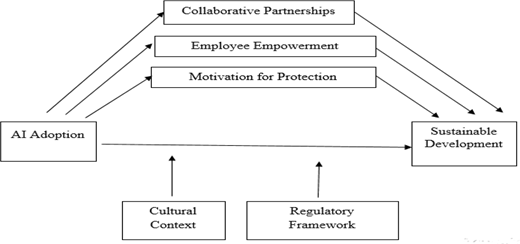
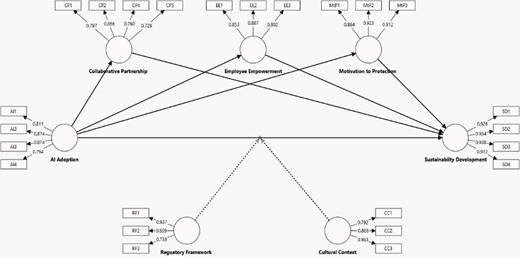
Collectively, these twelve hypotheses delineate the mechanisms by which AI adoption, employee empowerment, collaborative partnerships, protection motivation, cultural context and regulatory frameworks are anticipated to impact sustainable development. The paper presents a conceptual framework to visually integrate these links. The study’s conceptual framework is shown in Figure 1.
Figure 1. Conceptual framework illustrating the role of AI adoption in achieving sustainable development, mediated by collaborative partnerships, employee empowerment, and motivation for protection. Cultural context and regulatory framework are included as contextual factors influencing AI adoption
Theoretical framework
This study’s conceptual framework is supported by many theoretical views that elucidate the behavioral, organizational and contextual mechanisms connecting artificial intelligence (AI) adoption to sustainable development. Each theory elucidates particular constructs and linkages posited in the study’s hypotheses.
Employee empowerment theory: building a skilled workforce
Employee empowerment, as articulated by Kenter quoted in (Lundin et al., 2022), refers to an individual’s ability to organize resources and take action. In the realm of AI adoption, empowerment encompasses both technical expertise and the independence and drive to collaborate and develop. Empowered personnel are more likely to utilize AI tools and integrate them into sustainable organizational processes (Akoh, 2024; Nazarian-Jashnabadi et al., 2023; Venkatesh et al., 2003). (Arpaci, 2023) research suggests that employees with a heightened awareness of AI-related risks are more likely to engage in proactive behaviors and innovation when supported by leadership. This corresponds with the focus of transformational leadership on change readiness and collaborative creativity, especially in AI-driven contexts.
Protection motivation theory (PMT): security and compliance
Protection Motivation Theory (PMT), initially introduced by (Rogers, 1975), posits that individuals are driven to engage in protective activities when they recognize a threat and have confidence in the effectiveness of suggested measures. The Precautionary Model Theory (PMT) has been extensively applied in various domains, including cybersecurity, environmental behavior and public health (Conner and Norman, 2015; Rainear and Christensen, 2017). In the domain of artificial intelligence, PMT is becoming increasingly relevant due to growing concerns about data security, privacy, and the ethical use of AI. Organizational contexts with robust PMT variables – such as perceived vulnerability, reaction efficacy and threat severity – are more inclined to cultivate sustainable AI systems (Ophoff and Robinson, 2014; Thompson et al., 2017; Verkijika, 2018). The increasing worldwide awareness of the unsustainable exploitation of natural resources, expanding populations and inadequate public support for climate initiatives (Oskamp, 1995, VAN der Linden et al., 2015) highlights the importance of PMT in shaping ethical AI practices. (Arendt and Matthes, 2016; Wilson, 2012) emphasize that environmental sustainability is a critical issue that necessitates psychological models, such as PMT, to elucidate behavioral change within companies.
Cultural context and Hofstede’s dimensions: moderating AI integration
Hofstede’s Dimensions theory (Hofstede and Bond, 1984) elucidates the reasons cultural context may diminish the positive correlation between AI adoption and sustainable development. In Pakistan, prevailing social norms and a tendency toward risk aversion may result in resistance to the adoption of emerging technologies. The surrounding cultural and regulatory contexts powerfully shape the impact of AI implementation. Various cultures have distinct methods for embracing technology; for instance, some favor clear communication, whereas others are grounded in implicit customs (Kothe et al., 2019). The significance of cultural diversity has become increasingly apparent in the development of AI systems designed to promote sustainability, particularly in the context of growing global collaboration and interdependence. (Nurse, 2006; Ubertazzi, 2022) argue that achieving sustainable development requires a harmonious integration of cultural diversity, economic development, and environmental protection.
Stakeholder theory
Freeman (1984) underscores the significance of including diverse stakeholders – such as governments, corporations, NGOs and civil society – in the collaborative creation of inclusive and sustainable results (Freeman et al., 2010). In the realm of AI, collaborative partnerships serve as conduits for information exchange, resource sharing and ethical implementation. This theory supports hypotheses H1, H5 and H8, which assert that stakeholder engagement enhances the relationship between AI and sustainable development and may also act as a mediator.
Institutional Theory (Scott, 2005) underpins H12 by emphasizing the influence of regulatory frameworks and institutional forces on technological uptake(Scott, 2005). Robust, transparent and flexible laws enhance organizational preparedness and promote the ethical and efficient implementation of AI in alignment with sustainability goals. Collectively, these theories establish a multi-faceted basis for the proposed conceptual paradigm. PMT elucidates protective behaviors; Stakeholder Theory and Employee Empowerment Theory delineate essential mediators; while Hofstede’s and Institutional Theory contextualize the model by incorporating cultural and regulatory contexts. This integrative approach improves the model’s capacity to elucidate how AI adoption fosters sustainable development across various organizational and societal contexts.
Materials and methods
This section provides a comprehensive overview of the methods used to address the study’s questions. The document opens with an examination of the subjects involved and the methodology employed for gathering information. The subsequent section details the methodology employed, the sources of data utilized, and the development of the instruments. This study employs Partial Least Squares Structural Equation Modeling (PLS-SEM) as the primary data analysis technique to evaluate the proposed hypotheses. The discussion includes the ethical implications associated with the methodologies employed.
This investigation utilizes primary data to explore the specific research objectives, with a particular focus on the connection between AI adoption and sustainable development. The emphasis is placed on essential elements, including data privacy and security, stakeholder engagement and the impact of regulatory policies on determining sustainable education and organizational performance outcomes. Considering the characteristics of the investigation, a survey-based approach was deemed the most suitable methodology. This method is commonly utilized in scholarly investigations to collect empirical data (Othman, 2024; Shwedeh et al., 2024; Stalker, 2008). A structured questionnaire was distributed to institutions in the UAE that have either started implementing artificial intelligence technologies or are investigating metaverse-related initiatives. Additionally, the literature review provided the foundation for constructing the theoretical framework, which is primarily based on Protection Motivation Theory (PMT).
Participants
The snowball sampling method was employed to collect data from participants in diverse national and international work environments. The emphasis was placed on individuals employed in both public and private sector organizations at various points in their careers. Participants were intentionally selected to ensure a diverse range of representation in terms of gender, education, profession, and career level, thereby enhancing the applicability and inclusiveness of the findings. Snowball sampling, a nonprobability sampling technique, involves identifying initial participants who then direct the researcher to additional potential respondents, thereby establishing a chain of referrals. This method is commonly utilized in various types of studies when investigators seek to engage with hard-to-reach or specialized groups (Naderifar et al., 2017; Sadler et al., 2010).
The sample size in this study met the recommended threshold for PLS-SEM. A minimum of 150 respondents per group was deemed sufficient, as suggested by (Hair et al., 2017), to guarantee dependable and strong path modeling. The existing literature generally suggests that sample sizes should range from 50 to 500 participants, depending on the model’s complexity and the number of parameters being estimated (Boomsma and Hoogland, 2001; Kline and Tamer, 2016). Additionally, the requirements for sample size are influenced by factors such as multivariate nonnormality, the presence of missing data, and the number of indicators associated with each latent variable (Hair et al., 2010; Westland, 2010). This sampling strategy was suitably applied, given the exploratory nature of the study and its reliance on contextual workplace knowledge, which necessitated access to participants through trusted networks.
Variables of the study
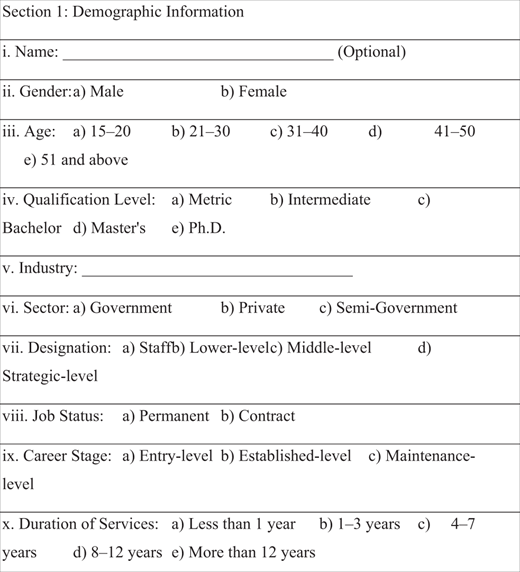
In Section 1 of the analysis, demographic data were collected from participants, along with an evaluation of the baseline levels of the primary variables of interest. In Part II, individuals at various stages of their careers participated in collecting information on the integration of AI and sustainable development, while also examining the influence of mediating and moderating factors within the proposed framework. The data collection process involved the use of a self-administered questionnaire, which helped maintain consistency and reduce the potential for interviewer bias. Every element utilized to assess the specified variables was modified from earlier validated investigations, guaranteeing construct validity and consistency with recognized measurement tools.
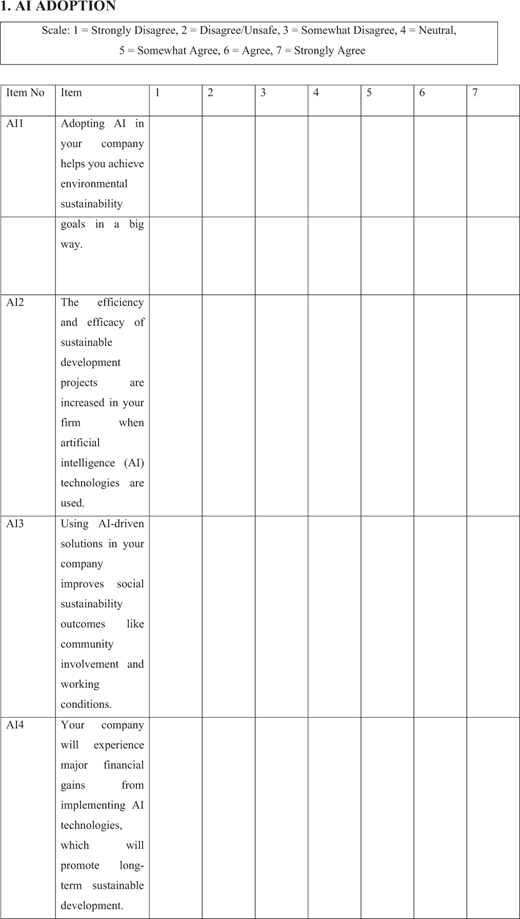
AI adoption
The measurement of AI adoption is conducted through four specific items: AI1, AI2, AI3, and AI4. The incorporation of artificial intelligence within organizational functions plays a crucial role in effectively attaining environmental sustainability objectives (Vinuesa et al., 2020). The utilization of AI technologies significantly enhances the efficiency and effectiveness of sustainable development initiatives, resulting in improved outcomes across various dimensions. AI-driven solutions play a crucial role in advancing social sustainability by bolstering community engagement and improving workplace conditions (Mani et al., 2016). Moreover, the strategic application of AI enables organizations to achieve significant financial benefits while promoting their long-term sustainability goals (Chen et al., 2025).
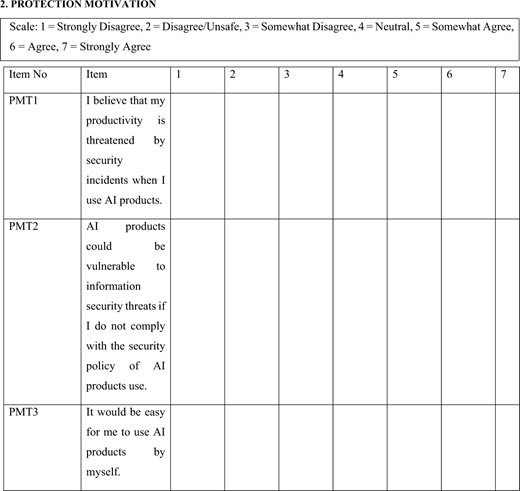
Protection motivation
The evaluation of Protection Motivation Theory (PMT) is conducted through three specific items: PMT1, PMT2, and PMT3. The purpose of these items is to gather insights into employees’ views on risk and their willingness to engage in protective behaviors regarding the implementation of AI. Important survey items consist of: “Security incidents hinder my work efficiency,” and “Artificial intelligence solutions could be susceptible to data security concerns if AI product safety regulations are not adhered to” (Venkatesh et al., 2003). Furthermore, the belief that tools and products powered by AI are user-friendly contributes to their widespread acceptance, highlighting the significance of perceived self-efficacy in alleviating perceived threats (Davis, 1989).
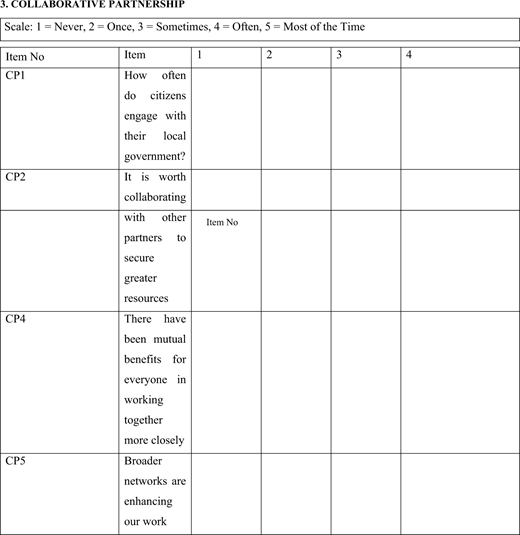
Collaborative partnership
The assessment of collaborative partnership is conducted through three specific items: CP1, CP2 and CP3. This analysis explores the complexities of collaboration among organizations and stakeholders in achieving sustainability objectives. For example, one study examines how residents collaborate with local governments to develop solutions (Gazley, 2008). Another examines the justification for collaborating with various partner organizations as a strategy to gain access to supplementary resources and capabilities (Cheruvelil et al., 2014). Ultimately, the advantages gained from engaging in close collaboration are evaluated, emphasizing how these partnerships foster trust, facilitate resource sharing, and promote co-learning for sustainable results (Cundill et al., 2015).
Employee empowerment
The assessment of employee empowerment involves three components that capture an individual’s perception regarding their engagement, significance and input in organizational activities, especially in the context of AI adoption. The initial element evaluates how much employees perceive their involvement in organizational efforts that promote AI integration (Ayinla et al., 2024).
The second item highlights the importance of employees feeling recognized as integral members of the organization, particularly in relation to their involvement in projects involving AI (Nazarian-Jashnabadi et al., 2023; Fountaine et al., 2019). The third item examines the perception of belonging to a collaborative social community in the workplace, where individual contributions are deemed essential for the progression of AI development (Venkatesh, 2022).
Cultural context
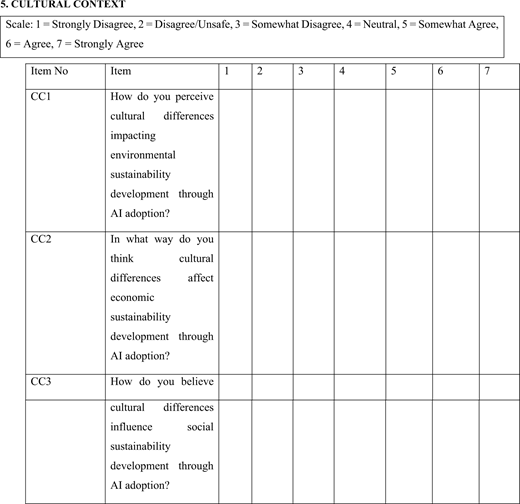
The variable “Cultural Context” is evaluated through three items aimed at understanding how individuals perceive the impact of cultural diversity on various aspects of sustainable development, specifically regarding AI adoption. The initial focus examines views on the influence of cultural variances on environmental sustainability within the framework of AI implementation (Schuetz and Venkatesh, 2020). The second item explores how cultural differences impact economic sustainability outcomes in the context of organizations implementing AI technologies (Gazley, 2008). The third item examines the impact of differing cultural norms and values on the development of social sustainability in the context of AI integration (Vu and Lim, 2022).
Regulatory framework
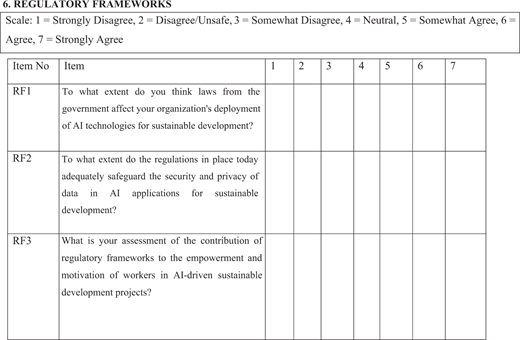
The variable Regulatory Framework is evaluated through three items that gauge perceptions of legal and institutional backing for AI-driven sustainable development. The initial point investigates how government regulations affect the implementation of AI technologies in sustainability efforts (Hacker, 2024). The second item assesses the adequacy of existing regulations in guaranteeing data security and privacy within AI applications focused on sustainable development (Lami et al., 2024). The third item aims to gather participants’ perspectives on the role of regulatory frameworks in enhancing employee empowerment and motivation within AI-driven sustainability initiatives (Paliszkiewicz and Gołuchowski, 2024).
Sustainability development
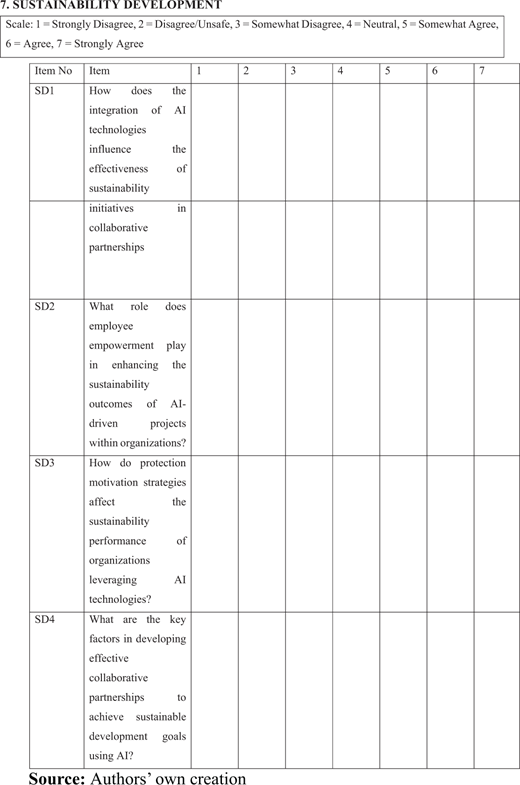
The variable concerning sustainable development is assessed through four essential components that investigate the influence of AI integration and associated strategies on the outcomes of organizational sustainability. The initial focus examines the impact of AI technology integration on the efficacy of sustainability efforts in collaborative partnerships (Sharma and Gupta, 2024). The second item explores how empowering employees contributes to improved sustainability results in AI-driven initiatives within organizations (Rao et al., 2025). The third item assesses how protection motivation strategies influence the sustainability performance of organizations that employ AI technologies (Yin et al., 2024). Ultimately, the fourth item highlights the essential elements necessary for fostering successful collaborative partnerships that utilize AI to achieve sustainable development objectives (Van Huijstee et al., 2007).
Procedures
This investigation utilized a quantitative approach. Data collection involved a self-administered questionnaire crafted to evaluate the latent constructs of the model, with each construct assessed through pertinent sub-dimensions. The survey comprised several items for each construct, with participants evaluating these items on a Likert scale, offering responses from 1 to 5, and in certain instances from 1 to 7, based on the characteristics of the construct. The survey collected information on the demographic characteristics of participants, encompassing their career stages, professional experiences, and other specific traits pertinent to the investigation. Prior to the ultimate data gathering, initial testing and pilot studies were carried out to guarantee the clarity and understandability of the survey items. The preliminary assessment facilitated the identification of linguistic ambiguities and improved the overall face validity. The completed questionnaire was disseminated worldwide through Google Forms. A total of 581 responses were collected, with 563 deemed complete and valid. A total of 343 responses were collected from Pakistan, providing a significant representation for local analysis and also incorporating international viewpoints.
Data analysis
SPSS serves as an effective instrument for executing data analysis, especially in areas such as frequency analysis, standard deviation, descriptive statistics, and evaluating common method bias. These methods assist in condensing the data set and pinpointing any possible concerns associated with data distribution or response trends. Conversely, PLS-SEM is utilized to evaluate the reliability and validity of the sample data in the context of the measurement model, commonly known as the outer model. PLS-SEM demonstrates significant efficacy in forecasting relationships within the structural model, particularly in intricate models that encompass multiple constructs and pathways. The utilization of PLS-SEM in this context is substantiated by the current body of literature (Hair et al., 2020; Sarstedt et al., 2021).
Descriptive analysis
The analysis of the quantitative data gathered via the questionnaires was conducted using SPSS version 26. The software facilitated the screening and preprocessing of the data, encompassing tasks such as coding variables, identifying and addressing missing values, detecting outliers, and evaluating data normality – particularly through the analysis of skewness and kurtosis. This also enabled the investigation of respondent traits for additional descriptive analysis.
Partial least squares structural equation modeling
PLS-SEM is a versatile method for generating statistical models in social science research (Dolce and Lauro, 2015; Hair et al., 2019; Sarstedt et al., 2022). PLS’s versatility and scope make it ideal for analyzing and exploring multifaceted route models (Sarstedt et al., 2021). PLS-SEM is a statistical approach that analyzes correlations between one or more independent variables for continuous or discrete dependent variables (Ali et al., 2018; Drolet and Morrison, 2001). PLS-SEM consists of two stages: measurement model assessment and structural model assessment. The first technique involves one-stage analysis using simultaneous estimating and measurement models. The second stage involves estimating structural links based on validity and reliability assessments (Hair et al., 2020).
Measurement model assessment
It is crucial to evaluate the indicators that affect latent constructs within reflective measurement models (Sarstedt et al., 2021). The use of PLS-SEM enables a comprehensive assessment of the reliability and validity of measurement models through the integration of multiple metrics, including indicator loadings, composite reliability, average variance extracted (AVE) and the heterotrait-monotrait (HTMT) ratio (Fornell and Larcker, 1981; Henseler et al., 2015). The initial phase in employing PLS-SEM entails evaluating the reliability of individual items. It is generally advised to consider items with loadings exceeding 0.708, as this suggests that over 50% of the variance in the indicator is accounted for by the underlying construct (Hair et al., 2020).
The subsequent phase evaluates the reliability of internal consistency, which is generally quantified through composite reliability (Jöreskog, 1971). Values deemed acceptable fall between 0.60 and 0.70 for initial investigations, while for more sophisticated inquiries, they range from 0.70 to 0.90. Values that surpass 0.95 could suggest redundancy among items, potentially diminishing construct validity (Diamantopoulos et al., 2012; Drolet and Morrison, 2001). While Cronbach’s alpha serves as a commonly utilized metric for assessing internal consistency, it is frequently viewed as conservative due to its assumption of equal weights among indicators. Composite reliability, on the other hand, considers varying loadings, providing a more precise estimate of reliability (Hair et al., 2010). Consequently, it is generally anticipated that the true construct reliability will fall within the range of estimates given by Cronbach’s alpha and composite reliability.
The next phase involves evaluating convergent validity through the calculation of the AVE. The AVE quantifies how much a latent construct accounts for the variance in its indicators, where values exceeding 0.50 suggest adequate convergent validity (Hair et al., 2020). The fourth step entails evaluating discriminant validity, which confirms that a construct is empirically separate from other constructs within the model. The criterion proposed by (Fornell and Larcker, 1981) suggests that one should compare the square root of AVE with the correlations between constructs. Nonetheless, recent investigations have brought attention to the constraints of this method, especially when item loadings exhibit only minor variations e.g. between 0.65 and 0.85 (Henseler et al., 2015). In response to this issue, the HTMT ratio has emerged as a more dependable measure for evaluating discriminant validity (Henseler, 2018)The HTMT is determined by evaluating the average correlations between different traits measured by different methods against the average correlations of the same trait measured by different methods (Voorhees et al., 2016).
A value exceeding 0.90 indicates potential issues with discriminant validity among conceptually similar constructs, whereas a stricter benchmark of 0.85 is advised for constructs that are conceptually distinct (Henseler et al., 2015). It is advisable to employ bootstrapping methods to verify if the upper limit of the HTMT confidence interval stays beneath the established critical threshold (for instance, 0.90 or 0.85). Validity and reliability are interconnected concepts that, while related, possess distinct characteristics (Bollen and Ting, 2000). A measure can possess validity without demonstrating reliability, or it can exhibit reliability without confirming validity. As noted by (Ahmad et al., 2015), an instrument is deemed valid when it effectively measures the intended concept, and it is regarded as reliable if it consistently yields stable results. Consequently, evaluations of both validity and reliability are essential for guaranteeing the overall quality of the study’s results.
Validity.
(Hair et al., 2019) assert that merely having instrument reliability does not guarantee the credibility of findings; thus, it is crucial to establish validity to underpin the foundational structure of a thesis. According to (Zikmund-Fisher et al., 2010), validity pertains to how effectively a scale measures the specific constructs it aims to evaluate. The accuracy of measurement is enhanced when there is a robust connection between theoretical comprehension and real-world implementation. In this context, validity denotes the extent to which a construct aligns with its observed indicators (Punch, 2013).
Content validity.
The concept of content validity involves a systematic and subjective assessment of the extent to which the content of a scale accurately represents the intended construct. Experts often refer to this agreement as face validity, indicating that the instrument sufficiently represents the concept being measured (Zikmund-Fisher et al., 2014). This investigation ensured content validity through a thorough review of existing scales in the literature and by conducting interviews with a panel of experts, comprising both academics and industry professionals, to gather their insights on the instrument. During the pretesting phase, these interviews played a crucial role in evaluating the clarity and thoroughness of the survey items. Given the inherently subjective nature of content validity, it is recognized that it may not function as a stringent empirical assessment (Trevena et al., 2013). Nevertheless, confidence was established beforehand to move forward with the final survey, utilizing the insights obtained as a basis for later validation evaluations.
Construct validity.
Construct validity represents a crucial aspect of validity, closely tied to the effectiveness of an instrument in measuring the intended construct. This indicates the extent to which the outcomes of an evaluation align with the theoretical predictions and assumptions it seeks to examine. Malhotra (2020) asserts that achieving construct validity requires the formulation of accurate and suitable operational definitions for theoretical concepts. Although content validity and reliability confirm the internal consistency of the measuring items, they are not adequate on their own to establish construct validity. A comprehensive evaluation of construct validity necessitates the application of further statistical methods to ensure that the tool effectively reflects the theoretical construct it claims to assess.
Criterion validity.
Criterion validity pertains to how well a measurement corresponds with other established indicators of the same construct (Zikmund et al., 2003). According to the timing of the comparison, criterion validity can be divided into two types: predictive validity, which examines the capacity of a measure to anticipate future results, and concurrent validity, which assesses the degree to which a new measure aligns with a preexisting, established tool at the same moment (Zikmund-Fisher et al., 2014). For instance, concurrent validity is shown when a newly created scale yields results that align with those of a recognized benchmark given at the same time. Another pertinent aspect is nomological validity, which evaluates if the relationships between constructs align with theoretical expectations. (Hair et al., 2020) indicate that nomological validity serves as a facet of criterion validity, particularly when bolstered by theory-driven connections. While criterion validity was extensively utilized in previous studies (Peter, 1979), its application has diminished in preference for construct validity, which is regarded as more rigorous. Given the close relationship between criterion validity and convergent validity, demonstrating convergent validity typically suggests that criterion validity is also present (Zikmund et al., 2003). Furthermore, contemporary methodologies like PLS-Predict can be employed to evaluate out-of-sample prediction, providing an empirical foundation to validate nomological relationships (Shmueli et al., 2016).
Structural model assessment
After establishing a satisfactory measurement model, the next step involves evaluating the structural model to analyze the relationships among latent constructs within the PLS-SEM framework. Essential evaluation metrics encompass the coefficient of determination (R2), the blindfolded cross-validated redundancy test (Q2), along with the significance and strength of the path coefficients (Hair et al., 2020). When the sample size is adequately large, the PLS-predict approach can be employed to assess the model’s predictive capability beyond the sample data (Shmueli et al., 2019). A significant metric to consider is the Variance Inflation Factor (VIF), utilized to assess multicollinearity. (Cheah et al., 2018; Park and Agarwal, 2018) indicate that VIF values exceeding 5 may indicate issues with collinearity, whereas values under 3 are typically deemed acceptable.
After eliminating collinearity, focus shifts to the R2 value of endogenous constructs, indicating the model’s explanatory strength. According to the findings of (Hair et al., 2011; Henseler, 2018; Rigdon, 2012; Shmueli and Koppius, 2011) R2 values of 0.75, 0.50 and 0.25 are categorized as substantial, moderate and weak, respectively. In exploratory studies, it is possible for a R2 value of 0.10 to be deemed acceptable (Raithel et al., 2012). Elevated R2 values can indicate overfitting, where the model identifies noise instead of significant patterns (Sharma et al., 2019). The effect size (f2) serves as a crucial metric, where values of 0.02, 0.15, and 0.35 correspond to small, medium, and large effects, respectively (Cohen, 2013). The Q2 value is determined through the blindfolding procedure (Enis and Geisser, 1974; Stone, 1974), which combines in-sample explanation with out-of-sample prediction (Hair et al., 2017; Shmueli et al., 2016) to assess predictive relevance. In the application of PLS-predict, the evaluation of prediction error is conducted using Mean Absolute Error (MAE) and Root Mean Squared Error (RMSE), where RMSE gives more significance to larger errors (Hair et al., 2019; Shmueli et al., 2019). In conclusion, assessing the importance and applicability of the path coefficients confirms the model’s ability to effectively explain and predict outcomes.
Results analysis
Screening of data
It is uncommon to gather data sets that are entirely complete or that adhere to a perfectly normal distribution (Kline, 2023). Instances of absent data frequently arise when participants neglect to respond to one or several questions on a survey. Studies on addressing absent data show that Expectation-Maximization (EM) proves to be a superior approach in comparison to conventional techniques like mean substitution or listwise deletion (Hair et al., 2010). (Tabachnick, 2007) examined different strategies for handling absent data and highlighted the significance of evaluating the percentage of missing responses within a data set.
The analysis performed in this study revealed through the data filtering process conducted with SPSS that merely 18 respondents exhibited more than 5% missing values. The choice to exclude those cases stemmed from the overall sample size, which originally included 581 responses – substantially exceeding the minimum necessary sample size of 384 for subsequent analysis. As a result, 18 incomplete responses were removed, resulting in 563 valid responses available for further analysis. The findings indicate that the data may be applicable more broadly, as there were no notable differences identified between responses from national and international sources.
Initial analysis of the data
This investigation utilized a survey-based questionnaire ( Appendix) to gather data. Before the final survey was conducted, the questionnaire underwent pretesting and pilot testing to confirm its clarity and validity. The initial phase included the assessment of item questions by field specialists acknowledged as experts in the subject, aimed at pinpointing any ambiguous or superfluous content (DuFon and Churchill, 2006; Reynolds and Diamantopoulos, 1998). The evaluation of the questionnaire’s face validity and content validity was conducted with the assistance of ten professionals holding doctorate degrees from three different organizations. In light of the feedback obtained, essential modifications were implemented prior to advancing to the pilot testing phase. A significant issue identified pertained to the scaling of “How” questions, which was resolved by substituting them with a Likert scale that ranges from “strongly agree” to “strongly disagree.”
Descriptive analysis
Descriptive statistics were utilized to analyze the survey participants, providing a more detailed insight into the characteristics of the sample. (Zikmund et al., 2003) emphasize that descriptive analysis plays a crucial role in developing a significant profile of demographic variables. The descriptive statistics, specifically the frequency analysis, of the sample respondents are detailed in Table 1. The characteristics analyzed encompass: country of residence, gender, age, educational qualification, industry sector, job title, and employment status, length of employment, experience level and career stage.
Table 1 delineates the demographic characteristics of the study participants, including both the frequency and percentage for each category. Sixty point nine percent of respondents were from Pakistan (national), whilst thirty-nine point one percent comprised international participation, including individuals from France, Italy, the UK and the USA. The sample consisted of 62.5% males and 37.5% females. The age distribution revealed that 51.5% of participants were in the 31–40 age range, 21.5% were aged 21–30, and 20.1% were aged 41–50. Merely 5.7% of participants exceeded 50 years of age, while a negligible minority (1.2%) fell within the 15–20 year age bracket.
Regarding educational qualifications, 68.9% possessed a Master’s or MPhil degree, 20.1% earned a Bachelor’s degree, and 9.1% attained a PhD or postdoctoral certification. The majority of participants (58.3%) were working in the private sector, followed by 27.5% in the government sector, 11.2% in semi-government positions, and 3% in other sectors. Regarding job description, 44% of respondents occupied middle-level management roles, 23.1% were staff-level employees, and 13.5% held strategic managing positions. The residual 12.6% was classified as “others” and lower-tier management.
Concerning employment status, 76.7% of respondents held permanent positions, whereas 23.3% were engaged on a contractual basis. The participants exhibited a varied range of professional experience: 31.4% had 1–3 years, 16.9% had 4–7 years, 15.6% accumulated 8–12 years, and 32.9% exceeded 12 years of experience. Merely 3.2% have fewer than one year of professional experience. Data on career stages indicated that 37.5% of participants were in the established stage, 36.4% at the entrance level, and 26.1% in the maturity/maintenance stage.
The findings suggest that most participants were youthful, highly educated, gainfully employed, and seasoned in their respective fields. Given the diverse representation of participants at various career stages, it was essential to adopt a sampling approach that effectively involved professionals from multiple industries, employment sectors, and organizational tiers. To achieve this, a snowball sampling technique was employed, enabling the identification of participants through professional networks (Naderifar et al., 2017). This method enabled engagement with individuals from diverse organizational roles and sectors, all while maintaining a concentrated focus on AI-driven workplace sustainability (Atkinson and Flint, 2001; Biernacki and Waldorf, 1981).Although snowball sampling is adept at reaching professionals, it presents potential challenges such as selection bias and the possibility of certain groups being overrepresented.
In response to this, various strategies were implemented to ensure a diverse sample and maintain methodological integrity (Sadler et al., 2010). For example, investigators emphasized the importance of recruiting participants from diverse backgrounds, rather than relying exclusively on uniform referrals. This was accomplished by promoting referrals that encompassed participants from various entry points and a range of social networks (Kusztal et al., 2023).
Furthermore, ensuring balanced representation from various sectors was taken into account to reduce bias in the selection of respondents.Well-defined inclusion and exclusion criteria were implemented to enhance the evaluation of participant characteristics and uphold the integrity of the selection process.
The initial group of participants was intentionally selected from both public and private organizations to guarantee a thorough representation across sectors. Participants were encouraged to nominate colleagues from diverse industries, job roles, and organizational levels, thereby preventing an excessive concentration of responses from any single workplace or professional group. After gathering the data, a statistical analysis of the sample composition was conducted to ensure demographic balance among various age groups, genders, experience levels, and sectors. In instances where disparities were noted, focused efforts were implemented to engage underrepresented populations (Heckathorn, 2011). The final data set was meticulously cross-referenced with national labor statistics to ensure its alignment with Pakistan’s workforce demographics, thereby enhancing the generalizability and representativeness of the findings (Ispiryan et al., 2024). The combination of these strategies effectively addressed the inherent limitations of snowball sampling, resulting in a diverse and methodologically sound data set.
Sector-specific insights: contrasting the private and government sectors
Distinct variations across sectors provided valuable insights, highlighting the importance of customized AI integration approaches within diverse organizational frameworks (Wirtz et al., 2021)A thorough comparative descriptive analysis highlighted significant differences in the adoption and perception of AI technologies across public and private sector organizations (Virkar et al., 2022). Both sectors recognized the strategic significance of AI for sustainable development; however, respondents from the private sector exhibited a more pronounced positive relationship between the adoption of AI and the empowerment of employees. This group highlighted the significance of ongoing digital skill enhancement and the cultivation of a culture focused on innovation (Al Fouri et al., 2024; Jaiswal et al., 2023).
The observed trends were reinforced by elevated mean scores on empowerment indicators among participants from the private sector in comparison to those from the public sector. On the other hand, individuals working in the government sector demonstrated increased apprehension regarding the regulatory and procedural obstacles to AI implementation, as indicated by diminished empowerment scores and a heightened focus on institutional limitations (Zuiderwijk et al., 2021).
While a comprehensive multi-group structural equation modeling analysis was not feasible within the confines of this study, the descriptive comparisons presented here offer strong evidence of divergence across sectors. The findings indicate a necessity for tailored AI approaches: in the private domain, frameworks ought to emphasize ethical innovation and the cultivation of talent, whereas in the public sphere, the emphasis should be on achieving a balance between regulatory adherence and flexible technological advancement (Jankin et al., 2018). This detailed comprehension adds depth to the ongoing conversation regarding the impact of institutional dynamics on the direction and success of AI-driven sustainable development efforts.
Structural equation modeling using partial least squares (PLS-SEM)
Partial Least Squares Path Modeling (PLS-PM) has become increasingly significant in multiple fields, owing to its effectiveness in modeling structural relationships between latent variables as indicated by observable measures(Sharma et al., 2019). Additionally, PLS-SEM allows for the evaluation of validity, reliability and uni-dimensionality of each construct, thereby supporting a thorough assessment of the measurement model (Hair et al., 2020). Furthermore, this method facilitates the concurrent evaluation of independent parameter estimates, aiding in the determination of the best model fit for the observed data (Hair et al., 2019).
Measurement model assessment
Evaluation of the measurement model
The primary aim of the measurement model is to evaluate the extent to which the observed (manifest) variables accurately reflect the underlying latent constructs they are designed to measure (Hair et al., 2017). The measurement model presented in Figure 2 illustrates the connections between each measurement item and its associated latent variable. As indicated in Table 2, the reliability and validity of the constructs were confirmed through psychometric testing. To further demonstrate the adequacy of these constructs, the measurement model was assessed, and the findings are presented in Figure 2. This study assessed each concept independently to confirm that suitable assessment procedures were utilized to demonstrate both reliability and validity (Byrne et al., 1989).
Cronbach’s alpha was computed for each construct to evaluate internal consistency. All results surpassed the acceptable level of 0.70, signifying strong internal reliability. The recorded scores were: AI Adoption (0.864), Cultural Context (0.872), Collaborative Partnership (0.797), Regulatory Framework (0.813), Sustainability Development (0.946), Employee Empowerment (0.804) and Motivation to protect (0.883). The findings validate that the observed items reliably represent their corresponding constructs.
Composite Reliability (CR) was evaluated to enhance the assessment of internal consistency, providing a more thorough metric than Cronbach’s alpha (Hair et al., 2020). All CR values surpassed the 0.70 threshold: AI Adoption (0.890), Regulatory Framework (1.103), Sustainability Development (0.947), Employee Empowerment (0.805), Motivation to Protect (0.894), Cultural Context (1.878) and Collaborative Partnership (0.799). The notably elevated CR values for Cultural Context and Regulatory Framework may indicate possible item repetition, necessitating additional examination in subsequent research.
Convergent validity was evaluated by Average Variance Extracted (AVE), which quantifies the ratio of variance accounted for by a concept in comparison to variance attributed to measurement error. An AVE score exceeding 0.50 signifies adequate convergent validity (Fornell and Larcker, 1981). All components satisfied this criterion: AI Adoption (0.704), Cultural Context (0.624), Collaborative Partnership (0.736), Employee Empowerment (0.719), Motivation to Protect (0.810), Regulatory Framework (0.709) and Sustainable Development (0.860).
Two latent interaction terms – Cultural Context × AI Adoption and Regulatory Framework × AI Adoption – were assessed to examine moderating effects. Consistent with product-indicator moderation models, both terms had fixed factor loadings of 1.000. Although statistically valid, these interactions must be viewed cautiously, since they may still present issues such as multicollinearity or artificial inflating of path strength. The measuring model exhibits robust reliability and convergent validity for all constructs. The psychometric features presented in Table 2 confirm the reliability and validity of the constructs, providing a strong foundation for further hypothesis testing in the structural model. The measurement model, including standardized factor loadings, is illustrated in Figure 2.
Discriminant validity assessment
Table 3 presents the correlation matrix of the latent components, offering a preliminary evaluation of discriminant validity. Discriminant validity guarantees that each construct inside the model is empirically distinct from the others, indicating that the constructs assess distinctive concepts (Fornell and Larcker, 1981). The correlation matrix indicates that all interconstruct correlations are well below the widely recognized threshold of 0.85 (Kline, 2011), with the strongest correlation recorded at 0.702 between Employee Empowerment and Sustainability Development. This signifies that while both constructs are positively correlated, they do not assess the same fundamental concept. AI Adoption exhibits moderate associations with Collaborative Partnership (0.565) and Employee Empowerment (0.415), indicating their conceptual interrelation without multicollinearity. Moreover, the weak correlations of dimensions like Motivation to Protection and Regulatory Framework with others further bolster the model’s discriminant validity.
The values indicate that each latent concept retains adequate independence, hence affirming the validity of the measurement model as detailed in Table 3.
Discriminant validity was evaluated using the Fornell–Larcker criterion and the Heterotrait-Monotrait (HTMT) ratio of correlations. Table 4 demonstrates that the square root of the Average Variance Extracted (AVE) for each construct, displayed along the diagonal, exceeds the interconstruct correlations in the respective rows and columns. The square root of the Average Variance Extracted (AVE) for Sustainable Development was 0.927, surpassing its connection with all other constructs, including the highest found correlation of 0.612 with Employee Empowerment.
Likewise, AI Adoption exhibited a square root of AVE of 0.839, surpassing its link with Collaborative Partnership (0.476). The Motivation to Protection construct also satisfied the criterion, with a square root of AVE of 0.900, surpassing all its correlations with other constructs. The results validate that each construct exhibits greater variance with its respective items than with those of other constructs, hence satisfying the Fornell–Larcker criterion for discriminant validity (Fornell and Larcker, 1981).
The HTMT ratio was utilized to further validate these results. The Fornell–Larcker criterion, although widely recognized, may be inadequate in identifying discriminant validity concerns in certain instances. Consequently, the HTMT approach was utilized as an auxiliary evaluation. All identified correlations between latent variables were below the stringent HTMT threshold of 0.85 (Henseler, Ringle, and Sarstedt, 2015). The correlations between AI Adoption and Motivation to Protection (0.154) and between Cultural Context and Sustainability Development (0.126) were well below the threshold, indicating a minimal probability of conceptual overlap. The persistently low correlations among all constructs affirm that discriminant validity is sufficiently established inside the model.
Structural model assessment
Structural model assessment
The structural model was evaluated to determine the direct, indirect, and moderating links among the constructs through route coefficients and their statistical significance. Figure 3 and Table 5 demonstrate that AI Adoption significantly impacted all three mediators – Collaborative Partnership (β = 0.476, p = 0.000), Employee Empowerment (β = 0.362, p = 0.000) and Motivation to Protection (β = 0.125, p = 0.003) – highlighting its essential role in influencing organizational mechanisms for sustainable development. Moreover, AI Adoption exerted a direct yet comparatively smaller effect on Sustainability Development (β = 0.129, p = 0.002), indicating that although its significance is notable, a substantial portion of its influence is mediated by intermediary variables.
Among the mediators, Employee Empowerment (β = 0.444, p = 0.000) exerted the most significant influence on Sustainability Development, succeeded by Motivation to Protection (β = 0.385, p = 0.000) and Collaborative Partnership (β = 0.177, p = 0.000). These findings underscore the significance of internal empowerment mechanisms and protective motivation in fostering sustainable outcomes in AI-integrated organizations.
Cultural Context exerted a substantial direct influence on Sustainability Development (β = 0.270, p = 0.000), whereas the Regulatory Framework unexpectedly demonstrated a significant negative effect (β = −0.159, p = 0.000), suggesting that inflexible or misaligned regulations could obstruct sustainable implementation.
The interaction term Regulatory Framework × AI Adoption significantly moderated the relationship with Sustainability Development (β = 0.087, p = 0.008), suggesting that regulatory environments can enhance or diminish the positive effects of AI Adoption based on their configuration. The moderation effect of Cultural Context × AI Adoption was not significant (β = 0.027, p = 0.471), indicating that cultural influences may not substantially impact this connection in the present data set.
Furthermore, the indirect mediation effects were all significant: AI Adoption → Employee Empowerment → Sustainability Development (β = 0.161, p = 0.000), AI Adoption → Collaborative Partnership → Sustainability Development (β = 0.084, p = 0.000), and AI Adoption → Motivation to Protect → Sustainability Development (β = 0.048, p = 0.005). These findings confirm that AI’s influence on sustainability is primarily facilitated by organizational and psychological enablers, highlighting the intricate mechanisms by which AI affects long-term development objectives (refer to Table 5 and Figure 3).
Assessing effect size: Cohen’s f2 metrics
The mere presence of statistical significance does not imply the practical importance of an effect. Cohen’s f2 provides a standardized measure for effect size, allowing for the evaluation of the influence of an independent variable on the dependent variable, categorized as small (f2 ≥ 0.02), medium (f2 ≥ 0.15), or large (f2 ≥ 0.35) (Cohen, 1988). The results reveal considerable differences in the impact strength of AI adoption across various sustainability aspects. The influence of employee empowerment is substantial, indicating that the integration of AI in workforce engagement plays a vital role in attaining sustainability outcomes.
The implementation of AI-driven learning systems, automation, and digital workplace solutions significantly improves employee adaptability, fosters innovation and promotes long-term job sustainability. The impetus to safeguard demonstrates a moderate effect size, suggesting that AI-enhanced security, risk management and adherence to regulations play a crucial role in promoting sustainability through the reinforcement of ethical business conduct, cybersecurity and compliance with regulations. The collaborative partnership demonstrates a modest but meaningful impact, indicating that while AI enhances stakeholder collaboration, interorganizational trust and data-sharing mechanisms, additional structural and policy measures might be required to strengthen these partnerships. Additional influencing factors, including cultural context, AI adoption, and regulatory framework, exhibit small to moderate effect sizes, indicating varying degrees of impact on sustainable outcomes.
The results demonstrate that the main benefits of AI in promoting sustainability lie in enhancing workforce capabilities and reducing risks, highlighting the importance of implementing AI-focused training initiatives, establishing ethical AI guidelines and creating rules for workforce involvement. The coefficient of determination (R2) measures how much the independent variables explain the variability in the dependent variable.
An elevated R2 value indicates a stronger predictive relationship, illustrating how AI adoption and associated organizational factors contribute to sustainable development. The sustainability development model demonstrates a strong R2 value, suggesting that a considerable portion of sustainability outcomes can be attributed to the adoption of AI. This highlights the role of AI in advancing eco-friendly technology, enhancing energy efficiency, and providing predictive insights for decisions focused on sustainability. The collaborative partnership model demonstrates a moderate R2 value, indicating that while the adoption of AI improves engagement among multiple stakeholders, it is also influenced by external economic, regulatory and institutional factors that impact the effectiveness of partnerships.
The findings regarding employee empowerment and motivation to protect models show relatively lower R2 values. This suggests that while AI contributes to workforce engagement and security, there are additional organizational and behavioral factors at play that also affect these elements. The results highlight that the integration of AI plays a vital role in driving sustainability transformation, particularly in areas such as workforce development and operational efficiency. The relatively lower R2 values for collaborative partnerships and regulatory frameworks indicate that governance mechanisms and AI adoption policies need further refinement to improve AI’s impact on sustainability. Integrating Cohen’s f2 and R2 values into the analysis deepens the comprehension of the influence of AI adoption on sustainability.
The results of this study offer numerous important considerations for policymakers, corporations, and scholars. The significant impact of employee empowerment suggests that organizations should prioritize AI-driven upskilling initiatives to ensure workforce adaptability and sustainable employment structures. Investing in AI-powered training initiatives, online learning systems and smart automation can enhance employee involvement and efficiency, thereby supporting sustainability goals.
The observed moderate effect size of motivation to protect indicates that there is a need for enhanced integration of AI-driven regulatory compliance and cybersecurity solutions within the framework of corporate sustainability objectives. It is essential for governments to create legislative frameworks that promote the ethical use of AI, including regulations on data privacy, mandates for AI transparency, and tailored risk management strategies for various industries. The minimal effect size of collaborative partnership suggests that while AI has the potential to improve stakeholder coordination and sustainable business networks, its effectiveness needs to be strengthened through policy-oriented engagement strategies, trust-building efforts and governance frameworks informed by AI.
The reduced R2 values for specific sustainability parameters highlight the need for further exploration of external factors affecting AI’s effectiveness in sustainable development. Subsequent inquiries ought to explore how sector-specific AI applications, economic incentives, and organizational leadership influence the sustainability potential of AI. This analysis provides quantifiable insights into the transformative capabilities of AI in promoting sustainable development by utilizing effect size evaluations and assessments of explanatory strength. The results offer crucial guidance for decision-makers, business leaders and sustainability planners, guaranteeing that AI is leveraged as a key driver for sustainable innovation, workforce development, and corporate sustainability resilience.
Diagnostics for collinearity
To evaluate the presence of multicollinearity among the predictor constructs, Variance Inflation Factor (VIF) values were assessed. As presented in Table 6, all VIF values fall below the critical threshold of 3.3, suggesting no serious multicollinearity issues within the structural model. The VIF values for AI Adoption were consistently 1.000 when predicting Collaborative Partnership, Employee Empowerment and Motivation to Protection, and slightly higher (1.350) when predicting Sustainability Development. This reflects a stable and independent contribution of AI Adoption across different endogenous constructs.
Among the predictors of Sustainability Development, Cultural Context recorded the highest VIF at 1.701, followed by Employee Empowerment (1.623), Collaborative Partnership (1.597) and Motivation to Protection (1.529), all of which remain within the acceptable range. Regulatory Framework also exhibited a VIF of 1.060, indicating minimal collinearity concerns. For the moderation effects, both interaction terms – Cultural Context × AI Adoption (1.013) and Regulatory Framework × AI Adoption (1.028) – showed low VIF under Theoretical Underpinning of the study values, confirming their independent variance contributions. Overall, these findings affirm the structural model’s robustness and support the interpretability of the path coefficients without distortion from multicollinearity.
Effect size
To enhance the study of route coefficients and ascertain the significant contribution of each predictor to the variance in Sustainable Development, Cohen’s (1988) f2 effect size metric was utilized. According to Table 7, Employee Empowerment (f2 = 0.290) and Collaborative Partnership (f2 = 0.292) exhibited moderate to large effect sizes, signifying that these characteristics significantly impact sustainability results in AI-integrated workplaces. The motivation for protection exhibited a substantial effect (f2 = 0.231), indicating that protection-oriented behavioral intentions considerably enhance sustainability performance.
Additional predictors demonstrated lesser effect sizes, such as AI Adoption (f2 = 0.030), Cultural Context (f2 = 0.103), and Regulatory Framework (f2 = 0.057), each of which nonetheless contributed significant contextual and structural influences. The two moderating variables – Cultural Context × AI Adoption (f2 = 0.002) and Regulatory Framework × AI Adoption (f2 = 0.022) – exhibited trivial effect sizes, signifying that their interaction effects on Sustainable Development are small. The findings elucidate the structures that most significantly influence organizational sustainability and digital transformation, highlighting the prominence of employee-centric and collaborative procedures (Hair et al., 2020).
Model fit: determination coefficient (R2)
The predictive strength of the model was evaluated by calculating the coefficient of determination (R2) and adjusted R2 for each endogenous construct. Table 8 indicates that the R2 value for Sustainable Development was 0.581, with an adjusted R2 of 0.575, reflecting a reasonable degree of predictive accuracy (Hair et al., 2019). This indicates that the exogenous variables collectively account for roughly 58.1% of the variance in Sustainable Development, representing a significant contribution in behavioral research contexts. The R2 values for Collaborative Partnership (0.226), Employee Empowerment (0.131), and Motivation to Protection (0.016) demonstrate differing levels of explained variance, with Collaborative Partnership and Employee Empowerment exhibiting moderate explanatory power, whereas Motivation to Protection indicates a diminished effect.
The corresponding f2 values further demonstrate the distinct contribution of each predictor to the model. Employee Empowerment (f2 = 0.290) and Motivation to Protection (f2 = 0.231) had medium to large effects on Sustainable Development. The Collaborative Partnership exhibited a moderate yet significant effect (f2 = 0.047), whereas Cultural Context (f2 = 0.103), AI Adoption (f2 = 0.030), and Regulatory Framework (f2 = 0.057) demonstrated tiny but substantial contributions. The interaction variables, Cultural Context × AI Adoption (f2 = 0.002) and Regulatory Framework × AI Adoption (f2 = 0.022), had negligible effect sizes, indicating that their moderating influence on sustainability outcomes was constrained. These results affirm the model’s explanatory capacity and underscore the essential roles of empowerment, behavioral incentive, and collaboration in promoting AI-aligned sustainable development.
Discussion
The results are consistent with earlier research, including that of Kulkov et al. (2024), which similarly emphasized the pivotal function of AI in improving capabilities and tackling intricate sustainability issues. The findings further demonstrate how the use of technology can enhance internal operations and decision-making by positively impacting collaborative partnerships and employee involvement (Xiang et al., 2022).
The considerable influence of employee empowerment on sustainable development strengthens the argument of the present study that more focus should be directed toward fostering employees to aid in the attainment of organizational sustainability (Lamm et al., 2015). In line with previous findings, the adverse impact of the regulatory framework on sustainable development indicates that excessively strict regulations or inadequately structured policies could obstruct the implementation of sustainable solutions (Nguyen et al., 2025).The quantitative findings, nonetheless, are still insufficiently investigated regarding the adoption of AI in diverse real-world situations – an aspect that deserves further scrutiny. In the last ten years, artificial intelligence has evolved considerably, transitioning from simple algorithms to intricate, multiphase models. It is widely acknowledged that AI possesses the capability to exceed human proficiency in a variety of tasks. In the current digital landscape, artificial intelligence is acknowledged as a significant catalyst for change across various sectors.
In the realm of healthcare, for example, advancements have been made with the implementation of sophisticated diagnostic methods driven by AI (Faiyazuddin et al., 2025). The efficiency of disease detection has significantly improved, with AI-driven diagnostic tools enhancing the accuracy of identifying health issues in patients. In the finance sector, mechanisms for detecting fraud have seen considerable advancements through the incorporation of AI technology. Finance managers now have the capability to oversee millions of transactions to identify fraudulent activities, a task that would be significantly more complicated with conventional approaches (Mahalakshmi et al., 2022). In a similar vein, the retail sector significantly depends on artificial intelligence frameworks to improve individualized customer interactions (Pandey and Pandey, 2025).
By utilizing advanced data technology, retail businesses are able to examine historical purchasing patterns of customers, which allows them to create marketing strategies that focus on the needs and preferences of their clientele. The implementation of AI-driven marketing strategies has significantly enhanced customer relationships, leading to increased product sales and better alignment with consumer expectations. Grasping these real-world applications of AI enables scholars to recognize the practical importance of models grounded in AI technology.
In the field of agriculture, there is a growing trend among farmers to utilize AI-driven predictive analytics for making informed decisions regarding crop cultivation, monitoring growth, and managing harvest cycles (Vardhan et al., 2025). The integration of AI has facilitated a connection between conventional agricultural techniques and contemporary, data-informed approaches. Farmers who once encountered difficulties stemming from erratic weather patterns, insufficient information, or decreasing productivity are now more prepared to adopt sustainable practices. Through the application of predictive analytics, it is possible to evaluate environmental data and project future outcomes based on historical trends (Nti et al., 2023). It is clear that the integration of AI has transformed workplace dynamics, enhanced productivity, and bolstered overall efficiency. Through the sustainable application of AI, organizations have gained competitive edges via product innovation and improved service delivery (Zechiel et al., 2024).
Engagement of employees continues to be a crucial element in upholding performance and ensuring competitiveness. Nonetheless, a significant obstacle in the adoption of AI technologies is the requirement for specialized knowledge. The integration of AI necessitates the enhancement of skills to guarantee its efficient application. A study conducted by Tusquellas et al. (2024) found that improving learning opportunities for employees greatly aids in the integration of AI. When properly aligned with advancements in artificial intelligence, digital training has the potential to significantly improve both its relevance and acceptance. The quantitative results of this study highlight the significance of employee empowerment as a crucial element in the effective and lasting integration of AI tools like chatbots. Enhancing employee capabilities is crucial for aligning with Pakistan’s 2030 sustainability agenda. Organizations need to empower their workforce with independence and the necessary skills to succeed in a landscape influenced by artificial intelligence.
Furthermore, sectors implementing AI encounter increasing apprehensions regarding data privacy and the potential dangers of algorithmic bias. Addressing these challenges is essential for achieving ethical, transparent, and sustainable implementation of AI. This highlights the increasing necessity for digital proficiency and a rising requirement for a competent workforce that possesses the essential skills to handle new technologies. (Morandini et al., 2023) found that organizations should focus on reskilling their workforce when implementing AI models. Equipping employees for new roles boosts various aspects of productivity. In a similar vein, scholarly investigations have underscored the importance of training initiatives for entities adopting AI technologies (Singh, 2025). Organizations should prioritize the development of an environment that encourages ongoing education, while also inspiring their workforce to embrace new skills related to artificial intelligence.
Further studies indicate that fostering an environment of independence enables individuals to pursue creative concepts and utilize their capabilities (Kaudela-Baum et al., 2023). Organizations must foster an innovative atmosphere that encourages analytical reasoning. The effective incorporation of AI in diverse fields relies on engaged employee participation, necessitating supportive operational policies that foster workforce involvement. When integrating AI technologies, it is essential to consider employee satisfaction as a crucial element. It is essential for organizations to cultivate motivation within the workplace by recognizing the factors that boost employee engagement. Investigating the practical effects of AI necessitates assessing how effectively business leaders have adopted AI technologies to promote sustainability goals. A study conducted by Kelly et al. (2022) observed that the integration of AI applications has led to a greater acceptance of innovative behavior, allowing companies to improve their operational efficiency.
Enhancing the integration of AI-based models is crucial for closing technological gaps. Different sectors, such as health, education, agriculture, and manufacturing, play a vital role in promoting sustainable development. Meanwhile, AI and associated technologies like big data and machine learning are significantly reshaping business operations across the board. The quantitative findings from this study highlight the significance of collaborative partnerships, enabling stakeholders like employees to contribute their insights and promote collective learning. Embracing a collaborative method guarantees that requirements and anticipations are comprehensively recognized and met. Encouraging a collective understanding of sustainability enhances the creation of impactful approaches for sustainable advancement. Training staff on how to effectively use resources can enhance understanding of sustainability efforts and their real-world application. Furthermore, the analysis emphasizes the significance of cultivating a collaborative environment – an indispensable factor for realizing Pakistan’s Vision 2030.
To achieve this, collaboration across sectors and the sharing of resources are essential during the implementation of AI. The significance of AI in enhancing sustainability outcomes, including the pursuit of net-zero carbon emissions, is particularly noteworthy. The sustainable development vision for Pakistan in 2030 is intricately connected to the goal of decreasing carbon emissions. Tackling climate change has emerged as an urgent challenge that demands advancements in AI methodologies (Matos et al., 2023). Previous studies have demonstrated that AI serves as an effective means for minimizing carbon footprints. The rise in production levels has significantly contributed to the increase in global temperatures. Nevertheless, the capacity of AI to analyze extensive data sets facilitates the recognition of intricate patterns, thereby aiding business leaders and policymakers in making well-informed decisions.
The potential of AI to foster sustainable innovation spans various sectors, including energy, manufacturing, and retail (Olawade et al., 2024). Investing strategically in AI has the potential to enhance the efficiency of sustainable energy systems. A substantial body of empirical evidence has shown the ongoing influence of AI on sustainability. Intelligent manufacturing methods driven by artificial intelligence have successfully decreased energy usage and lessened waste production.
The application of AI technologies plays a significant role in reducing carbon emissions and fostering a cleaner environment (Cao et al., 2025). Organizations utilizing artificial intelligence technologies are achieving notable advancements in minimizing waste deterioration and alleviating environmental contamination. Statistical evidence indicates that around 70% of natural gas sectors globally are currently employing AI to improve operational precision and efficiency.
Furthermore, advancements in artificial intelligence have enhanced the accuracy of weather predictions, allowing energy firms to optimize the scheduling of resource production, including gas and oil (Sharma and Dutt, 2024). It is clear that AI-driven decision-making and predictive tools have significantly lowered carbon emissions, aiding companies in their pursuit of sustainability goals. Countries worldwide have acknowledged the importance of AI technologies in improving sustainability efforts. Van Wynsberghe (2021) indicated that instruction in deep learning, particularly with natural language processing (NLP) models, has the potential to decrease carbon dioxide emissions by around 600,000 lb – comparable to the emissions generated by five vehicles, which can significantly affect the environment. This highlights the significance of implementing AI solutions to attain sustainable results, including the reduction of the carbon footprint.
A recent scholarly investigation revealed that Google’s AlphaGo Zero produced nearly 96 tons of CO2 during a mere 40 days of its training phase – an amount approximately equivalent to 1,000 h of carbon emissions. This example demonstrates that although AI provides significant advantages across various sectors, it also entails environmental repercussions. This study’s quantitative findings provide an in-depth examination of the connection between the adoption of AI and various sustainability factors. Nevertheless, comprehending the practical consequences of AI necessitates additional assessment of its efficacy in reducing carbon emissions. Although AI is crucial in addressing environmental waste management, there are ongoing concerns about the environmental costs linked to its implementation. Realizing the objectives set forth by the United Nations for sustainable development requires a sustained commitment to the integration of AI technologies.
In various industries, the integration of machine learning with AI frameworks is progressively being utilized to create cost-effective and sustainable energy solutions (Fan et al., 2023). SDG Goal 7 outlines a comprehensive framework aimed at ensuring worldwide access to sustainable and clean energy, which is in strong alignment with Pakistan’s Vision 2030. The significance of incorporating sustainable practices throughout various sectors is highlighted to guarantee growth that is environmentally responsible. Worldwide, approximately 600 million individuals continue to be without access to modern electricity, underscoring the necessity for solutions driven by artificial intelligence (Fan et al., 2023). In 2024, it is reported that 47% of Pakistan’s electricity comes from low-carbon sources. The energy composition of the country consists of around 19% derived from hydroelectric sources and 13% generated from solar and wind technologies.
This illustrates Pakistan’s dedication to shifting toward sustainable energy sources and encouraging the adoption of clean energy solutions. Studies show that “green AI” offers greater environmental sustainability compared to traditional AI systems.
In recent decades, advancements in artificial intelligence and machine learning have transformed multiple industries by improving efficiency and promoting precise methodologies that minimize operational waste.
Advanced nations have successfully utilized artificial intelligence to advance sustainable solutions. In these areas, sustainability practices are intricately woven into operational strategies to enhance performance and guarantee precision. Nonetheless, worldwide energy consumption in production processes has increased significantly, with forecasts indicating it will represent more than 30% of the global total energy usage by 2030. This underscores the critical necessity for scalable, AI-powered advancements that foster sustainable industrial methods and enhance energy efficiency. Researchers have expressed apprehensions regarding the adverse effects of AI technologies, especially large language models (LLMs), which have intensified energy consumption requirements (O’Neill and Connor, 2023). Additional authors bolster this argument by emphasizing that the training of GPT-3 on a data set comprising roughly 500 billion words necessitated 1,287 MWh of electricity and 10,000 computer chips – comparable to the annual energy consumption of approximately 121 homes in the USA. Moreover, GPT-4 underwent training with 570 times the number of parameters compared to GPT-3, which notably escalated energy requirements (Bollen and Ting, 2000).
It is important to recognize that the costs associated with the environment extend beyond just the training phase; there are also significant energy expenditures during operational use. As of January 2023, GPT-3 had been utilized approximately 590 million times, resulting in an energy consumption comparable to that of 175,000 people. Researchers have consequently recognized AI as an increasing factor in carbon emissions. Nonetheless, it is also crucial to examine the incorporation of sustainable AI in the context of these ecological issues. Incorporating sustainability principles into the design of models, training modules, and deployment processes can significantly lower the carbon footprint and alleviate environmental costs. Researchers contend that environmentally friendly artificial intelligence offers energy-saving alternatives by utilizing cloud computing centers and mobile technology. The implementation of these technologies facilitates access to superior data while maintaining logical clarity, thus empowering managers to make well-informed decisions that promote social sustainability, environmentally friendly production methods, and enhancements in service quality (Khalufi et al., 2025).
While it holds significant promise, the integration of AI comes with heightened economic expenses, especially as the majority of advancements in machine learning are propelled by large multinational companies that utilize extensive resources and workforce. In this context, green algorithms have demonstrated their effectiveness in enhancing energy efficiency and minimizing the environmental impact linked to the deployment of AI. There are two primary classifications of environmentally friendly algorithms that are frequently utilized. The initial category encompasses algorithms that are specifically crafted to optimize energy consumption during both the training and operational stages. The second category includes algorithms designed explicitly to tackle environmental issues. For example, in accordance with the Paris Agreement on climate change, specific AI algorithms have been utilized to address environmental degradation (Izuchukwu Precious et al., 2025).
In the domain of climate modeling, artificial intelligence is utilized to forecast and tackle climate-related issues, facilitating enhanced weather predictions and empowering managers to implement sustainable business practices. The implementation of these algorithms facilitates the improvement of climate policies and operational measures. In meteorological agencies like Met Offices, the utilization of AI-driven weather prediction models is prevalent. Furthermore, utilizing machine learning allows for the efficient analysis of large data sets, thereby enhancing the precision of short-term weather predictions (Chen et al., 2023) Scholarly discussions have highlighted the significance of AI in advancing sustainable agricultural practices. Technological advancements in artificial intelligence contribute to the enhancement of agricultural methods by minimizing the ecological footprint associated with farming operations (Rai et al., 2023). Machine learning algorithms enhance the accuracy of crop yield predictions and empower farmers to refine their approaches to fertilization, pest management, chemical application and irrigation planning.
Furthermore, the integration of AI into smart city initiatives is advancing the creation of urban environments that are more sustainable and energy-efficient. Through the examination of data from various sources, including weather reports and traffic patterns, project managers can leverage. AI frameworks to oversee urban operations while reducing carbon emissions. The sustainable application of artificial intelligence in accordance with the climate goals set forth by the Paris Agreement clearly demonstrates its potential for producing quantifiable sustainability results (Uddin, 2024). Nonetheless, it is crucial to consider ethical issues like data privacy, security, and possible algorithmic bias, which need to be handled with care when deploying AI to reduce its environmental footprint. Within the framework of Pakistan’s strategy for lowering carbon emissions, it is vital to investigate the role of AI implementation in achieving quantifiable sustainability results – an important element in conversations about the nation’s fundamental sustainable development objectives.
The Ministry of Information Technology and Telecommunication ought to evaluate the potential applications of AI across various sectors to foster sustainable development. To achieve this goal, it is essential to establish a thorough National Artificial Intelligence Policy Framework that will direct both governmental and private entities in the effective application of AI technologies (Ahmad et al., 2024). Moreover, improving workforce productivity via AI underscores the necessity for deliberate investments in training initiatives to boost employee engagement in AI-driven responsibilities. At this juncture, entities are required to assume a pivotal position in generating sustainable results through the incorporation of AI within their processes. Motivating employees to explore different AI tools and facilitating their involvement in associated initiatives can be a powerful approach for organizations worldwide.
In contrast to global companies, the government and private sectors in Pakistan are falling short in the implementation of AI technologies (Tariq et al., 2024) to effectively implement Vision 2030, it is essential for Pakistan’s regulatory bodies to focus on the execution of the National Artificial Intelligence Policy. This policy ought to incorporate advanced training methods that provide tailored learning experiences and allow users to participate in inquiries related to AI methodologies, including deep learning (Khan et al., 2024). Evaluating and implementing AI-driven training programs within organizational learning management systems is crucial. Furthermore, establishing targeted training programs would contribute to the development of a proficient AI workforce. Collaboration among IT teams, stakeholders and training administrators is essential for success.
It is essential for AI-trained managers to be assigned particular duties to guarantee that employee performance assessments and feedback surveys are carried out consistently throughout AI training sessions. This procedure aims to evaluate the extent of technical knowledge and readiness within the team. Creating a skilled workforce is a crucial step toward realizing Pakistan’s Vision 2030 and promoting sustainable development through AI technologies (Hussain, 2023)The quantitative findings indicate that a comparative analysis of AI’s impact across various sectors demonstrates that employees in the private sector have exhibited favorable responses, highlighting a significant correlation between the implementation of AI and the empowerment of employees. This trend promotes improved skill efficiency and fosters a culture driven by artificial intelligence. Conversely, employees in the public sector voiced apprehensions regarding regulatory obstacles that impede the integration of AI tools into their professional activities.
Their diminished measurement scores indicate a lack of motivation, primarily stemming from the focus on regulatory compliance. Nonetheless, this investigation is constrained in its examination of the varying effects of AI implementation on personnel within public and private sector entities. A study conducted by (Kelly et al., 2022) revealed that in the context of public sector management and employee preparedness for AI integration, a significant number of both employers and employees voiced doubts regarding the implementation of AI in internal processes. A significant issue in the application of AI is guaranteeing that organizational stakeholders gain advantageous outcomes from its deployment; nevertheless, there is still a necessity to investigate AI’s independent function more thoroughly. In private sector organizations, the adoption of AI has typically been more positive.
Quantitative analysis reveals an urgent necessity to promote talent development and improve employee motivation within public sector organizations in Pakistan, which often depend more on traditional systems. Enhancing ethical innovation practices would enable public sector institutions to gain a deeper understanding and more effectively implement AI applications. By conducting a detailed analysis of specific sectors, significant insights have been obtained regarding the application of AI frameworks within government and private organizations in Pakistan. Enhancing training programs focused on digital skill development is a crucial action that organizations must prioritize (Subrahmanyam, 2025). Moreover, recognizing the elements that lead to increased employee engagement and empowerment will be essential for the effective implementation of AI integration.
The absence of a notable interaction effect between cultural context and AI adoption challenges earlier findings that highlight the role of culture in technology acceptance (Wang et al., 2025) This difference could be linked to the prevailing characteristics of certain industry contexts or cultural frameworks present in the analyzed sample. Nevertheless, the notable interplay between the regulatory framework and the adoption of AI underscores the importance of taking regulatory factors into account during the implementation of AI technologies (Kumar et al., 2023). Consequently, the results of this investigation are bolstered by earlier studies, highlighting the significance of contextual factors in influencing the outcomes of AI adoption.
The discussion section offers a comprehensive analysis that examines the necessity for a wider assessment of Pakistan’s Vision 2030, especially when viewed through the framework of organizational cultural dimensions typically observed in other nations. This provides an extensive summary of the numerical outcomes, bolstered by pertinent literature, to substantiate the findings of the study. This section seeks to elucidate the importance of AI frameworks in fostering sustainable development in a developing nation such as Pakistan.
Conclusion
In summary, the findings reveal noteworthy coefficients for various motivational elements, including protection motivation (W = 0.125, p = 0.003), employee empowerment (W = 0.362, p < 0.001) and the establishment of partnerships (W = 0.476, p < 0.001). The findings indicate that these components are being actively promoted within the context of sustainable development. Furthermore, the results demonstrate a notably positive correlation between the utilization of AI and the advancement of sustainability initiatives (β = 0.129, p = 0.002), suggesting that the incorporation of AI is crucial for promoting sustainability efforts. Among the variables analyzed, employee empowerment stood out as the most significant factor, exhibiting a beta value of 0.344 (p < 0.001), highlighting its essential contribution to achieving sustainable outcomes. Although the statistical analysis validates the robustness of these connections, evaluating their practical implications is also crucial.
This investigation underscores the significant influence of AI on essential sustainability aspects, showcasing its quantifiable advantages in environmental, workforce, and economic areas. The statistical finding reduce carbons demonstrate a robust and significant relationship between the adoption of AI and indicators of sustainable development, highlighting the transformative potential of AI in improving environmental conservation, employee performance, and industrial sustainability. In addition to statistical significance, examining effect sizes provides important understanding of the practical scalability of AI-driven sustainability initiatives. The observed effect sizes indicate that enhanced AI integration results in increasingly better sustainability outcomes, highlighting the significance of strategically deploying AI in different sectors. It is important to highlight that environmental sustainability emerges as a significant domain where the application of AI yields considerable and quantifiable advantages.
Energy management systems powered by artificial intelligence facilitate immediate oversight and improvement of electricity usage, effectively reducing energy waste and promoting the incorporation of renewable energy sources. In a comparable manner, analytics driven by artificial intelligence play a significant role in minimizing carbon footprints through the enhancement of transportation logistics, material sourcing, and inventory management. These improvements collectively result in lower greenhouse gas emissions and a decrease in industrial waste. Moreover, tools that utilize artificial intelligence for environmental monitoring – such as algorithms for climate modeling and systems for pollution control – enhance the management of air and water quality, thus promoting wider sustainability objectives.
In addition to its environmental advantages, AI significantly contributes to the transformation of the workforce and the improvement of efficiency. Automation powered by artificial intelligence and smart decision-support systems alleviates the strain of monotonous tasks, enabling workers to concentrate on more complex cognitive endeavors like innovation, strategic planning, and resolving challenges. The incorporation of AI-driven educational platforms allows organizations to offer customized, data-informed upskilling options, guaranteeing that employees stay adaptable amidst technological advancements. Entities that effectively integrate AI into their operational structures frequently observe heightened employee involvement, enhanced job performance, and strengthened workforce resilience in AI-enhanced settings.
Examining the economic and industrial aspects, the adoption of AI fosters the advancement of sustainable business frameworks and circular economy initiatives. AI-driven predictive maintenance systems enhance operational efficiency by decreasing downtime, prolonging equipment lifespan, and reducing raw material usage, leading to more economical and sustainable industrial practices. Furthermore, the involvement of artificial intelligence in the development of urban infrastructure facilitates the establishment of advanced transportation systems, energy-efficient city designs, and intelligent waste management strategies – together promoting sustainable urban growth and resource preservation. The findings from this study indicate that increased levels of AI adoption are significantly linked to enhanced sustainability performance metrics. This discovery highlights the necessity for approaches guided by policy in the integration of AI, emphasizing the importance of collaboration between governments and private organizations to create regulatory frameworks that bolster sustainability strategies enhanced by AI.
The findings indicate that targeted policy interventions – like tax incentives for environmentally friendly AI technologies, national training initiatives for the workforce in AI, and enforced corporate sustainability standards – can enhance the integration of AI into efforts aimed at environmental and economic sustainability. In conclusion, this investigation underscores the practical significance of artificial intelligence in attaining enduring goals related to environmental, social, and economic sustainability by connecting empirical results to quantifiable impacts. The findings offer practical recommendations for decision-makers, business executives, and sustainability proponents, highlighting that AI must be recognized not merely as a means of technological progress but as a crucial facilitator of scalable, responsible, and inclusive transformation in sustainability.
The findings revealed a moderate negative impact, suggesting that the limitations imposed by regulations – integral to the regulatory framework – could obstruct the advancement of sustainability (β = −0.159, t = −11.725, p < 0.001). An examination of interaction effects was performed to assess the combined impact of cultural context and AI adoption on sustainability development; nevertheless, the findings were not significant (β = 0.027, p = 0.471). The interaction between the regulatory framework and AI adoption demonstrated a significant relationship (β = 0.087, p = 0.008), underscoring the moderating influence of regulatory conditions on the effects of AI on sustainability outcomes.
Implications for theory and practice
This investigation enhances the theoretical comprehension of the interactions between essential organizational elements – like employee empowerment, collaboration, and regulatory influence – and the adoption of AI in furthering sustainability goals. Empirical findings indicate that AI promotes organizational learning and transformation, bolstering existing theories that connect technology integration with improved employee engagement and collaborative work dynamics (Chowdhury et al., 2023). The theoretical framework is expanded to incorporate regulatory and cultural contexts, despite the limited interaction observed between cultural influence and AI adoption. Nonetheless, the significance of environmental culture persists, as it continues to influence long-term sustainability results in AI-enabled environments (Wang and Tian, 2023).
On a practical level, the analysis highlights employee empowerment as a crucial element in attaining sustainable development. It is recommended that organizations focus on investing in upskilling, engaging in participatory decision-making, and implementing inclusive AI training initiatives to fully harness the potential of AI (Lamm et al., 2015). The careful and principled implementation of AI enhances productivity while integrating sustainability into the fundamental operational structure of an organization (Kulkov et al., 2024). Nonetheless, successful execution necessitates maneuvering through intricate regulatory frameworks. Inadequate alignment with policy or insufficient regulatory clarity could impede the effectiveness of AI in achieving sustainability goals. Consequently, working together with policymakers and creating favorable regulatory frameworks are crucial for reducing risks and promoting responsible innovation (Truby, 2020).
Analysis of AI and sustainability across public and private sectors
The role of Artificial Intelligence (AI) in fostering sustainability is significant, as it improves efficiency, optimizes resource distribution, and encourages environmentally conscious practices. However, the implementation of this concept differs significantly between the public and private sectors, influenced by variations in institutional mandates, governance frameworks, and strategic objectives. An examination of these sectors highlights distinct challenges, opportunities, and the differing rates of AI adoption.
Public sector: AI adoption guided by policy.
In the public sector, the implementation of artificial intelligence is mainly influenced by governmental regulations, accountability to the public, and mandates for sustainability. Adhering to legal and ethical standards is crucial for ensuring transparency and fostering public trust; however, it frequently results in slower adoption rates because of bureaucratic delays and resistance to change. Worries regarding job displacement and inflexible decision-making frameworks additionally hinder the integration of AI. Nonetheless, authorities have effectively implemented AI in the realms of smart city advancement, disaster forecasting, public infrastructure design, and initiatives for environmental sustainability. These initiatives illustrate that AI, when effectively executed, can harmonize with national development strategies and international environmental objectives. Nonetheless, achieving favorable results necessitates intentional strategizing, enhancement of institutional capabilities, and a public sector culture that fosters innovation.
Private sector: embracing AI through innovation
The private sector demonstrates a more rapid embrace of AI, driven by competitive market forces, the ambition for technological supremacy, and the imperative to enhance profitability. Organizations leverage artificial intelligence to optimize their processes, improve energy efficiency, and align with Environmental, Social, and Governance principles. Systems driven by artificial intelligence provide immediate analytics for informed decision-making, enhanced understanding of customer behavior, and increased flexibility in operations. Furthermore, individuals in the workforce frequently gain advantages from automated processes, improved performance oversight, and tools for strategic planning. Nonetheless, this swift implementation comes with its own set of difficulties.
It is essential to thoroughly consider the ethical implications surrounding AI governance, data privacy, and the anxieties related to workforce displacement. To maintain innovation while upholding ethical standards, private companies ought to integrate responsible AI principles into their corporate governance and proactively participate in discussions with stakeholders.
Essential comparative observations
While both sectors utilize AI to promote sustainability, their methods vary considerably. The public sector approaches the integration of AI with careful consideration, emphasizing the importance of creating public value, ensuring governance, and adhering to policy compliance. Conversely, the private sector prioritizes profitability, efficiency, and swift technological integration. Public sector entities frequently encounter resistance to change and a more gradual adjustment of their workforce, whereas private sector companies usually reap prompt advantages from flexible methodologies and the enhancement of employee skills. Understanding these distinctions is crucial for formulating targeted approaches that enhance the sustainability capabilities of AI while remaining mindful of the specific contexts involved.
Recommendations for policy and organizational approaches to enhance sustainability through AI
To maximize the potential of AI in promoting sustainable development, leaders in both the public and private sectors need to adopt inclusive, ethical, and strategically informed approaches. The subsequent suggestions offer practical structures aimed at enhancing the sustainability effects of AI technologies.
Formulate ethical guidelines for artificial intelligence
It is imperative for governments to create thorough regulatory frameworks that guarantee the ethical, transparent, and responsible application of AI. It is essential for these frameworks to prioritize the reduction of algorithmic bias, the protection of data privacy, the enhancement of equitable access, and the promotion of fair labor practices. Clear regulations will promote innovation and reduce risks, encouraging organizations to confidently invest in AI solutions that align with national sustainability goals. It is essential for these regulations to encourage the development of AI models that are tailored for the purposes of environmental protection, energy optimization, and resource efficiency. It is crucial that inclusive policies focus on preventing the marginalization of vulnerable populations while also maintaining workforce stability throughout transitions involving AI.
Encourage collaborations between public and private sectors
Collaborations between public and private sectors can greatly improve the reach and effectiveness of sustainability solutions powered by artificial intelligence. Joint efforts between governmental organizations and private companies can expedite the implementation of artificial intelligence in sectors like climate resilience, energy infrastructure, smart cities and circular economy practices. Public institutions can provide financial resources, regulatory assistance and strategic guidance, whereas private enterprises contribute specialized knowledge, data systems and a capacity for innovation. Collaborative partnerships, experimental initiatives, and shared funding efforts can guarantee the effective and responsible application of AI technologies, tackling sustainability issues across various industries.
Enhance employee skills
The effective execution of AI relies on a workforce that is both digitally savvy and capable of adapting to change. It is essential for organizations and policymakers to focus on education, training, and reskilling initiatives that equip employees to excel in environments where AI is integrated. It is essential to integrate training initiatives throughout various sectors, including industries, universities and technical institutes, with an emphasis on fostering digital literacy, data analysis, critical thinking, and interdisciplinary knowledge. It is crucial to prioritize the development of partnerships that bridge technical and nontechnical fields, integrating AI proficiency with insights in sustainability, management, and policy. The implementation of these upskilling initiatives is poised to enhance overall organizational performance while simultaneously promoting fair access to new opportunities within the AI-driven economy.
Limitations of the study
The study utilizes global data to provide extensive insights; however, its applicability is limited due to variations in national legal frameworks, digital infrastructure, and institutional preparedness. The sole dependence on a quantitative approach restricts the investigation of more profound organizational dynamics and cultural factors. Moreover, the analysis offers merely a superficial comparison between the public and private sectors, failing to delve into AI adoption within particular industries like healthcare, education, or energy. The reliance on cross-sectional data limits the capacity to evaluate the enduring effects of AI on sustainability results. These constraints highlight the necessity for more detailed, context-aware explorations.
Future recommendations
Prospective Avenues for Investigation Future investigations should focus on longitudinal analysis to monitor the changing effects of AI integration on sustainability as time progresses. Analyzing different cultures and regulations would assist in pinpointing effective practices in various regions and guide the development of customized implementation strategies. It is essential to investigate the collaboration between humans and AI within workplace dynamics, particularly regarding shifts in team roles, job design, and ethical responsibilities. Furthermore, subsequent investigations ought to explore the realms of AI governance, algorithmic transparency, and data ethics as essential facilitators of sustainable development. Broadening these aspects will enhance our comprehensive grasp of AI’s transformative capabilities and facilitate more accountable and scalable uses of the technology.
References
Further reading
Appendix. Questionnaire