This study comprehensively investigates the impact of virtual streamers’ emotional expressions on the willingness of PC online game players to make in-game purchases, providing valuable insights for game developers and marketing professionals.
This research constructs a theoretical model integrating emotional expression, empathy theory and emotional labor to analyze PC online game players’ purchase willingness. The model covers personalization, interactivity and authenticity of emotional expression. Data from 457 questionnaires were analyzed using SEM and regression analysis to examine the emotional factors influencing in-game purchase willingness and verify hypotheses.
The findings reveal that the personalization, interactivity and authenticity of virtual streamers’ emotional expressions enhance empathy, which positively influences PC game players’ willingness to make in-game purchases. Empathy significantly impacts purchase intention. These factors not only boost empathy but also directly increase players’ willingness to buy. Additionally, empathy mediates the relationship between personalization, interactivity, authenticity and purchase willingness, while emotional labor moderates this effect, further strengthening the players’ willingness to purchase.
By integrating emotional expression, empathy theory and emotional labor, this study constructs an integrated model to explore the factors influencing the willingness of PC online game players to make in-game purchases. The model enriches the existing research by incorporating individual and social psychological factors.
1. Introduction
With the booming digital entertainment industry, PC online games have become a significant component of the global gaming market, attracting numerous loyal players due to their reliance on high-performance hardware (Cai et al., 2022), immersive gaming experiences, complex game mechanisms, and interactive multiplayer capabilities (O'Connor et al., 2015). The industry has demonstrated robust growth, as highlighted by the 2024 Digital PC Games Global Market Report, showing an annual growth rate of 13.6%. This growth underscores the sector’s economic relevance and reveals increasingly diverse consumer behavior patterns. Notably, the live-streaming sector is witnessing a rapid rise of virtual streamers, and on PC game streaming platforms, some virtual streamers are delivering superior emotional rendering effects compared to traditional human streamers. This impressive performance not only enhances viewer engagement but also prompts us to reflect on the pivotal role of emotional expression in virtual streaming. Virtual streamers have transitioned from mere entertainment providers to influential actors in live-streaming e-commerce and interactive entertainment, generating considerable economic impacts (Lee and Lee, 2023; Su and Wang, 2024). Consequently, understanding the role virtual streamers play in influencing PC gamers' purchasing behaviors is vital for industry development, particularly regarding strategies for enhancing player interaction, retention, and monetization.
Existing literature on factors influencing mobile game players' willingness to purchase mainly revolves around the following two aspects:
Regarding individual psychological factors, studies show that players form psychological ownership when purchasing virtual items, strengthening their emotional attachment to the game (Tan and Yang, 2022). They also enhance their willingness to purchase virtual items through emotional identification with their game characters (He and Liu, 2022). Romantic parasocial interaction and social needs are also key factors influencing willingness to purchase (Gong and Huang, 2023).
As for social interaction factors, in multiplayer online games, social interaction and pressure impact players' willingness to purchase. To maintain progress or character status, players may spend due to social competition, acquiring virtual items to enhance social standing and identity (Krassen and Aupers, 2022). A strong social identity in the game community boosts player engagement and spending, including in-game purchases (Duman and Ozkara, 2021). Character identification drives virtual goods purchases, enhancing self-expression, particularly for non-functional items where identification significantly affects spending (Shukla and Drennan, 2018).
Up to now, these extensive explorations of psychological and social factors, but the specific impact of virtual streamers' emotional expressions on game players' willingness to purchase has not been systematically examined, representing a critical research gap that this study seeks to address.
However, existing research lacks a systematic investigation of how virtual streamers' specific emotional expressions impact player empathy and subsequent purchase willingness. Particularly underexplored is the detailed psychological mechanism involving empathy in terms of how dimensions such as personalization, interactivity, and authenticity of emotional expressions influence purchase willingness. In addition, the role of emotional labor, defined as the deliberate management of emotions by virtual streamers, in moderating empathy’s effect on purchasing willingness remains largely unaddressed.
To address these important research gaps, our study combines empathy with emotional labor to build a comprehensive model. The model explores how virtual streamers’ emotional expressions influence PC gamers’ purchase willingness. We investigated how factors such as personalization, interactivity, and authenticity in emotional expression in streaming media affect players' purchasing willingness, studied the role of empathy in Mediating emotional expression with purchasing intention, and evaluated how emotional labor affects this relationship.
Using structural equation modeling on data from 457 PC online gamers, this study tested its hypotheses and developed a comprehensive model. It fills a gap by showing how different aspects of a streamer’s emotional display, such as personalization, interactivity, and authenticity, can influence purchase willingness. The findings reveal that empathy serves as a mediator connecting emotional expression with purchase willingness and that a streamer’s careful handling of their own emotions can strengthen this link. In short, the way streamers manage their feelings plays a critical role in shaping gamers' spending choices. This research provides both theoretical insights and practical recommendations for the PC game industry and the live-streaming economy.
2. Literature review and hypothesis development
2.1 Emotional expression of virtual streamers
Virtual streamers communicate emotions to their audiences using several channels such as voice, tone, virtual character expressions, body movements, and interactions. The Mehrabian communication model shows that communication effectiveness relies mostly on nonverbal factors, with only 7% coming from words, 38% from tone, and 55% from facial expressions (Spapé et al., 2019).
For virtual streamers, expressing emotions depends on facial expressions, the actions of their virtual characters, voice delivered by voice actors, and computer-generated electronic voices. This range of emotional expressions plays an important role in shaping viewers' emotional involvement, interactions, and ultimately their purchase willingness.
Previous research has identified key aspects of emotional expression that influence consumer purchase willingness. These include diversity (Kaufmann and Wagner, 2017), personalization (Huoshaohua and Waheed, 2024), interactivity (Zhou and Huang, 2023), and authenticity (Collishaw et al., 2008). This study focuses on personalization, interactivity, and authenticity because these are important for how virtual streamers show emotions. They shape the way PC game players engage and may affect their willingness to make purchases.
2.2 Empathy
Empathy theory was first introduced by Theodor Lipps, who described empathy as the process of imitating others' behaviors and emotions to better understand their mental states, thereby creating emotional resonance (Chen et al., 2007). Later, Titchener built on this idea by emphasizing the role of thinking. He suggested that empathy involves creating mental pictures by internally pretending the experiences of others (Coxon, 2004). Gladstein (1977) combined these views and defined empathy as having cognitive, emotional, and behavioral components. Cognitive empathy means understanding another person’s viewpoint. Emotional empathy is feeling others' emotions naturally. Behavioral empathy shows how we express these emotions outwardly.
Research shows that empathy is important for building emotional connections and affecting behavior in different situations. It is important in team-based gaming (Greitemeyer, 2013), educational services (Tan et al., 2019), consumer decision-making (Hwang and Kim, 2018), and AI-driven e-commerce (Yoon and Lee, 2021). Research shows that empathy often serves as a mental link between emotional triggers and actions. Based on this, it explores empathy as a mediating mechanism through which virtual streamers’ emotional expressions in terms of personalization, interactivity, and authenticity influence PC game players’ purchase willingness.
2.3 Emotional labor
Emotional labor refers to the management and regulation of emotions performed to meet occupational requirements (Hochschild, 1983). Initially studied in traditional work settings, the concept has since expanded with digital technology into digital platforms and social media contexts.
Content creators, live streamers, and social media managers actively engage in emotional labor to attract and retain fans, enhance user engagement, and increase platform traffic, thereby highlighting its essential role in digital interactions (Glatt, 2024). In the context of game companions, emotional labor is examined to illustrate how deep acting is strategically employed to foster long-term customer relationships (Li and Guo, 2023). Moreover, deep acting is shown to enhance positive emotional contagion and effectively improve customer interactions and satisfaction (Liu et al., 2019). Game video creators on sites like Bilibili work hard to manage their interactions with fans, keep viewers connected, and build strong fan loyalty (Zhang and Wu, 2022).
These studies highlight the important role of emotional labor in shaping consumer feelings and actions in digital environments. They offer a strong theoretical basis for studying its moderating effect on the link between empathy and willingness to purchase.
2.4 The impact of emotional expression dimensions on purchasing willingness
Prior research shows that personalization in virtual streamers' emotional expressions influences purchase willingness. It includes source dynamism and expertise (Peng et al., 2024; Li et al., 2022). Interactivity influences purchase willingness directly and it can influence purchase willingness indirectly through social presence. It influences purchase willingness indirectly through flow experience. It drives purchase intention through real-time interactions between consumers and streamers (Sun et al., 2021; Liu and Zhang, 2024). Authenticity enhances consumer purchase intention and includes sincerity, truthful endorsement, and uniqueness (Liu and Sun, 2024; Liu et al., 2022).
Based on these findings, the following hypotheses are proposed:
Personalization has a significant positive impact on purchase willingness of PC game players.
Interactivity has a significant positive impact on purchase willingness of PC game players.
Authenticity has a significant positive impact on purchase willingness of PC game players.
2.5 The impact of emotional expression dimensions on empathy
Personalized emotional expression, wherein virtual streamers tailor expressions to audience preferences, enhances psychological connection and experiential value (Xu et al., 2024). Digital human communication relies heavily on a “middle person” who defines the style and personality of virtual streamers (Guo, 2024). Virtual streamers can be widely applied in scenarios such as e-commerce live-streaming and game commentary through personalized images (Shen and Ren, 2024). Based on this, it is speculated that personalization profoundly increases empathy, leading to the hypothesis:
Personalization has a significant positive impact on empathy.
Interactive emotional expression emphasizes two-way communication between virtual streamers and audiences. Virtual idols interact directly with spectators for commercial activities in live-streaming scenarios (Luan and Lu, 2024). Virtual streamers are increasingly vital in promoting audience engagement and generating interactive content, playing a key role in information dissemination, emotional connection, and social interaction (Song, 2024). Based on this, interactivity positively impacts empathy, leading to the following hypothesis:
Interactivity has a significant positive impact on empathy.
Authentic emotional expression involves virtual streamers displaying natural and genuine emotions, promoting deeper emotional resonance and audience acceptance (Li and Li, 2024). Studies have confirmed the positive link between empathy and authentic emotional expression, with highly empathetic individuals more prone to naturally display organization-expected emotions (Aw et al., 2020). Consequently, the study advances this hypothesis:
Authenticity has a significant positive impact on empathy.
2.6 The role of empathy in influencing in-game purchase willingness
Empathy, as an emotional connection mechanism, significantly enhances consumers' trust and positive emotional responses, influencing purchasing behaviors (Lehnert and Kuehnl, 2024). Empathic engagement strengthens trust in streamers and positively affects consumer willingness to follow product recommendations (Q. Liu et al., 2025). Therefore, the following hypothesis is proposed:
Empathy has a significant positive impact on purchase willingness of PC game players.
2.7 The mediating role of empathy
When players perceive virtual streamers' emotional expressions as having personalization (Mittal and Lassar, 1996; Kim and Hur, 2024), interactivity (Chen and Wu, 2024), and authenticity (Nunes et al., 2021), they experience stronger empathetic resonance. Empathy thereby serves as a mediator, amplifying the impact of emotional expression dimensions on purchasing intention (Meng et al., 2021). Given the aforementioned, empathy acts as a mediating role in the relationship among personalization, interactivity, authenticity of emotional expression, and the purchase willingness of PC game players. Following this line of reasoning, the study presents the following hypotheses:
Empathy plays a mediating role between personalization and willingness to make in-game purchases.
Empathy plays a mediating role between interactivity and willingness to make in-game purchases.
Empathy plays a mediating role between authenticity and willingness to make in-game purchases.
2.8 Moderating role of emotional labor
Emotional labor involves virtual streamers managing emotions to meet players' expectations and gaming environment requirements, aiding in forming emotional connections and enhancing players' sense of identity and belonging (Zhao et al., 2023). Gamers selectively focus on streamers' emotional labor during live streams based on their interests and needs. “Viewer poaching” amplifies the boost of emotional empathy on willingness to purchase (Peng and Wu, 2022). Deep emotional labor significantly promotes consumer purchases, while surface emotional labor may diminish this positive effect (Seger-Guttmann and Medler-Liraz, 2020). Thus, the extent of emotional labor may play a moderating role between emotional empathy and PC game players' purchasing willingness, leading to the following hypothesis:
Emotional labor can positively moderate the relationship between empathy and the willingness to make in-game purchases in PC online games, meaning that the higher the level of emotional labor, the more significant the positive effect of empathy on purchase willingness of PC game players.
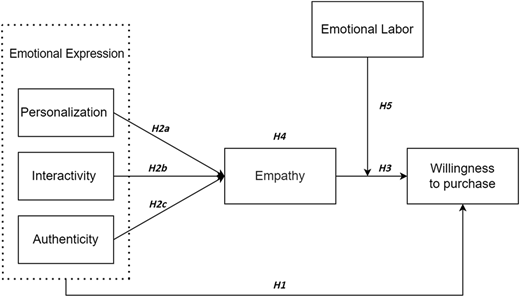
According to the previous analysis, this study formulates a research model diagram depicting factors affecting PC online game players' willingness to buy, presented in Figure 1.
3. Research design
3.1 Questionnaire design
The questionnaire used in this study adopts the Likert five point scale, ranging from “strongly disagree” to “strongly agree”, with “neutral” representing a neutral stance. The research instrument comprises four parts: First, a player background information questionnaire with 7 items; second, an emotional expression questionnaire covering three dimensions – personalization, interactivity, and authenticity. Drawing on the research of Davlembayeva et al. (2024), Ling et al. (2024), and Sun and Tang (2024), 12 items were developed; third, an empathy questionnaire. Referring to the study of Igarashi et al. (2024), 4 items were formulated; fourth, an emotional labor questionnaire. Based on Grandey (2003) and incorporating the surface and deep acting dimensions from Diefendorff et al. (2005), 5 items were created to verify the overall moderating effect of emotional labor. To verify the questionnaire’s reliability, Item 8 was set as a lie-detection question.
3.2 Data collection
The survey was conducted from December 2024 to January 2025. An online survey method utilizing convenience sampling was adopted, and participation was entirely voluntary. Given that the target population comprised PC online game players, potential respondents were recruited via various online channels. The survey link was disseminated across several prominent PC gaming forums and platforms, including Epic and Steam, as well as social media networks targeting players such as QQ and WeChat groups. In total, 540 questionnaires were distributed, resulting in 496 responses, representing a response rate of 91.85%. After careful screening, 457 questionnaires were deemed valid, yielding an effective response rate of 92.14%.
3.3 Sample statistics
Through the survey, this study ultimately collected a total of 457 valid samples. Table 1 provides more detailed data on the respondents.
Detailed Description of the Basic Characteristics of the Survey Participants:
Survey participants included 457 respondents, with 55.8% male and 44.2% female.
In terms of gaming experience, 4.8% had played PC online games for less than 1 year, 23.9% for 1–3 years, 44.0% for 3–5 years, and 27.4% for more than 5 years.
Regarding educational level, 0.9% high school or below, 28.9% associate degree, 65.9% bachelor’s degree, 4.4% graduate degree or above.
In terms of the frequency of watching virtual streamers, 20.8% watched daily, 41.8% watched 3–5 times per week, 26.9% watched 1–2 times per week, and 10.5% never watched.
As for the favorite types of virtual streamers, 56.7% liked virtual idols, 66.3% liked real-voiced virtual streamers, 84.2% liked game character virtual streamers, 35.9% liked two – dimensional style virtual streamers, 21.2% liked sci-fi/futuristic style virtual streamers.
In terms of recharging experience, 16.2% had none, and 83.80% had recharging experience.
Monthly amount: 53.8% CNY 0–100 ; 27.6% CNY 101–300; 10.7% CNY 301–500; 5.7% CNY 501–1,000; 2.2% > CNY 1,000.
4. Empirical analysis of the model
4.1 Descriptive analysis of key variables
Table 2 reports the results of descriptive statistics and normality tests for all variables included in the study. According to established criteria, data can be regarded as approximately normally distributed when absolute values of skewness are below 3, and absolute values of kurtosis remain under 8. The findings presented in Table 2 demonstrate that all variables examined in this research fall within these thresholds, suggesting the data distribution approximates normality.
4.2 Reliability and validity analysis
As illustrated in Table 3, all factor loadings exceed 0.7, suggesting that each measurement item strongly contributes to its associated latent variable, thereby satisfying convergent validity standards. The Cronbach’s Alpha coefficients for each construct surpass 0.8, and the Composite Reliability (CR) values exceed 0.7, demonstrating robust internal consistency and reliability for the questionnaire items. All Average Variance Extracted (AVE) values are greater than 0.5, signifying that the constructs are effectively represented by their measurement items.
4.3 Discriminant validity
As presented in Table 4, the correlation coefficients among personalization, interactivity, authenticity, empathy, emotional labor, and willingness to purchase are all lower than the square roots of their corresponding AVE values. This demonstrates clear statistical distinctions between constructs, confirming satisfactory discriminant validity. Each dimension independently captures its intended conceptual meaning during measurement.
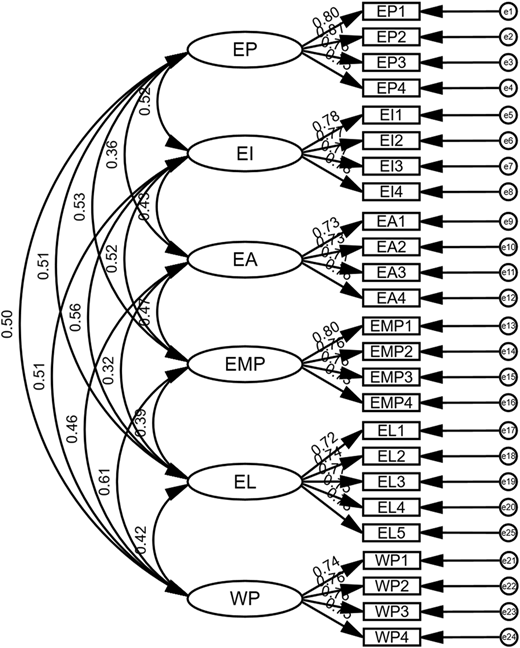
The following is the diagram of the confirmatory factor analysis model, as shown in Figure 2.
4.4 Model fit of structural equation analysis
This research applied Structural Equation Modeling (SEM) to test hypotheses and analyze paths between variables. Before conducting the path analysis, the model’s goodness-of-fit was assessed. SEM is a statistical approach that integrates factor analysis, multivariate regression, and path analysis to examine inter-variable relationships using covariance matrices. As shown in Table 5, all fit indicators satisfy the recommended criteria, confirming the suitability of the data for SEM analysis in this study.
Prior to conducting the path analysis, an assessment of the model’s fit was performed. As shown in Table 5, the value of X2/DF is 1.406, the value of RMSEA is 0.03, the value of SRMR is 0.043, the value of TLI is 0.985, the value of CFI is 0.982, and the value of IFI is 0.985. Since all fit indices meet acceptable standards, it can be concluded that the structural equation model has a good fit.
4.5 Path analysis
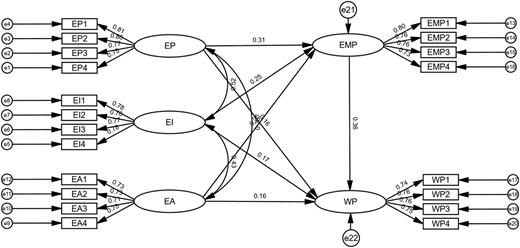
As shown in Table 6, the coefficients and their significance levels for each path are displayed. Among them, the hypotheses regarding the impact of personalization, interactivity, and authenticity in emotional expression on empathy are significantly established, with influence coefficients of 0.312, 0.252, and 0.25, respectively. This means that for every one-unit increase in personalization, interactivity, and authenticity, empathy will increase by 0.312, 0.252, and 0.25 units, respectively. The hypothesis regarding the impact of empathy on willingness to Purchase is also significantly established, with an influence coefficient of 0.365, which is the highest among the standardized coefficients. This indicates that empathy has a substantial impact on the willingness to Purchase.
4.6 Mediation effect analysis
The significance of the mediation effect was tested using a bias-corrected nonparametric percentile bootstrap method, with bootstrap 5,000 times and a 95% confidence level. As shown in Table 7, for the paths EP → EMP → WP, EI → EMP → WP, and EA → EMP → WP, the confidence intervals do not include 0, and the p-values for the indirect effects are all significant. This indicates that the three dimensions of emotional expression (personalization, interactivity, and authenticity) have a significant indirect effect on willingness to purchase through empathy, supporting hypotheses H3a, H3b, and H3c.
The following is the structural equation model diagram, as presented in Figure 3.
4.7 Moderation effect analysis
The moderating effect of emotional labor was tested using the PROCESS v4.2 macro in SPSS. We examined the conditional effects at one standard deviation above and below the mean of the moderator variable (±1 SD).
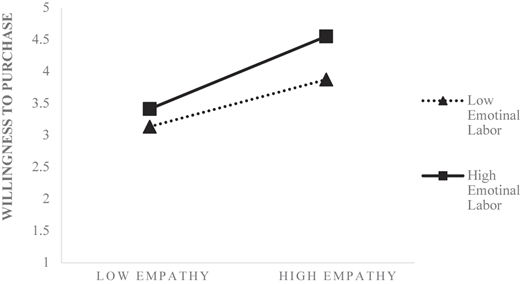
As illustrated in Table 8, the confidence intervals for all three variables do not contain zero, which provides robust statistical evidence for the moderating role of emotional labor. Empathy demonstrates a significant positive influence on consumers' willingness to purchase, with a p-value lower than 0.001, suggesting strong statistical significance. Emotional labor itself exhibits a direct and significant positive impact on willingness to purchase (p < 0.001). The interaction term (Int), representing the combined effect of emotional labor and empathy, is statistically significant (p = 0.0302), further confirming that emotional labor significantly moderates the relationship between empathy and consumer purchase willingness. This indicates that emotional labor not only independently enhances consumer willingness but also amplifies the positive effect of empathy on consumers' purchasing willingness.
As presented in Figure 4, empathy has a relatively limited effect on willingness to purchase when emotional labor is low. Conversely, the positive effect of empathy becomes notably stronger at higher levels of emotional labor, as indicated by the steeper slope compared to lower emotional labor conditions. This finding suggests that the presence of emotional labor strengthens the relationship between empathy and consumers' willingness to purchase. Emotional labor acts as a positive moderator that enhances the beneficial influence of empathy, providing additional empirical support for Hypothesis H4. In other words, consumers' responsiveness to empathy is substantially elevated when emotional labor is intensified.
5. Conclusion and discussion
This study used structural equation modeling (SEM) to analyze survey data from 457 PC online game players. We built and verified an integrated model of virtual streamers' emotional expression, empathy, and emotional labor, to explore their impact on players' willingness to purchase. After a series of reliability and validity tests, and analyses of measurement and structural models, all main, mediating, and moderating effect hypotheses were confirmed. The model shows strong explanatory power and applicability.
5.1 Main findings
The three dimensions of virtual streamers’ emotional expression, namely personalization, interactivity, and authenticity, each have a significant positive effect on PC game players’ in-game purchase willingness. This result is consistent with the conclusions of Peng et al. (2024) and Li et al. (2022) regarding the impact of personalization on consumer behavior. It confirms Liu and Zhang’s (2024) findings that interactivity enhances consumer purchase intention. It also confirms Liu and Sun’s (2024) research that authenticity builds trust.
Empathy serves as a mediator between virtual streamers’ emotional expressions and players' willingness to make in-game purchases. Personalization greatly boosts players' empathy (Mittal and Lassar, 1996; Kim and Hur, 2024). Interactivity increases players' empathy (Chen and Wu, 2024), and authenticity further strengthens it (Nunes et al., 2021). Higher levels of empathy lead to greater purchase willingness among players. This result supports earlier theories about empathy’s role in service experience and interactive marketing, and it aligns with the comprehensive view of empathic customer experience proposed by Lehnert and Kuehnl (2024). Unlike earlier studies that viewed empathy as unchanging, this study confirms its Mediating effect using quantitative methods. It broadens the scope of emotional marketing theory in the context of digital live streaming.
Emotional labor plays an important moderating role in linking empathy to purchase willingness. Virtual streamers who devote greater effort to managing their emotions further strengthen the beneficial impact of empathy on gamers' readiness to purchase. This finding echoes earlier research in traditional service sectors by Hochschild (1983) and Diefendorff et al. (2005) and extends Grandey’s (2003) theoretical perspective on the influence of emotional labor on consumer behavior. It indicates that in a digital live-streaming context, streamers’ deep emotional engagement and strategic emotion management not only directly affect consumers but also reinforce the transmission of emotional resonance. Notably, in contrast to some earlier literature that questioned the role of emotional labor, this study provides robust empirical evidence supporting its positive moderating role in digital interactive environments. As summarized in Table 9, all hypotheses regarding the main effects, mediating effects and moderating effects were supported.
5.2 Theoretical contributions
First, this study introduces “virtual streamer emotional expression” into player purchase behavior research, extending the boundaries of digital entertainment studies. Previous literature has focused on player-side psychological and social factors such as psychological ownership (Tan and Yang, 2022) and character identification (He and Liu, 2022). While some work has highlighted personalization, interactivity and authenticity’s impact on purchase intention (Peng et al., 2024; Sun et al., 2021; Liu et al., 2022), few have systematically examined emotional expression. This study conceptualizes emotional expression through personalization, interactivity, and authenticity, filling a gap in how streamer behavior and emotion affects players' purchase willingness.
Second, this study validates empathy as a mediating mechanism between emotional expression and purchase intention, expanding empathy theory in digital contexts. Empathy’s influence on trust and emotional response is well-established in services and education (Tan et al., 2019; Hwang and Kim, 2018), and increasingly in digital marketing (Yoon and Lee, 2021). However, few studies model how virtual streamers stimulate empathy that leads to actual purchase willingness. Building on classical views of emotional mimicry and simulation (Chen et al., 2007; Coxon, 2004), this study empirically confirms the effect of emotional expression dimensions on empathy, and further, empathy’s mediating role in purchase willingness. It extends Gladstein’s (1977) empathy framework into digital commerce.
Third, the study uncovers the moderating effect of emotional labor, deepening its theoretical reach in virtual interaction. While emotional labor’s importance in traditional services is well-known (Hochschild, 1983; Grandey, 2003), its role in live streaming remains understudied. Although recent works suggest deep emotional labor helps retain viewer loyalty (Zhang and Wu, 2022; Glatt, 2024), empirical research examining its moderating effect on the relationship between empathy and purchase intention remains limited. This study shows that emotional labor strengthens the empathy–purchase willingness link, reinforcing findings by Seger-Guttmann and Medler-Liraz (2020) and expanding on Peng and Wu’s (2022) insights on emotional performance in streaming. It extends the application of emotional labor theory within the context of the virtual streamer industry.
5.3 Practical implications
This study offers practical guidance for the PC online gaming and live-streaming industries by exploring how virtual streamers' emotional expressions influence players’ in-game purchase willingness. Strategic recommendations focus on three key areas: emotional interaction design, empathy-driven content creation, and emotion management.
Firstly, developers and platforms need to make streamer design better by focusing on personalization, interactivity, and authenticity. Streamers can improve their image by using popular phrases or internet slang. Real-time communication through bullet chats can boost interactivity, while matching emotional expressions with current events or everyday experiences helps keep things authentic. It is also vital that the verbal tone remains consistent with the gestures or actions of the virtual character to build trust and foster empathy.
Secondly, game companies should integrate design principles that evoke emotion into their main development processes. Emphasizing narrative-driven design can craft compelling storylines that emotionally engage players and provide streamers with rich content. Adding real-time tools for emotional feedback such as interactive emojis, polls, or in-game events can strengthen the emotional connection between players and streamers.
Lastly, given that emotional labor influences the impact of empathy on purchase willingness, attention to emotion management is essential. For human streamers, professional training in emotional labor is necessary to maintain authenticity and secure viewer trust. For AI-driven streamers, it is important that algorithms simulate suitable emotional expressions that align with audience expectations and gameplay narratives, thereby enhancing emotional bonds.
5.4 Limitations and future directions for improvement
Examining how virtual streamers' emotional expressions shape PC game players' empathy and purchase intent reveals certain limitations. Focusing exclusively on PC game players may restrict the applicability of the conclusions to other gaming genres or virtual environments. Future work could broaden the scope by including additional PC games or e-sports streaming to assess the generalizability of these findings. This study also does not examine how player characteristics (e.g. gender, experience, culture) affect the results. Future research could include these as control or moderating variables to understand their influence on purchase intent better. Using cross-sectional data, this study does not capture emotional dynamics. Future work could use longitudinal or experimental methods to study emotional expression’s role in long-term interactions. Overall, future research should diversify samples, expand variables, and use dynamic approaches to comprehensively support the mechanism of virtual streamers’ emotional expression on player behavior.
Funding: This work was funded by Jiangxi Higher Education Teaching Reform Research Project (JXJG-17-4-12), Project-driven Teaching Method in Brand Planning Course Great Innovation and Practice.
Competing interests: All authors certify that they have no affiliations with or involvement in any organization or entity with any financial interest or non-financial interest in the subject matter or materials discussed in this manuscript.
Consent: Informed consent was obtained from all individual participants included in the study. Participants signed informed consent regarding publishing their data.
Data: All data generated or analyzed during this study are included in this article.