
Skip to article sections
Purpose

This study analyzes how trust in generative artificial intelligence (GenAI) competency and supplier–supplier connection affect innovation capacities and service innovation performance via the compatibility of GenAI and customer agility.

Design/methodology/approach

An innovative performance model was developed by integrating orientation, cooperation and orchestration (OCO) theory, the knowledge-based view and diffusion of innovation (DOI). Empirical data were gathered from travel agencies in Taiwan, and the model was evaluated using the partial least squares (PLS) approach.

Findings

This study demonstrates that trust in GenAI competency impacts the compatibility of GenAI and customer agility; the role of digital marketing innovation moderates the effect of customer agility on online consumption value and service innovation performance.

Originality/value

The study’s findings underline the antecedents and consequences of service innovation and provide further specific suggestions for travel agencies, focusing on applying GenAI to innovation in travel agencies.

Enterprises are increasingly adopting technologies such as artificial intelligence (AI) and the internet of things to enhance customer interactions (Chan and Choi, 2025). Innovative travel agencies have quickly oriented toward these technologies using AI to develop products and services that meet market demands (Azdel et al., 2024). Generative AI (GenAI), for example, creates personalized itineraries based on tourists’ preferences su999ch as destinations, activities, budget, and travel dates (Christensen et al., 2025). A key insight is the link between digital competencies and using GenAI for better decision-making and growth. In this study, the knowledge-based view (KBV) is highlighted, showing that fostering supplier cooperation through GenAI integrates supplier expertise, drives innovation, and improves the supply chain (Celiktutan et al., 2024). In addition, GenAI supports continuous employee learning, keeps staff updated on trends, regulations, and services, strengthens orchestration by empowering staff to adapt quickly, and enhances the travel agency’s competitive advantage.

In this study, an investigation is conducted as to how trust in GenAI competency and supplier–supplier connections impact innovation and service performance through GenAI compatibility and customer agility. How GenAI redefines service innovation in tourism organizations is examined, focusing on its influence on tourist intentions and personal innovation, unlike previous studies on GenAI’s recommendation functions (Kim et al., 2025). Recent studies have emphasized tourists’ use of GenAI for trip planning (Christensen et al., 2025; Pham et al., 2024), whereas Lu et al. (2024) highlighted employee perceptions of GenAI and job insecurity in travel agencies. As GenAI adoption increases, understanding its role in operational transformations becomes essential. In contrast to previous studies that conceptualize GenAI adoption through a single theoretical lens such as the technology acceptance model or diffusion of innovation (DOI) theory, this study advances the literature by integrating three complementary frameworks: orientation–cooperation–orchestration (OCO) theory, which emphasizes process alignment and network coordination; the KBV, which underscores the strategic value of intangible resources; and the DOI, which captures the dynamics of technological assimilation. This integrative approach provides a holistic understanding of how GenAI reshapes service innovation processes in tourism enterprises. Specifically, this study offers novel insights into the collaborative interaction between travel agency employees and GenAI systems, illustrating how this constructive collaboration fosters enhanced service efficiency, personalization, and operational responsiveness. Rather than focusing solely on technical functionality, the research emphasizes the embeddedness of GenAI in daily organizational routines, revealing the emergence of human–AI collaboration as a core capability in the digital transformation of tourism operations.

RQ1.

How will GenAI collaborate with staff to improve travel agencies' service innovation performance?

RQ2.

Does digital marketing innovation play a moderating role in raising travel agencies' consumption value and service innovation performance?

Grounded in OCO theory, adopting GenAI in tourism emphasizes the alignment of digital capabilities, fostering of partnerships, and coordination of resources to drive innovation and maintain competitive advantage (Oberländer et al., 2025). As technologies shape tourism (Vial and Grange, 2024), agencies must adapt to evolving travel expectations. With tourists using GenAI for personalized itineraries, the industry shifts in value creation (Zhang and Prebensen, 2024). GenAI-driven innovation requires collaboration among travel agencies, technology providers, and data partners to co-create value and enhance responsiveness (Demir and Demir, 2023). Effective orchestration harmonizes internal competencies with external capabilities, while building trust in GenAI as a reliable asset.

Adopting AI in tourism depends on aligning digital orientation with organizational readiness and coordination. Key enablers include technological preparedness, system compatibility, and managerial support, signaling a commitment to digital transformation (Kumar et al., 2023). External forces such as customer demands, regulatory compliance, and competition, drive the need for agile cross-functional collaboration. Organizational agility, supported by a learning culture, is vital for adaptation. GenAI enhances service quality through real-time support, predictive personalization, and automation (Irani, 2024). While service innovation boosts satisfaction, loyalty, and revenue (Liu et al., 2025), travel agencies need to address potential drawbacks such as mistrust in AI and reduced human interaction.

From the KBV perspective, service innovation in tourism relies on intangible assets, such as knowledge-sharing networks and digital skills. Studies show that strong supplier linkages enhance collaboration and innovation capacity (Shukla et al., 2023). Customer agility—adapting to changing preferences—is critical for innovation (Conesa et al., 2024). In this study, digital competence is incorporated into the KBV framework to examine how organizations use internal knowledge and external connections to drive innovation. GenAI enhances knowledge flows and reshapes how firms approach innovation in their service ecosystems.

The DOI theory provides insights into the adoption of emerging technologies such as GenAI. The core DOI attributes—compatibility, perceived complexity, and trialability—shape the speed and extent of uptake (Shaw et al., 2023). When integrated, GenAI enhances responsiveness through faster decision making and adaptive customer engagement. Widespread diffusion fosters continuous innovation. This study uses OCO, KBV, and DOI to assess how GenAI adoption influences service innovation and organization positioning to thrive in a competitive digital environment.

Based on this framework, an innovative performance model was developed by combining OCO, KBV, and DOI. Data collected from travel agencies in Taiwan were analyzed using the partial least squares (PLS) approach. The research findings offer insights into how GenAI can be strategically applied to enhance innovation performance in tourism.

OCO explains how organizations align resources, build partnerships, and coordinate networks to drive innovation and gain a competitive advantage (Wiener et al., 2025). Building on this foundation, Oberländer et al. (2025) showed how integrating digital ecosystems accelerates transformation, especially innovation. They highlighted the management of digital assets, such as application program interfaces, platforms, and data, as key enablers, and recommended strategies to align, share, and orchestrate resources for better outcomes.

In tourism, GenAI adoption reflects internal capability alignment (orientation), collaboration with technology and data partners (cooperation), and the coordination of digital tools with human expertise (orchestration). As a content-generating model (Gao and Wang, 2024), GenAI helps agencies analyze data, forecast trends, optimize pricing, and personalize services. These innovations rely on digital expertise to apply insights throughout operations (Füller et al., 2024), and improve service delivery, efficiency, and competitiveness. Agencies integrating GenAI can remain agile and responsive to market changes.

Travel agencies that develop these capabilities are better equipped to innovate and meet evolving customer needs. Pham et al. (2024) applied the OCO theory, noting digital literacy as essential for inclusion and competence, with digital citizens reflecting maturity. GenAI promotes knowledge-sharing among suppliers (Limna and Kraiwanit, 2023) and builds trust in AI, fostering collaborative decision making and co-creating value (Lee and Ha, 2024). These coordinated efforts are vital in tourism, where seamless multichannel services rely on effective digital collaboration and orchestration across systems, teams, and partners.

The KBV posits that knowledge is an organization’s most valuable resource (Grant and Phene, 2022). Travel agencies can leverage GenAI to enhance their knowledge management by generating insights, automating content, and improving customer service. GenAI also contributes to knowledge creation, enabling competitive advantage through supplier–supplier connection strategies that maximize knowledge use (Donmez and Norheim-Hansen, 2024). Integrating suppliers into product development grants access to expertise and fuels innovation but also introduces interdependence and coordination challenges.

Similarly, Bhardwaj (2021) emphasizes that integrating consumer behavior into knowledge systems enables the identification of customer preferences, enhances organizational agility, and fosters product innovation. In line with the KBV, GenAI supports service innovation in travel agencies by facilitating real-time customer interactions, providing up-to-date staff training, and promoting continuous learning (Kirshner, 2024). Additionally, Liu et al. (2020) believe that GenAI offers valuable insights into market trends and competitor activities, which are essential for strategic planning and service development.

DOI explains how innovative technologies spread within organizations and are shaped by five factors: relative advantages, compatibility, complexity, trialability, and observability (Shaw et al., 2023). In the tourism sector, AI tools such as intelligent booking systems, itinerary planners, and chatbots are more likely to be adopted when they align well with existing workflows, are easy to use, and offer clear benefits (Binesh and Baloglu, 2023). The seamless integration of these tools enhances operational efficiency, supports innovative service models, and strengthens customer engagement through improved personalization and responsiveness.

When AI technologies are adopted effectively, they drive service innovation and improve customer agility (Wamba, 2022). Agile travel agencies can quickly adjust to evolving traveler demands, emerging trends, and competitive pressures. This responsiveness not only improves customer satisfaction but also supports a sustainable competitive advantage. By embedding AI within their core operations, travel agencies can modernize service delivery and position themselves for long-term success in a dynamic market.

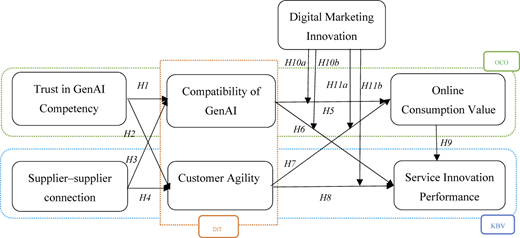
The research model presented in this study identifies significant constructs of service innovation performance through literature analysis. Figure 1 show the relationships between the primary constructs of organizational service innovation.

Competence refers to whether a transaction partner can perform their job competently (Nielsen et al., 2023); Zhou et al. (2024) argued that users' intention to use GenAI and their trust in it are intricately linked. Kim et al. (2025) defined trust in GenAI competency as users’ confidence in its capability to deliver accurate, dependable, and useful information.

Kundi and Shahid (2023) stated that shared decision-making positively correlates with team psychological safety and influences team creativity. Building trust in GenAI’s competency involves technical accuracy, ethical considerations, and effective communication with users (Pham et al., 2024). GenAI provides correct, up-to-date answers, especially for time-sensitive topics, and helps users understand how answers are generated and the potential for errors.

GenAI’s compatibility reflects how well it interacts with users based on their queries and needs (Akdim and Casaló, 2023). It generates relevant, coherent, and informative responses to conversations.

Realyvásquez et al. (2019) identified the factors for AI adoption, including relative advantage, compatibility, readiness, support, competitive pressure, and cooperation. GenAI builds trust by meeting user expectations and providing reliable responses (Markovitch et al., 2024). Trust grows as GenAI accurately answers queries (Min and Kim, 2024), gaining recognition for human-like interactions.

Leng and Zhao (2023) noted that compatibility enhances supplier-customer co-creation. For travel agencies, GenAI ensures that customer needs are met with accurate flight details and personalized assistance. This improves the ability to deliver reliable information and boosts value, satisfaction, repeat business, and word-of-mouth recommendations, supporting Hypothesis 1.

H1.

Trust in GenAI competency is positively associated with the compatibility of GenAI.

Customer agility is a company’s ability to leverage customer insights into market intelligence and competitive advantage (Tarn and Wang, 2023). It plays a crucial role in driving competitive actions, particularly in dynamic environments.

Studies have shown that digital technologies improve customer agility, productivity, service efficiency, and innovation (Tseng et al., 2022). Wamba (2022) observed that the adoption of AI boosts agility and performance. GenAI processes vast amounts of data (Caruccio et al., 2024), helping travel agencies to analyze trends and customer preferences and quickly adjust offerings and strategies.

GenAI manages numerous queries, provides travel details, and delivers personalized recommendations rapidly (Christensen et al., 2025). This enables travel agencies to offer high-quality services with minimal human intervention. Trust in GenAI competence enhances agility and helps businesses respond more quickly to customer needs and market shifts. Thus, the following hypothesis is proposed:

H2.

Trust in GenAI competency is positively associated with the agility of travel agencies to respond to customer needs.

In travel agencies, supplier–supplier connections involve collaboration among industry suppliers such as airlines, hotels, car rentals, and tour operators, to offer complementary services (Shukla et al., 2023). Strong relationships enable agencies to coordinate bookings for flights and accommodation in a single transaction, thereby improving efficiency and customer experience.

Shukla et al. (2023) noted that knowledge transfer and supplier–supplier connections enhance supply system performance. Supplier connections integrate data from multiple sources (Liu, 2024). In the supply chain, travel suppliers connect via platforms like global distribution systems or application program interface integrations, ensuring smooth data flow and easy access to services from multiple suppliers.

Collaboration among suppliers can generate high-quality training datasets, thereby improving GenAI’s ability to manage diverse queries (Pope et al., 2025). Joint efforts can also create compatible application program interfaces and integration protocols, allowing GenAI to interface seamlessly with supplier systems, thereby enhancing the user experience.

H3.

Supplier–Supplier connection directly facilitates GenAI compatibility.

Previous studies indicate that strong supplier–supplier connections facilitate better communication and collaboration (Ahmadzadeh et al., 2021). Liu et al. (2024) explored the impact of digital technology, collaboration, and technical capabilities on virtual integration and customer service, highlighting customer service as a key factor in strengthening tourism product advantages and supply chain flexibility. This enables travel agencies to receive timely updates on products, services, and availability that they can quickly relay to customers.

Supplier–supplier connections provide a broader range of services and products (Li et al., 2024). Travel agencies can use this diversity to offer more tailored and flexible options, thereby increasing their agility in meeting different customer needs. Collaborative supplier networks improve inventory management, giving travel agencies a clearer view of availability, pricing, and unique offers, and allowing them to promptly offer the best options.

H4.

Supplier–supplier connections directly facilitate the agility of travel agency customers.

The online consumption value (OCV) of travel agencies refers to the economic benefits generated when customers purchase travel services online (Xu et al., 2024). Effective digital marketing such as targeted ads, email campaigns, and social media boosts website traffic and converts visitors into customers (Ashraf et al., 2023). Culturally tailored content influences consumer decisions and preferences for online travel agencies.

A strong online presence extends the travel agency’s market reach. Digital marketing is crucial for targeting audiences and building relationships (Wakefield, 2024). GenAI enhances this by delivering accurate responses across devices and seamlessly integrating them with other systems, thus enabling fast information access (Markovitch et al., 2024). This reduces waiting times and boosts OCV.

GenAI integrates updates from multiple platforms to ensure customers receive the latest tools and information. Its consistency across channels strengthens trust, which is an essential factor in the travel sector, where timely support is vital. Thus, Hypothesis 5 is proposed.

H5.

GenAI compatibility is positively associated with travel agencies’ OCV.

Service innovation performance refers to innovation that enhances the value, utility, and effectiveness of products or services (Kumar et al., 2023). Ku (2024) also notes that proprietary interactive technology allows firms to derive economic value from innovation.

Empirical studies have shown that GenAI provides real-time customer support (Kirshner, 2024), resolves issues efficiently, and boosts customer satisfaction and loyalty (Ku and Chen, 2024). According to Markovitch et al. (2024), GenAI enhances the user experience, trust, and operational efficiency. Similarly, Sliz (2024) found that businesses using GenAI improve both efficiency and customer-focused services.

GenAI processes large datasets to detect trends and customer preferences, thereby helping companies innovate and remain competitive. By analyzing interactions, it identifies pain points and areas of improvement in tourism services. This insight drives service innovation to meet urgent customer needs. Thus, Hypothesis 6 is proposed:

H6.

Compatibility of GenAI is positively associated with service innovation performance.

Haider and Kayani (2021) found that companies must adopt an understanding and altruistic approach to realize the smoothness and agility of service programs in service design and coordinate relationships with empathy. Furthermore, Chen and Huan (2022) stated that market knowledge and product innovation have a positive impact on operational effectiveness, knowledge governance capability, and modular production. They emphasized that leveraging market insights and fostering innovation could enhance the overall efficiency and adaptability of production processes.

Travel agencies often offer time-sensitive offers and flash sales, and customers who adapt quickly can provide feedback that helps them refine their personalization algorithms, further enhancing their value. Therefore, agile customers, who can quickly respond to these opportunities, are more likely to take advantage of them, thereby increasing their OCV.

H7.

Customer agility is positively associated with the value of the travel agencies' OCV.

Previous studies show that businesses can use agile customer behavior as an indicator of shifting demand (Haider and Kayani, 2021), enabling them to innovate and adjust services. Chuang (2020) noted that customer agility strengthens the relationships between customers and travel agencies by interacting with social media agility. Wang et al. (2022) found that chatbot-enabled agility affected customer service performance.

Travel agencies can adapt quickly to agile customer feedback and preferences, thereby ensuring service relevance and innovation. Consistent innovation builds brand loyalty and supports sustained service innovation. Agile customers help agencies adopt lean innovation approaches, reduce market time, and improve innovation performance.

H8.

Customer agility is positively associated with service innovation performance.

Higher online consumption leads to more interactions and transactions, giving travel agencies access to valuable data (Mu et al., 2022). The analysis of these data reveals customer preferences, pain points, and trends that are essential for guiding service innovation. As online consumption grows, agencies can build detailed customer profiles (Shi, 2022), allowing them to personalize services and create innovative travel experiences that boost satisfaction and loyalty.

Travel agencies, seeing increased online spending, are driving the demand for advanced technologies to manage bookings, customer services, and recommendations. The integration of these tools streamlines operations and enables more sophisticated service innovations. Companies that use online consumer data to improve their services can be distinguished from their competitors. Unique travel offerings and seamless online experiences help attract more customers and increase market share.

H9.

OCV is positively associated with service innovation performance.

Digital marketing innovation in travel agencies involves the use of advanced strategies and tools to effectively promote services (Erhan et al., 2024). This includes the leveraging of emerging technologies and creative tactics to boost engagement and competition.

Ku (2024) notes that innovative digital marketing enhances online presence, strengthens customer engagement, and improves performance in competitive markets. Similarly, anthropomorphic, and warm digital technologies influence digital marketing innovation. This study suggests that digital marketing innovation moderates the impact of GenAI compatibility and customer agility on OCV and service innovation.

GenAI uses real-time data to deliver personalized content and improve customer experience. Integration with customer relationship management systems allows for tailored responses based on user behavior and preferences. Digital marketing tools offer real-time analytics of GenAI performance, helping agencies refine their responses and increase satisfaction. These insights enable optimization across websites, social media, and applications, ensuring consistent and seamless interactions on preferred platforms, broadening engagement, and deepening customer interactions.

H10a.

Digital marketing innovation moderates the impact of GenAI compatibility on travel agencies' OCV.

H10b.

Digital marketing innovation moderates the impact of GenAI compatibility on the service innovation performance of travel agencies.

Digital marketing innovations enable travel agencies to leverage data analytics and AI for targeted advertising campaigns (Lima et al., 2024). These efforts deliver personalized offers to agile customers and boost conversion rates. Digital tools also analyze customer behavior in real time (Abate et al., 2024), helping agencies understand platform interactions and dynamically adjust strategies to optimize engagement and consumption.

Travel agencies adopting integrated digital marketing ensure that agile customers receive consistent messaging and offers across devices, enhancing engagement and conversion. Advanced GenAI provides instant support and tailored recommendations based on the interactions. Quick and relevant responses improve customer satisfaction and increase the likelihood of purchasing.

H11a.

Digital marketing innovation moderates the impact of customer agility on travel agencies' OCV.

H11b.

Digital marketing innovation moderates the impact of customer agility on travel agencies' service innovation performance.

The survey items based on operational structures from previous studies are described. To validate the measures, the questionnaire design followed the recommendations of MacKenzie et al. (2011). Trust in GenAI competency was adapted from Ku (2014) and Kim et al. (2025) for four items. The compatibility of GenAI was modified from Xu et al. (2024) and Paul and Ahmed (2024) using three items. The supplier–supplier connection was adapted from Ku (2023) with three items, and customer agility was modified from Wamba (2022) with five items. Digital marketing innovation was adapted from Erhan et al. (2024) with three items, and OCV was derived from Chakraborty et al. (2023) with five items. Service innovation performance was modified from Yen et al. (2012) and Kumar et al. (2023) using four items. The 27 items are listed in Table 1.

A seven-point Likert scale was used to evaluate the survey items, ranging from strongly agree (7) to strongly disagree (1). For the pilot testing, three tourism managers and two IS professors provided feedback, resulting in slight adjustments in wording and order through an English-Chinese-English translation. Twenty-five travel agency employees then completed a pre-test with the Chinese version to verify content validity and confirm wording modifications.

Stratified random sampling was adopted to target travel agency salespersons, who play a pivotal role in service innovation. These salespersons gain deep insights into supplier–supplier linkages through their active coordination of services across the tourism supply chain (Hsu et al., 2022; Kan, 2022; Tuan, 2022; Zheng et al., 2023). Under the OCO theory, they align their actions with organizational goals (orientation), collaborate with suppliers such as airlines, hotels, and tour operators (cooperation), and integrate these services into unified travel packages (orchestration). Their frontline involvement in bundling, communication, and scheduling enhances their understanding of inter-supplier dynamics and improves their service delivery and innovation. Executive sales managers were also invited to participate in the survey.

In April 2024, Taiwan had 3,341 travel agencies (https://admin.taiwan.net.tw/). The study classified travel plans by region, targeting salespersons from Europe, North America, and Asia who collaborate with partners to sell tourism products. A survey invitation was sent to travel agency managers using a digital questionnaire requesting that they distribute it randomly.

In October 2024, 400 executive sales companies were selected to receive 1,200 questionnaires (three per agency). In total, 384 valid responses were received, resulting in a 32.0% return rate.

The initial dataset covered 384 respondents and revealed that 55.21% of the samples came from wholesalers, 53.91% oversaw Europe’s tourism products, and nearly 77% of tour planners’ working experience was more than six years, as shown in Table 2.

Common method bias (CMB) arises from measurement methods, which potentially distort variable relationships (Anisimova et al., 2025). This can inflate or deflate the observed effects, leading to misleading conclusions. Addressing CMB ensured the validity and reliability of the research. The Harmon one-factor test was performed to evaluate CMB. The results show that the seven latent variables account for 11.07% of the covariance, indicating that the CMB is not a concern.

This study used PLS structural equation modeling as the primary estimation technique, which integrates factor analysis and multiple regression to examine the relationships among constructs. The analysis was conducted using SmartPLS software (Version 4.1), which facilitated both measurement model assessment and hypothesis testing. To ensure that the constructs were both valid and dependable, a factor loading analysis was performed, revealing that all outer loadings exceeded the recommended threshold of 0.70 (Feng et al., 2024), indicating strong item reliability. The composite reliability values for each construct also surpassed the 0.70 benchmark (Le and Ngoc, 2024), confirming internal consistency reliability. Convergent validity was assessed using the average variance extracted, with each construct yielding an average variance extracted >0.50, thereby meeting the accepted standard for adequate variance explanation (Koutsoumpis et al., 2024). The detailed validity results are presented in Table 3 and confirm the robustness of the measurement model.

To assess the discriminant validity of the proposed model, three established methods were used: cross-loading analysis, the Fornell-Larcker criterion, and the heterotrait-monotrait ratio approach (Henseler, 2017). Cross-loadings were examined to ensure that each measurement item loaded more strongly on its associated construct than on any other, indicating good discriminant validity. Additionally, the Fornell-Larcker criterion was applied to compare the square root of the average variance extracted for each construct with its correlations with other constructs. All values satisfied the recommended criteria, as listed in Table 4. To further verify discriminant validity, the heterotrait-monotrait ratio values for all construct pairs were calculated and found to be below the conservative threshold of 0.90, as shown in Table 5. Collectively, these findings confirm that the model demonstrates strong discriminant validity and that the constructs are empirically distinct.

The variance inflation factor (VIF) was calculated to measure the level of multicollinearity among constructs. According to Goodhue et al. (2017), VIF values should remain <3.3 to rule out collinearity concerns. In this study, all VIF values were within the acceptable range of 1.108–2.079, indicating no significant multicollinearity issues. The R2 values obtained in this study indicate the proportion of variance in each dependent construct that is explained by its corresponding predictors within the structural model. According to Liengaard (2024), an R2 value ≥ 0.30 is considered indicative of an acceptable model fit, particularly in exploratory research involving behavioral constructs. The R2 values obtained in this study were 0.497 for GenAI compatibility and 0.501 for customer agility, suggesting a solid predictive relationship, particularly in contexts involving emerging technologies; 0.488 for OCV, reinforcing the model’s ability to capture consumer-related digital factors; and 0.462 for service innovation performance, which reflects a meaningful level of explanatory strength for performance-related outcomes. Collectively, these R2 values confirm that the model has adequate to strong explanatory capacity, supporting the reliability of the hypothesized relationships among the key constructs. Each value was ≥0.30, providing empirical justification for the model’s structural integrity and value for future research and managerial implications.

To further assess model fit, SmartPLS was used to perform a modified Bollen-Stine bootstrapping procedure to compute key fit indices, including the unweighted least squares discrepancy, geodesic discrepancy, and standardized root mean square residual. A value < 0.08 is typically regarded as indicative of a good fit, while values up to 0.10 are still considered acceptable (Hu and Bentler, 1998). In this study, the standardized root means square residual value was 0.081, confirming a satisfactory global model fit and low residual variance. Additionally, the normed fit index, which ranges from 0–1, was 0.894 (Schuberth et al., 2020). Normal fit index values closer to 1 indicate a better model fit, with values above 0.90 typically considered acceptable. This supports the model’s structural validity and alignment with the observed data patterns. further supporting the overall adequacy of the model. A comprehensive summary of the fit indices is presented in Table 6.

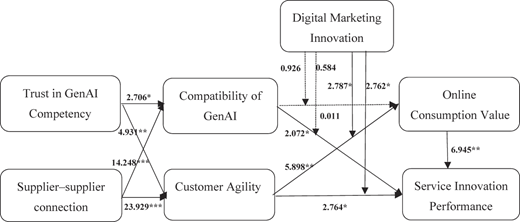
The structural model results provide empirical support for several proposed hypotheses. Trust in GenAI competency significantly influenced both GenAI compatibility (t = 2.706*, p < 0.05; H1) and customer agility (t = 4.931**, p < 0.01; H2). These findings extend the work of Markovitch et al. (2024), reinforcing the notion that GenAI’s specialized knowledge is well-suited for integration within tourism operations. Additionally, supplier–supplier connections demonstrated a strong positive impact on trust in GenAI competency (t = 14.248***, p < 0.001; H3) and customer agility (t = 23.929***, p < 0.001; H4), underscoring the role of inter-organizational collaboration in fostering AI readiness and responsiveness.

By contrast, GenAI compatibility did not significantly influence OCV (t = 0.011, p > 0.05; H5), suggesting that consumers may not directly perceive or value AI-enabled features. However, GenAI compatibility had a positive effect on service innovation performance (t = 2.072*, p < 0.05; H6), indicating that internal operational benefits were realized. Customer agility had significant positive effects on both OCV (t = 5.898**, p < 0.01; H7) and service innovation performance (t = 2.764*, p < 0.05; H8), highlighting the importance of responsive customer-centric capabilities. Furthermore, OCV positively impacts service innovation performance (t = 6.945**, p < 0.01; H9), which aligns with previous findings by Wamba (2022).

Digital marketing innovation did not significantly moderate the relationship between GenAI compatibility and OCV (t = 0.926, p > 0.05; H10a) or service innovation performance (t = 2.584*, p < 0.05; H10b). However, it significantly moderates the effect of customer agility on both OCV (t = 2.787*, p < 0.05; H11a) and service innovation performance (t = 2.762*, p < 0.05; H11b). These results suggest that the ability to respond quickly to AI insights, rather than digital marketing innovation alone, plays a critical role in driving perceived consumer value and organizational innovation outcomes.

Table 7 presents a comprehensive summary of the hypothesis-testing results, and Figure 2 visually maps the validated relationships within the research model.

This study makes four contributions to digital marketing and IS management literature. First, it is one of the few empirical studies to explore how GenAI’s integration with OCO theory, KBV, and DOI enhances service innovation in travel agencies. Two key drivers were identified (Figure 1). Trust in GenAI’s competency significantly enhanced perceived compatibility (H1), whereas compatibility directly improved service innovation performance (H6), which is consistent with Pham et al. (2024). These findings suggest that trust and compatibility not only enable digital competence but are also crucial in orchestrating AI-driven transformation. Through strategic GenAI adoption, collaboration with AI partners, and effective management of digital capabilities, agencies can accelerate innovation in line with the orientation, cooperation, and orchestration elements of the OCO theory.

Second, supplier–supplier connections and customer agility improve customer innovation (H4 and H8), reflecting unique knowledge resources. While previous studies emphasized GenAI’s recommendation capabilities (Demir and Demir, 2023), this study reveals how tourism businesses use GenAI to boost supplier coordination, streamline communication, and respond faster to changing customer demands. These results emphasize the role of GenAI as a knowledge facilitator, reinforcing the relevance of the KBV to service innovation and operational responsiveness.

Third, this study uniquely identifies digital marketing innovation as a moderating factor that influences innovation and performance. Unlike Ku (2024), this study highlights how digital marketing innovation strengthens service offerings and enhances market intelligence. Agencies that apply such innovations are better equipped to meet market shifts and customer expectations, improve competitiveness, and amplify GenAI’s contribution to service innovation outcomes.

Fourth, this study offers an enterprise-focused view of service innovation by emphasizing the importance of GenAI collaboration. This indicates that aligning GenAI with compatibility, supported by digital marketing innovation, positively affects OCV. Extending Ku (2024), this study contributes to AI innovation diffusion literature by showing how digital marketing innovation moderates the relationship between customer agility and innovation. This demonstrates that well-aligned digital marketing enhances the translation of agile responses into AI-powered service innovation.

This research highlights the importance of human-computer interaction in corporate service innovation, focusing on GenAI applications in travel agencies.

First, trust in GenAI’s competence enhances travel agencies' strategic direction by supporting AI adoption and fostering a digital readiness culture. As knowledgeable experts, GenAI updates its tourism products, personalizes strategies, analyzes performance data, and generates marketing content. It also aids collaboration by offering on-demand training and real-time support, thereby helping staff adapt quickly to new systems and workflows. When managers trust GenAI, it boosts orchestration by increasing agility, improving cross-departmental communication, and enabling effective teamwork through instant feedback and coordinated actions.

Second, GenAI fosters more collaborative, personalized supplier–supplier interactions, strengthening travel agencies’ orientation toward an integrated, AI-driven supply chain. It streamlines communication between suppliers, such as hotels, airlines, and tour operators, ensuring the timely and accurate exchange of information. Managers can link GenAI with supplier systems to assess real-time availability and pricing, enabling the quicker delivery of optimal options. As a central hub, GenAI supports orchestration by facilitating information sharing, monitoring supplier issues, and efficiently resolving concerns.

Third, GenAI’s compatibility with diverse data formats and sources supports travel agencies’ orientation toward efficient data use, ensuring seamless access to vital information. Its intuitive interfaces and secure transactions foster positive user experiences, enhancing cooperation by building trust in GenAI as a reliable tourism knowledge tool. To support orchestration, agencies should develop user-friendly GenAI platforms, tailor training to relevant industry and company knowledge, and embed GenAI into daily workflows. Additionally, GenAI identifies bottlenecks, recommends improvements, streamlines operations, and strengthens internal coordination.

Fourth, responsive agencies can improve orientation by using GenAI to personalize services and meet customer needs more effectively. Leveraging analytics, GenAI anticipates problems and offers initiative-taking solutions. It refines responses by incorporating customer feedback, while maintaining accuracy and relevance. To foster cooperation, managers should train GenAI using updated customer service practices and company-specific insights. By integrating regular feedback from users and staff, GenAI strengthens orchestration, ensuring continuous improvement and smooth integration of service delivery.

Finally, digital marketing innovations drive orientation by enhancing engagement, optimizing workflows, and enabling data-driven decisions. Travel agencies personalize content and interactions through creative strategies that strengthen customer cooperation. For effective orchestration, agencies should track campaign performance, fine-tune approaches, and adopt emerging digital tools to remain competitive and deliver seamless value-rich experiences.

The ability of GenAI to manage high interaction volumes without additional costs makes it a scalable solution for growing businesses. By embedding GenAI and leveraging supplier–supplier connections, managers can strengthen travel agencies' orientation, boosting agility, collaboration, and customer satisfaction. With access to customer data, GenAI personalizes responses and recommendations, fostering cooperation among agencies, suppliers, and clients. To support orchestration, agencies should regularly evaluate GenAI interactions with suppliers and staff to identify issues and enhance efficiency.

The data-processing capacity of GenAI reveals customer behaviors and trends, enabling smarter data-driven decisions. In this study, the transformative role of GenAI is highlighted in service strategies by positioning it as an expert system that accelerates the diffusion of innovation in tourism. Integrating GenAI into workflows streamlines operations reduces manual errors and improves efficiency, thereby enabling smooth orchestration across departments. This supports effective staff collaboration while delivering personalized professional services that meet evolving customer needs.

This study explored the role of GenAI in travel service innovation. Future research should expand the sample to include other service sectors such as restaurants and hotels for a more comprehensive view. Researchers may also evaluate the impact of GenAI on operational efficiency and customer experience across tourism organizations. In addition, examining the market advantages of GenAI-driven innovation in the tourism supply chain can reveal wider economic and competitive benefits.
Abate
,
Y.A.
,
Ukpabi
,
D.C.
and
Karjaluoto
,
H.
(
2024
), “
Investigating digital marketing readiness among tourism firms: an emerging economy perspective
”,
Current Issues in Tourism
, Vol. 
28
No. 
13
, pp. 
2153
-
2172
, doi: .
Ahmadzadeh
,
S.
,
Parr
,
G.
and
Zhao
,
W.Q.
(
2021
), “
A review on communication aspects of demand response management for future 5G IoT-based smart grids
”,
IEEE Access
, Vol. 
9
, pp. 
77555
-
77571
, doi: .
Akdim
,
K.
and
Casaló
,
L.V.
(
2023
), “
Perceived value of AI-based recommendations service: the case of voice assistants
”,
Service Business
, Vol. 
17
No. 
1
, pp. 
81
-
112
, doi: .
Anisimova
,
T.
,
Billore
,
S.
and
Kitchen
,
P.
(
2025
), “
Self-regulation and panic buying: examining the brake mechanism effect on fear of missing out
”,
Asia Pacific Journal of Marketing and Logistics
, Vol. 
37
No. 
2
, pp. 
294
-
313
, doi: .
Ashraf
,
M.H.
,
Zhang
,
J.Y.
and
Özpolat
,
K.
(
2023
), “
Antecedents of blatant benevolence on social media
”,
Behaviour and Information Technology
, Vol. 
42
No. 
8
, pp. 
1230
-
1252
, doi: .
Azdel
,
A.A.
,
Awang
,
K.W.
,
Yusof
,
R.N.R.
and
Hanafiah
,
M.H.
(
2024
), “
Navigating the digital travel landscape: understanding the role of technology readiness in OTAs acceptance and usage for hotel bookings
”,
Asia Pacific Journal of Marketing and Logistics
, Vol. 
36
No. 
6
, pp. 
1393
-
1408
, doi: .
Bhardwaj
,
B.R.
(
2021
), “
Adoption, diffusion and consumer behavior in technopreneurship
”,
International Journal of Emerging Markets
, Vol. 
16
No. 
2
, pp. 
179
-
220
, doi: .
Binesh
,
F.
and
Baloglu
,
S.
(
2023
), “
Are we ready for hotel robots after the pandemic? A profile analysis
”,
Computers in Human Behavior
, Vol. 
147
, 107854, doi: .
Caruccio
,
L.
,
Cirillo
,
S.
,
Polese
,
G.
,
Solimando
,
G.
,
Sundaramurthy
,
S.
and
Tortora
,
G.
(
2024
), “
Can ChatGPT provide intelligent diagnoses? A comparative study between predictive models and ChatGPT to define a new medical diagnostic bot
”,
Expert Systems with Applications
, Vol. 
235
, 121186, doi: .
Celiktutan
,
B.
,
Klesse
,
A.K.
and
Tuk
,
M.A.
(
2024
), “
Acceptability lies in the eye of the beholder: self-other biases in GenAI collaborations
”,
International Journal of Research in Marketing
, Vol. 
41
No. 
3
, pp. 
496
-
512
, doi: .
Chakraborty
,
D.
,
Siddiqui
,
M.
,
Siddiqui
,
A.
,
Paul
,
J.
,
Dash
,
G.
and
Dal Mas
,
F.
(
2023
), “
Watching is valuable: Consumer views—content consumption on OTT platforms
”,
Journal of Retailing and Consumer Services
, Vol. 
70
, doi: .
Chan
,
H.L.
and
Choi
,
T.M.
(
2025
), “
Using generative artificial intelligence (GenAI) in marketing: development and practices
”,
Journal of Business Research
, Vol. 
191
, 115276, doi: .
Chen
,
K.Y.
and
Huan
,
T.C.
(
2022
), “
Explore how SME family businesses of travel service industry use market knowledge for product innovation
”,
Journal of Business Research
, Vol. 
151
, pp. 
519
-
530
, doi: .
Christensen
,
J.
,
Hansen
,
J.M.
and
Wilson
,
P.
(
2025
), “
Understanding the role and impact of generative artificial intelligence (AI) hallucination within consumers' tourism decision-making processes
”,
Current Issues in Tourism
, Vol. 
28
No. 
4
, pp. 
545
-
560
, doi: .
Chuang
,
S.H.
(
2020
), “
Co-creating social media agility to build strong customer-firm relationships
”,
Industrial Marketing Management
, Vol. 
84
, pp.
202
-
211
.
Conesa
,
J.R.
,
Jimenez
,
D.J.
and
Costa
,
M.M.
(
2024
), “
Performing in green: towards eco-innovation through agility and customer involvement
”,
Journal of Organizational Change Management
, Vol. 
37
No. 
3
, pp. 
641
-
658
, doi: .
Demir
,
M.
and
Demir
,
S.S.
(
2023
), “
Is ChatGPT the right technology for service individualization and value co-creation? Evidence from the travel industry
”,
Journal of Travel and Tourism Marketing
, Vol. 
40
No. 
5
, pp. 
383
-
398
, doi: .
Donmez
,
M.
and
Norheim-Hansen
,
A.
(
2024
), “
Unlocking effective coordination: a knowledge-based multilevel perspective on supplier integration into product development
”,
Journal of Supply Chain Management
, Vol. 
60
No. 
2
, pp. 
22
-
38
, doi: .
Erhan
,
T.P.
,
van Doorn
,
S.
,
Japutra
,
A.
and
Ekaputra
,
I.A.
(
2024
), “
Digital marketing innovation and firm performance: the role of decision-making comprehensiveness in dynamic environments
”,
Asia Pacific Journal of Marketing and Logistics
, Vol. 
36
No. 
2
, pp. 
435
-
456
, doi: .
Feng
,
C.
,
Ding
,
S.R.
,
Chen
,
H.
and
Zhang
,
Y.
(
2024
), “
Antecedents and outcomes of firm internet-interactive capability in interfirm relationships
”,
Journal of Business and Industrial Marketing
, Vol. 
39
No. 
9
, pp. 
1845
-
1862
, doi: .
Füller
,
J.
,
Tekic
,
Z.
and
Hutter
,
K.
(
2024
), “
Rethinking innovation management-how AI is changing the way we innovate
”,
Journal of Applied Behavioral Science
, Vol. 
60
No. 
4
, pp. 
603
-
612
, doi: .
Gao
,
R.Z.
and
Wang
,
Y.H.
(
2024
), “
Collaborative supervision strategies for risk issues of generative artificial intelligence in the tourism industry
”,
Technology Analysis and Strategic Management
, pp. 
1
-
19
, doi: .
Goodhue
,
D.L.
,
Lewis
,
W.
and
Thompson
,
R.
(
2017
), “
A multicollinearity and measurement error statistical blind spot: correcting for excessive false positives in regression and PLS
”,
MIS Quarterly
, Vol. 
41
No. 
3
, pp. 
667
-
684
, doi: .
Grant
,
R.
and
Phene
,
A.
(
2022
), “
The knowledge based view and global strategy: past impact and future potential
”,
Global Strategy Journal
, Vol. 
12
No. 
1
, pp. 
3
-
30
, doi: .
Haider
,
S.A.
and
Kayani
,
U.N.
(
2021
), “
The impact of customer knowledge management capability on project performance-mediating role of strategic agility
”,
Journal of Knowledge Management
, Vol. 
25
No. 
2
, pp. 
298
-
312
, doi: .
Henseler
,
J.
(
2017
), “
Bridging design and behavioral research with variance-based structural equation modeling
”,
Journal of Advertising
, Vol. 
46
No. 
1
, pp. 
178
-
192
, doi: .
Hsu
,
P.Y.
,
Ku
,
E.C.S.
,
Lai
,
T.C.
and
Hsu
,
S.C.
(
2022
), “
Developing a Muslim tourism market: the perspective of travel agencies
”,
Journal of Hospitality and Tourism Insights
, Vol. 
5
No. 
1
, pp. 
166
-
185
, doi: .
Hu
,
L.T.
and
Bentler
,
P.M.
(
1998
), “
Fit indices in covariance structure modeling: sensitivity to underparameterized model misspecification
”,
Psychological Methods
, Vol. 
3
No. 
4
, pp. 
424
-
453
, doi: .
Irani
,
F.
(
2024
), “
Exploring the future of tourism: a qualitative study on the integration of robotics in North Cyprus hospitality and destination development
”,
Worldwide Hospitality and Tourism Themes
, Vol. 
16
No. 
6
, pp. 
694
-
705
, doi: .
Kan
,
T.C.
(
2022
), “
Perceived value, inter-functional coordination, and strategic adaptation: the perspective on selecting travel agencies from school travel plan
”,
Journal of Tourism and Services
, Vol. 
13
No. 
24
, pp. 
234
-
255
, doi: .
Kim
,
M.J.
,
Kang
,
S.E.
,
Hall
,
C.M.
,
Kim
,
J.S.
and
Promsivapallop
,
P.
(
2025
), “
Unveiling the impact of ChatGPT on travel consumer behaviour: exploring trust, attribute, and sustainable-tourism action
”,
Current Issues in Tourism
, Vol. 
28
No. 
8
, pp. 
1191
-
1196
, doi: .
Kirshner
,
S.N.
(
2024
), “
GPT and CLT: the impact of ChatGPT's level of abstraction on consumer recommendations
”,
Journal of Retailing and Consumer Services
, Vol. 
76
, 103580, doi: .
Koutsoumpis
,
A.
,
Ghassemi
,
S.
,
Oostrom
,
J.K.
,
Holtrop
,
D.
,
van Breda
,
W.
,
Zhang
,
T.Y.
and
de Vries
,
R.E.
(
2024
), “
Beyond traditional interviews: psychometric analysis of asynchronous video interviews for personality and interview performance evaluation using machine learning
”,
Computers in Human Behavior
, Vol. 
154
, 108128, doi: .
Ku
,
E.C.S.
(
2014
), “
Putting forth marketing competencies strength with collaborating partners in the hotel industry
”,
Service Business
, Vol. 
8
No. 
4
, pp.
679
-
697
.
Ku
,
E.C.S.
(
2023
), “
Role of inter-organizational systems in driving tourism businesses forward in the post-COVID-19 new normal
”,
Journal of Business & Industrial Marketing
, Vol. 
38
No. 
11
, pp.
2471
-
2484
.
Ku
,
E.C.S.
(
2024
), “
Digital marketing innovation and industrial marketing: evidence from restaurants' service robots
”,
Asia Pacific Journal of Marketing and Logistics
, Vol. 
36
No. 
11
, pp. 
3099
-
3117
, doi: .
Ku
,
E.C.S.
and
Chen
,
C.D.
(
2024
), “
Artificial intelligence innovation of tourism businesses: from satisfied tourists to continued service usage intention
”,
International Journal of Information Management
, Vol. 
76
, 102757, doi: .
Kumar
,
P.
,
Sharma
,
S.K.
and
Dutot
,
V.
(
2023
), “
Artificial intelligence (AI)-enabled CRM capability in healthcare: the impact on service innovation
”,
International Journal of Information Management
, Vol. 
69
, 102598, doi: .
Kundi
,
Y.M.
and
Shahid
,
S.
(
2023
), “
Joint decision-making and team outcomes: examining cross-lagged relationships and the roles of psychological safety and participative leadership
”,
Human Performance
, Vol. 
36
No. 
3
, pp. 
89
-
108
, doi: .
Le
,
T.M.H.
and
Ngoc
,
B.M.
(
2024
), “
Consumption-related social media peer communication and online shopping intention among Gen Z consumers: a moderated-serial mediation model
”,
Computers in Human Behavior
, Vol. 
153
, 108100, doi: .
Lee
,
C.
and
Ha
,
B.C.
(
2024
), “
Relationship between trust, the investment model and logistics performance in supply chain management
”,
Business Process Management Journal
, Vol. 
30
No. 
2
, pp. 
485
-
504
, doi: .
Leng
,
Y.X.
and
Zhao
,
X.Y.
(
2023
), “
Capability matching between suppliers and customers in solution co-creation: a process-based model
”,
Journal of Business and Industrial Marketing
, Vol. 
38
No. 
12
, pp. 
2545
-
2560
, doi: .
Li
,
B.
,
Jin
,
L.
and
Li
,
J.
(
2024
), “
Impact of awe on sustainable tourism consumption decisions: roles of diminished self-importance and regulatory focus
”,
Journal of Sustainable Tourism
, pp. 
1
-
21
, doi: .
Liengaard
,
B.D.
(
2024
), “
Measurement invariance testing in partial least squares structural equation modeling
”,
Journal of Business Research
, Vol. 
177
, 114581, doi: .
Lima
,
N.T.Y.
,
Haro-Zea
,
K.L.
and
Diaz
,
R.A.
(
2024
), “
Digital marketing and customer orientation as predictors of sustainability in tourism SMEs
”,
Innovative Marketing
, Vol. 
20
No. 
1
, pp. 
160
-
171
, doi: .
Limna
,
P.
and
Kraiwanit
,
T.
(
2023
), “
The role of ChatGPT on customer service in the hospitality industry: an exploratory study of hospitality workers’ experiences and perceptions
”,
Tourism and Hospitality Management–Croatia
, Vol. 
29
No. 
4
, pp.
583
-
592
.
Liu
,
F.H.
(
2024
), “
Local suppliers' power and its effects on buyers' reaction
”,
Asia Pacific Journal of Marketing and Logistics
. doi: .
Liu
,
Y.
,
Wang
,
D.D.
and
Xu
,
Q.
(
2020
), “
A supply chain coordination mechanism with suppliers' effort performance level and fairness concern
”,
Journal of Retailing and Consumer Services
, Vol. 
53
, 101950, doi: .
Liu
,
Q.H.
,
Chan
,
K.C.
and
Chimhundu
,
R.
(
2024
), “
From customer intimacy to digital customer intimacy
”,
Journal of Theoretical and Applied Electronic Commerce Research
, Vol. 
19
No. 
4
, pp. 
3386
-
3411
, doi: .
Liu
,
H.L.
,
Choi
,
C.S.
and
Kim
,
K.H.
(
2025
), “
Roles of value co-creation on social platforms in driving participating businesses' sustainable competitive advantage and performance
”,
Asia Pacific Journal of Marketing and Logistics
, Vol. 
37
No. 
3
, pp. 
573
-
593
, doi: .
Lu
,
L.
,
Zhao
,
J.L.
and
Chen
,
H.R.
(
2024
), “
Investigating OTA employees' double-edged perceptions of ChatGPT: the moderating role of organizational support
”,
International Journal of Hospitality Management
, Vol. 
120
, 103753, doi: .
MacKenzie
,
S.B.
,
Podsakoff
,
P.M.
and
Podsakoff
,
N.P.
(
2011
), “
Construct measurement and validation procedures in MIS and behavioral research: integrating new and existing techniques
”,
MIS Quarterly
, Vol. 
35
No. 
2
, pp.
293
-
334
.
Markovitch
,
D.G.
,
Stough
,
R.A.
and
Huang
,
D.L.
(
2024
), “
Consumer reactions to chatbot versus human service: an investigation in the role of outcome valence and perceived empathy
”,
Journal of Retailing and Consumer Services
, Vol. 
79
, 103847, doi: .
Min
,
S.
and
Kim
,
B.
(
2024
), “
Adopting artificial intelligence technology for network operations in digital transformation
”,
Administrative Sciences
, Vol. 
14
No. 
4
, p.
70
, doi: .
Mu
,
S.D.
,
Zheng
,
Z.
,
Wei
,
J.T.
,
Wang
,
Y.Y.
and
Xiong
,
Y.
(
2022
), “
Research on heterogeneous customer hotel supply chain channel selection model based on game theory
”,
Operations Management Research
, Vol. 
15
Nos
3-4
, pp. 
998
-
1009
, doi: .
Nielsen
,
S.
,
Ordoñez
,
R.
,
Skov
,
M.B.
and
Jochum
,
E.
(
2023
), “
Strategies for strengthening UX competencies and cultivating corporate UX in a large organisation developing robots
”,
Behaviour and Information Technology
, Vol. 
43
No. 
9
, pp. 
1769
-
1797
, doi: .
Oberländer
,
A.M.
,
Karnebogen
,
P.
,
Rövekamp
,
P.
,
Röglinger
,
M.
and
Leidner
,
D.
(
2025
), “
Understanding the influence of digital ecosystems on digital transformation: the OCO (orientation, cooperation, orchestration) theory
”,
Information Systems Journal
, Vol. 
35
No. 
1
, pp. 
368
-
413
, doi: .
Paul
,
A.
and
Ahmed
,
S.
(
2024
), “
Computed compatibility: examining user perceptions of AI and matchmaking algorithms
”,
Behaviour & Information Technology
, Vol. 
43
No. 
5
, pp.
1002
-
1015
.
Pham
,
H.C.
,
Duong
,
C.D.
and
Nguyen
,
G.K.H.
(
2024
), “
What drives tourists' continuance intention to use ChatGPT for travel services? A stimulus-organism-response perspective
”,
Journal of Retailing and Consumer Services
, Vol. 
78
, 103758, doi: .
Pope
,
N.
,
Kahila
,
J.
,
Vartiainen
,
H.
and
Tedre
,
M.
(
2025
), “
Children's AI design platform for making and deploying ML-Driven apps: design, testing, and development
”,
IEEE Transactions on Learning Technologies
, Vol. 
18
, pp. 
130
-
144
, doi: .
Realyvásquez
,
A.
,
Maldonado-Macías
,
A.A.
,
García-Alcaraz
,
J.L.
and
Blanco-Fernández
,
J.
(
2019
), “
Effects of macroergonomic compatibility of information and communication technologies on the performance of manufacturing systems
”,
Behaviour and Information Technology
, Vol. 
38
No. 
7
, pp. 
651
-
663
, doi: .
Schuberth
,
F.
,
Rademaker
,
M.E.
and
Henseler
,
J.
(
2020
), “
Estimating and assessing second-order constructs using PLS-PM: the case of composites of composites
”,
Industrial Management and Data Systems
, Vol. 
120
No. 
12
, pp. 
2211
-
2241
, doi: .
Shaw
,
B.
,
Roy
,
S.K.
,
Kesharwani
,
A.
,
van Doorn
,
S.
and
Japutra
,
A.
(
2023
), “
The adoption of mobile payment services by millennials: the roles of smartphone addiction and situational variables
”,
Asia Pacific Journal of Marketing and Logistics
, Vol. 
35
No. 
12
, pp. 
2912
-
2931
, doi: .
Shi
,
Z.Z.
(
2022
), “
Relationship between social exchanges and financial performance: examining a virtual community sponsored by a cloud provider
”,
International Journal of Electronic Commerce
, Vol. 
26
No. 
3
, pp. 
355
-
387
, doi: .
Shukla
,
S.
,
Kapoor
,
R.
,
Gupta
,
N.
and
Arunachalam
,
D.
(
2023
), “
Knowledge transfer, buyer-supplier relationship and supplier performance in agricultural supply chain: an agency theory perspective
”,
Journal of Knowledge Management
, Vol. 
27
No. 
3
, pp. 
738
-
761
, doi: .
Sliz
,
P.
(
2024
), “
The role of ChatGPT in elevating customer experience and efficiency in automotive after-sales business processes
”,
Applied System Innovation
, Vol. 
7
No. 
2
, p.
29
, doi: .
Tarn
,
D.D.C.
and
Wang
,
J.F.
(
2023
), “
Can data analytics raise marketing agility?-A sense-and-respond perspective
”,
Information and Management
, Vol. 
60
No. 
2
, 103743, doi: .
Tseng
,
H.T.
,
Aghaali
,
N.
and
Hajli
,
N.
(
2022
), “
Customer agility and big data analytics in new product context
”,
Technological Forecasting and Social Change
, Vol. 
180
, 121690, doi: .
Tuan
,
L.T.
(
2022
), “
Tourism employee ambidexterity: the roles of servant leadership, job crafting, and perspective taking
”,
Journal of Hospitality and Tourism Management
, Vol. 
51
, pp. 
53
-
66
, doi: .
Vial
,
G.
and
Grange
,
C.
(
2024
), “
Conceptualizing digital service: coconstitutive essence and value cocreation dynamics
”,
Journal of Service Management
, Vol. 
35
No. 
3
, pp. 
408
-
437
, doi: .
Wakefield
,
L.
(
2024
), “
Conceptualizing ephemerality in online marketing communication for consumers and firms
”,
European Journal of Marketing
, Vol. 
58
No. 
6
, pp. 
1437
-
1462
, doi: .
Wamba
,
S.F.
(
2022
), “
Impact of artificial intelligence assimilation on firm performance: the mediating effects of organizational agility and customer agility
”,
International Journal of Information Management
, Vol. 
67
, 102544, doi: .
Wang
,
X.Q.
,
Lin
,
X.L.
and
Shao
,
B.
(
2022
), “
How does artificial intelligence create business agility? Evidence from chatbots
”,
International Journal of Information Management
, Vol. 
66
, 102535, doi: .
Wiener
,
M.
,
Strahringer
,
S.
and
Kotlarsky
,
J.
(
2025
), “
Where are the processes in IS research on digital transformation? A critical literature review and future research directions
”,
Journal of Strategic Information Systems
, Vol. 
34
No. 
2
, 101900, doi: .
Xu
,
X.
,
Wang
,
Y.R.
,
Zhu
,
Q.Y.
and
Zhuang
,
Y.M.
(
2024
), “
Time matters: investigating the asymmetric reflection of online reviews on customer satisfaction and recommendation across temporal lenses
”,
International Journal of Information Management
, Vol. 
75
, 102733, doi: .
Yen
,
H.R.
,
Wang
,
W.K.
,
Wei
,
C.P.
,
Hsu
,
S.H.Y.
and
Chiu
,
H.C.
(
2012
), “
Service innovation readiness: dimensions and performance outcome
”,
Decision Support Systems
, Vol. 
53
No. 
4
, pp.
813
-
824
.
Zhang
,
Y.Z.
and
Prebensen
,
N.K.
(
2024
), “
Co-creating with ChatGPT for tourism marketing materials
”,
Annals of Tourism Research Empirical Insights
, Vol. 
5
No. 
1
, 100124, doi: .
Zheng
,
Y.H.
,
Shi
,
G.C.
,
Zhong
,
H.
,
Liu
,
M.T.
and
Lin
,
Z.X.
(
2023
), “
Motivating strategic front-line employees for innovative sales in the digital transformation era: the mediating role of salesperson learning
”,
Technological Forecasting and Social Change
, Vol. 
193
, 122593, doi: .
Zhou
,
P.Y.
,
Liang
,
C.Y.
,
Xie
,
Y.G.
,
Yan
,
J.H.
,
Zhao
,
S.P.
and
Jiang
,
L.
(
2024
), “
The impact of ChatGPT's competencies on users' intention to use
”,
Service Industries Journal
, pp. 
1
-
30
, doi: .
Licensed re-use rights only

Data & Figures

Figure 1
A flowchart shows links among trust in Gen A I competency, supplier-supplier connection, compatibility, and outcomes.The flowchart begins with two boxes stacked vertically on the left, with the top box labeled “Trust in Gen A I Competency” and the lower box labeled “Supplier-supplier connection.” From the box labeled “Trust in Gen A I Competency,” an arrow labeled “H 1” points to a central box labeled “Compatibility of Gen A I.” The box labeled “Supplier-supplier connection” is connected to “Customer Agility” with an arrow labeled “H 4.” From the box labeled “Trust in Gen A I Competency,” an arrow labeled “H 2” arises and points to the “Customer Agility” box. Likewise, an arrow labeled “H 3” from “Supplier-supplier connection” points to the “Compatibility of Gen A I” labeled box. From the “Compatibility of Gen A I” labeled box, a right-pointing arrow labeled “H 5” arises and points to the “Online Consumption Value” labeled box on the far right. From “Customer Agility,” a right-pointing arrow labeled “H 8” points to a box labeled “Service Innovation Performance.” From the “Compatibility of Gen A I” labeled box, an arrow labeled “H 6” arises and points to the “Service Innovation Performance” box. From “Customer Agility,” an arrow labeled “H 7” arises and points to the “Online Consumption Value” box. At the top right, a box labeled “Digital Marketing Innovation” is present and has four downward-pointing arrows labeled “H 10 a,” “H 10 b,” “H 11 a,” and “H 11 b,” which point to the arrows “H 5,” “H 6,” “H 7,” and “H 8,” respectively. An arrow labeled “H 9” from “Online Consumption Value” points downward to the “Service Innovation Performance” box. In the flowchart, the boxes “Compatibility of Gen A I” and “Customer Agility” are enclosed inside a dashed vertical rectangle labeled “D I T.” The flow from “Trust in Gen A I Competency” to “Compatibility of Gen A I” and “Online Consumption Value” is enclosed inside a dashed rectangle labeled “O C O.” The flow from “Supplier-supplier connection” to “Customer Agility” and “Service Innovation Performance” is enclosed inside a dashed rectangle labeled “K B V.”

Research model. Source: The authors

Figure 1
A flowchart shows links among trust in Gen A I competency, supplier-supplier connection, compatibility, and outcomes.The flowchart begins with two boxes stacked vertically on the left, with the top box labeled “Trust in Gen A I Competency” and the lower box labeled “Supplier-supplier connection.” From the box labeled “Trust in Gen A I Competency,” an arrow labeled “H 1” points to a central box labeled “Compatibility of Gen A I.” The box labeled “Supplier-supplier connection” is connected to “Customer Agility” with an arrow labeled “H 4.” From the box labeled “Trust in Gen A I Competency,” an arrow labeled “H 2” arises and points to the “Customer Agility” box. Likewise, an arrow labeled “H 3” from “Supplier-supplier connection” points to the “Compatibility of Gen A I” labeled box. From the “Compatibility of Gen A I” labeled box, a right-pointing arrow labeled “H 5” arises and points to the “Online Consumption Value” labeled box on the far right. From “Customer Agility,” a right-pointing arrow labeled “H 8” points to a box labeled “Service Innovation Performance.” From the “Compatibility of Gen A I” labeled box, an arrow labeled “H 6” arises and points to the “Service Innovation Performance” box. From “Customer Agility,” an arrow labeled “H 7” arises and points to the “Online Consumption Value” box. At the top right, a box labeled “Digital Marketing Innovation” is present and has four downward-pointing arrows labeled “H 10 a,” “H 10 b,” “H 11 a,” and “H 11 b,” which point to the arrows “H 5,” “H 6,” “H 7,” and “H 8,” respectively. An arrow labeled “H 9” from “Online Consumption Value” points downward to the “Service Innovation Performance” box. In the flowchart, the boxes “Compatibility of Gen A I” and “Customer Agility” are enclosed inside a dashed vertical rectangle labeled “D I T.” The flow from “Trust in Gen A I Competency” to “Compatibility of Gen A I” and “Online Consumption Value” is enclosed inside a dashed rectangle labeled “O C O.” The flow from “Supplier-supplier connection” to “Customer Agility” and “Service Innovation Performance” is enclosed inside a dashed rectangle labeled “K B V.”

Research model. Source: The authors

Close Figure 1
Figure 2
A flowchart shows links among trust in Gen A I competency and supplier-supplier connection with path coefficient values.The flowchart begins with two boxes stacked vertically on the left, with the top box labeled “Trust in Gen A I Competency” and the lower box labeled “Supplier-supplier connection.” From the box labeled “Trust in Gen A I Competency,” an arrow labeled “2.706 asterisk” points to a central box labeled “Compatibility of Gen A I.” The box labeled “Supplier-supplier connection” is connected to “Customer Agility” with an arrow labeled “23.929 triple asterisk.” From the box labeled “Trust in Gen A I Competency,” an arrow labeled “4.931 double asterisk” arises and points to the “Customer Agility” box. Likewise, an arrow labeled “14.248 triple asterisk” from “Supplier-supplier connection” points to the “Compatibility of Gen A I” labeled box. From the “Compatibility of Gen A I” labeled box, a right-pointing dashed arrow labeled “0.011” arises and points to the “Online Consumption Value” labeled box on the far right. From “Customer Agility,” a right-pointing arrow labeled “2.764 asterisk” points to a box labeled “Service Innovation Performance.” From the “Compatibility of Gen A I” labeled box, an arrow labeled “2.072 asterisk” arises and points to the “Service Innovation Performance” box. From “Customer Agility,” an arrow labeled “5.898 double asterisk” arises and points to the “Online Consumption Value” box. At the top right, a box labeled “Digital Marketing Innovation” is present and has four downward-pointing arrows labeled “0.926,” “0.584,” “2.787 asterisk,” and “2.762 asterisk,” which point to the arrows “0.011,” “2.072 asterisk,” “5.898 double asterisk,” and “2.764 asterisk,” respectively. An arrow labeled “6.945 double asterisk” from “Online Consumption Value” points downward to the “Service Innovation Performance” box.

Hypothesis testing results. Source: The authors

Figure 2
A flowchart shows links among trust in Gen A I competency and supplier-supplier connection with path coefficient values.The flowchart begins with two boxes stacked vertically on the left, with the top box labeled “Trust in Gen A I Competency” and the lower box labeled “Supplier-supplier connection.” From the box labeled “Trust in Gen A I Competency,” an arrow labeled “2.706 asterisk” points to a central box labeled “Compatibility of Gen A I.” The box labeled “Supplier-supplier connection” is connected to “Customer Agility” with an arrow labeled “23.929 triple asterisk.” From the box labeled “Trust in Gen A I Competency,” an arrow labeled “4.931 double asterisk” arises and points to the “Customer Agility” box. Likewise, an arrow labeled “14.248 triple asterisk” from “Supplier-supplier connection” points to the “Compatibility of Gen A I” labeled box. From the “Compatibility of Gen A I” labeled box, a right-pointing dashed arrow labeled “0.011” arises and points to the “Online Consumption Value” labeled box on the far right. From “Customer Agility,” a right-pointing arrow labeled “2.764 asterisk” points to a box labeled “Service Innovation Performance.” From the “Compatibility of Gen A I” labeled box, an arrow labeled “2.072 asterisk” arises and points to the “Service Innovation Performance” box. From “Customer Agility,” an arrow labeled “5.898 double asterisk” arises and points to the “Online Consumption Value” box. At the top right, a box labeled “Digital Marketing Innovation” is present and has four downward-pointing arrows labeled “0.926,” “0.584,” “2.787 asterisk,” and “2.762 asterisk,” which point to the arrows “0.011,” “2.072 asterisk,” “5.898 double asterisk,” and “2.764 asterisk,” respectively. An arrow labeled “6.945 double asterisk” from “Online Consumption Value” points downward to the “Service Innovation Performance” box.

Hypothesis testing results. Source: The authors

Close Figure 2
Table 1

Items in survey

Trust in GenAI competency (TGC) was adopted by Kim et al. (2025) 
TGC1GenAI is well-equipped to handle our work
TGC2GenAI aligns well with our expertise and specialties
TGC3GenAI can effectively support our professional activities
TGC4GenAI offers unique insights tailored to our business needs
Compatibility of GenAI (COM) was modified from Xu et al. (2024) and Paul and Ahmed (2024) 
COM1GenAI complements our business and service model
COM2Integrating GenAI suits my role in the company
COM3GenAI aligns with the operational model of travel agencies
Supplier–supplier connection (SSC) was modified from Ku (2023) 
SSC1We collaborate with suppliers using advanced technology
SSC2We share market insights and ensure timely supply
SSC3We use technology to share product designs with suppliers
Customer agility (CA) was modified by Wamba (2022) 
CA1We respond swiftly to customer emergencies
CA2We provide programs to enhance customer service
CA3We promptly adapt to customer changes
CA4We quickly address new customer needs
CA5We swiftly respond to changes in customer product needs
Digital marketing innovation (DMI) was modified from Erhan et al. (2024) 
DMI1We are exploring advanced technology to better connect with customers
DMI2We develop advanced technology to enhance market intelligence
DMI3We actively seek advanced technology to grow new markets
Online consumption value (OCV) was adapted from Chakraborty et al. (2023) 
OCV1We deliver a pleasant online shopping experience
OCV2We keep customers engaged on our mobile app
OCV3Our app makes online shopping enjoyable
OCV4Customers enjoy a pleasant shopping experience on our app
OCV5We are committed to a pleasant online shopping experience
Service innovation performance (SIP) was modified by Yen et al. (2012) and Kumar et al. (2023) 
SIP1We offer more innovative services to meet customer needs than other travel agencies
SIP2We prioritize service innovation more than other travel agencies
SIP3We excel in achieving service innovation and profit compared to other travel agencies
SIP4We outperform competitors in service innovation
Source(s): Integrated by authors
Table 2

Demographic characteristics of responding travel agencies (384)

ItemsNumberPercentage (%)
ClassifiedWholesaler21255.21
Tour operator direct sales17244.79
GenMale18247.40
Female20252.60
AgeUnder 30 years6316.40
31–40 years13234.38
41–50 years14638.02
Above 50 years4311.20
Tour planEurope20753.91
North America11830.73
Asia5915.36
EducationGraduate Institute5714.84
College/University26874.48
High School4110.68
1∼5 years8822.92
Experiences6∼10 years19350.26
Above 11 years10326.82
Source(s): Authors’ work, derived from the statistical analysis of this study (SPSS Ver.22)
Table 3

Descriptive statistics of constructs

ConstructsCronbach’s alpharho_ACRAVE
TGC0.8830.8860.9190.740
SSC0.8510.8540.9090.770
COM0.7410.7440.8520.658
CA0.8080.8200.8660.564
DMI0.8740.8750.9230.800
OCV0.8740.8770.9080.665
SIP0.7330.7510.8340.559

Note(s): CR: Composite Reliability; AVE: Average Variance Extracted

TGC stands for Trust in GenAI Competency, SSC for Supplier–Supplier Connection, COM for Compatibility of GenAI, CA for Customer Agility, DMI for Digital Marketing Innovation, OCV for Online Consumption Value, and SIP for Service Innovation Performance

Source(s): Authors’ work, derived from the statistical analysis of this study (SmartPLS, Version 4.1)
Table 4

Cross-loadings analysis

ItemTGCSSCCOMCADMIOCVSIP
TGC10.845      
TGC20.873      
TGC30.885      
TGC40.837      
SSC1 0.881     
SSC2 0.888     
SSC3 0.863     
COM1  0.828    
COM2  0.826    
COM3  0.779    
CA1   0.764   
CA2   0.760   
CA3   0.752   
CA4   0.680   
CA5   0.794   
DMI1    0.894  
DMI2    0.924  
DMI3    0.863  
OCV1     0.791 
OCV2     0.826 
OCV3     0.801 
OCV4     0.828 
OCV5     0.829 
SIP1      0.752
SIP2      0.747
SIP3      0.845
SIP4      0.731

Note(s): TGC stands for Trust in GenAI Competency, SSC for Supplier–Supplier Connection, COM for Compatibility of GenAI, CA for Customer Agility, DMI for Digital Marketing Innovation, OCV for Online Consumption Value, and SIP for Service Innovation Performance

Source(s): Authors’ work, derived from the statistical analysis of this study (SmartPLS, Version 4.1)
Table 5

Fornell-Larcker criterion and Heterotrait-Monotrait at Ratio

ItemConstructsCACOMCPDMISIPSSCTGC
Fornell-Larcker criterionCA0.751      
COM0.4550.811     
CP0.4610.4550.815    
DMI0.3560.4900.4670.894   
SIP0.2850.4250.5750.4040.748  
SSC0.2260.4840.5000.5390.3500.878 
TGC0.2880.4780.5250.5050.3370.4600.860
Heterotrait-Monotrait at ratioCA       
COM0.509      
CP0.4580.561     
DMI0.4520.4060.428    
SIP0.3120.4610.5100.395   
SSC0.2640.4610.4780.5260.362  
TGC0.2830.4890.4930.5010.3320.446 

Note(s): TGC stands for Trust in GenAI Competency, SSC for Supplier–Supplier Connection, COM for Compatibility of GenAI, CA for Customer Agility, DMI for Digital Marketing Innovation, OCV for Online Consumption Value, and SIP for Service Innovation Performance

Source(s): Authors’ work, derived from the statistical analysis of this study (SmartPLS, Version 4.1)
Table 6

Fit summary

ItemSaturated modelEstimated model
SRMR0.0730.081
d_ULS2.0212.414
d_G3.0413.126
Chi-square3355.3233399.865
NFI0.8990.894
Source(s): Authors’ work, derived from the statistical analysis of this study (SmartPLS, Version 4.1)
Table 7

Results of hypothesis testing

Hypothesest valueResults
H1: TGC → COM2.706*Supported
H2: TGC → CA4.931**Supported
H3: SSC → COM14.248***Supported
H4: SSC → CA23.929***Supported
H5: COM → OCV0.011Not supported
H6: COM → SIP2.072*Supported
H7: CA → OCV5.898**Supported
H8: CA → SIP2.764*Supported
H9: OCV → SIP6.945**Supported
H10a: DMI × COM → OCV0.926Not supported
H10b: DMI × COM → SIP0.584Not supported
H11a: DMI × CA → OCV2.787*Supported
H11b: DMI × CA → SIP2.762*Supported

Note(s): *p < 0.05, **p < 0.01, ***p < 0.001

TGC stands for Trust in GenAI Competency, SSC for Supplier–Supplier Connection, COM for Compatibility of GenAI, CA for Customer Agility, DMI for Digital Marketing Innovation, OCV for Online Consumption Value, and SIP for Service Innovation Performance

Source(s): Authors’ work, derived from the statistical analysis of this study (SmartPLS, Version 4.1)

Supplements

References

Abate
,
Y.A.
,
Ukpabi
,
D.C.
and
Karjaluoto
,
H.
(
2024
), “
Investigating digital marketing readiness among tourism firms: an emerging economy perspective
”,
Current Issues in Tourism
, Vol. 
28
No. 
13
, pp. 
2153
-
2172
, doi: .
Ahmadzadeh
,
S.
,
Parr
,
G.
and
Zhao
,
W.Q.
(
2021
), “
A review on communication aspects of demand response management for future 5G IoT-based smart grids
”,
IEEE Access
, Vol. 
9
, pp. 
77555
-
77571
, doi: .
Akdim
,
K.
and
Casaló
,
L.V.
(
2023
), “
Perceived value of AI-based recommendations service: the case of voice assistants
”,
Service Business
, Vol. 
17
No. 
1
, pp. 
81
-
112
, doi: .
Anisimova
,
T.
,
Billore
,
S.
and
Kitchen
,
P.
(
2025
), “
Self-regulation and panic buying: examining the brake mechanism effect on fear of missing out
”,
Asia Pacific Journal of Marketing and Logistics
, Vol. 
37
No. 
2
, pp. 
294
-
313
, doi: .
Ashraf
,
M.H.
,
Zhang
,
J.Y.
and
Özpolat
,
K.
(
2023
), “
Antecedents of blatant benevolence on social media
”,
Behaviour and Information Technology
, Vol. 
42
No. 
8
, pp. 
1230
-
1252
, doi: .
Azdel
,
A.A.
,
Awang
,
K.W.
,
Yusof
,
R.N.R.
and
Hanafiah
,
M.H.
(
2024
), “
Navigating the digital travel landscape: understanding the role of technology readiness in OTAs acceptance and usage for hotel bookings
”,
Asia Pacific Journal of Marketing and Logistics
, Vol. 
36
No. 
6
, pp. 
1393
-
1408
, doi: .
Bhardwaj
,
B.R.
(
2021
), “
Adoption, diffusion and consumer behavior in technopreneurship
”,
International Journal of Emerging Markets
, Vol. 
16
No. 
2
, pp. 
179
-
220
, doi: .
Binesh
,
F.
and
Baloglu
,
S.
(
2023
), “
Are we ready for hotel robots after the pandemic? A profile analysis
”,
Computers in Human Behavior
, Vol. 
147
, 107854, doi: .
Caruccio
,
L.
,
Cirillo
,
S.
,
Polese
,
G.
,
Solimando
,
G.
,
Sundaramurthy
,
S.
and
Tortora
,
G.
(
2024
), “
Can ChatGPT provide intelligent diagnoses? A comparative study between predictive models and ChatGPT to define a new medical diagnostic bot
”,
Expert Systems with Applications
, Vol. 
235
, 121186, doi: .
Celiktutan
,
B.
,
Klesse
,
A.K.
and
Tuk
,
M.A.
(
2024
), “
Acceptability lies in the eye of the beholder: self-other biases in GenAI collaborations
”,
International Journal of Research in Marketing
, Vol. 
41
No. 
3
, pp. 
496
-
512
, doi: .
Chakraborty
,
D.
,
Siddiqui
,
M.
,
Siddiqui
,
A.
,
Paul
,
J.
,
Dash
,
G.
and
Dal Mas
,
F.
(
2023
), “
Watching is valuable: Consumer views—content consumption on OTT platforms
”,
Journal of Retailing and Consumer Services
, Vol. 
70
, doi: .
Chan
,
H.L.
and
Choi
,
T.M.
(
2025
), “
Using generative artificial intelligence (GenAI) in marketing: development and practices
”,
Journal of Business Research
, Vol. 
191
, 115276, doi: .
Chen
,
K.Y.
and
Huan
,
T.C.
(
2022
), “
Explore how SME family businesses of travel service industry use market knowledge for product innovation
”,
Journal of Business Research
, Vol. 
151
, pp. 
519
-
530
, doi: .
Christensen
,
J.
,
Hansen
,
J.M.
and
Wilson
,
P.
(
2025
), “
Understanding the role and impact of generative artificial intelligence (AI) hallucination within consumers' tourism decision-making processes
”,
Current Issues in Tourism
, Vol. 
28
No. 
4
, pp. 
545
-
560
, doi: .
Chuang
,
S.H.
(
2020
), “
Co-creating social media agility to build strong customer-firm relationships
”,
Industrial Marketing Management
, Vol. 
84
, pp.
202
-
211
.
Conesa
,
J.R.
,
Jimenez
,
D.J.
and
Costa
,
M.M.
(
2024
), “
Performing in green: towards eco-innovation through agility and customer involvement
”,
Journal of Organizational Change Management
, Vol. 
37
No. 
3
, pp. 
641
-
658
, doi: .
Demir
,
M.
and
Demir
,
S.S.
(
2023
), “
Is ChatGPT the right technology for service individualization and value co-creation? Evidence from the travel industry
”,
Journal of Travel and Tourism Marketing
, Vol. 
40
No. 
5
, pp. 
383
-
398
, doi: .
Donmez
,
M.
and
Norheim-Hansen
,
A.
(
2024
), “
Unlocking effective coordination: a knowledge-based multilevel perspective on supplier integration into product development
”,
Journal of Supply Chain Management
, Vol. 
60
No. 
2
, pp. 
22
-
38
, doi: .
Erhan
,
T.P.
,
van Doorn
,
S.
,
Japutra
,
A.
and
Ekaputra
,
I.A.
(
2024
), “
Digital marketing innovation and firm performance: the role of decision-making comprehensiveness in dynamic environments
”,
Asia Pacific Journal of Marketing and Logistics
, Vol. 
36
No. 
2
, pp. 
435
-
456
, doi: .
Feng
,
C.
,
Ding
,
S.R.
,
Chen
,
H.
and
Zhang
,
Y.
(
2024
), “
Antecedents and outcomes of firm internet-interactive capability in interfirm relationships
”,
Journal of Business and Industrial Marketing
, Vol. 
39
No. 
9
, pp. 
1845
-
1862
, doi: .
Füller
,
J.
,
Tekic
,
Z.
and
Hutter
,
K.
(
2024
), “
Rethinking innovation management-how AI is changing the way we innovate
”,
Journal of Applied Behavioral Science
, Vol. 
60
No. 
4
, pp. 
603
-
612
, doi: .
Gao
,
R.Z.
and
Wang
,
Y.H.
(
2024
), “
Collaborative supervision strategies for risk issues of generative artificial intelligence in the tourism industry
”,
Technology Analysis and Strategic Management
, pp. 
1
-
19
, doi: .
Goodhue
,
D.L.
,
Lewis
,
W.
and
Thompson
,
R.
(
2017
), “
A multicollinearity and measurement error statistical blind spot: correcting for excessive false positives in regression and PLS
”,
MIS Quarterly
, Vol. 
41
No. 
3
, pp. 
667
-
684
, doi: .
Grant
,
R.
and
Phene
,
A.
(
2022
), “
The knowledge based view and global strategy: past impact and future potential
”,
Global Strategy Journal
, Vol. 
12
No. 
1
, pp. 
3
-
30
, doi: .
Haider
,
S.A.
and
Kayani
,
U.N.
(
2021
), “
The impact of customer knowledge management capability on project performance-mediating role of strategic agility
”,
Journal of Knowledge Management
, Vol. 
25
No. 
2
, pp. 
298
-
312
, doi: .
Henseler
,
J.
(
2017
), “
Bridging design and behavioral research with variance-based structural equation modeling
”,
Journal of Advertising
, Vol. 
46
No. 
1
, pp. 
178
-
192
, doi: .
Hsu
,
P.Y.
,
Ku
,
E.C.S.
,
Lai
,
T.C.
and
Hsu
,
S.C.
(
2022
), “
Developing a Muslim tourism market: the perspective of travel agencies
”,
Journal of Hospitality and Tourism Insights
, Vol. 
5
No. 
1
, pp. 
166
-
185
, doi: .
Hu
,
L.T.
and
Bentler
,
P.M.
(
1998
), “
Fit indices in covariance structure modeling: sensitivity to underparameterized model misspecification
”,
Psychological Methods
, Vol. 
3
No. 
4
, pp. 
424
-
453
, doi: .
Irani
,
F.
(
2024
), “
Exploring the future of tourism: a qualitative study on the integration of robotics in North Cyprus hospitality and destination development
”,
Worldwide Hospitality and Tourism Themes
, Vol. 
16
No. 
6
, pp. 
694
-
705
, doi: .
Kan
,
T.C.
(
2022
), “
Perceived value, inter-functional coordination, and strategic adaptation: the perspective on selecting travel agencies from school travel plan
”,
Journal of Tourism and Services
, Vol. 
13
No. 
24
, pp. 
234
-
255
, doi: .
Kim
,
M.J.
,
Kang
,
S.E.
,
Hall
,
C.M.
,
Kim
,
J.S.
and
Promsivapallop
,
P.
(
2025
), “
Unveiling the impact of ChatGPT on travel consumer behaviour: exploring trust, attribute, and sustainable-tourism action
”,
Current Issues in Tourism
, Vol. 
28
No. 
8
, pp. 
1191
-
1196
, doi: .
Kirshner
,
S.N.
(
2024
), “
GPT and CLT: the impact of ChatGPT's level of abstraction on consumer recommendations
”,
Journal of Retailing and Consumer Services
, Vol. 
76
, 103580, doi: .
Koutsoumpis
,
A.
,
Ghassemi
,
S.
,
Oostrom
,
J.K.
,
Holtrop
,
D.
,
van Breda
,
W.
,
Zhang
,
T.Y.
and
de Vries
,
R.E.
(
2024
), “
Beyond traditional interviews: psychometric analysis of asynchronous video interviews for personality and interview performance evaluation using machine learning
”,
Computers in Human Behavior
, Vol. 
154
, 108128, doi: .
Ku
,
E.C.S.
(
2014
), “
Putting forth marketing competencies strength with collaborating partners in the hotel industry
”,
Service Business
, Vol. 
8
No. 
4
, pp.
679
-
697
.
Ku
,
E.C.S.
(
2023
), “
Role of inter-organizational systems in driving tourism businesses forward in the post-COVID-19 new normal
”,
Journal of Business & Industrial Marketing
, Vol. 
38
No. 
11
, pp.
2471
-
2484
.
Ku
,
E.C.S.
(
2024
), “
Digital marketing innovation and industrial marketing: evidence from restaurants' service robots
”,
Asia Pacific Journal of Marketing and Logistics
, Vol. 
36
No. 
11
, pp. 
3099
-
3117
, doi: .
Ku
,
E.C.S.
and
Chen
,
C.D.
(
2024
), “
Artificial intelligence innovation of tourism businesses: from satisfied tourists to continued service usage intention
”,
International Journal of Information Management
, Vol. 
76
, 102757, doi: .
Kumar
,
P.
,
Sharma
,
S.K.
and
Dutot
,
V.
(
2023
), “
Artificial intelligence (AI)-enabled CRM capability in healthcare: the impact on service innovation
”,
International Journal of Information Management
, Vol. 
69
, 102598, doi: .
Kundi
,
Y.M.
and
Shahid
,
S.
(
2023
), “
Joint decision-making and team outcomes: examining cross-lagged relationships and the roles of psychological safety and participative leadership
”,
Human Performance
, Vol. 
36
No. 
3
, pp. 
89
-
108
, doi: .
Le
,
T.M.H.
and
Ngoc
,
B.M.
(
2024
), “
Consumption-related social media peer communication and online shopping intention among Gen Z consumers: a moderated-serial mediation model
”,
Computers in Human Behavior
, Vol. 
153
, 108100, doi: .
Lee
,
C.
and
Ha
,
B.C.
(
2024
), “
Relationship between trust, the investment model and logistics performance in supply chain management
”,
Business Process Management Journal
, Vol. 
30
No. 
2
, pp. 
485
-
504
, doi: .
Leng
,
Y.X.
and
Zhao
,
X.Y.
(
2023
), “
Capability matching between suppliers and customers in solution co-creation: a process-based model
”,
Journal of Business and Industrial Marketing
, Vol. 
38
No. 
12
, pp. 
2545
-
2560
, doi: .
Li
,
B.
,
Jin
,
L.
and
Li
,
J.
(
2024
), “
Impact of awe on sustainable tourism consumption decisions: roles of diminished self-importance and regulatory focus
”,
Journal of Sustainable Tourism
, pp. 
1
-
21
, doi: .
Liengaard
,
B.D.
(
2024
), “
Measurement invariance testing in partial least squares structural equation modeling
”,
Journal of Business Research
, Vol. 
177
, 114581, doi: .
Lima
,
N.T.Y.
,
Haro-Zea
,
K.L.
and
Diaz
,
R.A.
(
2024
), “
Digital marketing and customer orientation as predictors of sustainability in tourism SMEs
”,
Innovative Marketing
, Vol. 
20
No. 
1
, pp. 
160
-
171
, doi: .
Limna
,
P.
and
Kraiwanit
,
T.
(
2023
), “
The role of ChatGPT on customer service in the hospitality industry: an exploratory study of hospitality workers’ experiences and perceptions
”,
Tourism and Hospitality Management–Croatia
, Vol. 
29
No. 
4
, pp.
583
-
592
.
Liu
,
F.H.
(
2024
), “
Local suppliers' power and its effects on buyers' reaction
”,
Asia Pacific Journal of Marketing and Logistics
. doi: .
Liu
,
Y.
,
Wang
,
D.D.
and
Xu
,
Q.
(
2020
), “
A supply chain coordination mechanism with suppliers' effort performance level and fairness concern
”,
Journal of Retailing and Consumer Services
, Vol. 
53
, 101950, doi: .
Liu
,
Q.H.
,
Chan
,
K.C.
and
Chimhundu
,
R.
(
2024
), “
From customer intimacy to digital customer intimacy
”,
Journal of Theoretical and Applied Electronic Commerce Research
, Vol. 
19
No. 
4
, pp. 
3386
-
3411
, doi: .
Liu
,
H.L.
,
Choi
,
C.S.
and
Kim
,
K.H.
(
2025
), “
Roles of value co-creation on social platforms in driving participating businesses' sustainable competitive advantage and performance
”,
Asia Pacific Journal of Marketing and Logistics
, Vol. 
37
No. 
3
, pp. 
573
-
593
, doi: .
Lu
,
L.
,
Zhao
,
J.L.
and
Chen
,
H.R.
(
2024
), “
Investigating OTA employees' double-edged perceptions of ChatGPT: the moderating role of organizational support
”,
International Journal of Hospitality Management
, Vol. 
120
, 103753, doi: .
MacKenzie
,
S.B.
,
Podsakoff
,
P.M.
and
Podsakoff
,
N.P.
(
2011
), “
Construct measurement and validation procedures in MIS and behavioral research: integrating new and existing techniques
”,
MIS Quarterly
, Vol. 
35
No. 
2
, pp.
293
-
334
.
Markovitch
,
D.G.
,
Stough
,
R.A.
and
Huang
,
D.L.
(
2024
), “
Consumer reactions to chatbot versus human service: an investigation in the role of outcome valence and perceived empathy
”,
Journal of Retailing and Consumer Services
, Vol. 
79
, 103847, doi: .
Min
,
S.
and
Kim
,
B.
(
2024
), “
Adopting artificial intelligence technology for network operations in digital transformation
”,
Administrative Sciences
, Vol. 
14
No. 
4
, p.
70
, doi: .
Mu
,
S.D.
,
Zheng
,
Z.
,
Wei
,
J.T.
,
Wang
,
Y.Y.
and
Xiong
,
Y.
(
2022
), “
Research on heterogeneous customer hotel supply chain channel selection model based on game theory
”,
Operations Management Research
, Vol. 
15
Nos
3-4
, pp. 
998
-
1009
, doi: .
Nielsen
,
S.
,
Ordoñez
,
R.
,
Skov
,
M.B.
and
Jochum
,
E.
(
2023
), “
Strategies for strengthening UX competencies and cultivating corporate UX in a large organisation developing robots
”,
Behaviour and Information Technology
, Vol. 
43
No. 
9
, pp. 
1769
-
1797
, doi: .
Oberländer
,
A.M.
,
Karnebogen
,
P.
,
Rövekamp
,
P.
,
Röglinger
,
M.
and
Leidner
,
D.
(
2025
), “
Understanding the influence of digital ecosystems on digital transformation: the OCO (orientation, cooperation, orchestration) theory
”,
Information Systems Journal
, Vol. 
35
No. 
1
, pp. 
368
-
413
, doi: .
Paul
,
A.
and
Ahmed
,
S.
(
2024
), “
Computed compatibility: examining user perceptions of AI and matchmaking algorithms
”,
Behaviour & Information Technology
, Vol. 
43
No. 
5
, pp.
1002
-
1015
.
Pham
,
H.C.
,
Duong
,
C.D.
and
Nguyen
,
G.K.H.
(
2024
), “
What drives tourists' continuance intention to use ChatGPT for travel services? A stimulus-organism-response perspective
”,
Journal of Retailing and Consumer Services
, Vol. 
78
, 103758, doi: .
Pope
,
N.
,
Kahila
,
J.
,
Vartiainen
,
H.
and
Tedre
,
M.
(
2025
), “
Children's AI design platform for making and deploying ML-Driven apps: design, testing, and development
”,
IEEE Transactions on Learning Technologies
, Vol. 
18
, pp. 
130
-
144
, doi: .
Realyvásquez
,
A.
,
Maldonado-Macías
,
A.A.
,
García-Alcaraz
,
J.L.
and
Blanco-Fernández
,
J.
(
2019
), “
Effects of macroergonomic compatibility of information and communication technologies on the performance of manufacturing systems
”,
Behaviour and Information Technology
, Vol. 
38
No. 
7
, pp. 
651
-
663
, doi: .
Schuberth
,
F.
,
Rademaker
,
M.E.
and
Henseler
,
J.
(
2020
), “
Estimating and assessing second-order constructs using PLS-PM: the case of composites of composites
”,
Industrial Management and Data Systems
, Vol. 
120
No. 
12
, pp. 
2211
-
2241
, doi: .
Shaw
,
B.
,
Roy
,
S.K.
,
Kesharwani
,
A.
,
van Doorn
,
S.
and
Japutra
,
A.
(
2023
), “
The adoption of mobile payment services by millennials: the roles of smartphone addiction and situational variables
”,
Asia Pacific Journal of Marketing and Logistics
, Vol. 
35
No. 
12
, pp. 
2912
-
2931
, doi: .
Shi
,
Z.Z.
(
2022
), “
Relationship between social exchanges and financial performance: examining a virtual community sponsored by a cloud provider
”,
International Journal of Electronic Commerce
, Vol. 
26
No. 
3
, pp. 
355
-
387
, doi: .
Shukla
,
S.
,
Kapoor
,
R.
,
Gupta
,
N.
and
Arunachalam
,
D.
(
2023
), “
Knowledge transfer, buyer-supplier relationship and supplier performance in agricultural supply chain: an agency theory perspective
”,
Journal of Knowledge Management
, Vol. 
27
No. 
3
, pp. 
738
-
761
, doi: .
Sliz
,
P.
(
2024
), “
The role of ChatGPT in elevating customer experience and efficiency in automotive after-sales business processes
”,
Applied System Innovation
, Vol. 
7
No. 
2
, p.
29
, doi: .
Tarn
,
D.D.C.
and
Wang
,
J.F.
(
2023
), “
Can data analytics raise marketing agility?-A sense-and-respond perspective
”,
Information and Management
, Vol. 
60
No. 
2
, 103743, doi: .
Tseng
,
H.T.
,
Aghaali
,
N.
and
Hajli
,
N.
(
2022
), “
Customer agility and big data analytics in new product context
”,
Technological Forecasting and Social Change
, Vol. 
180
, 121690, doi: .
Tuan
,
L.T.
(
2022
), “
Tourism employee ambidexterity: the roles of servant leadership, job crafting, and perspective taking
”,
Journal of Hospitality and Tourism Management
, Vol. 
51
, pp. 
53
-
66
, doi: .
Vial
,
G.
and
Grange
,
C.
(
2024
), “
Conceptualizing digital service: coconstitutive essence and value cocreation dynamics
”,
Journal of Service Management
, Vol. 
35
No. 
3
, pp. 
408
-
437
, doi: .
Wakefield
,
L.
(
2024
), “
Conceptualizing ephemerality in online marketing communication for consumers and firms
”,
European Journal of Marketing
, Vol. 
58
No. 
6
, pp. 
1437
-
1462
, doi: .
Wamba
,
S.F.
(
2022
), “
Impact of artificial intelligence assimilation on firm performance: the mediating effects of organizational agility and customer agility
”,
International Journal of Information Management
, Vol. 
67
, 102544, doi: .
Wang
,
X.Q.
,
Lin
,
X.L.
and
Shao
,
B.
(
2022
), “
How does artificial intelligence create business agility? Evidence from chatbots
”,
International Journal of Information Management
, Vol. 
66
, 102535, doi: .
Wiener
,
M.
,
Strahringer
,
S.
and
Kotlarsky
,
J.
(
2025
), “
Where are the processes in IS research on digital transformation? A critical literature review and future research directions
”,
Journal of Strategic Information Systems
, Vol. 
34
No. 
2
, 101900, doi: .
Xu
,
X.
,
Wang
,
Y.R.
,
Zhu
,
Q.Y.
and
Zhuang
,
Y.M.
(
2024
), “
Time matters: investigating the asymmetric reflection of online reviews on customer satisfaction and recommendation across temporal lenses
”,
International Journal of Information Management
, Vol. 
75
, 102733, doi: .
Yen
,
H.R.
,
Wang
,
W.K.
,
Wei
,
C.P.
,
Hsu
,
S.H.Y.
and
Chiu
,
H.C.
(
2012
), “
Service innovation readiness: dimensions and performance outcome
”,
Decision Support Systems
, Vol. 
53
No. 
4
, pp.
813
-
824
.
Zhang
,
Y.Z.
and
Prebensen
,
N.K.
(
2024
), “
Co-creating with ChatGPT for tourism marketing materials
”,
Annals of Tourism Research Empirical Insights
, Vol. 
5
No. 
1
, 100124, doi: .
Zheng
,
Y.H.
,
Shi
,
G.C.
,
Zhong
,
H.
,
Liu
,
M.T.
and
Lin
,
Z.X.
(
2023
), “
Motivating strategic front-line employees for innovative sales in the digital transformation era: the mediating role of salesperson learning
”,
Technological Forecasting and Social Change
, Vol. 
193
, 122593, doi: .
Zhou
,
P.Y.
,
Liang
,
C.Y.
,
Xie
,
Y.G.
,
Yan
,
J.H.
,
Zhao
,
S.P.
and
Jiang
,
L.
(
2024
), “
The impact of ChatGPT's competencies on users' intention to use
”,
Service Industries Journal
, pp. 
1
-
30
, doi: .

Languages

or Create an Account

Close subscription notice
Close access options
