Upcycled foods (UFs), produced through the re-use of food by-products, are a promising solution to food waste. Since their market success depends on consumer acceptance, this study has two objectives: (1) to assess the role of multiple personality traits in shaping attitudes toward UFs and (2) to assess the relevance of the attitude–intention gap – commonly found for “green foods” – for UFs.
A theoretical model was grounded on the theory of planned behaviour (TPB). Data were collected through an online survey on a representative sample of 904 Italian consumers. Structural Equation Modelling was used to analyse data and test the model hypotheses.
Consumers' environmental concerns and knowledge of UFs are the main attitudinal drivers, identifying these as the main levers to increase UF consumption. Conversely, attitudinal barriers such as food neophobia and traditional consumption habits are weak, suggesting that consumers do not have strong prejudices against UFs. However, a relevant gap exists between attitudes and purchasing intentions, which risks undermining efforts in increasing UF attitudes.
The article sets a comprehensive framework for studying antecedents of UFs purchase intention, contributing to the sectorial literature that usually investigates a few factors at a time. While UFs are considered “green foods”, their technology-intensive production and connection to food waste require ad hoc research, making the transposition of insights from other “green foods” literature critical. From a theoretical perspective, we contribute to understanding the role of food neophobia, testing whether it should be considered an antecedent of attitudes or an attitude-intention moderator.
1. Introduction
At the global level, approximately one-third of the food produced annually for human consumption is wasted (Oztuna Taner, 2024). In Europe, according to Eurostat (2023), food waste amounts to around 58 million tons per year. This situation not only generates issues of social justice – around 800 million people suffer from food insecurity (Todd and Faour-Klingbeil, 2024) – but it also contributes to the exacerbation of environmental issues, as a relevant amount of resources is used to produce food that is then wasted.
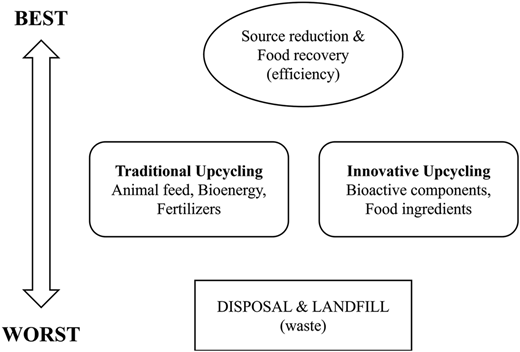
The acknowledgement of these problems led to the theorization (and implementation) of circular economy models, which, as opposed to linear ones, aim at reducing waste while increasing efficiency in the use of resources. A recent review by Bangar et al. (2024) conveniently summarizes the different approaches for dealing with food waste (Figure 1). An overall rethinking of the supply chain, reducing food loss and waste, is considered the most efficient strategy in a circular economy perspective. Upcycling is the second-best strategy, both in its traditional forms (e.g. production of bioenergy, animal feeds and fertilizers) as well as a way to create value-added foods (innovative upcycling).
Value-added foods created from upcycling techniques can be classified as “green foods”. Indeed, while a precise and consensual definition of “green foods” is difficult to retrieve (de Sio et al., 2024; Durif et al., 2010), this term usually indicates a broad category of food products that have a lower environmental impact throughout their entire life cycle (de Sio et al., 2024; Paul et al., 2016). In this respect, their alignment with circular economy principles ensures that upcycled foods (UFs) increase the efficiency of the use of resources, with potential environmental benefits (Moshtaghian et al., 2024).
Although food upcycling is recognized as an efficient strategy for food waste management, the production and consumption of UFs depend on the acceptability and response of consumers. To promote their consumption, it is important to understand which are the individual levers and barriers that affect the formation of consumer intentions to buy and consume UFs. The scientific literature on other “green foods” has already investigated several factors that promote and hinder their consumption, such as in the case of organic (Singh and Verma, 2017), biodynamic (Troiano et al., 2020) and sustainable products (Bahraseman et al., 2025). To some extent, some authors also analysed some of these factors in relation to UFs (Hellali and Korai, 2023; Grasso et al., 2023). However, so far, only a few factors at a time have been considered, and a broader picture is still missing. Relying on a behavioural model integrating the theory of planned behaviour (TPB) with evidence from the literature on other “green foods”, we aim at answering the following research question:
What are the factors that affect the intention of consumers to purchase UF products?
Our aim is to contribute to the knowledge of the behavioural processes leading to the consumption of UFs. In fact, while these products fall into the category of “green foods”, they differ from other green products for the role that technology plays in their production process (Cattaneo et al., 2019; Hellali and Korai, 2023) and their connection to waste (de Visser-Amudson et al., 2021; Zhang et al., 2021). These peculiarities might change the role played by some factors involved in the formation of purchase intention.
As “green foods”, however, UFs might be subject to some dynamics observed for other products in the category, as the so-called “green–gap”. The term refers to a gap that hinders the full translation of consumer intention to buy or consume “green foods” into actual behaviour (intention–behaviour gap, as in de Sio et al., 2024), or that exists between a general positive attitude toward “green foods” and the actual intention to purchase them (attitude-intention gap, as in Wang et al., 2021; Duong, 2022). Given the relative novelty of the topic, the importance of this gap for UFs has not yet been assessed, to the best of our knowledge. Studying its relevance, however, is important to predict the effectiveness of interventions stimulating consumers' attitudes toward UFs. A wide gap can in fact jeopardize the effects of actions on levers and barriers of consumer attitudes. Conversely, if the gap was small (or if it did not exist), even moderate stimuli could produce relevant results. Therefore, our second research question is the following:
To what extent does a gap exist between consumers' attitudes toward UFs and their intentions to purchase them?
To answer these research questions, in the next section, a theoretical framework is built and used to develop research hypotheses. In the third section, the methodology is described, followed by a presentation and discussion of the results. Conclusion and limitations close the manuscript.
2. Theoretical model and research hypotheses
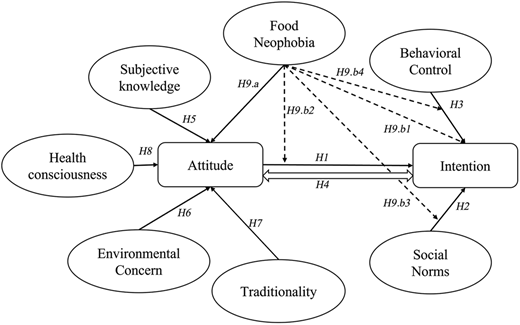
The theoretical model used in the study is shown in Figure 2. The TPB (Ajzen, 1991) constitutes the core of the model, being one of the most common theories in behavioural economics. In food economics, it has been used on a variety of products, from organic (Chen, 2007, 2009), to insect-based (Bae and Choi, 2021), to genetically modified foods (Kim et al., 2014). According to TPB, attitudes, social norms and behavioural control directly affect the individual behavioural intention. Our first three hypotheses are directly derived from these assumptions:
Consumers' attitudes towards UFs positively influence their purchase intention.
Consumers' subjective norms positively affect the intention of consumers to purchase UFs.
Consumers' perceived behavioural control positively affects consumers' intention to purchase UFs.
The TPB postulates that a positive consumer's attitude leads to the formation of a positive behavioural intention. However, literature on “green foods” often reports the existence of a gap between attitudes and intentions. Vermeir and Verbeke (2006) identified such a gap for sustainable dairy products, observing that people had a lower intention to purchase the products than what might have been expected from their positive attitudes. Wang et al. (2021) trace back this gap to the presence of some “reasons-against” the purchase of these products. As UFs are characterized by a “green” component, we expect the “green gap” to be relevant also in their case:
There is a gap between the attitude and the intentions of consumers to buy UFs.
While H4 answers our second research question, the first one is addressed adding to the TPB core additional factors potentially relevant in the behavioural process. Specifically, based on the literature on “green foods”, we included five additional constructs: subjective knowledge, environmental concern, traditionality, health consciousness and food neophobia.
Subjective knowledge is defined as the awareness, familiarity, or knowledge of the matter consumers are dealing with (Al Mamun et al., 2018; Tunca et al., 2024). In general, when consumers know a product, they develop positive attitudes toward it. This has been observed in multiple cases, such as for surplus meals (Pandey et al., 2023), algae-based foods (Bahraseman et al., 2025) or bread enriched with wine by-products (Miolla et al., 2023). Hence, on the basis of this literature, we propose the following hypothesis:
Subjective knowledge of UFs positively affects the attitudes of consumers towards UFs.
Environmental concern is defined as the degree to which people think about the impact of specific processes, products, or services on the environment and feel an urge to participate in solution-oriented activities (Paul et al., 2016; Bahraseman et al., 2025). The positive effect of the environmental concern of individuals on their attitudes is well acknowledged for organic products (Chen, 2007, 2009; Ahmed et al., 2021), local foods (Kumar and Smith, 2018) and other “green foods” (Kim et al., 2014; Paul et al., 2016; Yadav and Pathak, 2016). Since, like these products, UFs fall within a logic of sustainable consumption, we hypothesize that:
Environmental concerns positively affect the attitude of consumers towards UFs.
Traditional foods are foods connected with the customs, values, traditions and the local culture of an area (Aschemann-Witzel et al., 2023). Traditionality, indeed, is a factor that plays a role in food choices, pushing consumers to prefer foods that are part of their culture and their habits while being sceptic, if not hostile, towards products that are not part of their cultural patrimony (Yang et al., 2021). In this respect, UFs might be perceived as relatively distant from traditional foods. Grasso and Asioli (2020) observed that “traditionalist” consumers are indeed more inclined towards traditional foods than UFs. Yang et al. (2021) observed that respondents prefer traditional peach crisps more than the upcycled counterparts. We therefore suppose that:
The importance individuals attach to traditionality in food consumption negatively affects their attitude towards UFs.
Another factor frequently considered when analysing food consumption behaviours is health consciousness. However, anticipating the role of health consciousness in the acceptance of UFs might be difficult. Focusing on intrinsic attributes, there seems to be no reason to consider UFs healthier or nutritionally better than their standard counterparts. Health consciousness might thus not find a “fertile ground” on which to stimulate the formation of positive attitudes. However, two other factors might play a role. On the one hand, the use of technology-intensive processes and food production residuals as ingredients can make consumers doubt the safety and healthiness of UFs (Hellali and Korai, 2023), thus producing a negative response from health-conscious consumers. On the other hand, through a “halo effect”, frequently observed for “green foods” like organic (Sundar and Kardes, 2015), consumers might transfer the positive impression generated by other attributes (e.g. lower environmental impact) to the health dimension. In this case, health-conscious consumers would have more favourable attitudes. Given these contrasting potential effects, we propose a conservative hypothesis:
Health consciousness does not significantly influence the consumer attitudes towards UFs.
Food neophobia is defined as a form of psychological fear, reluctance, or resistance to trying or consuming new foods (Tunca et al., 2024; Coderoni and Perito, 2020; Cattaneo et al., 2019). As, in our context, UFs are quite novel (they are almost absent in the Italian market), we expect food neophobia to affect consumers' acceptance and the intention to purchase them. However, literature investigating the role of food neophobia provides contrasting evidence about the path through which food neophobia affects consumer purchase intentions. Some authors consider food neophobia a determinant of attitudes (Cattaneo et al., 2019), where consumers' predisposition toward novel products shapes the very attitude toward these products. Other authors (e.g. Tunca et al., 2024; Kim et al., 2014) conceptualize food neophobia as affecting behavioural intention in two ways: (1) directly and (2) moderating the effect of attitude on intention. Based on these different theorizations of the effect of food neophobia, we try to contribute to the field by empirically testing these two different views, thus proposing alternative hypotheses:
Food neophobia negatively affects the attitude of consumers towards UFs.
Food neophobia negatively affects the intention of consumers to purchase UFs.
The relationship between attitude and intention to purchase UFs is moderated by food neophobia.
The relationship between subjective norms and intention to purchase UFs is moderated by food neophobia.
The relationship between perceived behavioural control and intention to purchase UFs is moderated by food neophobia.
3. Methodology
A questionnaire with 48 questions divided into 3 sections was prepared. In the first section, basic information is provided about UFs (Appendix A). Therefore, our results are to be considered valid conditional on consumers having a basic knowledge of UFs. However, this strategy allows us to ensure a basic level of awareness in a context, the Italian one, where consumers are not familiar with UFs (Chiaraluce et al., 2024). The second section of the questionnaire contains questions that measure the specific constructs included in our model. In this respect, 7-point Likert scale items retrieved from the literature were used (Table I.A in Appendix B). In the questions, we do not refer to a specific upcycled product, but rather to the generic category of UFs. The implications of this choice are discussed in the discussion and conclusion sections. Eventually, the final section of the questionnaire collects socio-demographic information of respondents.
The questionnaire was tested by running a pilot study on 52 respondents to assess the consistency and validity of the constructs. The final sample consisted of 904 Italian consumers, above 18 years old, stratified by age, gender and region of residence to be representative of the Italian population. The administration was performed online by a specialized market agency in February 2025 [1].
The decision about the sample size was made following standard practices in the literature. Specifically, a 10:1 ratio of participants to questionnaire items is considered adequate (Yadav and Pathak, 2016; Aminizade et al., 2024). In our case, this would have implied 500 respondents. To remain conservative, we decided to work with a larger sample size, which grants us a ratio of approximately 18:1.
The choice of Italy as the national context where to conduct the study was motivated by the study being part of a wider national project (iNEST – Interconnected Nord-Est Innovation Ecosystem) that has, among its objectives, the promotion of research activity and technology transfer in the agri-food sector. Some studies have already investigated consumer perceptions of UFs in Italy, highlighting, in addition to a general low knowledge on the topic (Chiaraluce et al., 2024), a potential acceptance of these products (Coderoni and Perito, 2021), at least in some consumer segments (Coderoni and Perito, 2020; Miolla et al., 2023). However, no previous study analysed the preferences for UF products in Italy through a structured behavioural model, making the Italian context a relevant one to be investigated. In addition, the choice of Italy might spread further light on the acceptance of UFs in a country where these products are relatively rare on the market. In fact, despite the existence of companies that are involved in the production of UFs [2], the market presence of UFs remain scarce.
To analyse data, covariance-based structural equation modelling (CB-SEM) was used as the dataset is large (Zhang et al., 2021). The data were analysed in R software using the lavaan package. To model the moderation effect of food neophobia, a two-step method was used, first creating the moderation terms and then putting them in the structural model of SEM as suggested by Becker et al. (2018). Before creating the moderation terms, variables have been scaled in two different ways: mean-centred scaling and standard deviation scaling (Little et al., 2006). After comparing the standard indicators of model fitness (Root Mean Square Error of Approximation, Comparative Fit Index, Tucker–Lewis Index, Standardized Root Mean Square Residual) for the two scaling procedures, we proceeded with standard deviation scaling.
4. Results
4.1 Description of the sample
The data collection strategy allowed the sample to be representative of the Italian population in terms of gender, age and region of residence. Specifically, for gender, the share of respondents was similar in the two classes, 48.23% males and 51.77% females (Table 1). In terms of age, the highest number of participants (28.98%) are over 65 years old, while the youngest are the smallest age group (8.85%). In terms of education level, most of the participants had a high-school diploma (40.15%) or a middle-school education (36.62%). The size of the family is relatively heterogeneous, with most of the respondents living in two- and three-person families, but with a non-negligible share of larger as well as single-person families. While most of the respondents (68.81%) declared a yearly income lower than 35,000 euros, 78.83% of them consider their income status at least quite good. The regional distribution of respondents is reported in Table II.A in Appendix B.
4.2 Construct consistency and validity
All constructs have been tested for 1) consistency, through Cronbach's alpha; 2) convergent validity, through average variance extracted (AVE); and 3) discriminant validity, through Fornell–Larker value (FLV). The results of the tests are reported in Table 2. The Cronbach's alpha is greater than 0.8 for all constructs, demonstrating that the items used to measure the latent variables are reliable and consistent. The AVE is greater than 0.5, supporting convergent validity of every construct. Finally, the FLV is greater, for each construct, than the correlation coefficients with other constructs (Table III.A in Appendix B), which indicates that all the constructs are conceptually well-separated from the others.
Looking at the mean values of the constructs (Table 2) respondents scored particularly high on environmental and health consciousness. Relatively high average values are also observed for most of the other constructs, except for subjective knowledge and food neophobia. As hypothesized, the sample has relatively low knowledge about UFs. However, on average, respondents seem not particularly reluctant to try new products. This appears in line with Cattaneo et al. (2019), who reported the neophilic nature of Italian consumers towards new food technologies.
4.3 Regression results and hypotheses decisions
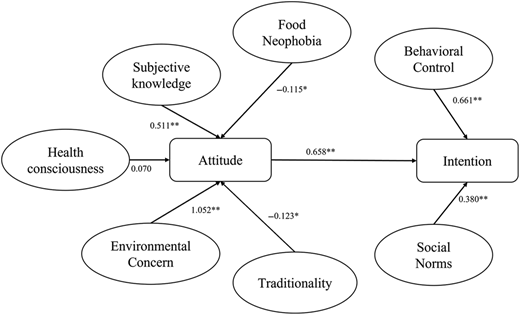
The regression results of the models with different specifications of the role of food neophobia are reported in Table 3, while Figure 3 graphically reports the estimated paths of the accepted model. The fit indices of the two models, which support the adequacy and robustness of the specification, are reported in Table IV.A in Appendix B. Both models provide similar indications, supporting the robustness of the results. All expected relations from the TPB model are confirmed, leading to acceptance of H1, H2 and H3. A Chi-Square (χ2) likelihood ratio test for equality to one of the attitude-intention parameters confirms the existence of a gap between attitudes and intentions, as maintained by H4. Similarly, all hypotheses about the determinants of attitude are supported (H5, H6, H7 and H8), with positive effects estimated for environmental concerns and subjective knowledge, a negative effect for traditionality and no effect for health consciousness. Among these factors, the positive ones are estimated to play a more relevant role, in magnitude, than the others. Finally, the results suggest that food neophobia should also be considered a determinant of attitudes, since its effect is significant in the first model (H9a), while none of the expected relationships (H9b.1, H9b.2, H9b.3, H9b.4) are confirmed in the second model.
5. Discussion
Grounding the investigation on the TPB, our study confirms, for UFs, the positive effects of attitude, social norms, and behavioural control on purchasing intention. However, a gap exists such that the attitudes of respondents toward UFs do not fully translate into an actual intention to purchase them. The attitude-intention gap observed in the literature for “green foods” (Wang et al., 2021; de Sio et al., 2024) also applies to UFs. The presence of this gap is an issue for the development of UF consumption, as the potential increase deriving from individuals who are intrinsically more inclined toward UFs is diluted to some extent. However, closing the attitude-intention gap is critical not only to ensure that inner attitudes of individuals are fully expressed but also to preserve the value of efforts aimed at generating these attitudes. Indeed, when attitudes do not fully translate into intentions, the effectiveness of every intervention to foster positive attitudes toward UFs is inevitably reduced, with the consequence of “losing” part of the invested resources. In addition, while we limited the analysis to respondents' intention, the literature on “green foods” suggests that the attitude-intention gap is only the first part of the story, as there is usually another gap between intention and actual behaviour (Duong, 2022; de Sio et al., 2024). Although the relevance of this additional gap should be specifically evaluated in the case of UFs, its presence might be a further bottleneck.
In this respect, future research should investigate the factors that might reduce these gaps in the case of UFs, possibly drawing from the “green food” literature. Here, in fact, multiple aspects have been investigated, ranging from consumers' personality traits (Duong, 2022) to their future orientation (Chekima et al., 2017), their involvement in food choices or the perceived uncertainty (Vermeire and Verbeke, 2006). Food neophobia has been proposed as a mediator between attitudes and intention (Tunca et al., 2024). However, in this respect, our study does not support this hypothesis.
Since the existence of positive attitudes is even more important when a gap with intentions exists, it is crucial to unravel the role of factors shaping consumers' attitudes. Our study identifies environmental concerns as the main determinant of attitudes towards UFs. Thus, any shift in environmental concerns likely translates into significant changes in the perception of UFs. Therefore, good opportunities stem from public awareness of climate change and environmental issues, which have improved greatly in recent years. This is evident in our sample, where the level of environmental concern is relatively high, in line with other studies on Italian consumers (Miolla et al., 2023; Coderoni and Perito, 2020). However, recent economic pressures might be a relevant threat, turning the attention of consumers away from environmental concerns, with potentially negative reflections on their consideration of UFs.
From a business perspective, the relevance of environmental concerns suggests that environmentally conscious consumers are the most prone to move to UFs. As such, companies can strategically target this segment to improve market acceptance of UFs, for example, through the selection of “green” communication strategies, the use of sustainable packaging or the choice of specific distribution channels.
The importance of “environmental consumers” could be somewhat expected. However, these consumers are not always the most important segment for “green foods”. For example, for organic products, several authors notice a prevalence of individualistic motives in consumption decisions (Cei and Rossetto, 2024; Diagourtas et al., 2023). Among these, perceived health benefits are quite recurrent. In our case, however, the investigation of the potential effects of health consciousness on consumers' attitudes led to inconclusive results. In general, we can reasonably exclude a negative association between individual health consciousness and attitude towards UFs. This suggests that consumers do not perceive relevant risks from the association of waste and residues with food. On the other hand, consumers seem able to understand that the benefits of UFs are of an environmental nature, rather than related to health characteristics. In this respect, no evidence of any halo effect, often observed for other “green foods” (Sundar and Kardes, 2015), has been identified for UFs.
Another important driver of consumers' attitudes is the knowledge of UFs, in line with evidence from other “green foods” (Yadav and Pathak, 2016; Al Mamun et al., 2018). This opens the way to promising avenues for the spread of UF consumption. First, the knowledge of UFs in our representative sample is relatively low, suggesting that there is room for improvement. In this sense, every information action performed by private companies or public institutions can be expected to have a good return in terms of consumer attitudes. As such, investments in information tools, such as marketing campaigns, logos and certifications, offer the prospect of an economic return (for producers) and of an increase in the market share of UFs (for producers and the public).
In addition, the positive association between consumer knowledge and attitudes might also trigger a positive feedback mechanism. When individuals encounter UFs, through advertising, availability, or direct experience, subjective knowledge tends to increase (Kumar and Raju, 2013; Mehta et al., 2023). Currently, market exposure of UFs is quite limited. However, increasing exposure could initiate a virtuous cycle. Enhanced knowledge stimulates favourable attitudes, strengthening purchase intentions and consumer demand. This, in turn, encourages greater supply and visibility in the market, further increasing exposure and knowledge. This self-reinforcing loop makes knowledge not only a direct driver of attitude but also a foundational element in the broader process of mainstreaming UF consumption.
Turning to factors potentially hindering the development of the UF sector, we focused on food neophobia and respondents' traditional attitude. In both cases, the effect on attitudes toward UFs was negative, despite being low in magnitude. In the case of food neophobia, our contribution also adds to literature identifying food neophobia as a determinant of attitudes (Sabbagh et al., 2023; Cattaneo et al., 2019) rather than intentions, or an attitude-intention mediator, as maintained in other studies (Tunca et al., 2024; Kim et al., 2014). Basically, when individuals do not feel confident in a new food product, the very perception they have of that product is affected (negatively). Afterwards, the intention to buy the product is affected as well, but as a response to the lower attitude that the individual developed.
The low negative effect of food neophobia and traditionality is a promising result, suggesting the presence of low barriers to UF consumption. However, the hypothetical context and the absence of a specific product to be evaluated may have played a role, as the degree to which respondents perceive a product as novel or not traditional might depend on the specific product and its characteristics. Nonetheless, these two factors seem not to constitute relevant a priori barriers to the perception of UFs altogether, despite the fact that strategies to limit their effect should be considered when promoting the expansion of this sector. In the case of food neophobia, some authors suggested that increasing familiarity with the product (e.g. communicating the technologies used and emphasizing their safety and sustainability) can decrease the perception of the product as “new” or “risky” (Ghazanfar et al., 2022). Similarly, communication can soften the role of traditionality. While modern upcycling exploits advanced technologies and processes, the principles of reusing and recycling are rooted in many culinary traditions, aligning with long-standing traditional practices of minimizing waste (Aschemann-Witzel et al., 2023; Mirosa and Bremer, 2023). Emphasizing this similarity while portraying upcycling as a modern expression of traditional wisdom could help reduce the preconceptions about traditionality, making even more conservative consumers open to developing a favourable attitude toward UFs.
6. Conclusions
Our study provides preliminary evidence on consumer attitudes and intentions towards UFs, a topic investigated to a limited extent and without a broader vision on the role played by multiple behavioural factors.
A main conclusion derived from the analyses is the importance of leveraging, from both a private and public perspective, customers' environmental concerns to stimulate positive attitudes toward UFs while increasing the customers' awareness of these products. Nevertheless, as in other “green” products, part of these efforts might be lost if no ways are found to reduce the gap between consumers' attitudes and their actual purchasing intentions. Conversely, compared to other innovative foods (e.g. insect-based food, cultured meat), UFs seem to be less affected by barriers related to neophobia or traditional food habits, thus alleviating the effort needed to overcome them.
As in all studies, these results should be critically evaluated in light of the characteristics of the research. In addition to the classical issues related to potential self-selection, we acknowledge that the role of factors determining consumer attitudes and intentions may be context-dependent (Randall et al., 2024). Therefore, while we consider the behavioural framework useful for the analysis of consumers' response to UFs, replication in different markets is recommended.
In addition, the absence of a specific product to be evaluated by consumers can increase the hypothetical bias in the results. Although further research should work with real upcycled products, asking respondents about generic UFs allowed us to investigate their attitudes toward the very concept of food upcycling. This allowed us to better investigate, at a general level, factors whose role might critically depend on the specific product proposed to respondents, as might be the case for health consciousness, traditionality or neophobia.
Notes
An ethical clearance is not necessary for this study, as data are collected by an external market agency, are anonymous, and no personal information is collected (as defined in the Regulation EU, 2016/679). In addition, the collected data are not sensible or confidential in nature, and no vulnerable group is included in the research, as specified in the Declaration of Helsinki.
Some examples of these companies are the “Biova Project”, which produces beer from leftovers of household bread, “Packtin”, which produces upcycled ingredients from fruit and vegetable waste, or “Circular Food”, which uses ley flour from spent beer grains to produce bakery products.
The supplementary material for this article can be found online.