This study tests an adapted six-dimensional framework of performance indicators in a business-to-business (B2B) setting on service provider satisfaction (in a sales role). The proposed nomological network is grounded in the meta-analysis of indicators of sales performance in B2B sales. However, it is applied in this study as an indicator of service provider satisfaction. As such, the study purports a framework of dimensions that motivates the overall level of B2B service provider satisfaction.
This research study adopted a deductive approach, utilising a structured questionnaire survey methodology. The sample comprised 389 service-orientated firms in Norway, selected to represent diverse industries and firm sizes across the B2B sector.
Motivation was established as the primary and most influential indicator category of service provider satisfaction, with skill and aptitude playing foundational but largely indirect roles via their association with motivation and role perception.
The findings can assist in B2B markets to better understand how managers who focus on developing skills, clarifying roles and unlocking intrinsic motivation will be best positioned to foster satisfaction, retention and performance in service-based B2B sales environments. Such guidance also enhances strategic workforce planning, employee engagement and long-term organisational competitiveness.
This study is original in proposing and empirically validating a six-dimensional service provider satisfaction framework tailored to B2B service contexts, integrating internal marketing, relationship marketing and service-dominant logic and demonstrating the central, direct role of motivation over the indirect ones of aptitude, skill and role perception.
1. Introduction
Employees in a sales role are critical stakeholders in the relationship-building process within business-to-business (B2B) markets. As such, sales managers increasingly seek to understand the indicators of their satisfaction in a B2B sales role context, considering that service provider satisfaction illustrates enhanced relational continuity (Rodriquez et al., 2023; Ružić et al., 2018). Since the new millennium, service provider performance and satisfaction in B2B sales have emerged as central themes in the sales management field. Scholars (Lučić et al., 2019; Westbrook and Peterson, 2022) argue that satisfaction directly influences employees' attitudes, intentions and behaviours in a sales role, which in turn affect B2B firms' overall sales performance.
Furthermore, Gounaris and Almoraish (2024) emphasise that B2B service encounters are complex, relational and co-created. The success of these interactions depends heavily on service providers' level of satisfaction and engagement (Berenguer-Contri et al., 2024). Consequently, service provider satisfaction in B2B sales influences service quality perceptions as well as the long-term profitability and sustainability of service firms competing in dynamic markets (Raišienė and Raišys, 2022).
In this study, we conceptualise service provider satisfaction as a role-based evaluative construct reflecting how individuals assess their organisational sales role within B2B service firms. It is not equivalent to general job satisfaction, nor does it refer to satisfaction within a dyadic buyer-seller relationship. Rather, it captures the service provider's internal evaluation of their contribution and relationship with the employing organisation. Consistent with previous research, we model satisfaction as a two-dimensional construct comprising economic and non-economic components. Economic satisfaction reflects the individual's perceived contribution to organisational profitability and financial performance (Sanzo et al., 2003). Non-economic satisfaction reflects the perceived quality and positivity of the relationship between the service provider and the firm (Geyskens et al., 1999). These dimensions capture together both performance-related and relational evaluations of the service providers' (organisational) role in B2B sales (henceforth labelled service provider satisfaction).
Ferro-Soto et al. (2024) and Zietsman et al. (2023) concurred, stating that satisfaction in B2B sales is influenced by various interrelated factors. A nomological network may enable us to map out these relationship dynamics systematically, showing not only what influences service provider satisfaction, but also how and through what pathways. This helps to move beyond simplistic cause–effect assumptions towards a more integrated understanding of the construct of service provider satisfaction in B2B sales. Existing models of satisfaction in B2B sales often focus on a few indicators in isolation or within limited frameworks (Berenguer-Contri et al., 2024; Raišienė and Raišys, 2022). A nomological network allows for a theory-driven and empirically validated structure that captures direct and indirect effects. It may clarify the role of mediators and contextual factors. This contributes to theoretical refinement and supports the development of additional models in sales research.
Furthermore, for sales managers, understanding the network of indicators on service provider satisfaction helps previous interventions in B2B sales. For instance, knowing that motivation may be a key indicator and is influenced by aptitude, skill and role clarity allows managers to design targeted strategies for training, role design and leadership development. This improves resource allocation and maximises the impact on service provider satisfaction and their retention in the firms. Especially, when considering that B2B sales are typically more complex, relationship-driven and longer in cycle compared to business-to-consumer (B2C) (Andersen et al., 2023; Høgevold et al., 2021).
Additionally, a generic model may not fully capture the relationship dynamics specific to B2B sales. Consequently, a nomological network tailored for B2B sales could account for the contextual nuances, making the insights more applicable and actionable. Establishing a validated relationship dynamics between indicator themes and a nomological network enhances the predictive power of sales research. It can furthermore assist firms to assess the causes of low service provider satisfaction as well as forecast the likely impact of changes in leadership, training or team structures on service provider outcomes. As such, developing a nomological network of indicators for service provider satisfaction in B2B sales creates a structured, empirically evidence-based foundation for advancing theory and guiding practical improvements in the management of service providers' role in B2B sales.
While earlier research predominantly explores buyer–seller satisfaction through relational quality constructs (Lii et al., 2025; Utami et al., 2022), relatively few studies investigate how established performance indicators (e.g. aptitude, skill, role perception and motivation) shape service provider satisfaction in B2B sales within the employing organisation. Existing research also examines leadership and environmental factors in relation to performance outcomes. Thus, a gap remains in understanding how these foundational sales indicators operate within a structured nomological network predicting service provider satisfaction in B2B sales.
Consequently, our study extends established performance-based frameworks by examining these indicators as indicators and contextual factors shaping service provider satisfaction in B2B sales. We provide a novel lens linking employee-level experiences to broader service outcomes by introducing a comprehensive and theory-integrated set of sales-related indicators. We thereby broadening theoretical understanding of service provider satisfaction formation in B2B sales. Accordingly, we propose a nomological framework that systematically illustrates the interrelationships among the indicators of service provider satisfaction.
In comparison to B2C sales, B2B sales are characterised by greater service complexity, longer relationship cycles and higher relational interdependence. Hence, a one-size-fits-all satisfaction model is inadequate. Instead, a contextualised nomological network can capture the relational, cognitive and affective interplay unique to B2B sales. It may offer actionable and empirically grounded insights (Gounaris and Almoraish, 2024; Wirtz et al., 2025). From a managerial perspective, a validated nomological network of service provider satisfaction can assist service firms' strategic efforts to enhance internal service quality, employee experience and overall satisfaction experience. Managers can use such frameworks to assess the effects of leadership styles, service design structures and training initiatives on service provider satisfaction outcomes. This allows firms to adopt a proactive, service-orientated approach to internal relationship management, fostering agility, empathy and alignment between the overall management of employees and service provider satisfaction experiences.
From a theoretical perspective, our study advances services marketing literature by integrating insights from internal marketing, relationship marketing and service-dominant logic. It contributes to theory refinement by demonstrating how the interplay between emotional, cognitive and contextual factors influences service provider satisfaction in B2B sales. To complement the theoretical foundation, we engaged experienced B2B service sales managers during the research design phase. These practitioners emphasised that aptitude often functions as a foundational driver shaping skill development, motivation and role perception. During these engagements, the managers reflected on their practical experiences in managing B2B sales teams. The indicated that individuals who entered service-orientated sales roles with a strong natural predisposition for interpersonal interaction and problem solving often progress more confidently in developing the skills required to manage complex client relationships. They also noted that organisational leadership and environment tend to influence service provider satisfaction indirectly, rather than through consistent direct effects. Unambiguously, they elucidated that leadership behaviours and organisational support structures frequently profile the conditions within which service providers operate. They argued that this is the case rather than directly determining how satisfied they feel in their roles. In this regard, the managers emphasised that organisational leadership primarily facilitates guidance, coordination and performance expectations, while the organisational environment provides the broader structural and cultural context in which B2B service interactions occur. Such practitioner insights illustrate the complex and layered nature of service provider satisfaction formation in B2B sales and motivated the development of our nomological framework. As such, these practitioner reflections were taken into consideration during the conceptual refinement of the study to ensure that the proposed relationships were aligned with observable realities in B2B service sales environments, while still remaining grounded in the theoretical objectives of the research. As such, the resulting framework supports a relational understanding of service provider satisfaction in B2B sales that transcends individual-level indicators and situates employee well-being within the broader logic of value co-creation in B2B sales.
We therefore argue that developing a nomological network of indicators for service provider satisfaction in B2B sales fills a notable gap in services marketing literature. It establishes a structured, empirically evidence-based foundation for advancing theory, while providing managers with practical tools to foster more engaged, motivated and effective service providers in B2B sales. Furthermore, by aligning service provider satisfaction with a firm's service excellence, such a framework contributes to sustained competitive advantage in service-driven B2B markets.
Our study builds upon the seminal frameworks of Chawla et al. (2020), Churchill et al. (1985), Kerr and Marcos-Cuevas (2024) and Verbeke et al. (2011), which collectively synthesise decades of research on performance in B2B sales. These meta-analyses provide cumulative evidence that aptitude, skill, motivation and role perception constitute foundational performance indicators within B2B sales.
However, these frameworks examine behavioural performance outcomes rather than organisational role satisfaction. While performance reflects observable output, satisfaction reflects the individual's evaluative assessment of role fulfilment within the employing organisation. The processes underlying performance (e.g. perceived competence, goal attainment and role clarity) are not inherently performance-specific and may reasonably extend to psychological and evaluative outcomes. Accordingly, the study adapts and extends these performance-based indicators into the domain of service provider satisfaction in B2B sales. By doing so, we broaden understanding of how foundational sales dimensions operate beyond behavioural outcomes and within a structured nomological network explaining organisational role satisfaction.
Emanating from the research meta-analyses and systematic reviews, our study aims to adapt and examine a five-dimensional framework of sales performance on service provider satisfaction in B2B sales. Previous systematic reviews and meta-analyses demonstrate that aptitude, skill, motivation and role perception may serve as indicators of sales performance in B2B sales, though with modest explanatory power. We build upon this established body of research, but shift the analytical focus from behavioural performance outcomes to service provider satisfaction within the organisational sales role. This shift is theoretically grounded. Furthermore, the processes underlying sales performance (e.g., perceived competence, goal attainment and role clarity) are also central to how individuals evaluate and experience their work. While performance captures observable behavioural output, satisfaction captures the individual's evaluative assessment of role fulfilment within the employing organisation. By extending performance-based models into the domain of organisational role satisfaction, the study broadens understanding of how foundational sales indicators operate beyond behavioural outcomes in B2B sales. As such, the following discussion conceptualises the frame of reference for the proposed nomological model in the study.
2. Research frameworks of reference
Building on the early model of Walker et al. (1977), subsequent studies expanded and refined the categories of indicators influencing performance in B2B sales. Churchill et al. (1985) identified six key indicator categories (personal factors, skills, role variables, aptitude, motivation and organisational or environmental influences) that continue to frame discussions around sales employee effectiveness. Verbeke et al. (2011) extended this typology, integrating additional indicators such as role ambiguity, adaptiveness, cognitive aptitude and work engagement. They are factors relevant to service contexts where relational quality and emotional labour are central to value creation in B2B sales. Considering this, Table 1 reflects the evolution of the indicators of performance in B2B sales.
Over time, adaptive shifts in the sales industry, driven by digitalisation, customer empowerment and the growing centrality of relational value, have prompted research to revisit and expand these performance models in B2B sales. For example, Chawla et al. (2020) advanced the work of Verbeke et al. (2011) by proposing a comprehensive framework of eight categories and 20 subcategories. They differentiated between external and internal organisational environments and introduced additional service-relevant dimensions (e.g. technological competence, strategic and non-strategic activities and job-related psychosocial factors) reflecting the evolving realities of frontline service work. Kerr and Marcos-Cuevas (2024) built on this typology by identifying inter-organisational service capabilities and technology-driven customer engagement as distinct indicators of performance in B2B sales. As such, these studies offer a contextually refined and relationally grounded model suited to modern sales environments. Collectively, these studies also serve as a cumulative meta-analytic foundation for understanding the indicators of service provider performance in B2B sales.
However, despite their conceptual breadth, these frameworks primarily focus on behavioural performance outcomes. Few, if any, studies have systematically examined how these established performance indicators jointly relate to service provider satisfaction within the employing organisation and particularly in relational and service-intensive B2B sales. This imbalance reveals a theoretical gap. For example, while performance has been extensively mapped, the evaluative and psychological consequences of these foundational indicators remain underexplored. Furthermore, advancing the field of service management, therefore, requires not only identifying performance indicators but also clarifying how these indicators interconnect within a broader nomological network explaining service provider satisfaction (Chawla et al., 2020; Hamzah et al., 2020). In alignment with the classification proposed by Høgevold et al. (2024a, b), this study organises these indicators into five core categories (namely aptitude, skill, motivation, role perception and organisational/environmental factors) that collectively may capture both individual capabilities and systemic influences in B2B sales.
The “personal/biographical” dimension is excluded, as such characteristics are typically non-controllable and offer limited managerial leverage for improving outcomes (Küster and Canales, 2008; Verbeke et al., 2011). As such, the focus of this study centres on malleable and development-orientated dimensions that managers can influence through leadership, training and organisational design.
The first dimension of aptitude (or inherent capability) encompasses psychological and emotional attributes that shape service providers' readiness for effective service delivery in B2B sales (Ewe and Ho, 2024; Gbormittah, 2023). In service contexts, aptitude includes empathy, sociability and emotional sensitivity, all of which are foundational factors reinforcing professional service orientation and customer-centred behaviour (Good and Schwepker, 2024). Cognitive aptitude (e.g. problem-solving ability, decisiveness, emotional intelligence) enables employees to interpret customer needs and tailor personalised service experiences (Kidwell et al., 2021; Rodríguez et al., 2024). The second dimension of skill emphasises developed competencies essential for service delivery in B2B sales. These include interpersonal communication, persuasion, conflict resolution and adaptive interaction behaviour (Høgevold et al., 2021; Krämer et al., 2022). Technical competence (e.g. digital tool proficiency, product knowledge and market awareness) further enhances value generation in technology-mediated service contexts (Ratajczak-Mrozek et al., 2021; Shin et al., 2024).
The third dimension of motivation reflects both intrinsic and extrinsic forces driving service providers to engage proactively in their service delivery in B2B sales. Intrinsic motivation stems from professional pride and personal fulfilment, while extrinsic motivators include recognition and financial rewards (Good et al., 2022; Ryan and Deci, 2020). In B2B service contexts, motivated service providers demonstrate higher engagement, adaptability and discretionary effort, thereby influencing service effectiveness in B2B sales (Rodriquez et al., 2023; Yim and Zhang, 2025). The fourth dimension of role perception concerns how service providers interpret and understand their responsibilities in their service delivery in B2B sales. Clear expectations, autonomy and supportive supervision reduce ambiguity and emotional strain in roles requiring sustained relational engagement (Li et al., 2025; Scholtz et al., 2024). A clear understanding of role expectations, therefore, enhances confidence and consistency in B2B sales (Arriaza, 2024; Verbeke et al., 2011).
Finally, organisational and environmental factors encompass internal and external contextual influences shaping service work in B2B sales. Internal variables such as leadership style, culture, teamwork and communication affect morale and workplace evaluations (Dinawati and Padmantyo, 2023; Fujii, 2025). On the other hand, external pressures (e.g. including market dynamics, technological change and customer expectations) further influence how service providers adapt within evolving B2B sales (Gounaris and Almoraish, 2024; Høgevold et al., 2024a, b).
These five core areas of indicators together provide a theoretically grounded but still managerially actionable structure for examining how foundational sales indicators may extend beyond performance and shape organisational role of satisfaction in B2B sales. This forms the basis for developing a comprehensive framework of service provider satisfaction.
In the following sections, the study outlines the theoretical rationale underpinning the study and positions its contribution within performance in B2B sales literature. Thereafter, we present a detailed overview of the meta-analytical findings that highlight the evolving indicators of service provider effectiveness. Our proposed theoretical framework serves as a foundation for developing and testing a nomological network that captures the multidimensional nature of service provider satisfaction in B2B sales. We conclude by discussing key findings, research and practical implications for service management and theoretical recommendations to guide future research on service provider satisfaction and firms' success.
3. Perspective on the theories grounding the study
To our knowledge, previous research has not systematically examined how the proposed foundational indicators in the study collectively influence service provider satisfaction in B2B sales, especially when considering that existing meta-analyses primarily address behavioural performance outcomes. As such, the study extends these performance-based indicators into the domain of satisfaction through theoretically grounded reasoning, drawing on social exchange theory (SET) and self-determination theory (SDT). SET (Blau, 1964) posits that workplace relationships operate through reciprocal exchanges of rewards and costs. In organisational contexts, investments in training, leadership support and skill development are perceived as relational benefits that strengthen employee evaluations of the organisation (Ahmad et al., 2023). Conversely, a lack of recognition or support constitutes relational costs that may reduce satisfaction (Xuecheng et al., 2022). Thus, SET explains how organisational investments in skill, role clarity and leadership may translate into positive evaluations of service provider satisfaction in B2B sales (Ahmad et al., 2023). SDT, on the other hand, argues that satisfaction arises when three psychological needs are fulfilled, namely autonomy, competence and relatedness (Ryan and Deci, 2020, 2024). Within a B2B sales context, competence relates to aptitude and skill, autonomy connects to role perception and discretion, while relatedness links to leadership and team environment (McAnally and Hagger, 2024). When these needs are supported, intrinsic motivation strengthens and positively influences service provider satisfaction and sustained performance (Laguerre and Barnes-Farrell, 2025).
Both SET and SDT provide complementary processes explaining how performance-related indicators may shape service provider satisfaction (Matrafi, 2024). While performance captures behavioural output, these theories clarify why competence, autonomy and relational exchange may directly influence how service providers evaluate their organisational role in B2B sales (Ren et al., 2025). Accordingly, the study is grounded in two main theories, namely SET and SDT. SET originates from the seminal work of Blau (1964), which posits that social behaviour is guided by reciprocal cost-benefit evaluations within relational exchanges. Through such evaluations, service providers may seek to maximise rewards and minimise relational costs. In organisational contexts, SET provides a strong foundation for understanding service provider development and job-related satisfaction (Cropanzano and Mitchell, 2005). For example, when organisations invest in training, mentorship and career development opportunities, service providers may interpret these initiatives as valuable relational rewards and thereby strengthening their commitment and motivation (Ahmad et al., 2023).
Conversely, a lack of support, recognition or fair treatment may be perceived as relational costs, reducing overall service provider satisfaction (Xuecheng et al., 2022). Therefore, by fostering equitable and supportive exchanges through recognition, skill development and constructive leadership, firms may enhance service provider satisfaction and their retention (Mampuru et al., 2024). From a SET perspective, satisfaction emerges when service providers perceive that organisational investments fairly reciprocate their efforts and contributions (Ahmad et al., 2023). By applying SET, managers can design development initiatives that signal value and fairness and strengthening service provider satisfaction, commitment and long-term organisational loyalty (Matrafi, 2024).
SDT argues that employee satisfaction is grounded in the fulfilment of three basic psychological needs, namely autonomy, competence and relatedness (McAnally and Hagger, 2024; Ryan and Deci, 2020). Autonomy refers to the experience of volition and discretion in one's role; competence reflects mastery and capability; and relatedness captures meaningful connection within the organisational environment (Ryan and Deci, 2000). According to Wandycz-Mejias et al. (2025), autonomy in the workplace is supported through flexible role perception and enabling leadership; competence is strengthened through skill development and ability alignment; and relatedness is fostered through supportive environments and team cohesion. When these needs are satisfied, intrinsic motivation increases, positively influencing service providers' satisfaction and sustained performance in B2B sales (Mo et al., 2020).
Thus, SDT posits that motivation and well-being depend on the extent to which service providers’ autonomous behaviour is supported, their competence is acknowledged, and relational belonging is reinforced (Laguerre and Barnes-Farrell, 2025). In B2B sales, service provider autonomy facilitates adaptive selling, competence enables mastery of complex service interactions, and relatedness strengthens collaborative support structures. When leadership and organisational environments cultivate these needs, intrinsic motivation enhances satisfaction, engagement and long-term performance (Good et al., 2022). Unlike SET, which emphasises external exchange dynamics, SDT highlights internal psychological fulfilment as a primary process underlying the formation of service provider satisfaction (Olafsen and Deci, 2020).
Both theories are therefore relevant to articulating the nomological network of service provider satisfaction in B2B sales. SET explains how organisational investments in skill development, leadership and recognition generate reciprocal positive evaluations. SDT, on the other hand, explains how aptitude, skill, role perception and environmental support fulfil competence, autonomy and relatedness needs, thereby strengthening intrinsic motivation and satisfaction. These complementary perspectives provide the theoretical foundation for extending established performance indicators into the domain of service provider satisfaction in B2B sales.
Building on the cumulative performance-based frameworks of Chawla et al. (2020), Churchill et al. (1985), Kerr and Marcos-Cuevas (2024) and Verbeke et al. (2011), we extend five established performance indicator areas into a six-dimensional framework explaining service provider satisfaction in B2B sales. By integrating aptitude, skill, role perception, motivation, leadership and environmental factors within a structured nomological model, we shift the analytical focus from behavioural performance to organisational role satisfaction. This extension contributes to sales management theory by clarifying how foundational sales indicators jointly shape service providers' evaluative responses to their organisational role.
4. Theoretical development of the nomological framework
We conceptualise service provider satisfaction in B2B sales as the outcome of a hierarchical and contextually embedded process. Drawing on SDT and SET, we propose that foundational individual capabilities may shape motivation, which in turn may determine evaluative satisfaction. In addition, leadership and organisational environment may operate as contextual factors that both directly influence satisfaction and condition the strength of motivational effects. Moreover, aptitude, skill and role perception specifically represent foundational dimensions that may shape intrinsic motivation. Motivation then functions as the psychological process translating these antecedents into service provider satisfaction. As such, leadership and organisational environment are conceptualised as contextual factors that may exert direct influence on service provider satisfaction and may moderate the relationship between motivation and satisfaction.
4.1 Foundational capabilities and motivation
Aptitude reflects an individual's inherent cognitive and emotional capability to acquire and apply competencies effectively (Lohman, 2005; VandenBos, 2007). In B2B sales, aptitude encompasses problem-solving ability, emotional intelligence and relational sensitivity (Rodríguez et al., 2024). These attributes provide the psychological foundation for mastering complex relational exchanges (Mallin et al., 2025). From an SDT perspective, aptitude strengthens perceived competence, one of the three basic psychological needs underlying intrinsic motivation. When service providers perceive alignment between their inherent capabilities and job demands, they experience mastery and confidence, thereby reinforcing internal motivation (Ryan and Deci, 2000). Accordingly, the following hypothesis is proposed:
Service provider aptitude positively influences their motivation in B2B sales.
Skill represents realised and developed competence acquired through training, experience and deliberate practice (Lamri and Lubart, 2023). In B2B sales, skill includes communication, negotiation, adaptive selling and technical knowledge (Høgevold et al., 2024a, b). Whereas aptitude reflects potential, skill reflects enacted capability (Høgevold et al., 2021). From an SDT standpoint, developed skills reinforce service provider competence fulfilment. From a SET perspective, organisational investments in training signal reciprocal commitment, enhancing service providers' perception of organisational support. Both processes contribute to strengthened intrinsic motivation (Mo et al., 2020; Ren et al., 2025). Thus, it is hypothesised that:
Service provider skill positively influences their motivation in B2B sales.
Role perception concerns service providers' understanding of job expectations, responsibilities and behavioural norms (Fang et al., 2025). Clear role perception reduces ambiguity and fosters structured discretion (Rizzo et al., 1970). Within SDT, autonomy is a driver of service providers' intrinsic motivation. When service providers experience clarity combined with discretion, they perceive greater volitional control over their work. Such autonomy strengthens their internal motivation and reduces strain associated with role conflict (McAnally and Hagger, 2024). Therefore, it is hypothesised that:
Service providers' role perception positively influences their motivation in B2B sales.
4.2 Motivation as an indicator of service provider satisfaction
Motivation represents the service providers' internalised psychological state through which competence and autonomy fulfilment translate into evaluative outcomes (Ryan and Deci, 2020). SDT posits that when competence and autonomy needs are satisfied, intrinsic motivation strengthens, leading to enhanced well-being and positive role evaluation (Ryan and Deci, 2020). In B2B sales, intrinsically motivated service providers experience greater engagement, purpose and alignment with organisational objectives. Such internalised drive influences how service providers evaluate their organisational role, thereby shaping service provider satisfaction (Rodriquez et al., 2023). Accordingly, the following hypothesis is proposed:
Service providers' motivation positively influences their satisfaction in B2B sales.
4.3 Leadership as a contextual influence
Leadership functions as a relational and contextual process shaping service providers' perceptions (Islam et al., 2025). In complex B2B sales, leadership influences service providers through recognition, developmental support, feedback and empowerment (Rodriquez et al., 2023). From a SET perspective, supportive leadership fosters perceptions of fairness and reciprocal exchange. Service providers who perceive equitable treatment and recognition are more likely to evaluate their organisational role positively (Lee and Rhee, 2023; Settoon et al., 1996). Thus, leadership may directly influence service provider satisfaction. Leadership may also condition the strength of motivational effects (Aljumah, 2023). When leaders provide autonomy support and recognition, intrinsic motivation may translate more strongly into service provider satisfaction. Conversely, unsupportive leadership may weaken this relationship (Bendera et al., 2025; Liu et al., 2026; McAnally and Hagger, 2024). Thus, it is hypothesised that:
Leadership positively influences service provider satisfaction in B2B sales.
Leadership moderates the relationship between motivation and service provider satisfaction, such that the relationship is stronger under supportive leadership conditions.
4.4 Organisational environment as a contextual influence
The organisational environment encompasses structural, cultural and relational aspects of the workplace, including teamwork, communication quality and resource availability (Rodriguez et al., 2022). From a SET perspective, a supportive environment signals organisational commitment and reduces relational costs (Rajâa and Mekkaoui, 2025). From an SDT perspective, supportive environments reinforce relatedness, strengthening psychological need fulfilment. Accordingly, the organisational environment may exert a direct effect on service provider satisfaction (Rodriquez et al., 2023). Furthermore, a supportive environment may amplify the impact of intrinsic motivation on service provider satisfaction by reinforcing relational belonging and organisational alignment (Deci et al., 2017; McAnally and Hagger, 2024). Thus, the following hypothesis is proposed:
Organisational environment positively influences service provider satisfaction in B2B sales.
Organisational environment moderates the relationship between motivation and service provider satisfaction, such that the relationship is stronger in supportive organisational environments.
5. Methodology
5.1 Research design and research context
This study adopted a deductive theory-extension design grounded in cumulative meta-analytic evidence from B2B sales research. Prior syntheses have consistently identified aptitude, skill, motivation and role perception as core determinants of sales performance (Chawla et al., 2020; Churchill et al., 1985; Kerr and Marcos-Cuevas, 2024; Verbeke et al., 2011). However, these studies primarily focus on behavioural outcomes. The present study extends these established indicators into a different outcome domain, namely organisational role-based service provider satisfaction. Such extensions are appropriate when underlying explanatory mechanisms are theoretically transferable across related constructs (Mackenzie et al., 1993).
To examine the structural relationships among foundational sales-role dimensions, a hierarchical nomological framework was specified. Given the prediction-orientated objective and the presence of higher-order constructs, partial least squares structural equation modelling (PLS-SEM) was employed. PLS-SEM is particularly suitable for estimating hierarchical component models and for prediction-orientated studies that extend theoretical relationships into a new outcome domain (Hair et al., 2017). Furthermore, PLS-SEM is appropriate when the research objective emphasises variance explanation and theory development rather than strict model fit evaluation typically associated with covariance-based SEM.
Empirical data were collected from B2B service-orientated firms in Norway. Ethical approval was granted under ethical clearance number 605489 by the Norwegian Center for Research Data (Link to the website). Norway represents a mature, institutionally stable market economy characterised by high societal trust and professional autonomy (Hofstede, 2001). These structural conditions provide an appropriate context for examining motivational and role-based mechanisms in professional sales environments and serve as a rigorous empirical test environment supporting the broader theoretical generalisability of the proposed relationships.
5.2 Sample and data collection
The population consisted of 732 service-orientated B2B firms in Norway, identified through the Standard Industrial Classification system (SN, 2007). Only firms meeting the criteria for service-based B2B operations were included, while product-orientated organisations were intentionally excluded, as their sales processes differ substantially from those of service-based enterprises. Given the clearly defined population boundary and its manageable size, a census approach was employed, and all eligible firms were contacted. This design strengthens representativeness within the defined industry segment.
An invitation to participate, the questionnaire and an introductory letter containing the research team's contact details were distributed to targeted key informants occupying roles directly related to B2B sales. These roles included sellers, sales managers, key account managers, team leaders and regional sales managers. Two inclusion criteria were applied, namely: (1) the respondent held budgetary responsibility and was evaluated based on performance against that budget; and (2) the respondent's primary function involved active selling rather than merely overseeing sales staff. Furthermore, companies were identified through industry databases and contacted via their sales directors, who facilitated access to the relevant informants. Follow-up emails were sent at two- and three-week intervals after the initial distribution to encourage response from non-respondents.
A total of 389 completed questionnaires were received from 389 firms, yielding a response rate of 53.1%. This high coverage substantially reduces concerns regarding sampling bias and enhances representativeness within the defined SIC-based population. The final sample displayed substantial variation in firm size and turnover. In terms of full-time employees, no firms had fewer than 20 employees, 26 firms had 20–99 employees, 116 firms had 100–249 and 78 firms had 250–999. Regarding annual turnover in euros, no firm reported under €0.5 million; 39 firms reported €0.5-€4.99 million; 106 reported €5-€9.9 million; 41 reported €10-€24.9 million; and 50 reported €25 million or more.
To ensure respondents' reliability and competence, two screening questions were included at the end of the questionnaire, assessing: (1) total years of sales experience and (2) years of sales experience within their current organisation. In line with Campbell (1955) recommendation that key informants must be sufficiently knowledgeable to provide accurate responses, these questions verified respondents' qualifications. Results indicated that participants had a mean total sales experience of 20.4 years (median = 20) and an average of 10.9 years (median = 8) within their organisations.
5.3 Measures and instrument development
All constructs were operationalised as reflective latent variables grounded in established theoretical frameworks and prior empirical research on sales performance indicators (Churchill et al., 1985; Verbeke et al., 2011). Existing literature highlights a range of common indicators that influence B2B sales performance. To ensure contextual relevance and measurement accuracy, the survey instrument's dimensions and items were adapted and refined through an iterative process informed by previously validated measures (see Table 2).
Prior to full-scale data collection, the instrument was pre-tested through individual face-to-face interviews with seven senior executives to assess item clarity, wording precision and contextual appropriateness. Minor wording adjustments were made to improve comprehensibility and ensure alignment with professional sales terminology. No substantive modifications to the underlying construct were required, thereby supporting content validity.
Skill was measured using scales adopted from Boorom et al. (1998), Engle and Barnes (2000), Lennox and Wolfe (1984), Shannahan et al. (2015) and Spiro and Weitz (1990). Role perception was operationalised using measures derived from Beehr et al. (1976), Rizzo et al. (1970) and Singh et al. (1994). Aptitude was measured using validated scales from Alós-Ferrer and Hügelschäfer (2012), Donnellan et al. (2006), Epstein et al. (1996), John and Srivastava (1999), Kohli and Jaworski (1994) and Pervan et al. (2009). Furthermore, the motivation items were obtained from Buchanan (1972), Dwyer et al. (2000), Schaufeli et al. (2002), Shannahan et al. (2015), Spiro and Weitz (1990) and VandeWalle et al. (1999). Organisational and environmental indicators were secured from Eisenberger et al. (1986), Han et al. (1998), Jaworski and Kohli (1991), Johnson et al. (2015) and Shannahan et al. (2015). Satisfaction was conceptualised as a two-dimensional construct comprising economic and non-economic components and measured using established scales from Geyskens et al. (1999) and Sanzo et al. (2003). A five-point Likert-type scale was employed for all questionnaire items, with response anchors ranging from “strongly disagree” (1) to “strongly agree” (5). The items for the different constructs were obtained as follows.
5.4 Data screening and bias assessment
Before conducting the SEM analysis, several preliminary assessments were performed to evaluate data quality and potential sources of bias. This subsection reports the procedures used to address missing data and to examine the distributional properties of the variables. In addition, Harman's single-factor test was conducted to assess potential common method variance (CMV). Together, these preliminary analyses help ensure the reliability and suitability of the dataset for subsequent measurement and structural model assessments.
Table 2 presents the descriptive statistics for the measurement items used in the study, including the number of valid observations, missing values, means, standard deviations, kurtosis and skewness. Across the indicators, the number of valid responses ranges from 378 to 389, indicating a high response completion rate with only a small proportion of missing data. For the subsequent PLS-SEM analysis, missing values were handled using case-wise deletion in SmartPLS. The mean values generally fall between 1.25 and 4.85, suggesting varying but overall moderate to relatively high levels of agreement across the constructs. The standard deviations indicate acceptable variability in responses. Although some items exhibit moderate skewness and kurtosis, particularly for role ambiguity constructs, the overall distribution of the data does not indicate severe non-normality. These results suggest that the data are suitable for subsequent SEM.
In addition, univariate outliers were examined using standardised z-scores and boxplot inspection. No extreme outliers were detected, as all standardised values fell within the recommended threshold of ±3.29. The mean values generally fall between 2.04 and 4.85, suggesting moderate to relatively high agreement across most measurement items. The skewness and kurtosis statistics indicate that the distributions of most items do not exhibit severe non-normality, suggesting that the data are suitable for subsequent SEM.
To assess the potential impact of CMV, Harman's single-factor test was conducted using exploratory factor analysis in IBM SPSS Statistics. The results indicate that multiple factors had eigenvalues greater than 1, and the first unrotated factor accounted for 16.02% of the total variance. As this value is well below the commonly suggested threshold of 50%, the results indicate that CMV is unlikely to seriously threaten the validity of the findings. In addition, full collinearity variance inflation factor (VIF) values were examined as a complementary diagnostic test. All VIF values were below the recommended threshold of 3.3, providing further evidence that common method bias is unlikely to affect the results.
5.5 Measurement and structural model assessment
To examine the proposed research model, the analysis was conducted in accordance with the recommended procedures for evaluating higher-order constructs within the PLS-SEM framework (Hair et al., 2017).
The measurement model was first assessed to evaluate the reliability and validity of the constructs. Indicator reliability was examined through outer loadings, while internal consistency reliability was assessed using Cronbach's alpha and rho_A. Convergent validity was evaluated using the average variance extracted (AVE). In addition, discriminant validity among the first-order constructs was examined using the heterotrait–monotrait ratio of correlations (HTMT).
Table 3 presents the assessment of the first-order measurement model, including indicator reliability, internal consistency reliability and convergent validity. The outer loadings of most indicators exceed the recommended threshold of 0.70, indicating satisfactory indicator reliability, although a few items fall slightly below this benchmark but remain acceptable in exploratory research contexts (Hair et al., 2017). Internal consistency reliability is generally supported, with most constructs exhibiting Cronbach's alpha and rho_A values close to or above the recommended threshold of 0.70. Furthermore, all constructs demonstrate adequate convergent validity, as their AVE values exceed the recommended level of 0.50. Overall, these results suggest that the first-order constructs exhibit acceptable reliability and validity for subsequent analysis.
Table 4 presents the HTMT ratio of correlations used to assess discriminant validity among the first-order constructs. As shown in the table, all HTMT values are below the recommended threshold of 0.85 (Hair et al., 2017), indicating satisfactory discriminant validity. These results suggest that the constructs are empirically distinct from one another and support the adequacy of the measurement model.
Table 5 presents the reliability assessment of the second-order constructs. The results indicate that all higher-order constructs exhibit satisfactory internal consistency reliability, with Cronbach's alpha values ranging from 0.741 to 0.848 and rho_A values ranging from 0.751 to 0.860. All values exceed the recommended threshold of 0.70 (Hair et al., 2017), supporting the reliability of the second-order constructs. These findings suggest that the higher-order constructs demonstrate adequate measurement properties and are suitable for subsequent structural model analysis.
After establishing the reliability and validity of the measurement model, the structural model was evaluated to test the proposed hypotheses. The assessment followed the recommended PLS-SEM procedures, including examining path coefficients, their statistical significance and the explanatory power of the endogenous constructs (Hair et al., 2022). The significance of the structural relationships was evaluated using a bootstrapping procedure with 5,000 resamples. In addition, mediation effects were assessed by examining the significance of the indirect effects between the constructs through the proposed mediators. The results of the bootstrapping analysis were used to assess whether the indirect paths were statistically significant, thereby providing evidence of mediating effects.
6. Findings
Extensive previous research, especially systematic reviews and meta-analyses, has examined the factors influencing performance in B2B sales, often through related conceptual models (Chawla et al., 2020; Churchill et al., 1985; Kerr and Marcos-Cuevas, 2024; Verbeke et al., 2011). Performance and satisfaction in B2B sales are assumed to be closely related. These frameworks identify several indicators and assess their effects on performance outcomes in B2B sales. In addition, these indicators are categorised into five key domains, namely skill, motivation, aptitude, role perception and organisational/environmental factors. As such, we observe that existing systematic reviews and meta-analyses report only modest explanatory power of key indicators on sales performance in B2B sales (β = 0.18–0.32). We also find this pattern intriguing and consider it worthy of further investigation. From a theoretical standpoint, strong performance in a sales role may reinforce positive self-evaluations and goal attainment perceptions, thereby increasing satisfaction. Conversely, weaker performance may undermine such evaluations and, in turn, reduce satisfaction. As such, we have examined the explanatory power of the key indicators on service providers' satisfaction in a sales role. A sixth category (personal factors) also plays a role, particularly during the recruitment process. However, since this factor cannot be influenced by sales managers after hiring, it was not included in our study.
The analytical process begins by examining the proposed indicators from established conceptual models and evaluating their influence on the service provider satisfaction in B2B sales (i.e., not on their sales performance), as outlined by Chawla et al. (2020), Churchill et al. (1985), Kerr and Marcos-Cuevas (2024) and Verbeke et al. (2011). Building on this, the subsequent phase involves constructing, evaluating and validating a nomological framework through a structured series of multivariate analyses. A hierarchical model is employed to test this framework, capturing the key indicators related to satisfaction in this context. The sequence of analyses was carried out in the following manner:
Association of each indicator category with service provider satisfaction;
Association of the subdivided organisational/environmental category with service provider satisfaction;
Association of all indicator categories with service provider satisfaction;
Association of service provider satisfaction excluding the organisational/environmental area;
Correlations and structural association among indicator categories;
Two-tiered hierarchical model: association among indicator categories and with service provider satisfaction;
Refined model: association among indicator categories and with service provider satisfaction; and
Direct and moderating associations of the organisational/environmental category with service provider satisfaction.
In the three phases preceding the final one, long-term, skilled service sales managers were engaged to provide additional qualitative perspectives that enrich our interpretation of the service sales context and clarify the reasoning behind the relationships between indicator categories and their influence on service provider satisfaction in B2B sales. These qualitative insights are succinctly integrated with the quantitative outcomes obtained through PLS-SEM.
We use PLS-SEM in this study due to the hierarchical nature of the research model and its prediction-orientated objective. The model is specified as a two-tier hierarchical component model in which higher-order constructs (e.g. skill, motivation, role perception and aptitude) are formed by multiple lower-order dimensions. In addition, PLS-SEM is particularly well-suited for efficiently estimating such hierarchical models. Furthermore, the indicators and their structural relationships have not previously been tested in relation to service provider satisfaction in B2B sales. Thus, our study extends and adapts existing indicators into a new empirical context. Considering the theory-developing and variance-explaining focus of the study, PLS-SEM is more appropriate than CB-SEM, which is primarily designed for strict theory confirmation and covariance-based model fit assessment.
6.1 Association of each indicator category with service provider satisfaction
Previous studies found that using only a few indicators has a limited impact on the service provider satisfaction in B2B sales (Mullins et al., 2020; Peterson et al., 2020). This study revisited the issue by testing five broader indicator categories – motivation, skill, aptitude, role perception and organisational/environmental indicators – across 25 validated measures. Two weak indicators were removed during analysis. Results showed that motivation (β = 0.591), skill (β = 0.459), organisational factors (β = 0.429) and aptitude (β = 0.364) positively influenced satisfaction, while role perception (β = −0.257) had a negative effect, highlighting the complex indicators of service provider satisfaction in B2B sales.
6.2 Association of the subdivided organisational/environmental category with service provider satisfaction
The findings further revealed that the organisational/environmental category can be divided into two parts, organisational leadership and organisational environment, aligning with previous frameworks (Churchill et al., 1985; Verbeke et al., 2011). Leadership was measured through three leadership styles, while the environment focused on teamwork and market orientation. When tested separately, both subcategories showed strong positive links to service provider satisfaction in B2B sales (organisational leadership: β = 0.422, p = 0.000; and organisational environment: β = 0.445, p = 0.000. These results highlighted that separating these factors provides clearer insight into how leadership and workplace environment individually shape service provider satisfaction in B2B sales.
6.3 Association of all indicator categories with service provider satisfaction
This study examined five categories of indicators – aptitude, skill, role perception, motivation and organisational/environmental factors – using multiple measures per category to provide a structured assessment of service provider satisfaction in B2B sales. When tested together, motivation showed the strongest positive effect (β ≈ 0.46, p = 0.000), followed by organisational leadership (β ≈ 0.136, p = 0.006), while role perception had a negative association (β ≈ −0.094, p = 0.015). Skill, aptitude and organisational/environmental factors showed no significant impact. The integrated model explained around 40% of satisfaction variance, suggesting that some traditional frameworks may overstate the predictive power of certain indicators.
6.4 Association with sales satisfaction excluding the organisational/environmental category
The findings suggested that organisational leadership and environment may act more as contextual or moderating factors than direct indicators of service provider satisfaction in B2B sales. When these categories were excluded, motivation remained the strongest positive indicator (β = 0.503, p = 0.000) and role perception retained a significant negative effect (β = −0.151, p = 0.000), while skill and aptitude remained nonsignificant. The model's explanatory power slightly decreased (Adjusted R2 = 0.394), indicating that core satisfaction indicators were largely unaffected. These results highlighted limitations in traditional frameworks and the need for a refined, structurally coherent nomological model.
6.5 Correlations and structural associations among indicator categories
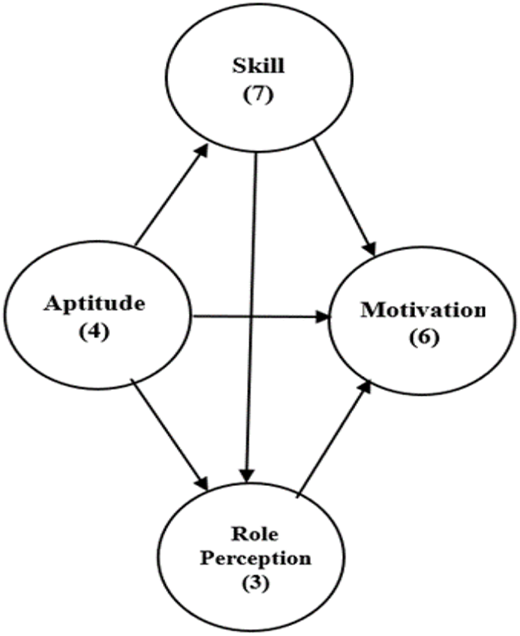
Our correlation analysis revealed meaningful relationships among the indicator categories and their links to satisfaction. Motivation showed the strongest positive correlation with satisfaction (r = 0.606), followed by skill (r = 0.441) and organisational/environmental factors (r = 0.423), aptitude (r = 0.376). Role perception negatively correlated with satisfaction (r = −0.213), confirming its potentially detrimental impact. Indicators also correlated with one another: skill related to motivation (r = 0.621) and aptitude (r = 0.491), while motivation correlated with aptitude (r = 0.503) and organisational/environmental factors (r = 0.461), suggesting both direct and indirect influences on satisfaction. Furthermore, to explore causal patterns, we consulted four experienced sales managers, who highlighted that aptitude is a foundation-shaping skill, motivation and role perception. Skill influenced motivation and role perception, while role perception affected motivation, indicating a layered hierarchy among the indicators, rather than purely independent effects.
Based on these insights, we constructed a preliminary nomological framework (refer to Figure 1). Structural analysis showed aptitude positively predicted skill (β = 0.499, p = 0.000) and motivation (β = 0.255, p = 0.000), while its link to role perception was not significant. Skill strongly predicted motivation (β = 0.493, p = 0.000), but not role perception and role perception did not significantly affect motivation. Explanatory power varied: skill was moderately explained by aptitude (R2 = 0.247), motivation was more robustly explained by aptitude and skill (R2 = 0.437) and role perception was minimally explained (R2 = 0.020). As such, these results highlighted the interconnected nature of indicators, suggesting that satisfaction is shaped by both direct and indirect relationships. The next step was to expand the framework to include satisfaction as an outcome, enabling a holistic understanding of these dynamics in B2B service contexts.
6.6 Two-tiered hierarchical model: association among indicator categories and with service provider satisfaction
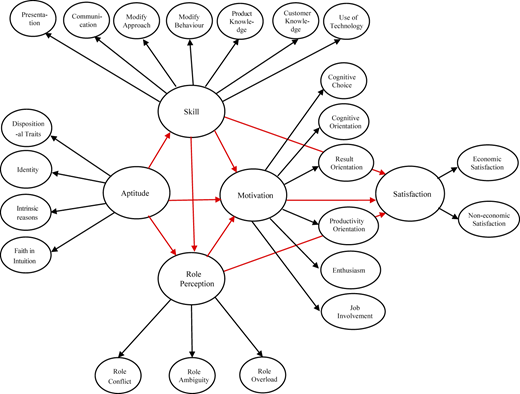
Building on earlier findings showing structural links among aptitude, skill, motivation and role perception, we extended the analysis by incorporating service provider satisfaction in B2B sales as an outcome in a two-tiered hierarchical nomological framework. In terms of Figure 2, it can be noted that this model captured both direct and mediated relationships among the indicators and their collective impact on service provider satisfaction in B2B sales. The analysis showed aptitude significantly predicted skill (β = 0.497, p = 0.000) and motivation (β = 0.254, p = 0.000), but its links to role perception (β = −0.106, p = 0.090) and satisfaction (β = 0.057, p = 0.307) were not significant. Skill predicted motivation (β = 0.491, p = 0.000), but not role perception or satisfaction. Role perception had a significant negative association with satisfaction (β = −0.153, p = 0.000), but did not significantly affect motivation. Motivation emerged as the strongest direct driver of satisfaction (β = 0.503, p = 0.000). The model further explained satisfaction moderately well (adjusted R2 = 0.394), with motivation showing substantial explained variance (R2 = 0.441), while skill (R2 = 0.245) and role perception (R2 = 0.030) showed weaker explanatory power. These results indicated that some factors, particularly role perception, influence satisfaction more indirectly through their effects on motivation and skill. Overall, the findings validated a hierarchical pattern among the indicator categories, emphasising the importance of understanding direct and mediated relationships to capture the full complexity of drivers of service provider satisfaction in B2B sales.
6.7 Refined model: association among indicator categories and with service provider satisfaction
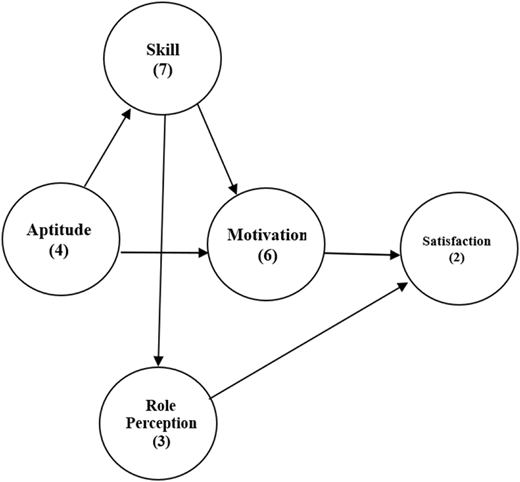
Based upon our findings of the two-tiered hierarchical model, we tested a streamlined nomological framework of indicator categories in association with service provider satisfaction in B2B sales, as displayed in Figure 3. In our refined model, four associations that previously lacked statistical significance were excluded: aptitude-role perception; aptitude-sales satisfaction; skill-sales satisfaction; and role perception-sales satisfaction. The updated framework concentrated on the remaining hypothesised relationships, which demonstrated statistical significance. As such, our analysis demonstrated a well-defined network of associations among the indicator categories, underscoring the layered and indirect structural associations through which satisfaction is influenced. Aptitude continued to show strong, statistically significant effects on skill (regression weight = 0.500, p = 0.000) and motivation (0.258, p = 0.000), reinforcing its foundational role. Skill significantly predicted motivation (0.496, p = 0.000) and role perception (−0.132, p = 0.013), although the latter association was negative. Turning to satisfaction, motivation had the strongest direct association (0.588, p = 0.000), while role perception also had a significant but negative association (−0.133, p = 0.001). These findings supported the idea that satisfaction is shaped not only by direct associations but also by cascading associations through intermediary category indicators, such as motivation and role perception.
Furthermore, our model demonstrated explanatory power for satisfaction (adjusted R2 = 0.382) and motivation (adjusted R2 = 0.437), while skill showed a somewhat lower but meaningful level (0.249). In contrast, role perception remained weakly explained (adjusted R2 = 0.015), suggesting the need to explore additional antecedents. The HTMT ratios of correlations ranged from 0.168 to 0.739, remaining well below the commonly accepted threshold of 0.90. This provided strong evidence for the discriminant validity of the latent indicator categories within our model. Our findings offered empirical backing for a streamlined, theory-driven model of satisfaction, highlighting the indirect association of aptitude and underscoring the roles of skill and motivation in shaping the service provider satisfaction in B2B sales.
6.8 Direct and moderating associations of the organisational/environmental category with service provider satisfaction
Building on our refined nomological framework, we reintroduced the organisational/environmental category, distinguishing organisational leadership (three leadership styles) from organisational environment (teamwork and market orientation) to assess their direct and moderating effects on service provider satisfaction in B2B sales. The results showed aptitude significantly predicted skill (β = 0.500, p = 0.000) and motivation (β = 0.254, p = 0.000), while skill predicted motivation (β = 0.492, p = 0.000) and negatively predicted role perception (β = −0.134, p = 0.021). Motivation remained the strongest direct driver of satisfaction (β = 0.522, p = 0.000) and role perception negatively affected satisfaction (β = −0.102, p = 0.010). Organisational leadership positively influenced satisfaction (β = 0.135, p = 0.006), whereas organisational environment was not significant (β = 0.034, p = 0.490). The model also explained moderate variance in satisfaction (R2 = 0.397) and motivation (R2 = 0.437), with skill moderately explained (R2 = 0.249), while role perception remained weakly explained (R2 = 0.015), suggesting additional factors may influence this domain.
Overall, separating organisational leadership and environment provides a clearer understanding of their distinct roles in shaping service provider satisfaction in B2B sales. Furthermore, the insights gained from the in-depth interviews offer valuable context for interpreting the (non-)significant direct associations of organisational leadership and environment with the service provider satisfaction in B2B sales. According to the practitioners, these organisational factors are likely to function in more indirect or conditional ways, influencing satisfaction through their interaction with other factors, rather than exerting a consistent, direct association across all situations.
Beyond assessing their direct associations, organisational leadership and organisational environment are also examined as potential moderators in the associations between skill and motivation and service provider satisfaction. Our analysis of moderating associations further demonstrates that neither organisational leadership nor organisational environment significantly moderates the associations between motivation or role perception and satisfaction in B2B sales. Specifically, the interaction between leadership and motivation with satisfaction demonstrates a non-significant association (regression weight = 0.042, p = 0.371), as does the interaction between leadership and role perception (0.017, p = 0.705). Similarly, organisational environment does not significantly moderate the association of motivation (−0.027, p = 0.635) or role perception (−0.043, p = 0.337) with satisfaction. Our findings suggest that, within this model, the association of leadership and environment is not contingent upon the levels of motivation or role perception.
The in-depth interviews provide additional insight into why organisational leadership and organisational environment may not significantly moderate the associations between individual-level factors and satisfaction among B2B service providers in sales roles. According to practitioner perspectives, top-performing sales professionals tend to depend more on their own intrinsic capabilities (e.g. self-motivation, resilience and personal drive) than on external organisational support or leadership structures. This viewpoint reinforces the quantitative results by proposing that, within the B2B service setting, the satisfaction of service providers in sales roles is primarily self-driven. When key competencies like motivation and skill are well developed, the influence of external factors such as leadership or organisational context becomes less critical, thereby diminishing their moderating role.
7. Discussion
This study set out to extend established performance-based sales frameworks into the domain of service provider satisfaction in B2B sales. While previous meta-analytic research has predominantly focused on behavioural performance outcomes, our findings demonstrate that the underlying drivers of performance operate through a hierarchical and psychologically mediated structure when the outcome shifts from performance to satisfaction. By integrating SDT and SET, the study conceptualised motivation as the central explanatory pathway linking foundational sales-role dimensions to service provider satisfaction. The results largely support this conceptualisation. Motivation emerged as the strongest and most consistent indicator of service provider satisfaction. This finding aligns closely with SDT, which posits that intrinsic motivation represents the immediate psychological state through which competence and autonomy fulfilment translate into well-being and positive role evaluation (Deci et al., 2017; Ryan and Deci, 2000). Furthermore, the results from the study indicate that aptitude and skill do not directly shape service provider satisfaction. Instead, their influence is transmitted through motivation. This distinction is theoretically important. While performance research often treats aptitude and skill as direct indicators of behavioural outcomes, our findings suggest that when the outcome is evaluative rather than behavioural, these foundational capabilities primarily operate through motivational processes. In other words, competence alone does not guarantee service provider satisfaction unless it is internalised as intrinsic motivation (Ntoumanis et al., 2021). This reinforces SDT's proposition that fulfilment of competence and autonomy needs enhances service provider satisfaction through internalised drive rather than through capability (McAnally and Hagger, 2024). Accordingly, the study clarifies that behavioural effectiveness and evaluative well-being may share antecedents but operate through partially distinct psychological mechanisms.
The strong path from aptitude to skill confirms that inherent capability functions as a foundational layer within the nomological network. Aptitude shapes the development and enactment of skill, which in turn strengthens motivation. This layered structure reflects a competence-building process consistent with SDT's emphasis on mastery and perceived capability. Importantly, neither aptitude nor skill directly predicted service provider satisfaction. This finding extends previous performance literature by demonstrating that competence-related dimensions influence service provider satisfaction indirectly. It suggests that while performance may benefit directly from skill execution, service provider satisfaction depends on how these competencies are internalised as meaningful and self-determined engagement. Thus, our findings refine performance-based frameworks by distinguishing between behavioural output processes and evaluative well-being processes.
Furthermore, contrary to expectations derived from SDT, role perception did not positively influence motivation but exhibited a significant negative association with satisfaction. This finding warrants careful interpretation. Role clarity is often assumed to enhance autonomy and reduce ambiguity (Karkkola et al., 2019; Zaheer et al., 2024). However, in complex B2B sales, heightened role awareness may also increase perceived performance pressure, accountability demands and emotional labour. When expectations are clear but demanding, role perception may amplify perceived strain rather than enhance fulfilment. This suggests that autonomy without adequate support may not automatically translate into service provider satisfaction. From an SDT perspective, autonomy must be accompanied by competence and relatedness fulfilment to enhance well-being. The negative effect, emanating from this study, may therefore reflect an imbalance between role expectations and available psychological or organisational resources. This finding refines SDT and indicates that role clarity alone is insufficient to ensure positive role evaluation.
Leadership also demonstrated a significant positive direct association with satisfaction, supporting SET. From a social exchange perspective, supportive leadership signals fairness, recognition and reciprocal investment. Service providers who perceive relational equity and developmental support are more likely to evaluate their organisational role positively. However, leadership did not moderate the relationship between motivation and satisfaction. This suggests that while leadership contributes directly to service provider satisfaction, it does not condition how intrinsic motivation translates into satisfaction. In other words, motivation appears to operate relatively independently of contextual reinforcement once internalised. This finding indicates that intrinsic motivational processes may outweigh external contextual influences in shaping service provider satisfaction in B2B sales.
Conclusively, unlike leadership, the broader organisational environment did not significantly predict service provider satisfaction or moderate motivational effects. This result challenges assumptions that structural and cultural context necessarily amplify intrinsic motivation (Sabuhari et al., 2025). The qualitative insights provide a useful explanation. Experienced sales managers emphasised that high-performing B2B professionals often rely more heavily on intrinsic drive and personal resilience than on environmental support. This suggests that in professional sales contexts characterised by autonomy and accountability, satisfaction may be primarily self-driven. From a theoretical standpoint, this finding suggests that SET-based contextual influences may be secondary to SDT-based internal motivational processes when explaining satisfaction in B2B sales roles.
8. Research implications
This study advances the literature on service provider satisfaction in B2B sales by extending and refining established performance-based sales frameworks. Previous meta-analyses (Chawla et al., 2020; Churchill et al., 1985; Verbeke et al., 2011) consistently identify aptitude, skill, role perception and motivation as key indicators of sales performance. However, these studies primarily examine behavioural outcomes rather than evaluative satisfaction. By testing these foundational dimensions within a hierarchical model of service provider satisfaction, our findings demonstrate that their explanatory power differs when the outcome shifts from performance to satisfaction. In addition, while performance literature often reports direct effects of skill and aptitude on behavioural outcomes, our results show that these dimensions influence service provider satisfaction mainly through motivation. This finding refines existing frameworks by distinguishing between capability-driven performance processes and psychologically mediated satisfaction processes. In doing so, our study contributes to a more nuanced understanding of how foundational sales-role dimensions operate across different outcome domains.
Furthermore, while previous research frequently treats role perception as a positive determinant of performance and well-being (Marescaux et al., 2019; Mossholder et al., 1981), the findings from this study reveal a significant negative association with satisfaction. This suggests that role clarity in B2B sales may heighten performance pressure rather than enhance evaluative well-being. This result refines assumptions derived from earlier literature and highlights the importance of contextualising role constructs within B2B sales. The consistent association between motivation and service provider satisfaction aligns with SDT (Ryan and Deci, 2020), reinforcing the view that intrinsic motivation functions as an indicator of evaluative outcomes. While previous performance studies identify motivation as one of several indicators (Cerasoli et al., 2014; Gerhart and Fang, 2015), our findings position it as the main explanatory pathway in satisfaction models. This extends the theoretical application of SDT within B2B sales research.
Regarding the contextual variables, previous studies (Priyono et al., 2022; Shao et al., 2022) often emphasise leadership and organisational climate as moderators of performance relationships. Our findings partially support this view. For example, leadership demonstrates a significant direct association with service provider satisfaction, which is consistent with SET. However, neither leadership nor organisational environment significantly moderates motivational effects. This suggests that contextual exchange processes may contribute directly to service provider satisfaction but do not substantially alter the strength of intrinsic motivational processes. Thus, our study refines the role of contextual variables by positioning them as complementary rather than indicators.
Methodologically, our study further contributes by testing established indicator categories within a two-tiered hierarchical structure using PLS-SEM. Previous research frequently examines these indicators in isolation or through linear models. By modelling direct, indirect and contextual relationships simultaneously, we provide a structurally integrated assessment of their combined explanatory power. This approach offers a more comprehensive understanding of how indicator categories function within an interconnected nomological network.
Finally, the integration of qualitative insights from experienced practitioners enhances theoretical relevance by contextualising statistical findings. While previous studies rely primarily on quantitative modelling, our mixed-method approach demonstrates how practitioner perspectives can inform the interpretation of non-significant or counterintuitive associations, particularly in applied domains such as B2B sales. Overall, our study does not reject established performance frameworks but refines their application when transferred to satisfaction outcomes. By distinguishing between behavioural and evaluative processes, clarifying hierarchical relationships and reassessing contextual influences, our research contributes to a more theoretically integrated and empirically grounded understanding of service provider satisfaction in B2B sales.
9. Managerial implications
The findings flowing from this study provide a structured basis for managerial decision-making in B2B sales by clarifying where managerial interventions yield the greatest impact on service provider satisfaction. Firstly, motivation emerges as the core indicator of service provider satisfaction. For managerial decision-making, this implies a shift from purely capability-based management to motivation-centred management. Sales managers may prioritise interventions that enhance intrinsic motivation (e.g. aligning individual goals with organisational strategy, increasing autonomy in customer interactions and recognising meaningful contributions) rather than focusing exclusively on short-term performance metrics. In addition, recruitment decisions should assess not only technical competence, but also intrinsic drive and self-regulatory capacity. This implies that the recruitment process should assess more than pure technical skills. It is important for employers to also consider a candidate's internal motivation and aptitude to manage their own behaviour. Especially when considering that individuals with strong self-drive often perform more reliably and adapt better. Furthermore, performance evaluation systems should include motivational and engagement indicators alongside financial targets.
Secondly, although skill does not directly influence service provider satisfaction, it exerts a strong indirect effect through motivation. This has important budgetary implications. As such, training investments should not be justified solely on immediate performance returns, but framed as motivational enablers. Furthermore, sales managers may design skill-development programmes that emphasise mastery progression, feedback loops and visible competence growth. Rather than offering isolated training modules, firms should implement structured development pathways that reinforce professional identity and intrinsic motivation. Third, the negative association between role perception and satisfaction suggests that increasing clarity alone may not enhance well-being. Highly structured roles may unintentionally increase perceived pressure in demanding B2B sales. Consequently, sales managers should balance clarity with flexibility. This implies that instead of intensifying control through rigid performance frameworks, sales managers may ensure that role expectations are realistic, supported and adjustable. Regular dialogue-based performance reviews may also prevent role clarity from becoming role strain.
Thirdly, leadership demonstrates a direct, but not moderating, influence on service provider satisfaction. This indicates that leadership should function as a stabilising and enabling force rather than as a contingent lever that amplifies service provider performance effects. For managerial practice, this may imply securing consistent, fair and supportive leadership behaviours over episodic motivational interventions. As such, leaders should focus on accessibility, constructive feedback and relational trust-building. Furthermore, leadership development programmes should emphasise psychological safety and autonomy support rather than directive control. For example, leaders can be trained to inspire open communication, listen to the ideas proposed by employees, support independent decision-making and avoid micromanaging. Thus, creating a safe environment where employees feel trusted, valued and confident to contribute.
Fourthly, the limited influence of organisational environment suggests that broad structural initiatives (e.g., culture-building campaigns or market-orientation programmes) may not directly increase service provider satisfaction unless they influence motivation. Sales managers should therefore allocate resources selectively. Also, investments in organisational climate should be evaluated based on whether they strengthen motivation and perceived competence rather than assuming automatic impact on service provider satisfaction. Fifth, the hierarchical structure identified in our study further suggests that managerial interventions may follow a layered logic. Sales managers may ensure recruitment and selection align aptitude with job demands. They may also invest in structured skill development to reinforce competence. Furthermore, they may cultivate intrinsic motivation through autonomy-supportive practices. Only then may contextual refinements (leadership style and organisational systems) be adjusted to reinforce these individual-level processes.
Conclusively, the findings from this study indicate that high-performing B2B sales professionals are often self-driven. This suggests a strategic shift from control-orientated management to enablement-orientated management. This implies that sales managers should create conditions that allow motivated service providers in B2B sales to thrive, including flexible structures, decentralised decision authority and self-directed growth opportunities. This underscores the importance of rendering supportive organisational conditions into practical managerial approaches that guide evaluation and development within B2B sales environments. As such, the validated nomological framework proposed by this study provides a toolbox for managerial evaluation. Rather than relying on broad employee satisfaction surveys, firms can assess specific indicators (e.g., aptitude alignment, skill development, motivational state and role clarity) to identify targeted intervention points. This enables more precise resource allocation and more evidence-based management of service providers in B2B sales. The study further argues that effective managerial decision-making in B2B sales should prioritise intrinsic motivation as the enabler of service provider satisfaction, treat skill development as a motivational investment, balance role clarity with autonomy and position leadership as a relational enabler rather than a primary performance lever.
10. Conclusions, contributions and future research
The study advances the understanding of service provider satisfaction in B2B sales by demonstrating that established performance-based indicator categories operate through a hierarchical and psychologically mediated structure when the outcome shifts from behavioural performance to organisational role satisfaction. While previous research (Churchill et al., 1985, 2013; Walker et al., 1977) predominantly treats aptitude, skill, role perception and motivation as parallel predictors of performance, our findings reveal a layered nomological network in which foundational capabilities shape motivation and motivation functions as the main explanatory pathway influencing service provider satisfaction. Rather than confirming intuitive assumptions, the findings from this study refine the theoretical understanding by distinguishing between capability-driven performance processes and motivationally mediated satisfaction processes. As such, our findings suggest that competence-related indicators do not directly translate into service provider satisfaction unless internalised through intrinsic motivation. This structural clarification constitutes a conceptual advancement in sales and service research.
We argue that our study contributes to the literature in several ways. For example, it extends performance meta-analytic frameworks into the domain of satisfaction outcomes. While previous research identifies aptitude and skill as direct indicators of behavioural performance, our findings demonstrate that their influence on service provider satisfaction is largely indirect and mediated by motivation. This distinction challenges implicit assumptions that indicators of performance function equivalently for evaluative outcomes. In addition, our study also introduces and empirically validates a hierarchical nomological structure among satisfaction drivers. Unlike traditional flat models, the two-tiered framework demonstrates multiple associations, where aptitude influences skill, skill shapes motivation and motivation determines satisfaction. This structural ordering refines how satisfaction models should be conceptualised and tested in B2B sales research. Furthermore, the negative association between role perception and service provider satisfaction provides a counterintuitive, but theoretically meaningful insight. While role clarity is often assumed to enhance well-being, the findings from this study suggest that in B2B sales, heightened role awareness may amplify perceived pressure. This distinction extends the application of SDT by highlighting contextual boundaries of autonomy-related constructs.
Conclusively, the limited moderating effects of leadership and organisational environment refine contextual assumptions derived from SET. While leadership demonstrates a direct association with service provider satisfaction, neither leadership nor environment significantly alters the strength of motivational effects. This suggests that intrinsic motivational processes may operate relatively independently of contextual reinforcement in B2B sales.
Considering the discussion above, it is argued that collectively, the contributions made by this study move beyond intuitive confirmation and provide structural, theoretical and contextual refinement of satisfaction modelling in B2B sales. For managerial practice, the novelty lies not in recognising that motivation matters, but in understanding its structural position within a layered framework. Our findings further indicate that investments in skill development or structural reform will not automatically enhance service provider satisfaction unless they strengthen intrinsic motivation. Sales managers may therefore treat motivation as the central leverage point within a sequential capability-building process rather than as one of several parallel indicators. As such, we suggest that future research should further distinguish between performance and satisfaction processes by examining whether similar hierarchical structures apply across different B2B sectors. Additionally, integrating alternative motivational frameworks, such as expectancy theory, may provide deeper explanatory insight into the formation of service provider satisfaction in B2B sales.