Skip to article sections
Purpose

As the construction industry undergoes digital transformation, the need for adaptive and effective leadership has become increasingly essential. This study aims to investigate the perceived importance and self-assessed performance of leadership competencies across four management levels in the construction industry.

Design/methodology/approach

Using survey data collected from 305 construction professionals, 25 leadership competencies were evaluated across four management levels: general staff, line management, middle management and senior management. A refined importance-performance analysis (IPA) approach was applied to identify competency gaps and reveal level-specific leadership patterns.

Findings

The results show distinct competency gap among different management levels. General staff face significant shortfalls in communication and strategic awareness; line managers underperform in coordination, policy implementation and financial management; middle managers struggle with innovation tolerance and interpreting digital strategies; while senior managers exhibit gaps in digital literacy, team motivation, and market research and evaluation.

Originality/value

Theoretically, the study contributes to digital transformation research in construction by highlighting the differentiated and multi-level nature of leadership under digital transformation. The findings emphasise leadership development in construction as a dynamic process rather than a static leadership style or set of capabilities. Practically, the study proposes a Multi-level Competency Enablement Pathway to guide leadership development strategies tailored to the specific demands of each management level. The findings provide actionable insights for construction organisations seeking to align leadership capability development with the requirements of digital transformation and enhance organisational digital readiness.

Challenges in the construction industry, such as an ageing workforce (Kamardeen and Hasan, 2022), skills shortages (Nisbet et al., 2026) and persistent safety concerns (Lestari et al., 2020), highlight the long-standing problems of the construction industry that are related to the labour-intensive, fragmented, and traditional project delivery processes (Taher, 2021). Under increasing pressure, digital transformation has become essential for enhancing productivity and meeting the industry’s growing demands. While other industries have successfully demonstrated the benefits of digital transformation, the construction sector continues to lag behind, constrained by conventional practices and a reluctance to embrace technological change (Liu et al., 2020; Maskuriy et al., 2019; Wang et al., 2022).

Leadership has been increasingly recognised as a key enabler of this transformation, helping construction organisations navigate complexity, foster innovation, and enable workforce adaptation (Gledson et al., 2024; Zulu and Khosrowshahi, 2021). However, leadership research in the construction industry has often assumed that leadership resides primarily within senior-level managers of organisations or projects, overlooking the presence and influence of leadership across different managerial levels (Ofori, 2008). Although recent studies have increasingly examined digital leadership and transformation in construction, their primary focus has remained on broader leadership frameworks and leadership barriers associated with digital transformation. For example, Bidhendi et al. (2026) investigated the leadership and organisational challenges associated with implementing human-centric digital transformation, while Zulu et al. (2024) investigated barriers undermining effective digital leadership enactment in construction organisations. Other studies have emphasised the broader capabilities or styles that support digital transformation (Ekechukwu and Lammers, 2019; Morgan and Papadonikolaki, 2022). Nevertheless, these studies provide limited understanding of how leadership competency requirements vary across organisational management levels under digital transformation contexts. This lack of understanding constrains the ability of construction organisations to develop targeted and context-sensitive leadership development strategies aligned with the differentiated responsibilities and expectations across organisational hierarchies.

Therefore, the purpose of this study is to address this gap by systematically identifying the gaps between the perceived importance and actual performance of leadership competencies that support digital transformation in the construction industry and provide actionable insights for level-specific leadership development to enable adaptive and effective digital transformation. Specifically, it seeks to:

  1. identify critical yet underperformed leadership competencies for digital transformation in the construction industry; and

  2. examine the competency gaps across different management levels within construction organisations.

To achieve this, the research employed refined importance-performance analysis (IPA) to reveal the differentiated and progressive nature of leadership competency development across organisational hierarchies, thereby advancing the leadership research in digital transformation in construction. By identifying these gaps and proposing a Multi-level Competency Enablement Pathway, the research further supports design of targeted and context-sensitive leadership development strategies in construction organisations.

Digital transformation has become a defining trend in the construction industry, reflecting the industrial change driven by emerging technologies such as Building Information Modeling (BIM), artificial intelligence (AI) and the Internet of Things (IoT) (Wang et al., 2022). Although these technologies have been widely studied, the transformation of the industry has been slow and uneven, hindered by fragmented structures, traditional delivery methods and cultural resistance to change (Perera et al., 2023; Wang et al., 2022). These barriers indicate that technological advancement alone is insufficient to achieve effective digital transformation. Leadership has emerged as a critical factor for driving and sustaining this transformation (Gledson et al., 2024).

Recent studies have increasingly examined leadership in the context of digital transformation, highlighting how leadership shapes innovation, technology adoption and organisational culture (Gledson et al., 2024; Sacavém et al., 2025). In this context, leadership is viewed as a central force that enables transformation, guiding organisations through uncertainty, fostering continuous learning, and promoting innovation-oriented mindsets (Morgan and Papadonikolaki, 2022; Zulu et al., 2024). Empirical studies have further discussed multiple leadership competencies essential for driving the transformation in construction, such as collaboration for engaging multiple stakeholders, including IT specialists, engineers and regulatory bodies, to ensure seamless digital integration (Rocha et al., 2021), as well as resilience and adaptability to manage the dynamics of digital environments (Soomro and Khan, 2024). Nevertheless, much of existing leadership research in construction remains focused on general leadership traits or styles that contribute to effective leadership in the digital age, while lacking an understanding of how leadership is enacted and developed across broader organisational hierarchies. As presented by DeChurch et al. (2010), leadership within organisations is distributed across multiple levels, each with distinct functional roles and expectations. These differences suggest that leadership should not be treated as uniform across organisations (Zaccaro and Klimoski, 2002). Instead, leadership competencies must be examined according to the specific responsibilities, challenges and decision-making contexts associated with different management level (Henderikx and Stoffers, 2023). Based on the general levels of leadership proposed by Jacobs and McGee (2001), the research adopts a four-level management structure to describe leadership within construction organisations. Senior managers are responsible for setting strategic directions and fostering an innovative-oriented culture (Wrede et al., 2020; Zhang et al., 2023d). Middle managers play a bridging role, translating strategic visions into operational processes and ensuring coordination across departments (Henderikx and Stoffers, 2022; Nadkarni and Prügl, 2021). Line managers focus on task execution and team coordination (Smits et al., 2023), while general staff directly implement digital tools and provide feedback from the operational front line (Athamlebbe and Rahman, 2025; Ullrich et al., 2023).

To better understand leadership in the context of digital transformation and to inform effective leadership development, it is necessary to move beyond descriptive discussions of leadership styles and focus on the concrete competencies that underpin effective leadership performance. A competency-based approach provides a structured and measurable framework for analysing leadership effectiveness. This approach identifies the specific characteristics, mindsets, skills and behaviours of a leader that contribute to superior performance in achieving desirable leadership outcome (Hollenbeck et al., 2006; Ledford and Lockwood, 2008; Spencer, 1993). Building on this approach, prior studies have identified key competencies in construction leadership research include communication, decision-making, conflict resolution and risk management (Ofori and Toor, 2009; Rehan et al., 2024a; Simmons et al., 2020).

With the advent of digital transformation, however, these competencies are no longer sufficient. Recent research emphasises that leaders must integrate technical understanding, with cognitive and interpersonal capabilities, aligning leadership performance with the demands of digital transformation (Athamlebbe and Rahman, 2025; Hensellek, 2020; Johari and Hendra, 2023; Yang et al., 2022b). The leadership competency frameworks for driving digital transformation highlight the need for integrating digital skills, strategic foresight and innovation management, ensuring that construction leaders can adapt to and thrive in an increasingly technology-driven industry (Athamlebbe and Rahman, 2025; Yang et al., 2022b). Yet, while existing leadership competency frameworks have evolved to reflect digital transformation, they often overlook management level as a critical contextual factor that shapes leadership requirements. This neglect limits their contribution to guiding effective leadership development and capability building within construction organisation (Ofori, 2008).

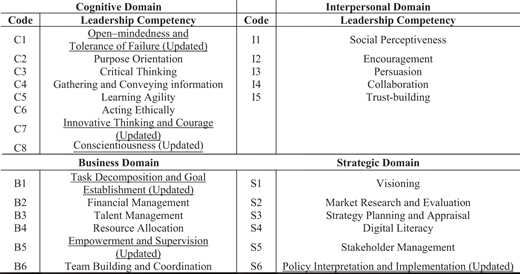
To address this knowledge gap, this study examines leadership competencies differences across four management levels, identifying key competencies and assessing how effectively they are performed. These findings are expected to provide practical insights for leadership development in the construction industry. Building on this rational, the research adopts the competency framework proposed by Yang et al. (2022b), which was further refined and extended in a subsequent qualitative study investigating digital transformation barriers and leadership competencies in construction organisations (Yang et al., 2026). The qualitative study involved semi-structured interviews with 13 senior managers from seven large-scale construction organisations, all of whom had substantial experience and direct involvement in digital transformation initiatives. The study identified four additional competencies together with revisions to two existing competencies to better reflect leadership requirements under digital transformation in construction. The resulting framework consists of 25 leadership competencies grouped into four domains, as presented in Table 1.

The study adopted a quantitative methodology to identify key leadership competencies across the management level for promoting digital transformation in the construction industry. The Chinese construction industry was selected as the primary data source for this research due to its ongoing rapid digital transformation, driven by national-level initiatives. As one of the world’s largest construction markets (China Construction Industry Association, 2025; Statista, 2022), the Chinese construction industry offers a compelling environment for studying the leadership challenges and opportunities during the digital transformation (Forcael et al., 2020). Despite the Chinese construction industry has its distinctive context, the studies regarding its digital transformation can provide indicative insights for other emerging and digitally transforming construction market.

A questionnaire was developed to systematically evaluate the leadership competencies listed in Table 1, capturing variations in competency perceptions across four management levels: General Staff (non-managerial level with no direct report), Line Management (e.g. site supervisor or site engineer), Middle Management (e.g. project or department manager) and Senior Management (e.g. general manager or CEO). Leadership Competency Assessment required respondents to rate both the importance and perceived performance of 25 leadership competencies using two separate five-point Likert scales ranging from 1 (least important/very poor) to 5 (very important/very strong). To ensure clarity, concise explanations for each competency were provided in the questionnaire, such as Financial management (Strategically planning investments and returns for businesses or projects in the digital era). The questionnaire was developed in English and subsequently translated into Chinese. The translated version was reviewed by three bilingual researchers in the research team to ensure linguistic clarity, contextual appropriateness, and consistency between the English and Chinese versions. Minor wording refinements were made during the review process to improve readability and reduce potential ambiguity in several competency descriptions.

The questionnaire was distributed using the Qualtrics online survey platform. The study targeted construction professionals working across the Chinese construction industry without restricting participation to any specific city or region. Participants were initially recruited through the authors’ professional networks within the Chinese construction industry, and a snowball sampling approach was adopted to facilitate broader dissemination across different organisational contexts and management levels. Respondents were encouraged to further distribute the survey to eligible professionals within their organisations and professional networks.

To ensure the relevance of responses, the selection criteria were clearly stated at the beginning of the questionnaire, allowing participants to self-assess their eligibility before proceeding. Considering the research objectives, participants were required to be currently working in the construction industry. However, to capture more diverse perspectives on leadership competencies across organisational hierarchies, no restrictions were imposed regarding years of working experience or management position. Respondents from different organisational levels, including general staff, line management, middle management and senior management roles, were welcomed to participate in the survey. Respondents were explicitly instructed on the cover page that when rating the importance and performance of each competency, they should consider the ratings in relation to their current management role. This approach aimed to mitigate potential misunderstandings regarding the definition of ‘importance’, a significant concern in IPA as highlighted by Oh (2001).

A total of 359 responses were received. Following data screening procedures, responses that were incomplete and provide uniform scores for both importance and performance across all competencies were removed, resulting in 305 valid questionnaires for further analysis.

The respondent profile is presented in Table 2. The majority of the respondents were men (79.34%). Most respondents were aged between 30 and 39 years (47.87%), and more than 80% of them had either an associate, bachelor’s or master’s degree. Their working experience was distributed relatively evenly across the different tenure groups. Regarding management levels, general staff accounted for the largest proportion (38.03%), followed by middle (29.51%) and line management roles (26.23%), while senior management represented the smallest percentage (6.23%). This distribution is aligned with the hierarchical workforce profile of construction organisations, which exhibit sharp reductions at the senior management positions (Tenah, 1986). Thus, the small sample size of senior management is an expected feature. Similar patterns are reported in previous quantitative studies, where senior-management subsamples are smaller when examining multiple organisational roles in construction (e.g. Jin et al., 2013 and Stoddard et al., 2024).

Internal consistency reliability was evaluated using Cronbach’s alpha. All four dimensions demonstrated satisfactory reliability, with alpha values exceeding 0.80, indicating a good internal consistency (Table 3) (Streiner, 2003).

In addition to the overall reliability assessment, internal reliability was also separately examined across the four management levels to ensure the consistency of subgroup-based analyses. The Cronbach’s alpha values for both importance and performance ratings across all management levels exceeded the recommended threshold, indicating strong internal consistency. Specifically, the importance ratings achieved Cronbach’s alpha values of 0.973 (general staff), 0.954 (line management), 0.973 (middle management) and 0.918 (senior management), while the corresponding values for performance ratings were 0.961, 0.952, 0.972 and 0.935, respectively.

To evaluate the discrepancies between the perceived importance and actual performance of leadership competencies, this study employed IPA as the primary analytical technique. IPA enables the simultaneous assessment of perceived importance and actual performance for each competency, providing a structured visual framework that supports competency-based decision-making and prioritisation of leadership development efforts (Martilla and James, 1977; Simpson et al., 2020).

Recognising the methodological limitations associated with traditional IPA (Abalo et al., 2007; Feng et al., 2014), particularly the arbitrary placement of quadrant boundaries at the midpoint of rating scales, this study adopted a refined IPA approach informed by methodological advancements recommended by Rial et al. (2008) and Bacon (2003). IPA, traditionally applied in service quality assessments, is adapted here to provide an empirically grounded, quantitative approach to leadership competency evaluation, thus extending its utility to organisational and human resource contexts. Specifically, quadrant boundaries were established using empirical mean values of the collected importance and performance scores instead of fixed scale midpoints. This empirical adjustment ensured accurate, context-specific placement of competencies within the IPA matrix. In addition, a 45-degree diagonal reference line was integrated into the IPA framework, representing equilibrium points where perceived importance equals actual performance. To quantify the magnitude and direction of discrepancies, the perpendicular distance from each competency to this diagonal was calculated using the following formula [which is consistent with the conceptual enhancements proposed by Rial et al. (2008) and Slack (1994)]:

where di represents the distance of competency i from the diagonal, Ii is the mean importance rating, and Pi is the mean performance rating. Competencies located above the diagonal (⁠Ii> Pi⁠) highlight areas of underperformance relative to their perceived importance and thus indicate priorities for targeted improvement. Conversely, competencies situated below the diagonal (⁠Pi> Ii⁠) suggest potential overinvestment in areas that are comparatively less critical.

This integrated approach, combining the enhanced IPA method with the diagonal line analysis that utilises empirical mean axes and diagonal discrepancy calculations, enabled a nuanced, rigorous and actionable assessment of leadership competency gaps (Abalo et al., 2007; Lai and Hitchcock, 2015; Rial et al., 2008). Ultimately, this methodology supports effective identification and prioritisation of leadership development strategies essential for the successful implementation of digital transformation in the Chinese construction industry.

The data in this research were analysed using IBM SPSS Statistics (version 30).

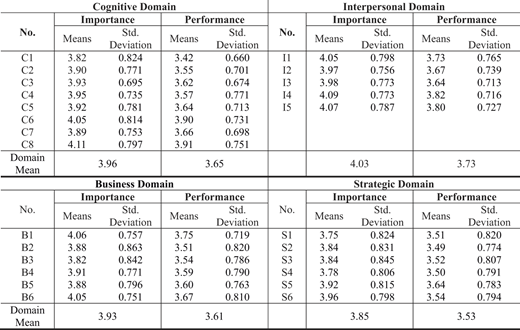
As presented in Table 4, which reports the mean and standard deviation values for both the importance and performance of leadership competencies. Participants generally rated leadership competencies as moderately to very important, with mean importance scores ranging from 3.75 (Visioning) to 4.11 (Conscientiousness). The majority of mean values (76%) clustered around 4.0, suggesting a general perception of importance for most competencies. The associated standard deviation values ranged between 0.695 (Critical Thinking) to 0.863 (Financial Management), suggesting a reasonable consensus among respondents regarding the importance of leadership competencies, although some of the items demonstrated slightly greater variability. In comparison, the performance mean scores ranged from 3.42 (Open-mindedness and Tolerance of Failure) to 3.91 (Conscientiousness), which were generally lower than those observed in the importance scale ratings. The standard deviation values for Performance scale ranged between 0.660 (Open-mindedness and Tolerance of Failure) and 0.820 (Financial Management, and Visioning), suggesting a relatively more consensus self-assessment of competency execution.

When comparing the Importance and Performance scales, importance ratings are consistently higher than performance ratings across all 25 competencies. This result suggests a competency-performance gap, where participants value leadership competencies highly but feel that actual performance falls short of expectations. The observed gap underscores the critical need for targeted development initiatives within the context of digital age. This further highlights the necessity for tailored strategies and interventions aimed at enhancing leadership effectiveness and aligning actual performance with perceived importance.

General staff.

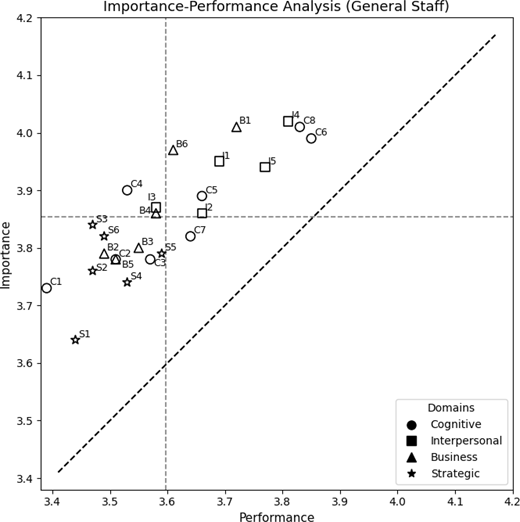
Figure 1 displays the IPA results for general staff. The scatter plot reveals that all competencies lie above the diagonal line, indicating a generally higher perceived importance than actual performance. A notable clustering of items appears in the lower-left quadrant, particularly from the business and strategic domains. This may reflect a lower prioritisation or applicability of these competencies in the current roles of general staff, whose responsibilities are typically task-focused and operational rather than strategic.

Three competencies, C4 (Gathering and Conveying information), I3 (Persuasion) and B4 (Resource Allocation), fall within the upper-left quadrant. These items represent high-priority targets for leadership development, as they reflect areas with high importance and low performance.

C4 (Gathering and Conveying Information) and I3 (Persuasion) are closely related in function, as both require effective interpersonal communication. Notably, C4 has the highest importance score and the lowest performance score, indicating a critical gap for improvement. The frontline staff in the construction industry serve as a key communication link between supervisors and operational execution. The ability to gather, interpret and convey accurate information is fundamental to maintain workflow efficiency, quality control and safety compliance. Miscommunication at this level often leads to significant delays and reworks. When paired with limited persuasive capability (I3), staff may struggle not only to communicate clearly but also to influence peers or subcontractors to align with task priorities or procedural standards (Lingard et al., 2012).

These shortfalls highlight a compound competency gap in communication-based influence, which may stem from insufficient training, a reactive rather than proactive communication culture, or hierarchical norms that discourage bottom-up interactions (Olanrewaju et al., 2017; Rehan et al., 2024b; Wilkinson, 2022). This issue may be particularly evident in the Chinese construction industry, where hierarchical organisational cultures and top-down management practices may discourage frontline employees from openly voicing concerns and operational feedback (Zhang and Liu, 2006). Such communication barriers may also reflect high-power distance and limited psychological safety within organisations (Subhakaran and Dyaram, 2018). Given their mutually reinforcing nature, C4 and I3 should be improved through targeted communication development programs, including technical training to familiarise these staff with the digital reporting and communication platform.

B4 (Resource Allocation), although traditionally viewed as managerial competency, is becoming increasingly relevant at the operational level. Frontline staff are often required to make quick judgements regarding labours and materials use, making this competency essential (Tawalare et al., 2020). Its low performance rating may demonstrate insufficient delegation or unclear expectations regarding these obligations.

To further prioritise improvement efforts among the competencies, a diagonal distance analysis was conducted. The results, shown in Table 5, revealed that S3 (Strategic Planning and Appraisal) had a distance of 0.26, the largest distance that is equivalent to the C4. Despite having a lower level of importance than C4 and I3, the substantial performance gap implies that general staff may lack both the strategic mindset and the opportunity to engage in higher-level planning.

In the digital age, strategic awareness is no longer confined to upper management. The decentralisation of decision-making, enabled by digital tools and real-time data access, increasingly requires staff at all levels to contribute to strategic appraisal of processes, risks and improvement opportunities (Nagy et al., 2021; Perera et al., 2023). It is not necessarily the degree of involvement, but a context-specific selection of measures, the quality of their implementation as well as the actual uptake of suggestions and activities developed by employees that contribute to employees accepting and participating in goal-directed transformation (Klein et al., 2024; Ullrich et al., 2023). Moreover, employees must have sufficient information and time for their participation in transformation processes (Kadi, 2024). Therefore, the relatively low importance rating of S3 does not reflect irrelevance, rather an organisational blind spot where general staff are neither empowered nor trained to think strategically.

Line management.

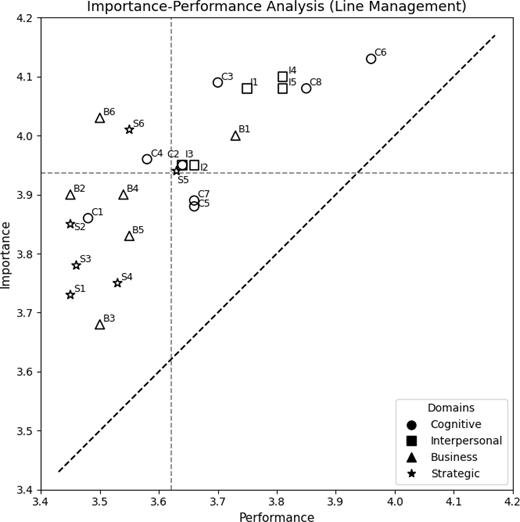
Figure 2, along with Table 6, present the IPA and diagonal analysis results for line management in the construction industry. This management level, such as site engineer and site supervisor, acts as the critical operational link between the upper management and on-site teams. As digital technologies become increasingly embedded in construction workflows, the line managers are expected to undertake beyond traditional supervision by engaging in real-time coordination through digital platforms, tech-enabled communication with diverse stakeholders, and data-informed decision-making based on live site conditions and analytics.

The competencies, B6 (Team Building and Coordination), S6 (Policy Interpretation and Implementation) and C4 (Gathering and Conveying Information) are positioned in the upper-left quadrant, indicating high importance, but are not well performed. These competencies form the foundations for managing the daily operations in the fast-moving, multi-trade construction environment, which has become even more dynamic and interconnected due to the integration of digital tools and real-time information systems.

B6 with its high diagonal distance (0.37) indicates the real-world challenge that line managers face in digital transformation. In aligning with the multiple teams and stakeholders under the tight schedules and shifting site conditions, coordination tasks for line managers demand both strong interpersonal communication and the ability to interact with real-time digital systems such as mobile dashboards, task apps and access control technologies (Amusan et al., 2021; Suleiman, 2022). S6, with a distance of 0.33, demonstrates the growing demand for line management to translate organisational-level digital transformation policies into on-site workflows (Koeleman et al., 2019; Lundberg et al., 2022). This challenge may be significant in the Chinese construction industry, where digital transformation initiatives are often implemented through top-down organisational directives and government-driven industry policies (Song et al., 2024; Zhang et al., 2023b). With frequent changes in safety reporting, quality assurance and digital compliance, the ability to interpret and apply new protocols has become a critical site-level responsibility. C4, although traditionally expected from line managers, entails more structure, tech-enabled communication, as pointed out by Samuelson and Stehn (2023), Edirisinghe (2019) and Yang et al. (2022a), such as digital site diaries, cloud-based request for information (RFI) submissions, and photo-tagged defect reporting. The performance shortfall suggests ongoing struggles in adapting these practices into routine workflows.

A particularly notable finding is B2 (Financial Management), which has the third-largest diagonal distance (0.32) despite being placed in the lower-left quadrant. This indicates that although site engineers and supervisors may not yet consider financial management central to their roles, the performance gap reveals a growing competency need. As digital transformation drives the decentralisation of cost control, real-time cost tracking, and lean resource management relevant at the site level financial literacy is becoming increasingly relevant for line-level managers (Elghaish et al., 2022; ICML, 2025). Without sufficient ability in this area, line-level managers may struggle to engage with digital financial tools or make data-informed decisions that align with evolving project and organisational objectives.

Middle management.

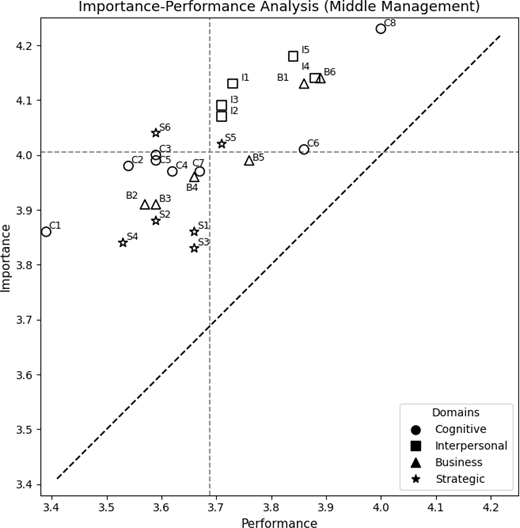
In the process of digital transformation in the construction industry, middle-level managers are responsible for translating high-level strategies into on-site executable plans. They are responsible for coordinating resources, optimising processes, guiding employees to adapt to new technologies, and promptly conveying front-line feedback to upper management, thereby ensuring that digital measures can be truly implemented and produce real results. The leadership competency analysis results for middle management are illustrated in Figure 3 and detailed in Table 7.

The IPA graph revealed a noteworthy distribution pattern, in which all the competencies in the interpersonal domain are clustered in the upper-right quadrant, indicating both high importance and high performance. This result shows that middle-level managers are relatively competent in relational abilities, which are fundamental to managing cross-functional teams and sustaining trust in the digital transformation of construction projects. It also reflects the industry’s growing emphasis on emotional intelligence, human skills and team cohesion as critical enablers for digital adoption and collaborative execution (Aasen and Klakegg, 2023; Franz et al., 2017; Potter et al., 2018).

Among the 25 competencies evaluated, only S6 (Policy Interpretation and Implementation) is located in the upper-left quadrant, meaning it is perceived as highly important but underperformed. With a diagonal distance of 0.32, this highlights the difficulty middle management faces in operationalising organisational digital strategies under shifting project demands and fragmented supply chains (Christodoulou et al., 2022). As construction organisations roll out new protocols in areas such as digital reporting, compliance and risk mitigation, middle management should act as translators, taking the responsibilities in turning language into practical workflows (Henderikx and Stoffers, 2022; Parera and Fernández-Vallejo, 2013). In the context of the Chinese construction industry, this responsibility becomes particularly challenging due to highly hierarchical organisational structures and complex coordination requirements (Zhang et al., 2023a). Middle managers are therefore expected to simultaneously respond to top-down strategic expectations while addressing frontline operational realities. This finding further supports Li et al.’s (2024) argument that middle managers play a critical intermediary role in translating strategic digital initiatives into operational practices. Further support and upskilling are required to fulfil this policy-interpreting function effectively.

Beyond quadrant-based insights, diagonal distance analysis reveals two additional high-priority gaps. Firstly, C1 (Open-mindedness and Tolerance of Failure), with a distance of 0.33, ranks as the largest gap across all competencies in this management level. In a construction setting, where errors are often penalised and innovations may face resistance, cultivating a psychologically safe environment that tolerates failure is crucial yet underdeveloped (Andersson et al., 2020; Shen et al., 2015). As pointed out by Henderikx and Stoffers (2023), organisations undergoing digital transformation should foster learning-oriented mindset and not be afraid to fail, especially among middle management who shape team culture and respond to setbacks. Secondly, C2 (Purpose Orientation) has a gap of 0.31, indicating middle level managers’ struggle to sustain goal-directed decision-making, potentially undermining their role in leading digital transformation. This pattern is consistent with evidence that construction middle managers often struggle to connect strategic intent with daily operations (Simu and Lidelöw, 2019).

Senior management.

In the era of digital transformation, senior managers play a central role in setting strategic direction, shaping organisational culture, and steering the overall trajectory of technological integration. Unlike middle management, whose responsibilities focus on implementation and coordination, senior leaders are entrusted with policy formulation, resource allocation and long-term planning. Their leadership decisions directly influence how digital initiatives are prioritised, communicated and sustained across the organisation.

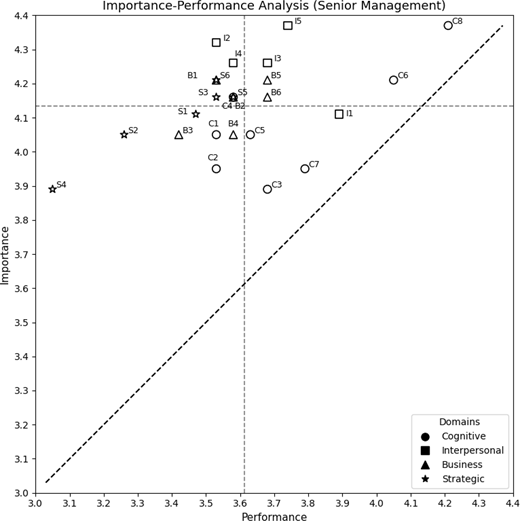
The IPA diagram for Senior Management (Figure 4) reveals a connected distribution of leadership competencies in the upper-central region, indicating that most competencies are considered highly important but only moderately performed. This pattern reflects senior managers’ own recognition of the strategic importance of a wide range of leadership competencies, alongside a perceived shortfall in their actual performance. Unlike middle management, which shows consistent strengths in interpersonal domains, the competencies of senior management appear more dispersed, with several critical areas falling short of expectations.

Notably, eight competencies are placed in the upper left-quadrant (high importance, low performance), including C4 (Gathering and Conveying Information), I2 (Encouragement), I4 (Collaboration), B1 (Task Decomposition and Goal Establishment), B2 (Financial Management), S3 (Strategic Planning and Appraisal), S5 (Stakeholder Management) and S6(Policy Interpretation and Implementation).

Diagonal distance analysis results (presented in Table 8) reveal three major competencies requiring attention. While S4 (Digital Literacy) does not appear in the upper-left quadrant, it ranks as the most underperformed competency (diagonal distance = 0.60). As digital tools, systems and platforms increasingly shape project planning, reporting and decision-making, digital literacy becomes a core competency for senior management. A lack of digital literacy at the executive level can result in missed opportunities for strategic alignment, poor oversight of digital investments, and reliance on outdated management practices (Allen, 2020; Matsunaga, 2024). I2 (Encouragement), located in the upper-left quadrant, indicates senior managers’ struggle to motivate and emotionally engage teams during organisational change (diagonal distance = 0.56). As digital transformation tends to result in ambiguity and resistance, leadership of senior management should shift from authoritative direction to inspirational communication and psychological support. The gap in I2 implies that senior management may undervalue or underutilise their role in fostering motivation and trust, which are the two enablers of digital adoption. This findings align with emerging literature that highlights the role of emotionally intelligent leadership in facilitating change during digital transformation initiatives (Hensellek, 2020).

Another critical gap is S2 (Market Research and Evaluation, diagonal distance = 0.56), which represents a leader’s ability to understand external market conditions, evaluate digital trends, and align internal strategies accordingly (Korherr et al., 2022). This gap reflects a reactive mindset and strategic pattern, where decisions are made based on internal assumptions and external environmental factors rather than data and market information (Bharadwaj et al., 2013). In the context of the Chinese construction industry, such patterns may be reinforced by hierarchical administrative structures and long-established management routines, which can reduce organisations’ responsiveness to rapidly evolving market dynamics and digital developments (Zhang et al., 2023c). This finding is also consistent with the qualitative findings of (Yang et al., 2026), which identified limited strategic capability and reactive operational patterns as important barriers hindering digital transformation in Chinese construction organisations. Therefore, strengthening senior managers’ competencies in market research and evaluation may help organisations develop more proactive and strategically informed approaches towards digital transformation.

The findings indicate that the revealed performance gaps under digital transformation are structured by organisational hierarchy rather than being uniformly distributed. The challenges of leadership under the digital transformation in construction manifest differently across management levels, which reflects variations in role expectations and decision-making scope to digital practices. This perspective emphasises the need for a differentiated and multi-level approach to leadership development rather than a uniform leadership style or a set of static leadership capabilities.

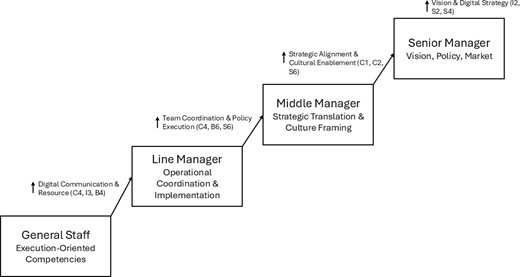
To synthesis the findings and provide a more comprehensive perspective on how leadership development should occur across organisational levels, this study proposes a Multi-level Competency Enablement Pathway, as shown in Figure 5.

The pathway begins with general staff level, where development hinges on building core capacities in communication, influence and resource handling. These foundational skills create the conditions necessary for progressing them into line management role. Line management then expands this base through enhanced coordination and policy implementation capabilities, allowing them to function as connectors between operational teams and formal procedures. The transition from line management is marked by a shift towards strategic and cultural leadership, with an emphasis on purpose orientation, openness to failure, and the capacity to interpret broader organisational goals. Finally, senior management elevates these competencies into organisation-wide influence by advancing digital versions, market sensitivity and team encouragement.

Rather than treating leadership development in isolation at each level, the Multi-level Leadership Competency Enablement Pathway highlights an interdependent progression. Each level builds upon the gaps of the previous, establishing a continuous and scalable leadership development structure that aligns with the demands of digital transformation. The pathway emphasises that leadership development in the digital transformation of a construction organisation is not a uniform task across the hierarchy, but should consider the differentiated nature of leadership gaps and the need for a management level-sensitive training and development strategy. Building on the pathway, the following recommendations are offered for designing level-specific leadership development strategies.

The analysis indicates that general staff display gaps primarily in communication and strategic awareness. Their role, while operational and grassroots for an organisation, increasingly requires more active participation in digital initiatives. Addressing these gaps through structural training programs, focused on digital communication and persuasive techniques, as well as practical sessions for resource allocation, can empower general staff to effectively handle daily operational responsibilities and contribute strategically (Asure Software, 2024). Facilitating strategic thinking sessions further aligns frontline employees with organisational transformation goals, making them active stakeholders in digital strategies (Kolb et al., 1986).

Line management, bridging operational execution and strategic oversight, experiences challenges in digital coordination, policy implementation and financial management. These competencies are essential for translating organisational-level strategies into actionable tasks at operational sites. Scenario-based training and regular updates on organisational policies, coupled with real-world exercises in digital tools and technologies (e.g. financial management platforms), can significantly enhance their capacity to manage digital transformation activities effectively and proactively (Dugarte-Peña et al., 2022; Özener, 2024).

Middle management, critical intermediaries in strategy implementation, show specific competency gaps related to digital policy interpretation, tolerance for innovation and risk, and purpose-driven mindset. Middle management should be equipped not only with translation of high-level strategies but also fostering an innovative and resilient organisational culture. Advanced training in digital policy compliance, coupled with workshops fostering psychologically safe environments, can empower middle management to effectively manage digital transformation initiatives.

Senior managers hold pivotal roles in steering digital transformation strategies, yet exhibit considerable gaps in digital literacy, motivational leadership and strategic market analysis. These gaps indicate an urgent need for enhanced executive training in digital literacy and market intelligence, ensuring informed decision-making aligned with current digital trends. In addition, leadership development programs emphasising inspirational and motivational communication techniques can significantly improve employee engagement during organisational transformation.

To support leadership improvements across all levels, this research suggests embedding development strategies directly into day-to-day operations. For instance, reverse mentoring, where middle managers or tech-savvy professionals guide senior leaders on digital tools, can close high-level literacy gaps while empowering middle level (Chen and Klimoski, 2007; Harrison, 2017; Srivastava and Shyam, 2022). Agile cross-functional teams that include staff from various management levels can foster collaborative learning and promote mutual understanding of strategic priorities and operational challenges (Ahmad et al., 2023; Khalil et al., 2013). These recommendations align closely with the identified gaps and reflect the pressing need to move beyond traditional hierarchical training structures, ensuring consistent capability reinforcement.

This research challenges the adequacy of traditional and hierarchical approaches to digital transformation, suggesting a more collaborative and decentralised approach. The study underscores that successful transformation relies significantly on developing context-specific leadership capabilities suited to digital transformation across all organisational levels, facilitated by continuing learning, open communication and strategic alignment. These insights enrich existing digital transformation framework, highlighting leadership development as a core component of sustained organisational agility and innovation in an increasingly complex and digital-driven industry.

Under the lens of digital transformation, this study provides a comprehensive analysis of leadership competency gaps across four organisational management levels in the Chinese construction industry. Drawing on IPA and diagonal distance analysis, the research uncovered both cross-cutting and level-specific insufficient leadership competencies. The results reveal a clear progression of leadership, from the communication, task-level execution and individual-influence at the base, to strategic framing and digital vision at higher management levels. The findings advocate for a decentralised and interactive leadership development model that facilitates cross-level learning, empowers bottom-up initiatives, and promotes continuous improvement. This reconceptualisation of leadership development in the construction industry offers valuable insight for future digital transformation strategies in construction and other complex project-based industries.

A key contribution of this study lies in the development of the Multi-Level Competency Enablement Pathway, which synthesises empirical findings into a practical roadmap for leadership development. Notably, to the best of our knowledge, the research marks the first application of the IPA framework in the context of leadership competency assessment within the construction industry. By expanding IPA beyond its conventional use in service quality and customer satisfaction studies, this study demonstrates its analytical utility for diagnosing competency priorities and guiding competencies development across management hierarchies.

The findings offer strong practical value to construction organisations by identifying priority capabilities for leadership training and aligning development strategies with the distinct demands of each management level in support of digital transformation. The organisations are encouraged to tailor their interventions to close specific competency gaps based on the management levels. More importantly, the research advocates for embedding leadership development directly into daily construction management activities. Strategies, such as reverse mentoring, should be viewed as merely supplementary, but as essential mechanisms for enabling adaptive leadership in complex the digital environment.

There are some limitations in this study. Firstly, the self-assessed nature of the performance ratings may introduce bias, as participants might over- or under-estimate their actual performance levels. Secondly, the research is based on cross-sectional survey data, which limits the ability of capture longitudinal changes in competency development overtime. Future research could build on this work by conducting longitudinal studies, integrating objective performance data, and exploring competency development interventions through experimental or case study methods. In addition, future studies may further examine how different leadership styles or leadership orientations interact with the identified competencies across organisational management levels during digital transformation processes. Such research may provide a more comprehensive understanding of how leadership behaviours and competencies jointly influence digital transformation outcomes in construction organisations. Future studies may also incorporate perspectives from industry practitioners to further validate and refine leadership competency expectations at different management levels in construction organisations.

This study was conducted in accordance with the ethical standards of the University of New South Wales (UNSW). Data collection commenced only after ethical approval was obtained from the Human Research Ethics Advisory Panel B: Art, Architecture, Design and Law (Approval No. HC230130).
Aasen
,
A.F.
and
Klakegg
,
O.J.
(
2023
), “
Human resilience and cultural change in the construction industry: communication and relationships in a time of enforced adaptation
”,
Frontiers in Built Environment
, Vol.
9
, p.
1287483
.
Abalo
,
J.
,
Varela
,
J.
and
Manzano
,
V.
(
2007
), “
Importance values for importance–performance analysis: a formula for spreading out values derived from preference rankings
”,
Journal of Business Research
, Vol.
60
No.
2
, pp.
115
-
121
.
Ahmad
,
T.
,
Boit
,
J.
and
Aakula
,
A.
(
2023
), “
The role of cross-functional collaboration in digital transformation
”,
Journal of Computational Intelligence and Robotics
, Vol.
3
No.
1
, pp.
205
-
242
.
Allen
,
S.J.
(
2020
), “
On the cutting edge or the chopping block? Fostering a digital mindset and tech literacy in business management education
”,
Journal of Management Education
, Vol.
44
No.
3
, pp.
362
-
393
.
Amusan
,
L.
,
Aigbavboa
,
C.
,
Olubiyi
,
T.
and
Babatunde
,
O.
(
2021
), “
Informatics approach to innovative site management practices for improving construction works
”,
International Review of Civil Engineering
, pp.
12108
-
12122
.
Andersson
,
M.
,
Moen
,
O.
and
Brett
,
P.O.
(
2020
), “
The organizational climate for psychological safety: associations with SMEs’ innovation capabilities and innovation performance
”,
Journal of Engineering and Technology Management
, Vol.
55
, p.
55101554
.
ASURE SOFTWARE
(
2024
),
available at:
Link to ASURE SOFTWARELink to the cited article.
Athamlebbe
,
R.
and
Rahman
,
R.A.
(
2025
), “
Digital leadership competency framework in construction: the case of Entry-Level positions
”,
Journal of Engineering, Project and Production Management
, Vol.
15
No.
3
, p.
0015
.
Bacon
,
D.R.
(
2003
), “
A comparison of approaches to importance-performance analysis
”,
International Journal of Market Research
, Vol.
45
No.
1
, pp.
1
-
15
.
Bharadwaj
,
A.
,
EL Sawy
,
O.A.
,
Pavlou
,
P.A.
and
Venkatraman
,
N.
(
2013
), “
Digital business strategy: toward a next generation of insights
”,
MIS Quarterly
, Vol.
37
No.
2
, pp.
471
-
482
.
Bidhendi
,
A.
,
Poshdar
,
M.
,
Babaeian Jelodar
,
M.
and
Hamzeh
,
F.
(
2026
), “
Enabling lean construction 4.0 through human-centric digital transformation: organisational leadership insights
”,
Engineering, Construction and Architectural Management
, Vol.
33
No.
2
, pp.
985
-
1011
.
Chen
,
G.
and
Klimoski
,
R.J.
(
2007
), “
Training and development of human resources at work: is the state of our science strong?
”,
Human Resource Management Review
, Vol.
17
No.
2
, pp.
180
-
190
.
China Construction Industry Association
(
2025
),
available at:
Link to China Construction Industry AssociationLink to the cited article.
Christodoulou
,
I.P.
,
Wasim
,
J.
,
Reinhardt
,
R.J.
and
Ivanov
,
K.
(
2022
), “
The strategic role of Middle managers in the formulation and implementation of digital transformation projects
”,
Strategic Change
, Vol.
31
No.
6
, pp.
613
-
622
.
Dechurch
,
L.A.
,
Hiller
,
N.J.
,
Murase
,
T.
,
Doty
,
D.
and
Salas
,
E.
(
2010
), “
Leadership across levels: Levels of leaders and their levels of impact
”,
The Leadership Quarterly
, Vol.
21
No.
6
, pp.
1069
-
1085
.
Dugarte-Peña
,
G.-L.
,
Sánchez-Segura
,
M.-I.
,
Medina-Domínguez
,
F.
,
DE Amescua
,
A.
and
González
,
C.
(
2022
), “
An instance-based-learning simulation model to predict knowledge assets evolution involved in potential digital transformation projects
”,
Knowledge Management Research and Practice
, Vol.
20
No.
6
, pp.
843
-
864
.
Edirisinghe
,
R.
(
2019
), “
Digital skin of the construction site: smart sensor technologies towards the future smart construction site
”,
Engineering, Construction and Architectural Management
, Vol.
26
No.
2
, pp.
184
-
223
.
Ekechukwu
,
J.
and
Lammers
,
T.
(
2019
), “Digital technology to enhance project leadership practice: the case of civil construction”,
Digital Transformation in Business and Society: Theory and Cases
,
Springer
, pp.
247
-
271
.
Elghaish
,
F.
,
Rahimian
,
F.P.
,
Hosseini
,
M.R.
,
Edwards
,
D.
and
Shelbourn
,
M.
(
2022
), “
Financial management of construction projects: hyperledger fabric and chaincode solutions
”,
Automation in Construction
, Vol.
137
, p.
137104185
.
Feng
,
M.
,
Mangan
,
J.
,
Wong
,
C.
,
Xu
,
M.
and
Lalwani
,
C.
(
2014
), “
Investigating the different approaches to importance–performance analysis
”,
The Service Industries Journal
, Vol.
34
No.
12
, pp.
1021
-
1041
.
Forcael
,
E.
,
Ferrari
,
I.
,
Opazo-Vega
,
A.
and
Pulido-Arcas
,
J.A.
(
2020
), “
Construction 4.0: a literature review
”,
Sustainability
, Vol.
12
No.
22
, p.
9755
.
Franz
,
B.
,
Leicht
,
R.
,
Molenaar
,
K.
and
Messner
,
J.
(
2017
), “
Impact of team integration and group cohesion on project delivery performance
”,
Journal of Construction Engineering and Management
, Vol.
143
No.
1
, p.
04016088
.
Gledson
,
B.
,
Zulu
,
S.L.
,
Saad
,
A.M.
and
Ponton
,
H.
(
2024
), “
Digital leadership framework to support firm-level digital transformations for construction 4.0
”,
Construction Innovation
, Vol.
24
No.
1
, pp.
341
-
364
.
Harrison
,
A.E.
(
2017
), “
Exploring millennial leadership development: an evidence assessment of information communication technology and reverse mentoring competencies
”,
Case Studies in Business and Management
, Vol.
4
No.
1
, pp.
25
-
48
.
Henderikx
,
M.
and
Stoffers
,
J.
(
2022
), “
An exploratory literature study into digital transformation and leadership: toward future-proof Middle managers
”,
Sustainability
, Vol.
14
No.
2
, p.
687
.
Henderikx
,
M.
and
Stoffers
,
J.
(
2023
), “
Digital transformation and Middle managers’ leadership skills and behavior: a group concept mapping approach
”,
Frontiers in Psychology
, Vol.
14
, p.
141147002
.
Hensellek
,
S.
(
2020
), “
Digital leadership: a framework for successful leadership in the digital age
”,
Journal of Media Management and Entrepreneurship (JMME)
, Vol.
2
No.
1
, pp.
1
-
15
.
Hollenbeck
,
G.P.
,
Mccall
,
M.W.
, Jr.
, and
Silzer
,
R.F.
(
2006
), “
Leadership competency models
”,
The Leadership Quarterly
, Vol.
17
No.
4
, pp.
398
-
413
.
ICML
(
2025
),
available at:
Link to ICMLLink to the cited article
Jacobs
,
T.O.
and
Mcgee
,
M.L.
(
2001
), “Competitive advantage: conceptual imperatives for executives”, In
Zaccaro
,
S.J.
and
Klimoski
,
R.J.
(Eds.),
The Nature of Organizational Leadership: Understanding the Performance Imperatives Confronting Today's Leaders
,
Jossey-Bass/Wiley
, pp.
42
-
78
.
Jin
,
Z.
,
Deng
,
F.
,
Li
,
H.
and
Skitmore
,
M.
(
2013
), “
Practical framework for measuring performance of international construction firms
”,
Journal of Construction Engineering and Management
, Vol.
139
No.
9
, pp.
1154
-
1167
.
Johari
,
S.
and
Hendra
,
S.
(
2023
), “
An overview of digital leadership dimensions in construction industry
”,
International Journal of Business and Technology Management
, Vol.
5
No.
2
, pp.
49
-
66
.
Kadi
,
S.
(
2024
), “
Digital transformation and employee involvement: employees’ perspective in Saudi Arabia’s public sector
”,
Environment and Social Psychology
, Vol.
9
No.
11
, p.
3042
.
Kamardeen
,
I.
and
Hasan
,
A.
(
2022
), “
Occupational health and safety implications of an aging workforce in the Australian construction industry
”,
Journal of Construction Engineering and Management
, Vol.
148
No.
10
, p.
04022112
.
Khalil
,
C.
,
Fernandez
,
V.
and
Houy
,
T.
(
2013
), “
Can agile collaboration practices enhance knowledge creation between cross-functional teams?
”,
Digital Enterprise Design and Management 2013: Proceedings of the First International Conference on Digital Enterprise Design and Management
,
Springer
,
Paris, France
, pp.
123
-
133
.
Klein
,
S.P.
,
Spieth
,
P.
and
Söllner
,
M.
(
2024
), “
Employee acceptance of digital transformation strategies: a paradox perspective
”,
Journal of Product Innovation Management
, Vol.
41
No.
5
, pp.
999
-
1021
.
Koeleman
,
J.
,
Ribeirinho
,
M.J.
,
Rockhill
,
D.
,
Sjödin
,
E.
and
Strube
,
G.
(
2019
), “Decoding digital transformation in construction”,
Capital Projects and Infrastructure Practice
,
McKinsey and Company
,
New York, NY
.
Kolb
,
D.
,
Lublin
,
S.
,
Spoth
,
J.
and
Baker
,
R.
(
1986
), “
Strategic management development: using experiential learning theory to assess and develop managerial competencies
”,
Journal of Management Development
, Vol.
5
No.
3
, pp.
13
-
24
.
Korherr
,
P.
,
Kanbach
,
D.K.
,
Kraus
,
S.
and
Mikalef
,
P.
(
2022
), “
From intuitive to data-driven decision-making in digital transformation: a framework of prevalent managerial archetypes
”,
Digital Business
, Vol.
2
No.
2
, p.
100045
.
Lai
,
I.K.W.
and
Hitchcock
,
M.
(
2015
), “
Importance–performance analysis in tourism: a framework for researchers
”,
Tourism Management (1982)
, Vol.
48
, pp.
48242
-
48267
.
Ledford
,
C.
and
Lockwood
,
N.R.
(
2008
),
available at:
Link to LedfordLink to the cited article.
Lestari
,
F.
,
Sunindijo
,
R.Y.
,
Loosemore
,
M.
,
Kusminanti
,
Y.
and
Widanarko
,
B.
(
2020
), “
A safety climate framework for improving health and safety in the indonesian construction industry
”,
International Journal of Environmental Research and Public Health
, Vol.
17
No.
20
, p.
7462
.
Li
,
Z.
,
Yang
,
C.
,
Yang
,
Z.
and
Zhao
,
Y.
(
2024
), “
The impact of Middle managers’ digital leadership on employee work engagement
”,
Frontiers in Psychology
, Vol.
15
, p.
151368442
.
Lingard
,
H.
,
Cooke
,
T.
and
Blismas
,
N.
(
2012
), “
Do perceptions of supervisors’ safety responses mediate the relationship between perceptions of the organizational safety climate and incident rates in the construction supply chain?
”,
Journal of Construction Engineering and Management
, Vol.
138
No.
2
, pp.
234
-
241
.
Liu
,
Y.
,
Ma
,
X.
,
Shu
,
L.
,
Hancke
,
G.P.
and
Abu-Mahfouz
,
A.M.
(
2020
), “
From industry 4.0 to agriculture 4.0: current status, enabling technologies, and research challenges
”,
IEEE Transactions on Industrial Informatics
, Vol.
17
No.
6
, pp.
4322
-
4334
.
Lundberg
,
O.
,
Nylén
,
D.
and
Sandberg
,
J.
(
2022
), “
Unpacking construction site digitalization: the role of incongruence and inconsistency in technological frames
”,
Construction Management and Economics
, Vol.
40
Nos
11-12
, pp.
987
-
1002
.
Martilla
,
J.A.
and
James
,
J.C.
(
1977
), “
Importance-performance analysis
”,
Journal of Marketing
, Vol.
41
No.
1
, pp.
77
-
79
.
Maskuriy
,
R.
,
Selamat
,
A.
,
Maresova
,
P.
,
Krejcar
,
O.
and
David
,
O.O.
(
2019
), “
Industry 4.0 for the construction industry: review of management perspective
”,
Economies
, Vol.
7
No.
3
, p.
68
.
Matsunaga
,
M.
(
2024
), “The role of digital literacy in leadership”,
Employee Uncertainty Over Digital Transformation: Mechanisms and Solutions
,
Springer
, pp.
139
-
188
.
Morgan
,
B.
and
Papadonikolaki
,
E.
(
2022
), “Digital leadership for the built environment”,
Industry 4.0 for the Built Environment
,
Springer
, pp.
591
-
608
.
Nadkarni
,
S.
and
Prügl
,
R.
(
2021
), “
Digital transformation: a review, synthesis and opportunities for future research
”,
Management Review Quarterly
, Vol.
71
No.
2
, pp.
233
-
341
.
Nagy
,
O.
,
Papp
,
I.
and
Szabó
,
R.Z.
(
2021
), “
Construction 4.0 organisational level challenges and solutions
”,
Sustainability
, Vol.
13
No.
21
, p.
12321
.
Nisbet
,
N.
,
Zhang
,
Z.
and
Cidik
,
S.
(
2026
), “
Real-time assessment of regulatory compliance of construction sites
”,
EC3 Conference 2024
.
European Council on Computing in Construction
Ofori
,
G.
and
Toor
,
S.U.R.
(
2009
), “
Research on cross‐cultural leadership and management in construction: a review and directions for future research
”,
Construction Management and Economics
, Vol.
27
No.
2
, pp.
119
-
133
.
Ofori
,
G.
(
2008
), “
Leadership for future construction industry: agenda for authentic leadership
”,
International Journal of Project Management
, Vol.
26
No.
6
, pp.
620
-
630
.
Oh
,
H.
(
2001
), “
Revisiting importance–performance analysis
”,
Tourism Management
, Vol.
22
No.
6
, pp.
617
-
627
.
Olanrewaju
,
A.
,
Tan
,
S.Y.
and
Kwan
,
L.F.
(
2017
), “
Roles of communication on performance of the construction sector
”,
Procedia Engineering
, Vol.
196
, pp.
196763
-
196770
.
Özener
,
O.Ö.
(
2024
), “
Context-based learning for BIM: simulative role-playing games for strategic business implementations
”,
Smart and Sustainable Built Environment
, Vol.
13
No.
4
, pp.
908
-
933
.
Parera
,
L.B.
and
Fernández-Vallejo
,
A.M.
(
2013
), “
Changes in the role of Middle manager: a historical point of view
”,
International Journal of Information and Education Technology
, Vol.
3
No.
3
, p.
362
.
Perera
,
S.
,
Jin
,
X.
,
Samaratunga
,
M.
and
Gunasekara
,
K.
(
2023
), “
Drivers and barriers to digitalisation: a cross-analysis of the views of designers and builders in the construction industry
”,
Journal of Information Technology in Construction
, Vol.
28
, pp.
2887
-
3106
.
Potter
,
E.M.
,
Egbelakin
,
T.
,
Phipps
,
R.
and
Balaei
,
B.
(
2018
), “
Emotional intelligence and transformational leadership behaviours of construction project managers
”,
Journal of Financial Management of Property and Construction
, Vol.
23
No.
1
, pp.
73
-
89
.
Rehan
,
A.
,
Thorpe
,
D.
and
Heravi
,
A.
(
2024a
), “
A framework for leadership practices and communication in the context of the construction sector
”,
Project Leadership and Society
, Vol.
5
, p.
5100142
.
Rehan
,
A.
,
Thorpe
,
D.
and
Heravi
,
A.
(
2024b
), “
Project success factors for leadership practices and communication: challenges in the construction sector
”,
International Journal of Managing Projects in Business
, Vol.
17
No.
3
, pp.
562
-
590
.
Rial
,
A.
,
Rial
,
J.
,
Varela
,
J.
and
Real
,
E.
(
2008
), “
An application of importance-performance analysis (IPA) to the management of sport centres
”,
Managing Leisure
, Vol.
13
Nos
3-4
, pp.
179
-
188
.
Rocha
,
C.
,
Quandt
,
C.
,
Deschamps
,
F.
,
Philbin
,
S.
and
Cruzara
,
G.
(
2021
), “
Collaborations for digital transformation: case studies of industry 4.0 in Brazil
”,
IEEE Transactions on Engineering Management
, Vol.
70
No.
7
, pp.
2404
-
2418
.
Sacavém
,
A.
,
DE Bem Machado
,
A.
,
DOS Santos
,
J.R.
,
Palma-Moreira
,
A.
,
Belchior-Rocha
,
H.
and
Au-Yong-Oliveira
,
M.
(
2025
), “
Leading in the digital age: the role of leadership in organizational digital transformation
”,
Administrative Sciences
, Vol.
15
No.
2
, p.
43
.
Samuelson
,
O.
and
Stehn
,
L.
(
2023
), “
Digital transformation in construction–a review
”,
Journal of Information Technology in Construction
, Vol.
28
, pp.
28385
-
28404
.
Shen
,
Y.
,
Tuuli
,
M.M.
,
Xia
,
B.
,
Koh
,
T.Y.
and
Rowlinson
,
S.
(
2015
), “
Toward a model for forming psychological safety climate in construction project management
”,
International Journal of Project Management
, Vol.
33
No.
1
, pp.
223
-
235
.
Simmons
,
D.R.
,
Mccall
,
C.
and
Clegorne
,
N.A.
(
2020
), “
Leadership competencies for construction professionals as identified by construction industry executives
”,
Journal of Construction Engineering and Management
, Vol.
146
No.
9
, p.
04020109
.
Simpson
,
G.D.
,
Patroni
,
J.
,
Teo
,
A.C.
,
Chan
,
J.K.
and
Newsome
,
D.
(
2020
), “
Importance-performance analysis to inform visitor management at marine wildlife tourism destinations
”,
Journal of Tourism Futures
, Vol.
6
No.
2
, pp.
165
-
180
.
Simu
,
K.
and
Lidelöw
,
H.
(
2019
), “
Middle managers’ perceptions of operations strategies at construction contractors
”,
Construction Management and Economics
, Vol.
37
No.
6
, pp.
351
-
366
.
Slack
,
N.
(
1994
), “
The importance‐performance matrix as a determinant of improvement priority
”,
International Journal of Operations and Production Management
, Vol.
14
No.
5
, pp.
59
-
75
.
Smits
,
I.
,
Dessers
,
E.
,
V.D.
and
Broeck
,
A.
(
2023
), “
The impact of digital transformation on line managers’ work
”,
14th Organizational Design and Management Conference
.
Bordeaux France
.
Song
,
J.
,
Gao
,
Q.
,
Hu
,
X.
and
Lei
,
J.
(
2024
), “
The impact of digital transformation of infrastructure on carbon emissions: based on a ‘local-neighborhood’ perspective
”,
Plos One
, Vol.
19
No.
7
, p.
e0307399
.
Soomro
,
M.A.
and
Khan
,
A.N.
(
2024
), “
Reimagining resilience: visionary leadership, digital transformation, and strategic flexibility in small and medium enterprises in construction sector
”,
IEEE Transactions on Engineering Management
, Vol.
71
.
Spencer
,
L.M.S.S.M.
(
1993
),
Competence at Work: model for Superior Performance
,
Wiley
.
Srivastava
,
S.
and
Shyam
,
K.
(
2022
), “
Reverse mentoring as digital pathway to growth: a framework-based approach
”,
Indian Journal of Training and Development
, Vol.
52
No.
1
, pp.
69
-
76
.
STATISTA
(
2022
),
available at:
Link to STATISTALink to the cited article.
Stoddard
,
E.
,
Bhandari
,
S.
,
Sherratt
,
F.
,
Bone
,
L.
and
Russell
,
S.
(
2024
), “
Exploring the perceptions of construction workers and senior management towards mental wellness interventions using Q-methodology
”,
International Journal of Environmental Research and Public Health
, Vol.
22
No.
1
, p.
52
.
Streiner
,
D.L.
(
2003
), “
Starting at the beginning: an introduction to coefficient alpha and internal consistency
”,
Journal of Personality Assessment
, Vol.
80
No.
1
, pp.
99
-
103
.
Subhakaran
,
S.E.
and
Dyaram
,
L.
(
2018
), “
Interpersonal antecedents to employee upward voice: mediating role of psychological safety
”,
International Journal of Productivity and Performance Management
, Vol.
67
No.
9
, pp.
1510
-
1525
.
Suleiman
,
A.
(
2022
), “
Causes and effects of poor communication in the construction industry in the MENA region
”,
Journal of Civil Engineering and Management
, Vol.
28
No.
5
, pp.
365
-
376
.
Taher
,
G.
(
2021
), “
Industrial revolution 4.0 in the construction industry: challenges and opportunities
”,
Management Studies and Economic Systems
, Vol.
6
Nos
4-3
, pp.
109
-
127
.
Tawalare
,
A.
,
Laishram
,
B.
and
Thottathil
,
F.
(
2020
), “
Relational partnership in public construction organizations: front-line employee perspective
”,
Journal of Construction Engineering and Management
, Vol.
146
No.
1
, p.
04019086
.
Tenah
,
K.A.
(
1986
), “
Management level as defined and applied within a construction organization by some US contractors and engineers
”,
International Journal of Project Management
, Vol.
4
No.
4
, pp.
195
-
204
.
Ullrich
,
A.
,
Reißig
,
M.
,
Niehoff
,
S.
and
Beier
,
G.
(
2023
), “
Employee involvement and participation in digital transformation: a combined analysis of literature and practitioners’ expertise
”,
Journal of Organizational Change Management
, Vol.
36
No.
8
, pp.
29
-
48
.
Wang
,
K.
,
Guo
,
F.
,
Zhang
,
C.
and
Schaefer
,
D.
(
2022
), “
From industry 4.0 to construction 4.0: barriers to the digital transformation of engineering and construction sectors
”,
Engineering, Construction and Architectural Management
.
Wilkinson
,
P.
(
2022
), “Communicating in the construction industry”,
Industry 4.0 for the Built Environment
,
Springer
, pp.
609
-
630
.
Wrede
,
M.
,
Velamuri
,
V.K.
and
Dauth
,
T.
(
2020
), “
Top managers in the digital age: exploring the role and practices of top managers in firms’ digital transformation
”,
Managerial and Decision Economics
, Vol.
41
No.
8
, pp.
1549
-
1567
.
Yang
,
B.
,
Lv
,
Z.
and
Wang
,
F.
(
2022a
), “
Digital twins for intelligent green buildings
”,
Buildings
, Vol.
12
No.
6
, p.
856
.
Yang
,
K.
,
Sunindijo
,
R.Y.
and
Wang
,
C.C.
(
2022b
), “
Identifying leadership competencies for construction 4.0
”,
Buildings
, Vol.
12
No.
9
, p.
1434
.
Yang
,
K.
,
Sunindijo
,
R.Y.
and
Wang
,
C.C.
(
2026
), “
Digital transformation in the construction industry: barriers and leadership competencies
”,
International Journal of Construction Management
, pp.
1
-
18
.
Zaccaro
,
S.J.
and
Klimoski
,
R.J.
(
2002
), “The nature of organizational leadership: an introduction”,
The Nature of Organizational Leadership: Understanding the Performance Imperatives Confronting Today’s Leaders
,
Jossey-Bass San Francisco, CA
.
Zhang
,
C.
,
Lv
,
L.
and
Wang
,
Z.
(
2023a
), “
Evolutionary game analysis for key participants’ behavior in digital transformation of the chinese construction industry
”,
Buildings
, Vol.
13
No.
4
, p.
922
.
Zhang
,
G.
,
Wang
,
T.
,
Wang
,
Y.
,
Zhang
,
S.
,
Lin
,
W.
,
Dou
,
Z.
and
D.U.
,
H.
, (
2023b
), “
Study on the influencing factors of digital transformation of construction enterprises from the perspective of dual effects—a hybrid approach based on PLS-SEM and fsQCA
”,
Sustainability
, Vol.
15
No.
7
, p.
6317
.
Zhang
,
N.
,
Ye
,
J.
,
Zhong
,
Y.
and
Chen
,
Z.
(
2023c
), “
Digital transformation in the chinese construction industry: Status, barriers, and impact
”,
Buildings
, Vol.
13
No.
4
, p.
1092
.
Zhang
,
X.
,
Xu
,
Y.Y.
and
Ma
,
L.
(
2023d
), “
Information technology investment and digital transformation: the roles of digital transformation strategy and top management
”,
Business Process Management Journal
, Vol.
29
No.
2
, pp.
528
-
549
.
Zhang
,
S.
and
Liu
,
A.M.
(
2006
), “
Organisational culture profiles of construction enterprises in China
”,
Construction Management and Economics
, Vol.
24
No.
8
, pp.
817
-
828
.
Zulu
,
S.L.
and
Khosrowshahi
,
F.
(
2021
), “
A taxonomy of digital leadership in the construction industry
”,
Construction Management and Economics
, Vol.
39
No.
7
, pp.
565
-
578
.
Zulu
,
S.L.
,
Saad
,
A.M.
,
Ajayi
,
S.O.
,
Dulaimi
,
M.
and
Unuigbe
,
M.
(
2024
), “
Digital leadership enactment in the construction industry: barriers undermining effective transformation
”,
Engineering, Construction and Architectural Management
, Vol.
31
No.
10
, pp.
40622
-
44078
.
Published by Emerald Publishing Limited. This article is published under the Creative Commons Attribution (CC BY 4.0) licence. Anyone may reproduce, distribute, translate and create derivative works of this article (for both commercial and non-commercial purposes), subject to full attribution to the original publication and authors. The full terms of this licence may be seen at Link to the terms of the CC BY 4.0 licenceLink to the terms of the CC BY 4.0 license.

Data & Figures

Figure 1.
A scatter plot compares performance and importance for cognitive, interpersonal, business and strategic domains, with labelled points, reference lines and a rising diagonal.The scatter plot presents Importance-Performance Analysis for General Staff. The horizontal axis represents Performance and ranges from approximately 3.4 to 4.2. The vertical axis represents Importance and ranges from approximately 3.4 to 4.2. Dashed reference lines occur at about 3.60 performance and 3.86 importance. A rising diagonal dashed line extends from approximately 3.41 performance and 3.41 importance to 4.17 performance and 4.17 importance. Cognitive items use circular markers. C 1 is approximately 3.39 performance and 3.73 importance. C 2 is 3.51 and 3.78. C 3 is 3.57 and 3.78. C 4 is 3.53 and 3.90. C 5 is 3.66 and 3.89. C 6 is 3.85 and 3.99. C 7 is 3.64 and 3.82. C 8 is 3.83 and 4.01. Interpersonal items use square markers. I 1 is approximately 3.69 performance and 3.95 importance. I 2 is 3.66 and 3.86. I 3 is 3.58 and 3.87. I 4 is 3.81 and 4.02. I 5 is 3.77 and 3.94. Business items use triangular markers. B 1 is approximately 3.72 performance and 4.01 importance. B 2 is 3.49 and 3.79. B 3 is 3.55 and 3.80. B 4 is 3.58 and 3.86. B 5 is 3.51 and 3.78. B 6 is 3.61 and 3.97. Strategic items use star markers. S 1 is approximately 3.44 performance and 3.64 importance. S 2 is 3.47 and 3.76. S 3 is 3.47 and 3.84. S 4 is 3.53 and 3.74. S 5 is 3.59 and 3.79. S 6 is 3.49 and 3.82. Most cognitive and interpersonal items lie to the right of the vertical reference line, while most business and strategic items lie to its left.

IPA for general staff

Source: Authors’ own work

Figure 1.
A scatter plot compares performance and importance for cognitive, interpersonal, business and strategic domains, with labelled points, reference lines and a rising diagonal.The scatter plot presents Importance-Performance Analysis for General Staff. The horizontal axis represents Performance and ranges from approximately 3.4 to 4.2. The vertical axis represents Importance and ranges from approximately 3.4 to 4.2. Dashed reference lines occur at about 3.60 performance and 3.86 importance. A rising diagonal dashed line extends from approximately 3.41 performance and 3.41 importance to 4.17 performance and 4.17 importance. Cognitive items use circular markers. C 1 is approximately 3.39 performance and 3.73 importance. C 2 is 3.51 and 3.78. C 3 is 3.57 and 3.78. C 4 is 3.53 and 3.90. C 5 is 3.66 and 3.89. C 6 is 3.85 and 3.99. C 7 is 3.64 and 3.82. C 8 is 3.83 and 4.01. Interpersonal items use square markers. I 1 is approximately 3.69 performance and 3.95 importance. I 2 is 3.66 and 3.86. I 3 is 3.58 and 3.87. I 4 is 3.81 and 4.02. I 5 is 3.77 and 3.94. Business items use triangular markers. B 1 is approximately 3.72 performance and 4.01 importance. B 2 is 3.49 and 3.79. B 3 is 3.55 and 3.80. B 4 is 3.58 and 3.86. B 5 is 3.51 and 3.78. B 6 is 3.61 and 3.97. Strategic items use star markers. S 1 is approximately 3.44 performance and 3.64 importance. S 2 is 3.47 and 3.76. S 3 is 3.47 and 3.84. S 4 is 3.53 and 3.74. S 5 is 3.59 and 3.79. S 6 is 3.49 and 3.82. Most cognitive and interpersonal items lie to the right of the vertical reference line, while most business and strategic items lie to its left.

IPA for general staff

Source: Authors’ own work

Close Figure 1.
Figure 2.
A scatter plot compares performance and importance for cognitive, interpersonal, business and strategic domains in line management, with labelled points and reference lines.The scatter plot presents Importance-Performance Analysis for Line Management. The horizontal axis represents Performance and ranges from 3.4 to 4.2. The vertical axis represents Importance and ranges from 3.4 to 4.2. A vertical dashed reference line lies at approximately 3.62 performance, and a horizontal dashed reference line lies at approximately 3.94 importance. A rising diagonal dashed line extends from about 3.43 performance and 3.43 importance to about 4.17 performance and 4.17 importance. Cognitive items use circular markers. C 1 is approximately 3.48 performance and 3.86 importance. C 2 is 3.64 and 3.95. C 3 is 3.70 and 4.09. C 4 is 3.58 and 3.96. C 5 is 3.66 and 3.88. C 6 is 3.96 and 4.13. C 7 is 3.66 and 3.89. C 8 is 3.85 and 4.08. Interpersonal items use square markers. I 1 is approximately 3.75 performance and 4.08 importance. I 2 is 3.66 and 3.94. I 3 is 3.66 and 3.95. I 4 is 3.81 and 4.10. I 5 is 3.81 and 4.08. Business items use triangular markers. B 1 is approximately 3.73 performance and 4.00 importance. B 2 is 3.45 and 3.90. B 3 is 3.50 and 3.68. B 4 is 3.54 and 3.90. B 5 is 3.55 and 3.83. B 6 is 3.50 and 4.03. Strategic items use star markers. S 1 is approximately 3.45 performance and 3.73 importance. S 2 is 3.45 and 3.85. S 3 is 3.46 and 3.78. S 4 is 3.53 and 3.75. S 5 is 3.63 and 3.94. S 6 is 3.55 and 4.01. Most interpersonal and cognitive points lie to the right of the vertical reference line, while most business and strategic points lie to the left.

IPA for line management

Source: Authors’ own work

Figure 2.
A scatter plot compares performance and importance for cognitive, interpersonal, business and strategic domains in line management, with labelled points and reference lines.The scatter plot presents Importance-Performance Analysis for Line Management. The horizontal axis represents Performance and ranges from 3.4 to 4.2. The vertical axis represents Importance and ranges from 3.4 to 4.2. A vertical dashed reference line lies at approximately 3.62 performance, and a horizontal dashed reference line lies at approximately 3.94 importance. A rising diagonal dashed line extends from about 3.43 performance and 3.43 importance to about 4.17 performance and 4.17 importance. Cognitive items use circular markers. C 1 is approximately 3.48 performance and 3.86 importance. C 2 is 3.64 and 3.95. C 3 is 3.70 and 4.09. C 4 is 3.58 and 3.96. C 5 is 3.66 and 3.88. C 6 is 3.96 and 4.13. C 7 is 3.66 and 3.89. C 8 is 3.85 and 4.08. Interpersonal items use square markers. I 1 is approximately 3.75 performance and 4.08 importance. I 2 is 3.66 and 3.94. I 3 is 3.66 and 3.95. I 4 is 3.81 and 4.10. I 5 is 3.81 and 4.08. Business items use triangular markers. B 1 is approximately 3.73 performance and 4.00 importance. B 2 is 3.45 and 3.90. B 3 is 3.50 and 3.68. B 4 is 3.54 and 3.90. B 5 is 3.55 and 3.83. B 6 is 3.50 and 4.03. Strategic items use star markers. S 1 is approximately 3.45 performance and 3.73 importance. S 2 is 3.45 and 3.85. S 3 is 3.46 and 3.78. S 4 is 3.53 and 3.75. S 5 is 3.63 and 3.94. S 6 is 3.55 and 4.01. Most interpersonal and cognitive points lie to the right of the vertical reference line, while most business and strategic points lie to the left.

IPA for line management

Source: Authors’ own work

Close Figure 2.
Figure 3.
A scatter plot compares performance and importance for cognitive, interpersonal, business and strategic domains in middle management, with labelled points and reference lines.The scatter plot presents Importance-Performance Analysis for Middle Management. The horizontal axis represents Performance and ranges from approximately 3.4 to 4.2. The vertical axis represents Importance and ranges from approximately 3.4 to 4.2. A vertical dashed reference line lies at approximately 3.69 performance, and a horizontal dashed reference line lies at approximately 4.00 importance. A rising diagonal dashed line extends from approximately 3.41 performance and 3.41 importance to 4.22 performance and 4.22 importance. Cognitive items use circular markers. C 1 is approximately 3.39 performance and 3.86 importance. C 2 is 3.54 and 3.98. C 3 is 3.59 and 4.00. C 4 is 3.62 and 3.97. C 5 is 3.59 and 3.99. C 6 is 3.87 and 4.01. C 7 is 3.67 and 3.97. C 8 is 4.00 and 4.23. Interpersonal items use square markers. I 1 is approximately 3.73 performance and 4.13 importance. I 2 is 3.71 and 4.07. I 3 is 3.71 and 4.09. I 4 is 3.89 and 4.14. I 5 is 3.84 and 4.18. Business items use triangular markers. B 1 is approximately 3.86 performance and 4.13 importance. B 2 is 3.57 and 3.91. B 3 is 3.59 and 3.91. B 4 is 3.66 and 3.96. B 5 is 3.76 and 3.99. B 6 is 3.89 and 4.14. Strategic items use star markers. S 1 is approximately 3.66 performance and 3.86 importance. S 2 is 3.59 and 3.88. S 3 is 3.66 and 3.83. S 4 is 3.53 and 3.84. S 5 is 3.71 and 4.02. S 6 is 3.59 and 4.04.

IPA for middle management

Source: Authors’ own work

Figure 3.
A scatter plot compares performance and importance for cognitive, interpersonal, business and strategic domains in middle management, with labelled points and reference lines.The scatter plot presents Importance-Performance Analysis for Middle Management. The horizontal axis represents Performance and ranges from approximately 3.4 to 4.2. The vertical axis represents Importance and ranges from approximately 3.4 to 4.2. A vertical dashed reference line lies at approximately 3.69 performance, and a horizontal dashed reference line lies at approximately 4.00 importance. A rising diagonal dashed line extends from approximately 3.41 performance and 3.41 importance to 4.22 performance and 4.22 importance. Cognitive items use circular markers. C 1 is approximately 3.39 performance and 3.86 importance. C 2 is 3.54 and 3.98. C 3 is 3.59 and 4.00. C 4 is 3.62 and 3.97. C 5 is 3.59 and 3.99. C 6 is 3.87 and 4.01. C 7 is 3.67 and 3.97. C 8 is 4.00 and 4.23. Interpersonal items use square markers. I 1 is approximately 3.73 performance and 4.13 importance. I 2 is 3.71 and 4.07. I 3 is 3.71 and 4.09. I 4 is 3.89 and 4.14. I 5 is 3.84 and 4.18. Business items use triangular markers. B 1 is approximately 3.86 performance and 4.13 importance. B 2 is 3.57 and 3.91. B 3 is 3.59 and 3.91. B 4 is 3.66 and 3.96. B 5 is 3.76 and 3.99. B 6 is 3.89 and 4.14. Strategic items use star markers. S 1 is approximately 3.66 performance and 3.86 importance. S 2 is 3.59 and 3.88. S 3 is 3.66 and 3.83. S 4 is 3.53 and 3.84. S 5 is 3.71 and 4.02. S 6 is 3.59 and 4.04.

IPA for middle management

Source: Authors’ own work

Close Figure 3.
Figure 4.
A scatter plot compares performance and importance for cognitive, interpersonal, business and strategic domains in senior management, with labelled points and reference lines.The scatter plot presents Importance-Performance Analysis for Senior Management. The horizontal axis represents Performance and ranges from 3.0 to 4.4. The vertical axis represents Importance and ranges from 3.0 to 4.4. A vertical dashed reference line lies at approximately 3.61 performance, and a horizontal dashed reference line lies at approximately 4.13 importance. A rising diagonal dashed line extends from approximately 3.03 performance and 3.03 importance to 4.37 performance and 4.37 importance. Cognitive items use circular markers. C 1 is approximately 3.52 performance and 4.05 importance. C 2 is 3.52 and 3.95. C 3 is 3.68 and 3.89. C 4 is 3.58 and 4.16. C 5 is 3.63 and 4.05. C 6 is 4.05 and 4.21. C 7 is 3.79 and 3.95. C 8 is 4.21 and 4.37. Interpersonal items use square markers. I 1 is approximately 3.89 performance and 4.11 importance. I 2 is 3.52 and 4.32. I 3 is 3.68 and 4.26. I 4 is 3.57 and 4.26. I 5 is 3.74 and 4.37. Business items use triangular markers. B 1 is approximately 3.52 performance and 4.21 importance. B 2 is 3.58 and 4.16. B 3 is 3.41 and 4.05. B 4 is 3.57 and 4.05. B 5 is 3.68 and 4.21. B 6 is 3.68 and 4.16. Strategic items use star markers. S 1 is approximately 3.46 performance and 4.11 importance. S 2 is 3.26 and 4.05. S 3 is 3.52 and 4.16. S 4 is 3.05 and 3.89. S 5 is 3.58 and 4.16. S 6 is 3.52 and 4.21.

IPA for senior management

Source: Authors’ own work

Figure 4.
A scatter plot compares performance and importance for cognitive, interpersonal, business and strategic domains in senior management, with labelled points and reference lines.The scatter plot presents Importance-Performance Analysis for Senior Management. The horizontal axis represents Performance and ranges from 3.0 to 4.4. The vertical axis represents Importance and ranges from 3.0 to 4.4. A vertical dashed reference line lies at approximately 3.61 performance, and a horizontal dashed reference line lies at approximately 4.13 importance. A rising diagonal dashed line extends from approximately 3.03 performance and 3.03 importance to 4.37 performance and 4.37 importance. Cognitive items use circular markers. C 1 is approximately 3.52 performance and 4.05 importance. C 2 is 3.52 and 3.95. C 3 is 3.68 and 3.89. C 4 is 3.58 and 4.16. C 5 is 3.63 and 4.05. C 6 is 4.05 and 4.21. C 7 is 3.79 and 3.95. C 8 is 4.21 and 4.37. Interpersonal items use square markers. I 1 is approximately 3.89 performance and 4.11 importance. I 2 is 3.52 and 4.32. I 3 is 3.68 and 4.26. I 4 is 3.57 and 4.26. I 5 is 3.74 and 4.37. Business items use triangular markers. B 1 is approximately 3.52 performance and 4.21 importance. B 2 is 3.58 and 4.16. B 3 is 3.41 and 4.05. B 4 is 3.57 and 4.05. B 5 is 3.68 and 4.21. B 6 is 3.68 and 4.16. Strategic items use star markers. S 1 is approximately 3.46 performance and 4.11 importance. S 2 is 3.26 and 4.05. S 3 is 3.52 and 4.16. S 4 is 3.05 and 3.89. S 5 is 3.58 and 4.16. S 6 is 3.52 and 4.21.

IPA for senior management

Source: Authors’ own work

Close Figure 4.
Figure 5.
A stepped hierarchy links general staff, line managers, middle managers and senior managers with progressively labelled competency areas and upward transitions.The stepped hierarchy begins with General Staff, labelled Execution-Oriented Competencies. An upward transition towards Line Manager is labelled Digital Communication and Resource, with C 4, I 3 and B 4. Line Manager is labelled Operational Coordination and Implementation. The next upward transition towards Middle Manager is labelled Team Coordination and Policy Execution, with C 4, B 6 and S 6. Middle Manager is labelled Strategic Translation and Culture Framing. The next upward transition towards Senior Manager is labelled Strategic Alignment and Cultural Enablement, with C 1, C 2 and S 6. Senior Manager is labelled Vision, Policy, Market. Above this level, an upward arrow is labelled Vision and Digital Strategy, with I 2, S 2 and S 4.

Multi-level competency enablement pathway

Source: Authors’ own work

Figure 5.
A stepped hierarchy links general staff, line managers, middle managers and senior managers with progressively labelled competency areas and upward transitions.The stepped hierarchy begins with General Staff, labelled Execution-Oriented Competencies. An upward transition towards Line Manager is labelled Digital Communication and Resource, with C 4, I 3 and B 4. Line Manager is labelled Operational Coordination and Implementation. The next upward transition towards Middle Manager is labelled Team Coordination and Policy Execution, with C 4, B 6 and S 6. Middle Manager is labelled Strategic Translation and Culture Framing. The next upward transition towards Senior Manager is labelled Strategic Alignment and Cultural Enablement, with C 1, C 2 and S 6. Senior Manager is labelled Vision, Policy, Market. Above this level, an upward arrow is labelled Vision and Digital Strategy, with I 2, S 2 and S 4.

Multi-level competency enablement pathway

Source: Authors’ own work

Close Figure 5.
Table 1.

Updated leadership competencies framework for digital transformation

A four-part chart lists leadership competencies under the Cognitive, Interpersonal, Business and Strategic domains, with alphanumeric codes for each competency.
Source(s): Authors’ own work
Table 2.

Demographic information of respondents

DescriptionFrequencyRatio (%)
Gender
Male24279.34
Female5718.69
Intend to not disclose the gender61.97
Age
18–296922.62
30–3914647.87
40–495317.38
≥503712.13
Qualification
Secondary vocational education or below5618.36
Post-secondary diploma/associate degree9531.15
Bachelor’s degree12641.31
Master’s degree and above289.18
Working experience
0–4 years6220.33
5–9 years8828.85
10–14 years7624.92
15 years and above7925.90
Management level
General staff (no direct report)11638.03
Line management role8026.23
Middle management role9029.51
Senior management role196.23
Source(s): Authors’ own work
Table 3.

Reliability test

ConstructCronbach’s alpha (>0.8)
Leadership competency (importance)
Cognitive0.909
Interpersonal0.914
Business0.909
Strategic0.927
Leadership competency (performance)
Cognitive0.892
Interpersonal0.877
Business0.896
Strategic0.922
Source(s): Authors’ own work
Table 4.

Descriptive analysis results

A table compares importance and performance means and standard deviations for coded competencies across the Cognitive, Interpersonal, Business and Strategic domains.
Source(s): Authors’ own work
Table 5.

Results of diagonal distance analysis for general staff

CompetencyImportancePerformanceDistanceCompetencyImportancePerformanceDistance
Cognitive domainInterpersonal domain
C13.733.390.24I13.953.690.18
C23.783.510.20I23.863.660.15
C33.783.570.15I33.873.580.21
C43.903.530.26I44.023.810.15
C53.893.660.16I53.943.770.12
C63.993.850.10    
C73.823.640.13    
C84.013.830.13    
Business domainStrategic domain
B14.013.720.20S13.643.440.14
B23.793.490.21S23.763.470.21
B33.803.550.18S33.843.470.26
B43.863.580.20S43.743.530.15
B53.783.510.19S53.793.590.14
B63.973.610.25S63.823.490.23
Source(s): Authors’ own work
Table 6.

Results of diagonal distance analysis for line management

CompetencyImportancePerformanceDistanceCompetencyImportancePerformanceDistance
Cognitive domainInterpersonal domain
C13.863.480.27I14.083.750.23
C23.953.640.22I23.953.660.20
C34.093.700.27I33.953.640.22
C43.963.580.27I44.103.810.20
C53.883.660.15I54.083.810.19
C64.133.960.11    
C73.893.660.16    
C84.083.850.16    
Business domainStrategic domain
B14.003.730.19S13.733.450.19
B23.903.450.32S23.853.450.28
B33.683.500.12S33.783.460.22
B43.903.540.26S43.753.530.16
B53.833.550.19S53.943.630.22
B64.033.500.37S64.013.550.33
Source(s): Authors’ own work
Table 7.

Results of diagonal distance analysis for Middle management

CompetencyImportancePerformanceDistanceCompetencyImportancePerformanceDistance
Cognitive domainInterpersonal domain
C13.863.390.33I14.133.730.28
C23.983.540.31I24.073.710.25
C34.003.590.29I34.093.710.27
C43.973.620.24I44.143.880.19
C53.993.590.28I54.183.840.24
C64.013.860.11    
C73.973.670.21    
C84.234.000.16    
Business domainStrategic domain
B14.133.860.20S13.863.660.14
B23.913.570.24S23.883.590.20
B33.913.590.23S33.833.660.13
B43.963.660.21S43.843.530.22
B53.993.760.16S54.023.710.22
B64.143.890.18S64.043.590.32
Source(s): Authors’ own work
Table 8.

Results of diagonal distance analysis for senior management

CompetencyImportancePerformanceDistanceCompetencyImportancePerformanceDistance
Cognitive domainInterpersonal domain
C14.053.530.37I14.113.890.15
C23.953.530.30I24.323.530.56
C33.893.680.15I34.263.680.41
C44.163.580.41I44.263.580.48
C54.053.630.30I54.373.740.45
C64.214.050.11    
C73.953.790.11    
C84.374.210.11    
Business domainStrategic domain
B14.213.530.48S14.113.470.45
B24.163.580.41S24.053.260.56
B34.053.420.45S34.163.530.45
B44.053.580.33S43.893.050.60
B54.213.680.37S54.163.580.41
B64.163.680.33S64.213.530.48
Source(s): Authors’ own work

Supplements

References

Aasen
,
A.F.
and
Klakegg
,
O.J.
(
2023
), “
Human resilience and cultural change in the construction industry: communication and relationships in a time of enforced adaptation
”,
Frontiers in Built Environment
, Vol.
9
, p.
1287483
.
Abalo
,
J.
,
Varela
,
J.
and
Manzano
,
V.
(
2007
), “
Importance values for importance–performance analysis: a formula for spreading out values derived from preference rankings
”,
Journal of Business Research
, Vol.
60
No.
2
, pp.
115
-
121
.
Ahmad
,
T.
,
Boit
,
J.
and
Aakula
,
A.
(
2023
), “
The role of cross-functional collaboration in digital transformation
”,
Journal of Computational Intelligence and Robotics
, Vol.
3
No.
1
, pp.
205
-
242
.
Allen
,
S.J.
(
2020
), “
On the cutting edge or the chopping block? Fostering a digital mindset and tech literacy in business management education
”,
Journal of Management Education
, Vol.
44
No.
3
, pp.
362
-
393
.
Amusan
,
L.
,
Aigbavboa
,
C.
,
Olubiyi
,
T.
and
Babatunde
,
O.
(
2021
), “
Informatics approach to innovative site management practices for improving construction works
”,
International Review of Civil Engineering
, pp.
12108
-
12122
.
Andersson
,
M.
,
Moen
,
O.
and
Brett
,
P.O.
(
2020
), “
The organizational climate for psychological safety: associations with SMEs’ innovation capabilities and innovation performance
”,
Journal of Engineering and Technology Management
, Vol.
55
, p.
55101554
.
ASURE SOFTWARE
(
2024
),
available at:
Link to ASURE SOFTWARELink to the cited article.
Athamlebbe
,
R.
and
Rahman
,
R.A.
(
2025
), “
Digital leadership competency framework in construction: the case of Entry-Level positions
”,
Journal of Engineering, Project and Production Management
, Vol.
15
No.
3
, p.
0015
.
Bacon
,
D.R.
(
2003
), “
A comparison of approaches to importance-performance analysis
”,
International Journal of Market Research
, Vol.
45
No.
1
, pp.
1
-
15
.
Bharadwaj
,
A.
,
EL Sawy
,
O.A.
,
Pavlou
,
P.A.
and
Venkatraman
,
N.
(
2013
), “
Digital business strategy: toward a next generation of insights
”,
MIS Quarterly
, Vol.
37
No.
2
, pp.
471
-
482
.
Bidhendi
,
A.
,
Poshdar
,
M.
,
Babaeian Jelodar
,
M.
and
Hamzeh
,
F.
(
2026
), “
Enabling lean construction 4.0 through human-centric digital transformation: organisational leadership insights
”,
Engineering, Construction and Architectural Management
, Vol.
33
No.
2
, pp.
985
-
1011
.
Chen
,
G.
and
Klimoski
,
R.J.
(
2007
), “
Training and development of human resources at work: is the state of our science strong?
”,
Human Resource Management Review
, Vol.
17
No.
2
, pp.
180
-
190
.
China Construction Industry Association
(
2025
),
available at:
Link to China Construction Industry AssociationLink to the cited article.
Christodoulou
,
I.P.
,
Wasim
,
J.
,
Reinhardt
,
R.J.
and
Ivanov
,
K.
(
2022
), “
The strategic role of Middle managers in the formulation and implementation of digital transformation projects
”,
Strategic Change
, Vol.
31
No.
6
, pp.
613
-
622
.
Dechurch
,
L.A.
,
Hiller
,
N.J.
,
Murase
,
T.
,
Doty
,
D.
and
Salas
,
E.
(
2010
), “
Leadership across levels: Levels of leaders and their levels of impact
”,
The Leadership Quarterly
, Vol.
21
No.
6
, pp.
1069
-
1085
.
Dugarte-Peña
,
G.-L.
,
Sánchez-Segura
,
M.-I.
,
Medina-Domínguez
,
F.
,
DE Amescua
,
A.
and
González
,
C.
(
2022
), “
An instance-based-learning simulation model to predict knowledge assets evolution involved in potential digital transformation projects
”,
Knowledge Management Research and Practice
, Vol.
20
No.
6
, pp.
843
-
864
.
Edirisinghe
,
R.
(
2019
), “
Digital skin of the construction site: smart sensor technologies towards the future smart construction site
”,
Engineering, Construction and Architectural Management
, Vol.
26
No.
2
, pp.
184
-
223
.
Ekechukwu
,
J.
and
Lammers
,
T.
(
2019
), “Digital technology to enhance project leadership practice: the case of civil construction”,
Digital Transformation in Business and Society: Theory and Cases
,
Springer
, pp.
247
-
271
.
Elghaish
,
F.
,
Rahimian
,
F.P.
,
Hosseini
,
M.R.
,
Edwards
,
D.
and
Shelbourn
,
M.
(
2022
), “
Financial management of construction projects: hyperledger fabric and chaincode solutions
”,
Automation in Construction
, Vol.
137
, p.
137104185
.
Feng
,
M.
,
Mangan
,
J.
,
Wong
,
C.
,
Xu
,
M.
and
Lalwani
,
C.
(
2014
), “
Investigating the different approaches to importance–performance analysis
”,
The Service Industries Journal
, Vol.
34
No.
12
, pp.
1021
-
1041
.
Forcael
,
E.
,
Ferrari
,
I.
,
Opazo-Vega
,
A.
and
Pulido-Arcas
,
J.A.
(
2020
), “
Construction 4.0: a literature review
”,
Sustainability
, Vol.
12
No.
22
, p.
9755
.
Franz
,
B.
,
Leicht
,
R.
,
Molenaar
,
K.
and
Messner
,
J.
(
2017
), “
Impact of team integration and group cohesion on project delivery performance
”,
Journal of Construction Engineering and Management
, Vol.
143
No.
1
, p.
04016088
.
Gledson
,
B.
,
Zulu
,
S.L.
,
Saad
,
A.M.
and
Ponton
,
H.
(
2024
), “
Digital leadership framework to support firm-level digital transformations for construction 4.0
”,
Construction Innovation
, Vol.
24
No.
1
, pp.
341
-
364
.
Harrison
,
A.E.
(
2017
), “
Exploring millennial leadership development: an evidence assessment of information communication technology and reverse mentoring competencies
”,
Case Studies in Business and Management
, Vol.
4
No.
1
, pp.
25
-
48
.
Henderikx
,
M.
and
Stoffers
,
J.
(
2022
), “
An exploratory literature study into digital transformation and leadership: toward future-proof Middle managers
”,
Sustainability
, Vol.
14
No.
2
, p.
687
.
Henderikx
,
M.
and
Stoffers
,
J.
(
2023
), “
Digital transformation and Middle managers’ leadership skills and behavior: a group concept mapping approach
”,
Frontiers in Psychology
, Vol.
14
, p.
141147002
.
Hensellek
,
S.
(
2020
), “
Digital leadership: a framework for successful leadership in the digital age
”,
Journal of Media Management and Entrepreneurship (JMME)
, Vol.
2
No.
1
, pp.
1
-
15
.
Hollenbeck
,
G.P.
,
Mccall
,
M.W.
, Jr.
, and
Silzer
,
R.F.
(
2006
), “
Leadership competency models
”,
The Leadership Quarterly
, Vol.
17
No.
4
, pp.
398
-
413
.
ICML
(
2025
),
available at:
Link to ICMLLink to the cited article
Jacobs
,
T.O.
and
Mcgee
,
M.L.
(
2001
), “Competitive advantage: conceptual imperatives for executives”, In
Zaccaro
,
S.J.
and
Klimoski
,
R.J.
(Eds.),
The Nature of Organizational Leadership: Understanding the Performance Imperatives Confronting Today's Leaders
,
Jossey-Bass/Wiley
, pp.
42
-
78
.
Jin
,
Z.
,
Deng
,
F.
,
Li
,
H.
and
Skitmore
,
M.
(
2013
), “
Practical framework for measuring performance of international construction firms
”,
Journal of Construction Engineering and Management
, Vol.
139
No.
9
, pp.
1154
-
1167
.
Johari
,
S.
and
Hendra
,
S.
(
2023
), “
An overview of digital leadership dimensions in construction industry
”,
International Journal of Business and Technology Management
, Vol.
5
No.
2
, pp.
49
-
66
.
Kadi
,
S.
(
2024
), “
Digital transformation and employee involvement: employees’ perspective in Saudi Arabia’s public sector
”,
Environment and Social Psychology
, Vol.
9
No.
11
, p.
3042
.
Kamardeen
,
I.
and
Hasan
,
A.
(
2022
), “
Occupational health and safety implications of an aging workforce in the Australian construction industry
”,
Journal of Construction Engineering and Management
, Vol.
148
No.
10
, p.
04022112
.
Khalil
,
C.
,
Fernandez
,
V.
and
Houy
,
T.
(
2013
), “
Can agile collaboration practices enhance knowledge creation between cross-functional teams?
”,
Digital Enterprise Design and Management 2013: Proceedings of the First International Conference on Digital Enterprise Design and Management
,
Springer
,
Paris, France
, pp.
123
-
133
.
Klein
,
S.P.
,
Spieth
,
P.
and
Söllner
,
M.
(
2024
), “
Employee acceptance of digital transformation strategies: a paradox perspective
”,
Journal of Product Innovation Management
, Vol.
41
No.
5
, pp.
999
-
1021
.
Koeleman
,
J.
,
Ribeirinho
,
M.J.
,
Rockhill
,
D.
,
Sjödin
,
E.
and
Strube
,
G.
(
2019
), “Decoding digital transformation in construction”,
Capital Projects and Infrastructure Practice
,
McKinsey and Company
,
New York, NY
.
Kolb
,
D.
,
Lublin
,
S.
,
Spoth
,
J.
and
Baker
,
R.
(
1986
), “
Strategic management development: using experiential learning theory to assess and develop managerial competencies
”,
Journal of Management Development
, Vol.
5
No.
3
, pp.
13
-
24
.
Korherr
,
P.
,
Kanbach
,
D.K.
,
Kraus
,
S.
and
Mikalef
,
P.
(
2022
), “
From intuitive to data-driven decision-making in digital transformation: a framework of prevalent managerial archetypes
”,
Digital Business
, Vol.
2
No.
2
, p.
100045
.
Lai
,
I.K.W.
and
Hitchcock
,
M.
(
2015
), “
Importance–performance analysis in tourism: a framework for researchers
”,
Tourism Management (1982)
, Vol.
48
, pp.
48242
-
48267
.
Ledford
,
C.
and
Lockwood
,
N.R.
(
2008
),
available at:
Link to LedfordLink to the cited article.
Lestari
,
F.
,
Sunindijo
,
R.Y.
,
Loosemore
,
M.
,
Kusminanti
,
Y.
and
Widanarko
,
B.
(
2020
), “
A safety climate framework for improving health and safety in the indonesian construction industry
”,
International Journal of Environmental Research and Public Health
, Vol.
17
No.
20
, p.
7462
.
Li
,
Z.
,
Yang
,
C.
,
Yang
,
Z.
and
Zhao
,
Y.
(
2024
), “
The impact of Middle managers’ digital leadership on employee work engagement
”,
Frontiers in Psychology
, Vol.
15
, p.
151368442
.
Lingard
,
H.
,
Cooke
,
T.
and
Blismas
,
N.
(
2012
), “
Do perceptions of supervisors’ safety responses mediate the relationship between perceptions of the organizational safety climate and incident rates in the construction supply chain?
”,
Journal of Construction Engineering and Management
, Vol.
138
No.
2
, pp.
234
-
241
.
Liu
,
Y.
,
Ma
,
X.
,
Shu
,
L.
,
Hancke
,
G.P.
and
Abu-Mahfouz
,
A.M.
(
2020
), “
From industry 4.0 to agriculture 4.0: current status, enabling technologies, and research challenges
”,
IEEE Transactions on Industrial Informatics
, Vol.
17
No.
6
, pp.
4322
-
4334
.
Lundberg
,
O.
,
Nylén
,
D.
and
Sandberg
,
J.
(
2022
), “
Unpacking construction site digitalization: the role of incongruence and inconsistency in technological frames
”,
Construction Management and Economics
, Vol.
40
Nos
11-12
, pp.
987
-
1002
.
Martilla
,
J.A.
and
James
,
J.C.
(
1977
), “
Importance-performance analysis
”,
Journal of Marketing
, Vol.
41
No.
1
, pp.
77
-
79
.
Maskuriy
,
R.
,
Selamat
,
A.
,
Maresova
,
P.
,
Krejcar
,
O.
and
David
,
O.O.
(
2019
), “
Industry 4.0 for the construction industry: review of management perspective
”,
Economies
, Vol.
7
No.
3
, p.
68
.
Matsunaga
,
M.
(
2024
), “The role of digital literacy in leadership”,
Employee Uncertainty Over Digital Transformation: Mechanisms and Solutions
,
Springer
, pp.
139
-
188
.
Morgan
,
B.
and
Papadonikolaki
,
E.
(
2022
), “Digital leadership for the built environment”,
Industry 4.0 for the Built Environment
,
Springer
, pp.
591
-
608
.
Nadkarni
,
S.
and
Prügl
,
R.
(
2021
), “
Digital transformation: a review, synthesis and opportunities for future research
”,
Management Review Quarterly
, Vol.
71
No.
2
, pp.
233
-
341
.
Nagy
,
O.
,
Papp
,
I.
and
Szabó
,
R.Z.
(
2021
), “
Construction 4.0 organisational level challenges and solutions
”,
Sustainability
, Vol.
13
No.
21
, p.
12321
.
Nisbet
,
N.
,
Zhang
,
Z.
and
Cidik
,
S.
(
2026
), “
Real-time assessment of regulatory compliance of construction sites
”,
EC3 Conference 2024
.
European Council on Computing in Construction
Ofori
,
G.
and
Toor
,
S.U.R.
(
2009
), “
Research on cross‐cultural leadership and management in construction: a review and directions for future research
”,
Construction Management and Economics
, Vol.
27
No.
2
, pp.
119
-
133
.
Ofori
,
G.
(
2008
), “
Leadership for future construction industry: agenda for authentic leadership
”,
International Journal of Project Management
, Vol.
26
No.
6
, pp.
620
-
630
.
Oh
,
H.
(
2001
), “
Revisiting importance–performance analysis
”,
Tourism Management
, Vol.
22
No.
6
, pp.
617
-
627
.
Olanrewaju
,
A.
,
Tan
,
S.Y.
and
Kwan
,
L.F.
(
2017
), “
Roles of communication on performance of the construction sector
”,
Procedia Engineering
, Vol.
196
, pp.
196763
-
196770
.
Özener
,
O.Ö.
(
2024
), “
Context-based learning for BIM: simulative role-playing games for strategic business implementations
”,
Smart and Sustainable Built Environment
, Vol.
13
No.
4
, pp.
908
-
933
.
Parera
,
L.B.
and
Fernández-Vallejo
,
A.M.
(
2013
), “
Changes in the role of Middle manager: a historical point of view
”,
International Journal of Information and Education Technology
, Vol.
3
No.
3
, p.
362
.
Perera
,
S.
,
Jin
,
X.
,
Samaratunga
,
M.
and
Gunasekara
,
K.
(
2023
), “
Drivers and barriers to digitalisation: a cross-analysis of the views of designers and builders in the construction industry
”,
Journal of Information Technology in Construction
, Vol.
28
, pp.
2887
-
3106
.
Potter
,
E.M.
,
Egbelakin
,
T.
,
Phipps
,
R.
and
Balaei
,
B.
(
2018
), “
Emotional intelligence and transformational leadership behaviours of construction project managers
”,
Journal of Financial Management of Property and Construction
, Vol.
23
No.
1
, pp.
73
-
89
.
Rehan
,
A.
,
Thorpe
,
D.
and
Heravi
,
A.
(
2024a
), “
A framework for leadership practices and communication in the context of the construction sector
”,
Project Leadership and Society
, Vol.
5
, p.
5100142
.
Rehan
,
A.
,
Thorpe
,
D.
and
Heravi
,
A.
(
2024b
), “
Project success factors for leadership practices and communication: challenges in the construction sector
”,
International Journal of Managing Projects in Business
, Vol.
17
No.
3
, pp.
562
-
590
.
Rial
,
A.
,
Rial
,
J.
,
Varela
,
J.
and
Real
,
E.
(
2008
), “
An application of importance-performance analysis (IPA) to the management of sport centres
”,
Managing Leisure
, Vol.
13
Nos
3-4
, pp.
179
-
188
.
Rocha
,
C.
,
Quandt
,
C.
,
Deschamps
,
F.
,
Philbin
,
S.
and
Cruzara
,
G.
(
2021
), “
Collaborations for digital transformation: case studies of industry 4.0 in Brazil
”,
IEEE Transactions on Engineering Management
, Vol.
70
No.
7
, pp.
2404
-
2418
.
Sacavém
,
A.
,
DE Bem Machado
,
A.
,
DOS Santos
,
J.R.
,
Palma-Moreira
,
A.
,
Belchior-Rocha
,
H.
and
Au-Yong-Oliveira
,
M.
(
2025
), “
Leading in the digital age: the role of leadership in organizational digital transformation
”,
Administrative Sciences
, Vol.
15
No.
2
, p.
43
.
Samuelson
,
O.
and
Stehn
,
L.
(
2023
), “
Digital transformation in construction–a review
”,
Journal of Information Technology in Construction
, Vol.
28
, pp.
28385
-
28404
.
Shen
,
Y.
,
Tuuli
,
M.M.
,
Xia
,
B.
,
Koh
,
T.Y.
and
Rowlinson
,
S.
(
2015
), “
Toward a model for forming psychological safety climate in construction project management
”,
International Journal of Project Management
, Vol.
33
No.
1
, pp.
223
-
235
.
Simmons
,
D.R.
,
Mccall
,
C.
and
Clegorne
,
N.A.
(
2020
), “
Leadership competencies for construction professionals as identified by construction industry executives
”,
Journal of Construction Engineering and Management
, Vol.
146
No.
9
, p.
04020109
.
Simpson
,
G.D.
,
Patroni
,
J.
,
Teo
,
A.C.
,
Chan
,
J.K.
and
Newsome
,
D.
(
2020
), “
Importance-performance analysis to inform visitor management at marine wildlife tourism destinations
”,
Journal of Tourism Futures
, Vol.
6
No.
2
, pp.
165
-
180
.
Simu
,
K.
and
Lidelöw
,
H.
(
2019
), “
Middle managers’ perceptions of operations strategies at construction contractors
”,
Construction Management and Economics
, Vol.
37
No.
6
, pp.
351
-
366
.
Slack
,
N.
(
1994
), “
The importance‐performance matrix as a determinant of improvement priority
”,
International Journal of Operations and Production Management
, Vol.
14
No.
5
, pp.
59
-
75
.
Smits
,
I.
,
Dessers
,
E.
,
V.D.
and
Broeck
,
A.
(
2023
), “
The impact of digital transformation on line managers’ work
”,
14th Organizational Design and Management Conference
.
Bordeaux France
.
Song
,
J.
,
Gao
,
Q.
,
Hu
,
X.
and
Lei
,
J.
(
2024
), “
The impact of digital transformation of infrastructure on carbon emissions: based on a ‘local-neighborhood’ perspective
”,
Plos One
, Vol.
19
No.
7
, p.
e0307399
.
Soomro
,
M.A.
and
Khan
,
A.N.
(
2024
), “
Reimagining resilience: visionary leadership, digital transformation, and strategic flexibility in small and medium enterprises in construction sector
”,
IEEE Transactions on Engineering Management
, Vol.
71
.
Spencer
,
L.M.S.S.M.
(
1993
),
Competence at Work: model for Superior Performance
,
Wiley
.
Srivastava
,
S.
and
Shyam
,
K.
(
2022
), “
Reverse mentoring as digital pathway to growth: a framework-based approach
”,
Indian Journal of Training and Development
, Vol.
52
No.
1
, pp.
69
-
76
.
STATISTA
(
2022
),
available at:
Link to STATISTALink to the cited article.
Stoddard
,
E.
,
Bhandari
,
S.
,
Sherratt
,
F.
,
Bone
,
L.
and
Russell
,
S.
(
2024
), “
Exploring the perceptions of construction workers and senior management towards mental wellness interventions using Q-methodology
”,
International Journal of Environmental Research and Public Health
, Vol.
22
No.
1
, p.
52
.
Streiner
,
D.L.
(
2003
), “
Starting at the beginning: an introduction to coefficient alpha and internal consistency
”,
Journal of Personality Assessment
, Vol.
80
No.
1
, pp.
99
-
103
.
Subhakaran
,
S.E.
and
Dyaram
,
L.
(
2018
), “
Interpersonal antecedents to employee upward voice: mediating role of psychological safety
”,
International Journal of Productivity and Performance Management
, Vol.
67
No.
9
, pp.
1510
-
1525
.
Suleiman
,
A.
(
2022
), “
Causes and effects of poor communication in the construction industry in the MENA region
”,
Journal of Civil Engineering and Management
, Vol.
28
No.
5
, pp.
365
-
376
.
Taher
,
G.
(
2021
), “
Industrial revolution 4.0 in the construction industry: challenges and opportunities
”,
Management Studies and Economic Systems
, Vol.
6
Nos
4-3
, pp.
109
-
127
.
Tawalare
,
A.
,
Laishram
,
B.
and
Thottathil
,
F.
(
2020
), “
Relational partnership in public construction organizations: front-line employee perspective
”,
Journal of Construction Engineering and Management
, Vol.
146
No.
1
, p.
04019086
.
Tenah
,
K.A.
(
1986
), “
Management level as defined and applied within a construction organization by some US contractors and engineers
”,
International Journal of Project Management
, Vol.
4
No.
4
, pp.
195
-
204
.
Ullrich
,
A.
,
Reißig
,
M.
,
Niehoff
,
S.
and
Beier
,
G.
(
2023
), “
Employee involvement and participation in digital transformation: a combined analysis of literature and practitioners’ expertise
”,
Journal of Organizational Change Management
, Vol.
36
No.
8
, pp.
29
-
48
.
Wang
,
K.
,
Guo
,
F.
,
Zhang
,
C.
and
Schaefer
,
D.
(
2022
), “
From industry 4.0 to construction 4.0: barriers to the digital transformation of engineering and construction sectors
”,
Engineering, Construction and Architectural Management
.
Wilkinson
,
P.
(
2022
), “Communicating in the construction industry”,
Industry 4.0 for the Built Environment
,
Springer
, pp.
609
-
630
.
Wrede
,
M.
,
Velamuri
,
V.K.
and
Dauth
,
T.
(
2020
), “
Top managers in the digital age: exploring the role and practices of top managers in firms’ digital transformation
”,
Managerial and Decision Economics
, Vol.
41
No.
8
, pp.
1549
-
1567
.
Yang
,
B.
,
Lv
,
Z.
and
Wang
,
F.
(
2022a
), “
Digital twins for intelligent green buildings
”,
Buildings
, Vol.
12
No.
6
, p.
856
.
Yang
,
K.
,
Sunindijo
,
R.Y.
and
Wang
,
C.C.
(
2022b
), “
Identifying leadership competencies for construction 4.0
”,
Buildings
, Vol.
12
No.
9
, p.
1434
.
Yang
,
K.
,
Sunindijo
,
R.Y.
and
Wang
,
C.C.
(
2026
), “
Digital transformation in the construction industry: barriers and leadership competencies
”,
International Journal of Construction Management
, pp.
1
-
18
.
Zaccaro
,
S.J.
and
Klimoski
,
R.J.
(
2002
), “The nature of organizational leadership: an introduction”,
The Nature of Organizational Leadership: Understanding the Performance Imperatives Confronting Today’s Leaders
,
Jossey-Bass San Francisco, CA
.
Zhang
,
C.
,
Lv
,
L.
and
Wang
,
Z.
(
2023a
), “
Evolutionary game analysis for key participants’ behavior in digital transformation of the chinese construction industry
”,
Buildings
, Vol.
13
No.
4
, p.
922
.
Zhang
,
G.
,
Wang
,
T.
,
Wang
,
Y.
,
Zhang
,
S.
,
Lin
,
W.
,
Dou
,
Z.
and
D.U.
,
H.
, (
2023b
), “
Study on the influencing factors of digital transformation of construction enterprises from the perspective of dual effects—a hybrid approach based on PLS-SEM and fsQCA
”,
Sustainability
, Vol.
15
No.
7
, p.
6317
.
Zhang
,
N.
,
Ye
,
J.
,
Zhong
,
Y.
and
Chen
,
Z.
(
2023c
), “
Digital transformation in the chinese construction industry: Status, barriers, and impact
”,
Buildings
, Vol.
13
No.
4
, p.
1092
.
Zhang
,
X.
,
Xu
,
Y.Y.
and
Ma
,
L.
(
2023d
), “
Information technology investment and digital transformation: the roles of digital transformation strategy and top management
”,
Business Process Management Journal
, Vol.
29
No.
2
, pp.
528
-
549
.
Zhang
,
S.
and
Liu
,
A.M.
(
2006
), “
Organisational culture profiles of construction enterprises in China
”,
Construction Management and Economics
, Vol.
24
No.
8
, pp.
817
-
828
.
Zulu
,
S.L.
and
Khosrowshahi
,
F.
(
2021
), “
A taxonomy of digital leadership in the construction industry
”,
Construction Management and Economics
, Vol.
39
No.
7
, pp.
565
-
578
.
Zulu
,
S.L.
,
Saad
,
A.M.
,
Ajayi
,
S.O.
,
Dulaimi
,
M.
and
Unuigbe
,
M.
(
2024
), “
Digital leadership enactment in the construction industry: barriers undermining effective transformation
”,
Engineering, Construction and Architectural Management
, Vol.
31
No.
10
, pp.
40622
-
44078
.

Languages

or Create an Account

Close subscription notice
Close access options