This study explores how brands can engage Generation Z on BeReal, a social media platform praised for its authenticity. It examines (1) the psychological drivers of GenZ's platform engagement and (2) how different types of brand posts affect advertising outcomes.
A multi-method approach was employed in two empirical studies. Study 1 surveyed 208 GenZ users to test the psychological mechanisms (e.g. narcissism and brand selfies) driving self-brand connection. Study 2 conducted a 2 × 2 online experiment to assess the influence of type of post (candid vs curated) and product involvement on ad recognition, ad irritation, brand attitudes and purchase intentions. To contextualize BeReal's cultural footprint, we analyzed the platform's publicly accessible presence on X (formerly Twitter).
BeReal users span diverse geographies but share a preference for authenticity. Narcissism and brand selfies mediate the relationship between BeReal's use and self-brand connections. Candid brand posts reduce ad recognition and ad irritation, improving brand attitudes and purchase intentions, but only for low-involvement products. These effects do not emerge for high-involvement products, which require more structured and informative messaging.
Both studies were conducted in a single national context (a Mediterranean country). Future research should extend across markets and platforms.
Brands targeting GenZ should employ candid, spontaneous content for low-involvement products and rely on more structured, informative communication for high-involvement products on authenticity-driven platforms.
This is the first study to integrate psychological drivers and post type within BeReal's authenticity-driven ecosystem. It extends the Persuasion Knowledge Model and Elaboration Likelihood Model by demonstrating how platform-congruent content reduces persuasion resistance among GenZ in authenticity-first platforms.
1. Introduction
Social media plays an increasingly central role in contemporary advertising, with 5.04 billion users worldwide, representing 62.3% of the global population (Kemp, 2024). While dominant platforms such as Instagram, TikTok and YouTube continue to shape digital culture, younger users, particularly Generation Z (hereinafter GenZ), show signs of disengagement. Their dissatisfaction largely stems from the pervasive commercialization of these spaces and the dominance of highly curated, branded content, which has led to perceptions of inauthenticity and reduced credibility (Kreling et al., 2022; Bulchand-Gidumal, 2023).
BeReal, a platform often described as the “anti-Instagram” (Boyd, 2022), emerged in 2020 as a deliberate counterpoint to the highly curated aesthetics of dominant platforms such as Instagram and TikTok. By prompting users to post once daily (simultaneously capturing front and back camera views), the app institutionalizes spontaneity, discourages editing and positions “realness” as both a feature and cultural value (Boyd, 2022; Hutchinson, 2024) (See Web Appendix I for visual examples of the BeReal interface). Since its launch, it has been downloaded over 28 million times and has more than 22 million monthly active users, primarily GenZ and millennials (Woodward, 2025). However, as the platform attempts to scale up by integrating brand and celebrity content (e.g. via its RealPeople feed), it risks eroding the authenticity that initially attracted users (Hutchinson, 2024). This tension raises an important strategic question: How can brands engage with GenZ on a platform defined by its resistance to traditional advertising?
To address this, the present research explores GenZ engagement with BeReal through two complementary lenses: (1) psychological drivers and (2) message content effectiveness. BeReal does not provide a public Application Programing Interface (API), making direct access to user data unobtainable. As an alternative, therefore, we examined the platform's official presence on external channels and specifically chose X (formerly Twitter) account with 57K followers at the time of the study, as this was the only available platform for data retrieval. To gain preliminary insights into audience composition, we collected the most recent 15K followers of BeReal's X account. Although consistent with prior digital profiling approaches (e.g. Tsapatsoulis et al., 2022), this approach may not fully capture in-app behavior, but it hints at the platform's international appeal (see Web Appendix II) and the varied ways in which its authenticity narrative may be interpreted across regions.
This contextual overview informs the empirical work that follows. This paper presents two empirical studies grounded in the Persuasion Knowledge Model (PKM) and the Elaboration Likelihood Model (ELM). Study 1, investigates the psychological drivers (narcissism and brand selfies) that link BeReal usage to self-brand connection among GenZs, conducted in a Mediterranean country with an active BeReal market. This study specifically seeks to answer the first research question which has been defined as follows:
How do narcissism and brand selfie behavior mediate the relationship between BeReal usage and self–brand connection among GenZ consumers?
Study 2 employed an experimental design to assess how the type of brand posts (candid vs curated) and the level of product involvement influence ad recognition, ad irritation, brand attitudes and purchase intentions. Study 2 was operationalized through a manipulation of post type (candid vs curated) and subsequently measured to confirm participants' perceptions. Study 2 specifically seeks to answer the second research question which has been defined as follows:
How do the type of brand posts (candid vs curated) and the level of product involvement affect ad recognition, ad irritation, brand attitudes and purchase intentions?
Collectively, this research advances PKM and ELM by identifying authenticity norm adherence as a boundary condition that jointly governs self-brand integration (via narcissistic identity performance) and ad processing (via involvement-contingent norm violation), yielding generalizable insights for persuasion in authenticity-regulated digital ecosystems.
2. Literature review and research hypotheses
2.1 GenZ and social media platforms
GenZ, born between 1997 and 2012, is the most ethnically diverse, socially aware and digitally fluent generation to date (Fry and Parker, 2018; Parker and Igielnik, 2020). They actively seek content that reflects real experiences and aligns with their values (Kokkinopoulou et al., 2025), favoring platforms that enable self-expression, identity exploration and participatory storytelling (Southgate, 2017; Zeng and Abidin, 2021).
Understanding how GenZ, a globally connected, digitally native cohort characterized by high diversity (Parker and Igielnik, 2020) and a collective ethos (Fry and Parker, 2018), engages with emerging social media platforms is crucial for effective brand communication. Although GenZ is known to value authenticity and open communication in brands (Southgate, 2017), they are incredibly diverse in terms of their background, race and personal preferences (Rubin et al., 2024). Brands that aim to connect meaningfully with this audience require granular insights into where and how they interact with these platforms.
Previous research portrays GenZs as self-aware and self-assured, yet vulnerable and damaged, often expressing unity through social platforms, such as TikTok (Stahl and Literat, 2022; Zeng and Abidin, 2021). Their digital behaviors suggest a preference for platforms that encourage replication, participation and richly layered self-expression (Zulli and Zulli, 2020; Schellewald, 2021). While earlier platforms like Instagram and TikTok incentivized polished, aspirational content, GenZs increasingly express fatigue with what Tirocchi (2023, p. 5) describes as a “society of superficiality” where identity is reduced to image and relationships are mediated through envy and performance. In response, young users are turning toward platforms that promise authenticity, not as a moral ideal, but as a practical antidote to the exhaustion of constant self-branding (Tirocchi, 2023; Snyder, 2023).
However, these authenticity-driven apps include a paradox. On one hand, they reinforce authenticity and more candid expressions and communication of a user and a user's life. On the other hand, they create new pressure as users must not only be on time, but also be engaging, which demands readiness at a moment's notice. Tirocchi (2023) also found this tension and anxiety in a focus group of university students who acknowledged and praised BeReal's “genuineness” and rejection of filters. They also believed that even on these platforms, there are curated brand posts, as many users wait for exciting moments to post and pre-design their actions. This reveals a critical insight: authenticity is not an inherent feature of content, but a normative performance, sustained by platform architecture and collective user practice (Tirocchi, 2023; Snyder, 2023). When brands violate this expectation (e.g. by posting overly polished, interruptive or off-timing content), they risk being flagged as inauthentic, triggering cognitive resistance and activating persuasion knowledge (Fortagne et al., 2024). This resistance can be accounted for by schema congruency theory, which holds that evaluations are more favorable when stimuli align with contextually activated expectations (Lynch and Schuler, 1994).
2.2 Psychological drivers: brand selfies, Narcissism and self-brand connection
Amid today's socially infused world, self-presentation is central to GenZs' online behavior, with the selfie being one of its most prominent forms. A selfie, as defined in Oxford Dictionaries' 2013, is not merely a photo, but a mode of digital self-construction (Sung et al., 2017). A natural extension of this behavior is the use of brand selfies, in which users intentionally display branded products in their social-media posts. Brand selfies allow users to express their affiliation and signal lifestyle choices, forming a symbolic bridge between their self-image and brand identity (Uzunboylu et al., 2020). On BeReal, these are not mere consumption displays but identity-signaling behaviors that must conform to platform norms: spotting a Nike shoe while hurrying to class feels authentic, whereas the same shoe staged in a studio would contradict BeReal's ethos.
This form of expression often intersects with narcissistic traits. Narcissistic tendencies, characterized by grandiosity, entitlement and a need for admiration (Emmons, 1987; Raskin and Terry, 1988), are reinforced in social media environments driven by peer validation (Jiang et al., 2021). While narcissism correlates positively with extraversion, openness and conscientiousness, it shows a strong negative association with honesty and humility, especially modesty and sincerity (Muris et al., 2017). On BeReal, the platform's “interestingly on-time” norm (Snyder, 2023) does not constrain the narcissistic expression. Instead, it reshapes it. Users tactically pair spontaneous-seeming brand selfies with the norm of “relatable authenticity” (Tirocchi, 2023), pursuing self-enhancement while maintaining an uncurated facade. Consequently, narcissism may operate as a psychological mechanism linking BeReal usage and self-brand connection.
Another relevant construct is self-brand connection, defined as the psychological link between consumers and brands that resonates with their identities (Sprott et al., 2009). Prior studies suggest that stronger self-brand connections lead to higher engagement with branded content (Moisescu et al., 2022). GenZs frequently use social media to construct identity and communicate, placing a strong emphasis on personal branding and self-presentation (Trang et al., 2023). Unlike the polished aesthetics of Instagram and TikTok, BeReal focuses on genuine content, allowing marketers to establish personal and authentic connections with users.
This mechanism aligns with prior evidence that schema violations trigger persuasion knowledge and resistance (Germelmann et al., 2020), whereas schema congruence facilitates conceptual fluency and persuasion knowledge suppression, enabling identity-relevant processes to emerge (Kong and Lou, 2026). By conforming to BeReal's norms of immediacy and unfiltered realism (Snyder, 2023), spontaneous brand-inclusive selfies are experienced as contextually legitimate self-presentation rather than overt persuasion, allowing narcissistic self-expression to manifest as relatable authenticity and strengthening self–brand connection (Tirocchi, 2023). Given these theoretical links, we propose that narcissism and brand selfies jointly mediate the relationship between BeReal usage and the self-brand connection. Specifically, users who frequently engage with BeReal may be more likely to share brand selfies, reinforcing their narcissistic traits and deepening their emotional bond with the brand. Building on these psychological insights, we addressed the following research hypothesis:
Brand selfies and narcissism serially mediate the relationship between BeReal usage and self-brand connections.
2.3 Message content effectiveness: content format, persuasion knowledge, ad irritation and the role of involvement
Beyond user behavior, brand success on BeReal is critically dependent on the content format. We distinguish between candid and curated brand posts. Candid posts are defined by minimal editing, real-time capture, unfiltered visuals and contextual immediacy (Snyder, 2023). They exhibit low editorial control, are captured in the moment and often depict users' mid-activity, unposed and seemingly unaware of the camera's gaze (Berger and Barasch, 2017). In contrast, curated posts are carefully crafted, polished and strategically designed to convey a controlled brand image, mirroring the idealized self-presentation commonly found on platforms such as Instagram (Tirocchi, 2023). Candid posts therefore function as cues to spontaneity and may foster the perception of authenticity, whereas curated posts (typically lower in spontaneity) are less likely to evoke such perceptions and thus diverge from BeReal's ethos.
This distinction is not merely stylistic; it has significant persuasive consequences. GenZ is highly attuned to these cues. They readily differentiate between genuine and crafted content and consistently favor the former (Chopdar and Paul, 2023). For this cohort, perceived genuineness directly shapes engagement: they respond more favorably to brands that communicate openly and are notably intolerant of perceived insincerity (Roth-Cohen et al., 2021). Consequently, content format powerfully influences trust, ad receptivity and downstream brand attitudes (Nosi et al., 2022).
This dynamic can be understood through the PKM (Friestad and Wright, 1994). PKM posits that consumers develop “persuasion knowledge,” that is, an awareness of marketers' persuasive intent, and deploy coping strategies, such as skepticism or resistance, when this knowledge is activated. A primary trigger for this activation is ad recognition (Boerman et al., 2022). On authenticity-oriented platforms like BeReal, however, candid brand posts closely mimic organic user behavior, thereby minimizing the perceptual cues of commercial intent. This reduced ad recognition inhibits the activation of persuasion knowledge, leading to more favorable ad and brand evaluations (Safeer and Liu, 2022; Voutsa et al., 2025). Thus, by aligning with BeReal's anti-curation normative expectations, candid advertising avoids the defensive responses typically evoked by overtly promotional content. Therefore, we hypothesize:
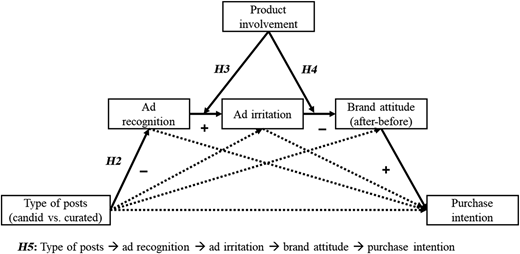
Ad spontaneity (operationalized through candid vs curated brand posts) reduces ad recognition.
Βrand success on authenticity-driven platforms may rely on how content is designed in relation to product involvement, which is a key boundary condition in the ELM. According to Petty and Cacioppo (1986), the ELM introduces a two-pathway plan to describe how humans interpret and consider persuasive messages through central and peripheral routes. The ELM posits that consumers process persuasive messages through two routes: the central route, which involves effortful, thoughtful evaluation of message arguments and is activated under high involvement; and the peripheral route, which relies on heuristic cues (e.g. source attractiveness, visual spontaneity) under low involvement (Palla et al., 2022). Thus, when examining GenZs' responses to various kinds of brand posts on authenticity-driven platforms, this distinction is especially salient. For low-involvement products (e.g. snacks and beverages), users tend to engage in peripheral processing and favor content that is effortless and relatable. In this context, candid and unpolished brand posts can serve as credible peripheral cues that signal authenticity and downplay commercial intent (Segev and Fernandes, 2022).
Conversely, for high-involvement products (e.g. electronics, athletic footwear), users are more likely to engage in central route processing, seeking substantive and informative content that justifies their purchase decisions (Te’Eni-Harari et al., 2007). In this context, candidness, while evoking perceptions of spontaneity or “realness”, functions as a peripheral cue that fails to satisfy central processing demands and instead introduces cue-context incongruence. As Kong and Lou (2026) demonstrate, raw visual spontaneity (a marker of visual appeal) primarily activates ideal self-congruence through affective pathways, but it does not provide the visual congruence (i.e. alignment between influencer aesthetics, product attributes and brand identity) necessary to foster cognitive authenticity and systematic evaluation. When consumers expect structured, credible information yet encounter informal, unpolished presentation, persuasion knowledge is activated not merely due to ad recognition, but because the format itself signals a misalignment with task goals (Kong and Lou, 2026). In contrast, curated posts that achieve visual congruence support central route processing by delivering coherent, functionally relevant content and thereby preserving authenticity through contextual appropriateness rather than raw spontaneity (Belanche et al., 2021; Duffett and Maraule, 2024).
Drawing on the ELM and recent empirical work on digital advertising (Kim, 2018; Segev and Fernandes, 2022), emotional and cognitive consequences of ad recognition are dependent on product involvement. Under low involvement, recognizing a brand post as an advertisement is likely to violate user expectations of authenticity, triggering irritation, a well-documented negative response to intrusive or inauthentic advertising (Li et al., 2002; Edwards et al., 2002). Ad irritation is a negative affective response characterized by provocation, displeasure and momentary impatience when consumers perceive an advertisement as intrusive or interruptive (Aaker and Bruzzone, 1985). It is distinct from general dislike in terms of intensity and behavioral consequences, often manifesting as aversion, skepticism or resistance (Song et al., 2025). Critically, irritation exerts a detrimental downstream influence on brand evaluations because it is generalized from the ad and backfires on the brand, which is a process well explained by the affect-transfer mechanism in advertising (Mitchell and Olson, 1981; Lutz et al., 1983). In contrast, under high involvement, users anticipate and even welcome detailed, persuasive messaging; thus, ad recognition is less likely to provoke irritation, because it aligns with their motivation to process information systematically (Petty and Cacioppo, 1986).
Thus, we hypothesize:
For low-involvement products, ad recognition increases irritation.
For high-involvement products, ad recognition does not cause irritation.
Building on this, the Dual Mediation Hypothesis (DMH) (MacKenzie et al., 1986) helps clarify why irritation is so consequential. DMH posits that ad attitude directly shapes brand attitude and indirectly influences brand attitude through its effect on brand-related cognitions. When attitude toward the ad has a negative valence (as in the case of irritation), it impairs both the cognitive elaboration of brand claims and the overall favorability toward the brand, ultimately weakening purchase intention. Empirical support for this pathway is robust: ad irritation predicts unfavorable brand attitudes (Chakrabarty and Yelkur, 2005; Avramova et al., 2021), heightens ad avoidance (Song et al., 2025) and erodes consumer trust (Eisend et al., 2020). For instance, Song et al. (2025) show that perceived ad intrusiveness, a common antecedent of irritation, triggers a negative attitude toward the ad, which backfires on the brand and reduces the intention to revisit the platform. Similarly, Kim (2018) finds that irritation mediates the link between ad intrusiveness and negative attitudes toward both the ad and the hosting medium.
In our context, when ad recognition occurs in low-involvement product scenarios, users may become irritated, as they will perceive a lack of spontaneity, as postulated earlier, which could negatively impact their brand attitude. The reverse may be true for high-involvement products, where ad irritation may not affect brand attitudes, as consumers expect detailed information from brands. Therefore, we hypothesize that:
For low-involvement products, ad irritation elicited by ad recognition negatively affects brand attitude.
For high-involvement products, ad irritation elicited by ad recognition does not affect brand attitude.
Extending this logic, purchase intention is positively driven by favorable brand attitudes (Reza Jalilvand and Samiei, 2012; Pink et al., 2023) but undermined when irritation disrupts the ad experience. Balroo (2023) confirms a strong inverse relationship between ad irritation and purchase intention, with heightened annoyance reducing both interest and behavioral intention (Li et al., 2020). Importantly, ad spontaneity can decrease this negative chain of events. Rifkin et al. (2023) note that spontaneous content is perceived as more authentic across entertainment contexts, and authenticity is known to enhance purchase intentions (Lee and Johnson, 2021). Spontaneity is expected to reduce ad recognition, which lowers irritation, thereby preserving a positive brand attitude and ultimately facilitating purchase intention. Thus, we hypothesize a serial mediation pathway:
Ad recognition, ad irritation and brand attitude mediate the relationship between type of brand posts (candid vs curated) and purchase intention.
Figure 1 depicts the conceptual model of this study.
3. Research design and methods
To investigate the overarching research questions of this study and their relevant hypotheses, we employed a sequential mixed-methods design. To bridge platform-level discourse and user-level responses, we began with a lightweight digital ethnographic scan of BeReal's official X account (57K followers at data collection), extracting metadata from the most recent 15K followers to assess demographic and geographic dispersion (see Web Appendix II). Although it does not reflect in-app behavior, this scoping step confirmed the platform's strong GenZ presence and global reach, supporting the relevance of authenticity as a culturally salient yet platform-specific norm.
Building on this, wherein Study 1 (cross-sectional survey) serves as a foundational exploratory phase to identify the psychological pathways through which BeReal use fosters brand connections, and Study 2 (controlled experiment) operates as a theory-testing phase to isolate the causal effects of ad format under varying involvement conditions (Table 1). Both studies were conducted online with independent samples of Gen Z BeReal users (N1 = 208; N2 = 211), but with the same sampling method, that is, a convenient sample from the same university population (no participant took part in both studies), and then a snowball sampling method. This sampling approach was employed because of the platform's relatively niche user base.
Analytically, Study 1 employed Hayes' (2018) PROCESS Model 6 (serial mediation) with bootstrapping (10,000 samples); Study 2 used PROCESS Models 91 (moderated mediation), with product involvement as the key moderator and brand familiarity as a covariate. Common method bias was proactively addressed in Study 1 (Harman's test, acquiescent-response screening), while random assignment and manipulation checks ensured validity in Study 2.
4. Study 1: psychological mechanisms on BeReal
4.1 Methodology
Study 1, investigates the psychological drivers (narcissism and brand selfies) that link BeReal usage to self-brand connection among GenZs, conducted in a country with an active BeReal market. This study specifically seeks to answer RQ1: How do narcissism and brand selfie behavior mediate the relationship between BeReal usage and self–brand connection among GenZ consumers?
We recruited N = 208 GenZs who participated voluntarily from a Mediterranean country. Eight participants were excluded from further analysis due to acquiescence bias, as they completed the questionnaire solely with agree statements (Podsakoff et al., 2003). Additionally, ten participants were excluded because they reported using the BeReal app but were inactive users. The final sample comprised 190 participants (76% female, 24% male) aged 17–26 years (M = 2003, SD = 2), with 70% being undergraduate students and 49% residing in large cities.
Participants were asked about their frequency of social media use across various platforms (see Web Appendix III). Questions from Sung et al. (2017) were also adopted to measure perceived information credibility on SNSs (M = 3.05, SD = 0.64), and participants' selfie behaviors were assessed. This included the frequency of sharing brand (M = 1.64, SD = 0.95), beauty (M = 2.07, SD = 0.99), simple/everyday (M = 2.61, SD = 1.01), food (M = 2.29, SD = 0.94) and party selfies (M = 3.06, SD = 1.02). The scale for selfie behaviors ranged from “not at all” (1) to “very much” (5) (M = 2.34, SD = 0.75; α = 0.817).
Participants' self-brand connection was measured using seven items, ranging from “strongly disagree” (1) to “strongly agree” (5) (Sprott et al., 2009). An example item is “I often feel a personal connection between my brands and me” (M = 3.42, SD = 0.77; α = 0.859). Additionally, participants' level of narcissism was measured with four items from Webster and Jonason (2013), such as “I tend to want others to admire me” (M = 2.78, SD = 0.91; α = 0.833).
4.2 Findings
Harman's single-factor test revealed that a single factor explained 27.79% of the total variance, suggesting that common method bias was not a significant issue in this study. Initial correlation analysis revealed weak associations between BeReal usage and other platforms, suggesting that BeReal may attract a distinct subset of GenZs who are not equally active elsewhere. Female users were significantly more active on BeReal, TikTok and Instagram than male users; thus, gender was used as a covariate in our analysis. All the correlation results appear in Web Appendix III.
To test H1, we used Process Macro Model 6 (Hayes, 2018) with 10,000 bootstrap samples (Table 2). The total effect of BeReal usage on self-brand connection was statistically significant (β = 0.152, SE = 0.06, p = 0.009), but the direct effect was not (β = 0.065, SE = 0.06, p = 0.269). The indirect effect via brand selfies and narcissism was statistically significant (β = 0.035, SE = 0.05, 95% CI = [0.01, 0.07]), indicating full serial mediation.
BeReal usage positively predicted brand selfie behavior (β = 0.306, p < 0.001), which, in turn, predicted higher narcissism levels (β = 0.293, p = 0.003). Narcissism significantly predicted self-brand connections (β = 0.31, p < 0.001). Gender was included as a covariate and did not significantly alter the path model. These findings support H1.
The findings revealed full serial mediation: BeReal usage encourages brand selfie sharing, which is linked to higher narcissism, ultimately strengthening users' emotional connection with brands. Notably, gender differences emerged, with female users being more active not only on BeReal but also on other visually driven platforms (e.g. Instagram), suggesting fertile ground for campaigns focused on self-expression and personal branding.
These findings reinforce the notion that BeReal is not just a space for passive content consumption but a platform where users actively construct their identity, often through brand interaction. For marketers, this presents an opportunity to design campaigns that invite GenZs to project themselves through branded challenges, user-generated content and everyday storytelling.
Although beyond the scope of the main study, we also estimated Model 84 with gender as a moderator. Females reported higher brand selfie behavior (β = 1.189, p = 0.007), while gender did not significantly predict narcissism (β = 0.873, p = 0.136). The moderated mediation analysis indicated that BeReal usage indirectly affected self-brand connection via brand selfie behavior and narcissism for both genders, consistent with the main analysis; however, this indirect effect was significantly stronger for males (difference between conditional indirect effects: β = −0.022, SE = 0.01, 95% CI [−0.056, −0.001]).
5. Study 2: persuasive outcomes of type of branded post
5.1 Methodology
Study 1 revealed that BeReal's spontaneous environment supports identity-driven brand expression: users post brand selfies, experience higher narcissistic gratification and develop stronger self–brand connections. These findings highlight the importance of platform-consistent cues in shaping positive brand outcomes. Study 2 extends this logic to brand-created content, examining whether the persuasive effectiveness of candid versus curated posts depends on product involvement and on how much the content fits BeReal's normative expectation of “being real.”
Study 2 employed an experimental design to assess how the type of brand posts (candid vs curated) and the level of product involvement influence ad recognition, ad irritation, brand attitudes and purchase intentions. This study specifically seeks to answer RQ2: How do the type of brand posts (candid vs curated) and the level of product involvement affect ad recognition, ad irritation, brand attitudes and purchase intentions?
An online experiment was conducted with 211 GenZs who were active BeReal users (Web Appendix IV). The final sample, after excluding 12 individuals due to invalid responses to the bogus questions, consisted of 199 individuals (30% males, 70% females; 68% undergraduate students; 33% stayed in small cities), born between 1997 and 2007 (M = 2003, SD = 2), who reported frequent use of the BeReal platform (M = 3.51, SD = 1.12).
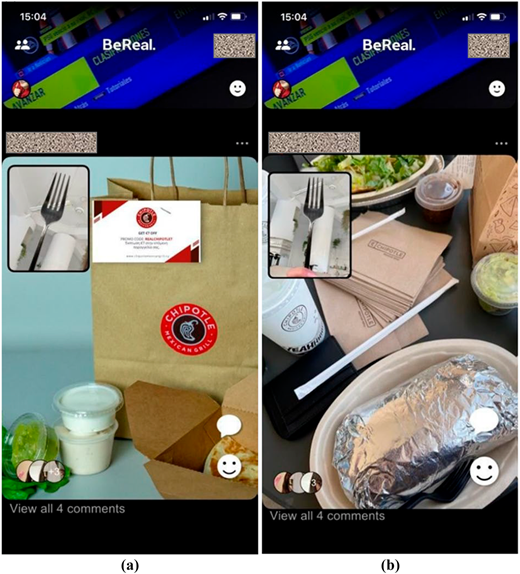
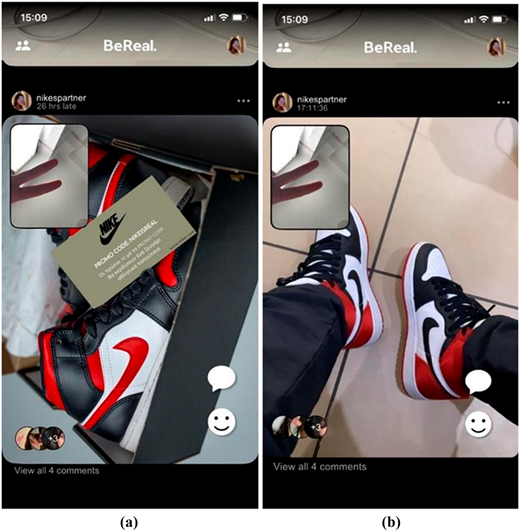
A focus group of 30 GenZs identified food and coffee as low-involvement products and Apple AirPods and Nike shoes as high-involvement products. Subsequently, eight advertisements were crafted (two versions, candid vs curated, for each product). A pre-test was also conducted on 26 GenZs, which led us to select the experimental stimuli (Figures 2 and 3). To check the involvement of the products in the final stimuli, we conducted a second pre-test with 60 GenZs. The fast-food category scored lower than the midpoint of 3 on product involvement (M = 2.61; t(25) = −3.467, p = 0.002), whereas athletic shoes scored higher than the midpoint of 3 (M = 3.7; t(33) = 4.646, p < 0.001). There was also a statistically significant difference in product involvement (t(56.9) = 5.797, p < 0.001); thus, Chipotle (Nike) was considered a low-involvement (high-involvement) product.
Ad irritation (Duncan and Nelson, 1985) (3-items; α = 0.853), brand attitude (Geuens and De Pelsmacker, 1998) (4-items; αbefore = 0.953; αafter = 0.972) and purchase intention (Geuens and De Pelsmacker, 1998) (3-items; α = 0.807) were measured using 5-point Likert scales. Bipolar single-item measurements were used for perceived spontaneity [curated (1) to candid (5)] and ad and brand familiarity [unknown (1) to known (5)]. Product involvement was measured using 18 5-point bipolar items (Zaichkowsky, 1985) (α = 0.972). Ad recognition was measured using a single-item scale (i.e. this image was an advertisement) with responses ranging from “strongly disagree” (1) to “strongly agree” (5).
5.2 Findings
The manipulation check confirmed that the candid condition increased perceived spontaneity relative to the curated condition for both Chipotle (M = 4.22, SD = 1.00 vs M = 2.49, SD = 1.10) and Nike (M = 4.17, SD = 1.10 vs M = 2.27, SD = 1.10), with all group means significantly different from the scale midpoint (3) (ps < 0.001). MANOVA revealed a significant effect of condition (ps < 0.01), but no significant difference between brands within conditions (p = 0.16 for curated; p = 0.77 for candid). Process Macro Model 91 (Hayes, 2018) with 10,000 bootstraps was used to test the full moderated mediation model (Table 3).
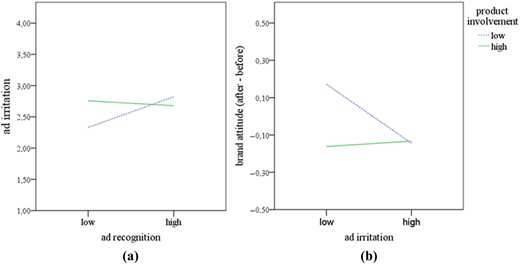
Ad spontaneity significantly reduced ad recognition (B = −0.651, p < 0.001), supporting H2. A significant interaction between ad recognition and product involvement on ad irritation was also found (B = −0.123, p = 0.001; Figure 4a). Specifically, ad recognition increased irritation for low-involvement products (B = 0.212, p < 0.001), supporting H3a. For high-involvement products, this effect was not significant (B = −0.033, p = 0.55), supporting H3b.
Ad irritation negatively affected brand attitude only for low-involvement products (B = −0.182, p < 0.001; Figure 4b), supporting H4a. No such effect was observed for high-involvement products (B = 0.017, p = 0.612), thus supporting H4b. Brand attitude significantly predicted purchase intention (B = 0.363, p < 0.001), while ad irritation had a direct negative effect (B = −0.154, p < 0.001).
The moderated mediation pathway: type of posts → ad recognition → ad irritation → brand attitude → purchase intention, was statistically significant for the low-involvement product only (B = 0.009, 95% CI = [0.002, 0.018]), partially supporting H5. No statistically significant indirect effects were found for the high-involvement product. The difference between the two conditional indirect effects was statistically significant (Figure 4).
The findings reveal that candid brand posts reduce ad recognition, which in turn lowers irritation but only for the low-involvement product. This reduction in irritation leads to more favorable brand attitudes and increased purchase intention, highlighting that the effectiveness of spontaneous advertising is contingent on product involvement. Notably, these psychological mechanisms were not activated for high-involvement products. It seems that GenZs are irritated when they see posts of high involvement products on BeReal, regardless of the spontaneity of these posts. We also run model 92 with gender as moderator but no statistically significant moderation effects were found.
In summary, H1 was fully supported in Study 1. In Study 2, H2, H3a,b and H4a,b were all supported, while H5 held only for low-involvement products (Table 4). Collectively, these findings indicate that platform-congruent (i.e. candid) branding fosters favorable outcomes through reduced persuasion knowledge, but only when content format aligns with both platform norms and user processing goals (i.e. low involvement).
6. Discussion
Through the lens of PKM and ELM, our research demonstrates that spontaneity on authenticity-oriented social media platforms, such as BeReal, operates through two distinct yet interrelated pathways: first, by shaping how users integrate brands into their self-presentation (Study 1), and second, by influencing how they interpret and react to branded content (Study 2). More specifically, brand selfie sharing heightens narcissistic self-presentation, which in turn strengthens consumer-brand relationships. Moreover, candid brand posts reduce ad recognition and irritation but yield persuasive benefits (improved brand attitude and purchase intention) only for low-involvement products. For high-involvement products, even candid brand posts trigger irritation because their presence on BeReal is perceived as promotional, which violates the platform's core norm of non-promotional sharing.
The non-significant serial mediation for high-involvement products in H5 delineates a critical boundary for both the PKM and DMH: their core mechanisms (ad recognition → irritation → negative outcomes) are conditional on processing mode. When central route processing dominates, irritation arises not from recognition per se, but from cue–goal incongruence, suggesting that PKM's emphasis on detection must be qualified by elaboration context (Kong and Lou, 2026; Friestad and Wright, 1994).
6.1 Theoretical and practical contributions
Prior studies have explored influencer marketing (Pradhan et al., 2023), brand storytelling (Nicoli et al., 2022) and user-generated content (Sung et al., 2017; Uzunboylu et al., 2020). However, none, to the best of our knowledge, have examined the type of brand posts (candid vs curated) and their role in online brand communication, particularly in environments explicitly designed to resist commercialization. BeReal, with its anti-curation ethos and spontaneous sharing model, offers a new empirical context for understanding how authenticity functions when it is not just a tactic but also a platform norm.
Our research reveals that using BeReal leads to posting more brand selfies, which makes users feel higher levels of narcissism, which enhances a stronger self-brand connection. This finding can be interpreted through schema congruency theory (Lynch and Schuler, 1994), which holds that people react more favorably when content matches the norms and expectations of its context. On BeReal, brand selfies fit the platform's spontaneous, anti-curated style, making them feel authentic rather than promotional. This congruency reduces persuasion knowledge and supports stronger self–brand connections. BeReal's platform architecture enforces a cultural schema of temporal spontaneity and unfiltered realism (Snyder, 2023; Kreling et al., 2022; Boyd, 2022), rendering brand selfies not as commercial intrusions but as schema-congruent extensions of authentic self-presentation (Tirocchi, 2023). As a result, users embed brands into “real” moments (Uzunboylu et al., 2020; Jiang et al., 2021; Moisescu et al., 2022). This alignment suppresses persuasion knowledge (Friestad and Wright, 1994), allowing the brand to be assimilated into the self-schema as a natural identity marker (Fortagne et al., 2024; Lynch and Schuler, 1994; Lee and Johnson, 2021; Rodrigues et al., 2022), while narcissism functions as a form of contextual self-enhancement. In this sense, BeReal users are motivated by the desire to be seen as genuinely relatable (Tirocchi, 2023) or vulnerably authentic (Snyder, 2023; Southgate, 2017; Stahl and Literat, 2022; Zulli and Zulli, 2020), and narcissism reflects the satisfaction of these needs through platform-normative behavior.
Our findings also extend the PKM (Friestad and Wright, 1994) by demonstrating that traditional markers of persuasion, such as polished visuals and structured messaging, can backfire (Boerman et al., 2022; Eisend et al., 2020; Safeer and Liu, 2022), especially for low-involvement products. Thus, persuasion knowledge is not merely triggered by overt commercial signals, such as ad and AI disclosures (Voutsa et al., 2025), but more subtly by message-platform incongruence. In other words, ad recognition does not function as a binary detection of sponsorship, but as a schema-violation signal via stylistic “over-curation”, a deviation from the “interestingly on-time” ideal (Snyder, 2023). In line with Kim (2018), who linked psychological reactance to perceived freedom restriction during immersive media use, our findings reveal that candid branded posts reduce perceived intrusiveness and irritation, but only in low involvement scenarios.
We further extend the ELM (Petty and Cacioppo, 1986) by demonstrating that candidness functions as a potent peripheral cue, but only under low-involvement conditions, where heuristic processing dominates. In line with Palla et al. (2022), who found that central cues (e.g. strong arguments, product information, discounts and coupons) (Segev and Fernandes, 2022) are necessary for effective persuasion in high-involvement products, our findings suggest that spontaneous messages may lack the informational depth required for effective persuasion. This finding helps resolve longstanding inconsistencies in ELM-based advertising research (e.g. null involvement effects among youth; Te’Eni-Harari et al., 2007) by showing that the platform context changes how users interpret persuasive cues (Palla et al., 2022; Segev and Fernandes, 2022; Petty and Cacioppo, 1986). On BeReal, the form of the message (spontaneous, candid) gains persuasive weight not because it is inherently central or peripheral, but because it aligns with the platform's normative ethos of “realness.” This shifting cue structure underscores Palla et al. (2022) call to adapt the ELM for digital contexts.
In addition to the theoretical contributions this research also provides practical insights for brand managers seeking to navigate authenticity-first platforms, such as BeReal. To connect with GenZs, brands must match the platform's casual and unfiltered style. Authenticity is expected; posts that appear too polished or strategic are likely ignored. Our findings highlight that BeReal usage affects self-brand connection, via brand selfie sharing and narcissism (Hypothesis H1). Thus, advertisers can leverage user-generated self-expression to build meaningful ties, particularly for low-involvement products. For instance, a personal care brand like Dove could launch a “#MyRealRoutine” campaign, inviting users to share unposed selfies applying products during their morning routine. Such initiatives tap into users' desire for self-presentation while fostering emotional affiliation with the brand (Southgate, 2017; Stahl and Literat, 2022).
Using spontaneous and authentic content can limit ad recognition (confirmed by hypothesis H2), making brand messages more effective (confirmed by hypothesis H5). For example, advertisers can prioritize behind-the-scenes content or interactive features that encourage user participation while maintaining brand relatability. However, care must be taken to balance spontaneity and transparency. Advertisers need to adjust their communication strategies according to the level of product involvement. Low-involvement products (e.g. Fast-Moving Consumer Goods - FMCG) are best suited to a spontaneous approach, as support of hypothesis H3a confirms that for low-involvement products, higher ad recognition increases irritation. Conversely, for high-involvement products (e.g. tech or financial products), the most suitable approach would be well-structured posts, as no support of hypothesis H3b shows no significant link between ad recognition and irritation for high-involvement products. For GenZs who desire real and unfiltered content, these approaches are the most appropriate for fostering brand trust.
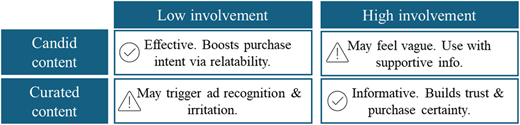
However, based on our results, this is mainly the case for low-involvement products, where spontaneous and informal brand content is the most effective (Figure 5). These types of posts increase ad recognition and reduce irritation, making people feel more favorable toward the brand and more likely to purchase it (confirmed by hypotheses H4a and H5). Marketers in these categories should utilize behind-the-scenes content, everyday user posts and natural-looking influencer partnerships that blend seamlessly into the platform. The approach for high-involvement products should be different. These products require more detailed and structured communication, even on casual platforms. Authenticity still matters, but it should include clear information, such as product stories, customer experiences or community content that adds credibility.
For high-involvement products, authenticity must be expressed differently. Our findings indicate that candid posts do not improve evaluations; instead, they risk provoking irritation because users see such attempts as promotional while lacking the informational depth they need to justify the purchase (confirmed by hypothesis H4b). In these categories, authenticity should come through clarity and transparency rather than candidness. Brands should present short factual cues, product walk-throughs filmed in real-life settings or simple demonstrations that highlight reliability and performance. These forms of structured messaging match Gen Z's expectations for diagnostic information and avoid the platform incongruence that undermines candid content in high-involvement contexts.
This study also reveals that brand selfies contribute to a greater sense of brand connection (confirmed by hypothesis H1). Rather than promoting overt advertisements, brands should encourage real users to write something for them daily. This type of content creates emotional connection and trust. Finally, brands should make it easy for users to share their stories by offering simple tools or prompts. This helps users feel involved and allows the brand to fit naturally into their lives.
Finally, Figure 5 helps translate the research findings into a simple decision guide for managers offering a practical, evidence-based overview of how brands should match content style to involvement level on authenticity-driven platforms like BeReal. For low-involvement products, candid posts lower persuasion knowledge and irritation, which improves brand attitude and purchase intention. For high-involvement products, this pattern reverses; even candid posts are processed as promotional and generate irritation, making more structured content a better fit.
6.2 Limitations and further research directions
As with any multi-method research, this research has limitations that open avenues for future research. Both studies relied on convenience and snowball sampling of GenZs from a single Mediterranean country. While culturally relevant, this limits representativeness and generalizability and may not reflect cross-cultural differences in self-expression and branding. Expanding the sample to more diverse contexts could enhance generalizability and uncover cultural moderators.
A further limitation concerns Study 1's reliance on self-report, cross-sectional data, which, despite procedural remedies and common method bias checks, remains susceptible to shared method variance and precludes causal inference. Future research should therefore replicate the proposed serial pathway (BeReal usage → brand selfies → narcissism → self-brand connection) using multi-method, longitudinal or experimental designs. In Study 2, while the stimuli were pre-tested, they represented simplified versions of BeReal content. Further studies could test dynamic, in-platform formats or employ real-time A/B testing of branded campaigns to enhance ecological validity, or investigate different forms of authenticity, such as naturalness, reliability, originality and continuity (Rodrigues et al., 2022).
Additionally, Study 2 focused on product involvement rather than message involvement. Future research could also examine message and technical dynamics to enhance engagement. We also used single items for ad spontaneity and ad recognition as used in prior research. However, future research could construct these two scales more effectively in the emerging era of digital marketing. Brand familiarity was also measured and used as a covariate. Further research could compare brands with similar levels of brand familiarity. Finally, this study focused on message design and product involvement but did not examine the influence of platform affordances (e.g. posting frequency, dual camera) or social dynamics (e.g. peer influence and virality), which could be incorporated into future models to deepen our understanding of authenticity in socially driven digital environments. Given the normative tensions between commercial intent and platform authenticity, future research could cautiously explore whether such practices shape Gen Zs' evolving expectations of transparency (or risk fostering adaptive cynicism), though such societal-level effects remain beyond the scope of the present work.
Ethical compliance
All procedures performed in studies involving human participants were in accordance with the ethical standards of the institutional and/or national research committee and with the 1964 Helsinki Declaration and its later amendments or comparable ethical standards.
During the preparation of this work, the authors used Grammarly to copyedit and refine the language. After using these tools, the authors reviewed and edited the content as needed, taking full responsibility for the content of the submitted work.
We would like to thank the anonymous reviewers for their thoughtful feedback and constructive suggestions, which greatly helped improve the quality of this manuscript. We also thank Eleni Kakoulli for her valuable assistance with the design of the experimental stimuli.
The supplementary material for this article can be found online.