This study examines how online reviews and consumers' attitude toward sustainable practices influence green hotel booking intention, while also evaluating the role of perceived corporate environmental responsibility within online hospitality decision environments. The study seeks to better understand how sustainability-related evaluations are formed and interpreted during green hotel booking decisions.
Data were collected from 287 respondents familiar with green hotels and online hotel booking platforms. Covariance-based structural equation modelling (CB-SEM) was employed to examine the relationships among online reviews, attitude toward sustainable practices, perceived corporate environmental responsibility and booking intention within an integrated TPB and S-O-R framework.
Online reviews and attitude toward sustainable practices significantly influenced both perceived corporate environmental responsibility and green hotel booking intention. However, perceived corporate environmental responsibility did not significantly mediate the relationship between sustainability-related evaluations and booking intention. The findings suggest that although consumers may positively evaluate hotels' environmental responsibility, such evaluations alone may not always independently strengthen booking intention within online hospitality environments.
The study contributes to sustainable hospitality literature by integrating online review evaluation and sustainability-oriented consumer attitudes within a unified green hotel booking framework. It further offers evidence from the Indian hospitality context and highlights the importance of credible review-based sustainability communication in digitally mediated hotel booking environments.
1. Introduction
The growing challenges of environmental degradation have increasingly pushed businesses worldwide to adopt sustainable practices. In the hospitality sector, many hotels now highlight their eco-friendly initiatives, such as obtaining green building certifications, installing energy-efficient technologies, and implementing comprehensive waste management systems to attract environmentally conscious travellers (Han, Hsu, Lee, & Sheu, 2011). Recent industry evidence further shows that sustainability is becoming a decisive factor in travel choice, with Agoda's 2026 Sustainable Travel Survey reporting that 88% of Indian travellers consider sustainability important when choosing travel options. As sustainability considerations increasingly influence travel choices, digital platforms have become an important source of information through which such initiatives are communicated and evaluated.
In contemporary digital hospitality environments, consumers typically learn about and evaluate these sustainability initiatives through electronic communication channels, particularly online reviews. However, the effectiveness of such initiatives often depends on whether travellers perceive these sustainability claims as credible and authentic. For hotel managers, this creates a practical challenge: green initiatives are more likely to influence booking decisions when consumers trust the environmental claims communicated through online platforms. As a result, the credibility of sustainability-related information communicated through online platforms can meaningfully influence consumers' booking decisions.
With increasing focus on sustainability and the growth of green tourism, concerns about “greenwashing” continue to make consumers sceptical. This scepticism is particularly pronounced in online environments, where sustainability information is largely mediated through digital platforms rather than direct experience. Although prior hospitality research has examined online reviews, sustainability attitudes, and green hotel intentions independently, limited attention has been paid to how these factors interact within online booking environments where consumers must evaluate the reliability of environmental claims. More specifically, prior studies have not sufficiently explained how online review cues and sustainability attitudes jointly shape perceived corporate environmental responsibility and, in turn, booking intention in an emerging-market hospitality context.
Against this backdrop, this study seeks to address two main questions:
How do online reviews and consumers' attitude towards sustainable practices influence their perception of corporate environmental responsibility in the hospitality context?
Does perceived corporate environmental responsibility mediate the relationships between online reviews, sustainable attitude, and booking intention?
To examine these relationships, the study integrates the attitudinal logic of the Theory of Planned Behaviour (TPB) with the Stimulus-Organism-Response (S-O-R) framework. TPB helps explain how favourable attitudes towards sustainable practices shape intention, while S-O-R explains how external digital stimuli such as online reviews are processed through internal evaluative mechanisms before producing a booking response. Within this structure, online reviews function as external digital stimuli, while consumers' attitude toward sustainable practices and perceptions of corporate environmental responsibility represent internal evaluative mechanisms influencing booking intention. This integrated framing is also consistent with recent hospitality research showing that consumers evaluate green claims and digital cues through trust and credibility, particularly in contexts where greenwashing concerns remain high (Alyahia, Azazz, Fayyad, Elshaer, & Mohammad, 2024; Delmas & Burbano, 2011; Lyon & Montgomery, 2015; Sparks & Browning, 2011).
The study, therefore, contributes to a better understanding of how sustainability-related perceptions formed within digital hospitality environments influence consumers' intentions to book green hotels. By focussing on India, where sustainability is already an important travel consideration for a large proportion of travellers, the study also offers evidence from a rapidly growing and digitally mediated emerging market. The findings also offer practical guidance for hotel managers seeking to communicate sustainability initiatives more credibly in digital review environments.
2. Literature review
2.1 Theoretical foundation
2.1.1 Theory of Planned Behaviour as a foundational framework
TPB (Ajzen, 1991) proposes that an individual's intention to perform a behaviour is shaped by three core factors: their attitude towards the behaviour, the perceived social pressure or subjective norms, and their perceived behavioural control. This framework has been extensively applied to understand consumer decision-making processes, including preferences for environmentally friendly hotels (Chen & Tung, 2014; Han, Hsu, & Sheu, 2010).
In sustainability-oriented hospitality contexts, TPB provides a robust foundation for explaining intention formation, while environmentally responsible decisions also involve evaluative judgements of sustainability-related information. Such judgements are especially relevant in contexts characterised by scepticism toward environmental claims and greenwashing (Delmas & Burbano, 2011; Lyon & Montgomery, 2015; Verma & Chandra, 2018). Accordingly, recent hospitality research has increasingly combined TPB with complementary perspectives that capture consumers' internal evaluation of sustainability cues, while retaining its core attitudinal logic. In this study, TPB explains how favourable attitudes towards sustainable practices shape booking intention, whereas the S-O-R framework is used to explain how consumers process online review cues and form internal evaluations before making booking-related decisions.
2.1.2 Integrating TPB with the S-O-R framework
To enhance understanding of sustainability-driven hotel choice, this study integrates the TPB with the S-O-R framework (Mehrabian & Russell, 1974). According to the S-O-R framework, external environmental cues function as stimuli that influence internal psychological processes within individuals, which subsequently shape behavioural responses. Within digital booking environments, the S-O-R framework offers a useful lens for explaining how consumers cognitively process digital information cues. This perspective also aligns with credibility and persuasion literature, particularly the Elaboration Likelihood Model (ELM), which suggests that consumers rely on informational quality and message credibility while evaluating persuasive communication in situations characterised by uncertainty (Petty & Cacioppo, 1986).
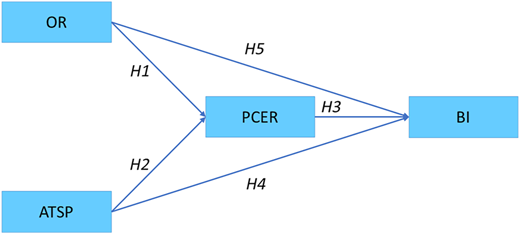
In the context of this study, online reviews (OR) function as the primary external stimuli, through which hotels' sustainability claims and practices are communicated in online settings. These digital cues are interpreted by consumers through internal evaluative processes within the organism. The organism comprises internal psychological states, including consumers' attitude toward sustainable practices (ATSP) as a pre-existing evaluative disposition, and Perceived Corporate Environmental Responsibility (PCER) as a situational, authenticity-related cognitive evaluation reflecting consumers' assessment of a hotel's environmental integrity and sincerity. Together, these internal mechanisms influence how consumers perceive and respond to sustainability-related information communicated through online reviews. The response is reflected in Booking Intention (BI), representing the behavioural outcome of these internal evaluations and indicating consumers' likelihood of choosing a green hotel.
2.2 Hypothesis development
2.2.1 Online reviews and PCER
Online reviews have become a primary source of information for consumers, especially in the hospitality sector (Cheung & Thadani, 2012). Reviews highlighting environmental initiatives such as recycling, energy savings, and other sustainable practices shape consumers' perceptions of a hotel's green credentials and impact booking intentions (Chuang, Yeh, Hsiao, & Wu, 2024). This is especially important in sustainability-oriented hospitality settings, where consumers often cannot directly verify environmental claims before making booking decisions. As a result, online reviews may serve as a useful cue through which travellers assess the genuineness of a hotel's environmental practices. In such contexts, online reviews may shape consumers' perceptions of a hotel's environmental sincerity and commitment by influencing how sustainability claims are interpreted and trusted (Booking.com Travel and Sustainability Report, 2026; Han & Yoon, 2015). Given the important role of online reviews on consumers' perceptions of hotel sincerity, it is expected that:
Online Reviews positively influence perceived corporate environmental responsibility.
2.2.2 Attitude toward sustainable practices and PCER
Consumers who hold favourable attitudes towards sustainability are more likely to value and positively interpret environmentally responsible business practices (Verma & Chandra, 2018). In hospitality settings, such consumers may therefore perceive hotels' sustainability initiatives as more genuine and meaningful, particularly when supported by credible environmental information. However, limited attention has been paid to whether favourable sustainability attitudes also influence how consumers evaluate hotels' environmental responsibility within online booking environments. Accordingly, consumers with favourable sustainability attitudes may be more likely to perceive hotels as environmentally responsible, leading to the following hypothesis:
Attitude Toward Sustainable Practices positively influences Perceived Corporate Environmental Responsibility.
2.2.3 PCER and booking intention
Perceived Corporate Environmental Responsibility (PCER) refers to consumer's belief in a company's genuine commitment to minimising environmental harm (Khairy, Elzek, Aliane, & Agina, 2023). In the hospitality context, PCER reflects consumers' trust in a hotel's sustainability claims and represents an internal evaluative judgement regarding the sincerity of its environmental practices. Prior research suggests that perceptions of environmental responsibility are shaped by observable sustainability initiatives such as renewable energy use, local sourcing, and credible green certifications (Yi, Li, & Jai, 2018), as well as by how such initiatives are communicated and interpreted by consumers.
Drawing on the Stimulus-Organism-Response (S-O-R) framework (Mehrabian & Russell, 1974), this study conceptualises PCER as an organism-level cognitive evaluation that emerges in response to external sustainability-related information cues. Within this framework, PCER functions as an authenticity-related mechanism through which consumers interpret environmental claims and sustainability initiatives communicated by hotels. PCER further reflects how consumers evaluate the credibility and sincerity of such claims before forming booking-related decisions. Consumers who perceive hotels as environmentally responsible may therefore develop stronger preferences towards green accommodations, particularly when sustainability claims appear credible and trustworthy. However, despite increasing emphasis on sustainability in hospitality research, limited attention has been paid to whether perceptions of environmental responsibility consistently translate into booking intention within online hotel booking settings. Accordingly, PCER is expected to influence consumers' intention to choose green hotels (Bamberg & Möser, 2007; Han & Yoon, 2015; Rahman & Reynolds, 2019), leading to the following hypothesis:
Perceived Corporate Environmental Responsibility positively influences Booking Intention.
2.2.4 Attitude toward sustainable practices and booking intention
Booking intention refers to a consumer's likelihood to reserve a specific hotel (Chen & Tung, 2014; Han et al., 2010). In the context of green hospitality, it represents the intention to book environmentally responsible accommodations based on consumers' evaluation of sustainability-related information and their perceptions of a hotel's environmental responsibility (Cheung & Thadani, 2012; Filieri, 2015; Han et al., 2010).
Attitude toward sustainability significantly influences consumers' willingness to book environmentally responsible accommodations (Han et al., 2010). Individuals with a positive attitude towards environmental protection are more inclined to visit hotels that adopt energy-efficient operations, waste reduction, and other green practices. Particularly, younger age groups view sustainability as a moral obligation, which strengthens the impact of attitude on booking choices. Prior green consumer research has also identified the existence of an attitude-behaviour gap, where favourable sustainability attitudes do not always translate into behavioural intention, particularly when consumers remain uncertain about the credibility of environmental claims. This makes this relationship worthy of further examination.
Attitude Toward Sustainable Practices positively influences Booking Intention.
2.2.5 Online reviews and booking intention
Online Reviews act as electronic word-of-mouth, where customers share detailed experiences and opinions about hotels. Research consistently shows that the quality, quantity, and tone of reviews significantly influence consumer trust and booking decisions (Filieri, 2015). In sustainability-oriented hospitality settings, consumers frequently depend on online reviews to assess the credibility of environmental practices before making booking decisions. In addition, detailed and positive reviews reduce consumer doubts and increase confidence in choosing green accommodations (Zhao, Wang, Guo, & Law, 2015). Nevertheless, limited attention has been paid to how sustainability-oriented online reviews directly influence booking intention within green hospitality contexts.
Online Reviews positively influence booking intention.
2.3 Research framework
By integrating TPB with the S-O-R framework, the proposed model (see Figure 1) explains how sustainability attitude and online review cues jointly influence booking intentions through authenticity-related cognitive perceptions. Within the proposed framework, Perceived Corporate Environmental Responsibility (PCER) is expected to function as an intervening evaluative mechanism through which online review cues and sustainability attitudes influence booking intention. In digitally mediated hospitality environments, consumers are often exposed to sustainability-related claims indirectly through online information sources rather than direct experience. As a result, booking-related responses may depend not only on exposure to sustainability information, but also on how consumers interpret the credibility and sincerity of environmental claims before making booking decisions. Accordingly, PCER is conceptualised as a cognitive authenticity-related evaluation that links sustainability-oriented perceptions with consumers' intention to choose green hotels. Figure 1 illustrates the proposed conceptual framework and the hypothesised relationships among the study variables.
2.4 Research gap
Existing hospitality research has largely examined online reviews and sustainability-related behavioural perceptions independently, offering limited explanation of how consumers evaluate the credibility and authenticity of sustainability-related information before forming booking intentions. This becomes particularly important in online hotel booking settings, where environmental claims are often interpreted through digitally available information rather than direct experience. The issue is especially relevant in emerging travel markets such as India, where sustainability-oriented travel behaviour is evolving alongside rapid growth in online accommodation decision-making. Recent cross-cultural studies suggest that green consumer judgements are influenced by contextual factors, and this is particularly relevant in emerging markets such as India, where sustainability attitudes and booking intentions may differ from Western settings. Accordingly, this study integrates TPB with the S-O-R framework to examine how online reviews and sustainability attitudes jointly influence booking intention through perceptions of corporate environmental responsibility.
3. Methodology
3.1 Sampling and data collection
This study employed a quantitative, cross-sectional survey design focussing on consumers with experience or interest in booking environmentally sustainable hotels. The study involved a voluntary online survey of adult respondents and did not include any invasive procedures or sensitive personal data. Prior to participation, respondents were informed about the purpose of the study and assured of confidentiality. A clear statement at the beginning of the questionnaire indicated that participation was voluntary, and participants provided their electronic informed written consent by selecting a mandatory consent checkbox before proceeding with the survey.
A purposive sampling technique was used to target individuals familiar with green or eco-friendly hotels who also had prior experience using online reviews while making hotel booking decisions. This approach was considered appropriate because the study sought responses from individuals possessing the specific knowledge and experience required to evaluate sustainability-related hotel information and online review content within hotel booking contexts. Data were collected using an online questionnaire administered via Google Forms. The study was conducted among Indian consumers who were familiar with green hotels and online hotel booking platforms. The survey link was shared through multiple online channels, including travel-related communities on platforms such as TripAdvisor, Booking.com, and Airbnb, along with travel-oriented social media groups on Facebook, Instagram and LinkedIn. In addition, it was also distributed through personal and professional networks to broaden participation among individuals with relevant travel experience.
To ensure that only relevant participants continued with the survey, screening questions were included at the beginning of the questionnaire. Respondents who indicated that they were unaware of green hotels, never read online reviews, or never considered environmental sustainability when selecting a hotel, were screened out. This targeted approach yielded 287 valid responses after data cleaning. Furthermore, following Kline's (1998) recommendation that the sample size should be at least ten times the number of parameters or items, the sample size of 287 in this study is adequate to support the analysis of 18 items. Descriptive and demographic characteristics of the sample are summarised in Table 1.
3.2 Questionnaire development
The questionnaire was organised into three parts. The initial section included screening items to identify participants who qualify for the study. The second section measured the core constructs of the study. The final section collected respondents' demographic information. All construct items were measured using a five-point Likert scale. Measurement items were adapted from validated scales in the literature and refined to suit the context of green hotel booking while ensuring conceptual relevance, reliability, and validity of the study constructs. Table 2 presents the details of the various constructs and their sources of adaptation.
To establish content adequacy and contextual clarity, the draft questionnaire was independently reviewed by three academic experts. A pilot study with 30 participants similar to the target group tested internal consistency and comprehension. Their feedback led to small wording and layout changes that improved question clarity.
3.3 Data analysis
The proposed theoretical framework was tested through structural equation modelling (SEM) using the two-step method outlined by Anderson and Gerbing (1988). Construct reliability and validity were evaluated through the measurement model. Prior to SEM analysis, data normality was assessed and confirmed. Missing values were handled using listwise deletion, where cases with missing data on key variables were excluded to ensure data completeness. Common method bias was examined using Harman's single-factor test. The first factor accounted for 32.6% of the total variance, which remained below the recommended threshold, indicating that common method bias was unlikely to be a major concern (Podsakoff, MacKenzie, Lee, & Podsakoff, 2003). Additionally, variance inflation factor (VIF) values were examined following the recommendations of Kock (2015). All VIF values were below the recommended threshold of 3.3, suggesting that common method bias and multicollinearity were unlikely to significantly affect the study results. Hypotheses testing and model fit assessment were subsequently conducted using CB-SEM with SPSS version 26 and AMOS version 24.
4. Results
The study analysed data from 287 valid respondents who were familiar with using online reviews and demonstrated basic awareness of sustainability-related factors when selecting hotels.
4.1 Measurement model results
The measurement model was estimated using CFA employing the maximum likelihood estimation method to evaluate construct reliability and validity. The model showed good fit to the data, with fit indices reported in Table 3 including χ2 = 671.234, χ2/df = 1.174, CFI = 0.989, TLI = 0.987, RMSEA = 0.025, and IFI = 0.990, all meeting established thresholds (Hair, Black, Babin, Anderson, & Tatham, 2010; Hu & Bentler, 1999).
All items loaded significantly onto their respective constructs, with standardised factor loadings ranging from 0.686 to 0.854 (See Table 4). Consistent with Peterson (1994), this study adopted a conservative criterion-in-use of 0.60 to retain items, ensuring measurement precision without forfeiting construct comprehensiveness. Therefore, all factors were retained for further analysis. Internal consistency was established using Cronbach's alpha and Composite Reliability (CR), with values ranging from 0.801 to 0.866, both exceeding the recommended minimum of 0.70 and indicating satisfactory reliability (Hair et al., 2010). Average Variance Extracted (AVE), used to assess convergent validity, ranged from 0.501 to 0.617 across constructs, aligning with the threshold of 0.50 (Fornell & Larcker, 1981) and confirming that each construct explains a substantial portion of the variance in its indicators (See Table 4).
Discriminant validity was established by applying the Fornell-Larcker criterion, wherein the square root of each construct's AVE exceeded the inter-construct correlations, thereby confirming empirical distinctiveness (Fornell & Larcker, 1981). Additionally, Heterotrait-Monotrait (HTMT) ratios were below the conservative cutoff of 0.85, further reinforcing discriminant validity (Henseler, Ringle, & Sarstedt, 2015). See Table 5 for details.
Overall, these results substantiate the measurement model's reliability, convergent, and discriminant validity, thereby supporting the theoretical constructs' adequacy and justifying their use in subsequent structural modelling analyses.
4.2 Structural model results
The structural model exhibited good fit, as indicated by multiple key fit indices reported in Table 6. Specifically, the CFI and TLI both exceeded the recommended threshold of 0.95, while the RMSEA was well below the 0.06 cutoff, demonstrating good model adequacy. These fit values align with established benchmarks in SEM research (Hair et al., 2010) and provide support for the overall adequacy of the hypothesised model.
4.3 Hypothesis testing results
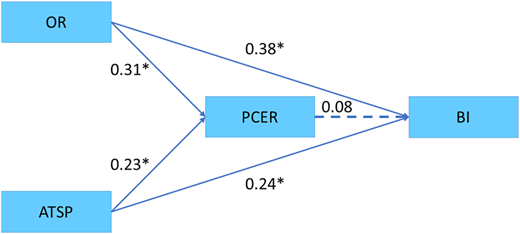
While investigating Research Question 1, path analysis demonstrated that both OR (β = 0.306, t = 4.507, p < 0.001) and ATSP (β = 0.231, t = 3.776, p < 0.001) had significant positive effects on PCER. These findings offer empirical support for Hypotheses 1 and 2, indicating that consumers' perceptions of green hotel responsibility are shaped by both peer feedback and personal attitude. In addition, the direct paths from ATSP (β = 0.237, t = 3.579, p < 0.001) and OR (β = 0.381, t = 4.854, p < 0.001) had significant positive effects on BI, supporting Hypothesis 4 and 5, respectively, reiterating their strong influence in making booking decisions (Refer Figure 2).
However, in examining Research Question 2, the direct effect of PCER on BI was not significant (β = 0.083, t = 1.079, p = 0.281), resulting in rejection of Hypothesis 3. Bootstrapped mediation analysis with 5,000 samples revealed that the 95% confidence intervals for both indirect effects included zero, indicating that PCER does not function as a statistically significant mediator between OR, ATSP, and BI.
In practical terms, the results indicate that consumers recognise a hotel's environmental responsibility, but this perception alone has a limited influence on their intention to book, consistent with earlier research highlighting the attitude-behaviour gap in hospitality (Juvan & Dolnicar, 2014; Khan, Acuti, Lemarié, & Viglia, 2024). Details and coefficients for all hypothesis tests are provided in Table 7.
4.4 Interpretation of findings
The findings reveal that both OR and ATSP significantly influence PCER. The positive paths (H1: β = 0.306, t = 4.507, p < 0.001; H2: β = 0.231, t = 3.776, p < 0.001) confirm that consumers who encounter high-quality online reviews and hold a favourable attitude toward sustainability perceive hotels as more environmentally responsible. This supports the stimulus-organism relationship proposed in the S-O-R framework (Mehrabian & Russell, 1974), where external information cues (reviews) and personal values (attitude) shape internal evaluations of a brand's responsibility. The findings further suggest that consumers' perceptions of environmental responsibility are influenced not only by hotels' sustainability initiatives themselves, but also by how such initiatives are interpreted through online review information and consumers' pre-existing sustainability orientation.
Our analysis further shows that OR exerts a significant direct effect on BI (β = 0.381, t = 4.854, p < 0.001). This finding highlights the vital role of digital word-of-mouth and online reputations in shaping consumer decisions related to green hotel stays (Chuang et al., 2024). It aligns with previous research emphasising authentic online feedback as a powerful driver of eco-conscious consumer choices (Yi et al., 2018). The strength of this direct relationship further suggests that consumers may rely strongly on immediately available review-based information when forming green hotel booking intentions. Alongside this, ATSP has a substantial direct effect on BI (β = 0.237, t = 3.579, p < 0.001). This relationship confirms that a favourable disposition toward sustainable practices enhances consumers' readiness to engage in green consumption, consistent with the Theory of Planned Behaviour and supported by eco-tourism studies (Ajzen, 1991; Han et al., 2010). Taken together, these findings indicate that both sustainability orientation and online review evaluations directly contribute to booking intention, even when perceptions of corporate environmental responsibility do not significantly mediate these relationships.
However, the direct path from PCER to BI and the indirect effects of OR and ATSP through PCER were not statistically significant. This suggests that PCER does not strongly transmit the effects of OR or ATSP to BI, which is consistent with previous evidence of an attitude-behaviour gap in hospitality and tourism contexts. Although consumers may positively evaluate hotels' environmental responsibility, such evaluations may not always translate into stronger booking intentions. Even when travellers express a strong pro-environmental attitude, their intentions often fail to translate into actual booking or consumption behaviour, as many environmentally conscious tourists still opt for resource-intensive or high-emission travel choices. This inconsistency is often rationalised through convenience, the need for rest, or a perceived lack of viable alternatives (Juvan & Dolnicar, 2014). Such patterns highlight the persistence of the attitude-behaviour gap in sustainable tourism, where positive intentions are not always reflected in real actions.
Subsequent research reinforces this pattern, showing that consumers stated intention to choose green hotels frequently does not translate into consistent sustainable behaviour once they are outside their usual environment (Khan et al., 2024). Scholars attribute this gap to situational constraints, financial considerations, and the influence of service quality or perceived risk (Wut, Lee, & Lee, 2023). Empirical work from European hotel settings further demonstrates that positive environmental attitude does not always result in sustainable purchasing choices (Borges-Tiago, Almeida, & Tiago, 2024). Together, these findings align with the current study by suggesting that while positive sustainability attitudes and credible environmental communication may contribute to favourable consumer evaluations, such perceptions alone may not always be sufficient to significantly strengthen booking intention through PCER.
5. Discussion and implications
5.1 Conclusions
The present study provides valuable insights into how online reviews and attitude toward sustainable practices influence consumers' intention to choose green hotels. By examining these relationships within an integrated behavioural framework, this research extends understanding of the joint role of online review information and sustainability-related attitudes in shaping green hotel booking intention.
Empirically, the findings reveal that online reviews function as social proof and are associated with consumers' attitude toward sustainable practices and perceptions of corporate environmental responsibility. Consumers with a favourable attitude toward sustainability also report stronger booking intention toward environmentally responsible hotels, reflecting the influence of sustainability-related values on hospitality booking decisions. Although the direct effect of perceived corporate environmental responsibility on booking intention was not significant, the construct still reflects an important evaluative dimension through which consumers interpret hotels' sustainability-related efforts.
The findings suggest that sustainability-related evaluations alone may not always be sufficient to independently strengthen booking intention. Prior sustainable tourism research similarly indicates that travellers often balance sustainability concerns with practical considerations such as comfort, convenience, price, and overall travel experience (Juvan & Dolnicar, 2014; Wut et al., 2023). Within online hospitality environments, consumers may therefore rely more directly on review-based information while evaluating green hotel choices.
5.2 Theoretical contributions
From a theoretical perspective, the study contributes to sustainable hospitality literature by integrating online review evaluation, sustainability-oriented attitudes, and perceived corporate environmental responsibility within a unified green hotel booking framework. Prior green hotel studies have primarily examined behavioural intention through conventional TPB-based predictors such as attitude, environmental concern, and perceived behavioural control (Han et al., 2010; Verma & Chandra, 2018), while online review studies have largely focused on review credibility, informational usefulness, and review adoption behaviour in digital decision environments (Filieri, 2015). Although recent hospitality studies have acknowledged the growing importance of sustainability communication and review-based information (Chuang et al., 2024), these research streams have largely evolved independently. The present study contributes by integrating these perspectives within a sustainability-oriented hotel booking context and examining how online review evaluations and sustainability-related attitudes jointly shape booking intention.
The study further contributes by offering a more nuanced understanding of the role of perceived corporate environmental responsibility (PCER) within sustainable hospitality decision-making. Existing green hotel literature has generally reported positive relationships between sustainability-related perceptions, environmental awareness, and behavioural intention (Han et al., 2010; Verma & Chandra, 2018; Jaiswal & Bihari, 2020; Khairy et al., 2023). However, the present findings suggest that consumers' recognition of hotels' environmental responsibility may not independently translate into booking intention, particularly within digitally mediated hotel selection environments where consumers are simultaneously exposed to multiple informational and evaluative cues. The findings therefore refine existing sustainable hospitality literature by suggesting that positive sustainability-related evaluations alone may not always be sufficient to directly convert sustainability awareness into booking intention within online hotel decision environments. Rather, sustainability perceptions may operate alongside multiple informational, experiential, and contextual considerations that influence consumer decision-making (Khairy et al., 2023; Wut et al., 2023).
The study also contributes contextually by providing evidence from the Indian hospitality setting, which remains comparatively underexplored in green hotel and sustainable tourism research. Much of the existing literature on green hotel intention and sustainability-oriented hospitality behaviour has emerged from Western or developed market contexts (Han et al., 2010; Juvan & Dolnicar, 2014; Filieri, 2015; Filimonau et al., 2022), while relatively fewer studies have examined these relationships within emerging hospitality markets characterised by rapidly expanding digital travel platforms and evolving sustainability awareness (Verma & Chandra, 2018; Amin & Tarun, 2019). By focussing on Indian consumers familiar with online hotel booking platforms and sustainability-related hotel information, the present study extends existing literature by highlighting how online review environments and sustainability-oriented evaluations jointly shape green hotel booking intention within an emerging market context.
5.3 Practical implications
From a practical perspective, the findings highlight the growing influence of review-based information in shaping green hotel booking decisions. Since online reviews significantly influenced both perceived corporate environmental responsibility and booking intention, hotels should focus on generating credible and experience-oriented sustainability communication through guest feedback rather than relying primarily on promotional green claims. Prior hospitality research has similarly shown that review credibility, informational usefulness, and review characteristics strongly influence consumers' evaluation of hotels in digital booking environments (Filieri, 2015; Chuang et al., 2024). Managers should therefore encourage guests to share specific sustainability-related service experiences, as review-based cues grounded in actual customer experiences may appear more credible and persuasive to prospective travellers.
The findings further suggest that sustainability-oriented consumers may continue to evaluate hotels through broader experiential and value-related considerations. Prior hospitality research similarly indicates that environmental concern alone may not be sufficient to influence sustainable hospitality choices unless supported by perceived value, service expectations, and overall travel experience (Filimonau et al., 2022; Khairy et al., 2023). Hotels should therefore integrate sustainability initiatives with overall service quality and customer experience rather than positioning sustainability as a standalone marketing message. In the Indian hospitality context, where online travel platforms increasingly influence hotel selection, sustainability-related communication may be more effective when supported by positive customer experiences and credible online reviews.
5.4 Limitations and future research
Despite these contributions, the study has limitations. The cross-sectional research design restricts causal inferences, suggesting the value of employing longitudinal or experimental approaches in future studies (Armitage & Conner, 2001). The data, primarily sourced from India-based travel forums, may limit generalisability, indicating the need for cross-cultural validation (Laroche, Bergeron, & Barbaro-Forleo, 2001). The sample largely consisted of educated and digitally active Indian consumers familiar with online hotel booking platforms and sustainability-related hotel information. Although this respondent profile was appropriate for examining sustainability-oriented hotel booking decisions within online travel environments, the findings may not fully represent travellers with lower levels of digital engagement, different socio-demographic backgrounds, or consumers from other cultural and geographic contexts. Future studies could employ more diverse sampling approaches across different population groups and national settings to enhance the generalisability and external validity of the findings. In addition, although the study operationalised online reviews through dimensions such as usefulness, trust, quantity influence, and review valence, online reviews remain inherently multidimensional. Future studies may further examine additional dimensions such as review authenticity, diagnosticity, comprehensiveness, and informational quality within green hotel decision-making contexts. Further exploration of contextual and behavioural influences, such as perceived risk, convenience, trust in sustainability communication, perceived value, familiarity with green hotels, and perceived greenwashing, could deepen the understanding of sustainable booking behaviour in hospitality contexts (Lyon & Montgomery, 2015; Moise, Gil-Saura, & Ruiz-Molina, 2020; Yang, Reza, Al Mamun, Masud, & Rahman, 2024).
Ethical considerations and informed consent
All authors confirm that this research complies with the ethical guidelines for human participants.
In particular, the study involved a voluntary online survey of adult respondents and did not include any invasive procedures or sensitive personal data. Prior to participation, respondents were informed about the purpose of the study and assured of confidentiality. A clear statement was provided at the beginning of the questionnaire that participation was voluntary, and by proceeding with the survey, participants gave their informed consent. As the research involved minimal risk and was conducted for academic purposes only, formal approval from an institutional ethics review board was not required.
Data availability statement
The data that support the findings of this study are available from the corresponding author upon reasonable request. To protect the privacy of participants, the raw survey responses are not publicly shared.
Author declaration and AI disclosure
This manuscript represents the authors' original work. All ideas, analyses, and interpretations were independently developed by the authors. AI did not contribute to the study's conceptual or analytical content.