Although leader empathy has long been argued to enhance leader–member relationships (LMX) and promote positive employee behaviors, its potential negative consequences, such as promoting unethical behaviors, remain unexplored. Drawing on social exchange theory, this study aims to examine how leader empathy can prompt employees’ unethical pro-organizational behaviors (UPB). Specifically, this study proposes that leader empathy enhances employees’ relative LMX (RLMX), which in turn facilitates UPB. Furthermore, the study theorizes that leaders’ work meaningfulness serves as a critical boundary condition, guiding employees’ ethical decisions and reducing the unethical reciprocity.
Survey data were collected from 275 Chinese hotel employees working under 58 leaders. The model was tested using multilevel modeling in Mplus.
The results support the mediation model, indicating that leader empathy increases UPB via RLMX. Furthermore, the moderated mediation model is supported, with the leader’s work meaningfulness mitigating the positive relationship between RLMX and employee UPB.
By demonstrating the impact of leader empathy on employee UPB, this study contributes to the research on leader empathy, highlighting its unintentional negative consequences. To the best of the authors’ knowledge, this study is among the first to examine RLMX, providing novel insights into the leader–follower relationship within a team dynamic. It also shifts the focus of previous work on meaningfulness from employees to leaders, showing its spillover effects.
Introduction
Empathy is the antidote to righteousness – Jonathan Haidt.
In the hospitality and tourism industry, understanding others is essential because work relies heavily on emotional labor and frequent customer interaction (Lee and Madera, 2021; Dogru et al., 2025). Reflecting this importance, scholars have shown sustained interest in empathy among both employees and leaders (Hwang et al., 2021; Koo et al., 2025), leading to prolific research on leader empathy and empathetic leadership. However, these two concepts are not the same. Empathetic leadership captures leadership styles shaped by empathy, while leader empathy specifically concerns a leader’s capacity to recognize, acknowledge and understand subordinates’ emotions (Mahsud et al., 2010). As a foundational interpersonal skill that operates across leadership styles (Guchait et al., 2023), leader empathy has been linked to positive employee outcomes such as stronger teamwork, greater citizenship behaviors and improved problem-solving (Lee and Lim, 2023; Mohd-Shamsudin et al., 2024). Yet emerging research cautions that empathy, when applied selectively or excessively, may also lead to unintended outcomes (Holt and Marques, 2012), such as behaviors perceived as justified but ethically problematic.
One such behavior is unethical pro-organizational behavior (UPB), which involves actions intended to benefit the organization but that violate societal norms, values or laws (Umphress et al., 2010). UPB is especially relevant in hospitality, where employees often face pressure to maintain service quality and protect organizational reputation (Gürlek and Çetiner, 2025). Examples include serving expired food to reduce waste, encouraging guests to leave overly positive reviews or engaging in greenwashing (Yan et al., 2021; Zhao et al., 2024). Although these actions may stem from a desire to help the organization, they ultimately undermine customer satisfaction and damage long-term reputation (Shum and Ghosh, 2022). UPB also carries personal costs, as employees may experience emotional ambivalence, guilt and work-to-life conflict (Liu et al., 2021; Chen et al., 2023). Yet despite increasing attention to UPB in hospitality research, the role of leader empathy in shaping such behavior remains underexplored.
Social exchange theory suggests that employees who receive leader empathy may feel obligated to reciprocate (Cropanzano and Mitchell, 2005). Yet in group-based work environments such as hospitality, employees do not rely solely on their understanding of individual exchange with the leader. Instead, they assess how their relationship compares with those of their coworkers and use these evaluations to guide their behavior (Hu and Liden, 2013). Evidence shows that employees’ relative standing within the leader–follower relationship often has a stronger influence on their attitudes and behaviors than their absolute level of exchange (Yoon and Yoon, 2019). To capture this comparative process, this study pioneers the concept of relative leader–member exchange (RLMX), reflecting employees’ perceptions of their exchange quality relative to peers, into the hospitality literature. Employees who perceive themselves with higher RLMX, such as being more favored, may feel heightened pressure to reciprocate their leader’s support (Erdogan and Liden, 2002), even when doing so involves engaging in moral disengagement, which further leads to ethical behaviors such as UPB.
Work meaningfulness, defined as the subjective perception of significance and value in one’s work (Rosso et al., 2010), further shapes how leader empathy influences followers. Existing studies indicate that meaningful work is closely tied to ethical responsibility, integrity and long-term organizational purpose (Michaelson et al., 2014; Steger et al., 2012). Yet, limited research has examined the moderating role of leaders’ work meaningfulness. Leaders who view their work as meaningful are therefore more likely to model appropriate conduct and emphasize value-driven goals, providing employees with a moral framework for evaluating their own behaviors. Recent studies also suggest that leaders’ sense of meaningfulness can be transferred to followers through daily interactions, shaping employees’ purpose and behavioral standards (Kipfelsberger et al., 2022). In this regard, leader work meaningfulness functions as a moral compass that discourages ethically questionable actions and promotes prosocial reciprocation. Thus, leader work meaningfulness may mitigate the positive relationship between RLMX and UPB.
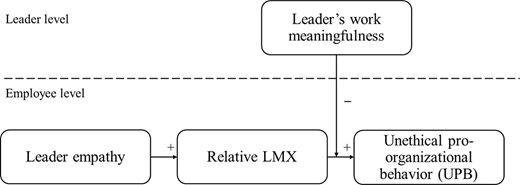
Overall, this study examines the backfire impact of leader empathy specifically on employee UPB in the hospitality industry. We propose that leader empathy enhances RLMX, which in turn encourages UPB as a form of unethical reciprocation. However, this relationship is attenuated when leaders possess high work meaningfulness. The proposed research model is presented in Figure 1. This study provides important theoretical and practical contributions. To date, Yoon and Yoon (2019) is the only hospitality study that has examined RLMX, leaving a limited understanding of how comparative, socially embedded leader–follower dynamics shape employee behaviors, particularly in the context of unethical reciprocity. By capturing the comparative and socially embedded nature of leader-follower dynamics, this study enriches the existing LMX literature (Chang et al., 2020) while extending the research on RLMX (Yoon and Yoon, 2019). It also addresses a notable gap by highlighting the backfire potential of leader empathy, a construct predominantly conceptualized as uniformly positive within leadership scholarship (Hwang et al., 2021). Finally, by demonstrating the buffering role of leader work meaningfulness, this study shifts the focus of meaningfulness research beyond employees, broadening theoretical perspectives on why and when leaders’ internal experiences matter for follower outcomes.
Literature review and hypotheses development
Social exchange theory and relative leader–member exchange
Social exchange theory is a sociological and psychological theory that explains social behaviors as outcomes of reciprocal exchanges (Cropanzano and Mitchell, 2005). Governed by reciprocity, the social exchange process involves both tangible and intangible resources, which shape interpersonal relationships over time. In this process, individuals tend to reciprocate the exchange of resources, repaying either good or bad deeds of another party (Cropanzano and Mitchell, 2005). However, social exchange reciprocation is not universal. The preferences and values of the receivers are particularly important in the examination of exchange with constructive deviant behaviors, like UPB. In such cases, the hypernorm of reciprocation targets dictate the value and desirability of reciprocal behaviors (Cropanzano et al., 2017).
Social exchange theory is widely applied to understand workplace relationships (Meira and Hancer, 2021; Xu et al., 2022). According to the hospitality and tourism literature, positive initiating actions, including organizational support and supportive leadership, can be related to positive reciprocating responses like job satisfaction, commitment, discretionary efforts, increasing engagement in collaboration, loyalty and organizational citizenship behavior (Meira and Hancer, 2021; Xu et al., 2022). Conversely, negative initiating actions, such as abusive supervision and exploitative leadership, bring forth negative reciprocating responses, such as decreased service performance, deviant behaviors, reduced job satisfaction and increased turnover intention (Lyu et al., 2016; Shum, 2021; Yu et al., 2020).
LMX focuses on the social exchange between leaders and employees in the workplace (Chang et al., 2020). According to Liden et al. (1997), high-quality LMX relationships are marked by mutual trust, reciprocal investment, enhanced collaboration and improved performance, while low-quality LMX tends to be transactional, relying on formal exchanges with limited reciprocity. Despite the considerable amount of LMX research, the dyadic nature of LMX has been criticized for its ignorance of the leaders’ relationship with other team members (Martin et al., 2018). To address this limitation, researchers developed objective measures of RLMX (Henderson et al., 2008; Yoon and Yoon, 2019), referring to “one’s LMX quality relative to the average LMX quality in a workgroup” (Henderson et al., 2008, p. 1209). Given that leaders naturally develop varying relationships with subordinates (Buengeler et al., 2021), understanding RLMX is critical, as it shapes employees’ perceptions of their workplace status and access to resources (Li and Ye, 2015).
Employees in high RLMX relationships receive greater access to both tangible and intangible resources (Karacay et al., 2023). They enjoy higher self-efficacy and team commitment (Yoon and Yoon, 2019). Conversely, those with a low RLMX may feel excluded and perceive minimal organizational support, which in turn negatively impacts critical workplace outcomes, including diminished individual creativity (Chen, 2023), reduced organizational citizenship behaviors, increased turnover intentions (Harris et al., 2014) and weaker team identification (Gao et al., 2023). Despite the importance of teamwork in the hospitality workplace (Lee and Lim, 2023; Yang and Lo, 2025), scant hospitality studies focus on the role of RLMX. Extending Yoon and Yoon’s (2019) examination of the positive consequences of RLMX, it is even more important to investigate the antecedents of RLMX, its potential negative consequences and factors that can moderate its impacts.
Leader empathy and relative leader–member exchange
Empathy is a vital leadership behavior, reflecting a leader’s ability to recognize and understand subordinates’ emotions and feelings (Mahsud et al., 2010). Leaders who demonstrate empathy are perceived as approachable and inclusive, which strengthens team cohesion and employee satisfaction (Kellett et al., 2006). More recently, empathy has been framed not merely as a cognitive capacity but as a relational construct cocreated through dialogue and emotion exchange, fostering bonds of care, responsibility and shared values between leaders and followers (Jian, 2022). Prior work also shows that empathy and ethical values jointly enhance LMX (Mahsud et al., 2010).
In the hospitality and tourism industry, where employees frequently engage in customer-facing roles, perform emotional labor and work irregular hours, empathy from leaders is particularly critical (Guchait et al., 2023). Recent hospitality studies highlight the importance of leader empathy. For instance, Mohd-Shamsudin et al. (2024) found that empathetic leadership reduced the negative impact of job stress on employees’ problem-solving behaviors, while Bani-Melhem et al. (2021) reported that leader empathy enhanced psychological safety, even among employees with paranoid personality traits. These findings suggest that empathy facilitates trust and relational stability between leaders and followers, which are essential for employees to function effectively under the stressful hospitality context.
Beyond these relational benefits, the mechanism of emotional contagion helps explain how leader empathy strengthens employees’ perceptions of their relationship with the leader. Leaders’ emotions, including empathy, can spread to employees through nonverbal cues and interpersonal exchanges (Barsade, 2002). It was found that leaders’ positive emotions, including empathy, amplified through emotional contagion, enhanced employees’ moods and perceptions during team interactions (Xerri et al., 2023). When leaders express empathy, their positive emotions can be “caught” by employees, amplifying perceptions of support, inclusion and authenticity. According to social exchange theory, when employees feel understood and supported, they perceive themselves as trusted and valued team members (Yang et al., 2021). Because emotional contagion operates more strongly with those employees who are most attuned to the leader, some followers may feel uniquely valued and aligned with the leader’s emotions. This differentiated emotional connection amplifies perceptions of relative standing, thereby strengthening RLMX:
Leader empathy is positively related to RLMX.
Unethical reciprocation: unethical pro-organizational behavior
UPB represents a unique form of workplace misbehavior characterized by its orientation to benefit the organization or its members, even at the cost of violating social norms, laws or ethical standards (Umphress et al., 2010). Such actions may offer benefits in the short term, such as enhancing team performance and preserving the company’s image (Mo et al., 2023a). However, they are societally unacceptable and potentially harmful to stakeholders and the organization’s long-term sustainability (Mo et al., 2023a; Umphress et al., 2010).
Literature has well documented that people justify UPB through moral disengagement (Hsieh et al., 2020). Prior research shows that employees often rationalize UPB through the process of moral disengagement (Hsieh et al., 2020), which enables them to maintain a positive moral self-image while engaging in unethical conduct. Bandura (1999) identified eight mechanisms of moral disengagement: moral justification, euphemistic labeling, advantageous comparison, displacement of responsibility, diffusion of responsibility, distortion of consequences, dehumanization and attribution of blame. In hospitality contexts, these mechanisms can rationalize behaviors such as concealing food safety violations to boost short-term sales or serving expired food to minimize waste, reframing them as necessary for organizational success (Yan et al., 2021). While moral disengagement has been widely applied to explain deviant and unethical behavior in hospitality research (Raza et al., 2024; Zhao et al., 2025), it overlooks a critical dimension of hospitality work, that is, its inherently group-based and socially comparative nature.
RLMX complements and extends the moral disengagement perspective by highlighting the reciprocal and comparative basis of workplace exchanges. Social exchange theory suggests that when employees perceive a high RLMX, they develop a strong sense of obligation to repay their leader’s care, support and resources (Bryant and Merritt, 2021; Yoon and Yoon, 2019). This sense of reciprocity often motivates employees to go beyond formal job requirements. When employees believe they are more valued by their leaders compared to peers, they are not only inclined to provide superior customer service (Yoon and Yoon, 2019) and exhibit higher levels of engagement and organizational citizenship behavior (Karacay et al., 2023), but they may also rationalize UPB as a legitimate form of reciprocation.
Based on social exchange theory, employees with superior RLMX often feel a heightened obligation to sustain high levels of customer service as a way of repaying their privileged standing with the leader (Yoon and Yoon, 2019). This sense of obligation can lead them to suspend moral self-regulation and justify UPB as acceptable, particularly when such behaviors enhance team performance (Mo et al., 2023a, 2023b) and reduce leaders’ responsibilities (Bryant and Merritt, 2021). When employees perceive their relationship quality with leaders as stronger than that of their coworkers, they may feel an intensified obligation to reciprocate (Vidyarthi et al., 2010). To sustain this privileged standing, employees may rationalize UPB as a legitimate form of repayment. In this context, RLMX functions as a relational trigger that activates moral disengagement, particularly through moral justification (e.g. framing unethical actions as necessary for protecting the leader or organization) and distortion of consequences (e.g. downplaying potential harm to customers or stakeholders) (Bandura, 1999). By interpreting UPB as loyalty-driven rather than unethical, employees suspend moral self-regulation and prioritize reciprocity over ethical considerations. Thus, high RLMX not only strengthens the sense of reciprocity but also provides the comparative context in which moral disengagement becomes more likely, thereby increasing employees’ enactment of UPB. Therefore:
RLMX is positively related to employee UPB.
A comparable process of moral disengagement underlies the link between leader empathy and UPB through RLMX. As discussed above, leader empathy functions as a relational cue that strengthens employees’ perceptions of RLMX, while high RLMX further acts as a relational trigger that facilitates moral disengagement and encourages UPB. Within these high-quality exchange relationships, employees feel compelled to reciprocate the benefits received from their leaders, and this heightened sense of reciprocity can lead them to rationalize behaviors that, although intended to support the leader and the organization, involve ethical compromises (Bryant and Merritt, 2021). This prediction is also supported by empirical evidence that demonstrates the mediating role of social exchange relationships in the connection between leadership style and UPB (Mo et al., 2023b). Thus, the present study argues that leader empathy generates strong relational obligations that encourage employees to reciprocate through UPB via enhanced RLMX. Accordingly:
RLMX mediates the positive relationship between leader empathy and employee UPB.
Adapted reciprocation: leader work meaningfulness
While RLMX captures the comparative and reciprocal dimension of leader–follower relationships, the translation of this reciprocity into UPB may depend on leaders’ value orientations. Social exchange reciprocation is not universal. The preferences and values of the receivers are vital in examining exchange with constructive deviant behaviors, such as UPB. In such cases, the reciprocation targets’ hypernorm, specifically, the leaders’ value and ethical standards, dictates the value and desirability of reciprocal behaviors (Cropanzano et al., 2017). In this sense, reciprocation involves not only the amount of return but also its alignment with what the leaders perceive as appropriate. Accordingly, employees may repay high RLMX with UPB only when such behaviors are perceived as morally acceptable and beneficial to the leader (Cropanzano et al., 2017). Therefore, leader work meaningfulness, defined as leaders’ perception of the significance and purpose of their work (Rosso et al., 2010; Steger et al., 2012), may function as a moral reference point within the group, shaping how employees interpret their exchange obligations.
Leaders with a high sense of work meaningfulness are often driven by social responsibility and moral goals, focusing more on the long-term impact of their work and the organization’s mission rather than solely on performance metrics (Steger et al., 2012). Through their daily actions and value-based communication, leaders can transfer their sense of meaningfulness to employees, shaping how followers interpret the purpose and significance of their work (Kipfelsberger et al., 2022). In the hospitality context, for instance, hotel managers who frame their work as contributing to guest well-being and community reputation are less likely to endorse questionable shortcuts such as misrepresenting sustainability practices or pressuring staff to solicit fabricated online reviews. This aligns with ethical leadership research, which shows that leaders’ ethical standards and role modeling establish boundaries for acceptable conduct and positively influence organizational outcomes in hospitality, including service quality, competitive performance and employee green behaviors (Kim and Brymer, 2011; Wood et al., 2021). In this sense, leader work meaningfulness operates in a manner similar to ethical leader modeling by signaling integrity and discouraging morally questionable reciprocation such as UPB.
As individuals reciprocate in ways their interaction partners desire (Cropanzano and Mitchell, 2005; Cropanzano et al., 2017), a leader’s work meaningfulness becomes an important reference point and boundary condition on how employees reciprocate leaders’ goodwill. In strong RLMX relationships, hospitality employees may otherwise feel compelled to reciprocate through UPB to demonstrate loyalty, such as concealing food safety violations to avoid customer complaints or covering up service errors to protect the team’s image (Yan et al., 2021). However, when leaders hold a strong sense of work meaningfulness, they are more likely to emphasize purpose, integrity and responsibility, consistent with research showing that meaningful work is deeply tied to values, ethics and moral responsibility (Rosso et al., 2010; Michaelson et al., 2014; Steger et al., 2012). By contrast, leaders low in meaningfulness often experience heightened performance pressures (Luu, 2021) and may signal a narrow focus on short-term achievements (Frémeaux and Pavageau, 2022), inadvertently legitimizing UPB and amplifying the RLMX–UPB link:
Leader work meaningfulness moderates the positive relationship between RLMX and employee UPB such that the relationship is weaker when leader work meaningfulness is high (vs low).
Furthermore, this moderation may also extend to the indirect pathway. Based on the earlier analysis, leader empathy promotes employee UPB indirectly by enhancing RLMX. However, if the leader shows a strong sense of work meaningfulness during this process, the signals conveyed are more likely to emphasize social and ethical responsibility rather than instrumental performance-related exchange. In other words, the leader’s sense of work meaning, as a value-oriented signal, not only influences how employees interpret the social nature of the leader’s behavior but also interrupts the process by which empathy activates reciprocal behaviors through relational exchange. Therefore, we propose that the leader’s sense of work meaning may weaken the indirect effect between leader empathy and employee UPB via RLMX:
Leader work meaningfulness moderates the indirect relationship between leader empathy and employee UPB such that the relationship is weaker when leader work meaningfulness is high (vs low).
Method
Procedures and sample
Using a convenience sampling approach, the authors accessed nine hotels in China through personal connections with their HR directors. Initially, 60 team leaders were contacted for permission to survey their work teams. With the leaders’ consent, their subordinates were subsequently invited to participate in a survey. Human subjects’ ethical approval was gained before data collection, and participants were informed of their rights (e.g. withdraw during the survey, anonymity, etc.) and the purpose of this study before the start of the survey. Each leader and employee was assigned a unique identification code prior to completing the survey. These IDs were generated and distributed by the research team to ensure confidentiality. After the data collection period, leader and employee responses were matched using these IDs. Because one leader was linked to multiple employees, all employee responses were nested under the same leader ID, which allowed the research team to accurately pair leader and employee data while maintaining anonymity.
Due to the subjective nature of work meaningfulness, this variable is collected from the leaders; employees assessed leader empathy, RLMX and employee UPB. Separate survey links were distributed to leaders and followers to complete their respective questionnaires. Of the 60 leaders approached, two failed to complete the survey, resulting in 58 fully completed team responses, which comprised a total of 275 followers. Each team consisted of one leader and an average of 4 to 5 employees (M = 4.81). Participants represented a range of departments, including front desk, housekeeping, food and beverage, restaurants, banquet services, sales and marketing, human resources and engineering.
Supplementary Table S1 summarizes the demographic characteristics. Half (49%) of the employees were between 18 and 25 years old, while nearly half (47%) of the leaders were between 31 and 40 years old. Most employees (63%) and leaders (64%) were female. Most employees (67%) and leaders (78%) had completed at least a two-year college degree. Regarding employment status, over half (59%) of the employees were full-time workers, and 23% were interns, with 95% earning under RMB 8000 (approximately US$1100). In contrast, 90% of the leaders worked full-time, with 47% earning above RMB 8000. Regarding organizational tenure, 59% of employees had been with the organization for less than two years, whereas 74% of the leaders had been with the organization for over two years.
Measures
This study used established measures. Both leaders and employees provided their basic information, including age, gender and organizational tenure. In addition, leaders reported their managerial tenure and perceived work meaningfulness (Steger et al., 2012, 10-item scale, α = 0.91). Employees first rated their leaders’ empathy with 16 items adapted from Liu (2017) (α = 0.93. This scale comprises three subdimensions, including empathic concern (4 items), perspective-taking (7 items) and emotional responsivity (5 items) (Jolliffe and Farrington, 2006; Wong and Page, 2003). Due to the multidimensional nature of empathy, we modeled our approach after Wieseke et al. (2012) and focused on a single construct of overall leader empathy in the multilevel path analyses. Specifically, we first averaged the items within each dimension, followed by the calculated overall empathy as the mean of the three dimension scores.
Then, they evaluated their LMX using LMX-7 (Graen and Uhl-Bien, 1995; α = 0.93). To calculate RLMX, we followed Henderson et al. (2008)’s original conceptualization and subtracted the individual employee’s rating of LMX from the aggregated mean of group LMX, which is the average of every employee’s LMX working under the same leader. Finally, they assessed their engagement of UPB with Umphress et al.’s (2010) 6-item scale (α = 0.97).
Data analysis
Before proceeding with the main path analysis, we conducted a multilevel confirmatory factor analysis and examined the construct validity (Yu et al., 2022). Supplementary Figure 1 graphically illustrates the model structure. Model fit indices, including CFI, RMSEA and TLI, were assessed to ensure the model’s factor structure enjoys plausibility. We used the Fornell and Larcker (1981) approach to assess the reliability and validity of the constructs with CRs and AVEs. In addition, common method bias was assessed with both Harman’s one-factor method and the unmeasured method factor model. Given the nested data structure with multiple employees working under the same leaders, we analyzed the data using multilevel path analysis with Mplus 7.3, following the recommendation by Kim et al. (2016). First, because employees’ and leaders’ characteristics can be related to their behaviors and relationships (Schyns et al., 2008), we regressed RLMX and employee UPB on employees’ and leaders’ age, gender and organizational tenure at the employee- and manager-level, respectively. In addition, the effects of a leader’s managerial tenure were controlled because leadership styles and behaviors may change as leaders’ managerial experience increases (Kim et al., 2015).
Next, to test H1, we included the effects of leader empathy on RLMX. We test H2 and the multilevel moderation (H4) using the random slope analysis as advised by Aguinis et al. (2013). Specifically, we specified the employee-level path between RLMX and employee UPB as random while controlling for the effects of leader empathy at the employee-level and the effect of group average LMX at the leader-level. The moderating effect is estimated by accounting for the effects of leader work meaningfulness on employee UPB and the RLMX – employee UPB random slope. Because RLMX was calculated as an individual’s LMX rating minus the group mean of LMX, it is the group-mean-centered version of LMX. To minimize the centering bias, as discussed in Lüdtke et al. (2008), we follow the approach of Enders and Tofighi (2007) and include the group mean of LMX as a covariate. To facilitate interpretation, the moderator (leader meaningfulness) was not centered as in Preacher et al. (2016). Supplementary analysis, centering leader meaningfulness, showed that centering did not affect the results. The mediation (H3) and moderated mediation (H5) hypotheses were tested using parametric bootstrapping following the recommendations by Preacher and Selig (2012).
Results
Factor analysis and descriptive statistics
Multilevel confirmatory factor analysis was used to test the factor structure. The proposed model, which includes five first-order factors at the employee-level (one factor for each of the three dimensions of leader empathy, RLMX and employee UPB), a second-order leader empathy factor at the employee level, one first-order factors at the leader-level for leader’s work meaningfulness fit the data well (Χ2[406] = 848.48, RMSEA = 0.06, CFI = 0.91, TLI = 0.90). The constructs also exhibit good reliability and validity, as evidenced by item factor loadings (all above 0.60), scale CR (ranging from 0.91 to 0.96) and AVE (ranging from 0.51 to 0.86) (Fornell and Larcker, 1981, see supplementary Table S2). The constructs were normally distributed with skewness and kurtosis ranging from −0.74 to 1.13 and −0.90 to 0.26, respectively. The proposed factor model also offered better fit indices than (1) the alternative four-factor model that does not account for the multidimensional nature of leader empathy (Χ2[409] = 1062.88, RMSEA = 0.08, CFI = 0.87, TLI = 0.85), and (2) alternative two-factor model that classified factors into employee- and leader-rating factors (Χ2[412] = 2781.01, RMSEA = 0.14, CFI = 0.52, TLI = 0.47).
Although the data were collected from two sources (leaders and employees), we conducted a single-level Harman’s one-factor test and a multilevel unmeasured method factor test to assess common method bias. After entering all items into an exploratory factor analysis, the common method factor accounted for only 33% of the extracted variance, which is well below the 50% threshold. Next, the unmeasured method factor test was analyzed by adding a common method factor at the employee level. This allows all employee-level items to load on both the proposed factor and the latent method factor. The model with the latent method factor did not yield a better fit (χ2 [374] = 847.73, RMSEA = 0.07, CFI = 0.90, TLI = 0.88), and the difference in loading ranges from −0.43 to 0.01, indicating that the common method bias is not a severe threat to the data quality.
Table 1 shows the correlations and descriptive statistics. As the square roots of AVEs were larger than intervariable correlations, the constructs demonstrated good discriminant validity (Fornell and Larcker, 1981). Moreover, leader empathy was related to RLMX (r = 0.62, p < 0.001), which was related to employee UPB (r = 0.14, p < 0.05). It provides preliminary support for H1 and H2.
Path analysis
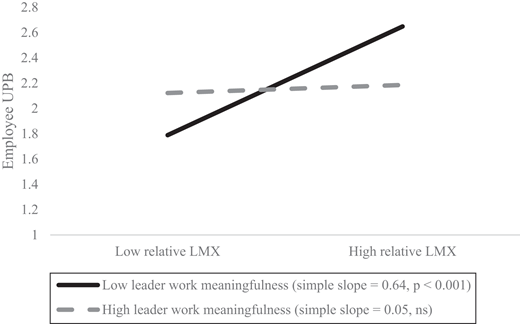
Table 2 shows the multilevel path analysis. H1 and H2 propose that leader empathy is positively related to RLMX, which further increases employee UPB. Supporting both hypotheses, the relationship between leader empathy and RLMX (γ = 0.30, p < 0.05) and that between RLMX and employee UPB (γ = 3.27, p < 0.001) were positive and significant. H3 states that RLMX mediates the positive relationship between leader empathy and employee UPB. The indirect effect of leader empathy and employee UPB via RLMX was 0.98 (95% CI = [0.14, 2.08]). Thus, H3 was supported. Together, the results show that leader empathy promotes employees’ unethical reciprocation in the form of UPB by improving the relative quality of social exchange for those employees compared with other team members (RLMX). This finding supports the social exchange perspective on ethically questionable reciprocation.H4 suggests that leaders’ work meaningfulness moderates the relationship between RLMX and employee UPB. In line with H4, leaders’ work meaningfulness exerts a cross-level moderation on the employee-level relationship between RLMX and employee UPB (B = −0.64, p < 0.01). As indicated in Figure 2, the relationship between RLMX and employee UPB was weaker when leader work meaningfulness was high. Thus, H4 was supported. Finally, supporting H5, the 95% CI of the moderated mediation index did not include zero (moderated mediation index = −0.19, 95% CI = [−0.43, −0.02]). The indirect effect between leader empathy and employee UPB via RLMX was significant when leaders’ work meaningfulness was low (simple indirect effect = 0.19, 95% CI = [0.03, 0.39]) but not when it was high (simple indirect effect = 0.01, 95% CI = [−0.13, 0.18]). The results support a nonuniversal view of reciprocation: whereas employees working under leaders with low work meaningfulness reciprocate high leader empathy and RLMX with UPB, those working under leaders high in work meaningfulness do not engage in such ethically questionable reciprocation. Overall, all hypotheses were supported.
Discussion
Through a group perspective, this study tested a multilevel moderated mediation model examining how leader empathy influences employee UPB through RLMX and how this indirect effect varies with leaders’ work meaningfulness. The results confirmed that leader empathy was positively related to RLMX, which serves as a relational trigger, and mediates its effect on employee UPB. This aligns with prior research highlighting leadership pathways to employee behavior and extends the application of social exchange theory to unethical outcomes (Bryant and Merritt, 2021; Liu et al., 2013).
The findings also show that leaders’ work meaningfulness moderates the RLMX and UPB relationship. Specifically, when leaders had a high sense of work meaningfulness, the positive association between RLMX and employee UPB was weakened. In such contexts, leaders’ work meaningfulness serves as a moral reference point, preventing employees from engaging in UPB. The moderated mediation test further revealed that leader work meaningfulness weakened both the direct effect of RLMX on UPB and the indirect effect of leader empathy via RLMX. These findings also echo the ethical leadership role modeling literature (Kim and Brymer, 2011).
In summary, this study highlights the interactive mechanism among leader empathy, RLMX and leader work meaningfulness in shaping employee UPB. Unlike most prior research emphasizing employee–organization relationships as explanatory mechanisms (Umphress et al., 2010; Mo et al., 2023b), this study shifts the focus to leader–follower dynamics in group settings. It reveals how RLMX channels the effects of leader empathy and how leaders’ meaningfulness signals establish moral boundaries for reciprocity, ultimately reducing the likelihood that employees engage in UPB as a form of exchange.
Theoretical contributions
This study makes several important theoretical contributions to the fields of leadership and organizational behavior. First, it reframes RLMX as a double-edged mechanism. While prior research (Yoon and Yoon, 2019), emphasized only the positive outcomes of RLMX, our findings demonstrate that RLMX can also foster unethical reciprocation, thereby linking leader empathy to UPB. In hospitality contexts, where employees naturally compare the support they receive from leaders with that of their peers (Lee and Lim, 2023), RLMX emerges as a relational trigger that not only strengthens reciprocity but also provides a comparative basis for moral disengagement, further leading to unethical behaviors such as UPB. This extends RLMX theorization by showing how relational imbalances can drive both prosocial and morally ambiguous outcomes.
Second, this study uncovers the dark side of leader empathy. Although empathy has traditionally been associated with inclusivity, fairness and team cohesion (Kellett et al., 2006), our results indicate that it may also encourage UPB when it heightens employees’ perceptions of RLMX. In this sense, leader empathy should not be viewed solely as a cognitive capacity but as a relational construct that can carry ethical risks depending on how it is reciprocated within leader–follower relationships (Jian, 2022; Mahsud et al., 2010). This insight enriches the leadership literature by challenging the assumption that empathy is uniformly beneficial and by demonstrating its potential to inadvertently foster morally ambiguous reciprocation.
Third, this study highlights leader work meaningfulness as a critical boundary condition. By focusing on leaders rather than employees, we extend the meaningfulness literature and show that leaders’ perceptions of the significance and value of their work serve as a moral model that shapes how employees interpret their exchange obligations. Specifically, leader work meaningfulness reduces the likelihood that employees reciprocate strong RLMX with UPB, thereby channeling reciprocity in a more ethical and constructive direction. This provides empirical support for the recent development of social exchange theory (Cropanzano et al., 2017) by demonstrating that leader–follower reciprocity is not value-neutral but is influenced by leaders’ hypernorms, which help set the ethical boundaries of exchange.
Practical implications
This study provides critical practical implications for hospitality industry professionals. First, our findings suggest that while high leader empathy can strengthen leader–employee relationships, it may also unintentionally increase the likelihood of employees engaging in UPB. However, this unintended effect can be mitigated when leaders experience a strong sense of work meaningfulness. Therefore, organizations should recognize the potential ambidextrous effect of empathy and promote leadership development programs that emphasize not only emotional intelligence but also the cultivation of purpose-driven leadership. Training initiatives should help leaders reflect on the broader value and impact of their work, reinforcing ethical awareness alongside empathetic engagement. In hospitality, where empathy is highly encouraged, embedding work meaningfulness into leadership development may serve as a key strategy for preventing and managing employee UPB while maintaining strong relational dynamics.
Second, the findings also highlight the organizational need to manage team dynamics, particularly how employees perceive their relative standing with their leader. In hospitality settings, where leader–employee interactions are often visible and frequent, employees may compare how empathetically they are treated compared to their peers. Such comparisons can shape perceptions of favoritism and may influence behaviors, including the likelihood of engaging in UPB. To mitigate these effects, organizations should develop relevant policies and rules to address the potential consequences of differential treatment and encourage practices that promote fairness and consistency. Organization-level efforts that ensure recognition, responsibilities and development opportunities are distributed transparently can help reduce negative social comparisons. These efforts can support a more inclusive team environment and reduce the ethical risks that may arise from well-intentioned but uneven leader–follower relationships.
Beyond organizational-level implications, this study also carries broader implications for the industry and society. In hospitality, UPB such as misrepresenting service quality, concealing customer complaints or engaging in greenwashing may temporarily protect the organization but ultimately erode customer trust, damage brand reputation, and expose firms to regulatory or legal risks. This erosion will eventually harm organizations and undermine the long-term sustainability, competitiveness and social legitimacy of the hospitality sector (Cain et al., 2025). To mitigate these outcomes, hospitality chains should integrate ethical safeguards into HR systems by linking performance evaluations not only to service outcomes but also to ethical standards of conduct. They also should embed clear ethical codes into corporate policies that not only guide employees on acceptable behaviors but also make clear that favoritism or leader preference is unacceptable in the workplace. From a teaching perspective, hospitality educators should emphasize the double-edged nature of empathy, preparing future leaders to balance emotional intelligence with value-driven decision-making.
Limitations and future research
Despite its theoretical and practical contributions, this study has several limitations that warrant further research. First, data were collected from employees and leaders in the Chinese hospitality industry using convenience sampling and personal networks. This may overrepresent individuals with similar backgrounds or shared connections to the researchers, potentially yielding leaders with comparable views on empathy. The industry- and culture-specific context also limits generalizability. Future research should replicate the model across countries, cultures and industries to test its robustness.
Second, the study used a cross-sectional design. Although multisource data, method bias tests and multilevel modeling reduce concerns about common method variance, causal inference remains limited. Longitudinal or experimental approaches would better capture the temporal dynamics. Time-lagged data could further mitigate method bias, and experience sampling methods could clarify how these processes unfold on a daily basis.
Finally, this study did not account for other leadership traits or contextual factors that may influence UPB. Future work could incorporate variables such as ethical leadership, transformational leadership or ethical climate, as well as individual characteristics like moral identity or value orientation, to develop a more comprehensive understanding of employees’ moral decision-making.
References
Supplementary material
The supplementary material for this article can be found online.