


Cryptocurrency exchanges operate in a hyper-volatile, “wild west” environment, fundamentally challenging existing theories of FinTech success that were built for stable markets. The literature lacks a framework to explain how firms thrive amidst such extreme regulatory ambiguity and institutional distrust. This study resolves this theoretical puzzle by developing a new principle for success in nascent, high-stakes digital ecosystems.
We conduct a multiple-case study of 14 leading cryptocurrency exchanges. Using the belief–action–outcome (BAO) logic as an analytical guide, we deconstruct the strategic actions that separate successful exchanges from failures, synthesising them into a new, empirically grounded framework.
We propose the LAS-VICT principle, a new set of seven critical success factors (CSFs): (1) low user burden, (2) high asset liquidity, (3) scalability, (4) variety, (5) innovativeness, (6) compliance sensitivity and (7) transparency. This framework advances FinTech theory by demonstrating that in low-trust environments, success is less about simple market adaptation and more about mastering a dynamic interplay between navigating volatility, managing complex compliance and actively manufacturing trust.
This study is the first to offer a comprehensive theoretical framework for success in the crypto-exchange sector. By moving beyond the limitations of existing models, the LAS-VICT principle provides a powerful new lens for scholars, managers and regulators to understand and foster sustainable growth in the next wave of disruptive, trust-deficient digital economies, with cryptocurrencies being a dominating part.
1. Introduction
In recent years, cryptocurrencies have gained popularity. At the end of March 2025, the global cryptocurrency market exceeded $2.69 trillion (Coinmarketcap, 2025a). To address adoption barriers, such as the absence of cryptographic key management and user-friendly interfaces (Fröhlich et al., 2021), cryptocurrency exchanges (crypto-exchanges) like Binance and Coinbase have emerged (Dierksmeier and Seele, 2018), potentially promoting cryptocurrency acceptance and proliferation (Au et al., 2024b).
Prior research on cryptocurrencies often focuses on technicalities or price trends, leaving a gap in understanding the factors behind crypto-exchanges’ business success. Crypto-exchanges differ significantly from mainstream FinTech and present heightened social and ethical concerns (Borri and Shakhnov, 2020; Dierksmeier and Seele, 2018). For example, in 2023, the scandal of JPEX, a self-claimed crypto-exchange in Hong Kong, was exposed, which drove concerns about the legitimacy and confidence of cryptocurrency applications (Au et al., 2024a). In addition, the falls of FTX and AAX in late 2022 were not only the losses of their owners but also their customers, as well as the general public, given that their falls had triggered a prolonged bear market (a period often referred to as a “crypto-winter”), along with significant financial losses (Li et al., 2025). These failures highlight a critical research gap: a lack of understanding of the strategic and managerial factors that contribute to the business success of crypto-exchanges.
While previous literature has covered the technical and financial aspects of cryptocurrencies, there remains a lack of understanding of critical success factors (CSFs) for crypto-exchanges. While Lee and Teo (2015) proposed the LASIC principle, which has been widely cited in previous FinTech literature, this set of principles was developed and examined mainly in non-Crypto FinTech. Conversely, the difference between crypto-based FinTech and non-crypto-FinTech lies in the currencies involved (cryptocurrencies vs. fiat currencies), taxation issues, public policies and regulations. Additionally, unlike many FinTech applications operating within a single economy, many cryptocurrency applications span multiple countries. In conjunction with the evolving FinTech landscape, applying this framework to the “wild west” of cryptocurrency (a challenging environment with high volatility and low trust) reveals its theoretical limitations. For example, the chaotic web of international taxation and regulation transforms the pursuit of legitimacy considerations within the LASIC principle from a process of conforming to stable institutions into a high-stakes game of navigating ambiguity and building trust in their absence. Simply put, the existing LASIC model lacks the theoretical vocabulary to account for a context where the very foundations of finance, regulation and trust are being contested and rewritten. This theoretical inadequacy necessitates a new, empirically grounded investigation to forge a more robust framework for their success in this hyper-volatile cryptocurrency landscape.
Through analysing 14 thriving centralised crypto-exchanges based on the belief–action–outcome (BAO) framework, we aimed to pinpoint the CSFs employed to achieve success, including the external drivers, related actions and outcomes. Our research question (RQ) is,
What are the critical success factors for building successful cryptocurrency exchanges?
Our study enhanced our understanding of the LAS-VICT (seven critical success factors, i.e. (1) low user burden, (2) high asset liquidity, (3) scalability, (4) variety, (5) innovativeness, (6) compliance sensitivity and (7) transparency) principles for crypto-exchange success, building on the LASIC Principle (Lee and Teo, 2015) but expanded with empirical evidence. We hoped that our findings might guide the development of crypto-exchanges, fostering not only their business success but also the advantages of cryptocurrencies for the broader general public, such as financial inclusion and reduced transaction times.
The rest of the paper is as follows. First, we will illustrate our literature review on cryptocurrencies, crypto-exchanges and the BAO framework. It will be followed by an explanation of our research method and the findings. Based on the findings, we arrived at a range of theoretical and practical implications before we concluded our study.
2. Literature review
2.1 Cryptocurrencies and crypto-exchanges
Cryptocurrency, a cryptography-secured digital currency, enables safe token transfers and transaction recording on a decentralised ledger (Lee and Teo, 2015; Li and Whinston, 2020). Originating from early blockchain technology, it led to Bitcoin's launch in 2009 (Au et al., 2024c). Key advantages include financial inclusion (Lee and Teo, 2015; Qureshi and Xiong, 2018), privacy protection (Herskind et al., 2020) and faster transactions (Dumitrescu, 2017). However, adoption faces risks such as key loss—permanently locking assets (Fröhlich et al., 2021), illegal uses like scams, money laundering (Brenig et al., 2015) and tax evasion (Dierksmeier and Seele, 2018), as well as price volatility (Ilk et al., 2021; Au et al., 2024c), security threats (Shalini and Santhi, 2019; ur Rehman et al., 2019), high energy consumption (Li et al., 2019) and adoption difficulties (Frizzo-Barker et al., 2020).
As a result, some countries have banned cryptocurrency applications (Borri and Shakhnov, 2020). These issues have led to the emergence of some cryptocurrency-related businesses, such as centralised crypto-exchanges [1]. This encourages some researchers to move beyond the cryptocurrency itself to these businesses, possibly drawing on previous FinTech literature. For example, Au et al. (2024b) developed the LAS-VICT principle, covering seven CSFs of crypto-exchanges, based on the LASIC principle of Lee and Teo (2015) and other FinTech literature (see Table 1 for their details).
A summary of crypto-exchange CSF based on the expanded LASIC principle
| CSF | Description |
|---|---|
| Low margin | Profit margins remain low at the user level to attract a critical mass of users and, thus, establish a network effect. In turn, profitability may be attained by increased demand for the core services and other channels (Lee and Teo, 2015; Singh, 2020) |
| Asset light | Asset-light businesses can innovate and scale without high fixed costs. By utilising existing infrastructure, they can develop new revenue streams without significantly increasing fixed or setup costs (Lee and Teo, 2015). This allows FinTech firms to be more agile in response to external changes (Nicoletti, 2017) |
| Scalable | FinTech startups must be able to scale without significantly raising costs or sacrificing efficiency to harness network externalities. This involves shifting operations online rather than relying on physical outlets (Lee and Teo, 2015), building ecosystems to engage collaborators (Muthukannan et al., 2021) and adopting platform-mediated approaches to manage vast transactions (Bruton et al., 2015) |
| Variety | When competing with other FinTech businesses, providing a more comprehensive range of product or service options can enhance customers' likelihood of choosing the exchange (Kahn, 1995). In the FinTech context, this can contribute to a thriving ecosystem that helps to meet clients' needs more thoroughly (Leong et al., 2017). In crypto-exchange contexts, product and service offerings can be categorised into three main groups: deposit, wealth accumulation and withdrawal (Shieh et al., 2023) |
| Innovative | Successful FinTech businesses should innovate in both products and operations (Gimpel et al., 2018; Liu et al., 2020). For example, the proliferation of smartphones and contactless technologies enables more FinTech innovations (Lee and Teo, 2015) |
| Compliance easy | Businesses not subject to high compliance regimes can focus more on innovations, given that they may face lower capital requirements and spend fewer resources on compliance activities (Lee and Teo, 2015; Bu et al., 2022) |
| Transparency | Transparency impacts users' propensity to switch to FinTech options (Jünger and Mietzner, 2020; Chen et al., 2022). Additionally, FinTech can mitigate the risk of financial instability through enhanced transparency (Fung et al., 2020) |
2.1.1 Existing research gaps on cryptocurrency exchanges
Prior literature on cryptocurrencies mainly focused on technical aspects or individual usage behaviour (e.g. Li and Whinston, 2020; Mattke et al., 2021), but fostering the wider adoption of technologies by the public should step beyond the technical aspects for business success. The unique drawbacks of cryptocurrency applications (e.g. ethical concerns) and differences from non-crypto applications (e.g. currencies involved and associated regulatory tensions) may highlight distinct factors influencing the success of cryptocurrency services compared to other FinTech applications. Therefore, the LASIC principle suggested by Lee and Teo (2015), which was developed based on two non-crypto Fintech firms, may not explain the CSFs of crypto-exchanges and did not consider the possible role of crypto-exchanges in shaping the regulatory environment. Au et al. (2024b) discussed some CSFs of crypto-exchanges, which potentially advanced the LASIC principle, but only focused on the general users' continuous intention to adopt crypto-exchanges, without understanding the antecedent conditions and outcomes of each CSF.
In response to our RQ, we assumed that external stimuli would influence belief in crypto-exchanges (e.g. market needs), which would lead to a range of actions in their development (e.g. introduction of different products and services), thus achieving different outcomes (e.g. more customers engaged). Thus, we refer to the BAO framework as a basis for building a theoretical foundation to guide our study.
2.2 Belief–action–outcome (BAO) framework
The BAO framework proposes that organisational behaviours stem from beliefs and actions at both macro and micro levels. Developed by Melville (2010), the framework was initially related to information systems (IS) innovations for environmental sustainability but has been adopted in broader contexts and elaborated by previous literature. Table 2 discusses the three primary concepts involved, along with relevant literature that has expanded or elaborated on the BAO framework.
The three main concepts in the BAO framework
| Terminologies | Description |
|---|---|
| Belief | Belief formation is primarily driven by one's experience (Pilditch and Custers, 2018), capabilities (Molla et al., 2014), norms and attitudes (Recker, 2016), as well as broader social and external influences (Au et al., 2023). These define one's expectations about others' behaviour and organise enduring interpersonal relationships |
| Action | An action, such as information systems (IS) adoptions to improve organisational recycling or facilitate ridesharing and purchase decisions (Kang et al., 2023), may be explained by an individual or organisational view of the environment. Such actions may be facilitated by the facilities and capabilities available to users and can be changed by different measures, such as training, education and experience (Anthony, 2019; Pilditch and Custers, 2018) |
| Outcome | Outcomes are about how actions affect social and organisational systems (Anthony, 2019), which can be societal impact (Au et al., 2023; Molla et al., 2014), individual performance improvement (Anthony, 2019) and self-confidence (Hong et al., 2022) |
Additionally, Table 3 presents a selection of previous studies that utilised the BAO Framework as their primary theoretical foundation, outlining their contexts and the key factors identified across the framework's three dimensions. Yet, among these previous studies, the applications of the BAO framework in cryptocurrency-related businesses were not commonly used in previous FinTech literature, which suggested a potential need to apply the BAO framework to FinTech contexts (such as crypto-exchanges).
A selected list of studies based on the BAO framework
| References | Contexts | Belief-related factors | Action-related factors | Outcome-related factors |
|---|---|---|---|---|
| Gräuler et al. (2013) | Online sustainability reports | Willingness to read, Expected benefits | Report consumption | Trust, Satisfaction |
| Molla et al. (2014) | Pro-environmental behaviour of IT professionals | Information acquisition capabilities | Attitude | Pro-environmental IT practice |
| Spangler et al. (2014) | Sustainability-focused knowledge management | System consistency, uniformity and interface suitability | Sustainability actions, knowledge sharing | Pro-environmental practice |
| Anthony (2019) | Green IS adoption | Beliefs of IT professionals and executives | Information Diffusion, IT infrastructure deployment, organisational strategy adoption | Environmental performance |
| Hong et al. (2022) | Post-graduation study | Self-efficacy | Active learning behaviour | Self-confidence, study duration |
| Au et al. (2023) | Consumers' online brand defending and ideological polarisation | Sentiment to brand | Purchase intention, positive/negative eWOM behaviour | Brand's eWOM, Market share |
| Alghamdi et al. (2023) | Carbon-intensity control | IT premises availability and demand | Board oversight, management incentive | Carbon intensity |
| Balozian et al. (2023) | Organisational Information Security Measures | Belief in the importance or risk | Adaptive responses, Maladaptive responses | Security level enhancement, individual experience |
| Kang et al. (2023) | Celebrities' endorsement and consumers' brand-defending behaviour | Perceived attractiveness, Trustworthiness and Ability (of celebrities) | Consumers' online brand defense, Purchase intention | Brand's eWOM |
| Xu et al. (2024) | IS-enabled sustainability transformation | Goal, Existence of alliance | Development of norms and infrastructure | Eco-effectiveness, community growth |
Similar to many other theoretical frameworks, the BAO framework alone may not be sufficient to capture the increasingly complex market dynamics fully. However, we regard BAO as a better framework to address our RQ compared with other frameworks, such as the technology acceptance model (TAM) and the Technology-Organisation-Environment (TOE) framework. For example, the TAM model is related to individual usage behaviours, which has a too-narrow scope, while our focus falls on the business's strategy for achieving success. On the other hand, while the TOE framework may be used for organisational-level studies, the BAO framework can provide a more process-oriented view and help us understand not only the needed drivers for successful crypto-exchanges and the reasons behind them, but also the outcomes of achieving such drivers.
To clarify the unique contribution of our study, we explicitly position our choice of the BAO framework against two common alternatives in technology research: the TAM and the TOE framework. First, TAM is fundamentally a theory of end-user adoption, focusing on perceived usefulness and ease of use. It is designed to answer, “Will an individual use this technology?” Our research, however, addresses a question of organisational strategy, while applying TAM would be a categorical error, mistaking the user for the architect. Second, while the TOE framework operates at the correct organisational level, it provides a static, factor-based “checklist” of technological, organisational and environmental attributes that influence adoption. It answers what factors are relevant. In contrast, BAO provides a dynamic, process-oriented “playbook” that explains how managers' beliefs about these factors are translated into specific actions to produce concrete outcomes. Our goal is not to list the drivers of success but to theorise the process of achieving them. For this purpose, BAO is not merely a better choice; it is the necessary one.
3. Research method
We adopted qualitative methods for several reasons. Firstly, the phenomenon of cryptocurrency exchanges is inherently multidimensional and rapidly evolving, involving an intricate interplay of external, technological and socio-ethical aspects. An objective, quantitative approach would struggle to capture the nuances and emergent properties of success in such a nascent and complex domain (Gable, 1994). Secondly, qualitative methods excel in discerning how particular outcomes (i.e. crypto-exchange business successes) or processes can evolve (Markus and Robey, 1988), and allow a deeper understanding of various stakeholders' perspectives (Klein and Myers, 1999).
Additionally, we employed some practices of netnography, as crypto-exchanges and broader cryptocurrency applications are predominantly online. Netnography is a written account of studying cultures and communities formed through Internet-based communications, following cultural anthropology traditions and techniques. This approach uncovers profound insights into less-explored phenomena and aligns well with qualitative methods (Kozinets, 2010). Netnography also retrieves informants' thoughts without inhibition (Rageh et al., 2013) or researchers' biases (Langer and Beckman, 2005). Specifically for our study, adopting netnography practices can help us include not only the official voice of crypto-exchanges but also users' insights and the broader Internet world. This is related to not only building an unbiased image but also acquiring an understanding of the broader outcomes of crypto-exchanges upon realising the identified CSFs.
Our chosen research design, a multiple-case study employing netnography and analysed through the systematic Gioia method, was selected for its exploratory capabilities and its alignment with our objective of building and elaborating theory in a nascent context. We were not to build a new theory from scratch (grounded theory) but rather to apply and extend an existing framework (BAO) to a new, important context (cryptocurrency exchanges).
3.1 Data collection
As the crypto-exchanges sector is still emerging (Shieh et al., 2023), we analysed and compared multiple successful cases to identify desired attributes and their realisation. To identify the CSFs for thriving crypto-exchanges, we employed a purposive sampling strategy. This approach, in contrast to random sampling, is appropriate for our qualitative design, as it ensures that implications are rooted in established practices (Pan and Tan, 2011). Our case selection criteria were operationalised across three key dimensions to ensure a comprehensive view of success in the crypto-exchange sector:
Market adoption: We assessed user reach through publicly available metrics, such as mobile app downloads and social media engagement (e.g. Binance with ∼100 million Google Play downloads and 2.3 million Facebook followers; Crypto.com with 10 million Google Play downloads and 0.7 million Facebook followers), as high user numbers signal market acceptance and trust.
Financial robustness: We examined total funding and valuation data from reputable industry databases (e.g. Crunchbase) to ensure the selection of financially stable entities. This metric serves as a proxy for investor confidence and long-term viability.
Industry reputation: We utilised external ratings and rankings from independent cryptocurrency review sites, such as CoinGecko (Lee, 2025) and CoinMarketCap (Coinmarketcap, 2025b), to identify top-tier performers with strong reputations for liquidity, security and service.
By selecting cases that demonstrated success across these multiple dimensions, we aimed to uncover the standard strategies and practices that distinguish thriving exchanges. The final sample size of 14 cases (see Table 4) was determined by the principle of theoretical saturation, where data collection continued until new cases no longer yielded novel insights or themes related to our RQ. This ensured that our findings were robust and grounded in a rich dataset from established industry leaders. Our selections generally aligned with centralised crypto-exchanges' rankings regarding market shares and trading volume at the time of our research.
The list of covered crypto-exchanges
| Name | Year of establishment | Headquarter location |
|---|---|---|
| Uphold | 2014 | London, UK |
| Coinbase | 2012 | San Francisco, US (∼2020/5) No headquarters (Now) |
| Crypto.com | 2016 | Singapore |
| Binance | 2017 | Malta |
| Nexo | 2018 | Sofia, Bulgaria |
| Kraken | 2011 | San Francisco, US |
| KuCoin | 2017 | Republic of Seychelles |
| Huobi | 2013 | Republic of Seychelles |
| Gate.io | 2013 | Hong Kong |
| Bitfinex | 2012 | Hong Kong |
| Bybit | 2018 | Singapore |
| Gemini | 2014 | New York, US |
| BlockFi | 2017 | New York, US |
| OKX | 2017 | Valletta, Malta |
After selecting the cases, we collected data from June 2023 to March 2025. Our research employed a netnographic approach, which provided invaluable primary qualitative data by allowing us to capture authentic, unfiltered user perspectives and sentiments from a range of online review platforms and the public. However, a key concern of using netnography is self-selection bias, as user-generated content is typically created by a non-representative sample of users—those who are most motivated to share their experiences. These user comments are presented not as generalisable public opinion, but as illustrative examples of the authentic, unfiltered sentiment of crypto-exchanges’ users. Conversely, to mitigate this, our multi-source data collection strategy was deliberately designed to achieve robust data triangulation (see Table 5 for data source information). By cross-verifying insights from netnographic data with more formal information from industry reports and official company disclosures, we were able to identify consistent patterns and achieve a more balanced view of the phenomena, reducing the potential for bias inherent in relying on any single source.
A summary of data sources for reviewing different crypto-exchanges
| Types of sources | Description |
|---|---|
| Startup and technology news reporting websites | These websites discussed the development and successes of different FinTech and cryptocurrency firms. Examples included Coindesk.com, G2.com, businesswire.com and TechCrunch.com. Some URLs of the web pages that we checked are as follows |
| Online review portals of technological services | Customers of technological services, including crypto-exchanges, often share comments and insights. These inputs can reveal their successes, how they achieved the necessary attributes and hint at whether we should include them in our data collection. Sources of these comments and insights include G2.com, Finder.com.au and Coindesk.com. More specifically, some URLs of the web pages that we checked are as follows
|
| External online communities | Online cryptocurrency-related forums indicated user viewpoints on different crypto-exchanges and trends. Interactions among forum members were analysed alongside online reviews, revealing additional facets of these services. Some of the related links are as follows
|
| Official blogs and websites | Some exchanges have their own blogs (e.g. Uphold, Coinbase and Binance). These provided information on their updates and senior executives' insights. Some of the website URLs are as follows
|
We also searched Google using selected firm names and cryptocurrencies as keywords to ensure a comprehensive data collection process. To ensure data transparency, we have included a range of footnotes within the findings section, indicating the sources from which we obtained the data. Moreover, during the data collection process, we used Excel to track data sources, providing an overview of the data.
3.2 Data analysis
To leverage the flexibility of qualitative research methods, we simultaneously gathered and analysed data (Eisenhardt, 1989). We established an initial set of theoretical lenses based on the literature on cryptocurrencies and FinTech business successes (Pan and Tan, 2011), which included several aggregate theoretical dimensions and second-order themes (see Table 6).
Initial dimensions and themes of the theoretical lens
| Theoretical dimensions | Second-order themes |
|---|---|
| Cryptocurrencies | |
| Characteristics | Financial inclusions (Lee and Teo, 2015; Qureshi and Xiong, 2018), Privacy protections (Herskind et al., 2020), Reduced transaction time (Dumitrescu, 2017) |
| Business opportunities | Cryptocurrency exchanges (Dierksmeier and Seele, 2018; Suratkar et al., 2020), Cryptocurrency wallets (Dierksmeier and Seele, 2018; Suratkar et al., 2020) |
| Dark sides | Loss of key (Fröhlich et al., 2021), Illegal applications (Brenig et al., 2015), Tax evasion (Dierksmeier and Seele, 2018), Price volatility (Ilk et al., 2021; Au et al., 2024c), Security issues (Shalini and Santhi, 2019, Ur Rehman et al., 2019), Electricity wastage (Li et al., 2019), Adoption difficulties (Frizzo-Barker et al., 2020) |
| Critical success factors of cryptocurrency business (See Table 1) | Low margin, Asset light, Scalable, Variety, Innovative, Compliance easy, Transparency |
| Belief–action–outcome framework | |
| Belief | Capabilities (Molla et al., 2014), Norms and attitude (Recker, 2016), Social and external influences (Au et al., 2023) |
| Actions | IS Adoptions (Anthony, 2019; Pilditch and Custers, 2018), Purchase decisions (Kang et al., 2023) |
| Outcomes | Societal impact (Au et al., 2023; Molla et al., 2014), Individual performance improvement (Anthony, 2019), Self-confidence (Hong et al., 2022) |
The data collected were coded using a mix of open, axial and selective coding (Strauss and Corbin, 1998). More specifically, open coding was used to assign conceptual labels to our data to create first-order concepts that had not been anticipated a priori (see Van Maanen, 1979). The first-order concepts were then grouped into second-order themes via axial coding. Axial coding was used to validate the existing second-order themes of our theoretical lens (e.g. business opportunities) or identify new themes (e.g. service options) that did not fall within our current schema. Selective coding was used to distil the second-order themes into new or existing aggregate dimensions.
For example, upon identifying the quotes from Uphold's executive about the importance of asset portfolio diversification and the wide range of service options offered by the crypto-exchanges which we studied, we identified these as the empirical evidence which suggested service variety (a second-order theme under the theoretical dimensions “Critical Success Factor”). Similarly, when we identified the <1% spread of the transaction amount in Uphold (and other crypto-exchanges) and the crypto-variants (cryptocurrency-based versions of traditional financial products or services) which facilitated users' transition from traditional options to cryptocurrency-based options, we regarded them as the empirical evidence which indicates a low user-burden (another second-order theme under the theoretical dimension “Critical Success Factor”). Appendix 1 shows three examples of the Gioia structure derived as a result of these coding efforts.
The iterative coding process, culminating in the detailed Gioia structures, served as a transparent audit trail, ensuring that our findings were systematically derived from the data. Furthermore, our commitment to triangulation was paramount during data analysis. Themes and concepts emerging from official reports were consistently cross-referenced with user sentiments from online forums and reviews. Only insights supported by converging evidence across multiple, diverse data sources were retained as validated findings, thereby actively mitigating potential biases from any single source and enhancing the overall trustworthiness of our conclusions.
When potential implications surfaced in one case, we sought corresponding evidence in another to validate them. Implications were included in our findings only if triangulating evidence was identified. We used visual maps, tables and narratives to interpret the extensive data (Langley, 1999). We analysed successful crypto-exchanges until we achieved theoretical saturation (Eisenhardt and Graebner, 2007; Pan and Tan, 2011), indicating that derived implications for building successful crypto-exchanges adequately explained the data, and further data would not yield new insights (Eisenhardt, 1989). Our choice of 14 crypto-exchanges was made at this point of theoretical saturation.
4. Findings
By triangulating the findings from different crypto-exchanges, we validated the role of seven CSFs of crypto-exchanges, and identified the more specific antecedent conditions, measures and outcomes of realising these factors.
4.1 Low user-burden
The first CSF that we identified is low user-burden (see related external influence on belief, realised actions and outcomes in Figure 1).
 The flow diagram is arranged from left to right and consists of three rectangular sections connected by thick solid arrows pointing from one section to the next. The left rectangle is titled “External Influence on Belief” and contains a bulleted list beginning with “The need to maintain low users perceived costs”, followed by three sub-bullets listed top to bottom as “Transaction fee”, “Price volatility”, and “Compliance”. A solid arrow connects this left rectangle to the central rectangle titled “Realising Actions”. Inside the central rectangle, two bulleted items are listed in top-to-bottom order: “Charging no fixed cost but only a small spread of the transaction amount”, and “Introducing crypto-variants of traditional products or services with more favourable rates”. A second solid arrow connects the central rectangle to the right rectangle titled “Outcomes”. The right rectangle lists two bulleted outcomes in top-to-bottom order: “Formation of the critical mass of users”, and “Lower user switching intention”.
An illustration of low user-burden as CSF in the crypto-exchange contexts, including related external influence on belief, realised actions and outcomes
The flow diagram is arranged from left to right and consists of three rectangular sections connected by thick solid arrows pointing from one section to the next. The left rectangle is titled “External Influence on Belief” and contains a bulleted list beginning with “The need to maintain low users perceived costs”, followed by three sub-bullets listed top to bottom as “Transaction fee”, “Price volatility”, and “Compliance”. A solid arrow connects this left rectangle to the central rectangle titled “Realising Actions”. Inside the central rectangle, two bulleted items are listed in top-to-bottom order: “Charging no fixed cost but only a small spread of the transaction amount”, and “Introducing crypto-variants of traditional products or services with more favourable rates”. A second solid arrow connects the central rectangle to the right rectangle titled “Outcomes”. The right rectangle lists two bulleted outcomes in top-to-bottom order: “Formation of the critical mass of users”, and “Lower user switching intention”.An illustration of low user-burden as CSF in the crypto-exchange contexts, including related external influence on belief, realised actions and outcomes
In the FinTech sector, there is a strong belief in the need to maintain low users' perceived costs. Therefore, Uphold, for instance, realise the low-user burden by typically charging no fixed cost but a spread of less than 1% of the transaction amount. This reduced barriers to the unbanked's access to these services (Dierksmeier and Seele, 2018; Lee and Teo, 2015). Uphold's executive director in India detailed their commitment to serving the unbanked population on their blog [2].
By opening services to India, we continue to move toward our mission to bring the 2.5 billion underbanked accessible and affordable financial service solutions for fast, free, and easy movement of money.
Another realising action involves introducing crypto-variants, such as crypto-linked debit cards offered by crypto-exchanges like Crypto.com, Binance and Gemini. These cards are connected to users' cryptocurrency wallets within the exchanges. Mirroring traditional credit card programs, these cards offer benefits catering to users' needs, such as reimbursement for online video streaming subscriptions and complimentary airport lounge access (Crypto.com) [3]. Consequently, users can enjoy a cost-effective experience and face fewer challenges in daily life and managing cryptocurrency investments.
Yet, users expect platform-based services like crypto-exchanges to be free or affordable (Au and Ho, 2021). Therefore, some crypto-exchanges (e.g. Gemini and BlockFi) acted further with financial incentives with more favourable rates, such as high-yield cryptocurrency savings with an average annual interest rate of 10%, surpassing traditional savings rates. Besides reduced service costs and interest gains, certain crypto-exchanges (e.g. Uphold, Coinbase and gate.io) helped users meet tax obligations (Chason, 2019). Uphold partnered with Koinly and TaxBit (two accounting firms) to aid users in preparing tax returns for cryptocurrency assets, leading to a low user burden in compliance. Uphold's Executive Vice President (Head of Growth and Partnerships) explained the taxation burdens on cryptocurrency holders and how their services could help [4].
We are excited to announce the launch of TaxBit on Uphold. TaxBit is a tax engine that supports transactions between any crypto or fiat currency. Their mission is to help cryptocurrency become mainstream by facilitating easy compliance with government tax rules. TaxBit provides consumers with an easy way to file their cryptocurrency taxes …. In the past, laws around United States cryptocurrency taxes were blurry and confusing. This caused many crypto-holders to take the risk of avoiding taxes altogether.
The outcomes were lower user switching intention in these services since a high perceived compliance cost may otherwise discontinue their usage (Newlands et al., 2019). Perceiving lower financial and legal burdens, users remain within the same crypto-exchange. A critical mass of users can thus be formed.
4.2 Asset liquidity high
Another CSF that we identified is asset liquidity-high (see related external influence on belief, realised actions and outcomes in Figure 2). We found that successful crypto-exchanges had light fixed assets and high asset liquidity (Lee and Teo, 2015). This is reflected in their transaction volume, profit, revenue and asset size ratio. In 2021, Uphold, with assets below US$500 million, recorded transactions of US$25.5 billion by December. Coinbase, with assets of US$28 billion, achieved quarterly transactions of over US$300 billion. In both cases, transaction volumes far exceeded asset sizes.
 The flow diagram consists of three rectangular boxes arranged horizontally and connected by solid arrows. The left box is labeled “External Influence on Belief” and contains a bullet point reading “The capital needs for expansion of crypto-exchanges”. A solid arrow connects this box to the middle box labeled “Realising Actions”, which contains two bullet points reading “Decreasing overhead cost” and “Decreasing the need for owning or maintaining fixed assets”. A solid arrow then connects the middle box to the right box labeled “Outcomes”, which contains a bullet point reading “Higher scalability for long-term development”.
An illustration of asset liquidity-high as CSF, in the crypto-exchange contexts, including related external influence on belief, realised actions and outcomes
The flow diagram consists of three rectangular boxes arranged horizontally and connected by solid arrows. The left box is labeled “External Influence on Belief” and contains a bullet point reading “The capital needs for expansion of crypto-exchanges”. A solid arrow connects this box to the middle box labeled “Realising Actions”, which contains two bullet points reading “Decreasing overhead cost” and “Decreasing the need for owning or maintaining fixed assets”. A solid arrow then connects the middle box to the right box labeled “Outcomes”, which contains a bullet point reading “Higher scalability for long-term development”.An illustration of asset liquidity-high as CSF, in the crypto-exchange contexts, including related external influence on belief, realised actions and outcomes
Comparing profit and revenue to asset size, although not all crypto-exchanges disclose financial performance, we compared two exchanges with two traditional international banks (see Table 7). Crypto-exchanges’ higher profit-asset and revenue-asset ratios indicated they achieved comparable profit and revenue levels with lighter assets.
Selected financial information for Standard Chartered Bank, HSBC, Coinbase and HTXa
| Company | Year | Asset value (billion) | Revenue (billion) | Profit (billion) | Profit–asset ratio | Revenue–asset ratio |
|---|---|---|---|---|---|---|
| Traditional bank | ||||||
| Standard Chartered Bank (SCB) | 2024 | 849.688 | 19.696 | 6.811 | 0.81% | 2.32% |
| HSBC | 2024 | 3,017 | 65.9 | 32.3 | 1.07% | 2.18% |
| Crypto-exchanges | ||||||
| Coinbase | 2024 | 22.5 | 6.6 | 2.6 | 11.55% | 29.3% |
| HTX | 2021 | 0.11 | 0.078 | 0.023 | 20.67% | 69.55% |
Note(s): aThis comparison is for illustrative purposes only to highlight the differences in their financial models and is not intended to suggest they are direct equivalents or operate under the same regulatory framework
Such greater asset liquidity is primarily driven by the belief in capital needs for expansion. Coinbase, for instance, acquired FairX, a derivatives exchange regulated by the US Commodity Futures Trading Commission, to enhance the development of crypto-derivative markets, as explained in their blog [5].
Today, we’re announcing the acquisition of FairX, a CFTC [6]-regulated derivatives exchange or Designated Contract Market, which represents our next step toward creating the robust and holistic trading environment investors are seeking. Through this acquisition, we plan to bring regulated crypto derivatives to market, initially through FairX’s existing partner ecosystem.
Similarly, Uphold expanded through acquisitions like JNK Securities, and KuCoin invested in various blockchain projects to broaden its service ecosystem.
Beyond their financial information, their operational models also reflect their light fixed assets. They operate mainly online, akin to neobanks [7], and many of their job positions allow remote work, providing benefits for both the companies and employees, as explained in Kraken's blog [8].
The benefits to both the company and employees extends beyond commuting time and costs. Work-from-home provides: lower administrative and overhead costs, work-family balance, stress reduction, health advantages and improved morale.
These actions might help decrease overhead costs and the need for owning or maintaining fixed assets like branches and office spaces (Adikaram et al., 2021), leading to the outcomes of enhanced asset liquidity and thus higher scalability for long-term development (Lee and Teo, 2015), rather than supporting short-term operations or acquiring fixed assets for business maintenance.
4.3 Scalability
Another CSF that we identified is scalability (see related external influence on belief, realised actions and outcomes in Figure 3).
 The flow diagram consists of three rectangular boxes arranged horizontally and connected by solid rightward arrows. The left box is labeled “External Influence on Belief” and contains two bullet points reading “Rapidly changing environment and cryptocurrency sector” and “Increasing traffic volume”. A solid arrow connects this box to the middle box labeled “Realising Actions”, which contains two bullet points reading “Establish infrastructure with constant updates and A P I for external collaborators’ input” and “Adopting digital platforms as service frontends”. A solid arrow then connects the middle box to the right box labeled “Outcomes”, which contains two bullet points reading “Scaled-up services offering” and “Higher traffic volume supported”.
An illustration of scalability as CSF in the crypto-exchange contexts, including related external influence on belief, realised actions and outcomes
The flow diagram consists of three rectangular boxes arranged horizontally and connected by solid rightward arrows. The left box is labeled “External Influence on Belief” and contains two bullet points reading “Rapidly changing environment and cryptocurrency sector” and “Increasing traffic volume”. A solid arrow connects this box to the middle box labeled “Realising Actions”, which contains two bullet points reading “Establish infrastructure with constant updates and A P I for external collaborators’ input” and “Adopting digital platforms as service frontends”. A solid arrow then connects the middle box to the right box labeled “Outcomes”, which contains two bullet points reading “Scaled-up services offering” and “Higher traffic volume supported”.An illustration of scalability as CSF in the crypto-exchange contexts, including related external influence on belief, realised actions and outcomes
We observed selected crypto-exchanges’ scalability (Lee and Teo, 2015), as reflected by their rapid growth. This is essential given the wide belief of increasing traffic volumes and the rapidly changing environment and cryptocurrency sector (Halaburda et al., 2022). In Coinbase's blog, an engineer emphasised the significance of platform scalability [9].
In 2017, the world saw an explosion in the popularity of cryptocurrency, and the ecosystem’s total market cap jumped from $20 billion to $600 billion. During this time, almost every component of Coinbase’s technology was battle-tested, and it showed our team that we need to focus on the reliability and scalability of our platform, just like we do with security.
Moreover, Coinbase's valuation surged from about USD$1.6 billion in 2017 to USD$28 billion in 2020. Official reports highlighted the substantial growth in assets under management, total transaction volume and integrated apps (number of mobile apps utilising Coinbase's application programming interface (API) [10]).
One of the first realising actions was constant infrastructure updates and testing, thereby supporting higher traffic volumes. In the same Coinbase blog article in which an engineer discussed platform scalability, the practices of scalability were elaborated further.
We worked around the clock to perform tasks like vertically scaling, upgrading database versions to take advantage of performance improvements, optimising indexes, and splitting out hotspot collections into their own clusters. Each of these improvements bought us headroom, but these low-hanging fruit were beginning to dry up, and traffic was continuing to climb.
In addition, Binance, on its blog, stated the importance of ensuring scalability via capacity management and automatic load testing [11].
Binance leverages capacity management for unplanned traffic surges caused by high volatility, ensuring adequate, timely infrastructure and computing resources for business demands ….Binance load tests in the production environment (rather than a staging environment) to get accurate service benchmarks. This method helps validate that our resource allocation is adequate to serve a defined load.
Moreover, crypto-exchanges adopted digital platforms as service frontends, consistently handling rising traffic (Bruton et al., 2015). Their scalability is facilitated by their APIs that facilitate external input, thus promoting interoperability and integrating numerous apps (Rai et al., 2019), as seen with Coinbase. Uphold, Gate.io and Bitfinex, among others, use APIs to share data with collaborators (Alaimo et al., 2020) and enable self-organisation (Tan et al., 2015).
The outcomes were user-enjoyed scaled-up service offerings, such as crypto-linked debit cards, savings, lending and investment services (see Appendix 2), which can be expanded with minimal additional attention needed from crypto-exchanges.
4.4 Variety
Another CSF that we identified is variety (see related external influence on belief, realised actions and outcomes in Figure 4). This is due to the belief in diversified users' needs and innovativeness, as well as risk and cryptocurrency price volatility (Au et al., 2024c) within the FinTech sector.
 The flow diagram is arranged from left to right and consists of three rectangular boxes connected by thick solid arrows that link each section sequentially. The left rectangle is titled “External Influence on Belief” and contains two bullet points listed from top to bottom: “Diversified users’ needs and innovativeness”, and “Risk and price volatility of cryptocurrencies”. A solid arrow connects the “External Influence on Belief” box to the central rectangle titled “Realising Actions”. The central rectangle contains two bullet points listed from top to bottom: “Introducing a wide range of options, including crypto-variants of financial service options”, and “Supporting a wider range of assets”. A second solid arrow connects the “Realising Actions” rectangle to the right rectangle titled “Outcomes”. The right rectangle contains a single bullet point reading “Increased need coverage”.
An illustration of variety as CSF in the crypto-exchange contexts, including related external influence on belief, realised actions and outcomes
The flow diagram is arranged from left to right and consists of three rectangular boxes connected by thick solid arrows that link each section sequentially. The left rectangle is titled “External Influence on Belief” and contains two bullet points listed from top to bottom: “Diversified users’ needs and innovativeness”, and “Risk and price volatility of cryptocurrencies”. A solid arrow connects the “External Influence on Belief” box to the central rectangle titled “Realising Actions”. The central rectangle contains two bullet points listed from top to bottom: “Introducing a wide range of options, including crypto-variants of financial service options”, and “Supporting a wider range of assets”. A second solid arrow connects the “Realising Actions” rectangle to the right rectangle titled “Outcomes”. The right rectangle contains a single bullet point reading “Increased need coverage”.An illustration of variety as CSF in the crypto-exchange contexts, including related external influence on belief, realised actions and outcomes
The realising actions included, for example, introducing a wide range of supported assets and diverse crypto-linked services. Uphold offers a starter guide to cryptocurrency investment risks, stating the importance of holding a variety of cryptocurrencies [12].
A key strategy for managing risk is diversification, which means spreading your investments across different asset classes, such as stocks, bonds and crypto assets. This reduces your overall exposure to any single market or asset.
Moreover, all selected exchanges introduce a broad array of cryptocurrency-related services catering to various stakeholders [13]. These services (e.g. crypto-linked debit cards as discussed in the low user-burden sub-section, and other measures listed in Appendix 2) often resemble offerings from traditional financial institutions, but cryptocurrencies are being used.
Yet, many firms innovate further. Uphold, KuCoin and Bybit, for instance, introduced crypto-based lottery and gaming options, a feature absent in most traditional financial institutions.
Moreover, as discussed in the scalability sub-section, crypto-exchanges’ API [14] infrastructure may lead to more service options, akin to the open-banking practices [15] of other financial institutions (Mansfield-Devine, 2016). The outcomes of combining traditional-like and innovative service offerings, in turn, were a variety of services that cover users' diversified needs and increase their adoption.
4.5 Innovativeness
Another CSF that we identified is innovativeness (see related external influence on belief, realised actions and outcomes in Figure 5). The belief of a highly competitive landscape has been proliferating in the crypto-exchange sector (Halaburda et al., 2022), which compels market players to innovate to overcome adoption barriers (Fröhlich et al., 2021) and other cryptocurrency challenges.
 The flow diagram is arranged from left to right and contains three rectangular boxes connected by thick solid arrows. The left rectangle is titled “External Influence on Belief” and lists two bullet points in top-to-bottom order: “Highly competitive landscape”, and “The need for overcoming adoption barriers”. A solid rightward arrow connects this box to the central rectangle titled “Realising Actions”. The central rectangle contains three bullet points listed from top to bottom: “Creating a culture of innovativeness”, “Including ostensibly unrelated options for users’ engagement”, and “Utilising A P I infrastructure for external collaborators’ input”. A second solid rightward arrow connects the central rectangle to the right rectangle titled “Outcomes”. The right rectangle contains a single bullet point reading “A wider range of service options was launched, possibly in non-financial service contexts”.
An illustration of innovativeness as CSF in the crypto-exchange contexts, including related external influence on belief, realised actions and outcomes
The flow diagram is arranged from left to right and contains three rectangular boxes connected by thick solid arrows. The left rectangle is titled “External Influence on Belief” and lists two bullet points in top-to-bottom order: “Highly competitive landscape”, and “The need for overcoming adoption barriers”. A solid rightward arrow connects this box to the central rectangle titled “Realising Actions”. The central rectangle contains three bullet points listed from top to bottom: “Creating a culture of innovativeness”, “Including ostensibly unrelated options for users’ engagement”, and “Utilising A P I infrastructure for external collaborators’ input”. A second solid rightward arrow connects the central rectangle to the right rectangle titled “Outcomes”. The right rectangle contains a single bullet point reading “A wider range of service options was launched, possibly in non-financial service contexts”.An illustration of innovativeness as CSF in the crypto-exchange contexts, including related external influence on belief, realised actions and outcomes
This led to the realising of actions, for example, creating an innovative culture. Uphold, for instance, emphasises innovation and supports technological advancements with external partners. Their executive VP elaborated [16]:
Blockchain technology needs to continue to innovate. Otherwise, we have a technology that’s too slow, hard to code, and will be hard to find good developers.
Innovativeness was also emphasised by Coinbase as part of their culture, which enabled their wider range of products and innovations. Their chief product officer explained further in their blog [17].
From the beginning, Coinbase has created a culture of continuous innovation, and as a result, it’s become a place where innovators and entrepreneurs thrive. We make it easy for employees to dream up new ideas, build new products, and bring them to market.
Realising actions also include providers' coverage of ostensibly unrelated options into their services, such as lottery (by KuCoin), online gaming (by Uphold), progressive learning paths (by gate.io) and gift card redemptions (by Uphold). These features incentivise cryptocurrency users, boosting overall engagement (Liu et al., 2017). Gift card redemptions also enhance usability perceptions among potential users (Grassman et al., 2021; Treiblmaier, 2022), especially when prominent brands like Starbucks are involved (Uphold), which can increase perceived trustworthiness (Veloutsou, 2007). KuCoin elaborated on its raffle options in a blog, emphasising welcoming newcomers as a primary goal [18].
With the intention of attracting more newcomers by bringing more entertainment and interaction into the industry, today we are going to launch a brand-new product - KuCoin Win … … KuCoin users can select prizes on the LuckyRaffling page (each prize will be split into N pieces of lucky codes) and exchange crypto for lucky codes. When the lucky codes are sold out, the system will randomly select one lucky code as the winning code through an open and transparent algorithm. The user who owns this code will win the prize.
Crypto-exchanges’ API infrastructure supports introducing these features, enabling them to expand their offerings and business, as discussed in the scalability sub-section. External entities, possibly non-FinTech, may have initially developed distinctive features, later integrating with crypto-exchanges via APIs. Uphold, for example, partnered with SkillGaming.com through API integration to offer gaming options indirectly.
The primary outcome was the enhanced range of service options (possibly in non-financial service contexts) and, thus, the number of users and their likelihood of continuous adoptions.
4.6 Compliance-sensitive
Another CSF that we identified is compliance-sensitive (see related external influence on belief, realised actions and outcomes in Figure 6).
 The flow diagram is arranged from left to right and contains three rectangular boxes connected by thick solid arrows. The left rectangle is titled “External Influence on Belief” and lists two bullet points in top-to-bottom order: “The impact of regulations”, and “Users’ burden and perception of cryptocurrencies-related businesses (Both legal and social)”. A thick solid rightward arrow connects this box to the central rectangle titled “Realising Actions”. The central rectangle lists three bullet points from top to bottom: “Showing complying facets”, “Building a more favourable environment for cryptocurrency”, and “Supporting users in fulfilling legal requirements”. A second thick solid rightward arrow connects the central rectangle to the right rectangle titled “Outcomes”. The right rectangle contains two bullet points listed from top to bottom: “More favourable regulatory environment”, and “Enhanced legitimacy and image of crypto-exchanges”.
An illustration of compliance-sensitive as CSF in the crypto-exchange contexts, including related external influence on belief, realised actions and outcomes
The flow diagram is arranged from left to right and contains three rectangular boxes connected by thick solid arrows. The left rectangle is titled “External Influence on Belief” and lists two bullet points in top-to-bottom order: “The impact of regulations”, and “Users’ burden and perception of cryptocurrencies-related businesses (Both legal and social)”. A thick solid rightward arrow connects this box to the central rectangle titled “Realising Actions”. The central rectangle lists three bullet points from top to bottom: “Showing complying facets”, “Building a more favourable environment for cryptocurrency”, and “Supporting users in fulfilling legal requirements”. A second thick solid rightward arrow connects the central rectangle to the right rectangle titled “Outcomes”. The right rectangle contains two bullet points listed from top to bottom: “More favourable regulatory environment”, and “Enhanced legitimacy and image of crypto-exchanges”.An illustration of compliance-sensitive as CSF in the crypto-exchange contexts, including related external influence on belief, realised actions and outcomes
We identified diverse compliance measures among successful crypto-exchanges to address the impact of regulations, legal obligations and societal expectations, termed as “compliance-sensitive” and a deep-rooted belief in the FinTech sector.
Regarding legal considerations, some exchanges acted by implementing various requirements, such as Know-Your-Customer (KYC), thus showing compliance facets. Users who did not provide sufficient personal information may have limited platform rights. Table 8 illustrates the comparison of user rights among several crypto-exchanges based on user-provided information.
Comparison between several crypto-exchanges in tiered-KYC requirements
| Binancea | Krakenb | Bybitc | ||
|---|---|---|---|---|
| Unverified | Rights/Benefits | No trade or withdrawal functions | ||
| Tier 1 | Requirement | Email, Name, ID info, photo ID, selfie | Email, name, date of birth, phone number, physical address, occupation information, ID Card | ID, Selfie |
| Rights/Benefits | Trade functions and a USD 50,000 daily withdrawal limit | Purchase cryptocurrencies via online banking, digital wallet and debit/credit cards, deposit and withdraw cryptocurrencies and cash, staking, rewards, trades | Deposit by Crypto or fiat, withdraw cryptocurrencies with a daily limit of 1 million USDT, Buy crypto, trade and derivative functions, finance, earn products, NFT | |
| Tier 2 | Requirement | Information required in Tier 1 plus | ||
| Occupation and proof of address | KYC questionnaire and proof of address | Proof of address | ||
| Rights/Benefits | Benefits at Tier 1 plus | |||
| Withdrawal limit at USD 2M per day | Benefits at Tier 1 plus a Higher limit in cryptocurrency deposits and withdrawals | Benefits at Tier 1 plus withdrawal limit at 2 million USDT per day | ||
Note(s): ahttps://www.binance.com/zh-TC/blog/community/%E5%8A%A0%E5%AF%86%E8%B2%A8%E5%B9%A3%E7%9A%84-kyc-%E9%A9%97%E8%AD%89--%E5%8F%83%E7%85%A7%E6%AF%94%E8%BC%83-421499824684904092 [Last accessed date: 1st November 2024]
Benefits: https://support.kraken.com/hc/en-us/articles/360001395743-Verification-levels-explained [Last accessed date: 1st November 2024], Requirements: https://support.kraken.com/hc/en-us/articles/201352206-Verification-level-requirements [Last accessed date: 1st November 2024]
https://www.bybit.com/en/help-center/article/Benefits-of-Different-KYC-Levels [Last accessed date: 1st November 2024]
Similarly, KYC practices have also been implemented by other crypto-exchanges, such as Coinbase [19], Uphold [20] and OKX [21].
Crypto-exchanges also acted by campaigning against regulatory duplications, prioritising consumer protection and Anti-Money Laundering (AML) efforts in order to build and maintain a more favourable environment for cryptocurrency. For example, Coinbase actively engaged policymakers globally, discussing virtual currency and supporting crypto-friendly candidates in U.S. midterm elections. Their spokesperson explained their motivation [22].
We believe the bi-partisan potential is clear and we intend to support crypto-forward lawmakers who align with our mission to advance economic freedom for all Americans.
Apart from political involvement, Coinbase mobilised its users in 2020 by emailing them about concerns over proposed EU crypto-surveillance legislation, urging them to contact local EU parliamentarians. This sparked criticism from Reddit users regarding the EU's stance.
Hmm, it seems I shifted to a dimension where the nazis won WW2 [23].
The combined influence of Coinbase and its users contributed to an outcome of a more favourable cryptocurrency regulatory environment. Coinbase's impact was evident in states like North Carolina, where they successfully garnered support from certain legislators for their advocacy.
Beyond their internal compliance efforts and responses to legal challenges, crypto-exchanges’ actions were also driven by their belief in users' and collaborators' legal burdens and perceptions. As discussed in the “Low User-Burden” sub-section, some firms provide taxation report-supporting services to users, supporting users in fulfilling legal requirements. Uphold's VIP Program Director explained in their blog how they recognised these legal burdens and assisted collaborators [26].
Uphold has built world-leading Know Your Customer (KYC) and Anti-Money Laundering (AML) controls right into its open API. This takes care of the regulatory burden and control requirements developers face when entering the financial economy, allowing innovation without restrictions on a globally compliant and robust platform.
Legal considerations may also be linked to perception. Some potential users view cryptocurrencies as controversial or illegal (Foley et al., 2019) and become reluctant to adopt cryptocurrency (Grougiou et al., 2016), especially after experiencing cryptocurrency-related frauds (Au et al., 2024a). Therefore, crypto-exchanges focused on establishing perceived legitimacy to overcome adoption barriers (Au et al., 2024b) and engage in communicating with users (Seele and Lock, 2015). The CEO and founder of Binance emphasised their collaborative approach to cryptocurrency-related regulations [27].
Before there were clear guidelines for the industry, we have always held Binance to the highest standard to prioritise our users' best interests — a goal that we share with regulators around the world.
Similar approaches were adopted by other crypto-exchanges, such as Coinbase, which emphasises gaining users' trust as the primary purpose of getting and presenting these approvals.
Successful crypto-exchanges are sensitive to societal expectations. For instance, in addressing cryptocurrency-related illicit activities (Xia et al., 2020), Coinbase dispelled prevalent misconceptions, emphasising that illegal transactions constituted only a minor portion of global cryptocurrency transactions and that higher traceability of these transactions would make them more detectable by law enforcement [28].
Research shows that illicit activity accounts for less than 1 percent of transactions.… Crypto is easier to track because searchable public databases (blockchains) already exist for the majority of transactions. This gives law enforcement access to substantially more information than a case involving cash, including the date, time, and amount of the transaction, as well as the type of crypto used, the wallet address involved, and the unique transaction identifier (hash value [29]).
Moreover, some exchanges (e.g. Binance and Uphold) initiated blockchain-enabled charity projects, enabling users to make cryptocurrency donations. Binance detailed the role of blockchain in these initiatives on its official website [30].
Traditional charities often face challenges due to a lack of transparency and accountability. Scandals involving misuse of charity funds is a common phenomenon, hampering the public’s faith in charitable organizations and in turn, reducing the community’s willingness to donate to charities. Using blockchain technology to facilitate charitable donations (also known as blockchain philanthropy) is a solution which we believe addresses many of the issues facing charitable organizations today.
Another instance of blockchain-enabled charity efforts is GiveTrack, a public donation platform jointly created by Uphold and BitGive for charity projects, which enables users to monitor real-time transactions. Similar to corporate social responsibility (CSR) initiatives, crypto-exchanges may enhance their legitimacy and image beyond cryptocurrency-related legal and social issues (Santos et al., 2015) as an outcome.
4.7 Transparency
Another CSF that we identified is transparency (see the related external influence on beliefs, realised actions and outcomes in Figure 7). Within the cryptocurrency landscape, a deep-rooted belief is that while blockchain enables real-time transaction tracking, the complexity of cryptocurrency knowledge (Frizzo-Barker et al., 2020) and market risk and volatility (Ciaian et al., 2016) can create uncertainty and hinder sustained user adoption. By increasing transparency in operations and market trends, exchanges can enhance users' perceived value (Buell and Norton, 2011), reduce risk perception (Fung et al., 2020) and mitigate users' switching intention (Jünger and Mietzner, 2020).
 The flow diagram is arranged from left to right and consists of three rectangular boxes connected by thick solid rightward arrows. The left rectangle is titled “External Influence on Belief” and contains one bullet point reading “Complex, high volatility, and risky nature of cryptocurrencies”. A thick solid rightward arrow connects this rectangle to the central rectangle titled “Realising Actions”. The central rectangle contains a single bullet point reading “Communicating with users related to business operations of the crypto-exchanges and market analysis”. A second thick solid rightward arrow connects the central rectangle to the right rectangle titled “Outcomes”. The right rectangle contains one bullet point reading “Increased user trust and confidence in cryptocurrency investment”.
An illustration of transparency as CSF in the crypto-exchange contexts, including related external influence on belief, realised actions and outcomes
The flow diagram is arranged from left to right and consists of three rectangular boxes connected by thick solid rightward arrows. The left rectangle is titled “External Influence on Belief” and contains one bullet point reading “Complex, high volatility, and risky nature of cryptocurrencies”. A thick solid rightward arrow connects this rectangle to the central rectangle titled “Realising Actions”. The central rectangle contains a single bullet point reading “Communicating with users related to business operations of the crypto-exchanges and market analysis”. A second thick solid rightward arrow connects the central rectangle to the right rectangle titled “Outcomes”. The right rectangle contains one bullet point reading “Increased user trust and confidence in cryptocurrency investment”.An illustration of transparency as CSF in the crypto-exchange contexts, including related external influence on belief, realised actions and outcomes
Transparency can be achieved through ongoing communication actions with users by providing real-time information on the website to build trust (Tang et al., 2019). In a blog post, Uphold's Executive VP (Chief Compliance, Risk and Security) detailed their transparency practices [31].
Trust is earned, not given ….. We operate the world’s only verifiable fully transparent financial service. Our transparency is built around the fundamental principle that everyone has the right to total visibility into and control over their funds. Anyone, at any time, can confirm (the status of) our reserve and ensure that his or her funds are safe and accessible.
Besides, Coinbase demonstrates transparency through its transparency report, which discloses details of requests from global law enforcement authorities. They explain their handling of these requests and emphasise their commitment to safeguarding users' financial privacy by not arbitrarily sharing user information. Such policies foster user trust (Bart et al., 2005) and promote continued adoption of their services (Pentina et al., 2013) [32].
We respect the key role of law enforcement and government agencies in pursuing bad actors who engage in prohibited activity or seek to abuse our platform. At the same time, protecting the financial privacy of our customers is a fundamental part of our commitment to being the most trusted place to engage with cryptocurrency …. Each request is carefully reviewed by a team of trained experts using established procedures to determine its legal sufficiency; where necessary, we will narrow or push back on requests that appear overly broad or vague.
However, users' cryptocurrency adoption can be influenced by market conditions such as price (Ciaian et al., 2016) and transaction fees (Ilk et al., 2021). Some exchanges provide detailed market information to mitigate these concerns. HTX, for example, constantly publishes its insights into the overall cryptocurrency market. In November 2024, they analysed the attitude of Donald Trump and Kamala Harris on cryptocurrencies, stating the potential impact on the overall cryptocurrency landscape [33].
Although Harris’s crypto policies may be friendlier than Biden’s and could improve the regulatory environment of the industry, she remains cautious on key issues such as taxation, Bitcoin mining, and self-custody and is far less pro-crypto than Trump …..Trump has shown strong interest in the digital asset industry, claiming that he aims to make the U.S. the “crypto capital of the planet and the Bitcoin superpower of the world”. He supports Bitcoin mining and has pledged to protect self-custody rights.
The pro-crypto attitude of Trump was also highlighted by, for example, an online news article from CNN in 2025, which recapped Trump's claims of making America the crypto capital of the world [34].
The outcomes of these actions were a boost of users' trust and confidence in cryptocurrency investments, potentially reducing the likelihood of withdrawal or discontinuation due to short-term price volatility (Ilk et al., 2021; Au et al., 2024c).
5. Discussions
5.1 Theoretical implications
Our primary theoretical implication is the expansion of the LAS-VICT principles by Au et al. (2024b), which relates to the external influence on belief, realising actions and outcomes of identified CSFs (see Table 9), with the “asset-light” concept converted into high asset-liquidity. An advanced understanding of the success of crypto-exchanges is essential, given that crypto-exchanges may partially address the impact of blockchain scalability, which may have otherwise impacted blockchain performance and, thus, the proliferation of some cryptocurrencies (Mssassi and Abou El Kalam, 2024). The blockchain can handle more transactions when some transactions are moved to the centralised crypto-exchanges like Binance and Coinbase.
Antecedent conditions, description and outcomes of different CSFs
| External influence on belief | Realising actions | Outcomes |
|---|---|---|
| Low user-burden | ||
|
|
|
| Asset liquidity high | ||
|
|
|
| Scalability | ||
|
|
|
| Variety | ||
|
|
|
| Innovativeness | ||
|
|
|
| Compliance-sensitive | ||
|
|
|
| Transparency | ||
|
|
|
For low user-burden, our identification of no fixed costs aligned with previous literature in FinTech (e.g. Lee and Teo, 2015) and digital platforms (e.g. Au and Ho, 2021) about freemium business models or charging a spread from the transaction amount. Additionally, profits from crypto-variants of traditional financial services (e.g. savings, loans, debit cards) offered by crypto-exchanges can help offset users' financial costs, cognitive load, or other burdens associated with cryptocurrency transactions and management. Thus, crypto-exchanges can build a critical mass of users with low switching intentions. Such a transformation from “Low Margin” to “Low User-Burden” is indeed a shift from a firm-centric financial metric to a holistic, user-centric value proposition. Beyond the crypto-exchange contexts, switching costs have also been highlighted as a mooring factor of switching intention or actual behaviour in broader Fintech contexts (e.g. Loh et al., 2021; Wang et al., 2019), cloud storage adoption (e.g. Cheng et al., 2019) and other IS contexts. Conversely, when crypto-variants can offset the switching cost upon switching from non-crypto to crypto options, the switching costs, as part of the user burden, are mitigated, and the adoption of cryptocurrency-based options is more likely.
For scalability, our findings indicate that successful crypto-exchanges build an infrastructure capable of managing increasing traffic volumes and the rapidly changing cryptocurrency environment (see, for example, CoinMarketCap.com). This is driven by the adoption of digital platforms as service frontends and the use of APIs that enable external collaborations and ongoing updates (as seen in, for example, the blog articles of Coinbase and Binance). This enables exchanges to efficiently scale their service offerings to support a higher throughput of transactions and users. While scalability has also been highlighted in traditional FinTech literature (e.g. Muthukannan et al., 2021), its role in crypto-exchanges is uniquely critical due to the extreme volatility and rapid growth spikes inherent in the digital asset market. Moreover, the adoption of API has also been identified in some more specific FinTech contexts, such as neobanks (see, e.g. Temelkov, 2022).
Variety is driven by different users' needs and innovativeness in cryptocurrency adoption (Rogers, 2010), as well as the risk and price volatility of cryptocurrencies. Less innovative users tend to switch to options similar to their previous choices (e.g. crypto-based loans and savings, see Appendix 2), while more innovative users may engage in speculative crypto-trading (Au et al., 2024b). Meeting the needs of both groups requires a variety of service offerings. Similarly, a pulling factor influencing users' switching intention (Fang and Tang, 2017) is crucial for less innovative users. Variety is achieved by introducing a wide range of crypto-variants of financial service options and supporting a broader range of cryptocurrencies (beyond the more mainstream cryptocurrencies, such as Bitcoin and Ethereum), thereby increasing coverage of users' needs and adoption among less innovative users. Beyond our study, Mukherjee and Moore (2022), when studying a range of failed crypto-exchanges, identified that trading more coins is negatively associated with failure, which mirrors our emphasis on variety. Last but not least, while some successful non-crypto FinTech firms may often offer monopolistic services (e.g. P2P lending platforms, see Au et al., 2020), crypto-exchanges need to address diverse user needs more strongly as they usually target users with different innovativeness levels.
Innovativeness is vital in the competitive FinTech landscape and the need to overcome adoption barriers (Lee and Teo, 2015), which requires an innovative culture (Deshpandé and Farley, 2004) and an API infrastructure for external input (Melville and Kohli, 2021), with some seemingly unrelated to FinTech (e.g. gaming, lottery and learning paths). Yet, these options help engage users, which can broaden the service scope into non-financial contexts. In turn, some Internet users who are not particularly interested in cryptocurrencies may be engaged and become part of the crypto-exchanges’ user base. The culture of innovativeness may be indicated by, for example, blog sharing by Uphold's senior executives and non-FinTech service options launched by Uphold, gate.io and KuCoin. On the other hand, the lack of innovativeness perceived by the customers may lead to the failure of FinTech firms, as indicated by the case of ScaleFactor (Failory, 2024b).
Compliance-sensitive, in both legal and social aspects, is essential owing to the influence of legislation and regulations and users' burden and perception of cryptocurrency-related businesses (both legal and social). Compared to non-crypto FinTech, the regulatory tensions in the cryptocurrency landscape have made compliance sensitivity a more significant consideration. While “Easy” implies passively finding a friendly jurisdiction, “Sensitive” implies proactively manufacturing legitimacy in an environment of regulatory ambiguity and shaping (instead of solely following) the rules. Compliance-sensitive can be realised by showing business's complying facets, such as adopting legally-required measures, such as Know-Your-Customer and launching blockchain-enabled pro-social initiatives (e.g. Binance Charity wing), building a more favourable environment for cryptocurrency (e.g. advocating more favourable legislation, such as garnering support from certain legislators and clarifying cryptocurrencies-related myths) and supporting users in fulfilling the legal requirements (e.g. supporting users in complying with tax regulations for cryptocurrencies), as illustrated by Coinbase, Binance, Uphold and Crypto.com (Chason, 2019; Dierksmeier and Seele, 2018). Last but not least, the influence of legal requirements on FinTech can also be observed not only in our cases but also in other instances, such as the failures encountered by Paytm (Verma, 2024) and Koinex (Failory, 2024a).
Transparency is essential due to the complex nature of cryptocurrencies and their inherent volatility. Users need detailed information on firms' operations (e.g. security and privacy) and the cryptocurrency market (e.g. news and price trends). Providing this can build user trust and confidence, promoting ongoing cryptocurrency adoption. As per our findings, many crypto-exchanges (e.g. Uphold and Huobi) have established blogs that offer updates about their services and market insights. This aligns with the established importance of transparency for FinTech success (e.g. Fung et al., 2020; Jünger and Mietzner, 2020). Beyond the context of crypto-exchanges, transparency in broader financial markets reduces information asymmetry and fosters trust, which institutional theory highlights as essential for legitimacy and stability (Moin et al., 2015). Clear disclosure of financial statements, regulatory compliance and market activities signals adherence to established norms, strengthening institutional credibility (Łyziak et al., 2007). In digital markets, where interactions are often impersonal and mediated by technology, transparency plays a pivotal role in building trust between individuals and platforms (Vorm and Combs, 2022). By ensuring accountability and reducing risks of fraud or manipulation, transparency enhances confidence, attracts participation and sustains the legitimacy of both traditional and digital financial ecosystems.
Finally, our research extends the “asset-light” concept from traditional FinTech literature into high asset-liquidity. While “asset-light” is a simple operational tactic which refers to firms' minimal reliance on physical assets like offices (Lee and Teo, 2015; Au et al., 2024b), we found that crypto-exchanges go further by strategically maintaining high asset liquidity to fund long-term growth and acquisitions. Conversely, high asset-liquidity is a sophisticated financial strategy. It's about maintaining agility for merger and acquisition and rapid scaling in a hyper-volatile market, a concept not captured by the original LASIC principle. For example, exchanges like Coinbase acquire companies such as FairX to launch new crypto-derivatives, while others like Kraken reduce overhead by promoting remote work initiatives. These strategies allow exchanges to minimise fixed assets (e.g. using smartphones as primary service outlets) and maintain the financial flexibility needed for a dynamic business environment. Comparing scalability and asset liquidity, scalability is fundamentally supported by the financial flexibility that high asset liquidity provides, as a lean cost structure frees up capital for future growth and innovation.
To summarise, while our work is grounded largely on the well-cited LASIC principle, which was introduced before the dominance of cryptocurrencies, our findings necessitate a significant extension to explain the unique dynamics of centralised cryptocurrency exchanges. The proposed LAS-VICT model, detailed below, builds upon but also departs from this foundational work. Table 10 provides a direct comparison to highlight the novel dimensions and conceptual shifts that form our primary theoretical contribution.
A comparison between the LASIC principle of Lee and Teo (2015) and our LAS-VICT principle of cryptocurrency exchanges
| Dimension | Lee and Teo (2015) | Our crypto-exchange study |
|---|---|---|
| Low user-burden | It was initially “low profit margin”, which suggests that where there is widespread Internet access, where information and services are readily available for free, users not only search for the lowest prices but, in many cases, are even unwilling to pay for some services or products. The FinTech products/services should be kept at low costs so that the network effects can be built for monetisation | We transformed this into “Low User-burden”, which suggests that when costs are sometimes inevitable owing to external market conditions, it will be more realistic to consider the benefits altogether, which would offset the costs |
| High asset liquidity | It was initially “asset-light”, which suggests that asset-light FinTech businesses can be innovative and scalable without incurring high fixed costs on assets. This results in relatively low marginal costs, reinforcing the first principle of “low-profit margin.” | We transformed this into high asset-liquidity. In addition to the need to not incur large fixed costs, we argue that crypto-exchanges and possibly other FinTech businesses will need to maintain a high liquidity in terms of assets for addressing the capital needs for expansion |
| Scalability | FinTech businesses may start small, but they need to be scalable in order to reap the full benefits of network externalities | We inherit this from the LASIC principle with no significant changes |
| Variety | Not mentioned | We argue that a varied range of products and services should be offered to address users' needs and diversify the risks associated with cryptocurrencies |
| Innovativeness | Successful FinTech businesses need to be innovative, both in terms of products and operations | We inherit this from the LASIC principle with no significant changes |
| Compliance-sensitive | It was initially “compliance-easy”, which suggested that businesses that are not subject to high compliance regimes will be able to be innovative and have a lower capital requirement | We moved from solely deciding where to establish FinTech businesses to more proactively changing legislation and policies where FinTech businesses are located |
| Transparency | Not mentioned | We argue that transparency is essential for addressing users' needs and providing them with confidence due to the complex nature of cryptocurrency and its volatility |
5.2 Practical implications for crypto-exchanges
Our study offers practical implications for diverse stakeholders. Crypto-exchanges must cultivate a belief that long-term competitiveness depends not only on technological efficiency but also on adaptability, legitimacy and trust. Users' belief in the safety, liquidity and transparency of an exchange directly shapes their engagement with the crypto-exchange, while regulators' and partners' perceptions of compliance readiness influence institutional trust and market access.
To sustain trust in an increasingly scrutinised environment, exchanges should view compliance not as a constraint but as a credibility signal. By offering embedded KYC and AML solutions, exchanges can help customers meet legal obligations while projecting regulatory alignment. Proactive engagement with frameworks such as the OECD's Crypto Asset Reporting Framework (CARF)—to be implemented in the EU and Australia by 2026–2027—positions the exchange as a first mover in compliance readiness. These initiatives strengthen user confidence, reduce the perceived risk of trading and frame the exchange as a responsible gatekeeper in the broader financial ecosystem.
To counter market saturation and user fatigue, exchanges can extend beyond traditional FinTech partnerships and explore adjacent digital ecosystems. Collaborations with online game hosts, for instance, can integrate cryptocurrencies into in-game economies—where digital points may be converted into mainstream tokens or distributed as gaming rewards. This gamified model turns participation into a rewarding loop that deepens user engagement and enhances visibility across new audiences. Both exchanges and partners benefit from transaction spreads and mutual exposure.
Moreover, scalability begins with lean operations. Exchanges can maintain high asset liquidity by minimising overhead costs and avoiding heavy investment in fixed infrastructure, thereby remaining agile in volatile markets. Cloud-based operations, automated trading systems and modular service architectures can further enhance flexibility and reduce downtime during demand surges. These operational choices reflect a belief in efficiency-driven growth, allowing exchanges to allocate capital toward innovation and market expansion instead of maintenance-heavy assets.
These belief-driven actions collectively foster user trust, partner confidence and regulatory acceptance. The resulting outcomes include diversified revenue streams from cross-industry collaborations and strengthened institutional legitimacy. In turn, such credibility enhances user acquisition and retention, enabling crypto-exchanges to sustain growth in an environment of increasing scrutiny and competition.
5.3 Practical implications for non-crypto financial institutions
Our framework can also guide other non-crypto FinTech firms. Non-crypto financial institutions must recognise that the digital asset ecosystem is no longer peripheral but integral to financial innovation. The prevailing belief should shift from perceiving crypto-exchanges as competitors to viewing them as co-shapers of a new financial architecture. Public confidence now rests on transparency, accessibility and adaptability—principles that extend beyond blockchain firms to all institutions operating in the financial domain.
To strengthen belief in institutional reliability, traditional and FinTech firms should embrace radical transparency. Providing users with enhanced visibility into transaction processes, risk metrics, and fee structures reinforces perceptions of fairness and accountability. Even when services remain conventionally structured, transparent communication builds reputational capital that differentiates the firm in a trust-deficient environment increasingly shaped by decentralised models.
To remain relevant in an ecosystem accustomed to frictionless, digital-first experiences, financial institutions must evolve by reducing reliance on physical branches, enhancing operational transparency and embedding open-banking capabilities that allow seamless data exchange with third-party platforms. Such actions reflect a belief in agility and inclusivity—making banking more comprehensible and attractive even to less innovative users. This transformation also fosters scalability by enabling modular service expansion through API infrastructures and internal innovation cultures.
As crypto-exchanges increasingly offer bank-like services with competitive returns, traditional institutions can counter disruption through collaboration rather than confrontation. Strategic partnerships or the development of compliant crypto-linked services can enable coexistence while managing regulatory exposure. Through such “coopetition,” banks can retain existing customers, gain insights into digital asset operations and gradually integrate blockchain-enabled products without abandoning their core strengths in compliance and customer trust.
These belief-driven strategies jointly cultivate institutional resilience, restore user confidence and position non-crypto financial institutions as adaptive participants in the digital finance ecosystem. By aligning transparency, scalability and partnership readiness, such firms can mitigate the risks of obsolescence while unlocking new pathways for innovation and inclusion in the evolving financial landscape.
5.4 Practical implications for government
Governments must recognise that cryptocurrencies and digital assets represent not merely speculative markets, but the early architecture of a new financial order. The prevailing belief should shift from fear-based regulation to strategic enablement—where innovation and protection coexist. Effective governance rests on the conviction that proactive, transparent, and adaptive policymaking can transform potential risks into national advantages.
To sustain innovation without compromising stability, governments should adopt tiered compliance frameworks rather than blanket restrictions. Finance ministries and regulators can calibrate oversight—lighter for startups and more stringent for systemically important exchanges—to encourage entry while maintaining systemic safeguards. Applying diagnostic tools such as the LAS-VICT principle can help assess an exchange's legitimacy, operational robustness and potential for long-term success. This evidence-based approach shifts policy from reactive prohibition to anticipatory governance, building both market confidence and regulatory credibility.
Sustainable digital economies rely on informed citizens. Education ministries should integrate financial literacy and digital asset awareness into school curricula to prepare future participants for responsible engagement. Core topics may include (1) the role and function of crypto-exchanges and (2) the distinction between exchange-based storage and independent wallets. Clear public communication can also prevent citizens from being misled by ambiguous marketing terms used by some exchanges. Informed citizens reduce systemic vulnerabilities and enhance collective resilience against fraud and misinformation.
At the strategic level, national leaders—such as prime ministers or presidents—should treat crypto-exchanges as both an opportunity and a risk. Investing in regulatory sandboxes [35], innovation hubs and cross-agency task forces can enable governments to experiment with new frameworks while maintaining control over potential spillovers. Such initiatives cultivate a national innovation ecosystem, positioning the country as a safe yet progressive hub for digital finance development.
Through these belief-driven strategies, governments can cultivate a balanced, future-ready financial environment. Clear regulatory frameworks reduce uncertainty and attract responsible innovators; financial literacy programmes empower citizens; and innovation governance mechanisms enhance competitiveness while maintaining systemic integrity. Ultimately, governments that harmonise innovation with prudence can emerge as global leaders in the evolving digital economy.
5.5 Limitations and future scope of the study
Our research is not without limitations. First, we employed a qualitative multiple-case study design. While this approach is a legitimate and valuable endeavour for building new theory and developing rich insights (Lee and Baskerville, 2003), it raises concerns regarding generalisability. Our goal was not statistical generalisation to a broad population, which is the aim of quantitative studies. Instead, we adhered to the principles of analytic generalisation (Yin, 2003), where the findings from a limited set of cases are used to validate and refine a theoretical proposition. Our purposeful selection of 14 successful crypto-exchanges allowed us to identify common patterns and principles that contributed to their success. The insights derived from these cases informed the development of our LAS-VICT framework. Therefore, our findings are intended to be generalisable to the theory itself, not to a broader population of all crypto-exchanges. Future research can build upon this foundational theory by using quantitative methods to statistically test our propositions across a larger, more diverse sample and to define the boundary conditions of our identified CSFs. This would complement our qualitative findings by confirming their statistical relevance.
Second, we focused on successful cases in our study. In the meantime, we believe that our theoretical implications are established not only based on our findings on successful cases but also from some previous literature related to failed FinTech cases. While studies focusing on the positive sides of digital business or a phenomenon have been commonly published in top-tier journals (e.g. Au et al., 2024d; Saheb and Mamaghani, 2021), future research may consider studying failure cases of crypto-exchanges. Comparing a successful case and a failed case allows us to validate the identified CSFs (or identify their boundary conditions) and identify the drivers of crypto-exchange failures.
Third, future research may compare crypto-exchanges of different scales or mechanisms, as businesses of different scales may require different developmental strategies and an emphasis on CSFs. Additionally, while this study focused on centralised crypto-exchanges, for the long-term development of the broader cryptocurrency sector, we may also focus on decentralised crypto-exchanges or even non-crypto FinTech. Our identification of the LAS-VICT principle is based on centralised crypto-exchanges, which may be a boundary condition of our implications. Testing on decentralised crypto-exchanges or non-crypto FinTech will also be desirable. In fact, moving transactions to more centralised platforms would be a trade-off in terms of the three criteria (Scalability, Security and Decentralisation) within the blockchain scalability trilemma (which posits that a blockchain system can only achieve two of the three properties—scalability, security and decentralisation—at any given time, see Mssassi and Abou El Kalam, 2024). Especially, moving to a more centralised side may be regarded as a violation of the principle of cryptocurrency and riskier from the perspective of some users who strongly prefer decentralised options (Kyles, 2022). Therefore, there is also a need for future research to cover decentralis crypto-exchanges.
Last but not least, adopting alternative theoretical approaches, data collection methods (e.g. interviews) and research designs (e.g. longitudinal approach or grounded analysis with no particular theoretical foundations) to study crypto-exchanges may also be desirable.
6. Conclusions
Examining 14 thriving crypto-exchanges, we advanced our understanding of the LAS-VICT principles for the business success of crypto-exchanges, which was primarily based on the LASIC principle proposed by Lee and Teo (2015), yet expanded based on our empirical evidence. Importantly, we have identified why the factors within the LAS-VICT principles are important, how to realise them and the associated outcomes.
We also provided development directions for crypto-exchanges (e.g. gamification practices), non-crypto FinTech firms (e.g. enhancing transparency and removing physical branches) and the government (e.g. public education). While our findings have mentioned some names and weblinks of crypto-exchanges, we do not intend to promote or endorse these crypto-exchanges.
We hope our research contributes to the success of crypto-exchanges and promotes the advantages of cryptocurrencies. However, the proliferation of cryptocurrencies may also require further studies in various aspects of the broader cryptocurrency world, such as decentralised crypto-exchanges. We sincerely hope that more researchers will collaborate on these topics.
Appendix 1 Examples of Gioia structure used in our data analysis
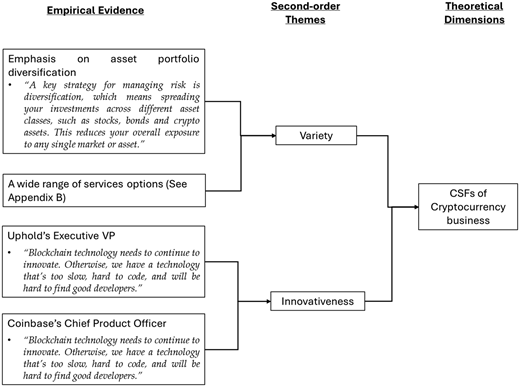
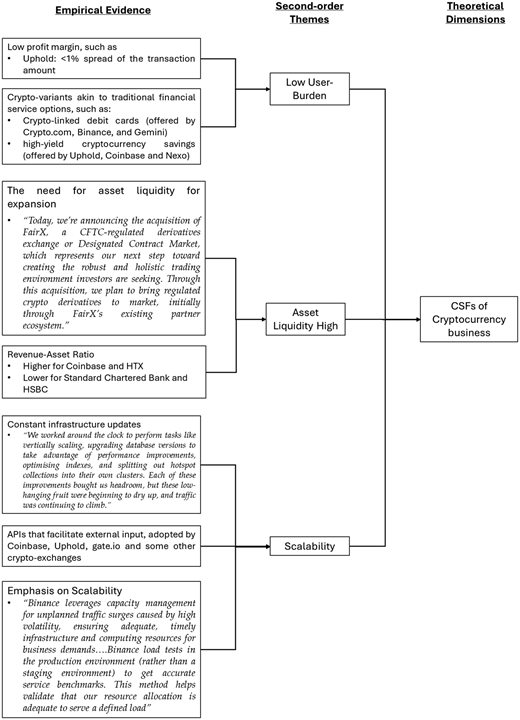
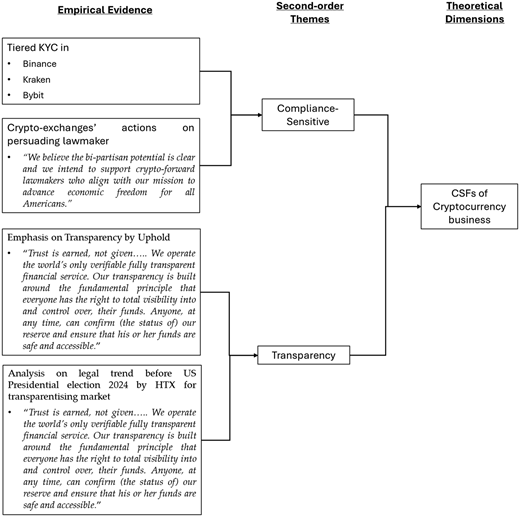
Appendix 2
Measures launched by different crypto-exchange service providers
| Variety measures | 1 | 2 | 3 | 4 | 5 | 6 | 7 | 8 | 9 | 10 | 11 | 12 | 13 | 14 |
|---|---|---|---|---|---|---|---|---|---|---|---|---|---|---|
| Crypto-linked debit/credit cards | Y | Y | Y | Y | Y | Y | Y | |||||||
| Crypto-based Donations | Y | Y | Y | |||||||||||
| Crypto-based Social Innovations | Y | Y | ||||||||||||
| Crypto-loans | Y | Y | Y | Y | Y | Y | Y | |||||||
| Taxation Reporting Support | Y | Y | Y | Y | Y | |||||||||
| Crypto-based P2P lending | Y | |||||||||||||
| Crypto-based saving/staking | Y | Y | Y | Y | Y | Y | Y | Y | Y | Y | Y | Y | ||
| Crypto-enabled stock and ETF investments | Y | |||||||||||||
| Crypto-based crowdfunding | Y | Y | ||||||||||||
| Precious metal trading with cryptocurrencies | Y | |||||||||||||
| Self-issued stablecoin | Y | Y | ||||||||||||
| Learn-and-earn | Y | |||||||||||||
| Cryptocurrencies-based lottery and gaming | Y | Y | Y | |||||||||||
| Progressive Path | Y | |||||||||||||
| Gift Card | Y |
Note(s): (1) Binance, (2) Uphold, (3) Coinbase, (4) Nexo, (5) Kraken, (6) KuCoin, (7) Huobi, (8) Gate.io, (9) Bitfinex, (10) Bybit, (11) Gemini, (12) Crypto.com, (13) BlockFi, (14) OKX
Notes
Cryptocurrency exchanges (or “crypto-exchanges”) may be classified into centralised or decentralised. In this study, we focus on centralised crypto-exchanges.
CFTC stands for the US Commodity Futures Trading Commission.
Neobank refers to digital-only banks operating without physical branches.
An application programming interface (API) is a connection between computers or between computer programs.
See COINBASE as an example: https://www.coinbase.com/en-au/products
Application Programming Interfaces.
Where banks share customer data with third-party providers via APIs.
Trustless means transactions can occur directly between parties without requiring a trusted third-party intermediary)
Hash value refers to a unique digital fingerprint in cryptocurrency context.
Sandboxes refer to controlled environments where firms can test innovative products under relaxed regulatory requirements.

