The paper attempts to address the following research questions (RQs): RQ1: What are the main research topics within PSS research? RQ2: What are future trends for PSS research?
Twenty years of research (1999–2018) on product-service systems (PSS) produced a significant amount of scientific literature on the topic. As the PSS field is relatively new and fragmented across different disciplines, a review of the prior and relevant literature is important in order to provide the necessary framework for understanding current developments and future perspectives. This paper aims to review and organize research contributions regarding PSS. A machine-learning algorithm, namely Latent Dirichlet Allocation, has been applied to the whole literature corpus on PSS in order to understand its structure.
The adopted approach resulted in the definition of eight distinct and representative topics able to deal adequately with the multidisciplinarity of the PSS. Furthermore, a systematic review of the literature is proposed to summarize the state-of-the-art and limitations in the identified PSS research topics. Based on this critical analysis, major gaps and future research challenges are presented and discussed.
On the basis of the results of the topic landscape, the paper presents some potential research opportunities on PSSs. In particular, challenges, transversal to the eight research topics and related to recent technology trends and digital transformation, have been discussed.
1. Introduction
The last two decades have seen a growing trend toward research on product-service systems (PSSs). One of the first definitions of the concept was provided by Goedkoop et al. (1999) who stated that PSSs are “systems of products, services, networks of “players” and supporting infrastructure that continuously strives to be competitive, satisfy customer needs and have a lower environmental impact than traditional business models”. The following year, Roy (2000) published one of the early works on this topic, highlighting the positive environmental impacts that arise from the cohesive delivery of products and services.
Since its first appearance, the meaning of the term PSS has evolved and broadened (Hansch Beuren and Cauchick Miguel, 2013). Some common features emerge from definitions available in the literature:
PSSs are value offering composed of a mix of tangible and non-tangible elements, that can be labeled as products, services and infrastructures (Goedkoop et al., 1999; Barravecchia et al., 2020a, b);
the elements of a PSS interact to fulfill customer needs (Manzini and Vezzoli, 2003);
PSS-based strategies have positive environmental effects compared to traditional business models (Roy, 2000);
Interactions between provider and customers are extended to different phases of PSS lifecycle (Cavalieri and Pezzotta, 2012).
Even if relatively young, this field of research has produced a remarkable amount of scientific literature that analyzed the PSS concept from a plurality of points of view. Despite this, the literature still remains sparse in terms of guidance on how to categorize and delineate studies on PSSs (Li et al., 2020). Research on PSS is becoming increasingly fine-grained and some fundamental aspects of PSS remain dispersed (Annarelli et al., 2016). Multiple disciplines are interested in the concept of PSS (Mont and Tukker, 2006). Each of these analyzes the PSS from its specific point of view, sometimes losing the overall view of the phenomenon. This conclusion is proven by the wide diffusion of literature reviews related to specific domains such as design (Qu et al., 2016), business models (Reim et al., 2015), or service engineering (Cavalieri and Pezzotta, 2012), while, there is a lack of updated reviews concerning the whole PSS corpus literature (Moro et al., 2020). Heterogeneity in dealing with problems related to PSS enriches the field of research, but at the same time it is likely to lose a comprehensive view of the phenomenon.
A field of research that is becoming increasingly mature and specialized needs a general framework to collocate the different scientific contributions. Considering this, a structured and objective analysis allowing us to understand the main pillars of the PSS literature could be helpful.
The presented research aims at applying a computational and replicable approach to build on existing literature a theoretical framework capable of framing past, present and future works in PSS research. The methodological approach taken in this study is based on topic modeling analysis so as to produce a clustering of the entire body of literature on PSS. Specifically, the Latent Dirichlet Allocation (LDA) algorithm was implemented. This approach provides different advantages, including (1) the capability of analyzing a vast number of papers time, (2) the possibility of automatically grouping scientific articles in homogeneous clusters, thus identifying a framework of the main topics in a specific research field, (3) the outputs are not influenced by bias or prior knowledge of the researchers being produced solely by data analysis (Antons and Breidbach, 2018; Asmussen and Møller, 2019).
In detail, the following two research questions (RQs) were faced up:
What are the main topics within PSS research? Specific research goals are the recognition and characterization of the main streams of research within the heterogeneous scientific literature on PSS to establish a framework capable of describing the hidden structure of the PSS research corpus.
What are future trends for PSS research? A specific research goal is the recognition of current and future research priorities to address the academic community's efforts.
Trying to answer these questions, this paper provides the following three main contributions: (1) it proposes a conceptual framework – i.e. a topic landscape – to support identifying and understanding topics and trends in PSS research over the last 20 years, (2) it provides an updated overview of issues discussed in PSS literature and (3) it identifies and analyses emerging trends and possible research directions related to PSS.
Moreover, this study represents a first attempt to leverage machine learning and text mining techniques to cluster scientific contributions on PSS and identify the main research topics.
The rest of the paper is organized as follows. Section 2 presents the methodology applied to produce the topic landscape. Section 3 illustrates the results of the topic landscape of the literature on PSSs. The description of each PSS research topic, including the related literature, is presented in section 4. Section 5 proposes potential opportunities and future trends in PSS research. The concluding section summarizes the implications, limitations and original contributions of the paper.
2. Mapping the structure of the PSS literature
In order to interpret a corpus as vast as that concerning PSS, the first step is to understand its structure. To this end, one of the challenges to be faced when attempting to analyze the scientific production of a large research field is the identification of the most discussed topic. Online databases make available a massive amount of journal articles and conference proceedings. In managing such a large number of documents, traditional methods, based on a systematic reading and classification of the documents, show some limitations, mainly related to the huge need of time and resources (see Table 1).
Trying to overcome these limitations, this study proposes the use of a topic modeling algorithm to identify the hidden structure of PSS literature.
Topic modeling is unsupervised machine-learning algorithms that can discover topics running through a collection of documents and annotating individual documents with topic labels (Blei et al., 2003). In this research, a specific topic modeling algorithm, i.e. Latent Dirichlet Allocation (LDA), has been applied. Given a big set of documents, LDA handles with the problems of: (1) identifying a set of topics that describe a text corpus (i.e. a collection of text document from a variety of sources); (2) associate a set of keywords to each topic and (3) define a specific mixture of these topics for each document (Blei et al., 2003).
The main difference between topic modeling techniques and traditional literature analysis lies in the cluster identification process (Asmussen and Møller, 2019). Text mining techniques use the information related to the analyzed documents as a whole and cluster the various documents according to their content. From this perspective, this methodology can be defined as a bottom-up approach since the clustering is exclusively based on data analysis without any influence from the expert perceptions and prior knowledge. On the contrary, traditional literature survey methodologies can be considered as top-down approaches since the classification of papers is based either on pre-existing frameworks or on logical and deductive processes driven by an expert.
Table 1 offers a summary of the differences in terms of assumptions and costs between traditional literature review methodologies based on article reading and the topic modeling approach. The main differences relate to the automation of the process and the required to instruct and perform the analysis. In addition, there is evidence that the topic modeling approach allows even researchers with low substantive knowledge of the field under analysis to address the pre-analysis and analysis phases.
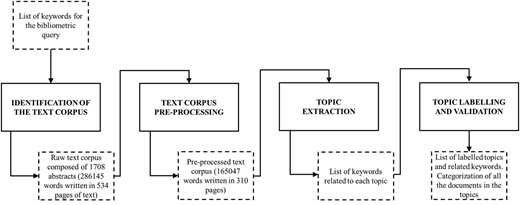
In detail, the LDA methodology can be structured in four steps: (1) identification of the text corpus; (2) text-corpus pre-processing; (3) topic extraction and (4) topic labeling and validation (see Figure 1). The following sections describe the four aforementioned steps in the specific application case related to the review of the PSS literature.
2.1 PHASE I: identification of the text corpus
The first step in the analysis was the selection of the data source. According to a plurality of authors, Scopus proved to be the bibliometric databases with the highest coverage in engineering and management literature in terms of indexed journals and conference proceeding (Harzing and Alakangas, 2016). Data used for our analysis were retrieved from Scopus in January 2020 (Scopus Elsevier, 2020).
This study focuses its analysis on the literature related to the concept of PSS. Similar concepts such as “Solutions” or “Hybrid offerings” were not explicitly included. The primary difference between PSS and similar concepts lies in their origins and in the different research communities investigating them. PSS is highly related to manufacturing and engineering research (see Table 2), while other concepts are mainly associated with marketing or service science (Ulaga and Reinartz, 2011). Moreover, the PSS concept has been associated with the positive impact that it can have on the environmental sustainability of production systems. This aspect is marginal in the scientific literature concerning “hybrid offerings” or “solutions” concepts.
In this view, the main inclusion criterion for article selection was the presence in the title, abstract or keywords of the words “Product-Service Systems”. Analogous notations were also included in the query. The selection of search keywords is consistent with the objective of the paper, which, as mentioned above, is limited to surveying the literature regarding the specific concept of PSS. The resulting query string was: “PSS” OR “PSSs” OR “Industrial product service system” OR “Industrial product service systems” OR “Product Service Systems” OR “Industrial Product Service System” OR “Product-Service Systems” OR “Product/Service-Systems” OR “IPS2” OR “IPSS”. The differences in PSS notation are due to the different origin and academic backgrounds of the authors. In addition, a reference dictionary and standardized definitions have yet to be defined.
Only articles published in scientific peer-reviewed journals and indexed conference proceedings were included in the analysis. This selection resulted in 2028 documents published from 1999 to December 2019, of which 843 were published in journals and the rest on conference proceedings.
Table 2 reports the ten most influential journals in PSS research in terms of the number of published articles. From the table, it can be seen that PSS research covers several domains. In particular, the most critical subject categories in PSS publications are “Engineering”, “Business, Management and Accounting”, “Computer Science”, “Environmental Science” “Energy” and “Decision Sciences”.
Given the limited number of articles published, some strongly influential journals on PSS research are not included in the list reported in Table 2. Among these, the most prominent are: International Journal of Operations and Production Management; Proceedings of the Institution of Mechanical Engineers, Part B: Journal of Engineering Manufacture; CIRP Annals - Manufacturing Technology; Industrial Marketing Management.
As for most of the applications of LDA in the analysis of scientific literature, the collection of the abstract of the documents was used as text corpus for the analysis (Fang et al., 2018). This phase resulted in the definition of the initial dataset of 534 pages of raw text composed of 286,145 words.
2.2 PHASE II: text corpus pre-processing
Following the approach suggested by Meyer et al. (2008), the text corpus was pre-processed and unified in order to improve the efficiency of the topic modeling algorithm. In detail, the pre-processing phase included the following main steps:
Removal of stop words (e.g. “the”, “and”, “when”), punctuation, numbers, words with a low frequency, words generally not related to topical content (e.g. “paper”, “present”);
Text lemmatization, i.e. all the words with similar meaning but with different inflected forms were replaced with a unique lemma (e.g. “manufacturing”, “manufacturer”);
Replacing all the n-grams – i.e. contiguous sequences of n items from a given sequence of text – with a single term;
2.3 PHASE III: topic extraction
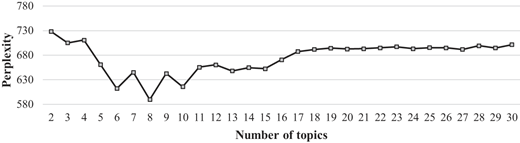
The LDA algorithm was used to infer the major topics addressed within the text corpus. To this end, KNIME Analytics Platform, an open-source software, was used. The algorithm requires the definition of three parameters: the Dirichlet hyperparameters (α, β) and the number of topics (T) (Blei et al., 2003). Following the indications of Griffiths and Steyvers (2004), we used β = 0.1, α = 50/T. The optimal number of topics was determined to minimize the value of perplexity, i.e. a statistical measure of how well a probability model predicts a sample (Clarkson and Robinson, 1999). A lower perplexity value suggests a better fit. As shown in Figure 2, an optimal value of 8 topics can be defined. Based on the statistical distribution of the words in the text corpus, the LDA algorithm generated the list of keywords characterizing each topic (see Table 3) and, for each document, its probability of belonging to each of the defined topics.
2.4 PHASE IV: topic labeling and validation
The LDA algorithm identifies sets of keywords associated with each topic without generating a semantic label to describe each topic (Blei, 2012). The authors of this paper used the sets of the principal 15 keywords associated with each topic to assign descriptive labels to each topic. To test their reliability, the defined topic labels were submitted to an external panel of scholars familiar with the PSSs literature, which confirmed the identified labels. The LDA algorithm results were validated by comparing the assigned topic of a randomly selected sample composed of one hundred articles with a manual topic assignment performed by a team of four researchers on PSS-related topics. The validation showed that the LDA algorithm produced a topic assignment that generally did not differ significantly from the results obtained by a manual categorization (estimated accuracy: 93%).
3. Topic landscape of product-service systems research
The application of the LDA algorithm resulted in the extraction of eight different topics. Table 3 reports a brief description of each topic together with the lists of keywords and the percentage of documents belonging to the topic. Some interesting considerations emerge from this table:
around 21% of the scientific production on PSSs concerns “PSS design”, followed by “PSS environmental and social impact” (18%) and “PSS & Servitization Process” (13%);
sustainability, including both the design and environmental and social aspects, represents more than a quarter of the scientific production on PSSs (the two topics may seem overlapping, but they deal with different aspects of sustainability: the former concerns the sustainability assessment, while the latter deals with the design of sustainable PSS).
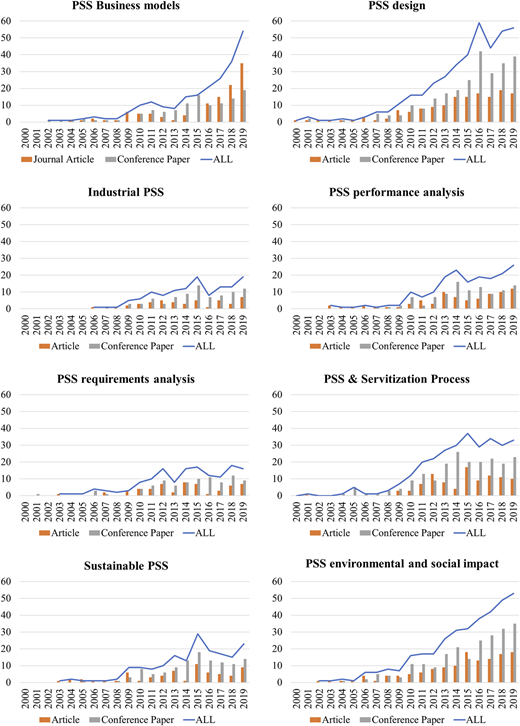
Figure 3 reports the publication trend over time of the eight identified topics. Griffiths and Steyvers (2004) proposed a distinction between hot and cold topics: while the former are topics for which the number of published articles grows over time or remains constant, the latter are topics with a decreasing number of publications. According to this view, none of the topics concerning PSSs can be defined as “cold” (see Figure 3). In particular, two topics (“PSS business models” and “PSS environmental and social impact”) show a steady increase in the number of publications. Furthermore, it can be observed that some topics show a leveling in the number of publications, see for example: “Industrial PSS”, “PSS requirement analysis” and “PSS & Servitization Process”.
4. Product-service systems research topics
Results reported in Table 3 provide a framework to understand and analyze the vast literature corpus concerning the concept of PSSs. Since the first definition of the PSS concept, several literature reviews concerning the field of research have been published (Moro et al., 2020). Most of these cover specific topics (see Table 4), whereas only a handful focused on an overall analysis of the PSS literature corpus (Tukker and Tischner, 2006; Baines et al., 2007; Wang et al., 2011; Beuren et al., 2013). Given the highly evaluative context, most of these reviews can be considered dated, being the most recent more than seven years old (Moro et al., 2020).
The following sections provide an updated overview of PSS research taking into account the theoretical framework presented in the previous sections and recent advances in PSS research.
4.1 PSS design
PSS design is the most influential topic in terms of the number of documents (21%). Studies discussing concepts, methodologies and tools aiming at supporting the design of innovative PSSs are considered part of this topic. The integration between the design process of products and services is intended as the basis for the development of novel PSS (Aurich et al., 2006; Barravecchia et al., 2020a, b). Due to the heterogeneous configuration of PSSs, their design is often characterized by systemic approaches useful to integrate product and service perspective (Morelli, 2006). Several studies agree that the research topic on PSS design is not yet fully mature, a variety of dedicated methodologies have been developed; however, there are neither reference standards nor established models yet (Vasantha et al., 2012).
Table 5 reports some tools specifically developed to support PSS design during the different phases of the PSS life cycle. To face this aspect, recent contributions on the topic are focusing on integrating digital technologies within PSS.
4.2 PSS environmental and social impact
The offering of PSSs may provide new opportunities in increasing sustainability (Tukker, 2004). Existing research recognizes the critical role of the combined offering of products and services to effectively decrease the consumption of natural resources, reduce environmental impacts and improve social equity and cohesion (Vezzoli et al., 2015). Moreover, as Tukker (2015) argued, PSSs are one of the most effective instruments for moving society toward a circular economy.
The creation of PSSs long-term relationships with customers provides incentives to extend the useful life of the product and to optimize resource utilization (Evans et al., 2007). The implementation of service-oriented strategies encourages advances in product life cycle management and facilitates the transition toward more sustainable consumption patterns (Salazar et al., 2015).
Table 6 introduces and summarizes articles concerning the management and the evaluation of PSS environmental and social impact. Common elements of these studies are: the multidimensional analysis of sustainability, the comparison with traditional business models and the analysis of impacts throughout the PSS life cycle.
4.3 PSS and servitization process
The concepts of servitization and PSSs are strongly related. While the former refers to the progressive transformation process, the latter refers to the output of the servitized manufacturing companies (Beuren et al., 2013).
The process of servitization has been defined as “the innovation of organization's capabilities and processes to better create mutual value through a shift from selling products to selling Product-Service Systems” (Neely, 2009). It is possible to recognize a variety of forms of servitization (Baines et al., 2009; Mastrogiacomo et al., 2020a), defining the so-called “product-service continuum” (Kowalkowski et al., 2015), i.e. a continuum from traditional manufacturing companies to product-service providers able to manage all the PSS lifecycle and to offer complex solutions. Interaction between PSS delivery and the servitization process has been analyzed from a variety of points of view. Most characterizing works of the topic are reported in Table 7. Issues addressed are wide-ranging, covering analysis of the diffusion of the servitization process, impact on the company's performance and challenges to be faced during the transformation process.
4.4 Sustainable PSS
LDA application resulted in the definition of a specific topic on the development of sustainable PSS, with a particular focus on increasing the environmental, social and economic sustainability of complex solutions composed of tangible elements (products) and intangible elements (services). This topic straddles two other topics identified by this analysis: “PSS design” and “PSS environmental and social impact”.
PSSs developed and designed with the explicit purpose of reducing environmental impact are labeled as sustainable PSS (SPSS) (Roy, 2000; Vezzoli et al., 2015) or eco-efficient PSS (EPSS) (Ceschin, 2013). Several practical methodologies have been developed over the past years to address issues related to the development of sustainable PSS. Intending to summarize the main research works, Table 8 provides an overview of articles on the subject.
4.5 PSS business models
PSSs can be seen as new opportunities to create new business models. A growing number of manufacturing companies are shifting their focus to services as a new way of creating and capturing added value (Adrodegari et al., 2017b). The emerging of complex offerings composed of products and services implies a transition from revenue streams mainly determined by selling products to revenue mechanisms based on customer relationship and service provisions (Mathieu, 2001).
Several studies noted that business models are critical for the success of PSS implementations (Kindström, 2010). This is confirmed by the results reported in section 3, according to which a significant number of papers on PSS deal directly with business model issues, and the topic is also closely related to many other research topics.
There is a general consensus on categorizing the PSS business model into three types: product-oriented, use-oriented and result-oriented business models (Tukker, 2004). These three types of business models can be applied in both consumer-oriented and B2B contexts (e.g. industrial PSS). Besides this, several business model classifications of PSS have been defined (Barquet et al., 2013; Adrodegari et al., 2017a).
Most of the studies related to PSS business models are highly related to a particular application or to the implementation of sustainable strategies integrating both the economic and the environmental aspects (Boons et al., 2013; Yang et al., 2017). Table 9 shows the most characterizing papers on this topic.
4.6 PSS performance analysis
The performance analysis of PSS is a fundamental step in the implementation of innovative service-oriented strategies (Qu et al., 2016). There is a broad agreement among experts about the critical role played by the in-depth evaluation of PSSs performance in their management and productivity (Baines et al., 2007).
Additional challenges for the performance analysis are posed by the PSS heterogeneity being composed of tangible products, intangible services, infrastructures. Traditional tools developed for the analysis of products and services are not capable of capturing the complexity of PSS (Rondini et al., 2020). To face this issue, several authors proposed practical approaches and methodologies for evaluating the performance of a PSS. Some of these are adaptations of pre-existing approaches (Geng and Chu, 2012), while others have been explicitly developed for PSS (Rondini et al., 2020). Table 10 shows the most influential papers on this topic.
4.7 PSS requirements analysis
Given the complexity of value offerings composed of a mix of tangible and intangible elements, the requirement analysis carved out a niche in the scientific literature on PSS. The definition of PSS structure and requirements is a necessary preliminary stage for their design (Wiesner et al., 2017). The definition of the requirements of a PSS cannot disregard some essential elements: the consideration of the entire PSS life cycle, the demand for customized solutions, the involvement of different stakeholders in the value creation process and the additional services associated with the primary offering (Berkovich et al., 2011). Several attempts have been made to define novel methods or to adapt existing approaches to the problem of defining PSS requirements (Cavalieri and Pezzotta, 2012). Table 11 shows the state-of-the-art on this topic.
4.8 Industrial PSS
According to Meier et al. (2010), “an industrial product-service system (IPSS) is characterized by the integrated and mutually determined planning, development, provision and use of product and service shares including its immanent software components in business-to-business applications and represents a knowledge-intensive socio-technical system”.
A shift from product and technology-centered strategies toward the offering of complex solutions comprising both product and services is taking place also in contexts characterized by business-to-business relationships (Meier et al., 2011).
This topic has been analyzed from different perspectives (see Table 12). Apart from a few articles that have defined the concept of Industrial PSS, most of the articles are contaminated by other research topics, in particular by the requirements analysis, design and performance evaluation.
4.9 Relationship between topics
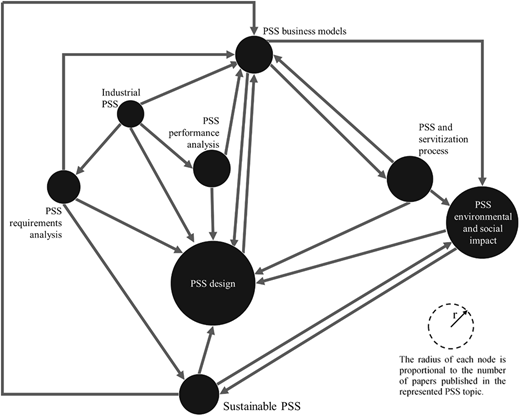
The results of the LDA algorithm allow the construction of a topic network graph, i.e. a directed graph in which nodes represent topics and directed arcs indicate relationships between topics. In detail, the graph shows an arc between two topics, say from “Topic A” to “Topic B”, when documents belonging to “Topic A” have an average probability of belonging to “Topic B” above a certain threshold. For the purpose of this analysis, the selected threshold was set to 5%. The resulting graph is shown in Figure 4.
“PSS business models” and “PSS design” nodes show the most incoming arcs. This evidence suggests that these two topics are cross-cutting and intertwined with most of the others. The literature review confirms this evidence. The concept of business model and the process of developing and designing novel PSS are also addressed in many of the pivotal papers in other topics. For example, the provision of industrial PSS cannot be achieved without the definition of new business models for the specific industry context or the application of PSS design approaches.
Newer, less developed topics such as “Industrial PSS” have no incoming arcs, meaning it has limited relevance within the documents belonging to any other topics.
5. Future trends in product-service systems research
While previous sections provided structure and interpretation to PSS research, looking at past and present scientific production as well as the relationships between topics, the purpose of this section is to outline potential research trends and challenges yet to be tackled.
5.1 Smart PSS and digital servitization
In parallel with the spread of the concept of PSS and service-oriented business models, there has been a growing diffusion of digital technologies. In recent years, these two once distinct fields of research converged (Zheng et al., 2019). Digitalization supports companies in the development of new services, business models and innovative products. This process is generally defined as digital servitization (Kohtamäki et al., 2019). The outputs of the companies that faced the process of digital servitization are PSS that exploit digital technologies, commonly labeled as Smart-PSS, digital PSS, cyber-physical PSS, IoT-enabled PSS, digital-driven PSS (Zheng et al., 2019).
The LDA algorithm (see section 2) did not recognize a specific topic related to these issues, but assigned the articles dealing with these issues to the eight PSS research topics. This result tells us that technology and Smart PSS does not yet represent a pillar of PSS research. Despite this, given the growing importance of digital servitization in research and practice, this area will represent a major challenge for PSS research in all the eight identified topics.
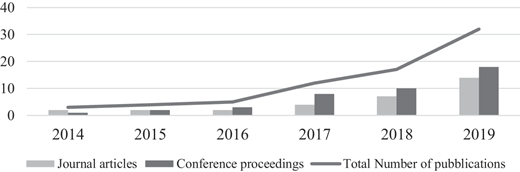
In recent years, interest in smart PSS has grown exponentially (see Figure 5). According to data reported in Figure 5, it can be inferred that Smart PSS is rapidly becoming “hot topic” in the coming years. This fact is also supported by the results of the LDA algorithm. From 2014, most topics have seen the emergence of prominent articles addressing issues related to the deployment of Smart PSS (see Table 13).
The analysis of the literature and debate with researchers and practitioners revealed several possible RQs still to be addressed. These potential RQs are reported in Table 14 by dividing them into the eight PSS research topics and the key phases of the PSS life cycle.
Current literature on traditional PSS guided the definition of these RQs. Problems already faced in the study of traditional PSS require new considerations to successfully address the new challenges posed by the implementation of Smart PSS. For instance, consider RQ 1.4, 1.6 and 1.10. These issues were considered critical ten years ago for the development of traditional PSS. The same issues became critical again with the emergence of Smart PSS. Similar considerations can be made for the other phases of the PSS life cycle. See for example RQ 2.4, 2.5, 2.11 for the Delivery phase and RQ 3.2, 3.4, 3.8 for the end-of-life phase of the PSS lifecycle.
Taken together, these challenges provide us with an overview of what is needed for full implementation of smart PSS and what are the main open issues requiring further investigation.
5.2 PSS and emerging technological issues
The previous section highlighted the challenges that need to be addressed to link PSS research with currently diffused digital technologies. However, researchers and companies must also prepare to face new challenges arising from the emergence of new technological paradigms that will invest the digital world and beyond. In this respect, an analysis of the relationships between the top technological trends and PSS research topics deserves more attention. Every year Gartner, a world's leading research and advisory company, highlights strategic trends, including the most promising emerging technologies and business innovations (Panetta, 2019).
Table 15 relates each technological trend with the identified eight PSS research topics and reports the number of articles published in each area. Data were retrieved from Scopus database (Scopus Elsevier, 2020). This table reveals that research on PSS related to emerging technological trends is still limited and particularly recent.
In detail, few studies investigated the relationship between hyperautomation and PSS, mainly focusing on the application of data mining algorithms for the evaluation and management of PSS (Wiesner et al., 2017; Shimomura et al., 2018). Issues related to multiexperience were partially covered by analyzing the use of augmented reality equipment and smart devices for the maintenance and monitoring of industrial plants with a Product-Service approach (Mourtzis et al., 2017).
Transparency and traceability, empowered edge, distributed cloud and autonomous things received more, albeit limited, attention in various PSS research topics.
Recent studies associated the study of empowered edge to the topic of industrial PSS (Liu et al., 2019a) and to the design of IoT-based PSSs (Shao et al., 2019). Few works have explored opportunities resulting from edge-computing and the implementation of IoT technologies in the servitization process (Heinis et al., 2018).
Issues related to transparency and traceability were mainly addressed in the study of sustainable consumption and production practices of PSS (Pialot et al., 2017; Sakao, 2019). The impact of distributed cloud on PSS strategies is an area partially covered. So far, the study of the distributed cloud paradigm related to the PSS concept resulted in the definition of smart PSSs design tools (Zheng et al., 2018). Finally, concerning autonomous things, some studies have analyzed their design in specific PSS application, such as autonomous vehicles (Wang et al., 2018) or collaborative robots (Cordeiro, 2018).
Many technological trends (democratization, human augmentation, practical blockchain and AI security) resulted in having no connection with current PSS research.
Table 15 shows several uncovered areas and emphasizes potential issues that would be matter of research in the PSS field. If the debate on PSS is to be moved forward, a better understanding of the influence of emerging technologies on PSS research topics needs to be developed.
In the past twenty years, the PSS concept advanced in different contexts: product, service and software sector. Nowadays, as aforementioned, the concept of PSS and that of digital transformation are inevitably approaching each other. Business models based on the delivery of tangible products and intangible services contaminate a wide range of sectors and new emerging trends will not be unaffected. It is therefore crucial starting to understand how to leverage these technologies to develop more effective, innovative and sustainable PSS.
In addition to core topics presented in previous sections, further research could usefully attempt to shed light on how these new technologies could impact on the design, management and provision of PSS.
6. Discussion and conclusions
The analysis reported in this article provides insight into what PSS research has been over the past 20 years and offers a key to understanding how it might evolve in the near future.
Given the vastness of the body of literature on PSSs, machine learning and text mining techniques were applied to understand its structure.
Eight topics were identified as pillars of research related to PSSs: (1) PSS design; (2) PSS environmental and social impact; (3) PSS and servitization process; (4) sustainable PSS; (5) PSS business models; (6) PSS performance analysis; (7) PSS requirements analysis and (viii) industrial PSS. “PSS design” and “PSS environmental and social impact” are the two most discussed topics in terms of the number of articles published.
This research confirms the vital link between research on PSS and research on the development of environmentally and socially sustainable production systems. It also reinforces the notion that the advent of the PSS paradigm has necessitated the development of new business models capable of capturing the value generated by the joint offering of products and services. The topic related to PSS business models was found to be central to the literature on PSS and closely related to the other research topics.
Twenty years of research may seem like a long time, but it is very short compared to other fields of research. Therefore, we should expect continued research on the topics identified, delving into particular aspects and providing operational tools to implement, evaluate and improve PSS over time. Alongside the eight identified research topics, however, we can expect others to emerge. Section 5 attempted to identify some of them. The PSS technological aspect is likely to play a key role in the development of the field. Digitization and emerging technologies will contaminate the PSS concept and make it relevant for coming years.
The result of this study strengthens the idea that PSSs often pose significant challenges to a broad range of discipline, ranging from engineering to design and management. For this reason, a map for navigating the literature on PSS can be useful for a variety of subjects. Researchers and practitioners approaching this field can understand how PSS research is structured and can identify key topics and articles, open issues and research gaps that need to be addressed. Conversely, for researchers who are already addressing PSS-related issues, the results of this study may be useful in positioning their research within a framework that may allow them to identify new research opportunities. Finally, research funding organizations and institutions could use the proposed topic landscape to focus and target support and funding.
Further research will be addressed to deepen the analysis between strategic technology trends and PSS research topics.
Funding: This work has been partially supported by “Ministero dell'Istruzione, dell'Università e della Ricerca” Award “TESUN-83486178370409 finanziamento dipartimenti di eccellenza CAP. 1694 TIT. 232 ART. 6”.