To improve leadership development in informal collegiate leadership learning environments, this study explores how student affairs professionals perceive the importance of and their proficiency in 55 previously identified required student affairs leadership educator professional competencies.
The Borich needs assessment model was used to measure the differences between the perceived importance of, and the professionals' knowledge of, ability to perform and ability to teach each of the 55 competencies.
The present research highlights a critical need to reexamine student affairs preparatory programs' ability to prepare effective leadership educators and thereby prepare the next generation of leaders, as more students engage in leadership development in informal rather than formal collegiate educational settings. Although 49 of the 55 competencies were deemed important by participants, significant discrepancies emerged between importance and proficiency. Knowledge proficiency gaps were most frequent, but teaching proficiency gaps had the largest magnitude and thus should be the focus of future interventions and research.
If higher education institutions are serious about developing the next generation of leaders and active citizens and improving students' leadership learning at their institutions, then it is imperative to reexamine how student affairs practitioners are prepared to be leadership educators and invest the additional resources in their staff.
Introduction
Leadership learning transcends the formal collegiate classroom (Buschlen & Guthrie, 2014; Guthrie & Jenkins, 2018), with the majority of students who engage in leadership learning doing so outside of formal academic spaces (Dunn, Moore, Odom, Bailey, & Briers, 2019; Hartman, Allen, & Miguel, 2015). Indeed, developing students to be leaders and engaged, active citizens is a central goal of higher education in the 21st century (Komives & Sowcik, 2020; Rosch, Collier, & Thompson, 2015). Yet, if higher education institutions are committed to developing effective leaders, then it is crucial to examine the preparation and training of those who provide these leadership learning opportunities, because we learn how to lead most often by watching and modeling those who lead us (McClellan, 2021).
Leadership researchers within both academic and student affairs openly acknowledge that neither exclusively controls the leadership education narrative. Rather, both assert the significant educational value derived from leadership experiences beyond formal classrooms (Barnes, 2020; Buschlen & Guthrie, 2014). Leadership initiatives offered through Divisions of Student Affairs (DSAs) create opportunities and environments where students can enhance their leadership competencies. However, not all student affairs professionals view student affairs leadership educators similarly (Dunn et al., 2019).
An inherent challenge in examining student affairs practitioners as leadership educators is their lack of formal leadership educator preparation, as leadership education is not a primary focus within student affairs preparatory programs (Barnes, 2020; Holzweiss & Franklin, 2024). Typically, student affairs practitioners possess advanced degrees in higher education administration or closely related fields rather than specific training as leadership educators (Jenkins & Owen, 2016; O'Brien, 2018). Thus, student affairs practitioners must actively pursue their own professional development if they are to cultivate leadership competence in their students. Put another way, one cannot teach what they do not know themselves. Ideally, this development comes through programs grounded in theory and best practices, but more often than not, it comes through just-in-time on-the-job experience (Jenkins, 2019).
Literature review
Collegiate leadership education exists in both academic and student affairs contexts (Guthrie & Jenkins, 2018). No longer do students study leadership only in their classes, with students encountering diverse opportunities for leadership education and development beyond their courses. This shift underscores the importance of co-curricular contexts, and by extension those who work within them, in fostering leadership development.
All student affairs practitioners contribute to students' leadership learning and should, therefore, be considered leadership educators (Barnes, 2020; Dunn et al., 2019; Kroll & Guvendiren, 2023). However, the idea that leadership education is the exclusive work of those within a specific functional area rather than the work of all remains. Consequently, the professional preparation of student affairs leadership educators has not been researched extensively (Guthrie & Jenkins, 2018; Jenkins & Owen, 2016). Moreover, determining the specific competencies leadership educators should teach is challenging, as there is no one set approach to teaching leadership in either academic or student affairs contexts (Johnson & Routon, 2024). The varying views on the leadership learning process, curriculum scaffolding, diverse associated programmatic objectives, the optimal location for collegiate leadership programs and changing college student demographics further complicate the issue (Hartman et al., 2015; Jamieson, Coggo Cristofoletti., Oanda, & Saarinen, 2023; Rosch et al., 2015). Therefore, student affairs leadership educators may find it challenging to discern essential leadership competencies and effective instructional methods (Komives, Dugan, Owen, Slack, & Wagner, 2011).
Although the notion of professional competencies is not new within student affairs (i.e. Dickerson et al., 2011; O'Brien, 2018; West & Henning, 2023), consensus on these competencies remains elusive (Cuyjet, Longwell-Grice, & Molina, 2009; Herdlein, Riefler, & Mrowka, 2013). The same is true within the context of student affairs leadership educators. One objective of the current research is to fill that gap by exploring the importance of previously identified required professional competencies for leadership educators (Dunn, Moore, Odom, Briers, & Bailey, 2021).
The Council for the Advancement of Standards in Higher Education (CAS) provides widely recognized professional guidelines for student affairs in order to enhance consistency and effectiveness among practitioners in the field. While Leadership Education and Development is a specialty area within CAS, the formal preparation of leadership educators is not explicitly addressed (CAS, 2020). The absence of quality control processes to ensure compliance and the variability in meeting these standards is concerning (Holzweiss & Franklin, 2024).
Purpose
The purpose of this study was to identify where growth and development opportunities exist for student affairs professionals in regard to their competencies as leadership educators. There were two main objectives for this study. First, we sought to prioritize leadership educator competencies (as previously identified) (Dunn et al., 2021) that student affairs professionals believe are important for job success, and second, to identify the gaps between student affairs professionals' perceived knowledge of, ability to perform and ability to teach said competencies with the importance of said competencies for job success. Two research questions guided this study:
What leadership educator competencies do student affairs professionals perceive to be most important for job success?
What discrepancies exist between the importance of each leadership educator competency and a) the perceived knowledge of, b) the ability to perform and c) the ability to teach said competency?
Conceptual framework
Historically, DSAs have relied on preparatory programs to socialize and professionally develop new professionals (Faidley, 2025; Olson & Ruiz Alvarado, 2024). Yet, the connection between the professional competencies learned within a preparatory program and applied as a student affairs professional is not well researched. Thus, to better understand the importance of and proficiency level student affairs professionals associate with an expert-identified list of professional competencies needed by student affairs leadership educators (Dunn et al., 2021), we used the Borich (1980) needs assessment model to frame this study.
A primary purpose of a needs assessment is to ascertain program effectiveness and areas in need of improvement. The Borich (1980) model was specifically designed as an alternative format of rating competencies to provide a better evaluation of training needs for a group. Borich relies on identifying gaps or discrepancy scores between an individual's perceived ability to perform a particular competency and how important that competency is for success in their role. Using discrepancy scores, one can determine those competencies that were perhaps rated as above average importance for their job success but having a below average ability in competence. It allows researchers to purposefully prioritize competencies so that training can be created in the most needed area first. Because this study was assessing individuals' thoughts on the importance of the competency and the ability for the competency to determine areas for growth and development, the Borich (1980) model was determined to be the best approach. For this study, needs for improvement were determined by the magnitude of the discrepancy between how important a concept is for job success and how proficient people perceive or rate themselves in that concept. To provide a more detailed analysis, we separated proficiency into three sub-areas: knowledge of, performance ability and teaching ability (Borich, 1980).
Methods
Positionality
Two of the five authors spent a collective thirty years as student affairs practitioners and administrators before transitioning to faculty roles – one in a student affairs preparatory program and one in leadership education. Two other authors are leadership educators who have both served as Student Affairs Faculty Fellows. The remaining author is a doctoral student in Agricultural Leadership, Education, and Communications. To avoid speaking for the data, all authors worked to bracket existing assumptions and previous experiences; however, we acknowledge our backgrounds may have influenced our interpretations of the data.
Population and sample
The study population was current full-time student affairs professionals, preparatory program faculty members, or administrators. The presenter lists from the two most recent NASPA national conferences, at the time of the study, were used to gather a national sample of potential participants. Duplicate names and individuals who were consultants, had retired or left the profession, or had passed away (as determined by an internet search) were removed from the list, leaving the accessible population of 1,477 individuals.
Data collection
We followed the Tailored Designed Method (Dillman, Smyth, & Christian, 2014). The accessible population received a recruitment email asking for participation from current, full-time student affairs professionals, preparatory faculty members and administrators who have an interest in, or current job responsibilities related to, the leadership development of undergraduates. An emailed link to the questionnaire followed. Two reminder emails were sent to those who had not yet completed the questionnaire, including those who had started but not finished it. Over 220 survey links were opened, but only 109 individuals completed at least one section of the questionnaire, with 63 individuals completing the entire questionnaire, thereby highlighting the challenges of pinpointing student affairs leadership educators. Table 1 details participant demographics.
Instrumentation
We developed a questionnaire using the Borich (1980) needs assessment model. The questionnaire was approved by the Institutional Review Board at Texas A&M University. The 55 competencies examined were identified previously by student affairs experts as required for student affairs leadership educators (Dunn et al., 2021). To temper any potential preconceived opinions associated with named groups and to reduce participant fatigue, the research team sorted the competencies into 12 unnamed, evenly sized groups.
Participants were asked to rate their perceived importance of each competency on a five-point Likert-like scale (1 = Strongly Disagree to 5 = Strongly Agree, with 3 = Neutral). Proficiency was separated into three sub-areas: knowledge of, ability to perform and ability to teach. Participants were asked to rate each aspect of proficiency on a similar five-point scale, where 1 = not proficient and 5 = very proficient. By separating proficiency into sub-areas, participants were required to make more detailed and focused judgements regarding what they knew about, how they performed and their ability to teach the competencies in question, thereby providing a more nuanced examination of the potential need for development within these competencies.
Data analysis
To address research question 1, descriptive statistics were used to detail the perceived importance and proficiency within each sub-area participants placed on the competencies presented. Descriptive statistics uncover distinctive factors of groups who may be dissimilar (Agresti & Finlay, 2009). The descriptive statistics included mean perceived importance scores, mean proficiency scores and standard deviations. For ease of data analysis and using content analysis techniques, the research team reorganized the 55 competencies into seven named thematic groups: Program Development; Inclusion and Belonging; Professional Behaviors; Working on a Team; Education and Student Success; Environment; and Communication Skills. The competencies are ordered by thematic group and listed from highest to lowest mean perceived importance score within each group (see Table 2).
Findings
Analysis of the data revealed the respondents found a majority of the competencies to be important or very important for professional success. Forty-nine of the 55 competencies (85.5%) had a mean perceived importance score of 4.0 (agreed competency was important) or higher, with 26 (47.3%) having a mean perceived importance score above 4.5. To address nonresponse error, we compared early versus late responders (Lindner, Murphy, & Briers, 2001). We found significant differences for two of the 49 competencies deemed important (Table 2 items 20 and 41). Thus, they were removed from the analysis. The 11 competencies with the highest mean perceived importance scores, all 4.70 or higher, clustered around three themes: Inclusion and Belonging (items 6–9), Professional Behaviors (items 13–17) and Working on a Team (items 33 and 34).
The six competencies with mean perceived importance scores below 4.0 are also noteworthy. These scores ranged from 3.61 to 3.97, indicating slightly more positive than neutral perceptions of importance. These competencies also clustered around three themes: Program Development (items 4 and 5), Working on a Team (item 36) and Professional Environment (items 49–51). Seemingly, understanding the organizational structure of the institution, how leadership education is assessed and how university administration views leadership education were not considered particularly important by respondents for professional success.
To address research question 2, two different analyses were conducted. The first calculated the difference between the perceived importance (need) and the perceived proficiency (confidence) scores for each sub-area; all of which were positive (see Table 2), indicating the respondents believe the need for these competencies exceeded their confidence in them. Yet, the range of the discrepancy scores varied between the three sub-areas (knowledge: 0.10 to 0.55; performance: 0.01 to 0.53 and teaching: 0.37 to 1.17), signifying respondents recognized the nuanced gaps in their proficiency. Consequently, respondents believe their knowledge most closely aligns with the importance of the competencies, whereas their teaching proficiency aligns the least.
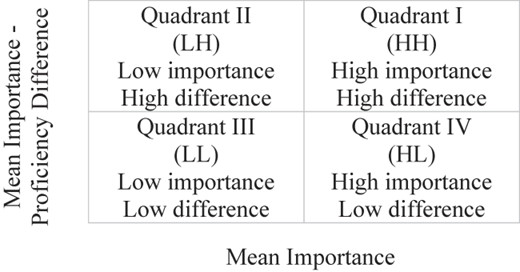
To determine which of the 55 competencies had the greatest need for additional development, we used a Locus of Focus model, which creates a matrix comprised of two coordinate axes: the horizontal axis represents the mean importance score and the vertical axis represents the difference between the mean importance and sub-area of proficiency scores (Ziwei, Mengjiao, Yongjie, Mengqi, & Yeqin, 2023). The two axes create four quadrants: Quadrant I – high importance and high difference, Quadrant II – low importance but high difference, Quadrant III – low importance and low difference, and Quadrant IV – high importance but low difference (see Figure 1). With both high importance and difference scores, Quadrant I represents the highest priority area for additional development and thus becomes the focus of the analysis. One Quadrant 1 matrix was constructed for each proficiency sub-area (see Figures 2–4, respectively).
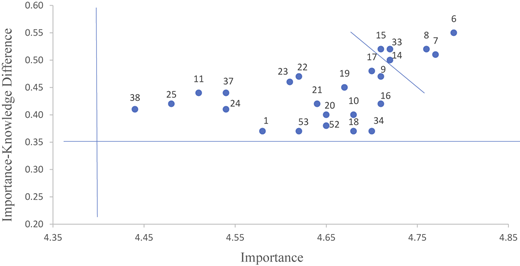
For the knowledge sub-area, 25 items are included in Quadrant 1 (mean importance above 4.40 and mean importance-knowledge difference above 0.35). An asterisk following an item number indicates responses were significantly different when handling nonresponse error and thus were removed from the larger analysis. The 25 items represent six thematic groups, including Program Development (Table 2 item 1), Inclusion and Belonging (items 6–11), Professional Behaviors (items 14–19, 20*, 21–25), Working on a Team (items 33 and 34), Education and Student Success (items 37 and 38), and Communication Skills (items 52 and 53) (see Figure 2). The items where additional knowledge is most needed are those with the highest importance and highest difference scores, namely items 6–8, 14, 15 and 33.
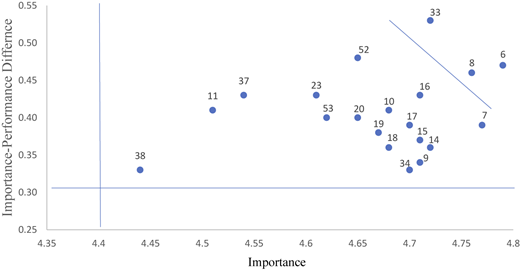
For performance, 20 items were included in Quadrant 1 (mean importance above 4.40 and mean importance-performance difference above 0.31). Five thematic groups were represented: Inclusion and Belonging (Table 2 items 6–11), Professional Behaviors (items 14–19, 20* and 23), Working on a Team (items 33 and 34), Education and Student Success (items 37 and 38) and Communication Skills (items 52 and 53) (see Figure 3). The competencies with the highest importance and highest difference scores indicate the competencies in greatest need for additional development, namely items 6, 8 and 33.
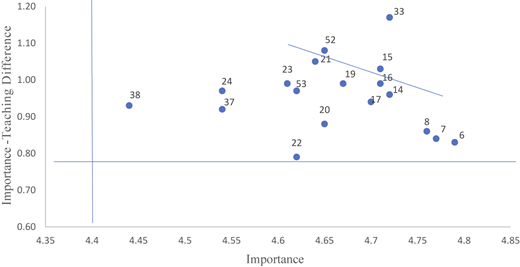
For the teaching sub-area, 18 items are included in Quadrant 1 (mean importance above 4.40 and mean importance-teaching difference above 0.79). Five thematic groups are represented: Inclusion and Belonging (Table 2 items 6–8), Professional Behaviors (items 14–17, 19, 20* and 21–24), Working on a Team (item 33), Education and Student Success (items 37 and 38) and Communication Skills (items 52 and 53) (see Figure 4). The items with the highest importance and difference scores indicate those in greatest need for additional development, namely items 15, 33 and 52.
Of the 55 competencies, 25 (45.5%) landed in Q1 at least once. Here the respondents agreed the competencies were professionally important, but lacked confidence in either their current knowledge of, ability to perform, or ability to teach said competency. Fifteen of those 25 competencies (60%) landed in Quadrant 1 for all three sub-areas, indicating the need for additional development across all areas of proficiency (Table 2 items 6–8, 14–17, 19, 20*, 23, 33, 37, 38, 52 and 53). Three of the 25 competencies (12%) were identified as having the greatest need for additional development across the knowledge and performance sub-areas (items 6, 8 and 15), while one competency, communicating across differences (item 33), was identified as having the greatest need for additional development across all three sub-areas.
While it is instructive to know which competencies respondents determined needed additional development, a more nuanced analysis is needed to know where to prioritize resources. Therefore, we followed the Ranked Discrepancy Model (RDM) (Narine & Harder, 2021) to determine Ranked Discrepancy Scores (RDSs) for each of the 55 competencies. The RDS is a standardized score between −100 and 100 that characterizes the magnitude of the discrepancy between an individual's perceived importance and proficiency ratings. Three RDSs were calculated for each competency, one for each sub-area of proficiency explored: knowledge, performance and teaching.
Calculating the RDS consists of four steps. First, calculate the frequency of negative ranks (NR), positive ranks (PR) and tied ranks (TR) for each competency by performing the Wilcoxon rank test between paired responses (Narine & Harder, 2021). Negative ranks have perceived proficiency scores less than the importance score. Positive ranks have perceived proficiency scores greater than the importance score, and tied ranks have equal scores. Second, convert the counts of NR, PR and TR into percentages (i.e. NR% = (NR/sample size) x 100). Third, assign relative weights to each calculated percentage as follows: NR% x (−1), PR% x (1) and TR% x (0). Fourth, sum the three weighted percentages to calculate the final RDS for each competency. Although TR% (0) drops out of the equation, leaving RDS = NR% (−1) + PR% (1), it must be calculated as it impacts the NR and PR percentages (Narine & Harder, 2021). This process was repeated for each sub-area of proficiency explored.
The more negative the RDS, the greater the discrepancy between perceived importance of and proficiency in said competency, and therefore, the greater the need for an intervention. Scores greater than zero indicate performance outpaces importance, eliminating the need for additional development. The size of the RDS scale is particularly adept at pinpointing the magnitude of the discrepancies that may arise (Narine & Harder, 2021). All RDSs for all 55 competencies were negative. Thus, overall, the respondents believed additional interventions are needed for each competency. The RDSs are listed from lowest, most need for interventions, to highest, least need for interventions, within each of the three sub-areas of proficiency.
The range of the discrepancy scores varied between each of the three proficiency sub-areas, as did the utmost scores. For knowledge and performance proficiencies, the RDSs did not extend beyond the second quartile (−26 to −50), with utmost scores of −38 and −30, respectively, indicating a focused but modest need for interventions in both sub-areas. However, for teaching proficiency, the RDSs began in the second quartile and extended into the third (−51 to −75) with an utmost score of −61, indicating the greatest need for intentional interventions. Respondents saw the greatest need for intervention in learning from mistakes (knowledge), modifying behavior based on feedback and effective written communication (performance), and being authentic (teaching) (see Tables 3–5).
While 49 of the 55 competencies examined (89.1%) were considered important or very important for professional success, additional professional development in all 55 competencies was considered necessary, although to varying degrees. Overall, participants believe more than one-quarter (n = 15, 27.1%) of the 55 competencies require professional development across all three proficiency sub-areas. Participants perceived student affairs professionals to be most confident in their ability to perform the competencies, followed by their knowledge of them. However, the magnitude of the gap indicates prioritizing development focused on enhancing professionals' ability to teach these competencies to others.
Conclusions and recommendations
These findings raise concerns regarding the ability of student affairs preparatory programs, as currently structured in the United States, to develop future student affairs professionals who are prepared and able to develop students as effective leaders. Increasingly, students are no longer “blank slates” waiting for the experiences or people who will mold them into effective leaders. Rather, they come to college with prior leadership experience (Dunn, Odom, Moore, & Rotter, 2016; Johnson & Routon, 2024) and see college leadership programs as a way to expand on what they already know and do as leaders. Therefore, it is vital that student affairs professionals, as all are leadership educators (Barnes, 2020; Kroll & Guvendiren, 2023), are trained to not only meet their students in their current practice of leadership, but also to challenge them to develop as leaders and in their leadership. While beyond the scope of this study, we acknowledge that the challenge may look different in different cultures or contexts.
Participants clearly saw a need for intentional, systematic professional development for student affairs professionals, as they reported intervention needs for all 55 competencies. Because professional preparation most often occurs in preparatory programs (Cuyjet et al., 2009; Holzweiss & Franklin, 2024), the needed interventions should occur first within the student affairs preparatory programs and then be reinforced through intentional professional development opportunities. Mentoring opportunities, where early-career professionals can shadow and learn from master teachers and facilitators, are one way to enhance professionals' competence, particularly in terms of teaching others. Interestingly, confidence in professionals' performance ability was higher than knowledge of the 55 competencies. Thus, we ask, if one has limited confidence in their knowledge of a competency but greater confidence in their performance of said competency, how do they know they are performing it correctly? Is their confidence based on mimicking the behaviors they have observed in others they deem successful leadership educators or is it self-reported skill inflation?
The effectiveness of co-curricular leadership programming may also be in question. While student affairs professionals may possess foundational leadership knowledge and skills and be seen as leadership educators, that does not mean everyone was trained well nor is an effective educator. The gaps in respondents' confidence in teaching others indicate a lack in the pedagogical tools to transfer this learning to others and begin to break the myth that anyone can teach leadership. The sizable gap in teaching ability has significant implications, as it could affect the quality and impact of leadership development workshops, seminars, mentoring relationships and ultimately the development of students as leaders. Thus, is proficiency in teaching in general or proficiency in teaching leadership competencies necessary to support and encourage students' leadership development?
The finding that competence in the theory of team formation, conducting empirical research and assessing leadership education are not important for job success is concerning. Much of the work student affairs practitioners do depends on effective teams. The profession cannot continue to rely on group work in preparatory programs nor just-in-time, on-the-job training to be the primary avenues professionals use to learn how to effectively build teams. Moreover, in recent years DSAs have increasingly had to justify and document their impact on students' education (Aichele, 2021; Haber-Curran & Owen, 2013); nevertheless, two of the most fundamental ways to do that, conducting empirical research and knowing how leadership education is assessed, were not seen as important. With 33.3% of respondents having less than 10 years of professional service, this could be a reflection of limited time in the profession, inadequate training in, or institutional barriers to research and assessment. Additional research to examine reasons why these competencies were not deemed important is needed.
We recommend the competencies with the greatest development need, along with those at the top of multiple sub-areas receive top priority when considering designing professional development opportunities. These opportunities should take a constructivist approach and thereby enable professionals to develop their own learning activities and tools to use as they teach their colleagues and students. Therefore, these opportunities should focus on learning how to teach and assess the learning of others to be authentic, effective written communicators; challenge students appropriately; communicate across ideological differences, how to modify behavior based on feedback and learn from mistakes.
Given the scope of leadership education outside formal classrooms (Aichele, 2021; Hartman et al., 2015), it follows that student affairs professionals should have a level of proficiency as leadership educators. Historically, proficiency was developed in preparatory programs (Holzweiss & Franklin, 2024); consequently, these gaps, specifically in terms of ability to teach others, indicate a need to revisit student affairs preparatory programs, professional development opportunities and how professional organizations can assist. Specifically, student affairs preparatory programs should consider integrating dedicated leadership pedagogy, including case studies, teaching simulations, or leadership development-focused practicum experiences, into the curriculum, providing opportunities for students to practice and receive feedback. DSAs should establish and encourage participation in scaffolded professional development opportunities focused on best practices in pedagogy and adult learning theory. Finally, professional organizations should develop additional standards for leadership educator preparation to ensure consistent quality and rigor across preparatory programs. By strategically investing in the development of leadership educators, we can bridge the proficiency gap to empower student affairs professionals as they foster transformative learning experiences for all students.
Because leadership education happens across college campuses, failing to address these gaps may undermine the effectiveness of student affairs initiatives and may detract from efforts to equip students with the skills necessary to navigate a complex and rapidly changing world. Additional research is needed. We recommend (1) using regression analysis to explore moderating and mitigating variables as well as causal relationships between importance and proficiency contribute to student affair practitioners' attrition, (2) using mixed methods to investigate the connections between teaching proficiency and leadership learning in student affairs contexts, (3) using qualitative research methods (e.g. Q-sort, grounded theory) to identify strategies for appropriately integrating the scholarship of teaching and learning into student affairs preparatory programs, (4) using regression analysis to examine why professional environment was not seen as important to professional success as a student affairs leadership educator and (5) conducting an exploratory factor analysis of these 55 competencies.