


Certain researchers have expressed concerns about inequitable discipline representations in an integrated STEM/STEAM (science, technology, engineering, arts and mathematics) unit that may limit what students gain in terms of depth of knowledge and understanding. To address this concern, the authors investigate the stages of integrated teaching units to explore the ways in which STEAM programs can provide students with a deeper learning experience in mathematics. This paper addresses the following question: what learning stages promote a deeper understanding and more meaningful learning experience of mathematics in the context of STEAM education?
The authors carried out a qualitative case study and collected the following data: interviews, lesson observations and analyses of curriculum documents. The authors took a sample of four different STEAM programs in Ontario, Canada: two at nonprofit organizations and two at in-school research sites.
The findings contribute to a curriculum and instructional model which ensures that mathematics curriculum expectations are more explicit and targeted, in both the learning expectations and assessment criteria, and essential to the STEAM learning tasks. The findings have implications for planning and teaching STEAM programs.
The authors derived four stages of the STEAM Maker unit or lesson from the analysis of data collected from the four sites, which the authors present in this paper. These four stages offer a model for a more robust integrated curriculum focusing on a deeper understanding of mathematics curriculum content.
Introduction
Globally, educators hope to improve student learning outcomes, such as participation, interest, engagement, persistence and aspiration in STEM (science, technology, engineering and mathematics) and STEM-related fields. STEAM (science, technology, engineering, arts and mathematics) fosters students' creativity and design thinking (Herro et al., 2018; Kang, 2019; Peppler and Bender, 2013). Educators and researchers recognize the importance of these practices (e.g. designing prototypes, modeling or finding solutions to problems) to mathematicians, scientists and engineers (Hogan and Down, 2016). Taylor (2016) explained that STEAM education is a key factor in preparing young people to “deal positively and productively with 21st century global challenges that are impacting the economy […] [and the] environment” (p. 86).
Limited research on integrated curricula focuses on mathematics competencies, such as problem-solving (Herro et al., 2019) and modeling (English, 2016b, 2017). Chalmers et al. (2017) asserted that “poorly conceptualized integrated STEM curriculum units have the potential to undermine in-depth student learning” (p. 2). For example, in “many integrated STEM curricula students do not engage in the construction of in-depth mathematics, engineering, and science concepts” (Chalmers et al., 2017, p. 2), which reduces the overall rigor of the students' learning (Berland, 2013; English, 2016b). According to Shaughnessy (2013), “the M [in STEM] will become silent if not given significant attention” (p. 324) when incorporating these STEM initiatives into the K-12 curriculum. English (2016a) suggested that promoting an in-depth understanding of content will enhance the overall mathematical knowledge gained or applied within a STEM unit. To investigate the concerns of Berland (2013), Chalmers et al. (2017), Herro et al. (2019), English (2016a, b, 2017) and Shaughnessy (2013), we researched different frameworks and models and their stages of STEAM learning in both informal and formal settings. Our goal was to propose a pedagogical model – the four stages of a STEAM Maker unit or lesson – and investigate how this model provides students with meaningful learning of mathematics. In this paper, we address the following question: what learning stages promote a deeper understanding and more meaningful learning experience of mathematics in the context of STEAM education?
Literature review
Integrated curriculum models
Several STEAM education researchers have explored frameworks for developing and teaching STEAM-based curricula (Chung et al., 2018; Cook and Bush, 2018; Henriksen et al., 2019; VanTassel-Baska and Wood, 2010). For example, VanTassel-Baska (1986) developed the integrated curriculum model, which promotes “intra- and inter-disciplinary concept development and understanding” (p. 350). Similarly, Costantino (2015) proposed the creative inquiry process framework for a STEAM-based curriculum, which is an iterative framework incorporating pedagogies of art and design such as the presentation of ideas in an exhibit (Costantino, 2018).
Design thinking in STEAM
Design-based learning integrates design thinking and the design process into the classroom, where students engage in a real-world context; it is a natural approach to and an essential component of an authentic STEAM program (Henriksen et al., 2019; Liao, 2016). Henriksen et al. (2019) observed that design thinking supports students in making the interconnection between and beyond curriculum content through “processes of design work […] or the thinking skills and practices designers use to create new artefacts or ideas [to] solve problems in practice” (p. 60). Cook and Bush (2018) stated that “in an educational context, design thinking is interdisciplinary and can even be transdisciplinary (i.e. creating new intellectual spaces by integrating the disciplines)” (p. 94). Design thinking, nonetheless, has been described by Henriksen et al. (2019) as “blurring the disciplinary boundaries across STEAM” (p. 58): this blurring may sacrifice the depth of knowledge gained in an individual discipline for the knowledge that transcends disciplines (Chalmers et al., 2017).
Theoretical frameworks
We adopted the theoretical frameworks of Doppelt's (2004, 2009) creative design process (CDP) and English et al.’s (2017) engineering design process (EDP) as lenses to analyze the instructional models in the four STEAM programs we studied.
Doppelt's (2009) CDP builds upon the design-based learning model where students create a plan and design a prototype that they test and redesign. Doppelt (2009) identified six stages of the CDP, which involve students defining the problem and identifying the need (describing the target consumer and defining the restrictions); collecting information (collecting and organizing the data), introducing alternative solutions; choosing the optimal solution (identifying the strengths and weaknesses of each option); designing and constructing a prototype (creating a multimedia artefact) and evaluating the prototype (documenting the process and evaluating the product).
Similarly, EDP by English et al. (2017) involves students determining the goal, constraints and feasibility of the solution (problem scoping); brainstorming, planning and strategizing (idea creation); sketching the designs, predicting the possible outcomes and drafting a prototype (designing and constructing); testing the model and checking the constraints (assessing the design) and modifying and refining the design (redesigning and reconstructing). Design-based learning, CDP and EDP are in line with Papert and Harel's (1991) assertion that students learn best when they construct their own knowledge and learn by making.
Research design
The researchers conducted a qualitative case study (Yin, 2009) of four sample STEAM programs in Ontario, Canada: two at nonprofit organizations and two at in-school research sites, both in urban settings (Bertrand, 2019). Bertrand (2019) reports the design of the study: a total of 103 participants were involved: 19 adults and 84 students. These included directors, teachers, instructors, teacher-librarians and students aged 4–13 (Bertrand, 2019). At the in-school sites, there was one integrated STEAM unit per semester (a total of two units per year). One unit focused on mathematics while the other focused on the science curriculum. At the nonprofit sites, all the lessons or sessions were based on an integrated STEAM unit.
Researchers' roles
According to Creswell (2014), “personal background, culture, and experiences hold potential for shaping” (p. 175) the interpretation of data (Bertrand, 2019). Rather than being detached observers, the authors drew from their frames of reference – 15 years of experience teaching various STEM curricula for Author 1 and 15 years of research experience for Author 2 – to understand the context of the study. The authors also had previous experience designing, implementing and researching (Bertrand and Namukasa, 2020a, b; Kotsopoulos et al., 2017) STEM/STEAM frameworks.
Data collection
Bertrand (2019) reports in detail the data collection strategies for the study: the participants were informed about the study via an email script sent to the director or principal of the research site. This email, together with letters of information and consent, was then forwarded to all staff; the instructors or teachers could opt in to participate in the study (i.e. a voluntary response sample was created). Students in the classes of consenting teachers or instructors were given the letters of information and consent to take home and could choose to consent (for the parents) and assent (students) to participate. Participants were told they could withdraw at any time. At each research site, the first author observed students at the primary (K-3), junior (grades 4–6) and intermediate (grades 7–8) levels. The researcher observed the participants during their lessons, took photographs and conducted conversational interviews using open-ended questions (Arthur et al., 2012) as well as analyzing written teaching plans and curriculum documents (Bertrand, 2019).
Face-to-face interviews were carried out with 52 adult and student participants, individually and in groups of three to five students (Bertrand, 2019). The interview questions were intended to capture personal stories and insights from the participants (Arthur et al., 2012; Bertrand, 2019). The researchers used interview templates adapted from other STEM/STEAM research, such as Ghanbari (2014) and Misher (2014). Utilizing naturalistic observation (Mears, 2009), the researchers observed the instructors/teachers and students naturally in their learning environments (Bertrand, 2019). They observed all student participants and 7 out of 19 adult participants during the facilitation of the lesson. Each observed lesson was audio recorded to enhance the accuracy of the field notes. The researchers used the Classroom Observation Protocol ( Appendix 1) adapted from Luna (2015). The curriculum documents and lesson plans were collected from the adult participants both digitally (i.e. by email and cloud drive) and with paper copies (Bertrand, 2019). The researchers analyzed 111 documents and then reduced this number to 38 items of interest using the following criterion: documents focusing on and mentioning STEM/STEAM skills and models (Bertrand, 2019).
Data analysis
As reported in Bertrand (2019), the researchers used Nvivo software to code the interview data and created “nodes.” These nodes were then arranged into a hierarchical structure to visually see different levels within each theme (Arthur et al., 2012; Bertrand, 2019). The researchers organized the interview data by the cases and types of interviewees (e.g. director, instructor and teacher). By labeling the different cases and participants, the researchers were able to compare different code patterns in each STEAM program. During the analysis, the authors ran text search queries for keywords of the codes, such as inquiry, design, make, build, and model, all of which were repeated in the transcripts. The authors then started searching for trends and categories among the codes, which then were clustered to form themes (Arthur et al., 2012). The themes were also informed by the literature (Gibbs, 2007) on STEAM frameworks.
The authors summarized the descriptive field notes and photographs that were gathered during the observations into a table to analyze cross-case commonalities and differences among the instructions at the four research sites. The authors analyzed the text curriculum documents manually because those from each research site were drastically different in length and form (digital files and paper copies). The researchers looked for keywords (verbs such as “design,” “make,” “build,” “share”), codes and themes (phrases such as “sharing with an authentic audience”), and trends (common components in the lessons at each site) to investigate questions on lesson frameworks (Hodder, 2000). For analyzing specific learning goals presented in the curriculum documents in relation to broader curriculum standards, the researchers referenced the Ontario mathematics curriculum, grades 1–8 (Ontario Ministry of Education (OME), 2020). Specifically, the researchers examined the structures of curriculum sessions (lesson, unit or course) and focused on the learning objectives (e.g. curriculum content and anticipated learning skills).
The initial development of the four emergent stages of the STEAM Maker lesson (SML) was observed at the research sites and then verified in the curriculum documents before it was triangulated using the interview and observation data (Bertrand, 2019). Triangulation added to the validity of the study (Arthur et al., 2012). The researchers then compared the findings to the STEAM curriculum frameworks reviewed in the literature and to the Ontario curriculum expectations. Table 1 was created to illustrate the overarching themes showing comparisons between the different data sites and cross-case analyses.
The four stages of the SML design and their theoretical support
| Doppelt's (2004, 2009) six stages of the CDP | English et al.'s (2017) EDP | SML process: four stages |
|---|---|---|
|
| Stage 1 Building curiosity: engaging with technology through play and discovery. Encouraging students to wonder and pique their interest by asking and answering questions |
|
| Stage 2 Collecting data and facts: gathering ideas and facts (from books, articles, images, experts and websites) to solve a problem or create something new |
|
| Stage 3 Making and refining: creating a prototype, testing and refining their design. Encouraging students to take risks, make mistakes and persevere |
|
| Stage 4 Reflecting, applying and thinking forward: students reflecting upon their work (what worked, what did not work and next steps or iterations) and sharing it with an authentic audience during the evaluation stage |
The authors found data that did not corroborate other sources, such as Stage 3 of a lesson at In-school 1, which differed from the other two research sites. The authors also found differences between the STEAM curriculum models in the study and those reviewed in the literature. The first stage of both the CDP and EDP, for example, provides students with the opportunity to identify their needs and issues before engaging in the design process, whereas the first stage of the SML focusses on activating the students' natural curiosity and interest. In both the CDP and EDP, the frameworks did not appear to include an additional stage as an opportunity for students to document and share the making process with an authentic audience; this aspect is included in the fourth stage of the SML.
Results
In this section, the authors report the cross-case findings from the curriculum documents, interpreted through the analytical framework of the SML (Bertrand, 2019). The findings in this section were written in part in a report by the first author of the preliminary findings of a larger study (Bertrand, 2019). As in Bertrand (2019), in presenting the findings, the researchers provide illustrations using excerpts from the interviews, pictures of student work and images of lesson artefacts that corroborated the findings from the curriculum documents in each of the four stages of the SML (Tables 2–5). All the images of artefacts and some of the excerpts of documents and interview transcripts reported in this findings section first appeared in Bertrand (2019).
Inquiry, planning verbs and learning processes in Stage 1
| Stage 1 | Non-profit 1 | Non-profit 2 | In-school 1 | In-school 2 |
|---|---|---|---|---|
| Building curiosity,i nquiry-based and discovery verbs and learning processes | Play/Discovery – students explore, experiment and take things apart and tinker and have fun | Look, listen and learn – students are given activities that elicit a sense of wonder Ask tons of questions – spark the students' interest and curiosity | Ask – students begin the inquiry process, choose the topic, develop questions and explore | Minds on – students begin the inquiry process and ask/answer inquiry-type questions |
Note(s): Mathematics curriculum content: students may be provided with mathematics storybooks, photos of real-life artefacts, excerpts from printed computations, such as a budget chart, and videos showing related mathematics lists, drawings and artefact constructions from which they may potentially make meaningful and curricular connections when asking and answering questions on content
Design verbs and learning processes in Stage 2
| Stage 2 | Non-profit 1 | Non-profit 2 | In-school 1 | In-school 2 |
|---|---|---|---|---|
| Collecting data and facts | Design – students plan and brainstorm ideas | Understand the problem or process – find out more information | Collect ideas – design an outline, select information (notes, images and websites) and formulate a focus | Let us read, practice and plan – |
| Design-based and planning verbs and learning processes | Make a plan and critically analyze the plan | Navigate ideas – students apply knowledge to solve a problem or create something new | Students read the book, sort ideas and information, collect ideas, create multimedia artefacts to communicate and share their thinking |
Note(s): Mathematics curriculum content: students may be provided related mathematics data, information, situations and problems to observe, processes to write down, drawings to construct on a scale to prompt them to think about the mathematics which may help them in designing and making their prototype or solutions. Examples: measuring money (e.g. creating a budget), linear dimensions, geometrical measurements (Plates 5 and 6), sketched diagrams (Plates 3 and 6) and coordinate geometry, 2D/3D geometric figures, rotations, measurements and computations, such as angles, perimeter and area
Making verbs and learning processes in Stage 3
| Stage 3 | Non-profit 1 | Non-profit 2 | In-school 1 | In-school 2 |
|---|---|---|---|---|
| Making and refining | Build/Failure – failure and iteration. Test it and refine the design | Create a prototype – digital or tangible product | Plan – draw a blueprint or storyboard, list materials needed, organize, and synthesize the information | Let us make, tinker and modify – students determine the materials needed. They create a prototype and test it |
| Design andconstruct verbs and learning processes | Highlight and fix – students note what works well and what needs modifications |
Note(s): Mathematics curriculum content: students will use the information in the data and fact stage, such as a blueprint (see Plates 3 and 6) that uses mathematics concepts (see Table 3). Students may be asked to explore in detail mathematical representations and ideas, such as algorithms, coordinate planes, functions, variables, geometry and spatial reasoning, which are directly related to their designs and prototypes
Assessing, documenting, sharing verbs and learning processes in Stage 4
| Stage 4 | Non-profit 1 | Non-profit 2 | In-school 1 | In-school 2 |
|---|---|---|---|---|
| Reflecting, applying and thinking forward Assessing, documenting, sharing and extending verbs and learning processes | Celebrate – students showcase what they have made (to parents and peers) Opportunities for students to share/display their projects/inventions in the community | L.A.U.N.C.H. students share their work with an authentic audience (parents, community and on the website) | Make – create, assess product and process, make and present product, extend and transfer learning | Let us connect and reflect – both students and teachers reflect on what worked well, what needs to be changed, what could have been done differently and where they might go next |
Note(s): Mathematics curriculum content: students may be prompted to share a section for an audience interested in the mathematics involved. Examples of the documentation for sharing may include constructions made on a scale, charts, estimates and budgets, measurements and calculations, diagrams, graphs, tables of values, spreadsheets and calculations. Students may also be asked to reflect on the broader mathematics' themes such as optimization of space, minimizing of cost, reducing of waste and affordability that shows the application of both the mathematics and design process to their lives and to society
Stage 1: Building curiosity
At all four sites, each lesson started with a section that engaged students to make them wonder and pique their interest. Both nonprofit cases used games and storytelling to pique the curiosity of their students in Stage 1 of a lesson. At Non-profit 1, the director explained that “the first stage is play so that they can experiment with the technology [to] get an idea of what it can do, [and] get excited about it.” At Non-profit 2, students were given the opportunity by the instructors to tinker with the craft materials and technologies to spark their curiosity as seen in Plate 1.
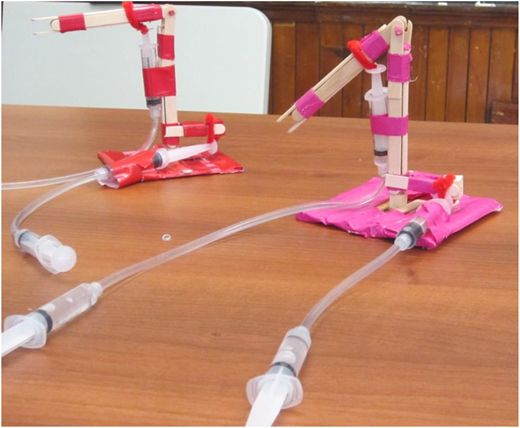
At Non-profit 2, students played with an invention made of Popsicle sticks and syringes to learn how changes in pressure can make the contraption move
At Non-profit 2, students played with an invention made of Popsicle sticks and syringes to learn how changes in pressure can make the contraption move
At the in-school sites, the teachers encouraged students to wonder by getting them to ask and answer “the questions that arise in their minds by giving them prompts” and focusing their attention on mathematical concepts, such as angular and linear measurements (see Plate 2). The following keywords related to wonder were found in the curriculum documents: inquiry, developing questions and exploring at In-school 1 and the words ask and answer inquiry-type questions at In-school 2. In the postobservation interview at In-school 2, the special education teacher expressed that the “inspiring piece [is] […] doing these types of learning activities […] you are activating kids' natural curiosity, their natural interest in figuring out how things work and how they can make things better.” Both in-school cases offered students the opportunity to inquire and then tinker as they explored new materials before using these to solve a problem or in creating something.
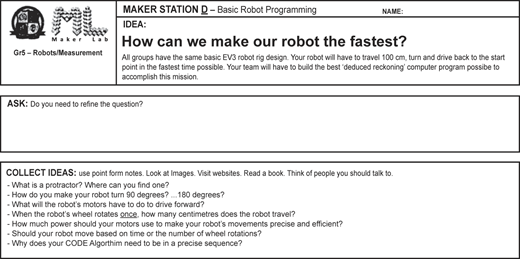
At In-school 1, students were given a handout and were asked questions to determine how to make the robot go faster
At In-school 1, students were given a handout and were asked questions to determine how to make the robot go faster
At In-school 2, specific mathematics objectives from OME (2020) were clearly written in the assessment guide given to the students (outlined in the success criteria), whereas In-school 1 embedded the mathematical concepts (OME, 2020) learned into the inquiry-type questions (see Plate 2). At In-school 1, the teacher-librarian said they did this purposely to get the students to think about the problem critically by asking questions such as “How do you make your robot turn 90°?” that is to say, questions on the mathematics concept of angle measurements; “When the robot's wheel rotates once, how many centimeters does the robot travel?,” that is to say, on circumference and revolution of a circle, and “Should the robot move based on time or the number of wheel rotations?” that is to say, on time and distance measurement (see Plate 2). The researchers elaborate on the specific learning processes (action verbs) that were embedded in the curriculum documents, which promoted inquiry in Stage 1 of a lesson and the mathematics concepts that could be used or taught during this stage, Stage 2 (Table 2).
Further, specific keywords were associated with the building curiosity stage (Stage 1). The adult participants mentioned the word inquiry 74 times during the interviews, and 12 out of 19 adult participants talked about using inquiry-based models and inquiry-type questions. Instructors/teachers said they activated students' natural curiosity in figuring out how things work and how they can make a prototype better. Students learned by searching through the sources of information and answering inquiry-type questions.
Stage 2: Collecting data and facts
The second stage involved gathering data and facts to solve a problem or create something new, whether it was using these facts to design a plan in Non-profit 1 or to find out more information and apply their knowledge in Non-profit 2. The director at Non-profit 1 encouraged students to plan and brainstorm ideas as well as to make a plan and critically analyze the plan. At Non-profit 1, the students had to plan their design by creating a sketch of their robot and creating a budget (using mathematics concepts of measuring money). The purpose of the sketch was to determine the materials, design and function of the robot (see Plate 3).
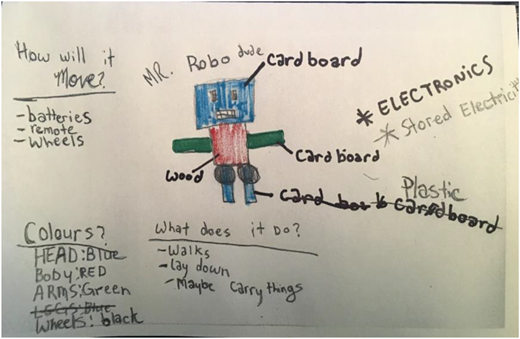
A student at Non-profit 1 planned and designed a blueprint of a robot by listing the materials and electronic supplies needed, the robot's purpose and the ways to make it move
A student at Non-profit 1 planned and designed a blueprint of a robot by listing the materials and electronic supplies needed, the robot's purpose and the ways to make it move
During the observations, the teachers at the in-school research sites were seen to allow the students more time to plan and collect ideas than at the nonprofit sites. At In-school 1, students collected data from several sources, such as images and websites, and used that information to design an outline, select information from their notes and formulate a focus. In contrast, In-school 2 teachers asked students to gather facts and resources (to collect ideas) from a specific children's book the teacher had selected. Then, they sorted the ideas and information gathered from the book and other resources. The information and facts were then used when designing and making the prototype in Stage 3. Teachers at In-school 1 and 2 also encouraged students to document the “making process” by writing and completing a handout. As shown in Plate 4, the teacher-librarian at In-school 1 used questions on the handout to prompt students to sketch a plan and write their ideas. At In-school 1, Grade 5 students completed a log, which included a section for writing notes about programming the robot to navigate the perimeter of the mat, and for calculating the distance traveled during one rotation (see Plate 4). The researchers identified the specific verbs and learning processes that were embedded in the curriculum documents that promoted the design and planning of the prototype in Stage 2 of a lesson, as well as the mathematical concepts that students learned when, for example, making a sketch, creating a budget or calculating distances traveled (Table 3). Further, the adult participants mentioned the word design 120 times during the interviews, and 15 out of 19 adult participants talked about design inquiry, process or phase as seen in Table 3.
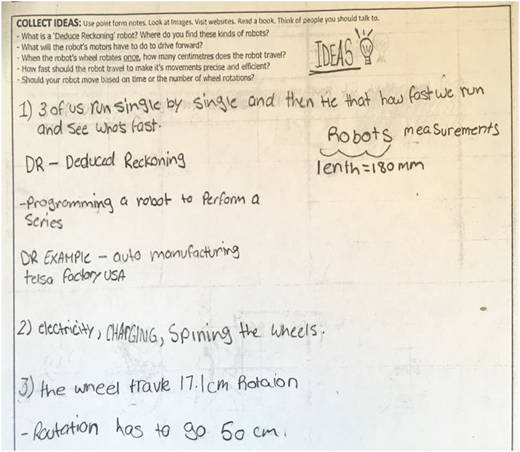
At In-school 1, students wrote the information to answer the inquiry-type questions that would help them build and program their robot
At In-school 1, students wrote the information to answer the inquiry-type questions that would help them build and program their robot
Stage 3: Making and refining
The third stage was the making stage where the students used design thinking to create a prototype, test it and refine the design for Non-profit 1 and 2 and In-school 2 sites. To encourage perseverance, failure and iteration were built into each course curriculum at Non-profit 1; students “learned-by-making.” Students at Non-profit 2 followed the design-inquiry model: plan, design, make a prototype, test, redesign and repeat, in this case, when designing the buzz wire game that lights up when the metal key touches the wire, as seen in Plate 5.
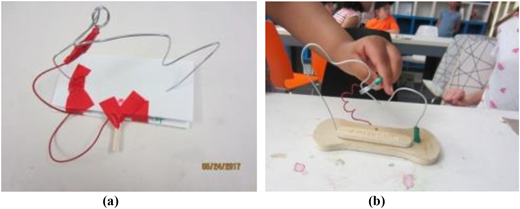
At Non-profit 2, (a) students designed and built a prototype and (b) then tested and redesigned a more efficient version of the buzz wire game
At Non-profit 2, (a) students designed and built a prototype and (b) then tested and redesigned a more efficient version of the buzz wire game
In-school 1 engaged students in this stage by taking an extra step after collecting the ideas to make a detailed plan as evidenced in drawing a blueprint or storyboard, listing the materials and organizing the information. The other three research sites combined the collecting ideas stage and planning stage. At In-school 2, students in a special education class were asked to create a prototype of an airplane. They were able to use “inquiry and research skills, so they had ideas from their prior knowledge […], but they also used the iPads to research and follow a video model [on making a paper airplane […] and they collaborated with other partners too” (Special Education Teacher, In-school 2). In this paper plane example, the younger students were given a create–improve–reflect prompts on the hand-out to guide them to reflect on why their first design was more successful than the second: they were asked to discuss the length of the wings, geometric shape of the airplane's body and distance traveled, and then use this information to improve their designs.
At In-school 1, students created a detailed plan for their challenge mat, which was a 2D irregular geometric shape (see Plate 6), and their robot had to be coded to go around the perimeter of this shape. Many of these designs, which students were taught to refer to as blueprint designs, incorporated measurement and coordinate geometry, for example, angles, rotations, perimeter, area and 2D/3D geometric figures (see Table 4). Besides the design of the challenge mat, the Grade 6 students had to “think about the design of [the] exterior [body], different LEGO parts used [for the robot] to do different tasks” and “actually [the] making [of] the robot, [like] where to put the wheels,” etc (Student 3, In-school 1). Similarly, the Grade 5 teacher mentioned that students had to design and program their robot to meet the requirements and compete against other students from different schools at a competition.
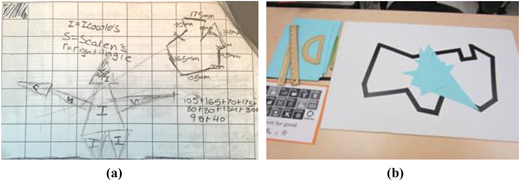
At In-school 1, the students (a) created the initial sketch of a 2D irregular shape for their challenge mat; (b) the students modified their design to a simpler shape to increase the precision and speed of the robot completing the course
At In-school 1, the students (a) created the initial sketch of a 2D irregular shape for their challenge mat; (b) the students modified their design to a simpler shape to increase the precision and speed of the robot completing the course
In Table 4, the researchers identify specific verbs and learning processes in the making and refining stage, such as create, iteration, modify, refine and test, which were also found in the CDP and EDP (see Table 1). These were observed in the handout prompts to guide students through the design process. Further, during the interviews, the adult participants mentioned the word make and its variant making 224 times, build/building 107 times and model/modeling 106 times; these keywords are associated with the making and refining stage (Stage 3 of a lesson).
Stage 4: Reflecting, applying and thinking forward
The fourth stage had the most diverse implementations among the four research sites (see Table 5). The two nonprofit organizations ended each course with a reflection and dissemination stage where the students shared, displayed their projects as well as shared their work with an authentic audience, which included their peers, parents and/or the community. For example, students hosted a station at the annual Maker Festival and shared their designs and prototypes with the community (Non-profit 1). At the in-school sites, students were prompted to document the “making process” formally (on the handouts) and informally (through conversations with the teacher and peers). In-school 1 allowed their students to make their prototypes, test and redesign them, and then present their products to an authentic audience. This audience included the class, school, parents and/or community.
After sharing, the teachers/instructors prompted students to extend and transfer their learning to another context. The teacher-librarian at In-school 1 asked students to reflect upon what worked well and what modifications needed to be made to improve the efficiency of their robots (see Plate 7). Students completed logs that included entries for the eight challenge mats that they had completed. Columns 3 and 4 were for notes about coding the robots and calculating the perimeters the robots navigated. Similarly, In-school 2 provided students with the opportunity to reflect on their work and what could have been done differently.
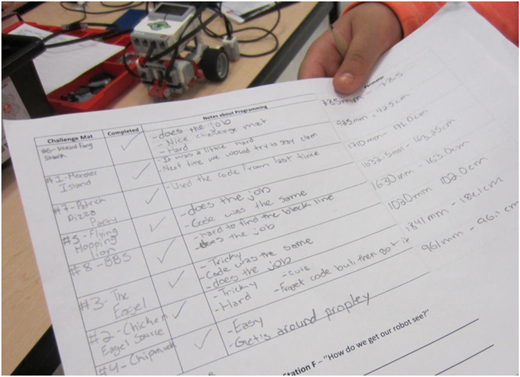
At In-school 1, students filled in a log for each challenge mat that their robot successfully or unsuccessfully completed and made modifications to the code or robot design
At In-school 1, students filled in a log for each challenge mat that their robot successfully or unsuccessfully completed and made modifications to the code or robot design
Each site had evidently adopted the design-inquiry model in their STEAM programs: plan, design, make, test, redesign and repeat. For example, at In-school 2, during the lesson of The Little Boy who Lived Down the Drain, students responded to the following question: how might you design and create a drain to help send a message down to the little boy (Plate 8)? Students used more than one blueprint when they planned, designed, made a prototype and tested and redesigned their drain based on their reflections on what worked well, what would need to be changed and what could have been done differently, as seen in Plate 8. One student mentioned “I would change it to have more materials and it to be more stable. I wish I could use tape […] to hold it up.” Students redesigned the drain and had to evaluate their designs and determine how well the designed solutions met the criteria specified in the lesson.
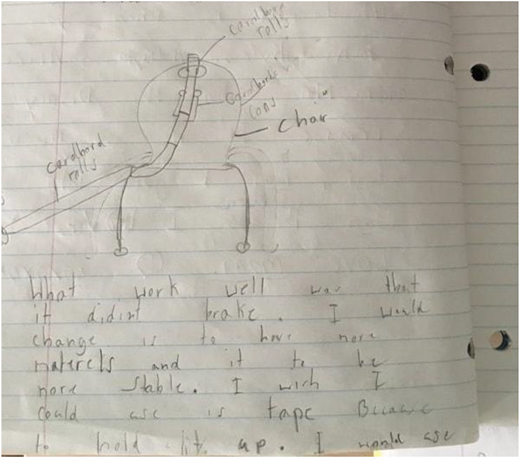
At In-school 2, students reflected upon their initial design and how they might make the structure better
At In-school 2, students reflected upon their initial design and how they might make the structure better
The stages were reinforced by students exploring and building curiosity and interest, collecting data and facts, gathering ideas and information needed; making, testing and refining; and reflecting, applying, disseminating and thinking forward about their solutions, own knowledge, designs and prototypes. At the building curiosity stage, only Non-profit 1 differed as students explored the technology immediately. The other three sites focused on sparking curiosity before students explored the tools and materials. At the planning stage, students gathered facts at Non-profit 1, or applied their ideas at Non-profit 2, or had time to research and collect ideas in this second stage through gathering ideas from several sources at In-school 1, and focusing on a specific book at In-school 2.
During the making and refining stage, only In-school 1 differed from the other three sites as it engaged students in one more sub-stage: of making a detailed plan of a blueprint or storyboard in addition to prototype defining, testing and refining. The four research sites, nonetheless, varied widely in the last stage, which included students sharing their work with an authentic audience, student reflection and transference of knowledge. The teacher-librarian at In-school 1 encouraged students to think about using that knowledge and understanding in another context, such as solving a problem at home, later in high school, in postsecondary education or in a future career. In contrast, In-school 2 provided students with the opportunity to reflect on what worked well and what they would do differently. It appeared that all four research sites used the fourth stage to extend and focus on learning that transcended the individual activities so that the learning continued after the lesson or unit had finished (see Table 5).
Discussion
The main findings, as analyzed in the curriculum documents and interview transcripts and as observed in the lessons at the STEAM programs, were as follows: (1) the lessons or units from the in-school research sites seemed to be more structured than those from the nonprofit cases because they included specific expectations from the provincial mathematics curriculum (OME, 2020) in the lesson goals and objectives; (2) the lesson structures, as outlined in these curriculum documents at each site, differed by the research site's program objectives and (3) what was common, nonetheless, was that each model could be seen to address the four major stages: building curiosity, collecting data and facts, making and refining, and thinking forward through sharing (see Tables 2–5).
Data interpreted through the theoretical frameworks
Although the four stages of the SML may appear linear, interpreted through the lens of the literature on Doppelt's (2004, 2009) CDP and English et al.'s (2017) EDP, they are cyclical. For example, the fourth stage of the SML provides students with the opportunity to reflect on what worked well and where they might go next by revisiting the previous stages (Plate 7). This is in line with English et al.’s (2017) description of the iterative process when students test, reflect, revise and revisit the other stages to develop alternative solutions or a more efficient design (as seen in Plate 8). According to English et al. (2017), the iterative process can be powerful as students learn to identify inadequacies and revise their design.
STEAM programs in this study, through their focus on hands-on activities and design thinking, and their adoption of making processes, in preparation for, during or following Stage 3, appeared to employ constructionism when students were offered opportunities to construct their own knowledge and to learn-by-making (Papert and Harel, 1991).
Previous studies (English and King, 2015; English et al., 2017; Kendall, 2018) suggest that younger children require more direct instructions with respect to the design and making process compared to older students. Further, Doppelt (2009) explained that, for a deeper understanding, “teachers should assist pupils in integrating disciplines in their design process” (p. 57). The process of testing, reflecting and revising their design, for example, is “critical in fostering a deeper understanding of the concepts inherent in the problems and generating an improved product” (English et al., 2017, p. 258). Direct instructions were evident at the nonprofit sites, where instructors used scaffolding techniques, and the in-school sites, where they used inquiry-type verbal or handout questions to prompt students to sketch and write during the testing and redesigning stage (see Plates 5–8).
Extending learning during the four stages of a Maker lesson
Stage 1 in the CDP and the EDP focuses on identifying the issue and considering the needs of the person for whom the students are designing a solution (social-emotional learning). Stage 1 (Building curiosity) of the SML could potentially be expanded to incorporate identifying the issues and the needs, as social-emotional learning has recently become a critical component of the new Ontario mathematics curriculum in which students are encouraged to “express their feelings and understand the feelings of others” (OME, 2020, p. 36). When students identify the issues and needs, they can empathize, feel and show understanding for others (verbs to be added to Stage 1, Table 2).
When speaking about making in Stage 3 (Making and refining) of the SML, the instructors/teachers, even when they did not directly mention CDP or EDP, spoke of using some sort of design and engineering education-based model in their STEAM programs. At the four research sites, students followed the design thinking process, consistent with CDP, to create a plan and design a prototype that will be tested and redesigned. For example, at In-school 2, the students plan, design, make, test and redesign their drain (see Plate 8). These design-based verbs were also prevalent, especially during Stage 2 of a lesson. This finding is in line with Liao (2016), who maintained that design thinking is an essential component of STEAM education. The researchers see the potential to extend the learning of curriculum concepts by encouraging students to make, design, model, organize and critically analyze their plans and to collect data and information related to the planning of their prototypes and designs (Stage 2; Table 3). The CDP and EDP used similar verbs, such as construct, create, design, redesign and reconstruct (see Table 1).
From our analysis, we speculate that students used and learned disciplinary skills which transcend the designs they planned and the products they made. We also speculate that, at the in-school sites, the learning of mathematics was not blurred while focusing on the disciplinary boundaries across, say, science and engineering skills. Further, we see the stages as key to aiming at the depth of knowledge gained in an individual discipline and for the knowledge that transcends an individual discipline (Chalmers et al., 2017), both of which would be useful in other mathematics activities and potentially for other disciplines. Skills were referred to as transferrable, such as perseverance, when failure and iteration were built into the lesson. The instructors/teachers said they encouraged students to make mistakes and take risks. Teachers offered students prompts and organizers that focused on the mathematics curriculum (see Plates 2, 4, and 7). We see the potential to extend the learning of the mathematics curriculum by supporting students in making, creating, modeling, testing and in engaging in the accompanying thinking and activities, such as drawings sketches and graphs, and writing tables and charts related to the making and refining of designs, prototypes and artefacts (Table 4).
In the fourth stage, the students are given the opportunity to reflect upon their solutions, approach the problem in multiple ways and revisit the other stages to develop alternative solutions, and integrate across the disciplines (i.e. apply their knowledge to mathematics and other curricular content in a real-world context). These findings are consistent with Reeves et al.’s (2004) claim that students should have authentic tasks that have a real-world context and integrate across the disciplines.
Deeper engagement with mathematics
In each stage of a lesson, students were encouraged to engage in the construction of in-depth understanding of concepts, which seemed to increase the overall rigor. Out of the four stages, applying and learning of mathematics and other school curricula were more enabled in the collecting data and facts (Stage 2) and the reflecting, applying and thinking forward stages (Stage 4). During these stages, instructors/teachers encouraged students to engage in the use of mathematical concepts, such as linear measurements, geometry planes and spatial reasoning, rotational transformations and budget computations, as well as exploring the ideas of graph coordinates, functions and variables. When students were planning, designing and testing their robots (as seen in Plates 2, 4, 6, and 7), they explored mathematical concepts such as “adding and subtracting integers, rotating an object through a specific degree and moving counter-clockwise (i.e. positive angles) and clockwise (i.e. negative angles) […] Students also practiced fact-based or procedural mathematics” when they had to divide, measure the dimensions of the robot, calculate the perimeter of the path and the distance traveled during one rotation (Bertrand and Namukasa, 2020a, pp. 88–89). The students learned and used mathematical concepts that were essential to the precision and design of the robot, which seemed to provide them with a more in-depth learning experience.
In the mathematics content section of the tables (see Tables 2–5), we make connections to how teachers can provide mathematics prompts, contexts and tasks during each stage to help the students focus more on mathematics and other school curricular concepts. This potential to extend the learning of the mathematics curriculum during the designing and making phases needs to be extended by supporting students in inquiring about, designing, making and reflecting on mathematics information, ideas, representations, designs, computations and data, alongside their physical or digital prototypes, artefacts and products. Since design thinking refers to cognitive processes and the thinking skills and practices designers use to create designs or solve problems (Henriksen et al., 2019), mathematics could be seen as the basis for choosing the optimal solution (Doppelt, 2009), idea creation (English et al., 2017) and creating meaningful (Cook and Bush, 2018) designs, expressions, computations and applications.
The authors see the last stage, its verbs and learning processes as the hallmark of integrating design and making processes in learning mathematics (Table 5). In Stage 4, students demonstrated their understanding of the mathematical concepts learned: beyond simply making a product, students appeared to deepen their understanding as they shared their ideas on the planning, designing, making and refining stages. At In-school 1, the students documented every stage of the “making process” in a video to capture their observations, creations and group discussions. According to Fitzallen (2015), the mathematics in these STEAM activities was an integral part of the lesson and not merely a part that was “incidental to the purpose” (p. 241) of the activity. For example, mathematical concepts were integrated into the assessment (success) criteria and inquiry questions. This is in line with English's (2016a, b) findings, which maintain that focusing on an in-depth understanding of the content knowledge of disciplines, such as mathematics during STEM/STEAM instruction, will enhance the overall disciplinary knowledge gained and applied within a STEM/STEAM unit. Stage 1 – collecting data and facts – and Stage 4 – the reflecting, applying and thinking forward stages – appear crucial to creating a more robust integrated STEAM curriculum that is not poorly conceptualized and does not “undermine in-depth student learning” (Chalmers et al., 2017, p. 2).
Recommendations
For educators, researchers and policymakers, the authors recommend that a STEAM lesson should adopt a specific model, such as EDP, CDP or the SML proposed in this study (see Tables 2–5), to create a more robust, integrated STEAM curriculum. To provide students with in-depth learning experiences in mathematics, the STEAM curriculum should embed the concepts of an iterative process (English et al., 2017), real-world problems, creative solutions, design-based learning and inquiry-type questions.
Recently, the authors had the opportunity to adopt the four stages of the SML from this study into another context (STEAM summer camp). The authors implemented the four stages of a lesson during a summer camp, which was an out-of-school outreach program for students in grades 5–8. For identification purposes, the authors labeled the screenshots of the slides with the specific stages of the lesson (see Appendix 2), but, during the actual STEAM camp, the headings of each slide were labeled differently. A sample of 8 out of a total of 43 slides was selected from the module. The software used for learning online was Cospaces Edu (https://cospaces.io/edu/). The authors selected this third module as an artefact to illustrate how the four stages can be adopted for the SML. From the STEAM camp, 18 out of the 19 students explained that they were “excited through the process,” “want[ed] to learn more” and “challenged [themselves] in ways that [they] thought [they] never would.” The findings from the STEAM camp appeared to indicate that the students had a meaningful learning experience as they expressed feelings of excitement and the motivation to learn more. One of the main goals of the four stages of the SML is to promote a deeper understanding. Further investigation through quantitative data collection and analysis will be necessary to determine if there is a relationship between the four stages of the SML and the students' deeper engagement with the curricular content.
This study's findings can be helpful to an educator or policymaker who is designing the instructions for a STEAM program. Specifically, the four stages of the SML may be adapted to guide the design of a STEAM program that builds curiosity (piques students' interests), allows students to design, then make and connect their design to the real world. It is evident that the four stages, when woven within the thread of mathematics curriculum content, can create a more robust, integrated curriculum that avoids the pitfall of developing a STEAM unit/lesson that does not engage students or promote a deeper understanding of the content (Chalmers et al., 2017, p. 2). Educators must be mindful of the students' ages and levels of comfort with the technology and materials to be able to provide direct instruction when needed to assist students in the different stages of the SML, especially during the making and refining of their design (English et al., 2017).
Conclusion
At each site, students were learning-by-making and following the design thinking process to create a plan (Stage 2 collecting data and facts) and design a prototype to be tested and redesigned (Stage 3 making and refining). These findings demonstrate that students were given opportunities to practice or learn curriculum content and transferrable skills from the design thinking process. Design thinking skills in STEAM are increasingly noted as, “creating new intellectual spaces by integrating the disciplines” (Cook and Bush, 2018, p. 94). This observation is in line with the literature on STEM/STEAM education, which states that students, when they learn in integrated contexts, can transfer their knowledge across disciplines and solve problems creatively in another context (Liao, 2016).
Although these findings provide deeper insight into STEAM education, there are several possibilities for future research. Future studies may investigate whether students' ability to test and refine their own design may be further strengthened with instructional prompts. This is in line with English et al.’s (2017) suggestion that further research needs to be done on “young students' approaches to design and redesign sketching, including their annotations, […] especially [in] the redesign phase” (p. 269).
One limitation of this study is the length and the number of research sites. Although the data the researchers collected were extremely rich and thick (Fusch and Ness, 2015), it would have been beneficial to have a longitudinal study over a one to three-year period to develop a deeper understanding of the participants for more in-depth study and in-case analyses. More opportunities to observe the same students during different lessons, stages of a lesson and environment as well as the same grade levels in an informal and formal setting would be beneficial. It would also be informative to research the reflecting, applying and thinking forward stage in further depth to gain more insight into how educators assess and document the STEAM learning process.
In contrast to our four stages of a lesson, the CDP and EDP encourage students to identify their needs and the issues by “express[ing] their feelings and understand[ing] […] [for] others” (OME, 2020, p. 36), as seen in Table 1. There is potential for future research on the social-emotional learning of students, as well as an expansion of the four stages of the SML by adding this component onto the first stage. It also would be advantageous to research the development of transferable skills, such as critical thinking and problem-solving, to support the learning of mathematical concepts and the use of mathematical processes (reasoning, proving, reflecting, connecting, communicating, representing, selecting tools and strategies) in the context of our four stages of the SML.
Although there are pedagogical models that promote “intra- and inter-disciplinary” (p. 350) learning, such as the integrated curriculum model (VanTassel-Baska, 1986) and the creative inquiry process framework (Costantino, 2018), there is no specific pedagogical model for STEAM education. The four stages of the SML were made for this purpose. The findings from this study contribute to an instructional model that ensures that mathematics standards and curriculum expectations are more explicit, targeted (embedded into the questions and criteria for assessing them), purposeful and essential in STEAM integrative learning tasks. The findings have implications for planning, teaching and researching STEAM programs. In this paper, we use examples and artefacts from each research site to provide illustrations of the findings on each of the four stages. These illustrations contribute to an understanding of how these stages can be implemented in classrooms.
Classroom Observation Protocol | |
Adapted from Luna, 2015 | |
Instructor __________ | Date __________ |
School __________ | Class __________ |
Observer __________ | Time __________ |
| Research Question |
|---|
What curriculum and instruction models of STEAM education are implemented in non-profit and in school contexts? |
| STEAM Classroom/Workshop Environment | |
|---|---|
Organization of the STEAM lab | |
➢ Take picture/video of STEAM lab | |
Number of Students: | |
Use of Technology: | |
What types of tools and technology are used in this STEAM lab/center/program? Organization and access to tools and materials. | |
Environment Checklist | |
Check all that apply: | |
□ STEAM lab/center | □ Traditional Classroom setting |
□ Visual Displays of STEAM projects | □ No examples of STEAM projects |
□ Instructor Facilitator | □ Instructor lecturer/presenter |
□ Instructor-student interaction positive | □ Instructor-student interaction negative |
□ Student-student interaction positive | □ Student-student interaction negative |
□ Grouped seating | □ Individual seating |
Notes: | |
Classroom/Workshop Activities | |||
Type of Instruction/pedagogy. Check all that apply: | |||
□ Lecture/Presenter | □ Problem-based learning | ||
□ Class discussion | □ Reading, seatwork | ||
□ Small group discussions | □ Hands-on activity | ||
□ Learning Centers/Stations | □ Cooperative learning | ||
□ Teaching/Student Interaction | □ Assessment | ||
□ Other | |||
Notes: | |||
The tasks and Activities | |||
Student Engagement: | |||
High: 80% or more engaged Medium: 50-60% engaged Low: 80% or more off task | □ Low | □ Medium | □ High |
Students’ Attitude towards STEAM or STEM activities: | □ Positive | □ Negative | □ Indifferent |
Differentiation: | Check all that apply: | ||
□ Multiple ways to approach a problem | |||
□ Low floor and high ceiling approach to learning | |||
□ Open-ended problem with multiple outcomes | |||
□ Flexible and adaptable lesson plans | |||
□ Adaptation for learning disabilities and giftedness | |||
Arts integrated into the lesson: | □ Seamlessly | □ Added component | □ N/a |
Other Observations | |||
Check all that apply: | |||
□ Collaboration | □ Communication | ||
□ Self-motivation | □ Self-confidence | ||
□ Self-regulation | □ Perseverance | ||
□ Curiosity | □ Innovation | ||
□ Problem-solving | □ Critical Thinking skills | ||
□ Other | |||


