The purpose of this study is to expand knowledge about the dynamic nature of the engagement concept. To this end, the paper proposes a conceptual model of engagement dynamics that offers a systematic and comprehensive understanding of how and why engagement evolves over time, illustrated through the context of climate action.
Based on the insights of a semi-systematic literature review and building upon the actor engagement concept, the authors adopted the conceptual paper type and used a propositional conceptual approach to develop the authors’ model.
The model, comprising a set of propositions, describes the dynamic elements of engagement as well as the internally and externally caused engagement dynamics and the different levels at which they occur.
The theoretical derivations of this paper advance the understanding of the engagement construct and its evolving nature, facilitate knowledge diffusion across engagement research fields and provide a theoretical basis for a dynamic approach to engagement in the service and marketing discipline, which becomes particularly relevant when addressing the complex societal and market transformations driven by climate change. In practice, the authors’ model can help foster intended and counteract unintended engagement dynamics across individual, collective and system levels, which is crucial in the context of climate change, where rapid societal and environmental transformations both drive and necessitate changes in actors’ engagement in climate action.
1. Introduction
Climate change and its impacts are transforming our world, while simultaneously compelling us to respond with transformative action. Fundamental changes are required across all domains: service organizations must adapt their offerings, consumer expectations and behaviors must evolve and policymakers must establish regulatory frameworks that enable and guide these transformations (Haaja and Evers, 2025). In addition, knowledge must be generated, for instance, as a basis for both policymaking and the design of new or adapted services. Driving such transformations depends not only on the engagement of individual actors but also on their collective efforts (Fehrer et al., 2020; Alexander et al., 2025). While we observe growing engagement for climate protection among many actors, we also see negative developments, such as declining engagement or disengagement due to frustration and exhaustion, or even the strengthening of negative engagement (Sommer et al., 2019; Verleye et al., 2024). Understanding how and why engagement changes is therefore essential for generating measures that reinforce intended developments and counteract unintended ones. This deeper understanding of engagement and its dynamic nature becomes even more crucial if we assume that the pace and magnitude of global change will continue to accelerate, both triggering changes in actors’ engagement and requiring further adaptations in their engagement.
Historically, engagement has been primarily regarded as a dyadic concept (Alexander et al., 2018), studied at some single, specific point in time (Fehrer et al., 2018), but recent research has recognized the need to address its inherently dynamic nature (Li et al., 2017; Brodie et al., 2019; Fehrer et al., 2020; Finsterwalder et al., 2022). Other studies also adopt a systemic perspective and acknowledge actor engagement (Storbacka et al., 2016), prompting research developments that move away from viewing engagement as an isolated process between an engagement subject and engagement object. By addressing the system in which the actors are embedded (Brodie et al., 2019), researchers reveal that a focal actor’s engagement often changes, through interactions with other actors (Alexander et al., 2018) and the institutional arrangements of the system (Storbacka et al., 2016).
The growing acceptance of the importance of engagement dynamics (Finsterwalder, 2018; Brodie et al., 2019; Hollebeek et al., 2022) has prompted relevant studies in a range of domains, including employee engagement, student engagement and customer engagement (Brodie et al., 2011a, 2011b). As a result, the overall literature stream has become fragmented, featuring multiple, discrepant conceptualizations, without any holistic view of the dynamic nature of engagement or clear understanding of which engagement characteristics undergo changes, why and how.
To establish such a comprehensive understanding and thereby build a foundation for further research and practice, we seek to address the central research question:
How can the processual and dynamic nature of engagement be conceptualized?
Based on a semi-systematic literature review we identified three components of engagement dynamics, changes in engagement itself (i.e. dynamic elements), factors that influence the changes (triggers) and mechanisms underlying these changes. Building upon the actor engagement concept, we applied the conceptual paper type of a model (Jaakkola, 2020), used a propositional conceptual approach (Cornelissen, 2017) to build the theoretical model based on the identified components and define the corresponding conceptual domain of engagement dynamics. The model, comprising a set of propositions, describes the dynamic elements of engagement, internally caused engagement dynamics, externally caused engagement dynamics and the levels of engagement dynamics. To visualize the model’s propositions, we used the illustrative case of the international climate strike movement Fridays for Future.
Started by the Swedish teenaged activist Greta Thunberg in 2018, her engagement with climate protection efforts, has initiated and increased the engagement of approximately 7.6 million people in 185 countries (Nielsen et al., 2021). It also has prompted other actors, such as politicians, media, environmental organizations and businesses, to engage (Daniel et al., 2020). This case effectively illustrates engagement dynamics within systems, showcasing changes in the engagement of both individual and collective actors. It further demonstrates the practical relevance of the topic by highlighting how the rapidly changing world not only increases the potential to transform actors’ engagement but also emphasizes the necessity of changing their engagement to address global challenges like climate change, thus underscoring the far-reaching impact of these engagement dynamics.
The theoretical implications of this paper are threefold. First, by introducing the construct of engagement dynamics, it advances understanding of the engagement concept and its dynamic nature. Second, by synthesizing insights from different research areas under the generic perspective of actor engagement, our conceptualization facilitates knowledge diffusion across engagement research fields and contributes not only to the actor engagement literature but also to engagement research more broadly. Third, our paper contributes to the service and marketing disciplines by promoting a dynamic perspective on engagement and offering a theoretical foundation for its analysis, which is especially relevant given climate change and the developments it entails. In practice, our model’s insights can help practitioners foster intended engagement dynamics and counteract unintended ones at individual, collective and system levels. This is crucial, as rapid transformations in society and the environment both drive and necessitate changes in actors’ engagement in climate action.
To establish these ambitious contributions, we first introduce the engagement concept, with a specific focus on actor engagement, and derive from this a definition of actor engagement dynamics. Subsequently, we describe the semi-systematic literature review and present its results. We then develop our model of engagement dynamics through a series of propositions, followed by an illustration using the case of the Fridays for Future movement. Building on these insights, we elaborate on the theoretical and practical implications, discuss the limitations of our study and suggest promising avenues for future sustainability research.
2. Engagement, actor engagement and actor engagement dynamics
2.1 Engagement
Over the last three decades, both academics and practitioners have increasingly given attention to the engagement concept, as it is linked to positive effects at the individual, collective and system levels (Bakker and Albrecht, 2018). At an individual level, engagement impacts creative thinking (Harvey and Kou, 2013), well-being (Bakker and Leiter, 2010) and the attitude to go the “extra” mile (Kwon and Kim, 2020) among other effects. In collectives like teams or groups, engagement can lead to the achievement of collective efforts (Bakker, 2011) such as generating open innovations (Dahlander and Gann, 2010) or service innovations. For organizations, engagement can influence performance and thus the success of an organization, leading to a competitive advantage (Brodie et al., 2011a, 2011b). Moreover, authors recognize the potential for systems transformation through the engagement of the various actors within the systems (Kleinaltenkamp et al., 2021). On the contrary, low engagement, disengagement or negatively valenced engagement at the individual level can lead to negative feelings, behavior and performance (Grégoire and Fisher, 2008). Groups may fail to achieve their goals and organizations may struggle to succeed (Costa et al., 2016). While at the system level, necessary changes – such as those aimed at transforming systems towards greater sustainability – might not be implemented due to a lack of engagement or could even face active opposition against the required transformations (Verleye et al., 2024).
Given the evidenced impact of engagement, the concept has gained significant importance across a wide range of fields. For instance, in sociology, researchers have examined “civic engagement” (e.g., Theiss-Morse and Hibbing, 2005), while psychology has focused on “social engagement” (e.g., Huo et al., 2009). “Student engagement” (e.g., Alzahrani et al., 2023) has been explored in educational studies, “social media engagement” in communication studies (Poole et al., 2024), with organizational behavior literature investigating “employee engagement” (e.g., Bader et al., 2023) and “stakeholder engagement” (Hollebeek et al., 2022). Researchers in the marketing and service fields have studied “consumer engagement” (Hollebeek et al., 2023), “customer engagement” (Azer and Alexander, 2020), “brand engagement” (Juric et al., 2015) and “actor engagement” (Storbacka et al., 2016). Despite being studied across different domains, engagement research consistently examines the relationship between an engagement subject, for instance a person or a group of persons and an engagement object, where the object varies by field and may refer to a brand, work or studies.
The diverse areas of application underscore the relevance of engagement and, consequently, the necessity of a comprehensive understanding of the concept. Historically, engagement has been examined as a relatively stable concept, whereas more recent research and practical observation emphasize that the engagement process can also be short-term and highly variable (Hollebeek et al., 2022). The evolution in how engagement is understood in the literature can be exemplified by reviewing definitions from different academic domains, which reveal a clear shift toward a process-oriented conceptualization.
In the field of work, engagement is defined as “[…] a positive, fulfilling, work-related state of mind […]” (Schaufeli et al., 2002, p. 74). In the marketing area, customer engagement is prominently described as a “psychological state, which occurs by virtue of interactive customer experiences with a focal agent/object within specific service relationships” (Brodie et al., 2011a, 2011bp.7) that extends beyond the transactional purchase (Jaakkola and Alexander, 2014). Both definitions conceptualize engagement as a psychological state. Though the definition of customer engagement also notions the interactivity of engagement by referring to the “interactive customer experiences” and thus its dynamic nature (Sim and Plewa, 2017). Moreover, states present by definition transient psychological experiences. Hence, engagement as a state is necessarily not static because it is influenced by the states of other individuals and groups (Costa et al., 2014). Considering this dynamic nature, it seems more adequate to describe engagement as a psychological process (Bowden, 2009).
2.2 Actor engagement and actor engagement dynamics
Recognizing the processual character of engagement, the concept of actor engagement was introduced, which is based on the theoretical perspective of Service-dominant logic (Barrera Rodriguez et al., 2023). In detail, actor engagement has been defined as “both the actor’s disposition to engage and the activity of engaging in an interactive process of resource integration within the institutional context provided by a service ecosystem” (Storbacka et al., 2016, p. 3009). Another relevant definition highlights its dynamism, referring to actor engagement as “a dynamic and interactive process that reflects actors’ disposition to invest resources in their interaction with other connected actors in a service system” (Brodie et al., 2019, p. 2). Thus, existing definitions of actor engagement reflect a dynamic and systemic perspective on engagement, such that it accounts for changes and considers context influences and, thus, interactions with other actors and the institutions surrounding the actor.
Actor engagement refers to an interactive process of resource investment (Brodie et al., 2019; Storbacka et al., 2016), such that the activity of engaging relates directly to resource investments by the actors, whose engagement disposition implies their “capacity and tendency to enter into the act of engaging” (Sim et al., 2022, p. 1931). The process element implies a “particular sequence of connected events over time” that can fluctuate and vary (Van Geert, 2019, p. 172). In the case of the actor engagement process, the sequence of connected events is described as iterative in nature (Li et al., 2017). Changes or developments occurring as part of the process reflect dynamics. Using actor engagement notions and thus the idea of engagement as resource investment, we define engagement dynamics as an ongoing process of the actor’s changing disposition to invest resources and changing activity of investing resources in their interaction with other connected actors in a service system. We have adopted the definition of actor engagement by Brodie et al. (2019) as a basis for our definition, as it describes engagement as resource investment and emphasizes interaction with other actors, a central aspect of the actor engagement concept and crucial considering engagement dynamics. However, since the definition by Brodie et al. (2019) only implicitly shows the activity of resource investment and does not explicitly mention it, we have taken the definition by Storbacka et al. (2016) as a benchmark and explicitly point out that engagement dynamics refer to changes in the disposition and the activity of investing resources.
At its core, engagement dynamics are changes in the engagement concept over time. However, the variability and thus the dynamic nature is not well understood to date (Brodie et al., 2019; Hollebeek et al., 2022; Engert et al., 2023) and the literature is characterized by an inconsistent theoretical understanding of the concept (Fehrer et al., 2018). Comprehensive insights about how and why engagement evolves over time and the consequences of these changes remain sparse. This is despite such understanding being critical to enable conscious management of engagement dynamics, fostering intended dynamics and mitigating unintended ones to achieve desired outcomes at individual, collective and system level. Thus, this paper aims to deepen the understanding of the dynamic nature of the engagement concept by introducing the new construct of engagement dynamics.
3. Semi-systematic literature review on the dynamic nature of engagement
Engagement is a broad and widely studied concept, used across various disciplines such as student engagement, work engagement and customer engagement (Kleinaltenkamp et al., 2019). Across these domains but also within these domains the conceptualization of engagement varies. For instance, some studies define engagement as a multidimensional construct, while others adopt a unidimensional perspective (Brodie et al., 2013). In some cases, only observable engagement is considered, whereas other studies distinguish between engagement behavior and engagement disposition (Brodie et al., 2019). Given the breadth of the topic and the diverse conceptualizations across fields, this variability also extends to how the dynamic nature of engagement is understood and portrayed. Accordingly, we adopted a semi-systematic approach (Snyder, 2019) to identify in the engagement literature how and why engagement changes over time. This approach is particularly well-suited for broad topics examined across diverse disciplines and conceptualized in varying ways, as it is not feasible to conduct an exhaustive review of every potentially relevant publication (Wong et al., 2013). Moreover, this type of analysis is suitable for detecting themes and identify components in these broad topics to for instance generate a theoretical concept (Ward et al., 2009). Thus, it is particularly appropriate for examining how the dynamic nature of engagement is conceptualized and represented in the engagement literature and for identifying recurring themes that can inform the development of a conceptual model of engagement dynamics.
To identify how engagement dynamics can be conceptualized based on insights from the existing literature, we applied the four established steps of conducting a literature review:
designing the review;
conducting the review;
analyzing the findings; and
writing the review (Snyder, 2019).
First, we began by conducting an initial scoping review to gain an overview of the literature that addresses how and why engagement changes over time. The findings revealed that engagement dynamics are explored across a variety of fields and that studies within the social sciences, in particular, offer valuable insights for understanding this phenomenon and should therefore be included. In contrast, research from the natural sciences—such as physics—was found to be of limited relevance to our research question and was consequently excluded from further analysis. Within the body of relevant literature from the social sciences, both journal articles and books or book chapters were considered relevant. The journal articles included conceptual, quantitative, qualitative and literature review studies. Based on these initial insights from the scoping review, we decided to conduct our literature search using the two frequently used academic databases: Google Scholar and Web of Science. We used the search terms “engagement dynamics” and “dynamic nature engagement” to identify relevant literature. Only contributions from the field of social sciences were considered. In this process, we included all English-language publications—empirical and conceptual papers, literature reviews, books and book chapters—regardless of their publication date.
Applying these criteria, we identified the relevant publications in the following step. Publications were considered relevant if they addressed the dynamic nature of engagement either directly or indirectly. A direct reference implies that the specific study explores how and why engagement changes over time. An indirect reference instead means that, even if the article does not examine changes in engagement over time, it takes such changes into account (e.g., by investigating antecedents or outcomes of engagement) and achieves relevant results, so it can contribute to our understanding of the dynamic nature of engagement. To determine whether the publications addressed the dynamic nature of engagement directly or indirectly, we then scanned the keywords, titles and abstracts of the papers. We identified 122 publications dealing with the dynamic nature of engagement, 44 directly and 78 indirectly (see web appendix).
To analyze and synthesize the findings from the literature review, we conducted a thematic analysis (Braun and Clarke, 2006). This qualitative method enables the identification, analysis and reporting of themes (patterns) within the data (Braun and Clarke, 2006). In this case the data set presents the identified 122 publications and the themes are reoccurring patterns about the dynamic nature of engagement. To identify these themes, we followed the six phases of thematic analysis:
familiarization with the data;
generation of initial codes;
searching for themes;
reviewing themes;
defining and naming themes; and
producing the report (Braun and Clarke, 2006).
Through the process of identifying the papers, we had already developed an initial familiarity with the data. However, as part of the analysis, we revisited all abstracts and then read either selected sections—such as the introduction and conclusion—or the full texts of particularly relevant papers. Subsequently, we systematically reviewed all papers and coded all passages that referred to the dynamic nature of engagement. We then focused exclusively on the coded segments and attempted to categorize them. Through this inductive approach, we were able to identify three overarching categories: changes in engagement itself (i.e. dynamic elements), factors that influence the changes (triggers) and mechanisms underlying these changes (see web appendix). While many extant studies also refer to outcomes of engagement, these do not reflect a focus of this research and are thus not included in our proposed model. Rather, reflecting the reciprocal relationship between triggers and an actor’s engagement, as well as the assertion that engagement is an iterative process (Li et al., 2017), we propose that each outcome always represents an effect on the triggers. Thus, we concentrate on triggers and acknowledge their interactions with the dynamic elements of engagement. As part of phase six of the thematic analysis and the fourth step of conducting a literature review, we now present the three identified overarching categories, which constitute the main components of our model.
First, the literature review revealed that most publications addressing engagement dynamics focus primarily on changes in the engagement construct itself. The majority of these studies examine changes in engagement intensity (e.g., Alzahrani et al., 2023), often through quantitative research that investigates influencing factors, such as the impact of the previous engagement stat (e.g., Saqr et al., 2023). These studies typically focus on changes in intensity, either in isolation or in combination with changes in the intensity of the engagement dimensions (e.g., Vasalampi et al., 2021). Furthermore, most of these investigations examine only the activity of engaging, whereas fewer studies consider changes in engagement disposition (e.g., Kahu et al., 2020). Even less frequently, studies address changes in engagement valence (e.g., Azer and Alexander, 2020). In summary, we found that studies exploring changes in engagement focus on shifts in the activity of engaging, engagement disposition, valence, intensity, dimensions or some combination thereof. Since these characteristics represent aspects of the engagement construct that are subject to change, we subsume them under the term dynamic elements and define them as the attributes of the engagement construct that can change over time.
As previously described, numerous studies examine factors influencing engagement, such as the previous state of engagement (e.g., Saqr et al., 2023). These specific studies investigate how prior levels or expressions of engagement affect engagement at a later point in time. Accordingly, they explore potential changes within engagement itself, addressing engagement dynamics that are initiated by changes by the dynamic elements themselves. The literature review also revealed that numerous studies have investigated external triggers of engagement dynamics. These triggers vary significantly across research domains—for instance, the influence of classmates (Mendoza and King, 2020), the presence of personal and job resources (Xanthopoulou et al., 2009) or the effect of brand engagement on consumer engagement (Dhaoui and Webster, 2021). We categorized this wide range of external triggers into four overarching groups: focal object, other objects, other actors and context. To emphasize that these triggers lie outside the focal actor, we subsume them under the label external triggers, which we define as factors outside of the focal actor that influence the actor’s engagement. In contrast, if one or more dynamic elements influence and thereby change engagement over time, these are referred to as internal triggers.
As a third category, we derived the mechanisms of engagement dynamics from the literature. Across publications addressing both internally and externally triggered engagement dynamics, the underlying mechanisms of influence were frequently discussed. In the case of externally triggered engagement dynamics, the influence of other actors is commonly explained through the crossover effect (Finsterwalder et al., 2022), while the influence of other engagement objects is often attributed to the spillover effect (Hollebeek et al., 2023). For contextual factors (Kahu et al., 2020), changes in the engagement object itself (Omigie and Mencke, 2024) or in internally triggered dynamics, interaction is frequently identified as the underlying mechanism (Alessandri et al., 2018). This includes specific phenomena such as the crowding-in effect, where the activity of engaging influences disposition (Fehrer et al., 2018) or the spiral effect (Dhaoui and Webster, 2021), which is also rooted in interaction-based mechanisms. In our literature review, we primarily distinguished between interaction, spillover and crossover, and grouped them under the overarching category of mechanisms. We define mechanisms as causes of action, involved in and responsible for changes to the dynamic elements, initiated by other dynamic elements or external triggers.
Beyond the three categories of dynamic elements, triggers and mechanisms, the literature review indicates that engagement may arise at both individual and collective levels (Kleinaltenkamp et al., 2019), implying that engagement dynamics can manifest within as well as across levels of aggregation (Costa et al., 2014; Jonas et al., 2018).
4. Conceptual model – actor engagement dynamics
Integrating the components, identified in the literature review, into a framework that elucidates the relationships between the components, this research aims at demonstrating how and why engagement can change over time. We draw on Jaakkola (2020), who describes that a model paper “seeks to build a theoretical framework that predicts relationships between concepts” (p. 24) and “identifies previously unexplored connections between constructs, introducing new constructs, or explaining why elements of a process lead to a particular outcome” (p. 24), to determine the model as the appropriate approach for our research objective.
Using the identified components as a starting point and building upon the actor engagement concept, we generated nine propositions (Cornelissen, 2017) that describe the domain of engagement dynamics (Table 1). Actor engagement was considered the most appropriate engagement concept and was used as a theoretical lens to build a model for engagement dynamics for two reasons. First, its generic character (Vargo and Lusch, 2016) allows for the synthesis of insights from multiple domains while also enabling their application across a wide range of contexts. Second, actor engagement is inherently defined as a dynamic process (Brodie et al., 2019), providing a solid foundation for a more in-depth examination of its evolving nature.
We organized the nine propositions into four thematic areas and labelled them accordingly (Table 1). Two propositions relate to the dynamic elements (P1), aiming to define engagement dynamics as changes in these elements (P1a) and to specify the elements themselves (P1b). These two propositions provide the foundation for a systematic and coherent understanding of engagement dynamics. Building upon P1a and P1b, a distinction is subsequently made between internally caused engagement dynamics (P2) and externally caused engagement dynamics (P3), which differentiates whether the triggers of the engagement dynamic lie within the engagement concept itself or outside of it. This distinction is crucial for adequately capturing the complexity of the engagement concept and its potential changes. Two propositions are developed for the internally caused engagement dynamics, pointing to the dynamic elements as triggers of dynamics (P2a) and the underlying mechanisms (P2b). The propositions help to understand and illustrate the interactions between the dynamic elements and the corresponding complexity. For the externally caused engagement dynamics (P3), three propositions are generated, outlining the external triggers as the drivers of engagement dynamics (P3a), differentiating between the diverse triggers (P3b) and their underlying mechanisms (P3c). External triggers are particularly relevant with regard to practical implications, as they provide a point of leverage for developing interventions to support intentional engagement dynamics and counteract unintentional ones. Finally, two propositions are presented that concern the aggregation levels of engagement dynamics (P4), dealing with the individual and the collective level (P4a) and their interaction (P4b). Considering engagement dynamics at different aggregation levels, as well as across levels, is crucial because it can trigger self-reinforcing processes that lead to far-reaching changes such as institutional change, for which collective engagement is necessary.
In the following sections, we present each of the nine propositions providing a detailed explanation of their theoretical derivation. After the presentation of the propositions, we provide a visualization of the overall conceptual model, accompanied by a brief explanation. Following this, we illustrate the model and its propositions using the case of Fridays for Future.
4.1 Dynamic elements
Engagement dynamics manifest as changes in the dynamic elements of the engagement concept.
Although the importance of the dynamic nature of engagement, and consequently the understanding of this phenomenon, is repeatedly emphasized, the dynamic character of engagement in not well understood to date (Fehrer et al., 2018; Brodie et al., 2019; Hollebeek et al., 2022). This lack of a comprehensive understanding can, among other factors, be traced back to the absence of a unified conceptual definition of what is meant by the dynamic nature or dynamic character of engagement, and, consequently, of engagement dynamics. For instance, referring to the dynamic nature of engagement, changes in the intensity of engagement are examined (Engert et al., 2023), as well as the spread of engagement within networks (Li et al., 2017). Despite the different research foci, our review revealed that studies referring to engagement dynamics or to the dynamic nature of engagement concentrates on changes in the engagement construct itself, even though the engagement construct and the associated changes are defined and conceptualized differently. To incorporate the diverse understandings of engagement, we address all attributes that engagement can possess and that may change as dynamic elements. When these elements change, engagement dynamics occur. This generic conceptualization of engagement dynamics represents the minimal consensus in the literature reviewed, while also providing a starting point for conducting a more in-depth and differentiated investigation of engagement dynamics:
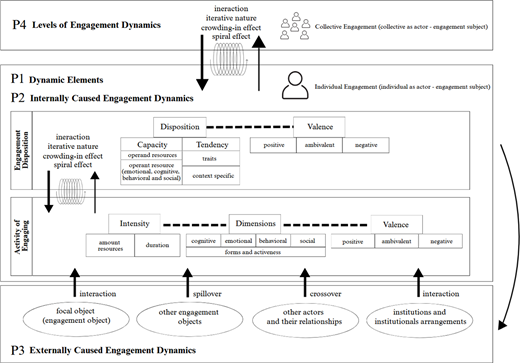
The dynamic elements of the engagement concept are the engagement disposition (capacity, tendency, valence) and the activity of engaging (intensity, dimensions, valence).
Based on the understanding that engagement dynamics represent changes in the dynamic elements of the engagement concept, the corresponding dynamic elements need to be identified and conceptualized. What exactly can change in engagement, depends on the underlying definition and conceptualization. Building upon the actor engagement concept and based on our definition of engagement dynamics, as the ongoing process of the actor’s changing disposition to invest resources and changing activity of investing resources, we understand the disposition and the activity of investing resources as the core dynamic elements that can change over time. Both these elements comprise sub-elements that need to be disentangled to gain comprehensive insights into how they – and thus the core elements – evolve. We identified the sub-elements in the engagement literature and then adopted the perspective of actor engagement, understanding engagement as resource investment, to explain for instance, how the sub-element of intensity can be conceptualized in relation to resource investment. In the following, we examine in more detail the two core elements and their sub-elements, how they are presented in literature and how they can be conceptualized as dynamic elements from the theoretical perspective of actor engagement.
Disposition as a dynamic element. Engagement disposition is a crucial element, evident in its direct mention in definitions of actor engagement (Storbacka et al., 2016; Brodie et al., 2019). Although it is consistently conceptualized as specific to the actor (Brodie et al., 2011a, 2011b), disposition has been associated with actors’ goals, desires and needs (Li et al., 2017), and defined as a psychological state (Chandler and Lusch, 2015), a tendency to act (Fehrer et al., 2018) or an actor’s readiness to invest resources in connections with other actors (Brodie et al., 2019). While the activity of engaging presents the actual investment of resources, disposition presents the “capacity and tendency to enter into the act of engaging” (Sim et al., 2022, p. 6). Thus, engagement disposition is understood as the capacity and tendency to invest resources in the interactive process with the focal object, which can change over time (Li et al., 2017).
Turning to its sub-elements, we can separate a tendency to engage into an internal tendency and a tendency shaped by interactions with the focal object. The internal tendency reflects actor-specific traits, so it constitutes a relatively stable attribute; the tendency determined in interaction with the focal object instead is context-specific and more likely to change over time (Sim et al., 2022). The capacity to engage depends on resource availability, such as expertise, knowledge and time (Sim et al., 2022), which also is context specific. To conceptualize the capacity and tendency to invest resources, we note that in Service-dominant logic, which presents the theoretical grounding for actor engagement (Hollebeek et al., 2022), resources are differentiated in operand and operant resources. Operand resources are natural resources that require some action to be performed on them to have value; operant resources instead can be used to act (Vargo and Lusch, 2016). Hollebeek et al. (2019) expand this conceptualization by differentiating cognitive, emotional, behavioral and social operant resources. Cognitive resources are, for instance, knowledge; emotional resources are, for instance, emotions such as curiosity; behavioral resources are invested effort; and social resources point to the connections with other actors. To sum up, engagement disposition refers to the actor′s resources and the willingness or likelihood to invest these resources. In detail, engagement disposition, as a core element, consists of a capacity sub-element (comprised of operand and operant [emotional, cognitive, behavioral and social] resources) and a tendency sub-element (traits and context-specific tendency), all of which can change over time.
Activity of engaging as a dynamic element. The activity of engaging is often referred to as engagement behaviors or engagement activities (Van Doorn et al., 2010). Some research distinguishes engagement disposition from engagement behavior by emphasizing that only the latter is observable (Wang et al., 2023). But in taking an actor engagement perspective and understanding engagement as investments of resources, including emotional resources (Hollebeek and Andreassen, 2018), we posit that the investment process might not be perceptible from an external perspective. Thus, we define the activity of engaging as any investment of resources, which does not have to be observable. This activity of engaging presents the actual resource investment and is reflected in the intensity of engagement, the different engagement dimensions and the valence that can vary over time (Wang et al., 2023).
Intensity. Intensity can be described as different degrees, states or levels (Bryson and Hand, 2007; Brodie et al., 2013); variations in strength (Finsterwalder, 2018); or oscillations (Costa et al., 2014). Across all these conceptualizations, engagement is a continuum, ranging from low to high (Brodie et al., 2011a, 2011b). Building on the actor engagement concept, we propose that engagement intensity reflects the varying levels or amounts of resources invested in the interactive process with the focal object. Without resources, no interactive experience can occur between the actor and focal object (Ng et al., 2020); it implies disengagement (Alexander et al., 2018). Halting resource investments might be temporary or permanent, implying an intermission before the re-engagement or the end of an engagement process, respectively (Alexander et al., 2018).
Engagement intensity can be further defined, inter alia, as the varying magnitudes (i.e. efforts, duration) of resource investment (Wang et al., 2023). Efforts refer to the size and amount of invested resources, such as energy or time spent in the interaction. Duration describes the time span of the resource integration process. The amount of invested resources and duration of resource investment are inherently connected, through the notion of intensity. The same quantity of invested resources is naturally more intense when allocated in a short timeframe rather than spread over an extended period. Thus, we consider both the amount of resources and the duration of the resource investment.
Dimensions. When defined as a multidimensional concept (Brodie et al., 2019), engagement usually comprises emotional (feeling-based), cognitive (thought-based) and behavioral (activity-based) dimensions (Jonas et al., 2018), as well as a social dimension (ties to other actors) in some cases (Hollebeek et al., 2019). Hence, different kinds of resources are invested, for instance, thoughts, feelings, efforts or resources gained through the connection to other actors. The manifestation of these dimensions depends on the context (Bowden et al., 2017). For actor engagement, which entails interactions with other actors in a service system, the social dimension seems crucial, in that ties to other actors represent resources that become part of the focal actor’s capacity and that also can be invested in the interactive process with the engagement object (Hollebeek et al., 2019). Realistically, the four types of invested resources likely occur in combination; actors rarely exhibit a behavior without investing thought into it, for example. However, it may be possible to interact with an engagement object by investing cognitive and emotional resources, without devoting behavioral and social resources to it.
In addition to the various types of resources (emotional, cognitive, behavioral, social), they might take different forms, within those four type categories. We note that these forms primarily have been examined in relation to behavioral resources. For example, behavioral resources in social media settings include both viewing and sharing (Van Doorn et al., 2010). In linking engagement dimensions and different forms of resources to intensity, Wang et al. (2023) refer to the level of activeness (activity vs passivity) to distinguish more and less active resources being invested; they cite the example of viewing (more passive) or sharing (more active). To consider that different types of resources can be invested and that not only the various types and the amount of the various types can vary over time but also that there are qualitative differences in the invested resources, we adopt the different forms (Van Doorn et al., 2010) and the level of activeness (Wang et al., 2023) to describe the invested resources in the activity of engaging more precisely. Thus, the invested resources can vary considering the different types of resources (cognitive, emotional, behavioral and social), which comprise more or less active forms of resources.
Valence. Engagement spans a spectrum from positive to negative. If an actor experiences positive and negative engagement toward an object simultaneously, it implies engagement ambivalence (Li et al., 2018). Some papers point out that valence refers to the engagement disposition (Li et al., 2018; Wang et al., 2023) and that positive or negative engagement is shown depending on the positive or negative disposition (Brodie et al., 2011a, 2011b). A positive engagement disposition linked to pleasant feelings and affirmative evaluation of the engagement object can lead to increased repurchase behavior (Jahn and Kunz, 2012) and increased altruistic behavior (Mathwick and Mosteller, 2017). Negative engagement disposition can be associated with negative feelings and adverse appraisals of the engagement object and can thus cause boycotts and revenge behavior (Grégoire and Fisher, 2008).
If it is assumed that valence lies in the engagement disposition and cause related engagement (Brodie et al., 2011a, 2011b), it would be difficult to explain cases in which, for example, an actor indicates a positive disposition but exhibits negative engagement, such as due to social pressure. Thus, we acknowledge that both the disposition and the activity of engaging can be independently positive or negative in valence (Juric et al., 2015). Usually engagement disposition and activity align, but they do not have to. Therefore, we follow the understanding that valence lies in the disposition (Wang et al., 2023) but also apply the conceptualization that actual resource investment can be valenced (e.g., van Doorn et al., 2010).
4.2 Internally caused engagement dynamics
Changes in the dynamic elements can be caused by the dynamic elements.
Having defined engagement dynamics as changes in the dynamic elements and conceptualized these elements, the subsequent step is to investigate the factors that may trigger such changes. The literature indicates that engagement dynamics may be triggered both by external factors and by changes within the dynamic elements of the concept itself. In the following, we first focus on the latter. Understanding the triggers of engagement dynamics is of critical importance, as it provides the basis for explaining why engagement changes and, potentially, for influencing these changes.
Engagement is described as an iterative process, meaning that an engagement state or the outcome of an engagement state can be regarded as input for the next iteration and thus influences the subsequent engagement state (Li et al., 2017). Based on this theoretical reasoning, changes in certain dynamic elements may lead to changes in other dynamic elements. In such cases, we refer to internally caused engagement dynamics. For example, the literature has examined the mutual influence of different engagement dimensions over time (Taboada Barber et al., 2017; Skinner et al., 2008; Vasalampi et al., 2021), as well as how the level of engagement intensity may subsequently affect disengagement tendencies (Bowden et al., 2015). The examples presented each refer only to the influence of a given dynamic element on changes in the same element in the subsequent iteration of the engagement process, on changes in the engagement dimensions and on changes in engagement intensity. Our differentiation of the dynamic elements, however, highlights both the considerable potential and the theoretical complexity of how these elements may influence changes in themselves as well as in other dynamic elements throughout the course of the engagement process:
The mechanisms underlying the internally caused engagement dynamics are: interaction, crowding-in effect, iteration and spiral effect.
The reasons why dynamic elements may change over time and influence one another lead us to the underlying mechanisms of internally caused engagement dynamics. For parsimony, we next illustrate the interactions between the two core elements without delving into the interactions of the sub-elements, but with the explicit presumption that those sub-elements also continuously influence one another; that is, the core elements of actor engagement and their sub-elements inevitably interact and influence one another. We leave the dynamics of the sub-elements to further research.
Prior literature on engagement explicitly attempts to examine and empirically demonstrate the influence of an engagement disposition on actual engagement (e.g., Baker et al., 2021). Recent studies also propose a reciprocal relationship, such that the activity of engaging can influence the disposition (Fehrer et al., 2018). Fehrer et al. (2018) specify that an increased engagement disposition follows once engagement behavior has been triggered in a utilitarian service setting. They describe this influence as a crowding-in effect (Osterloh et al., 2002), such that an external intervention (e.g., rewards) strengthens the intrinsic motivation. Such mutual influences, in combination with the iterative nature of the engagement process—where the outcome of one iteration serves as the input for the next iteration (Li et al., 2017)—can gradually reinforce or diminish both dispositions and behavior, suggesting the possibility of gain or loss spirals throughout the process. Spiral effects in employee and work engagement literature manifest, for example, in positive gain spirals between personal and job-related resources and work engagement (e.g., Bakker, 2011).
4.3 Externally caused engagement dynamics
Changes in the dynamic elements can be caused by external triggers.
As previously introduced, dynamic elements can influence themselves and each other, inducing their change. However, changes in these elements can also be triggered by external factors, pointing to externally caused engagement dynamics. These external triggers are particularly relevant, as they often represent the initial cause of changes in one or more dynamic elements, which in turn give rise to internally caused engagement dynamics (e.g., Ranellucci and Rosenberg, 2024). Moreover, considering external triggers allows for capturing the embeddedness of engagement in specific contexts, such as interactions with other actors and particular institutional settings. If we understand external triggers and their influence on the engagement construct in detail, we are able to develop measures to purposefully influence and intentionally alter engagement. Although this paper primarily examines the influence of external factors on the engagement of the focal actor, it is essential to note that the actor’s engagement also impacts the external factors, albeit not discussed in detail here:
External triggers are: the focal object, other engagement objects, other actors and their relationships and/or institutions and institutional arrangements.
The mechanisms underlying the externally caused engagement dynamics are: interaction, spillover and crossover.
In the current engagement literature, we have identified the following external triggers that can influence the engagement of the focal actor and cause engagement dynamics: the focal object, other engagement objects, other actors and their relationships and institutions and institutional arrangements. How these external triggers cause a change in the dynamic elements of the engagement construct can be described by pointing to the mechanisms of the triggers. Since the mechanisms are specifically associated with different triggers, we next present the respective external triggers together with their underlying mechanisms.
Focal object. Actors engage with a focal object, meaning that engagement requires an interrelation of subject and object; engagement does not exist without both (Rodríguez et al., 2022), as acknowledged in various engagement literature domains that explore actors’ engagement with their work (Schaufeli, 2013), community (Eldor et al., 2016), educational studies (Conduit et al., 2016) or brands (Juric et al., 2015). Engagement objects can also be individual or collective actors (Brodie et al., 2011a, 2011b). If the engagement object changes over time, it should alter the focal actor’s engagement. The object might undergo changes through its interaction with the focal actor or due to other, external factors. The changes in engagement objects and their effects on the focal actor’s engagement appear evident. However, it remains a crucial influencing factor regarding the triggers of engagement dynamics. The underlying mechanism for the influence of the object on the foal actor’s engagement is the interactive process (Breidbach et al., 2014). Even if an engagement object is a physical entity, a continuous interaction occurs between the subject and object, involving resource investments (Rodríguez et al., 2022). The corresponding influences on resource investments occur through this ongoing exchange process.
Other engagement objects. Research often describes engagement with a single focal object, but in reality, actors usually engage with multiple focal objects simultaneously, such that multiple engagement processes influence one another (Naumann et al., 2020). Actors can engage with various objects in the same (Blasco-Arcas et al., 2020) or different (Alexander et al., 2018) institutional contexts. If various engagement objects belong to the same institutional context, engagement with multiple objects might be understood as “layers” of engagement, which also interact (Conduit et al., 2016). For example, student engagement as a multilayered concept comprises engagement with the university structure (broad service system), the course (narrow service system) and the lecturer (individual, dyadic) (Conduit et al., 2016). However, it can also appear that the actor’s engagement with work influences the actor’s engagement with the community (Eldor et al., 2016) or with the family at home (Culbertson et al., 2012), thus influencing the engagement with other objects in different institutional contexts.
The main mechanism for evolving engagement due to engagement with another engagement object is the spillover effect, which describes the transfer of engagement within one person from one engagement object to another engagement object (Westman and Chen, 2017). It depends on the engagement subject and engagement object (Hollebeek et al., 2022). Spillover effects are particularly likely when actors are highly engaged, regardless of the valence of that engagement (Hollebeek et al., 2022). Nilsson et al. (2017) examine spillover effects in pro-environmental engagement behavior and identify both positive and negative forms: A negative spillover effect predicts that engaging in a first pro-environmental behavior prevents or decreases a second pro-environmental behavior, whereas the positive spillover effect predicts that interventions targeting one engagement behavior can promote other, non-targeted or future pro-environmental engagement behaviors. The spillover effect can occur in relation to engagement disposition and activity of engaging.
Other actors and their relationships. From an actor engagement perspective, engagement is always considered within the context of connected actors in a service system, which emphasizes their influence (Brodie et al., 2019). This influence stems from connections to (Storbacka et al., 2016) or interactions with (Finsterwalder et al., 2022) other actors. The mechanism for this influence signals a crossover effect, which might result from emotional contagion (Costa et al., 2014), defined as people’s “tendency to automatically mimic and synchronize facial expressions, vocalizations, postures and movements with another person and, consequently, to coverage emotionally” (Hatfield et al., 1994, p. 5). Crossover theory postulates that “the experience of psychological states in one person affects the experience of congruent states in another individual within the same system” (Wirtz et al., 2017, p. 2). Because engagement is a psychological process, other actors likely mimic and synchronize gestures that express a focal actor’s engagement. Thus, their engagement is affected; in other words, the actor’s engagement crosses over to other actors (Bakker et al., 2006).
In employee engagement settings, crossover effects have been identified between employees and their life partners, whose connection tends to be very intense (Bakker and Xanthopoulou, 2009). This influence depends on the attributes of both actors, such as character traits (e.g., extroversion, empathy), and their level of engagement (Bakker et al., 2011). A relationship between the actors is requisite for crossover effects though, such that a close relationship characterized by high interactivity may be necessary for another actor to alter a focal actor’s engagement (Bakker and Xanthopoulou, 2009). In a consumer engagement setting, Pan et al. (2018) find that the volume of online reviews by friends exerts a more substantial impact on a focal actor’s engagement than posting behaviors by the crowd. The influence of one or more actors on a focal actor’s engagement thus might occur among colleagues (Bakker et al., 2006), between supervisors and team members (Wirtz et al., 2017) and between employees and customers (Niederbacher and Zimmermann, 2011). As these studies show, crossover effects often occur among actors in the same institutional context (colleagues, supervisor and team, employee and customer) but also between actors in different institutional contexts (employee and spouse).
Institutions and institutional arrangements. The actor engagement concept indicates the need to examine engagement not as an isolated process between an engagement subject and engagement object but rather to include the context in which the focal actor is embedded. The context, comprised of institutions and institutional arrangements, both enables and constrains actor engagement (Storbacka et al., 2016). Institutions or sets of institutions refer to humanly devised rules, norms and beliefs; institutional arrangements are higher-order assemblages of interrelated institutions (Vargo and Lusch, 2016), presented as industry standards or social norms. Edvardsson et al. (2014) differentiate regulative, normative and cognitive institutions, which combine to shape the institutional logic. Regulative institutions refer to formal rules, normative institutions comprise norms and values and cognitive institutions are related to actors’ perceptions of reality. Prior conceptual literature predicts the influence of institutional arrangements on engagement disposition (Li et al., 2018), and empirical studies affirm its influence on the modes and forms of engagement activities (Li et al., 2017).
Although institutions and institutional arrangements are generally stable and reproduced by actors, they are capable of disruption and change (Brodie et al., 2019). Actors can change the institutional arrangements through their engagement (Vargo and Lusch, 2016), when new institutions are collectively enacted (Kleinaltenkamp et al., 2021). Institutions and institutional arrangements influence the engagement of the actors and also are influenced by the engagement of these actors (Alexander et al., 2018), and this interaction represents the underlying mechanism for the potential of institutions and institutional arrangements to change an actor’s engagement.
4.4 Levels of engagement dynamics
Engagement dynamics can manifest at the individual level (i.e., one actor) and at the collective level (i.e., multiple actors).
Engagement is an individual phenomenon but also manifests at higher level as collective engagement (Kleinaltenkamp et al., 2019), which refers to engagement by a team, group or collective (Bakker et al., 2011) and can be defined formally as “multiple actors’ shared cognitive, emotional and behavioral disposition, as manifested in their interactive efforts devoted to a focal object” (Kleinaltenkamp et al., 2019, p. 12). As this definition emphasizes, engagement at the collective level entails a shared resource investment; it is a shared phenomenon, not simply the sum or average of the engagement levels of individual members of the collective (Storbacka, 2019). This view of engagement, as existing on the individual level while also manifesting on a collective level, aligns with the dynamic elements of engagement that arise when discussing the engagement of an individual actor and groups of actors. Accordingly, engagement dynamics can occur at both the individual and collective levels.
Accounting for collective engagement and its potential changes is particularly important, as collective engagement has substantial implications across various domains. For instance, in collectives like teams or groups, engagement can lead to the achievement of collective efforts (Bakker, 2011) such as generating open innovations (Dahlander and Gann, 2010). For organizations, engagement can influence performance and thus the success of an organization, leading to a competitive advantage (Brodie et al., 2011a, 2011b). Moreover, in the case of changes to institutions and institutional arrangements—for example, with regard to greater sustainability—collective engagement for institutional change must be present to bring about such transformations (Kleinaltenkamp et al., 2021).
Extant literature proposes two ways that engagement becomes a collective phenomenon: The collective can respond similarly to a shared context (Bakker et al., 2006), or collective engagement arises through a contagion effect among members of a collective (Torrente et al., 2013). The same contextual conditions, such as institutions and institutional arrangements, might encourage shared resource investments by a collective, or a resource investment by one actor might crosses over to another actor until the entire collective shares this resource investment. If institutions and institutional arrangements trigger the emergence of transmitted engagement at the collective level, the level of collective engagement increases if the institutional setting is better aligned (Kleinaltenkamp et al., 2019). Contagious engagement instead is more likely if most members of the collective are engaged, their engagement is high, and they participate in intensive interactions (Bakker and Xanthopoulou, 2009). In a team engagement study, Van Mierlo and Bakker (2018) also note that highly engaged actors in the collective can drive the contagion process, which leads to collective engagement.
Engagement dynamics can manifest across aggregation levels.
Considering the emergence of collective engagement based on the contagion effect, it becomes evident that collective engagement is an emerging phenomenon and, therefore, arises from a lower level (Kleinaltenkamp et al., 2019). Accordingly, there is an interaction between levels, and changes in engagement at one level can lead to changes at the other level. We highlight two fundamental, related processes across levels: Top-down contextual effects shape lower-level phenomena, and bottom-up emergent processes manifest on the collective level (Kozlowski and Chao, 2012). Such interdependence and interaction evoke engagement dynamics across levels. Considering the iterative nature of the engagement process (Li et al., 2017) and the mutual influence of individual and collective levels, due to contagion effects, both positive and negative spiral effects can arise between levels of aggregation (Costa et al., 2012).
4.5 Illustrating the conceptual model of actor engagement dynamics within the context of Fridays for Future
Before illustrating our model using the case of Fridays for Future, we briefly explain the visualization of the propositions in Figure 1. The concept of actor engagement considers both individual and collective actors, as well as the interdependence between these two levels, since collective actors are constituted by individual actors. This is reflected in the central box (P1 and P2), which represents individual actors, and the upper box (P4), which depicts collectives as actors. The interdependence of the two levels is characterized by the arrows, the spiral and the designation of the underlying mechanisms of influence. For both individual and collective actors, engagement disposition as well as the activity of engaging can change over time. These two dynamic core elements of the engagement concept also comprise several sub-elements, which are presented in the middle box. The sub-elements are depicted in smaller boxes connected by dashed lines, indicating that these sub-elements mutually influence one another and can consequently undergo change, reflecting internally caused engagement dynamics. The interdependence of the two core elements is visualized in the figure through the arrows, spiral and the enumeration of mechanisms, which further illustrate how these internally caused dynamics unfold. If changes in the dynamic elements occur due to external influences, we refer to these as externally caused engagement dynamic, which are represented in the lower box (P3). The influence of external triggers on engagement is depicted in the figure through arrows with the corresponding designation of the underlying mechanism. The mutual influence between the engagement construct and the external trigger is visualized through the arrow on the right side from the central box, which describes the dynamic elements, to the box containing the external triggers.
We now consider the model and the corresponding propositions in the context of the global movement addressing climate change, Fridays for Future, highlighting how engagement dynamics can be leveraged to tackle sustainability challenges and contribute to shaping a better future. The movement itself can be understood as a collective actor; national or local chapters of the movement can also be seen as collective actors composed of individual actors. Both the individual and the collective actors are engagement subjects, engaging with climate protection, which serves as the engagement object. An overview of the key definitions and elements of the model, along with corresponding examples from the context of FFF, are summarized in Table 2.
4.5.1 Proposition 1: Dynamic elements
Disposition as a dynamic element. Changes in one of the core dynamic elements, the engagement disposition, can be observed when FFF is considered as a collective actor. Referring to resource capacity, FFF has progressively fostered connections with established climate protection organizations, which enables this actor to leverage resources such as venues, microphones and stages (Rucht and Rink, 2020). Thus, FFF uses its social operant resources to access operand resources, which increases its own resource capacity. In addition, adding members with prior experience in other climate organizations represents an increase in the cognitive resources of FFF, which contribute to its ability to organize professionally and quickly (Rucht and Rink, 2020).
The tendency to engage, referring to the traits, can be illustrated by considering the moral identity of the FFF participants. A study examining the association between moral identity and support for FFF confirms the role of moral identity in people’s pro-environmental engagement (Misch et al., 2021). The context-specific tendency can be displayed by the finding that individuals convinced their protest could persuade politicians to do more for climate protection were particularly inclined to attend the FFF protests (Sommer et al., 2019). Based on the findings of these studies, it can be assumed that both the moral identity of the protesters (tendency referring to traits) and the confidence to initiate change (context-specific tendency) can undergo alterations. It is less likely that the moral identity changes but more probable that, for instance, the passivity of politicians leads to the perception that the protests are ineffective, thus leading to a decrease in the context-specific tendency (Sommer et al., 2019).
Activity of engaging as a dynamic element. The changing intensity of the engagement can be illustrated by referring to individual actors who were heavily involved within FFF. Their engagement increased markedly, particularly during the initial phase, as the movement received significant public attention. However, due to this very high level of engagement, some members experienced burnout and consequently reduced their engagement or discontinued it temporarily or permanently (Rucht and Rink, 2020). Changes in the engagement dimensions can be demonstrated by referring to the diverse range of behavioral engagement forms and their evolution by reviewing the history of FFF. It initially focused on protests, then expanded its activities to include convening panels with scientists to devise strategies to meet the Paris Climate Agreement goals (De Wever Van der Heyden et al., 2020). Ultimately, it engaged in more assertive actions, like a blockade of Siemens headquarters in Germany (Grupp et al., 2020). A shift in valence is evident within the FFF context, exemplified by the transformation of individual members’ engagement disposition from positively valenced to negatively valenced. Initially, participants expressed euphoria and optimism that their engagement would lead to progress on climate policy. Thus, their engagement disposition was positively valenced. As the political sphere continued to resist, though, the positive tendency of protesters shifted toward increasing frustration and disappointment (Sommer et al., 2019).
4.5.2 Proposition 2: Internally caused engagement dynamics
In the context of FFF, internally caused engagement dynamics could be traced with respect to the interaction between the two core dynamic elements, engagement disposition and activity of engaging. FFF as a collective actor entered a positive engagement spiral based on the interaction of the two core dynamic elements. Increased activity of engaging, such as in protests, led more people to join FFF (Rucht and Rink, 2020), which raised the organization’s engagement disposition. Because more people became actively involved, assisting in various actions, FFF was able to undertake more engagement activities. Consequently, this enabled the mobilization of a larger number of individuals. This gave rise to a self-reinforcing cycle between engagement disposition and engaging activity, premised on the iterative character of the engagement process and the interplay between the core elements of disposition and activity of engaging.
4.5.3 Proposition 3: Externally caused engagement dynamics
Examples of externally caused engagement dynamics could also be identified in the context of FFF, with respect to the triggers: focal object, other engagement objects, other actors and their relationships and institutions and institutional arrangements.
A change in the in the engagement object, and subsequently in the engagement of the actors, can be illustrated by the FFF case when considering a local chapter in Marburg (Germany) that adopted a more radical position. The chapter concluded that achieving climate protection would require a fundamental transformation of the capitalist system and therefore prohibited collaboration with actors operating within capitalist structures. Many members opposed this shift and disengaged from the local chapter, ultimately leading to its dissolution (Dieckmann and Pesch, 2023). This example illustrates that for numerous individual actors in Marburg, the engagement object—climate protection—underwent a transformation, whereby the belief emerged that effective climate protection necessitates ending collaboration with actors embedded in capitalist systems. This radicalized conceptualization of the engagement object resulted in the disengagement of many individual actors and ultimately in the disengagement of the Marburg chapter as a collective actor.
Regarding to other engagement objects as triggers of engagement dynamics in the context of FFF, a study has demonstrated the spillover effect regarding engagement disposition. Young people participating in the FFF protests expressed a heightened desire to engage with political organizations in the future, due to their engagement with FFF (Grupp et al., 2020).
Referring to other actors and their relationships as the causes of externally caused engagement dynamics, we find crossover effects in FFF, in the form of increasing numbers of demonstrating students, who reported being mainly motivated to engage by their university peers (Rucht and Rink, 2020). That is, engagement crossed over from student to student. Another study also indicates that students’ engagement in climate protection activism crosses over to their parents (Fabel et al., 2023).
An example for institutions and institutional arrangements as triggers of engagement dynamics can be outlined in the FFF context by pointing to the different manifestations of engagement in diverse countries. Engagement with FFF has varied from country to country, influenced by political institutions that either legitimize the protestors’ demands or oppose them (Kern and Opitz, 2021). Poland’s relatively weak environmental efforts and the absence of an established green party likely explain its comparatively low engagement in FFF (Neuber et al., 2020). In Africa, street protests were scarce, due to security challenges, but engagement manifested in another way, through educational initiatives among students and resource mobilization (Nakabuye et al., 2020). As these examples underscore, the institutional arrangements of diverse national contexts shape the intensity and forms of engagement actors adopt.
4.5.4 Proposition 4: Levels of engagement dynamics
In our previous illustrations, in which we present FFF as a collective actor, we have demonstrated that dynamic elements can change for both individual and collective actors. The examples reveal that the individual and collective levels are interconnected, because the individuals advocating for FFF constitute FFF as a collective actor. At this point, we also emphasize that in the case of FFF, the meaning of the collective is relative, so expressions of collective engagement also vary. In particular, FFF is not a registered association, and no formal structures exist. However, within countries, members are organized into local chapters, which host their own websites and digitally exchange information with other chapters, nationally or internationally, once a week (Döninghaus et al., 2019). Depending on the perspective we take, collective engagement could refer to all protesters at a specific demonstration, a local chapter, a less definable collective such as the online community supporting FFF, or the overarching international protest movement.
For protesters, collective engagement often manifests as shared protest chants and collective actions such as marching, jumping and singing together. Through the direct experience of the crowd, individual actors feel the collective engagement intensely (Teune, 2019). If highly engaged participants—such as those leading protest chants with a microphone—leave the protest early, this change in individual engagement can negatively affect the level of collective engagement. As collective engagement declines, additional individuals may choose to leave the protest, for example because the absence of chanting reduces their ability to sustain emotional engagement. As more participants leave, the size of the protest diminishes and the volume of protest chants decreases further. This process illustrates a self-reinforcing negative spiral of declining individual and collective engagement.
5. Conclusion
5.1 Theoretical contributions
This paper contributes to the limited knowledge of how and why engagement evolves over time, and thus to the understanding of the dynamic nature of engagement (Fehrer et al., 2018; Brodie et al., 2019; Hollebeek et al., 2022; Engert et al., 2023). The theoretical implications are threefold, enhancing our understanding of the engagement concept, advancing the engagement literature and informing the service and marketing disciplines (MacInnis, 2011):
First, the introduction of the new construct of engagement dynamics contributes to a comprehensive understanding of the engagement concept by providing a definition and conceptual model. Building upon the actor engagement concept (Storbacka et al., 2016; Brodie et al., 2019), we offer a clear definition of engagement dynamics describing them as changes in engagement disposition and the activity of engaging, thus as changes in the dynamic elements of the engagement concept. Furthermore, we offer detailed definitions of the components of engagement dynamics, delineating the entities of engagement dynamics forming a stable foundation for future theoretical and empirical research, as well as for operationalization. This disentangles the dynamic nature of engagement by clarifying which characteristics change, why they change and how. The propositions of the model referring to the relation between the components offer a roadmap for further studies to analyze and operationalize engagement dynamics. By illustrating the propositions with the illustrative case of the movement Fridays for Future, we highlight the significance of engagement dynamics in a rapidly changing world and the relevance of a comprehensive understanding these dynamics to be able to create measures to manage engagement dynamics.
Second, the conceptualization of engagement dynamics contributes specifically to the domain of actor engagement, but, due to its generic nature, also to the broader field of engagement research across different research areas. Based on a semi-systematic literature review (Snyder, 2019) and thus the findings from diverse research areas on the dynamic nature of engagement, we could identify the components of engagement dynamics and thus introduce the new construct of engagement dynamics by synthesizing the insights from related but foremostly not intersected engagement fields. In this way, we contributed to revising the predominantly static perspective on engagement and addressed the need for a comprehensive understanding of its dynamic nature (Brodie et al., 2019). By synthesizing insights from different research areas and by adopting the generic perspective of actor engagement (Vargo and Lusch, 2016) to conceptualize engagement dynamics, we contribute to knowledge diffusion and sharing across research fields and advance conceptual understanding in domains such as actor engagement, but also employee engagement, student engagement and customer engagement (Brodie et al., 2011a, 2011b).
Third, our paper contributes to the service and marketing disciplines by advocating for a dynamic perspective of engagement and providing the theoretical basis for its analysis. Moreover, we offer a research agenda for further studies dealing with the evolving character of engagement, indicating how the engagement research in the service and marketing disciplines should shift. One research priority should focus on engagement dynamics across aggregation levels, thereby addressing a relevant gap in the literature (Sim et al., 2018). Applying actor engagement and its associated conceptualizations of engagement for individual and collective actors enables us to examine engagement dynamics for individuals and organizations or, as in our illustrative case, collectives and non-institutionalized movements. Moreover, the model depicts how engagement at the individual and collective levels interact, providing the theoretical basis for understanding how macro-level phenomena can be explained through an understanding of engagement on the lower levels. This is particularly important, considering the relevance of collective engagement to initiate developments to the context of climate protection efforts (Fehrer et al., 2020; Kleinaltenkamp et al., 2021) but at the same time the lack of knowledge within this field and the general question of how service and marketing research can drive meaningful society change (Alexander et al., 2025).
5.2 Practical implications
In practice, the insights provided by our research as reflected in the model can be used by practitioners from different fields to foster intended engagement dynamics and counteract unintended dynamics at individual, collective and system levels. This is particularly relevant in the context of climate change and climate action, where profound and rapid transformations both drive and require changes in the engagement of diverse actors. At the institutional level, policymakers responsible for sector-wide initiatives and organizational leaders managing system-wide changes can use the insights from this paper. At the collective level, team and project leaders can apply these findings to enhance engagement within both internal and inter-organizational projects, such as service innovations. At the individual level, the results can be used to understand customer engagement for or against sustainable services and climate protection. The framework provided helps these stakeholders understand how to influence the engagement of different actor groups through specific, targeted measures.
For instance, at the individual level, our model can help understand why customer do not exhibit high engagement for new or adapted services serving climate protection and assist in finding triggers to increase the engagement. It may be that customers’ low engagement with new services that support climate protection is causally linked to limited cognitive resources, particularly a lack of understanding of the service’s relevance and impact in the context of climate change. If this is identified, service providers can act in a targeted way by providing the necessary knowledge, thereby increasing customer engagement.
At the collective level, for example, service innovation team leaders and project managers can use our insights regarding the crossover effect by bringing their team together in person and particularly having highly engaged team members work closely with less engaged members to increase engagement across the entire team and thereby improve collective outcomes. Engagement in service innovation projects is particularly critical, as at the outset typically only the problem to be addressed is known, while the solution remains undefined. Developing an appropriate innovation therefore requires a creative and demanding process. Consequently, the failure rate of innovation initiatives is high, and the success of the process depends largely on the innovation team’s engagement (Jonas et al., 2018).
At the system level, particularly for system-wide changes regarding sustainable development, the consideration of collective actors such as service organizations plays an important role, as system changes can be implemented particularly effectively through the engagement of these collective actors. Here, for example, the interaction between actor engagement and institutions and institutional arrangements could provide a foundation for policymakers to decide whether the necessary changes, such as sustainable production, arise from the actors’ disposition and thus change institutions, or whether, for example, political institutions must first be changed to alter the activity of engaging of collective actors, in the hope that this will ultimately lead to changes in disposition.
Using the illustrative case of the international movement Fridays for Future, this paper has demonstrated the relevance of engagement dynamics in our increasingly changing world. This is particularly evident in light of global challenges such as climate change, which require engagement from various actors across different levels to be effectively addressed. The example also highlights the complexity of engagement dynamics, which is captured in our model and thereby helps explain the intricate interrelations observed in practice. For instance, at FFF, the extremely high engagement of many members led to burnout. This, in turn, negatively affected both the engagement of individual actors and that of FFF as a collective actor. These developments show that increasing engagement is not simply a matter of intensifying activity. Rather, engagement must be actively and strategically managed over time. For this, a comprehensive understanding of the dynamic nature of engagement is essential.
5.2 Limitations and a future research agenda
Although we provide a detailed description of the dynamic elements of the engagement concept, triggers and underlying mechanisms, further theoretical and empirical research is necessary. Exemplary research questions for future investigations, particularly in the field of sustainability, are presented in Table 3.
Our propositions are theoretically developed; they still need empirical validation. Studies that examine engagement dynamics across various domains or actor groups for climate protection and sustainability could determine if different patterns of engagement dynamics exist. For example, in the generation of innovative sustainable services, actors from different sectors must cooperate with one another. These specific collaborations might produce specific, recurring engagement dynamic patterns.
We consider the interaction of two core, dynamic elements of engagement (disposition and activity of engaging), without delving into the intricate interactions of their sub-elements, a pursuit that we leave for future studies. In the context of climate protection, engagement is often driven by emotions but also shaped by knowledge. It would be relevant, for instance, to investigate the interaction between tendency and capacity, as well as the development of the amount and form of cognitive and emotional resource investment.
Our model demonstrates that engagement does not always depend on disposition but can be also externally triggered, which might alter the disposition. This possibility warrants further investigation, particularly in relation to sustainability, to reveal how altering the institutional arrangements first might modify the activity of engagement and subsequently the dispositions of individual and collective actors in ways that encourage them to engage in sustainability efforts on their own accord.
Additionally, we reference the various mechanisms underlying the changes in the dynamic elements. We have identified all the mechanisms known to us from the literature, but further studies should explore additional mechanisms. For instance, future research could look into psychological mechanisms that may influence engagement, such as conformity pressure.
The literature, as well as our practical case, has shown that the interaction with other actors is highly relevant for changing engagement. Engagement in movements like Fridays for Future manifests both offline and online. Since interactions online differ from those offline, it is important to examine the relevant engagement platforms and investigate how engagement dynamics emerge on these platforms and how the corresponding mechanisms influence them.
We have focused on the triggers of engagement dynamics, assuming that they interact with the focal actor and its engagement, without directly examining the outcomes, but positing an interaction between the altered engagement and the engagement triggers. However, broad outcomes of engagement dynamics, such as the transformation of entire systems, represent a pertinent consideration for continued studies. This is particularly relevant when considering that, in relation to climate change, all our systems must be transformed towards greater sustainability.
Furthermore, in our model, we conceptualize both individual actors and collective actors and acknowledge how individual actors are embedded in the collective. Thus, collective actors vary constantly, depending on which individual actors are together at a given moment, as well as the perspective taken (e.g. regional, national or international). We address these notions in our illustrative FFF case, but we hope continued studies will examine the extent to which changing collectives relate to the emergence of collective engagement and the corresponding dynamics.
References
Supplementary material
The supplementary material for this article can be found online.