This study aims to investigate whether audit committees shape the corporate social responsibility (CSR) disclosure practices of family-controlled and politically connected firms. Specifically, this study examines the extent to which audit committees mitigate the tendency of these firms to withhold CSR information and enhance transparency in an emerging market context.
This study analyses 1,108 firm-year observations from 140 non-financial firms listed on the Dhaka Stock Exchange over the period 2013–2023. To examine how family control, political connections and audit committees influence CSR disclosure. This study estimates several multivariate regression models. In addition, to strengthen causal inference and address potential endogeneity concerns. This study employs entropy balancing and a regression discontinuity design as complementary identification strategies.
This study finds that family control and political connections significantly reduce CSR disclosure, whereas effective audit committees enhance transparency and mitigate these negative effects. CSR disclosure is lowest in firms that are both family-controlled and politically connected, indicating mutually reinforcing constraints on transparency. However, audit committees consistently counteract these tendencies. Their effectiveness strengthens after the Corporate Governance Code 2018 and is particularly pronounced in firms with low institutional ownership and in environmentally sensitive industries. Finally, audit committees’ independence, accounting expertise and female representation further improve CSR reporting and enhance the committee’s moderating role.
This study suggests that regulators and firms should promote balanced governance mechanisms that curb opportunistic behaviour by family owners and politically connected directors while retaining the benefits these governance structures offer. Strengthening audit committees, particularly by enhancing their independence, expertise and diversity, has significant potential to mitigate the negative effects of family influence and political capture and support greater CSR disclosure.
This study highlights the critical role of strong internal governance, particularly effective audit committees, in promoting transparent CSR practices in firms characterised by concentrated family ownership and political connections. In emerging markets like Bangladesh, where external enforcement is limited, empowered audit committees help curb opportunistic behaviour, strengthen accountability and protect stakeholder interests. The findings support ongoing governance reforms and emphasise the need for greater public awareness around the social responsibilities of influential business groups, ultimately contributing to improved transparency, fairer stakeholder treatment and stronger trust between firms and society.
This study offers novel evidence by jointly examining how family control and political connections shape CSR disclosure, and by establishing the moderating role of audit committees within these ownership settings. Unlike prior research, which typically investigates these governance factors individually, this study provides an integrated analysis that reveals how audit committees can counteract the combined influence of family dominance and political embeddedness. This multidimensional approach advances understanding of internal governance effectiveness in emerging markets.
1. Introduction
Over the past few decades, corporate social responsibility (CSR) disclosure has become a central concern in corporate governance and sustainability research, reflecting the growing demand for transparency in firms’ social and environmental reporting. Capital market participants increasingly rely on CSR disclosure as an informative signal in equity valuation, risk assessment and evaluations of governance quality (Wang and Wang, 2023). Importantly, CSR disclosure does not necessarily reflect the actual level of CSR activity, but rather it represents a strategic reporting choice shaped by ownership structures, internal power dynamics and broader institutional pressures (see recent reviews, Ali et al., 2024; Stuart et al., 2023). However, these dynamics are particularly salient in environments where family-controlled and politically connected firms exert significant influence over organisational decision-making (Biswas et al., 2022; Muttakin et al., 2018). Prior research suggests that such controlling owners tend to be less inclined to prioritise wider stakeholder interests (Ananzeh et al., 2023; Ananzeh et al., 2022; Rashid and Hossain, 2022), raising concerns about the credibility, completeness and objectivity of disclosed information in such a contextual setting (Li et al., 2025). As global expectations for transparency intensify, particularly after the IFRS S1 and S2, firms increasingly use CSR disclosure as a strategic mechanism to manage legitimacy, shape stakeholder perceptions and navigate institutional expectations (Chen et al., 2023; El Ghoul et al., 2016; Gaaya et al., 2017; Muttakin et al., 2018). Within this context, audit committees play a critical internal governance role by strengthening oversight, enhancing reporting integrity and promoting credible sustainability disclosure (Al‐Shaer and Zaman, 2018).
Despite the recognised importance of audit committees in enhancing CSR disclosure (Jain and Jamali, 2016), their effectiveness within family-controlled and politically connected firms remains insufficiently understood. These governance structures exacerbate information asymmetry and intensify conflicts of interest between managers (agents) and broader stakeholders (principals), as controlling owners and politically connected directors possess both the incentives and the capacity to influence disclosure in ways that protect private benefits (Jensen and Meckling, 1976). Moreover, as highlighted by Zaman et al. (2022), the governance–CSR relationship is inherently context dependent, shaped by institutional quality, regulatory enforcement and the distribution of power within firms. This perspective implies that audit committees may not exercise uniform monitoring effectiveness across different ownership environments, particularly where concentrated ownership and political embeddedness limit board independence. Against this backdrop, we aim to investigate the extent to which audit committees can influence CSR disclosure in firms characterised by family control and political ties.
Building on these concerns, prior research shows that family-controlled and politically connected firms often maintain concentrated ownership and political embeddedness to secure organisational control and preferential access to economic and regulatory benefits (Biswas et al., 2022; Muttakin, Khan et al., 2015). Family ownership remains a dominant organisational form in many emerging economies, where families contribute both capital and managerial oversight, enabling them to shape strategic priorities and reporting decisions (Azizul Islam and Deegan, 2008; Belal et al., 2017). Evidence suggests that such firms frequently prioritise the preservation of socio-economic wealth through rent extraction, reduced transparency and lower engagement in stakeholder-oriented activities, including CSR (El Ghoul et al., 2016; Muttakin et al., 2018). Politically connected firms similarly benefit from regulatory leniency, access to favourable financing and insulation from enforcement actions (Rashid and Hossain, 2022; Zaman et al., 2022). These incentives weaken pressures for credible CSR disclosure and heighten the potential for selective, symbolic or strategically constructed reporting. As a result, controlling owners and political directors are bound to exert disproportionate influence over the scope, depth and credibility of CSR disclosure, with implications for transparency and minority shareholder protection.
In emerging markets such as Bangladesh, where family ownership is pervasive and political connections are deeply embedded, agency conflicts extend beyond the traditional principal–agent problem to include pronounced tensions between controlling shareholders and minority investors (Muttakin et al., 2015; Khan et al., 2016). Weak regulatory enforcement, limited investor protection and inconsistent application of corporate governance rules further enable firms to appoint politically affiliated directors to secure preferential access to resources and regulatory leniency (Muttakin et al., 2018; Rashid and Hossain, 2022). Within such institutional conditions, internal governance mechanisms, particularly audit committees, assume an especially important role in enhancing transparency and strengthening the credibility of CSR disclosure (Al-Qadasi et al., 2025). Recognising this need, the Corporate Governance Code (CGC) 2018 substantially reinforced audit committees’ requirements by mandating independent membership, substantive financial expertise and clearer oversight responsibilities (Bangladesh Securities and Exchange Commission [BSEC], 2018). These reforms provide a natural context to examine how empowered audit committees operate within ownership structures characterised by concentrated family control and political embeddedness. Accordingly, the Bangladeshi setting presents an empirically suitable and theoretically grounded environment for investigating how empowered audit committees’ function within firms dominated by family control and political connections, particularly in shaping the extent of CSR disclosure.
To address our research questions, we analyse 1,108 firm-year observations from Dhaka Stock Exchange (DSE) listed firms between 2013 and 2023. Our results show that both family control and political connections are strongly and negatively associated with CSR disclosure, indicating that firms with higher levels of family ownership or politically connected directors disclose significantly less CSR information. In contrast, we find that audit committees significantly enhance CSR disclosure and, importantly, mitigate the adverse effects of family control and political capture through a strong moderating interaction. Our baseline results remain robust after applying more advanced econometric techniques, including entropy balancing and a regression discontinuity design (RDD), to strengthen causal inference.
We extend our analysis by comparing disclosure patterns across ownership types. Our additional cross-sectional results suggest that politically connected firms disclose less CSR information in both family and non-family settings, with the lowest disclosure observed when firms are both family-controlled and politically connected. Similarly, family-controlled firms disclose less CSR information regardless of political affiliation, but this reduction intensifies when political ties are present. These results highlight that the negative effects of family ownership and political influence are mutually reinforcing. Despite this, audit committees consistently counteract these tendencies across all firm types, with their moderating effect particularly strong in politically connected firms, where external monitoring is weaker.
Recognising that internal governance mechanisms function differently across regulatory contexts (Zaman et al., 2022), we next examine whether audit committees’ effectiveness changes under strengthened oversight conditions. Consistent with expectations, we find that the moderating influence of audit committees becomes significant after the implementation of the CGC 2018, indicating that the revised regulatory framework has enhanced their monitoring capacity in both family-controlled and politically connected firms.
Since monitoring incentives vary across firms and shape CSR disclosure (Li et al., 2025; Bahadar and Zaman, 2022), we also examine whether the effectiveness of audit committees depends on the strength of external oversight. Our results show that the effectiveness of audit committees is context-dependent: their role is particularly pronounced in firms with low institutional ownership in the case of politically connected firms, highlighting a compensatory function when external monitoring is weak, whereas in family-controlled firms, audit committees are most effective when institutional ownership is high. We further find evidence that their influence is likewise stronger in environmentally sensitive industries-settings where reputational and regulatory risks heighten the importance of credible disclosure and where weak reporting can impose higher legitimacy costs.
Finally, we investigate whether audit committees’ characteristics shape their monitoring effectiveness. We find that independence, accounting expertise and female representation not only improve CSR disclosure directly but also strengthen the moderating effect of audit committees on the negative influence of family control and political connections. These results reinforce our core arguments that the composition of audit committees meaningfully determines their capacity to constrain managerial and controlling-owner discretion in CSR reporting.
Our findings contribute to the literature in several ways. Firstly, the study advances corporate governance and CSR research by addressing recent calls to integrate internal and external governance mechanisms and to account for the context-dependent nature of governance outcomes (Aguilera et al., 2015; Zaman et al., 2022). Zaman et al. (2022) review emphasises that the effectiveness of governance mechanisms, particularly in shaping CSR disclosure, depends heavily on institutional conditions, regulatory enforcement and the distribution of power within firms. Building on this insight, we examine Bangladesh’s weak institutional environment, where concentrated family control, political embeddedness and limited external monitoring create distinctive governance challenges (Rashid et al., 2024; Uddin et al., 2018; The Business Standard, 2023). Within this control setting, we demonstrate how audit committees operate as pivotal internal safeguards when external institutions provide insufficient protection. By jointly analysing family ownership, political connections and audit committees’ oversight, the study offers an integrated perspective that “connects the dots” between internal and external governance mechanisms, showing how these forces interact to influence CSR disclosure in ways overlooked by prior research.
Secondly, our study contributes novel empirical insights by showing when and under what conditions audit committees become most effective in enhancing CSR disclosure. Beyond the baseline moderation tests, our additional empirical analyses reveal several outcomes that have not been documented in prior work. We show that audit committees are more effective after the introduction of the CGC 2018, indicating that regulatory strengthening amplifies internal monitoring capacity. We further demonstrate that audit committees play a compensatory governance role in politically connected firms with weak external oversight, as their moderating influence is strongest when institutional ownership is low, whereas in family-controlled firms, this role is reinforced by higher institutional ownership. In addition, their effectiveness is more pronounced in environmentally sensitive industries, where disclosure risks and stakeholder pressures are higher. Finally, by unpacking audit committees’ attributes, independence, accounting expertise and female representation, we show that specific committee characteristics materially reinforce both CSR disclosure and the committee’s moderating ability. These findings collectively extend the governance–CSR literature by illustrating that the efficacy of audit committees is conditional, context-sensitive and shaped by regulatory, market and industry environments.
Thirdly, we extend prior research on Bangladesh, which has focused predominantly on the banking sector, an industry characterised by mandatory CSR reporting and comparatively stronger regulatory oversight (Bangladesh Bank, 2022; Rashid and Hossain, 2022; Uddin et al., 2018). Because CSR disclosure in banks is closely monitored and heavily regulated, the scope for managerial discretion is limited (Jizi et al., 2014; Crawford et al., 2017). In contrast, CSR disclosure in the non-financial sector remains voluntary under the BSEC (2018) CGC, operating within a weaker institutional environment marked by concentrated ownership, political entanglements and lax enforcement (Rashid et al., 2024; Muttakin et al., 2018; The Business Standard, 2023). By shifting the analytical focus to non-financial firms, our study captures greater variation in disclosure incentives and governance practices, offering deeper insights into how internal governance mechanisms function when external monitoring is weak.
Finally, our findings offer several important policy implications for strengthening corporate transparency in emerging markets. Our empirical evidence that family-controlled and politically connected firms systematically disclose less CSR information signals a structural weakness in ownership environments with high private benefit extraction. For regulators such as the BSEC, this underscores the need to further tighten sustainability disclosure requirements and enhance enforcement capacity, particularly in sectors that are environmentally sensitive or vulnerable to political influence. Furthermore, our pre and post–CGC 2018 results show a clear improvement in audit committees’ effectiveness following the implementation of the revised governance code. This reinforces the value of regulatory reform and suggests that periodic updates to governance requirements, particularly those concerning audit committees’ independence, diversity, qualifications and oversight responsibilities, hold significant potential to further strengthen the extent of CSR disclosure.
The remainder of the paper is organised as follows. Section 2 outlines the rationale for the Bangladeshi institutional context, presents the theoretical framework and develops the study’s hypotheses. Section 3 details the research design, including the data, sample and variable definitions. Section 4 reports and discusses the empirical findings, followed by additional and robustness analyses in Section 5. Section 6 concludes the study.
2. Institutional context, theoretical framework and hypothesis development
2.1 Institutional context
The study considers Bangladesh as a research context for many reasons. Firstly, it is the second-fastest-growing economy globally, with an expected average economic growth of 6.9% from 2021 to 2025 (Focus-Economic, 2019). Nevertheless, unlike many other emerging economies, firms in Bangladesh are characterised by family ownership, high power distance and weak governance with a very poor regulatory environment (Khan et al., 2016). The majority of the firms in Bangladesh are primarily family-owned, which results in highly concentrated ownership that plays an important role in shaping corporate decisions (Abedin et al., 2022). Wealthy business families often tend to develop ties with political leaders and top bureaucrats to create power triangles to create reciprocal dependence for mutual benefits (Alam and Teicher, 2010). These create uncertainty, compelling a reason to promote CSR disclosure (Muttakin et al., 2018).
Secondly, political patronage is a notable firm characteristic in Bangladesh (Uddin et al., 2018). Businesses are often affiliated with two dominant political parties, the Bangladesh Nationalist Party (BNP) and the Bangladesh Awami League (AL), which have long-standing influence over economic and political institutions (Muttakin et al., 2018). The success of many firms appears to depend on the involvement of Members of Parliament (MPs) in business, many of whom are also owners of large enterprises. For example, 57% of elected MPs in the ninth parliament (2009–2013) were businessmen, 44% of whom held assets exceeding 10 m BDT. In subsequent parliamentary sessions, this trend intensified, with 59% (10th, 2014–2018), 61.07% (11th, 2019–2023) and 66.89% (12th, 2024) of MPs identified as business owners (Rashid et al., 2024). These figures clearly reflect the increasing involvement of business elites in legislative processes over time. A majority of industrialists with political ties have been accused of engaging in financial fraud and irregularities (Khan et al., 2016). They adversely impact the firm’s performance in emerging economies like Bangladesh, where the regulatory environment and investor protection are weak (Muttakin et al., 2018). Moreover, the business elites potentially exploit their political linkages to influence the system in accumulating their own wealth at the expense of the general shareholders (Li et al., 2008). In this regard, both family-controlled and politically connected firms affect firms’ strategic decisions, including CSR disclosures (Muttakin, Monem, et al., 2015; Uddin et al., 2018).
Finally, the BSEC introduced Corporate Governance Guidelines (CGG) in 2006 and revised them with a stride forward in 2012, which established a “compliance” basis for publicly traded firms. These guidelines featured the absence of audit committees’ power and detailed responsibilities, which affected stakeholders’ interests. Consequently, in September 2015, the Bangladesh Parliament passed the Financial Reporting Act of 2015, which calls for the establishment of an independent regulatory oversight body, the Financial Reporting Council, to oversee the profession, the performance of audit committees and audit firms that conduct audits of financial statements of listed entities and financial institutions. Under the Financial Reporting Act of 2015, the Financial Reporting Council, once established, is authorised to set auditing standards in Bangladesh. It was still insufficient to address the qualities and expertise of the audit committee’s members. Later, the BSEC issued the CGC in June 2018, replacing the CGG 2012, which states that at least one-fifth of the board members must be independent of the listed companies (BSEC, 2018), where the audit committees shall be composed of at least three members. The board shall appoint members of the audit committees who shall be non-executive directors of the company, except for the chairperson of the board, and shall include at least one independent director, and at least one member shall have an accounting or related financial management background and 10 years of experience. Moreover, it now specifically addresses the environmental damage caused by the listed firms. As of December 2018, all the listed companies must comply with the new CGC (BSEC, 2018). This recent modification to corporate governance demonstrates the increasing demand for audit committee members, who must possess the expertise, experience and discernment to act in the best interests of shareholders and other stakeholders, in addition to receiving important strategic guidance. Therefore, it is crucial to investigate whether the changing governance over the years empowers the audit committees and whether they influence the family owners and political directors in strategic decisions regarding CSR.
2.2 Theoretical framework
Prior research focused on stakeholder and agency theories, the two crucial theories explaining the relationship between corporate governance and CSR. The primary goal of stakeholder theory is to protect the stakeholder interests, maximising profits for shareholders (Chiu and Wang, 2015). This theory posits that companies will go out of their way to satisfy the expectations of stakeholders (also known as lowering the gap between stakeholder expectations) (Chan et al., 2014). In light of this expectation, companies need to maintain active stakeholder participation to enhance and establish the legitimacy of their operations and ensure their continued success. Effective communication channels are one means by which companies can attempt to promote stakeholder participation (Gamerschlag et al., 2011). CSR disclosure can give an ideal chance for managers to establish such channels with stakeholder groups (Chiu and Wang, 2015) and management can use it to eliminate information asymmetry among stakeholders (Zaman et al., 2022).
Bangladesh appears to have numerous challenges that hinder its application of stakeholder theory. Bangladesh’s ownership structure is skewed heavily towards a small number of powerful shareholders (e.g. individuals and families) (Abedin et al., 2022). In this situation, it makes sense that managers are more likely to seek the interests of shareholders than stakeholder groups. As a result, this research highly relies on the agency theory.
In family-controlled and politically connected firms, agency conflicts often arise not only between managers and owners (Type I agency problem) (Jensen and Meckling, 1976), but also between controlling family shareholders and minority shareholders (Type II agency problem) (Faccio and Lang, 2002; El Ghoul et al., 2016). Type I agency problem indicates the conflicts of interest between principals (shareholders) and their agents (managers), and shows that managers are more likely to share information when they have good reasons to do so (Haniffa and Cooke, 2002). This conflict creates agency issues because of the separation of ownership and control (Jensen and Meckling, 1976). This idea implies that managers and stockholders frequently have dissimilar goals and interests. In other words, the agency theory says that agents are likely to act in their own best interests at the expense of shareholders. Type II agency theory, on the other hand, highlights conflicts that can arise when family-concentrated owners seek to dominate business decision-making at the expense of minority shareholders (Faccio and Lang, 2002; El Ghoul et al., 2016).
In such settings, value-relevant information disclosure is an effective strategy to offset the costs incurred by the agency. Due to the fact that CSR disclosure is value-relevant, managers have the option to choose to voluntarily share CSR information to cut down on agency expenses (Omair Alotaibi and Hussainey, 2016). Similarly, controlling families and political directors may prioritise private benefits over firm-wide value maximisation and suppress CSR disclosures that may reduce their private benefits. Audit committees, in this regard, serve as internal governance mechanisms to reduce both types of agency conflicts by enhancing oversight, ensuring more transparent CSR reporting, and protecting minority shareholder interests (Al-Qadasi et al., 2025). In the Bangladesh setting, audit committees with independent and accounting/finance expert members can serve as an internal monitoring mechanism to reduce information asymmetry and prevent misleading CSR disclosures, especially where external governance is weak (Al‐Shaer and Zaman, 2018; Bose et al., 2022).
2.3 Hypotheses development
2.3.1 Family control and corporate social responsibility.
Many companies located in emerging economies have high levels of ownership concentration and are dominated by members of the same family on the board of directors (El Ghoul et al., 2016; Khan et al., 2013), which may create both Type I and Type II agency problems. As a result, there is typically a limited expectation from these shareholders about the voluntary reporting and disclosure of CSR information (Haniffa and Cooke, 2002). The reason for this is that a large number of shareholders and board members are part of the controlling family, who have access to enough information about the company (Biswas et al., 2022) and do not have any motivation to publish relevant information.
Prior research found mixed results on how family ownership and its control affect CSR reporting in developing countries (El Ghoul et al., 2016; Habbash, 2016; Khan et al., 2015; Muttakin, Monem, et al., 2015). Family-controlled firms may have conflicting incentives regarding CSR disclosure. On one hand, controlling families may prioritise preserving socio-emotional wealth, family reputation and long-term business sustainability, which encourages CSR engagement (García-Sánchez et al., 2021; Yu et al., 2015). As the family businesses are driven by socio-emotional wealth – the emotional, social and identity-related benefits that family members derive from their firm, they are positively related to CSR disclosure (Biswas et al., 2022). Supporting the socio-emotional wealth (SEW) theory, Yu et al. (2015) also found that family firms outperform non-family firms in CSR performance in Taiwan, a developed country.
On the other hand, family-controlled firms may reduce CSR disclosure to retain private control benefits, avoid external scrutiny and minimise resource diversion in developing nations (El Ghoul et al., 2016; Muttakin et al., 2015). These firms are less likely to be involved with CSR disclosures to save money on CSR investments and increase the wealth of shareholders (Biswas et al., 2022; El Ghoul et al., 2016). This study, therefore, posits that Bangladeshi family-controlled firms may not be motivated to be involved in higher CSR disclosure. Findings by Muttakin et al. (2015) support this idea because they document that companies with a lot of family control have less information about their CSR than companies with a broader range of owners:
Family-controlled firms are negatively associated with CSR disclosure.
2.3.2 Political connections and corporate social responsibility.
Political connections are regarded as a potentially valuable resource to acquire the government’s favours and support. In emerging economies, firms are likely to engage politicians in their boards of directors to secure entry to networks with people who hold important government positions (Khan et al., 2016). In politically connected firms, the politicians acting on the board are likely to have their own interests in the company. Hence, a situation may exist in which their representation fulfils their own interests and agendas at the expense of the wealth of shareholders and the resources of companies, leading to the Type I agency problem (Qian and Chen, 2021; Rashid and Hossain, 2022). Even politically connected executives and directors are typically perceived to be powerful because they can exploit a variety of advantages by using their links with governments (Cheng et al., 2017). They can also use their political power to strengthen their positions and influence firm outcomes. It provides firms with many benefits, such as rent-seeking activities (Cheng et al., 2017), financial support and permissive regulations, licences, project approval and the avoidance of fines for negative environmental impacts (Faccio, 2006). These facilities give the company greater competitive advantages, resulting in a reduced propensity for CSR disclosure (Muttakin et al., 2018).
However, there are mixed results on the impact of firm political connections on CSR. In developed countries, politically connected managers involve themselves in more CSR projects for either of two purposes (Qian and Chen, 2021). Firstly, they would like to acquire greater funding and government subsidies by developing political connections and complying with government regulations. CSR disclosure is a way to satisfy the government that they are contributing to the stakeholders (Cheng et al., 2017). Secondly, firms view political connections as insurance against extreme events, which are risky for their reputation (Qian and Chen, 2021). For example, politically connected firms often engage in tax avoidance, which could damage their reputations, and CSR is viewed as a means to mitigate their negative image (Hoi et al., 2013). In emerging countries like Bangladesh, on the other hand, political directors view CSR contribution as an expense that takes a firm’s funds away from the business, reducing firm performance (Rashid and Hossain, 2022). In these countries, politically connected firms are less inclined to invest in CSR activities; instead, they focus more on political pursuits (Muttakin et al., 2018). Prior research documented a negative relationship between firms’ political connections and CSR disclosure in the Bangladeshi banking industry, indicating that politically connected directors make their firms socially irresponsible (Rashid and Hossain, 2022). In a similar vein, this study assumes that politically connected firms in the non-financial sector will exhibit comparable behaviour:
Politically connected firms are negatively associated with CSR disclosure.
2.3.3 Audit committees and their moderating role in corporate social responsibility disclosure.
Audit committees play a crucial role in enhancing CSR disclosure through several mechanisms. Firstly, audit committees monitor both financial and non-financial reporting, ensuring compliance with disclosure regulations and mitigating information asymmetry between controlling insiders and external stakeholders (Al‐Shaer and Zaman, 2018). The main objective of the audit committees is to monitor internal controls, ensure transparency and protect stakeholder interests, particularly in environments where ownership concentration and political influence may compromise disclosure quality (Bose et al., 2022). Secondly, independent and financially expert audit committees can demand better transparency in CSR reporting, reducing the opportunity for controlling shareholders to engage in selective disclosure. Consequently, they reduce both Type I and Type II agency conflicts, safeguarding both controlling and minority shareholders’ interests and ensuring transparency in corporate disclosures, including CSR reporting (Al‐Shaer and Zaman, 2018; Al-Qadasi et al., 2025). Thirdly, audit committees may help strengthen a firm’s reputation by ensuring credible CSR disclosure, thereby attracting capital, improving stakeholder relationships and reducing reputational risk (Liao et al., 2015; Chauhan et al., 2016). Firms with higher monitoring demands tend to appoint a greater proportion of directors to their audit committees (Kwack, 2025), which enhances their capability to monitor firm CSR-related risks and performance (Al‐Shaer and Zaman, 2018; Zaman et al., 2022).
Prior research found that audit committees are positively associated with CSR (Bose et al., 2022). Building on this experience, audit committees assist the board in recognising and assessing CSR-related risks while ensuring appropriate measures are taken (Bose et al., 2022; Dimitropoulos, 2025). Al‐Shaer and Zaman (2018) argue that audit committee members play a crucial role in advancing a company’s sustainability initiatives and can allocate necessary resources to secure external assurance for its sustainability reports.
However, a large audit committee generates additional costs, such as the potential cost of ineffective coordination, control and communication (Jensen, 1993). Studies have demonstrated that extra-large committees and distributed duties can cause the free-rider problem, which could reduce CSR (Li et al., 2012). Nevertheless, the study anticipated that the improvement in corporate governance requires audit committees to possess the expertise, experience and discernment to act in the best interests of shareholders and other stakeholders (BSEC, 2018). Hence, the study hypothesises the following:
Audit committees are positively associated with CSR disclosure.
Further, the study examines whether audit committees can mitigate the influence of family owners and political directors in CSR disclosure. From one perspective, political directors often perceive CSR activities as a cost rather than an investment, believing that such expenditures divert resources away from core business operations and reduce firm performance (Rashid and Hossain, 2022). As a result, politically connected firms are generally less inclined to engage in CSR disclosure, aiming instead to preserve firm resources and maximise shareholder wealth (El Ghoul et al., 2016). From another view, family-controlled and politically connected firms are significantly less likely to disclose CSR information, consistent with the notion that these entities may prioritise private or political interests over broader stakeholder accountability (Biswas et al., 2022; El Ghoul et al., 2016). By enforcing objective reporting practices, they reduce the risk of family owners and political directors manipulating CSR disclosures to protect their wealth or legacy (Ghosh and Tang, 2015; Khan et al., 2015).
While family-owned firms may engage in selective CSR disclosure to signal legitimacy to hide adverse impacts, audit committees can standardise CSR reporting and prevent cherry-picking favourable information (Ghosh and Tang, 2015). As the audit committees ensure compliance with corporate governance regulations, they prevent family-dominated boards from shaping CSR disclosures in ways that prioritise private benefits over stakeholders (Ghosh and Tang, 2015; Xu et al., 2015). Moreover, as each audit committee member is considered independent, they ensure that CSR disclosures align with transparency standards rather than family or politically motivated interests (Xu et al., 2015). In this regard, audit committees ensure disclosures reflect actual corporate responsibility efforts rather than strategic self-interest, mitigating both Type I and Type II agency conflicts:
The audit committees mitigate the influence of family control on CSR disclosure.
The audit committees mitigate the influence of political directors on CSR disclosure.
3. Research design
3.1 Data and sample
We draw samples from all non-financial firms listed on the DSE. As of 31 December 2023, the DSE comprised 241 listed companies, of which we include 140 non-financial firms across 14 industries (see Table 1).
This yields 1,108 firm-year observations covering the period 2013–2023. Financial and corporate governance data were manually collected from firms’ annual reports, while CSR disclosure information was obtained from companies’ websites, CSR reports, directors’ reports, chairmen’s statements and the notes to the financial statements.
3.2 Dependent variable
We measure CSR disclosure using a content analysis–based CSR disclosure index, which systematically codes textual information into quantifiable categories (Weber, 1990). The index comprises 27 disclosure items classified into four categories:
environmental information (5 items);
social and community involvement (4 items);
employee-related information (10 items); and
product- and service-related information (8 items), as shown in Appendix 2Table A2.
The items are adapted from prior CSR disclosure studies (Khan et al., 2013; Rashid and Hossain, 2022). Each item is scored “1” if disclosed and “0” otherwise, producing a firm-level CSR disclosure score for each year:
where CSRD reflects the extent of CSR disclosure by firm i at year t. 1 if item ci is disclosed. 0 if the item ci is not disclosed. n = number of items.
3.3 Independent, moderating and control variables
3.3.1 Independent variables: family control and political connections.
This study considers two independent variables: family control (FC) and political connections (PC). Following established literature, we classify a firm as family-controlled when the controlling shareholder holds at least 10% of equity ownership and at least one member of the controlling family serves on the board of directors or occupies a top executive position; FC is coded as 1 when these conditions are met and 0 otherwise (Biswas et al., 2022; El Ghoul et al., 2016).
Similarly, consistent with prior research, we measure a firm’s political connections (PC) based on the presence of politically affiliated individuals on its board. Following Muttakin et al. (2018) and Rashid and Hossain (2022), we classify a firm as politically connected when at least one director is, or has previously been, a politician, minister, or member of parliament. We operationalise political connections as the proportion of politically affiliated directors relative to the total number of board members.
3.3.2 Moderating variables: audit committees.
We consider audit committee size (AUDIT) as the moderating variable, measured as the proportion of audit committee members to the total number of board directors, following (Al‐Shaer and Zaman, 2018) Under the CGC (2018), audit committees are required to comprise at least three board members, including a minimum of one independent director and one member possessing accounting expertise (BSEC, 2018).
3.3.3 Control variables.
We also incorporate a range of control variables known to influence CSR disclosure. Firm size (FSIZE) and return on assets (ROA) are included because larger and more profitable firms may face greater stakeholder pressure and reputational scrutiny, making them more likely to engage in strategic CSR behaviour (Zaman et al., 2022; Gaaya et al., 2017; Rashid et al., 2024). Capital intensity (CAPIn) and leverage (LEV) are controlled for, as both have been shown to shape firms’ CSR decisions (Muttakin et al., 2018). We further include financial constraints (KZ), given that constrained firms have limited flexibility to invest in climate-related and CSR activities (Bae et al., 2022); the KZ index is measured following Bae et al. (2022) and Schauer et al. (2019). Cash holdings (CASHH) are incorporated because higher cash reserves may increase managerial discretion and the potential for opportunistic behaviour, including reduced CSR engagement (Zaman et al., 2022). Firm age (AGE) is also included, as more established firms may face less pressure to signal legitimacy through CSR than younger firms (Rashid and Hossain, 2022).
4. Results and discussions
4.1 Descriptive statistics
Table 2 presents the descriptive statistics, where mean, standard deviation and minimum and maximum values are displayed. The dependent variable, CSR disclosure, has a mean of 13.31, suggesting that, on average, Bangladeshi non-financial companies disclose nearly half (49.29%) of the 27 CSR items. This indicates significant room for improvement in CSR contributions. We also report the average percentage disclosure in Appendix 2Table A2 by dividing the mean score of each CSR category by the maximum number of items in that category. Among the categories, employee information has the highest average disclosure (56.99%), followed by product and services (52.50%) and community involvement (52.19%). Environmental disclosure, on the other hand, lags far behind with an average of only 26.37%. This result is consistent with prior findings that environmental reporting remains relatively underdeveloped in emerging economies like Bangladesh (Khan et al., 2013).
In addition, the mean values of family control (0.52) and political connections (0.25) suggest that 52% of firms are family-controlled, while 25% board members have political affiliations. The average audit committee size is 3.54, aligning with the CGC’s requirement that the audit committees must have at least three members (BSEC, 2018).
4.2 Correlations and multicollinearity issues
Table 3 reports the Pearson correlation results for the study variables. The results revealed that CSR disclosure is positively associated with audit committees (AUDIT), firm performance (ROA), size (FSIZE) and age (AGE). The results suggest that a larger audit committee, better financial performance, larger firm size and longer firm experience are associated with higher levels of CSR disclosure. On the other hand, firms facing financial constraints exhibit a negative relationship with CSR disclosure, as their limited resources may reduce their ability to contribute to CSR compared to financially stable firms. These findings offer initial insights into the key factors influencing firms’ CSR disclosure.
The results show that the correlation coefficients among all explanatory variables are below the 0.8 threshold (Wooldridge, 2010), confirming the absence of multicollinearity. In addition, the variance inflation factor (VIF) analysis in Table 4 indicates that all VIF values are below 10 (Hair et al., 1984). It further proves that multicollinearity is not a concern in this study.
4.3 Baseline results
We employ fixed effect (FE) regression to analyse the impact of family control and political connections on CSRD, incorporating the moderating effect of the audit committees. Since the data set consists of panel data covering multiple firms over several years, we employed FE regression models to control for unobservable firm-specific heterogeneity that may influence CSR disclosure. In the context of family-controlled and politically connected firms, many firm-specific characteristics (e.g. ownership structure, governance practices, organisational culture) are likely constant over time but unobservable. Failing to control such factors may lead to omitted variable bias. The fixed effects approach allows us to isolate the impact of within-firm changes in audit committees’ characteristics on CSR disclosure. We run the following regression model:
where i = number of firms, t = the sample period from 2013 to 2023. All the variables are defined in Appendix 1Table A1.
Further, we use two separate models for family-controlled and politically connected variables. As our sample contains many firms that are both politically connected and family-controlled, this approach helps us avoid interaction term overlapping and reduce the complexity of interpreting these two interaction terms:
We report our baseline results in Table 4. Our baseline results reported in Table 4 provide explicit evidence that family ownership and political connection significantly shape CSR disclosure behaviour. We find that family-controlled firms disclose substantially less CSR information, with coefficients of −2.519 (p < 0.01) and −2.809 (p < 0.01), indicating that concentrated family ownership reduces incentives for transparency and strengthens opportunities for entrenchment. Similarly, our findings show that politically connected firms also engage in significantly lower CSR disclosure, reflected in coefficients of −3.307 (p < 0.01) and −3.770 (p < 0.01). These results suggest that political embeddedness weakens external monitoring pressures and enables firms to limit voluntary disclosure without facing meaningful regulatory or stakeholder sanctions. Taken together, these results provide strong empirical support for H1 and H2.
In contrast, we find that audit committees exert a positive and statistically significant effect on CSR disclosure, with coefficients of 0.550 (p < 0.05), 0.577 (p < 0.05) and 0.558 (p < 0.05), supporting H3 and highlighting their central role as an internal governance mechanism that enhances CSR reporting. Moreover, the interaction terms demonstrate that audit committees meaningfully moderate the negative effects of both family control and political connections. Specifically, the coefficients for family control × audit committees (0.849, p < 0.01; 0.937, p < 0.01) and political connections × audit committees (0.676, p < 0.01; 0.871, p < 0.01) indicate that stronger audit committees oversight constrains insider discretion and mitigates opportunistic disclosure behaviour. These results provide strong support for H4 and H5 and underscore our argument that audit committees serve as a compensatory governance mechanism in contexts where external institutions and regulatory enforcement are weak.
At the outset of control variables, we find that firm size and firm age are positively and significantly associated with CSR disclosure, indicating that larger and more established firms are more likely to engage in voluntary CSR reporting. This is consistent with the view that such firms possess greater resources, face heightened stakeholder visibility and use CSR disclosure as a tool to maintain legitimacy and strengthen public confidence. Leverage and capital intensity also exhibit positive effects on CSR disclosure. These results suggest that highly leveraged firms may increase CSR reporting to reassure creditors and reduce perceived financing risk, while capital-intensive firms, often exposed to environmental scrutiny, use CSR disclosure to legitimise their operations and demonstrate responsible resource utilisation.
In contrast, financial constraints (KZ) show a significant negative association with CSR disclosure, implying that financially constrained firms lack the capacity to invest in CSR activities or provide extensive disclosure, consistent with the argument that CSR is perceived as a discretionary expenditure under tight financial conditions (Bae et al., 2022). Finally, among board-level characteristics, the presence of independent directors is positively associated with CSR disclosure, supporting prior evidence that independent oversight enhances transparency and promotes stakeholder-oriented reporting (Rashid and Hossain, 2022).
5. Cross-sectional analysis
5.1 Family vs non-family and political vs non-political firms
We further conduct a cross-sectional analysis because the governance dynamics in family-controlled and politically connected firms differ fundamentally from those in firms without such ownership or political influence, implying that CSR disclosure incentives are unlikely to be uniform across these groups. Family-controlled firms often concentrate ownership and managerial power within a small circle, enabling controlling families to prioritise private benefits and maintain reporting opacity (El Ghoul et al., 2016; Biswas et al., 2022). Politically connected firms, similarly, benefit from regulatory forbearance, preferential treatment and reduced scrutiny, which weakens external monitoring and diminishes the pressure to engage in transparent CSR reporting (Muttakin et al., 2018). When these two characteristics coexist, insider dominance becomes even more entrenched, intensifying agency conflicts and creating stronger incentives to limit voluntary disclosures. Given these structural differences, it is theoretically plausible and empirically important to examine whether audit committees’ function differently across such ownership and political settings.
To investigate this, we conduct a cross-sectional analysis by dividing the sample into four groups: family versus non-family firms and politically connected versus non-connected firms and re-estimate our baseline models within each subsample to assess whether the strength and direction of audit committees effect vary across these distinct governance settings. We present our results in Table 5.
Our results show that both family-controlled and politically connected firms are consistently associated with lower levels of CSR disclosure across all subsamples. Politically connected firms demonstrate a strong negative association with CSR disclosure in both family and non-family settings (coefficients = −5.765 and −5.061, respectively; p < 0.01), indicating that political ties systematically reduce transparency regardless of ownership structure. Likewise, family control exerts a significant negative influence on CSR disclosure in both politically connected and non-connected firms (coefficients = −5.952 and −2.912, respectively; p < 0.01), with the effect notably stronger when family firms also possess political ties. These results suggest that family influence and political embeddedness reinforce each other in suppressing voluntary CSR reporting.
Despite these outcomes, we find evidence that audit committees continue to play an important governance role across all firm types. Our results show that audit committees are consistently positive across subsamples and statistically significant in non-family and non-politically connected firms. More importantly, the interaction terms show that audit committees significantly moderate the adverse effects of both family control and political connections. The moderating effect is particularly pronounced in politically connected firms (PC × AUDIT = 1.453 and 0.963; p < 0.01) and in family-controlled firms with political ties (FC × AUDIT = 1.658; p < 0.01), implying that audit committees provide a vital internal safeguard in environments where insider power is strongest. Overall, the results reinforce the baseline findings and demonstrate that audit committees help counter the opacity associated with family ownership and political connections.
5.2 Corporate governance code 2018
The introduction of the CGC 2018 represents one of the most significant regulatory reforms in Bangladesh aimed at strengthening board oversight, improving audit committees’ independence and enhancing firms’ overall disclosure practices. Given that audit committees serve as a key internal governance mechanism, particularly in environments characterised by concentrated ownership and political influence, their effectiveness is likely to be shaped by changes in formal governance requirements. Prior research emphasises that regulatory stringency enhances board accountability, formalises monitoring responsibilities and reduces managerial discretion in disclosure-related decisions (Zaman et al., 2022; Bahadar and Zaman, 2022).
Against this background, it becomes theoretically important and empirically relevant to examine whether the moderating role of audit committees on CSR disclosure differs before and after the CGC 2018. We argue that strengthened provisions such as mandatory independence, expanded expertise requirements and clearer oversight responsibilities are more likely to amplify the audit committee’s ability to constrain insider opportunism and promote transparency. This is especially salient in Bangladesh’s institutional setting, where external enforcement mechanisms remain weak, and family and political ties exert strong influence (Zaman et al., 2022). Evaluating the pre- and post-CGC periods, therefore, allows us to assess whether the regulatory reform has materially improved the monitoring capacity of audit committees in shaping CSR disclosure behaviour. To examine whether the effectiveness of audit committees changed following the introduction of the CGC 2018, we divide our sample into two periods, pre-CGC (2013–2018) and post-CGC (2019–2023), and re-estimate our baseline model separately for each subsample. The results of this analysis are presented in Table 6.
Our results indicate that family-controlled firms do not exhibit significant differences in CSR disclosure either before or after the introduction of the CGC. In contrast, politically connected firms show a consistently significant negative association with CSR disclosure both before and after the CGC (β = −2.099, p < 0.05; and β = −4.370, p < 0.01; columns 3–4), suggesting that political affiliations continue to hinder transparency even under enhanced governance requirements. The moderating effect of the audit committees is positive and highly significant across all models. Specifically, the interaction between family control and the audit committees (FC × AUDIT) is positive and significant after the CGC (β = 1.036, p < 0.05; column 2), implying that stronger audit committees alleviate the adverse impact of family ownership on CSR disclosure. Likewise, the interaction between political connections and the audit committees (PC × AUDIT) becomes more pronounced following the CGC (β = 1.272, p < 0.01; column 4), indicating that effective audit committees enhance transparency even among politically influenced firms. Although the direct effect of audit committees on CSR disclosure is relatively stronger before the CGC, their moderating influence on both family-controlled and politically connected firms strengthens after the reform, reflecting improved monitoring under the revised governance framework. These findings highlight the critical role of robust internal governance mechanisms in fostering transparency where external governance remains weak, aligning with prior evidence by Al-Shaer and Zaman (2018) and Bose et al. (2022).
5.3 Institutional investors
Institutional investors are an important external governance force (Aguilera et al., 2015; Zaman et al., 2022), particularly in emerging markets where regulatory enforcement is often weak and ownership is highly concentrated. Prior research suggests that institutional investors exert substantial monitoring pressure on firms, demand higher levels of transparency and discourage managerial opportunism, including in the area of CSR disclosure (Jain and Jamali, 2016). However, in settings such as Bangladesh, where institutional ownership is relatively low and dominated by domestic institutions with limited activism, monitoring effectiveness may vary considerably across firms.
Given this variation, it is theoretically important to assess whether audit committees substitute for or complement the monitoring role of institutional investors. Audit committees might be more effective in firms with low institutional ownership, where external scrutiny is insufficient to constrain powerful insiders such as family owners or politically connected directors. Conversely, in firms with high institutional ownership, audit committees also have the potential to operate alongside external monitors, potentially enhancing or sharing oversight responsibilities. Therefore, by splitting firms into high- and low-institutional-investor categories, we evaluate whether audit committees are more effective as a compensating governance mechanism in environments where external monitoring pressures are weak. This approach provides deeper insight into how internal and external governance mechanisms interact to shape CSR disclosure practices in emerging markets.
Our findings in columns (5)–(8) of Table 6 reveal that the moderating role of audit committees varies significantly between firms with low and high levels of institutional ownership. For family-controlled firms, audit committees exert a significantly stronger moderating effect on CSR disclosure in high–institutional-ownership settings (interaction coefficient = 2.443, p < 0.01) than in firms with low institutional ownership (interaction coefficient = 0.810, p < 0.05). This pattern suggests that, in family firms, audit committees play a more substantive governance role when reinforced by stronger external monitoring from institutional investors. In contrast, for politically connected firms, audit committees significantly moderate CSR disclosure only when institutional ownership is low (interaction coefficient = 1.520, p < 0.01). When institutional ownership is high, this moderating effect becomes statistically insignificant, indicating that external monitoring by institutional investors substitutes for the internal oversight provided by audit committees in such firms.
Overall, these results suggest that audit committees play a crucial role as a key internal governance mechanism, not only promoting direct CSR disclosure but also mitigating the adverse effects of family control and political connections. At the same time, institutional investors function as effective external monitors, particularly in constraining politically connected firms. When institutional ownership is high, however, external monitoring appears to reduce the marginal influence of audit committees on CSR transparency. Taken together, the evidence suggests that audit committees and institutional investors operate as complementary or substitutive governance mechanisms, depending on firm characteristics – specifically, whether firms are family-controlled or politically connected.
5.4 Environmental sensitivity
Firms operating in environmentally sensitive industries such as chemicals, textiles, cement or energy typically face stronger public scrutiny, higher regulatory exposure and greater reputational risks related to their environmental and social performance (Zaman et al., 2021). Prior research shows that such firms experience heightened stakeholder pressure to provide credible sustainability information and are therefore expected to adopt more transparent CSR disclosure practices relative to firms in less sensitive sectors (e.g. Clarkson et al., 2008). At the same time, family-controlled and politically connected firms operating in high-visibility sectors may have stronger incentives to withhold CSR information to avoid attention to potentially harmful environmental practices or regulatory non-compliance.
In this context, audit committees become an important governance actor. For instance, in environmentally sensitive industries facing higher external expectations for transparency, audit committees could exert greater monitoring pressure, reduce managerial discretion and promote more credible CSR reporting. Conversely, in non-sensitive sectors, low stakeholder expectations and higher insider influence can potentially weaken the oversight capacity of audit committees. Therefore, given these theoretical considerations, it becomes essential to examine whether the effectiveness of audit committees in moderating the CSR disclosure practices of family-controlled and politically connected firms varies depending on the industry’s environmental sensitivity. To investigate this, we classify firms into environmentally sensitive and non-sensitive groups and re-estimate our baseline model. The results are reported in Table 7.
For family-controlled firms, we find that the negative association with CSR disclosure is considerably more pronounced in environmentally sensitive industries (β = −6.372, p < 0.01), whereas the relationship becomes statistically insignificant in non-sensitive industries. This indicates that family firms operating in high-environmental-risk sectors are particularly reluctant to provide CSR-related disclosures. This suggests that family firms operating in high-visibility sectors are particularly reluctant to disclose CSR information, potentially due to heightened reputational or regulatory exposure. Similarly, politically connected firms exhibit significant negative associations with CSR disclosure in both sensitive (β = −3.545, p < 0.01) and non-sensitive industries (β = −3.095, p < 0.01), indicating consistently lower transparency regardless of environmental context.
The role of audit committees also differs significantly across sectors. In environmentally sensitive industries, the main effect of audit committees is negative for both family-controlled (β = −0.959, p < 0.05) and politically connected firms (β = −1.171, p < 0.01), suggesting that audit committees alone are insufficient to counter insider influence in these high-risk settings. However, the interaction terms show a strong compensating effect, as the moderating influence of audit committees is significantly positive and economically meaningful for both family-controlled firms (β = 2.088, p < 0.01) and politically connected firms (β = 1.084, p < 0.01). This indicates that audit committees play an important role in offsetting the tendency of these firms to limit CSR disclosure. In non-sensitive industries, audit committees consistently exert a positive effect on CSR disclosure (family: β = 1.227, p < 0.01; political: β = 1.239, p < 0.01), and the interaction terms remain significant (family: β = 0.496, p < 0.05; political: β = 0.800, p < 0.01). Overall, these findings highlight that audit committees enhance CSR disclosure across all settings, but their moderating influence is particularly pronounced in industries where environmental risks and stakeholder scrutiny are higher.
5.5 Audit committee’s characteristics
While our baseline findings show that the overall presence and size of audit committees strengthen CSR disclosure, audit committees themselves are heterogeneous in their composition and monitoring effectiveness. Prior literature emphasises that specific characteristics such as independence, financial expertise and gender diversity substantially influence the committee’s ability to constrain managerial opportunism and enhance transparency (Al-Shaer and Zaman, 2018; Jusoh et al., 2022; Mnif Sellami and Borgi Fendri, 2017). These attributes enhance monitoring quality by improving objectivity, technical competence and the diversity of perspectives within the committees. In contexts marked by high insider power, such as family-controlled or politically connected firms, these characteristics may be particularly critical in shaping whether audit committees can effectively counterbalance entrenched owners and politically aligned directors.
Given this theoretical relevance, it is important to examine whether these characteristics moderate the relationship between ownership structures and CSR disclosure differently. For instance, independent directors reduce the influence of controlling families and political actors by providing impartial oversight (Zaman et al., 2022). Similarly, audit committee members with accounting expertise are better equipped to scrutinise CSR reporting processes and detect omissions or misleading disclosures (Zaman et al., 2024). Likewise, female directors, often associated with greater ethical sensitivity and stakeholder orientation (Jain and Zaman, 2020; Zaman et al., 2025), encourage more transparent CSR practices. By analysing these dimensions separately, we aim to identify which aspects of audit committees’ composition drive the committee’s capacity to mitigate the adverse effects of family control and political connections on CSR disclosure. Accordingly, we incorporate three audit committees’ characteristics – independence (INDACM), accounting expertise (AEXAC) and female representation (FMAC) – to provide deeper insights into how committees’ structure shapes CSR-related governance within firms. The results of this analysis are presented in Table 8.
Our results show that family-controlled firms tend to disclose less CSR information (column 1), consistent with the argument that concentrated family ownership can limit transparency. However, when audit committees are more independent, financially expert and gender-diverse, this negative effect is substantially offset, as shown by the positive and significant coefficients of FC × AEXAC and FC × FMAC. Interestingly, the interaction between family control and audit committees’ independence (FC × INDACM) is insignificant, implying that independence alone may not be sufficient to influence CSR practices in family firms unless combined with expertise or diversity.
In contrast, politically connected firms consistently exhibit lower CSR disclosure across models (columns 2, 4, 6 and 8). Yet, the positive and significant interaction terms (PC × INDACM, PC × AEXAC and PC × FMAC) highlight that effective audit committees can mitigate the opportunistic behaviour often associated with political influence. Among these characteristics, accounting expertise and independence have the strongest moderating effects, suggesting that knowledgeable and autonomous audit members are critical in enforcing transparency and accountability. The findings emphasise that the structure and composition of audit committees play a vital role in improving CSR disclosure quality. This supports the agency theory perspective, which argues that effective audit committees with independent, expert and female directors strengthen monitoring effectiveness, particularly in firms with entrenched family or political interests, thereby fostering more credible and socially responsible reporting.
6. Robustness and endogeneity tests
6.1 Audit committees size compliance – alternative proxy
To further validate the stability of our baseline findings, we conduct an additional robustness test by constructing an audit committee’s compliance variable (AUDIT_COM). This dummy variable equals 1 when the audit committees meet the minimum size requirement of at least three members, as mandated under the CGC 2018, and 0 otherwise. Using this alternative proxy allows us to test whether our main results are sensitive to how audit committee’s strength is operationalised. Prior literature suggests that compliance-based measures capture formal adherence to governance standards and may reflect a minimum threshold of monitoring capacity, particularly in emerging markets where enforcement is uneven (Zaman et al., 2022). Thus, examining the moderating role of AUDIT_COM provides an important complementary check on whether the audit committee’s influence persists when measured using a regulatory compliance benchmark rather than a continuous size ratio.
Our findings, reported in Table 9, show that audit committees’ compliance significantly moderates the negative association between ownership structures and CSR disclosure. Specifically, AUDIT_COM attenuates the adverse effect of family control (interaction coefficient = 0.782, p < 0.01) and political connections (interaction coefficient = 3.103, p < 0.01) on CSR disclosure, consistent with our earlier results. These findings align with the expectation that compliance with governance requirements enhances monitoring effectiveness and constrains opportunistic reporting by influential insiders.
6.2 Entropy balancing
We employ entropy balancing to address potential selection bias arising from systematic differences between firms with and without family or political influence. This method reweights the data to ensure covariate balance across groups, enabling a more credible estimation of the moderating effect of audit committees on CSR disclosure. In prior literature, both entropy balancing and propensity score matching (PSM) are commonly used to address biases arising from functional misspecification, recent research by King and Nielsen (2019) has raised concerns regarding the validity of PSM. Specifically, they argue that PSM can introduce model dependency and increase covariate imbalance, potentially leading to biased treatment effect estimates. In response to these concerns, the current study employs entropy balancing, a reweighting technique that directly achieves covariate balance, to mitigate potential bias in estimating the impact of audit committees on CSR disclosure. For this purpose, firms are categorised into treatment and control groups based on audit committees’ size: firms with larger audit committees constitute the treatment group, while those with smaller committees form the control group.
As shown in Panel A of Table 10, the treatment and control groups exhibit significant differences in covariate means prior to entropy balancing. However, after applying entropy balancing, these differences are eliminated, indicating successful covariate alignment between the two groups. The re-estimated results, presented in Panel B (columns 1 and 2), reveal that although audit committees do not have a direct significant effect on CSR disclosure, they play an important moderating role, significantly reducing the negative impact of both family control and political connections on CSR disclosure. This finding underscores the value of internal governance mechanisms, particularly audit committees, in promoting CSR transparency in firms with family control and political ties. Overall, the results reinforce the baseline findings, confirming their robustness even after addressing potential endogeneity concerns.
6.3 Quasi-experimental design
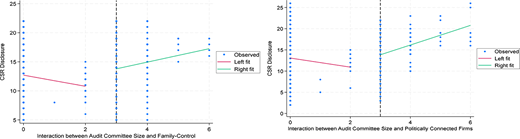
We also apply a RDD to strengthen causal inference. RDD is particularly appropriate in governance settings because it leverages a policy-defined threshold to approximate random variation around a cut-off. In our context, the running variables are the interactions between audit committee size and family-controlled firms, and between audit committee size and politically connected firms, with a cut-off of three members as mandated by the CGC (2018). By comparing firms just above and just below this threshold, the RDD approach provides credible causal evidence on how audit committee size interacts with family control and political connections to shape CSR disclosure.
Figure 1 shows the RDD plot illustrating the interaction effect of audit committees’ size with family control and political connections on CSR disclosure. The x-axis represents the interaction terms between audit committees’ size and family control (left side) and politically connected firms (right side), while the y-axis indicates CSR disclosure. The vertical dashed line at the cut-off (c = 3) marks the audit committee’s size threshold – typically the minimum recommended number of audit committee members. Blue dots depict firm-level CSR disclosure values, and the red and green lines represent local linear fits below and above the cut-off, respectively.
The plot reveals that CSR disclosure declines slightly below the cut-off, suggesting that smaller audit committees in family-controlled or politically connected firms fail to ensure effective CSR oversight. Above the cut-off, CSR disclosure rises, indicating that adequately sized audit committees enhance CSR transparency and accountability. Furthermore, for larger committees of approximately four to six members, the green line reveals an upward trend, suggesting that in some firms, expanding committees’ size restores benefits – likely because additional members contribute specialised expertise (e.g. in sustainability, risk management or legal compliance) or enable more effective division of responsibilities through subcommittees.
The visible upward discontinuity at the threshold signifies that having at least three members provides a well-governance structure capable of mitigating agency issues arising from family and political influence. Overall, the RDD evidence suggests that audit committees’ strength plays a moderating role, improving CSR disclosure in firms where family control or political ties might otherwise weaken corporate transparency.
7. Conclusion and implications
We examine whether family control, political connections and audit committees jointly shape CSR disclosure in an emerging market setting. While prior studies typically assess these ownership characteristics separately (Biswas et al., 2022; El Ghoul et al., 2016; Muttakin et al., 2018), our study provides an integrated analysis that reflects the reality of many firms in developing economies, where family influence and political embeddedness often coexist. Using 1,108 firm-year observations from DSE-listed non-financial firms, we find that both family-controlled and politically connected firms are significantly less likely to disclose CSR information. In contrast, audit committees enhance CSR disclosure and significantly moderate and mitigate the adverse effects of family control and political connections. These findings indicate that when audit committees are sufficiently empowered, they reinforce accountability and align CSR disclosure with broader stakeholder and societal expectations. Our results remain robust after addressing potential endogeneity concerns.
We further show that firms characterised by both family control and political connections exhibit the lowest levels of CSR disclosure, underscoring the compounded agency problems arising from concentrated insider power. However, audit committees demonstrate a stronger moderating influence in these firms than in non-family or non-politically connected firms, suggesting that effective audit oversight curbs entrenched insider dominance. We also investigate whether the strengthening of corporate governance regulation through the BSEC Governance Code-2018 enhances audit committee effectiveness. Our findings reveal that while audit committees continue to mitigate the CSR-reducing disclosure incentives of politically connected firms, their influence becomes weaker in family-controlled firms post-CGC-2018, possibly reflecting symbolic compliance or persistent family dominance. Further, our findings demonstrate that audit committees substitute for weak external monitoring in politically connected firms, with their strongest moderating effect occurring under low institutional ownership, while in family-controlled firms, their governance role is amplified by higher institutional ownership. Finally, by comparing environmentally sensitive and non-sensitive industries, we find that although audit committees do not directly increase CSR disclosure in high-risk industries, their interaction with family and political ownership becomes more pronounced, indicating a heightened governance imperative where reputational and regulatory pressures remain high.
Our findings carry several important policy implications. Firstly, the evidence underscores that enhancing audit committees’ effectiveness, particularly through independence, accounting expertise and gender diversity, is more consequential than simply increasing the committee’s size. We therefore emphasise that regulators and firms should prioritise these qualitative attributes to strengthen monitoring capacity, reduce information asymmetry and promote credible CSR communication. Secondly, although family ownership and political ties tend to weaken CSR disclosure, these structures also bring benefits such as organisational stability, resource networks and long-term strategic orientation. Rather than limiting such ownership forms, policymakers should encourage governance mechanisms that safeguard against opportunistic behaviour while preserving their potential advantages. Thus, we suggest mandating a minimum proportion of independent, financially literate and female members on audit committees is one such targeted and feasible approach. Thirdly, we recognise the persistent enforcement challenges in Bangladesh, where regulatory compliance can be symbolic and monitoring capacity is constrained. To address this, we suggest strengthening supervisory systems, providing incentives for genuine CSR disclosure and gradually tightening governance requirements. Such incremental reforms can enhance accountability while reducing the risk of unintended consequences, including box-ticking compliance.
Despite its contributions, our study has limitations. We focus solely on non-financial firms, whereas financial institutions may exhibit different CSR dynamics. Our results reflect the institutional characteristics of Bangladesh and should be interpreted cautiously in contexts with stronger governance environments. Moreover, although we consider family control, political connections and audit committees, other governance mechanisms such as board diversity, CEO duality, or ownership by foreign investors also influence CSR disclosure (see Zaman et al., 2024). Future research could explore cross-country comparisons to examine how institutional differences shape the interplay between ownership structures, audit committees and CSR disclosure.
The authors thank Professor Jie Zhou (California State University, Fullerton) and Associate Professor Jian Cao (Florida Atlantic University) for their editorial guidance. Authors are also grateful to two anonymous reviewers for their constructive feedback and helpful comments. Special thanks are due to Dr Nishant Agarwal (Curtin University) for his valuable technical advice regarding the Regression Discontinuity Design (RDD) methodology.