


The purpose of this paper is threefold. First, it aims to clarify the moderating role of self-esteem (SE) and susceptibility to normative influence (SNI) in the relationship between brand love and brand loyalty. Second, the study proposes modeling the mediation role of brand love and outlining how SE and SNI affect the consumer-brand relationship. Finally, the study explores the impact of brand love on brand loyalty: the moderating role of self-esteem and social influences, as the literature regarding this is still lacking.
Data were collected via an online survey, which yielded 218 responses. Structural equation modeling was used to predict the research model.
The findings indicate that both SE and SNI mediate the relationship between brand love and brand loyalty. Additionally, consumers love the focal brands positively relates to SE and SNI. In return, SE and SNI lead to brand loyalty. The tight relationship of SE and SNI affects the connection between brand love and brand loyalty.
The data has been collected in Vietnam, which creates a limitation regarding the study’s cross-cultural nature and the economic context. Thus, the study should be conducted in different cultures and economies (both developing and developed countries) to enhance the generalizability in consumer-brand relationships.
Brand managers should conduct more advertising in brand communities to enhance the influence of SNI and emphasize unique features of the brands, to attract consumers through the overlap of SE.
The findings can contribute to enhancing unique brand identity and self-motivation will increase consumer loyalty, increasing the revenue of a specific brand. Moreover, as acceptable peers contribute to making purchase decisions, boosting the brand community will maintain current consumers and attract additional potential consumers from the current consumer relationships.
This study contributes to consumer psychology by indicating both SNI and SE as the mediators in the relationship between brand love and brand loyalty and how the consumer-brand relationship can be enabled.
El impacto del amor a la marca en la lealtad a la marca: El papel moderador de la autoestima y las influencias sociales
El propósito de este trabajo es triple. En primer lugar, pretende aclarar el papel moderador de la autoestima (SE) y la susceptibilidad a la influencia normativa (SNI) en la relación entre el amor y la lealtad a la marca. En segundo lugar, el estudio propone modelar el papel mediador del amor a la marca y esbozar cómo la autoestima y la SNI afectan a la relación consumidor-marca. Por último, el estudio explora los factores que afectan a la relación entre el amor a la marca y la lealtad a la misma, ya que aún no existe literatura al respecto.
Los datos se recogieron mediante una encuesta en línea, que arrojó 218 respuestas. Se utilizó el modelo de ecuaciones estructurales (SEM) para predecir el modelo de investigación.
Los hallazgos indican que tanto la autoestima como la SNI median la relación entre el amor y la lealtad a la marca. Además, el amor de los consumidores por las marcas focales se relaciona positivamente con la autoestima y la SNI. En cambio, la autoestima y la SNI conducen a la lealtad a la marca. La estrecha relación de la autoestima y la SNI afecta la conexión entre el amor a la marca y la lealtad a la misma.
Los datos se han recogido en Vietnam, lo que crea una limitación en cuanto a la naturaleza transcultural del estudio y el contexto económico. Así pues, el estudio debería realizarse en diferentes culturas y economías (tanto de países en desarrollo como desarrollados) para aumentar la posibilidad de generalización en las relaciones entre consumidores y marcas.
Los gerentes de marca deberían hacer más publicidad en las comunidades de marcas para aumentar la influencia de la SNI y hacer hincapié en las características singulares de las marcas, a fin de atraer a los consumidores mediante la superposición de la autoestima.
Las conclusiones pueden contribuir a mejorar la identidad de una marca única, y la automotivación aumentará la lealtad de los consumidores, incrementando los ingresos de una marca específica. Además, como los pares aceptables contribuyen a la toma de decisiones de compra, el impulso de la comunidad de marcas mantendrá a los consumidores actuales y atraerá a otros consumidores potenciales de las relaciones de consumo actuales.
Este estudio contribuye a la psicología del consumidor al indicar que tanto la SNI como la autoestima son los mediadores en la relación entre el amor y la lealtad a la marca y la forma en que se puede habilitar la relación consumidor-marca.
摘要
本文有三方面的研究目的。第一,明确自尊(SE)和易受规范影响(SNI)在品牌喜爱与品牌忠诚关系中的调节作用。第二,建立品牌喜爱的中介作用模型,并概述SE和SNI如何影响消费者与品牌的关系。最后,探讨品牌喜爱对品牌忠诚度的影响:自尊和社会影响因素的调节作用,目前有关这方面的文献还比较缺乏。
通过在线调查收集数据,共收到218份答复。采用结构方程模型进行预测研究模型。
研究结果表明,自尊和易受规范影响都对品牌喜爱和品牌忠诚度之间的关系起到了调节作用。此外,消费者对焦点品牌的喜爱与自尊和易受规范影响具有正相关关系。反过来,自尊和易受规范影响又会导致品牌忠诚。自尊和易受规范影响的紧密关系影响了品牌喜爱和品牌忠诚之间的联系。
由于本次研究数据是在越南收集的,造成了研究的跨文化性质和经济背景的局限性。因此,未来的研究可以在不同的文化和经济体(包括发展中国家和发达国家)进行,以提高关于消费者与品牌关系结论的普遍性。
品牌管理者可以在品牌社区中增强广告宣传,提高易受规范影响的影响力,同时强调品牌的独特性,与自尊因素相结合来吸引消费者。
本文研究结果有助于增强独特的品牌识别和自我激励,提高消费者的忠诚度,增加特定品牌的收入。此外,由于合适的同伴有助于消费者做出购买决策,提升品牌社区可以维持现有消费者,并通过现有消费者关系吸引更多的潜在消费者。
本研究提出了自尊和易受规范影响是品牌喜爱和品牌忠诚关系的调节变量,并且进一步阐释了它们如何促成消费者与品牌的关系,从而为消费者心理学做出了贡献。
1. Introduction
Relationship marketing based on brand love and brand loyalty constructs has emerged in recent years. Brand loyalty is one of the key consequences of brand love (Albert and Merunka, 2013; Aro et al., 2018; Bergkvist and Bech-Larsen, 2010; Carroll and Ahuvia, 2006). Brand loyalty includes both behavioral and attitudinal loyalty. It refers to the intention of purchasing and repurchasing the brand, willingness to pay a higher price, refusal to switch to other brands and recommendation of the brand to others (Oliver, 1999). Brand love “adopts brand-loyal customers and turn them into advocates or influencers for your brand” (Schreane, 2020). Consumers increase their loyalty to a brand when they fall in love with that particular brand (Carroll and Ahuvia, 2006; Roy et al., 2013).
Studies have established the main factor that impacts brand love and brand loyalty and that is, self-image congruence (Bergkvist and Bech-Larsen, 2010; Roy et al., 2013). Self-image congruence increases the brand loyalty of consumers (Kressmann et al., 2006; Sirgy et al., 2008). In addition, consumers build engagement with brand love through the overlap of their self-expression and self-esteem (SE) with the brand identity (Albert et al., 2008; Leventhal et al., 2014). Self-brand integration mediates brand love relationships (Delgado-Ballester et al., 2017). The relationship between brand love and brand loyalty is mediated by self-concept and self-image congruence (Liu et al., 2012), as well as consumer-brand identification (Alnawas and Altarifi, 2016; Kim et al., 2001). Self-concept correlates with SE in maintaining internal consistency (Campbell, 1990); for example, driving a Mazda sports car to attain an ideal of self-identity while indirectly upscaling the consumer’s sense of SE.
SE shows personal development and enhances happiness, well-being and success (Sime, 2019). It explains the correlation between consciousness and personality traits that have not been widely considered by previous researchers (Giluk, 2009), as well as emotional stability (Joshanloo and Afshari, 2011; Skues et al., 2012). SE emphasizes the relationship between self-identity and the brand and the overlap between brand image and consumer identity is linked through self-congruence (Campbell, 1990; Kuenzel and Halliday, 2010; Sirgy et al., 2008). Thus, SE influences brand loyalty through self-identity (Kressmann et al., 2006; Sirgy et al., 2008), and is related to the self-brand connection (Song et al., 2017; Wu, 2009). Consumers with high SE tend to be more loyal and emotional toward the brand than consumers with low SE (Brown and Dutton, 1995).
Susceptibility to normative influence (SNI) is a construct that refers to the extent to which a consumer’s product choice decisions are influenced by others who are significant to them (Bearden et al., 1989). Peer group influence significantly contributes to consumer engagement (Kaur et al., 2020), purchasing decisions (Childers and Rao, 1992) and brand loyalty (Kim et al., 2020). SNI refers to the acceptance of the surrounding community (i.e. peers, friends, families) in selecting a suitable brand (Mourali et al., 2005). This increases a consumer’s self-value to others and connects gaps between them (Hardeman et al., 2017). Consumers tend to buy products if they believe that their friends, colleagues or family will approve or buy the same types of product, as affected by a reference group influence (Algesheimer et al., 2005; Arpita et al., 2011). SNI plays an important role in the brand community (Marzocchi et al., 2013) and consumers tend to behave similarly to others in their closed community (Kuo and Feng, 2013; Tsai et al., 2013). Peer influence reinforces the bond between a brand and consumer and increases brand love (Algesheimer et al., 2005; Coelho et al., 2019; Huang et al., 2012), tightens brand engagement (Kumar and Kumar, 2020) and attachment (Flavián-Blanco et al., 2011; Huang et al., 2012) and explains the positive relationship with SE (Sierra et al., 2016). Community normative influence encourages consumers to continue with their purchase intention (Hsiao and Chiou, 2017; Rook and Fisher, 1995). SNI contributes to building the loyalty connection to favorite brands (Hur et al., 2011; Shen et al., 2010).
Previous research on relationship marketing has determined brand loyalty as an outcome of brand love. However, the factors affecting the relationship between brand love and both behavioral and attitudinal loyalty have not been addressed. Different types of consumer identity can control the impact of brand love on brand loyalty in different ways (Roy et al., 2013). Understanding these factors can explain the situation in which consumers tend to be more loyal to a particular brand (Fournier, 1998). Furthermore, relationship-marketing research has been conducted in developed countries such as Australia, the UK and the USA; however, in developing countries such as Vietnam, studies on this concept are lacking.
SE leads to a strong self-image and consumer-brand identification and shows the emotional connection of an individual to a brand. SNI enhances brand loyalty and emotional brand connection (Ruane and Wallace, 2015). Both SE and SNI contribute to urging consumers to consume more (Bandyopadhyay, 2016). SE encourages individuals to engage with a favoring group behavior to increase their collective identity (Khare et al., 2011). However, in terms of considering SE as a tool to mediate loyalty levels through the emotional attachment channel, there is a lack of agreement in the literature regarding the role of SE and SNI in the relationship between brand love and brand loyalty. Thus, the study findings can help determine how the loyalty of consumers toward their loved brand can be enhanced.
To address the above gaps, the current study enriches the literature by considering the relationship marketing of brand constructs, using social identity theory (Ashforth and Mael, 1989) and social comparison theory (Morse and Gergen, 1970). In addition, the study proposes a theoretical model based on the relationship marketing perspective. Social identity theory explains a self-concept of an individual obtained from membership of a related social group (Ashforth and Mael, 1989) and implies that SE impacts the tendency to compare oneself with others or social groups (Vogel et al., 2014). Social comparison theory shows that individuals’ opinions are affected by their peers, friends or communities (Gibbons and Buunk, 1999; Tajfel et al., 1979). Consumers tend to portray themselves as being aligned with their friends, family and social groups to have a connection with them. This is called SNI (Chan and Prendergast, 2007; Joe et al., 2017; Orth and Kahle, 2008; Savani et al., 2015).
2. Theoretical development
This section provides social identity theory and background literature on the constructs of brand loyalty and brand love used to develop the conceptual model in this study.
2.1 The relationship between brand love and brand loyalty
Brand love has been conceptualized as a long-term relationship with a particular brand (Fournier, 1998). Carroll and Ahuvia (2006, p. 18) define love for a brand as “the degree of passionate emotional attachment that a person has for a particular trade name.” Brand love is positive valence and higher-order emotion that consumers direct toward a brand and is similar to other affective constructs such as brand loyalty and brand attachment (Bergkvist and Bech-Larsen, 2010). Brand love can have a positive impact on consumer behavior. The love that a consumer feels for a particular brand impacts their brand commitment and leads to the consumer giving positive word-of-mouth recommendations (WOM) to that brand and paying a higher price for the brand (Albert and Merunka, 2013). WOM is likely to happen if consumers feel their self-identity is relevant to a particular brand. Bergkvist and Bech-Larsen (2010) argue that brand loyalty and active engagement are two consequences of brand love. Active engagement involves consumers following the news and visiting the stores or the website of a particular brand (Bergkvist and Bech-Larsen, 2010). Previous research findings show that brand loyalty is a consequence of brand love (Albert and Merunka, 2013; Aro et al., 2018; Bergkvist and Bech-Larsen, 2010; Brandão et al., 2019).
Dick and Basu (1994, p. 102) define customer loyalty as “the relationship between relative attitude and repeat patronage.” Brand loyalty is defined as a deeply held commitment to rebuy a preferred product/service consistently in the future, thereby causing repetitive same-brand or same-brand-set purchasing, despite situational influences and marketing efforts having the potential to cause switching behavior (Oliver, 1999, p. 2). Dick and Basu (1994) examined loyalty using both attitudinal (e.g. consumer satisfaction) and behavioral (e.g. repurchase intention) dimensions. Chaudhuri and Holbrook (2001) considered loyalty on multidimensions, including attitudinal and intention or commitment to consume and exhibit behavioral loyalty. There are several dimensions of brand loyalty: cognitive loyalty, attitudinal loyalty and behavioral loyalty (Oliver, 1999). Attitudinal loyalty expresses a brand preference or reflects the emotional connection between brand and consumer (Flavián-Blanco et al., 2011). Conversely, behavioral loyalty is understood as referring to a consumer repeatedly purchasing that brand (Morgan, 1999). Brand loyalty evidence higher-order emotions or attitudes and is one of the consequences of brand commitment and attachment (Amine, 1998; Espejel et al., 2009; Shukla et al., 2016). This loyalty is suggested by positive WOM, willingness to pay a premium price and willingness to commit to the brand (Amine, 1998; Grisaffe and Nguyen, 2011; Kim et al., 2008). Brand loyalty mainly encompasses positive aspects of the behavior of loyal consumers who like to use the brand in ways that could be regarded as socially acceptable.
2.2 Social identification theory and self-esteem
Social identity theory shows that individuals compare their personal identity with the abilities and characteristics of others (Morse and Gergen, 1970) and with relevant comparison groups (Tajfel et al., 1979). SE at a collective level refers to a self-concept which matches with social identity in-group favoritism (Luhtanen and Crocker, 1992; Rubin and Hewstone, 1998) and shows a commitment to a group (Bergami and Bagozzi, 2000; Fuller et al., 2003). Social identity theory implies that SE impacts the tendency to compare oneself with others (Vogel et al., 2014), which, in turn, would positively influence loyalty toward a loved brand (He et al., 2012; Kuo and Hou, 2017).
The term “SE” refers to an individual’s evaluation of their identity and includes four dimensions: esteem, public collective SE, private collective SE and importance of identity (Luhtanen and Crocker, 1992). Campbell (1990) determined that people with high SE tend to have positive, well-articulated views of themselves. Product involvement and SE increase the positive influence of actual self-congruence and self-brand integration on emotional brand attachment (Delgado-Ballester et al., 2017; Malär et al., 2011). Thus, a consumer with a strong social identity (Shroff and Thompson, 2006) normally cares about their image and is keen on what others think about them (Dolich, 1969).
SE impacts the maintenance of self-identity. High SE refers to a highly consistent self-identity and self-concept (Campbell, 1990; Lafrenière et al., 2011). Self-brand connection increases if the brand presents the self-image or self-identity that the consumer wishes to project (Thomson et al., 2005). In this case, consumers strongly connect with their favorite brand and their self-identity overlaps with the brand (Batra et al., 2012; Fournier and Yao, 1997; Mackellar, 2009; Trump and Brucks, 2012). Strong overlapping of self-identification tightens brand love and brand loyalty commitment (Alnawas and Altarifi, 2016; Islam et al., 2017; Sallam and Wahid, 2015). Thus, this study applies social identity theory to explain the influence of SE on the relationship between brand love and brand loyalty.
2.3 Social comparison theory and susceptibility to normative influence
Social comparison theory identifies an individual’s opinions and abilities that are affected by others (Gibbons and Buunk, 1999; Moschis, 1976; Turner et al., 1979). Peer communication or feedback from friends can help buyers better position their self-identity when shopping, by making a social comparison with friends (Chan and Prendergast, 2007; Mangleburg et al., 2004; Turner et al., 1979). Individuals with high normative influence avoid creating a negative impression in a public community, easily portraying themselves as being aligned with peers (Wooten and Reed, 2004) and engaging with the community (Raïes et al., 2015). They avoid calling attention from the crowd (Bearden and Rose, 1990) and prefer to have a similar outlook as their friends through the use of similar brands (Algesheimer et al., 2005; Mangleburg et al., 2004).
SNI shows peer purchase expectation, which navigates consumer behavior toward the brand (Bearden et al., 1989). Previous research identifies that SNI significantly impacts the efforts of consumers in matching themself with their network. Consumers with high SNI seek products that bring socially visible benefits (Batra et al., 2001) and avoid disapproval from society (Wooten and Reed, 2004). SNI influences brand self-expression and creates loyal behavior (Escalas and Bettman, 2005; Ruane and Wallace, 2015). Consumers are willing to buy their favorite brand because the brand aids an individual’s self-expression through the image the brand projects (Gounaris and Stathakopoulos, 2004; Redden and Steiner, 2000). Values, brand logo and brand prominence are all features to encourage consumers to be more SNI (Batra et al., 2001), especially with luxury brands, which leads to brand love (Joe et al., 2017; Wu and Lin, 2016) and enhances brand loyalty (Labrecque et al., 2011). This study applies the social comparison theory to explain how SNI can mediate consumer loyalty with their favorite brand.
Bearden et al. (1989) showed that SNI relates to SE and the approval of others. SE is the self-cognition that guides an individual’s choice of brand or product that may receive approval from their peers (Batra et al., 2001; Kahle et al., 1980), showing a linkage between SE and SNI in enhancing the individual’s purchase decision. In addition, a consumer’s love for their favorite brand tends to increase peer comparison and SE and the consumer tends to protect the brand against rival brands (Turner et al., 1979). Both SNI and SE enhance the identity of a loved brand, especially with an in-group influence (Brodie et al., 2013; Hur et al., 2011; Kumar and Kumar, 2020).
3. Hypothesis development
3.1 Brand love, brand loyalty and self-esteem
Brand love determines the bonding of brand image and consumer self-identity (Bagozzi et al., 2017). When consumers connect with a brand as self-congruence, they tend to defend the brand to preserve self-integrity (Lisjak et al., 2012). Research in consumer behavior states that products develop SE by flattering an individual’s ego (Arndt and Greenberg, 1999) and tie with self-concept (Campbell, 1990).
Consumers love a brand due to motives relating to SE and self-image (Albert et al., 2008). Brand love can enhance SE when developing a unique identity (Alnawas and Altarifi, 2016). For example, consumers tend to buy luxury brands to show their standing and wealth to others (Tsai et al., 2013; Yim et al., 2014). Fans of car brands are willing to pay huge sums of money for the cars as it shows the fans’ self-identity and style and distinguishes them from others (Algesheimer et al., 2005). At the brand love level, consumers fall in love with brands for self-brand connection and passion (Batra et al., 2012; Fedorikhin et al., 2008; MacInnis and Folkes, 2017). Moreover, SE moderates brand attachment (Sierra et al., 2016) and is considered as an outcome to maintain the relationship with an individual or group (Cast and Burke, 2002). Thus, SE can be considered as the outcome of brand love.
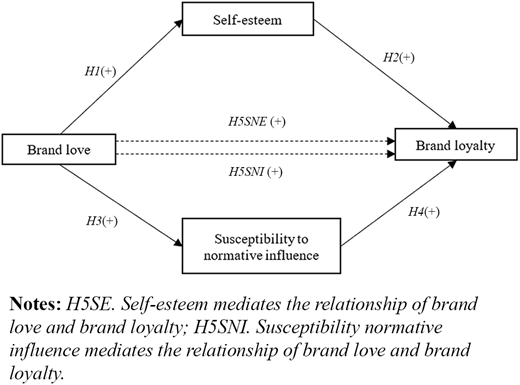
Brand love positively affects self-esteem.
Self-image congruence directly affects brand loyalty and indirectly connects with the brand through product involvement, congruity (Kressmann et al., 2006). Product involvement and SE positively increase self-congruence on emotional brand attachment (Malär et al., 2011). SE implies to evaluate an individual’s personal identity (Campbell, 1990; Luhtanen and Crocker, 1992). The consumer’s ego is developed by the brand prestige and image, which enhances loyalty (Kressmann et al., 2006). SE moderates the relationship between self-congruity and brand loyalty. In turn, self-congruity predicts brand loyalty (Sirgy et al., 2008).
Self-esteem positively impacts brand loyalty.
3.2 Brand love, brand loyalty and susceptibility to normative influence
Social influence occurs within friendship groups and sometimes the choice is delegated to others within social situations (Albert and Merunka, 2013). SNI creates a brand community (Algesheimer et al., 2005). In return, this community builds up a strong connection between the brand and consumers (Casalo et al., 2008). Brand love is the willingness to engage in active cocreating behavior in the brand community; in particular, brand values are vividly communicated by celebrities (Kaufmann et al., 2016). Brand love emphasizes both cognitive and emotional attachment with loyal consumers (Albert et al., 2009; Fedorikhin et al., 2008). Peer influence boosts the strength of brand attachment, especially on adolescent consumers (Huang et al., 2012). Thus, brand love can enhance SNI under peer effects.
SNI is influenced by social interactions (Savani et al., 2015). Consumers prefer to be accepted in their own community, such as schools, universities and workspaces (Suki et al., 2016). Consumers who love a particular brand spread positive words to their friends or networks (Flavian et al., 2009; Huang et al., 2012), urging other consumers to buy and creating motivation for them to be more loyal (Badrinarayanan and Sierra, 2018). Thus, SNI mediates the relationship between brand love and brand loyalty, leading to the hypothesis:
Brand love positively affects SNI.
SNI refers to peer advice that impacts consumers’ decisions in buying products (Shukla, 2011). The brand has a big brand community and brand prestige will help consumers to more easily make their final decision, confidentially (Einwiller, 2003; Tussyadiah et al., 2018). Brands are suggested by consumers’ friends and colleagues through WOM, which indirectly develops loyalty. SNI tends to improve brand loyalty through brand prestige (Tsai et al., 2013). Furthermore, when consumers feel happy because their new products are accepted by their community, it increases their satisfaction (Erciş et al., 2012). Satisfaction is one of the most important factors that maintains and boosts brand loyalty (Bloemer and Kasper, 1995; Nam et al., 2011). SNI increases the intention to be involved and to participate in group buying, as a signal of purchase intention (Sharma and Klein, 2020), as well as urging other consumers to buy.
SNI positively impacts brand loyalty.
3.3 The mediating role of self-esteem and susceptibility to normative influence
This study postulates that SE and SNI mediate the relationship between brand love and brand loyalty. SE and SNI have a relationship in the specific community that helps consumers identify themselves with a certain social group and may also help to boost their SE (Penz and Hogg, 2011). Tribalism boosts SE and this behavior supports the community (Sierra et al., 2016, p. 1), enhancing the commitment of consumers and the brand community. Therefore, this study adds SE and SNI in the research model to consider their impacting role in brand love and brand loyalty relationship.
SE increases the loyalty of customers when they fall in love with a brand. Brand love leads to brand loyalty, which enhances purchase intention and WOM. The existing literature on SE is extensive, with a particular focus on impulsive buying behavior (Hadjali et al., 2012; Narang, 2016). The studies presented thus far provide evidence that SE can relate to brand loyalty. Furthermore, SE increases social attention in relation to self-image and self-identity (Song et al., 2017). In return, consumers increase their SE through the brand reputation connecting with their identity (Bizman and Yinon, 2002; Eastman et al., 1999). The overlap of self-identity and brand creates brand self-congruence (Hsiu-Yu, 2014) and relates to brand identification (Eastman et al., 1999). Consumer-brand identification mediates the relationship between brand love and brand loyalty (Alnawas and Altarifi, 2016); thus, SE in relation to brand identification might mediate brand love and brand loyalty; this is our H5SE.
Customers tend to buy products due to the influence of their friends and communities. SNI consumers search for products with socially visible benefits (Arpita et al., 2011) and rely on the acceptance of others to make their purchase decision. Brand loyalty, on the other hand, is determined by product quality, satisfaction (Li and Petrick, 2008), brand identification (Bergkvist and Bech-Larsen, 2010) and brand or commitment community (Hur et al., 2011), all of which enhance brand loyalty and the consumer connection (Kuo and Feng, 2013). In addition, SE and SNI are also considered as determinants of brand loyalty (Kressmann et al., 2006; Ruane and Wallace, 2015). Moreover, brand love enhances the brand experience (Nikhashemi et al., 2019) and contributes to building positive WOM (Gómez-Suárez and Veloso, 2020) (Table 1). Thus, SNI may mediate the relationship between brand love and brand loyalty, this is our H5SNI. The conceptual framework and research hypotheses are illustrated in Figure 1.
Self-esteem, susceptibility normative influence, brand love and brand loyalty relationships
| Brand and SE, SNI | Authors |
|---|---|
| Self-esteem and brand relationships | |
| Self-congruity involving the ideal self involves a different self-concept motive, namely, the SE motive | Wallace et al. (2017), Zhang and Bloemer (2008) |
| Consumers may love a brand due to self-image motives and SE motives | Albert et al. (2008, p. 73), Lafrenière et al. (2011) |
| Self-esteem positively influences romantic brand jealousy | Leventhal et al. (2014) |
| Self-esteem has strong correlation with the brand passion, brand commitment, brand identification, brand loyalty, brand love | Bergami and Bagozzi (2000), Song et al. (2017), Tuškej et al. (2013) |
| SNI and brand relationships | |
| Within a brand community, consumers interact other members and their purchase decisions are impacted by susceptibility normative influences | Bearden et al. (1989), Carroll and Ahuvia (2006), Martínez-López et al. (2017) |
| SNI affects brand benefits consumers desire and consequently choice | Joe et al. (2017), Orth and Kahle (2008) |
| Self-esteem and SNI | |
| Consumers commit with a specific brand community that increase the chance to boost their SE | Bandyopadhyay (2016), Penz and Hogg (2011) |
| Tribalism boosts SE and their behaviors that support the community | Sierra et al. (2016, p. 1), Veloutsou and Moutinho (2009), Zhou et al. (2012) |
4. Research methods
4.1 Data collection and sample
Studies on brand love have been conducted in different countries but have not yet explored emerging markets such as Vietnam. Vietnam is a growing market (International Monetary Fund, 2019) and has attracted investment from a variety of big brands such as Apple, Honda, Samsung, Coca-Cola, H&M and Uniqlo. Vietnamese consumers tend to be loyal to reputable brands and services (Nguyen et al., 2011; Thao and Swierczek, 2008) and are enthusiasts of sports apparel (Pourazad et al., 2019) and of gaming (Lobo and Kennedy, 2009). Furthermore, Vietnamese are loyal consumers and are willing to pay premium prices to obtain their loved products (Baumann et al., 2013; Nguyen and Nguyen, 2011). Vietnamese consumers are keen on using big brands as this represents their standing and style to others. As a growing economy, the finances of Vietnamese consumers are sufficient to buy big brand products. A deeper understanding of Vietnamese consumers can provide better insight and suggestions for brands and increase consumer loyalty in this market.
A survey of students and staff at a Vietnamese university was conducted using convenience sampling. Before filling the questionnaire, respondents were brief about the survey. To ensure respondents’ eligibility to complete the survey, a screening question was first used to rule out those respondents who did not have a favorite brand. Once participants answered “Yes,” respondents were asked to fill a favorite brand name and to think about that brand when answering the survey questions (Batra et al., 2012; Escalas and Bettman, 2005). A total of 230 completed questionnaires were received, but only 218 valid questionnaires can be used. Demographic information and three of the most favorite brands were shown in Table 2.
Descriptive statistics
| Items | Frequency | (%) |
|---|---|---|
| Gender | ||
| Men | 114 | 52.3 |
| Women | 104 | 47.7 |
| Total | 218 | 100.0 |
| Age | ||
| 18–25 | 162 | 74.3 |
| 25–45 | 56 | 25.7 |
| Total | 218 | 100 |
| Education | ||
| High school | 1 | 0.5 |
| Vocational or Trade Certificate | 2 | 0.9 |
| Associate diploma or Diploma | 213 | 97.7 |
| Bachelor’s degree/Graduate certificate | 1 | 0.5 |
| Post-graduate degree (Master, PhD, etc) | 1 | 0.5 |
| Total | 218 | |
| Brand | ||
| Apple | 36 | 16.5 |
| Nike | 36 | 16.5 |
| Oppo | 18 | 8.2 |
| Others | 128 | 58.8 |
| Total | 218 | 100 |
4.2 Measures
A questionnaire was developed to test the study’s research hypotheses. To test the theoretical model, scales were adopted from the literature for brand love, brand loyalty, SE and SNI. All measures used seven-point scales with the same labels (strongly disagree/disagree/somewhat disagree/neither disagree nor agree/somewhat agree/strongly agree).
Brand love was measured with six items from Bagozzi et al. (2017). Items were averaged to form a brand love evaluation index (Cronbach’s α = 0.843).
Brand loyalty was measured on four items from Mrad and Cui (2017). Items were averaged to form a brand addiction evaluation index (Cronbach’s α = 0.728).
SE was measured on five scales from Rosenberg (1965). Items were averaged to form an obsessive passion evaluation index (Cronbach’s α = 0.803).
SNI was measured on four scales from Bearden et al. (1989). Items were averaged to form an obsessive passion evaluation index (Cronbach’s α = 0.911).
4.3 Data analysis
First, constructs’ reliability was measured including the factor loading value > 0.5, Cronbach’s α > 0.7 and composite reliability (CR) > 0.7 (Hair et al., 2014). As Table 3 reports, all the constructs showed values of α and CR above 0.70, thus meeting the requirement of construct reliability. Moreover, convergent validity was measured through the average variance extracted (AVE). All the latent variables showed AVE values higher than 0.50 (Table 4). Finally, Table 4 shows that all variables achieved discriminant validity according to both the Fornell-Larcker criterion and the Heterotrait-Monotrait ratio of correlations (HTMT) (Henseler et al., 2015). The Fornell-Larcker criterion was met (Table 4) because the square root of the AVE score is above the intercorrelation (IC) (Hair et al., 2020). The HTMT criterion was significantly smaller than 1 or below 1, thus indicating the distinctiveness of the constructs (Henseler et al., 2015) (Table 5).
Measurement model evaluation
| Construct | Item | Mean | SD | Loading | α | CR | AVE |
|---|---|---|---|---|---|---|---|
| Brand love adopted from Batra et al. (2012) | 0.903 | 0.839 | 0.530 | ||||
| To what extent do you feel yourself longing to use your favorite brand? | BLV1 | 4.561 | 1.562 | 0.762 | |||
| Please express the extent to which you feel there is a natural “fit” between you and your favorite brand | BLV2 | 4.473 | 1.466 | 0.723 | |||
| Please express the extent to which your favorite brand seems to fit your own tastes perfectly | BLV3 | 4.472 | 1.500 | 0.746 | |||
| Please express the extent to which your favorite brand seems to fit your own tastes perfectly. | BLV4 | 4.583 | 1.544 | 0.795 | |||
| To what extent do you feel that your favorite brand is exciting? | BLV5 | 4.601 | 1.569 | 0.839 | |||
| Please express the extent to which you expect that your favorite brand will be part of your life for a long time to come | BLV6 | 4.693 | 1.641 | 0.761 | |||
| Brand loyalty adopted from Mrad and Cui (2017) | 0.728 | 0.873 | 0.587 | ||||
| I will buy this brand next time | BLY1 | 3.843 | 1.071 | 0.882 | |||
| I have an intention to buy this brand | BLY2 | 3.982 | 1.011 | 0.890 | |||
| I commit with this brand | BLY3 | 3.472 | 1.232 | 0.723 | |||
| I would be willing to pay a higher price for this brand than switching to other brands | BLY4 | 2.921 | 1.393 | 0.615 | |||
| SE adopted from Rosenberg (1965) | 0.726 | 0.818 | 0.530 | ||||
| On the whole, I am satisfied with myself | SE1 | 3.022 | 0.931 | 0.758 | |||
| I take a positive attitude toward myself | SE2 | 3.091 | 0.922 | 0.662 | |||
| I feel that I have a number of good qualities | SE3 | 3.011 | 0.872 | 0.703 | |||
| I am able to do things as well as most other people | SE4 | 2.802 | 0.871 | 0.624 | |||
| I feel that I’m a person of worth, at least on an equal plane with others | SE5 | 2.961 | 0.913 | 0.690 | |||
| Susceptibility normative influence adopted from Bearden et al. (1989) | 0.911 | 0.896 | 0.523 | ||||
| When buying products, I generally purchase those brands that I think others will approve of | SNI1 | 3.592 | 1.933 | 0.748 | |||
| If other people can see me using a product, I often purchase the brand they expect me to buy | SNI2 | 3.463 | 1.869 | 0.762 | |||
| I achieve a sense of belonging by purchasing the same products and brands that others purchase | SNI3 | 3.521 | 1.784 | 0.762 | |||
| If I want to be like someone, I often try to buy the same brands that they buy | SNI4 | 3.033 | 1.865 | 0.736 |
Notes: AVE: average variances extracted; α: Cronbach’s alpha; CR: composite reliability; SD: standard deviation
Reliability, convergent validity and ICs
| Constructs | AVE | MSV | SNI | BLY | BLV | SE |
|---|---|---|---|---|---|---|
| SNI | 0.523 | 0.093 | 0.696 | |||
| BLY | 0.587 | 0.389 | 0.206 | 0.766 | ||
| BLV | 0.597 | 0.389 | 0.305 | 0.624 | 0.679 | |
| SE | 0.530 | 0.209 | 0.002 | 0.331 | 0.457 | 0.592 |
Notes: SNI: susceptibility to normative influence; BLV: brand love; BLY: brand loyalty; SE: self-esteem; MSV: maximum shared variance; AVE: average variances extracted. Square root of AVE greater than inter-construct correlations. The diagonal scores (in Italic) indicate the square root of AVEs
CIs for the HTMT ratio
| Hi | Relations | Lower than 2.5% | Upper than 97.5% | Sig | HTMT confidence interval | HTMT confidence interval is less than 1 |
|---|---|---|---|---|---|---|
| H1 | Brand love → SE | 0.498 | 0.695 | 0.000 | 0.601 | Yes |
| H2 | Brand love → SNI | 0.396 | 0.616 | 0.000 | 0.506 | Yes |
| H3 | Self-esteem → brand loyalty | 0.680 | 0.789 | 0.000 | 0.737 | Yes |
| H4 | SNI → brand loyalty | 0.060 | 0.228 | 0.000 | 0.140 | Yes |
Note: SNI: susceptibility to normative influence
This study used the partial least squares structural equation modeling (PLS-SEM) by using the Smart-PLS software (Hair et al., 2016). This study has 4 latent constructs that were predicted by 20 indicators and a sample with 218 respondents. PLS works more efficiently in a small sample and has an advantage in predicting or identifying the relationships between constructs. Also, PLS-SEM offers R2 values and shows the significance of relationships among constructs and how well the model is performing (Hair et al., 2016). To assess the predictive ability of the structural model, this study would conduct three tests before conducting further tests, including:
The R2 value (variance accounted for) for the dependent constructs, which has to exceed the 0.1 value. R2, for brand loyalty, was 0.655, which meant that brand love, SE, SNI explained 65.5% of brand loyalty. In this sense, brand love explained 36% of SE and was the construct that best represented brand loyalty, SNI explained 25.5% of brand love, respectively (>0.1 value), which predict capabilities and relationships between the constructs (Hair et al., 2020).
The Stone-Geisser test of predictive relevance (Q2), which is calculated through the Blindfolding technique. The model has a predictive relevance when Q2 is greater than zero. Table 6 showed the Stone-Geisser test of predictive relevance (Q2) for brand loyalty was 0.358, SE was 0.188 and SNI was 0.137, which meant that the research model was predictably relevant (Hair et al., 2016).
The overall goodness-of-fit (GoF) of the measurement model (Tenenhaus et al., 2005), as described follows. The GoF of the measurement model was checked before interpreting the causal paths of the structural model. The estimation results demonstrated an acceptable GoF despite the significant chi-square statistic: χ2, 1.875 (p = 0.000) (<5); the root mean square error of approximation (RMSEA), 0.063 (<0.08); comparative fit index (CFI), 0.924; goodness-of-fit index (GFI), 0.887; Tucker-Lewis index (TLI), 0.912, respectively (≥0.85); normed fit index (NFI), 0.853 and standardized root mean square residual, 0.061 (<0.80).
5. Results and analysis
5.1 Structural model
A good-fitting structural model is required before conducting the path analysis. The estimation results demonstrated an acceptable GoF despite the significant chi-square statistic: χ2, 2.309 (p = 0.000) (<5); RMSEA, 0.078 (<0.08); CFI, 0.975; GFI, 0.988; TLI, 0.853, respectively (≥0.85); NFI, 0.971 and standardized root mean square residual, 0.064 (<0.80) (Hair et al., 2016).
As Table 7 shows, brand love were positively related to SE (β = 0.601, p < 0.000), supporting H1. Brand love were positively related to SNI (β = 0.506, p < 0.000), supporting H2. SE were positively related to brand loyalty (β = 0.737, p < 0.000), supporting H3. SNI were positively related to brand loyalty (β = 0.140, p < 0.000), supporting H4.
Results of the hypotheses testing
| Hi | Relations | Collinearity Assessment VIF | Significant of the path coefficients (β) | t-statistics | Results |
|---|---|---|---|---|---|
| H1 | Brand love → SE | 1.000 | 0.601*** | 12.149 | Supported |
| H2 | Brand love → SNI | 1.000 | 0.506** | 9.039 | Supported |
| H3 | Self-esteem → brand loyalty | 1.135 | 0.737*** | 26.351 | Supported |
| H4 | SNI → brand loyalty | 1.135 | 0.140** | 3.258 | Supported |
Notes:
SE = standardized estimate, *p < 0.05,
**p < 0.01,
***p < 0.001, SNI: susceptibility to normative influence
5.2 Mediation test
To test for the mediation of SE and SNI (H5SE, H5SNI), the bootstrap method (Preacher and Hayes, 2008) was used via Smart PLS (Wong, 2013) using 5,000 bootstrapping resamples with bias-corrected 95% confidence intervals (CIs) to test the significance of the indirect effect of the mediator. There were two indirect effects in this model. The first (BLV → SE → BLY) was 0.116 with LLCI and ULCI, respectively, of [0.006; 0.90], the second (BLV → SNI → BLY) was 0.065 with LLCI and ULCI, respectively, of [0.023; 0.120], CI was entirely above 0, this effect was different from 0. Thus, the analysis of the indirect effects reveals SE contributes more than SNI in the mediation effect. Mediation is indicated by the significance level of the indirect effect from brand love to brand loyalty through SE and SNI as indicated by the p-value or the LLCIs and ULCIs. Hence, SE and SNI partially mediated the relationship (β = 0.056, p < 0.001; β = 0.061, p < 0.001, respectively), when one has a love to a favorite brand, one can directly build a higher loyalty, statistically supporting H5a and H5b (Table 8).
Mediation of the effect of SE and SNI on the relationship between brand love and brand loyalty
| Path | Direct effects (coefficients) | Specific indirect effects | Bias corrected bootstrap 95% confidence interval | Partial mediation | ||
|---|---|---|---|---|---|---|
| Lower | Upper | SPC | t-value | |||
| BLV → SE | 0.437 | 0.311 | 0.568 | 0.065 | 0.292*** | |
| BLV → SNI | 0.271 | 0.151 | 0.397 | 0.060 | 0.472*** | |
| SE → BLY | 0.266 | 0.146 | 0.412 | 0.056 | 0.127* | |
| SNI → BLY | 0.242 | 0.109 | 0.376 | 0.061 | 0.135* | |
| BLV → SE → BLY | 0.116 | 0.006 | 0.090 | 0.056 | 0.562*** | |
| BLV → SNI → BLY | 0.065 | 0.023 | 0.120 | 0.061 | 0.535*** | |
Notes: Bootstrapping based on n = 5,000 subsamples; SPC: standardized path coefficient.
*p < 0.01;
***p < 0.001; BLV: brand love; SE: self-esteem, BLY: brand loyalty; SNI: susceptibility to normative influence
6. Discussion
The emerging literature shows that brand loyalty is a consequence of brand love in consumer-brand relationships (Bergkvist and Bech-Larsen, 2010; Carroll and Ahuvia, 2006; Rageh Ismail and Spinelli, 2012; Roy et al., 2013). Considering the consumer-brand relationship, social identity theory and social comparison theory, this study developed a research model to test the mediating role of SE and SNI in controlling the relationship between brand loyalty and brand love. The results reveal that both SE and SNI significantly and positively influence this relationship and contribute to consumer psychology (Luhtanen and Crocker, 1992; Vogel et al., 2014; Wu, 2009; Rubin and Hewstone, 1998). Next, the important theoretical and practical implications that arise from this research will be discussed.
6.1 Theoretical contribution
This study adds to the consumer-brand relationship literature in the following ways. First, by combining SE, SNI, brand love and brand loyalty in a conceptual model, the study offers more understanding of the factors that mediate the correlated relationship between brand love and brand loyalty. SE is related to self-identity and self-congruence, which are the key elements for consumers to build a strong emotional connection with the brand (Japutra et al., 2019). Previous studies show that SE directly relates to brand loyalty (Arpita et al., 2011; Lin, 2010; Sierra et al., 2016). This study finds that SE correlates with consumers’ loyalty to their loved brands. In addition, brand love refers to positive advice to others and active commitment to the brand (Amine, 1998). Extant research suggests that SNI indicates that consumers are affected by their reviews of their peers when buying the brand (Wooten and Reed, 2004). The findings of this research also show that SNI contributes to increased consumer loyalty to a favorite brand. Moreover, as research on the consumer-brand relationship has been conducted mostly in developed countries, the findings conducted in a developing country add further to the understanding of the brand relationship construct. The research also adds SNI and SE mediating to the causal relationship between brand love and brand loyalty (Albert and Merunka, 2013; Wu, 2009).
6.2 Managerial implications
This study offers insight for marketing practitioners. First, SE links with self-image congruence (Campbell, 1990), which certainly influences brand loyalty (Kressmann et al., 2006). SE contributes an important role, enhancing brand value (Browning, 2015). Brand managers should create advertisements that foster ideal self-congruence to influence brand attachment, which then increases loyalty and brand value. For example, a global tea company creates innovative gourmet foods using superfood ingredients to identify the frame of reference and point of difference to attract consumers, enhance brand value and build brand loyalty (Shah, 2020). Second, the present study contributes proven evidence for brand managers, that enhancing the unique features of a brand maintains SE and levels up the emotional connection between brand and consumer (Lafrenière et al., 2011). Brand managers can emphasize the unique features of products, comparing against competitors, to enhance the SE of the user and, indirectly, increase consumer loyalty.
Third, social activities among members of the brand community exert a strong influence on consumer purchase intention. This study presents that SNI positively increases the loyalty of consumers toward focal brands. Brands should build up brand communities, such as fan pages and brand Instagram accounts and websites to upload up-to-date, accurate product information and knowledge to help loyal consumers select products and exchange ideas (Flavian et al., 2009). These brand communities enhance positive WOM channels and reviews by peers to attract greater numbers of loyal consumers (McAlexander et al., 2002). Brand managers can run advertisements with review content to increase consumer satisfaction (Lin, 2015) through the use of SNI. Furthermore, managers can combine advertisements and reviews with brand prestige. This can result in consumers being strongly satisfied when buying a brand, as well as being accepted by their network and guaranteeing their reputation.
Consumers who love a brand still prefer to receive acceptance from their community and are considered as members with expertise (Sharma and Klein, 2020). Brand managers may invite these brand-loyal members to provide reviews of their product usage experiences. By acting as influencers to other consumers, expert members recognize the spiritual values of being loyal consumers of a brand, not simply that the material values of the products continue. In addition, these members can spread their positive comments across online communities or at brand community events, which then significantly influences others. In terms of online communities, brand-loving consumers can use hashtags as an effective way of providing their usage experiences or product knowledge in online pages (Stathopoulou et al., 2017). Consumers tend to trust other consumer reviews, which, in turn, can increase consumer brand loyalty (Serra-Cantallops et al., 2018).
6.3 Limitation and future research
Although this study contributes important points to the marketing literature, there are limitations. First, the data has been collected only in Vietnam, which has a specific culture. This creates a limitation regarding its cross-cultural nature and the economic context. Thus, the study should be conducted in different cultures and economies (both developing and developed countries) to enhance generalizability in consumer-brand relationships. In addition, the study should be conducted within specific brand communities such as Apple, Harley-Davidson and Gucci (Algesheimer et al., 2005; Kumar and Kumar, 2020). This may show clearly the role of SNI and SE in the relationship between brand love and brand loyalty.
Second, this is a cross-sectional study conducted at a specific point in time. The consumer-brand relationship is dynamic; therefore, future research could use longitudinal methods to investigate changes in the consumer-brand relationship over time (Rindfleisch et al., 2008; Solem, 2016) and capture updated consumer psychology trends in real-time. The brand construct scale of this study was adopted from the dimensional scale of Batra et al. (2012) and the brand loyalty scale of Aaker (1997). This study also asked respondents to indicate in the survey their favorite brands, which created a diversity of brand names. Future studies could include a specific brand that can capture deeply the different effects of SE and SNI in the research model.
In addition, further research should be devoted to checking the different influences of SE and SNI on luxury brands and frugality brands in building brand loyalty (Goldsmith et al., 2014). It would be of significant interest to include the concept of “social self-efficacy” or “self-monitoring” to predict the role of self-control in connection with social influences and SE (Khare et al., 2011).
In conclusion, this study contributes to consumer psychology literature by indicating that both SE and SNI mediate the impact of brand love on brand loyalty. This research also extends the understanding of the relationship between brand love (Bergkvist and Bech-Larsen, 2010; Carroll and Ahuvia, 2006) and brand loyalty (Brandão et al., 2019). The study results show that SE connects with consumers’ self-identity and brand identity to enhance the bonding of brand loyalty in the relationship with brand love. SNI indicates that peers, friends or brand communities influence consumers to increase emotional attachment and loyalty. The findings suggest the increasingly important role of brand community in maintaining current customers, as well as in attracting more potential consumers through the networks of current brand-loyal consumers. Further studies can be conducted in the future to understand the relationship between SE and SNI in consumer-brand relationships.
The author wishes to thank Professor Carlos Flavian, the SJM-ESIC editor and the anonymous reviewers for their constructive reflections and comments to enable the publication of this paper.
Funding: This research received the funding from University of Economics Ho Chi Minh City, Vietnam.

