This study aims to examine how customers’ inherent tendencies and capacity to engage with loyalty programmes (LPs) shape their actual engagement, and how this subsequently influences their engagement with and loyalty to retailers.
In Study 1, the components of loyalty programme engagement (LPE) are validated using data collected from 250 Australian supermarket retail customers. In Study 2, using data from 820 Australian supermarket retail customers the proposed research model is tested. Both symmetrical partial least squares structural equation modelling and asymmetric fuzzy-set qualitative comparative analysis (fsQCA) are used to enhance the rigour of the findings.
Results show that customers’ disposition towards LP engagement, in the form of internal tendencies and capacity, are important drivers of LP engagement. In addition, results also show that LP engagement leads to retailer engagement and customer loyalty (both attitudinal and behavioural loyalty). fsQCA results show that combination of trust, commitment and perceived benefits is the key configuration whose presence or absence determines the enhancement or impediment of LP engagement.
These findings will help retailers design LPs based on a better understanding of the factors (i.e. trust, commitment, perceived benefits and temporal and spatial price searches) influencing customers’ LPE.
Retailers should consider customers’ internal tendencies and capacity to engage with LPs. Importantly, retailers must aim to focus on a combination of perceived benefits, trust and commitment towards LPs when designing these.
The central role played by customers’ disposition towards LPE as a key driver of both LP engagement and customer loyalty represents an important contribution to the existing LP literature. In addition, providing the recipe for designing effective LPs provides another valuable and original contribution to the LP research.
Introduction
The number of loyalty programmes (LPs) offered by retailers is increasing. In Australia, the LP market grew by 17.5% between 2020 and 2024 and is expected to grow by 13% between 2025 and 2029 (Australian Loyalty Association, 2025). Globally, this market is expected to reach US$6,452m by 2026, up from US$3,691m in 2021 (GlobeNewswire, 2022). In the UK, 80% of adults belong to an LP (Statista, 2023a). The LP market is expected to continue expanding as cost-of-living pressures force households to seek discounts, coupons, gifts and vouchers to reduce their shopping expenditure. For instance, 60% of customers in the USA indicated that they would join an LP if it allowed them to earn points and receive rewards (Statista, 2023b).
Customers use LPs to obtain rewards that can be classified as abstract (e.g. convenience and social status) or concrete (e.g. monetary savings and frequent flyer miles) (Meyer-Waarden, 2015). Alternatively, Belli et al. (2022) classified the LP rewards as economic (hard), which include savings and discounts, and psychological (soft), which include receiving special or exclusive attention. However, joining an LP does not necessarily mean that customers will use it. For example, while customers in the USA belong to an average of 16.6 LPs, only about half of these LPs are actively used (Statista, 2023b). Similarly, although 90% of Australian customers report belonging to at least one LP, only about 45% say that they actively use their membership (Statista, 2024). This implies that loyalty programme engagement (LPE) is relatively low, meaning that LP members frequently miss out on potential savings and other benefits, while retailers lose opportunities to strengthen customer relationships and increase engagement through their LPs.
The poor performances of many LPs have been noted in past research (Henderson et al., 2011). This has made some retailers reluctant to introduce LPs due to their perceived lack of effectiveness (Bombaij and Dekimpe, 2020). Li et al. (2024) identified that LP members tend to stockpile their loyalty points rather than redeeming them. Prior studies contend that when customers stockpile loyalty points rather than redeeming these, many of the intended benefits of LPs (e.g. developing positive customer attitude towards the retailer and increased spending) are not realised by the retailers (Danaher et al., 2020; Smith and Sparks, 2009). Moreover, firms face uncertainty regarding future cash flows because customers stockpiling loyalty points can redeem these points at any time in the future (Breugelmans and Liu-Thompkins, 2017). In addition, customers sacrifice the time value of money when they accumulate loyalty points instead of redeeming them promptly (Stourm et al., 2015). Consequently, it is important to investigate the drivers of LPE. Accordingly, this study offers a novel understanding of LPE through the lens of customers’ disposition towards LP engagement.
The primary goal of LPs is to nurture long-term customer loyalty towards a retailer. This long-term loyalty is typically classified into attitudinal loyalty, which reflects customers’ positive feelings and commitment towards the retailer, and behavioural loyalty, which refers to their repeated purchasing actions (Bandyopadhyay and Martell, 2007; Dowling and Uncles, 1997; Evanschitzky et al., 2012). Loyalty towards a company is influenced by customer’s emotional state, while loyalty towards an LP is influenced by its benefits (financial and non-financial). Nevertheless, retailers expect customers to become more loyal to them by engaging with their LPs (Meyer-Waarden, 2015).
Customer engagement is an essential driver of firm performance, competitive advantage and customer lifetime value (Fehrer et al., 2018). Unsurprisingly, retailers recognise the important influence of customer engagement in building strong customer relationships and ensuring customer satisfaction and loyalty (Pansari and Kumar, 2017). To engender such engagement, retailers use a range of marketing tools, including LPs, to encourage continuous customer interaction and develop long-term customer relationships.
Prior researchers have explored LPE via the lens of behaviours reflected through engagement. For example, Bruneau et al. (2018) found that LPE comprises of six first-order behaviours: proactive use of the loyalty card, changing purchase behaviours, redeeming points, searching for information, sharing information and being receptive to information. However, these behaviours are the consequences of LP engagement and do not answer the question of what factors initially led customers to engage with the LPs. In a recent study, Sim et al. (2022) argue that customers’ disposition is necessary to actualise customer engagement. Customer engagement disposition is conceptualised as an individual’s inherent propensity and capacity to engage with a focal object, driven by underlying personality dimensions and psychological traits (Sim et al., 2022). In addition, customer engagement disposition is context-specific, meaning it depends on the nature of the focal object (Storbacka, 2019). According to Li et al. (2017), customer disposition is shaped by an individual’s goals, desires and needs.
Based on the preceding discussion, it is hypothesised that the extent of customers’ LPE will depend on their disposition towards LP engagement, which, in turn, depends on the context in which they use the LPs. This implies that customers will only engage with an LP (i.e. the focal object) if it fulfils their specific goals, desires and needs. A critical distinction between customer disposition engagement and actual engagement is that the former precedes the latter; that is, a customer’s engagement disposition leads to actual customer engagement (Sim et al., 2022). Thus, it is expected that customer disposition towards LPE will determine whether customers will engage with LPs. Therefore, this research has the following objectives:
To identify the components of customer disposition towards LPE.
To explore the influence of customer disposition towards LPE on LPE.
To examine the effect of LPE on customers’ engagement with and loyalty to the retailer.
To identify the configurations of factors affecting LPE and engagement with retailers.
To meet these objectives, two separate studies are conducted in this paper. In Study 1, the underlying dimensions of LPE are validated using data collected from 250 Australian supermarket retail customers. In Study 2, a multimethodological approach is used. First, data is collected from 820 Australian supermarket retail customers, then partial least squares structural equation modelling (PLS-SEM) is used to examine the influence of customers’ disposition towards LPE on their engagement with the retailer’s LP, as well as the subsequent effects of this engagement on customers’ overall engagement with- and loyalty towards the retailer. Second, fuzzy-set qualitative comparative analysis (fsQCA) (Ragin, 2009) is used to complement and expand the findings of PLS-SEM. PLS-SEM is used to analyse the linear and symmetrical relationships between latent variables and estimate the average net effects of exogenous variables on endogenous variables (Hair et al., 2019a, 2019b, 2021). However, scholars have raised concerns that this symmetrical net effect approach cannot provide a complete picture of the relationship between exogenous and endogenous variables (Woodside, 2013; Acquah et al., 2023; Al-Emran et al., 2023). In this case, the asymmetrical fsQCA approach can be used to identify configurations of conditions that are necessary and sufficient for an outcome to occur (Ragin, 2009; Woodside, 2013, 2014; Kumar et al., 2022), providing a more comprehensive analysis of the relationship between exogenous and endogenous variables. Hence, in Study 2, fsQCA is used to complement PLS-SEM and identify the configurations of factors that influence customer engagement with LPs and retailers.
It is noted that fsQCA ultimately forms the principal foundation of analysis in this study. In this two-stage approach, fsQCA functions as both a validation mechanism for the PLS-SEM results (by demonstrating that antecedents identified in PLS-SEM reliably appear (or not appear) across robust configurations) and an expansion device, enabling the uncovering of asymmetrical causal paths that PLS-SEM alone cannot detect (e.g. where an antecedent may not matter in isolation but only as part of a specific combination). While PLS-SEM establishes the “what” of the relationships, fsQCA reveals the “how” and “under what configuration” those relationships lead to high customer engagement with LPs. Thus, fsQCA constitutes the dominant interpretive framework in this study.
The findings of this research contribute to the existing knowledge in multiple ways. First, the findings provide a theoretical underpinning of LPE through the lens of customer disposition towards LP engagement. Thereby, the underlying mechanism that impacts LP engagement is identified. Second, results demonstrate that internal tendencies (specifically, perceived benefits) and capacities (specifically, the temporal price search) drive LPE. fsQCA complements this finding, showing that a configuration of trust, commitment and perceived benefits is essential for enhancing customers’ engagement with LPs and retailers. In contrast, the absence of this combination can lead to a lack of engagement with LPs and retailers. Third, results also demonstrate that LPE is a crucial antecedent for retailer engagement, contributing to the existing LP literature. Furthermore, the more a customer engages with a retailer, the greater their attitudinal and behavioural loyalty. This implies that retailers should develop strategies that align with the components of customers’ disposition towards LP engagement, increasing LPE, and attitudinal and behavioural loyalty. Finally, this study also offers a methodological contribution through the combined use of PLS-SEM and fsQCA, showing the value of understanding the customer–retailer relationship based on both symmetrical and asymmetrical pathways (Kumar et al., 2022).
The remainder of this article is organised as follows. The next section reviews the relevant literature on LPs; theoretical framework used in the study and customers’ disposition towards LPE. This is followed by the research hypotheses and research model. Next, the two studies conducted in this research are detailed. Finally, we outline the theoretical and managerial implications of the findings and suggest the avenues for future research.
Literature review: key concepts
Loyalty programmes
Kim et al. (2021, p. 73) defines LPs as “any institutionalised incentive system that attempts to enhance consumers’ consumption behaviour over time, which captures a broad span of types of programs”. Given its focus on consumption, this definition indicates that LPs are primarily intended to influence customers’ loyalty (Belli et al., 2022). There is an emerging consensus in the literature that LPs are vital antecedents of attitudinal and behavioural customer loyalty (Bilgihan et al., 2016; Leenheer et al., 2007). Literature investigates the role of LP in enhancing customers’ perceived value (Kreis and Mafael, 2014; Yi and Jeon, 2003). Specifically, past studies acknowledge the contribution of LP in offering tangible (e.g. reward points) and intangible benefits (e.g. community membership) that directly impact customers’ purchase and repurchase behaviour (Haverila et al., 2022). Apart from the transactional benefits, literature also underscores that LPs are strong enablers of promoting relational bonds with customers (Kim et al., 2021). The customised reward mechanisms inherent in LPs foster stronger trust and relational commitment (Beck et al., 2015). In addition, the tendency to repetitively engage with LPs, guided by automaticity and inertia, fosters customers’ habit, thereby strengthening their engagement behaviour (Olsen et al., 2013).
Table 1 provides an overview of selected LP studies, which can be divided into five broad themes. The first theme pertains to the factors influencing LP’s points redemption, including mobile push messages (Bies et al., 2021), customer relationship characteristics (Li et al., 2024) and exchange rate stability (Chun and Hamilton, 2024). The second theme relates to LP effectiveness (Kim et al., 2021). The third and fourth themes relate to LP design and LP entry methods, respectively (Bombaij and Dekimpe, 2020; Esmark et al., 2016). The fifth theme relates to the antecedents of LPE (Meyer-Waarden et al., 2023). The present research contributes to this fifth theme by investigating the antecedents of LPE through the lens of customers’ disposition towards LP engagement. We find that a combination of trust, commitment and perceived benefits is essential for fostering customer engagement with both LPs and retailers.
Extant literature suggests that LPs show comparatively greater effects on behavioural loyalty than on attitudinal loyalty (Belli et al., 2022). In addition, LPs’ effectiveness is positively associated with reward contents, direct delivery of the rewards and closed (rather than open) LP enrolment structure (Belli et al., 2022). However, there is a greater need to understand the underlying customer characteristics that encourages customers to engage with LPs (Meyer-Waarden et al., 2023). This research focuses on the LPs that are managed by the retailers themselves, known as sole-proprietary LPs as opposed to the coalition or partnership LPs which are operated jointly by multiple companies (Dorotic et al., 2021; Li et al., 2025). Examining the sole-proprietary LPs allows us to more precisely investigate the role of customers’ disposition towards LPs within a context where the retailer has full control over the programme’s design and reward structure.
Social exchange theory and loyalty programmes
Social exchange theory (SET) has been used as the overarching theory supporting customer–retailer relationships concerning LPs (Chen et al., 2021). Principles of equity and reciprocity forms the foundation of SET. According to this theory, when customers perceive that they have received a benefit from another entity, they feel a sense of obligation to reciprocate (Blau, 1964). As LP members obtain benefits by participating in the retailer’s LP, the customers, in effect, give permission to the retailer to collect and use personal information (Lacey and Sneath, 2006). Retailers then use the collected data to provide desirable and valuable customised offerings (Schultz and Bailey, 2000). This allows the retailers to form long-term customer relationships and engender customer loyalty. Prior research suggests a connection between social exchange, the LPs’ structure and the types of LP reward (Ma et al., 2018; Septianto et al., 2019).
Customers’ disposition towards loyalty programme engagement
Extant research considers customer engagement from four different perspectives (Ng et al., 2020). For example, customer engagement is considered a psychological state that arises when customers engage in value co-creation activities with a focal object like the firm or the brand (Brodie et al., 2011; Jaakkola and Alexander, 2014; Roy et al., 2018). Others note that customer engagement is the behavioural expression of customer engagement that goes beyond purchase (Abdul-Ghani et al., 2019; Jaakkola and Alexander, 2014; van Doorn et al., 2010). Vivek et al. (2012) also contend that customer engagement can manifest cognitively, affectively, behaviourally and socially. A third perspective is that customer engagement is a process (Bowden, 2009). Finally, customer engagement has been studied from the perspective of disposition to act (Li et al., 2017; Storbacka et al., 2016). Our research builds on this last perspective by examining customer engagement with LP from the perspective of disposition to act (Ng et al., 2020).
Customer engagement disposition is a characteristic of an individual (Sim et al., 2022) and refers to a customer’s readiness and tendency to engage with a focal object (Fehrer et al., 2018; Storbacka et al., 2016). This notion differentiates customer engagement disposition from customer engagement behaviour because the latter represents an investment of customers” resources (i.e. cognitive, emotional and behavioural) to engage with the focal object (Sim et al., 2022). In this research, we adopt Sim et al.’s (2022, p. 1927) definition of customer engagement disposition, which refers to “customers’ capacity and tendency to invest resources in interacting with the focal object”. In other words, customers’ internal disposition influences their decision to engage with a focal object (Li et al., 2017), leading to customer engagement behaviour. In this research, LPs are the focal object and customers’ disposition towards LP engagement drives customers’ decision to invest resources to engage with the LPs.
LPs are a vital marketing tool used by retailers, with the primary aim of engaging customers and enhancing their loyalty to the brand (Belli et al., 2022). However, to develop brand loyalty, LP members must first engage with the LP. Therefore, understanding LPE is crucial for the successful implementation of an LP.
LPE is a relatively new concept and has received very limited research attention. Bruneau et al. (2018) criticised previous studies on LPE on the basis that they did not consider the specific behaviours induced by LPs. These authors conceptualised LPE as a combination of six hierarchical behavioural dimensions, organised according to the degree of effort required:
proactive use of the loyalty card;
adapting purchase behaviours;
redeeming points;
searching for information;
sharing information; and
being receptive to information.
However, and crucially, they did not address the conditions leading to LPE. Meyer-Waarden et al. (2023) found that the perceived value of LPs (comprising financial, personalisation, preferential treatment and exploration/hedonistic value) influences LPE. However, we argue that customers’ disposition towards LP engagement in the form of internal tendencies and capacity also influences LPE. Accordingly, the aim of this research is to investigate how customers’ disposition towards LPE leads to their engagement with the LP itself, as well as the consequential impacts of this engagement on customer loyalty.
Research model and hypotheses
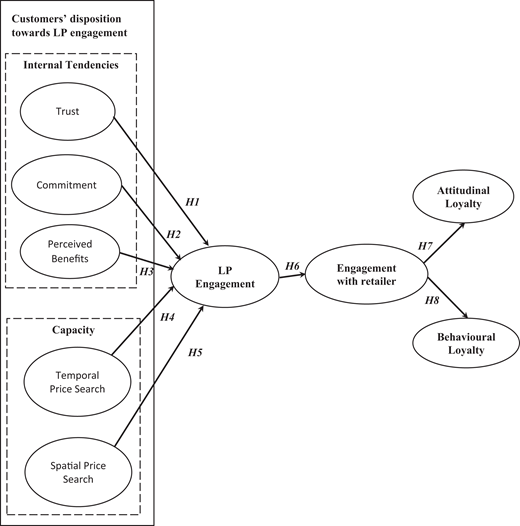
As noted earlier, customers’ disposition towards LP engagement comprises their internal tendencies and capacity to engage with an LP. In this research, internal tendencies include trust, commitment and perceived benefit, while capacity refers to temporal and spatial price search abilities. Figure 1 shows the proposed research model.
Customer disposition towards loyalty programme engagement: Internal tendencies
Trust.
Trust refers to the confidence of one party in the reliability and integrity of another party (Morgan and Hunt, 1994). Prior research suggests that building trust of customers is critical to ensure their engagement with and loyalty to a brand (Sun and Lin, 2010; Pansari and Kumar, 2017; Kosiba et al., 2020). Trust in LPs differs from trust in LP providers (i.e. retailers) (Uncles et al., 2003). We expect that trust in the LP provider will shape members’ engagement, as individuals typically become customers of the retailer before enrolling in the programme. Trust in the retailer represents a psychological state that predisposes customers to interact with the focal entity (Sim et al., 2022). Accordingly, we hypothesise (replication hypothesis):
Trust in a retailer will positively impact loyalty programme engagement.
Commitment.
Commitment is defined as an “enduring desire to maintain a valued relationship” (Moorman et al., 1992, p. 316). Customers with greater commitment will identify with and become emotionally attached to the focal object (Keiningham et al., 2015). Furthermore, commitment leads to a psychological dependence on the focal object (Jones and Taylor, 2007). Thus, we argue that when customers are committed to a retailer, they are more likely to engage with the retailer’s LP to continue the relationship.
Commitment has been conceptualised as both a unidimensional and a multidimensional construct (Morgan and Hunt, 1994). In this study, we adopt Keiningham et al.’s (2015) five-component model of consumer commitment, which consists of affective commitment (characterised by strong emotions), normative commitment (characterised by shared norms and values), economic commitment (based on cognitive appraisals of investments made in a retailer), forced commitment (based on the perceived lack of alternatives) and habitual commitment (based on consumption behaviours being enacted repetitively, automatically and with inertia). Fullerton (2003) conceptualises commitment in terms of an individual’s feelings about engaging with an object such as an LP. Thus, in this study we consider that commitment is a psychological state which represents an internal tendency of customer disposition towards LP engagement and subsequently, leads to LP engagement. Thus, we hypothesise (replication hypothesis):
Commitment to a retailer will positively impact loyalty programme engagement.
Perceived benefits.
Customers compare the costs of joining an LP (e.g. membership fees, switching costs, the risks of providing personal information) against the rewards offered by that LP (Meyer-Waarden, 2015). In addition, LP members consider the perceived utilitarian, hedonic and symbolic benefits of the LP. Utilitarian benefits include financial and non-financial benefits (e.g. avoiding complex and time-consuming evaluation of options). Hedonic benefits refer to gratifying non-instrumental and experiential benefits (Hirschman and Holbrook, 1982), including exploratory and entertainment components. The exploratory component is activated when LP members are exclusively invited to trial new or innovative products, while the entertainment component is activated when LP members obtain pleasure from collecting and redeeming loyalty points (Mimouni-Chaabane and Volle, 2010). Symbolic benefits relate to an individual’s social approval and self-esteem needs, and are met through recognition and social benefits (Mimouni-Chaabane and Volle, 2010). LP members may feel special or privileged when they receive customised offers (Gordon et al., 1998), perceive that they are higher in status than non-members (Csikszentmihalyi, 2000) or believe that they belong to an exclusive consumer group (Muniz and O’Guinn, 2001). This research conceptualises the perceived benefits of LPs as a second-order construct comprising utilitarian, hedonic and symbolic benefits.
Extant research report that the perceived benefits of LPs are essential antecedents that lead to LP engagement (Keh and Lee, 2006). In this research, we consider that perceived benefit reflects the internal tendencies related to customer disposition towards LP engagement. Individuals will only consider engaging (i.e. investing resources) with the focal object (i.e. LP) if the perceived benefits are positive. Accordingly, we hypothesise (replication hypothesis):
The perceived benefits of a loyalty programme will positively impact loyalty programme engagement.
Customer disposition towards loyalty programme engagement: Capacity
Temporal price search. Retailers use price promotions linked to LPs to entice customers to join and engage with these. Prior research considers temporal price search strategy as consumers’ capacity to wait for a preferred retailer to offer the best deal (Gauri et al., 2008; Sobel, 1984). Based on this, we define temporal price search as the capacity of consumers to intentionally time their shopping activities to obtain lower prices, that may involve monitoring price specials and spreading purchases across multiple trips to capitalise on price fluctuations. In other words, price-sensitive customers who are LP members are prepared to wait for promotions before making purchases. According to SET, customers deepen their engagement in a relational exchange when they anticipate that they can derive more value from the relationship (Cropanzano and Mitchell, 2005). Consistent with this premise, we argue that customers with temporal price search capacity develop a transferable ability that extends naturally into LPE. This implies that rather than restricting their timing strategy solely to finding low prices, customers apply the same temporal reasoning to LPE by spreading their shopping across different time periods.
This carryover behaviour of customer reflects that, temporal price search capacity is not limited to low price market search, rather it evolves as a mechanism for making their engagement with the LP more rewarding and logical. Based on the preceding discussion we advance the following hypothesis:
Temporal price search capacity will positively impact loyalty programme engagement.
Spatial price search. The capacity to engage in a spatial price search strategy refers to the ability to shop around for the best deals (Fox and Hoch, 2005; Gauri et al., 2008). In this research, spatial price search is defined as the capacity of consumers to compare prices across multiple supermarkets and select shopping locations based on advertised specials, promotional information and inter-store price differences, often involving visits to more than one retailer to secure the best available deals. According to SET, relational commitment between exchange parties is governed by an individual’s dependence on others for resources (Richard and Emerson, 1976). When the dependence is low because of availability of alternative sources, the relational commitment drops (Richard and Emerson, 1976).
Accordingly, we propose that spatial price search enables customers to compare prices across multiple retailers, exposing them to a broader set of alternatives. This pursuit of alternatives weakens consumers’ engagement with any single retailer’s LP. This is in contrary to the LPs’ function as commitment devices that reward concentrated patronage with a single retailer. This implies that comparing offers across different retailers makes the LP appear relatively less attractive, thereby diminishing customers’ motivation to stay engaged with a particular retailer’s LP.
The capacity to engage in spatial price search shifts the orientation of customers from relational to transactional, thereby making them spread their shopping to multiple retailers and weakening their retailer-specific patronage. Eventually, customers start to disengage with LP offered by a specific retailer because the spatial price search capability is incompatible with the reciprocal commitment that LPs demand. Thus, we propose that although LP members with strong spatial price search capacity possess characteristics typically associated with higher engagement, the same capacity ultimately reduces their engagement with retailer’s LP. Based on the preceding discussion, we propose the following hypothesis:
Spatial price search capacity will negatively impact loyalty programme engagement.
Loyalty programme engagement and retailer engagement. Prior studies have investigated LPE in terms of LP-related behaviours. However, Bruneau et al. (2018) argue that this fails to take into account the specific behaviours which reflects LPE. These authors further argue that LPE is a second-order hierarchical construct constituting several first-order behavioural constructs which are “proactively using a loyalty card”, “adapting purchase behaviours”, “redeeming points” and “searching for, sharing and being receptive to information”. We adopt this conceptualisation of LPE in our research.
Past studies note that customer engagement is a multi-dimensional construct consisting of cognitive, affective and behavioural dimensions (Hollebeek, 2011). Research indicates that attitudinal engagement is necessary for behavioural engagement (Barari et al., 2021). Similarly, Lim et al. (2022) contend that cognitive and affective engagements lead to behavioural engagement which subsequently lead to cognitive, affective and behavioural engagement with another entity. In addition, empirical evidence suggests that LPE positively influences engagement with the retailer (Bruneau et al., 2018). Thus, we infer that engagement with the LP will lead to engagement with the retailer. Consistent with the propositions of SET and preceding discussion, we expect that highly engaged LP members will be more engaged with the retailer because they expect something in return. Thus, we advance the following hypothesis:
Loyalty programme engagement will positively impact engagement with the retailer.
Engagement with retailer and customer loyalty. Customer loyalty is critical for retailers to boost their customer retention, competitiveness, profits and brand equity (Karunaratna and Kumara, 2018). Customer loyalty has been classified into attitudinal and behavioural loyalty (Kandampully et al., 2015; Zhang et al., 2020). Attitudinal loyalty refers to customers’ favourable attitudes towards retailers based on their positive experiences and satisfaction and contributes to enduring relationships (Oliver, 1996; Yuksel et al., 2010). However, attitudinal loyalty may not necessarily lead to future purchases (Dick and Basu, 1994). In contrast, behavioural loyalty is evidenced through actual purchases (Oliver, 1999).
Research shows that customer engagement is a key determinant of customer loyalty (Bowden, 2009; Zhang et al., 2020) and demonstrates customers’ interest in continuing their relationship with the retailers (Brodie et al., 2011). Highly engaged customers exhibit greater customer loyalty (Vivek et al., 2012). Thus, it is posited that LP members who show greater LPE will also be highly engaged with retailers, and display attitudinal and behavioural loyalty:
Engaging with a retailer will positively impact loyalty programme members’ attitudinal loyalty.
Engaging with a retailer will positively impact loyalty programme members’ behavioural loyalty.
Research context: Australian retail supermarkets
This research focuses on supermarkets in Australia. In 2023–2024, the nation’s four largest retailers: Woolworths, Coles, ALDI and Metcash accounted for over 80% of the industry revenue (GourmetPro, 2025). These retailers are classified as supermarkets and grocery stores (Martin, 2025). Woolworths and Coles are increasingly relying on LPs (Kahla, 2024). However, Australian supermarket customers are failing to adequately engage with them (Statista, 2024). Therefore, Australian supermarkets offer an appropriate research context in which to test our hypotheses. The following sections outline the two studies.
Study 1: structure of loyalty programme engagement
Rationale
Schultz et al. (2022) lamented that scholarly rigour is lost because of lack of replication studies in marketing and consumer behaviour. Uncles and Kwok (2013) contend that findings that are not replicated may not hold empirical generalisations and therefore, can lack practical importance. Evanschitzky et al. (2007) went as far as to suggest that practitioners should be cautious of the results published in marketing journals because the results are not replicated. LPE is a relatively new concept that needed to be replicated in the Australian supermarket context before proceeding with Study 2 which examined customers’ disposition towards LP engagement. Accordingly, the objective of Study 1 was to empirically validate the components of LPE developed by Bruneau et al. (2018) in the Australian supermarket context. By conducting this study, we adopted an inter-study replication approach, as recommended by Kwon et al. (2017), that seeks to reproduce the results of a previous study through an independent investigation by different researchers in a separate setting (Park et al., 2015; Phua et al., 2023).
Measures and data collection
An online questionnaire was distributed Australia-wide via Pureprofile, an Australian survey panel provider that was selected for its national reach, ensuring that data were collected from supermarket customers across the country. Our target population was supermarket LP cardholders aged 21–80 years. We used a quota sampling technique, where the sample was matched to the Australian population (according to the most recent Australian census) in terms of age, gender and location. All questionnaire items (see Appendix 1) were measured using a seven-point Likert-type scale. To avoid biased responses, the items were randomly distributed within the questionnaire.
Data were collected over a 30-day period. Any questionnaire completed in less than 10 min was not considered during the data analysis stage. Prior studies contend that longer surveys can suffer from several drawbacks. For example, longer surveys can lead to lower response rates, greater chances of choosing “don’t know” answers, higher dropout rates during the survey completion and higher non-responses to the end of the survey questions (Revilla and Höhne, 2020). In a series of studies conducted by Revilla and Ochoa (2017) and Revilla and Höhne (2020) across two countries (Mexico and Germany), using both probabilistic and non-probabilistic panel respondents, the authors conclude that the ideal survey duration is between 10 and 15 min. In addition, Revilla and Höhne (2020) reported that perceived survey ease is associated with shorter ideal completion times, suggesting that lower cognitive effort facilitate more efficient responding. In a similar vein, Kato and Miura (2021) demonstrate that respondents who completed online surveys in less than 10 s per question had significantly lower accuracy rate. Accordingly, surveys completed in less than 10 min were considered inappropriate for the current research. In total, 250 completed questionnaires were returned (86% response rate), which is more than the minimum of 45 required for models with a maximum of five arrows pointing at a construct, with a significance level of 5%, statistical power of 80% and a minimum R2 of 50% (Cohen, 1992; Hair et al., 2017).
Data analysis
We initially used exploratory factor analysis to examine the correlations between dimensions. As suggested by Hair et al. (2019a), we followed an iterative process to eliminate items with communalities < 0.5, factor loadings < 0.5 or cross-factor loadings > 0.3. We also examined construct reliability and validity.
Results
Table 2 shows that the factor loadings were higher than the cut-off value of 0.70. The measurement item PRO1 had a loading of 0.472 and was removed from the subsequent analysis. While the loading of PRO3 (0.696) was slightly lower than the cut-off of 0.70, given the reliability indicators, we decided to retain it for subsequent analysis. The results also show that Cronbach’s alpha, composite reliability and rho_A (Dijkstra–Henseler’s composite reliability) values for all constructs were greater than 0.70. The average variance extracted (AVE) of all constructs was greater than 0.50, indicating convergent validity (see Table 2). We assessed discriminant validity using both the Fornell–Larcker criterion and the heterotrait–monotrait (HTMT) ratio (Hair et al., 2019b). The square root values of AVEs were greater than the bivariate correlations between each variable, supporting discriminant validity. In addition, the HTMT values were below 0.85.
Discussion
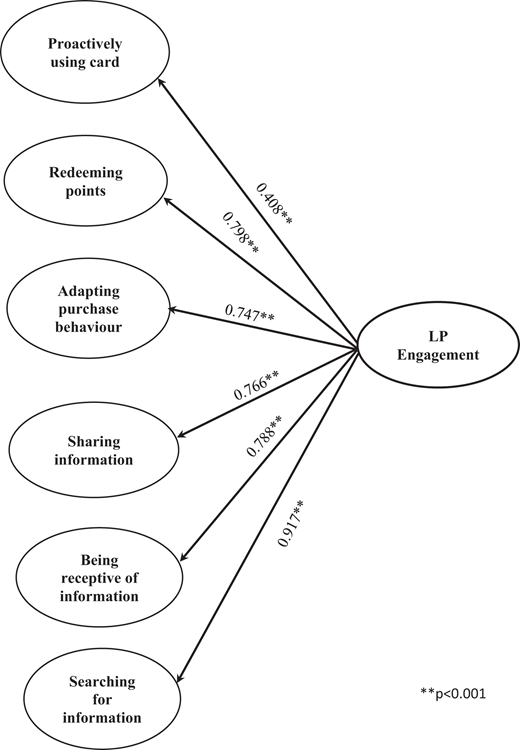
Answering the calls for replication studies in different contexts to generalise the findings of the marketing literature (Easley et al., 2000), we retested the LPE scale established by Bruneau et al. (2018) in the context of Australian supermarkets. Like the results obtained by Bruneau et al. (2018), we found that the coefficients of the paths from the second-order constructs to the first-order constructs for LP engagement were all greater than 0.70 except for proactive use of the loyalty card (see Figure 2). The highest coefficient was for information searching (0.917) and the lowest coefficient was for proactive use of the loyalty card (0.408). Bruneau et al. (2018) also reported the highest coefficient for searching for information (0.944) and the lowest coefficient for proactively using card (0.390). These contrast with the findings of Meyer-Waarden et al. (2023), who report a high correlation for the proactive use of the loyalty card (0.753). Overall, the results from Study 1 validate the findings of Bruneau et al. (2018) on LPE.
Study 2: outcomes of customer disposition towards loyalty programme engagement
In line with our second and third research objectives, Study 2 empirically tested the influence of customer LPE disposition on LPE based on SET (Blau, 1964). According to SET, customers will engage with retailers if the perceived benefits exceed the perceived costs (Yan et al., 2016), meaning that they will proactively contribute to their relationship with retailers by investing their personal resources (Higgins and Scholer, 2009). The cost–benefit perspective inherent in SET accounts for the interactional feature of LPE (Hollebeek, 2011). Figure 1 presents the research model.
Measures and data collection
We adapted the measurement items for all constructs from the existing literature (see Appendix 2). The items corresponding to LPE (see Appendix 1) validated in Study 1 were used in Study 2.
The minimum sample size required was computed using G*Power software. Based on a medium effect size of 0.15, an error probability of 0.05 and a power of 0.80, the minimum sample size was 92. Pureprofile was again used in Study 2 to obtain the required sample. The data for Study 2 were collected using the same procedure as in Study 1. The final sample size obtained by Pureprofile was 820 (response rate of 84%).
Data analysis
PLS-SEM was used to analyse the relationships between the multiple variables in the proposed model for Study 2 (Hair et al., 2019b). The analysis was conducted using SmartPLS 4.0 (Ringle et al., 2024). PLS-SEM was ideal for data analysis because it can predict models using small sample sizes (Sarstedt et al., 2022). In addition, PLS-SEM requires fewer distributional assumptions and is robust to non-normal data, which are common in behavioural and consumer research contexts. In addition, PLS-SEM focuses on maximising the explained variance (R2) of endogenous constructs, making it an ideal method for exploratory studies and emerging research areas where theoretical foundations are continuing to develop (Hair et al., 2021).
Results
Common method bias.
To assess for common method bias, we applied the procedural and statistical approaches suggested by Podsakoff et al. (2024). To ensure participant anonymity, the questionnaire was designed to minimise evidence of causal relationships between the dependent and independent constructs (MacKenzie and Podsakoff, 2012). To assess for common method bias, we used both Harman’s single-factor test and the marker variable approach. In Harman’s single-factor test, the percentage of variance was 31.807% (less than the cut-off value of 50%), indicating that common method bias was not an issue. Given the criticisms of Harman’s single-factor test (Baumgartner and Weijters, 2021), we also used a three-item marker variable technique, where we surveyed respondents’ mobile phone usage intensity (Valenzuela et al., 2009). The analysis showed that this marker variable did not significantly increase the variance of the dependent variable, with the average correlation between this and the marker variable being 0.026 (p > 0.05). Thus, we concluded that common method bias was not a critical issue in this study.
Partial least squares structural equation modelling with higher-order constructs
Higher-order constructs represent the multi-dimensional and abstract nature of a concept which are based on the first-order factors (Crocetta et al., 2021). The higher-order construct effectively represents the core of a given concept, as the residual variance left unexplained in each first-order construct is minimal (Hagger and Chatzisarantis, 2005). In PLS-SEM, the specification of a higher-order factor is justified when first-order factors are empirically distinct but demonstrate significant covariance, indicating a common underlying source (Hair et al., 2012). Sarstedt et al. (2019) noted the advantages of using higher-order constructs which include achieving parsimony (by reducing the number of individual path model relationships) and overcoming bandwidth-fidelity dilemma.
The research model proposed in this study consists of four higher-order constructs: commitment, perceived benefits, LPE and retailer engagement. We used the disjoint two-stage approach to estimate the structural model comprising the higher-order constructs (Sarstedt et al., 2019). In the first stage, the lower-order constructs were directly linked to each other without creating the higher-order constructs. The latent scores from the first stage were then used in the second stage to form the higher-order constructs, and the structural model was assessed based on the outputs from the second stage.
Stage 1 results: Based on the results of Stage 1, one item each was removed from proactively using card (PRO3), sharing information (SHA1) and temporal price search (TPS5) and two items were removed from economic commitment (EC3 and EC4) because of their low factor loadings (<0.70). In addition, forced commitment and habitual commitment were removed from the higher-order construct of commitment because of their low loading values. The low factor loadings for these constructs imply that customers do not feel compelled to choose a particular retailer or repeatedly purchase from a specific retailer. This suggests that a split loyalty pattern may exist among Australian consumers (Ehrenberg et al., 2004). Table 3 presents the Stage 1 results.
The Stage 1 results show that the factor loadings of all constructs were equal to or greater than 0.70. Cronbach’s alpha and rho_A (Dijkstra–Henseler’s composite reliability) values of all constructs (apart from redeeming points) were greater than 0.70. However, we decided to retain the redeeming points construct because its composite reliability was greater than the cut-off of 0.70 and it is theoretically supported by prior research (Bruneau et al., 2018). The AVE for all constructs was greater than the threshold value of 0.50, implying convergent validity. Discriminant validity was met based on the Fornell–Larcker criterion (i.e. the square root of AVE was greater than the bivariate correlations between each of the variables) and the HTMT ratio, the values of which were less than 0.85.
Stage 2 results: In Stage 2, the higher-order constructs were created based on the latent scores of the associated lower-order constructs in Stage 1. Stage 2 began by assessing the measurement properties of the higher-order constructs and the structural model (Sarstedt et al., 2019). Table 4 shows the factor loadings of the four higher-order constructs. All the lower-order constructs had factor loadings of greater than 0.70. The AVE for all constructs was greater than 0.50, demonstrating convergent validity. Discriminant validity was met according to the Fornell–Larcker criterion (i.e. the square root of AVEs were greater than the bivariate correlations between each of the variables) and the HTMT ratio, the values of which were less than 0.85.
Next, we examined the structural model using bootstrapping, where 5,000 resamples were analysed based on 820 cases. The R2 values were 0.72 for LPE, 0.58 for retailer engagement, 0.34 for attitudinal loyalty and 0.11 for behavioural loyalty. Table 5 shows the results of the path analysis. Both perceived benefit (β = 0.68, p < 0.01) and temporal price search (β = 0.23, p < 0.01) had a positive and significant effect on LPE, supporting H3 and H4. However, trust (β = 0.00, p > 0.01), commitment (β = 0.01, p > 0.01) and spatial price search (β = 0.023, p > 0.01) had no significant effect on LPE, rejecting H1, H2 and H5. LPE positively and significantly affected retailer engagement (β = 0.76, p < 0.01), supporting H6. Finally, retailer engagement had a positive and significant effect on both attitudinal loyalty (β = 0.58, p < 0.01) and behavioural loyalty (β = 0.34, p < 0.01), supporting H7 and H8.
Data analysis using fuzzy-set qualitative comparative analysis
Symmetric and mean-centred approaches to examining the effect of independent variables on the dependent variable fail to provide a complete picture (Rasoolimanesh et al., 2021). In contrast, investigating configurations of independent variables can provide a more holistic exploration of the dependent variable (Misangyi et al., 2017; Singh et al., 2025). Therefore, in line with the last research objective, we used fsQCA to further investigate the effects of the independent variables.
fsQCA is one of the most effective methodological procedures to investigate different combinations of independent variables to effectively explain the absence or presence of an outcome (Kumar et al., 2022). fsQCA has steadily gained popularity in strategic management because it is designed to analyse causal complexity, equifinality (multiple routes to the same outcome) and asymmetry (Greckhamer et al., 2008, 2018; Kumar et al., 2022; Ruiz et al., 2023). In marketing research, scholars have used fsQCA to expose multiple configurations of customer and firm side conditions that produce desirable outcomes (for example, brand loyalty, purchase intention and e-loyalty among others) (Zhang and Huang, 2024; Elshaer et al., 2024). Several empirical papers show that fsQCA often uncovers two or more “recipes” for loyalty that PLS-SEM does not reveal. The configurational view by fsQCA, therefore, complements the variable-centric estimates common in marketing (Pekovic and Rolland, 2020; Latif and Bashir, 2024; Arias-Oliva et al., 2024).
Based on extant literature we argue that fsQCA is a perfect analytical tool for LP problems for the following reasons:
Loyalty is configurational: loyalty outcomes often arise from combinations of programme attributes (rewards structure and personalisation), relational factors (trust and commitment) and customer traits (involvement and tenure). fsQCA explicitly models such combinations (recipes), rather than assuming linear additivity (Pekovic and Rolland, 2020).
Loyalty exhibits equifinality: fsQCA identifies multiple distinct strategies that can achieve the same loyalty outcomes, which gives managers concrete, actionable ‘paths’ to follow. This is repeatedly shown in marketing studies using fsQCA (Zhang and Huang, 2024; Elshaer et al., 2024; Pekovic and Rolland, 2020).
Loyalty is heterogeneous: LPs operate in diverse customer segments. fsQCA can reveal why some antecedents of loyalty outcome matters in some cases but not in others.
We used fsQCA (Ragin, 2009; Pappas and Woodside, 2021) to analyse the data from Study 2 to gain additional insights into the effect of customers’ disposition towards LP engagement on LPE and the consequential effects of LPE on customer engagement with and loyalty to retailers. We executed two fsQCA models as follows:
Table 6 provides a full description of the variables. We also explored how the lack of antecedent combinations might negate (impede) LPE and retailer engagement.
Following the extant literature (Greckhamer et al., 2018; Lewellyn and Muller-Kahle, 2021; Pappas and Woodside, 2021), we used the following steps to perform fsQCA:
transform data into fuzzy variables (full fuzzy membership, full fuzzy non-membership and crossover point);
perform the necessary analysis;
develop a truth table; and
conduct a sufficiency analysis based on the truth table solutions (configurations).
Decisions regarding necessary and sufficient conditions are based on two important fsQCA concepts: consistency and coverage. Consistency (0–1) refers to the degree to which a condition (or configuration) leads to the outcome (Lewellyn and Muller-Kahle, 2021; Ragin, 2009). This is equivalent to statistical significance. Coverage (0–1) assesses the degree to which a condition (or configuration) accounts for instances of an outcome (Ragin, 2009), thus gauges the empirical relevance or importance of a condition (or configuration).
Data transformation: In the first step of fsQCA, data are transformed into fuzzy variables. In this study, we collected data using a seven-point Likert scale. While the literature suggests how to transform Likert-scale data into fuzzy variables (Ordanini et al., 2014; Pappas and Woodside, 2021), we followed Rasoolimanesh et al. (2021) and transformed the standardised latent variable scores from PLS-SEM into fuzzy variables. This is superior to the former technique, which “ignores the effect of measurement error inherent in the indicators” (Rasoolimanesh et al., 2021, p. 1572). The latent variable scores procedure has also been used in other recent studies (Wang et al., 2024; Chanda et al., 2025). Standardised latent variable scores have a mean of zero and a standard deviation of one. As per Rasoolimanesh et al. (2021), we used a latent variable score of −3 for no set membership (i.e. 0), + 3 for full set membership (i.e. 1) and 0 as the crossover point (i.e. 0.5). These produced fuzzy values between 0 and 1.
Necessary analysis: We used fsQCA 4.1 [1] to conduct the necessary analysis to explore the conditions necessary to enhance or hinder LP engagement as per equation (1). Table 6 shows the results.
A condition is necessary if it is always present whenever the outcome occurs (LPE in this case) (Lewellyn and Muller-Kahle, 2021). In fsQCA, a condition is necessary when its consistency value is greater than 0.9 (Pappas and Woodside, 2021; Ragin, 2009). Table 6 (left hand side) reveals that PBenefit (Perceived Benefit) has a consistency of 0.90 and a coverage of 0.90. Hence, perceived benefit is the only necessary condition to enhance LPE. The right-hand side of Table 6 shows that ∼PBenefit (i.e. negation or lack of perceived benefit) is also the only necessary condition to hinder LPE. Thus, perceived benefit was identified as pivotal in explaining the enhancement or impediment of LPE.
Table 7 shows the results of necessary analysis to explore the conditions necessary to enhance or hinder engagement with retailer, as per equation (2). The left-hand side of Table 7 reveals that commitment, perceived benefit and LPE are necessary for engagement with the retailer (with consistency > 0.90 and coverage > 0.80). The right-hand side of Table 7 shows that negation (or lack of) commitment, perceived benefit and LPE are also the necessary conditions to hinder engagement with retailer (all consistency values > 0.90). Thus, commitment, perceived benefit and LP engagement are identified as pivotal conditions in explaining customer engagement with the retailer.
Sufficiency analysis: A condition or a combination of conditions (i.e. configurations) is considered sufficient when its presence consistently results in the occurrence of the outcome (Ragin, 2009; Lewellyn and Muller-Kahle, 2021). Accordingly, the analysis of sufficient conditions reveals multiple configurations that can produce the desired outcome.
Following the guidelines of Pappas and Woodside (2021), the sufficiency analysis used threshold values of 0.8 for solution consistency and 0.5 for coverage. The analysis, based on equations (1) and (2), began with the construction of a truth table informed by prior literature (Ragin, 2009; Pappas and Woodside, 2021). A frequency threshold of 3 was set to capture at least 80% of cases, and a consistency threshold of 0.75 was applied to exclude low-consistency solutions. The minimum proportional reduction in inconsistency measure was set at 0.5 to eliminate significant inconsistency in the solution (Pappas and Woodside, 2021). These thresholds yielded multiple configurations through the truth table algorithm in the fsQCA software.
Sufficient configurations that enhance or impede LP engagement:Table 8 presents various configurations obtained from the truth table analysis as per Model 1 (i.e. prediction of high and low scores of LPE). As per extant literature, a consistency and coverage thresholds of 0.80 and 0.75 respectively have been used to select the best configurations. Overall solution consistency and coverage exceeded the thresholds for both the solutions. From the left-hand side of Table 8, we observe that configuration (ii) (CTrust*CCommit*CPBnefit) has a consistency and coverage measures of 0.94 and 0.78 respectively, which exceeds the threshold values. Thus, this is the best configuration contributing to the enhancement of LPE. It is noted that this configuration contains the necessary condition “perceived benefit” to enhance LPE (see Table 6). It is interesting to note that as per PLS-SEM analysis, trust and commitment do not have any significant impact on the advancement of LPE. However, the fsQCA results indicate that the combined presence of trust, commitment and perceived benefit significantly enhances LPE.
The right-hand side of Table 8 presents the configurations to impede LPE. It is observed that configurations (i) (∼CPBnefit*∼CTemporalPS) and (v) (∼CTrust*∼CCommit*∼ CPBnefit) exceed the threshold values and thus they are the most effective configurations to impede LPE. The configuration ∼CTrust*∼CCommit*∼CPBnefit indicates that lack of trust, commitment and perceived benefit would decrease LPE. This configuration is just the inverse of the configuration CTrust*CCommit*CPBnefit which enhances LPE. Thus, fsQCA results identify trust, commitment and perceived benefit as the key conditions whose combined presence or absence determines the enhancement or impediment of LPE.
Sufficient configurations that enhance or impede engagement with retailer:Table 9 presents various configurations obtained from the truth table analysis as per Model 2 (i.e. prediction of high and low scores of engagements with retailer). From the left-hand side of Table 9, we observe that the overall solution consistency and coverage to enhance engagement with retailer are 0.938 and 0.889 respectively, which exceed the threshold values. Seven configurations are found. Among them the configuration (iv) (CLPEngage*CTrust*CCommit*CPBnefit) satisfies the minimum threshold values of consistency and coverage. Thus, a combination of LPE along with trust, commitment and perceived benefit helps to increase the engagement with retailer. As shown in Table 9 (left-hand side), LPE appears in four of the seven configurations and is also identified as a necessary condition for enhancing engagement with retailer (Table 7), underscoring its critical role in driving such engagement.
The right-hand side of Table 9 presents the configurations to impede engagement with retailer. Six configurations have been found. Among them configurations (i) (∼CTrust*∼CCommit*∼CPBnefit) and (iii) (∼CLPEngage*∼CPBnefit*∼CTemporalPS*∼ CSpatialPS) exceed the threshold values and thus they are the most effective configurations to impede engagement with retailer. It is thus observed that impediment of engagement with retailer is associated with two negated configurations. However, ∼LP engagement (i.e. lack of LPE), emerges as a key condition as it appears in four of the six configurations (right hand side of Table 9), highlighting its central role in diminishing engagement with retailer.
Discussion
Study 2 was conducted using a combination of PLS-SEM and fsQCA. This study yielded important findings regarding customers’ disposition towards LPE. First, the PLS-SEM results show that of the three internal tendencies investigated in this study (trust, commitment and perceived benefit), only perceived benefit influences LPE, suggesting that monetary and non-monetary benefits influence LPE. However, the fsQCA results show that a combination of trust, commitment and perceived benefit is necessary to enhance LPE. Second, of the two capacities examined in this study, PLS-SEM analysis found that only temporal price search (not spatial price search) influenced LPE. Third, the PLS-SEM findings show that LPE is a significant antecedent of retailer engagement, and ultimately engenders attitudinal and behavioural loyalty, suggesting the importance of LPs in building customer loyalty to retailers. Further analysis using fsQCA revealed that a combination of trust, commitment, perceived benefit and LPE is needed to enhance retailer engagement.
Conclusion and implications
Despite the proliferation of retailer LPs, customers often do not engage with these (Statista, 2024). There is also a need for a deeper understanding of the antecedents of LPE, with only one study to date investigating the effect of the perceived value of LPs on LPE (Meyer-Waarden et al., 2023). The present research contributes to the literature by examining the role of customer disposition towards LPE as an important antecedent of LPE. Specifically, we investigated the role of two customer engagement disposition dimensions, internal tendencies and capacity, on LPE. Furthermore, the findings show that LPE can contribute to both attitudinal and behavioural loyalty towards retailers.
Theoretical implications
Given that LPE is a relatively new concept (Meyer-Waarden et al., 2023), Study 1 validated Bruneau et al.’s (2018) conceptualisation of LPE in the Australian retail context. Results confirm the existence of Bruneau et al.’s (2018) six first-order behavioural constructs. Moreover, like Bruneau et al. (2018), this research found that the proactive use of a loyalty card has the lowest correlation and searching for information has the highest correlation with LPE.
Study 2 investigated how customers’ disposition towards LPE engender LPE and retailer engagement, and subsequently, leads to attitudinal and behavioural loyalty towards the retailers, making several contributions to the literature. First, this study is the first to investigate the role of customer dispositions towards LPE as an antecedent of LPE. The concept of customer engagement disposition is based on the notion that a customer’s incentive to engage with a focal object depends on their capacity and internal tendencies to invest resources into interacting with that focal object (Sim et al., 2022). In this research, the focal object was the LPs offered by the retailers. Results show that the capacity to engage in a temporal price search (i.e. to wait until there is an LP promotion) influences LPE. In other words, these customers are willing to wait for price discounts linked to the LP, leading them to engage with the LP.
Consistent with Meyer-Waarden et al. (2023), Study 2 also demonstrated that the perceived benefits of LPs had the greatest influence on LPE, followed by temporal price search. Spatial price search was not an essential antecedent of LPE, implying that customers’ capacity to shop around for the best deals does not influence their engagement with a specific LP.
Second, the PLS-SEM analysis in Study 2 showed that neither trust in nor commitment to a retailer influences LPE, suggesting that customers differentiate between the retailer and the LP. In other words, simply because customer exhibits trust in and commitment to a retailer, this does not mean that they will be willing to engage with that retailer’s LP. This supports an earlier study indicating that a customer’s engagement with an LP may differ from their interaction with the LP’s provider (i.e. the retailer) (Uncles et al., 2003).
PLS-SEM analysis was complemented using fsQCA to reinforce and refine the results. Contrary to the PLS-SEM finding that only perceived benefit impacted LPE, the fsQCA results show that a combination of trust, commitment and perceived benefits (rather than these constructs individually) contribute to LPE. This finding demonstrates the importance of causal combinations and highlights the nonlinear, asymmetric nature of LPE mechanisms.
Third, this research contributes to the customer engagement literature by demonstrating that LPE enhances engagement with retailer, ultimately building attitudinal and behavioural loyalty to the retailer. Importantly, the fsQCA results show that LPE is a necessary condition for retailer engagement, positioning it as a key antecedent in the customer engagement framework. Furthermore, a lack of trust, commitment, perceived benefits and LPE consistently impedes retailer engagement. By identifying multiple equifinal paths to customer outcomes, the study contributes theoretically by shifting the focus from variable-centric to configuration-centric explanations, offering a more nuanced understanding of how customers’ dispositions towards LPE interact to shape customer loyalty and engagement behaviours.
In summary, this research is related to the fifth research theme as outlined in Table 1 which considered the antecedents of LPE. Specifically, this research contributes to this fifth theme by examining customers’ disposition towards LP engagement as an antecedent for LPE in the form of internal tendencies and capacity. A critical finding of this research is that customers must be disposed towards LPE for LPE to occur (in other words, for LPs to be an effective tool for retailers). Specifically, LPE is likely to be enhanced when a combination of trust, commitment and perceived benefits is present and when customers are willing to wait for various incentives linked to the LP. This research also suggests that engagement with LPs can enhance customer engagement with and loyalty towards the retailer (Hollebeek et al., 2014). Methodologically, the use of both PLS-SEM and fsQCA advances the understanding of relationship marketing and customer engagement by uncovering configurational pathways that lead to both the enhancement and impediment of loyalty behaviours.
Managerial implications
Bombaij and Dekimpe (2020) argue that companies are reluctant to introduce LPs because of their associated costs and complexities. A recent report found that 50% of customers would switch retailers if they were offered better rewards (Theocharous, 2024). Therefore, it is vital that customers find LPs appealing and engage with them. The results of this research provide managers with a clear understanding of the areas on which to focus to successfully implement an LP.
Monetary incentives are an obvious strategy for enhancing LPE. This is supported by the finding that a temporal price search capacity influences LPE. However, if all retailers were to offer monetary incentives, this could lead to a price war, ultimately undermining profits and making LPs unattractive to retailers. Our research findings show that a combination of trust, commitment and perceived benefits also play a significant role in enhancing both LP and retailer engagement, and engendering customer loyalty. To avoid a potential LP-related price war, retailers should focus on the internal tendency dimensions of customers’ disposition towards LP engagement.
To engender customer trust, retailers should strive to be transparent about their prices and business practices, provide exceptional customer service and send out consistent brand image messages. Transparency is an important issue for retail customers. For example, in a recent report, the Australian Competition and Consumer Commission advised Australian supermarkets to be more transparent about their pricing, promotions and LPs (Fogden, 2025). Retailers can enhance customer commitment by conducting market research to ensure that their values are aligned with those of their customers. In addition, retailers may cultivate customer commitment by creating personalised offerings, increasing the likelihood of customer engagement with LPs.
Retailers should design LPs in such a way that it improves their perceived benefits. For example, retailers can highlight how the LPs have resulted in lower spending as recommended by ACC (Fogden, 2025). Furthermore, they could offer new products exclusively to LP members, creating a sense of privilege and prestige; design gamified LPs to promote the entertainment aspect of perceived benefits (Hwang and Choi, 2020); and use proximity marketing or digital push notifications to encourage the exploration of new products. These actions are likely to increase the perceived benefits of the LP, enhancing LPE and engagement with the retailer and engendering customer loyalty.
The finding that customers are willing to wait to take advantage of LP benefits (i.e. temporal price search) implies that retailers should carefully consider the timing of LP benefits. Given that retailers now have access to customers’ buying behaviours, it is possible to identify which customers and products are associated with a temporal price search strategy. Retailers can personalise product offering timings to each customer and link them to the LP to boost LPE. As our study shows, this will result in greater attitudinal and behavioural loyalty.
Given that LPE is crucial for fostering deeper customer engagement, retailers should design LPs that deliver clear, consistent value and build an emotional connection by focusing on a combination of trust, commitment and perceived benefits. It is important to note that the absence of these conditions significantly hinders engagement with LPs and retailers, highlighting the risks of poorly designed LPs. A tailored, integrated strategy that aligns a LP’s value with trust and relationship building is essential for sustaining customer loyalty and long-term retailer relationships.
Limitations and future research directions
This study is not without limitations, which provide several avenues for future research. First, the sample comprised only Australian residents aged 21–80 who were members of Australian retailer LPs. Given that LP outcomes are often context specific, the findings may not readily generalise to other countries or industries (Beck et al., 2015). Future studies can test the research model across different national, cultural and industry contexts to assess its broader applicability. Second, the study focused on two categories of customers’ engagement disposition, namely, internal tendencies (trust, commitment and perceived benefits) and capacities (temporal and spatial price search). While these constructs are important, other psychological and personality-based factors known to influence engagement were not examined (Sim et al., 2022). Incorporating such factors in future research could further enhance our understanding of how customers’ disposition towards LPs influence engagement. Third, the study relied exclusively on survey data, which limits the ability to capture actual behavioural patterns. Future research can combine survey measures, that capture unobserved psychological constructs, with transaction-level loyalty data (Hair and Sarstedt, 2021) and adopt longitudinal or panel designs to examine how customers’ disposition towards LPE and LP engagement evolve across different stages of the customer–retailer relationship (i.e. acquisition, expansion or retention) (Kim et al., 2021). Fourth, several contextual and competitive factors were beyond the scope of this research. These include customer engagement dispositions within coalition or multi-vendor LPs (Dorotic et al., 2011; Dorotic et al., 2021; Li et al., 2025; Shirai, 2023), the influence of competing LPs (Khodakarami et al., 2024), variations in incentive structures (Haverila et al., 2022) and the possibility that LP participation reduces customers’ price sensitivity (Sayman and Hoch, 2014). Exploring these aspects could enhance understanding of how broader market and structural conditions shape customers’ disposition towards LP engagement. Finally, the study did not investigate potential reverse causality (i.e. whether LP engagement itself strengthens trust and commitment) nor did it account for cross-channel variation in customers’ disposition towards LP engagement. Future research can investigate these alternative causal pathways and explore whether disposition differs across online and offline contexts (Hwang et al., 2016).