The purpose of this paper is to explore the key drivers influencing B2B buyers’ adoption of remanufactured products (REMAN). Using the theory of reasoned action, it examines psychological, economic, environmental and social factors shaping attitudes towards REMAN, and trigger purchasing behaviour towards this product class.
To collect the data, a survey was constructed. The survey was distributed to farmers/owners of agricultural machinery through collaboration with a leading brand in the agricultural equipment industry, i.e. New Holland during the 2022 EIMA exhibition. Data from 234 surveys were analysed using PLS-SEM.
Perceived quality, warranties and awareness of green production processes drive positive attitudes towards REMAN. Attitude and subjective norms significantly influence purchase intentions. Brand loyalty and green brand equity play a moderating role. Purchase intention positively influences switching intention and willingness to pay for REMAN.
The findings suggest targeted communication emphasizing product quality, warranties and sustainability benefits, alongside fostering strong supplier–buyer relationships to build trust and long-term engagement. These strategies can help businesses address buyer concerns effectively and promote REMAN adoption.
This research fills a gap in B2B marketing literature on REMAN. It offers actionable insights for promoting REMAN adoption, emphasizing the role of sustainability, quality and trust in driving purchase decisions.
1. Introduction
Even in the traditionally less environmentally sensitive B2B environment, sustainability has become an essential strategic cornerstone (Dominidiato et al., 2023). Companies increasingly recognize that the long-term success of their business depends not only on economic performance but also on the ability to minimize environmental impact (Blenkhorn and MacKenzie, 2017). Sustainability has transformed from mere compliance to a competitive opportunity. It fosters innovation (Esty and Winston, 2009), reduces operating costs (Esty and Winston, 2009) and enhances brand image (Casidy and Lie, 2023). This shift is especially pronounced in sectors where the environmental impact of production processes is significant (Fraj et al., 2013).
Remanufactured products (henceforth REMAN) have emerged as a particularly promising option (Nikseresht et al., 2024). REMAN are end-of-life (EOL) or end-of-use (EOU) products restored to like-new condition through remanufacturing processes (Guide and Van Wassenhove, 2009). These products offer the same quality as new alternatives, come with extended warranties and cost less to produce than new products (Abbey et al., 2015). The economic benefits are manifold: REMAN have a lower purchase price than the new alternative, reduce waste and resource use (Wang and Wang, 2016). In addition, the adoption of REMAN can improve a company’s reputation by aligning with increasing social and regulatory expectations (Wang and Wang, 2016).
REMAN differ substantially from refurbished, repaired or recycled products (King et al., 2006). A refurbished product undergoes a complete overhaul which may include the replacement of several components, both for functional and aesthetic reasons (King et al., 2006), but not necessarily according to strict specifications. Repair refers to a corrective action limited to replacing or fixing defective components, without a complete renewal of the product (King et al., 2006). Recycling refers to the transformation of waste materials into new raw materials, without maintaining the original function of the product (Ijomah et al., 1999). Instead, REMAN, through a structured process of disassembly, restoration and reassembly, match the quality and reliability of their new counterparts.
The combination of economic, environmental and reputational benefits makes REMAN a strategic option in B2B, as purchasing decisions are shaped by a delicate balance between sustainability considerations and economic value (Kapitan et al., 2019). However, despite the operational relevance of REMAN in business practices, there is a gap in the literature regarding the understanding of how B2B buyers perceive, and purchase REMAN. Although significant research has been conducted in B2C, research on REMAN is underdeveloped in B2B. This gap is crucial in the industrial marketing literature as B2B purchasing decisions differ from B2C markets due to their complexity, multiple stakeholders and longer purchasing cycles (Casidy and Yan, 2022).
This study aims to fill this gap and provides an answer to the following research questions:
What drives B2B buyers to adopt REMAN? What will drive B2B buyers to switch from buying new products to buying REMAN? Will B2B buyers pay a premium price for REMAN?
Based on the theory of reasoned action (TRA) (Ajzen and Fishbein, 1973), the study explores how factors such as brand perception, general perception of REMAN and social expectations influence purchasing decisions of REMAN. TRA is a psychological model developed to predict individual behaviour based on behavioural intention, influenced by attitude and subjective norms. Applied to the B2B context, this theory allows for the analysis of how individual beliefs and contextual influences contribute to the formation of purchase intentions and to corporate decision-making behaviour.
The agricultural machinery spare parts sector was used as an empirical context. In collaboration with New Holland, a market leader in both new and REMAN, the study collected a total of 346 questionnaires, of which 234 usable responses were retained from business owners in the agricultural sector. The brand was used as a stimulus to analyse its moderating effect in the relationships examined. The results provide valuable insights. From a theoretical perspective, the study identifies the key factors that shape attitudes and purchase intentions towards REMAN in B2B. It demonstrates which factors encourage REMAN purchase and B2B buyers’ intention to switch from new products to REMAN and pay a price premium. From a practical perspective, the results offer strategic guidance. They help identify the critical factors that influence buying behaviour. This information is particularly relevant for companies seeking to incorporate sustainability into their supply chains and product offerings, without sacrificing competitive advantage. Although the findings are drawn with specific reference to the spare parts market for the agricultural sector, they can be generalized to other sectors where operational efficiency, speed of production restoration and attention to sustainability are crucial determinants of spare parts purchasing.
The article is structured as follows: literature review, development of the theoretical model, methodology, results, discussion, managerial implications, conclusions and limitations.
2. Sustainable procurement in B2B: a review of the literature
The adoption of sustainable purchasing practices in B2B in recent years has attracted increasing attention (Kerin and Pham, 2020; Zocco et al., 2025). Companies are increasingly recognizing sustainability as a crucial element for maintaining long-term competitiveness (Hostetter and Winkler, 2022; Quintana-García et al., 2021; Vesal et al., 2021). A key factor in this acceleration is environmental regulations pushing companies towards more sustainable behaviours (Kamewor et al., 2024). The regulations under discussion influence business practices and promote the adoption of sustainable solutions (Huang et al., 2022). This phenomenon is spreading especially in those sectors where reducing environmental impact has become a distinctive criterion in the selection of suppliers and products (Quintana-García et al., 2021).
A second factor underlying this trend is the perceived value of ecological practices and their products. According to Seuring and Müller (2008), companies prefer suppliers who are environmentally responsible. For this reason, the perceived value of a product is increasingly based on its ability to reduce long-term costs, minimize waste and optimize raw materials (Casidy and Yan, 2022), along with its recognition in the market as a sustainable product (Tavanti, 2023). In this context, recent research has proposed extending the concept of customer-perceived value within the circular economy framework, demonstrating that the value created in B2B markets is inherently multidimensional, encompassing economic, environmental, symbolic and relational dimensions (Sairanen et al., 2024). This perspective broadens the traditional literature on perceived value, emphasizing that purchasing decisions are increasingly shaped by suppliers’ capacity to support circular business models.
Another important aspect to consider is the growing importance of the role of branding and reputation. Companies that are recognized as sustainable by the market can improve their image and attractiveness (Kapitan et al., 2019; Vesal et al., 2021). According to Eccles et al. (2014), ecological practices in the supply chain increase the perception of the company as reliable and innovative. Consequently, they strengthen the trust of partners and customers who reward alignment with shared ecological values (Casidy and Yan, 2022). This focus on procurement stems from the desire to reduce risks. These include environmental and reputational issues, ultimately improving competitiveness (Vesal et al., 2021).
Furthermore, companies adopting sustainable solutions benefit from improvements in internal processes and the quality of products and services. Lee and Park (2016) showed how the adoption of green practices leads to continuous improvement in business performance. Similarly, recent literature has highlighted the role of business models oriented towards the circular economy. In particular, Alcayaga and Hansen (2025) propose a “circular economy as a service” framework, illustrating how B2B suppliers can create value through activity systems grounded in circular principles. This approach emphasizes that sustainability is no longer merely a regulatory or reputational objective, but a strategic architecture capable of redefining procurement processes and strengthening long-term relationships between business partners.
Sustainability in B2B purchasing is expected to continue growing, with the integration of digital technologies and technological innovations considered key factors to facilitate this environmentally friendly transition (Carayannis, 2013). Digitalization increases traceability and transparency, reducing inefficiencies and optimizing the use of natural resources. Moreover, pressure from end consumers and investors pushes B2B companies to focus on sustainability to meet market expectations (Trivedi et al., 2018).
The set of identified factors and emerging trends in B2B market demonstrate that sustainability is already a response to regulatory requirements and a strategic lever to improve business efficiency and reliability (Casidy and Lie, 2023). Organizations that integrate sustainable principles into their procurement process are more likely to meet ecological, social and business expectations. This enables them to differentiate themselves in the market and promote a positive brand image (Casidy and Yan, 2022).
One of the most promising options that are emerging is the use of REMAN. REMAN are remanufactured from EOU or EOL items, restored to conditions equivalent to new ones and reintroduced to the market (Abbey et al., 2015). The remanufacturing process involves disassembly, cleaning, reconditioning and reassembly (Paul et al., 2024). This system creates a virtuous circle of recovery and reuse of resources. REMAN help preserve natural resources, reduce pollution and extend the life cycle of products (Peng et al., 2022). REMAN save up to 70% of raw materials, cut energy consumption by 60% and lower emissions by 80% (Zhuang et al., 2023). REMAN also offer significant economic (Nikseresht et al., 2024) and social benefits (D’Amato and Korhonen, 2021). They allow companies to purchase components and equipment at lower costs than new ones (Nikseresht et al., 2024), thereby reducing maintenance and production costs. In addition, companies receive warranties and certificates ensuring the efficiency and effectiveness of REMAN (Hartwell and Marco, 2016). As a result, an increasing number of companies are turning to REMAN to optimize costs. Volvo CE has developed remanufacturing programmes for key components of construction machinery (Linder and Williander, 2017); Caterpillar has launched Cat Reman, a program aimed at advancing remanufacturing processes for a wide range of components, improving sustainability and operational efficiency (Ridley et al., 2019).
Therefore, REMAN create a “win-win-win” situation: buyers reduce costs; sellers access previously unreachable market segments; and society benefits from reduced resource consumption (Chirumalla et al., 2022).
The academic literature examining B2B buyer behaviour for REMAN is still limited and lacks practical guidance for companies (Hostetter and Winkler, 2022). Most of the studies that have examined REMAN have focused on the B2C context (Hong et al., 2018; Chinen et al., 2022). However, the B2B context presents distinctive characteristics that make it particularly suitable for the adoption of REMAN. Unlike the B2C context where purchasing decisions can be influenced by emotional impulses or subjective preferences, decision-making processes in B2B are generally more rational, structured and based on impulse-free evaluation (Wilson, 2000). Corporate buyers systematically consider the benefits and risks associated with a purchase, as an inadequate choice can compromise business productivity. Wrong purchases can also generate operational inefficiencies, or bring supply chain problems. Furthermore, B2B buyers focus on objective and measurable criteria such as product quality, performance reliability, technical compliance and return on investment (Zhang et al., 2022). These priorities align well with the advantages offered by REMAN, which deliver performance comparable to new products at a lower cost. This contributes to the economic and environmental sustainability of companies.
Based on these considerations, this study aims to fill the gap in the literature on the adoption of REMAN in the B2B context. It intends to examine how various functional and emotional factors (perceived quality, perceived risks, perceived warranties and awareness of green production processes) influence attitudes towards REMAN. The study analyses the role of attitude towards REMAN in the formation of purchase intention and evaluates the moderating effect of brand loyalty and green brand equity on this relationship. A further objective is to investigate the influence of subjective norms on purchase intention and to understand whether such intention leads to a greater willingness to pay for sustainable solutions. It also aims to assess whether there is a higher propensity to replace new products with REMAN alternatives.
The goal is to outline the mechanisms that drive the adoption of REMAN in the B2B context, to identify practical and strategic guidelines. These guidelines are useful to companies for promoting sustainable solutions and enhancing the impact of their marketing and communication strategies.
3. Development of the theoretical framework and research hypotheses
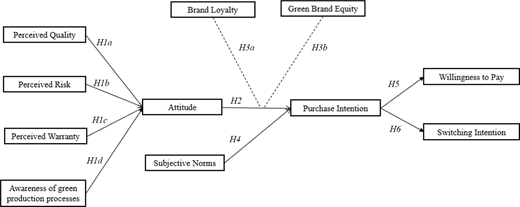
A theoretical framework has been developed specifically for the context of REMAN purchasing in B2B, drawing on the TRA (Ajzen and Fishbein, 1973). TRA suggests that behaviour stems from the intention to act, which is shaped by personal beliefs about outcomes and perceived social expectations. In other words, individuals tend to act consistently with what they consider advantageous and socially approved. In the context of B2B purchasing decisions, this perspective allows for the consideration of both a cognitive dimension related to the perceived utility of the purchase, such as the quality or value of the product purchased. It also considers a normative dimension, such as the influence exerted by other actors, that could encourage or discourage such behaviour. The theoretical framework that has emerged from the objectives of the study allows for the exploration of the functional and emotional factors underlying buyers’ attitudes and purchasing decisions (Figure 1).
3.1 Attitude and its antecedents
Attitude is the mental predisposition that guides a buyer in evaluating and deciding on products and services (Douglass, 1977). It is shaped by the buyer’s beliefs and emotions (Ajzen, 1991). The B2B literature has shown that attitudes are influenced by a combination of factors that drive firms’ purchasing decisions (Kotler and Keller, 2017). The first element is perceived quality, i.e. the subjective evaluation of a product’s excellence (Zeithaml, 1988). Perceived quality is influenced by technical characteristics and factors such as branding, packaging and customer experience (Leek and Christodoulides, 2012). The relationship between perceived quality and attitude is direct and positive (Wu et al., 2014). Higher perceived quality leads to more favourable attitudes towards the product or service (Wu et al., 2014). A low perceived quality increases buyer uncertainty and mistrust (Jiang et al., 2021). This relationship is particularly significant for REMAN buyers, as REMAN are made using EOL components. Research on B2C consumers (e.g. Abbey et al., 2015) shows that high perceived quality mitigates concerns and reduces psychological barriers, fostering positive attitudes towards REMAN. Therefore, perceived quality is crucial to position REMAN as an equivalent alternative to the new product. In the B2B context, this element is particularly relevant as operational risks associated with the malfunction of a component lead to production interruptions or significant additional costs. Therefore, we assume that:
REMAN’s perceived quality has a significant and positive influence on attitudes towards REMAN.
A second factor that shapes attitudes is perceived risk, i.e. the uncertainty of incurring negative consequences due to a wrong purchasing decision (Mitchell, 1999). The perceived risk depends on the buyer’s experiences, expectations and available information (Mitchell, 1999). This concept is especially important in B2B, where purchasing decisions involve significant investments. The relationship between perceived risk and attitudes towards a product is inverse. As perceived risk increases, attitudes become less favourable towards the product (Snoj et al., 2004; Jiang et al., 2021). To reduce perceived risk and promote positive attitudes, it is crucial to share detailed information with the buyer and offer guarantees (Mccoll et al., 2019). Studies in B2C confirm this negative relationship between perceived risk and attitude, even REMAN (Wang et al., 2013). The high-risk perception of REMAN is often linked to a lack of familiarity with the product (Matsumoto et al., 2017). This dynamic can be even more critical in B2B as companies purchase for functional and operational needs (Lau and Lee, 1999). A malfunction or poor performance of a product affects the entire production cycle, resulting in unexpected costs and possible disruptions. Furthermore, recent studies indicate a high level of concern regarding sustainable products due to the risk of greenwashing (Vangeli et al., 2023). This risk perception diminishes positive attitudes and purchase intentions towards sustainable products in the B2B context (Vangeli et al., 2023; Barbosa et al., 2024). For this reason, perceived risk is expected to have a greater influence on B2B buyer attitudes than B2C consumers. Given the importance of perceived risk in shaping attitudes in B2B, further investigation is needed. Based on the above, we assume that:
REMAN’s perceived risks significantly and negatively influence attitudes towards REMAN.
Perceived warranties refer to the perception of a supplier’s ability to reassure the buyer when purchasing a product through after-sales support and troubleshooting of the purchasable product (Shimp and Bearden, 1982). Warranties protect against perceived risk and symbolize the reliability of the supplier. The relationship between perceived warranties and attitude is positive (Erevelles, 1993). The greater the warranties, the stronger the buyer’s trust in the supplier (Shimp and Bearden, 1982). They act as “psychological insurance”, increasing the purchasing company’s favourable attitude. In the case of REMAN, the perceived warranties are even more crucial. Warranties covering defects, maintenance and service help mitigate customer uncertainty, thereby instilling confidence in REMAN. B2C studies confirm the importance of perceived warranties in improving attitudes towards REMAN (Oliveira et al., 2023). Unlike consumers, B2B buyers require more specific and robust warranties to prevent operational disruptions. Therefore, we assume:
REMAN's perceived warranties significantly and positively influence the attitude towards REMAN.
Awareness of the green production processes refers to the buyer’s understanding of the environmental and social aspects implicit in a manufacturer’s production methods (Casidy and Lie, 2023). Consumers associate ecological practices with ethical responsibility and for this reason awareness of green production processes positively influences attitudes towards REMAN (Hazen et al., 2012). This dynamic is probably relevant in B2B, where awareness of ecological practices can foster even more positive attitudes, thanks to social and regulatory pressures. In addition, awareness of green practices can boost companies’ readiness, especially when supplier relationships are built on shared sustainability values, which offer long-term competitive advantages (Reuter et al., 2010). Companies recognize sustainability as an ethical and strategic business approach that improves customer relationships, brand reputation and long-term costs (Casidy and Yan, 2022). Based on this, we assume that:
Awareness of green production processes has a significant and positive influence on the attitude towards REMAN.
3.2 The relationship between attitude and purchase intention
Purchase intention refers to a company’s willingness or interest in proceeding with the purchase of a product (Zhang et al., 2022). Attitude positively influences purchase intention, as the latter is conditioned by psychological and relational factors (Guan et al., 2020). A positive attitude significantly and directly influences purchase intention, as customers tend to associate the product with both tangible benefits, such as operational efficiency. They associate the product with both intangible benefits, such as reputation or safety (Douglass, 1977). When the attitude is negative, purchase intention decreases. In these cases, the product is perceived unfavourably, often due to prior negative experiences or a lack of consistency between the brand’s promises and the actual perceived quality (Kotler and Armstrong, 2016). In extreme cases, this not only reduces purchase intention but may also lead to supplier abandonment, damaging long-term relationships (Lilien, 2016). This relationship between attitude and purchase intention is expected to be equally significant for REMAN, as previous research in the consumer domain also confirms. It can be assumed that this relationship is even more relevant in B2B, where purchasing decisions are more complex and strategic. Therefore, we hypothesize that:
Attitude towards REMAN significantly and positively influences the purchase intention of REMAN.
3.3 The moderating role of the brand
Brand plays a key moderating role in the relationship between attitude and purchase intention (Siyal et al., 2021). Given the REMAN’s future core, factors such as brand loyalty and green brand equity influence how B2B companies perceive a brand and make purchasing decisions (Casidy and Yan, 2022). A strong brand can reduce the perceived risks of its products and promote a positive attitude towards branded products, thus encouraging the purchase of REMAN (Chaudhuri and Holbrook, 2001). Brand loyalty, through the customer’s emotional commitment, encourages repurchase even in a competitive environment (Reichheld, 2003). It can be said to act as a “buffer”, reducing the impact of negative information and increasing the likelihood of repeat purchases (TaghiPourian and Bakhsh, 2015; Matzler et al., 2008). This effect also applies to REMAN. Previous studies show that loyal customers are more likely to choose the same brand for the REMAN alternative (Chen and Chen, 2019). In B2B, brand loyalty can have a greater impact on the relationship between attitude and intention to buy, as companies prefer suppliers with whom they already have a long-standing relationship of trust. Based on this, we hypothesize that:
Brand loyalty positively moderates the relationship between attitude towards REMAN and REMAN’s purchase intention.
Another important aspect of the brand that can influence the purchase intention of REMAN is green brand equity. This concept builds on the foundations of traditional brand equity, i.e. the added value that a brand creates through customer perceptions, associations and long-term relationships (Keller, 2013). In a conventional sense, brand equity captures how consumers recognize, value and remain loyal to a brand. When applied to the environmental domain it becomes a measure of how much credibility and value a company gains from its commitment to sustainability. In this view, green brand equity represents the extent to which environmental responsibility strengthens a brand’s image and affects customer choice (Hartmann and Apaolaza Ibáñez, 2006).
Green brand equity develops when stakeholders perceive environmental commitments as genuine, consistent and aligned with real practices. The strength of green brand equity lies in its dual impact. On the one hand, it creates positive associations with the brand, generating loyalty and long-term relationships. On the other hand, it provides firms with strategic advantages in competitive markets. As Chen (2010) notes, when green image, satisfaction and trust are aligned, companies can differentiate themselves more effectively, justify premium pricing strategies, and consolidate their positioning in sustainability-driven industries. In this way, green brand equity becomes not only a reputational asset but also a driver of tangible business performance.
In the case of REMAN, evidence shows that consumers prefer brands that demonstrate environmental commitment. Abbey et al. (2015) found that customers are more willing to purchase REMAN from brands engaged in sustainability, reinforcing the positive link between attitude and purchase intention. This relationship is also expected in B2B contexts, where firms increasingly favour products aligned with their sustainability goals to ensure consistency with corporate values (Leonidou et al., 2013). Based on these insights, we hypothesize that:
Green brand equity positively moderates the relationship between attitude towards REMAN and REMAN’s purchase intention.
3.4 The influence of subjective norms
According to TRA, subjective norms refer to the perceived social pressure to engage in or avoid a behaviour (Ajzen and Fishbein, 1980). These standards could also have a significant influence on company’s purchase intention, especially when expectations are deeply rooted in the industry, culture or legislation (Young and Thyil, 2014). When companies perceive certain behaviours as accepted or expected in their environment, they are more likely to develop a positive attitude, which impacts their purchase intentions (Ajzen and Fishbein, 1980). Subjective norms also influence the speed of adopting new innovations or practices. When a product or practice aligns with subjective norms, companies are more likely to adopt it quickly. This mechanism encourages wider industry acceptance of the product in question (Abbasi et al., 2022). We expect the same behaviour for REMAN, whose production, sale and adoption have become increasingly important in the B2B context. Driven by social pressure and industry expectations that promote sustainable and circular practices, companies are increasingly aware of and responsive to the importance of REMAN solutions. Based on this, we hypothesize that:
Subjective norms significantly and positively influence purchase intention towards REMAN.
3.5 Purchase intention, willingness to pay and intention to switch
Purchase intention influences the willingness to pay a premium price (WTP) (Aaker, 1996). Customers may be willing to pay a premium price when they have a strong purchase intention and, at the same time, recognize the added value of the product. Studies show that companies that consider sustainability attributes of a product important are willing to pay a premium. This is often in response to regulatory, social, but also market differentiation expectations (Casidy and Lie, 2023). Companies that align sustainability with strategic corporate goals show higher WTP for products that support these values (Goebel et al., 2018; Casidy and Lie, 2023). Therefore, in the case of REMAN, it is expected that companies will be willing to pay a higher price for intrinsic qualities. In addition, REMAN help achieve sustainability goals, extend product lifecycles and ensure compliance with evolving regulations. Purchasing REMAN enables companies to position themselves in the circular economy landscape, enhancing brand reputation and competitive advantage. Therefore, we hypothesize that:
Purchase intention towards REMAN significantly and positively influences willingness to pay.
Purchase intention also influences the intention to switch, which refers to the willingness to move from a new product to a substitute product (Bansal et al., 2005). Switching intention has strategic importance, as switching to a substitute product offers an opportunity for suppliers to acquire new customers. At the same time, it allows buyers to scout new market opportunities. A stronger purchase intention for a substitute product tends to increase the likelihood that the company will decide to make the change (Ranaweera and Prabhu, 2003). A strong purchase intention indicates that the customer perceives the substitute product as superior to the current solution, thus motivating the change. In recent years, intention to switch has increasingly been driven by the emergence of sustainable solutions in the industrial market (Hazen et al., 2017). Moreover, the intrinsic characteristics of sustainable products, such as regulatory compliance and the ability to reduce operational costs through longer life cycles, reinforce the propensity to switch (Casidy and Lie, 2023). We hypothesize that:
Purchase intention towards REMAN is significantly and positively related to intention to switch from new products to REMAN.
4. Research methodology
4.1 Research context
The focus on agricultural machinery parts was chosen due to its significance in industrial marketing, characterized by high functionality and centrality in business operations, as well as strict technical requirements and inelastic demand. Moreover, this empirical context was selected because it is particularly active in REMAN offering while being especially sensitive to the efficiency and functionality of spare parts and equipment. Agricultural machinery are used for a limited period, as their operations are confined to a few weeks or days during which harvesting, sowing, fertilization and other agricultural tasks are carried out. When in use, agricultural machinery must ensure high performances, and the likelihood of a malfunctioning must be reduced to zero as in agriculture even a day of delay can be catastrophic. Data were collected through a survey conducted during the 2022 EIMA (International Agricultural Machinery Fair) exhibition to agricultural OEM customers. Collaboration with New Holland, a global leader in agricultural machinery, enabled a closer examination of customer preferences and purchasing behaviour, and the key role a brand plays in REMAN purchasing decisions.
4.2 Measures
The theoretical constructs tested in this research were drawn from existing scales, reworded to fit with the empirical context (Table 1) (Churchill, 1979). Perceived risk was measured using items proposed by Matsumoto et al. (2017), perceived quality was assessed using the scales by Yoo et al. (2000). The construct of perceived warranties was measured through items by Erevelles et al. (1999) while items for awareness of green production processes were drawn from Chen (2010). Subjective norms were instead measured through adaptation of items from Ajzen (2002). Brand loyalty was measured using the scale by Zeithaml et al. (1996), while observed variables for green brand equity were drawn from Ng et al. (2014). Purchase intention is from Bian and Forsythe (2012), intention to switch is from Hazen et al. (2017), while willingness to pay is from Netemeyer et al. (2004).
4.3 Survey instrument
The questionnaire consists of three sections. Section 1 collects information about the participants to understand their roles in the corporate decision-making process and confirm their position as business buyers. Section 2 focuses on New Holland’s brand awareness and the perception of its distinctive characteristics, asking respondents about their familiarity with the brand and using rating scales for brand loyalty and green brand equity. Section 3 includes psychometric questions based on the theoretical constructs. Respondents indicated their level of agreement on a five-point Likert scale, from “strongly disagree” (1) to “strongly agree” (5).
4.4 Data collection
Data collection took place from 9 to 13 November 2023 during EIMA held in Bologna, Italy. The questionnaire was administered via a QR code to be scanned, allowing respondents to complete the form independently without outside influence. This approach has ensured a significant reduction in distortions. The survey was administered to individuals who self-identified as business owners in the agricultural business and responsible for decisions regarding the purchase of spare parts when needed. As the aim of the research is to understand the process through which individuals form an intention to purchase, we limit the sample to this class of respondents to ensure the results' validity and reliability. Ownership of New Holland equipment was not deemed a prerequisite for the study’s participation, but the brand was used as an experimental stimulus to analyse the effect of the brand on buyers’ choices.
A total of 346 questionnaires were collected. After preliminary analysis and the use of control questions to identify and exclude incomplete or potentially biased questionnaires, a final set of 234 usable responses was obtained.
5. Results
5.1 Measurement model
The measurement model was tested using PLS-SEM (Smart PLS 4 software) (Ringle et al., 2024). For each construct, convergent validity was assessed by analysing the loadings of individual indicators, ensuring that each value exceeded the threshold of 0.70 (Table 2). The Average Variance Extracted (AVE) was calculated, confirming that AVE values met the 0.50 threshold for convergent validity (Table 3) (Hair et al., 2009). Internal consistency was assessed using both Cronbach’s alpha and Composite Reliability (CR), with values exceeding the 0.70 threshold for all constructs (Table 3) (Nunnally and Bernstein, 1994). Discriminant validity was assessed using the Fornell–Larcker criterion (Table 4) and the heterotrait–monotrait ratio (HTMT) (Henseler et al., 2015). The Fornell–Larcker criterion showed that the AVE of each construct was greater than the squared correlations between that construct and all others, meeting the requirements for discriminant validity. Moreover, HTMT values were below the critical threshold of 0.85 for all construct pairs, further confirming the adequacy of the model.
Multicollinearity was assessed by examining the Variance Inflation Factor (VIF) values to identify potential issues with multicollinearity among predictor constructs. All VIF values were within acceptable limits, with all values well below the threshold of 5 (Hair et al., 2014). Finally, the presence of common method variance was assessed using two complementary approaches. Firstly, the Full Collinearity VIF method (Kock, 2015) was applied, with all values below the critical threshold of 3.3, indicating no significant methodological bias (Table 5). Secondly, the Unmeasured Latent Method Construct (ULMC) approach was implemented in SmartPLS (Podsakoff et al., 2012). For this procedure, a latent Method_Factor was added to the model, and each indicator loaded both on its theoretical construct and on the Method_Factor. The results showed that loadings on the theoretical constructs were consistently high (average = 0.87, range 0.682–0.941), whereas loadings on the Method_Factor were low and non-systematic (average = 0.09, all ≤ 0.19), and the Method_Factor explained only 7.1% of the total variance. These results confirm that common method bias is unlikely to compromise the validity of the findings. Overall, the measurement model meets all required psychometric criteria, ensuring reliability, convergent and discriminant validity and statistical adequacy for proceeding with the structural analysis.
5.2 Structural model
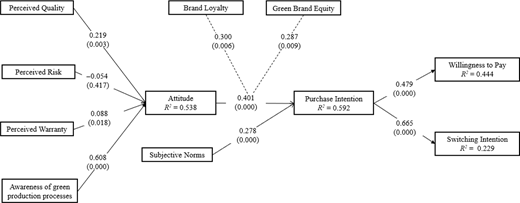
The evaluation of the structural model allowed for the examination of the hypothesized relationships among the constructs, considering the sign, significance and strength of the path coefficients, obtained through bootstrapping with 10,000 subsamples (Figure 2). The results show that most of the hypotheses are significant, with t-values above the critical threshold of 1.96 (p < 0.05) (Table 6).
With regard to H1a, perceived quality has a significant and positive effect on the attitude towards REMAN (β = 0.219; t = 2.985; p = 0.003). Conversely, H1b, which hypothesizes a negative influence of perceived risk on attitude, was not confirmed (β = −0.054; t = 0.812; p = 0.417). H1c is supported, showing a positive and significant effect of perceived warranties on attitude (β = 0.088; t = 2.206; p = 0.018). Awareness of green production processes also shows a strongly positive impact on the attitude towards REMAN (β = 0.608; t = 8.737; p < 0.001), confirming H1d. Attitude, in turn, has a significant and positive influence on purchase intention, validating H2 (β = 0.401; t = 5.851; p < 0.001).
As for the moderation hypotheses, H3a is supported, demonstrating that brand loyalty significantly strengthens the relationship between attitude and purchase intention (β = 0.300; t = 2.737; p = 0.006), while H3b is supported by a positive moderating effect of green brand equity, although at the significance threshold (β = 0.287; t = 2.628; p = 0.009).
H4 is confirmed, with subjective norms having a significant and positive influence on purchase intention (β = 0.278; t = 4.598; p < 0.001). H5 shows that purchase intention positively affects willingness to pay for REMAN (β = 0.479; t = 6.893; p < 0.001), while H6 is confirmed with a significant and positive effect of purchase intention on the intention to switch new products with REMAN alternatives (β = 0.665; t = 13.725; p < 0.001).
In terms of explanatory power, the model shows satisfactory R2 values for all dependent variables (Table 7). These results suggest that the model explains a significant portion of the variance of the main constructs, attesting to its theoretical and empirical robustness. Predictive relevance (Q2), calculated for each endogenous variable, shows positive values, indicating that the model has acceptable predictive capacity (Table 7). Furthermore, the f2 effect size was calculated to assess the practical relevance of the relationships between constructs, providing insights into the specific impact of each predictor on the dependent variables (Table 8).
Regarding model fit, the SRMR (Standardized Root Mean Square Residual) is 0.049 for the Saturated Model and 0.073 for the Estimated Model. Both values are below the recommended threshold of 0.08 (Hu and Bentler, 1999), indicating a good model fit to the data.
Overall, the structural model provides convincing empirical evidence of the hypothesized relationships, contributing to a better understanding of the behavioural and cognitive drivers behind REMAN adoption in B2B contexts.
6. Discussion
The study identified eight variables influencing REMAN purchase decisions in B2B. Among these, awareness of the green production processes proved to be the most important. In fact, companies show great attention not only to product quality but also to how the product is made. Knowing that a product originates from a sustainable and environment-friendly production process contributes to creating a positive attitude towards REMAN. This reinforces the idea that sustainability is not merely a compliance issue but a strategic criterion in procurement. Firms increasingly seek transparency in suppliers’ practices, considering environmental responsibility as a proxy for credibility and long-term orientation (Casidy and Yan, 2022). In this regard, environmental awareness serves as a reputational lever and a symbolic asset in inter-firm relationships (Casidy and Lie, 2023).
Perceived quality also plays a relevant role. Companies associate quality with functionality, guarantees and reliability, three fundamental elements in a business context. Another significant contributing factor is the presence of perceived warranties, which convey trust and help reduce any doubts about the product. These results confirm that a positive attitude towards REMAN is built through a combination of tangible elements such as quality and safety, but also values related to sustainability. This confirms previous research showing that B2B decisions are increasingly influenced by social and symbolic factors, beyond pure economic or technical criteria (Wu et al., 2014; Jiang et al., 2021).
A favourable attitude then translates into a greater intention to purchase REMAN. This shows that business decisions are shaped not only by rational factors but also by evolving opinions and beliefs. Furthermore, when companies are loyal to a brand, or when they recognize a brand’s environmental value, this purchase intention becomes even stronger. In other words, brands that invest in sustainability and build trust are more likely to drive the shift towards regenerated solutions. These findings echo existing literature on green brand equity and loyalty in industrial marketing, where environmental positioning strengthens the link between attitude and purchase intention (Siyal et al., 2021; Casidy and Yan, 2022; Chen et al., 2006).
Another significant variable is subjective norms. Social pressures, customer expectations and industry regulations push companies to make more responsible choices. This suggests that companies act not only for internal motivations but also to respond to the demands of an increasingly environmentally conscious market. This aligns with earlier studies emphasizing that legitimacy concerns and stakeholder pressures significantly influence sustainable choices in inter-organizational settings (Ajzen and Fishbein, 1980; Young and Thyil, 2014; Abbasi et al., 2022).
The research also shows that companies are not only interested in purchasing REMAN, but are even willing to pay a higher price for them. Moreover, many are ready to replace new spare parts with remanufactured ones. This demonstrates that REMAN are now seen as a strategic option, generating both economic and environmental value. This reflects a broader shift in industrial markets, where circular business models are no longer perceived as cost-saving alternatives, but as premium solutions with reputational and innovation benefits (Casidy and Lie, 2023; Goebel et al., 2018).
Perceived risk was the only factor without a significant influence. This might indicate that respondents see REMAN as reliable and safe solutions, perhaps due to increased familiarity with these products or the presence of warranties that reduce uncertainty. This is consistent with recent literature showing that risk perception towards REMAN tends to diminish as awareness and institutional support increase (Matsumoto et al., 2017; Mccoll et al., 2019).
Overall, the results suggest that B2B purchasing decisions are no longer guided solely by economic logic, but increasingly by a combination of trust, environmental responsibility and reputation.
6.1 Theoretical implications
This study offers a significant theoretical contribution to industrial marketing. It extends the literature on the TRA to the B2B context, demonstrating that industrial purchasing decisions can no longer be interpreted exclusively as rational choices driven by efficiency, quality and operational continuity (Homburg et al., 2014; Oliveira et al., 2023). The results highlight that, just like end consumers (Gaur et al., 2019), industrial buyers are also influenced by socio-emotional, reputational and value-based factors. It confirms that attitude, subjective norms and social perceptions play a crucial role in shaping intentions. In this way, the research contributes to broadening the interpretative scope of TRA. It reinforces its theoretical validity in complex organizational contexts, where regulatory pressures, environmental expectations and corporate reputation are increasingly influential determinants.
It also adds the variable of green brand equity which, until now, had been more frequently analysed with reference to the consumer context (Gorska-Warsewicz et al., 2021). Our empirical evidence shows that awareness of green production processes not only improves the perception of transparency and legitimacy of companies, but also constitutes a decisive lever in developing positive attitudes towards REMAN. Brand loyalty, in turn, acts as a moderator between attitude and intention (Chaudhuri and Holbrook, 2001), influencing companies’ willingness to adopt innovative and sustainable solutions. These results extend the literature on B2B purchasing behaviour, demonstrating that industrial decision-making increasingly incorporates symbolic and relational dimensions, in line with contemporary sustainable marketing paradigms.
It is also noteworthy that industrial buyers are willing to prefer REMAN and even pay a premium for them. This result, not yet documented in B2B, once again challenges the traditional assumption that procurement decisions are motivated solely by economic motives (Robinson et al., 1967; Webster and Wind, 1972). It confirms that industrial clients recognize value in intangible attributes related to sustainability and social responsibility. In this sense, the study contributes to repositioning the academic discussion on B2B choices, showing that perceived value can exceed merely functional value, opening the way to a more articulated understanding of purchasing behaviour.
Overall, the results extend the literature on soft factors in industrial marketing. They emphasize that the criteria for evaluating alternatives are no longer limited to performance and technical reliability, but include social legitimacy, symbolic sustainability and brand storytelling. The research thus contributes to shifting the focus from the product to meaning, from use value to perceived value, by showing how reputation, relational capital and alignment with institutional pressures, are ever more capable of guiding firms’ strategic choices.
6.2 Managerial implications
The emerging scenario shows that the adoption of REMAN cannot be framed exclusively through technical or cost-based logic. Purchasing decisions are influenced by a complex mix of functional, social and emotional drivers. This compels managers to rethink the strategic, communicative and relational levers to be activated to promote REMAN effectively and efficiently. The positive relationship between perceived quality and purchase intention confirms that in B2B, even in the presence of sustainable innovations, the perception of technical reliability remains an essential prerequisite. Managers should invest in strengthening communication about the quality of REMAN, emphasising performance tests, certified standards, direct comparisons with new alternatives, and industry best practices. It is crucial to present REMAN as a technologically reliable solution, validated by rigorous and well-established industrial processes. In line with this, perceived warranty also shows a significant correlation with intention. Managers should adopt extended warranties and after-sales support schemes specifically designed for REMAN, and should do their best to communicate them proactively. The warranty must be seen as an asset of trust and reassurance, capable of reducing adoption barriers for traditionally risk-averse buyers.
On the emotional and value-based level, perceived sustainability emerges as a highly impactful transversal lever. It directly influences attitudes towards REMAN and acts as a moderator in the relationship between attitude and intention. These findings suggest that sustainability acts not only as an ethical consideration but also as a practical driver of behaviour, strengthening the link between intention and action. Managers should integrate sustainability into marketing messages as the core narrative of REMAN, highlighting the product’s positive environmental impact with measurable data, LCA (Life Cycle Assessment), visual storytelling and real case studies.
At the same time, green brand equity stands out as one of the most strategic elements identified by the research. Managers should build a strong green brand identity based on consistent, credible values. The brand must be positioned as a leader in the industrial ecological transition, capable of embodying values such as responsibility, sustainable innovation and strategic partnership. Investing in the brand’s environmental reputation thus becomes a multiplier of effectiveness for every other marketing lever.
Brand loyalty also has a significant moderating impact, confirming that trust built over time is a crucial capital in encouraging the adoption of REMAN. Managers should leverage this asset to introduce REMAN within already established relationships. Loyalty programmes focused on sustainability, dedicated after-sales services, collaborative platforms and co-creation with key clients can represent effective tools to strengthen retention and promote a smooth transition to REMAN. The significant influence of subjective norms on purchase intention highlights that firms do not act in isolation, but within networks of meaning and social expectations. This insight opens strategic space for communication campaigns that highlight REMAN’s alignment with regulatory, cultural and business specific pressures. Managers should leverage institutional endorsements, sustainability awards, testimonials from leading customers, and benchmarking practices to generate a perception of REMAN as the emerging standard of responsible excellence.
Finally, the study suggests a potential rethinking of REMAN’s positioning, traditionally offered as a low-cost option. Value-based and emotional factors allow managers to pursue premium pricing strategies tied to reputation, sustainability and Environmental, Social and Governance (ESG) Impact. ESG impact is the effect that business practices have on the environment, on society and on corporate governance standards. The ESG goals, introduced by the United Nations in 2004, are now internationally recognized as key sustainability parameters (Li et al., 2021). REMAN should therefore be positioned not as a budget option, but as a value-added solution that differentiates firms in sustainability-driven markets.
6.3 Social implications
The increase in demand for REMAN not only reduces the consumption of natural resources and emissions associated with producing new goods, but it also stimulates a deep cultural change in how value, quality and innovation are perceived. REMAN contributes to systemic change by promoting circular practices across the supply chain. Companies adopting REMAN improve their environmental performance and influence suppliers, customers and partners. This creates a multiplier effect that strengthens the principles of the circular economy. This dynamic shows how society increasingly recognizes the value of sustainable choices, reflecting greater collective awareness.
Culturally, legitimizing REMAN as a choice of value, rather than a compromise, helps redefine standards of excellence and progress in the production system. It is a paradigmatic shift that moves focus from ownership to function, from linear consumption to smart reuse, and from competition based on costs and volumes to co-creation of sustainable value. This change is also supported by growing legislative pressure and social norms that encourage responsible practices, showing that cultural transformation is not only internal to companies but integrated into a broader regulatory and social context.
Regarding the results, the importance companies place on awareness of green production processes and supplier transparency suggests that REMAN is not just an economic lever but a social device that can shape collective attitudes towards sustainability. The centrality of variables such as perceived quality, trust and guarantees demonstrates that legitimizing REMAN involves reconstructing new criteria of social trust, redefining the very concepts of “safety” and “reliability” in a sustainable key. This phenomenon indicates a broader cultural shift in the world of conscious purchasing, where buying choices reflect shared social and environmental values.
Moreover, the role of subjective norms and social pressures highlighted by the research reflects how REMAN is becoming a topic of shared responsibility. It goes beyond company boundaries to enter collective market expectations and institutional regulations. The increasing legislative attention and public policies in environmental matters further strengthen this process, showing that corporate choices intersect with social and regulatory pressures, producing tangible effects on collective behaviour and consumption patterns.
Company choices thus help reinforce broader social trends in which sustainability becomes a cultural and operational imperative. This aspect is particularly relevant because it shows that change is no longer driven solely by internal business logic but by a social ecosystem that recognizes and rewards responsible behaviour. In other words, society is actively participating in defining new cultural and economic standards, with legislative pressures acting as a catalyst.
At a time when sustainability represents an ethical and operational imperative, companies that choose REMAN take an active role in promoting responsible and inclusive practices. They participate in a collective ecological transition project. The willingness to pay a higher price for REMAN, highlighted by the study, signals a change in social attitudes towards REMAN which are no longer seen as inferior alternatives to new products but as symbols of status, reputation and foresight. This phenomenon reflects a cultural shift, where purchasing choices become a way to testify a company’s social and environmental awareness, a way to encourage end customers to reconsider their priorities.
These choices build social capital and public trust, strengthening the bond between business and society. In this perspective, the spread of REMAN helps normalizing a culture of sustainable innovation, where reuse and regeneration logic are no longer virtuous exceptions but shared standards, with deep implications for the future of work, industrial policies and social relations related to production and consumption.
7. Limitations and future research
This study has several limitations, which offer opportunities for future research. The investigation was conducted in a single industrial sector, agricultural machinery. Although the findings may apply to other B2B settings where spare parts are essential for efficiency, future studies are needed to test if the model holds also in other contexts. Comparative research between high-tech and low-tech industries could verify whether the cognitive, organizational and institutional drivers of REMAN adoption remain valid across different markets. Using stratified or multi-industry samples would increase external validity and show how sector-specific features shape buyer perceptions and behaviours.
The study used a cross-sectional design, which helped identify purchase intentions but not their conversion into actual behaviours. This is a major limitation that future research can overcome by adopting longitudinal approaches. By following buyers over time and combining survey evidence with transactional or experimental data, scholars could observe how intentions evolve into concrete decisions. Such an approach would also test whether willingness to pay translates into real financial sacrifices in competitive markets. Field experiments and natural experiments in partnership with one or more firms that sell REMAN could provide further evidence on how price levels, communication strategies and environmental positioning shape long-term adoption of REMAN.
Another limitation concerns the predictive strength of the model for willingness to pay. The variance explained was moderate, but accuracy remained limited. This suggests that additional variables should be included in future models. Possible extensions could consider trust in suppliers, the perception of risks related to switching or pressures from regulation and policy. Integrating these constructs would create a more complete framework that clarifies not only how customers value REMAN, but also the deeper reasons behind their investment decisions. A similar observation applies to the intention to switch suppliers. While this construct shows predictive potential, it requires a more detailed analysis of its antecedents. Factors such as market competition, quality of relationships and switching costs may explain these dynamics more clearly. Comparative studies across institutional and cultural settings would also reveal how wider macro-level drivers interact with company-level decision-making.
The analysis also focused on a single decision-maker within each company. This simplification does not reflect the real complexity of B2B purchasing, where several roles and interests are involved. Future research should adopt a multi-stakeholder perspective to better capture interfunctional dynamics. Case studies, ethnographic research and social network analysis could uncover how purchasing managers, engineers, sustainability officers and senior executives collectively influence REMAN purchase and adoption. This would give a richer and more realistic picture of the decision-making process and of the internal negotiations that shape final choices.
Finally, future studies could extend the analysis to international contexts. Cross-country research would make it possible to assess how cultural and institutional factors affect the diffusion of REMAN. It would clarify whether sustainability-based choices are universally valid or depend on national conditions. Experimental studies could also explore the effectiveness of different communication strategies aimed at increasing perceived value and green brand equity in industrial markets. Such work could test which messages and narratives are most effective in convincing different types of stakeholders.
By addressing these limitations, future studies would strengthen the theoretical foundations of REMAN adoption and provide managers with practical insights. This would increase both the academic contribution and the managerial relevance of the topic, helping accelerate the spread of sustainable solutions in industrial markets.
8. Conclusion
This study explores the key factors influencing REMAN’s B2B purchasing decisions, offering new insights into industrial marketing. Factors such as perceived quality, warranties and sustainable production processes significantly shape attitudes and intentions for REMAN. Knowledge of green production processes is the most influential driver, underlining the importance of environmental credentials in B2B contexts. Social norms, brand loyalty and the perceived value of a brand’s ecological commitment further support REMAN adoption, underscoring sustainability’s role in purchasing decisions. This study fills a gap in the literature by clarifying how B2B companies are incorporating environmental factors into decision-making, beyond traditional functional and economic criteria. The results provide a strategic guide for exploiting sustainability, confirming that REMAN offer an effective, efficient and responsible solution.