This study presents a comprehensive bibliometric analysis of global civet coffee research published between 2004 and 2024, identifying key publication trends, research themes and future directions.
A bibliometric analysis was conducted using the Scopus database, selected for its broad coverage of agriculture, food science and environmental disciplines, and its compatibility with the Bibliometrix R package. Bibliometric tools in R and Excel were used to examine publication trends, leading authors, journals, institutions, country contributions and keyword co-occurrence.
The study shows steady growth in civet coffee research, with Indonesia leading in author and institutional output. Dominant themes include authentication methods, chemical profiling, microbial and enzymatic fermentation, animal welfare and ethical production. Spectroscopy, chromatography and metabolomics were common analytical tools. A thematic shift is observed towards biotechnological alternatives replicating civet digestion. Nonetheless, research gaps persist in sustainability assessment, certification systems and consumer perception studies.
This study offers insights for researchers, producers and policymakers aiming to develop ethical and sustainable civet coffee systems. Emphasising fermentation-based alternatives and robust certification could enhance animal welfare, authenticity and consumer trust.
This is the first bibliometric analysis focused exclusively on civet coffee, mapping its global scientific landscape and identifying emerging research priorities. The findings underscore the need for interdisciplinary collaboration to address ethical, technological and ecological challenges.
1. Introduction
Coffee is one of the most significant agricultural exports globally, with approximately 475 million bags shipped in 2014. Premium varieties such as Jamaican Blue Mountain and Hawaiian Kona are celebrated for their superior flavour, while civet coffee stands out as the most expensive and rarest (Jumhawan et al., 2015). Commonly known as Kopi Luwak, civet coffee is a speciality product originating from Southeast Asia, particularly Indonesia, the Philippines, Thailand, and Vietnam (Jumhawan et al., 2015; Raveendran and Murthy, 2022; Lewis-Whelan et al., 2024). Indonesia is widely acknowledged as its primary source (Prajna et al., 2023). What makes civet coffee unique is its distinctive production method: civets consume ripe coffee cherries, and the beans are collected after passing through their digestive tract. Enzymatic fermentation within the civet’s gastrointestinal system is believed to enhance flavour by reducing bitterness and acidity, resulting in a smoother, more refined cup profile (Shehasen, 2024).
Traditionally, civet coffee has been associated with cultural heritage and economic prestige in its regions of origin (Cahill, 2020), serving as a symbol of luxury and exclusivity (Raveendran and Murthy, 2022). Economically, civet coffee commands a premium in international markets, with wild-sourced products retailing for USD 200 to over USD 1,000 per 250 grams, depending on origin, authenticity, and ethical sourcing practices. A single cup can sell for up to USD 100 in luxury cafés (Team Colipse, 2025). Its high value contributes substantially to local economies, particularly in rural Southeast Asia, where small-scale farmers and artisanal producers depend on niche luxury markets (Maspul, 2024). However, the rising global demand has prompted concerns over sustainability, authenticity, and ethical sourcing practices. Many commercial operations now involve the captivity and force-feeding of civets, raising significant animal welfare issues (Carder et al., 2016). Furthermore, the proliferation of counterfeit products and inconsistent quality has complicated market trust. Recent research has focused on developing sustainable and ethical alternatives, such as artificial fermentation techniques using isolated microbes from civet excreta and employing advanced analytical tools to verify product authenticity (Adadi et al., 2024).
Due to its unique characteristics and high market value, civet coffee has drawn attention from diverse research fields, including agriculture, food science, economics, and ethics (Carder et al., 2016). Nevertheless, scholarly efforts remain fragmented, often addressing narrow aspects such as flavour chemistry (Marcone, 2004; Muzaifa et al., 2020; Farag et al., 2023), production methods (Muzaifa et al., 2023; Prajna et al., 2023; Munandar et al., 2024), authentication technologies (Adadi et al., 2024), or consumer perceptions (Lopetcharat et al., 2016; Wicaksono, 2022). This fragmentation limits a comprehensive understanding of the field and hinders integrated solutions.
A bibliometric approach offers a robust framework to systematically assess the intellectual landscape and evolution of civet coffee research. It helps identify dominant themes, prolific authors, influential institutions, and collaboration networks (Chen and Song, 2019; Donthu et al., 2021). Such insights are crucial for recognising knowledge gaps and future research opportunities, particularly around sustainability, animal welfare, and quality assurance. Moreover, bibliometric analysis can guide stakeholders—including researchers, industry actors, and policymakers—in fostering informed decisions and interdisciplinary collaboration.
This study aims to investigate the research trajectory of civet coffee as indexed in the Scopus database, a leading repository of peer-reviewed literature. By applying bibliometric tools and techniques, this analysis maps publication trends, citation patterns, and thematic developments over time. It also highlights regional contributions and interdisciplinary linkages, laying the groundwork for addressing pressing challenges such as ethical sourcing and product authenticity. Ultimately, this bibliometric review offers a comprehensive overview of the current state of civet coffee scholarship and proposes directions for future inquiry.
This study seeks to answer the following eight research questions (RQs):
What are the annual publication trends in civet coffee research from 2004 to 2025?
How has the average citation count per document evolved over the years?
Which countries are the leading contributors, and what percentage of publications do they represent?
How does international collaboration vary among different countries?
Which institutions are the most prolific, and what is their publication output?
Who are the top authors, and what are their publication and citation metrics?
What key themes and topics have emerged in civet coffee research over the years?
What future research directions are recommended based on identified trends and gaps?
2. Methodology
2.1 Data source
This bibliometric analysis was conducted using the Scopus database as the sole data source due to its extensive and multidisciplinary coverage of peer-reviewed literature. Scopus is widely recognised for its robust indexing of high-quality journals, conference proceedings, and scholarly books, and is frequently used in bibliometric studies for its reliable citation metrics and metadata (Pranckutė, 2021). Its user-friendly interface, export features, and detailed author and affiliation information make it particularly suitable for studies on niche research areas such as civet coffee, where relevant literature may be limited (Sharun et al., 2022; Zyoud et al., 2014).
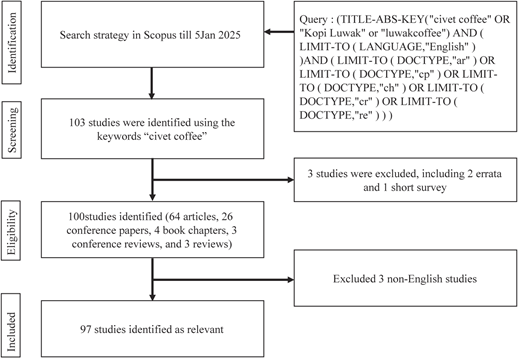
The inclusion criteria were restricted to English-language, peer-reviewed articles that focused on civet coffee or closely related topics, such as production, trade, sustainability, authenticity, or cultural significance. Editorials, commentaries, and unrelated documents were excluded to maintain dataset relevance. As Scopus was the only database used, the issue of duplicate records was minimal; however, a manual review of exported metadata was conducted to confirm and eliminate any unintentional repetitions or misclassified entries. The final dataset included all articles retrieved up to 12 November 2024, as detailed in the PRISMA flow diagram (Figure 1).
2.2 Search strategy
To identify relevant literature, a systematic search strategy was employed using the Scopus advanced search tool. The keywords “civet coffee” and “Kopi Luwak” were applied using Boolean operators to capture terminological variations and broaden the search scope (Marcone, 2004). The search focused on documents published up to the end of 2024. The search results were exported in both BibTeX and CSV formats and included metadata such as title, authors, affiliations, publication year, abstract, keywords, source title, and citation counts. Each record was reviewed to ensure topic relevance, and duplicates—though rare due to the single-database approach—were removed manually during pre-processing using Microsoft Excel and R.
2.3 Data cleaning and inclusion criteria
All records retrieved from Scopus were screened to ensure consistency with the study’s aims. Publications were included only if they explicitly addressed civet coffee or its associated aspects. Non-scholarly publications, non-English language articles, and duplicated records (checked manually) were excluded. Any inconsistencies or classification errors were resolved through cross-checking titles, abstracts, and keywords.
2.4 Analytical tools and procedures
The bibliometric analysis was performed using R version 4.3.1 (R Core Team, 2023) and the Bibliometrix R package version 4.2.1 (Aria and Cuccurullo, 2017), which provides a comprehensive suite of tools for bibliometric research. Microsoft Excel 365 was also used for organising and summarising data. The analysis included descriptive statistics (e.g. annual publication trends and document types), citation analysis to identify highly cited papers and influential authors, and co-authorship network mapping to visualise collaborative relationships among researchers and institutions. Additionally, keyword co-occurrence and trend analyses were conducted to detect emerging research themes and shifts in scholarly focus (Mokhtarpour and Khasseh, 2021; Büyükkıdık, 2022). Collectively, these approaches offered a systematic and data-driven understanding of the global research landscape on civet coffee.
3. Results and discussion
3.1 A bibliometric overview
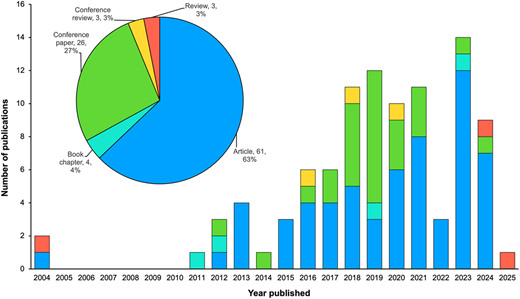
The bibliometric analysis of civet coffee research indexed in the Scopus database from 2004 to 2025 identified a total of 97 documents, comprising 61 journal articles (63%), 26 conference papers (27%), 4 book chapters (4%), 3 review articles (3%), and 3 conference reviews (3%) (Table S1). These distributions are illustrated in the pie chart within Figure 2. While civet coffee research spans over 2 decades, the field has experienced non-linear publication growth, with a notable rise in output beginning in 2015.
Although the compound annual growth rate (CAGR) was calculated as −3.25%, this does not indicate a consistent yearly decline. Instead, it reflects fluctuations in publication activity, with minimal output during the early years (2004–2010) and more substantial growth emerging in the past decade. The negative value is primarily due to a low initial baseline and variability in annual outputs, including a dip in 2022 following a peak in 2021, and another dip in 2024 after the peak in 2023 (see Figure 2).
The average age of documents is 5.93 years, indicating that the majority of work on this topic has emerged in recent years. On average, each document has received 11.92 citations, suggesting moderate academic impact, and the total reference count across all documents is 3,137, highlighting the field’s engagement with broader scholarly discourse.
The research shows significant collaboration, with 330 authors contributing, including nine single-authored works. The average of 4.47 coauthors per document and 19.59% international co-authorship highlight the collaborative nature of the field. A total of 693 Keywords Plus and 253 author-provided keywords were identified, demonstrating the diversity of topics within civet coffee studies. These publications offer valuable insights into thematic evolution, trends, and collaborative networks.
As shown in Figure 2, articles make up 63% of publications, followed by conference papers at 27%, book chapters at 4%, and reviews at 3%. This distribution emphasizes the prominence of articles and conference papers as primary scholarly outputs.
Two key early publications in civet coffee research—Kurt (2004) in New Scientist, which highlights the cultural significance of Kopi Luwak, and Marcone (2004) in Food Research International, which provides a scientific comparison of civet coffee from Indonesia and Ethiopia—illustrate the blend of cultural and scientific interest in the field.
3.2 Geographic and institutional contributions
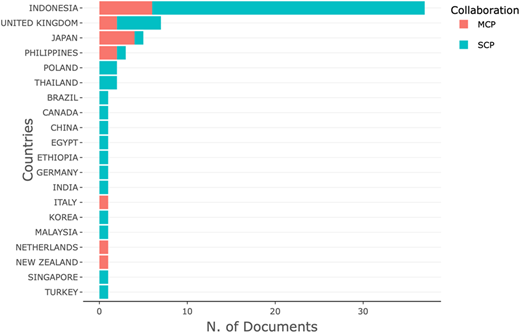
The analysis of publication output in civet coffee studies from 2004 to 2025, summarised in Table S2 and Figure 3, reveals that Indonesia is the leading contributor, accounting for 37 publications (38.1%), of which 31 are single-country publications (SCPs) and 6 are multiple-country publications (MCPs), reflecting 16.2% international collaboration. The United Kingdom ranks second with seven publications (7.2%), comprising 5 SCPs and 2 MCPs, with a higher proportion of MCPs at 28.6%. Japan follows with five publications (5.2%), showcasing a strong international collaboration rate, as 4 of 5 publications (80%) are MCPs. The Philippines, with three publications (3.1%), also demonstrates significant collaboration, with 66.7% of its output involving MCPs. Countries such as Poland and Thailand, with two publications (2.1%), contributed solely through SCPs. Brazil, Canada, China, and Egypt each produced one publication (1%) and did not collaborate. This distribution underscores Indonesia’s dominant role in civet coffee research and highlights the varying levels of international collaboration among other contributing countries.
Table S3 analyses institutional contributions to civet coffee research in Scopus, highlighting the significant role of universities and research institutes in advancing this niche field. Universitas Syiah Kuala in Indonesia leads with 28 publications, reflecting its prominent position in civet coffee studies, likely due to the country’s status as a major producer of civet coffee. Hasanuddin University, also in Indonesia, follows with 14 publications, further emphasising the country’s central role in this research domain. International contributions are also noteworthy. Osaka University in Japan ranks third with 12 publications, highlighting Japan’s interest in civet coffee’s scientific and cultural aspects. Oxford Brookes University in the United Kingdom holds fourth place with 11 publications, emphasising the global nature of this research field. Other significant contributors include Universitas Gadjah Mada (8 publications) and Institut Teknologi Sepuluh Nopember (ITS) Sukolilo (7 publications), both from Indonesia, along with Puerto Real in Spain (7 publications) and Chiang Mai University in Thailand (6 publications). Brazil and India also make significant contributions, with the Federal University of Rio de Janeiro and the Advanced Institute for Wildlife Conservation producing six and five publications, respectively. These results highlight the collaborative and interdisciplinary aspects of civet coffee research, involving institutions from producing and consuming countries.
3.3 Key authors and journals
Figures S1 and S2 provide a comprehensive overview of the key authors contributing to civet coffee research. Figure S1 highlights the top ten authors in Scopus, with Suhandy D. leading in publication count (10) and article fractionalisation (3.59), indicating extensive collaboration. Muzaifa M. and Yulia M. closely follow, demonstrating high levels of co-authorship and underscoring their collaborative approach. This teamwork culture is evident in civet coffee studies, where researchers often work together to explore its multifaceted aspects. Figure S2 further illustrates these authors’ publication outputs and citation impacts over time, showing that Suhandy D. and Muzaifa M. maintain consistently high productivity and citation impact, while Yulia M. experiences a significant increase towards the end of the period. Authors such as Abubakar A. and Hasni D. show more sporadic publication activity. The analysis suggests a growing interest in civet coffee research, with increasing collaboration and citation impact, positioning Suhandy D. and Muzaifa M. as established leaders and Yulia M. as an emerging researcher.
Table 1 presents a refined summary of influential studies on civet coffee (Kopi Luwak), highlighting the most cited authors and their key scientific contributions, along with the total citations (TC), citations per year (Tcpy), and the 2023 impact factor of the journals in which their work appeared. Among the leading contributors, Bamba T. achieved the highest citation metrics, with studies identifying citric acid, malic acid, and the inositol/pyroglutamic acid ratio as robust markers for Kopi Luwak authentication using gas chromatography–mass spectrometry. Further work by the same author applied orthogonal projection to latent structures (OPLS) to quantify the proportion of civet coffee in adulterated blends, demonstrating the efficacy of metabolomics in ensuring product integrity. Suhandy D., frequently collaborating with Yulia M., developed accessible and accurate methods using UV-visible (UV–Vis) and fluorescence spectroscopy combined with chemometric techniques such as Partial Least Square Regression (PLSR) and Soft Independent Modelling of Class Analogies (SIMCA). These approaches consistently achieved high accuracy in distinguishing civet from non-civet coffee and quantifying adulteration in blends, offering practical tools for industry stakeholders. Muzaifa M. focused on the chemical profile of Gayo Arabica civet coffee, documenting compositional changes in lipid, protein, caffeine, and chlorogenic acid contents during roasting. These collective findings emphasise the centrality of authentication, quality control, and chemical analysis in civet coffee research, and reflect a strong trend towards the use of affordable, non-destructive, and reproducible techniques to protect the authenticity and market value of this high-end product.
3.4 Research collaboration networks
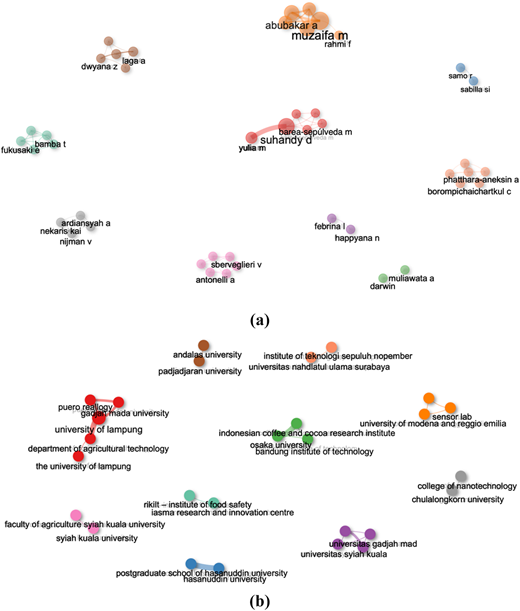
Based on data from the Scopus database (2004–2025), the collaboration network among civet coffee researchers exhibits distinct clustering, indicating that most scholarly partnerships occur within specific groups rather than across the broader research community (Figure 4a). Central researchers such as Suhandy D. and Yulia M. frequently co-author with multiple collaborators, forming dense, well-connected clusters. In the Bibliometrix-generated network, node size reflects publication volume or degree centrality, while edge thickness indicates the strength of co-authorship ties. Isolated nodes represent independent or infrequent contributors. This structure highlights the presence of core research groups with limited inter-cluster collaboration, where a few key authors serve as bridges between otherwise disconnected clusters.
Institutional collaborations (Figure 4b) also form well-defined clusters. Indonesian institutions such as the University of Lampung and the Indonesian Coffee and Cocoa Research Institute are central to a prominent domestic cluster, reflecting strong national collaboration. A separate institutional cluster centres around Syiah Kuala University, while Chulalongkorn University in Thailand represents a more technologically oriented cluster focused on nanotechnology. International linkages, though fewer, include collaborations between Indonesian institutions and partners such as the Rikilt Institute of Food Safety (Netherlands) and the University of Modena and Reggio Emilia (Italy). These patterns suggest that collaboration is strongly shaped by institutional focus and geographic proximity.
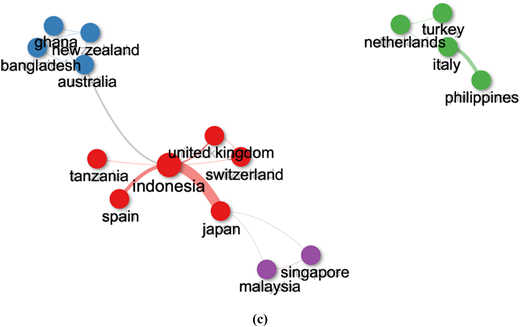
At the country level (Figure 4c and Table S4), Indonesia emerges as the central hub in global civet coffee research, with the highest number of collaborations, particularly with Japan (5 publications) and Spain (3 publications). Moderate partnerships are also observed with Australia and the United Kingdom (2 publications each). Smaller but noteworthy collaborations involve countries such as Bangladesh, New Zealand (e.g. Adadi et al., 2024), and Switzerland, often through multi-country efforts (e.g. Nijman et al., 2024). A European cluster—comprising Italy, Turkey, and the Netherlands—demonstrates strong regional cooperation (e.g. Özdestan et al., 2013; Ayseli, 2024), while an Asian cluster including Japan, Malaysia, and Singapore reflects active intra-regional collaboration (e.g. Watanabe et al., 2020). In Bibliometrix visualisations, larger nodes denote countries with higher publication output or centrality, and thicker edges signify stronger co-authorship links. Overall, the analysis reveals both Indonesia’s central role and the emerging potential for expanded international research partnerships.
3.5 Citation analysis
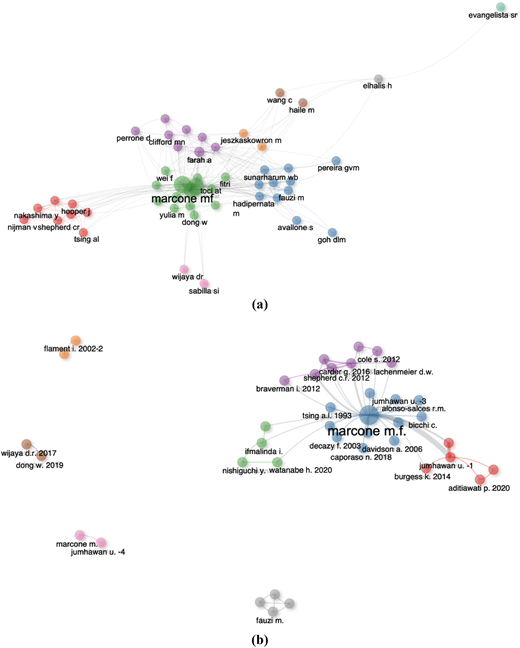
The network of authors in civet coffee research consists of distinct clusters, as shown in Figure 5a and outlined in Table S5. These clusters reveal that specific authors or groups are often cited together, reflecting their influence or shared research perspectives. Nine clusters, represented in different colours, are centred around influential authors such as Marcone M.F., Jumhawan U., and Muzaifa M. in Cluster 3 (green). These authors show high betweenness, closeness, and PageRank values, highlighting their roles as connectors and leaders in the field. Cluster 3 (green), with the most prominent authors, suggests a particularly active and diverse research community. These clusters likely represent research schools or traditions with shared methodologies or theoretical frameworks.
Figure 5b illustrates a similar network of citations, showing that specific articles are frequently cited together, underscoring their influence in the field. A prominent cluster centres around the works of Marcone M.F. and Jumhawan U., along with other highly cited articles such as Decazy (2003), Davidson (2006), and Caporaso (2018). Another cluster includes Wijaya (2017) and Dong W. (2019), representing another group of influential articles. Smaller clusters depict additional groups of frequently cited works, likely reflecting various research traditions within civet coffee studies.
3.6 Evolution of research themes and emerging trends in civet coffee studies (2004–2025)
The historiography from the bibliometric analysis of civet coffee studies in the Scopus database (2004–2025), as shown in Figure S3, visualises a network of publications, with node size reflecting citation counts and lines depicting co-citation relationships. A significant example is the central node “Marcone M.F., 2004,” which is highly influential, as indicated by its large size and numerous connections. The network reveals evolving clusters over time, such as the early emphasis on “Marcone M.F., 2004” (2004–2013) and later clusters around “Jumhawan U., 2016” and “Hendrawan Y., 2019” (2016–2025), suggesting emerging research themes and new methodologies. As shown in Figure S3, by tracing the chronological development of key research themes, influential works, and notable authors, the historiographical analysis offers insights into the intellectual structure of civet coffee research. This helps identify foundational studies, major turning points, and emerging topics, while also highlighting trends in the field, shifts in research directions, and methodologies. It also guides future studies, emphasising areas for further exploration, such as ethical considerations, biochemical analysis, and sustainable practices.
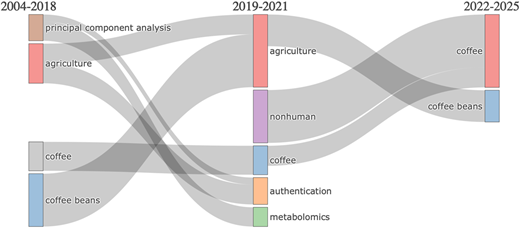
Figure 6 presents a Sankey diagram illustrating the evolution of research themes in civet coffee studies from 2004 to 2018, 2019 to 2021, and 2022 to 2025. The width of the bands indicates each theme’s relative frequency during these periods. Key observations show a shift in research focus: from an emphasis on agriculture and coffee in the initial period (2004–2018) to the diversification of themes such as “nonhuman” and “authentication” in 2019–2021, followed by a focus on “coffee” and “coffee beans,” alongside the rise of “metabolomics,” in the most recent period (2022–2025). The changing width of the bands reflects evolving research interests, such as the decline of the “agriculture” band and increased attention to “coffee beans,” highlighting a growing focus on their chemical composition and quality. The emergence of new themes such as “nonhuman” and “metabolomics” suggests novel research directions, including ethical considerations, animal welfare, and the chemical profiles of civet coffee that influence flavour and quality.
Trend topics in civet coffee studies from 2004 to 2025, analysed using the Keyword Plus feature of published articles in the Scopus database, were illustrated using bibliometrics with a minimum word frequency of five and at least three words per year (Figure S4). These analyses highlight evolving research interests over distinct periods. Between 2013 and 2017, there was an initial surge in focus on terms such as “discriminant analysis” and “Kopi Luwak,” reflecting interest in identifying unique characteristics and traditional production practices. From 2017 to 2019, attention shifted to broader biological and agricultural topics, including “Coffea arabica” and “Viverridae.” Between 2019 and 2021, research emphasised scientific and analytical approaches, including “gas chromatography” and “fermentation.” From 2021 to 2023, topics such as “Indonesia” and “animal welfare” gained prominence, highlighting ethical and regional considerations. By 2023–2025, emerging terms such as “nonhuman” and the continued focus on “animal welfare” indicated a growing concern for ethical and ecological impacts. These trends suggest future research directions in ethical production practices, biochemical analysis, and sustainable agriculture in civet coffee studies.
The key takeaway from the historiography and trend analysis of civet coffee studies is that the field has evolved significantly, shifting from early agricultural and coffee-centric research to more diverse and specialised areas. Emerging topics include ethical considerations, animal welfare, biochemical analysis, and sustainable practices. As research continues to expand, themes such as “metabolomics,” “coffee beans,” and “nonhuman” are gaining attention, indicating a future direction that integrates ethical concerns with scientific and ecological insights. This evolution underscores the importance of understanding both the production processes and the effects of civet coffee on animals and the environment.
3.7 Content analysis of civet coffee research in Scopus
The analysis of 97 civet coffee publications in Scopus (2004–2025) reveals a diverse distribution across key research themes (Figure S5). The largest category, Miscellaneous (33, 34%), includes articles without specific titles or those not fitting defined themes. This is followed by Authentication and Discrimination of Civet Coffee (16, 17%), focusing on authenticity verification; Civet Coffee Processing and Chemical Composition (13, 14%), which examines production methods and chemical properties; Civet Coffee Quality and Sensory Evaluation (9, 9%), assessing taste and aroma; Environmental Impact of Civet Coffee (9, 9%), exploring sustainability and ecological effects; Fermentation and Microbial Influence (8, 8%), investigating microbial roles; Civet Coffee Tourism and Ethical Considerations (8, 8%), addressing tourism and ethics; and Civet Coffee Technology and Innovation (5, 5%), focusing on production advancements. This distribution reflects broad research interests, from chemical and sensory properties to environmental and ethical concerns. The high percentage of miscellaneous articles suggests a need for more precise classification or the presence of unique studies.
3.7.1 Authentication and discriminant of civet coffee
Civet coffee, among the most expensive coffees globally, owes its distinctive flavour and aroma to the enzymatic and microbial biotransformation within the digestive tract of civets. However, the high market value has led to widespread adulteration, prompting the development of rapid and reliable authentication methods. As summarised in Adadi et al. (2024), recent technological advancements have significantly improved the ability to distinguish genuine civet coffee from imitations.
Numerous studies have focused on volatile compound profiling. For example, Ongo et al. (2012) and Sberveglieri et al. (2014) used electronic nose (e-nose) and GC-MS to characterise aroma profiles, finding distinct differences between civet and regular coffee due to the influence of fermentation and bean origin. Prajna et al. (2024) further enhanced this approach by applying HS-GCMS coupled with machine learning algorithms, such as Support Vector Machine (SVM) and Random Forest (RF), achieving accuracy rates of 90 and 100%, respectively, in differentiating between wild and farmed civet coffee.
To address market fraud, rapid and cost-effective tools such as UV–Visible spectroscopy combined with chemometric models such as PLSR and Support Vector Machine Regression (SVMR) have been proposed by Suhandy and Yulia (2017, 2019b). These techniques yielded high residual predictive deviation (RPD > 3), indicating excellent predictive capacity for detecting civet coffee content in blends. Moreover, Hendrawan et al. (2022) developed a low-cost classification method using visible light cameras and deep learning models (e.g. GoogLeNet, ResNet-50), achieving classification accuracies up to 89.65%.
Emerging non-destructive approaches such as near-infrared spectroscopy (NIRS) and fluorescence spectroscopy have also shown promise. Arboleda (2018) applied NIRS with artificial neural networks (ANN), yielding 95–100% classification accuracy. Suhandy et al. (2018) used fluorescence spectroscopy with SIMCA (Soft Independent Modelling of Class Analogies) to differentiate Indonesian speciality coffees, including civet coffee, with perfect sensitivity and specificity. In addition, advanced tools such as proton-transfer-reaction time-of-flight mass spectrometry (PTR-ToF-MS) offer real-time volatile profiling and have demonstrated strong discriminatory power when combined with chemometric models (Adadi et al., 2024).
Collectively, these tools provide reliable, non-invasive solutions for authenticating civet coffee and safeguarding its quality and market integrity (Table S6).
3.7.2 Processing and chemical composition
Civet coffee has been extensively studied to understand its chemical and sensory attributes. The fermentation processes involved, including digestive bioprocessing by civets and monsooning, significantly influence the volatile compounds in the coffee beans. Monsooning, which involves exposing green coffee beans to moist monsoon winds for three to four months along the Malabar coast of Southern India, induces natural fermentation (Variyar et al., 2003). For example, civet green beans contain compounds such as pentamethyl heptane and 3-methyl-1-butanol, while monsoon beans feature a broader range of compounds, such as alkyl butanols and benzaldehyde (Kim et al., 2019). Although roasting tends to reduce these differences, some compounds remain distinctive, such as α-pinene in civet coffee and 2-methyl furan in monsoon coffee. Advanced chemometric methods, such as PLS-DA (partial least squares – discriminant analysis), effectively differentiate fermented coffee beans based on their volatile profiles (Kim et al., 2019).
Roasting and fermentation also influence the amino and fatty acid profiles of civet coffee. While lipids and caffeine remain relatively stable, chlorogenic acids tend to degrade during roasting (Muzaifa et al., 2020). In vitro and in vivo fermentation studies have shown that higher concentrations of civet coffee isolates reduce protein content, with molecular weight profiles varying based on fermentation conditions (Uliyandari et al., 2021). Enzymatic treatments involving pepsin and trypsin have been found to increase soluble protein content, though roasting modifies these effects (Pakosz et al., 2024). The use of cellulolytic bacteria during fermentation also enhances the bioactive and sensory properties of Liberica coffee (Tarigan et al., 2024).
Metabolomics studies, including NMR (nuclear magnetic resonance) and LC-MS/MS (Liquid Chromatography-Tandem Mass Spectrometry), reveal elevated levels of alanine, citrate, and lactate in civet coffee, along with unique bioactive markers such as kahweol and chlorogenic acid lactones (Febrina et al., 2021; Farag et al., 2023). Roasted civet coffee also shows higher levels of guaiacol derivatives and pyrazines that contribute to its distinctive flavour. Amino acid profiles shift during roasting, with glutamic acid commonly found as the most abundant (Muzaifa et al., 2019a, b). Ifmalinda et al. (2018) used GC-MS (Gas Chromatography-Mass Spectrometry) to differentiate civet coffee from Arabica by identifying volatile compounds like maltol and pyrazines.
Civet coffee exhibits a balanced aromatic and antioxidant profile (Cheong et al., 2013), and the digestion process—whether by civet or Jacu bird—alters caffeine and chlorogenic acid levels (Ripper et al., 2022). Jeszka-Skowron et al. (2022) reported higher levels of caffeine and theophylline in civet coffee than in other Arabica varieties, though phenolic acid, and vitamin B3 levels did not differ significantly.
These findings, detailed in Table S7, confirm that civet coffee’s premium value is rooted in a complex interplay of fermentation, enzymatic treatments, and chemical transformations that enhance both its sensory appeal and nutritional profile.
3.7.3 Fermentation and microbial influence
The fermentation of civet coffee, facilitated by gut microbiota and digestive enzymes, plays a central role in defining its flavour and biochemical properties. Adadi et al. (2024) provided comprehensive insights into microbial communities and their role in flavour generation.
Iswanto et al. (2023) isolated caffeine-degrading bacteria, such as Klebsiella spp., from civet faeces that reduced caffeine by up to 66%. Darwin et al. (2021) demonstrated that fermentation using civet faecal suspensions reduced glucose levels and caffeine content by over 90%. Fitri et al. (2021b, c) identified LAB strains—Leuconostoc b)pseudomesenteroides and Weissella cibaria—capable of producing protease, lipase, and cellulase, all of which enhance aroma and flavour.
In vitro fermentation methods using microbes isolated from civets have been developed as ethical alternatives. For instance, Watanabe et al. (2020) identified Gluconobacter spp. containing genes linked to flavour biosynthesis. Muzaifa et al. (2023) isolated yeasts such as Wickerhamomyces anomalus and Trichosporon asahii, which enhanced flavour when used as fermentation starters. Fauzi et al. (2023) created dried starter cultures from LAB obtained from the civet caecum, combined with rice and coffee cherry peel flour, resulting in improved flavour under controlled fermentation.
Other microbial strategies include the use of Bacillus subtilis in submerged fermentation, which improved sensory qualities and acidity (Fauzi and Hidayati, 2016). Chen et al. (2024) simulated gastrointestinal fermentation with pepsin and pancreatin, reducing bitterness by 24–38% and modifying bean surface morphology.
These findings, summarised in Table 2, demonstrate that civet-associated microbiota can be effectively utilised in artificial systems to replicate the unique attributes of civet coffee. Ex-situ fermentation using bioreactors and enzymatic treatments presents a promising, ethical, and scalable approach to maintain quality while addressing concerns about animal welfare.
3.7.4 Civet coffee quality and sensory evaluation
Civet coffee is widely celebrated for its smooth texture, complex aroma, and mellow flavour—qualities largely attributed to the unique digestive biotransformation that occurs in the gastrointestinal tract of the Asian palm civet (Paradoxurus hermaphroditus). This process alters the chemical composition of the coffee beans, reducing certain bitter compounds and generating new flavour precursors. A study by Nadzirah et al. (2020) demonstrated increased expression of bitter taste receptors (T2Rs) in animals consuming civet coffee, suggesting that modified bitter compounds produced during digestion influence sensory perception through altered gustatory responses.
Chemical and sensory qualities of civet coffee are further influenced by post-digestion processing such as roasting and grinding. Suhandy and Yulia (2019a, b) demonstrated that variations in particle size affect UV-visible spectral profiles, and that chemometric models such as PLS1 and PLS2 can effectively compensate for these variations during quality authentication. Ayseli (2025) provided a comprehensive review of volatile and non-volatile compounds that contribute to coffee quality, identifying furans, pyrazines, aldehydes, ketones, and lipid-derived volatiles as key aroma contributors, particularly in civet and other speciality coffees. These compounds are shaped by microbial and enzymatic reactions during digestion and are further modified during roasting through Maillard reactions and thermal degradation processes, which also transform non-volatile compounds such as chlorogenic acids, caffeine, and trigonelline, affecting flavour intensity, bitterness, and antioxidant capacity. Ayseli also emphasised the potential of multi-omics tools, including metabolomics and sensory profiling, to enhance traceability and quality assurance in premium coffees.
Environmental conditions during cultivation also play a significant role. Withaningsih et al. (2018) reported that higher abundance and diversity of pollinator insects, supported by flowering understory vegetation, improved coffee fruit quality, which in turn enhanced the sensory profile of the final product. Studies by Durek de Conti et al. (2013) and Kulapichitr et al. (2015) confirmed that civet coffee could be distinguished from conventional coffees using sensory panels and electronic tongue analysis, with flavour differences linked to processing method (wild vs. caged civets) and geographical origin.
Microbial communities are central to civet coffee’s transformation. Muzaifa et al. (2018) found that wild and caged civet coffee shared similar lactic acid bacteria (LAB) community profiles and sensory characteristics. Some LAB strains demonstrated proteolytic activity, suggesting they contribute to flavour development through protein breakdown and peptide release. Noorazwani et al. (2021) highlighted the effects of fermentation and roasting on organic acids and bioactive compounds, noting significant changes in caffeine, acetic acid, and chlorogenic acid levels that influence taste, acidity, and antioxidant activity.
Patria et al. (2018) further revealed a strong correlation between caffeine content and sensory attributes such as aroma, flavour, and cupping score. This highlights the importance of both biological processing and chemical composition in defining civet coffee’s exceptional quality. Collectively, these studies underscore that civet coffee’s unique flavour profile results from a complex interplay of digestion, microbial activity, thermal processing, and ecological factors. Understanding these mechanisms offers a foundation for developing ethical and reproducible fermentation techniques that preserve civet coffee’s sensory appeal without the need for animal involvement.
3.7.5 Civet coffee tourism and ethical considerations
Civets, members of the Viverridae family, are often overlooked in scientific research despite their widespread presence in Southeast Asia and Africa. Recent studies highlight the intersection of animal welfare, conservation, and colonialism within civet-based tourism, particularly the global management of civets in zoos and the production of civet coffee in Asia (Hooper, 2023b). Civet coffee involves the partial digestion of coffee beans by the Asian palm civet (P. hermaphroditus), and its production has led to a growing tourism industry in Bali, where civets are often kept in poor conditions for tourist displays (Carder et al., 2016; Hooper, 2023a, 2024). Research analysing TripAdvisor reviews reveals that tourists generally perceive these practices as exploitative, raising concerns about animal welfare and the authenticity of the experience (Hooper, 2023a; Lewis-Whelan et al., 2024). Studies also highlight the ethical implications of caged civet coffee production, contrasting it with traditional methods of collecting scat from wild civets, and call for improved welfare standards and the enforcement of trade laws (Carder et al., 2016; Lewis-Whelan et al., 2024). Furthermore, the marketing of civet coffee and its potential for agrotourism are examined, stressing the need for strategies that balance economic benefits with environmental ethics (Deliana et al., 2021; Pratono and Radjamin, 2012; Satriawan et al., 2015). These studies advocate for decolonising animal-based tourism and promoting ethical practices to ensure both civet welfare and industry sustainability.
3.7.6 Civet coffee technology and innovation
Civet coffee technology and innovation have seen significant advancements, as highlighted by various studies. Nufiqurakhmah et al. (2016) used Laser-Induced Breakdown Spectroscopy (LIBS) to assess civet coffee quality by analysing elemental content and identifying markers such as Ca, W, Sr, Mg, and H, which differentiate civet coffee from regular beans. Salengke et al. (2019) developed an ohmic-based fermentation technology that improved flavour quality, achieving higher cup-test scores than traditional civet coffee. Suhandy and Yulia (2019b) explored combining ultraviolet-visible (UV–Vis) spectroscopy with Support Vector Machine Regression (SVMR) for authenticating civet coffee, demonstrating its effectiveness in quantifying civet content in coffee blends. Misto et al. (2018) investigated nanoencapsulation for bacterial starters in artificial civet coffee fermentation, finding that maltodextrin significantly enhanced the viability of Proteus penneri and Bacillus aerophilus during storage. Hadipernata and Nugraha (2018) developed a bioreactor system to simulate civet digestion, producing artificial civet coffee with proximate analyses and taste profiles such as those of original civet coffee, though with slightly lower caffeine content. These innovations collectively enhance civet coffee’s quality, authenticity, and production efficiency.
3.7.7 Civet coffee and environmental impact
The environmental and ethical implications of civet coffee production are multifaceted, encompassing issues related to habitat suitability, wildlife trade, animal welfare, and sustainability. Chairani et al. (2017) conducted a land suitability assessment for civet Arabica coffee cultivation in Indonesia, identifying temperature, rainfall, and soil properties as critical environmental determinants. Their findings underscored the necessity of integrated land-use planning that supports both sustainable coffee agriculture and the preservation of civet habitats.
Despite such efforts, the illegal trade and exploitation of civets remain persistent. Nijman et al. (2024) documented ongoing violations of wildlife protection laws in Indonesia, where civets continue to be trafficked to produce kopi luwak. These practices undermine national commitments to the Sustainable Development Goals (SDGs), particularly those related to biodiversity conservation and the reduction of illegal wildlife trade. Nakabayashi et al. (2016) further warned that escalating civet captures, coupled with habitat alteration, pose serious risks to wild populations, even though civets exhibit some adaptability to anthropogenic landscapes.
Ethical concerns are equally pressing, especially regarding commercial civet farms. Intensive farming conditions often subject civets to malnutrition, chronic stress, and diseases, compromising animal welfare (Hooper, 2023b; Indriyani et al., 2023). Moreover, the tourism-driven practice of displaying caged civets for public attraction and the fraudulent blending of regular coffee beans with civet-labelled products exacerbate both ethical and economic issues (Adier et al., 2020). Cahill (2020) criticised the industrialisation of civet coffee, arguing that it has transformed the historically symbiotic human–civet relationship into one of commodification and exploitation.
From a conservation perspective, studies such as Winaya et al. (2020) have highlighted the need to monitor genetic diversity and morphometric variation in civet populations to ensure long-term ecological viability. However, despite these insights, research gaps persist. Few studies have evaluated the cumulative ecological impact of civet coffee production on biodiversity, land degradation, and ecosystem services. Alternative methods such as microbial or enzymatic fermentation, which offer ethically and environmentally sustainable production pathways, remain underexplored in terms of scalability and sensory comparability (Arboleda, 2018).
Furthermore, although bibliometric analyses are useful for mapping publication trends and institutional affiliations, they often lack the conceptual depth necessary to critically assess environmental and ethical dimensions (Ahmad Saadi et al., 2023; Alshawabkeh et al., 2024; Sangwan and Maity, 2024). Future research should adopt interdisciplinary approaches to holistically evaluate the socio-ecological impacts of civet coffee, integrate traceability systems, and support the development of certification schemes that promote transparency, animal welfare, and ecological sustainability.
4. Conclusion and future directions
Despite recent advancements, several important research gaps remain. There is currently no widely adopted certification framework that guarantees both product authenticity and animal welfare standards. Additionally, empirical research on consumer perceptions—particularly regarding the acceptability of civet-free or lab-fermented alternatives—is still limited. Environmental sustainability assessments of civet coffee production, including life cycle analysis and ecological impact, are also underexplored. Addressing these gaps is crucial for guiding future interdisciplinary research and aligning industry practices with ethical, ecological, and market-based priorities.
This bibliometric analysis covering the period from 2004 to 2024 reveals an expanding body of research focused on civet coffee, particularly in areas such as authentication techniques, chemical composition, production methods, and ethical concerns. Indonesia remains the primary hub of scholarly output, reflecting both the origin and dominance of civet coffee production and research. Analytical advancements—especially in spectroscopy, chromatography, and metabolomics—have enhanced the capacity to differentiate authentic civet coffee from counterfeits and to understand its unique chemical profile. However, despite technological progress, critical issues persist regarding animal welfare, environmental sustainability, and market transparency.
Future research must pivot towards humane and sustainable production approaches. As highlighted in the recent review by Adadi et al. (2024), biofermentation technologies—such as microbial and enzymatic processes—present promising alternatives to conventional civet-based methods. These techniques simulate gastrointestinal transformations during digestion, while eliminating the ethical issues tied to caged civet use. In addition to replicating the flavour and aroma profiles of traditional civet coffee, these methods offer scalability, safety, and production consistency. The integration of omics-based tools, such as metabolomics, proteomics, and genomics, can further enhance our understanding of the molecular pathways that define civet coffee’s sensory attributes. Furthermore, machine learning and artificial intelligence hold significant potential for advancing quality control, traceability, and fraud detection across the value chain.
Environmental sustainability should also be a central focus of upcoming studies. Life cycle assessment (LCA) and ecological footprint analyses are needed to evaluate the broader environmental impacts of civet coffee production, including land use change, carbon emissions, and water consumption. Findings from such studies can inform eco-labelling initiatives and guide policy decisions. In parallel, efforts must be made to establish rigorous, internationally recognised animal welfare certification schemes to ensure that civets are not subjected to inhumane treatment.
Equally important is the need to understand consumer perspectives. Research should explore factors influencing consumer willingness to adopt civet-free or lab-fermented alternatives, as well as their ethical purchasing behaviours, sensory preferences, and trust in certification systems. Insights into consumer trends will be vital in shaping transparent marketing strategies, supporting ethical branding, and encouraging responsible consumption.
In sum, the future of civet coffee research lies in the convergence of food science, biotechnology, environmental studies, animal ethics, and consumer behaviour. Addressing current challenges through interdisciplinary collaboration and innovative technologies can pave the way for a more ethical, sustainable, and scientifically grounded civet coffee industry that meets the expectations of both global markets and conservation priorities.
The supplementary material for this article can be found online.