Skip to article sections

Education is one of the fields that has improved rapidly as a direct result for the development of information and communications technology (ICT), and stimulated to adopt e-learning. E-learning directly resulted from the integration of education and technology and is increasingly considered a powerful medium for learning.

E-learning has facilitated learning by delivering a learner-centered and interactive learning environment to anyone, anywhere, and anytime (Khan, 2005). In addition, it plays a significant role in shifting from teacher-centered to student-centered education (Taha, 2014, p. 2).

Despite e-learning’s successful implementation, a considerable number of e-learning projects fail to achieve their goals, and face slow progress and increasing dropout rate (Frimpon, 2012; Liaw, 2008). In addition, evaluating the success of e-learning systems is still an issue facing e-learning stakeholders.

ROA significant number of studies have focused on the issue of e-learning success. In fact, they fulfil the needs of e-learning stakeholders to a certain extent but do not meet all of the requirements. There remain disagreements about the factors that are most influential in measuring e-learning systems’ success. This direction of research has received little attention for developing an overarching model that can assess e-learning systems’ success from different perspectives.

This study aims to fill this void by proposing a comprehensive model for evaluating the success of e-learning. The significance of this study is in identifying the determinant factors and constructs impacting the success of e-learning systems and group these factors in a model that is believed to be holistic because different perspectives are considered in developing the model.

E-learning systems are multidisciplinary systems, for which consensus on their definition has not been achieved (Al Sabaway, 2011; Lee, Choi, & Kang, 2009; Ozkan & Koseler, 2009). Many researchers have evaluated e-learning systems from computer science, information systems, psychology, pedagogy, and technology perspectives.

Various methods, frameworks, and models have been introduced to measure e-learning systems’ success. The contributions to evaluating e-learning systems’ success can be categorized into four such approaches: technology acceptance model (TAM); the DeLone and McLean IS success model (D&M); user satisfaction models; and e-learning quality models.

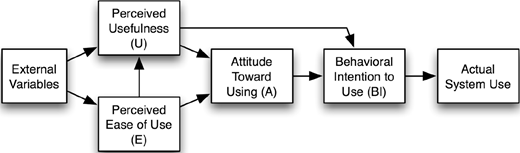
TAM is a widely used model in the information system field. It was developed first in 1989 (Figure 1) to measure the success of a new technology in terms of the acceptance and use of this technology. The model presumes that there are factors that impact the users’ decisions when they face a new technology.

In the context of e-learning, many studies adopted TAM to evaluate the success of e-learning in the same manner as information systems success (Hayashi, Chen, Ryan, & Wu, 2004; Lee, Choi, et al., 2009; Liaw, 2001; Limayem & Cheung, 2008; Martins & Kellermanns, 2004; McFarland, 2001; Ngai, Poon, & Chan, 2007; Ong & Lai, 2006; Roca, Chiu, & Martínez, 2006; Sánchez & Hueros, 2010; Selim, 2003, 2007; Stoel & Lee, 2003; Wang & Chiu, 2011; Yi & Hwang, 2003). These studies vary between validating and testing the robustness of the model by providing empirical evidence on the existing relationships between model factors, to studies that have changed the model’s constructs and extended it to include factors applicable in the context of e-learning.

From the studies found in the literature, it is evident that TAM is a commonly used model. TAM has been adopted and/or extended to include other factors that influence the acceptance of e-learning. It is concluded from previous research that some factors are more outstanding than others and have a significant impact on the acceptance of e-learning systems, for example, self-efficacy, while others need more investigation, for instance, habit, gender, and perceived resources.

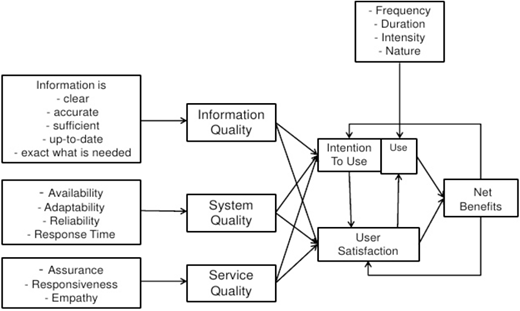
The D&M model is a common model that has been used for measuring the success of information systems. It has been extensively cited in academic papers, and reportedly used in over 300 (Delone & McLean, 2003). The D&M model is one of the most important models in information systems. It first appeared in 1992 and was updated in 2003 to include six constructs (Figure 2): system quality, information quality, service quality, use, user satisfaction, and net benefit.

The D&M model was applicable in the field of e-learning in the same manner (Adeyinka & Mutula, 2010; Almarashded, Noraidah, Azan, & Mukhtar, 2010; Hassanzadeh, Kanaani, & Elahi, 2012; Holsapple & Lee-Post, 2006; Hsieh & Cho, 2011; Klobas & McGill, 2010; Lee & Lee, 2008; Lin & Lee, 2006; Lin, 2007, 2008; Masrek, Jamaludin, & Mukhtar, 2010; Wang & Wang, 2009). The validity of the model has been tested by measuring the success of e-learning as a whole or partially and others have extended this model by including other factors that influence the success of e-learning. Other researchers have combined the model with other models and theories to explore widely the factors affecting the success of e-learning systems (Al Sabawy et al., 2011).

The D&M model has been successfully used for measuring the success of different e-learning systems and most of the studies empirically demonstrated its validity and reliability.

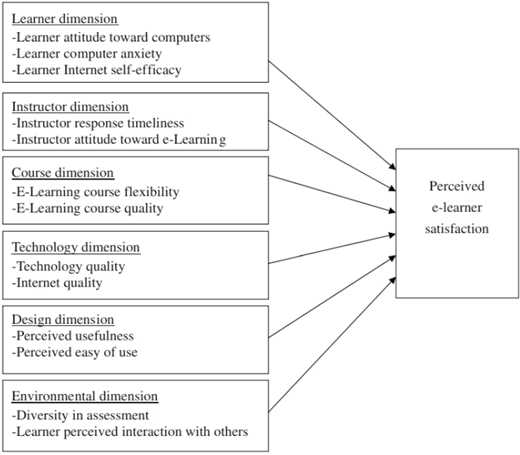
The user satisfaction approach has been used widely by researchers in the field of e-learning (Kang & Lee, 2010; Leclercq, 2007; Ong & Lai, 2007; Pike Tayles & Abu Mansor, 2010). Sun, Tsai, Finger, Chen, & Yeh (2008) developed a six-construct model to measure e-learning based on learner, instructor, course, technology, design, and environment (Figure 3). The results of the study revealed that learner computer anxiety, instructor attitude toward e-learning, e-learning course flexibility, e-learning course quality, perceived usefulness, perceived ease of use, and diversity in assessments are the critical factors affecting learners’ perceived satisfaction (Sun et al., 2008).

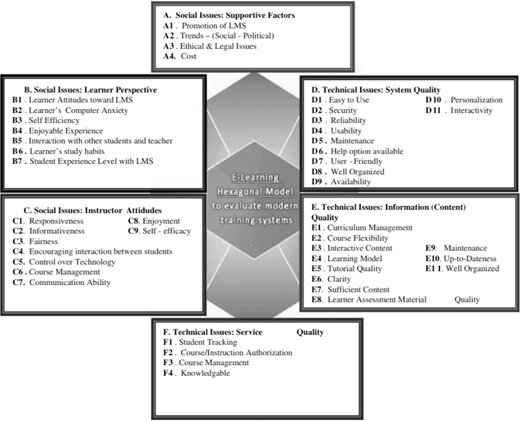
Ozkan and Koseler (2009) assessed the user’s satisfaction with learning management system (LMS) and proposed a multidimensional model via six dimensions (Figure 4): system quality, information quality, service quality, supportive factors, learner perspective, and instructor attitudes.

In 2010, Naveh, Tubin, and Pliskin conducted a study to investigate students’ use and satisfaction of LMS and the relation between these two factors and organizational factors. According to this study, use and satisfaction are significantly correlated with organizational variables: course content and size, instructor status, and the existence of interactive functionalities like forum showed significant correlation with LMS use. The study also reveals low correlation between course discipline and satisfaction.

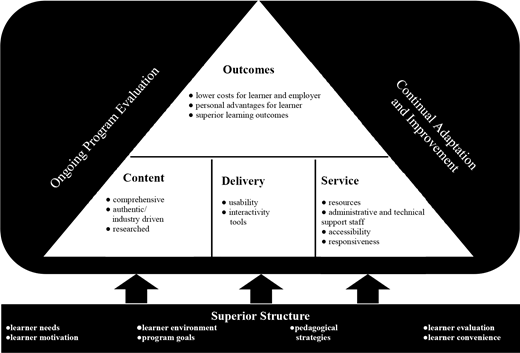
Different approaches and models have emerged to assess the overall quality of e-learning, for example, MacDonald, Stodel, Farres, Breithaupt, & Gabriel’s (2001) demand-driven learning model (DDLM) (Figure 5).

The demand-driven learning model was developed to evaluate the benefits of web-based learning. It has five main components: the quality standard of “superior structure,” three consumer demands (content, delivery, and service), and learner outcomes (MacDonald et al., 2001).

Another approach to measure the quality of e-learning was introduced by Ehler (2004) based on the learner’s perspective. This study was developed to identify the critical indicators adopted by learners to evaluate the quality of e-learning. The study identified seven main constructs used by learners for assessing the quality of e-learning: tutor support, cooperation and communication in the course, technology, cost-expectations-value, information transparency, course structure, and didactics.

In 2007, Ehlers provide a new model for e-learning quality based on the participation of educational stakeholders. The model identified four dimensions of quality: knowledge, experience, innovation, and analysis.

Pawlowski, Barker, and Okamoto (2007) presented ISO/IEC 19796-1 and compared it with existing approaches of e-learning quality. Abdellatief, Sultan, Jabar, and Abdullah (2011) proposed a model for e-learning quality based on developer’s view with four main measurement indicators service content, system functionality, information technology and system reliability and proposed 11 subcharacteristics with its attributes by following the structure of standard IOS/IEC 912.

Considerable research has focused on measuring e-learning quality and proposing models and indicators for this purpose. However, the complexity and generality of the “quality” concept is an issue encountered by researchers. In addition, the varied e-learning stakeholders put more pressure to identify the measurements most suitable for each group.

In order to develop a model for evaluating the success of e-learning systems, we used the constructs of the four models: (D&M) model; TAM; User Satisfaction Models; and E-learning Quality Models. In spite of all their strengths, the four models still have defects (Hassanzadeh et al., 2012), they partially fulfil the needs of e-learning success assessment, and they need to be customized for e-learning areas. In addition, there is still room for improvements and extensions (Marangunic & Granic, 2013). In this article, to propose a more comprehensive model, a synthesis of these previous models is presented.

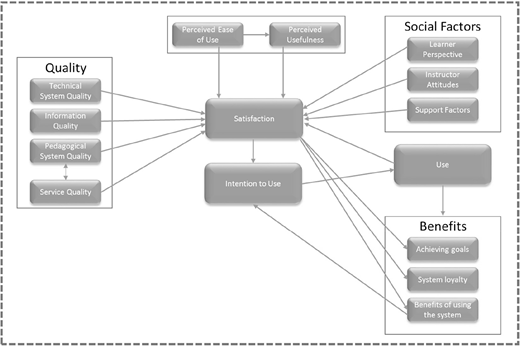
Based on the results and analysis of the literature review, a conceptual model is proposed. The model is believed to be comprehensive for measuring the success of e-learning system. The model is based on six perspectives: quality; usefulness; satisfaction; user attitude; social factors; and benefits of using the system.

The selection of the model constructs is based on the four approaches for evaluating the success of e-learning: DeLone and McLean, TAM, Satisfaction, and Quality approaches and based on their importance in measuring the success of e-learning systems field.

In order to build a model for evaluating e-learning systems success we used, first, the D&M model measurements. Because this model was developed to measure information systems success and these systems have no pedagogy theme, it has to be customized for the e-learning area.

The technical quality is another important determinant of the quality of e-learning, and technical problems strongly influence the overall success and satisfaction of users. On the other hand, students are very concerned about the quality of the information (course content) to be clear, easily understandable, appropriate breadth, and has up-to-date content. As a result, a more customized version, to meet the specific needs of the students, is needed.

So we incorporated the Quality construct with four measures (Technical System Quality, Pedagogical System Quality, Information Content, and Service Quality). The System Quality was decomposed into two factors, technical and pedagogical system quality, as suggested by Hassanzadeh et al. (2012) and Ozkan and Koseler (2009) to be appropriate in the context of e-learning.

Technical System Quality is related to technical success of the issues related to the system (DeLone & McLean, 2003) and measured by the indicators in Table 1.

Pedagogical System Quality consists of the quality measures according to the educational functionalities and capabilities that facilitate teaching and learning (Lee 2010; Hassanzadeh et al., 2012), for example, existence of features like chats and forums that facilitate interactivity and communication with other students and instructors. The Table 2 summarized the pedagogical system quality factors.

Information Quality (Content) is the measure of system semantic success (Delone & McLean, 2003) that is related to the quality of the output (Wang & Wang, 2009) (see Table 3).

The last theme in the Quality construct is Service Quality. The quality of the service delivered through electronic media has received noteworthy attention in the context of e-learning (Al Sabawy, 2012). Four indicators were employed to gauge service delivery quality in e-learning (see Table 4).

Benefits of using the system, in a restricted sense, is the impact of using the e-learning system on an individual or group. This construct assesses the different benefits obtained from using the system. In a broader sense it is the benefit to the organization and community as a whole. For the purposes of developing our model, only benefits of using the system on individuals are considered with three determinants: achieving goals; system loyalty; learning benefits. The broader benefits of using the e-learning systems are beyond the scope of the present study, so it was excluded. Indicators of the benefits construct supported by related studies are presented.

Achieving Goals is one of the components that has a significant role in measuring the success of e-learning and has to be included in our model. It measures the acquisition of skills that influence achieving the personal goals and improving the academic development of students (see Table 5).

System Loyalty is another factor included in our model, which is related to students’ involvement and dependence on the e-learning systems (see Table 6) (Hassanzadeh et al., 2012; Lin & Lee, 2006).

Learning Benefits are used to measure the student’s performance improvement resulting from using the e-learning system and other benefits of learning in terms of saving students’ time in searching for the information and course materials (see Table 7).

In respect to TAM, ease of use, perceived usefulness, and use are considered the major constructs in this model. The evidence presented by previous studies support the selection of the three constructs to measure e-learning system success. Consequently, it was included in this model.

Ease of Use was defined, according to Davis (1989), as “the degree to which an individual perceives using the e-learning system free of effort” (p. 319). In the e-learning era prior researchers adopted “ease of use” as a central determinate of student satisfaction and the success of e-learning systems. Indicators for ease of use are shown in Table 8.

Perceived Usefulness is a construct employed in this model to predict different factors. It was defined as “The degree to which a person believes that using a particular system would enhance his or her job performance” (Davis, 1989, p. 319). Empirical research has showed the reliability of this construct as a predictor of intention to use. Davis (1989), Joo, Lim, and Kim. (2011), Drennan, Kennedy, and Pisarski (2005), and Hsieh and Cho (2011) found that perceived usefulness had the strongest effect on student satisfaction among the factors that predicted this construct. Table 9 shows the determinants used to gauge this construct.

Intention to Use is an attitude toward using the system (Davis, 1989; DeLone & McLean, 2003) and is defined as the users’ decision to use the system before actually doing so (Hassanzadeh et al., 2012). Table 10 lists details of some studies that targeted identifying the intention to use in the context of e-learning.

User Satisfaction is a fundamental measurement in the success and acceptance of technology. Several studies considered satisfaction as a single construct to evaluate the success of an e-learning system (DeLone & McLean, 2003) or as multiple constructs; (Sun et al., 2008; Ozkan & Koseler, 2009). It was found that user satisfaction is a valuable learner’s attitude construct to incorporate in our model that was validated and supported by several studies (see Table 11).

Social Factors have been considered an important construct in measuring the success of e-learning. Ozkan and Koseler (2009) considered e-learning systems as a sociotechnical entities and the success of e-learning as a combination of “social issues” and “technical issues” and other circumstances. Previous research supported e-learning as social entity being an important indicator for successful systems (Liaw et al., 2007; Selim, 2007; Wang et al., 2007). The technical part in our model is covered in the quality construct adopted from the DeLone and McLean model. Accordingly, social factors with three major determinants (learners, instructors, and supportive issues) are added to our model (see Tables 12 and 13).

As mentioned earlier in this article, quality of e-learning is a complicated concept and metrics for measuring the quality of e-learning are diverse based on different perspectives of different stakeholders. A significant contribution to measure the quality of e-learning, which has been presented by several researchers and has been tested and confirmed in studies, are the supportive issues which are incorporated in our model as “support factors” under social factors construct based on the model proposed by Ozkan and Koseler (2009) (see Table 14).

Another important factor presented under the fourth approach is Academic Performance, which was employed in the Lee and Lee (2008) model. Academic performance is included in our model under the Benefits as suggested by (Hassanzadeh et al., 2012; Lee & Lee, 2008).

According to previous studies on e-learning and the performed analysis, the constructs, factors, and relations between model constructs were identified. As a result, a model for evaluating the e-learning systems success EESS is presented (Figure 6).

This study has proposed a model for evaluating e-learning systems success (EESS) encompassing a collective set of measures associated with e-learning systems. In this article, we have proposed a comprehensive model based on different perspectives in relation to quality, usefulness, social factors, user satisfaction, attitude, and benefits of using the e-learning systems. However, several researchers confirmed, “the success of e-learning is a multidimensional and interdependent construct” (Delone & McLean, 2003) and it is essential to examine the interrelationships between these constructs (Hassanzadeh et al., 2012; Ozkan & Koseler, 2009) in more detail. Therefore, future research efforts will be conducted to focus on and test the relationships between the proposed model constructs within the context of e-learning. Another future endeavor will be to check the validity of the model on learning management systems.

The EESS model is not a fixed and unchanged model and is subject to further and continuous developments. Future research may extend this model through adding the organizational perspective and other indicators to cope with the continuous development and changes in the e-learning field. In this regards, the EESS model is composed of the major constructs and factors which are basics for successful evaluation of e-learning. In conclusion, 52 measures grouped under 7 constructs for measuring the success of e-learning systems will be of great benefit to those involved in e-learning as a guidance to gain a better understanding of the issues related to evaluating the success of e-learning systems.

The EESS model has 52 measures grouped under 7 constructs for measuring the success of e-learning systems.

A portrait of Dimah Al Fraihat with contact information for the University of Warwick Department of Computer Science.
Dimah Al-Fraihat, Department of Computer Science, University of Warwick, UK.

A portrait of Mike Joy with contact information for the University of Warwick Department of Computer Science.
Mike Joy, Department of Computer Science, University of Warwick, UK.

A portrait of Jane Sinclair with contact information for the University of Warwick Department of Computer Science.
Jane Sinclair, Department of Computer Science, University of Warwick, UK.

Abdellatief
,
M.
,
Sultan
,
A. B.
,
Jabar
,
M.
, &
Abdullah
,
R.
(
2011
).
A technique for quality evaluation of e-learning from developers perspective
.
American Journal of Economics and Business Administration
,
3
(
1
),
157
164
.
AbuSneineh
,
W.
, &
Zairi
,
M.
(
2010
). An evaluation framework for e-learning effectiveness in the Arab world. In
P.
Peterson
,
E.
Baker
, &
B.
McGaw
(Eds.),
International Encyclopedia of Education
(pp.
521
535
).
Oxford, England
:
Elsevier
.
Adeyinka
,
T.
, &
Mutula
,
S.
(
2010
).
A proposed model for evaluating the success of WebCT course content management system
.
Computers in Human Behavior
,
26
(
6
),
1795
1805
.
Almarashded
,
I. A.
,
Noraidah
,
S.
,
Nor Azan
,
M. Z.
, &
Mukhtar
,
S. A.
(
2010
).
The success of learning management system among distance learners in Malaysian university
.
Journal of Theoretical and Applied Information Technology
21
(
2
),
80
91
.
Al Sabawy
,
A. Y.
,
Cater-Steel
,
A.
, &
Soar
,
J.
(
2011
,
July
). Measuring e-learning system success (Research in progress). In
Proceedings of the 15th Pacific Asia Conference on Information Systems (PACIS 2011)
(pp.
1
15
).
Brisbane, Queensland, Australia
:
Queensland University of Technology
.
Antonis
,
K.
,
Daradoumis
,
T.
,
Papadakis
,
S.
, &
Simos
,
C.
(
2011
).
Evaluation of the effectiveness of a web-based learning design for adult computer science courses
.
IEEE Transactions on Education
,
54
(
3
),
374
380
.
Basak
,
S. K.
,
Wotto
,
M.
, &
Bélanger
,
P.
(
2016
).
A framework on the critical success factors of e-learning implementation in higher education: A review of the literature
.
World Academy of Science, Engineering and Technology, International Journal of Social, Behavioural, Educational, Economic, Business and Industrial Engineering
,
10
(
7
),
2335
2340
.
Bhuasiri
,
W.
,
Xaymoungkhoun
,
O.
,
Zo
,
H.
,
Rho
,
J. J.
, &
Ciganek
,
A. P.
(
2012
).
Critical success factors for e-learning in developing countries: A comparative analysis between ICT experts and faculty
.
Computers & Education
,
58
,
843
855
.
Bolliger
,
D. U.
,
Supanakorn
,
S.
, &
Boggs
,
C.
(
2010
).
Impact of podcasting on student motivation in the online learning environment
.
Computers & Education
,
55
(
2
),
714
722
.
Bowdish
,
B.
,
Chauvin
,
S.
, &
Vigh
,
S.
(
1998
,
April
).
Comparing student learning outcomes in hypermedia and analogue assisted lectures
.
Paper presented at the annual meeting of the American Educational Research Association
,
San Diego, CA
.
Cheawjindakarn
,
B.
,
Suwannatthachote
,
P.
, &
Theeraroungchaisri
,
A.
(
2012
).
Critical success factors for online distance learning in higher education: A review of the literature
.
Creative Education
,
3
(
8
),
61
.
Davis
,
F. D.
(
1989
).
Perceived usefulness, perceived ease of use, and user acceptance of information technology
.
MIS quarterly
,
13
(
3
),
319
340
.
DeLone
,
W. H.
, &
McLean
,
E. R.
(
2003
).
The DeLone and McLean model of information system success: A ten-year update
.
Journal of Management Information Systems
19
(
4
),
9
30
.
Drennan
,
J.
,
Kennedy
,
J.
, &
Pisarski
,
A.
(
2005
).
Factors affecting student attitudes toward flexible online learning in management education
.
The Journal of Educational Research
,
98
(
6
),
331
338
.
Duan
,
Y.
,
He
,
Q.
,
Feng
,
W.
,
Li
,
D.
, &
Fu
,
Z.
(
2010
).
A study on e-learning take-up intention from an innovation adoption perspective: A case in China
.
Computers & Education
,
55
(
1
),
237
246
.
Ehlers
,
U. D.
(
2004
).
Quality in e-learning. The learners perspective
.
European Journal of Open, Distance and E-Learning, Article
101
,
1
7
.
Ehlers
,
U. D.
(
2007
).
Quality literacy: Competencies for quality development in education and e-learning
.
Educational Technology and Society
,
10
(
2
),
96
108
.
Fetaji
,
B.
, &
Fetaji
,
M.
(
2009
).
E-learning indicators: A multi-dimensional model for planning and evaluating e-learning software solutions
.
Electronic Journal of e-Learning
,
7
(
1
),
1
28
.
Fresen
,
J.
(
2007
).
A taxonomy of factors to promote quality web-supported learning
.
International Journal on ELearning
,
6
(
3
),
351
.
Frimpon
,
M. F.
(
2012
).
A re-structuring of the critical success factors for e-learning deployment
.
American International Journal of Contemporary Research
,
2
(
3
),
115
127
.
Gong
,
M.
,
Xu
,
Y.
, &
Yu
,
Y.
(
2004
).
An enhanced technology acceptance model for web-based learning
.
Journal of Information Systems Education
,
15
(
4
),
365
374
.
Hassanzadeh
,
A.
,
Kanaani
,
F.
, &
Elahi
,
S.
(
2012
).
A model for measuring e-learning systems success in universities
.
Expert Systems with Applications
,
39
(
12
),
10959
10966
.
Hayashi
,
A.
,
Chen
,
C.
,
Ryan
,
T.
, &
Wu
,
J.
(
2004
).
The role of social presence and moderating role of computer self efficacy in predicting the continuance usage of e-learning systems
.
Journal of Information Systems Education
,
15
,
139
154
.
Hayashi
,
A.
,
Chen
,
C.
,
Ryan
,
T.
, &
Wu
,
J.
(
2004
).
The role of social presence and moderating role of computer self efficacy in predicting the continuance usage of e-learning systems
.
Journal of Information Systems Education
,
15
(
2
),
139
.
Ho
,
C. L.
, &
Dzeng
,
R. J.
(
2010
).
Construction safety training via e-learning: Learning effectiveness and user satisfaction
.
Computers & Education
,
55
(
2
),
858
867
.
Holsapple
,
C. W.
, &
Lee-Post
,
A.
(
2006
).
Defining, assessing, and promoting e-learning success: An information systems perspective
.
Decision Sciences Journal of Innovative Education
,
4
(
1
),
67
85
.
Hong
,
S.
,
Thong
,
J. Y.
, &
Tam
,
K. Y.
(
2006
).
Understanding continued information technology usage behavior: A comparison of three models in the context of mobile Internet
.
Decision Support Systems
,
42
(
3
),
1819
1834
.
Hsieh
,
P. A. J.
, &
Cho
,
V.
(
2011
).
Comparing eLearning tools’ success: The case of instructor–student interactive vs. self-paced tools
.
Computers & Education
,
57
(
3
),
2025
2038
.
Islam
,
A. N.
(
2011
).
The determinants of the post-adoption satisfaction of educators with an e-learning system
.
Journal of Information Systems Education
,
22
(
4
),
319
.
Islam
,
A. N.
(
2013
).
Investigating e-learning system usage outcomes in the university context
.
Computers & Education
,
69
,
387
399
.
Joo
,
Y. J.
,
Lim
,
K. Y.
, &
Kim
,
E. K.
(
2011
).
Online university students’ satisfaction and persistence: Examining perceived level of presence, usefulness and ease of use as predictors in a structural model
.
Computers & Education
,
57
(
2
),
1654
1664
.
Kang
,
Y. S.
, &
Lee
,
H.
(
2010
).
Understanding the role of an IT artifact in online service continuance: An extended perspective of user satisfaction
.
Computers in Human Behavior
,
26
(
3
),
353
364
.
Khan
,
B.
(
2005
).
Learning features in an open, flexible and distributed environment
.
AACE Journal
,
13
(
2
),
137
153
.
Klobas
,
J. E.
, &
McGill
,
T. J.
(
2010
).
The role of involvement in learning management system success
.
Journal of Computing in Higher Education
,
22
(
2
),
114
134
.
Law
,
K. M.
,
Lee
,
V. C.
, &
Yu
,
Y. T.
(
2010
).
Learning motivation in e-learning facilitated computer programming courses
.
Computers & Education
,
55
(
1
),
218
228
.
Leclercq
,
A.
(
2007
).
The perceptual evaluation of information systems using the construct of user satisfaction: Case study of a large French group
.
ACM SIGMIS Database
,
38
(
2
),
27
60
.
Lee
,
B. C.
,
Yoon
,
J. O.
, &
Lee
,
I.
(
2009
).
Learners’ acceptance of e-learning in South Korea: Theories and results
.
Computers & Education
,
53
(
4
),
1320
1329
.
Lee
,
H.
,
Choi
,
S. Y.
, &
Kang
,
Y. S.
(
2009
).
Formation of e-satisfaction and repurchase intention: Moderating roles of computer selfefficacy and computer anxiety
.
Expert Systems with Applications
,
36
(
4
),
7848
7859
.
Lee
,
J. K.
, &
Lee
,
W. K.
(
2008
).
The relationship of e-learner’s self-regulatory efficacy and perception of e-learning environmental quality
.
Computers in Human Behavior
,
24
(
1
),
32
47
.
Lee
,
M. C.
(
2010
).
Explaining and predicting users’ continuance intention toward e-learning: An extension of the expectation–confirmation model
.
Computers & Education
,
54
(
2
),
506
516
.
Levy
,
Y.
(
2007
).
Comparing dropouts and persistence in e-learning courses
.
Computers & Education
,
48
(
2
),
185
204
.
Liaw
,
S. S.
(
2001
).
Developing a user acceptance model for web-based learning
.
Educational Technology
,
41
(
6
),
50
54
.
Liaw
,
S. S.
(
2008
).
Investigating students’ perceived satisfaction, behavioural intention, and effectiveness of e-learning: A case study of the Blackboard system
.
Computers & Education
,
51
(
2
),
864
873
.
Liaw
,
S. S.
, &
Huang
,
H. M.
(
2013
).
Perceived satisfaction, perceived usefulness and interactive learning environments as predictors to self-regulation in e-learning environments
.
Computers & Education
,
60
(
1
),
14
24
.
Liaw
,
S. S.
,
Huang
,
H. M.
, &
Chen
,
G. D.
(
2007
).
Surveying instructor and learner attitudes toward e-learning
.
Computers & Education
,
49
(
4
),
1066
1080
.
Lim
,
H.
,
Lee
,
S. G.
, &
Nam
,
K.
(
2007
).
Validating e-learning factors affecting training effectiveness
.
International Journal of Information Management
,
27
(
1
),
22
35
.
Limayem
,
M.
, &
Cheung
,
C. M. K.
(
2008
).
Understanding information systems continuance: The case of Internet-based learning technologies
.
Information & Management
,
45
(
4
),
227
232
.
Lin
,
H. F.
(
2008
).
Determinants of successful virtual communities: Contributions from system characteristics and social factors
.
Information & Management
,
45
(
8
),
522
527
.
Lin
,
H. F.
(
2007
).
Measuring online learning systems success: Applying the updated DeLone and McLean model
.
CyberPsychology & Behavior
,
10
(
6
),
817
820
.
Lin
,
H. F.
, &
Lee
,
G. G.
(
2006
).
Determinants of success for online communities: an empirical study
.
Behaviour & Information Technology
,
25
(
6
),
479
488
.
Liu
,
J. N.
, &
Cheng
,
X.
(
2008
).
An evaluation of the learning of undergraduates using elearning in a tertiary institution in China
.
International Journal on ELearning
,
7
(
3
),
427
.
MacDonald
,
C. J.
,
Stodel
,
E. J.
,
Farres
,
L. G.
,
Breithaupt
,
K.
, &
Gabriel
,
M. A.
(
2001
).
The demand-driven learning model: A framework for web-based learning
.
The Internet and Higher Education
,
4
(
1
),
9
30
.
Marangunić
,
N.
, &
Granić
,
A.
(
2015
).
Technology acceptance model: A literature review from 1986 to 2013
.
Universal Access in the Information Society
,
14
(
1
),
81
95
.
Martinez-Torres
,
M. R.
,
Toral Marín
,
S. L.
,
Garcia
,
F. B.
,
Vazquez
,
S. G.
,
Oliva
,
M. A.
, &
Torres
,
T.
(
2008
).
A technological acceptance of elearning tools used in practical and laboratory teaching, according to the European higher education area
.
Behaviour & Information Technology
,
27
(
6
),
495
505
.
Martins
,
L. L.
, &
Kellermanns
,
F. W.
(
2004
).
A model of business school students’ acceptance of a web-based course management system
.
Academy of Management Learning & Education
,
3
(
1
),
7
26
.
Masrek
,
M. N.
,
Jamaludin
,
A.
, &
Mukhtar
,
S. A.
(
2010
).
Evaluating academic library portal effectiveness: A Malaysian case study
.
Library Review
,
59
(
3
),
198
212
.
McFarland
,
D. J.
(
2001
,
October
).
The role of age and efficacy on technology acceptance: Implications for e-learning
.
Paper presented at the World Conference on the WWW and Internet Proceedings
,
Orlando, FL
.
Naveh
,
G.
,
Tubin
,
D.
, &
Pliskin
,
N.
(
2010
).
Student LMS use and satisfaction in academic institutions: The organizational perspective
.
The Internet and Higher Education
,
13
(
3
),
127
133
.
Ngai
,
E. W. T.
,
Poon
,
J. K. L.
, &
Chan
,
Y. H. C.
(
2007
).
Empirical examination of the adoption of WebCT using TAM
.
Computers & Education
,
48
(
2
),
250
267
.
Oliver
,
R.
(
2001
). Assuring the quality of online learning in Australian higher education. In
M.
Walle
,
A.
Ell
, &
D.
Newton
(Eds.),
Proceedings of Moving Online II conference
(pp.
222
31
).
Lismore, NSW, Australia
.
Ong
,
C. S.
, &
Lai
,
J. Y.
(
2006
).
Gender differences in perceptions and relationships among dominants of e-learning acceptance
.
Computers in Human Behavior
,
22
(
5
),
816
829
.
Ong
,
C. S.
, &
Lai
,
J. Y.
(
2007
).
Measuring user satisfaction with knowledge management systems: scale development, purification, and initial test
.
Computers in Human Behavior
,
23
(
3
),
1329
1346
.
Ozkan
,
S.
, &
Koseler
,
R.
(
2009
).
Multi-dimensional students’ evaluation of e-learning systems in the higher education context: An empirical investigation
.
Computers & Education
,
53
(
4
),
1285
1296
.
Oztekin
,
A.
,
Kong
,
Z. J.
, &
Uysal
,
O.
(
2010
).
Use-Learn: A novel checklist and usability evaluation method for eLearning systems by criticality metric analysis
.
International Journal of Industrial Ergonomics
,
40
(
4
),
455
469
.
Parker
,
M. A.
, &
Martin
,
F.
(
2010
).
Using virtual classrooms: Student perceptions of features and characteristics in an online and blended course
.
Journal of Online Learning and Teaching
,
6
(
1
),
135
.
Pawlowski
,
J. M.
,
Barker
,
K. C.
, &
Okamoto
,
T.
(
2007
).
Foreword: Quality research for learning, education, and training
.
Educational Technology and Society
,
10
(
2
),
1
2
.
Phipps
,
R.
, &
Merisotis
,
J.
(
2000
).
Quality on the line: Benchmarks for success in Internet-based distance education
(Report No. 2000-175)
.
Washington, DC
:
Institute for Higher Education Policy
.
Piccoli
,
G.
,
Ahmad
,
R.
, &
Ives
,
B.
(
2001
).
Webbased virtual learning environments: A research framework and a preliminary assessment of effectiveness in basic IT skills training
.
MIS Quarterly
,
25
(
4
),
401
426
.
Pike
,
R. H.
,
Tayles
,
M. E.
, &
Abu Mansor
,
N. N.
(
2010
).
Activity-based costing user satisfaction and type of system: A research note
.
The British Accounting Review
,
43
,
65
72
.
Pituch
,
K. A.
, &
Lee
,
Y. K.
(
2006
).
The influence of system characteristics on e-learning use
.
Computers & Education
,
47
(
2
),
222
244
.
Ramayah
,
T.
,
Ahmad
,
N. H.
, &
Lo
,
M. C.
(
2010
).
The role of quality factors in intention to continue using an e-learning system in Malaysia
.
Procedia Social and Behavioural Sciences
,
2
(
2
),
5422
5426
.
Roca
,
J. C.
,
Chiu
,
C. M.
, &
Martínez
,
F. J.
(
2006
).
Understanding e-learning continuance intention: An extension of the technology acceptance model
.
International Journal of Human-Computer Studies
,
64
(
8
),
683
696
.
Rosenberg
,
M. J.
(
2006
). Beyond e-learning.
Approaches and technologies to enhance organizational knowledge, learning, and performance
.
San Francisco, CA
:
Pfeiffer
.
Sánchez
,
R. A.
, &
Hueros
,
A. D.
(
2010
).
Motivational factors that influence the acceptance of Moodle using TAM
.
Computers in Human Behavior
,
26
(
6
),
1632
1640
.
Selim
,
H. M.
(
2003
).
An empirical investigation of student acceptance of course websites
.
Computers & Education
,
40
(
4
),
343
360
.
Selim
,
H. M.
(
2007
).
Critical success factors for elearning acceptance: Confirmatory factor models
.
Computers & Education
,
49
(
2
),
396
413
.
Shee
,
D. Y.
, &
Wang
,
Y. S.
(
2008
).
Multi-criteria evaluation of the web-based e-learning system: A methodology based on learner satisfaction and its applications
.
Computers & Education
,
50
(
3
),
894
905
.
Sørum
,
H.
,
Andersen
,
K. N.
, &
Vatrapu
,
R.
(
2012
).
Public websites and human-computer interaction: An empirical study of measurement of website quality and user satisfaction
.
Behaviour & Information Technology
,
31
(
7
),
697
706
.
Ssemugabi
,
S.
, &
De Villiers
,
R.
(
2007
). A comparative study of two usability evaluation methods using a web-based e-learning application. In
Proceedings of the 2007 annual research conference of the South African institute of computer scientists and information technologists on IT research in developing countries
(pp.
132
142
).
New York, NY
:
ACM
.
Stoel
,
L.
, &
Lee
,
K. H.
(
2003
).
Modeling the effect of experience on student acceptance of web-based courseware
.
Internet Research
,
13
(
5
),
364
374
.
Sun
,
P. C.
,
Tsai
,
R. J.
,
Finger
,
G.
,
Chen
,
Y. Y.
, &
Yeh
,
D.
(
2008
).
What drives a successful elearning? An empirical investigation of the critical factors influencing learner satisfaction
.
Computers & Education
,
50
(
4
),
1183
1202
.
Taha
,
M.
(
2014
).
Investigating the success of elearning in secondary schools: The case of the Kingdom of Bahrain
(Doctoral dissertation)
.
Brunel University
,
London, England
.
Toral
,
S. L.
,
Barrero
,
F.
, &
Martínez-Torres
,
M. R.
(
2007
).
Analysis of utility and use of a webbased tool for digital signal processing teaching by means of a technological acceptance model
.
Computers & Education
,
49
(
4
),
957
975
.
Volery
,
T.
, &
Lord
,
D.
(
2000
).
Critical success factors in online education
.
International Journal of Educational Management
,
14
(
5
),
216
223
.
Wang
,
H. C.
, &
Chiu
,
Y. F.
(
2011
).
Assessing elearning 2.0 system success
.
Computers & Education
,
57
(
2
),
1790
1800
.
Wang
,
W. T.
, &
Wang
,
C. C.
(
2009
).
An empirical study of instructor adoption of web-based learning systems
.
Computers & Education
,
53
(
3
),
761
774
.
Wang
,
Y. S.
, &
Liao
,
Y. W.
(
2008
).
Assessing eGovernment systems success: A validation of the DeLone and McLean model of information systems success
.
Government Information Quarterly
,
25
(
4
),
717
733
.
Wang
,
Y. S.
,
Wang
,
H. Y.
, &
Shee
,
D. Y.
(
2007
).
Measuring e-learning systems success in an organisational context: Scale development and validation
.
Computers in Human Behavior
,
23
(
4
),
1792
1808
.
Wu
,
J. H.
,
Tennyson
,
R. D.
,
Hsia
,
T. L.
, &
Liao
,
Y. W.
(
2008
).
Analysis of e-learning innovation and core capability using a hypercube model
.
Computers in Human Behavior
,
24
(
5
),
1851
1866
.
Yi
,
M. Y.
, &
Hwang
,
Y.
(
2003
).
Predicting the use of web-based information systems: Self-efficacy, enjoyment, learning goal orientation, and the technology acceptance model
.
International Journal of Human-Computer Studies
,
59
(
4
),
431
449
.
Zaharias
,
P.
, &
Poulymenakou
,
A.
(
2003
).
Identifying training needs for ICT skills enhancement in south-eastern Europe: Implications for designing web-based training courses
.
Educational Technology & Society
,
6
(
1
),
50
54
.
Zaíane
,
O. R.
(
2002
). Building a recommender agent for e-learning systems. In
Proceedings of the International Conference on Computers in Education
(pp.
55
59
).
Auckland, New Zealand
.
Licensed re-use rights only

Data & Figures

Figure 1
A flow diagram showing relationships among external variables, perceived usefulness, perceived ease of use, attitude, intention, and system use.The diagram shows a sequence of connected boxes with arrows. On the left a box labeled External Variables points to two boxes. The first box is Perceived Usefulness with the letter U. The second box is Perceived Ease of Use with the letter E. Perceived Ease of Use points upward to Perceived Usefulness. Both Perceived Usefulness and Perceived Ease of Use point to the next box labeled Attitude Toward Using with the letter A. This box points to the next box labeled Behavioral Intention to Use with the letters B I. Behavioral Intention to Use points to the final box labeled Actual System Use. An additional arrow goes directly from Perceived Usefulness to Behavioral Intention to Use.

TAM model (Davis, 1989).

Figure 1
A flow diagram showing relationships among external variables, perceived usefulness, perceived ease of use, attitude, intention, and system use.The diagram shows a sequence of connected boxes with arrows. On the left a box labeled External Variables points to two boxes. The first box is Perceived Usefulness with the letter U. The second box is Perceived Ease of Use with the letter E. Perceived Ease of Use points upward to Perceived Usefulness. Both Perceived Usefulness and Perceived Ease of Use point to the next box labeled Attitude Toward Using with the letter A. This box points to the next box labeled Behavioral Intention to Use with the letters B I. Behavioral Intention to Use points to the final box labeled Actual System Use. An additional arrow goes directly from Perceived Usefulness to Behavioral Intention to Use.

TAM model (Davis, 1989).

Close modal
Figure 2
A flow diagram linking information, system, and service quality to intention to use, user satisfaction, use, and net benefits.The diagram shows interconnected boxes with text. On the left three labeled lists connect to quality factors. The first list reads Information is clear, accurate, sufficient, up to date, and exact what is needed. This connects to a box labeled Information Quality. The second list reads Availability, Adaptability, Reliability, Response Time. This connects to a box labeled System Quality. The third list reads Assurance, Responsiveness, Empathy. This connects to a box labeled Service Quality. Information Quality, System Quality, and Service Quality each connect with arrows to two boxes in the center labeled Intention to Use and User Satisfaction. Intention to Use points to a box labeled Use. User Satisfaction also points to Use and connects to Net Benefits. Use connects upward to a box labeled Frequency, Duration, Intensity, Nature, then points to Net Benefits. Net Benefits connects back to User Satisfaction.

Delone and McLean (2003) model of information systems success.

Figure 2
A flow diagram linking information, system, and service quality to intention to use, user satisfaction, use, and net benefits.The diagram shows interconnected boxes with text. On the left three labeled lists connect to quality factors. The first list reads Information is clear, accurate, sufficient, up to date, and exact what is needed. This connects to a box labeled Information Quality. The second list reads Availability, Adaptability, Reliability, Response Time. This connects to a box labeled System Quality. The third list reads Assurance, Responsiveness, Empathy. This connects to a box labeled Service Quality. Information Quality, System Quality, and Service Quality each connect with arrows to two boxes in the center labeled Intention to Use and User Satisfaction. Intention to Use points to a box labeled Use. User Satisfaction also points to Use and connects to Net Benefits. Use connects upward to a box labeled Frequency, Duration, Intensity, Nature, then points to Net Benefits. Net Benefits connects back to User Satisfaction.

Delone and McLean (2003) model of information systems success.

Close modal
Figure 3
A diagram showing six e learning dimensions influencing perceived e learner satisfaction.The diagram shows six labeled boxes on the left, each with a list, all pointing with arrows to a box on the right labeled Perceived e learner satisfaction. The first box is Learner dimension with three items Learner attitude toward computers, Learner computer anxiety, Learner Internet self efficacy. The second box is Instructor dimension with two items Instructor response timeliness, Instructor attitude toward e learning. The third box is Course dimension with two items E learning course flexibility, E learning course quality. The fourth box is Technology dimension with two items Technology quality, Internet quality. The fifth box is Design dimension with two items Perceived usefulness, Perceived ease of use. The sixth box is Environmental dimension with two items Diversity in assessment, Learner perceived interaction with others. All six boxes have arrows pointing to Perceived e learner satisfaction.

Satisfaction model (Sun et al., 2008).

Figure 3
A diagram showing six e learning dimensions influencing perceived e learner satisfaction.The diagram shows six labeled boxes on the left, each with a list, all pointing with arrows to a box on the right labeled Perceived e learner satisfaction. The first box is Learner dimension with three items Learner attitude toward computers, Learner computer anxiety, Learner Internet self efficacy. The second box is Instructor dimension with two items Instructor response timeliness, Instructor attitude toward e learning. The third box is Course dimension with two items E learning course flexibility, E learning course quality. The fourth box is Technology dimension with two items Technology quality, Internet quality. The fifth box is Design dimension with two items Perceived usefulness, Perceived ease of use. The sixth box is Environmental dimension with two items Diversity in assessment, Learner perceived interaction with others. All six boxes have arrows pointing to Perceived e learner satisfaction.

Satisfaction model (Sun et al., 2008).

Close modal
Figure 4
A diagram titled E Learning Hexagonal Model to evaluate modern training systems with six labeled categories of factors.The diagram is titled E Learning Hexagonal Model to evaluate modern training systems and shows a central hexagon connected to six surrounding labeled boxes. The top box is A Social Issues colon Supportive Factors with four items A1 Promotion of L M S comma A2 Trends social political comma A3 Ethical and legal issues comma A4 Cost. The left box is B Social Issues colon Learner Perspective with seven items B1 Learner attitudes toward L M S comma B2 Learner computer anxiety comma B3 Self efficacy comma B4 Enjoyable experience comma B5 Interaction with other students and teacher comma B6 Learner study habits comma B7 Student experience level with L M S. The bottom left box is C Social Issues colon Instructor Attitudes with seven items C1 Responsiveness comma C2 Informativeness comma C3 Fairness comma C4 Encouraging interaction between students comma C5 Courseware technology comma C6 Course management comma C7 Communication ability. The bottom right box is F Technical Issues colon Service Quality with four items F1 Student tracking comma F2 Course information authorization comma F3 Course management comma F4 Knowledgeable. The right box is D Technical Issues colon System Quality with eleven items D1 Easy to use comma D2 Security comma D3 Reliability comma D4 Usability comma D5 Maintainable comma D6 Rich options available comma D7 User friendly comma D8 Well organized comma D9 Availability comma D10 Personalization comma D11 Interactivity. The bottom box is E Technical Issues colon Information Content with nine items E1 Course content management comma E2 Course flexibility comma E3 Interactive content comma E4 Learner assessment quality comma E5 Sufficient content comma E6 Learner assessment material quality comma E7 Maintenance comma E8 Up to dateness comma E9 Well organized.

HELAM (hexagonal e-learning assessment model).

Figure 4
A diagram titled E Learning Hexagonal Model to evaluate modern training systems with six labeled categories of factors.The diagram is titled E Learning Hexagonal Model to evaluate modern training systems and shows a central hexagon connected to six surrounding labeled boxes. The top box is A Social Issues colon Supportive Factors with four items A1 Promotion of L M S comma A2 Trends social political comma A3 Ethical and legal issues comma A4 Cost. The left box is B Social Issues colon Learner Perspective with seven items B1 Learner attitudes toward L M S comma B2 Learner computer anxiety comma B3 Self efficacy comma B4 Enjoyable experience comma B5 Interaction with other students and teacher comma B6 Learner study habits comma B7 Student experience level with L M S. The bottom left box is C Social Issues colon Instructor Attitudes with seven items C1 Responsiveness comma C2 Informativeness comma C3 Fairness comma C4 Encouraging interaction between students comma C5 Courseware technology comma C6 Course management comma C7 Communication ability. The bottom right box is F Technical Issues colon Service Quality with four items F1 Student tracking comma F2 Course information authorization comma F3 Course management comma F4 Knowledgeable. The right box is D Technical Issues colon System Quality with eleven items D1 Easy to use comma D2 Security comma D3 Reliability comma D4 Usability comma D5 Maintainable comma D6 Rich options available comma D7 User friendly comma D8 Well organized comma D9 Availability comma D10 Personalization comma D11 Interactivity. The bottom box is E Technical Issues colon Information Content with nine items E1 Course content management comma E2 Course flexibility comma E3 Interactive content comma E4 Learner assessment quality comma E5 Sufficient content comma E6 Learner assessment material quality comma E7 Maintenance comma E8 Up to dateness comma E9 Well organized.

HELAM (hexagonal e-learning assessment model).

Close modal
Figure 5

Demand-driven learning model (Macdonald et al., 2001).

Figure 5

Demand-driven learning model (Macdonald et al., 2001).

Close modal
Figure 6

EESS model.

Table 1
Table 2
Table 3
Table 4
Table 5
Table 6
1. Dependence on the systemWang and Liao (2008); Wang et al. (2007); Hassanzadeh et al. (2012); Hsiu-Fen Lin (2008); Lin and Lee (2006); Duan, He, Feng, Li, and Fu (2010); Holsapple and Lee-Post (2006); Lee (2010); Lin (2007) 
2. Return to use the system 
3. Suggest to others to use the system 
Table 7
1. Improve learning processLin (2008); Wang et al. (2007); Parker and Martin (2010); Ho and Dzeng (2010); Wang and Liao (2008); Duan et al. (2010); Sørum (2012)
2. Save time 
3. Systematically manage the learning process 
Table 8
1. Interaction is clear and understandableDavis (1989); Hong, Thong, Tam (2006); Islam (2011); Yi and Hwang (2003); Selim (2003); Ngai et al. (2007); Limayem and Cheung (2008); Lee et al. (2009); Wang and Chiu (2011); Gong and Yu (2004) 
2. Interaction does not require a lot of mental effort 
3. Ease in finding the information you want to 
4. Overall, it is easy to use it 
Table 9
1. Using the model is of benefit to the studentDavis (1989); Limayem and Cheung (2007); (2006); Islam (2011); Toral, Barrero, and Martínez-Torres (2007); Roca et al. (2006); Martinez-Torres et al. (2008); Gong and Yu (2004) 
2. The advantages outweigh the disadvantages 
3. Overall the system is advantageous 
Table 10
1. Belief that use of the system is worthwhileDavis (1989); Lin (2008); Selim (2007); Hassanzadeh et al. (2012); Roca et al. (2006); Gong and Yu (2004).
2. Tendency to use the system 
Table 11
1. Satisfaction with system performanceDeLone and McLean (2003); Wang et al. (2007); Wu, Tennyson, Hsia, and Liao (2010); Holsapple and Lee-Post (2006); Lee (2010); Bolliger et al. (2010); Sun et al. (2008); Ozkan and Koseler (2009); Chen and Jang (2010); Oztekin et al. (2010) 
2. Users being pleased with system 
Table 12
Table 13
Instructors’ Perspective
1. Attitude toward e-learningSun et al. (2008); Ozkan and Koseler (2009) 
2. ResponsivenessSun et al. (2008); Ozkan and Koseler (2009) 
3. Encouraging interaction between studentsLiu and Cheng (2008); Wu et al. (2008); Ssemugabi and Villiers (2007); Ozkan and Koseler (2009) 
4. Teaching styleSelim (2007) 
5. Control over technologyVolery and Lord (2000); Webster and Hackley (1997)
6. Course managementDillon and Gunawardena (1995)
7. Communication abilityPicolli et al. (2001); Levy (2007) 
Table 14
Support Factors
1. Access to library materialsSelim (2007); Khan (2005); AbuSneineh and Zairi (2010); Govindasamy (2001); Oliver (2001); Antonis et al. (2011); Fetaji and Fetaji (2009); Cheawjindakarn et al. (2013)
2. Support from technicians 
3. Support from university 
4. Infrastructure availability 
5. Ethical-legal issues 

Supplements

References

Abdellatief
,
M.
,
Sultan
,
A. B.
,
Jabar
,
M.
, &
Abdullah
,
R.
(
2011
).
A technique for quality evaluation of e-learning from developers perspective
.
American Journal of Economics and Business Administration
,
3
(
1
),
157
164
.
AbuSneineh
,
W.
, &
Zairi
,
M.
(
2010
). An evaluation framework for e-learning effectiveness in the Arab world. In
P.
Peterson
,
E.
Baker
, &
B.
McGaw
(Eds.),
International Encyclopedia of Education
(pp.
521
535
).
Oxford, England
:
Elsevier
.
Adeyinka
,
T.
, &
Mutula
,
S.
(
2010
).
A proposed model for evaluating the success of WebCT course content management system
.
Computers in Human Behavior
,
26
(
6
),
1795
1805
.
Almarashded
,
I. A.
,
Noraidah
,
S.
,
Nor Azan
,
M. Z.
, &
Mukhtar
,
S. A.
(
2010
).
The success of learning management system among distance learners in Malaysian university
.
Journal of Theoretical and Applied Information Technology
21
(
2
),
80
91
.
Al Sabawy
,
A. Y.
,
Cater-Steel
,
A.
, &
Soar
,
J.
(
2011
,
July
). Measuring e-learning system success (Research in progress). In
Proceedings of the 15th Pacific Asia Conference on Information Systems (PACIS 2011)
(pp.
1
15
).
Brisbane, Queensland, Australia
:
Queensland University of Technology
.
Antonis
,
K.
,
Daradoumis
,
T.
,
Papadakis
,
S.
, &
Simos
,
C.
(
2011
).
Evaluation of the effectiveness of a web-based learning design for adult computer science courses
.
IEEE Transactions on Education
,
54
(
3
),
374
380
.
Basak
,
S. K.
,
Wotto
,
M.
, &
Bélanger
,
P.
(
2016
).
A framework on the critical success factors of e-learning implementation in higher education: A review of the literature
.
World Academy of Science, Engineering and Technology, International Journal of Social, Behavioural, Educational, Economic, Business and Industrial Engineering
,
10
(
7
),
2335
2340
.
Bhuasiri
,
W.
,
Xaymoungkhoun
,
O.
,
Zo
,
H.
,
Rho
,
J. J.
, &
Ciganek
,
A. P.
(
2012
).
Critical success factors for e-learning in developing countries: A comparative analysis between ICT experts and faculty
.
Computers & Education
,
58
,
843
855
.
Bolliger
,
D. U.
,
Supanakorn
,
S.
, &
Boggs
,
C.
(
2010
).
Impact of podcasting on student motivation in the online learning environment
.
Computers & Education
,
55
(
2
),
714
722
.
Bowdish
,
B.
,
Chauvin
,
S.
, &
Vigh
,
S.
(
1998
,
April
).
Comparing student learning outcomes in hypermedia and analogue assisted lectures
.
Paper presented at the annual meeting of the American Educational Research Association
,
San Diego, CA
.
Cheawjindakarn
,
B.
,
Suwannatthachote
,
P.
, &
Theeraroungchaisri
,
A.
(
2012
).
Critical success factors for online distance learning in higher education: A review of the literature
.
Creative Education
,
3
(
8
),
61
.
Davis
,
F. D.
(
1989
).
Perceived usefulness, perceived ease of use, and user acceptance of information technology
.
MIS quarterly
,
13
(
3
),
319
340
.
DeLone
,
W. H.
, &
McLean
,
E. R.
(
2003
).
The DeLone and McLean model of information system success: A ten-year update
.
Journal of Management Information Systems
19
(
4
),
9
30
.
Drennan
,
J.
,
Kennedy
,
J.
, &
Pisarski
,
A.
(
2005
).
Factors affecting student attitudes toward flexible online learning in management education
.
The Journal of Educational Research
,
98
(
6
),
331
338
.
Duan
,
Y.
,
He
,
Q.
,
Feng
,
W.
,
Li
,
D.
, &
Fu
,
Z.
(
2010
).
A study on e-learning take-up intention from an innovation adoption perspective: A case in China
.
Computers & Education
,
55
(
1
),
237
246
.
Ehlers
,
U. D.
(
2004
).
Quality in e-learning. The learners perspective
.
European Journal of Open, Distance and E-Learning, Article
101
,
1
7
.
Ehlers
,
U. D.
(
2007
).
Quality literacy: Competencies for quality development in education and e-learning
.
Educational Technology and Society
,
10
(
2
),
96
108
.
Fetaji
,
B.
, &
Fetaji
,
M.
(
2009
).
E-learning indicators: A multi-dimensional model for planning and evaluating e-learning software solutions
.
Electronic Journal of e-Learning
,
7
(
1
),
1
28
.
Fresen
,
J.
(
2007
).
A taxonomy of factors to promote quality web-supported learning
.
International Journal on ELearning
,
6
(
3
),
351
.
Frimpon
,
M. F.
(
2012
).
A re-structuring of the critical success factors for e-learning deployment
.
American International Journal of Contemporary Research
,
2
(
3
),
115
127
.
Gong
,
M.
,
Xu
,
Y.
, &
Yu
,
Y.
(
2004
).
An enhanced technology acceptance model for web-based learning
.
Journal of Information Systems Education
,
15
(
4
),
365
374
.
Hassanzadeh
,
A.
,
Kanaani
,
F.
, &
Elahi
,
S.
(
2012
).
A model for measuring e-learning systems success in universities
.
Expert Systems with Applications
,
39
(
12
),
10959
10966
.
Hayashi
,
A.
,
Chen
,
C.
,
Ryan
,
T.
, &
Wu
,
J.
(
2004
).
The role of social presence and moderating role of computer self efficacy in predicting the continuance usage of e-learning systems
.
Journal of Information Systems Education
,
15
,
139
154
.
Hayashi
,
A.
,
Chen
,
C.
,
Ryan
,
T.
, &
Wu
,
J.
(
2004
).
The role of social presence and moderating role of computer self efficacy in predicting the continuance usage of e-learning systems
.
Journal of Information Systems Education
,
15
(
2
),
139
.
Ho
,
C. L.
, &
Dzeng
,
R. J.
(
2010
).
Construction safety training via e-learning: Learning effectiveness and user satisfaction
.
Computers & Education
,
55
(
2
),
858
867
.
Holsapple
,
C. W.
, &
Lee-Post
,
A.
(
2006
).
Defining, assessing, and promoting e-learning success: An information systems perspective
.
Decision Sciences Journal of Innovative Education
,
4
(
1
),
67
85
.
Hong
,
S.
,
Thong
,
J. Y.
, &
Tam
,
K. Y.
(
2006
).
Understanding continued information technology usage behavior: A comparison of three models in the context of mobile Internet
.
Decision Support Systems
,
42
(
3
),
1819
1834
.
Hsieh
,
P. A. J.
, &
Cho
,
V.
(
2011
).
Comparing eLearning tools’ success: The case of instructor–student interactive vs. self-paced tools
.
Computers & Education
,
57
(
3
),
2025
2038
.
Islam
,
A. N.
(
2011
).
The determinants of the post-adoption satisfaction of educators with an e-learning system
.
Journal of Information Systems Education
,
22
(
4
),
319
.
Islam
,
A. N.
(
2013
).
Investigating e-learning system usage outcomes in the university context
.
Computers & Education
,
69
,
387
399
.
Joo
,
Y. J.
,
Lim
,
K. Y.
, &
Kim
,
E. K.
(
2011
).
Online university students’ satisfaction and persistence: Examining perceived level of presence, usefulness and ease of use as predictors in a structural model
.
Computers & Education
,
57
(
2
),
1654
1664
.
Kang
,
Y. S.
, &
Lee
,
H.
(
2010
).
Understanding the role of an IT artifact in online service continuance: An extended perspective of user satisfaction
.
Computers in Human Behavior
,
26
(
3
),
353
364
.
Khan
,
B.
(
2005
).
Learning features in an open, flexible and distributed environment
.
AACE Journal
,
13
(
2
),
137
153
.
Klobas
,
J. E.
, &
McGill
,
T. J.
(
2010
).
The role of involvement in learning management system success
.
Journal of Computing in Higher Education
,
22
(
2
),
114
134
.
Law
,
K. M.
,
Lee
,
V. C.
, &
Yu
,
Y. T.
(
2010
).
Learning motivation in e-learning facilitated computer programming courses
.
Computers & Education
,
55
(
1
),
218
228
.
Leclercq
,
A.
(
2007
).
The perceptual evaluation of information systems using the construct of user satisfaction: Case study of a large French group
.
ACM SIGMIS Database
,
38
(
2
),
27
60
.
Lee
,
B. C.
,
Yoon
,
J. O.
, &
Lee
,
I.
(
2009
).
Learners’ acceptance of e-learning in South Korea: Theories and results
.
Computers & Education
,
53
(
4
),
1320
1329
.
Lee
,
H.
,
Choi
,
S. Y.
, &
Kang
,
Y. S.
(
2009
).
Formation of e-satisfaction and repurchase intention: Moderating roles of computer selfefficacy and computer anxiety
.
Expert Systems with Applications
,
36
(
4
),
7848
7859
.
Lee
,
J. K.
, &
Lee
,
W. K.
(
2008
).
The relationship of e-learner’s self-regulatory efficacy and perception of e-learning environmental quality
.
Computers in Human Behavior
,
24
(
1
),
32
47
.
Lee
,
M. C.
(
2010
).
Explaining and predicting users’ continuance intention toward e-learning: An extension of the expectation–confirmation model
.
Computers & Education
,
54
(
2
),
506
516
.
Levy
,
Y.
(
2007
).
Comparing dropouts and persistence in e-learning courses
.
Computers & Education
,
48
(
2
),
185
204
.
Liaw
,
S. S.
(
2001
).
Developing a user acceptance model for web-based learning
.
Educational Technology
,
41
(
6
),
50
54
.
Liaw
,
S. S.
(
2008
).
Investigating students’ perceived satisfaction, behavioural intention, and effectiveness of e-learning: A case study of the Blackboard system
.
Computers & Education
,
51
(
2
),
864
873
.
Liaw
,
S. S.
, &
Huang
,
H. M.
(
2013
).
Perceived satisfaction, perceived usefulness and interactive learning environments as predictors to self-regulation in e-learning environments
.
Computers & Education
,
60
(
1
),
14
24
.
Liaw
,
S. S.
,
Huang
,
H. M.
, &
Chen
,
G. D.
(
2007
).
Surveying instructor and learner attitudes toward e-learning
.
Computers & Education
,
49
(
4
),
1066
1080
.
Lim
,
H.
,
Lee
,
S. G.
, &
Nam
,
K.
(
2007
).
Validating e-learning factors affecting training effectiveness
.
International Journal of Information Management
,
27
(
1
),
22
35
.
Limayem
,
M.
, &
Cheung
,
C. M. K.
(
2008
).
Understanding information systems continuance: The case of Internet-based learning technologies
.
Information & Management
,
45
(
4
),
227
232
.
Lin
,
H. F.
(
2008
).
Determinants of successful virtual communities: Contributions from system characteristics and social factors
.
Information & Management
,
45
(
8
),
522
527
.
Lin
,
H. F.
(
2007
).
Measuring online learning systems success: Applying the updated DeLone and McLean model
.
CyberPsychology & Behavior
,
10
(
6
),
817
820
.
Lin
,
H. F.
, &
Lee
,
G. G.
(
2006
).
Determinants of success for online communities: an empirical study
.
Behaviour & Information Technology
,
25
(
6
),
479
488
.
Liu
,
J. N.
, &
Cheng
,
X.
(
2008
).
An evaluation of the learning of undergraduates using elearning in a tertiary institution in China
.
International Journal on ELearning
,
7
(
3
),
427
.
MacDonald
,
C. J.
,
Stodel
,
E. J.
,
Farres
,
L. G.
,
Breithaupt
,
K.
, &
Gabriel
,
M. A.
(
2001
).
The demand-driven learning model: A framework for web-based learning
.
The Internet and Higher Education
,
4
(
1
),
9
30
.
Marangunić
,
N.
, &
Granić
,
A.
(
2015
).
Technology acceptance model: A literature review from 1986 to 2013
.
Universal Access in the Information Society
,
14
(
1
),
81
95
.
Martinez-Torres
,
M. R.
,
Toral Marín
,
S. L.
,
Garcia
,
F. B.
,
Vazquez
,
S. G.
,
Oliva
,
M. A.
, &
Torres
,
T.
(
2008
).
A technological acceptance of elearning tools used in practical and laboratory teaching, according to the European higher education area
.
Behaviour & Information Technology
,
27
(
6
),
495
505
.
Martins
,
L. L.
, &
Kellermanns
,
F. W.
(
2004
).
A model of business school students’ acceptance of a web-based course management system
.
Academy of Management Learning & Education
,
3
(
1
),
7
26
.
Masrek
,
M. N.
,
Jamaludin
,
A.
, &
Mukhtar
,
S. A.
(
2010
).
Evaluating academic library portal effectiveness: A Malaysian case study
.
Library Review
,
59
(
3
),
198
212
.
McFarland
,
D. J.
(
2001
,
October
).
The role of age and efficacy on technology acceptance: Implications for e-learning
.
Paper presented at the World Conference on the WWW and Internet Proceedings
,
Orlando, FL
.
Naveh
,
G.
,
Tubin
,
D.
, &
Pliskin
,
N.
(
2010
).
Student LMS use and satisfaction in academic institutions: The organizational perspective
.
The Internet and Higher Education
,
13
(
3
),
127
133
.
Ngai
,
E. W. T.
,
Poon
,
J. K. L.
, &
Chan
,
Y. H. C.
(
2007
).
Empirical examination of the adoption of WebCT using TAM
.
Computers & Education
,
48
(
2
),
250
267
.
Oliver
,
R.
(
2001
). Assuring the quality of online learning in Australian higher education. In
M.
Walle
,
A.
Ell
, &
D.
Newton
(Eds.),
Proceedings of Moving Online II conference
(pp.
222
31
).
Lismore, NSW, Australia
.
Ong
,
C. S.
, &
Lai
,
J. Y.
(
2006
).
Gender differences in perceptions and relationships among dominants of e-learning acceptance
.
Computers in Human Behavior
,
22
(
5
),
816
829
.
Ong
,
C. S.
, &
Lai
,
J. Y.
(
2007
).
Measuring user satisfaction with knowledge management systems: scale development, purification, and initial test
.
Computers in Human Behavior
,
23
(
3
),
1329
1346
.
Ozkan
,
S.
, &
Koseler
,
R.
(
2009
).
Multi-dimensional students’ evaluation of e-learning systems in the higher education context: An empirical investigation
.
Computers & Education
,
53
(
4
),
1285
1296
.
Oztekin
,
A.
,
Kong
,
Z. J.
, &
Uysal
,
O.
(
2010
).
Use-Learn: A novel checklist and usability evaluation method for eLearning systems by criticality metric analysis
.
International Journal of Industrial Ergonomics
,
40
(
4
),
455
469
.
Parker
,
M. A.
, &
Martin
,
F.
(
2010
).
Using virtual classrooms: Student perceptions of features and characteristics in an online and blended course
.
Journal of Online Learning and Teaching
,
6
(
1
),
135
.
Pawlowski
,
J. M.
,
Barker
,
K. C.
, &
Okamoto
,
T.
(
2007
).
Foreword: Quality research for learning, education, and training
.
Educational Technology and Society
,
10
(
2
),
1
2
.
Phipps
,
R.
, &
Merisotis
,
J.
(
2000
).
Quality on the line: Benchmarks for success in Internet-based distance education
(Report No. 2000-175)
.
Washington, DC
:
Institute for Higher Education Policy
.
Piccoli
,
G.
,
Ahmad
,
R.
, &
Ives
,
B.
(
2001
).
Webbased virtual learning environments: A research framework and a preliminary assessment of effectiveness in basic IT skills training
.
MIS Quarterly
,
25
(
4
),
401
426
.
Pike
,
R. H.
,
Tayles
,
M. E.
, &
Abu Mansor
,
N. N.
(
2010
).
Activity-based costing user satisfaction and type of system: A research note
.
The British Accounting Review
,
43
,
65
72
.
Pituch
,
K. A.
, &
Lee
,
Y. K.
(
2006
).
The influence of system characteristics on e-learning use
.
Computers & Education
,
47
(
2
),
222
244
.
Ramayah
,
T.
,
Ahmad
,
N. H.
, &
Lo
,
M. C.
(
2010
).
The role of quality factors in intention to continue using an e-learning system in Malaysia
.
Procedia Social and Behavioural Sciences
,
2
(
2
),
5422
5426
.
Roca
,
J. C.
,
Chiu
,
C. M.
, &
Martínez
,
F. J.
(
2006
).
Understanding e-learning continuance intention: An extension of the technology acceptance model
.
International Journal of Human-Computer Studies
,
64
(
8
),
683
696
.
Rosenberg
,
M. J.
(
2006
). Beyond e-learning.
Approaches and technologies to enhance organizational knowledge, learning, and performance
.
San Francisco, CA
:
Pfeiffer
.
Sánchez
,
R. A.
, &
Hueros
,
A. D.
(
2010
).
Motivational factors that influence the acceptance of Moodle using TAM
.
Computers in Human Behavior
,
26
(
6
),
1632
1640
.
Selim
,
H. M.
(
2003
).
An empirical investigation of student acceptance of course websites
.
Computers & Education
,
40
(
4
),
343
360
.
Selim
,
H. M.
(
2007
).
Critical success factors for elearning acceptance: Confirmatory factor models
.
Computers & Education
,
49
(
2
),
396
413
.
Shee
,
D. Y.
, &
Wang
,
Y. S.
(
2008
).
Multi-criteria evaluation of the web-based e-learning system: A methodology based on learner satisfaction and its applications
.
Computers & Education
,
50
(
3
),
894
905
.
Sørum
,
H.
,
Andersen
,
K. N.
, &
Vatrapu
,
R.
(
2012
).
Public websites and human-computer interaction: An empirical study of measurement of website quality and user satisfaction
.
Behaviour & Information Technology
,
31
(
7
),
697
706
.
Ssemugabi
,
S.
, &
De Villiers
,
R.
(
2007
). A comparative study of two usability evaluation methods using a web-based e-learning application. In
Proceedings of the 2007 annual research conference of the South African institute of computer scientists and information technologists on IT research in developing countries
(pp.
132
142
).
New York, NY
:
ACM
.
Stoel
,
L.
, &
Lee
,
K. H.
(
2003
).
Modeling the effect of experience on student acceptance of web-based courseware
.
Internet Research
,
13
(
5
),
364
374
.
Sun
,
P. C.
,
Tsai
,
R. J.
,
Finger
,
G.
,
Chen
,
Y. Y.
, &
Yeh
,
D.
(
2008
).
What drives a successful elearning? An empirical investigation of the critical factors influencing learner satisfaction
.
Computers & Education
,
50
(
4
),
1183
1202
.
Taha
,
M.
(
2014
).
Investigating the success of elearning in secondary schools: The case of the Kingdom of Bahrain
(Doctoral dissertation)
.
Brunel University
,
London, England
.
Toral
,
S. L.
,
Barrero
,
F.
, &
Martínez-Torres
,
M. R.
(
2007
).
Analysis of utility and use of a webbased tool for digital signal processing teaching by means of a technological acceptance model
.
Computers & Education
,
49
(
4
),
957
975
.
Volery
,
T.
, &
Lord
,
D.
(
2000
).
Critical success factors in online education
.
International Journal of Educational Management
,
14
(
5
),
216
223
.
Wang
,
H. C.
, &
Chiu
,
Y. F.
(
2011
).
Assessing elearning 2.0 system success
.
Computers & Education
,
57
(
2
),
1790
1800
.
Wang
,
W. T.
, &
Wang
,
C. C.
(
2009
).
An empirical study of instructor adoption of web-based learning systems
.
Computers & Education
,
53
(
3
),
761
774
.
Wang
,
Y. S.
, &
Liao
,
Y. W.
(
2008
).
Assessing eGovernment systems success: A validation of the DeLone and McLean model of information systems success
.
Government Information Quarterly
,
25
(
4
),
717
733
.
Wang
,
Y. S.
,
Wang
,
H. Y.
, &
Shee
,
D. Y.
(
2007
).
Measuring e-learning systems success in an organisational context: Scale development and validation
.
Computers in Human Behavior
,
23
(
4
),
1792
1808
.
Wu
,
J. H.
,
Tennyson
,
R. D.
,
Hsia
,
T. L.
, &
Liao
,
Y. W.
(
2008
).
Analysis of e-learning innovation and core capability using a hypercube model
.
Computers in Human Behavior
,
24
(
5
),
1851
1866
.
Yi
,
M. Y.
, &
Hwang
,
Y.
(
2003
).
Predicting the use of web-based information systems: Self-efficacy, enjoyment, learning goal orientation, and the technology acceptance model
.
International Journal of Human-Computer Studies
,
59
(
4
),
431
449
.
Zaharias
,
P.
, &
Poulymenakou
,
A.
(
2003
).
Identifying training needs for ICT skills enhancement in south-eastern Europe: Implications for designing web-based training courses
.
Educational Technology & Society
,
6
(
1
),
50
54
.
Zaíane
,
O. R.
(
2002
). Building a recommender agent for e-learning systems. In
Proceedings of the International Conference on Computers in Education
(pp.
55
59
).
Auckland, New Zealand
.

Languages

or Create an Account

Close Modal
Close Modal