


Healthcare lean management (HLM) is a managerial approach widely adopted in hospitals to reduce waste and improve process performance. Despite its potential to support sustainable care quality, its adoption in territorial healthcare is still in its early stages. This aspect is particularly relevant for primary and secondary low-complexity outpatient healthcare (LCOH), which often represents the first point of access to national healthcare systems and has a crucial role in the aging society. Given the relevance of this topic and the limited literature available, the current structured literature review aims to analyze HLM implementations in LCOH to support sustainable care quality.
A structured literature review was conducted on HLM implementations within LCOH, analyzing the care quality goals pursued, managerial and organizational activities, tools and practices employed, outcomes achieved, encountered sustainability barriers and facilitators.
The analysis highlights the importance of comprehensively addressing care quality to effectively implement HLM in LCOH, identifying specific barriers and facilitators to foster sustainable care quality. It underscores the limited evidence on HLM implementations within LCOH, especially considering public and European healthcare systems. Moreover, a lack of implementations addressing comprehensive care quality aspects was identified, highlighting limited evidence on care quality sustainability.
From an academic point of view, this study broadens the knowledge of HLM implementations outside hospital boundaries, addressing care sustainability within the territorial context. Moreover, considering managerial aspects, it provides valuable insights for healthcare organizations that aim to implement HLM, guaranteeing project completion and sustained improvement over time.
1. Introduction
In the international context, healthcare organizations are often considered complex systems designed to address diverse care needs across multiple levels of service. They frequently experience significant fragmentation, requiring patients to navigate discontinuous pathways across multiple non-integrated care providers, thus struggling to guarantee high-care quality standards (Kern et al., 2024).
The issue is particularly evident in primary community-based settings due to their inherent complexity and the broad range of services they deliver (Tulenko et al., 2013). However, ensuring high standards of care quality in these settings is essential not only to promote equitable access to care but also to prevent acute episodes and exacerbations, especially among the most vulnerable segments of the population, such as elderly people and chronic patients (OECD, 2020; World Health Organization, 2018a; World Health Organization and United Nations Children’s Fund, 2018, 2020). As a result, the evaluation of care quality should address multiple dimensions, including process efficiency and timeliness, patient safety and satisfaction, care integration, equitable access to services and effective care defined by optimal clinical outcomes (World Health Organization, 2024b). In this context, there is widespread recognition of the urgent need to strengthen primary care services to achieve universal health coverage, improve care quality and provide comprehensive services. Thus, including health promotion, preventive programs and rehabilitative and palliative care (United Nations, 2023; World Health Organization, 2018b). However, achieving these objectives within healthcare systems is inherently complex, since it requires the provision of a wide range of services and processes that address heterogeneous patient needs and involve multiple care providers who must effectively coordinate and integrate their activities. Within this perspective, particular attention has been directed toward the development of local health networks through the integration of primary and secondary low-complexity outpatient healthcare (LCOH). In this context, secondary low-complexity ambulatory refers to specialist care that does not require highly specialized hospital services, such as emergency departments or surgical facilities (Sampson et al., 2015; Van Hoof et al., 2016).
As previously highlighted, promoting and managing the quality of care within LCOH is essential to achieving universal health coverage. This requires advancing research on quality improvement and promoting managerial approaches that effectively integrate with these complex, interdependent systems while fostering bottom-up initiatives (World Health Organization, 2018c; Young et al., 2021). Furthermore, it is particularly noteworthy that a critical aspect to prioritize in primary care is the reduction of preventable harm caused to patients (World Health Organization, 2018c). Accordingly, there is a need for managerial approaches that foster integrated quality management, process-oriented organizational models and continuous improvement (Endalamaw et al., 2024). Within this context, healthcare lean management (HLM) emerges as a relevant approach for improving care quality and patient safety, as it systematically addresses process inefficiencies and wastes while fostering the integration of care pathways, enhancing coordination among multiple stakeholders and reducing non-value adding activities that contribute to fragmentation and quality deficits (Akmal et al., 2020; Tiso et al., 2022). Adopted initially in the industrial and automotive sectors, it has been successfully implemented in healthcare since the 2000s (Furman and Caplan, 2007; Ohno, 1979; Womack and Jones, 1996), establishing itself as a “powerful tool for healthcare organizations aiming to improve service quality and efficiency” (Talero-Sarmiento et al., 2024). The implementation of HLM aims to improve care quality and process performance, reducing wastes and increasing patient satisfaction (Antony et al., 2019; Henrique and Godinho Filho, 2020). In this context, any aspect of the care process that does not add value for patients is classified as waste. This includes waiting times, inefficiencies, redundant activities, errors and unnecessary movement of people and materials (Tlapa et al., 2020). Moreover, given the critical importance of minimizing patient harmful events, it is noteworthy that this approach can be integrated with clinical risk management (CRM) tools and techniques to proactively reduce risks and improve patient safety. When HLM is integrated with CRM, the approach is referred to as lean & safety management (L&SM) (Crema and Verbano, 2015).
In the past decades, HLM has also been integrated with Six Sigma methodologies, which were initially developed in the manufacturing sector to improve quality by reducing defects and errors while controlling process variability. This integrated approach, known as Lean Six Sigma (LSS), was widely adopted in the healthcare sector, introducing a broader use of process data, control charts and descriptive and inferential statistics (Snee, 2010). Furthermore, an essential contribution of LSS is the introduction of the DMAIC cycle, a comprehensive approach to conduct improvement initiatives in healthcare, which has also been integrated into HLM improvement projects. The DMAIC cycle provides a structured framework to guide projects and comprehends five phases: define, measure, analyze, improve and control. Each phase is associated with a detailed set of activities, tools and practices to conduct project implementations (Pyzdek, 2003).
However, HLM is not merely a collection of tools and techniques; its primary aim is to promote continuous improvement through deep cultural change within the organization. This entails actively engaging healthcare personnel in improvement initiatives and fostering meaningful changes that originate from those directly involved in care pathways (Henrique and Godinho Filho, 2020; Hines et al., 2004; Radnor et al., 2012). A key factor in pursuing continuous improvement is the implementation of sustainable HLM projects. This is essential to guarantee these initiatives’ success and avoid wasting time and resources (Talero-Sarmiento et al., 2024). In this context, sustainable care quality is achieved when “after a defined period of time, the program, clinical intervention, and/or implementation strategies continue to be delivered and/or individual behavior change is maintained” (Moore et al., 2017). In this regard, two main aspects are relevant in pursuing HLM sustainability: preventing project failure and sustaining achieved results over time. The first emphasizes the importance of preventing projects from failing before they are fully completed. In fact, in the healthcare sector, a significant number of HLM improvement projects remain uncompleted, contributing to emphasize disillusionment with the Lean philosophy among healthcare personnel. As a result, people often become increasingly reluctant to engage in future projects. The second aspect concerns the common tendency to revert to the original state after achieving the stated objectives, resulting in an inability to maintain care quality outcomes over time (Albliwi et al., 2014; Costa et al., 2024; Henrique et al., 2021; Kunnen et al., 2023; Narayanamurthy et al., 2018). Furthermore, according to Narayanamurthy et al. (2018), a key factor contributing to the failure of HLM implementations is the organization’s lack of readiness to adopt complex managerial methodologies. This underscores the importance of conducting a preliminary assessment to evaluate the “HLM readiness” level before starting improvement projects. Such an assessment should focus on evaluating a set of cultural, organizational and managerial factors, referred to in the literature as critical readiness factors (CRFs), that ensure that organizational context is adequately prepared for HLM implementation. As the authors point out, HLM readiness “is a prerequisite to be successful in the roll-out of lean projects, especially in the health care sector,” thereby supporting sustainability (Narayanamurthy et al., 2018). The literature identifies several CRFs related to different stakeholders involved in HLM implementation. Those include factors associated with top management (e.g. lean know-how, top management commitment to Lean implementation), frontline healthcare staff working in direct contact with patients (e.g. level of lean training, openness to change), patients themselves and their caregivers (e.g. patient involvement and knowledge of care pathways), lean facilitators (e.g. project planning, facilitation of continuous improvement practices), suppliers (collaboration and partnership arrangements) and the healthcare organization as a structural entity (e.g. IT infrastructure, performance measurement systems) (Costa et al., 2024; Narayanamurthy et al., 2018).
However, despite the need to pursue sustainable care quality in LCOH, few studies address HLM implementations outside the hospital boundaries (Tiso et al., 2022, 2024). Moreover, structured literature reviews often analyze HLM initiatives without focusing on a particular setting, even though there is a recognized need for research on sustainability within different, specific settings (Talero-Sarmiento et al., 2024). For these reasons and considering the theoretical background previously presented, the purpose of the current structured literature review is to investigate the implementation of HLM within LCOH to support sustainable improvement of care quality. Compared to existing recent literature, this study specifically focuses on the implementation of HLM in LCOH settings. By narrowing the scope to this particular care setting, the review represents one of the first attempts to systematically synthesize evidence in a context that has been largely underexplored in prior literature, which generally adopt a broad healthcare perspective and, when setting-specific analyses are provided, mainly focus on hospital-based applications (Ciobanu et al., 2025; Lima et al., 2024; Wang et al., 2025). Indeed, this setting-specific focus enables the identification of insights that cannot be fully captured in broader reviews covering heterogeneous healthcare environments.
In addition, although sustainability has been widely discussed in the HLM literature, this review explicitly addresses sustainability in relation to HLM implementation, with particular attention to long-term adoption, continuity of improvements and enabling conditions required within LCOH settings. The rationale behind the research is both academic and managerial. From an academic perspective, this theoretical study aims to address the previously identified literature gaps, thereby enriching the knowledge about HLM implementations in an explored context. From a managerial perspective, the research can support health organizations, top managers and clinical leadership in sustainably enhancing care quality, thereby strengthening the role of territorial care in promoting social well-being through universal healthcare coverage. Overall, the limited and fragmented evidence on HLM implementations in LCOH highlights a critical research gap that this review seeks to address.
Therefore, this study aims to systematize the existing literature on the adoption of HLM in LCOH, by providing a structured overview of:
Care quality goals pursued,
Activities, tools and practices implemented,
Outcomes achieved,
Barriers and facilitators influencing the sustainability of HLM implementations.
To address these objectives, the following research questions were framed:
What are the care providers and services involved, the care processes targeted and the care quality goals pursued in HLM implementations within LCOH settings?
What phases and activities are performed, and which tools and practices are employed in HLM implementations within LCOH settings?
What outcomes are achieved in HLM implementations within LCOH settings?
What barriers and facilitators impact the sustainability of HLM implementations within LCOH settings?
2. Methodology
Taking into account the gaps highlighted in the literature and the objectives of this study a structured literature review was conducted to address the research questions, following the PRISMA protocol (Liberati et al., 2009), as illustrated in Figure 1.
 A flowchart illustrating the research protocol for analyzing HLM implementations within LCOH. The flowchart begins with the research purpose and objective, which aims to systematize literature about the adoption of HLM in LCOH. Keywords used for searching include terms related to lean health management and lean care organization of hospitals. The database creation process involves filtering by language, document type, and research fields, with specific numbers of papers from SCOPUS, WOS, and PubMed. The process includes title and abstract reading, followed by exclusion criteria to filter out non-relevant papers. The final selection involves full-text reading and further exclusion criteria to narrow down to 45 papers. The framework for database analysis includes descriptive analysis and content analysis, focusing on various aspects such as context, HLM project implementation, and outcomes.
Research protocol for analyzing HLM implementations within LCOH. Source: Authors’ own work
A flowchart illustrating the research protocol for analyzing HLM implementations within LCOH. The flowchart begins with the research purpose and objective, which aims to systematize literature about the adoption of HLM in LCOH. Keywords used for searching include terms related to lean health management and lean care organization of hospitals. The database creation process involves filtering by language, document type, and research fields, with specific numbers of papers from SCOPUS, WOS, and PubMed. The process includes title and abstract reading, followed by exclusion criteria to filter out non-relevant papers. The final selection involves full-text reading and further exclusion criteria to narrow down to 45 papers. The framework for database analysis includes descriptive analysis and content analysis, focusing on various aspects such as context, HLM project implementation, and outcomes.Research protocol for analyzing HLM implementations within LCOH. Source: Authors’ own work
2.1 Database search
Following the research strategy previously adopted by Pozzan et al. (2025), keywords were identified by integrating two main areas of investigation: the improvement methodology adopted (HLM) and the target setting (LCOH). The database search was performed in December 2023, considering three scientific databases: Scopus, Web of Science (WOS) and PubMed. These databases were selected because they provide access to peer-reviewed scientific literature of widely recognized quality. Moreover, PubMed was additionally included due to its specific focus on the healthcare domain. Grey literature was not considered in this study. Given the filtering options available in each database, automatic filters were applied to retain only English-language articles and reviews. No restrictions on the publication year were applied. After the removal of duplicate records, a total of 529 papers were retained for further analysis.
2.2 Papers screening and selection
Following the database search, an initial screening based on titles and abstracts was performed to exclude studies not related to the implementation of HLM in LCOH. This step resulted in the selection of 193 papers, which were subsequently analyzed through full-text reading. Given the limited number of studies available in this research domain, all literature reviews addressing HLM implementation in LCOH settings were retained, as they were considered capable of providing valuable contributions. With regard to empirical studies, only papers demonstrating sufficient methodological rigor in the implementation of HLM were included. To ensure this, an exclusion criterion based on a scoring system was applied, whereby one point was assigned for each of the following criteria met: (1) a clear definition of improvement objectives, (2) a clear description of activities, tools and practices, (3) presentation process mapping results, (4) reporting of measurable improvement results and (5) identification of barriers and facilitators affecting HLM improvement implementation. Only studies achieving a final score of 4/5 or 5/5 were retained.
As detailed in Appendix_1, the final database comprises 45 papers, including 33 Case Studies, 5 Action Research papers, 4 Literature Reviews and 3 Surveys. This database was considered adequate, as it encompasses all relevant and authoritative studies necessary to address the research questions. Both descriptive and content analyses were performed on this database. Literature reviews and survey papers were included in the database due to the limited number of studies available and because they were considered to provide a useful contribution to addressing the research questions.
2.3 Data analysis framework
The descriptive analysis investigated the quality variables of the papers (journal quality quartiles and SJR indicators), journals and subject areas, papers’ country and year of publication.
The content analysis was conducted by adapting a framework previously established in the literature, as shown in Figure 1 (Tiso et al., 2022). Although initially applied to a broader context than the specific target setting of this study, this framework was considered appropriate because it explicitly addresses HLM initiatives outside the hospital boundaries. As shown in Figure 1, the primary dimensions analyzed include context, HLM implementation process and outcomes. Specific variables were selected for each dimension to enable a detailed analysis of HLM improvement projects within LCOH and to answer the research questions.
To address RQ4 (What barriers and facilitators impact the sustainability of HLM implementations within LCOH settings?) a two-step analysis was conducted. First, sustainability-related barriers and facilitators were identified from both empirical and theoretical studies. Second, elements of the HLM implementation process that support sustainability were identified, based on five established frameworks. Specifically, three frameworks focusing on the sustainability of HLM initiatives (Bhat et al., 2023; Henrique et al., 2021; Kunnen et al., 2023) and two frameworks defining the CRFs required for HLM implementation (Costa et al., 2024; Narayanamurthy et al., 2018) were selected based on their alignment with the study objectives, methodological rigor and scientific relevance.
Finally, to assess the contribution of specific aspects to sustainability, findings related to the methodology, organization, activities, tools and practices adopted during HLM implementations were cross-referenced with the sustainability factors emerging from the selected framework. CRFs were treated as sustainability-related factors, as they support HLM implementations in achieving sustainable care quality objectives and maintaining improvements over time (Narayanamurthy et al., 2018).
3. Results
3.1 Descriptive analysis
The descriptive analysis, summarized in Figure 2, investigated journal quality quartiles and journal subject areas, the authors’ affiliation country and year of publication. The database is largely composed of high-quality studies, predominantly referring to “Medicine” as their main subject area. The field has developed progressively since 2009, showing a steady growth over time and a marked increase in publications in recent years, particularly between 2021 and 2023. The literature is mainly authored by researchers affiliated with US institutions.
 The table presents a descriptive analysis of journal quality quartiles, subject areas, author affiliations, and publication years. It is divided into four sections: Papers Quality, Papers Source, Papers Country and Year, and a bar graph showing the number of papers per year. The Papers Quality section lists journal quality quartiles based on the SJR and the number of papers in each quartile. The Papers Source section details the journal subject areas and the number of papers in each area, as well as the main journals and the number of papers published in each. The Papers Country and Year section lists the first author's affiliation countries and the number of papers from each country. The bar graph shows the number of papers published per year from 2009 to 2023.
Descriptive analysis: journal quality quartiles and subject areas, authors affiliation country, year of publication. Source: Authors’ own work
The table presents a descriptive analysis of journal quality quartiles, subject areas, author affiliations, and publication years. It is divided into four sections: Papers Quality, Papers Source, Papers Country and Year, and a bar graph showing the number of papers per year. The Papers Quality section lists journal quality quartiles based on the SJR and the number of papers in each quartile. The Papers Source section details the journal subject areas and the number of papers in each area, as well as the main journals and the number of papers published in each. The Papers Country and Year section lists the first author's affiliation countries and the number of papers from each country. The bar graph shows the number of papers published per year from 2009 to 2023.Descriptive analysis: journal quality quartiles and subject areas, authors affiliation country, year of publication. Source: Authors’ own work
These trends reflect the broader trajectory of Lean implementation, which began to expand into the healthcare sector in the early 2000s, initially within hospitals and subsequently extending to other healthcare settings, such as community and territorial services (de Souza, 2009; Talero-Sarmiento et al., 2024; Tiso et al., 2022; Young and McClean, 2008). In recent years, these settings have gained increasing relevance due to their central role in managing the growing prevalence of chronic conditions and an ageing population outside hospital boundaries. They are crucial in preventing disease exacerbations and delivering proximity-based care, enabling chronic conditions to be managed before they progress to acute episodes, while allowing for a more effective and efficient use of healthcare resources (World Health Organization, 2022, 2024a). The predominance of US-based contributions reflects America’s pioneering role in adapting Lean beyond Toyota and introducing it to healthcare, where it remains a leading adopter today (D’Andreamatteo et al., 2015; Womack et al., 1990).
3.2 Content analysis
The content analysis results will be presented in the following section and organized according to the dimensions of the framework of analysis.
3.2.1 Context
The analysis of contextual features was conducted to address RQ1 and focused on four variables (Tiso et al., 2022): healthcare organization country, healthcare system characteristics, provided services and health settings. As shown in Table 1, 42% of the papers focus on specialist clinics and medical centers offering mono-specialist outpatient services; this is the most frequently represented category. In contrast, only a small number of improvement projects (22%) have been implemented within primary care centers or networks of multiple facilities, underscoring the limited adoption of HLM within territorial settings. Moreover, it is notable that 46% of the studies report HLM implementations in United States healthcare organizations and 24% occur in private institutions (Appendix_2).
Healthcare settings and services of HLM implementations within LCOH
| Services → | Secondary low-complexity healthcare N. papers (%) | Primary healthcare N. papers (%) | LCOH (primary and secondary low-complexity) N. papers (%) | N/A N. papers (%) | TOT N. papers (%) | |
|---|---|---|---|---|---|---|
| Settings ↓ | Mono-specialist | Multi-specialist | ||||
| Specialistic clinics and medical centers (Specialistic clinic, specialistic treatment facility, medical center, cancer center, local health authority) | 17 (42%) | 1 (2%) | – | – | – | 18 (44%) |
| Hospital | 7 (17%) | 6 (15%) | – | – | 1 (2%) | 14 (34%) |
| Primary care center (Primary care center, primary care clinic, nonprofit clinic, complex care center) | – | – | 3 (7%) | 2 (5%) | – | 5 (12%) |
| Multiple facilities care network | 2 (5%) | – | 2 (5%) | – | – | 4 (10%) |
| TOT | 26 (64%) | 7 (17%) | 5 (12%) | 2 (5%) | 1 (2%) | 41 (100%) |
Note(s): *This analysis is based exclusively on empirical studies (41 papers). Literature reviews are not included
3.2.2 HLM project implementation
Considering the scope of implementation, this analysis investigates the main care quality goals pursued, target care process considered and activities implemented. Care quality goals encompass the care quality dimensions as defined by the World Health Organization (2024b) and were classified into three categories: (1) stated goals, representing the objectives defined prior to the start of HLM implementation; (2) measured goals, which are monitored through performance indicators during the project; and (3) achieved goals, reflecting the outcomes realized as a result of the implementation project (Figure 3).
 A horizontal bar graph compares care quality goals across three categories: stated, measured, and achieved. The x-axis represents the number of papers, ranging from 0 to 40. The y-axis lists the care quality goals: timeliness, efficiency, patient-centredness, effectiveness, employee work-balance, and safety. Each goal has three bars: dark gray for stated, medium gray for measured, and light gray for achieved. Timeliness has the highest values with 32 papers stated and measured, and 24 achieved. Efficiency follows with 22 stated, 19 measured, and 15 achieved. Patient-centredness shows 9 stated, 7 measured, and 3 achieved. Effectiveness has 5 stated, 5 measured, and 4 achieved. Employee work-balance has 5 stated, 4 measured, and 3 achieved. Safety has the lowest values with 2 papers in each category. Annotations indicate the analysis is based on 41 empirical studies, and a single paper can have multiple care quality goals.
Care quality stated, measured and achieved goals of HLM implementations within LCOH. Source: Authors’ own work
A horizontal bar graph compares care quality goals across three categories: stated, measured, and achieved. The x-axis represents the number of papers, ranging from 0 to 40. The y-axis lists the care quality goals: timeliness, efficiency, patient-centredness, effectiveness, employee work-balance, and safety. Each goal has three bars: dark gray for stated, medium gray for measured, and light gray for achieved. Timeliness has the highest values with 32 papers stated and measured, and 24 achieved. Efficiency follows with 22 stated, 19 measured, and 15 achieved. Patient-centredness shows 9 stated, 7 measured, and 3 achieved. Effectiveness has 5 stated, 5 measured, and 4 achieved. Employee work-balance has 5 stated, 4 measured, and 3 achieved. Safety has the lowest values with 2 papers in each category. Annotations indicate the analysis is based on 41 empirical studies, and a single paper can have multiple care quality goals.Care quality stated, measured and achieved goals of HLM implementations within LCOH. Source: Authors’ own work
The majority of the papers aims to enhance timeliness and efficiency. However, there is limited evidence of care quality goals addressing patient-centeredness, effectiveness, employee–work balance and safety. Furthermore, there is a notable lack of studies implementing HLM with the explicit objective of improving care integration and equitable access to care, suggesting that these quality dimensions remain underexplored. When considering projects that define performance indicators to measure goals, the number of papers decreased across all categories except those addressing timeliness and effectiveness. A more in-depth analysis that investigates target care processes and activities of HLM implementations reveals that 88% of the projects address administrative activities, 76% clinical activities and 46% diagnostic activities. Notably, 59% do not focus on a single-disease care pathway but address a generic one within the target setting (Appendix_3).
Considering the sub-dimensions of methodology and organization, the following variables have been investigated to address RQ2 (Tiso et al., 2022): improvement methodology, problem-solving structured approach, CRM practices and project team composition. As reported in Appendix_4, 61% of the projects adopted Lean as the improvement approach, while 39% implemented LSS and 50% of the improvement projects adopted a structured problem-solving approach. Among these, 42% used the DMAIC cycle (define – measure – analyze – improve – control), and 10% used the PDCA (Plan – Do – Check – Act) cycle. Notably, most studies adopting the DMAIC approach were associated with LSS. Although a comprehensive approach to quality is essential in healthcare, only 20% of studies integrate CRM tools and practices alongside L&SM to jointly reduce risk and waste, thus limiting the possibility of improving multiple dimensions of quality. Notably, seven of these eight studies employed LSS, indicating that LSS fosters a synergistic and structured approach to measuring and managing both risks and wastes compared to Lean alone. This emphasis is particularly evident in the “Measure” phase of the DMAIC cycle, which supports systematic data collection and analysis. All the L&SM implementations conducted a risk identification and assessment, and among them, five projects conducted a Failure Mode and Effect Analysis (FMEA) and five completed a future state risks analysis. Considering project teams, it is noteworthy that 85% of the projects explicitly define “creating a project team” as a key activity in HLM implementations (Table 2). These teams mainly comprise healthcare workers, administrative employees and quality management experts or improvement facilitators (Appendix_5). Additionally, the teams are multidisciplinary in 61% of the projects (Appendix_6).
DMAIC phases’ activity, tools and practices of HLM implementations within LCOH
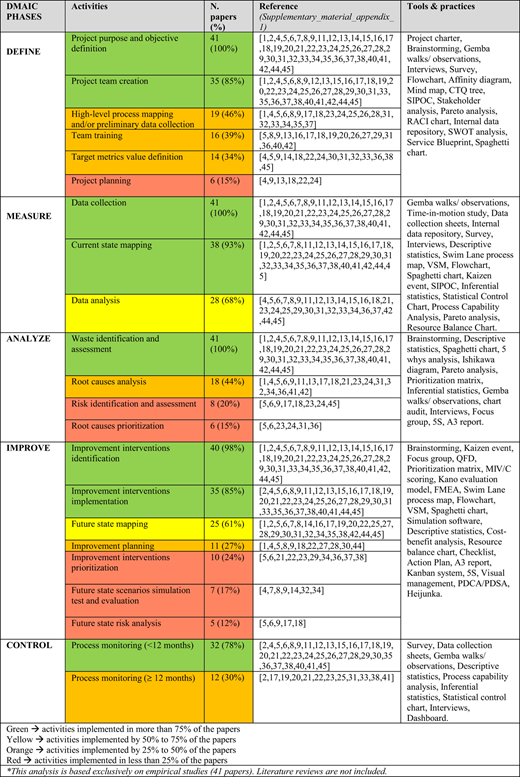
Considering the HLM implementation process, the main activities, tools and practices have been categorized following the DMAIC cycle phases (Appendix_7). As highlighted in Table 2, four distinct categories of activities can be identified: those implemented in more than 75% of the papers (green), those adopted by 50–75% (yellow), those occurring in 25–50% (orange) and those utilized in less than 25% of the studies (red). Overall, the findings indicate a strong recurring focus on a limited subset of activities. Across studies, considerable attention is devoted to defining project objectives, establishing project teams, collecting and analyzing data; mapping current processes; identifying waste and implementing improvement actions. This pattern reflects an implementation approach centered on setting improvement objectives and achieving them through process analysis and countermeasures implementation. While these elements represent essential pillars of Lean implementation, the analysis suggests that they are often pursued in isolation and insufficiently supported by complementary activities.
In particular, limited evidence emerges regarding structured planning efforts, the prioritization of improvement initiatives and the integration of risk analysis alongside waste reduction. Activities such as future-state mapping, systematic improvement planning, prioritization of interventions and risk assessment are reported only sporadically, indicating a partial application of the DMAIC approach. Limited evidence was also observed in training activities, the measurement of objectives through the definition of target metrics, long-term monitoring and the integration of risk management.
In the final phase of HLM implementation, control activities primarily focus on process monitoring after the introduction of improvement actions. However, follow-up is frequently confined to short-term assessments, with relatively few studies reporting extended monitoring over longer time horizons. This pattern points to a limited emphasis on the long-term sustainability of improvement projects and on ensuring that achieved gains are maintained over time.
The tools and practices analysis highlights a wide range of options that can be tailored to different healthcare contexts. As shown in Figure 4, the most frequently adopted tools and practices are related to descriptive statistics (93%), followed by Gemba walks and field observations (80%) and less frequently inferential statistics (56%). This pattern suggests that many HLM implementation projects in healthcare rely primarily on general quality management tools and observational practices, with relatively limited adoption of more advanced HLM-specific instruments. Such an emphasis on basic rather than advanced, or analytical, HLM tools has been interpreted in the literature as indicative of early stages of HLM maturity, where organizations focus first on developing shared problem understanding and process awareness before progressing to more sophisticated Lean analyses and improvement methods (D’Andreamatteo et al., 2015). The most used tool for process mapping is the flowchart, followed by the Value Stream Map (VSM) and Swim Lane process map.
 A horizontal bar graph compares various tools and practices based on the number of papers and their corresponding percentages. The graph features 20 horizontal bars, each representing a different tool or practice. The horizontal axis indicates the number of papers, ranging from 0 to 40, while the vertical axis lists the tools and practices. Key labels on the vertical axis include Descriptive statistics, Gemba walks/observations, Inferential statistics, Internal data repository, Brainstorming, Project charter, Flowchart, Interviews, Ishikawa Diagram, VSM, Survey, Statistical Control Chart, Swim Lane process map, Data collection sheets, Spaghetti chart, SIPOC, Simulation Software, Prioritization matrix, 5S, and Process Capability Analysis. Notable trends include Descriptive statistics being the most adopted tool with 38 papers (93 percent), followed by Gemba walks/observations with 33 papers (80 percent). The color scheme is uniform, with all bars in a single shade of gray.
Most adopted tools and practices of HLM implementations within LCOH. Source: Authors’ own work
A horizontal bar graph compares various tools and practices based on the number of papers and their corresponding percentages. The graph features 20 horizontal bars, each representing a different tool or practice. The horizontal axis indicates the number of papers, ranging from 0 to 40, while the vertical axis lists the tools and practices. Key labels on the vertical axis include Descriptive statistics, Gemba walks/observations, Inferential statistics, Internal data repository, Brainstorming, Project charter, Flowchart, Interviews, Ishikawa Diagram, VSM, Survey, Statistical Control Chart, Swim Lane process map, Data collection sheets, Spaghetti chart, SIPOC, Simulation Software, Prioritization matrix, 5S, and Process Capability Analysis. Notable trends include Descriptive statistics being the most adopted tool with 38 papers (93 percent), followed by Gemba walks/observations with 33 papers (80 percent). The color scheme is uniform, with all bars in a single shade of gray.Most adopted tools and practices of HLM implementations within LCOH. Source: Authors’ own work
Finally, to answer RQ4, two analyses were conducted to identify the main barriers and facilitators impacting the sustainability of HLM implementations within the LCOH setting, as described in the methodology section. The first, as shown in Table 3, focused on identifying those aspects recognized by the authors of the database literature as either challenging or supporting the success of HLM projects and the long-term sustainment of improvements. The second evaluated the implementation process according to the dimensions of methodology and organization, HLM activities, tools and practices, identifying the aspects that contribute to sustainability according to Bhat et al. (2023), Kunnen et al. (2023), Henrique et al. (2021), Costa et al. (2024) and Narayanamurthy et al. (2018).
Barriers and facilitators that challenge/support the sustainability of HLM implementations within LCAH
| Barriers (N. Papers) | References (Supplementary_material_appendix_1) | |
|---|---|---|
| Cultural and organizational factors | Limited resource availability (7) (Insufficient financial support; limited time allocated for the project; conflicts between health staff daily activities and project-related tasks) | [19, 27, 29, 30, 35, 37, 39] |
| Organization and process complexity (3) (Organizational complexity of the setting; poor understanding of the organizational context; lack of systematic process) | [1, 25, 39] | |
| Limited patients’ involvement and engagement in the project (2) (Not considering the “Voice Of the Customer”; not including patients’ point of view in the definition of value; not collecting patients’ satisfaction measures) | [27, 35] | |
| Healthcare staff resistance to change and improvement (2) | [30, 43] | |
| Operational process and improvement factors | Inadequate risk detection and prevention (1) | [6] |
| Lack of continuous monitoring (1) | [39] | |
| Technology and communication factors | Inadequate IT infrastructure (4) (Lack in data availability and reliability; difficulties in collecting data; low digital competencies; limited bandwidth) | [6, 7, 25, 37] |
| Leadership and governance factors | Not adopting a system-wide approach (1) | [3] |
| Facilitators (N. Papers) | References (Supplementary_material_appendix_1) | |
|---|---|---|
| Cultural and organizational factors | Employees’ involvement and commitment (24) (Employees’ willingness to participate; employees’ feedback collection; low turnover rates; team members empowerment to make changes) | [8, 9, 10, 12, 13, 14, 16, 17, 19, 20, 21, 22, 23, 24, 27, 28, 30, 35, 36, 38, 39, 40, 42, 44] |
| Spreading the continuous improvement culture within the organization (11) | [8, 14, 17, 19, 20, 21, 35, 36, 40, 43, 44] | |
| Project team collaboration and mutual trust (9) (Collaboration and team cohesiveness; mutual support and trust among management and healthcare staff) | [6, 13, 14, 19, 20, 21, 23, 37, 40] | |
| Creation of a cross-functional project team (6) (Team members selected from different care units or departments) | [5, 11, 14, 17, 18, 22] | |
| Creation of a multidisciplinary project team (6) (Team members selection including different roles) | [15, 16, 22, 38, 39, 45] | |
| Resource availability (4) (Material resources and infrastructures; human resources; financial support; time allocation) | [23, 28, 38, 40] | |
| Patients involvement and engagement (4) (Collecting patients’ feedback; patients’ value identification) | [5, 21, 22, 41] | |
| Presence of HLM experts and improvement facilitators (3) | [8, 30, 41] | |
| Employees’ change acceptance (3) | [14, 19, 40] | |
| Learning from the past improvement experiences (2) | [20, 21] | |
| Overcoming the hierarchical culture (2) | [14, 20] | |
| Suppliers involvement and engagement (1) (Enhancing suppliers’ collaboration) | [5] | |
| Operational process and improvement factors | Adapting HLM practices, tools, and techniques to the specific context (7) | [1, 5, 3, 14, 28, 40, 41] |
| Streamlined and standardized process (5) | [6, 25, 41, 42, 45] | |
| Monitoring the improvements achieved over time (4) | [4, 8, 13, 18] | |
| Project implementation plan (3) | [5, 37, 38] | |
| Adopting structured problem-solving approaches (3) | [5, 8, 9] | |
| Adopting performance measurement indicators (1) | [5] | |
| Adopting a system-wide improvement approach (1) | [35] | |
| Leadership and governance factors | Top and middle management commitment and personal involvement (16) | [5, 8, 9, 12, 20, 22, 23, 24, 30, 35, 36, 38, 39, 40, 43, 44] |
| Employees’ digital and data analysis abilities (3) | [7, 9, 18] | |
| Top and middle management HLM knowledge (2) (HLM principles; HLM tools and practices) | [9, 30] | |
| Aligning improvement initiatives and objectives with the organization’s strategic plan (2) | [2, 43] | |
| Stakeholders’ support and expectations alignment (1) | [7] | |
| Stakeholders’ support and expectations alignment (1) | [7] | |
| Human resources and capability factors | Employees HLM knowledge (7) (HLM principles; HLM tools and practices) | [16, 18, 20, 24, 30, 36, 42] |
| Employees’ full process understanding (2) (Comprehensive understanding of the target process; training on the target process) | [5, 25] | |
| Employees performance assessment (2) | [22, 30] | |
| Technology and communication factors | Strong IT infrastructure (7) (Data availability and reliability; digital and connected services) | [5, 7, 9, 11, 18, 22, 32] |
| Good communication channels (2) | [17, 22] | |
As shown in Table 3, the most frequently reported facilitators regard the involvement and commitment of employees (53%) and top and middle management (36%). Indeed, management plays a crucial role in fostering employees’ willingness to participate in the project, by involving them in decision-making, gathering feedback and empowering them to implement changes. It is widely recognized that managers must take an active role in the project by acting as sponsors, demonstrating leadership and ensuring the availability of necessary resources (Henrique et al., 2021). These aspects are further reinforced by other facilitators highlighted in the analyzed papers, such as “spreading the continuous improvement culture within the organization” (24%), “project team collaboration and mutual trust” (9 papers), “creation of a cross-functional project team” (13%), and “creation of a multidisciplinary project team” (13%). Furthermore, when considering the project team composition, it was observed that in 61% of the projects, the teams were multidisciplinary, comprising members with different roles within the organization. However, while healthcare personnel are widely involved, clinical leadership is represented in the project teams in only 27% of the papers and top management in just 17%. Considering the composition of the project team, another factor supporting sustainability is the involvement of HLM experts (Kunnen et al., 2023; Narayanamurthy et al., 2018), which, however, was observed in only 37% of the papers (Appendix_5). The limited availability of resources is among the main barriers identified, although reported in only 16% of the papers (Table 3). In the analyzed projects, the focus is primarily on challenges related to the limited time allocated for the project and conflicts arising between healthcare staff’s daily activities and project-related tasks.
Appendix_8 provides a comprehensive list of the variables analyzed to investigate the organizational aspects of the projects, as well as the HLM activities, tools and practices implemented, grasping the key sustainability factors identified in the referenced studies that were also observed in the analyzed projects. In particular, the analysis highlights the limited adoption of project implementation planning (15%), HLM healthcare staff training (40%) and the monitoring of improvement over time (29%). This latest aspect is reported as a facilitator in four papers and its absence as a barrier in one paper. However, the analysis of the projects reveals a limited number of papers that effectively monitor results throughout one year or more, with attempts to standardize improvements using a dashboard and periodic reporting (Table 3). Finally, according to the detailed list of HLM tools that support sustainability provided by Henrique et al. (2021), it is evident that these tools are only partially implemented in the analyzed projects. For instance, the use of A3 reports is reported in only one paper, VSM adoption is reported in 29% of the papers, and Kaizen events are reported in 11%. The only tool widely used and considered supportive of sustainability is Gemba walks, reported in 80% of the projects.
3.2.3 Outcome
In order to answer RQ3, both improvement results and deriving benefits were analyzed to evaluate the outcomes of HLM implementations within the LCOH setting. The comparison between the stated goals prior to implementation and the effectively achieved outcomes reveals a decrease in the number of projects that successfully meet their initial objectives (Figure 3). This outlined that in some cases, even if the projects are considered successful, not all the goals are achieved. Under these circumstances, they cannot be considered as complete failures but rather as partial successes, having achieved only a subset of their stated goals or contributed to process improvements without fully reaching the target objectives. As previously highlighted, the most frequently achieved outcomes are related to timeliness (59%) and efficiency (37%). There is limited evidence of improvements linked to care effectiveness (e.g. improvements in patients’ clinical conditions), patient-centeredness (e.g. patients’ satisfaction with the care provided), employees’ work-balance (e.g. the psycho-physical well-being of healthcare professionals) and safety (e.g. reductions in clinical risk).
Regarding the benefits derived from HLM implementation, this analysis includes improvement that are not directly measured through process performance indicators, excluding outcomes classified as “achieved care quality goals”. These benefits are frequently reported as perceived achievements by the authors and/or by project participants and are not directly linked to the initial care quality goals. The only benefits measured by a few numbers of papers are those related to cost reduction and revenue increase; however, these were not considered improvement results, as they were not explicitly associated with initial stated goals of cost-reduction or revenue-increase and were therefore classified as project-related benefits rather than goal-driven outcomes. As shown in Appendix_9, the deriving benefits can be classified into seven categories: efficiency, effectiveness, patient-centeredness, integration, employees’ work balance, sustainability and equitability. Unlike the analysis of care quality goals, the timeliness category is not included here, as it remains mainly linked with measurable process performance indicators. This analysis outlines that 34% of the papers were declared to have obtained benefits related to efficiency. In particular, this is related to the reduction of service costs with the rise of revenue (34%) and the increase of process standardization (10%). Moreover, 22% of the papers declare to improve patient care and reduce poor treatment outcomes, and 22% to improve patient-centeredness by improving patients’ satisfaction, enhancing communication with patients, improving patients’ trust in healthcare professionals and reducing patients’ psychological stress and anxiety. Considering integration benefits, 17% of the papers declare to strengthen communication and collaboration, and just one paper to enhance care coordination. Within the employee work–balance category, 10% of the papers enhance employees’ morale and teamwork experience, 5% improve employees’ satisfaction, 5% reduce work stress and care overload and one paper enhances employees’ decision-making abilities. Notably, 12% of the papers report to achieve sustainability benefits, fostering cultural change throughout the organization and enhancing economic, social and environmental sustainability. Finally, 4% of the papers declare to improve patients’ accessibility to healthcare services.
Waste identification and assessment are among the outcomes achieved in HLM implementations within LCOH. As shown in Figure 5, most of the papers identified waiting as a waste (68%), followed by over-processing and unnecessary activities (59%), patients and material transport (32%), employees’ movement (27%), errors and defects (24%), inventory wastes (24%), underutilization of employees’ skills and competencies (15%) and over-production through unnecessary prescription of services provision (10%).
 The bar graph presents data on waste identification and assessment in papers, focusing on various types of waste. The x-axis represents the number of papers, while the y-axis lists different categories of waste. The categories include Waiting, Over-processing, Transport, Movement, Errors/defects, Inventory, Skills, and Over-production. Each category is represented by a horizontal bar indicating the number of papers and the corresponding percentage. Waiting has the highest values with 28 papers and 68 percentage, followed by Over-processing with 24 papers and 59 percentage. Transport, Movement, Errors/defects, and Inventory each have values around 10 to 13 papers and 24 to 32 percentage. Skills and Over-production have the lowest values with 6 papers and 15 percentage, and 4 papers and 10 percentage, respectively. The analysis is based exclusively on empirical studies, with 41 papers included. All values are approximated.
Waste identification and assessment of HLM implementations within LCOH. Source: Authors’ own work
The bar graph presents data on waste identification and assessment in papers, focusing on various types of waste. The x-axis represents the number of papers, while the y-axis lists different categories of waste. The categories include Waiting, Over-processing, Transport, Movement, Errors/defects, Inventory, Skills, and Over-production. Each category is represented by a horizontal bar indicating the number of papers and the corresponding percentage. Waiting has the highest values with 28 papers and 68 percentage, followed by Over-processing with 24 papers and 59 percentage. Transport, Movement, Errors/defects, and Inventory each have values around 10 to 13 papers and 24 to 32 percentage. Skills and Over-production have the lowest values with 6 papers and 15 percentage, and 4 papers and 10 percentage, respectively. The analysis is based exclusively on empirical studies, with 41 papers included. All values are approximated.Waste identification and assessment of HLM implementations within LCOH. Source: Authors’ own work
4. Discussion
To address the study’s aim of providing an overview of care quality goals, activities, tools and practices, outcomes achieved, barriers and facilitators of HLM implementations in LCOH, this section discusses the findings in relation to the research questions and the relevant literature.
4.1 What are the care providers and services involved, the care processes targeted and the care quality goals pursued in HLM implementations within LCOH settings (RQ1)?
The HLM projects in LCOH are mainly conducted in specialist centers and hospitals that provide secondary care services, with limited evidence for primary care and territorial settings. This reflects the still limited adoption of HLM implementations outside the hospital boundaries (Tiso et al., 2026). In territorial care settings, the implementation of HLM may be constrained by cultural and organizational barriers that limit the allocation of resources to improvement initiatives. These barriers appear to be less pronounced in hospital contexts, where HLM is more widely disseminated and has reached a higher level of maturity (Hung et al., 2015; Kaltenbrunner et al., 2019; Leite and Quadros, 2025; Tiso et al., 2022).
Moreover, there are few European cases, with most evidence coming from private organizations in the United States. This study highlights that in outpatient settings, many projects select a general care pathway as the target process, grouping activities common to multiple care pathways rather than focusing on a specific disease. This approach confirms the positive impact of jointly managing different care pathways and patients’ diseases within LCOH settings (van Erp et al., 2021; Van Hoof et al., 2016). Additionally, improvement projects often focus on administrative activities, emphasizing their impact on process wastes and inefficiencies. The target settings, processes and activities previously mentioned are reflected in the definition of improvement objectives, which predominantly focus on timeliness and efficiency. However, there is limited evidence on HLM projects addressing critical challenges in territorial healthcare, such as the integration of different services and settings, patient safety and the provision of equitable access to care for the population. This pattern may reflect the fact that the integration of safety within Lean is a relatively recent and innovative development requiring higher levels of organizational maturity, while integration-related objectives are culturally more complex and represent more advanced stages of HLM implementation (Parkhi, 2019; Talero-Sarmiento et al., 2024; Tiso et al., 2022).
4.2 What phases and activities are performed, and which tools and practices are employed in HLM implementations within LCOH settings (RQ2)?
The literature analyzed highlights a lack of uniformity in the execution of improvement activities and employment of tools and practices adopted. This pattern reflects the tendency of many healthcare organizations to focus on the application of specific HLM techniques and tools, often in the absence of a system-wide approach to improvement (Henrique et al., 2021; Mazzocato et al., 2010). As highlighted in the results description, four distinct categories of activities can be identified. Considering only the most widely performed activities, the HLM improvement implementations follow this sequence: project purpose and objective definition, project team creation, data collection, current state mapping, waste identification and assessment, improvement intervention identification and implementation and process monitoring (>12 months). While some projects conduct a wide range of activities, others include just a few of them, indicating that many implementations are partial and incomplete, thus highlighting the difficulties of successfully conducting an entire and complete HLM implementation. The MEASURE phase stands out, with many projects encompassing all related activities, making it comparatively more standardized than the other phases. However, when considering performance measurement indicators, there is a high degree of variability across different projects, with limited standardization in what is measured. Regarding the CONTROL phase, it is particularly significant to note the scarcity of studies that conducted results monitoring for over 12 months or adopted practices and tools to ensure improvements’ long-term sustainability. This aspect is critical, as a project success is also evaluated based on its ability to sustain improvements over time (Albliwi et al., 2014; Costa et al., 2024; Henrique et al., 2021; Kunnen et al., 2023; Narayanamurthy et al., 2018). This highlights that both the completion of HLM implementation and the long-term sustainability of improvement initiatives represent significant challenges in this context (Talero-Sarmiento et al., 2024).
In this scenario, the limited adoption of CRM practices and tools emerges as a notable issue. This observation aligns with the analysis of improvement objectives, which highlights that patient and employee safety remain insufficiently prioritized, and the full potential of integrating these approaches is not yet fully exploited.
Interestingly, the adoption of VSM appears to be less prevalent than what emerges from previous analyses on HLM implementations (Talero-Sarmiento et al., 2024). Moreover, in some empirical studies, authors claim to employ VSM; however, the results indicate the adoption of a simpler and more reductive tool resembling a flowchart. In this study, only papers that explicitly included and documented the use of VSM in their projects were considered to have adopted it. Finally, although 80% of the papers map the target process, qualitative process mapping seems to be the most adopted approach, with limited evidence on structured mapping approaches that include cycle time, lead time, waiting time or waste identification information.
4.3 What outcomes are achieved in HLM implementations within LCOH settings (RQ3)?
Focusing on the deriving benefits, outcomes related to integration, equitability, effectiveness, patient-centeredness and employee–work balance are often perceived as achieved by the personnel involved in the projects. However, the achieved improvement should be properly measured, instead of exclusively relying on individual opinions (Womack and Jones, 1996). Based on that, it emerges the need to investigate how quality outcomes, beyond timeliness and efficiency, can be validated. Given the peculiarity and variety of deriving benefits, identifying and adopting standardized performance measurement indicators is challenging. Moreover, waste identification and assessment further emphasize the importance of achieving timeliness objectives, such as patients’ waiting time.
4.4 What barriers and facilitators impact the sustainability of HLM implementations within LCOH settings (RQ4)?
This analysis highlights that the involvement of healthcare staff and management is widely recognized as a facilitator for the sustainability of these projects, and this is further supported by the firm belief in the importance of spreading a culture of continuous improvement and fostering collaboration and mutual trust within project team members. Moreover, while the analysis of project team composition provides only a partial view of how best practices are implemented, it reflects a clear intention to bring together individuals with diverse roles to enhance the success of the projects. However, when examining the involvement of management within the project teams, a limited presence of both top and middle management is observed in the composition of these teams. This suggests that management may only play a limited role, often failing to actively participate in project meetings or proactively contribute to solutions when challenges arise (Talero-Sarmiento et al., 2024). Moreover, the limited presence of HLM experts and the frequently reported lack of time and resources within the project team may indicate the need for more active engagement. Indeed, effectively involving healthcare workers requires scheduling dedicated time for their participation, ensuring it does not conflict with their routine duties. This limited participation may hinder their ability to fully support the sustainability of these projects, as their active involvement is crucial for ensuring long-term success (Henrique et al., 2021). Furthermore, insufficient engagement from leadership can often result in limited employees’ participation in the HLM implementation. Employees may feel unmotivated and unrewarded, mainly when no dedicated time is allocated for their involvement in the project, making it challenging to free up time from daily activities (Bhat et al., 2023). These aspects are the most recurring and consistent across the analyzed projects, making them suitable for discussion. The other sustainability factors, identified in fewer projects, would require further studies to be adequately addressed.
5. Implications and limitations of the study
The present study offers several implications for both research and practice in the field of HLM implementation within LCOH. By providing a structured overview of existing initiatives, it clarifies how HLM has been applied in territorial healthcare settings in terms of care providers and services involved, targeted care processes and pursued care quality goals. However, due to the limited number of studies available in the literature, it was not possible to address all relevant aspects such as the characteristics of care settings and clinical care pathways in a detailed and comparative manner. Nevertheless, this mapping helps delineate the boundaries of current practice and may support healthcare organizations, particularly those engaged in territorial system reorganization, in defining the scope, goals and stakeholders of improvement initiatives.
This contribution may be particularly relevant for European public healthcare systems, where, over recent decades, substantial efforts have been directed toward strengthening territorial care for frail and ageing populations. In these contexts, territorial healthcare services play a key role in managing chronic conditions outside hospital settings, with the objective of preventing unnecessary hospital admissions and avoidable disease exacerbations (OECD, 2020; World Health Organization, 2018a; World Health Organization and United Nations Children’s Fund, 2018, 2020). Nevertheless, the study also highlights a significant gap in the existing literature, as empirical evidence on HLM implementation within LCOHs in European public healthcare organizations remains limited. Indeed, the majority of HLM implementations are reported in private healthcare settings, were stronger incentives related to economic performance, productivity and efficiency are typically present, facilitating the adoption of HLM. The literature also suggests that private organizations may exhibit a greater propensity for organizational change compared with public ones, which often operate within more regulated and risk-averse contexts (Radnor and Osborne, 2013). This represents an important limitation of the current body of research and applications and points to promising avenues for future studies. Further research could expand the application of HLM in these underexplored contexts, not only to refine and improve existing processes but also to guide the design of new care pathways capable of addressing complex and heterogeneous needs.
Territorial healthcare systems are inherently complex, and the findings of this study indicate that structured and systemic approaches to care quality improvement are essential in these settings, where isolated or fragmented interventions are unlikely to be effective (Henrique et al., 2021; Mazzocato et al., 2010). Unlike hospital-based initiatives, which frequently focus on a single disease-specific care pathway, improvement in territorial healthcare typically address multiple patient needs and services concurrently, reflecting the broader and more integrated nature of care delivery in these settings (McCalman et al., 2018). Consequently, patients with diverse conditions who access the same outpatient facilities may be included in the same aggregated care pathway. From both a practical and research perspective, future studies could investigate whether such aggregation represents an effective simplification or whether disaggregating pathways by specific clinical conditions could help creating additional value. In particular, examining which elements of care can be meaningfully combined and which require separate analysis would provide valuable insights for the design of effective and context-sensitive improvement initiatives.
From an implementation perspective, the study contributes by organizing the tools and practices adopted in HLM projects within the structured framework of the DMAIC cycle (Antony et al., 2012; Smith et al., 2011) This has practical implications for healthcare organizations seeking to undertake more sustainable improvement initiatives, as it underscores the importance of adopting a comprehensive approach that includes not only problem definition and solution design but also results measurement and monitoring. The limited diffusion of advanced process mapping tools identified in the literature (D’Andreamatteo et al., 2015) highlights opportunities for future development and innovation in the analysis of complex care pathways in territorial settings, also with the ultimate aim of designing care processes that achieve high levels of care quality within these contexts. Moreover, the insights provided on the use of CRM-related tools and practices contribute to expanding current knowledge on the integration between HLM and CRM, an area that remains relatively underexplored in the literature (Crema and Verbano, 2015; Talero-Sarmiento et al., 2024).
In terms of outcomes, the study distinguishes between measurable improvement results directly linked to initial care quality goals and perceived benefits that are not always formally quantified or explicitly connected to predefined objectives. Recognizing the relevance of these perceived benefits has significant implications (Mazzocato et al., 2010), as they may capture additional dimensions of HLM impact beyond conventional performance indicators. This calls for future research to further investigate and assess both measured and perceived HLM outcomes, particularly in territorial healthcare contexts where empirical evidence remains limited. Moreover, the study highlights the importance of HLM initiatives that not only enhance timeliness and efficiency but also address a more comprehensive conception of care quality. The identification of initial examples in the literature may support healthcare organizations in establishing a starting point and encourage the pursuit of improvement objectives related to safety, integration, equity and patient-centeredness.
By identifying key facilitators and barriers to sustainability, this study also provides actionable insights for improving the long-term success of HLM initiatives. Critical enablers include employee involvement and commitment, active engagement of top and middle management, the diffusion of a continuous improvement culture and collaboration and mutual trust within project teams. These elements are consistently highlighted in the literature as key determinants of Lean maturity (Kaltenbrunner et al., 2019), suggesting that LCOHs may currently exhibit a relatively limited level of Lean maturity, partly due to the novelty of implementing HLM within territorial healthcare settings (Tiso et al., 2022).
At the same time, these findings also point to important limitations of the study. First, the evidence base remains uneven with respect to other sustainability factors, such as technology and communication, human resources and capabilities and leadership and governance, which are less systematically addressed across the reviewed studies. Second, the available literature provides limited guidance on how these facilitators can be effectively implemented in territorial healthcare contexts. Future research could focus on assessing organizational and contextual readiness for HLM adoption (Costa et al., 2024; Narayanamurthy et al., 2018). However, the findings also suggest that countermeasures required to support sustainability factors are likely to be highly context-specific, requiring adaptation to local healthcare system characteristics and co-design with the healthcare staff directly involved in the processes (Narayanamurthy et al., 2018).
From a broader perspective, the ability to sustain HLM implementation can be interpreted through wider sustainability frameworks, including the United Nations Sustainable Development Goals (United Nations, 2025), as it enables systematic and continuous improvements in care quality and, in doing so, contributes to population health and well-being, efficient resource use and the strengthening of public healthcare institutions.
6. Conclusions and future research developments
This literature review provided an overview of HLM implementations within LCOH, focusing on the care quality goals, managerial and organizational activities, tools and practices, outcomes achieved, barriers and facilitators to support sustainable HLM implementations.
Considering academic and managerial perspectives, the findings highlight the need of approaching HLM not merely as a collection of tools and practices to enhance project efficiency, but as a comprehensive strategy for improving multiple dimensions of care quality. This is particularly relevant in complex, non-standardized contexts involving multiple stakeholders, such as territorial healthcare systems, especially in European public healthcare contexts, where organizations face increasing challenges in managing frail and ageing populations outside hospital settings.
In these contexts, addressing sustainability becomes crucial: the breadth of project scope and the number care services involved make systematic failure prevention even more imperative. However, empirical evidence on long-term HLM implementation strategies remains limited and uneven. This suggests the need for policy indications that support structured, long-term improvement programs, invest in organizational readiness and managerial capabilities and allow for context-specific adaptation rather than prescriptive solutions. While several organizational factors appear to support the sustainability of HLM initiatives, there is still limited evidence on how these factors can be effectively operationalized in territorial settings. Future research should investigate organizational readiness and context-specific implementation pathways to better support healthcare organizations adopting complex managerial approaches, which often face gaps in cultural, organizational, technical, digital, infrastructural and managerial readiness.
Finally, strengthening the capacity of healthcare organizations to sustainably improve care quality in territorial contexts contributes not only to better health outcomes but also to broader social well-being and social sustainability by fostering more equitable, integrated and resilient healthcare systems.
Caterina Pozzan gratefully acknowledges the financial support of the European Union – NextGenerationEU, Mission 4 Component 1 [CUP C96E22000360007].
The supplementary material for this article can be found online.

