Without competent and talented employees, no organisation can grow and sustain for a long time. It becomes essential for every organisation to retain and satisfy the employees to achieve their predetermined organisational goals. The present study examines the mediating effect of workplace spirituality dimensions (i.e. meaningful work, compassion,transcendence, mindfulness and sense of community) in the link between job satisfaction and organisational citizenship behaviour (OCB) among managerial employees of selected manufacturing firms of Chhattisgarh state.
Correlational research design was incorporated. Employees working at managerial positions at different private manufacturing firms of Chhattisgarh state were chosen as a sample for the present study. Regression analysis and confirmatory factor analysis tools were used to analyse the primary data collected from 400 respondents.
The results revealed that all the dimensions of workplace spirituality, i.e. meaningful work, compassion, transcendence, mindfulness and sense of community, were found statistically significant and partially mediated between job satisfaction and OCB among managerial employees of Chhattisgarh. The authors discussed the results thoroughly and provided avenues for the future research.
The findings of the present research study will assist all private organisations in rethinking their employee retention and satisfaction strategies, since the presence of workplace spirituality in the organisation has a significant and beneficial impact on its environment. The current research will assist organisations in creating circumstances for OCB for employee via the introduction of workplace spirituality.
Creating spirituality in the current situation, where Covid-19 has suddenly affected all organisations around the world, would be extremely beneficial in terms of employee retention and satisfaction, which would eventually aid in the development of an environment conducive to citizenship behaviour at the workplace. However, the role of workplace spirituality as a mediator in the link between job satisfaction and OCB is innovative and has received little attention in the research community.
1. Introduction
Modern organisations are currently facing several employee-related issues, such as absenteeism, turnover, corruption, stress-related illness, conflict, burnout,violence, etc. Previous researchers evidenced that these issues are abundant where spirituality is not present in the workplace (Nasina and Doris, 2011). Workplace spirituality is itself demonstrating an essential ingredient in order to retain and satisfy the talented employees of the organisation, which eventually helps the growth and development of the same (Chawla and Guda, 2010; Choerudin, 2014; Giacalone and Jurkiewicz, 2003; Kinjerski and Skrypnek, 2008; Van Der Walt and De Klerk, 2014). Workplace spirituality pervades the society and promotes peer knowledge, while also allowing them to express their sentiments for other people (Giacalone and Jurkiewicz, 2003). It is all about pursuing a spiritual path in one's employment as a means of moving forward and contributing to the community in a meaningful manner. It entails showing compassion, understanding and support to others, as well as being truthful and trustworthy to oneself and others. Previous studies explained that workplace spirituality has a significant role in creating the positive environment for OCB (Belwalkar et al., 2018; Charoensukmongkol et al., 2015).
OCB is a notion that is still in the early stages of development that concerns how and why employees contribute positively to their organisations outside of their designated job duties; it is a concept that has gained popularity in recent years. When it comes to OCB, researchers are asking basic issues about the conditions in which people “go the extra mile” at their places of employment. But,more specifically, what are the personal characteristics and organisational settings that motivate people to contribute in ways that go beyond their official job requirements? Was there a compelling reason for someone to contribute to a colleague's fundraising efforts or to bring in refreshments at the workplace?The definition of OCB has evolved as a result of its use. Organ provided the fundamental definition of OCB in 1988, stating that it is “individual behaviour that is discretionary, not expressly acknowledged by the formal incentive system, and that, taken together, enhances the effective functioning of the organisation”. Giving coworkers a ride home, recommending methods to enhance a colleague's work or simply feeding paper into the common printer are all examples of OCBs. It also includes assisting with the recruitment of competent personnel for certain jobs, providing ideas to enhance workplace amenities and working unpaid overtime. Because of these, such behaviours are desirable, yet they are difficult to nurture inside traditional organisational structures. Organisations wishing to promote OCB must first identify the elements and specific actions that may contribute to the development of the condition.
Spirituality has the ability to influence people's conduct in a positive manner from the inside out (Heaton et al., 2004). Employees' spirituality may assist them in identifying and comprehending the significance in their life,which can be beneficial to their professional growth (Lips-Wiersma, 2002). In addition, promoting spirituality in the workplace may be seen as an approach to organisational growth since it allows for the expression of values like as virtue, citizenship behaviour, honesty and integrity in a safe and comfortable environment (Petchsawang and Morris, 2006).
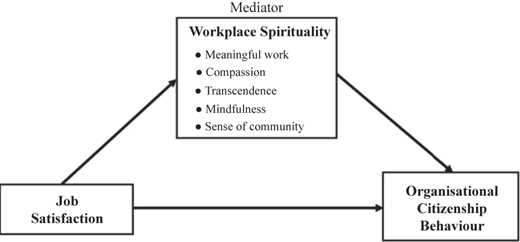
Moreover, it has been pointed out by Halbesleben and Bellairs (2016) that just when two persons display the same kind of OCB, it does not always follow that they are motivated by the same reasons. When two individuals are being courteous to one another, one may be motivated by image management and the other by concern for the quality of their workplace environment. Despite the fact that it is difficult to identify conclusive drivers and indicators of OCB, owing to its importance in the development and prosperity of the organisation, it has become necessary to undertake research in order to identify such elements. The present study conducts an empirical investigation of workplace spirituality dimensions (i.e. meaningful work, mindfulness, compassion,transcendence and sense of community) as mediating variables in the link between job satisfaction and OCB among managerial employees of private manufacturing firms of Chhattisgarh state.
2. Literature review
2.1 Workplace spirituality
Globally, there is no clear consensus about workplace spirituality, with almost 70 definitions existing (Giacalone and Jurkiewicz, 2003; Markow and Klenke, 2005; Karakas, 2010; Valecha, 2012). Workplace spirituality identifies that when a person comes to work, he/she brings his/her unique skill set, talents and interests (Doraiswamy and Deshmukh, 2015). According to Marques et al. (2007), workplace spirituality is an experience of interconnectedness, a sense of community and a connection to higher goals by individuals at work.
Different researchers have shown the concept of workplace spirituality through distinct elements. Westgate (1996) has identified four elements of workplace spirituality, i.e. meaning and purpose in work, transcendent experiences (something beyond normal rationality), intrinsic values (internalised values that direct individuals' behaviour) and community aspects. Ashmos and Duchon (2000) found in their study that workplace spirituality should not just be considered a manifestation of one's intellectual capabilities at work but expressing oneself entirely at the workplace.
Giacalone and Jurkiewicz (2003) defined spirituality at the workplace as an organisational value framework that encourages employees' various transcendental experiences through work and motivates people to have a sense of connection with other employees, increasing completeness and joy. According to Ashmos and Duchon (2000), workplace spirituality acknowledges that every employee has an inner life, which encourages and is encouraged through meaningful work in the organisation.
2.2 Job satisfaction and workplace spirituality
Despite the fact that job satisfaction has been widely investigated, consistent findings have not been found. Job satisfaction may have a spiritual basis,rather than merely a “materialistic” one, because contemporary employees consider aspects such as self-actualisation, being associated with an ethical organisation, having interesting work, earning money, having colleagues who serve humanity and serving future generations and the community environment to be important, meaningful and purposeful in their work (Mitroff and Denton, 1999).
Additionally, meaning and purpose in life contribute to a person's well-being (or life satisfaction) (Zika and Chamberlain, 1992). Thus, spirituality plays a critical role in a person's well-being (or life satisfaction). This argument is backed up by Young et al. (1998), who discovered that spirituality helps people retain their overall well-being. As a result, it is thought that a spiritual person will be usually satisfied with life and, as a result, will interpret events and act differently than a dissatisfied person. Thus, a person who is satisfied is more likely to exhibit more spiritual behaviour at work in order to maintain that satisfaction and to develop a stronger connection with the organisation.
2.3 Job satisfaction and organisational citizenship behaviour
Several academics have addressed the link between job satisfaction and OCB. Non-academic employees of the Malaysian University System were studied by Mohamed (2016) for the relationship between job satisfaction and OCB. He discovered that both intrinsic and extrinsic job satisfaction had a positive impact on OCB. According to Unal (2013), four elements (business policy, supervision and advancement, the job itself, remuneration and coworkers)are linked to OCB.
Furthermore, employees' level of job satisfaction is critical in influencing their level of OCB. Employees that exhibit a high degree of OCB will assist the organisation in achieving its goals and will also contribute to the efficacy and performance of the company (Organ, 2018). Work satisfaction and OCB have been shown to be strongly correlated in earlier research (Arif and Chohan, 2012; Miao and Kim, 2010; Organ, 2018; Pavalache-Ilie, 2014; Ruhana, 2020; Unal, 2013). Moreover, these research studies have shown that workers who are extremely happy exhibit higher levels of OCB than their counterparts. As a result, OCB leads to improved organisational performance as well as increased employee retention rates.
2.4 Workplace spirituality and organisational citizenship behaviour
The workplace's spirituality was called by employees' experience(Meezenbroek et al., 2012; Porshariati et al., 2014). When employees can express their desire for caring and showing compassion with others, experiencing inner consciousness in search of meaning and purpose at work leads him/her to transcendence, so this can be explained as having a positive experience by employees during working in the organisation. This exposure of employees makes them work with pleasure in the organisation, and they do other positive things too, which exceed their standard job description in the workplace (Kazemipour and Mohd Amin, 2012). Hence, studies reveal that workplace spirituality helps in enhancing the organisational citizenship behaviour (OCB) among employees. Similar findings were noted by some past studies (Al-Mahdy et al., 2021; Belwalkar et al., 2018; Charoensukmongkol et al., 2015; Garg, 2018; Jannah and Santoso, 2017; Makiah et al., 2018; Sani et al., 2018). But there were some studies explain insignificant relation between workplace spirituality and OCB (Kazemipour and Mohd Amin, 2012; Nasurdin et al., 2013; Utami et al., 2021).
2.5 Mediation of workplace spirituality the link between job satisfaction and organisation citizenship behaviour
Recently, researchers, all around the world, have begun to pay more attention to the idea of workplace spirituality. There have been very limited research studies conducted taking workplace spirituality as a mediator in the link between job satisfaction and OCB. But studies connecting the variables have been found explaining significant relationships. The correlation of job satisfaction(Arif and Chohan, 2012; Miao and Kim, 2010; Organ, 2018; Pavalache-Ilie, 2014; Unal, 2013) and workplace spirituality (Belwalkar et al., 2018; Charoensukmongkol et al., 2015; Garg, 2018; Jannah and Santoso, 2017; Makiah et al., 2018; Sani et al., 2018) on OCB have been noted in several studies. It has been seen that individuals who are satisfied are tend to engage more in meaningful work, show compassionate and mindfulness behaviour, strive for transcendence at work and connect with other employees in order to complete the job efficiently, which leads them to perform extra role behaviour for improved organisational performance. Thus, in order to remain satisfied at work, individuals connect with spirituality at the workplace, which further encourages them to perform OCB.
2.6 Theoretical model of the present study
The present study attempts to answer the following questions:
Whether workplace spirituality dimensions (i.e. meaningful work,mindfulness, transcendence, compassion and sense of community) mediate as a link between job satisfaction and OCB among the managerial employees of selected private manufacturing firms of Chhattisgarh state.
Thus, the author proposes the following theoretical model in Figure 1:
3. Methodology
3.1 Hypotheses of the study
Based on the conceptual model of the present study, the following hypotheses are formulated:
Meaningful work would emerge as a positive mediator between job satisfaction and OCB.
Compassion would emerge as a positive mediator between job satisfaction and OCB.
Transcendence would emerge as a positive mediator between job satisfaction and OCB.
Mindfulness would emerge as a positive mediator between job satisfaction and OCB.
Sense of community would emerge as a positive mediator between job satisfaction and OCB.
Overall workplace spirituality (OWS) would emerge as a positive mediator between job satisfaction and OCB.
3.2 Operational definition
3.2.1 Meaningful work
According to Ashmos and Duchon (2000), meaningful work shows the importance, energising and pleasantness about work. Meaningful work is a feeling of completeness and harmoniousness with something higher purpose that clarifies their work(Overell, 2008).
3.2.2 Mindfulness
Mindfulness is awareness of a person's thoughts of surrounding environments. Petchsawang and Duchon (2009) defined mindfulness as a status of being aware of individuals' thoughts, emotions and actions moment by moment via self-inner consciousness. It is about present mind of a person without any distraction related to past, future or any other thing.
3.2.3 Transcendence
According to Petchsawang and Duchon (2012), transcendence is a special energy, wonderful actions and vitality at work experienced by matching an individual's inner and outer life via self-fulfilment. In other words, transcendence is like having a feeling beyond the physical or standard level.
3.2.4 Compassion
Compassion refers to care for others or empathy, often saying an aspiration to help. According to Petschsawang and Duchon (2009), compassion is defined as deep alertness, sympathy for others and a desire to relieve others from suffering, which eventually enforces to take responsibility for others who are distressed and less fortunate.
3.2.5 Sense of community
According to McMillan and Chavis (1986), sense of community can be defined as a feeling that members have of belonging, a feeling that members matter to one another and to the group, and a shared faith that members' needs will be met through their commitment to be together.
3.2.6 Job satisfaction
In the words of Dandona (2013), job satisfaction is considered an essential determinant which explains that employees in the organisation love their work and try to engage themselves as much as in their work, which leads to enhanced individual performance and productivity and further will remain in the organisation for a long term.
3.2.7 Organisational citizenship behaviour
According to Organ (1997), OCB can be defined as the contributions to the continuance and facilitation of social and psychological environment, which directly affects the performance of tasks significantly. Individuals in the organisations at times reveal certain behaviours that go beyond the assigned duty. Such behaviour is known as OCB (Tambe and Shanker, 2014).
3.3 Sampling and data collection
As per the industrialisation of private manufacturing firms in Chhattisgarh state, four districts were selected, i.e. Raipur, Durg, Raigarh and Korba. Then,using stratified random sampling, the primary responses from nine manufacturing firms were collected. Respondents working at managerial positions in different private manufacturing firms were chosen as participants for the present study. Authors ensured that responses taken from each firm would have equal/appropriate representation in the analysis. The data were collected during September 2019 to March 2020.
3.4 Research design and sample size
Correlational research design is applied in the present study. Employees working at the managerial positions at different private manufacturing firms of Chhattisgarh state were chosen as sample of the study. A total of 530 questionnaires were delivered to the participants across nine private manufacturing firms of four districts in Chhattisgarh state. Out of which, 400 responses were found useable for further analysis, approximately 75.47%(see Table 1).
3.5 Research instrument
Adoption of right instrument is the prime necessity for the collection of right data for the study. The present study followed the scientific process of selection, development and validation of the scale. First, authors thoroughly studied the previous literature and found validated scale of previous studies. The authors adapted seven constructs with certain modification as per the research objectives. Second, the adapted/modified constructs were sent to four subject experts for examining the content validity and to gain valuable insights. Experts confirmed the content validity with minor changes. Finally,the authors conducted pilot study with 50 respondents to check the content creation, in which no modifications were asked by the participants in the final questionnaire. Hence, a final 46-item questionnaire was ready for collecting the primary data as showed in Table 2.
3.6 Reliability and validity measures
Smart PLS 3 (trial version) was incorporated for measurement analysis. In Table 3, Cronbach's alpha and Rho A values were found to be greater than 0.7 (Nunnally, 1978; Robert, 2004) for all the constructs taken in the present study,which explains the constructs' reliability measures. Similarly,convergent validity was noted greater than 0.7 (Bagozzi and Yi, 1988; Hair et al., 2010), and average variance extracted (AVE) was found greater than 0.5 (Henseler et al., 2009) for all the constructs. In Table 4,discriminant validity helps to identify whether all the constructs taken in the study are independent from each other. The values explained more than 0.7 for each construct, thus it can be derived that the present study has a satisfactory measurement model (Dubey and Sahu, 2022).
4. Analysis and results
4.1 Testing of H1
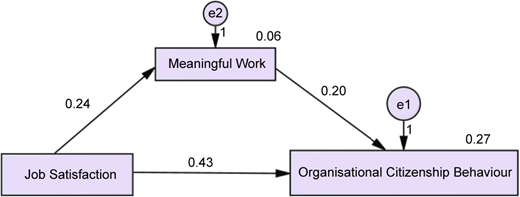
Regression analysis was incorporated to examine the mediating effect of meaningful work between job satisfaction and OCB in which Table 5 and Figure 2 explain the direct and significant effect between job satisfaction on meaningful work (JS → MW)(β = 0.244, t = 5.035, p < 0.001). Job satisfaction was also found to be significantly associated with OCB (JS → OCB)(β = 0.430, t = 9.728, p < 0.001). Meaningful work indicates significant relations with OCB (MW → OCB)(β = 0.197, t = 4.461, p < 0.001). Thus, the direct effect between variables was found to be significantly connected; hence, it is evidenced to be the case of partial mediation (Dubey and Sahu, 2022). Table 5and Figure 2also showed the significant indirect effect between job satisfaction and OCB through meaningful work (JS → MW → OCB)(β = 0.048, p < 0.001) with total effect(β = 0.479, p < 0.001). Hence, it concludes that meaningful work is found to be partially mediated (0.048) between job satisfaction and OCB.
The measurement model shows an acceptable (Dubey et al., 2020) model fit of the data with x2/df = 2.624,AGFI = 0.881, CFI = 0.901,GFI = 0.912, NFI = 0.870,RMSEA = 0.058. Thus, the model exhibits a good fit.
4.2 Testing of H2
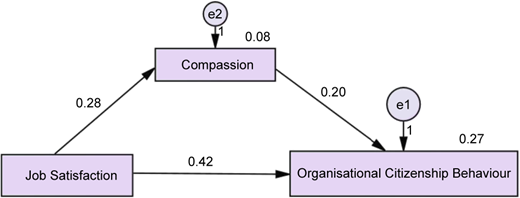
Regression analysis was applied to investigate the mediating effect of compassion between job satisfaction and OCB in which Table 6 and Figure 3 explain the direct and significant effect between job satisfaction and compassion (JS → CM)(β = 0.281, t = 5.850, p < 0.001). Job satisfaction is also found significantly associated with OCB (JS → OCB)(β = 0.421, t = 9.438, p < 0.001). Compassion also indicates significant and positive correlation with OCB (CM → OCB)(β = 0.203, t = 4.554, p < 0.001). Thus, the direct effect between variables was found to be significantly connected; hence, it is evidenced to be the case of partial mediation (Dubey and Sahu, 2022). Table 6and Figure 3also showed the indirect effect between job satisfaction and OCB through compassion significantly associated (JS → CM → OCB)(β = 0.057, p < 0.001) with the total effect(β = 0.479, p < 0.001). Hence, it concludes that compassion is found to be partially mediated (0.057) between job satisfaction and OCB.
The measurement model shows an acceptable model fit of the data with x2/df = 2.845,AGFI = 0.821, CFI = 0.941,GFI = 0.859, NFI = 0.921,RMSEA = 0.067. Thus, the model exhibits a good fit.
4.3 Testing of H3
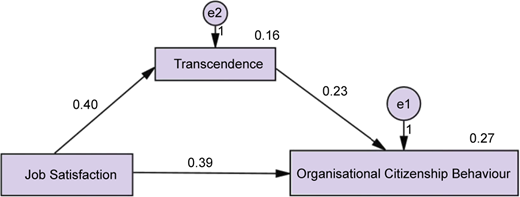
Regression analysis is incorporated to investigate the mediating effect of transcendence between job satisfaction and OCB in which Table 7 and Figure 4 explain the direct and significant effect between job satisfaction and transcendence (JS → T)(β = 0.397, t = 8.643, p < 0.001). Job satisfaction is also found significantly linked with OCB (JS → OCB)(β = 0.388, t = 8.342, p < 0.001). Transcendence indicates significant correlation with OCB (T → OCB)(β = 0.228, t = 4.906, p < 0.001). Thus, the direct effect between variables was found to be significantly connected; hence, it is evidenced to be the case of partial mediation (Dubey and Sahu, 2022). Also, Table 7 and Figure 4 explain the indirect effect between job satisfaction and OCB through transcendence associated significantly (JS → T →OCB) (β = 0.091, p < 0.001) with the total effect(β = 0.479, p < 0.001). Thus, it concludes that transcendence is found to be partially mediated (0.091) between job satisfaction and OCB.
The measurement model shows an acceptable model fit of the data with x2/df = 2.547,AGFI = 0.935, CFI = 0.980,GFI = 0.962, NFI = 0.970,RMSEA = 0.061. Thus, the model exhibits a good fit.
4.4 Testing of H4
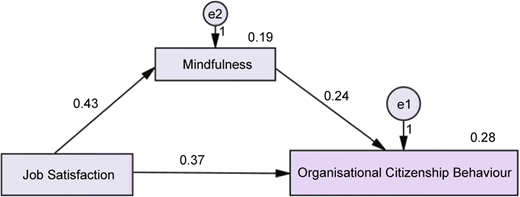
Regression analysis is incorporated to investigate the mediating effect of mindfulness between job satisfaction and OCB in which Table 8 and Figure 5 explain the direct and significant effect between job satisfaction and mindfulness (JS → MF)(β = 0.432, t = 9.564, p < 0.001). Job satisfaction is also found significantly linked with OCB (JS → OCB)(β = 0.373, t = 7.912, p < 0.001). Mindfulness also indicates significant correlation with OCB (MF → OCB)(β = 0.244, t = 5.168, p < 0.001). Thus, the direct effect between variables was found to be significantly connected; hence, it is evidenced to be the case of partial mediation (Dubey and Sahu, 2022). Also, Table 8 and Figure 5 indicate the indirect effect between job satisfaction and OCB through mindfulness associated significantly (JS →MF → OCB) (β = 0.105, p < 0.001) with the total effect(β = 0.479, p < 0.001). Hence, it concludes that mindfulness is found to be partially mediated (0.105) between job satisfaction and OCB.
The measurement model shows an acceptable model fit of the data with x2/df = 2.950,AGFI = 0.921, CFI = 0.942,GFI = 0.931, NFI = 0.966,RMSEA = 0.054. Thus, the model exhibits a good fit.
4.5 Testing of H5
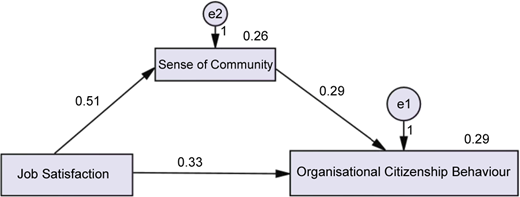
Regression analysis is incorporated to examine the mediating effect of sense of community between job satisfaction and OCB in which Table 9 and Figure 6 explain the direct and significant effect between job satisfaction and sense of community (JS →SoC) (β = 0.509, t = 11.809, p < 0.001). Job satisfaction is also found significantly associated with OCB (JS → OCB)(β = 0.329, t = 6.726, p < 0.001). Sense of community also indicates significant correlation with OCB (SoC → OCB)(β = 0.294, t = 6.021, p < 0.001). Thus, the direct effect between variables was found to be significantly connected; hence, it is evidenced to be the case of partial mediation (Dubey and Sahu, 2022). Also, Table 9 and Figure 6 showed the indirect effect between job satisfaction and OCB through sense of community associated significantly (JS → SoC→ OCB) (β = 0.150, p < 0.001) with the total effect(β = 0.479, p < 0.001). Hence, it concludes that sense of community is found to be partially mediated (0.150) between job satisfaction and OCB.
The measurement model shows an acceptable model fit of the data with x2/df = 2.750,AGFI = 0.924, CFI = 0.874,GFI = 0.899, NFI = 0.911,RMSEA = 0.072. Thus, the model exhibits a good fit.
4.6 Testing of H6
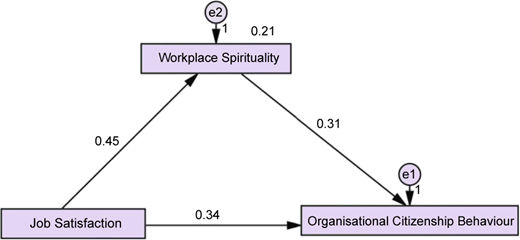
Regression analysis was applied to test the mediating effect of OWS in the link between job satisfaction and OCB in which Table 10 and Figure 7 explain that job satisfaction is significantly connected with OWS (JS → OWS)(β = 0.454, t = 10.19, p < 0.001) and OCB (JS → OCB)(β = 0.337, t = 6.664, p < 0.001). Also, OWS is found to be significantly associated with OCB (OWS → OCB)(β = 0.312, t = 7.196, p < 0.001). Thus, the direct effect between the variables was found to be connected significantly; hence, it is evidenced to be the case of partial mediation (Dubey and Sahu, 2022). Table 10 and Figure 7 also indicates the indirect effect between job satisfaction and OCB through OWS significantly associated (JS → OWS → OCB)(β = 0.117, p < 0.001) with the total effect(β = 0.454, p < 0.001). Hence, it concludes that OWS is found to be partially mediated (0.117) between job satisfaction and OCB (see Table 11).
The measurement model shows an acceptable model fit of the data with x2/df = 2.811,AGFI = 0.901, CFI = 0.886,GFI = 0.901, NFI = 0.920 and RMSEA = 0.077. Thus, the model exhibits a good fit.
5. Findings and discussion
The results of the first hypothesis test revealed that meaningful work evidenced to be partially mediated between job satisfaction and OCB;thus, the hypothesis is accepted. Thus, it can be concluded that when meaning and purpose at work are added,a substantial relationship between job satisfaction and OCB is discovered among managerial employees of selected private manufacturing companies. This suggests that the existence of meaningful employment in an organisation has a positive relationship with the satisfaction of employees and their participation in civic activities at work. Employees' sense of meaning and purpose at work instils positive sentiments in them, which leads to them achieving organisational efficiency by going above and beyond their job responsibilities.
The outcome of the second hypothesis test predicted that compassion evidenced to be partially mediated between job satisfaction and OCB; thus, the hypothesis is accepted. Therefore, it can be concluded that when compassion is brought into the workplace, a significant link is shown between job satisfaction and OCB among managerial employees of selected private manufacturing firms. It suggests that the existence of the compassion element in the workplace has a beneficial impact on the satisfied workers' willingness to engage in citizenship behaviour. When workers show compassion for one another, it fosters cooperation and camaraderie inside the organisation, which in turn encourages citizenship behaviour, which leads to improved organisational performance.
Similarly, the result of third hypothesis test indicated that transcendence evidenced to be partially mediated between job satisfaction and OCB; thus, the hypothesis is accepted. So, it can be concluded that when the transcendence component is added into the workplace, a statistically significant relationship is shown between job satisfaction and OCB. This suggests that the existence of the transcendence factor has a considerable impact on the relationship between satisfied workers and their employers' citizenship behaviour at the workplace. In other words, employees who have a strong sense of transcendence are more connected to their jobs and their workplace, which results as extra role behaviour in the organisation.
Likewise, the outcome of fourth hypothesis test revealed that mindfulness evidenced to be partially mediated between job satisfaction and OCB; thus, the hypothesis is accepted. Therefore, it can be derived that when the mindfulness aspect is added into the workplace, a significant relationship between job satisfaction and OCB is revealed. It suggests that the presence of mindfulness has a favourable impact on the transformation of satisfied employees into individuals who exhibit OCB in the organisation. Employees need to have a mindfulness component since it helps them be aware of their surroundings and positively engage in certain jobs in order to achieve organisational success by practicing civic behaviour.
Also, the result of fifth hypothesis test explained that sense of community evidenced to be partially mediated between job satisfaction and OCB; thus, the hypothesis is accepted. Therefore, it is likely to infer that when the sense of community component is added at the workplace, a substantial link is discovered between job satisfaction and OCB. It suggests that the existence of a sense of belonging is positively associated with satisfied employees' participation in organisational citizenship activities. Employees who have a strong sense of belonging at work are more likely to complete certain tasks with the assistance of the community, which encourages them to embrace citizenship behaviours.
Expectedly, the outcome of sixth hypothesis test predicted that OWS evidenced to be partially mediated between job satisfaction and OCB; thus, the hypothesis is accepted. Therefore, it can be derived that when spirituality is present in the workplace, a statistically significant association between job satisfaction and OCB has been observed. Consequently, evidence appears that the existence of workplace spirituality has a favourable impact on the willingness of satisfied employees to take on more responsibilities in the workplace. As a result, it is concluded that workplace spirituality assists employees in engaging in more meaningful and transcendental work, committed to compassionate and mindfulness behaviour as well as a strong sense of community with other employees, in order to contribute to the overall growth of the organisation, which ultimately creates an environment conducive to the development of OCB at the workplace.
6. Implications of the study
The current research adds to management theory and practice. Every organisation wants to keep its talented personnel so that they may develop and thrive in a cutthroat competitive market. Previous research indicates that workplace spirituality helps to retain and satisfy workers and has a substantial impact on organisational success. The present study attempts to examine the presence of workplace spirituality dimensions (i.e. meaningful work, mindfulness, transcendence, compassion and sense of community) in the link between job satisfaction and OCB among managerial employees. The results explained that all the dimension of workplace spirituality positively evidenced to be a favourable link between job satisfaction and OCB. It means that the meaning and purpose of work, compassion for others, a sense of transcendence, mindfulness at work and a sense of belonging in the workplace had the greatest impact on the development of citizenship behaviour among management employees.
Given the importance of OCB in the workplace, it becomes critical to have such behaviours in the workplace in order to achieve sustained organisational success. However, establishing conditions for citizenship behaviour among employees is not a simple job, and in order to achieve this aim, it is necessary to perform such a study to determine the elements that positively impact the citizenship behaviour of employees in the organisation. Employees who are sustained, retained and satisfied are the pillars of any organisation's success and growth, in which people who demonstrate extra-role behaviour at work give an organisation an extra-edge in a variety of ways, such as motivating others to perform more and better, assisting others in problems, feeling the organisation as its own and so on. In reality,organisations use multiple methods to foster citizenship behaviour among employees,such as greater compensation for work, incentives, medical and life insurance,various types of leaves and so on, yet they are unable to keep talented employees. In this respect, the present study's findings will assist all private organisations to comprehend the needs and perceptions of their employees, allowing the businesses to act appropriately in order to foster citizenship behaviour in the organisation.
The study will undoubtedly assist Chhattisgarh state's private manufacturing firms in understanding their employees' perceptions of work and the workplace, which will aid in policymaking. Globally, organisations are confronting a dilemma in keeping talented and qualified personnel; consequently, the current research may be useful to all of those organisations in developing an environment for achieving citizenship behaviour among their employees.
7. Conclusion
Workplace spirituality is a major determinant that has a direct and significant impact on a variety of organisational outcomes, including increased employee engagement, job satisfaction, morale, OCB, a reduction in absenteeism, conflict and stress, and many more. Developing a conducive environment for citizenship behaviour among employees has never been a simple task for any organisation. Previous research suggests that workplace spirituality can aid in the development of citizenship behaviour among employees; however, the question of whether it can act as a mediator between job satisfaction and OCB remains unanswered as this area lacks original research papers in the knowledge domain. The present study attempted to analyse workplace spirituality dimensions (i.e. meaningful work, mindfulness, transcendence,compassion and sense of community) as a mediator in the effect of job satisfaction on OCB among managerial employees of selected private manufacturing firms of Chhattisgarh state. According to the findings, all dimensions of workplace spirituality considerably and partly mediated the relationship between job satisfaction and OCB. As a result, it can be stated that workplace spirituality has a good and substantial influence on establishing citizenship behaviour among employees; hence, private manufacturing firms must examine the results of the current research to increase workplace belongingness and connection.
7.1 Limitations of the study
The findings of this research were based on cross-sectional data, but a longitudinal study might provide a more complete picture of the impact of workplace spirituality on employees. However, the project was entirely self-funded.
7.2 Future research avenues
Future researchers can conduct similar studies using the same model in other sectors, such as banking, academics, information technology (IT) and so on, to determine how the workplace spirituality dimensions create or not create any impact as a mediating variable between job satisfaction and OCB among employees. If the researchers use longitudinal data, it will be far more effective in examining the influence of workplace spirituality on different organisational outcomes.