This study aims to examine how national reform policies shape supply chain transformation through two distinct but interrelated pathways: Pathway A (short-term efficiency and service performance gains) and Pathway B (long-term capability development via organizational readiness). Using Saudi Arabia’s Vision 2030 as the empirical context, this study addresses how policy-driven reforms translate into firm-level outcomes.
A sequential explanatory mixed-methods design was used. Survey data from 247 supply chain professionals across 14 sectors were analyzed using partial least squares structural equation modeling. These findings were complemented by 20 semi-structured interviews. Multi-group and mediation analyses were conducted to examine sectoral variation and the mechanisms linking reform drivers to transformation outcomes.
The results reveal a dominant efficiency-oriented pathway. Pathway A accounts for 54%–65% of observed effects, while Pathway B explains 35%–46%. Digitalization, localization and regulatory reform activate both pathways, but with clear sectoral contingencies. Logistics sectors prioritize efficiency gains, whereas manufacturing sectors emphasize capability development. Organizational readiness operates as a dynamic capability mediating reform–performance relationships. IoT, AI and blockchain enable both immediate operational improvements and longer-term adaptive capacity.
The findings are grounded in a Saudi Arabian reform context and a cross-sectional design, which may limit generalizability to other institutional environments. Future research could adopt longitudinal and comparative multi-country designs to examine how dual transformation pathways evolve across sectors and policy contexts.
This study provides managers and policymakers with the Dual Transformation Readiness Framework (DTRF), a diagnostic tool for aligning reform initiatives with organizational readiness, sectoral conditions and staged technology adoption strategies. The framework supports evidence-based prioritization of both efficiency-oriented and capability-building investments.
The findings demonstrate that coordinated national reforms spanning digitalization, localization and regulatory restructuring can strengthen supply chain resilience, workforce adaptability and long-term capability development, thereby supporting broader economic transformation objectives.
This study advances supply chain transformation theory by developing a dual-pathway framework that moves beyond single-mechanism explanations. It reconceptualizes organizational readiness as a dynamic, multidimensional capability. This study also demonstrates how national reforms operate through a coordinated architecture of digitalization, localization and regulatory change. By integrating institutional and contingency perspectives, it explains sectoral variation in transformation responses. The DTRF is introduced as a diagnostic tool for aligning reform pressures with organizational capabilities.
1. Introduction
Global supply chains are undergoing profound structural transformation driven by technological disruption, geopolitical realignment and sustainability imperatives (Ivanov and Dolgui, 2020; Wieland, 2021). Increasingly, governments are not merely external actors but active architects of supply chain change. Through coordinated industrial, digital and regulatory reforms, they reshape sourcing, production and logistics systems at scale (Ivanov, 2024; Wu and Jia, 2018). Despite this shift, supply chain research has yet to fully explain how such coordinated reform programs translate into firm-level performance outcomes.
A central unresolved tension concerns the temporal and structural effects of reform-driven transformation. While some reforms generate immediate efficiency and service performance gains, others require sustained capability development before measurable results emerge (Belhadi et al., 2022; Lee, 2021). Existing research largely treats these effects separately. Digitalization is typically linked to operational efficiency and visibility (Jing and Fan, 2024; Zhu, 2024), localization to institutional alignment and supply chain restructuring (Wu and Jia, 2018) and regulatory reform to compliance and governance mechanisms (DiMaggio and Powell, 1983; Scott, 2008). This fragmented perspective overlooks the reality that reforms are often implemented as coordinated policy architectures. Such architectures generate simultaneous pressures for both short-term performance and long-term capability development (Ivanov and Dolgui, 2020; MacCarthy et al., 2016).
Addressing this gap requires a multi-level framework linking national reform drivers, sectoral contingencies and organizational capabilities. Drawing on dual transformation theory (Anthony et al., 2017; del Socorro Encinas-Grijalva et al., 2024), this study develops and tests a dual-pathway model of supply chain transformation. Pathway A captures the direct effects of reform drivers on short-term efficiency and service performance gains through operational integration and process optimization (Gunasekaran et al., 2001; Huo et al., 2014). Pathway B captures indirect effects, whereby reform drivers enhance long-term adaptability and resilience through organizational readiness, conceptualized as a dynamic capability (Teece et al., 1997; Weiner, 2020). This distinction enables a more precise explanation of how immediate operational performance outcomes and capability-based transformation mechanisms operate in parallel.
Saudi Arabia’s Vision 2030 provides a reform-intensive empirical context in which digitalization, localization and regulatory reform operate concurrently across sectors (Government of Saudi Arabia, 2024; Khan et al., 2025). This setting allows for systematic examination of how overlapping policy drivers activate both transformation pathways under varying sectoral conditions. A sequential explanatory mixed-methods design was used, combining survey data from 247 supply chain professionals with 20 semi-structured interviews to uncover both generalizable relationships and context-specific mechanisms.
This study advances supply chain management theory in three key ways. First, it offers a theoretical resolution to the efficiency–capability tension by proposing a dual-pathway explanation of reform-driven transformation. Reform drivers are conceptualized as a coordinated architecture that simultaneously activates short-term performance and long-term capability development. Second, it integrates institutional and contingency theory to explain how reform pressures interact with sectoral and organizational conditions, demonstrating why the relative dominance of each pathway varies across industries. Third, it reconceptualizes organizational readiness as a multidimensional dynamic capability – aligned with Teece’s (2007) sensing, seizing and reconfiguring microfoundations – that mediates the relationship between reform drivers and supply chain outcomes.
Beyond its theoretical contributions, the study introduces the Dual Transformation Readiness Framework (DTRF), a diagnostic tool that enables managers and policymakers to align reform initiatives with sectoral characteristics and organizational capability requirements. The findings demonstrate that large-scale reform programs generate both immediate operational improvements and longer-term capability renewal, highlighting the need for balanced transformation strategies.
Although grounded in the Saudi Arabian context, the proposed framework has broader applicability. Contemporary reform initiatives – such as the EU Green Deal and China’s Belt and Road Initiative – similarly combine digitalization, sustainability mandates and regulatory restructuring to reshape supply chain systems (Almeida et al., 2023; Cui et al., 2025). Post-pandemic industrial policies have also intensified state involvement in supply chain resilience and localization (Gereffi et al., 2025; Ivanov, 2024). These developments suggest that dual-pathway transformation is not context-specific but reflects a structural feature of reform-driven supply chain change under conditions of overlapping institutional pressures.
2. Literature review
2.1 Theoretical foundations of reform-driven supply chain transformation
Supply chain transformation research has increasingly shifted toward resilience, viability and adaptability in response to systemic disruption (Ivanov and Dolgui, 2020; Wieland, 2021). In contrast, traditional supply chain performance literature emphasizes cost efficiency, integration and service performance as primary design objectives (Gunasekaran et al., 2001; Huo et al., 2014). This divergence reflects a fundamental theoretical tension between short-term operational optimization and long-term capability development. Despite its centrality, this tension remains insufficiently resolved within existing supply chain theory.
Much of the literature adopts implicit single-mechanism explanations of transformation. Digital transformation studies predominantly link technological adoption to efficiency gains, visibility and improved coordination (Jing and Fan, 2024; Zhang, 2024; Zhu, 2024). Resilience research, by contrast, emphasizes structural adaptation, redundancy and risk mitigation (Ivanov, 2024). Sustainability research focuses on firm-level green supply chain practices and their impact on environmental and operational performance (Gupta et al., 2025; Kalpande and Toke, 2021). While these streams offer valuable insights, they remain analytically fragmented and are rarely integrated within a unified explanatory framework. As a result, existing theory does not adequately explain how multiple transformation mechanisms operate simultaneously under conditions of coordinated external pressure.
This limitation becomes particularly salient in the context of national reform programs, which increasingly combine digitalization, localization and regulatory restructuring to reconfigure supply chain systems at scale (Gereffi et al., 2025; Wu and Jia, 2018). Digital transformation enhances visibility and decision-making accuracy, contributing directly to operational efficiency (Zhu, 2024). Localization strengthens domestic supplier networks and reduces dependency on global inputs, while regulatory reforms reshape governance structures and institutional compliance environments (DiMaggio and Powell, 1983; Scott, 2008). However, existing scholarship largely treats these drivers independently, overlooking how their coordinated interaction simultaneously generates short-term performance gains and longer-term capability development.
2.2 Integrating institutional, contingency and dual transformation perspectives
Institutional Theory explains how organizations respond to external policy pressures to maintain legitimacy within complex regulatory environments (DiMaggio and Powell, 1983; Scott, 2008). In coordinated reform contexts, firms are exposed to overlapping demands arising from digitalization mandates, localization policies and governance restructuring (Gereffi et al., 2025; Wu and Jia, 2018). These pressures generate institutional complexity, requiring organizations to simultaneously pursue compliance and performance objectives (Greenwood et al., 2011; Kraatz and Block, 2008). However, while Institutional Theory explains why firms respond to reform pressures, it provides limited insight into how these responses translate into distinct transformation outcomes.
Contingency theory complements this perspective by emphasizing that organizational responses are conditioned by the alignment between external demands and internal capabilities (Donaldson, 2001; Lawrence and Lorsch, 1967). In supply chain contexts, structural configurations, resource endowments and technological readiness shape how firms absorb and operationalize reform pressures (Fynes et al., 2005; Huo et al., 2014). Consequently, identical reform initiatives may produce heterogeneous outcomes across sectors, reflecting differences in capability profiles and structural fit. Yet, contingency theory explains why responses vary but does not identify the mechanisms through which reform pressures produce distinct transformation outcomes.
Dual transformation theory provides this missing mechanism by distinguishing between the reinforcement of existing capabilities and the development of new ones (Anthony et al., 2017; del Socorro Encinas-Grijalva et al., 2024). Applied to supply chains, this distinction captures the coexistence of operational optimization and structural renewal under reform-driven conditions. Pathway A reflects efficiency gains, integration and service performance improvements (Gunasekaran et al., 2001; Ivanov and Dolgui, 2020), whereas Pathway B captures long-term capability development and resilience (Teece et al., 1997; Wieland, 2021). However, Dual Transformation Theory alone does not explain why these pathways are activated differently across institutional environments and sectoral contexts.
Integrating these perspectives enables a more comprehensive theoretical explanation of reform-driven supply chain transformation. Institutional theory explains the source and intensity of reform pressures, contingency theory explains the conditions under which firms respond differently, and dual transformation theory explains the mechanisms through which transformation unfolds. Together, they provide a multi-level framework linking external reform drivers, organizational conditions and transformation outcomes across both short- and long-term horizons.
From a global value chain (GVC) perspective, localization reforms further extend this integrated framework by reshaping supply chain governance structures. GVC theory explains how lead firms coordinate activities across governance modes – ranging from market-based to hierarchical – depending on transaction complexity and supplier capabilities (Gereffi et al., 2005). Localization policies can shift these governance structures by increasing reliance on domestic suppliers, altering power asymmetries and necessitating new coordination mechanisms. This often involves supplier capability upgrading and intensified knowledge transfer (Humphrey and Schmitz, 2002), reinforcing both immediate operational adjustments (Pathway A) and longer-term capability development (Pathway B). As such, localization operates not only as a sourcing strategy but as a structural mechanism linking institutional pressures to dual transformation pathways.
2.3 Organizational readiness as dynamic capability
Despite increasing recognition of coordinated reform drivers, the mechanism through which they generate dual transformation outcomes remains theoretically underdeveloped. Existing supply chain research provides limited explanation of how reform pressures translate simultaneously into short-term operational gains and longer-term capability development (Ivanov and Dolgui, 2020; Lee, 2021). This gap reflects the absence of a clearly specified mediating mechanism linking external reform pressures to internal transformation processes.
Organizational readiness offers a critical but underutilized lens to address this gap. While widely acknowledged as essential for transformation, readiness is often conceptualized as a static condition – reflecting preparedness for change – rather than as an evolving capability that actively shapes transformation outcomes (Weiner, 2020). This static view limits its explanatory power in dynamic reform environments characterized by continuous and overlapping pressures.
From a dynamic capabilities perspective, organizational readiness can be reconceptualized as a firm’s ability to sense environmental shifts, mobilize resources and reconfigure operational processes in response to external demands (Teece, 2007; Teece et al., 1997). Within supply chains, these capabilities enable organizations to translate institutional pressures into coordinated strategic and operational responses (Tortorella et al., 2021; Wieland, 2021). This perspective positions readiness not as a passive precondition, but as an active mechanism through which transformation unfolds.
However, existing research rarely conceptualizes readiness as a mediating capability linking reform drivers to both efficiency-oriented and capability-oriented outcomes. Instead, it is typically treated as a contextual moderator or antecedent to change (Ivanov, 2024; Weiner, 2020). As a result, its role in concurrently activating multiple transformation pathways remains insufficiently theorized.
This study positions organizational readiness as the central dynamic capability mediating the relationship between coordinated reform pressures and dual transformation outcomes. In Pathway A, readiness enables the rapid and efficient implementation of operational adjustments, facilitating short-term efficiency and service performance gains (Gunasekaran et al., 2001; Huo et al., 2014). In Pathway B, readiness supports deeper structural adaptation by enabling capability development, resource reconfiguration and strategic renewal (Anthony et al., 2017; Teece et al., 1997). In this way, readiness functions as the mechanism through which reform pressures are translated into both operational reinforcement and long-term capability development.
From a dynamic capabilities perspective, the dimensions of organizational readiness align with Teece’s (2007) microfoundations. Leadership alignment reflects sensing, as it enables firms to interpret reform signals and identify strategic priorities. Capability development corresponds to seizing, as organizations mobilize resources and build the competencies required for transformation. Adaptive capacity reflects reconfiguring, as firms continuously adjust structures, processes and supply chain relationships. This mapping not only clarifies the internal structure of readiness but also explains how it enables firms to respond to reform pressures across both transformation pathways.
2.4 The dual-pathway challenge and research gaps
Reform-driven supply chain transformation introduces a fundamental theoretical tension: organizations are required to deliver short-term efficiency and service performance gains while also developing long-term capabilities for resilience and competitiveness. This dual expectation becomes particularly acute in coordinated reform environments where digitalization, localization and regulatory restructuring operate concurrently (Gereffi et al., 2025; Ivanov, 2024).
A central challenge concerns the timing and mechanisms through which reform outcomes materialize. Some initiatives produce immediate operational improvements through process integration, digital adoption and streamlined governance (Gunasekaran et al., 2001; Jing and Fan, 2024). Others require sustained investment in supplier development, technological capability and organizational learning before measurable benefits emerge (Anthony et al., 2017; Teece et al., 1997). These differences indicate that reform-driven transformation does not follow a single linear trajectory, but instead unfolds through parallel mechanisms of operational reinforcement and structural renewal.
Evidence from large-scale reform programs further highlights the generality of this dual transformation dynamic. Initiatives such as China’s Belt and Road Initiative and the EU Green Deal combine immediate performance-oriented interventions with longer-term investments in infrastructure, sustainability and capability development (Almeida et al., 2023; Cui et al., 2025). These cases suggest that the coexistence of short-term and long-term transformation pressures reflects a structural feature of reform-driven supply chain change rather than a context-specific phenomenon.
Despite increasing recognition of transformation complexity, three key gaps persist in the supply chain literature. First, reform drivers – digitalization, localization and regulatory restructuring – are predominantly examined in isolation, limiting understanding of how coordinated reform architectures shape supply chain outcomes (Jing and Fan, 2024; Wu and Jia, 2018). Second, existing models largely rely on single-pathway assumptions, emphasizing either short-term performance or long-term capability development, but rarely theorizing their simultaneous activation (Belhadi et al., 2022; Ivanov and Dolgui, 2020). Third, organizational readiness remains underdeveloped as a mediating dynamic capability linking reform pressures to both efficiency-oriented and capability-oriented outcomes (Teece et al., 1997; Weiner, 2020).
Addressing these gaps requires an integrative framework that captures the interaction between coordinated reform pressures, organizational capabilities and transformation outcomes. The dual-pathway model developed in this study advances such a framework. It conceptualizes reform drivers as a coordinated architecture and positions organizational readiness as the central mediating capability linking these drivers to both short-term efficiency gains (Pathway A) and long-term capability development (Pathway B).
2.5 Research contributions
2.5.1 Theoretical contributions
Building on the preceding analysis, this study advances supply chain management theory in three interrelated ways:
First, it develops a dual-pathway framework that extends supply chain transformation theory beyond single-mechanism explanations. Digitalization, localization and regulatory reform are conceptualized as a coordinated reform architecture that generates both short-term efficiency gains (Pathway A) and longer-term capability development (Pathway B). This framework demonstrates that operational optimization and structural renewal are not competing outcomes but coexisting transformation mechanisms.
Second, the study reconceptualizes organizational readiness as a multidimensional dynamic capability. Drawing on Teece’s (2007) microfoundations of sensing, seizing and reconfiguring, readiness is positioned as an active mediating mechanism linking reform drivers to both efficiency-oriented and capability-oriented outcomes. This moves beyond static interpretations of readiness as a precondition for change.
Third, the study extends contingency theory to reform-driven supply chain contexts. By demonstrating how sectoral and organizational conditions shape the relative activation of each pathway, it explains why identical reform pressures produce heterogeneous outcomes across industries. This highlights the importance of alignment between external reform demands and internal capability configurations.
2.5.2 Practical contributions
This study also provides actionable insights for managers and policymakers operating in reform-driven environments.
First, the DTRF offers a diagnostic tool enabling managers to assess readiness across both efficiency-oriented and capability-oriented pathways. By identifying gaps in sensing, mobilization and reconfiguration capabilities, it supports more targeted and balanced transformation strategies.
Second, the findings provide guidance for policymakers designing coordinated reform programs. Rather than treating digitalization, localization and regulatory change as independent levers, the study highlights the importance of aligning these interventions to reinforce synergies and avoid trade-offs between short-term performance and long-term capability development.
Third, the study outlines a technology implementation logic in which AI, IoT and blockchain are deployed not only to enhance immediate operational efficiency but also to build adaptive capacity over time. This shifts technology adoption from an operational decision to a strategic enabler of transformation.
Finally, the study identifies organizational development priorities necessary to sustain reform-driven transformation, including leadership development, cross-functional collaboration and continuous learning systems that translate reform pressures into both operational improvements and capability renewal.
Together, these contributions translate the dual-pathway model into actionable strategies, enabling organizations to balance immediate performance objectives with long-term competitiveness.
2.6 Research objectives
Building on the theoretical framework developed in this study, the research aims to empirically examine how coordinated national reform drivers shape supply chain transformation through dual pathways. Specifically, the study investigates the direct and indirect effects of digitalization, localization and regulatory reform on supply chain performance, adaptability and resilience, while assessing the mediating role of organizational readiness as a dynamic capability.
In doing so, the study tests a dual-pathway model that distinguishes between short-term efficiency and service performance (Pathway A) and long-term capability development (Pathway B). It further examines how the activation of these pathways varies across sectors using multi-group analysis (MGA) and qualitative insights, thereby capturing the role of sectoral contingencies in reform-driven transformation.
Finally, the study seeks to translate these findings into practical guidance by identifying how managers and policymakers can align reform initiatives with organizational readiness and sectoral conditions to achieve both immediate performance improvements and sustained capability development.
2.7 Hypotheses and conceptual framework
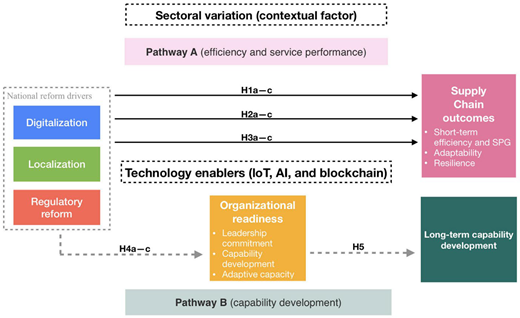
Building on the research objectives, this study develops hypotheses linking national reform drivers – digitalization, localization and regulatory reform – to supply chain outcomes. The framework distinguishes two pathways: Pathway A, in which reform drivers are directly linked to short-term efficiency and service performance, and Pathway B, in which reform drivers influence long-term capability development indirectly through organizational readiness. Sectoral variation is incorporated as a contextual factor shaping how these pathways are activated.
H1a–H1c: Digitalization effects
Digitalization is positively related to:
supply chain performance;
supply chain adaptability; and
supply chain resilience.
H2a–H2c: Localization effects
Localization is positively linked to:
supply chain performance;
supply chain adaptability; and
supply chain resilience.
H3a–H3c: Regulatory reform effects
Regulatory reform is positively associated with:
supply chain performance;
supply chain adaptability; and
supply chain resilience.
H4a–H4c: Drivers’ effects on organizational readiness
Digitalization is positively related to organizational readiness.
Localization is positively linked to organizational readiness.
Regulatory reform is positively associated with organizational readiness.
H5: Mediating role of organizational readiness
Organizational readiness mediates the relationships between reform drivers (digitalization, localization and regulatory reform) and supply chain outcomes.
Conceptual Framework:
This study proposes a conceptual framework in which three national reform drivers – digitalization, localization and regulatory reform – are expected to shape supply chain performance, adaptability and resilience. The framework integrates institutional theory, which explains organizational responses to external policy pressures, with contingency theory, which emphasizes alignment between external demands and internal capabilities (Lawrence and Lorsch, 1967).
Organizational readiness is positioned as the central mediating construct through which reform drivers are translated into supply chain outcomes. Conceptualized as a dynamic capability, readiness reflects the organization’s ability to sense opportunities, mobilize resources and reconfigure operations in response to reform demands (Teece, 2007; Teece et al., 1997). This perspective shifts readiness from a static condition to an active mechanism enabling transformation.
The model captures two complementary pathways. In Pathway A, reform drivers are directly linked to short-term efficiency and service performance gains. In Pathway B, reform drivers influence longer-term capability development indirectly through organizational readiness. Together, these pathways explain how reform pressures produce both immediate operational improvements and sustained capability renewal.
The model is examined within the context of Saudi Arabia’s Vision 2030, a reform-intensive environment characterized by overlapping institutional pressures. Figure 1 illustrates the proposed relationships, including direct effects (Pathway A), indirect effects mediated by organizational readiness (Pathway B) and sectoral variation in the strength of these relationships.
3. Methodology
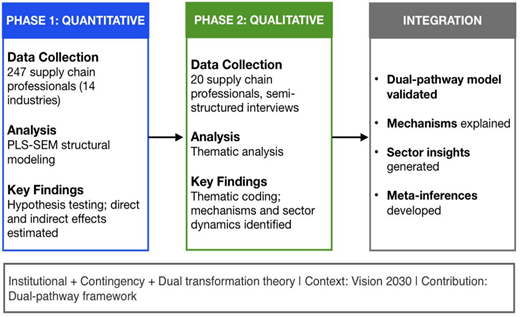
This study uses a sequential explanatory mixed-methods design to examine how national reform drivers shape supply chain transformation. The design integrates a quantitative phase (survey-based, analyzed using partial least squares structural equation modeling [PLS-SEM]) with a qualitative phase (semi-structured interviews), enabling the identification of generalizable relationships and context-specific mechanisms.
This approach is particularly appropriate for reform-driven environments characterized by overlapping institutional pressures and heterogeneous organizational responses. The quantitative phase provides statistical validation of the proposed dual-pathway model, while the qualitative phase offers deeper insight into the mechanisms through which reform drivers are interpreted and operationalized within organizations. The integration of these phases enhances explanatory depth and strengthens the robustness of the findings, consistent with established mixed-methods research practices (Creswell and Plano Clark, 2017; Venkatesh et al., 2013).
Figure 2 illustrates the research design. The quantitative phase tests the hypothesized relationships, the qualitative phase examines underlying processes and sector-specific dynamics, and their integration enables a comprehensive analysis of dual transformation pathways.
3.1 Quantitative phase
3.1.1 Sampling and data collection
The survey targeted supply chain professionals in Saudi Arabia using a purposive sampling approach, leveraging professional networks, industry associations and national reform-related programs. This approach ensured access to respondents with direct exposure to reform-driven supply chain environments. Eligibility criteria required a minimum of three years of professional experience and completion of all survey sections to ensure data quality and relevance.
Sample size determination followed established PLS-SEM guidelines (Hair and Alamer, 2022). A priori power analysis indicated a minimum of 123 responses to detect medium effect sizes (f2 = 0.15) with 80% power at α = 0.05. To account for potential non-response and to enable sectoral comparisons, a target sample size of 300 responses was set.
The final data set included 247 valid responses across 14 sectors, providing post-hoc statistical power exceeding 90%. The largest proportions were drawn from logistics and transportation (27%), aviation (13.5%), energy and natural resources (10.8%) and health care (8.1%). The remaining 40.6% of responses were distributed across retail, manufacturing and other reform-affected industries. This sectoral distribution supports the examination of cross-sectoral variation in reform-driven supply chain transformation.
3.1.2 Measurement of constructs
Supply chain outcomes were operationalized across three dimensions: performance, adaptability and resilience. Performance reflects short-term efficiency and service outcomes (Pathway A), including cost efficiency, asset productivity and service performance indicators such as on-time-in-full delivery and cycle time. Adaptability and resilience capture longer-term capability development (Pathway B), reflecting the organization’s ability to respond to changing conditions and recover from disruptions.
Organizational readiness was modeled as a multidimensional mediating construct, comprising leadership alignment, capability development and adaptive capacity. Consistent with a dynamic capabilities perspective, these dimensions reflect the organization’s ability to sense, mobilize and reconfigure resources in response to reform pressures (Teece, 2007; Teece et al., 1997).
Measurement items were adapted from established sources in the supply chain performance and dynamic capabilities literature (Gunasekaran et al., 2001; Helfat and Peteraf, 2003; Neely et al., 1995) and refined to fit the reform-driven context. Supplementary Table 1 provides details on construct operationalization, including the number of items, representative indicators and source references.
3.1.3 Measurement instrument
The survey instrument was designed to operationalize the constructs defined in subsection 3.2.2. Items were adapted from validated scales and refined to reflect the Saudi Vision 2030 context. All items were measured using a seven-point Likert scale (1 = strongly disagree, 7 = strongly agree). Two open-ended questions were included to capture sector-specific challenges and contextual insights.
Pre-testing was conducted with 12 experts, including academics and supply chain practitioners, to assess clarity and contextual relevance. Feedback resulted in minor refinements to item wording and structure.
The instrument was administered in both English and Arabic. A back-translation procedure was used to ensure linguistic equivalence between versions.
3.1.4 Measurement validity checks
Construct validity and reliability were assessed following established PLS-SEM guidelines. Internal consistency was evaluated using Cronbach’s α and composite reliability (CR), with values exceeding the recommended threshold of 0.70. Convergent validity was confirmed through average variance extracted (AVE), with all constructs exceeding the 0.50 threshold. Discriminant validity was assessed using both the Fornell–Larcker criterion and the heterotrait–monotrait ratio (HTMT), with HTMT values below 0.85.
To address potential common method bias, both procedural and statistical remedies were applied. Procedurally, respondent anonymity was ensured and item order was counterbalanced. Statistically, Harman’s single-factor test was conducted, and full collinearity variance inflation factors (VIFs) were examined, with all values below 3.3, consistent with the absence of common method bias.
3.1.5 Data analysis procedures
Data were analyzed using SmartPLS 4, following a two-step PLS-SEM approach. First, the measurement model was evaluated by examining indicator reliability (outer loadings), internal consistency (Cronbach’s α and CR), convergent validity (AVE) and discriminant validity using the HTMT. VIFs were also assessed to detect potential multicollinearity.
Second, the structural model was assessed using bootstrapping with 5,000 resamples. Path coefficients (β), significance levels and confidence intervals were examined to test the hypothesized relationships. Model explanatory power was evaluated using the coefficient of determination (R2), and predictive relevance was assessed using Q2. Model fit was evaluated using the standardized root mean square residual (SRMR).
Mediation effects were tested by examining bootstrapped indirect effects of reform drivers on supply chain outcomes through organizational readiness. In addition, multi-group analysis (MGA) was conducted to assess sectoral differences in the strength of the proposed relationships.
3.1.6 Measurement model assessment
The measurement model was evaluated following established PLS-SEM procedures (Hair and Alamer, 2022), assessing indicator reliability, internal consistency, convergent validity and discriminant validity as described in subsection 3.2.4. All constructs met the recommended thresholds for outer loadings (>0.70), CR (>0.70), AVE (>0.50) and HTMT (<0.85). Full collinearity VIF values were below 3.3, consistent with the absence of common method bias.
Detailed results are reported in subsection 4.2 and summarized in Table 2.
3.2 Qualitative phase
3.2.1 Sampling and data collection
A total of 20 semi-structured interviews were conducted. In line with the mixed-methods design, the qualitative phase aimed to elaborate and contextualize the survey findings rather than achieve statistical generalizability.
Prior methodological research suggests that 15–30 interviews are typically sufficient to capture key themes and achieve saturation in organizational studies (Guest et al., 2006; Hennink et al., 2017). In this study, thematic saturation was reached by the 17th interview, with no substantively new insights emerging thereafter. The final sample of 20 interviews provided sufficient depth and variation to support the study objectives.
The profile of interview participants, including sector, role, years of experience and exposure to reform drivers, is presented in Supplementary Table 2.
3.2.2 Data analysis
Interview transcripts were analyzed using Braun and Clarke’s (2006) six-phase thematic analysis, supported by NVivo 14. Coding combined deductive codes derived from the conceptual framework with inductive codes that captured emergent themes.
Codes were iteratively reviewed and grouped into higher-order themes through constant comparison. These themes were refined and validated against the full data set to ensure internal coherence and representativeness. The final themes were interpreted in relation to the research questions and theoretical framework, enabling alignment between qualitative insights and the proposed dual-pathway model.
To enhance trustworthiness, multiple strategies were used, including reflexive note-taking throughout the analysis process, peer debriefing to challenge interpretations and member checking with selected participants to confirm the accuracy of the findings. This systematic approach ensured transparency, analytical rigor and a clear linkage between the data, the conceptual framework and the study objectives.
3.3 Integration of quantitative and qualitative findings
Integration of the quantitative and qualitative phases occurred at the interpretation stage. The quantitative phase identified structural relationships among reform drivers, organizational readiness and supply chain outcomes and revealed sectoral differences in the strength of these relationships. The qualitative phase then interpreted these findings. It explained the mechanisms through which reform drivers were operationalized, clarified the mediating role of organizational readiness and provided context for observed sectoral variation.
This integrative approach enabled the alignment of statistical results with process-level insights, allowing for a more comprehensive understanding of the dual transformation pathways. In particular, qualitative findings helped explain differences in pathway activation across sectors and provided insight into how organizations translate reform pressures into both operational improvements and capability development.
Triangulation across methods enhanced the robustness and credibility of the findings by confirming key patterns across data sources while also identifying context-specific nuances. The integrated findings are presented in Section 4 and discussed in Section 5.
3.4 Ethical considerations
The study complied with institutional and international ethical standards for research involving human participants. Ethical approval was obtained from the Institutional Review Board prior to data collection (IRB Log Number: 25–0023). All participants provided informed consent. Survey responses were collected anonymously, interviews were pseudonymized, and all data were stored securely with restricted access. Participants were informed of their right to withdraw at any time without penalty.
4. Results
This section presents findings from the quantitative and qualitative phases. Results are reported sequentially: sample characteristics and descriptive statistics, measurement and structural model outcomes, mediation and sectoral analyses and qualitative insights.
4.1 Sample characteristics and descriptive statistics
4.1.1 Sample characteristics
The final sample consisted of 247 respondents, providing sufficient statistical power for PLS-SEM analysis and representing a response rate of 41.2%. Participants were mid- to senior-level supply chain professionals across 14 sectors, with an average of 11.2 years of experience.
This profile indicates that respondents possessed substantial exposure to reform-driven supply chain environments, supporting the credibility and relevance of the self-reported data. The sectoral distribution reflects a diverse representation of reform-affected industries, enabling the examination of cross-sectoral variation.
The sectoral distribution of survey respondents is presented in Supplementary Table 3.
4.1.2 Descriptive statistics
As shown in Table 1, construct means ranged from 3.95–4.15, with moderate variability (SD = 0.56–0.61). Organizational readiness (M = 4.08) and short-term efficiency and service performance (M = 4.15) recorded the highest mean values.
Overall, the results indicate moderate levels across the measured constructs, with means clustering slightly above the scale midpoint. Correlations among constructs were in the expected direction and below critical thresholds, providing preliminary support for subsequent measurement and structural model assessment.
4.2 Measurement model and structural model results
The measurement model was assessed following the procedures outlined in subsection 3.1.6. As reported in Table 2, all constructs demonstrated satisfactory reliability and validity. CR values exceeded the recommended threshold of 0.70, and AVE values were above 0.50, confirming convergent validity. Discriminant validity was established, with HTMT ratios below 0.85. Full collinearity VIFs were also examined to assess common method bias, with all values below 3.3, indicating that common method bias is unlikely to affect the results (Kock, 2015).
The structural model was evaluated using bootstrapping with 5,000 resamples. Results for the direct paths (H1a–H1c, H2a–H2c, H3a–H3c and H4a–H4c) are presented in Table 3, while the mediation hypothesis (H5) is evaluated separately in Section 4.4 and reported in Table 5. The model demonstrated moderate explanatory power, with R2 values indicating meaningful variance explained across endogenous constructs; organizational readiness exhibited the highest explanatory power (R2 = 0.31). All Q2 values were above zero, confirming predictive relevance.
In terms of path relationships, digitalization showed the strongest positive relationship with organizational readiness (β = 0.34), underscoring the role of digital infrastructure in enabling organizational adaptation to reform pressures. Localization exhibited the strongest direct relationship with adaptability (β = 0.33), highlighting its contribution to supplier development and operational flexibility. Regulatory reform demonstrated moderate but significant relationships across all outcome variables, reflecting its system-wide influence on governance and compliance processes.
Overall, the results provide support for the hypothesized relationships (H1–H5). Reform drivers are linked to supply chain outcomes through both direct effects (Pathway A) and indirect effects mediated by organizational readiness (Pathway B), consistent with the proposed dual-pathway framework.
4.3 Sectoral analysis: contrasting pathways in logistics and manufacturing
Sectoral differences were examined to assess how reform drivers are absorbed differently across logistics and manufacturing supply chains. The results reveal distinct orientations toward the two transformation pathways.
4.3.1 Quantitative comparison
Multi-group analysis (MGA) was conducted using Henseler’s MGA procedure in SmartPLS 4. Differences between logistics and manufacturing sectors were assessed by comparing group-specific path coefficients based on bootstrapping with 5,000 resamples. A significance threshold of p < 0.05 was used to determine whether differences between path estimates were statistically significant.
The results indicate that the logistics sector exhibits stronger direct relationships between reform drivers and supply chain performance outcomes, consistent with a dominant Pathway A orientation. In contrast, the manufacturing sector demonstrates stronger indirect relationships through organizational readiness, indicating a greater reliance on Pathway B for capability development.
These findings suggest that logistics operations prioritize immediate efficiency and service improvements, whereas manufacturing contexts emphasize longer-term capability building through organizational readiness. This pattern is consistent with contingency theory, whereby sector-specific characteristics shape how organizations respond to reform pressures.
Detailed MGA results are reported in Table 4.
4.3.2 Qualitative insights
Interview evidence corroborates the quantitative findings and provides process-level insight into sectoral differences in transformation pathways. Logistics managers consistently emphasized immediate operational improvements following reform implementation:
“The new customs clearance system has been a game-changer. Our lead times have been cut by 30% almost overnight.” (Logistics manager)
These accounts highlight how digitalization and regulatory streamlining translate rapidly into efficiency and service performance gains, consistent with a dominant Pathway A orientation.
In contrast, manufacturing respondents emphasized longer-term capability development and organizational transformation:
It’s not just about a new system. We must rethink supplier development and invest heavily in training for Industry 4.0. It’s a slower, deliberate process that will pay off in the long run.—Senior Manufacturing Manager
These insights indicate that manufacturing firms rely more heavily on building organizational readiness – through skill development, supplier integration and process reconfiguration – to realize reform benefits over time. This pattern aligns with a Pathway B orientation, where outcomes are mediated through capability development.
Taken together, the qualitative evidence suggests that logistics is more responsive to reforms that enhance operational efficiency. In contrast, manufacturing depends more on sustained investments in readiness and capability development. These findings are consistent with contingency theory, which posits that sector-specific characteristics shape how organizations respond to external reform pressures.
4.4 Mediation analysis
The mediating role of organizational readiness was examined to determine whether reform drivers influence supply chain outcomes solely through direct effects (Pathway A) or also indirectly through capability development mechanisms (Pathway B). As shown in Table 5, organizational readiness partially mediates the relationships between reform drivers and supply chain outcomes across all examined paths, providing support for H5.
The findings indicate that organizational readiness partially mediates the relationships between reform drivers (digitalization, localization and regulatory reform) and supply chain outcomes. Both direct and indirect effects are statistically significant, confirming the presence of complementary partial mediation.
To assess the relative importance of the two pathways, direct-to-total and indirect-to-total effect ratios were calculated based on bootstrapped estimates. Pathway A, representing direct effects on short-term efficiency and service performance, accounts for approximately 54–65% of total effects, while Pathway B, representing indirect effects through organizational readiness, accounts for 35–46%.
These findings indicate that reform-driven transformation operates through both immediate performance improvements and longer-term capability development. Rather than substituting for one another, the two pathways operate in parallel – reinforcing the dual transformation framework proposed in this study.
4.5 Cross-Sector comparison
Sectoral comparisons were conducted to examine whether reform drivers operate differently across industries. The findings reveal that reform uptake is shaped by sector-specific conditions, resulting in varying emphasis on transformation pathways.
Infrastructure-intensive sectors, such as energy and aviation, demonstrate a stronger orientation toward capability development (Pathway B). In contrast, service and transactional sectors – including logistics, retail and hospitality – prioritize cost efficiency, speed and responsiveness, reflecting a dominant orientation toward Pathway A. Manufacturing occupies an intermediate position. It shows a stronger orientation toward Pathway B than service sectors, driven by its dependence on supplier development and long-term capability investment.
Across sectors, leadership commitment and digital infrastructure emerge as consistent enablers of reform outcomes. In contrast, regulatory complexity and uneven levels of organizational readiness are frequently identified as constraints. These patterns indicate that reform initiatives are not uniformly absorbed; sector-specific conditions shape whether organizations prioritize efficiency gains or capability development. This variation aligns with contingency theory, which holds that organizational responses to external pressures are contingent on contextual factors and internal capabilities.
Detailed results are summarized in Table 6.
4.6 Qualitative insights
The qualitative phase provides deeper insight into how organizations interpret and implement reform initiatives. Thematic analysis identified five recurring themes: leadership commitment, digital infrastructure, supplier development, regulatory adaptation and sectoral differences in organizational readiness.
Leadership commitment emerged as a key catalyst, aligning resources and strategic priorities with reform objectives. Digital infrastructure shaped the pace of adoption, with advanced systems enabling rapid integration, while weaker systems created operational bottlenecks. Supplier development served a twofold role, acting as both an enabler and a constraint. Firms with established local supplier networks progressed more rapidly, whereas those with limited vendor capacity faced delays in meeting reform requirements.
Regulatory adaptation was identified as resource-intensive, particularly among service sectors where compliance requirements were frequently updated. Finally, sectoral differences in organizational readiness help explain variation in transformation outcomes, with some industries achieving rapid improvements while others required extended timelines to build capabilities.
Taken together, these findings highlight the central role of organizational readiness in translating reform pressures into outcomes. Leadership alignment and digital infrastructure support more immediate efficiency gains (Pathway A), while supplier development and capability building underpin longer-term transformation (Pathway B). These themes are summarized in Table 7.
4.7 Integration of quantitative and qualitative findings
The integrated analysis provides further support for the dual transformation framework by combining evidence from both phases of the study. The quantitative results show that Pathway A, capturing short-term efficiency and service performance gains, accounts for the majority of reform outcomes (54–65%), while Pathway B, reflecting capability development through organizational readiness, explains a substantial proportion (35–46%).
The qualitative analysis complements these findings by identifying the mechanisms through which these pathways operate. Across interviews, leadership commitment, digital infrastructure and supplier capability emerge as key enablers of organizational readiness, whereas regulatory complexity acts as a recurring constraint. These factors help explain why some organizations translate reforms into immediate performance improvements, while others require sustained effort to build capabilities over time.
Taken together, the combined evidence indicates that reform impacts are not uniform but are shaped by sectoral context and organizational conditions. Infrastructure-intensive sectors tend to emphasize Pathway B for long-term resilience, whereas service-oriented sectors prioritize Pathway A for rapid efficiency gains.
Overall, the integration of quantitative and qualitative evidence demonstrates that reform-driven transformation simultaneously produces short-term performance improvements and long-term capability development. This duality explains variation in organizational outcomes and provides empirical support for the proposed framework. The integrated framework is summarized in Table 8.
5. Discussion
5.1 Theoretical implications
This study extends supply chain transformation theory by demonstrating that reform-driven transformation operates through dual pathways. National reform policies shape outcomes through both immediate efficiency and service performance gains (Pathway A) and longer-term capability development (Pathway B). By examining digitalization, localization and regulatory reform as a coordinated reform architecture, the findings contribute to ongoing debates in supply chain management on resilience, adaptability and competitiveness.
5.1.1 Extension of supply chain transformation theory
Prior research has largely conceptualized reform effects as operating either through direct efficiency improvements or through longer-term capability development, but rarely both (Altalhi and Basiouni, 2023; Wu and Jia, 2018). The findings advance this perspective by demonstrating that these mechanisms operate simultaneously. This dual-pathway view aligns with dual transformation perspectives in strategic management (Anthony et al., 2017; del Socorro Encinas-Grijalva et al., 2024), but extends them to reform-driven supply chain contexts.
This perspective provides a more complete explanation of variation in reform outcomes. Organizations that effectively integrate both pathways achieve immediate performance gains while simultaneously building long-term capabilities. In contrast, organizations that emphasize only one pathway capture partial benefits, despite operating under similar reform conditions.
5.1.2 Integration of institutional and contingency perspectives
This study advances the integration of Institutional and Contingency perspectives in supply chain transformation research. Institutional Theory explains how organizations respond to external reform pressures and legitimacy demands (DiMaggio and Powell, 1983; Scott, 2008). However, it offers limited insight into why similar reforms produce divergent outcomes across organizations. Contingency Theory addresses this limitation by emphasizing the alignment between external demands and internal capabilities (Donaldson, 2001; Lawrence and Lorsch, 1967). It does not, however, specify the mechanisms through which such alignment produces transformation outcomes.
By integrating these perspectives, the findings demonstrate that reform-driven transformation is shaped by both the intensity of institutional pressures and the degree of organizational and sectoral fit with reform demands. Although reform initiatives impose relatively uniform mandates, their effects vary according to organizational readiness and sector-specific conditions. This explains why some organizations translate reforms into immediate performance gains, while others rely more heavily on capability development processes.
This integrated perspective provides a more complete theoretical explanation of reform-driven transformation, linking external pressures, internal capabilities and observed outcomes across both transformation pathways.
5.1.3 Organizational readiness as dynamic capability
Organizational readiness accounts for 28%–33% of total reform effects, demonstrating its role as a dynamic capability in reform-driven supply chain transformation. Rather than representing a binary condition, readiness is multidimensional, encompassing leadership alignment, capability development and adaptive capacity.
These findings reconceptualize organizational readiness as an active mechanism through which firms translate reform pressures into immediate efficiency and service performance gains as well as longer-term capability development. From a dynamic capabilities perspective, these dimensions correspond to sensing (leadership alignment), seizing (capability development) and reconfiguring (adaptive capacity) (Teece et al., 1997; Weiner, 2020).
This perspective extends prior conceptualizations by showing that readiness is not merely a precondition for change, but a central process through which dual transformation pathways are activated.
5.1.4 Sectoral contingency framework
The findings extend contingency perspectives by demonstrating that sector-specific conditions shape how reform pressures are translated into outcomes. Infrastructure-intensive sectors emphasize digital infrastructure investment, enabling faster operational integration. Manufacturing sectors prioritize supplier development, reflecting their reliance on long-term capability building. Service industries face greater challenges with regulatory complexity, which can constrain implementation.
These differences confirm that identical reform initiatives can produce divergent outcomes across sectors (Lawrence and Lorsch, 1967). The findings extend this perspective by linking sectoral variation to the dual-pathway framework: industries differ not only in their responses to reform pressures, but also in the relative emphasis placed on efficiency gains (Pathway A) vs capability development (Pathway B). Reform strategies are therefore more effective when aligned with sector-specific characteristics rather than applied uniformly.
5.2 Technology-specific implementation pathways
The findings position technology as a central enabler of both transformation pathways. Quantitative results confirm the significance of digitalization, while qualitative evidence illustrates how firms deploy IoT, AI and blockchain to achieve immediate efficiency gains and longer-term capabilities.
Pathway A – Efficiency and Service Performance
In logistics and service sectors, technology primarily supports process optimization. IoT sensors enhance tracking, route optimization and predictive maintenance, improving cost efficiency and service reliability. As one logistics manager noted: “With IoT, we have full visibility of our fleet. We can predict maintenance needs and avoid costly downtime.” AI and machine learning further improve demand forecasting, inventory management and warehouse automation, reducing stockouts and improving order fulfillment. AI-enabled customer service tools also enhance responsiveness, a key element of service performance.
Pathway B – Capability Development
Technology also contributes to longer-term capability development. Blockchain applications enhance transparency and traceability across supply chain partners, strengthening compliance and trust. Manufacturing managers emphasized that blockchain adoption was not merely an efficiency measure, but a means of building transparent and secure supply chain relationships. Data generated from IoT, AI and blockchain systems supports strategic decision-making, continuous learning and adaptive capacity in reform-driven environments.
Technology functions both as a driver of immediate operational efficiency and as a foundation for sustained competitiveness. This dual role underscores the importance of organizational readiness in enabling firms to balance short-term implementation with longer-term capability development.
5.3 Practical implications
5.3.1 Managerial implications
The findings suggest that managers should balance short-term efficiency and service performance gains with longer-term capability development. Strategies that combine rapid digital integration with sustained investment in supplier development and workforce training are more effective than those focused on a single pathway.
The Dual Transformation Readiness Framework (DTRF) provides a diagnostic tool for assessing readiness across leadership alignment, capability development, adaptive capacity and sectoral orientation (see Table 8). By applying the framework, managers can identify capability gaps and prioritize targeted interventions that align reform initiatives with organizational conditions.
The results also highlight the importance of sector-specific strategies. Logistics firms benefit from prioritizing immediate efficiency gains through accelerated digital integration, particularly IoT-enabled tracking and AI-based forecasting. In contrast, manufacturing firms require a stronger focus on supplier development, workforce training and advanced production capabilities to meet localization requirements and support longer-term transformation.
Technology plays a cross-cutting role in enabling both pathways. In the short term, IoT and AI support efficiency and service performance improvements through enhanced visibility and predictive analytics. Over the longer term, blockchain and advanced data systems strengthen transparency, compliance and adaptive capacity. This staged approach enables managers to align technology adoption with both operational priorities and capability development objectives.
These implications provide a structured approach for aligning organizational readiness, sectoral conditions and technology investment in navigating dual transformation under national reform.
5.3.2 Policy implications
The findings indicate that national reform programs are more effective when they activate both transformation pathways simultaneously. Rather than treating digitalization, localization and regulatory reform as independent policy levers, policymakers should design coordinated interventions that reinforce complementarities across these drivers.
Coordinated governance mechanisms play a critical role in enabling reform uptake. Integrated digital platforms, streamlined licensing processes and transparent regulatory frameworks can reduce compliance burdens and accelerate implementation. Strengthening coordination across agencies ensures that reforms operate as a coherent system rather than as fragmented initiatives.
The results also highlight the importance of sectoral alignment in policy design. Efficiency-focused initiatives tend to generate greater impact in logistics and service sectors, where such gains can be realized rapidly. In contrast, manufacturing sectors require longer-term investments in supplier development, workforce capabilities and advanced technologies. Tailoring policies to sector-specific conditions enhances reform effectiveness and avoids the limitations of one-size-fits-all approaches.
Readiness-oriented policy support is essential for sustained transformation. The Dual Transformation Readiness Framework (DTRF) provides a basis for identifying capability gaps across industries and targeting support accordingly. This may include leadership development programs, SME capability financing and workforce training initiatives aimed at strengthening adaptive capacity.
Ultimately, coordinated, sector-sensitive and readiness-oriented policy design enables reform programs to deliver both immediate efficiency gains and longer-term capability development.
5.4 Limitations and future research directions
This study has several limitations that suggest avenues for further research.
First, the focus on Saudi Arabia limits generalizability to other institutional settings. The Kingdom’s centralized governance structure, resource endowments and state-led approach create a distinctive policy environment. As a result, dual transformation pathways may unfold differently in decentralized or consensus-based systems. Comparative studies across alternative reform contexts would help clarify the boundary conditions of the proposed framework.
Second, the cross-sectional design limits causal inference between reform drivers and firm-level outcomes. Although the mixed-methods approach strengthens explanatory depth, other contextual factors – such as global economic conditions, sectoral restructuring or independent technological shifts – may also influence outcomes. Longitudinal and quasi-experimental designs would provide stronger evidence on causal mechanisms and the evolution of transformation pathways over time.
Third, the empirical analysis focuses primarily on logistics and manufacturing. While these sectors are central to reform implementation, other industries – such as health care, education and financial services – may exhibit different balances between efficiency and capability development. Extending the framework to a broader set of sectors would enhance its explanatory scope.
Fourth, while this study integrates Institutional and Contingency perspectives with dual transformation logic, further theoretical development is possible. Future research could deepen the analysis by incorporating the resource-based view to better explain capability accumulation under sustained reform pressures.
Finally, the relationship between firm-level practices and macro-level reform remains underexplored. Future studies could examine how sustainability initiatives, such as green supply chain management (Gupta et al., 2025; Kalpande and Toke, 2021), interact with national reform architectures, thereby extending the framework to broader policy domains.
Building on these limitations, several research directions emerge. Comparative institutional analysis across reform environments – such as China’s Belt and Road Initiative, the EU Green Deal or resource-based decentralized governance systems – would clarify which aspects of the framework generalize across contexts. Sector-specific studies could further examine how technological intensity, regulatory complexity and supply chain structure shape pathway activation. Longitudinal research would be particularly valuable in tracking how the relative importance of Pathway A and Pathway B evolves as reforms mature. Additional work on capability microfoundations could explore how leadership cognition, digital maturity and organizational learning influence readiness under sustained reform pressure. Finally, future research could investigate the interdependencies among reform drivers, particularly how regulatory reforms interact with digitalization and localization strategies within coordinated reform architectures.
6. Conclusion
National reform agendas are increasingly reshaping supply chain strategy, yet the mechanisms through which policy initiatives translate into firm-level outcomes remain underexplored. Examining Saudi Vision 2030, this study demonstrates that reform-driven transformation operates through two complementary pathways: direct efficiency and service performance gains (Pathway A) and longer-term capability development via organizational readiness (Pathway B). Pathway A accounted for 54–65% of total reform effects and Pathway B for 35–46%, confirming that both pathways operate in parallel rather than in substitution.
The findings advance supply chain transformation theory by developing a dual-pathway framework that moves beyond single-mechanism explanations. By positioning organizational readiness as a dynamic capability and integrating institutional and contingency perspectives, the study explains how external reform pressures and internal conditions jointly shape transformation outcomes. It further demonstrates that sectoral conditions shape the relative activation of these pathways, explaining why identical reforms produce divergent outcomes across industries.
From a practical perspective, the Dual Transformation Readiness Framework (DTRF) offers a structured diagnostic tool for managers and policymakers. The framework supports the alignment of reform initiatives with organizational readiness and sectoral conditions, while guiding the staged adoption of technologies such as IoT, AI and blockchain to balance immediate performance gains with long-term capability development.
While the findings contribute to theory and practice, their generalizability is bounded by the Saudi Arabian context. Future studies could adopt comparative and longitudinal designs to examine how dual transformation pathways evolve across institutional settings and to further explore the microfoundations of organizational readiness in reform-driven environments.
References
Supplementary material
The supplementary material for this article can be found online.