Parasocial processes shape consumer responses to influencer marketing. However, how dispositional parasocial tendency affects early-stage responses to unfamiliar, virtual influencers (VIs) remains unclear. This paper aims to introduce parasocial tendency as a novel dispositional predictor of consumer responses to both human influencers and VIs that are novel and unfamiliar.
Two studies were conducted using controlled experiments. Study 1 pooled four data sets (n = 1,385) in which participants viewed identical influencer advertisements featuring an unfamiliar human or virtual influencer and completed measures of parasocial tendency, trust and purchase intention. Study 2 (n = 322) replicated this design and incorporated additional measures of perceived anthropomorphism. PROCESS analyses tested moderated mediation models to determine the psychological pathways linking parasocial tendency, trust, influencer type and perceptions of humanness.
In Study 1, parasocial tendency positively predicted purchase intention, partially through trust. This indirect effect was significantly stronger for human (vs virtual) influencers. Study 2 tested whether perceived anthropomorphism further moderated this pathway. Parasocial tendency predicted endorsement trust only when the influencer was human and was perceived as highly anthropomorphic. For VIs, high anthropomorphism nullified the effect. Findings suggest that while parasocial tendency shapes consumer behaviour, its effects depend on influencer type and cues of humanness.
This research advances influencer marketing theory by establishing parasocial tendency as a dispositional antecedent to endorsement trust and by extending Trait Activation Theory into human–AI contexts. It identifies anthropomorphism as a critical boundary condition that can either strengthen or undermine endorsement trust, depending on influencer type. To our knowledge, this is the first empirical study to examine whether a pre-existing parasocial tendency is associated with endorsement trust towards an unfamiliar influencer before a target-specific parasocial relationship has developed.
Introduction
Social media influencers are central actors in contemporary digital marketing, shaping brand perceptions and purchase decisions across platforms. Recently, computer-generated or AI-driven personas designed to imitate human appearance and behaviour (i.e. virtual influencers or VIs) have emerged as a viable alternative to human influencers (HIs) in brand campaigns. The rise of virtual influencers introduces significant psychological and ethical challenges, particularly around whether consumers grant endorsement trust to digital agents during early-stage encounters, and how persuasion processes shift when the source is algorithmically constructed rather than human.
Many consumers describe feelings of closeness and trust towards influencers, despite the one-sided communication (Breves et al., 2021; Kim and Kim, 2021). These effects are explained by parasocial relationships (PSRs), a psychological attachment formed through repeated exposure to a media figure (Horton and Richard Wohl, 1956). PSRs drive trust and mimicry, making them central to influencer effectiveness (Lee and Kim, 2025; Stein et al., 2022). However, comparative parasocial studies show that VIs can sometimes elicit parasocial responses comparable to humans, but often only when specific cues such as perceived human-likeliness or identification are present (e.g. Liu and Lee, 2024; Rejón‐Guardia et al., 2026). These mixed findings suggest that consumers’ responses to influencers depend not only on influencer characteristics but also on their pre-existing readiness to form parasocial bonds with mediated figures. This distinction becomes especially important when differentiating between state-based parasocial relationships, which capture feelings towards a specific influencer, and parasocial tendency, which reflects stable individual differences in the readiness to form such bonds. In such settings, measuring parasocial relationship only as a target-specific state risk conflating momentary impressions with deeper relational bonds and offers limited insight into why some consumers respond socially at the outset while others do not. Accordingly, we focus on parasocial tendency as a trait-like predisposition that can shape early-stage trust judgments, even when consumers encounter unfamiliar influencers or one-off posts.
Parasocial tendency is conceptualised as a trait-level predisposition that reflects stable individual differences in consumers’ readiness to form parasocial bonds with mediated figures. Instead of capturing feelings towards a particular influencer, parasocial tendency reflects a generalised orientation towards engaging with media personae be it human or virtual. This perspective is especially relevant in AI-driven influencer contexts, where persuasion may occur during early-stage encounters with unfamiliar influencers, before a target-specific parasocial relationship has developed. Against this background, the present research advances a more diagnostic perspective by examining how parasocial predispositions are activated and translated into endorsement trust and purchase intention, without assuming a uniform advantage for human over virtual influencers. In doing so, it clarifies the conditions under which parasocial tendency yields similar or divergent trust outcomes across influencer origins.
In this paper, trust is conceptualised as endorsement trustworthiness or epistemic trust, rather than interpersonal trust based on reciprocal relational obligation. Drawing on Trait Activation Theory and Computers Are Social Actors (CASA), we propose an integrated model in which parasocial tendency predicts endorsement trust in the influencer’s endorsement, which subsequently predicts purchase intention. We further test whether influencer origin (human vs virtual) conditions the relationship between consumers’ parasocial tendency and endorsement trust, and whether perceived anthropomorphism further shapes this origin-based difference by influencing whether the influencer’s social cues are perceived as credible and coherent. By examining these boundary conditions, this study clarifies when VIs may approximate HIs in persuasive effectiveness, when parasocial predispositions translate into endorsement trust, and when they instead fail to convert into persuasion.
This study contributes to parasocial theory and influencer marketing by shifting the analytical focus from target-specific parasocial states to parasocial tendency as a trait-like readiness for mediated social engagement. Whereas prior research has primarily examined PSR with a particular known influencer (Stein et al., 2022; Stever, 2017; Tukachinsky et al., 2020), the present study explains how consumers respond at an earlier stage, when a human or virtual influencer is still unfamiliar and no mature parasocial bond yet exists. Drawing on trait activation logic (Tett et al., 2021), the study argues that parasocial tendency becomes consequential when influencer cues encourage consumers to apply social heuristics to the source, and that this activation differs across human and virtual influencer contexts. Our research therefore explains not only whether parasocial tendency matters, but when a pre-existing disposition is converted into endorsement trust and purchase intention.
To maintain conceptual precision, we distinguish between three related but separate constructs. Firstly, PSR refer to target-specific relational bonds with a particular media figure that typically develop through repeated exposure (Stein et al., 2022; Stever, 2017; Tukachinsky and Stever, 2019). Secondly, parasocial tendency refers to a trait-like predisposition or readiness to form such bonds with media figures more generally (Lee et al., 2011). Thirdly, early-stage responses refer to participants’ immediate evaluations of the unfamiliar influencer presented in the study, namely endorsement trust and purchase intention. The present research does not claim that participants formed a mature PSR with the unfamiliar influencer during a single exposure. Rather, it examines whether participants’ pre-existing parasocial tendency, measured with reference to a familiar favourite influencer, predicts early-stage trust and purchase intention towards unfamiliar human and virtual influencers. Table 1 summarises the main literature streams relevant to the present research, the limitations that remain in prior work, and the specific contribution advanced in this paper.
Review of relevant literature
Parasocial tendency in an artificial intelligence-driven influencer landscape
Parasocial Interaction Theory (PSI Theory) describes how individuals form one-sided but emotionally significant relationships (i.e. parasocial relationship or PSR) with mediated figures such as television hosts, celebrities or social media influencers (Horton and Richard Wohl, 1956; Tukachinsky and Stever, 2019). Through repeated exposure, perceived self-disclosure and interactional cues, audiences may experience influencers as familiar and intimate despite the lack of genuine reciprocity (Breves et al., 2021). In influencer marketing, such parasocial bonds have been shown to strengthen downstream outcomes by fostering trust, engagement and persuasion (Rejón‐Guardia et al., 2026).
However, most research operationalises PSRs as state-based constructs, measured in relation to a specific influencer [e.g. “I feel close to this influencer”; Lim et al. (2023)]. While useful for evaluating known or familiar figures, state-based PSR measures are limited in their ability to predict responses to novel or unfamiliar influencers, particularly AI-powered VIs, who lack personal histories, lived experiences or spontaneous interaction. Empirical studies show that once a state-based PSR is established, it can enhance downstream outcomes such as trust, satisfaction and purchase intention (e.g. Li et al., 2023; X. Zhou et al., 2024). These findings confirm that PSR functions as a powerful relational mechanism linking influencer characteristics to consumer responses. In one-off encounters with unfamiliar influencers, immediate parasocial interaction may be limited, while an enduring PSR is unlikely to have developed. In such settings, target-specific measures cannot easily distinguish consumers’ underlying parasocial tendency from reactions to the particular influencer or post.
The present research distinguishes parasocial tendency from target-specific parasocial relationships during an early-stage exposure to an unfamiliar influencer (see Table 1). Parasocial interaction is typically conceptualised as a situational one-sided response during media exposure, while PSR refers to a more enduring bond with a particular media persona that develops across repeated encounters (Stein et al., 2022; Tukachinsky et al., 2020). Recent work likewise distinguishes immediate parasocial processing from longer-term relational outcomes (Möri et al., 2026). By contrast, parasocial tendency refers to a consumer’s general readiness to form parasocial bonds with media figures. Unlike state-based PSR, it is not directed towards a specific influencer. Rather, it is a pre-existing disposition that may become expressed when an influencer provides cues that encourage consumers to apply social heuristics. This distinction is especially important in unfamiliar influencer encounters, where target-specific parasocial bonds are not yet well developed and early-stage evaluations may instead reflect pre-existing differences in parasocial tendency.
To address this limitation, recent work conceptualises parasocial tendency as a trait-level predisposition reflecting stable individual differences in consumers’ readiness to form parasocial bonds with media figures (Hwang and Zhang, 2018). Rather than capturing momentary feelings towards a specific influencer, parasocial tendency reflects stable individual differences in the propensity to develop PSRs more generally. This trait-level perspective offers a more generalisable lens for understanding persuasion in contemporary influencer landscapes where influencer familiarity and relational history may be limited. In this context, parasocial tendency captures consumers’ baseline readiness to engage mediated personae as quasi-social targets regardless of which influencer they encounter.
Trait activation theory (TAT) provides the mechanism through which parasocial tendency becomes consequential. TAT posits that personality traits have latent potential to be activated by situational cues (Tett et al., 2021). For instance, agreeableness is more likely to manifest in social contexts requiring cooperation or interpersonal harmony, where it may appear as cooperative or trust-granting behaviour (Tett et al., 2021). Extending this logic to influencer marketing, parasocial tendency should not be assumed to influence trust uniformly across all endorsement contexts. In the present model, parasocial tendency represents the focal predictor of trust towards the influencer and subsequent attitudinal outcomes, while influencer type provides the primary situational context that changes how that predisposition becomes expressed. Specifically, human influencers are more readily perceived as genuine social agents because they inherently convey humanness, intentionality, emotional capacity and lived experience. Consequently, individuals high in parasocial tendency should be more likely to translate their predisposition into endorsement trust when encountering human influencers. By contrast, virtual influencers are known to be artificial agents. Although they may display social cues, their artificial origin may create ambiguity regarding agency, emotional authenticity and relational capacity, thereby constraining the extent to which parasocial tendency is translated into trust. Influencer type therefore functions as the primary situational boundary condition determining whether and how parasocial tendency is expressed. TAT is therefore applied most directly to the conditional effect of parasocial tendency on endorsement trust across human versus virtual influencer settings. Anthropomorphism functions as a higher-order boundary condition because it captures the extent to which the influencer is perceived as humanlike. Consistent with CASA, stronger anthropomorphic cues may encourage consumers to apply social heuristics when evaluating the influencer. However, whether this facilitates endorsement trust depends on the extent to which those cues are coherent with the influencer’s human or virtual origin.
Taken together, prior research has shown that parasocial processes and trust matter in influencer persuasion, and that virtual and human influencers may differ in how these mechanisms operate. However, existing studies mostly treat parasociality as a state tied to a specific influencer, not as a stable consumer tendency, and they rarely integrate influencer type, endorsement trust and higher-order boundary conditions in a single model. The present study addresses this gap by examining parasocial tendency as a trait-based antecedent of trust and purchase intention in virtual versus human influencer contexts.
Trust
Trust in the present research is conceptualised as endorsement trustworthiness and defined as the extent to which an influencer’s product recommendation is perceived as sincere, honest, reliable and dependable (Ohanian, 1990). Importantly, this operationalisation reflects an early-stage, primarily epistemic form of trust grounded in judgements of credibility, integrity and informational reliability rather than interpersonal trust that is based on care, benevolence and reciprocity (Rizzo et al., 2024). This distinction is especially critical in the context of VIs, which lack moral agency and the capacity for genuine reciprocity. Trust in this context therefore reflects credibility-based judgements about the endorsement rather than interpersonal benevolence, ensuring theoretical plausibility for VIs.
Drawing on the CASAs framework, we argue that audiences may apply social heuristics to virtual agents when evaluating mediated communication (Nass and Moon, 2000), resulting in social-cognitive judgements such as perceived sincerity and trustworthiness. In addition, individuals who perceive algorithms as rational, unbiased and data-driven may grant VIs relatively high epistemic trust even in the absence of interpersonal closeness (Lee et al., 2025). This perspective may help explain findings showing that VIs can be evaluated as equally or more credible than HIs (e.g. Gerlich, 2023; Lee et al., 2025). Thus, even when an influencer is disclosed as virtual, consumers may still trust the influencer as a source of information and recommendation. Accordingly, trust in this study reflects an early-stage evaluative judgement, which subsequently shapes purchase intention.
Despite trust being central to influencer persuasion, its dispositional antecedent remains underexplored, particularly in contexts where followers have limited prior familiarity with the influencer at an early stage. Parasocial tendency captures stable individual differences in consumers’ readiness to form parasocial connections and engage with media figures as quasi-social targets. We propose that individuals higher in parasocial tendency are more likely to extend endorsement trust to an influencer, thereby increasing their willingness to accept the recommendation and strengthening purchase intention. In this way, trust represents a key pathway through which dispositional parasocial tendency translates into persuasion. We therefore hypothesised:
Parasocial tendency (conceptualised as a trait-like readiness to form parasocial bonds with media figures) is positively associated with endorsement trust towards the influencer.
Parasocial tendency is positively associated with consumers’ purchase intention towards products endorsed by influencers.
Endorsement trust in the influencer mediates the positive relationship between parasocial tendency and consumers’ purchase intention.
Influencer types and parasocial tendency
Building on TAT, personality traits can be understood as latent potentials to behave in identifiable ways when situations provide trait-relevant cues (Tett et al., 2021). In such contexts, individuals who possess a given trait are more likely to display behaviours consistent with that trait when the environment affords opportunities for its manifestation. For example, traits such as agreeableness tend to manifest in social situations requiring cooperation, empathy or trust-granting behaviours (Tett et al., 2021). Parasocial tendency represents a latent predisposition that is expressed only when the situation provides cues relevant to social engagement. Influencer endorsement contexts vary in the extent to which they afford such cues. Although parasocial tendency should, in general, foster greater endorsement trust towards influencers, the translation of this trait into trust is likely contingent on the ontological status of the influencer or whether the influencer is perceived as a real human or as virtual/AI-driven agent. HIs, by virtue of their perceived ontological humanness, emotional capacity and presumed lived experience, are more readily treated as social actors (Arsenyan and Mirowska, 2021). As a result, parasocial tendency is more likely to be activated in response to HIs, translating into higher endorsement trust. By contrast, although VIs may simulate social cues, they are known to be artificial agents (Sands et al., 2022). This ontological constraint may limit the activation of parasocial tendency in the early-stage encounters, such that the same dispositional readiness does not translate as efficiently into endorsement trust. Accordingly, we propose that influencer type should condition whether and how parasocial tendency is activated and expressed as endorsement trust:
The type of influencer (human vs virtual) moderates the positive effect of parasocial tendency towards endorsement trust. Specifically, the positive effect of parasocial tendency is significantly higher for human influencers than for virtual influencers.
Influencer anthropomorphism
Influencer type provides the primary situational context in which parasocial tendency is expressed. HIs are more readily interpreted as social agents because they naturally convey humanness, intentionality and emotional capacity. However, consistent with CASA, consumers may also apply social heuristics to VIs when these figures display sufficiently humanlike cues (Ahn et al., 2022; Stein et al., 2022). TAT complements this logic by explaining that such cues do not affect all consumers equally. Specifically, anthropomorphic cues make the influencer appear more humanlike, but whether these cues translate into trust depends on the individuals’ level of parasocial tendency. Consumers high in parasocial tendency should be more likely to interpret humanlike influencers as socially meaningful interaction partners, whereas those low in parasocial tendency may be less responsive to the same cues. Accordingly, the expression of parasocial tendency depends on the strength and relevance of the humanlike cues available in the influencer context.
Perceived anthropomorphism refers to the extent to which an influencer is seen as possessing humanlike appearance, emotions and mental states (Dabiran et al., 2024). In the present study, it is operationalised as perceived humanness using the Bartneck et al. (2009) scale. Perceived humanness therefore represents the measured expression of anthropomorphism rather than a separate construct. Prior research shows that anthropomorphic cues can increase social presence, human-likeness and trust-related responses towards VIs and other artificial agents (Ahn et al., 2022; Li and Ma, 2024). In the present model, perceived anthropomorphism is conceptualised as a higher-order boundary condition. Consistent with CASA, stronger perceptions of human-likeness may encourage consumers to apply social heuristics when evaluating the influencer. Whether this facilitates endorsement trust depends on the congruence between these perceptions and the influencers’ human or virtual origin.
For HIs, anthropomorphism is congruent with the source’s perceived humanness. When a HI expresses and appears socially agentic, these cues reinforce the credibility of the influencer as a social source. Accordingly, consumers high in parasocial tendency should be more likely to translate their dispositional readiness into endorsement trust. For VIs, however, high anthropomorphism may create a mismatch between humanlike cues and known artificiality. In such cases, highly anthropomorphic VIs may raise expectations of sincerity, emotional capacity or autonomous agency that a disclosed artificial persona cannot fully satisfy (Lou et al., 2022; Stein et al., 2022). This interpretation is consistent with work showing that anthropomorphism can improve responses to virtual agents under some conditions but may also produce ambivalence or discomfort when humanlike form and artificial agency appear misaligned (Kim et al., 2024; Mori, 1970; Zourrig et al., 2025). Rather than uniformly increasing trust, anthropomorphism may therefore amplify the difference between HIs and VIs by making HIs seem more socially credible and making VIs more vulnerable to expectation violation. In this way, anthropomorphism functions as a higher-order boundary condition, with parasocial tendency translating more strongly into endorsement trust for HIs but less strongly for VIs as perceived anthropomorphism increases because humanlike presentation conflicts with VIs’ artificial origin:
Perceived influencer anthropomorphism moderates the moderating effect of influencer origin on the relationship between parasocial tendency and endorsement trust. Specifically, as perceived anthropomorphism increases, the positive association between parasocial tendency and endorsement trust will strengthen for HIs, whereas the association will weaken for VIs, such that at high levels of perceived anthropomorphism, higher parasocial tendency will predict lower endorsement trust towards VIs.
The current study
The current paper comprises two studies examining whether parasocial tendency predicts early-stage endorsement trust and purchase intention towards products endorsed by human and virtual influencers. Participants viewed identical product endorsements presented by either a human or an AI influencer, allowing a direct investigation into the effects of influencer origin, without any confounds related to visual differences. Our first study examined whether parasocial tendencies may lead to trust and purchase intention, and whether these relationships differ based on influencer type (human vs virtual). In Study 2, we extended our model by including perceived anthropomorphism of the influencer as an additional moderator.
Methodology
Study 1
Data set
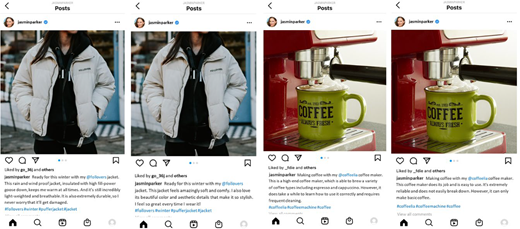
Study 1 integrates data from four distinct studies, previously conducted by Sung et al., (in prep) on the effect of advertising framing on consumer responses towards human versus virtual influencers. All studies measured the variables required by Study 1 and were not analysed in the previous paper by (Sung et al., in prep). Specifically, participants in Study 1 took part in one of four nearly identical experiments that examined the impact of framing on the effectiveness of influencer advertisements (for more details, see Sung et al., in prep). The experimental procedure was identical. However, each group received a different influencer advertisement (see Figure 1). The four data sets were then pooled for analysis. Hence, Study 1 served as an integration of these four studies into a single, cohesive analysis to enhance statistical power and allow us to explore and confirm consistency in patterns across diverse samples. A series of one-way ANOVAs were conducted to assess whether key psychological variables differed across the four experimental groups (see Appendix 1). Significant differences were observed between the four groups on parasocial tendency, endorsement trust and purchase intention. This confirms the diversity of the sample collected, allowing Study 1 to provide a more generalisable and robust analysis of parasocial tendency measurement as well as its effect between human and virtual influencers. In addition, to further ensure robustness and validity, we performed all analyses while controlling for “data set group” as a covariate (see Appendix 3). Our results remained consistent regardless of whether this covariate was included, reinforcing the robustness of our findings.
Participants and procedure
1632 participants were recruited from the online platform Prolific. After excluding cases with missing data and failed attention checks, 1,385 participants were retained for the analysis (82.3% women, 1.7% gender non-conforming and 0.6% preferring not to state their gender). Participants’ ages ranged from 18 to 83 (M = 40.88, SD = 13.32). All participants were required to have used social media platforms (e.g. TikTok, Instagram, Facebook) in the last seven days and to have actively followed a social media influencer. These inclusion criteria ensured that participants had recent and relevant exposure to influencer content. Because the study examined parasocial tendencies in influencer contexts, it was important that participants had sufficient familiarity with social media influencers to provide meaningful responses about influencer engagement, perceived familiarity and parasocial connection.
After providing informed consent, participants were randomly assigned to either the human or virtual influencer condition. Participants received a description of (either a human or AI Influencer, together with an Instagram post (see Figure 1). The description was the same except for the first sentence, which specified the influencer origin. In the virtual (human) influencer condition, the participants were informed that: “[the influencer] is a social media influencer powered by artificial intelligence (AI), which means that she is a virtual entity.” Whereas, the human influencer condition was informed that the influencer is a human entity. To ensure the description was clear, participants then completed a manipulation check adopted from Mozafari et al. (2022). Participants were asked to “rate whether you think you viewed a virtual influencer or a human influencer” on a seven-point semantic-differential scale anchored by virtual influencer (1) and human influencer (7) (Mozafari et al., 2022).
Following the stimulus presentation, participants completed self-report measures assessing purchase intention, endorsement trust and parasocial tendency. Means, internal consistencies (Cronbach’s alpha), and bivariate correlations for the three primary variables are reported in Table 2. Notably, bivariate correlations among the variables were moderate in magnitude (all r < 0.62) and were below the recommended multicollinearity threshold of 0.80 (Kennedy and Kennedy, 2003), indicating that multicollinearity was not a concern in Study 1 (see Appendix 2 for other multicollinearity tests). Purchase intention was measured on a seven-point scale from strongly disagree (1) to strongly agree (7). This was measured using three items taken from; (Evans et al., 2017; e.g. I would buy this product if happened to see it). Endorsement trust was measured using a seven-point semantic-differential scale (e.g. Ohanian, 1990). Participants rated their impression of the influencer on five different scales: insincere/sincere, undependable/dependable, untrustworthy/trustworthy, dishonest/honest and unreliable/reliable (Ohanian, 1990).
Following this, participants completed the measure of parasocial tendency. To operationalise parasocial tendency as a trait-like predisposition of participants’ general readiness to form parasocial bonds, we adapted the items from Hwang and Zhang (2018) state PSI measure (see Table 3). Participants’ parasocial tendency was measured with reference to their favourite influencer. This anchor was selected because PSR are inherently relational and typically emerge through repeated exposure, perceived familiarity, identification and affective attachment. Measuring parasocial tendency towards a completely unfamiliar influencer would therefore be problematic, as low scores could reflect a lack of exposure rather than a low general tendency to form parasocial bonds. By asking participants to refer to their favourite influencer, the study captured parasocial tendency in a context where such a relationship could plausibly exist. This approach is also consistent with recent social-media PSR measurement work (Boyd et al., 2022). To clarify, the resulting measure was not intended to assess attitudes towards the favourite influencer as the focal outcome. Rather, it was used as an ecologically valid indicator of participants’ existing parasocial tendency. This tendency was then examined as a predictor of early-stage responses to a different, unfamiliar influencer featured in the study’s stimulus. Nevertheless, because the measure uses participants’ favourite influencer as a reference point, responses may reflect both their general readiness to form parasocial bonds and their attachment to that particular influencer. The measure should therefore be understood as a contextually anchored indicator of parasocial tendency.
Analysis and results
Dimensionality of parasocial tendency measurement. Parasocial tendency was measured using six items and participants responded on a scale from strongly disagree (1) to strongly agree (7). The internal consistency of the scale was excellent (Cronbach’s α = 0.91). No item removal substantially improved reliability. To assess the dimensionality of the Parasocial Tendency (PST) scale, we conducted a principal component analysis (PCA) with varimax rotation. Preliminary tests supported the factorability of the correlation matrix. The Kaiser–Meyer–Olkin (KMO) measure of sampling adequacy (representing the ratio of the squared correlation between variables to the squared partial correlation between variables; (Kaiser, 1974) was 0.91, indicating acceptable sampling adequacy. Bartlett’s test of sphericity was significant, χ2(15) = 5703.75, p < 0.001, confirming sufficient correlations among items for principal components analysis.
The PCA revealed a clear single-component solution with an eigenvalue of 4.21, accounting for 70.21% of the total variance. All six items loaded strongly on this component, with factor loadings ranging from 0.653 to 0.892 (see Table 3). The inflexion of the scree plot confirmed this. The rotated solution could not be generated, as only one component was extracted. These results support the unidimensional structure of the scale and justify the use of a composite parasocial tendency score in subsequent analyses.
Moderated mediation. A moderated mediation analysis was conducted using Model 7 of Hayes’ (Hayes et al., 2022) PROCESS macro (Version 4.1) with 10,000 bootstrap samples and 95% confidence intervals. The model examined whether endorsement trust (M) mediated the relationship between parasocial tendency (X) and purchase intention (Y), and whether this indirect effect was moderated by influencer type (W; coded 0 = virtual, 1 = human).
The overall model was significant, F(2, 1382) = 606.16, p < 0.001, R2 = 0.4673. Importantly, PST significantly predicted endorsement trust, B = 0.35, SE = 0.0395, t(1382) = 8.92, p < 0.001, 95% CI [0.27, 0.43], supporting H1a and purchase intention directly, B = 0.35, SE = 0.0243, t(1382) = 14.33, p < 0.001, 95% CI [0.30, 0.40], supporting H1b. Furthermore, supporting H2, endorsement trust emerged as a robust predictor of purchase intention, B = 0.49, SE = 0.0207, t(1,382) = 23.81, p < 0.001, 95% CI [0.45, 0.53]. Referring to Table 4, the interaction between PST and influencer type was significant, B = 0.19, SE = 0.06, t(1381) = 3.43, p = 0.001, 95% CI [0.08, 0.30]. Probing this interaction revealed that the conditional effect of parasocial tendency was stronger when the influencer was human (B = 0.55, SE = 0.04, t = 13.52, p < 0.001, 95% CI [0.47, 0.62]) compared to when the influencer was virtual (B = 0.35, SE = 0.04, t = 8.92, p < 0.001, 95% CI [0.27, 0.43]). Supporting H3, these results suggest that the effect of parasocial tendency on endorsement trust is significantly stronger when the influencer is perceived as human than when they are perceived as virtual. Bootstrapped indirect effects confirmed moderated mediation.
Referring to Table 5, the indirect effect of parasocial tendency on purchase intention via endorsement trust was stronger for human influencers (effect = 0.27, SE = 0.02, 95% CI [0.2255, 0.3122]) than for virtual influencers (effect = 0.17, SE = 0.02, 95% CI [0.13, 0.22]). The index of moderated mediation was significant, index = 0.10, SE = 0.03, 95% CI [0.04, 0.15], indicating that the indirect pathway from parasocial tendency to purchase intention through endorsement trust significantly varied by influencer origin (also see robustness check in Appendix 3).
Study 2
Study 1 confirmed that the relationship between parasocial tendency, endorsement trust and purchase intention was stronger for human, compared to virtual influencers. Therefore, Study 2 used the “process-as-moderator” approach to elucidate which psychological mechanisms were responsible for this difference. Thus, Study 2 extended the design of Study 1 by investigating an additional psychological moderator, perceived anthropomorphism. The stimulus, influencer descriptions, and core measures remained consistent with Study 1 to ensure comparability.
Participants and procedure
362 participants were recruited for the study from the crowdsourcing platform Prolific. After excluding cases with missing data and failed attention checks, 322 participants were retained for the analysis (64.3% women, 1.2% gender nonconforming and 0.6% preferring not to state their gender). Participants’ ages ranged from 19 to 77 years (M = 42.35, SD = 13.20). All participants were required to have used social media platforms (e.g. TikTok, Instagram, Facebook) in the last seven days and to have actively followed a social media influencer. Data were analysed using SPSS (Version 30).
The procedure was adopted from method (Sung et al., in prep) and followed Study 1. However, participants also completed a self-report measure of perceived anthropomorphism. Perceived anthropomorphism was measured using a seven-point semantic-differential scale adapted from Bartneck et al. (2009) humanness scale. Participants rated their impression of the influencer on five semantic-differential items: fake/natural, machinelike/humanlike, unconscious/conscious, artificial/lifelike and mechanical/organic (Bartneck et al., 2009). Means, internal consistencies (Cronbach’s alpha), and bivariate correlations for the four primary variables are reported in Table 6. Notably, bivariate correlations among the variables were moderate in magnitude (all r < 0.76), and were below the recommended multicollinearity threshold of 0.80 (Kennedy and Kennedy, 2003), suggesting that multicollinearity was not a concern in Study 2 (see Appendix 2 for other multicollinearity tests).
Analysis and results
Dimensionality of parasocial tendency measure. To ensure the parasocial tendency scale was valid, we again examined the dimensionality of the parasocial tendency scale by conducting a PCA with varimax rotation. The KMO value was 0.92, indicating acceptable sampling adequacy. Bartlett’s test of sphericity was also significant, χ2(15) = 1747.66, p < 0.001, confirming that the correlation matrix was appropriate for PCA. The PCA revealed a clear single-component solution with an eigenvalue of 4.58, accounting for 76.40% of the total variance. As in Study 1, all items loaded cleanly on a single factor, supporting the unidimensionality of the construct (see Table 7).
Moderated Moderated Mediation. A moderated moderated mediation analysis was conducted using Model 11 of Hayes’ (2022) PROCESS macro (Version 4.1) with 10,000 bootstrap samples and 95% confidence intervals. The model examined whether endorsement trust mediated the relationship between parasocial tendency and purchase intention, and whether this indirect effect was jointly moderated by influencer type and perceived anthropomorphism. As perceived authenticity is conceptually proximal to endorsement trustworthiness, it was not included in the focal theoretical model. However, to ensure transparency and assess whether the focal results were robust to an alternative evaluative cue, we report a supplementary analysis involving perceived authenticity in Appendix 4.
Perceived anthropomorphism. A moderated moderated mediation analysis was conducted to test whether the indirect effect of parasocial tendency on purchase intention via endorsement trust was jointly moderated by influencer type (0 = virtual, 1 = human) and perceived anthropomorphism of the influencer. Specifically, the model examined whether endorsement trust (M) mediated the relationship between parasocial tendency (X) and purchase intention (Y), and whether this indirect effect was jointly moderated by influencer type (W; coded 0 = virtual, 1 = human) and perceived anthropomorphism (Z). Table 8 presents the unstandardised coefficients and significance tests for the full model.
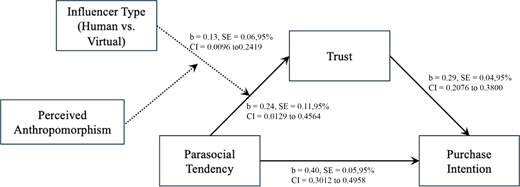
Probing the three-way interaction revealed that the effect of PST on endorsement trust varied depending on both influencer type and perceived anthropomorphism (see Table 9). For human influencers, PST significantly predicted endorsement trust at moderate levels of anthropomorphism (B = 0.18, SE = 0.07, p = 0.014, 95% CI [0.04, 0.31]) and at high levels of anthropomorphism (B = 0.24, SE = 0.09, p = 0.005, 95% CI [0.08, 0.41]). In contrast, for virtual influencers, the effect of parasocial tendency on endorsement trust was not significant at moderate anthropomorphism (B = −0.10, SE = 0.08, p = 0.240, 95% CI [−0.26, 0.06]), and was marginally negative at high anthropomorphism (B = −0.33, SE = 0.18, p = 0.063, 95% CI [−0.68, 0.02]). Supporting H2–H4, these results suggest that parasocial tendency predicted endorsement trust only when the influencer was human and perceived as moderately and highly anthropomorphic.
Following this, we examined the variables predicting purchase intention. The overall model was significant, F(2, 319) = 89.66, p < 0.001, R2 = 0.360. Supporting H1b, PST (B = 0.399, SE = 0.050, t = 8.06, p < 0.001, 95% CI [0.301, 0.496]) and endorsement trust (B = 0.294, SE = 0.044, t = 6.71, p < 0.001, 95% CI [0.208, 0.380]) significantly predicted purchase intention directly, as was found in Study 1.
Bootstrapped conditional indirect effects were examined (see Table 10). For human influencers, the indirect effect of PST on purchase intention through endorsement trust was significant at both moderate (effect = 0.052, SE = 0.021, 95% CI [0.014, 0.095]) and high levels of anthropomorphism (effect = 0.072, SE = 0.024, 95% CI [0.031, 0.126]). However, the direction of the relationship changed when the influencer was virtual. There was a significant negative effect at high levels of anthropomorphism for virtual influencers (effect = −0.097, SE = 0.048, 95% CI [−0.190, −0.001]). This relationship was non-significant at lower levels. Supporting H2–H4, these results suggest that parasocial tendency enhances endorsement trust and purchase intentions when influencers are human and highly anthropomorphic but may backfire under similar conditions when the influencer is virtual (see Figure 2).
General discussion
Existing literature on parasocial relationships and influencer marketing has largely examined target-specific parasocial relationships with familiar and established influencers, leaving the role of stable audience predispositions in early-stage influencer encounters underexplored (see Table 1). By contrast, the present research examines parasocial tendency as a pre-existing disposition that shapes endorsement trust and purchase intention during initial encounters with unfamiliar HIs and VIs. Grounded in CASAs (Nass and Moon, 2000) and Trait Activation Theory (Tett et al., 2021), the primary contribution of this research is to explain when and how a pre-existing parasocial tendency is translated into endorsement trust and purchase intention during initial encounters with unfamiliar HIs and VIs, before a target-specific parasocial relationship has developed.
Consistent with H1, we found that individuals higher in trait-level parasocial tendency reported stronger endorsement trust and purchase intentions, even when the influencer was unfamiliar. Because parasocial tendency was assessed with reference to the participants’ favourite influencer, its association with responses to a different, unfamiliar influencer suggests that the measure reflects a broader trait-based readiness to respond socially beyond the relationship with the favourite influencer. This supports the view that parasocial tendency is a significant trait-based mechanism that can shape early-stage evaluative responses before a target-specific parasocial relationship has developed. Specifically, the findings suggest that individuals differ in their readiness to respond socially to mediated figures, and that this readiness is more likely to translate into endorsement trust when the influencer context provides relevant cues. This finding complements prior evidence linking target-specific parasocial interaction and parasocial relationships to trust (Lee & Kim, 2025; Stein et al., 2022) and purchase-related outcomes in both human (e.g. Garg and Bakshi, 2024; Sokolova and Kefi, 2020) and virtual-influencer contexts (e.g. Dondapati and Dehury, 2024; Ma and Li, 2024).
More critically, endorsement trustworthiness emerged as a mediating mechanism between trait-level parasocial tendency and purchase intention (H2). Specifically, individuals high in parasocial tendency were more likely to perceive the influencer’s recommendation as trustworthy, which was subsequently associated with higher purchase intention. Notably, the trust measured here reflects endorsement trustworthiness (epistemic trust), rather than interpersonal trust grounded in reciprocity. From a theoretical standpoint, this extends prior influencer work by suggesting that credibility-based trust can be dispositionally facilitated, not only relationally earned over time. That is, consumers’ trait-level readiness to respond socially to mediated figures can shape endorsement trustworthiness judgements even in early-stage or unfamiliar influencer encounters.
However, these effects were not uniform across influencer types. As predicted in H3, the positive effect of parasocial tendency on trust and purchase intention was significantly stronger for HIs. The corresponding indirect effect on purchase intention through endorsement trust was also stronger for HIs than for VIs. This aligns with parasocial interaction theory, which suggests that perceived emotional realism, interactivity and social presence are essential for parasocial responses and endorsement evaluation (Dibble et al., 2016; Reinikainen et al., 2020). Importantly, from a trait-based perspective, this pattern is consistent with the possibility that parasocial tendency is more readily activated when the influencer affords clear cues of social agency and emotional capacity. One possible explanation is that HIs provide less ambiguous signals of humanness, intentionality and sincerity, allowing individuals high in parasocial tendency to more easily translate their predisposition into trust. In contrast, for VIs, the activation of parasocial tendency appears more constrained, as their artificial origin introduces ambiguity about emotional authenticity and agency. Thus, although parasocial tendency reflects a general readiness to respond socially to mediated figures, its downstream effects on trust and persuasion depend on whether the influencer context provides sufficient cues for that predisposition to be expressed.
Study 2 further clarified the boundary conditions of these effects by introducing perceived anthropomorphism as a moderator. Results showed that anthropomorphism shaped when parasocial dispositions translated into endorsement trustworthiness. Specifically, parasocial tendency positively predicted endorsement trust when the influencer was human and highly anthropomorphic (supporting H4). However, this pattern reversed for VIs at high anthropomorphism, where parasocial tendency negatively predicted trust. One possible explanation for this pattern is that highly anthropomorphic VIs elicit expectations of humanlike emotional credibility that conflict with their artificial origin. Hence, VIs cannot satisfy such an expectation, leading consumers with high parasocial tendency to experience expectation violations and reduced trust. This mirrors Lim and Lee (2023) finding that negative emotional disclosures reduced parasocial responses when attributed to VIs but increased them for humans. This distinction refines parasocial theory by positioning anthropomorphism as the focal condition under which parasocial tendency translates into endorsement trust. Table 11 summarises support for the hypotheses across Studies 1 and 2.
Implications
This study offers several important implications for theory and practice in the context of AI-powered influencer marketing. Firstly, the findings extend Parasocial Interaction Theory by positioning parasocial tendency as a trait-based antecedent that shapes consumers’ early-stage responses to influencer content. Whereas prior research often conceptualises parasociality as a state-based and target-specific bond developed towards familiar media figures, our results demonstrate systematic individual differences in consumers’ readiness to engage with mediated personae as quasi-social targets, even in unfamiliar or virtual influencer encounters. This supports the view that parasocial tendency can shape early-stage evaluative responses before a target-specific parasocial relationship has developed. To our knowledge, this study provides initial evidence that consumers’ pre-existing predisposition to form parasocial bonds (i.e. parasocial tendency) may influence how consumers evaluate an unfamiliar influencer at first exposure. This highlights the need for a trait-based account of parasocial processes that explains how stable individual differences interact with situational cues to shape early-stage influencer evaluations, rather than treating parasociality solely as a target-specific state.
Secondly, the findings contribute to the TAT by demonstrating that parasocial tendency is expressed only when the influencer provides trait-relevant cues (i.e. anthropomorphism). Perceived anthropomorphism operates as a critical activation condition, with parasocial tendency translated into endorsement trust most strongly for HIs perceived as sufficiently humanlike. Importantly, anthropomorphism was not uniformly beneficial for VIs. For VIs, our findings showed that high anthropomorphism reversed the effect of parasocial tendency on trust. This pattern may be consistent with an expectation-violation account related to the uncanny valley effect (Mori, 1970). Theoretically, these findings extend TAT by showing that the consequences of trait-relevant cues depend on their congruence with the source displaying them, demonstrating how the same cue can operate differently across human and artificial social agents.
Finally, the findings highlight the form of trust through which parasocial tendency is associated with persuasion. Prior influencer research generally treats trust as a consequence of parasocial relationship or an established relationship with a known influencer, leaving unclear how trust arises during an initial encounter. This is particularly the case with a VI that cannot reciprocate or possess genuine relational intent. The present findings identify endorsement trustworthiness, a credibility-based judgement of an endorsement’s sincerity, honesty and reliability, as the indirect pathway linking pre-existing parasocial tendency with purchase intention. This is theoretically meaningful because it separates the readiness to form parasocial bonds from the formation of a target-specific bond itself, while distinguishing trust in an endorsement from interpersonal trust in the influencer. Extending the parasocial theory with a trait-based account through parasocial tendency can therefore explain early-stage persuasion without assuming that consumers have already developed a target-specific relationship, which is important and relevant when considering how consumers react to unfamiliar social agents and influencers.
From a practical perspective, these findings offer specific guidance for managers deciding when and how to use HIs and VIs. Firstly, the findings suggest that managers should not always assume that an influencer must develop a target-specific parasocial relationship before becoming a trusted endorser. Some consumers have a stronger general tendency to engage with mediated figures socially, which can support endorsement trust even when the influencer is unfamiliar. Brands targeting these consumers can therefore test introducing endorsement content earlier, rather than waiting for a lengthy relationship-building period. The findings suggest that this approach is likely to be more reliable for HIs than for VIs.
Secondly, the results suggest that parasocial tendency can be used as a psychographic segmentation variable, particularly in campaigns involving unfamiliar endorsers. In practice, firms cannot directly observe consumers’ parasocial tendency, which would ordinarily require survey measurement. Where routine surveying is impractical, managers may use behavioural data as provisional indicators. These indicators were not validated in the present studies, so firms should calibrate them against survey measures in a smaller customer sample before using them for targeting. Following numerous influencers and frequently viewing, commenting on, interacting or sharing influencer content may indicate relatively high parasocial tendency. Consumers displaying these behaviours may be more receptive to unfamiliar influencers and influencer-led endorsement content. For consumers with lower levels of influencer following and interaction, managers should rely less on immediate parasocial engagement and instead test established endorsers, repeated exposure, product evidence and other credibility cues before introducing stronger purchase appeals. The resulting audience profiles can then inform influencer selection, campaign development, alternative creative executions and media targeting.
Thirdly, our findings are consistent with TAT and suggest that identifying a receptive audience is only part of the task. Campaigns must also provide social cues capable of activating consumers’ parasocial tendencies. For HIs, managers can test design cues such as personal voice, emotional expression and direct audience address. These cues were not examined directly in the present studies, but they provide theoretically relevant options for campaign testing because parasocial tendency predicted trust when the influencer was perceived as sufficiently humanlike. The same approach should not be applied mechanically to VIs. In our studies, greater human-likeness was not uniformly beneficial and at high perceived anthropomorphism, parasocial tendency was associated with a negative indirect effect on purchase intention through trust. Managers should therefore preserve congruence between a VI’s artificial identity and its presentation, rather than attempting to make it indistinguishable from a human.
Relatedly, the findings suggest that anthropomorphism should be treated as a design variable that requires calibration rather than maximisation. For VIs, anthropomorphism can be adjusted through (a) facial realism (e.g. skin texture, micro-expressions), (b) behavioural realism (e.g. gaze behaviour, motion timing) and (c) social-agency cues (e.g. first-person voice, self-disclosure, interactive language) (Cho, 2025; Kim et al., 2024). Managers should therefore avoid assuming that making a virtual influencer more humanlike will always improve campaign performance. Instead, anthropomorphic presentation should be pretested across different executions to determine which level best supports endorsement trust in the intended audience. The managerial task is not simply to increase human-likeness, but to match the VI’s design to the audience’s predispositions and the campaign objective.
Limitations and future research
While the present findings advance understanding of how parasocial tendency shapes early-stage responses to unfamiliar influencers, the limitations of the proposed framework should be recognised. The present model was developed within influencer marketing contexts, consumer product endorsements and Instagram-style static posts. Accordingly, the findings should be interpreted within these conditions. Whether similar mechanisms operate for other mediated figures (e.g. celebrities, AI assistants or brand avatars), different product categories, alternative platform environments or across cultural contexts remains an important avenue for future research. These contexts may provide different social and technological cues that influence when parasocial tendency is activated and translated into endorsement trust and purchase intention. Thus, future research can extend the current findings by examining how the effect of parasocial tendency differs in different contexts.
Another limitation of the current research lies in the design of Study 1, which was compiled from four independent data sets collected at different time points, each using a slightly varied version of the influencer stimulus. While the key manipulation (i.e. human vs virtual influencer type) remained constant across groups, post hoc analyses revealed significant group-level differences in parasocial tendency, influencer trust and purchase intention (see Appendix 1). Notably, the fourth group consisted of a significantly younger sample and reported the highest parasocial tendency and purchase intentions, suggesting potential framing or demographic effects that may have influenced outcomes.
To address this concern, we included the experimental group as a covariate in the moderated mediation analysis ( Appendix 3). The core pattern of effects remained robust, as the only notable change was that the experimental group modestly predicted purchase intention. This indicates that minor framing differences may have influenced behavioural intention, though trust, the central mediator, was unaffected. Future research should aim for tighter control over stimulus framing and demographic balance, ideally through a single-wave or stratified experimental design.
In addition, future studies could systematically manipulate levels of anthropomorphism in VI stimuli to isolate their effects on trust, credibility and persuasion. This would provide stronger causal evidence for mechanisms behind consumer responses to VIs. Although the current study used naturally varying perceptions, a factorial approach could isolate the effects of these features on endorsement trust and purchase intention. Such work would also help clarify the threshold at which anthropomorphism reverses its effect. Furthermore, future work can compare how parasocial tendency predicts trust and purchase intentions across novel and familiar influencers. While PSI and relationships have typically been studied in relation to familiar figures (e.g. Kim, 2022; Tukachinsky and Stever, 2019), it remains unclear whether parasocial tendency plays a different role when individuals already have established perceptions of trustworthiness or relational closeness.
Finally, a broader design limitation concerns the temporal nature of parasocial relationships. Parasocial relationships are often conceptualised as developing over repeated exposure and narrative continuity, yet the present studies used a single exposure experimental design. Accordingly, our findings should be interpreted as capturing early-stage evaluative responses shaped by parasocial tendency, rather than the formation of parasocial relationships over time. Future research could use longitudinal or repeated-exposure designs to examine whether and how parasocial bonds develop with different types of influencers and how these relationships subsequently shape endorsement trust and downstream outcomes.
References
Further reading
Appendix 1. Difference on focal variables across four data sets
Levene’s test indicated that the assumption of homogeneity of variances was violated for parasocial tendency and influencer endorsement trust (both p < 0.001), but not for purchase intention or age (both p > 0.18). Accordingly, Games-Howell post hoc comparisons were used for all variables to ensure robustness to variance differences. Parasocial tendency significantly differed across groups, F(3, 1381) = 6.10, p < 0.001. Participants in Group 4 (M = 3.89, SD = 1.32) reported significantly higher parasocial tendency than those in Group 1 (M = 3.60, SD = 1.50; p = 0.023) and Group 2 (M = 3.45, SD = 1.31; p < 0.001). No other group comparisons were significant. Purchase intention also significantly differed across groups, F(3, 1381) = 4.59, p = 0.003. Levene’s test was not significant (p = 0.185), suggesting equal variances. Group 4 (M = 3.51, SD = 1.65) reported significantly higher purchase intentions than Group 1 (M = 3.16, SD = 1.52; p = 0.013) and Group 2 (M = 3.11, SD = 1.47; p = 0.010). No other pairwise comparisons reached significance.
A significant effect of group was also found for endorsement trust, F(3, 1381) = 8.58, p < 0.001. Group 1 (M = 4.03, SD = 1.69) reported significantly greater endorsement trust than Group 2 (M = 3.70, SD = 1.18; p = 0.040) and Group 3 (M = 3.56, SD = 1.68; p = 0.002). Likewise, Group 4 (M = 4.06, SD = 1.69) reported significantly greater endorsement trust than Group 2 (p = 0.007) and Group 3 (p < 0.001). Groups 1 and 4 did not differ significantly. Finally, a significant group difference in age was observed, F(3, 1381) = 5.80, p < 0.001. Participants in Group 4 (M = 39.27, SD = 12.95) were significantly younger than those in Group 1 (M = 42.34, SD = 13.20; p = 0.007) and Group 2 (M = 43.09, SD = 13.86; p = 0.004). No other pairwise comparisons were significant.
Appendix 2. Multicollinearity check
Multicollinearity was assessed using bivariate correlations, tolerance and variance inflation factor (VIF) in SPSS. Bivariate Pearson correlations among the focal variables are presented in Table A2. Most correlations were below the recommended threshold of 0.80 (Dormann et al., 2013). The largest correlation (trust → authenticity) was (r = 0.816), which suggests strong conceptual overlap but does not necessarily indicate severe multicollinearity.
We also conducted additional multicollinearity diagnostics using variance inflation factor (VIF) and tolerance statistics (see Table A3). Results indicated no problematic multicollinearity, as all VIF values were below 5 and tolerance values exceeded 0.20 (Field, 2024). This confirms that no multicollinearity was detected.
Appendix 3. Robustness testing
To assess the robustness of the findings reported in Study 1, we conducted an additional moderated mediation analysis (PROCESS Model 7; Hayes, 2022) controlling for experimental group, which indexed the subsamples recruited from Prolific (coded 1–4). This covariate was included to account for potential variability across data collection sessions, as participants were recruited across four nearly identical study waves differing only in the presentation of the Instagram post (see Figure 1 for examples of all four stimuli). The same model specifications were retained (X = parasocial tendency, M = trust, Y = purchase intention, W = influencer origin), with experimental group entered as a covariate. The results mirrored the original analysis, suggesting that the moderated mediation pathway remained robust to this control (see Table A4).
As reported above, we conducted a moderated mediation analysis with 10,000 bootstrap samples and 95% confidence intervals. The model predicting endorsement trust was significant, F(4, 1380) = 89.06, p < 0.001, R2 = 0.21. Parasocial tendency significantly predicted endorsement trust, B = 0.35, SE = 0.04, t(1380) = 8.96, p < 0.001, 95% CI [0.28, 0.43]. Although the main effect of influencer origin was not significant (B = 0.02, SE = 0.22, p = 0.936), the interaction between parasocial tendency and influencer origin was significant, B = 0.19, SE = 0.06, t(1380) = 3.43, p = 0.001, 95% CI [0.08, 0.30]. The experimental group was not a significant predictor of endorsement trust (B = −0.03, SE = 0.03, p = 0.395), suggesting that endorsement trust was not meaningfully different across subsamples after accounting for the other predictors.
Probing the interaction revealed that the conditional effect of parasocial tendency on endorsement trust was stronger when the influencer was human (B = 0.55, SE = 0.04, t = 13.54, p < 0.001, 95% CI [0.47, 0.63]) compared to when the influencer was virtual (B = 0.35, SE = 0.04, t = 8.96, p < 0.001, 95% CI [0.28, 0.43]). This supports the hypothesis that parasocial tendency is more impactful in building endorsement trust with human influencers than with virtual ones.
Following this, we examined the variables predicting purchase intention. The model predicting purchase intention was also significant, F(3, 1381) = 409.61, p < 0.001, R2 = 0.47. Both parasocial tendency (B = 0.34, SE = 0.02, p < 0.001) and endorsement trust (B = 0.49, SE = 0.02, p < 0.001) were significant predictors. The experimental group emerged as a significant covariate in this model (B = 0.08, SE = 0.03, t = 3.04, p = 0.002), suggesting that purchase intention slightly varied across different subsamples.
Bootstrapped indirect effects confirmed moderated mediation. Specifically, the indirect effect of parasocial tendency on purchase intention via influencer endorsement trust was stronger for human influencers (effect = 0.27, SE = 0.02, 95% CI [0.23, 0.32]) than for virtual influencers (effect = 0.18, SE = 0.02, 95% CI [0.13, 0.22]). The index of moderated mediation was significant, index = 0.10, SE = 0.03, 95% CI [0.04, 0.15], indicating that the indirect pathway from parasocial tendency to purchase intention through endorsement trust significantly varied by influencer type.
Although the overall moderated mediation pattern remained consistent, the inclusion of the covariate introduced some minor differences. The amount of variance explained in purchase intention increased slightly (R2 = 0.4708 vs 0.4673 in the original model), suggesting that accounting for differences across experimental groups improved model fit. In addition, the experimental group emerged as a significant predictor of purchase intention (B = 0.08, p = 0.002), indicating that the specific influencer featured in each wave may have modestly affected consumers’ willingness to purchase the product.
In contrast, the covariate did not significantly predict endorsement trust (B = −0.03, p = 0.395) and had no meaningful effect on the key interaction or indirect paths. The index of moderated mediation (0.0956) was virtually identical to the original value (0.0952), suggesting our original model is robust (see Table A6 for model comparison). These results suggest that the psychological processes linking parasocial tendency to purchase behaviour via endorsement trust in the influencer were stable across conditions.
Appendix 4. Supplementary analysis with perceived authenticity
Perceived authenticity was measured in Study 2 but was not retained in the focal theoretical model because of its conceptual proximity to endorsement trustworthiness. To maintain construct clarity while still providing transparency, a supplementary robustness test was conducted. This analysis examines whether the focal moderator mediation pattern is robust when perceived authenticity is considered as an alternative evaluative cue. A moderated moderated mediation analysis was conducted to test whether the indirect effect of parasocial tendency on purchase intention via endorsement trust was jointly moderated by influencer origin (0 = virtual, 1 = human) and perceived authenticity of the influencer. Specifically, the model examined whether endorsement trust (M) mediated the relationship between parasocial tendency (X) and purchase intention (Y), and whether this indirect effect was jointly moderated by influencer origin (W; coded 0 = virtual, 1 = human) and perceived authenticity (Z). Table A7 presents the unstandardised coefficients and significance tests for the full model.
The model predicting endorsement trust was significant, F(7, 314) = 110.87, p < 0.001, R2 = 0.712. Although perceived authenticity was a strong positive predictor of trust (B = 0.803, SE = 0.130, p < 0.001, 95% CI [0.546, 1.060]), neither parasocial tendency nor its interactions with influencer origin or authenticity significantly predicted endorsement trust (all ps > 0.05). Unlike with anthropomorphism, the three-way interaction term (parasocial tendency × influencer origin × authenticity) was not significant (B = −0.010, SE = 0.045, p = 0.819, 95% CI [−0.098, 0.078]), suggesting no evidence of a moderated moderated mediation effect.
Following this, we examined the variables predicting purchase intention. The overall model was significant, F(2, 319) = 89.66, p < 0.001, R2 = 0.360. Supporting H1b, PST (B = 0.399, SE = 0.050, t = 8.06, p < 0.001, 95% CI [0.301, 0.496]) and endorsement trust (B = 0.294, SE = 0.044, t = 6.71, p < 0.001, 95% CI [0.208, 0.380]) significantly predicted purchase intention directly, as was found in Study 1, and with the above model including anthropomorphism. The index of moderated moderated mediation was not statistically significant (index = −0.003, SE = 0.012, 95% CI [−0.028, 0.022]), indicating that the strength of the indirect effect of parasocial tendency on purchase intention through endorsement trust did not significantly vary as a function of both influencer origin and perceived authenticity. Bootstrapped conditional indirect effects confirmed the absence of a moderated moderated mediation. Across all levels of authenticity and both influencer conditions, none of the conditional indirect effects were statistically significant (95% CIs all included zero). Consistent with the main model, parasocial tendency and endorsement trustworthiness both predicted purchase intention. However, perceived authenticity did not jointly moderate the indirect pathway with influencer origin. These supplementary findings suggest that authenticity appears more closely aligned with endorsement trustworthiness as an evaluative cue, supporting its exclusion from the focal theoretical model.
References
Dormann, C.F., Elith, J., Bacher, S., Buchmann, C., Carl, G., Carré, G., Marquéz, J.R.G., Gruber, B., Lafourcade, B. and Leitão, P.J. (2013), “Collinearity: a review of methods to deal with it and a simulation study evaluating their performance”, Ecography, Vol. 36 No. 1, pp. 27-46.
Field, A. (2024), Discovering Statistics Using IBM SPSS Statistics, Sage publications limited.