Artificial intelligence (AI)-powered service apps are widely adopted but raise critical authenticity concerns, particularly as human-facing AI increasingly simulates social presence and care. This study aims to explore how customers discern authenticity through symbolic and natural stimuli, moving beyond technical perspectives.
A sequential mixed-method design combining in-depth interviews (n = 26) and text mining (N = 11,400 reviews) is conducted, focusing on health, beauty and lifestyle sectors. Interviews identified symbolic and natural stimuli, while topic modeling assessed their relative importance in comparison with physical and social stimuli.
We developed an integrated servicescape model incorporating physical, social stimuli with the new four symbolic stimuli (monetization strategy, situational/cultural fit, moral commitment, recommendation precision) and three natural stimuli (service realism, soothing interactions, safe disclosure environments). The findings reveal asymmetric effects on customer engagement valence, showing how different stimuli are associated with positive vs negative engagement.
The model guides app developers, service designers and marketers to strategically embed symbolic and natural stimuli that strengthen authenticity and foster sustained and positively valenced customer engagement.
This study supports the creation of more transparent, trustworthy and inclusive AI service ecosystems.
Building on and extending the stimulus–organism–response framework and servicescape literature, this research identifies previously underexplored symbolic and natural stimuli beyond physical and social factors. It demonstrates how these stimuli shape customer engagement valence in AI-powered service apps, offering fresh insights into contemporary service authenticity.
Introduction
Service brands have been moving beyond traditional touchpoints such as television, billboards or websites (Blut et al., 2021). These days, artificial intelligence (AI)-powered service apps have emerged as “next favorite celebrity,” “financial adviser,” “relationship builder” or “virtual companions,” who co-create meaningful experiences with the customers (Baidu, 2022; Cheng and Jiang, 2021). With nearly five million apps available across major app stores, and 90% of mobile internet time spent on apps, AI service apps have acted as an integral service touchpoint (Ceci, 2022; Kumar et al., 2024); the integration of AI into service ecosystems is reshaping how services function and how they are designed.
However, AI integration in service marketing raises critical authenticity concerns. Around 61% of customers distrust AI systems due to privacy, manipulation and bias concerns (Gillespie et al., 2023). People disengage with apps within 5.8 days on average, finding them unlike brick-and-mortar experiences or lacking human traits (Alimamy and Nadeem, 2021; Rese et al., 2020). These patterns indicate a growing authenticity crisis, as users increasingly question whether AI service apps genuinely understand their needs or merely prioritize sales (Vo et al., 2025). Consequently, perceived authenticity has emerged as a critical priority in AI-powered service environments (Vo et al., 2025), which acts as a cue to enhance their assessment of service quality. Recent advances in conversational and generative AI mark a shift from background automation to human-facing service agents that simulate empathy, reasoning and social presence (Huang and Rust, 2021). Unlike earlier machine-learning systems that operated invisibly, these AI-powered service apps engage users in relational interactions, prompting evaluations of intention, sincerity and care (Vo et al., 2025). As a result, authenticity has emerged as a central concern in the service environment.
Research on perceived authenticity in digital touchpoints shows diverse conceptualizations (Vo et al., 2023). Despite growing research on influencer, brand and tourism authenticity (Morhart et al., 2015; Moulard et al., 2020), no mutual understanding exists regarding what constitutes authenticity in the context of digital service marketing, specifically in AI apps. In traditional service settings, authenticity manifests through tangible cues such as historical building restoration, which then enhances experiencescapes (Valentini and Roederer, 2026). In livestreaming retail, authenticity encompasses scene, decoration and streamer appearance that enrich the e-servicescape (Teng and Kpd Balakrishnan, 2025). In influencer marketing, authenticity emerges through collaborative brand-related cues (Mai et al., 2025). However, new touchpoints such as AI service apps introduce different service challenges: they lack physical presence, human embodiment and traditional servicescape elements, yet must still convey authenticity to ensure service acceptance and satisfaction.
The conceptual ambiguity deepens in AI service contexts. Authenticity could refer to stimulating environments that mimic bricks-and-mortar (Alimamy and Nadeem, 2021), displaying human traits like feelings and ambitions (Huang and Rust, 2021) or reflecting customers’ true selves through transparency and autonomy (Shin, 2020). This gap persists partly because authenticity is highly context-dependent: different settings emphasize different cues (Vo et al., 2025), and digital services introduce unique combinations of technology, service satisfaction and user control that do not map neatly onto existing authenticity frameworks. The lack of understanding about authenticity in AI-powered service encounters constrains theory development in digital service research and evidence-based practice in digital servicescape design.
Early research focuses on technical perspectives such as personalization, linguistic style (Wuenderlich and Paluch, 2017) and demographic attributes (Esmark Jones et al., 2022). However, AI-powered service apps involve broader customer engagement beyond chat interactions (Vo et al., 2025). AI-powered apps add an additional layer of complexity because they operate as autonomous agents with capabilities such as learning, adapting and simulating human communication that can simultaneously enhance and undermine perceptions of genuineness. We, therefore, examine how customers evaluate authenticity during AI service app engagement.
We build on this research stream and address an important question regarding how customers discern the authenticity of AI-powered service applications. Premised on the stimulus–organism–response (SOR) framework and extended servicescape literature, we review and categorize prior antecedents of AI authenticity into types of stimuli. Previous research has emphasized physical (e.g. visual elements, functionality) and social stimuli (e.g. AI agent as employee, communicative capabilities, gender representation) in AI contexts (Esmark Jones et al., 2022; Neururer et al., 2018; Vo et al., 2024; Vo et al., 2025). These studies show that customers rely on interface cues and avatar design to infer authenticity, as underlying intentions are not directly observable (Esmark Jones et al., 2022; Vo et al., 2025). However, AI and service literature posit that customers naturally attempt to infer the causes behind brand-related behaviors and responses (Noor et al., 2022); therefore, the perception of AI service apps authenticity could be shaped by natural stimuli that reflect the feeling of being away or fascination or by symbolic stimuli that represent meaningful identity connections (Espitia et al., 2025; Rosenbaum et al., 2011).
Current research explores symbolic and natural stimuli for two main reasons. First, these stimuli can help users strengthen confidence in attribution inferences about AI authenticity, which cannot be directly observed through interface design. Second, technology scholars have recently called for further research to explore symbolic cues from the monetization approach and user experience inclusivity that influence the perceived authenticity of AI-powered service applications (Hollebeek and Macky, 2019).
This research includes two complementary research questions (RQ). First, to determine how customers discern authenticity through symbolic and natural stimuli, we ask:
What symbolic and natural stimuli do customers perceive as shaping the authenticity of AI-powered service apps?
Identifying these stimuli alone may limit the comprehensive understanding of the servicescape; therefore, our second research question examines:
How do symbolic and natural stimuli, compared to physical and social stimuli, influence the valence of customer engagement in AI-powered service apps?
Together, these questions provide foundational knowledge of authenticity stimuli and practical insights into their relative effectiveness in shaping customer engagement.
To answer these questions, we use a sequential mixed-method design. Study 1 uses in-depth interviews with 26 AI service app users to identify and understand symbolic and natural stimuli that shape authenticity perceptions (RQ1). Then, Study 2 aims to quantify the relative importance of all four stimulus types in fostering authenticity perception and engagement (RQ2) by analyzing 11,400 customer reviews using latent Dirichlet allocation (LDA) topic modeling. This sequential approach ensures the investigation of new stimuli and their comparative measurement against established factors.
Our research offers three theoretical contributions related to discerning the perceived authenticity of AI service apps in their engagement. First, this study contributes to customer engagement research. Our findings answer the calls for research on authenticity in engagement studies (Hollebeek and Macky, 2019; Rosado-Pinto and Loureiro, 2020). Second, building on SOR and servicescape literature, we show that discerning authenticity in AI-powered services requires symbolic and natural stimuli that create identity alignment and a sense of escape, beyond visual design and functional performance. Recent studies have advanced servicescape research in physical contexts, from investigating the interplay between physical and social stimuli leading to negative customer interactions (Furrer et al., 2023), to exploring the signaling effects of tangible cues on customer co-creation (Kim and Baker, 2022), co-curated transformative places along a sanctum-to-surveillance continuum (Krisjanous et al., 2023). However, these frameworks remain grounded in tangible, spatially bound environments. Third, we develop a novel integrated servicescape model, which offers an overview of how four particular stimuli are used to discern the authenticity of AI service apps. Importantly, our mixed-method approach enhances the generalizability of findings by combining localized user insights with global app review data spanning diverse cultural and economic contexts.
The next section begins with the literature review and theoretical framework. Then, the methodology sections cover how interviews and LDA topic modeling are conducted, followed by the findings of each study. The last section discusses the theoretical implications and provides managerial suggestions.
Literature review
Customer engagement and authenticity of artificial intelligence-powered service apps
AI-powered services refer to applications used in customer service interactions, including virtual assistants, chatbots, recommendation systems and self-service kiosks (Bock et al., 2020). Virtual assistants (e.g. Siri, Alexa) understand user queries, complete tasks and simulate human conversations in service contexts. Recommendation systems (e.g. Netflix, Spotify) use AI and machine learning to personalize user experiences (Bock et al., 2020). In this research, an AI-powered service app refers to an app that (1) is developed by a service, (2) must offer a virtual assistant as their primary feature and provide direct consumer interaction with the virtual agent. However, apps that provide recommendation algorithms are not included because the existence of the AI features is not explicitly shown to the customers.
Customer engagement is a motivational context-dependent state and is characterized by cognitive (e.g. thoughts and mental elaboration), emotional (e.g. consumer’s summative and enduring level of emotions) and behavioral experiences (Hollebeek and Chen, 2014). Customers can also experience symbolic engagement (e.g. perceiving designer bags as representing exclusivity, elite status and personal achievement) or physical engagement where they feel themselves immersed in the environment (e.g. IKEA shoppers feeling as though they are furnishing their own homes while navigating showrooms) (Alimamy and Nadeem, 2021; van Berlo et al., 2023). Engagement can occur in the form of positively valenced, negatively valenced (Hollebeek and Chen, 2014) or disengagement (Naumann et al., 2017). While positively valenced engagement may center on favorable or affirmative cognitive, emotional and behavioral brand-related dynamics (e.g. deriving pleasure from using a focal brand) (van Doorn et al., 2010), negatively valenced engagement, in contrast, is exhibited through consumers’ unfavorable brand-related thoughts, feelings and behaviors during focal brand interactions (Bowden et al., 2017). Furthermore, disengagement happens when customers’ physical, cognitive and emotional absence withdraw from a service relationship (Do et al., 2021). As disengagement is often passive, invisible and difficult to measure directly in secondary data, we only focus on positively and negatively valenced engagement to understand the customer’s online response to the authenticity factors.
Authenticity refers to realness, genuineness and sincerity (Napoli et al., 2014), or “the degree to which an entity in one’s environment (e.g. object, person, performance) is perceived to be true to or match up with something else” (Moulard et al., 2020, p. 99). In marketing, authenticity has been categorized into three main types: true-to-ideal (e.g. brand is faithful to itself), true-to-fact (e.g. deliver what it promises) and true-to-self (intrinsically motivated by customers’ interests, and allows customers to be true to themselves) (Morhart et al., 2015; Moulard et al., 2020). In the context of service apps, authenticity combines and extends these frames to social presence, credibility, integrity and symbolism (Vo et al., 2025). Thus, we define authenticity in AI service apps as the perception that the app is a real person interacting with customers, delivers reliable performance, aligns its commercial practices with stated values and reflects users’ identities and aspirations (Vo et al., 2025).
While prior studies have explored authenticity in immersive environments such as augmented reality (AR) and virtual reality (VR) (Alimamy and Nadeem, 2021), less is known about how authenticity operates in AI-driven services where humanlike cues are algorithmically simulated. Understanding this distinction requires examining not just what makes AI feel authentic, but how users process and respond to authenticity cues in these algorithmically mediated contexts. To address this, we adopt the SOR framework, which provides a systematic structure for explaining how environmental stimuli are internally processed to shape behavioral outcomes, to discern the concept of authenticity and how it fosters or inhibits both positively and negatively valenced engagement with AI-powered service apps. In AI-mediated environments, authenticity emerges not from isolated environmental cues but from the coherence between service stimuli and users’ sense of self. Thus, rather than contradicting the SOR framework, this study extends the organism component by specifying identity-based meaning-making as a central internal mechanism through which AI servicescape stimuli are interpreted.
Servicescape stimuli of perceived authenticity in artificial intelligence-powered branded apps
The SOR theory provides a framework for understanding the impacts of environmental factors on an individual’s response (Mehrabian and Russell, 1974). The framework consists of three core components: stimulus (external factors that affect individuals, encompassing various aspects of the environment and atmosphere), organism (internal processes and mechanisms that mediate between the external stimuli and the individual’s responses) and response (behavior and actions) (Mehrabian and Russell, 1974).
Building on Bitner’s (1992) original focus on physical stimuli, Rosenbaum et al. ((2011) developed an expanded servicescape framework encompassing physical, social, social-symbolic and natural dimensions. This comprehensive model provides a fuller understanding of servicescape stimulus, making it suitable for understanding the servicescape in AI-powered service apps. Likewise, Espitia et al. ((2025) have proposed a multidimensional servicescape model integrating six dimensions of physical, social, technological, symbolic, natural and spiritual, which are linked to cognitive, emotional and behavioral responses across consumers, employees and communities. This approach highlights underexplored dimensions such as spirituality and biomorphic design and advocates for inclusive, multistakeholder approaches to servicescape research.
While previous frameworks (Rosenbaum et al., Rosenbaum et al., 2011; Espitia et al., 2025) include social-symbolic and natural dimensions, their framework was developed primarily for physical service environments. Similarly, while Ballantyne and Nilsson (2017) have pointed out that many sensory attributes of the servicescape model relating to physical places hold up metaphorically when describing digital virtual spaces, they do not specify what transformations occur in AI-mediated environments. Recent attempts made by Nöjd et al. ((2020) and Nanu (2025) indicate that new technologies have transformed the servicescape in which the value co-creation process could be disrupted. Our study extends this foundation by demonstrating how AI-powered service apps transform the servicescape into an interactive, relational and identity-laden environment. As AI agents are more capable of adaptive responses, they introduce new stimuli to service quality, such as algorithmic transparency, emotional reflection and commercial intent signaling (Huang and Rust, 2021; Shin, 2020), that do not map neatly into traditional ambience, design, or social dimensions. By identifying AI-specific symbolic and natural stimuli, we show how servicescape theory must evolve to account for autonomous agents, emotional safety and value signaling in digital services.
Physical stimuli include warmth, cleanliness, noise levels, ease of entry/exit, equipment quality, decor and music (Bitner, 1992; Rosenbaum et al., 2011). According to the Co-Curated Transformative Place framework, the materiality of place is where service actors jointly select, present and adapt physical artifacts and material resources to incorporate the continuum of terrain and co-curate substantive staging according to service actor needs (Krisjanous et al., 2023). In e-servicescape, physical stimuli relate to aesthetic appeal, layout and functionality (Harris and Goode, 2010). For AI-powered service apps, physical stimuli encompass online atmospherics such as interactivity, vividness, layout, backgrounds, colors, modern design and usability (Lee and Jeong, 2012; Wuenderlich and Paluch, 2017).
Social stimuli include interaction, social density and displays with others through customer–employee and customer–customer engagement (Rosenbaum et al., 2011). These stimuli are constituted through verbal and non-verbal communication, experience sharing and thought exchanges (Bitner, 1992). The interplay between physical and social dimensions is important because it could trigger the negative customer-to-customer interactions through one of three mechanisms: triggering (physical elements spark other customers’ disruptive behavior), behavioral incongruence (other customers violate expectations set by the physical environment) and spillover (other customers damage the servicescape for subsequent users) (Furrer et al., 2023). In AI-powered service apps, social interactions occur with brand activities, AI agents, human employees or other customers in brand communities (Mondal and Chakrabarti, 2019). Within these interactions, concordant social stimuli in apps include AI agent communication quality, human employee attitudes and community activeness (Table 1).
“Authenticity is in the eye of the beholders” (Kovács, 2019). This idea suggests a more sophisticated approach to authenticity – it is not an inherent property of an object or service but is socially constructed through interpretation and meaning-making by audiences (Kovács, 2019). Research has shown how cultural context shapes these perceptions: German participants rated authenticity highest when targets expressed both likes and dislikes, while Chinese participants preferred expressing only positive views (Kokkoris and Kühnen, 2014). Similarly, US audiences judge influencer authenticity through honesty and transparency (Lee and Eastin, 2021), whereas Vietnamese customers assess it through brand partnerships and follower characteristics (Mai et al., 2025). Brand experience also influences authenticity perceptions more strongly in individualistic cultures, where customization and personal pleasure carry greater weight (Khan and Fatma, 2021).
Consistent with these insights, authenticity in the context of AI-powered service apps cannot be assessed through observable features like interface design or humanlike language. While prior research focused on physical and social stimuli (Table 1), discerning authenticity requires attention to symbolic and natural stimuli. By evaluating alignment with users’ needs, values and lived experiences, we better explain how users infer authenticity.
Socio-symbolic (symbolic) stimuli influence customer perception of the servicescapes through original and unique aspects of brand identity (Rosenbaum et al., 2011). Socio-symbolic stimuli convey cultural and symbolic meanings that could influence the perceptions of specific sub-consumer groups, fostering a sense of belonging within the servicescape (Rosenbaum et al., 2011), even when some elements resemble physical stimuli (Özgen et al., 2024). For example, recent literature has examined the co-consumption dynamics between LGBTQIA + and heterosexual consumers to identify how inclusion is co-constructed within shared service environments (Asokan-Ajitha and Sengupta, 2025). Inclusive servicescapes are shaped not only by physical design and brand symbolism but also by visible behaviors, attitudes and micropractices of co-consumers and frontline employees (Asokan-Ajitha and Sengupta, 2025).
The application of symbolic stimuli in understanding the authenticity of AI service apps is scarce. Transparency has been the primary symbolic stimulus examined in this context (Neururer et al., 2018). However, prior studies often conceptualize transparency in terms of the agent’s argumentation capabilities or as a function of user disposition (Neururer et al., 2018; Shin, 2020) rather than considering its role in shaping symbolic identity alignment or authenticity. Our study expands the scope of symbolic stimuli to explore how a broader set of stimuli, beyond transparency, contributes to users’ perceptions of authenticity in AI-powered service apps.
Although previous research has not specifically examined socio-symbolic stimuli in the AI context, some studies have explored how AI agents can affect customers’ symbolic values. The lack of uniqueness in AI agents can harm customers’ unique identity (Granulo et al., 2020). For example, when automation replaces skill or effort, it removes opportunities for internal attribution. In addition, we posit that symbolic stimuli foster a sense of identity alignment and belonging by embedding cues that resonate with users’ values, lifestyles, or social identities.
Natural stimuli in service environments help alleviate negative emotions such as stress, density and fatigue through elements like “being away,” “fascination,” and “compatibility” (Rosenbaum et al., 2011). Being away provides a sense of escape from the stress of daily life. Features like gentle animations, ambient soundscapes, smooth transitions, or visually soothing color palettes can offer a sense of “being away” and provide users with a temporary escape from the demands or stressors (Kandampully et al., 2022). For example, meditation and mental health chatbots often simulate nature-inspired environments through soft background sounds (e.g. rain, forest ambience) and slow-paced conversational rhythms to create a restorative sense of escape tailored to the input of the customers. Fascination refers to a person having a pleasant experience that alters their perception of time. For instance, AI-powered fitness apps often employ progress visualizations, streak systems, interactive feedback and gamified challenges that allow the customer to enjoy the time spent, making time feel as though it passes more quickly (Kandampully et al., 2022). Compatibility refers to a person’s sense of belonging to the environment, which occurs when users feel that the app flows naturally with their lifestyle (Kandampully et al., 2022). In AI service apps, compatibility may emerge when the health monitoring apps synchronize with wearable devices and respect users’ daily schedules. Following this logic, we conceptualize factors that trigger feelings of relaxation, and being away (e.g. such as emotionally supportive design, credible service environments) as part of natural stimuli in AI servicescapes, as they share the core restorative function of alleviating stress and creating mental refuge in digital interactions.
Natural stimuli relate, but are not the same as, immersion or flow. Immersion refers to the depth of cognitive and sensory involvement in a mediated environment, often driven by vividness, or interactivity (Algharabat et al., 2018). Natural stimuli differ in both purpose and mechanism. Rather than intensifying cognitive absorption or task engagement, natural stimuli serve a restorative function in general by reducing stress, easing mental load and creating a soothing sense of harmony (Kandampully et al., 2022). They support emotional regulation rather than performance-oriented immersion or flow.
While the idea of being away has been well-researched in virtual environments with the help of AR and VR, limited studies have explored this in the context of an AI app. Yet, anthromorphism, social presence and humanlikeness are often considered as a part of the ambient conditions, rather than the idea of fascination or compatibility. Our study broadens the scope to include AI-powered services and further explores a range of natural stimuli.
Although SOR is often applied as a linear cause–effect model, we adopt it here as a structural organizing framework rather than a strict causal mechanism. In AI-powered servicescapes, symbolic and natural stimuli operate simultaneously and reinforce one another during ongoing interactions. Authenticity judgments, therefore, emerge from an interwoven configuration of cues rather than isolated stimulus–response chains. Our integrated servicescape model thus expands SOR by accommodating overlapping, multilayered and relational evaluations that characterize AI-mediated service experiences.
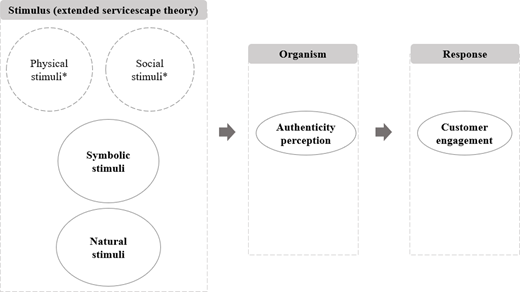
Taken together, we propose a structured framework (Figure 1) that highlights two unexplored categories of symbolic and natural stimuli and provides a systematic approach for decoding the AI-powered service app authenticity as well as guiding our data analysis. Two questions guide our research:
What symbolic and natural stimuli do customers perceive as shaping the authenticity of AI-powered service apps?
How do symbolic and natural stimuli, compared to physical and social stimuli, influence the valence of customer engagement in AI-powered service apps?
Methodology
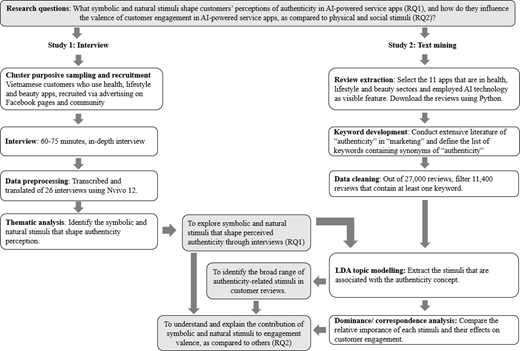
This research investigates the stimuli that shape authenticity perceptions and contribute to customer engagement with AI-powered service apps. A sequential mixed-method design combining in-depth interviews and large-scale review analysis was adopted (Figure 2). Study 1 (interviews) addressed RQ1 by identifying and understanding what symbolic and natural stimuli exist through rich, contextual insights from lived experiences. Study 2 (review analysis) addressed RQ2 by quantitatively measuring the comparative influence of all four stimuli on engagement valence across a large, diverse data set.
In the first study, in-depth interviews were conducted with individuals who have experience using AI-powered service apps across health care, beauty and lifestyle sectors. This qualitative stage aimed to identify and categorize symbolic and natural stimuli that users associate with authenticity. This inductive process grounded the conceptual framework and informed the development of thematic codes used in the next phase.
While interviews provide rich contextual insights, they cannot assess the relative importance of different stimulus types or their comparative impact on engagement valence. Therefore, Study 2 analyzed customer reviews from Google Play Store and Apple App Store. Online reviews offer ecological validity, reflecting authentic post-use perceptions (Kumar et al., 2024) and capturing both positive engagement (endorsements, praise) and negative engagement (frustration, criticism) (Bowden et al., 2017).
Reviews containing authenticity-related keywords were extracted and subjected to LDA topic modeling to identify recurring themes and latent structures in customer discourse (Yun et al., 2019). LDA was applied to uncover the underlying topics that shape engagement perceptions, particularly how symbolic and natural stimuli manifest in broader user-generated content. The interview findings played a critical role in naming, validating and interpreting the resulting LDA topics, addressing a common limitation of topic modeling (Luo et al., 2020). An intercoder reliability check was also performed to enhance interpretive consistency. By combining qualitative interviews with computational text analysis, this mixed-method design enables a nuanced understanding of both the types of stimuli users associated with authenticity (RQ1) and the comparative influence of symbolic/natural vs physical/social stimuli on engagement valence (RQ2).
Study 1 – Methods
Data collection
Twenty-six in-depth semistructured interviews with AI-powered service apps customers, who had used different types of AI-powered service apps in the health, beauty and lifestyle sectors, were conducted. First, in-depth interviews elicited nuanced subjective insights from informants (Creswell and Clark, 2018) to provide detailed explanations and clarifications of stimuli in their engagement. Second, in-depth interviews maintained the independence of informants, thus mitigating the risk of contamination from exposure to other informants or the stress associated with group dynamics (Saunders et al., 2009). The detailed qualitative research design follows the approach outlined by Creswell and Clark (2018) (Figure 2). Before the main interviews, we conducted a pilot study with five interviewees.
Although the interview guide was informed by servicescape literature, participants were not prompted with predefined symbolic or natural categories. Instead, they were encouraged to describe any features that shaped their sense of authenticity during their interactions with AI-powered service apps. Several key themes (e.g. monetization strategy, safe disclosure environment) emerged inductively and were not explicitly referenced in the interview questions. We, therefore, treat symbolic and natural stimuli as empirically grounded constructs reflecting users’ lived experiences, rather than as deductively imposed dimensions.
Sampling and recruitment
The health, beauty and lifestyle sectors in Vietnam were chosen as the context because it is on the rise, with digital health market value having the market growth rate of 14.5% (IMARC Group, 2026) while beauty and personal care market is projected to reach US$2.74bn by 2025 (Nguyen, 2025) and the mass smartphone penetration, rapid growth in e-commerce suggests strong demand for lifestyle tech, including wellness and beauty-focused AI services (IMARC Group, 2026). Culturally, Vietnamese consumers tend to have a more interdependent self-construal, where self-concept is defined in relation to others (Winskel and Bui, 2025). This orientation may influence how authenticity is perceived, not necessarily as personal uniqueness, but as alignment with socially accepted norms or collective ideals.
This study used a cluster purposive sampling technique to select interviewees from two distinct age groups of Gen Z (18–26 years) and Gen Y (27–40 years). We consulted industry reports on the popular AI-powered mobile app in health, beauty and lifestyle sectors to select the top ten apps that were familiar to people. We then used social listening tools to find Facebook pages and communities that have high discussion regarding the use of those apps and then ran the recruitment advertisements after asking the admin’s permission. Those who were interested in the project contacted the researchers. Twenty-six individuals participated in the in-depth interviews at which saturation was achieved (Table 2). To maintain privacy, we allocated pseudonyms to the participants. Details of interview questions are in Appendix 1.
Data analysis
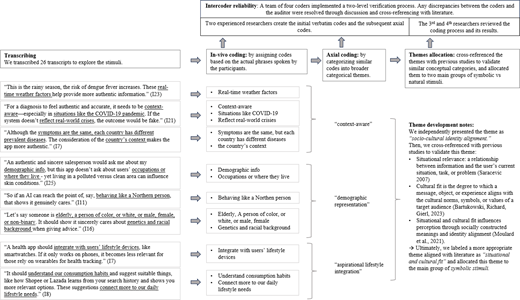
We transcribed and analyzed the in-depth interviews using NVivo 12. The data analysis and theme development process, which involved four steps: transcribing, in vivo coding using participants’ actual words, axial coding to categorize similar concepts and allocating themes. In Step 2, we applied in vivo coding, using participants’ own words to preserve their meanings. In the preceding example, phrases such as “real-time weather factors,” “context-aware” or “behaving like a Northern person” were coded directly from the transcripts. These codes reflect the participants’ lived experiences and language. In Step 3, we grouped similar in vivo codes into broader categories that capture shared concepts. For example, phrases referencing demographics (e.g. “elderly,” “person of color,” “genetics and racial background” and “behaving like a Northern person”) were clustered into a “demographic representation” category, while codes such as “real-time weather factors,” “situations like COVID-19” and “the country’s context” were combined into a larger axial category labeled “context-aware.” Finally, these categories were allocated into overarching themes and organized under symbolic or natural stimuli (e.g. situational and cultural fit). All themes were cross-referenced with existing literature to ensure theoretical alignment and validity (Rosado-Pinto and Loureiro, 2020). Details of coding procedures and interview excerpts are in Appendixes 2 and 3.
Intercoder reliability was ensured through a four-coder team with two-level verification. Two experienced researchers created initial codes, while two others audited the process. Discrepancies were resolved through discussion and literature cross-referencing (Saldana, 1996).
Study 1 – Findings and discussions
Symbolic stimuli
Our findings identified four pertinent symbolic stimuli: monetization strategy, situational and cultural fit, moral commitment and recommendation precision.
Monetization strategy
The interviews reveal monetization strategies, which include forced advertising, the value of subscription plans and the placement of subscription prompts. These strategies signal perceived power and control, thus serving as a symbolic stimulus that shapes perceptions of AI app authenticity.
One recurring concern relates to forced advertisements, when long and unskippable ads appear on the welcome screen. A forced ad is interpreted as intrusive, disrespectful and a symbolic assertion of commercial power where users are denied control, leading to customers’ skepticism about the exploitative intention of the brands, as Hnhu shares: “Forcing me to watch an ad for 3 min is absolutely a cue of an inauthentic app.”
Regarding the subscription strategy, for some participants, especially among Gen Z cohorts, the free version of an app is perceived as more authentic. It suggests that the app prioritizes accessibility and user benefit over profit. These respondents valued brands that appeared to “sacrifice” short-term revenue in favor of user experience. For other respondents, paid subscriptions indicate transparency and control. They believe that if the app is free, it may be using their data to generate income, which makes it inauthentic, as Klin shares:
If it is free, it means it lives on advertising money, then I must worry whether the recommendation is biased, whether my data is sold. And if I have already paid, the apps do not rely on advertising anymore, so they can be honest with me.
While participants accepted the need for premium tiers, they expressed discomfort when payment requests appeared immediately before or during critical service delivery (e.g. beauty recommendations, lifestyle advice). This placement was seen as strategically manipulative, suggesting that access to vital information was being commercially withheld. As Lna shares: “An authentic app should not say I must top up to buy this package to get the advice. It should give the conclusion without forcing you.” Such interruptions not only disrupted the perceived flow of care but also symbolized a profit-first mindset.
Situational and cultural fit
Situational and cultural fit encompasses three stimuli, where users assess how well the app aligns with their lived experience and social identity: context-aware features, demographic representation and aspirational lifestyle integration.
Context-aware features such as alignment with local conditions, seasons, or beauty trends help users evaluate whether the app genuinely understands their environment. Interviewees valued apps that accounted for regional differences in recommendations, as they reinforce their sense of belonging to that place. For example, Mtom shares:
It is important to note that illnesses in the rainy or COVID season will all have similar symptoms but different treatments. For example, high fevers are common in Australia during certain times of the year, but not in Vietnam.
To evaluate the authenticity, users expected the app to reflect and respect their ethnic, linguistic and body diversity (demographic representation), particularly in contrast to dominant Western standards. When the app acknowledged local language, accents or regional norms, it affirmed users’ social identity, as Dkha shares: “Culture and tradition are what make up a person. When the AI reaches a level where it understands the northern or southern language style, it is wonderful. If an AI can […] like a Northern person, that shows it genuinely cares.”
Aspirational lifestyle integration happens when the app integrates seamlessly with their daily routines and preferred devices, reinforcing the sense that the service understands and supports their ideal selves. For instance, Mtom mentions: “It must be suitable. If that app can only be used on the phone and not the smartwatch, then it is very difficult. A health app should integrate with users’ lifestyle devices, like smartwatches.”
Moral commitment
There are three main stimuli mentioned in this theme: privacy disclosure, role boundary clarification and inclusive utility.
Data privacy is evaluated not by whether users provide their data, but by how the app manages it. In this sense, privacy disclosure is when the apps declare how they respect customer autonomy and how data is used to benefit the customers, as Klin noted:
It is like going to a doctor – they need your data for treatment, and you trust them to keep it safe. If the app promises not to sell my data or leak it, then I will think it cares about me, even if I am not confident.
Interviewees place strong emphasis on the role boundary clarification – the app’s ability to communicate its role. They expected the app to clearly define its scope of work and reaffirm its supportive, not substitutive role as Mdu explains: “It should authentically declare its role and responsibility. It should never say it can replace real doctors.”
Inclusive utility, such as accessibility and support for vulnerable groups, emerged as key symbolic stimuli of authenticity. Participants valued apps that addressed the needs of users with disabilities or limited financial means, interpreting such efforts as signs of moral care and social responsibility. Equitable treatment – regardless of background or payment ability – was also seen as essential to fairness, as the interviewees shares:
A good and authentic app should reflect ethical values – treat all patients equally, regardless of who they are or what they can pay (Avi).
That app helped blind people see what is around them. That is real authenticity – caring about the smallest human needs (Dkha).
Recommendation precision
Recommendation precision, manifested through three stimuli: symptom pattern recognition, response uniformity and explanatory depth of AI-generated recommendations. These qualities are not technical expectations but symbolic indicators of psychological need fulfillment and self-determination.
When the customers share their symptoms with the apps, they may not clearly describe everything from the beginning. Symptom pattern recognition refers to when the AI app can refer to combinations of input rather than isolated ones, allowing users to feel confident that the app could deliver context-sensitive insights, as Che mentions: “You can see that the sincere AI asks you a lot of questions about your habit, and the questions are linked together, which are combined when give you recommendations.” Participants appreciated it when recommendations were responsive to situational nuances such as seasonal skin patterns or geographical health risks.
Participants evaluated authenticity based on how closely the app’s responses mirrored their expectations, values and understanding of themselves. When the app delivered stable and non-contradictory recommendations, users experienced a symbolic affirmation of their identity, strengthening a harmonious sense of self. In contrast, inconsistent or contradictory outputs disrupted this alignment, weakening the sense of personal relevance and authenticity, as Nnhi explained:
Authenticity could be assessed by the consistency of recommendations. It should not diagnose cancer today and the flu tomorrow for the same inputs. But if it is dengue or flu season, then it should change – that makes sense.
Explanatory depth supports users’ sense of autonomy and determination. Participants wanted to understand how and why recommendations were generated, enabling them to make informed, self-directed decisions. Superficial or generic outputs were perceived as inauthentic, suggesting a lack of respect for the user’s desire for knowledge alignment, as Tnhi noted:
And as with recommendations, the virtual doctor should rely on specific information, that is, it explains why it makes the recommendation in a transparent and authentic way.
Natural stimuli
Our findings delineated three natural stimuli that provide psychological restoration and stress relief in AI servicescapes, which include service realism, soothing interactions and safe disclosure environments.
Service realism
In virtual environments, service realism is the sense of interacting with a real clinic/store, supporting the stimulus of being away by allowing users to detach from mundane concerns and immerse themselves in a credible care environment. The service realism is described through a pleasing atmosphere and the logical sequence of interaction.
The pleasing atmosphere was created through visual and auditory cues that mimicked the ambience of a physical place. Participants noted that color tones, interface layout and subtle sound effects played a key role in making the app feel familiar and emotionally grounding. As Mtom described:
To genuinely feel like a real health service, I think it needs certain color tones[…] and the sounds that help build a sense of familiarity.
The logical sequence of interaction reinforced this immersive experience by replicating the natural flow of an in-person consultation. Users appreciated step-by-step guidance, from background profiling to personalized recommendations, which resembled how they would be assessed in a physical setting, as Mtom mentions:
Just like when you go to a beauty store, there are consultation steps – understanding your age, your goals, whether you want to look good for an event, for work, or school[…] even ethnicity matters. The salesperson considers factors like skin tone, fashion style, even lipstick preferences. The same sequence will make the app authentic.
Soothing interactions
Interviewees evaluate their emotional resonance as natural stimuli that enhanced the app’s authenticity, as these features tap into the restorative quality of fascination, which refers to a setting’s ability to hold attention effortlessly and meaningfully. For respondents, fascination was not driven by visual realism or humanlike appearance alone, but by (1) guided conversation flow, (2) gentle communication tones.
The first aspect, guided conversation flow, mirrored the experience of being supported by a compassionate professional and helped users feel that the app was actively listening and responding to them, helping them articulate their needs and symptoms without feeling overwhelmed. Such conversation flow should be accompanied by the second aspect, gentle communication tones, which help users feel at ease and emotionally supported.
Respondents preferred apps that communicated in a soft, empathetic manner, avoiding harsh or overly technical language. These tones symbolized attentiveness and compassion, making users feel like they were interacting with a sensitive and emotionally aware entity.
It guides me through the process of identifying a problem in a caring manner, making me feel as if I am receiving personalized attention from a compassionate health-care professional, such as a nurse in a hospital. The app’s approach is gentle and empathetic, making me feel comfortable, supported, and real (Mdu).
Safe disclosure environment
Respondents emphasized that emotionally safe environments were critical to perceiving an AI-powered app as authentic. This emotional safety was fostered through three key elements: emotionally triggering prompts, the use of a cartooned virtual doctor and calm encouragement.
First, emotionally triggering prompts helped users open about personal or sensitive concerns. This is not about how the app looks like a real human, but customers want the apps to have the ability to trigger the customers to reflect on their identities, their needs and their values. Some respondents shared that for sensitive personal concerns-whether health issues, beauty insecurities or lifestyle challenges – they often feel uncomfortable discussing with friends or professionals. In these cases, apps that encourage self-reflection and provide private, confidential spaces are considered more authentic, as Lna points out:
An authentic app is an app that makes me feel as if I am receiving a diagnosis from someone I trust and know well, someone who is close and familiar to me, allowing me to openly discuss my concerns.
Second, the use of a cartooned virtual doctor sometimes contributed to users’ sense of emotional ease. This design choice reduced social pressure and made the experience feel less intimidating. Respondents explained that interacting with a friendly, cartoon-like character made them feel more comfortable sharing intimate or uncomfortable details, as the figure was symbolically detached from real-world judgment. As Lna explained:
When you talk to a real doctor, you may hesitate. But here, I know it is an app – a trustworthy one[…] even if someone is behind it, I will not meet them. So, I feel more comfortable sharing.
Third, calm encouragement emerged as a vital emotional cue. Rather than rushing users toward recommendations or decisions, the most authentic apps were described as those that walked alongside the user, offering gentle affirmations as exemplified by Hanh: “You’re not alone – many people experience this,” or “There’s no single definition of beauty.” These messages created a sense of nonjudgmental support, allowing users to feel heard and guided rather than evaluated.
Study 2 – Methods
Data collection
App Store and Google Play were selected as data sources for customer reviews (Kumar et al., 2024). Following Ahmed et al.'s (2021) strategy, we used a three-step approach: Google searches using “AI app in brand,” “AI service app,” and “AI in retail app,” analyzing the first five pages and cross-checking app store descriptions; examining store-recommended apps meeting inclusion criteria; and direct app store searches using “artificial intelligence” or “virtual assistant” with “brand” or “marketing.” Searches were conducted in February 2022. Inclusion criteria required apps to: feature visible AI agents as central functions, be free to download and have over 100 reviews. While chatbots only provide live predefined responses, virtual assistants could learn from prior interactions with their customers and improve their ability to contextualize and act as personal assistants for personal communications, productivity or stress management (Noor et al., 2022). Apps were excluded if non-English, web-based, social media-based, or primarily recommendation systems. Twelve apps were initially selected (Table 3).
To mitigate the risk that general service dissatisfaction rather than AI authenticity drives negative engagement, we restricted the data set to reviews containing authenticity-related keywords synthesized from recent literature (Moulard et al., 2020; Nunes et al., 2021; Alimamy and Nadeem, 2021; Esmark Jones et al., 2022; Morhart et al., 2015; Napoli et al., 2014) ( Appendix 4). This approach isolates evaluations directed at the AI agent’s behavior, intentions or relational cues, thereby strengthening construct validity by distinguishing authenticity-based engagement from general service complaints. Criteria included: English or Vietnamese language, containing authenticity keywords and exceeding 20 words to ensure contextual richness (Kumar et al., 2024). From 58,992 initial reviews, 11,400 were analyzed after extraction in March 2022 using Python with App-store-scraper 0.3.5 and Google-play-scraper 1.0.3 packages.
Following Huang and Rust (2021) framework, apps were categorized into utilitarian relational (UR) (services focusing on functional task and emphasizing the buyer-seller relationship), hedonic transactional (HT) (pleasure-oriented hedonic services focused on profitable benefit by selling) and hedonic relational (HR) services (pleasure-oriented services fostering relationships) to examine authenticity factor variations.
The data pre-processing was conducted to remove noise and duplicate reviews from our text data. We consider the following data as noise: non-standard text such as ðw; zw; non-English text and symbols, URLs, stop words and usernames (Kumar et al., 2024). While 12 apps were initially selected (Table 3), 1 app (Genvita) was excluded due to an insufficient number of reviews remaining after data processing. To prepare the data set for regression analysis, we extracted the probability scores for each identified topic – such as authenticity factors – and used them as independent variables. The user-provided rating for each review served as the dependent variable. All relevant values were compiled into a single data frame, which was then used to perform the regression analysis.
Data analysis
Our data consisted of 11,400 customer reviews from 11 apps that contained authenticity keywords and were posted from 2012 to 2022. In this study, engagement is inferred from review text as expressed engagement – the manifestation of users’ cognitive, emotional and behavioral involvement through their written evaluations of app experience. As user reviews serve as a proxy measure for customer engagement rather than a direct assessment, they may not fully capture all dimensions of this multidimensional construct. However, this approach is consistent with established digital service research practices, where user-generated content offers rich, naturalistic expressions of engagement that complement traditional measurement methods.
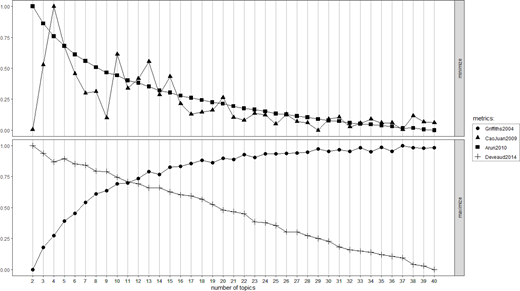
Topics are created by the LDA algorithm based on patterns of word co-occurrence in documents ( Appendix 5). LDA is an unsupervised machine-learning technique widely used for extracting latent themes from textual data. To ensure the validity and interpretability of the extracted topics, we combined computational results with human interpretation. Two independent researchers reviewed the top keywords and representative reviews from each topic and compared them with the literature and interview results to assign meaningful labels. Discrepancies were discussed and resolved through consensus, ensuring consistency and reducing potential bias in topic interpretation. Topic labels were finalized through an iterative process of triangulation: labels were cross-validated against both the qualitative interview findings and existing servicescape and authenticity literature, ensuring that each label was not only statistically grounded in the LDA output but also theoretically meaningful and consistent with patterns observed across the broader data set.
Study 2 – Findings and discussion
Topic modeling on user review data
The topics obtained from LDA and the top keywords for each topic are shown in Table 4. The frequency analysis indicates that all the topics were observed, with frequencies ranging from 6% to 14%. The three most commonly occurring topics are safe-disclosure environment, service provision and service realism. Conversely, the three least occurring topics are situational and cultural fit, soothing interaction and customer support.
LDA was used to extract numerous factors from a large set of reviews, often resulting in an extensive list. While researchers emphasize the importance of evaluating factor relevance based on data and methods, practitioners typically narrow this list due to resource constraints. To further assess factor impact, regression analysis is applied, commonly for prediction and trend analysis (Kumar et al., 2024) ( Appendix 6).
Dominance analysis
Dominance analysis is used to rank multiattribute alternatives by comparing predictors in pairs and scoring them based on relative performance (Kumar et al., 2024). A predictor with stronger performance across more comparisons is considered more influential. Unlike regression, which may be affected by correlated variables, dominance analysis effectively identifies key determinants of engagement. This method was adopted following prior research (Kumar et al., 2024).
Dominance analysis was conducted to determine the relative importance of authenticity factors to customer engagement valence. The model-adjusted coefficient of determination (adjusted R2) is 27.98%. Among the 11 factors examined, safe disclosure environment is found to have the highest impact, accounting for 24.1% of customer engagement, followed by functionality and service realism (Table 5). This indicates that customers value both symbolic alignment with the app and its ability to perform essential functions.
We compared the dominance of authenticity-related factors across different types of AI-powered service apps, following Huang and Rust’s (2021) typology of utilitarian–hedonic and transactional–relational services. In UR services (e.g. Amazon Alexa, Google Assistant, Hilton Honors, IKEA, Sephora), engagement is driven primarily by customer support (46.5%) and functionality (22%). This result reflects the role of AI as a mediator of online–offline transactions (e.g. booking, purchasing), where authenticity is judged based on responsiveness, reliability and task effectiveness rather than emotional or experiential cues.
In HT apps such as Pulse by Prudential and Vitality by AIA, engagement centers on safe disclosure environment (26%), functionality (21.4%) and recommendation precision (24.7%). While the importance of functionality aligns with the goal-oriented nature of these services, the strong dominance of safe disclosure suggests that engagement is not merely driven by performance. Because customers often confront sensitive or personal issues in health-related contexts, emotional safety and the ability to disclose vulnerabilities without judgment emerge as central to their engagement.
HR apps, such as Replika, Wysa, Neutrogena’s virtual dermatologist and StyleMyHair by L’Oréal, emphasize enjoyment, personalization and situational and cultural fit. Dominant factors include monetization strategy (20.7%), safe disclosure environment (18%) and soothing interactions (12.2%). While the prominence of emotional and soothing interactions is expected in relationship-oriented hedonic services, the salience of monetization is more surprising. This suggests that in emotionally intimate and long-term AI relationships, users often question whether commercial intentions are transparent and fair, making monetization itself a key stimulus for authenticity.
Correspondence analysis
In this study, correspondence analysis was used to examine how authenticity-related factors vary across engagement valence, from 1 (negative) to 5 (positive). Correspondence analysis is like principal component analysis, which explores relationships between categorical variables without assuming causality. This analysis helps AI-powered service app developers identify which authenticity factors should be focused on and improved.
We conducted a correspondence analysis to examine how authenticity factors relate to overall engagement valence. By projecting onto a two-dimensional plot, we visualized their associations. First, the chi-square test of independence indicated a statistically significant association between the two categorical variables, χ2 (40) = 3692.88, p < 0.001, thereby justifying the application of correspondence analysis for structural interpretation.
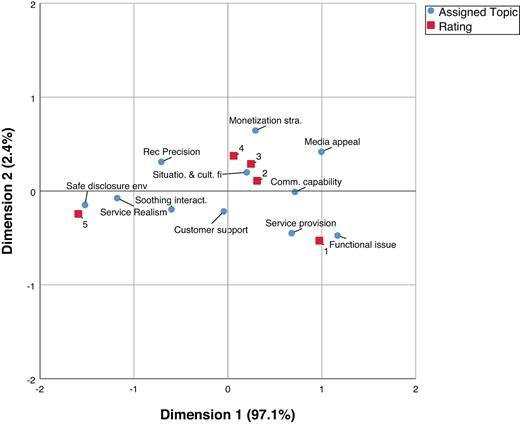
Following the chi-square test, the association structure was further examined in Euclidean space using a symmetrical normalization biplot (Figure 3). The total inertia of the solution was 0.547, indicating a meaningful degree of association between topic categories and user evaluations. Dimension 1 accounted for 97.1% of the total inertia, while Dimension 2 explained an additional 2.4%, resulting in a cumulative explained variance of 99.5%. The positions of categories in the figure reflect Euclidean distances between their coordinates on Dimensions 1 and 2. The closer the two points are in this Euclidean space, the stronger their association.
As shown in Figure 3, service realism, safe disclosure environment and soothing interactions are positioned closest to rating 5, indicating they are strongly associated with positive-valence engagement. Monetization strategy, and recommendation precision align with rating 4, suggesting these factors also contribute positively. In contrast, functionality is located near rating 1, identifying it as a key source of negative valence. Meanwhile, topics such as media appeal, situational and cultural fit and communicative ability are closer to lower mid-range ratings (2 and 3), suggesting mixed perceptions. Some users found these features engaging, whereas others described them as superficial or irrelevant.
Topic modeling identifies the latent structure of authenticity-related discourse, revealing how users naturally articulate their experiences with AI-powered service apps. Regression and dominance analyses then quantify the behavioral relevance of these themes by estimating their relative influence on engagement valence. Together, these methods triangulate qualitative meaning with quantitative impact, ensuring that the findings move beyond descriptive pattern identification to theory-driven explanation.
Discussion
In the following sections, we elaborate on each stimulus category, comparing our empirical findings with established service research to highlight the theoretical implications for AI-mediated service contexts.
Uncovering symbolic stimuli for authenticity perceptions
While commercialization and financial benefits have been widely mentioned in authenticity literature (Morhart et al., 2015; Moulard et al., 2020), existing studies have not explored specific monetization approaches in authenticity perception. In this research, we highlight the nuanced factors of monetization strategy, including the strategic implementation of forced advertising placements, the transparency of subscription-based plans and the nonintrusive integration of subscription prompts. For example, users may perceive an AI mental health app as inauthentic when forced to watch advertisements before accessing crisis support, viewing this as profit prioritization over genuine care.
While authenticity is related to the idea of fit and congruence, studies mainly focus on personalization (e.g. fit to personal routine) or humanoid design (e.g. congruent with human behavior) (Blut et al., 2021; Esmark Jones et al., 2022; Yang and Hu, 2021). We demonstrate that authentic AI service requires simultaneous consideration of context-aware features, demographic representation and lifestyle integration. For example, a language learning app may feel inauthentic to Vietnamese users if it only offers Western cultural references and lacks local dialect support, despite having sophisticated personalization algorithms.
Our finding extends current research focused on ethical and transparent AI (Shin, 2020). Moral commitment as a symbolic authenticity driver in AI service goes beyond just privacy disclosure but includes clear role boundary clarification between human and AI interactions and inclusive utility demonstration across diverse user groups. Role clarity signifies customers’ knowledge and understanding of what type of participant is expected (O’Connor et al., 2021). In this case, customer experience depends on whether the AI service app is overpromising about their role and responsibility (e.g. virtual assistant vs virtual doctor, a list of recommendations vs final diagnosis). In addition, inclusive utility leans toward the consideration of marginalized populations (Kumar et al., 2024), for example, those who are blind, deaf or vulnerable in the community. In this sense, emotional engagement emerges not just from entertaining or expressive content, but from how fairly and respectfully users feel treated, suggesting that perceptions of moral intention are central to trust and attachment in AI–human interactions. This study contributes to the current discussion about inclusive servicescapes. Aligning with Asokan-Ajitha and Sengupta (2025)’s work on interactions among customers and perceptions of inclusion, this study highlights that such perceptions can also be constituted in the context of service apps. Not only identity-affirming cues, culturally sensitive communication and openness to experience (Asokan-Ajitha and Sengupta, 2025), but also privacy disclosure, role clarity and consideration of marginalized populations can trigger feelings of inclusion, thus fostering belonging and psychological safety.
Finally, while our findings echo the current understanding of AI recommendation systems by elucidating the underlying mechanisms of recommendation precision as a symbolic authenticity cue in AI-powered services (Shin, 2020). We highlight the sophisticated interplay between advanced pattern recognition, consistent response uniformity across user interactions and the explanatory depth of AI-generated recommendations. For instance, Netflix’s “Because you watched…” feature transparently links recommendations to viewing history, while health apps should explain why certain nutritional suggestions align with user-logged meals and fitness goals. We find that contradictions between AI recommendations and customer beliefs threaten self-identity. AI apps should explain their decisions, helping customers connect inputs to outputs, reinforcing their sense of control and fostering positive symbolic engagement (van Berlo et al., 2023). This finding demonstrates that authentic AI service perception is enhanced when users understand the intention of the AI when it makes recommendations.
Harnessing natural stimuli for perceived authenticity
Natural stimuli in AI service app advance authenticity literature by showing how technology replicates humanlike service qualities. First, service realism extends previous works by demonstrating that AI apps foster authenticity through environmental design that alleviates negative emotions rather than traditional service quality metrics (Noor et al., 2022). While previous studies emphasized functional accuracy and competence as the primary driver of AI authenticity (Noor et al., 2022), our research demonstrates that atmospheric elements and contextual personalization create higher authenticity perceptions. While virtual environment is typically associated with immersive environments (van Berlo et al., 2023), service realism creates authenticity through pleasing atmosphere and logical interaction sequences that provide temporary escape from daily routines.
Second, unlike (Go and Sundar, 2019)’s emphasis on anthropomorphic design features, our research reveals that soothing interactions such as gentle communication tones achieve authenticity through linguistic empathy rather than visual humanlikeness, suggesting a more sophisticated approach to AI personality design. This symbolic resonance fosters engagement, where users experience meaning-making beyond the utilitarian value of the app (Alimamy and Nadeem, 2021).
While previous studies focused on privacy concerns as barriers to AI adoption (Blut et al., 2021; Kumar et al., 2024), our findings demonstrate that anonymity combined with professional representation facilitates greater openness than traditional human interactions. Further analysis also confirms the importance of safe disclosure environment by showing it as the most influential driver of engagement across the data set, emphasizing the role of natural stimuli in AI-powered service interactions, supporting the idea that customers could be true to themselves (van Berlo et al., 2023; Vo et al., 2025).
The findings of natural stimuli in this study resonate with Krisjanous et al.'s (2023) conceptualization of co-curated transformative places. In their framework, grounded in health-care servicescapes, the terrain of the service environment exists on a continuum from sanctum (protective, calming, privacy-enhancing) to surveillance (clinical, technology-driven, control-oriented) and transformative outcomes depend on agile co-curation of these resources between providers and users. Our findings suggest that a parallel continuum operates within AI-powered service apps: natural stimuli elements, such as guided conversation flow, gentle communication tones and the use of cartoonized virtual doctors, function as digital equivalents of sanctum-like terrain, fostering emotional safety and calm encouragement. In contrast, when these elements are absent or poorly designed, the app environment shifts toward surveillance, undermining trust and authentic engagement.
Physical and social stimuli as baseline requirements
While emphasizing symbolic and natural stimuli, our findings show that physical stimuli and social stimuli remain important baseline requirements. Physical stimuli include the functionality of the apps and media appeal, which signals the apps’ competence and reliability. Social stimuli relate to the human service team (e.g. customer support), brand service (e.g. service provision) and AI as an employee (e.g. communicative capability). Correspondence analysis reveals that when these fundamental elements fail, users experience negative engagement and frustration. When users perceive the app as trustworthy and stable, they are more likely to cognitively engage by investing mental effort to learn and integrate the app into their routines (Hollebeek and Chen, 2014). Once basic functionality is established, customers are more likely to stay within the environment, engaging physically and behaviorally with its features (Alimamy and Nadeem, 2021; Chi et al., 2020; Tran et al., 2021), at which symbolic and natural stimuli become the primary drivers of authentic experiences and sustained engagement. This finding extends Furrer et al.'s (2023) physical–social interplay logic from brick-and-mortar contexts into AI-powered service apps, where technical failures similarly trigger negative perceptions of the service’s social and relational qualities.
Theoretical implications
While previous studies advocate for a multistakeholder lens encompassing consumers, employees and communities (Espitia et al., 2025), our research extends this perspective by introducing the AI agent as an additional co-creator within the servicescape. In AI-powered health apps, the AI does not merely function as a technological interface but actively shapes the service environment through its communicative behavior, recommendation logic and emotional responsiveness, which operates as a digital service actor that co-curates the user experience. This added complexity also demands rethinking environmental dimensions. For example, natural dimensions in AI service apps could go beyond greenery and water elements (Espitia et al., 2025) but consider soothing interactions or safe disclosure environments.
Our research contributes to the AI-powered service apps literature by highlighting the role of authenticity in shaping customer engagement. While previous studies have identified authenticity as an antecedent of consumer brand engagement (Algharabat et al., 2018; Rosado-Pinto and Loureiro, 2020), they have not examined how customers construct authenticity perceptions in AI-mediated service environments or which specific servicescape stimuli drive these perceptions. This study addresses this gap by identifying symbolic and natural stimuli that shape authenticity perception of AI-powered branded app, in comparison with physical and social stimuli. We develop the integrated model of e-servicescape stimuli featuring four symbolic stimuli (monetization strategy, situational and cultural fit, moral commitment and recommendation precision), three natural stimuli (service realism, soothing interactions and safe disclosure environment), while maintaining the importance of physical and social stimuli. By contributing to the understanding of authenticity in service marketing, our approach aligns with the call from Kuppelwieser et al. ((2025), who note that service research has become increasingly focused on methodological sophistication at the expense of conceptual development.
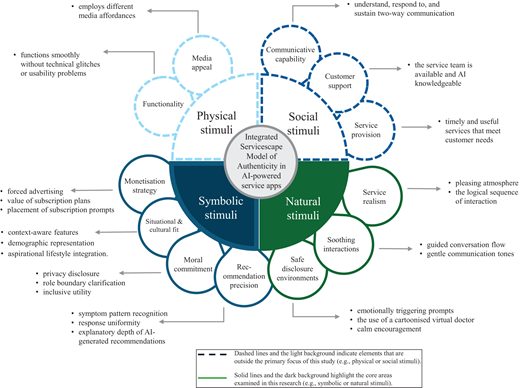
Using empirical findings from in-depth interviews and topic modeling, we introduce the integrated servicescape model of authenticity (Figure 4). Our work extends prior studies that have examined physical and social stimuli, which are easy to achieve but not sufficient to capture the needs of the customers (Esmark Jones et al., 2022; Vo et al., 2024; Wuenderlich and Paluch, 2017). Unlike studies focusing on surface-level design elements like gender, age and eye color (Esmark Jones et al., 2022; Wuenderlich and Paluch, 2017), this study directly responds to recent calls to move beyond the app’s interface design to focus on symbolic elements (Vo et al., 2025) as well as natural stimuli. In this sense, servicescape for AI-powered service applications is no longer spatially bound (Kim and Baker, 2022) but digitally mediated. This model extends Bitner’s (1992) servicescape framework into digital AI contexts, demonstrating that traditional stimuli such as physical and social cues play a different level of dominance when human agents are accompanied by artificial intelligence. By incorporating social-symbolic and natural stimuli, we extend Rosenbaum et al.’s (2011) framework by clarifying how these elements transform in AI-mediated environments.
In addition, we contribute to the emerging stream of human-centric service research (Holmqvist et al., 2026) that emphasizes services with humans as beneficiaries rather than focusing exclusively on technological capabilities. We demonstrate how AI service design can enhance customer experiences not through technological sophistication, but through careful attention to how symbolic and natural stimuli matter to human customers. Future work could examine how authenticity contributes to well-being outcomes and addresses societal challenges; for instance, whether authentic AI health services lead to better patient adherence and health outcomes, or whether authentic financial service AI reduces anxiety and improves financial decision-making.
Combining this model with our correspondence analysis, we advance understanding of customer engagement in the servicescape by showing that not all stimuli equally trigger positive engagement. For instance, while symbolic and natural stimuli such as safe disclosure environment, service realism and recommendation are often associated with high-engagement score, physical stimuli such as media appeal and functionality are related to negative ratings. For physical stimuli, the effects appear asymmetric: good functionality does not meaningfully elevate engagement, whereas poor functionality sharply reduces it, which aligns with hygiene factor logic. These findings challenge the assumption that humanlike features always enhance AI interactions (Esmark Jones et al., 2022; Vo et al., 2023) and highlight the need to consider authenticity as a relational and context-dependent construct. For this reason, researchers should conduct further empirical tests to differentiate the effect of various authenticity-related factors on levels of engagement valence, rather than treating engagement as a single, positive experience.
Our study empirically extends Huang and Rust (2021)AI service typology by categorizing the type of stimuli by app types (utilitarian–hedonic and transactional–relational services). Rather than rejecting the role of physical and social stimuli, we demonstrate that their dominance varies across contexts. Consistent with the framework from Espitia et al. (2025), our findings confirm that physical and social dimensions remain essential baseline requirements in AI-powered service apps. However, our model demonstrates that symbolic stimuli ultimately drive perceived authenticity and sustained engagement, aligning with Espitia et al.'s (2025) recognition that identity expression, inclusion and sense of belonging are critical yet underexplored servicescape dimensions. This finding also resonates with the touchpoints–contexts–qualities (TCQ) framework (De Keyser et al., 2020): in AI-powered services, specific servicescape stimuli (touchpoints) interact with app type (context) to shape authenticity perceptions (qualities), which in turn influence engagement valence. Future research should investigate the boundary conditions under which symbolic vs natural stimuli differentially influence authenticity perceptions, such as the relative importance of these stimuli varies by type of AI (e.g. service robots), customer characteristics (digital literacy, AI anxiety) or cultural context (individualism vs collectivism).
Practical implications
With over two million apps competing across major app stores and AI-assisted development tools like Claude Code dramatically lowering technical barriers to entry, almost every brand and services have their own apps. Thus, contrary to industry trends emphasizing advanced technical features, our research demonstrates that perceived authenticity matters more than sophisticated capabilities. Our findings suggest that the next frontier of competitive differentiation lies not in what AI can do, but in how authentically it does it – a dimension that cannot be easily replicated through code alone. Understanding and operationalizing AI authenticity is, therefore, critical for the fundamental viability of app adoption service satisfaction.
Developers must go beyond basic performance, designing experiences that are emotionally supportive, identity-consistent and socially intuitive. While previous studies emphasize growing demand for humanlike AI interactions (Esmark Jones et al., 2022), communicative capability ranks lowest among predictors, suggesting users do not prioritize advanced affordances like voice interaction or augmented reality. In detail, Table 6 provides actionable design guidance organized by stimulus type.
Developers of UR apps should maintain focus on functionality such as task completion speed, while maintaining the human customer support team. This means designing protocols in which complex requests transition smoothly to human specialists with full conversation history intact, rather than forcing users to restart their requests. Crucially, these apps should embrace transparent acknowledgment of AI limitations as a trust-building strategy; explicitly stating “This customization requires verification I cannot perform – let me connect you to our specialist” signals competence and honesty rather than failure.
For HT apps, recommendation precision and functionality should be prioritized together with a safe disclosure environment. This typology allows development teams to allocate resources more strategically based on their app’s primary function. Developers should move far beyond compliance-oriented privacy policies toward active, visible demonstrations by showing users what specific health metrics are being stored and how long they are retained. Recommendation precision in these sensitive contexts requires explainability interfaces that translate algorithmic reasoning into accessible language (Shin, 2020), such as “Based on your consistent daily steps and declining resting heart rate, increasing cardio intensity could optimize your health score.”
For HR apps, developers should prioritize designing a safe disclosure environment and genuine monetization strategies over functional efficiency. This represents a paradigm-shifting insight: in emotionally intimate, long-term AI relationships, users actively scrutinize whether business models align with or betray the relational value proposition, Traditional freemium models that restrict emotional features behind create fundamental authenticity violations by commodifying the very relational intimacy users seek.
Instead, developers should explore monetization approaches that users perceive as fair exchanges, such as framing subscriptions around sustainable service delivery or monetizing enhancement features like cosmetic customizations while keeping core emotional support freely accessible.
Conclusion
Our research demonstrates how AI-powered service apps transform the servicescape into an interactive, relational and identity-oriented environment where symbolic stimuli and natural stimuli operate simultaneously. This study extends the SOR framework by integrating perspectives on symbolic consumption and the sense of fascination, showing that AI servicescape stimuli are interpreted through identity-based meaning-making processes (Ballantyne and Nilsson, 2017; Rosenbaum et al., 2011). Practically, our findings show that physical stimuli function as hygiene factors (preventing dissatisfaction). In contrast, symbolic and natural stimuli actively drive positive engagement, offering service managers actionable guidance for designing authentic AI experiences.
The authors would like to appreciate the constructive feedback from colleagues and reviewers, which helped improve the quality of this manuscript.
Funding
This research received no external funding.
References
Further reading
Appendix 1
Appendix 2. Coding procedures
Appendix 3
Appendix 4
Appendix 5. Topic modeling on user review data
Our data consisted of 11,400 customer reviews from 11 apps that contained authenticity keywords and were posted from 2012 to 2022. Topics are created by the LDA algorithm based on patterns of word co-occurrence in documents. LDA is an unsupervised machine-learning technique widely used for extracting latent themes from textual data.
In exploratory research, selecting the appropriate number of topics presents a key challenge, as it must be specified in advance and significantly impacts the quality and clarity of the results. To overcome the challenge of finding the optimal number of topics, researchers determine the optimal number of topics (k) by evaluating Arun’s (2010) and Griffiths’ (2004) metrics (minimized) and Cao Juan’s (2009) and Deveaud’s (2014) metrics (maximized) (Figure A1).
For the analysis, we evaluated both metric values and topic interpretability to determine the optimal number of topics. Metrics suggested 9–15 topics, but k = 10, 13 and 15 were excluded due to high Cao Juan values. Overlapping topics in k = 12 and 14 reduced distinctiveness, so k = 11 was chosen to best summarize authenticity dimensions.
Appendix 6
The regression analysis suggests that all the authenticity factors exhibit statistical significance on engagement at a 95% confidence interval. Prior research has used ordinary least squares (OLS) regression on review data to develop models predicting customer responses (Kumar et al., 2024; Luo et al., 2020).
In our study, all the variance inflation factors (VIF) values ranged from 1.1 to 2.5, thus, the issue of multicollinearity was effectively managed as it remained below the acceptable limit of 5 (Kumar et al., 2024). The regression model is statistically significant (F = 403.6, p = 0.000). All 11 determinants obtained from LDA analysis are statistically significant at a 5% significance level (Table A2).